𝗙𝗨𝗟𝗟 𝗦𝗧𝗢𝗥𝗬 The Officer Looked at My Lexus, Looked at Me, and Decided One of Us Didn’t Belong There
𝗙𝗨𝗟𝗟 𝗦𝗧𝗢𝗥𝗬
His clippers stopped.
He looked at me through the mirror.
“You really a lawyer?”
“Consultant.”
“That wasn’t my question.”
I smiled.
“No. It wasn’t.”
He studied me for another second.
Then he resumed cutting.
“People here know who to watch out for.”
“Who?”
He hesitated.
“Swanson.”
That was the first time I heard Derek’s name outside a complaint file.
It would not be the last.
At Grace Baptist Church, I met a seventy-year-old deacon named Samuel Price.
He described being pulled from his car at a red light.
“I asked why they stopped me,” he said.
We were sitting near the back of the sanctuary beneath stained-glass windows that turned the morning light blue and gold.
“What did they say?”
“That I was agitated.”
“Were you?”
“I became agitated after they pulled me out of my car.”
He gave me a tired smile.
“I suppose they considered that proof.”
I asked whether he had filed a complaint.
He nodded.
“What happened?”
“Chief sent me a letter.”
“Result?”
“Unsubstantiated.”
“Did anyone interview the people who saw it?”
“Not that I know of.”
He folded his hands.
“My wife wanted me to forget about it.”
“Did you?”
His eyes moved toward the pulpit.
“No.”
But there was a difference, I learned, between not forgetting something and believing anyone would ever care.
Over the next two weeks, I listened more than I spoke.
I met shopkeepers.
Teachers.
Nurses.
Retirees.
Parents.
College students.
Some had filed complaints.
Others never bothered.
Their stories were not identical, which made them more convincing.
Real patterns rarely look copied.
They rhyme.
The same officers appeared.
The same locations.
The same explanations.
The same escalation whenever a citizen asked a question the wrong officer considered disrespectful.
I drove everywhere.
My black Lexus SUV became part of the work.
I drove through predominantly Black neighborhoods.
Then through white neighborhoods.
I noted patrol cars.
Traffic stops.
Where officers lingered.
Where they didn’t.
I parked near busy intersections and watched.
The dash camera remained on whenever I drove.
I also spent hours observing the police station from public areas.
Shift changes.
Patrol patterns.
Personnel.
Eventually two names emerged more often than any others.
Derek Swanson.
Thirty-one.
Six complaints in four years.
Four involving Black residents.
Known for aggressive stops.
Quick temper.
Liked being challenged even less than most insecure men with authority.
The second was Travis Collier.
Twenty-eight.
Fewer complaints.
But Travis appeared repeatedly beside Derek.
Never the one leading.
Almost never the one objecting.
There are people who do harm because they enjoy power.
There are others who do harm because standing beside power feels safer than standing against it.
The result for the person being hurt can be exactly the same.
Above them sat Chief Wade Garrison.
Eighteen years as chief.
Every complaint ended on his desk.
Every complaint disappeared there.
By the end of my second week, I had enough evidence to know Belmont had a serious problem.
I did not yet have enough to prove exactly how deep it went.
I called Eleanor on Wednesday evening.
“I need three more days.”
“You were given three weeks.”
“I know.”
“What are you missing?”
“Body-camera footage from two specific officers. I have dispatch discrepancies and witness accounts, but I want the video before I move.”
“Swanson?”
I smiled slightly.
“You read my notes.”
“I always read your notes.”
“And Collier.”
A pause.
“You think they’re central?”
“I think Swanson is a symptom. Garrison may be the disease.”
“Three days.”
“Thank you.”
“Olivia.”
“Yes?”
“Be careful.”
I looked through the kitchen window.
The street outside was silent.
A porch light glowed across the road.
Somewhere in Belmont, Derek Swanson was probably finishing a shift without the slightest awareness that a federal file containing his name was open on my table.
“I will.”
The morning we met began with coffee.
That is still one of the strangest parts to me.
Big moments rarely announce themselves.
There was no thunderstorm.
No warning.
No sense that my life was about to divide itself into before and after.
It was 7:15 on a Tuesday morning.
Warm already.
Belmont was waking up around me.
Sullivan’s Coffee House was busy with commuters.
A retired couple shared a newspaper outside.
A mother loaded groceries into a minivan.
People came and went carrying paper cups and breakfast sandwiches.
I had been working late the previous night and wanted caffeine before reviewing dispatch records.
I wore a gray blazer, white blouse, dark slacks and low heels.
Nothing about me was undercover in the dramatic sense.
I looked like exactly what I had told Belmont I was.
A professional woman going to work.
I ordered a latte and a blueberry muffin.
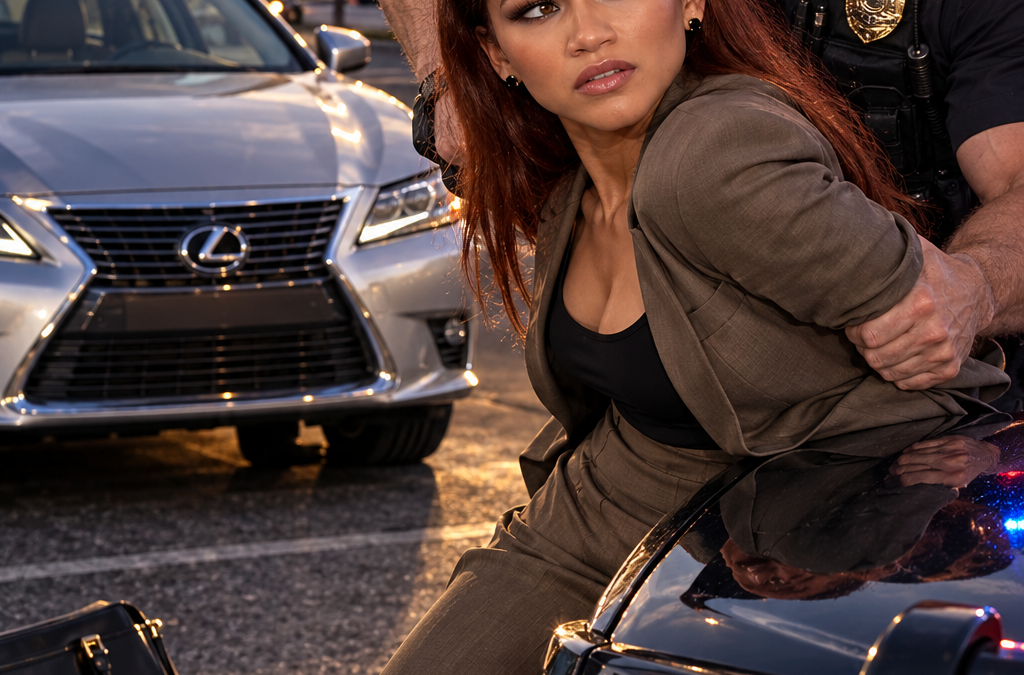
Then I walked toward my Lexus, parked three rows from the entrance.
I pressed the key fob.
The headlights flashed.
The locks clicked.
I set my coffee on the roof, opened the trunk and put the muffin beside my black leather briefcase.
Inside that case were my DOJ credentials.
The sealed federal order.
Two weeks of notes.
Names.
Statements.
Records.
Evidence.
I closed the trunk.
Reached for my coffee.
Then heard a man behind me.
“Put it down.”
I turned.
Two uniformed officers were approaching.
Derek Swanson was in front.
I recognized him instantly.
Travis Collier followed several feet behind.
Derek’s right hand rested near his belt.
“Hands up where I can see them.”
For a fraction of a second, I thought maybe something serious had happened nearby.
A robbery.
A fleeing suspect.
Some legitimate reason two officers were moving toward me that way.
Then I saw Derek’s face.
Not alert.
Not uncertain.
Certain.
That was worse.
My hand loosened.
The coffee slipped.
The cup hit the pavement and burst open.
Brown liquid spread across the concrete.
“Whose car did you steal?”
The question hit me harder than I expected.
Not because I had never heard language like it.
I had read versions of it in hundreds of complaints.
But ink protects you from tone.
Paper cannot recreate contempt.
“This is my car.”
He looked at the Lexus.
Then at me.
He laughed.
“Your car?”
“Yes.”
“Sure it is.”
Travis said nothing.
I lowered my hands slightly.
Derek stepped closer.
“Keep them up.”
“My keys are right there.”
I indicated them carefully.
“Check them. Check the registration.”
He snatched the key fob from my hand.
For one second, I thought reason had entered the conversation.
Then he threw the keys onto the pavement.
They bounced beneath the Lexus.
“You don’t tell me how to do my job.”
People were watching now.
I could feel it before I looked.
The woman at the minivan had stopped loading groceries.
An elderly man had lowered his newspaper.
A man in a business suit stood ten feet away.
A teenager inside a parked car lifted her phone.
I heard myself say, “Officer, the vehicle is registered to me.”
Derek moved closer.
“Shut up.”
My pulse changed.
Not faster exactly.
Harder.
Each heartbeat became distinct.
I had spent years teaching myself what to do in volatile situations.
Observe.
Remember.
Do not give anyone an excuse to rewrite what happened later.
But knowing what to do professionally did not make the moment less human.
I was still a woman standing in a parking lot while a stranger with a badge looked at me as if I were filthy.
I was still being humiliated in front of people.
I was still angry.
I also knew something Derek did not.
Three cameras were recording him.
My dash cam.
His body camera.
The parking lot security camera.
If I showed my DOJ credentials immediately, the encounter would end.
And later, perhaps, the report would say he had made a mistake.
An awkward misunderstanding.
A brief investigative detention.
Nothing more.
I thought about Patricia Coleman, the nurse detained for forty minutes beside a road because of a taillight witnesses said was working.
I thought about Andre Wells, stopped while jogging.
I thought about Deacon Price being pulled from his car.
They had not been able to reach into a briefcase and make their mistreatment stop.
So I did not.
Not yet.
Travis moved behind me.
I turned my head slightly.
“What are you doing?”
“Hands behind your back.”
“There is no basis to arrest me.”
Derek’s voice sharpened.
“You want to resist?”
“No.”
“Then shut your mouth.”
Travis grabbed my right wrist.
He pulled it back.
Then my left.
The handcuffs closed.
Too tight.
The steel pressed immediately into bone.
“Those are too tight.”
Neither man answered.
“Officer Collier, the cuffs are too tight.”
Derek grabbed the back of my blazer.
Then he pushed.
My cheek struck the hood of the patrol car.
The metal had been sitting in the Georgia sun.
Heat burned against my skin.
For a moment, I smelled nothing but dust, warm paint and engine oil.
My jaw clenched.
My eyes filled.
I hated that.
I hated that my body could betray how much the moment hurt when I was trying so hard not to give him anything.
Then Derek bent close enough that I could hear his breathing.
“World would be better without people like you.”
Something inside me became completely still.
Not numb.
Still.
I turned my eyes toward his chest.
SWANSON.
Then toward Travis.
COLLIER.
I fixed both names in my mind even though I already knew them.
Around us, no one spoke.
I saw a mother pull her daughter closer.
The little girl stared at me.
Confused.
That look hurt more than the handcuffs.
Children notice injustice before they learn the words adults use to explain it away.
Derek keyed his radio.
“Dispatch, Unit Seven. I’ve got a possible 10-35 at Sullivan’s lot on Fifth. Black female, mid-thirties, suspicious activity around a late-model Lexus. Requesting a tow.”
The dispatcher answered.
“Unit Seven, confirm registration?”
Derek hesitated.
“Negative. Suspect is uncooperative. Bringing her in.”
Uncooperative.
The word almost broke my composure.
I had offered him my keys.
I had offered registration.
I had stood still.
I had allowed myself to be handcuffed.
And now, inside the official record, I was becoming uncooperative.
That was how it happened.
Not later.
Not when someone typed the report.
Right there.
Reality was being rewritten while I was still standing inside it.
Travis opened the rear door of the cruiser.
He guided me toward it.
The plastic seat was hard.
My hands remained cuffed behind me.
No one fastened my seat belt.
The door slammed.
Through the window, I watched Derek approach my Lexus.
He glanced beneath the tire where my keys had landed.
Then walked away.
He climbed behind the wheel.
Travis got in beside him.
Neither apologized.
Neither checked the registration.
The patrol car pulled out.
I watched Sullivan’s disappear behind us.
My cheek burned.
My wrists throbbed.
Each turn made the cuffs bite deeper.
From the back seat, Belmont looked different.
We passed the Third Street barbershop.
I remembered Leon saying people knew who to watch out for.
We passed Grace Baptist.
I remembered Deacon Price sitting beneath stained glass.
I had entered Belmont as an investigator.
Now I was traveling through it as one more Black citizen in the back of a police car.
That realization was not intellectually surprising.
Emotionally, it hollowed me out.
Derek glanced in the mirror.
He smirked.
Travis stared through the windshield.
His knee bounced.
I watched him.
Men like Derek were easy to identify once they revealed themselves.
Men like Travis disturbed me differently.
Because if he knew something was wrong, his silence had become part of what was happening.
Three minutes later, we entered the police department lot.
Derek pulled me from the cruiser by the elbow.
Inside, fluorescent lights hummed over six desks.
The room smelled like burnt coffee.
Two officers looked up.
Derek grinned.
“Caught one trying to boost a Lexus at Sullivan’s. Broad daylight.”
One officer raised his eyebrows.
Another looked at my clothes and then quickly back at his monitor.
No one asked whether the Lexus had been reported stolen.
No one asked whether Derek had confirmed ownership.
No one asked why the woman he was calling a car thief was dressed for an office and remained so calm.
Then I noticed a sergeant near the filing cabinets.
Nina Caldwell.
I recognized her from personnel records.
Forty-two.
Eleven years with the department.
Few complaints.
Passed over twice for promotion.
She looked at me for several seconds.
Then she turned to Derek.
“You sure about this?”
He waved her off.
“She was all over a Lexus.”
“All over it how?”
“Trying to get into it.”
I said, “I unlocked it.”
Derek pointed at me.
“You’re done talking.”
Nina’s eyes narrowed.
“Did you confirm registration?”
“Working on it.”
“She’s already in cuffs.”
Derek turned.
“What’s your point?”
Nina did not answer.
She reached into her pocket, removed a small leather notebook and wrote something.
I remembered that.
Date.
Time.
Names.
Then Derek marched me down the hallway into an interrogation room.
Gray walls.
Metal table.
Three chairs.
A fluorescent tube buzzing overhead.
He sat across from me.
Travis remained near the doorway.
Derek leaned back.
“Name.”
“Olivia Hayes.”
“Occupation.”
“Legal consultant.”
He smiled.
“Legal consultant.”
“Yes.”
“Office?”
“I work independently.”
“How long have you been in Belmont?”
“Two weeks.”
“And in two weeks you decided you deserved a Lexus?”
I looked at him.
“The car belongs to me.”
“Registration can be forged.”
“Have you looked at it?”
Travis shifted.
That movement told me something.
“You retrieved the registration,” I said to him.
Derek turned sharply.
Travis said nothing.
“What did it say?”
Silence.
“Officer Collier?”
Travis looked toward Derek.
Then down.
Derek leaned forward.
“Don’t play games with us.”
“The registration matches my name, doesn’t it?”
He slapped his palm against the table.
“I decide what matters here.”
My wrists hurt badly now.
“Then run my name.”
“I’ll run what I want, when I want.”
His face was flushed.
“You don’t tell me how to investigate.”
I sat back.
“Fine.”
That unsettled him.
He wanted fear.
Or anger.
He wanted something that would let him feel powerful again.
Instead, I waited.
Finally, Derek stood.
“Run her through NCIC.”
Travis went into the hallway.
I could not see the computer screen from the interrogation room, but I could see him.
He entered my information.
Then waited.
At first, nothing changed.
Then his fingers stopped moving.
His face lost color.
He leaned closer to the monitor.
Read.
Read again.
Derek noticed.
“What?”
Travis didn’t respond.
“What is it?”
“You need to see this.”
Derek walked toward him.
He bent over the screen.
I watched his expression.
Confusion first.
Then disbelief.
Then something I had seen many times across courtroom tables.
Fear.
“What the hell?”
Travis whispered, “I ran it twice.”
“Run it again.”
He did.
My federal credentials remained on the screen.
United States Department of Justice.
Civil Rights Division.
Senior attorney.
Active federal investigation.
Belmont Police Department.
Derek turned slowly toward the interrogation room.
Our eyes met.
For the first time that morning, he looked at me as a person whose words mattered.
I hated that more than I expected.
He had not discovered that I deserved dignity.
He had discovered that mistreating me might have consequences for him.
Those are not the same realization.
He returned to the room.
Travis followed.
Derek opened his mouth.
“You’re…”
“I’m a senior attorney with the United States Department of Justice Civil Rights Division.”
Neither man spoke.
“I have been in Belmont for two weeks investigating this department.”
Travis stepped backward.
Derek stared at me.
I raised my cuffed hands as far as I could.
“You may want to remove these.”
His fingers shook while he reached for the key.
He fumbled once.
Then unlocked the cuffs.
When I brought my hands forward, dark red lines circled both wrists.
The skin was swollen in places.
I rubbed one mark with my thumb.
Derek looked away.
Nina stood in the doorway.
Her expression did not change much.
But she nodded once.
A small motion.
Almost imperceptible.
As if something she had waited years to see had finally arrived.
I stood.
Straightened my blazer.
Then looked at Derek.
“I need your body-camera footage from this morning.”
His face tightened.
“I need the dispatch recording for Unit Seven.”
Silence.
“And I need a phone.”
Nina stepped forward.
“I’ll get you one.”
She walked me back into the bullpen.
Every officer knew by then.
No one looked directly at me for long.
Nina handed me a desk phone.
I dialed Eleanor from memory.
She answered on the second ring.
“Olivia?”
“It’s me.”
Something in my voice changed hers immediately.
“What happened?”
“I’ve been detained by two Belmont officers.”
Silence.
Then, very carefully, “Explain.”
“Derek Swanson and Travis Collier approached me in the Sullivan’s Coffee House parking lot at approximately 7:20 this morning. Swanson accused me of stealing my Lexus. They refused to verify ownership before placing me in handcuffs.”
“Were you searched?”
“Yes.”
“Transported?”
“Yes.”
“Use of force?”
“My face was pushed against the patrol hood. Cuffs were overtightened.”
I looked at the red marks.
“And Swanson made discriminatory statements before and during the detention.”
“Are you hurt?”
“Nothing requiring a hospital.”
“Are you still inside the station?”
“Yes.”
“Do they know who you are?”
“They ran my credentials.”
A different kind of silence followed.
Then Eleanor said, “Do not leave.”
“I wasn’t planning to.”
“I’m sending a team.”
“How many?”
“Six agents initially. Seizure authority for internal records, body cameras, dispatch logs and personnel files. Forty-eight hours.”
I glanced across the bullpen.
Derek stood near a water cooler staring at the floor.
Travis sat with his hands pressed against his forehead.
“Understood.”
“Olivia.”
“Yes?”
“This is priority one now.”
“I know.”
I hung up.
The entire room was quiet.
Twenty minutes later, Chief Wade Garrison arrived.
I heard his truck before I saw him.
He came through the front door adjusting his tie.
He scanned the bullpen.
Derek near the wall.
Travis at a desk.
Nina beside the filing cabinets.
Me sitting calmly with both hands visible on the desk.
“What the hell happened?”
Nina answered.
“Chief, close the door.”
Garrison looked at her.
Then at me.
He closed it.
His expression changed immediately.
His shoulders relaxed.
His voice softened.
He put on the face of a man who had spent eighteen years learning how to make institutional failure sound like a misunderstanding.
“Ms. Hayes, whatever happened this morning, I assure you—”
“Chief Garrison.”
He stopped.
“There is no misunderstanding.”
He glanced at Derek.
I continued.
“There are twenty-six formal civil-rights complaints against officers in this department over the last three years.”
His jaw moved.
“All twenty-six were marked unsubstantiated.”
He said nothing.
“All twenty-six carry your approval.”
“That doesn’t mean—”
“And now there is video.”
His face changed.
Only slightly.
But I saw it.
People who survive through controlling paperwork fear cameras because cameras do not care who signs the report.
“Ms. Hayes—”
“Senior Attorney Hayes.”
He swallowed.
“For two weeks, I have been collecting evidence concerning discriminatory enforcement practices, unlawful detentions and the suppression of citizen complaints in this department.”
Garrison looked around as though another version of the morning might be hiding somewhere in the room.
There wasn’t one.
“You were investigating us?”
“Yes.”
“And you didn’t notify me?”
“No.”
“You can’t just—”
“I can.”
He stopped.
“The federal order authorizing the investigation is in the trunk of the vehicle Officer Swanson accused me of stealing.”
No one said anything after that.
Forty-eight hours later, three black federal SUVs pulled into the Belmont police lot.
I stood outside waiting.
The same entrance Derek had dragged me through was behind me.
I wore a navy blazer and my DOJ credentials openly around my neck.
Special Agent Paul Bennett stepped from the first vehicle.
Five investigators followed carrying evidence boxes and sealed orders.
Paul looked at my wrists.
The bruising had darkened.
“That from Swanson?”
“Yes.”
His mouth tightened.
“You okay?”
“I’m working.”
“That wasn’t my question.”
“I know.”
I met his eyes.
“I’m okay enough.”
He nodded.
Then we went inside.
Paul handed Chief Garrison the seizure order.
Garrison read it slowly.
“This is everything.”
“Correct,” Paul said.
“Personnel records?”
“Yes.”
“Internal affairs?”
“Yes.”
“Body-camera server?”
“Yes.”
“Dispatch?”
“Yes.”
“How far back?”
“Five years.”
Garrison looked at me.
I gave him nothing.
He set the order down.
The federal team went to work.
Two investigators mirrored the body-camera server.
Two entered the records room.
Paul and I took the conference room.
We began with Derek’s body camera.
I had lived the encounter once.
Watching it was different.
On video, I could see what I had not been able to see from inside my own body.
Derek and Travis sitting in their cruiser before approaching me.
Derek looking through the windshield.
His voice came through the speaker.
“Look at that.”
Travis said something too low to hear.
Derek leaned forward.
“No way that’s her ride.”
I stopped the video.
Paul looked at me.
“Play it again.”
We did.
No way that’s her ride.
Before speaking to me.
Before checking a plate.
Before asking a question.
He had already reached his conclusion.
I pressed play.
We watched him order me to raise my hands.
He accused me of theft.
He threw my keys.
Then came the sentence.
“Trash like you shouldn’t even breathe near this lot.”
Hearing it again turned my stomach.
On the body camera, my own face remained mostly outside the frame.
I had almost forgotten that.
An officer’s body camera often records the person being confronted better than the officer himself.
But there was enough.
My voice.
My compliance.
My repeated offer to verify ownership.
Then the handcuffs.
Then the hood.
Then Derek’s voice close to the microphone.
“World would be better without people like you.”
Paul paused the footage.
His face had gone hard.
“You want a minute?”
“No.”
“Olivia.”
“I said no.”
He watched me for a moment.
Then continued.
The Sullivan’s security footage showed the scene from above.
That view disturbed me in a different way.
From a distance, there was no possible justification.
I walked to my car.
Unlocked it.
Opened the trunk.
Used the vehicle exactly as an owner would.
The cruiser entered.
The officers approached.
Everything that followed had originated not from suspicious conduct but from what Derek believed when he looked at me beside a Lexus.
Then we reviewed my dash camera.
It captured less visually but more emotionally.
The sound of my coffee hitting pavement.
The keys striking asphalt.
The handcuffs closing.
My body hitting metal.
Then silence.
After the cruiser left, the camera kept recording.
For six hours, my keys lay beneath the tire.
The coffee stain dried.
People walked past.
Cars came and went.
The ordinary world continued.
That footage affected me more than the arrest.
I sat watching the empty parking space where I had been taken away, thinking about how many lives had been interrupted in exactly that manner while everything around them simply continued.
That afternoon, federal investigators began interviewing witnesses.
A seventeen-year-old girl named Samantha Briggs came in with her mother.
She had filmed the incident through her car window.
Her hands shook even while describing it.
“I thought he was going to hurt you worse,” she said.
“You kept filming?”
She nodded.
“I was scared they’d see me.”
“Why didn’t you stop?”
Her eyes filled.
“Because if I didn’t, I thought they could say it never happened.”
I had heard that reasoning from seasoned investigators.
Hearing it from a seventeen-year-old made my throat tighten.
“Thank you,” I said.
Angela Torres, the woman with the little girl, gave a statement next.
“My daughter asked why they were hurting you.”
She pressed both hands around a paper cup.
“What did you tell her?” I asked.
“Nothing.”
Her voice cracked.
“I couldn’t think of anything that wouldn’t be a lie.”
I looked down.
She continued.
“I wanted to do something. I wanted to yell at him. But my daughter was there.”
“You don’t need to explain.”
“I do.”
“No, you don’t.”
She looked at me.
“I hated myself afterward.”
“Don’t.”
Her eyes reddened.
“You were protecting your child.”
“But everybody protecting themselves is how people like him keep doing it.”
I had no easy answer.
That was the hardest thing about civil-rights work.
People wanted the law to produce clean moral lessons.
Real fear was rarely clean.
An elderly witness named Howard Greer told us he had seen Derek stop Black residents in the same parking lot three times in the previous year.
“Did you report those incidents?”
“No.”
“Why?”
He stared at the table.
“Who was I supposed to report them to?”
That question followed me for the rest of the investigation.
Who was I supposed to report them to?
A complaint system means nothing when the person receiving the complaint is committed to protecting the conduct being challenged.
By Wednesday evening, Samantha’s video had reached social media.
By the following morning, millions had seen it.
News vans arrived.
Cable networks ran the footage.
People began gathering outside the department.
Their signs said things I had heard residents say privately for two weeks.
WE TOLD YOU.
WHO DO THEY PROTECT?
LISTEN TO US.
The attention mattered.
But I knew attention could also distort a case.
I did not want Belmont’s investigation reduced to the fact that a DOJ attorney had been mistreated.
The real case was the twenty-six people who had not possessed federal credentials.
So we returned to the files.
Patricia Coleman.
A nurse.
Stopped for a broken taillight.
Witness photographs taken afterward showed both lights functioning.
Derek detained her for forty minutes while her vehicle was searched.
Nothing illegal was found.
Complaint filed.
Unsubstantiated.
Chief Garrison’s signature.
Andre Wells.
College student.
Stopped while jogging.
Derek claimed he matched a burglary suspect.
Dispatch records showed no burglary call in the relevant area that day.
Complaint filed.
Unsubstantiated.
Garrison’s signature.
Another man stopped while leaving work.
Another woman questioned outside her own home.
Again.
Again.
Again.
The complaints did not prove every allegation automatically.
But when matched with dispatch records, body cameras, timestamps and witness statements, a structure became visible.
Then Nina Caldwell entered our conference room carrying the small leather notebook I had seen on the morning of my arrest.
She closed the door.
“I want to make a statement.”
Paul gestured to the chair.
She sat.
Placed the notebook between us.
“What is it?” I asked.
“Three years.”
She opened it.
Dates.
Times.
Officers.
Vehicle numbers.
Citizen names when she knew them.
Stops.
Arguments.
Complaints.
Rumors.
Internal incidents.
“Why did you keep this?”
Her eyes met mine.
“Because the department didn’t.”
For the next two hours, Nina described Belmont from the inside.
Derek was not an aberration.
He was rewarded for aggressiveness.
Officers who made large numbers of stops were praised.
Questions about racial patterns were dismissed as political.
When Nina challenged discrepancies between use-of-force reports and witness statements, Garrison told her she needed to “trust her brothers.”
She had been passed over for promotion twice.
“I filed concerns through official channels in 2022,” she said.
“What happened?”
“Nothing.”
“Nothing?”
“They disappeared.”
“Did you retain copies?”
“No. I was stupid.”
“You weren’t stupid.”
“I trusted the process.”
She looked down at the notebook.
“Then I stopped.”
Paul leaned forward.
“Why not go outside the department?”
“To whom?”
There it was again.
The same question.
Nina exhaled.
“City council thought Garrison walked on water. Internal affairs answered to him. State investigators weren’t interested without more proof. I had a mortgage. A daughter. Eleven years invested here.”
Her eyes shifted toward me.
“You can call that cowardice.”
“I won’t.”
“I watched things I should have challenged more aggressively.”
“That’s different from pretending they didn’t happen.”
She touched the notebook.
“I kept waiting for somebody to come.”
“I did.”
A sad smile appeared.
“Yeah.”
She looked at the bruises around my wrists.
“You sure did.”
The next morning, we interviewed Derek.
Same interrogation room.
Same fluorescent buzz.
Different chairs.
He sat where I had sat.
His union lawyer sat beside him.
Paul and I faced them.
I placed the evidence on the table one piece at a time.
Body-camera transcript.
Security images.
Dispatch recording.
Witness statements.
Vehicle registration.
Personnel complaints.
Derek looked older than he had three days earlier.
Power can change a face quickly when it disappears.
“Officer Swanson,” I said, “why did you enter Sullivan’s parking lot that morning?”
His lawyer whispered something.
Derek answered.
“I observed suspicious behavior.”
“What behavior?”
“A person near a high-value vehicle.”
“Near it?”
“Yes.”
“Did you see me unlock it?”
“I don’t recall.”
I slid a still image toward him.
“The headlights are illuminated. Your body camera recorded the unlock signal.”
No answer.
“You also said, while still inside your cruiser, ‘No way that’s her ride.’”
His jaw tightened.
“That was casual conversation.”
“It occurred before any investigation.”
Silence.
“What specifically about me caused you to believe I could not own that vehicle?”
His attorney interrupted.
“My client has answered.”
“No,” I said. “He hasn’t.”
Derek looked at me.
“You were acting suspicious.”
“How?”
“You were nervous.”
“I became nervous after two armed officers accused me of stealing my own car.”
“You were defensive.”
“I offered you the keys.”
Nothing.
“The registration matched my identity.”
“I had concerns it might be fraudulent.”
“What evidence supported those concerns?”
No answer.
I opened another folder.
“Six complaints in four years.”
His lawyer shifted.
“Four involving Black citizens performing ordinary activities. Driving. Jogging. Shopping. Parking.”
Derek’s hands clenched.
“All dismissed.”
“Yes.”
He finally looked directly at me.
“So what?”
There it was.
Not remorse.
Not confusion.
Defiance.
I leaned closer.
“Exactly.”
He blinked.
“That is why we are here.”
His lawyer requested a break.
We granted it.
Travis was interviewed separately.
He lasted less than twenty minutes before the story changed.
“Derek made the call.”
“You put the cuffs on me,” I said.
“He told me to.”
“You knew the registration matched.”
Travis looked down.
“Yes.”
“You knew I had the key.”
“Yes.”
“You knew there was no stolen-vehicle confirmation.”
“Yes.”
“Then why did you handcuff me?”
His fingers trembled.
“Because Derek was senior.”
“That is not an answer.”
“It’s how things work here.”
I waited.
He swallowed.
“You don’t contradict him in front of people.”
“Why?”
“You just don’t.”
“What happens if you do?”
“You get frozen out. Bad shifts. No backup. Complaints from other officers. Everybody knows.”
“So when you believed something was wrong, you participated because refusing would have made your job uncomfortable.”
He winced.
“When you say it like that—”
“How should I say it?”
He had no response.
Chief Garrison arrived with a personal attorney and a prepared statement.
He read three paragraphs describing his eighteen years of service, his respect for Belmont and his confidence that the encounter involving me was an isolated error by two officers.
When he finished, I opened a cardboard evidence box.
I removed the twenty-six complaints.
Placed them across the table.
One after another.
Patricia.
Andre.
Samuel.
Twenty-three others.
“This is your isolated incident, Chief.”
Garrison stared at them.
“Those cases were investigated.”
“By whom?”
“My department.”
“Under whose authority?”
“Mine.”
“Who approved the findings?”
“My command staff.”
I pushed one file toward him.
His signature filled the bottom.
“Yours.”
He said nothing.
Another file.
“Yours.”
Another.
“Yours.”
I placed my hands flat on the table.
“The language changes slightly, but the result never does.”
“My officers were doing difficult work.”
“Your officers arrested me for unlocking my own vehicle.”
“That was a mistake.”
“No.”
My voice remained calm.
“That was evidence.”
His attorney touched his arm.
Garrison leaned back.
I continued.
“A mistake is entering the wrong date on a form. A mistake is misreading an address. Officer Swanson looked at a Black woman beside a Lexus and decided the car could not belong to her before he ever spoke to her.”
Garrison said nothing.
“He had complaints warning you about similar conduct.”
Silence.
“You dismissed them.”
His attorney said, “We’re done.”
I looked at Garrison.
“When an officer abuses authority and leadership repeatedly refuses to see it, the problem is no longer one officer.”
Garrison’s face hardened.
I gathered the complaints.
“It becomes the institution.”
Three weeks after my arrest, Belmont Town Hall was full before the federal hearing began.
People stood against walls.
Others crowded into the hallway.
Reporters filled the front rows.
Camera crews set up near the rear.
I sat beside Paul Bennett and two Civil Rights Division attorneys.
Across from us sat Derek with his union lawyer.
Travis with counsel.
Wade Garrison with his attorney.
Behind them were residents whose names I had known first as paper files.
Patricia Coleman.
Andre Wells.
Deacon Price.
Angela Torres.
Samantha Briggs.
Nina Caldwell.
Real people.
Not case numbers.
Paul presented the findings for forty minutes.
The undercover investigation.
Dispatch records.
Complaint patterns.
Body cameras.
Parking lot footage.
Witness statements.
Nina’s notebook.
Then he played Derek’s recording.
The room heard his voice.
“No way that’s her ride.”
Then:
“Trash like you shouldn’t even breathe near this lot.”
Someone gasped.
I stared at the table.
I did not want to watch the screen.
I had seen enough.
Then came the sound of my body hitting the hood.
And Derek saying the world would be better without people like me.
A woman in the audience covered her mouth.
When the video ended, Paul did not speak immediately.
No one did.
That silence mattered.
It gave every person in the room ten seconds without excuses.
Then he read the findings.
Derek Swanson was terminated from the Belmont Police Department effective immediately.
His conduct was referred for federal criminal prosecution under 18 U.S.C. Section 242 for deprivation of rights under color of law.
Travis Collier was terminated and referred in connection with his role in the detention.
He would later receive supervised probation, community service and a permanent prohibition against returning to law enforcement.
Then Paul read Wade Garrison’s finding.
Removed as chief.
Subject to separate federal investigation for systematically obstructing civil-rights complaints.
Pension benefits suspended pending the outcome.
For eighteen years, Wade Garrison had been the most powerful law-enforcement official in Belmont.
His career ended while the people whose complaints he had dismissed watched from ten rows away.
Then came the consent decree.
Five years of federal oversight.
Mandatory body cameras.
Quarterly anti-bias training.
Independent review of complaints.
Civilian oversight with subpoena authority.
A five-year review of arrests, traffic stops and detentions involving minority residents.
Then Paul looked toward the second row.
“Sergeant Nina Caldwell.”
She stood.
“Effective today, you are appointed interim chief of the Belmont Police Department.”
For one second, nobody moved.
Then the room erupted.
People stood.
Applause rolled through the hall.
Nina remained almost motionless.
She did not raise her hands.
Did not smile broadly.
She simply nodded once.
The same small nod she had given me when Derek removed my handcuffs.
I watched Deacon Price bow his head.
Patricia Coleman wiped tears from her face.
Across the room, Derek stared at the floor.
After the hearing, reporters packed the town hall steps.
Microphones appeared from every direction.
Questions collided.
“Ms. Hayes!”
“Olivia!”
“Was this investigation personal?”
“Did you expect the arrest?”
“Do you believe Belmont is racist?”
“What happens next?”
I waited until the noise weakened.
Then I stepped toward the microphones.
“What happened to me in that parking lot was not important because of my job.”
The crowd quieted.
“It was important because my job revealed the difference between what happened to me and what happened to many people before me.”
Camera shutters clicked.
“I had credentials in a briefcase that eventually made powerful people listen.”
I looked toward the crowd.
“Patricia Coleman didn’t.”
Patricia covered her mouth.
“Samuel Price didn’t.”
The deacon lowered his head.
“Andre Wells didn’t.”
I paused.
“They told the truth anyway.”
The microphones remained still.
“No one should need a federal badge for their dignity to become visible.”
I stepped back.
That was all I wanted to say.
Six months later, Belmont looked almost unchanged from the highway.
The courthouse still faced the town square.
Oak Street still filled at lunchtime.
The diner still served pecan pie on Wednesdays.
Sullivan’s Coffee House still opened before sunrise.
But inside the police department, things had changed.
Citizen complaints dropped sharply during the first months of federal oversight.
Body cameras were no longer optional pieces of equipment officers could conveniently forget.
Every patrol officer completed monitored anti-bias training.
The new civilian oversight board held public meetings.
At its first meeting, forty residents attended.
Within several months, twice that many were showing up.
Nina Caldwell was confirmed as permanent chief in April.
The first Black police chief in Belmont’s history.
When I called to congratulate her, she answered from Garrison’s old office.
“You sitting in his chair?” I asked.
“Unfortunately.”
I laughed.
“How does it feel?”
“Like a chair.”
“That sounds like you.”
She was quiet for a moment.
Then she said, “We reopened Patricia’s complaint today.”
I stopped smiling.
“And?”
“Sustained.”
I closed my eyes.
One word.
Sustained.
For years, Patricia had been told what happened to her could not be proven.
Now the institution had finally written a different word.
“Good,” I said.
“We’re reviewing the others.”
“All of them?”
“All of them.”
“You know it’s going to get ugly.”
“It already was ugly.”
She paused.
“We’re just turning the lights on.”
Derek Swanson eventually received an eighteen-month federal sentence.
He entered custody without ceremony.
No badge.
No uniform.
No department standing behind him.
Travis Collier received three years of supervised probation and five hundred hours of community service.
He was permanently barred from law enforcement.
I heard later that he moved north and took a job in a hardware store.
Wade Garrison lost his pension after the federal findings against him.
The chief’s office he had occupied for eighteen years belonged to Nina now.
She kept her old leather notebook in the top drawer.
Not because she needed to hide it anymore.
Because she wanted to remember why she had started writing things down.
I returned to Washington the week after the consent decree was signed.
My apartment looked exactly as I had left it.
I unpacked the suitcase.
Hung the navy blazer in my closet.
Then I found the gray blazer from the morning at Sullivan’s.
For several seconds, I held it without moving.
There was nothing visibly wrong with it.
No torn seam.
No stain.
Nothing that would tell someone what had happened while I wore it.
I hung it beside the others.
Monday morning, I returned to my office.
My Harvard diploma was still on the wall.
The commendation letter still hung beside it.
On my desk were twelve new files.
Twelve jurisdictions.
Twelve sets of allegations.
Twelve collections of people asking whether anyone was going to listen.
I sat down.
Opened the first.
Reached for my coffee.
Then stopped.
A faint mark remained around my left wrist.
Barely visible now.
The bruise had disappeared.
The swelling was gone.
Only a thin line remained where the steel had pressed deepest.
For several weeks, I caught myself looking at it.
Not because I needed proof.
The proof was everywhere.
Video.
Audio.
Records.
Witnesses.
Federal findings.
I looked because the mark reminded me of something the legal system can make easy to forget.
Every complaint file contains a moment before it becomes paperwork.
A moment when somebody is standing beside a car.
Or sitting on a curb.
Or lying against a hood.
A moment when another human being has the power to decide whether they will be treated with dignity.
Before Belmont, I understood that professionally.
After Belmont, I understood it in my bones.
Months later, I returned once for a compliance review.
Nina met me at the station.
The building looked cleaner, though I suspected that was mostly fresh paint.
She walked me through the bullpen.
New cameras.
Updated evidence systems.
Complaint instructions posted in public view.
An independent-review number printed beside the front desk.
Small things.
Necessary things.
We spent four hours going through reports.
Before I left town, I drove to Sullivan’s.
I parked in almost the same spot.
For a while, I stayed behind the wheel.
People crossed the lot carrying coffee.
A delivery driver unloaded boxes.
Two women laughed near the entrance.
No one knew why I was sitting there.
That was fine.
I got out.
The light pole still stood at the edge of the lot.
The security camera above it blinked red.
Recording.
I walked to the place where my coffee had fallen.
There was no stain now.
Rain and tires and months of footsteps had erased it.
The pavement looked ordinary.
I thought about Samantha filming from her car because she was afraid nobody would believe what she had seen.
Angela pulling her daughter close.
Howard Greer admitting he had watched similar stops for years because he believed reporting them was pointless.
Nina writing names into a secret notebook after midnight because official records could not be trusted.
And twenty-six people who had filed complaints anyway.
People often imagine change begins when somebody powerful arrives.
A federal prosecutor.
A judge.
An investigator.
A camera crew.
But standing in that parking lot, I understood Belmont differently.
The case had not begun with me.
It began every time someone told the truth when the system gave them no reason to believe the truth would matter.
I was simply the person who arrived carrying enough authority to force others to read what had already been written.
My phone buzzed.
A message from Nina.
Another complaint reviewed.
Another old finding reversed.
I read the name.
Samuel Price.
Sustained.
For a moment, I saw him again beneath the stained-glass windows at Grace Baptist Church.
My wife wanted me to forget about it.
Did you?
No.
I slipped the phone into my pocket.
Then I looked once more toward the blinking camera.
Some marks disappear.
Coffee washes from pavement.
Bruises fade.
Departments change uniforms.
Chiefs leave offices.
Files move into archives.
But truth has a strange endurance when somebody preserves it.
A teenager with a shaking phone.
A sergeant with a hidden notebook.
A nurse who refuses to accept a false finding.
An old man who remembers.
A camera that keeps recording after everyone walks away.
I got back into my Lexus.
The engine started.
The dashboard illuminated.
For just a second, I kept both hands on the steering wheel and looked through the windshield at the place where Derek Swanson had first seen me and decided he already knew who I was.
Then I put the car in reverse.
This time, no cruiser blocked my way.
I drove out of the parking lot, turned onto Fifth Street and headed toward Washington with another case waiting on my desk.
The work was not finished.
I no longer believed it ever would be.
But Belmont had taught me that unfinished did not mean hopeless.
Sometimes justice did not arrive as one dramatic victory.
Sometimes it arrived as a complaint finally marked sustained.
A camera left running.
A frightened witness who kept filming.
An officer who finally spoke.
A community that stopped accepting silence as an answer.
And sometimes it began in the most ordinary place imaginable, on an ordinary morning, beside a car that already belonged to you, when someone with authority looked at your face and decided the truth before you were allowed to say a word.
I could not undo what happened in that parking lot.
I could not give Patricia back those forty minutes on the curb.
I could not erase the humiliation from Samuel Price’s memory.
I could not return the years Nina spent wondering whether anyone would ever open the records she knew were being buried.
But we could make sure those moments were no longer invisible.
For me, that had become the difference between pain and evidence.
Pain asks to be believed.
Evidence makes denial expensive.
I had learned to build cases from paper, testimony and law.
Belmont reminded me that behind every page was someone who had once stood alone in a moment when the people around them had already decided who they were.
I opened the window slightly as the town disappeared behind me.
Warm Georgia air moved through the car.
My wrists no longer hurt.
The mark on my skin would eventually vanish completely.
I knew that.
But I also knew I would never again read the words “unsubstantiated complaint” without remembering the sound of my own keys striking pavement.
And that was something Belmont could never take back.








