𝗙𝗨𝗟𝗟 𝗦𝗧𝗢𝗥𝗬 The Night My Manager Ripped Off My Apron, the Man in Booth 12 Never Took His Eyes Off Me
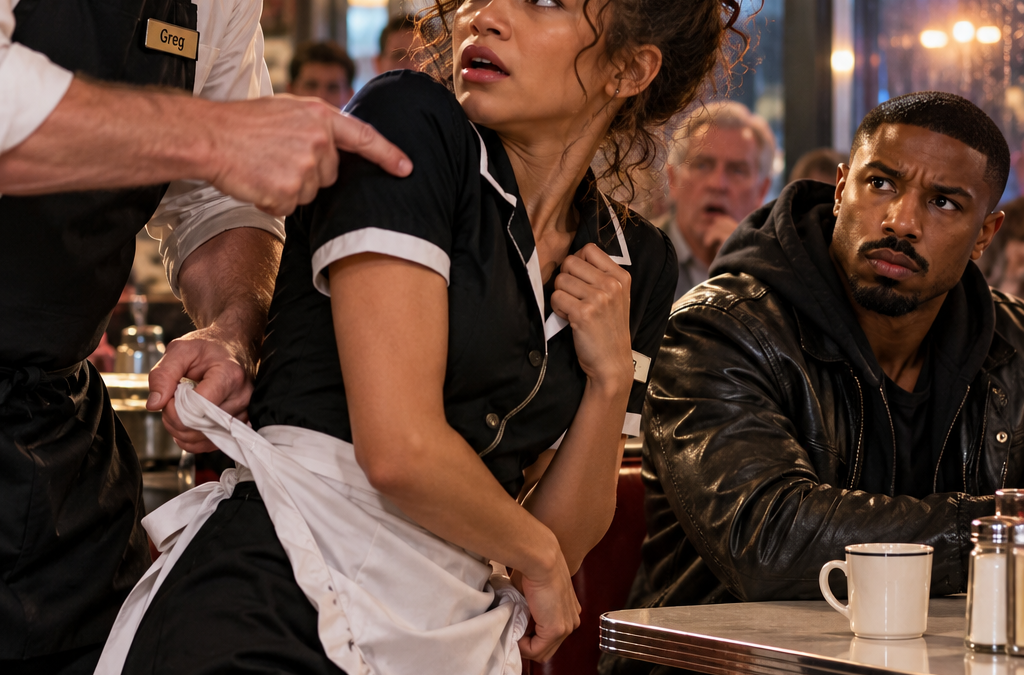
𝗙𝗨𝗟𝗟 𝗦𝗧𝗢𝗥𝗬
I was six.
I didn’t understand what she meant.
My father did.
He smiled at me with one side of his mouth lifted slightly higher than the other.
“Come on, baby girl,” he said. “Let’s find somewhere better.”
We ate powdered donuts from a gas station in his truck.
At the time, I thought he had turned breakfast into an adventure.
Years later, I understood.
He had been humiliated.
And he had protected me from seeing it.
Dad died when I was nineteen.
Heart attack on the plant floor.
People called it sudden.
I never did.
There had been nothing sudden about the way life wore my father down.
It happened slowly.
One double shift at a time.
One overdue bill at a time.
One person looking through him at a time.
Standing behind the counter at Ridley’s, I looked at the man in booth 12 and saw my father’s shoulders.
That same quiet shrinking.
That same stillness.
The posture of a man who had learned that sometimes asking to be treated like everybody else only made things worse.
I put the ketchup bottle down.
Then I picked up a menu.
I grabbed a rolled set of silverware.
Finally, I poured a cup of black coffee.
I didn’t know how he took it.
But he looked cold, and cold people deserve something warm before they have to answer questions.
I started walking.
My sneakers squeaked against the tile.
The dining room seemed to get quieter with every step.
I could feel Greg’s office behind me even without looking back.
I reached booth 12.
I set down the menu.
Then the silverware.
Then the coffee.
The cup made a soft sound against the tabletop.
The man looked up.
His eyes were pale blue and red around the edges from wind and exhaustion.
There was something in them I recognized immediately.
Surprise.
Not because I had brought him coffee.
Because I had spoken to him like he belonged there.
“Evening,” I said. “Kitchen’s open another hour. Meatloaf’s pretty good tonight.”
He stared at me.
I gave him a small smile.
“Coffee’s fresh.”
“Thank you.”
His voice was low and rough.
I nodded toward the menu.
“Take your time. I’ll come back.”
I turned away.
“Tessa.”
I looked back.
He must have read my name tag.
He wrapped both hands around the coffee cup.
“Thank you.”
There was more weight in the words that time.
I nodded.
“You’re welcome.”
I had almost reached the counter when Greg’s office door opened.
Fast.
He came toward me with his tie loosened and his face already reddening.
“What did I just tell you?”
The whole diner heard him.
I stopped.
“I gave him coffee and a menu.”
“I told you not to.”
“He’s a customer.”
“He’s a liability.”
Greg stepped closer.
“Table three is uncomfortable. The Hendersons haven’t ordered their second round. You think money doesn’t matter?”
“I gave a man coffee.”
“Your job is to do what I tell you.”
The dining room went completely still.
The jukebox had reached the gap between songs.
No silverware.
No conversation.
Nothing.
Greg pointed toward booth 12.
“You know what your problem is? You think being nice is enough.”
I said nothing.
“Being nice doesn’t pay the electric bill. Being nice doesn’t keep customers in their seats. And being nice to every stray that wanders in off the highway doesn’t keep this place open.”
Stray.
He said it like he was talking about an animal digging through trash.
Something cold settled inside me.
Not rage.
Something clearer.
I looked at Greg and realized I had spent fourteen months being afraid of a very small man.
He stared back at me.
“Take off your apron.”
For a second, I thought I had misheard him.
“What?”
“You heard me.”
His voice was flat.
“You’re done. Tonight. Right now.”
My heart began beating so hard I could feel it in my throat.
Rent was due in ten days.
My checking account held less than two hundred dollars.
The check-engine light flashed through my head.
The jar of coins.
Groceries.
Electricity.
All of it.
I looked around the diner.
Twenty people had seen everything.
Nobody spoke.
The woman from table three stared down at her plate.
The two men at the counter suddenly found their coffee fascinating.
Even employees who knew what Greg was like avoided my eyes.
That silence hurt more than Greg’s words.
I reached behind my back.
My fingers found the apron strings.
I untied them.
I folded the apron once and placed it on the counter.
Then I set my order pad on top.
Greg looked satisfied.
That bothered me.
So I did one more thing.
I picked up the coffee pot.
“Tessa.”
I ignored him.
I walked back to booth 12.
The stranger watched me approach.
I filled his cup to the rim.
My hand was steady.
“Enjoy your meal,” I said. “And if you want dessert, get the pecan pie. It’s the one thing here I’ll defend without hesitation.”
For the first time, the corner of his mouth moved.
Not quite a smile.
But close.
I put down the coffee pot.
Then I walked past Greg.
He said my name again.
I kept going.
I pushed through the front door and stepped into the cool night.
I made it to my car before my hands began shaking.
I sat behind the steering wheel and stared through the windshield.
Inside Ridley’s, Greg was already clearing the counter.
My apron disappeared.
My order pad disappeared.
Within minutes, it looked as if I had never worked there.
Fourteen months erased between dinner and dessert.
That was when I cried.
Not loudly.
I just sat there with my forehead against the steering wheel and let the tears fall.
I cried because I was scared.
I cried because doing the right thing felt much less heroic when you were staring at next month’s rent.
I cried because twenty people had watched Greg humiliate me, and not one had stood up.
And somewhere underneath all of that, I cried because I knew I would still make the same choice again.
I drove home.
What happened after I left Ridley’s that night, I learned much later.
The man from booth 12 stayed another twenty minutes.
His name was Wade Emerson.
He ordered the meatloaf.
According to him, it wasn’t very good.
The potatoes tasted boxed.
The gravy had been sitting under the heat lamp too long.
He ate anyway.
A different waitress served him.
He left thirty dollars on a twelve-dollar check.
Then he walked outside to his Harley.
But instead of riding away, he sat in the parking lot looking back through the restaurant windows.
Greg was laughing with one of the regulars.
Everything had returned to normal.
At least, that was what Greg believed.
Wade took out his phone.
He called a man named Raymond Price.
“Raymond, it’s Wade.”
Raymond managed operations for Emerson Holdings.
At the time, that name meant nothing to me.
I would eventually learn that Wade had started working construction at nineteen.
He framed houses.
Poured concrete.
Carried lumber.
Saved money by living in a trailer behind job sites.
At thirty-one, he bought his first rental property.
Then another.
Then another.
Over thirty years, Emerson Holdings grew into a company that owned commercial property across several counties in Tennessee and northern Alabama.
Office buildings.
Storage facilities.
Strip malls.
Restaurants.
Including Ridley’s Family Grill.
Greg didn’t own the building.
Wade did.
Nobody at the diner knew because Wade liked it that way.
His picture wasn’t on the company website.
His name wasn’t painted on buildings.
He still lived in a modest ranch house he had owned for years.
And he still rode his Harley hundreds of miles whenever he could.
That night, sitting in Ridley’s parking lot with rainwater drying on his leather jacket, Wade called Raymond.
“I need the full lease file on the Route 70 restaurant.”
“Ridley’s?”
“Yes.”
“What am I looking for?”
“Everything.”
“Everything?”
“Lease history. Payments. Inspections. Maintenance. Complaints. I want the whole file on my desk in the morning.”
Raymond apparently knew Wade well enough not to argue.
By nine the next morning, Wade had the file.
I knew none of this.
I woke up unemployed.
My first thought was rent.
My second was that I needed another job before panic had time to become paralysis.
I filled out applications that morning.
Then more that afternoon.
For three days, I drove around handing copies of my résumé to anybody who would take one.
A breakfast place in Germantown said they might call.
They didn’t.
Another diner had no openings.
A barbecue restaurant off Highway 64 offered me three shifts a week for $7.50 an hour.
Less money.
Fewer hours.
I took it.
Three shifts were better than zero.
The manager barely spoke to me.
At first, I considered that a blessing.
But every time I tied the new apron behind my waist, I felt Greg’s hands in the memory of that night.
I heard his voice.
Take off your apron.
I saw twenty silent customers.
At night, I lay in my apartment with the television murmuring softly and asked myself questions I hated.
Had I been stupid?
Had I sacrificed steady work for a man I didn’t know?
Would my father have told me to keep my head down?
No.
I knew the answer to that one.
Dad had spent his life enduring things quietly, but he never taught me to become cruel in order to survive.
Six years earlier, after I had lost another job and was trying to get home, I had spent several hours sitting in a Greyhound station with almost no money.
I hadn’t eaten since the previous morning.
I never told anybody.
Hunger is embarrassing when you’re broke.
A man sitting two benches away noticed.
He got up.
Bought a sandwich.
Walked back.
He handed it to me wrapped in foil.
“You need this more than I do.”
That was all he said.
I never learned his name.
I never saw him again.
But I remembered that sandwich.
I remembered how humiliating it had felt to need it.
And how carefully he had offered it so I didn’t feel humiliated accepting it.
That night, I made myself a promise.
If I ever saw somebody hungry and had the ability to help, I would not look away.
Years later, Wade walked into Ridley’s.
I kept my promise.
It cost me my job.
But a promise isn’t worth much if you only keep it when there’s no price attached.
The morning after Greg fired me, my phone rang.
“Hello?”
“Ms. Turner?”
“Yes.”
“My name is Wade Emerson. I was at the diner last night.”
I sat straighter.
Then he added, “Booth 12.”
“The biker.”
He laughed softly.
“Yes, ma’am. The biker.”
I didn’t know why he was calling.
“I wanted to thank you.”
“You don’t have to thank me for serving you.”
“I think I do.”
“You were hungry.”
“And you lost your job.”
“I lost my job because Greg Holloway is a small man with a loud voice. That wasn’t your fault.”
There was a pause.
“Have you found anything else yet?”
“I’ve applied around.”
“I’d like to help.”
The sentence immediately made me defensive.
“I’m not looking for charity.”
“Neither am I.”
His answer came quickly.
“I want to ask you some questions about Ridley’s.”
“What kind of questions?”
“How Greg treated employees. Hours. Pay. Safety. Money. Whatever you know.”
I frowned.
“Why?”
Another pause.
Then Wade said something I remembered later.
“Because what happened to you didn’t feel like the first wrong thing that man ever did.”
I looked around my tiny apartment.
“No,” I said quietly. “It wasn’t.”
We talked for nearly forty minutes.
I told him about split time sheets.
About doubles that somehow never became overtime.
About the refrigerator that couldn’t hold temperature properly.
About Greg threatening to cut hours if people complained.
About employees disappearing from the schedule after questioning their paychecks.
Wade listened.
He didn’t interrupt much.
At the end, he said, “Would you be willing to tell somebody else all of this?”
“Who?”
“My attorney.”
That made me sit up.
“Why do you have an attorney involved?”
“I’ll explain when we meet.”
Then he thanked me again and ended the call.
Several days passed.
I assumed maybe nothing would come from it.
That was usually how things worked.
People got angry.
They made promises.
Then life moved on and the person who had been hurt was left carrying the consequences alone.
What I didn’t know was that Wade had already started pulling at loose threads.
The lease records themselves looked mostly normal.
Greg paid roughly $3,200 a month.
There had been a couple of late payments, nothing dramatic.
But Wade hired a forensic accountant named Patricia Howell to go deeper.
She compared business filings, payroll records, tax documents, time sheets and reported employee counts.
Within days, she found what Greg had spent years hiding.
He had been taking money from the register.
Not huge amounts.
A hundred dollars.
Two hundred.
Small enough to dismiss as mistakes.
Over two years, those “mistakes” added up to nearly nineteen thousand dollars.
Then Patricia found the payroll.
Greg reported fourteen employees.
Ridley’s had nine.
Five people receiving paychecks had never worked there.
Ghost employees.
Money was being deposited into an account Greg controlled.
Then she compared the time records.
Greg kept two systems.
One digital.
One handwritten.
If an employee worked too many hours, shifts could appear on different records so no single sheet reflected the actual overtime.
My name appeared again and again.
So did several others.
There were also health inspection violations.
A broken refrigeration system.
Inadequate handwashing facilities.
Expired storage containers.
Greg had signed documents saying the problems would be corrected.
He never corrected them.
He simply counted on nobody checking again.
When Patricia finished, she called the pattern what it was.
Systematic fraud.
Wade sent everything to his attorney, Douglas Webb.
The lease contained a material-breach provision allowing termination if illegal activity occurred on the premises.
Douglas told Wade there was enough to act.
Wade’s response was simple.
“I want him out.”
But they moved carefully.
They copied records first.
Preserved documents.
Contacted former employees.
Because Wade knew something I didn’t.
Once a dishonest man realizes people have begun looking at his records, records have a way of disappearing.
That was exactly what Greg tried to do.
I learned later that his accountant called him about discrepancies.
Then Douglas Webb visited Ridley’s for lunch and left his business card on the table.
No message.
Just the card.
Greg understood.
He began calling former employees.
He offered cash to “settle misunderstandings.”
One hung up.
Another told him to get a lawyer.
Then, after closing one night, Greg locked himself inside his office.
He shredded folders.
Deleted a spreadsheet.
Moved backup drives into his car.
He thought he was cleaning up his problems.
In reality, he was confirming them.
Around that time, Wade called me again.
“Can you meet me?”
We chose a coffee shop in Germantown.
When I walked in, I nearly missed him.
The man sitting by the window wore a clean button-down shirt and dark jeans.
His beard was trimmed.
His hair was combed back.
The boots were still boots, but somebody had at least wiped the road grime from them.
Only the eyes were the same.
Pale blue.
Steady.
I sat across from him.
“You clean up different.”
“I hear that sometimes.”
He bought me coffee.
Black.
No sugar.
Exactly the way I had served his.
We talked for a few minutes.
Then Wade set his cup down.
“I own the building.”
I stared at him.
“What building?”
“Ridley’s.”
I thought he was joking.
His expression didn’t change.
“Emerson Holdings is my company.”
I put my coffee down.
“The company Greg pays rent to?”
“Yes.”
“The property company in Nashville?”
“Yes.”
I leaned back.
I actually laughed once because my brain refused to accept what he was saying.
“You’re telling me the man I served coffee to in a filthy leather jacket owns the entire building?”
“That’s about it.”
“Why were you dressed like that?”
“Because I was riding.”
“No. I mean…”
I stopped.
He understood.
“Why didn’t I look like somebody who owned commercial property?”
I felt embarrassed.
“That’s not what I meant.”
“It is.”
He didn’t sound offended.
He sounded amused.
Then he leaned back.
“I worked construction most of my adult life before the property business took off. Framing. Concrete. Renovation. I spent years coming home with dirt under my nails.”
He turned his cup slowly.
“Then I made money.”
His eyes dropped to the table.
“And people changed.”
“How?”
“They started opening doors for me. Calling me sir. Laughing harder at my jokes. Treating me like I had become a different man.”
He looked back at me.
“But I hadn’t changed nearly as much as they had.”
I understood immediately.
“So you ride dressed like that to see how people treat you when they don’t know.”
“Exactly.”
“That sounds depressing.”
“It can be.”
“How often do people act like Greg?”
“Not often.”
He paused.
“But often enough.”
I thought about that.
Then he slid a folder across the table.
“Open it.”
I did.
The first page contained a list of financial irregularities.
I read slowly.
Register discrepancies.
Ghost employees.
Overtime manipulation.
Inspection violations.
My stomach turned.
“He was stealing?”
“For years.”
“And the overtime?”
“Also documented.”
I looked at Wade.
“What happens now?”
“My attorney is terminating Greg’s lease.”
I didn’t say anything.
“We’re also referring the tax and payroll matters to the appropriate agencies.”
“Because of what he did to me?”
Wade’s expression hardened slightly.
“No.”
That surprised me.
He continued.
“What he did to you made me look.”
He tapped the folder.
“This is why he loses the lease.”
That mattered to me.
I didn’t want revenge disguised as justice.
Greg firing me was wrong.
But fraud was fraud whether I existed or not.
“What do you need from me?”
“A statement.”
“About that night?”
“Everything. Your hours. Pay. Conditions. How he treated employees. Whatever you can truthfully document.”
I pushed the folder back toward him.
“I’ll do it.”
Within a week, I learned I wasn’t alone.
Two former cooks came forward.
A dishwasher described months of unpaid overtime.
A hostess had saved text messages in which Greg threatened to cut her hours if she reported an injury.
I had records too.
Photographs of schedules.
Screenshots.
Messages.
Pay stubs that had never made sense.
Things I had kept because some part of me always knew I might need them.
Douglas organized it all.
Six witness statements.
Years of financial records.
Health inspection reports.
Payroll discrepancies.
Fourteen exhibits.
Greg had spent years assuming the people beneath him were too tired, poor or frightened to keep evidence.
He had been wrong.
The notice was served on a Tuesday morning.
I wasn’t there.
What happened inside Ridley’s was told to me afterward by Wade and Douglas, and I have replayed it so many times that I can almost see it.
Greg had just opened the restaurant.
He was behind the register counting cash when two men in suits came through the door.
Douglas introduced himself.
“Mr. Holloway, I represent Emerson Holdings.”
Greg apparently tried to smile.
“I deal with Raymond Price.”
“Mr. Price reports to my client.”
Douglas placed a thick document on the table.
“You are being served formal notice that your lease will terminate thirty days from today.”
Greg stopped smiling.
“On what grounds?”
“Material breach.”
Douglas opened the file.
“Exhibit A. Payroll fraud involving five fictitious employees.”
Greg said it was a clerical mistake.
Douglas continued.
“Exhibit B. Cash discrepancies totaling approximately eighteen thousand nine hundred dollars.”
Greg tried to interrupt.
“Exhibit C. Multiple labor violations involving unpaid overtime and falsified timekeeping records.”
Then Douglas said my name.
Tessa Turner.
Greg went quiet.
“Exhibit D,” Douglas continued. “Repeated health code violations and documented failure to complete required repairs.”
Greg finally asked the obvious question.
“Who is your client?”
That was when the front door opened.
Wade walked in.
But he wasn’t wearing the button-down shirt from the coffee shop.
He wore the same cracked leather jacket.
The same boots.
Road dust marked his jeans.
His beard had gone several days without trimming.
He looked exactly like the man Greg had refused to serve.
Greg recognized him.
According to Wade, all the color left his face.
“You.”
Wade didn’t answer.
He walked through the dining room.
Past the counter.
Past the office.
All the way to booth 12.
Then he sat down.
Same seat.
Same posture.
Hands folded on the table.
Greg stared at him.
“You own this place?”
Wade looked around the restaurant.
“I own the building.”
Greg grabbed the counter.
“I didn’t know.”
Wade nodded.
“That’s the point.”
Greg started talking faster.
“You came in covered in grease. Customers were complaining. I was trying to protect the business.”
“No.”
Wade’s voice stayed quiet.
“You decided what kind of man I was before I opened my mouth.”
Greg looked toward Douglas.
Wade continued.
“And you did the same thing to Tessa.”
“This is because of her?”
“This investigation started because of her.”
Greg’s eyes narrowed.
“She disobeyed a direct order.”
“She served a customer.”
“I was managing my restaurant.”
“You were humiliating an employee because she refused to help you humiliate somebody else.”
Greg didn’t answer.
Wade leaned forward slightly.
“You didn’t know who I was.”
Silence.
“You didn’t know who she was either.”
Greg’s jaw tightened.
“You saw a man who looked poor and a waitress you thought couldn’t afford to stand up to you.”
Wade stood.
“And you decided neither one of us mattered.”
Douglas reminded Greg that the termination was final.
Thirty days.
No destroying records.
No contacting witnesses.
No removing property that did not belong to him.
Greg repeated one word.
“Witnesses?”
“Six former employees have provided statements,” Douglas said.
Then he added, “Ms. Turner’s is particularly detailed.”
That was the moment, according to Wade, when Greg seemed to understand the size of what was happening.
Not the lease.
Not the audit.
The fact that the people he had treated as disposable had been talking to each other.
Greg looked at Wade.
“You can’t do this. I’ve been here eight years. I built this place.”
Wade’s answer was the part Douglas remembered word for word.
“You leased a building somebody else built. You hired people and underpaid them. You stole money, falsified payroll and ignored safety violations. Then a twenty-six-year-old waitress showed more integrity in thirty seconds than you showed in eight years.”
Greg said nothing.
Wade walked toward the door.
Before leaving, he stopped.
“You want to know why you’re losing this place?”
Greg looked at him.
“It isn’t because you didn’t recognize a rich man.”
Wade opened the door.
“It’s because you didn’t recognize a human being.”
Then he left.
The thirty days passed badly for Greg.
Government agencies began asking questions.
Former employees filed wage claims.
His records were reviewed.
The lease ended.
Ridley’s closed.
I thought that was the end of my involvement.
I was wrong again.
A few days later, Wade asked me to meet him at the building.
The Ridley’s sign still hung above the entrance, but the restaurant was empty.
No customers.
No music.
No Greg.
I walked through the dining room and felt something twist inside me.
Booth 12 was still there.
So was the counter where I had folded my apron.
I could almost see myself standing beside it.
Wade was waiting near the kitchen.
“What do you think?” he asked.
“About what?”
“The place.”
“It needs work.”
He smiled.
“Good answer.”
I walked toward the kitchen.
“The refrigerator needs replacing.”
“Already planned.”
“The ventilation is terrible.”
“Also planned.”
“The back storage room needs shelving.”
He nodded.
“What else?”
I stared at him.
“Why are you asking me?”
“Because I’m reopening it.”
“As what?”
“I don’t know yet.”
He paused.
“That depends on you.”
I thought I had misunderstood him.
“Me?”
“I want you to run it.”
I laughed.
“No.”
“I’m serious.”
“I’m a waitress.”
“You know the restaurant better than the man who ran it.”
“That doesn’t mean I know how to own one.”
“I didn’t say own.”
“Run, own—”
“General manager.”
I stopped talking.
Wade continued.
“Salary. Benefits. Full operational authority. Profit-sharing agreement.”
I just stared.
He pulled out a folder.
“Read it before you say no.”
My hands remained at my sides.
“Why me?”
His expression changed.
“You want the flattering answer or the true one?”
“The true one.”
“You notice people.”
I looked away.
“That isn’t a management qualification.”
“It should be.”
“Wade—”
“You know what happens when the freezer is failing before someone writes a report. You know which employee is exhausted before she calls out. You know when a customer needs help without making that person beg for it.”
He pointed toward the dining room.
“Greg understood numbers. He never understood what the numbers represented.”
I looked through the kitchen doorway.
Tables.
Chairs.
Coffee station.
A place that had humiliated me.
“Why would I want to come back here?”
“That,” Wade said, “is the question.”
I walked slowly toward the counter.
My fingers touched the edge.
I remembered Greg standing there.
Take off your apron.
I remembered the silence.
I remembered walking toward booth 12 after losing everything and filling a stranger’s coffee cup because I wanted my last act in that building to belong to me.
“I don’t want Ridley’s,” I said.
“Neither do I.”
I looked at Wade.
“If I do this, the name changes.”
“Fine.”
“Employees get real overtime.”
“Yes.”
“Schedules are posted on time.”
“Yes.”
“No retaliation if somebody reports an injury.”
“Obviously.”
“If the kitchen equipment isn’t safe, we fix it.”
“Yes.”
“And nobody gets turned away because their clothes are dirty.”
Wade smiled.
“That one I assumed.”
I looked around again.
Something had shifted.
The building wasn’t Greg.
The booths weren’t Greg.
The kitchen wasn’t Greg.
I had allowed one man to contaminate the entire place in my memory.
Maybe taking it back meant separating the walls from what he had done inside them.
“I’ll read the contract.”
Wade nodded.
“That’s all I’m asking.”
I read it.
Then I hired an attorney to read it because I had learned a few things.
Wade approved of that.
Three weeks later, renovation began.
Workers replaced the refrigeration system.
They repaired plumbing.
Installed better ventilation.
Repainted the walls.
Changed the lighting.
Removed the old booths and put in new ones.
I was there nearly every day.
At first, I told myself I was supervising.
The truth was simpler.
I couldn’t stay away.
For fourteen months, I had walked through Ridley’s seeing problems I wasn’t allowed to solve.
Now somebody was asking my opinion.
I chose storage shelves.
Helped redesign the service station.
Moved equipment so waitresses wouldn’t have to cross behind the cooks during the rush.
I measured the distance between tables because I knew exactly where trays used to collide.
I helped build a schedule that didn’t treat employees like interchangeable parts.
Then came the sign.
Wade asked what I wanted to call the restaurant.
I thought about it for several days.
Eventually, I knew.
“Turner’s.”
“Your name?”
“My father’s.”
The old Ridley’s sign came down.
When the new wooden sign went up, I stood across the parking lot and stared at it.
TURNER’S.
My father had spent most of his life being overlooked.
His name was now hanging over a door.
I cried again.
Different tears this time.
Before opening, I called the former employees.
The two cooks.
The dishwasher.
The hostess.
Some had found other work.
Some hadn’t.
I told each of them the truth.
“I’m not asking because we went through something together. I’m asking because you’re good at your job, and I want good people.”
Most came back.
Opening morning, I arrived before sunrise.
For a few minutes, I sat alone in booth 12.
The restaurant smelled different.
Fresh paint.
Coffee.
Bread.
Clean metal from the kitchen.
The windows were dark mirrors.
I thought about Dad.
The pancake restaurant.
The gas-station donuts.
The Greyhound station.
The sandwich wrapped in foil.
All the little moments that had brought me to that booth.
Kindness is often described like it is soft.
It isn’t.
Sometimes kindness is easy.
You smile.
You hold a door.
You leave a good tip.
But sometimes kindness asks you to choose what kind of person you are while something important is being taken from you.
That night with Wade, my job was the price.
I hadn’t known whether I could afford it.
I paid anyway.
At seven, we unlocked the doors.
Customers came.
Then more.
By lunch, every booth was full.
Nobody cared that the sign had changed.
They cared that the food was good.
They cared that the staff looked happy.
They cared that coffee arrived hot and nobody rushed them out the door.
Around three, I realized I had barely stopped moving since sunrise.
I stood behind the counter drinking water.
One of the cooks leaned through the service window.
“You know we’re outpacing Ridley’s busiest Friday?”
I looked around.
Families.
Truckers.
Construction workers.
Two older women splitting pecan pie.
A man in work boots sitting beside somebody in a suit.
“Don’t jinx it.”
He laughed and disappeared back into the kitchen.
At 4:15, I heard an engine outside.
I knew the sound before I saw the bike.
A Harley rolled into the parking lot.
Wade came through the door wearing his riding jacket.
Dusty boots.
Windblown hair.
Grease near one cuff.
A few customers looked up.
Nobody moved away.
Nobody clutched a purse.
One of my waitresses grabbed a menu.
I stopped her.
“I’ve got him.”
Wade walked to booth 12.
Of course he did.
He sat.
Hands on the table.
Same as the first night.
I poured black coffee.
Then I went into the kitchen.
“Bowl of stew.”
The cook looked at the clock.
“We’ve got meatloaf.”
“I know.”
He saw my face.
“Stew it is.”
I carried the bowl out.
I set it in front of Wade.
Then the coffee.
Neither of us spoke for a few seconds.
Finally, he looked around the restaurant.
“You’ve done something with the place.”
“I changed the management.”
He smiled.
“That’ll do it.”
I sat across from him.
Just for a minute.
“You know what still bothers me?”
“What?”
“I almost walked away from you.”
His expression became serious.
“Because of Greg?”
“Because I was scared.”
“Those aren’t the same thing.”
“They felt the same.”
I wrapped my hands around my coffee cup.
“I knew I could lose my job.”
“You did lose your job.”
“Exactly.”
He waited.
I looked toward the counter where the old apron had once been folded.
“I used to think doing the right thing would feel certain.”
Wade shook his head.
“No.”
“No?”
“If it feels easy, you probably haven’t paid much for it yet.”
I considered that.
Then I smiled.
“Your stew’s getting cold.”
He lifted the spoon.
“Yes, ma’am.”
I stood.
As I turned away, he called my name.
“Tessa.”
I looked back.
“Thank you.”
It was the same way he had said it that first night.
Quiet.
Serious.
I nodded.
“You’re welcome.”
Three months later, Greg drove past Turner’s.
I didn’t see him.
One of the cooks did.
Greg slowed down enough to look at the sign.
Then he kept driving.
He never came inside.
I never spoke about him publicly.
I didn’t need to.
His legal and financial problems belonged to the authorities.
His mistakes belonged to him.
What mattered to me was what happened after he was gone.
The employees he had underpaid received help pursuing what they were owed.
The kitchen finally met the standards it should have met all along.
People who had been afraid to speak began speaking.
And I stopped thinking of myself as the waitress Greg had fired.
For a long time, that identity had stayed with me.
The woman humiliated in front of twenty silent strangers.
The woman sitting in her car wondering whether integrity had just made her homeless.
But that wasn’t the whole story.
I was also the daughter of James Turner.
The girl who once ate gas-station donuts because her father refused to let humiliation ruin breakfast.
The hungry young woman who never forgot a stranger’s sandwich.
The waitress who looked at a tired man and recognized something everybody else had chosen not to see.
And eventually, I became the woman whose name was on the building.
Not because Wade Emerson happened to be wealthy.
That was never the lesson.
If Wade had truly been broke, I would still have served him.
If he had ridden away and never called me, I would still believe I made the right choice.
Because the value of what I did cannot depend on who the stranger secretly turned out to be.
That would make Greg right in a different way.
It would mean people deserve dignity only when they might be important.
Wade mattered when I thought he was nobody.
That was the entire point.
Years later, I still remember the first night more clearly than the opening day.
I remember the grease on his hands.
The wet leather jacket.
The silence in the diner.
The sound of the coffee cup touching the table.
And I remember walking across that dining room after Greg fired me.
I had no plan.
No powerful friend.
No idea who Wade was.
I was terrified.
But my hand did not shake when I filled his cup.
That matters to me.
Because there are moments in life when everything unnecessary falls away.
Your job title.
Your bank balance.
Who is watching.
Whether anybody will defend you.
All that remains is the decision directly in front of you.
Look away.
Or don’t.
My father had been looked through enough times for one lifetime.
So had I.
The stranger on the Greyhound bench had taught me that being seen by one person could sometimes be enough to get you through the night.
When Wade walked into Ridley’s, tired and dirty and unwanted, I recognized the choice.
I chose not to look away.
For a few frightening days, it seemed like that choice had taken everything from me.
Instead, it showed me what I had been unwilling to see about myself.
Greg could remove my apron.
He could erase my name from his schedule.
He could make twenty people watch me walk out the door.
But he could not decide what kind of woman I would become after I crossed that parking lot.
That part had always belonged to me.
𝗧𝗛𝗘 𝗘𝗡𝗗
The Night My Manager Ripped Off My Apron, the Man in Booth 12 Never Took His Eyes Off Me
The stranger looked like he had been riding through rain and cold for hours, but my manager took one look at the grease on his jacket and ordered me to pretend he didn’t exist.
When I carried a cup of coffee to his booth anyway, I thought the worst thing I could lose that night was my job.
Ridley’s Family Grill sat just off Route 70 in a squat brick building with a neon sign that buzzed louder than it glowed.
Nobody named Ridley had worked there in years.
The building belonged to some property company out of Nashville, but none of us knew much about that. As far as the staff was concerned, Ridley’s belonged to Greg Holloway.
At least, Greg acted like it did.
I had worked there for fourteen months.
I was twenty-six, exhausted most of the time, and good enough at my job that customers assumed I had been doing it for years.
I knew which regular wanted his eggs over easy enough for the yolks to shake when I carried the plate.
I knew the elderly couple by the window would order one slice of pecan pie and spend ten minutes insisting they weren’t sharing it.
I knew that if Mrs. Henderson’s coffee cup got below half-full, she would start looking around for me without actually raising her hand.
I knew how to smile when my feet hurt.
I knew how to carry six plates without letting my wrists show how badly they were burning.
Mostly, I knew how to notice people.
That wasn’t something Greg valued.
He valued speed.
He valued low labor costs.
He valued customers who tipped well and employees who didn’t ask questions.
I made $8.60 an hour before tips. Some nights I went home with enough cash to breathe a little easier. Other nights I counted the bills at my kitchen table and tried to decide which payment could survive being late.
My apartment was twelve minutes from the diner.
One room.
One window facing a parking lot.
A refrigerator that rattled after midnight.
On my kitchen counter sat an old glass jar filled with loose change. I called it my emergency fund.
Usually, there was about forty dollars in it.
My car had been showing the check-engine light for seven months.
I ignored it because the car kept starting, and when you live close enough to the edge, anything that still works is considered fixed.
Greg understood that about me.
That was the problem.
He knew I needed the job.
He knew I would take doubles.
He knew I would stay late to mop the floor if somebody called out.
He knew that when the schedule showed fifty-plus hours divided between two different sheets, I would complain under my breath and then show up anyway.
He mistook necessity for weakness.
For a long time, I let him.
Then the man in the leather jacket walked through the door.
It was a Tuesday evening.
The dinner rush had begun to fade. A family near the entrance was finishing dessert. Two men in polo shirts were arguing about football at the counter. An old country song played quietly from the jukebox.
I was behind the counter refilling ketchup bottles when the front door opened.
The first thing I heard was the heavy scrape of boots against tile.
Then came the faint metallic rattle of a chain hanging from his belt.
He was broad through the shoulders, though age had bent him slightly forward. His gray beard looked like it hadn’t met a razor in several weeks. Rain had darkened his leather jacket. Grease stained his jeans and hands.
He smelled like road water, engine oil and cold air.
Every head in the diner seemed to turn at once.
A woman at table three pulled her purse closer.
One of the men at the counter stopped speaking in the middle of a sentence.
The stranger noticed.
I could tell because I had spent enough of my life noticing the moment people realized they were being judged.
But he didn’t react.
He simply walked to booth 12.
Booth 12 sat in the back near the emergency exit. It was the booth customers chose only when every other seat was taken.
He lowered himself onto the vinyl bench, placed both hands on the table and waited.
Nobody went to him.
I watched for maybe thirty seconds.
It felt longer.
Then I saw Greg’s reflection in the chrome napkin holder.
He was staring at booth 12.
His jaw moved slightly from side to side.
I knew that look.
He was calculating.
Greg came over and stopped beside me.
“That guy in twelve.”
“I see him.”
“Don’t go over there.”
I looked at him.
“What?”
“No menu. No water. Nothing.”
I set the ketchup bottle down.
“He’s a customer.”
“He’s a problem.”
“He hasn’t said anything.”
“Look at him, Tessa.”
I did.
All I saw was a tired man.
Greg leaned closer.
“He’s covered in grease. He smells like a garage. People are already uncomfortable.”
“He just sat down.”
“And he can stand back up.”
I stared at him.
Greg straightened his tie.
He always did that when he wanted to remind himself that he was the person in charge.
“I’m not losing paying customers because some road trash decides to wander in here.”
My stomach tightened.
“Greg—”
“Don’t serve him.”
His voice dropped.
“That’s not a suggestion.”
He walked toward his office and shut the door.
I remained behind the counter with my hand around the ketchup bottle.
The stranger hadn’t moved.
He didn’t wave.
He didn’t snap his fingers.
He didn’t complain.
He sat with his shoulders slightly curved inward, as though he was trying to occupy less space than his body required.
I knew that posture.
My father used to sit that way.
His name was James Turner.
He had been a pipe fitter at a plant outside Memphis. He worked twelve-hour shifts and came home smelling like metal, sweat and flux paste. His hands were rough enough that when he held mine as a little girl, his palm felt like sandpaper.
He was one of the gentlest men I ever knew.
The world rarely treated him gently in return.
When I was six, he took me to breakfast after finishing a night shift.
He was still wearing his work clothes.
Dirt under his nails.
Grease on his collar.
Steel-toed boots peeling around the edges.
We sat in a pancake restaurant for fifteen minutes while waitresses walked past us.
When one finally came over, she dropped a single menu on the table.
Then she looked at my father and asked, “Are you sure you want to eat here?”
I was six.
I didn’t understand what she meant.
My father did.
He smiled at me with one side of his mouth lifted slightly higher than the other.
“Come on, baby girl,” he said. “Let’s find somewhere better.”
We ate powdered donuts from a gas station in his truck.
At the time, I thought he had turned breakfast into an adventure.
Years later, I understood.
He had been humiliated.
And he had protected me from seeing it.
Dad died when I was nineteen.
Heart attack on the plant floor.
People called it sudden.
I never did.
There had been nothing sudden about the way life wore my father down.
It happened slowly.
One double shift at a time.
One overdue bill at a time.
One person looking through him at a time.
Standing behind the counter at Ridley’s, I looked at the man in booth 12 and saw my father’s shoulders.
That same quiet shrinking.
That same stillness.
The posture of a man who had learned that sometimes asking to be treated like everybody else only made things worse.
I put the ketchup bottle down.
Then I picked up a menu.
I grabbed a rolled set of silverware.
Finally, I poured a cup of black coffee.
I didn’t know how he took it.
But he looked cold, and cold people deserve something warm before they have to answer questions.
I started walking.
My sneakers squeaked against the tile.
The dining room seemed to get quieter with every step.
I could feel Greg’s office behind me even without looking back.
I reached booth 12.
I set down the menu.
Then the silverware.
Then the coffee.
The cup made a soft sound against the tabletop.
The man looked up.
His eyes were pale blue and red around the edges from wind and exhaustion.
There was something in them I recognized immediately.
Surprise.
Not because I had brought him coffee.
Because I had spoken to him like he belonged there.
“Evening,” I said. “Kitchen’s open another hour. Meatloaf’s pretty good tonight.”
He stared at me.
I gave him a small smile.
“Coffee’s fresh.”
“Thank you.”
His voice was low and rough.
I nodded toward the menu.
“Take your time. I’ll come back.”
I turned away.
“Tessa.”
I looked back.
He must have read my name tag.
He wrapped both hands around the coffee cup.
“Thank you.”
There was more weight in the words that time.
I nodded.
“You’re welcome.”
I had almost reached the counter when Greg’s office door opened.
Fast.
He came toward me with his tie loosened and his face already reddening.
“What did I just tell you?”
The whole diner heard him.
I stopped.
“I gave him coffee and a menu.”
“I told you not to.”
“He’s a customer.”
“He’s a liability.”
Greg stepped closer.
“Table three is uncomfortable. The Hendersons haven’t ordered their second round. You think money doesn’t matter?”
“I gave a man coffee.”
“Your job is to do what I tell you.”
The dining room went completely still.
The jukebox had reached the gap between songs.
No silverware.
No conversation.
Nothing.
Greg pointed toward booth 12.
“You know what your problem is? You think being nice is enough.”
I said nothing.
“Being nice doesn’t pay the electric bill. Being nice doesn’t keep customers in their seats. And being nice to every stray that wanders in off the highway doesn’t keep this place open.”
Stray.
He said it like he was talking about an animal digging through trash.
Something cold settled inside me.
Not rage.
Something clearer.
I looked at Greg and realized I had spent fourteen months being afraid of a very small man.
He stared back at me.
“Take off your apron.”
For a second, I thought I had misheard him.
“What?”
“You heard me.”
His voice was flat.
“You’re done. Tonight. Right now.”
My heart began beating so hard I could feel it in my throat.
Rent was due in ten days.
My checking account held less than two hundred dollars.
The check-engine light flashed through my head.
The jar of coins.
Groceries.
Electricity.
All of it.
I looked around the diner.
Twenty people had seen everything.
Nobody spoke.
The woman from table three stared down at her plate.
The two men at the counter suddenly found their coffee fascinating.
Even employees who knew what Greg was like avoided my eyes.
That silence hurt more than Greg’s words.
I reached behind my back.
My fingers found the apron strings.
I untied them.
I folded the apron once and placed it on the counter.
Then I set my order pad on top.
Greg looked satisfied.
That bothered me.
So I did one more thing.
I picked up the coffee pot.
“Tessa.”
I ignored him.
I walked back to booth 12.
The stranger watched me approach.
I filled his cup to the rim.
My hand was steady.
“Enjoy your meal,” I said. “And if you want dessert, get the pecan pie. It’s the one thing here I’ll defend without hesitation.”
For the first time, the corner of his mouth moved.
Not quite a smile.
But close.
I put down the coffee pot.
Then I walked past Greg.
He said my name again.
I kept going.
I pushed through the front door and stepped into the cool night.
I made it to my car before my hands began shaking.
I sat behind the steering wheel and stared through the windshield.
Inside Ridley’s, Greg was already clearing the counter.
My apron disappeared.
My order pad disappeared.
Within minutes, it looked as if I had never worked there.
Fourteen months erased between dinner and dessert.
That was when I cried.
Not loudly.
I just sat there with my forehead against the steering wheel and let the tears fall.
I cried because I was scared.
I cried because doing the right thing felt much less heroic when you were staring at next month’s rent.
I cried because twenty people had watched Greg humiliate me, and not one had stood up.
And somewhere underneath all of that, I cried because I knew I would still make the same choice again.
I drove home.
What happened after I left Ridley’s that night, I learned much later.
The man from booth 12 stayed another twenty minutes.
His name was Wade Emerson.
He ordered the meatloaf.
According to him, it wasn’t very good.
The potatoes tasted boxed.
The gravy had been sitting under the heat lamp too long.
He ate anyway.
A different waitress served him.
He left thirty dollars on a twelve-dollar check.
Then he walked outside to his Harley.
But instead of riding away, he sat in the parking lot looking back through the restaurant windows.
Greg was laughing with one of the regulars.
Everything had returned to normal.
At least, that was what Greg believed.
Wade took out his phone.
He called a man named Raymond Price.
“Raymond, it’s Wade.”
Raymond managed operations for Emerson Holdings.
At the time, that name meant nothing to me.
I would eventually learn that Wade had started working construction at nineteen.
He framed houses.
Poured concrete.
Carried lumber.
Saved money by living in a trailer behind job sites.
At thirty-one, he bought his first rental property.
Then another.
Then another.
Over thirty years, Emerson Holdings grew into a company that owned commercial property across several counties in Tennessee and northern Alabama.
Office buildings.
Storage facilities.
Strip malls.
Restaurants.
Including Ridley’s Family Grill.
Greg didn’t own the building.
Wade did.
Nobody at the diner knew because Wade liked it that way.
His picture wasn’t on the company website.
His name wasn’t painted on buildings.
He still lived in a modest ranch house he had owned for years.
And he still rode his Harley hundreds of miles whenever he could.
That night, sitting in Ridley’s parking lot with rainwater drying on his leather jacket, Wade called Raymond.
“I need the full lease file on the Route 70 restaurant.”
“Ridley’s?”
“Yes.”
“What am I looking for?”
“Everything.”
“Everything?”
“Lease history. Payments. Inspections. Maintenance. Complaints. I want the whole file on my desk in the morning.”
Raymond apparently knew Wade well enough not to argue.
By nine the next morning, Wade had the file.
I knew none of this.
I woke up unemployed.
My first thought was rent.
My second was that I needed another job before panic had time to become paralysis.
I filled out applications that morning.
Then more that afternoon.
For three days, I drove around handing copies of my résumé to anybody who would take one.
A breakfast place in Germantown said they might call.
They didn’t.
Another diner had no openings.
A barbecue restaurant off Highway 64 offered me three shifts a week for $7.50 an hour.
Less money.
Fewer hours.
I took it.
Three shifts were better than zero.
The manager barely spoke to me.
At first, I considered that a blessing.
But every time I tied the new apron behind my waist, I felt Greg’s hands in the memory of that night.
I heard his voice.
Take off your apron.
I saw twenty silent customers.
At night, I lay in my apartment with the television murmuring softly and asked myself questions I hated.
Had I been stupid?
Had I sacrificed steady work for a man I didn’t know?
Would my father have told me to keep my head down?
No.
I knew the answer to that one.
Dad had spent his life enduring things quietly, but he never taught me to become cruel in order to survive.
Six years earlier, after I had lost another job and was trying to get home, I had spent several hours sitting in a Greyhound station with almost no money.
I hadn’t eaten since the previous morning.
I never told anybody.
Hunger is embarrassing when you’re broke.
A man sitting two benches away noticed.
He got up.
Bought a sandwich.
Walked back.
He handed it to me wrapped in foil.
“You need this more than I do.”
That was all he said.
I never learned his name.
I never saw him again.
But I remembered that sandwich.
I remembered how humiliating it had felt to need it.
And how carefully he had offered it so I didn’t feel humiliated accepting it.
That night, I made myself a promise.
If I ever saw somebody hungry and had the ability to help, I would not look away.
Years later, Wade walked into Ridley’s.
I kept my promise.
It cost me my job.
But a promise isn’t worth much if you only keep it when there’s no price attached.
The morning after Greg fired me, my phone rang.
“Hello?”
“Ms. Turner?”
“Yes.”
“My name is Wade Emerson. I was at the diner last night.”
I sat straighter.
Then he added, “Booth 12.”
“The biker.”
He laughed softly.
“Yes, ma’am. The biker.”
I didn’t know why he was calling.
“I wanted to thank you.”
“You don’t have to thank me for serving you.”
“I think I do.”
“You were hungry.”
“And you lost your job.”
“I lost my job because Greg Holloway is a small man with a loud voice. That wasn’t your fault.”
There was a pause.
“Have you found anything else yet?”
“I’ve applied around.”
“I’d like to help.”
The sentence immediately made me defensive.
“I’m not looking for charity.”
“Neither am I.”
His answer came quickly.
“I want to ask you some questions about Ridley’s.”
“What kind of questions?”
“How Greg treated employees. Hours. Pay. Safety. Money. Whatever you know.”
I frowned.
“Why?”
Another pause.
Then Wade said something I remembered later.
“Because what happened to you didn’t feel like the first wrong thing that man ever did.”
I looked around my tiny apartment.
“No,” I said quietly. “It wasn’t.”
We talked for nearly forty minutes.
I told him about split time sheets.
About doubles that somehow never became overtime.
About the refrigerator that couldn’t hold temperature properly.
About Greg threatening to cut hours if people complained.
About employees disappearing from the schedule after questioning their paychecks.
Wade listened.
He didn’t interrupt much.
At the end, he said, “Would you be willing to tell somebody else all of this?”
“Who?”
“My attorney.”
That made me sit up.
“Why do you have an attorney involved?”
“I’ll explain when we meet.”
Then he thanked me again and ended the call.
Several days passed.
I assumed maybe nothing would come from it.
That was usually how things worked.
People got angry.
They made promises.
Then life moved on and the person who had been hurt was left carrying the consequences alone.
What I didn’t know was that Wade had already started pulling at loose threads.
The lease records themselves looked mostly normal.
Greg paid roughly $3,200 a month.
There had been a couple of late payments, nothing dramatic.
But Wade hired a forensic accountant named Patricia Howell to go deeper.
She compared business filings, payroll records, tax documents, time sheets and reported employee counts.
Within days, she found what Greg had spent years hiding.
He had been taking money from the register.
Not huge amounts.
A hundred dollars.
Two hundred.
Small enough to dismiss as mistakes.
Over two years, those “mistakes” added up to nearly nineteen thousand dollars.
Then Patricia found the payroll.
Greg reported fourteen employees.
Ridley’s had nine.
Five people receiving paychecks had never worked there.
Ghost employees.
Money was being deposited into an account Greg controlled.
Then she compared the time records.
Greg kept two systems.
One digital.
One handwritten.
If an employee worked too many hours, shifts could appear on different records so no single sheet reflected the actual overtime.
My name appeared again and again.
So did several others.
There were also health inspection violations.
A broken refrigeration system.
Inadequate handwashing facilities.
Expired storage containers.
Greg had signed documents saying the problems would be corrected.
He never corrected them.
He simply counted on nobody checking again.
When Patricia finished, she called the pattern what it was.
Systematic fraud.
Wade sent everything to his attorney, Douglas Webb.
The lease contained a material-breach provision allowing termination if illegal activity occurred on the premises.
Douglas told Wade there was enough to act.
Wade’s response was simple.
“I want him out.”
But they moved carefully.
They copied records first.
Preserved documents.
Contacted former employees.
Because Wade knew something I didn’t.
Once a dishonest man realizes people have begun looking at his records, records have a way of disappearing.
That was exactly what Greg tried to do.
I learned later that his accountant called him about discrepancies.
Then Douglas Webb visited Ridley’s for lunch and left his business card on the table.
No message.
Just the card.
Greg understood.
He began calling former employees.
He offered cash to “settle misunderstandings.”
One hung up.
Another told him to get a lawyer.
Then, after closing one night, Greg locked himself inside his office.
He shredded folders.
Deleted a spreadsheet.
Moved backup drives into his car.
He thought he was cleaning up his problems.
In reality, he was confirming them.
Around that time, Wade called me again.
“Can you meet me?”
We chose a coffee shop in Germantown.
When I walked in, I nearly missed him.
The man sitting by the window wore a clean button-down shirt and dark jeans.
His beard was trimmed.
His hair was combed back.
The boots were still boots, but somebody had at least wiped the road grime from them.
Only the eyes were the same.
Pale blue.
Steady.
I sat across from him.
“You clean up different.”
“I hear that sometimes.”
He bought me coffee.
Black.
No sugar.
Exactly the way I had served his.
We talked for a few minutes.
Then Wade set his cup down.
“I own the building.”
I stared at him.
“What building?”
“Ridley’s.”
I thought he was joking.
His expression didn’t change.
“Emerson Holdings is my company.”
I put my coffee down.
“The company Greg pays rent to?”
“Yes.”
“The property company in Nashville?”
“Yes.”
I leaned back.
I actually laughed once because my brain refused to accept what he was saying.
“You’re telling me the man I served coffee to in a filthy leather jacket owns the entire building?”
“That’s about it.”
“Why were you dressed like that?”
“Because I was riding.”
“No. I mean…”
I stopped.
He understood.
“Why didn’t I look like somebody who owned commercial property?”
I felt embarrassed.
“That’s not what I meant.”
“It is.”
He didn’t sound offended.
He sounded amused.
Then he leaned back.
“I worked construction most of my adult life before the property business took off. Framing. Concrete. Renovation. I spent years coming home with dirt under my nails.”
He turned his cup slowly.
“Then I made money.”
His eyes dropped to the table.
“And people changed.”
“How?”
“They started opening doors for me. Calling me sir. Laughing harder at my jokes. Treating me like I had become a different man.”
He looked back at me.
“But I hadn’t changed nearly as much as they had.”
I understood immediately.
“So you ride dressed like that to see how people treat you when they don’t know.”
“Exactly.”
“That sounds depressing.”
“It can be.”
“How often do people act like Greg?”
“Not often.”
He paused.
“But often enough.”
I thought about that.
Then he slid a folder across the table.
“Open it.”
I did.
The first page contained a list of financial irregularities.
I read slowly.
Register discrepancies.
Ghost employees.
Overtime manipulation.
Inspection violations.
My stomach turned.
“He was stealing?”
“For years.”
“And the overtime?”
“Also documented.”
I looked at Wade.
“What happens now?”
“My attorney is terminating Greg’s lease.”
I didn’t say anything.
“We’re also referring the tax and payroll matters to the appropriate agencies.”
“Because of what he did to me?”
Wade’s expression hardened slightly.
“No.”
That surprised me.
He continued.
“What he did to you made me look.”
He tapped the folder.
“This is why he loses the lease.”
That mattered to me.
I didn’t want revenge disguised as justice.
Greg firing me was wrong.
But fraud was fraud whether I existed or not.
“What do you need from me?”
“A statement.”
“About that night?”
“Everything. Your hours. Pay. Conditions. How he treated employees. Whatever you can truthfully document.”
I pushed the folder back toward him.
“I’ll do it.”
Within a week, I learned I wasn’t alone.
Two former cooks came forward.
A dishwasher described months of unpaid overtime.
A hostess had saved text messages in which Greg threatened to cut her hours if she reported an injury.
I had records too.
Photographs of schedules.
Screenshots.
Messages.
Pay stubs that had never made sense.
Things I had kept because some part of me always knew I might need them.
Douglas organized it all.
Six witness statements.
Years of financial records.
Health inspection reports.
Payroll discrepancies.
Fourteen exhibits.
Greg had spent years assuming the people beneath him were too tired, poor or frightened to keep evidence.
He had been wrong.
The notice was served on a Tuesday morning.
I wasn’t there.
What happened inside Ridley’s was told to me afterward by Wade and Douglas, and I have replayed it so many times that I can almost see it.
Greg had just opened the restaurant.
He was behind the register counting cash when two men in suits came through the door.
Douglas introduced himself.
“Mr. Holloway, I represent Emerson Holdings.”
Greg apparently tried to smile.
“I deal with Raymond Price.”
“Mr. Price reports to my client.”
Douglas placed a thick document on the table.
“You are being served formal notice that your lease will terminate thirty days from today.”
Greg stopped smiling.
“On what grounds?”
“Material breach.”
Douglas opened the file.
“Exhibit A. Payroll fraud involving five fictitious employees.”
Greg said it was a clerical mistake.
Douglas continued.
“Exhibit B. Cash discrepancies totaling approximately eighteen thousand nine hundred dollars.”
Greg tried to interrupt.
“Exhibit C. Multiple labor violations involving unpaid overtime and falsified timekeeping records.”
Then Douglas said my name.
Tessa Turner.
Greg went quiet.
“Exhibit D,” Douglas continued. “Repeated health code violations and documented failure to complete required repairs.”
Greg finally asked the obvious question.
“Who is your client?”
That was when the front door opened.
Wade walked in.
But he wasn’t wearing the button-down shirt from the coffee shop.
He wore the same cracked leather jacket.
The same boots.
Road dust marked his jeans.
His beard had gone several days without trimming.
He looked exactly like the man Greg had refused to serve.
Greg recognized him.
According to Wade, all the color left his face.
“You.”
Wade didn’t answer.
He walked through the dining room.
Past the counter.
Past the office.
All the way to booth 12.
Then he sat down.
Same seat.
Same posture.
Hands folded on the table.
Greg stared at him.
“You own this place?”
Wade looked around the restaurant.
“I own the building.”
Greg grabbed the counter.
“I didn’t know.”
Wade nodded.
“That’s the point.”
Greg started talking faster.
“You came in covered in grease. Customers were complaining. I was trying to protect the business.”
“No.”
Wade’s voice stayed quiet.
“You decided what kind of man I was before I opened my mouth.”
Greg looked toward Douglas.
Wade continued.
“And you did the same thing to Tessa.”
“This is because of her?”
“This investigation started because of her.”
Greg’s eyes narrowed.
“She disobeyed a direct order.”
“She served a customer.”
“I was managing my restaurant.”
“You were humiliating an employee because she refused to help you humiliate somebody else.”
Greg didn’t answer.
Wade leaned forward slightly.
“You didn’t know who I was.”
Silence.
“You didn’t know who she was either.”
Greg’s jaw tightened.
“You saw a man who looked poor and a waitress you thought couldn’t afford to stand up to you.”
Wade stood.
“And you decided neither one of us mattered.”
Douglas reminded Greg that the termination was final.
Thirty days.
No destroying records.
No contacting witnesses.
No removing property that did not belong to him.
Greg repeated one word.
“Witnesses?”
“Six former employees have provided statements,” Douglas said.
Then he added, “Ms. Turner’s is particularly detailed.”
That was the moment, according to Wade, when Greg seemed to understand the size of what was happening.
Not the lease.
Not the audit.
The fact that the people he had treated as disposable had been talking to each other.
Greg looked at Wade.
“You can’t do this. I’ve been here eight years. I built this place.”
Wade’s answer was the part Douglas remembered word for word.
“You leased a building somebody else built. You hired people and underpaid them. You stole money, falsified payroll and ignored safety violations. Then a twenty-six-year-old waitress showed more integrity in thirty seconds than you showed in eight years.”
Greg said nothing.
Wade walked toward the door.
Before leaving, he stopped.
“You want to know why you’re losing this place?”
Greg looked at him.
“It isn’t because you didn’t recognize a rich man.”
Wade opened the door.
“It’s because you didn’t recognize a human being.”
Then he left.
The thirty days passed badly for Greg.
Government agencies began asking questions.
Former employees filed wage claims.
His records were reviewed.
The lease ended.
Ridley’s closed.
I thought that was the end of my involvement.
I was wrong again.
A few days later, Wade asked me to meet him at the building.
The Ridley’s sign still hung above the entrance, but the restaurant was empty.
No customers.
No music.
No Greg.
I walked through the dining room and felt something twist inside me.
Booth 12 was still there.
So was the counter where I had folded my apron.
I could almost see myself standing beside it.
Wade was waiting near the kitchen.
“What do you think?” he asked.
“About what?”
“The place.”
“It needs work.”
He smiled.
“Good answer.”
I walked toward the kitchen.
“The refrigerator needs replacing.”
“Already planned.”
“The ventilation is terrible.”
“Also planned.”
“The back storage room needs shelving.”
He nodded.
“What else?”
I stared at him.
“Why are you asking me?”
“Because I’m reopening it.”
“As what?”
“I don’t know yet.”
He paused.
“That depends on you.”
I thought I had misunderstood him.
“Me?”
“I want you to run it.”
I laughed.
“No.”
“I’m serious.”
“I’m a waitress.”
“You know the restaurant better than the man who ran it.”
“That doesn’t mean I know how to own one.”
“I didn’t say own.”
“Run, own—”
“General manager.”
I stopped talking.
Wade continued.
“Salary. Benefits. Full operational authority. Profit-sharing agreement.”
I just stared.
He pulled out a folder.
“Read it before you say no.”
My hands remained at my sides.
“Why me?”
His expression changed.
“You want the flattering answer or the true one?”
“The true one.”
“You notice people.”
I looked away.
“That isn’t a management qualification.”
“It should be.”
“Wade—”
“You know what happens when the freezer is failing before someone writes a report. You know which employee is exhausted before she calls out. You know when a customer needs help without making that person beg for it.”
He pointed toward the dining room.
“Greg understood numbers. He never understood what the numbers represented.”
I looked through the kitchen doorway.
Tables.
Chairs.
Coffee station.
A place that had humiliated me.
“Why would I want to come back here?”
“That,” Wade said, “is the question.”
I walked slowly toward the counter.
My fingers touched the edge.
I remembered Greg standing there.
Take off your apron.
I remembered the silence.
I remembered walking toward booth 12 after losing everything and filling a stranger’s coffee cup because I wanted my last act in that building to belong to me.
“I don’t want Ridley’s,” I said.
“Neither do I.”
I looked at Wade.
“If I do this, the name changes.”
“Fine.”
“Employees get real overtime.”
“Yes.”
“Schedules are posted on time.”
“Yes.”
“No retaliation if somebody reports an injury.”
“Obviously.”
“If the kitchen equipment isn’t safe, we fix it.”
“Yes.”
“And nobody gets turned away because their clothes are dirty.”
Wade smiled.
“That one I assumed.”
I looked around again.
Something had shifted.
The building wasn’t Greg.
The booths weren’t Greg.
The kitchen wasn’t Greg.
I had allowed one man to contaminate the entire place in my memory.
Maybe taking it back meant separating the walls from what he had done inside them.
“I’ll read the contract.”
Wade nodded.
“That’s all I’m asking.”
I read it.
Then I hired an attorney to read it because I had learned a few things.
Wade approved of that.
Three weeks later, renovation began.
Workers replaced the refrigeration system.
They repaired plumbing.
Installed better ventilation.
Repainted the walls.
Changed the lighting.
Removed the old booths and put in new ones.
I was there nearly every day.
At first, I told myself I was supervising.
The truth was simpler.
I couldn’t stay away.
For fourteen months, I had walked through Ridley’s seeing problems I wasn’t allowed to solve.
Now somebody was asking my opinion.
I chose storage shelves.
Helped redesign the service station.
Moved equipment so waitresses wouldn’t have to cross behind the cooks during the rush.
I measured the distance between tables because I knew exactly where trays used to collide.
I helped build a schedule that didn’t treat employees like interchangeable parts.
Then came the sign.
Wade asked what I wanted to call the restaurant.
I thought about it for several days.
Eventually, I knew.
“Turner’s.”
“Your name?”
“My father’s.”
The old Ridley’s sign came down.
When the new wooden sign went up, I stood across the parking lot and stared at it.
TURNER’S.
My father had spent most of his life being overlooked.
His name was now hanging over a door.
I cried again.
Different tears this time.
Before opening, I called the former employees.
The two cooks.
The dishwasher.
The hostess.
Some had found other work.
Some hadn’t.
I told each of them the truth.
“I’m not asking because we went through something together. I’m asking because you’re good at your job, and I want good people.”
Most came back.
Opening morning, I arrived before sunrise.
For a few minutes, I sat alone in booth 12.
The restaurant smelled different.
Fresh paint.
Coffee.
Bread.
Clean metal from the kitchen.
The windows were dark mirrors.
I thought about Dad.
The pancake restaurant.
The gas-station donuts.
The Greyhound station.
The sandwich wrapped in foil.
All the little moments that had brought me to that booth.
Kindness is often described like it is soft.
It isn’t.
Sometimes kindness is easy.
You smile.
You hold a door.
You leave a good tip.
But sometimes kindness asks you to choose what kind of person you are while something important is being taken from you.
That night with Wade, my job was the price.
I hadn’t known whether I could afford it.
I paid anyway.
At seven, we unlocked the doors.
Customers came.
Then more.
By lunch, every booth was full.
Nobody cared that the sign had changed.
They cared that the food was good.
They cared that the staff looked happy.
They cared that coffee arrived hot and nobody rushed them out the door.
Around three, I realized I had barely stopped moving since sunrise.
I stood behind the counter drinking water.
One of the cooks leaned through the service window.
“You know we’re outpacing Ridley’s busiest Friday?”
I looked around.
Families.
Truckers.
Construction workers.
Two older women splitting pecan pie.
A man in work boots sitting beside somebody in a suit.
“Don’t jinx it.”
He laughed and disappeared back into the kitchen.
At 4:15, I heard an engine outside.
I knew the sound before I saw the bike.
A Harley rolled into the parking lot.
Wade came through the door wearing his riding jacket.
Dusty boots.
Windblown hair.
Grease near one cuff.
A few customers looked up.
Nobody moved away.
Nobody clutched a purse.
One of my waitresses grabbed a menu.
I stopped her.
“I’ve got him.”
Wade walked to booth 12.
Of course he did.
He sat.
Hands on the table.
Same as the first night.
I poured black coffee.
Then I went into the kitchen.
“Bowl of stew.”
The cook looked at the clock.
“We’ve got meatloaf.”
“I know.”
He saw my face.
“Stew it is.”
I carried the bowl out.
I set it in front of Wade.
Then the coffee.
Neither of us spoke for a few seconds.
Finally, he looked around the restaurant.
“You’ve done something with the place.”
“I changed the management.”
He smiled.
“That’ll do it.”
I sat across from him.
Just for a minute.
“You know what still bothers me?”
“What?”
“I almost walked away from you.”
His expression became serious.
“Because of Greg?”
“Because I was scared.”
“Those aren’t the same thing.”
“They felt the same.”
I wrapped my hands around my coffee cup.
“I knew I could lose my job.”
“You did lose your job.”
“Exactly.”
He waited.
I looked toward the counter where the old apron had once been folded.
“I used to think doing the right thing would feel certain.”
Wade shook his head.
“No.”
“No?”
“If it feels easy, you probably haven’t paid much for it yet.”
I considered that.
Then I smiled.
“Your stew’s getting cold.”
He lifted the spoon.
“Yes, ma’am.”
I stood.
As I turned away, he called my name.
“Tessa.”
I looked back.
“Thank you.”
It was the same way he had said it that first night.
Quiet.
Serious.
I nodded.
“You’re welcome.”
Three months later, Greg drove past Turner’s.
I didn’t see him.
One of the cooks did.
Greg slowed down enough to look at the sign.
Then he kept driving.
He never came inside.
I never spoke about him publicly.
I didn’t need to.
His legal and financial problems belonged to the authorities.
His mistakes belonged to him.
What mattered to me was what happened after he was gone.
The employees he had underpaid received help pursuing what they were owed.
The kitchen finally met the standards it should have met all along.
People who had been afraid to speak began speaking.
And I stopped thinking of myself as the waitress Greg had fired.
For a long time, that identity had stayed with me.
The woman humiliated in front of twenty silent strangers.
The woman sitting in her car wondering whether integrity had just made her homeless.
But that wasn’t the whole story.
I was also the daughter of James Turner.
The girl who once ate gas-station donuts because her father refused to let humiliation ruin breakfast.
The hungry young woman who never forgot a stranger’s sandwich.
The waitress who looked at a tired man and recognized something everybody else had chosen not to see.
And eventually, I became the woman whose name was on the building.
Not because Wade Emerson happened to be wealthy.
That was never the lesson.
If Wade had truly been broke, I would still have served him.
If he had ridden away and never called me, I would still believe I made the right choice.
Because the value of what I did cannot depend on who the stranger secretly turned out to be.
That would make Greg right in a different way.
It would mean people deserve dignity only when they might be important.
Wade mattered when I thought he was nobody.
That was the entire point.
Years later, I still remember the first night more clearly than the opening day.
I remember the grease on his hands.
The wet leather jacket.
The silence in the diner.
The sound of the coffee cup touching the table.
And I remember walking across that dining room after Greg fired me.
I had no plan.
No powerful friend.
No idea who Wade was.
I was terrified.
But my hand did not shake when I filled his cup.
That matters to me.
Because there are moments in life when everything unnecessary falls away.
Your job title.
Your bank balance.
Who is watching.
Whether anybody will defend you.
All that remains is the decision directly in front of you.
Look away.
Or don’t.
My father had been looked through enough times for one lifetime.
So had I.
The stranger on the Greyhound bench had taught me that being seen by one person could sometimes be enough to get you through the night.
When Wade walked into Ridley’s, tired and dirty and unwanted, I recognized the choice.
I chose not to look away.
For a few frightening days, it seemed like that choice had taken everything from me.
Instead, it showed me what I had been unwilling to see about myself.
Greg could remove my apron.
He could erase my name from his schedule.
He could make twenty people watch me walk out the door.
But he could not decide what kind of woman I would become after I crossed that parking lot.
That part had always belonged to me.








