𝗙𝗨𝗟𝗟 𝗦𝗧𝗢𝗥𝗬 The Night My Daughter’s Bedroom Floor Filled With Water, I Finally Understood Why the HOA President Had Been Watching Our House
𝗙𝗨𝗟𝗟 𝗦𝗧𝗢𝗥𝗬
We paid that one too.
Then came the chalk drawings.
Lily had drawn stars and flowers on the driveway after school. Pink stars. Blue flowers. A yellow moon with a smiling face. The next morning, Karen issued a warning for “unapproved visible markings on hardscape surfaces.”
That one hurt.
Not because of the money.
Because Lily saw me washing the chalk away.
“Did I do something wrong?” she asked.
I knelt beside her.
“No, baby. You didn’t.”
“Then why does it have to go?”
Because a man with a title had decided her sidewalk flowers offended property values.
I didn’t say that.
I told her it might rain anyway.
She didn’t believe me.
Children know when adults are lying gently.
The fines became more frequent.
A trash can left out an hour early.
A porch planter allegedly too close to the walkway.
A welcome mat with colors that didn’t match the seasonal guideline.
Each letter came with Karen’s signature.
Each one sounded polite in the way threats often do when printed on official stationery.
Failure to cure may result in additional assessments.
Continued noncompliance may be referred to the HOA attorney.
Unpaid fines may become subject to collection remedies, including lien action.
Lien.
That word made Tom stop laughing.
It made me start saving everything.
I bought a file box and labeled it HOA.
At first, I felt ridiculous.
Who keeps a file over chalk drawings and trash cans?
People being targeted, apparently.
The first time I tried reasoning with Karen, I did it at an open board meeting.
The clubhouse was nearly full that night. Maybe thirty people sat in folding chairs, most watching silently while Karen stood at the front table with a binder opened before him.
He conducted the meeting like a judge.
Not a president.
A judge.
Every question from a resident received the same calm smile before he dismissed it.
When homeowners’ comments opened, I stood.
“My name is Mara Delgado. I’d like clarification on recent violations issued to my property.”
Karen looked directly at me.
“Of course, Mara.”
His tone was warm.
His eyes were not.
I held up the chalk notice.
“This was issued after my daughter drew on our driveway with sidewalk chalk. It washed away the same day. Is this really something the HOA considers a violation?”
Karen smiled.
“The rules exist to protect property values.”
“I understand that, but children using washable chalk seems different from permanent markings.”
“We cannot enforce rules emotionally.”
A few people shifted in their seats.
Tom, beside me, crossed his arms.
I took a breath.
“What about consistency? Other homes have visible decorations and structures that seem outside the guidelines.”
Karen tilted his head.
“If you have a specific concern, submit it in writing.”
“I’m asking generally.”
“And I’m answering generally.”
His smile sharpened.
“The board applies rules as needed to preserve community standards.”
As needed.
I didn’t like those words.
They meant rules could sleep until Karen wanted them awake.
That night, while Tom put Lily to bed, I searched through neighborhood photos on the HOA website.
That was when I found Karen’s shed.
It appeared in the background of a photo from the previous year’s fall festival. A large wooden shed sat behind Karen’s house, visible over the fence. It was easily twice the size allowed by the architectural standards.
The rules limited backyard storage structures to eight by ten feet.
Karen’s shed looked closer to sixteen by twenty.
I checked permit records.
Nothing.
No county permit.
No HOA variance posted in the minutes.
The man who fined Lily for chalk had an unpermitted shed nearly the size of a garage.
When I mentioned it to Denise the next morning, she looked around before answering.
“You didn’t hear this from me.”
“Hear what?”
“Karen has hated your house since before you bought it.”
I frowned.
“What does that mean?”
“His cousin wanted your lot.”
I stared at her.
“Our house?”
“He thought he had it. Then you and Tom outbid him.”
“That was two years ago.”
She nodded.
“Karen remembers.”
I almost laughed.
A grudge over real estate sounded like something from a bad soap opera.
But the fines kept coming.
Three hundred dollars.
Then eight hundred.
Then a combined enforcement statement with late fees and warnings about lien action.
And all of it started to feel less like governance and more like punishment.
Then one morning, I found survey stakes in our side yard.
Bright orange flags had been driven into the ground along the property line we shared with the clubhouse lot.
I stood there in my robe, coffee cooling in one hand, staring at them.
Tom came out behind me.
“What are those?”
“I don’t know.”
By midmorning, a man in a reflective vest appeared with a clipboard.
I walked outside.
“Excuse me. What’s happening?”
“Drainage improvement,” he said.
“On our property?”
“Common easement.”
“Who authorized it?”
“The HOA.”
He waved a document in my direction, but he didn’t hand it to me.
I caught only a few words.
Drainage Correction Permit.
Brook Hollow Estates.
Common Area Realignment.
I asked for a copy.
He told me to contact the board.
So I called the county.
No permit existed.
Not for drainage correction.
Not for grading work.
Not for excavation beside our lot.
When I emailed Karen, he replied three hours later.
The project is board approved and falls within the association’s maintenance authority.
No permit copy.
No engineering plan.
No explanation.
Two weeks later, contractors arrived with a mini excavator.
They dug a trench along the clubhouse side of our property line.
Eleven feet long.
Angled toward our foundation.
I stood outside with Tom while the machine chewed through the grass.
“This can’t be right,” Tom said.
The contractor avoided eye contact.
I called Karen.
He didn’t answer.
I emailed.
No response.
So I walked to the clubhouse office and found him inside, standing beside a copier with his reading glasses low on his nose.
“Karen, they’re digging beside our house.”
He looked up calmly.
“Yes. I’m aware.”
“They’re pointing a trench toward our foundation.”
“That’s not accurate.”
“I’m looking at it.”
“The drainage work follows the approved alignment.”
“Approved by who?”
“The board.”
“Show me the vote.”
He removed his glasses slowly.
“Mara, you need to stop treating every maintenance decision as a personal attack.”
I felt heat rise in my face.
“Then stop making decisions that damage my property.”
His expression hardened.
“That’s a serious accusation.”
“It’s a serious trench.”
He smiled slightly.
A tiny smile.
The kind people wear when they know something you don’t.
“The work runs through the common easement. Your property is not being damaged.”
I stepped closer.
“If water comes toward my house, you’re going to have a problem.”
He folded his arms.
“Threatening the HOA won’t help you.”
“I’m not threatening you. I’m documenting this.”
His face changed.
Only for a second.
But I saw it.
Documentation bothered him.
That night, it rained for the first time in almost a month.
Not a gentle rain.
A hard, driving storm that started just before midnight.
I woke to thunder shaking the windows.
For a few minutes, I lay still, listening.
Then I heard something beneath the house.
A groan.
Deep.
Slow.
Wrong.
It sounded like wood and concrete straining together.
Tom sat up.
“What was that?”
Another sound followed.
A sharp crack from somewhere under the floor.
Then Lily screamed.
We ran down the hall.
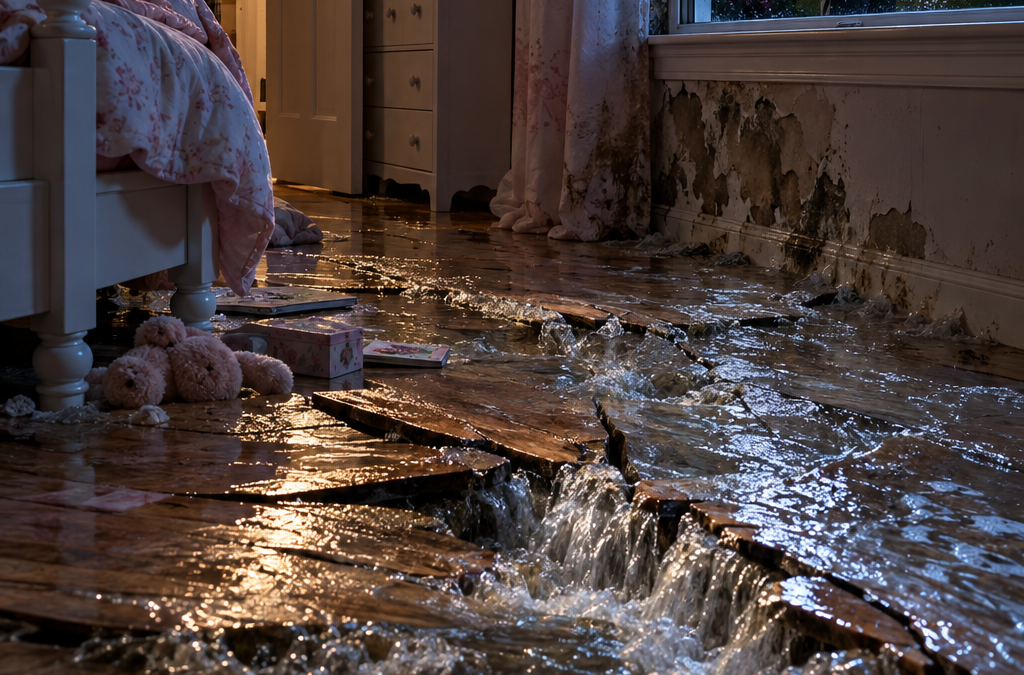
Her bedroom floor was wet.
Water was seeping from beneath the baseboard along the exterior wall. At first, it looked like a small leak. Then I stepped onto the rug and felt the floor shift slightly under my foot.
“Tom.”
He looked down.
Water was pooling beneath the laminate, pushing up in small bubbles.
Lily was standing on her bed, crying.
“Mom, what’s happening?”
I lifted her into my arms.
Tom ran outside with a flashlight.
I followed as far as the back door, rain blowing across my face.
Water was rushing through the trench.
Not away from the house.
Toward it.
The new trench had become a channel, carrying runoff straight along our foundation.
By morning, the drywall in Lily’s room had cracked.
A jagged line ran upward from the baseboard like a black vein.
The hallway door frame had shifted enough that the door scraped when closing.
Tom called a structural engineer.
His name was Peter Lawson, and he arrived that afternoon wearing boots, a rain jacket, and the blunt expression of a man used to seeing expensive mistakes.
He inspected the trench first.
Then the foundation.
Then Lily’s room.
He crouched near the crack in the drywall and ran his fingers along the seam.
Finally, he stood and looked at us.
“Someone graded this to point at your house.”
Tom went silent.
I felt my stomach drop.
“You mean accidentally?”
Peter looked out the window toward the trench.
“No. The slope is deliberate.”
I stared at him.
“Are you saying someone engineered this?”
“I’m saying this trench collects surface water and directs it toward your slab. Any competent drainage contractor would know that.”
Tom rubbed a hand over his face.
“What kind of damage are we looking at?”
“Potentially foundation movement, water intrusion, slab undermining. You need a full report, moisture assessment, and repair plan. And you need whoever authorized that trench to stop further flow immediately.”
“How much?”
Peter hesitated.
“Could be tens of thousands.”
Lily was sitting at the kitchen table drawing silently.
I looked toward her.
Our daughter’s bedroom was wet because someone had directed water under our house.
For the first time, fear turned into rage.
Not loud rage.
Cold rage.
The kind that makes your hands steady.
I pulled every HOA document I could find.
Meeting minutes.
Financial statements.
Project reports.
Quarterly updates.
Old newsletters.
If Karen had touched this drainage project, I wanted his fingerprints.
I found them in the public meeting minutes from six weeks earlier.
Buried halfway down page four.
President Coulter proposed drainage realignment near the Delgado property due to recurring runoff concerns adjacent to clubhouse common area. Motion carried.
Karen had written the minutes himself.
He had used our name.
Not “Lot 42.”
Not “side-yard easement.”
The Delgado property.
I printed it.
Then I kept reading.
In the quarterly financial report, I found a line item under common-area improvement expenditures.
Coulterfields LLC — Drainage and Landscape Realignment — $40,000.
Coulterfields.
Karen’s last name was Coulter.
At first, I thought it might be coincidence.
I knew better than to assume.
So I searched the state business registry.
Coulterfields LLC had been registered three weeks before the contract was issued.
The registered agent used a mailing address associated with Karen’s family trust.
No website.
No business history.
No contractor license I could find.
No evidence it had performed legitimate landscaping work anywhere else.
I sat at the kitchen table near midnight staring at the filing.
Rain tapped against the windows.
Tom was upstairs trying to dry Lily’s floor with fans we had rented from a hardware store.
The house smelled damp.
My daughter was sleeping in the guest room because her own room felt unsafe.
And Karen Coulter had paid forty thousand dollars in HOA funds to a company that looked like it existed on paper only.
For the first time in days, I laughed.
It was not a happy laugh.
It was the sound of something clicking into place.
This was never just about our lawn.
Or the mailbox.
Or Lily’s chalk.
The trench wasn’t random.
The fines weren’t random.
Karen had been using HOA authority like a weapon, and now the drainage work had left a paper trail tied directly to him.
I wanted to confront him immediately.
I wanted to pound on his door and throw the papers at his polished shoes.
But my father used to say you don’t corner a snake until you know where all the exits are.
So I waited.
I hired people instead.
A public adjuster.
A second structural engineer.
A water mitigation company.
Then a lawyer.
Her name was Priya Shah, and she specialized in HOA fraud and property-damage disputes.
When she came to our house, I walked her through Lily’s bedroom, the hallway crack, the side yard, and the trench.
Then I handed her the documents.
The meeting minutes.
The financial report.
The Coulterfields LLC filing.
The nonexistent county permit.
The engineer’s preliminary opinion.
Priya read quietly.
She didn’t gasp.
She didn’t make dramatic promises.
She simply turned page after page until she reached the business filing.
Then she looked at me.
“Do you know how rare it is for someone this arrogant to leave the trail this clean?”
Tom exhaled sharply.
“So we have something?”
Priya looked toward the wet wall.
“You have more than something.”
“What do we do?”
“First, we prevent further damage. Second, we preserve all evidence. Third, we notify the HOA and its insurer. Fourth, we file suit if they refuse responsibility.”
“And Karen?”
Priya closed the folder.
“We find out how many times he has done this.”
At the next open board meeting, Karen stood in front of the residents and announced a mandatory assessment for unexpected drainage repairs.
He wore a charcoal blazer, pressed white shirt, and dark trousers. His hair was perfect. His face was calm.
He looked straight at me while speaking.
“The recent weather has exposed urgent drainage concerns affecting several common areas,” he said. “The board is implementing a temporary assessment to protect property values and prevent future damage.”
Tom shifted beside me.
I kept my face still.
Karen continued.
“All homeowners will receive the assessment notice next week.”
I wrote down every word.
Then something brushed my arm.
Mr. Okafor, who lived two streets over, slipped a manila folder into my lap.
He didn’t look at me.
He simply leaned close and whispered, “Read it at home.”
Mr. Okafor was a retired forensic accountant.
I knew him only casually. He walked every morning, always in a brimmed hat, always polite.
That night, after Lily fell asleep in the guest room, Tom and I opened the folder.
Inside were copies of contracts.
Three years of them.
Drainage repair.
Landscape restoration.
Emergency erosion control.
Common-area grading.
Different company names.
Different projects.
But the pattern was the same.
Each company had been formed shortly before receiving HOA money.
Each had an address or registration connection tied to someone in Karen’s family.
A cousin.
A brother-in-law.
A nephew.
A relative with the Coulter name buried one layer back.
Some contracts had no completion photos.
Others referenced work that residents said had never been done.
A sticky note on top carried Mr. Okafor’s handwriting.
You are not the first. You are the first with a damaged foundation.
Tom sat back slowly.
“How much?”
I began adding the totals.
Fifteen thousand.
Twenty-two thousand.
Thirty-eight thousand.
Forty thousand.
The numbers climbed.
Over three years, the contracts reached well into six figures.
All disguised as neighborhood repairs.
All routed through entities that looked suspiciously like shells.
The trench beside our house wasn’t only retaliation.
It was cover.
Karen had needed a visible project to justify another payment.
We were not unlucky.
We were useful to him.
That realization made me feel physically ill.
My family’s home had become part of someone else’s fraud scheme.
The next morning, I gave the folder to Priya.
She read every page.
Then she said, “This changes the case.”
“How?”
“We still sue for property damage. But now we notify the appropriate authorities about potential fund misuse and civil fraud.”
Tom asked, “Will this become criminal?”
Priya chose her words carefully.
“That will depend on what investigators find. But if these records are accurate, yes, it could.”
The lawsuit was filed the following week.
Fifty thousand dollars in structural damages, mitigation costs, engineering fees, and related expenses.
Plus claims tied to civil fraud, improper HOA actions, and the unauthorized drainage project.
Priya also sent preservation letters demanding that the HOA retain emails, contractor records, board minutes, financial statements, invoices, and communications involving Coulterfields LLC and related companies.
Karen’s first response was not legal.
It was public.
He emailed the entire subdivision.
Subject line:
Statement Regarding False Allegations by Disgruntled Homeowner
In the email, Karen described our lawsuit as a smear campaign.
He said Tom and I had been repeatedly noncompliant with association standards.
He claimed the drainage project had been necessary due to long-standing runoff issues.
He said any damage to our home was likely the result of poor homeowner maintenance and exaggerated for financial gain.
Then came the sentence that sealed him.
The board was aware of the drainage realignment near the Delgado property, and all work was performed in good faith under my supervision.
Under my supervision.
Priya called me twenty minutes after receiving the forwarded email.
“Mara, did you see it?”
“Yes.”
“He just gave us Exhibit C.”
I stared at the screen.
“What part?”
“All of it. But especially his admission that the trench near your property was done under his supervision.”
“He thinks it helps him.”
“He thinks sounding confident makes things true.”
I almost laughed.
“Doesn’t it?”
“Not in court.”
The county attorney’s office opened its inquiry after receiving the shell-company filings, contracts, and financial records.
Investigators requested documents from the HOA.
They also contacted some of the vendors listed in past repair contracts.
Several had no legitimate business presence beyond a filing address.
One phone number was disconnected.
Another routed to a voicemail box that did not identify a company.
Coulterfields LLC became a central focus.
Karen’s confidence began to crack.
He stopped appearing at neighborhood events.
The fines stopped.
The HOA office no longer answered questions without copying its attorney.
At home, we were living with fans, plastic sheeting, and the dull constant fear that another storm would make everything worse.
Lily slept in the guest room for eight weeks.
She stopped inviting friends over.
One night, she asked me if the house was going to fall down.
I sat beside her bed and said no because that is what mothers say when they need their children to sleep.
Then I went into the bathroom and cried quietly so she wouldn’t hear me.
The legal process moved faster than I expected.
The emergency hearing was scheduled within weeks because of ongoing structural concerns and the risk of continued water intrusion.
Karen arrived in court wearing a dark suit and a face that looked carved from stone.
He didn’t look at me.
His attorney argued that the HOA had acted within its maintenance authority.
Priya stood and presented the documents.
The nonexistent permit.
The engineer’s report.
The meeting minutes naming the Delgado property.
The contract to Coulterfields LLC.
The business registration.
Karen’s own email admitting supervision of the drainage realignment.
The judge asked one question that made the room go still.
“Who approved payment to Coulterfields LLC?”
The HOA attorney began to answer generally.
The judge stopped him.
“I asked who approved it.”
After a pause, the answer came.
“President Coulter signed the authorization.”
Priya presented the signature page.
Karen’s signature sat there in dark ink.
The same sharp pressure I had seen on every fine notice.
The hearing did not take long after that.
The court ordered emergency remediation of the trench and required funds to be secured for our repairs pending further proceedings.
The HOA could not continue to deny responsibility for the drainage work while its own records tied Karen directly to the project.
Within a week, Karen was removed from the board.
Not gracefully.
Not quietly.
But completely.
An emergency board vote stripped him of authority and removed his access to association accounts and records.
The county investigation continued.
The shell-company contracts widened the matter far beyond our home.
What started as an HOA property dispute became an investigation into potential embezzlement and fraudulent use of association funds.
When neighbors learned the scope of it, the atmosphere in Brook Hollow changed almost overnight.
People began comparing stories.
One family remembered an emergency erosion assessment after a storm that had barely touched their part of the neighborhood.
Another resident had questioned a landscaping charge years earlier and then received a sudden wave of violation notices.
Mr. Okafor disclosed that he had been quietly collecting suspicious records because he recognized the pattern.
“I was waiting for someone with standing and damages,” he told me.
I smiled tiredly.
“Lucky us.”
He looked toward Lily’s repaired doorway.
“No, Mara. Unlucky you. Useful evidence, but unlucky you.”
That was the truth.
Winning did not erase what happened.
Our house still had to be repaired.
Lily still had nightmares when it rained.
Tom still walked the foundation after every storm with a flashlight.
I still felt my chest tighten when I saw orange survey flags anywhere in the neighborhood.
But repairs began.
The trench was filled and regraded properly by a qualified contractor approved through the court process, not Karen’s private network.
Drainage was redirected away from our house.
Foundation stabilization work began after the engineers finalized the plan.
The cracked drywall was removed.
Damaged flooring came up.
Moisture was treated.
The smell of damp concrete slowly faded.
The repair bills reached the number Priya had warned us about.
Fifty thousand dollars.
Karen was eventually ordered to personally cover our damages as part of the civil proceedings tied to his improper conduct and conflict-tainted project approval.
The HOA’s insurer became involved in separate claims, and the board had to unwind years of financial negligence, but the final result for our family was clear.
We would not pay for the damage Karen caused.
He would.
The felony fraud charges came later.
I learned about them from Priya before the news broke publicly.
The county alleged that Karen had misused HOA funds through shell contracts connected to his relatives and companies he controlled or influenced.
Coulterfields LLC was only one part of the case.
The total amount was still being calculated when charges were announced.
Karen’s attorney claimed the contracts reflected legitimate maintenance work and that any paperwork problems were administrative, not criminal.
That would be for the court to decide.
But for the first time, Karen Coulter was no longer standing at a podium deciding everyone else’s fate.
He was answering questions he couldn’t dismiss with a smile.
I watched from my porch the day the for-sale sign went up on his lawn.
His house looked different without him moving confidently around it.
The massive unpermitted shed still stood in the backyard then, visible above the fence.
Funny how property values work both ways.
Tom stood beside me.
“Do you feel bad?”
I thought about Lily’s wet floor.
The crack in the drywall.
The nights we spent listening to rain like it was an enemy.
The fines.
The threats.
The fake permit.
The trench angled toward our foundation.
“No,” I said.
Then, after a moment, I added, “I feel tired.”
Tom nodded.
“Me too.”
Months passed before our house felt like ours again.
Lily moved back into her room after the repairs were done.
We repainted the walls pale green because she said she never wanted to see the old color again.
Tom installed new baseboards himself.
I bought a rug with sunflowers on it.
The first night she slept there again, rain started just after midnight.
I woke instantly.
So did Tom.
We both lay still, listening.
No groan.
No cracking.
No water.
Only rain against the roof, moving through gutters that now carried it safely away.
I got up anyway.
I checked Lily’s room.
She was asleep, one arm wrapped around her stuffed rabbit.
The floor was dry.
I stood there longer than necessary.
Then I went back to bed.
Brook Hollow changed after Karen.
The new board hired an outside management company temporarily and brought in an independent accountant to review past contracts.
Meeting minutes became detailed.
Vendor bids were posted.
Conflict disclosures became mandatory.
No single officer could authorize payments to a company without documented board review.
The rules still existed.
Grass height still mattered to some people more than I thought reasonable.
Mailbox colors still appeared in guidelines.
But the neighborhood no longer felt like one man’s kingdom.
At the first annual meeting after Karen’s removal, Mr. Okafor stood and proposed a finance committee.
The motion passed overwhelmingly.
Denise leaned over and whispered, “He’s the scariest kind of retired man.”
“What kind?”
“The kind with time and spreadsheets.”
I laughed for the first time in that clubhouse.
Not politely.
Really laughed.
Karen’s name came up less often as months went by.
The legal case continued, of course. Criminal matters move at their own pace. His lawyers filed motions. The county responded. More records surfaced.
But in the neighborhood, life slowly returned to ordinary concerns.
Snow removal.
Pool hours.
Landscaping contracts.
Whether the clubhouse coffee machine should be replaced.
I attended more meetings than I used to.
Not because I loved HOA politics.
I hated them.
But I had learned the cost of not reading the minutes.
Karen had counted on residents being too busy, too trusting, or too intimidated to look closely.
He wrote our name directly into the minutes and assumed nobody would ever read the PDF.
He paid a shell company and assumed nobody would search the registry.
He sent threats and assumed fear would do the rest.
For a while, it did.
Then the house groaned in the middle of the night.
And I started reading everything.
One Saturday in late spring, after the final foundation inspection passed, we hosted a small barbecue in our backyard.
Nothing formal.
Just neighbors who had helped us, believed us, or handed us documents at exactly the right time.
Mr. Okafor came with a folder under his arm.
Tom pointed at it.
“No paperwork today.”
Mr. Okafor smiled.
“This is not paperwork. It is lemon cake.”
He opened the folder.
Inside, wrapped carefully in foil, was a cake.
Denise nearly fell over laughing.
Lily invited a few friends, and for the first time in almost a year, children ran through our yard without anyone worrying about violation letters.
At one point, Lily drew a chalk rainbow on the patio.
She looked at me afterward, uncertain.
“Is this okay?”
My throat tightened.
“Yes,” I said. “It’s okay.”
She smiled and kept drawing.
I looked toward the side yard where the trench had been.
Fresh grass covered it now.
If you didn’t know what had happened, you would never see the scar.
But I saw it.
I always would.
Not in a fearful way.
In a remembering way.
That strip of yard taught me that damage can be deliberate even when it arrives dressed as maintenance.
It taught me that paperwork can be a weapon or a shield depending on who holds it.
And it taught me that people who abuse power often rely on everyone else being too polite to say the obvious.
Karen Coulter hated us because we bought a house his cousin wanted.
That was petty.
He fined us for ordinary things to make our lives miserable.
That was cruel.
He directed a drainage project toward our foundation and used a shell company to profit from it.
That was something much darker.
But he made one mistake.
He assumed my family would only react emotionally.
He thought I would cry over my daughter’s flooded room, rage at a board meeting, and then collapse under the stress.
I did cry.
I did rage.
But then I organized.
I hired experts.
I read minutes.
I followed money.
And I let people who understood structure, law, insurance, and fraud turn his own documents against him.
Near sunset, after the barbecue, I stood on the porch watching Tom and Lily collect paper plates from the backyard.
Our foundation was fixed.
The trench was filled.
The lawsuit had forced accountability.
The criminal case was moving forward.
Karen’s for-sale sign still stood two streets over.
I thought about the night we heard the house crack.
That awful groan.
The water under Lily’s floor.
The fear in Tom’s face.
For a long time, that sound had lived inside me.
But standing there in the quiet evening, I realized something had changed.
When I remembered it now, I no longer heard only the house breaking.
I heard the beginning of the collapse Karen had built for himself.
His scheme had held for years because it was hidden beneath routine words.
Drainage.
Maintenance.
Assessment.
Property values.
But lies can only carry weight for so long.
Eventually, something cracks.
For us, it was the foundation.
For Karen, it was the paper trail.
The next morning, I walked outside with coffee and stood near the side yard.
The grass was wet with dew.
Water from the overnight rain had drained properly into the corrected swale, away from the house, away from Lily’s room, away from everything Karen had tried to damage.
I looked toward the clubhouse lot.
Then toward our walls.
Solid.
Quiet.
Still standing.
I thought about Karen’s welcome-barbecue smile.
“You’ll love it here,” he had said.
He wasn’t entirely wrong.
I did love our home.
Not because Brook Hollow was perfect.
Not because the HOA protected us.
Not because the quiet streets had stayed quiet.
I loved it because we had fought for it.
Because Tom repaired what could be repaired.
Because Lily slept safely in her room again.
Because neighbors who had been afraid started speaking.
Because Mr. Okafor’s folders were sharper than Karen’s lies.
Because the house that groaned in the dark did not fall.
Karen Coulter wanted our property to become a warning.
He wanted fines, water, and legal threats to drive us out.
Instead, our house became evidence.
His signature on the drainage proposal.
His company in the financial report.
His email admitting supervision.
His shell contracts.
His relatives’ names.
His own paper trail buried him deeper than that trench ever could.
I finished my coffee and walked back inside.
Lily was at the kitchen table, eating cereal and reading a library book.
Tom was checking repair receipts one last time before filing them away.
Normal things.
Beautiful things.
The kind of things that seem small until someone almost takes them from you.
I opened the cabinet where we kept the HOA folder.
It was thick now.
Too thick.
I placed the final foundation inspection inside, right on top of the court order requiring Karen to cover the repairs.
Then I closed it.
For once, I didn’t feel the need to reopen it.
The house was dry.
The foundation was stable.
The trench was gone.
And the man who had tried to turn an HOA grudge into a financial scheme was finally facing consequences strong enough to match the damage he caused.
That was enough.
For that morning, it was more than enough.
𝗧𝗛𝗘 𝗘𝗡𝗗
The Night My Daughter’s Bedroom Floor Filled With Water, I Finally Understood Why the HOA President Had Been Watching Our House
The sound came first, a deep groan under the walls like the house was trying to warn us before it broke. By the time water spread beneath my daughter’s bedroom floor, I already knew whose name belonged on that flood.
My name is Mara Delgado, and six months before my foundation cracked, I thought moving to a quiet Ohio subdivision would give my family the peaceful life we had been chasing for years.
I was wrong.
Peace, I learned, can be staged.
It can be trimmed into perfect lawns, painted across matching mailboxes, and sold behind entrance signs carved into stone. It can look like children riding bikes in cul-de-sacs, neighbors waving from porches, and a homeowners association promising to protect property values.
But peace is not the same thing as control.
And in Brook Hollow Estates, control belonged to one man.
Karen Coulter.
He was fifty years old, tall, sharp-featured, and always dressed like he expected photographers to appear at any moment. Pressed linen shirts in summer. Expensive sweaters in fall. Polished loafers even when walking construction sites. His silver-black hair was combed back perfectly, and his smile had the polished calm of a man who had spent years practicing how to sound reasonable while ruining people’s lives.
When we first met him, he seemed harmless.
That was the worst part.
Tom and I had just moved in with our daughter, Lily. She was eight then, still young enough to believe a new house meant instant adventure. She picked the back bedroom because it had a view of the maple tree and a corner where she planned to put her reading tent.
The house was not enormous, but it was ours.
Three bedrooms. Brick front. Finished basement. A small backyard sloping gently toward a drainage swale we were told belonged to the association’s common area.
After years of renting and saving, it felt like a miracle.
Tom worked as a project manager for a regional plumbing supplier. I managed billing for a small medical clinic in Dayton, mostly from home. We had spent more than a decade trying to buy somewhere stable. Somewhere Lily could grow up without hearing us whisper about rent increases through the wall after she went to bed.
Brook Hollow seemed perfect.
The schools were strong. The streets were quiet. The neighborhood was full of families. The listing said the HOA kept everything orderly but fair.
Orderly sounded good.
Fair sounded better.
Two weeks after we moved in, the association hosted a welcome barbecue near the clubhouse.
The clubhouse sat beside a small common green two lots down from our property line. It had white columns, a covered patio, and flower beds maintained so carefully they looked artificial.
Karen Coulter greeted us near the buffet table.
“Mara Delgado,” he said warmly, as though we had known each other for years. “And Tom, of course. Welcome to Brook Hollow.”
He shook Tom’s hand first, then mine.
His grip was firm.
His eyes were assessing.
“This is Lily,” I said.
Lily hid halfway behind me, holding a paper plate with a hot dog and far too many potato chips.
Karen bent slightly.
“Well, hello there. You’re going to love it here.”
I remember his exact smile.
It was smooth, practiced, confident.
Then he looked back at me.
“You’ll all love it here.”
At the time, I believed him.
Why wouldn’t I?
Neighbors introduced themselves. Kids played near the picnic tables. Someone offered Tom a beer. A woman named Denise told me which grocery store had the best produce and which pediatric dentist everyone used.
Karen moved through the crowd like a mayor.
People smiled when he approached.
But their shoulders tightened.
I noticed that even then.
I didn’t understand it.
When he walked away, a woman beside me leaned close and said, “Just make sure you read the rules.”
I laughed lightly.
“Are they that bad?”
She looked toward Karen.
“The rules? Not really.”
Then she lowered her voice.
“Karen is another matter.”
I should have asked more.
I didn’t.
I was still too busy believing in the life we had just bought.
The first violation arrived twelve days later.
Our grass, according to Karen, exceeded the HOA limit by half an inch.
Half an inch.
The notice included a grainy photograph of our front yard taken from the sidewalk. It had Karen’s signature at the bottom in dark blue ink, all sharp loops and heavy pressure.
I stood in the kitchen reading it while Tom unpacked a box of dishes.
“Is this real?” I asked.
He took the paper.
“Grass height?”
“Half an inch.”
He laughed.
I laughed too.
What else could we do?
We paid the fine, mowed the grass, and told ourselves this was just part of living somewhere with community standards.
Then came the mailbox letter.
Apparently, our mailbox had been painted a shade of black that did not conform to the approved “deep bronze-black” finish listed in a 2009 architectural addendum.
Tom stared at the notice.
“Deep bronze-black?”
“It looks black to me.”
“It is black.”
“Apparently not the right kind.”
We paid that one too.
Then came the chalk drawings.
Lily had drawn stars and flowers on the driveway after school. Pink stars. Blue flowers. A yellow moon with a smiling face. The next morning, Karen issued a warning for “unapproved visible markings on hardscape surfaces.”
That one hurt.
Not because of the money.
Because Lily saw me washing the chalk away.
“Did I do something wrong?” she asked.
I knelt beside her.
“No, baby. You didn’t.”
“Then why does it have to go?”
Because a man with a title had decided her sidewalk flowers offended property values.
I didn’t say that.
I told her it might rain anyway.
She didn’t believe me.
Children know when adults are lying gently.
The fines became more frequent.
A trash can left out an hour early.
A porch planter allegedly too close to the walkway.
A welcome mat with colors that didn’t match the seasonal guideline.
Each letter came with Karen’s signature.
Each one sounded polite in the way threats often do when printed on official stationery.
Failure to cure may result in additional assessments.
Continued noncompliance may be referred to the HOA attorney.
Unpaid fines may become subject to collection remedies, including lien action.
Lien.
That word made Tom stop laughing.
It made me start saving everything.
I bought a file box and labeled it HOA.
At first, I felt ridiculous.
Who keeps a file over chalk drawings and trash cans?
People being targeted, apparently.
The first time I tried reasoning with Karen, I did it at an open board meeting.
The clubhouse was nearly full that night. Maybe thirty people sat in folding chairs, most watching silently while Karen stood at the front table with a binder opened before him.
He conducted the meeting like a judge.
Not a president.
A judge.
Every question from a resident received the same calm smile before he dismissed it.
When homeowners’ comments opened, I stood.
“My name is Mara Delgado. I’d like clarification on recent violations issued to my property.”
Karen looked directly at me.
“Of course, Mara.”
His tone was warm.
His eyes were not.
I held up the chalk notice.
“This was issued after my daughter drew on our driveway with sidewalk chalk. It washed away the same day. Is this really something the HOA considers a violation?”
Karen smiled.
“The rules exist to protect property values.”
“I understand that, but children using washable chalk seems different from permanent markings.”
“We cannot enforce rules emotionally.”
A few people shifted in their seats.
Tom, beside me, crossed his arms.
I took a breath.
“What about consistency? Other homes have visible decorations and structures that seem outside the guidelines.”
Karen tilted his head.
“If you have a specific concern, submit it in writing.”
“I’m asking generally.”
“And I’m answering generally.”
His smile sharpened.
“The board applies rules as needed to preserve community standards.”
As needed.
I didn’t like those words.
They meant rules could sleep until Karen wanted them awake.
That night, while Tom put Lily to bed, I searched through neighborhood photos on the HOA website.
That was when I found Karen’s shed.
It appeared in the background of a photo from the previous year’s fall festival. A large wooden shed sat behind Karen’s house, visible over the fence. It was easily twice the size allowed by the architectural standards.
The rules limited backyard storage structures to eight by ten feet.
Karen’s shed looked closer to sixteen by twenty.
I checked permit records.
Nothing.
No county permit.
No HOA variance posted in the minutes.
The man who fined Lily for chalk had an unpermitted shed nearly the size of a garage.
When I mentioned it to Denise the next morning, she looked around before answering.
“You didn’t hear this from me.”
“Hear what?”
“Karen has hated your house since before you bought it.”
I frowned.
“What does that mean?”
“His cousin wanted your lot.”
I stared at her.
“Our house?”
“He thought he had it. Then you and Tom outbid him.”
“That was two years ago.”
She nodded.
“Karen remembers.”
I almost laughed.
A grudge over real estate sounded like something from a bad soap opera.
But the fines kept coming.
Three hundred dollars.
Then eight hundred.
Then a combined enforcement statement with late fees and warnings about lien action.
And all of it started to feel less like governance and more like punishment.
Then one morning, I found survey stakes in our side yard.
Bright orange flags had been driven into the ground along the property line we shared with the clubhouse lot.
I stood there in my robe, coffee cooling in one hand, staring at them.
Tom came out behind me.
“What are those?”
“I don’t know.”
By midmorning, a man in a reflective vest appeared with a clipboard.
I walked outside.
“Excuse me. What’s happening?”
“Drainage improvement,” he said.
“On our property?”
“Common easement.”
“Who authorized it?”
“The HOA.”
He waved a document in my direction, but he didn’t hand it to me.
I caught only a few words.
Drainage Correction Permit.
Brook Hollow Estates.
Common Area Realignment.
I asked for a copy.
He told me to contact the board.
So I called the county.
No permit existed.
Not for drainage correction.
Not for grading work.
Not for excavation beside our lot.
When I emailed Karen, he replied three hours later.
The project is board approved and falls within the association’s maintenance authority.
No permit copy.
No engineering plan.
No explanation.
Two weeks later, contractors arrived with a mini excavator.
They dug a trench along the clubhouse side of our property line.
Eleven feet long.
Angled toward our foundation.
I stood outside with Tom while the machine chewed through the grass.
“This can’t be right,” Tom said.
The contractor avoided eye contact.
I called Karen.
He didn’t answer.
I emailed.
No response.
So I walked to the clubhouse office and found him inside, standing beside a copier with his reading glasses low on his nose.
“Karen, they’re digging beside our house.”
He looked up calmly.
“Yes. I’m aware.”
“They’re pointing a trench toward our foundation.”
“That’s not accurate.”
“I’m looking at it.”
“The drainage work follows the approved alignment.”
“Approved by who?”
“The board.”
“Show me the vote.”
He removed his glasses slowly.
“Mara, you need to stop treating every maintenance decision as a personal attack.”
I felt heat rise in my face.
“Then stop making decisions that damage my property.”
His expression hardened.
“That’s a serious accusation.”
“It’s a serious trench.”
He smiled slightly.
A tiny smile.
The kind people wear when they know something you don’t.
“The work runs through the common easement. Your property is not being damaged.”
I stepped closer.
“If water comes toward my house, you’re going to have a problem.”
He folded his arms.
“Threatening the HOA won’t help you.”
“I’m not threatening you. I’m documenting this.”
His face changed.
Only for a second.
But I saw it.
Documentation bothered him.
That night, it rained for the first time in almost a month.
Not a gentle rain.
A hard, driving storm that started just before midnight.
I woke to thunder shaking the windows.
For a few minutes, I lay still, listening.
Then I heard something beneath the house.
A groan.
Deep.
Slow.
Wrong.
It sounded like wood and concrete straining together.
Tom sat up.
“What was that?”
Another sound followed.
A sharp crack from somewhere under the floor.
Then Lily screamed.
We ran down the hall.
Her bedroom floor was wet.
Water was seeping from beneath the baseboard along the exterior wall. At first, it looked like a small leak. Then I stepped onto the rug and felt the floor shift slightly under my foot.
“Tom.”
He looked down.
Water was pooling beneath the laminate, pushing up in small bubbles.
Lily was standing on her bed, crying.
“Mom, what’s happening?”
I lifted her into my arms.
Tom ran outside with a flashlight.
I followed as far as the back door, rain blowing across my face.
Water was rushing through the trench.
Not away from the house.
Toward it.
The new trench had become a channel, carrying runoff straight along our foundation.
By morning, the drywall in Lily’s room had cracked.
A jagged line ran upward from the baseboard like a black vein.
The hallway door frame had shifted enough that the door scraped when closing.
Tom called a structural engineer.
His name was Peter Lawson, and he arrived that afternoon wearing boots, a rain jacket, and the blunt expression of a man used to seeing expensive mistakes.
He inspected the trench first.
Then the foundation.
Then Lily’s room.
He crouched near the crack in the drywall and ran his fingers along the seam.
Finally, he stood and looked at us.
“Someone graded this to point at your house.”
Tom went silent.
I felt my stomach drop.
“You mean accidentally?”
Peter looked out the window toward the trench.
“No. The slope is deliberate.”
I stared at him.
“Are you saying someone engineered this?”
“I’m saying this trench collects surface water and directs it toward your slab. Any competent drainage contractor would know that.”
Tom rubbed a hand over his face.
“What kind of damage are we looking at?”
“Potentially foundation movement, water intrusion, slab undermining. You need a full report, moisture assessment, and repair plan. And you need whoever authorized that trench to stop further flow immediately.”
“How much?”
Peter hesitated.
“Could be tens of thousands.”
Lily was sitting at the kitchen table drawing silently.
I looked toward her.
Our daughter’s bedroom was wet because someone had directed water under our house.
For the first time, fear turned into rage.
Not loud rage.
Cold rage.
The kind that makes your hands steady.
I pulled every HOA document I could find.
Meeting minutes.
Financial statements.
Project reports.
Quarterly updates.
Old newsletters.
If Karen had touched this drainage project, I wanted his fingerprints.
I found them in the public meeting minutes from six weeks earlier.
Buried halfway down page four.
President Coulter proposed drainage realignment near the Delgado property due to recurring runoff concerns adjacent to clubhouse common area. Motion carried.
Karen had written the minutes himself.
He had used our name.
Not “Lot 42.”
Not “side-yard easement.”
The Delgado property.
I printed it.
Then I kept reading.
In the quarterly financial report, I found a line item under common-area improvement expenditures.
Coulterfields LLC — Drainage and Landscape Realignment — $40,000.
Coulterfields.
Karen’s last name was Coulter.
At first, I thought it might be coincidence.
I knew better than to assume.
So I searched the state business registry.
Coulterfields LLC had been registered three weeks before the contract was issued.
The registered agent used a mailing address associated with Karen’s family trust.
No website.
No business history.
No contractor license I could find.
No evidence it had performed legitimate landscaping work anywhere else.
I sat at the kitchen table near midnight staring at the filing.
Rain tapped against the windows.
Tom was upstairs trying to dry Lily’s floor with fans we had rented from a hardware store.
The house smelled damp.
My daughter was sleeping in the guest room because her own room felt unsafe.
And Karen Coulter had paid forty thousand dollars in HOA funds to a company that looked like it existed on paper only.
For the first time in days, I laughed.
It was not a happy laugh.
It was the sound of something clicking into place.
This was never just about our lawn.
Or the mailbox.
Or Lily’s chalk.
The trench wasn’t random.
The fines weren’t random.
Karen had been using HOA authority like a weapon, and now the drainage work had left a paper trail tied directly to him.
I wanted to confront him immediately.
I wanted to pound on his door and throw the papers at his polished shoes.
But my father used to say you don’t corner a snake until you know where all the exits are.
So I waited.
I hired people instead.
A public adjuster.
A second structural engineer.
A water mitigation company.
Then a lawyer.
Her name was Priya Shah, and she specialized in HOA fraud and property-damage disputes.
When she came to our house, I walked her through Lily’s bedroom, the hallway crack, the side yard, and the trench.
Then I handed her the documents.
The meeting minutes.
The financial report.
The Coulterfields LLC filing.
The nonexistent county permit.
The engineer’s preliminary opinion.
Priya read quietly.
She didn’t gasp.
She didn’t make dramatic promises.
She simply turned page after page until she reached the business filing.
Then she looked at me.
“Do you know how rare it is for someone this arrogant to leave the trail this clean?”
Tom exhaled sharply.
“So we have something?”
Priya looked toward the wet wall.
“You have more than something.”
“What do we do?”
“First, we prevent further damage. Second, we preserve all evidence. Third, we notify the HOA and its insurer. Fourth, we file suit if they refuse responsibility.”
“And Karen?”
Priya closed the folder.
“We find out how many times he has done this.”
At the next open board meeting, Karen stood in front of the residents and announced a mandatory assessment for unexpected drainage repairs.
He wore a charcoal blazer, pressed white shirt, and dark trousers. His hair was perfect. His face was calm.
He looked straight at me while speaking.
“The recent weather has exposed urgent drainage concerns affecting several common areas,” he said. “The board is implementing a temporary assessment to protect property values and prevent future damage.”
Tom shifted beside me.
I kept my face still.
Karen continued.
“All homeowners will receive the assessment notice next week.”
I wrote down every word.
Then something brushed my arm.
Mr. Okafor, who lived two streets over, slipped a manila folder into my lap.
He didn’t look at me.
He simply leaned close and whispered, “Read it at home.”
Mr. Okafor was a retired forensic accountant.
I knew him only casually. He walked every morning, always in a brimmed hat, always polite.
That night, after Lily fell asleep in the guest room, Tom and I opened the folder.
Inside were copies of contracts.
Three years of them.
Drainage repair.
Landscape restoration.
Emergency erosion control.
Common-area grading.
Different company names.
Different projects.
But the pattern was the same.
Each company had been formed shortly before receiving HOA money.
Each had an address or registration connection tied to someone in Karen’s family.
A cousin.
A brother-in-law.
A nephew.
A relative with the Coulter name buried one layer back.
Some contracts had no completion photos.
Others referenced work that residents said had never been done.
A sticky note on top carried Mr. Okafor’s handwriting.
You are not the first. You are the first with a damaged foundation.
Tom sat back slowly.
“How much?”
I began adding the totals.
Fifteen thousand.
Twenty-two thousand.
Thirty-eight thousand.
Forty thousand.
The numbers climbed.
Over three years, the contracts reached well into six figures.
All disguised as neighborhood repairs.
All routed through entities that looked suspiciously like shells.
The trench beside our house wasn’t only retaliation.
It was cover.
Karen had needed a visible project to justify another payment.
We were not unlucky.
We were useful to him.
That realization made me feel physically ill.
My family’s home had become part of someone else’s fraud scheme.
The next morning, I gave the folder to Priya.
She read every page.
Then she said, “This changes the case.”
“How?”
“We still sue for property damage. But now we notify the appropriate authorities about potential fund misuse and civil fraud.”
Tom asked, “Will this become criminal?”
Priya chose her words carefully.
“That will depend on what investigators find. But if these records are accurate, yes, it could.”
The lawsuit was filed the following week.
Fifty thousand dollars in structural damages, mitigation costs, engineering fees, and related expenses.
Plus claims tied to civil fraud, improper HOA actions, and the unauthorized drainage project.
Priya also sent preservation letters demanding that the HOA retain emails, contractor records, board minutes, financial statements, invoices, and communications involving Coulterfields LLC and related companies.
Karen’s first response was not legal.
It was public.
He emailed the entire subdivision.
Subject line:
Statement Regarding False Allegations by Disgruntled Homeowner
In the email, Karen described our lawsuit as a smear campaign.
He said Tom and I had been repeatedly noncompliant with association standards.
He claimed the drainage project had been necessary due to long-standing runoff issues.
He said any damage to our home was likely the result of poor homeowner maintenance and exaggerated for financial gain.
Then came the sentence that sealed him.
The board was aware of the drainage realignment near the Delgado property, and all work was performed in good faith under my supervision.
Under my supervision.
Priya called me twenty minutes after receiving the forwarded email.
“Mara, did you see it?”
“Yes.”
“He just gave us Exhibit C.”
I stared at the screen.
“What part?”
“All of it. But especially his admission that the trench near your property was done under his supervision.”
“He thinks it helps him.”
“He thinks sounding confident makes things true.”
I almost laughed.
“Doesn’t it?”
“Not in court.”
The county attorney’s office opened its inquiry after receiving the shell-company filings, contracts, and financial records.
Investigators requested documents from the HOA.
They also contacted some of the vendors listed in past repair contracts.
Several had no legitimate business presence beyond a filing address.
One phone number was disconnected.
Another routed to a voicemail box that did not identify a company.
Coulterfields LLC became a central focus.
Karen’s confidence began to crack.
He stopped appearing at neighborhood events.
The fines stopped.
The HOA office no longer answered questions without copying its attorney.
At home, we were living with fans, plastic sheeting, and the dull constant fear that another storm would make everything worse.
Lily slept in the guest room for eight weeks.
She stopped inviting friends over.
One night, she asked me if the house was going to fall down.
I sat beside her bed and said no because that is what mothers say when they need their children to sleep.
Then I went into the bathroom and cried quietly so she wouldn’t hear me.
The legal process moved faster than I expected.
The emergency hearing was scheduled within weeks because of ongoing structural concerns and the risk of continued water intrusion.
Karen arrived in court wearing a dark suit and a face that looked carved from stone.
He didn’t look at me.
His attorney argued that the HOA had acted within its maintenance authority.
Priya stood and presented the documents.
The nonexistent permit.
The engineer’s report.
The meeting minutes naming the Delgado property.
The contract to Coulterfields LLC.
The business registration.
Karen’s own email admitting supervision of the drainage realignment.
The judge asked one question that made the room go still.
“Who approved payment to Coulterfields LLC?”
The HOA attorney began to answer generally.
The judge stopped him.
“I asked who approved it.”
After a pause, the answer came.
“President Coulter signed the authorization.”
Priya presented the signature page.
Karen’s signature sat there in dark ink.
The same sharp pressure I had seen on every fine notice.
The hearing did not take long after that.
The court ordered emergency remediation of the trench and required funds to be secured for our repairs pending further proceedings.
The HOA could not continue to deny responsibility for the drainage work while its own records tied Karen directly to the project.
Within a week, Karen was removed from the board.
Not gracefully.
Not quietly.
But completely.
An emergency board vote stripped him of authority and removed his access to association accounts and records.
The county investigation continued.
The shell-company contracts widened the matter far beyond our home.
What started as an HOA property dispute became an investigation into potential embezzlement and fraudulent use of association funds.
When neighbors learned the scope of it, the atmosphere in Brook Hollow changed almost overnight.
People began comparing stories.
One family remembered an emergency erosion assessment after a storm that had barely touched their part of the neighborhood.
Another resident had questioned a landscaping charge years earlier and then received a sudden wave of violation notices.
Mr. Okafor disclosed that he had been quietly collecting suspicious records because he recognized the pattern.
“I was waiting for someone with standing and damages,” he told me.
I smiled tiredly.
“Lucky us.”
He looked toward Lily’s repaired doorway.
“No, Mara. Unlucky you. Useful evidence, but unlucky you.”
That was the truth.
Winning did not erase what happened.
Our house still had to be repaired.
Lily still had nightmares when it rained.
Tom still walked the foundation after every storm with a flashlight.
I still felt my chest tighten when I saw orange survey flags anywhere in the neighborhood.
But repairs began.
The trench was filled and regraded properly by a qualified contractor approved through the court process, not Karen’s private network.
Drainage was redirected away from our house.
Foundation stabilization work began after the engineers finalized the plan.
The cracked drywall was removed.
Damaged flooring came up.
Moisture was treated.
The smell of damp concrete slowly faded.
The repair bills reached the number Priya had warned us about.
Fifty thousand dollars.
Karen was eventually ordered to personally cover our damages as part of the civil proceedings tied to his improper conduct and conflict-tainted project approval.
The HOA’s insurer became involved in separate claims, and the board had to unwind years of financial negligence, but the final result for our family was clear.
We would not pay for the damage Karen caused.
He would.
The felony fraud charges came later.
I learned about them from Priya before the news broke publicly.
The county alleged that Karen had misused HOA funds through shell contracts connected to his relatives and companies he controlled or influenced.
Coulterfields LLC was only one part of the case.
The total amount was still being calculated when charges were announced.
Karen’s attorney claimed the contracts reflected legitimate maintenance work and that any paperwork problems were administrative, not criminal.
That would be for the court to decide.
But for the first time, Karen Coulter was no longer standing at a podium deciding everyone else’s fate.
He was answering questions he couldn’t dismiss with a smile.
I watched from my porch the day the for-sale sign went up on his lawn.
His house looked different without him moving confidently around it.
The massive unpermitted shed still stood in the backyard then, visible above the fence.
Funny how property values work both ways.
Tom stood beside me.
“Do you feel bad?”
I thought about Lily’s wet floor.
The crack in the drywall.
The nights we spent listening to rain like it was an enemy.
The fines.
The threats.
The fake permit.
The trench angled toward our foundation.
“No,” I said.
Then, after a moment, I added, “I feel tired.”
Tom nodded.
“Me too.”
Months passed before our house felt like ours again.
Lily moved back into her room after the repairs were done.
We repainted the walls pale green because she said she never wanted to see the old color again.
Tom installed new baseboards himself.
I bought a rug with sunflowers on it.
The first night she slept there again, rain started just after midnight.
I woke instantly.
So did Tom.
We both lay still, listening.
No groan.
No cracking.
No water.
Only rain against the roof, moving through gutters that now carried it safely away.
I got up anyway.
I checked Lily’s room.
She was asleep, one arm wrapped around her stuffed rabbit.
The floor was dry.
I stood there longer than necessary.
Then I went back to bed.
Brook Hollow changed after Karen.
The new board hired an outside management company temporarily and brought in an independent accountant to review past contracts.
Meeting minutes became detailed.
Vendor bids were posted.
Conflict disclosures became mandatory.
No single officer could authorize payments to a company without documented board review.
The rules still existed.
Grass height still mattered to some people more than I thought reasonable.
Mailbox colors still appeared in guidelines.
But the neighborhood no longer felt like one man’s kingdom.
At the first annual meeting after Karen’s removal, Mr. Okafor stood and proposed a finance committee.
The motion passed overwhelmingly.
Denise leaned over and whispered, “He’s the scariest kind of retired man.”
“What kind?”
“The kind with time and spreadsheets.”
I laughed for the first time in that clubhouse.
Not politely.
Really laughed.
Karen’s name came up less often as months went by.
The legal case continued, of course. Criminal matters move at their own pace. His lawyers filed motions. The county responded. More records surfaced.
But in the neighborhood, life slowly returned to ordinary concerns.
Snow removal.
Pool hours.
Landscaping contracts.
Whether the clubhouse coffee machine should be replaced.
I attended more meetings than I used to.
Not because I loved HOA politics.
I hated them.
But I had learned the cost of not reading the minutes.
Karen had counted on residents being too busy, too trusting, or too intimidated to look closely.
He wrote our name directly into the minutes and assumed nobody would ever read the PDF.
He paid a shell company and assumed nobody would search the registry.
He sent threats and assumed fear would do the rest.
For a while, it did.
Then the house groaned in the middle of the night.
And I started reading everything.
One Saturday in late spring, after the final foundation inspection passed, we hosted a small barbecue in our backyard.
Nothing formal.
Just neighbors who had helped us, believed us, or handed us documents at exactly the right time.
Mr. Okafor came with a folder under his arm.
Tom pointed at it.
“No paperwork today.”
Mr. Okafor smiled.
“This is not paperwork. It is lemon cake.”
He opened the folder.
Inside, wrapped carefully in foil, was a cake.
Denise nearly fell over laughing.
Lily invited a few friends, and for the first time in almost a year, children ran through our yard without anyone worrying about violation letters.
At one point, Lily drew a chalk rainbow on the patio.
She looked at me afterward, uncertain.
“Is this okay?”
My throat tightened.
“Yes,” I said. “It’s okay.”
She smiled and kept drawing.
I looked toward the side yard where the trench had been.
Fresh grass covered it now.
If you didn’t know what had happened, you would never see the scar.
But I saw it.
I always would.
Not in a fearful way.
In a remembering way.
That strip of yard taught me that damage can be deliberate even when it arrives dressed as maintenance.
It taught me that paperwork can be a weapon or a shield depending on who holds it.
And it taught me that people who abuse power often rely on everyone else being too polite to say the obvious.
Karen Coulter hated us because we bought a house his cousin wanted.
That was petty.
He fined us for ordinary things to make our lives miserable.
That was cruel.
He directed a drainage project toward our foundation and used a shell company to profit from it.
That was something much darker.
But he made one mistake.
He assumed my family would only react emotionally.
He thought I would cry over my daughter’s flooded room, rage at a board meeting, and then collapse under the stress.
I did cry.
I did rage.
But then I organized.
I hired experts.
I read minutes.
I followed money.
And I let people who understood structure, law, insurance, and fraud turn his own documents against him.
Near sunset, after the barbecue, I stood on the porch watching Tom and Lily collect paper plates from the backyard.
Our foundation was fixed.
The trench was filled.
The lawsuit had forced accountability.
The criminal case was moving forward.
Karen’s for-sale sign still stood two streets over.
I thought about the night we heard the house crack.
That awful groan.
The water under Lily’s floor.
The fear in Tom’s face.
For a long time, that sound had lived inside me.
But standing there in the quiet evening, I realized something had changed.
When I remembered it now, I no longer heard only the house breaking.
I heard the beginning of the collapse Karen had built for himself.
His scheme had held for years because it was hidden beneath routine words.
Drainage.
Maintenance.
Assessment.
Property values.
But lies can only carry weight for so long.
Eventually, something cracks.
For us, it was the foundation.
For Karen, it was the paper trail.
The next morning, I walked outside with coffee and stood near the side yard.
The grass was wet with dew.
Water from the overnight rain had drained properly into the corrected swale, away from the house, away from Lily’s room, away from everything Karen had tried to damage.
I looked toward the clubhouse lot.
Then toward our walls.
Solid.
Quiet.
Still standing.
I thought about Karen’s welcome-barbecue smile.
“You’ll love it here,” he had said.
He wasn’t entirely wrong.
I did love our home.
Not because Brook Hollow was perfect.
Not because the HOA protected us.
Not because the quiet streets had stayed quiet.
I loved it because we had fought for it.
Because Tom repaired what could be repaired.
Because Lily slept safely in her room again.
Because neighbors who had been afraid started speaking.
Because Mr. Okafor’s folders were sharper than Karen’s lies.
Because the house that groaned in the dark did not fall.
Karen Coulter wanted our property to become a warning.
He wanted fines, water, and legal threats to drive us out.
Instead, our house became evidence.
His signature on the drainage proposal.
His company in the financial report.
His email admitting supervision.
His shell contracts.
His relatives’ names.
His own paper trail buried him deeper than that trench ever could.
I finished my coffee and walked back inside.
Lily was at the kitchen table, eating cereal and reading a library book.
Tom was checking repair receipts one last time before filing them away.
Normal things.
Beautiful things.
The kind of things that seem small until someone almost takes them from you.
I opened the cabinet where we kept the HOA folder.
It was thick now.
Too thick.
I placed the final foundation inspection inside, right on top of the court order requiring Karen to cover the repairs.
Then I closed it.
For once, I didn’t feel the need to reopen it.
The house was dry.
The foundation was stable.
The trench was gone.
And the man who had tried to turn an HOA grudge into a financial scheme was finally facing consequences strong enough to match the damage he caused.
That was enough.
For that morning, it was more than enough.








