𝗙𝗨𝗟𝗟 𝗦𝗧𝗢𝗥𝗬 The Night I Gave Away My Last Two Loaves, a Ballroom Full of Wealthy Guests Decided I Was the Problem
𝗣𝗔𝗥𝗧 𝟮
That got half a smile.
I finished ironing the shirt.
Folded it carefully.
Put it in my bag for the catering shift that night.
Then I kissed her forehead.
“Big gala tonight at the Grand Summit. Cash pay.”
“You working until late?”
“Probably.”
“Those people tip?”
“I’m not planning on it.”
“You eat.”
“I will.”
That was a lie.
At that point, I had twenty-one dollars until payday.
Most of it was already spoken for.
I opened the refrigerator.
Mustard.
Half a bottle of water.
A little milk.
Nothing else.
I closed it quickly.
“I’ll bring bread home,” I said. “For both of us.”
Grandma looked at me over the top of her glasses.
“From the bakery?”
“From the event. Catering always has leftovers.”
“You sure?”
“Yes.”
Another lie.
But it was one I intended to make true.
She reached for my wrist before I could leave.
“Una.”
I looked down.
Her eyes were tired.
“Be careful with those rich people.”
I laughed.
“They won’t even see me.”
I meant it as a joke.
The words sounded different after they left my mouth.
Grandma heard it too.
She squeezed my wrist once.
Then let go.
Sunrise Bakery opened at five-thirty.
By five-thirty-one, I was in an apron pulling trays from the oven.
The smell was almost cruel when you were hungry.
Fresh bread.
Butter.
Cinnamon.
Warm sugar.
The bakery was small, wedged between a laundromat and an insurance office, but for eight hours every morning it felt like the safest place in my life.
Lorraine Taylor was already behind the counter boxing pastries when I arrived.
She was thirty-eight, loud, funny, and incapable of humming on key.
“You still doing that fancy hotel tonight?” she asked.
“Unfortunately.”
“Girl, you’re going to work sixteen hours.”
“Fifteen and a half if Gerald lets us leave on time.”
“You know he won’t.”
I slid another tray onto the cooling rack.
“I need the money.”
Lorraine looked at me.
Not casually.
Really looked.
“How short are you?”
“For Grandma’s prescription?”
She nodded.
“About sixty.”
“You’re always sixty short.”
“Seventy, technically.”
“That’s better.”
We both laughed.
It was the kind of laugh poor people recognize.
Nothing was funny.
But sometimes laughing is cheaper than crying.
Around nine, when the morning rush slowed, Lorraine leaned against the prep table.
“Listen.”
“What?”
“At those hotel galas, they throw away more food than we sell here in three days.”
“I know.”
“When the night’s over, grab some.”
“That’s the plan.”
“Don’t be shy.”
“I’m never shy around free bread.”
“You know what I mean.”
I did.
Work the shift.
Get paid.
Take whatever bread would otherwise go into a trash bag.
Bring it home.
Grandma and I would eat.
Maybe I could stretch the cash enough to get the prescription filled.
The entire day was built around those two small goals.
Money.
Food.
Nothing complicated.
Nothing dramatic.
I clocked out from Sunrise just after two.
Took the bus home.
Showered quickly.
Changed into black pants and my one good white shirt.
Grandma was asleep in her recliner.
I left without waking her.
At 6:48 p.m., I walked into the Grand Summit Hotel through the service entrance beside the dumpsters.
The first thing I noticed was how different wealth smells.
Not literally.
But almost.
The service corridor smelled like bleach, stainless steel, food steam, and hot plates.
The ballroom beyond it smelled like perfume, flowers, champagne, and air-conditioning.
Gold fixtures.
Marble floors.
Fresh orchids in arrangements taller than I was.
I remember staring at one arrangement for a second and thinking it probably cost more than our rent.
Then Gerald Davis appeared.
“You.”
He pointed at me without checking my name.
Gerald was forty-five, maybe.
Thin.
Always perfectly dressed.
His smile was something he wore only around people he considered important.
He looked at my shoes.
The toes were worn.
“Back tables. Far section.”
“Yes, sir.”
“Stay away from the main guest area unless you’re clearing.”
“Yes, sir.”
“No socializing.”
“I understand.”
He looked at me another second.
Then moved to the next temp worker.
I clipped my badge to my shirt.
UNA GREEN.
Picked up a tray.
Walked into the ballroom.
Two hundred guests.
Black ties.
Evening gowns.
Diamonds.
Watches that probably cost more than every car I had ever owned combined.
At the center of the room stood a six-tier champagne tower glittering beneath the chandeliers.
Servers moved around it like satellites.
That was the first thing I saw.
The second was the old man.
He sat alone at a corner table.
Stained dark coat.
Unshaven face.
Gray hair badly in need of washing.
Both hands resting on the white tablecloth.
They were trembling.
I noticed him because he did not match the room.
Neither did I.
For the next two hours, I worked.
Fill water.
Clear plates.
Smile.
Move.
Disappear.
That was the rhythm.
A woman in an emerald dress backed into my tray without looking.
Champagne spilled across the front of my shirt.
Cold liquid soaked through immediately.
She turned.
Instead of apologizing, she looked me up and down.
“Watch where you’re going.”
My jaw tightened.
“I’m sorry, ma’am.”
I stepped away.
Found a napkin.
Blotted the shirt.
Kept working.
I did not have enough money to be insulted.
That sounds ugly, but it is true.
Pride is easier when rent is paid.
I had one job that morning, another job that night, and a prescription waiting at a pharmacy.
I could survive some rude woman’s opinion.
What I had trouble ignoring was the old man.
Every time I crossed the ballroom, my eyes went back to him.
He had no plate.
No drink.
No one sitting beside him.
A server passed his table and removed an unused place setting without asking whether he needed anything.
The old man watched the plate disappear.
His fingers tightened on the tablecloth.
Later, I saw him cough.
Not once.
A deep, dry cough that folded his body forward.
No one reacted.
A woman with diamonds around her neck glanced toward him.
“Someone really should remove that man,” she said to the man beside her.
“He’s making people uncomfortable.”
Then she turned back to her champagne.
I wanted to say something.
I did not.
Gerald was already watching the temp staff like he expected someone to steal silverware.
I needed the cash.
I needed the food.
I needed to get through the night.
By ten, my feet were burning.
My stomach had been growling for hours.
One of the kitchen staff passed me near the bread station.
“End of night leftovers are getting tossed,” he whispered. “Take what you want before cleanup.”
I thanked him.
When nobody was looking, I slipped two small loaves into my apron.
One for Grandma.
One for me.
That was dinner.
I remember touching them through the fabric.
Still warm.
That tiny weight made me feel relieved.
Not happy.
Relieved.
We would eat.
Then I looked at the old man again.
His head was dropping.
He would catch himself.
Lift it.
Then it would fall again.
His hands were trembling harder.
He looked disoriented.
His eyes moved around the room without finding anything.
I had seen hunger before.
Not on television.
Not in a charity commercial.
Real hunger.
The kind where your body starts making decisions for you.
I recognized it.
Then he looked at me.
Directly.
Not at my tray.
Not at my uniform.
At me.
Two hundred people were talking around us.
Music.
Glassware.
Laughter.
And for a second, I felt like the room disappeared.
He looked terrified.
I reached into my apron.
My hand closed around the bread.
I thought about Grandma.
The oxygen tube.
The empty refrigerator.
Her hand hidden beneath the blanket that morning.
If I gave this away, she would not eat.
Neither would I.
My fingers stayed around those loaves for five full seconds.
I wish I could say I did not hesitate.
I did.
I thought about myself.
I thought about Grandma.
I thought about how unfair it was that helping someone else had to mean taking from us.
Then I looked at his hands.
I walked over.
I set down my tray.
Sat across from him.
Gerald would have fired me just for that if he had seen it.
“Sir?”
The man slowly lifted his head.
“When was the last time you ate?”
He stared at me.
His eyes were cloudy.
“I…”
He stopped.
“I don’t remember.”
Something inside me dropped.
Not broke.
Dropped.
Like a stone.
I pulled both loaves from my apron.
Put them on the table.
“Please eat.”
He looked at the bread.
Then at me.
“All of it?”
“All of it.”
“You?”
“I’m fine.”
Another lie.
He touched one loaf with both hands.
“Thank you.”
His voice cracked.
“You remind me of someone kind.”
“What’s your name?”
He frowned as though the question hurt.
“Ed.”
“Ed?”
“Edmund.”
“Edmund what?”
Another pause.
“Wilson.”
“Okay, Edmund Wilson.”
He tore off a small piece of bread.
His hand shook so badly crumbs fell onto the tablecloth.
He ate slowly at first.
Then faster.
I stayed.
I did not take any bread.
Not one piece.
I could have.
He would have shared.
But once I had given it away, I could not bring myself to take it back.
After a few bites, his shoulders loosened.
“What brings you here tonight?” I asked.
He stared around the ballroom.
“I think I’m supposed to be somewhere.”
“You are somewhere.”
He almost smiled.
“I can’t remember where.”
His voice was becoming frightened.
I lowered mine.
“That’s okay.”
“No, it isn’t.”
“We’ll figure it out.”
“I had…”
He stopped again.
“What?”
“A daughter.”
“You know her name?”
His eyes squeezed shut.
“No.”
“That’s okay.”
“I should know.”
“I know.”
“I should know my own daughter.”
His hands started trembling again.
I moved my chair slightly closer.
“Edmund, look at me.”
He did.
“You’re here.”
He breathed.
“You’re eating.”
Another breath.
“You’re not alone right now.”
His shoulders fell.
“Right here is enough for the next five minutes.”
That was when Gerald found me.
“What do you think you’re doing?”
I stood.
“Sir, this man needs help.”
“You’re sitting with a guest.”
“He doesn’t know where he lives.”
“I don’t care.”
“He may be confused.”
Gerald’s expression did not change.
“You are staff.”
“Yes, sir, but—”
“Staff do not sit with guests.”
Edmund tried to stand.
Gerald turned toward him.
“You’re not on the guest list.”
Edmund blinked.
“I…”
“You need to leave.”
I stepped between them slightly.
“Sir, he can barely stand.”
Gerald looked over my shoulder.
“Security.”
Two guards approached.
My heart started pounding.
“Gerald, please.”
His eyes snapped toward me.
That was the first time I had used his name without “sir.”
“You’re done.”
I froze.
“What?”
“You’re fired.”
“For feeding him?”
“For refusing instructions and creating a disturbance.”
“There is no disturbance.”
“There is now.”
Edmund pushed himself up.
His knees gave out.
I caught his arm.
The bread fell.
One loaf hit the carpet.
Gerald recoiled as if the crumbs offended him.
“Get both of them out.”
I bent down.
Picked up the bread.
Brushed off what I could.
Put it back into Edmund’s hands.
One guard touched my elbow.
“I can walk.”
He released me.
They escorted us through the kitchen.
People stared.
Dishwashers.
Cooks.
Servers.
Nobody said anything.
I had worked nine hours on my feet.
I had given away my dinner.
Now I had lost the job before I could collect the pay I needed for my grandmother’s medication.
The service door opened.
Cold alley air hit my face.
We were pushed outside.
The door shut behind us.
Just like that.
The Grand Summit Hotel forgot we existed.
The alley smelled like grease and wet cardboard.
A single bulb flickered above the door.
Edmund stood beside me swaying.
For a moment, neither of us spoke.
Then he looked around.
“Where am I?”
My anger disappeared.
“We’re behind the hotel.”
“Hotel?”
“Yes.”
He looked down at the bread.
“I don’t remember a hotel.”
His cough started again.
Deep.
Painful.
He bent forward against the brick wall.
I looked toward the street.
My bus stop was four blocks east.
If I walked fast, I could catch the 11:15.
Go home.
Drink water.
Sleep.
Wake up for the bakery.
Figure out how to get sixty dollars before Friday.
I looked back at Edmund.
Seventy-four, maybe.
Alone.
No wallet I could see.
No phone.
No address.
No idea where he lived.
“Edmund.”
He lifted his head.
“Do you know where you live?”
“No.”
“Do you remember an address?”
“No.”
“Anyone I can call?”
He closed his eyes.
“My daughter.”
“What’s her name?”
“I…”
His face twisted.
“I can’t…”
“It’s okay.”
“No.”
His voice broke.
“It isn’t.”
I closed my eyes.
The bus stop was east.
The police station was eight blocks west.
I knew because Lorraine’s nephew had been arrested once and we had gone there to pick him up.
I put Edmund’s arm over my shoulder.
“We’re going to the police station.”
His eyes widened.
“Did I do something?”
“No.”
“I don’t want trouble.”
“You’re not trouble.”
“I don’t want to be trouble.”
“You’re not.”
I tightened my grip around his waist.
“Lean on me.”
We started walking.
The first two blocks were slow.
The next three were slower.
Every intersection seemed to confuse him.
Twice he stopped and looked behind us.
Once he called me Clara.
“Clara?”
He stared at me.
I almost corrected him.
Then I saw the panic in his face.
“Yes,” I said softly. “I’m here.”
He nodded.
We kept walking.
At the fifth block, his legs gave out.
I caught him badly and almost went down with him.
We reached a bus bench.
He sat.
His breathing was hard.
I pulled out the bread.
Broke off a piece.
“Eat.”
“You eat.”
“I will later.”
“You gave me everything.”
“Eat, Edmund.”
He obeyed.
I watched him chew.
My own stomach cramped.
I drank water from a fountain near a closed storefront.
Then we kept going.
At 11:40 p.m., I pushed open the police station doors.
The officer at the front desk looked at us.
I must have looked terrible.
White catering shirt stained with champagne.
Shoes dirty from walking.
Edmund leaning almost all his weight into me.
“This man is lost,” I said. “His name is Edmund Wilson. I think he has memory problems.”
The officer stood.
“Are you family?”
“No.”
“You know him?”
“I met him tonight.”
The officer looked from me to Edmund.
“Where?”
“The Grand Summit.”
He typed the name.
I watched his face change.
His posture straightened.
He looked at the screen again.
“Edmund Wilson?”
“That’s what he told me.”
The officer looked toward another officer.
“We’ve got a missing person match.”
I sat Edmund in a plastic chair.
“What does that mean?”
“Missing person report filed three years ago.”
“Three years?”
The officer nodded.
“Family’s been looking for him.”
I looked at Edmund.
He was staring at the bread.
The officer made calls.
I could have left.
It was 11:53.
If I ran, there was a chance I could catch the final bus.
I stood once.
Edmund looked at me.
Not dramatically.
He just turned his head.
His eyes found mine.
Then he looked down again.
I sat back.
An officer brought water.
Edmund held the cup with both hands.
It trembled against his lips.
I steadied it.
“Your family is coming.”
He looked at me.
For one moment, his eyes cleared.
“You’re a good person.”
I swallowed.
“You don’t know me.”
“I know enough.”
Then the clarity disappeared.
He looked at the cup like he had never seen it.
At 12:35 a.m., a man in a dark suit rushed through the doors.
He introduced himself as Philip Anderson.
He barely looked at me.
His eyes were on Edmund.
He knelt.
Pulled out his phone.
Compared a photograph.
Then his face changed.
“It’s him.”
He stood and turned away, already calling someone.
“Ma’am…”
He swallowed.
“It’s your father.”
I did not know who he was speaking to.
I did not know what family he worked for.
I knew only that somebody had finally come.
I crouched beside Edmund.
“Your people are here.”
He looked at me.
“You’re going home.”
He held the bread toward me.
“Take it.”
“No.”
“You need it.”
“That’s yours.”
“You gave me everything.”
“I’ll be okay.”
I stood.
To the desk officer, I said, “He’s been coughing all night. Make sure somebody checks him medically.”
“We will.”
I started toward the door.
“Miss.”
Philip called after me.
I stopped.
“Can I get your name? Number?”
I looked at Edmund.
Safe.
Seated.
Surrounded by people who knew who he was.
“I’m just glad he’s okay.”
Then I left.
No bus.
No money for a cab.
Phone at twelve percent.
I walked home.
The city looked different after midnight.
Businesses locked.
Streetlights humming.
Cars passing without slowing.
My feet hurt so badly I started changing how I walked.
Heel.
Toe.
Heel.
Toe.
Anything to spread the pain.
I thought about Grandma asleep in her chair.
I thought about the prescription.
The lost catering pay.
The two loaves.
At 1:34 a.m., I opened our apartment door.
Grandma was asleep.
The oxygen machine made its quiet mechanical sound.
I went to the refrigerator.
Opened it.
Nothing had changed.
Of course it had not.
I poured a glass of water.
Drank slowly.
Changed clothes.
Lay down on the mattress.
I did not cry.
I was too tired.
Ninety minutes after I left the police station, Edmund’s daughter arrived.
I did not know that until much later.
Her name was Catherine Wilson.
Fifty-two years old.
CEO of Wilson Capital Holdings.
The kind of woman newspapers photographed at economic conferences and charity dinners.
The kind of woman who could have bought the Grand Summit without needing to ask the price.
She had been looking for her father for three years.
Edmund had wandered from a care facility after his dementia worsened.
He had crossed cities.
States.
Shelters.
Hospitals.
Places where people recorded him as John Doe.
Philip had followed leads through six states.
Most ended nowhere.
That night, Catherine entered the same fluorescent police station where I had been sitting.
She saw Edmund in the chair.
Thin.
Dirty.
Holding half-crushed bread in his lap.
She knelt in front of him.
“Dad.”
He stared at her.
“It’s me.”
He searched her face.
“I know you.”
Catherine began crying.
“I think I know you.”
She pressed her forehead against his hands.
Then she asked the officer the question that changed everything.
“Who brought him here?”
“A young woman.”
“What young woman?”
“Early twenties. Black. Catering uniform.”
“From the hotel?”
“We think so.”
“Did hotel security bring them?”
“No, ma’am. She walked him here.”
“Walked?”
“Eight blocks.”
Catherine looked at the bread.
“What’s her name?”
The officer checked his notes.
“She didn’t want to leave it.”
Philip spoke.
“She gave first name only.”
“What?”
“Una.”
The next morning, Catherine called the Grand Summit.
She wanted to find me.
Instead, she found Gerald.
I learned the details later from Catherine herself.
She asked what had happened to her father.
Gerald did not hesitate.
“When I noticed the gentleman seemed disoriented, I personally intervened to ensure his comfort and safety.”
He made himself sound compassionate.
Professional.
Responsible.
He told her he had arranged for Edmund to be looked after.
He never said my name.
Never mentioned firing me.
Never mentioned security.
Never mentioned the alley.
Catherine believed him.
Why wouldn’t she?
He was the event director of a luxury hotel.
I was an unnamed catering temp.
Three days later, she sent him a check for twenty-five thousand dollars.
A personal thank-you.
Gerald deposited it.
If that had been the end, I might never have known.
But Catherine could not make the police report fit his story.
Gerald claimed he had handled everything.
The report said I walked Edmund to the station.
No security.
No hotel escort.
No transportation.
Just me.
So she called Philip.
“Get the footage.”
The Grand Summit had cameras everywhere.
Ballroom.
Lobby.
Service corridor.
Alley.
Philip built a timeline.
8:47 p.m.
I sat with Edmund.
Put two loaves of bread in front of him.
8:54.
Gerald confronted me.
8:56.
Security escorted us out.
8:57.
Gerald walked back into the ballroom.
8:58.
The alley camera showed me holding Edmund upright.
Then walking with him into the dark.
At 9:03, another camera showed Gerald laughing with a guest beside the champagne tower.
Philip wrote one sentence at the bottom of his report.
At no point did Gerald Davis assist, contact, or acknowledge Edmund Wilson.
Catherine watched the footage twice.
Then she said, “Find her.”
Philip found me two days later.
Wednesday afternoon.
I had just come home from Sunrise when a black town car pulled up outside our building.
A man in a suit knocked.
I opened the door with flour on my hands.
“Ms. Green?”
“Yes?”
“My name is Philip Anderson.”
I recognized him from the police station.
My stomach tightened.
“Edmund?”
He paused.
“Is he okay?”
That was the only question I had.
Not why he was at my door.
Not who Edmund was.
Not whether somebody wanted to pay me.
“Is he okay?”
Philip’s face softened.
“He’s safe.”
I exhaled.
“He’s with his daughter.”
“Good.”
My knees almost weakened.
“Good.”
He looked past me into the apartment.
Grandma was asleep in her recliner.
“I work for his daughter, Catherine Wilson. She’d like to meet you.”
“Why?”
“To thank you.”
“She doesn’t owe me anything.”
“She knows.”
I looked at him.
Then back at Grandma.
The pharmacy receipt was still on the refrigerator.
The culinary-school jar still held forty dollars.
“Okay.”
I stepped back.
“Give me a minute to wash my hands.”
Wilson Capital Holdings occupied the thirty-sixth floor of a glass office tower.
I wore my cleanest jeans and a blouse I ironed twice.
The elevator alone looked more expensive than our apartment.
When the doors opened, I felt every eye in the reception area move toward me.
I did not belong there.
That was obvious.
But I had spent enough of my life feeling small in rooms designed for other people.
I refused to help the room do it.
Catherine stood when I entered her office.
That surprised me.
Powerful people do not usually stand for catering workers.
“Ms. Green.”
“Una.”
“Thank you for coming.”
We sat.
The city spread beneath the windows behind her.
She did not waste time.
“I watched the security footage.”
I said nothing.
“I saw you give my father your food.”
I looked at my hands.
“I saw Gerald Davis fire you.”
Still nothing.
“I saw you walk my father eight blocks.”
“He couldn’t remember where he lived.”
“I know.”
“He was scared.”
“I know.”
Her voice changed on those words.
I finally looked up.
Her eyes were wet.
“He’s my father.”
I nodded.
“I’m glad you found him.”
“Una, I want to repay you.”
“No.”
She seemed startled.
“You lost your job.”
“I have another one.”
“You lost wages.”
“I’ll manage.”
“You were blacklisted by the catering agency.”
That I did not know yet.
“What?”
“They received a report from the hotel.”
My stomach dropped.
“What report?”
“We’ll address it.”
I sat back.
Catherine continued.
“You gave away the only food you had.”
“You don’t know that.”
“I do.”
I stared at her.
“Philip is thorough.”
That made me uncomfortable.
She saw it.
“I’m sorry. I asked him to understand your situation.”
“My situation?”
“Your grandmother.”
My body stiffened.
“She has lupus.”
“Yes.”
“You looked at her medical records?”
“Only enough to understand why you were working that night. I should have asked permission.”
“Yes, you should have.”
“You’re right.”
That answer disarmed me more than an excuse would have.
She opened a drawer.
“I still want to help.”
“You don’t owe me for being decent to your father.”
“No.”
She leaned forward.
“But I may owe you for what happened because my family’s gratitude went to the man who hurt you.”
That I understood.
She slid a check across the desk.
Ten thousand dollars.
I stared at it.
My first thought was that there had to be too many zeros.
“I can’t.”
“You can.”
“No.”
“Una.”
“My grandmother’s medication is due Friday.”
“Then fill it.”
“My rent is behind.”
“Pay it.”
I looked at the check.
“Why ten thousand?”
“Medication. Lost wages. Rent. Time. Damage caused by a lie.”
“It’s too much.”
“It isn’t.”
I swallowed.
“I don’t want charity.”
“It isn’t charity.”
“What is it?”
“A correction.”
I sat there for a long time.
Then I took the check.
Folded it once.
Put it in my pocket.
“Thank you.”
For one week, my life became quiet.
I paid two months of rent.
Filled Grandma’s prescription.
Bought groceries.
Real groceries.
Eggs.
Chicken.
Vegetables.
Fruit.
Bread.
The pharmacist looked surprised when I paid the full balance.
I wanted to cry over that more than the check.
Tuesday night, I baked Grandma a small cake.
No birthday.
No reason.
She laughed when she saw it.
“You done lost your mind.”
“Eat the cake.”
“Chocolate?”
“Obviously.”
She laughed until she coughed.
I brought her water.
At Sunrise, Lorraine asked what happened.
“Somebody helped me back.”
She looked at me.
“That all I’m getting?”
“That’s all.”
For one week, I breathed.
Then Gerald found out Catherine had investigated him.
His response was not guilt.
It was fear.
He called the catering agency.
Reported me for unprofessional conduct.
Claimed I had harassed a guest.
Refused management instructions.
Created a disturbance.
The manager told him they had not received a formal incident report.
Gerald created one.
Backdated it.
Official letterhead.
Professional vocabulary.
A lie dressed like paperwork.
Then he called a tabloid blog.
Two days later, Lorraine showed me the headline.
CATERING WORKER CONS BILLIONAIRE HEIRESS WITH BREAD-ROLL SOB STORY.
I read the article in the bakery’s back room.
It said I knew who Edmund was.
That I had researched him.
Targeted him.
Used bread as a prop.
Staged an act of kindness to get access to Catherine.
Manipulated her into giving me ten thousand dollars.
Anonymous hotel sources claimed I had a history of inappropriate conduct.
The article spread.
Facebook groups.
Gossip pages.
Comments.
Fraud.
Scammer.
Gold digger.
Con artist.
I read every word.
My hands did not shake.
I went back to work.
For two hours, I said nothing.
That evening, Grandma saw it.
A neighbor had sent it to her.
She sat at the kitchen table reading slowly.
When she finished, she placed the phone down.
“Baby.”
I looked away.
“Come here.”
I sat.
She took my hands.
“The truth doesn’t need to be loud.”
I nodded.
“It just needs to be true.”
“I know.”
But knowing did not make it painless.
That night, I sat on our front steps alone.
For the first time, I regretted stopping at Edmund’s table.
Not because helping him was wrong.
Because I was tired of paying for it.
I thought about calling Catherine.
Returning the money.
Every dollar I had left.
Maybe if I gave it back, people would stop.
Maybe if I disappeared, the story would disappear.
My phone buzzed.
Lorraine.
You gave an old man bread. That’s the whole story. Don’t let anybody rewrite it.
I read it three times.
Then went inside.
I did not sleep.
At 6:15 the next morning, Catherine saw the article.
By eight, her PR team was recommending she distance herself from me.
She told me later.
“Optics.”
“Reputational risk.”
“Brand exposure.”
She listened.
Then sent everyone out.
Alone, she replayed the alley footage.
Not the ballroom.
The alley.
The place where there was no audience.
No guests.
No camera I knew about.
No reason to perform.
She watched me hold Edmund up.
Watched me walk away from the hotel.
Watched us disappear into the dark.
Then she called me.
I answered on the fourth ring.
“Una. It’s Catherine.”
I said nothing.
“I saw the article.”
Still nothing.
“I know it’s false.”
My throat tightened.
“And I know who planted it.”
I finally spoke.
“Are you calling to ask for the money back?”
“No.”
I closed my eyes.
“I’m calling to tell you I’m fixing this.”
“You don’t have to.”
“I know.”
A pause.
“But I need to ask you something.”
“What?”
“Do you trust me?”
I thought about the rich woman from the gala who wanted Edmund removed because he made her uncomfortable.
I thought about Gerald.
I thought about Catherine kneeling on a police station floor beside her father, something Philip had described to me.
“I trust the woman who knelt down to hold her father’s hands.”
Catherine inhaled quietly.
“Yeah.”
I nodded even though she could not see me.
“I trust you.”
Philip spent the next forty-eight hours digging into Gerald Davis.
His employment history.
Complaints.
Expenses.
Past hotels.
He found two prior terminations.
One involved taking credit for subordinate work.
Another involved a young concierge who filed a harassment complaint.
She was fired before her complaint was properly investigated.
He found inflated expense reports at the Grand Summit.
Missing receipts.
Complaints from temp workers.
He found the fake incident report Gerald had created about me.
And he traced the anonymous email sent to the tabloid.
Gerald had used his personal account.
Not even a burner.
Maybe arrogance makes people careless.
Philip also obtained a sworn statement from the Grand Summit’s head of security confirming every second of the footage was authentic.
Catherine could have released it online.
She did not.
She invited Gerald somewhere instead.
Wilson Capital announced a public community-philanthropy event.
Media invited.
Community leaders.
Nonprofit directors.
City council members.
Grand Summit executives.
And Gerald Davis.
His invitation said:
In recognition of your service and compassion, please join us for a special announcement.
Gerald believed it.
Completely.
He bought a new suit.
Italian shoes.
Told colleagues Catherine was going to honor him publicly.
I almost felt sorry for him when Catherine told me.
Almost.
The event took place in Wilson Capital’s main conference hall.
Two hundred seats.
The same number of people as the gala.
I waited behind a side door.
My hands were sweating.
Lorraine had lent me a blue blouse.
“You look professional,” she had said.
“I look terrified.”
“That too.”
Catherine walked onto the stage at ten.
No notes.
No teleprompter.
Gerald sat front row center.
She began with Edmund.
Three years missing.
Dementia.
Six states searched.
Shelters.
Hospitals.
Nothing.
Then she described the gala.
“My father sat in a ballroom with more than two hundred people.”
The room became still.
“He was hungry. Confused. Shaking.”
She paused.
“No one helped him.”
Gerald adjusted his tie.
“But one person did.”
He sat straighter.
I could imagine what he thought was coming.
Then Catherine said my name.
“Una Green.”
I heard movement in the audience.
“A twenty-three-year-old temporary catering worker.”
She explained the bread.
One loaf for me.
One for Grandma.
Our entire dinner.
She told them I gave both away.
Then she said, “And she was fired for it.”
The room changed.
Gerald knew.
Even behind the door, I knew he knew.
Catherine continued.
“She was escorted out through a service entrance beside the dumpsters with my father.”
Then the screen lit up.
The footage played.
8:47.
Me sitting beside Edmund.
The bread.
8:54.
Gerald pointing.
Security arriving.
8:56.
Us being taken through the service hallway.
8:57.
Gerald returning to the ballroom.
8:58.
Me holding Edmund upright in the alley.
The video ended.
Silence.
Then Catherine told the rest.
Gerald’s phone call claiming credit.
The twenty-five-thousand-dollar check he accepted.
The backdated report.
The catering blacklist.
The tabloid story.
The traced email.
The previous complaints.
When she finished, she looked directly at Gerald.
“Kindness doesn’t ask for a résumé.”
Her voice was calm.
“It just shows up.”
Gerald stood.
“I can explain.”
Before he could continue, the Grand Summit’s general manager spoke from the third row.
“Don’t.”
Gerald turned.
“Your contract is terminated effective immediately.”
His face emptied.
He looked toward the door.
Then the cameras.
Then Catherine.
No one came to rescue him.
He walked out.
I wish I could say I felt victorious.
I did not.
I felt exhausted.
Catherine looked toward the side entrance.
That was my cue.
I stepped out.
Two hundred faces turned toward me.
At the gala, two hundred people had not seen me.
Now two hundred people were looking directly at me.
I almost hated it more.
Catherine crossed the stage.
She did not hug me.
Did not turn me into a prop.
She simply stood beside me.
“Una Green did not help my father because of who he was.”
She looked at me.
“She helped him because of who she is.”
Then she announced the Una Green Opportunity Grant.
A full culinary-school scholarship.
Any accredited institute I chose.
And a fifty-thousand-dollar community fund in my name for families facing food insecurity.
The room applauded.
I could barely hear it.
Everything sounded distant.
Catherine leaned toward me.
“You want to say anything?”
“No.”
She smiled slightly.
“That’s fair.”
Then I looked at the crowd again.
Something changed.
“Yes.”
She stepped aside.
I approached the microphone.
My voice came out smaller than I wanted.
“That night…”
I stopped.
Breathed.
“I wasn’t being brave.”
The room was silent.
“I was just being a person.”
I looked across the faces.
“We should all try to be people to each other.”
That was all.
I stepped back.
The room stood.
Three weeks later, I visited Edmund at Maplewood Memory Care Residence.
The place was quiet.
Warm.
Wide hallways.
Soft lights.
A garden behind the main building.
Catherine had found a room for him there.
Private.
Specialized dementia care.
Staff who knew his name.
His habits.
His medication.
How he liked toast cut into triangles.
I brought bread.
Fresh.
Made at Sunrise that morning.
Lorraine had looked the other way while I used the ovens before my shift.
Edmund sat in the garden beneath a tree.
Blanket over his knees.
He looked better.
Clean.
Fed.
Color back in his skin.
His hands were steadier.
I sat beside him.
Placed the bread between us.
He looked at it.
Then at me.
His eyes searched my face.
“You remind me of someone kind.”
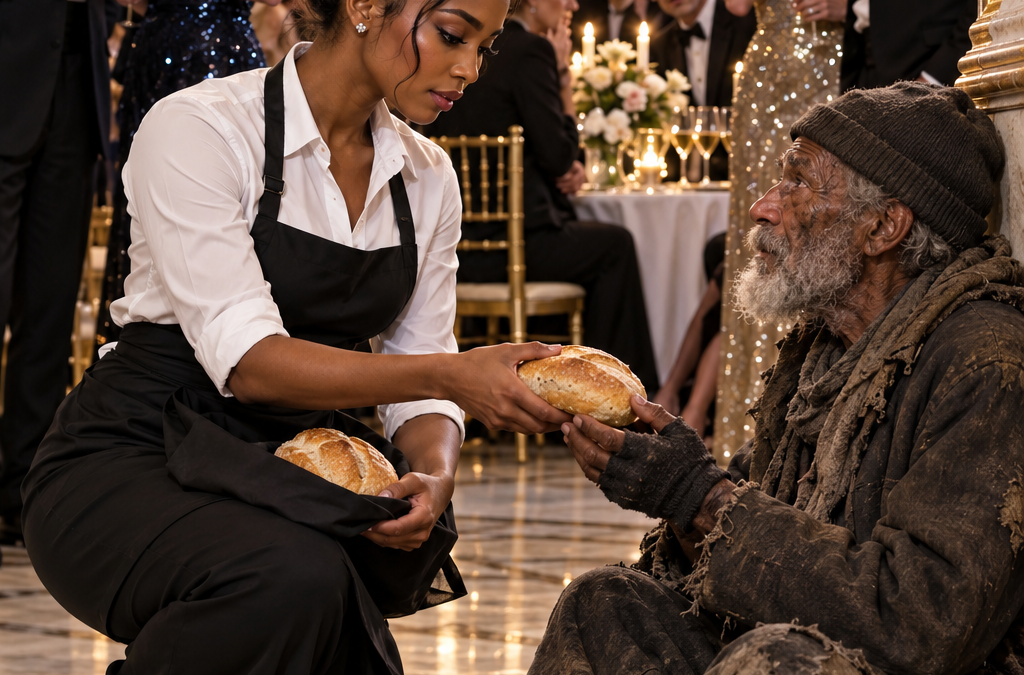
I smiled.
“You’ve told me that before.”
“Then it must be true.”
We sat for almost an hour.
I told him about Grandma.
About Sunrise.
About culinary school.
He forgot parts of the conversation before I finished them.
But he listened.
When I stood to leave, he reached out.
Held my hand.
For a moment, his grip was firm.
Like he was holding onto something he did not want his mind to take away.
In September, I walked into Piedmont Culinary Institute carrying a secondhand backpack.
The knife set was new.
Lorraine and three bakery employees had pooled their money to buy it.
My first class terrified me.
Stainless-steel stations.
Students who had trained in kitchens nicer than any restaurant I had ever entered.
Chefs who spoke in French terms I had only read in books.
I tied my apron.
Stood at my station.
And something inside me shifted.
For years, aprons had meant service.
Invisible work.
Carry.
Clear.
Clean.
Smile.
That day, the apron meant something else.
Create.
I burned something in my first hour.
Badly.
I called Grandma after class.
“How was it?”
“Terrifying.”
“Good.”
“I burned something.”
“Better.”
“Why is that better?”
“Means they’re teaching you something you don’t already know.”
I laughed.
She started coughing.
Then she said quietly, “Your mama would’ve been proud.”
That one stayed with me.
A week later, Catherine and I met for coffee.
Not at Wilson Capital.
A diner on Broad Street.
Sticky menus.
Bottomless refills.
No security desk.
No thirty-sixth floor.
She stirred cream into her coffee.
“You changed how I see what I do.”
I looked at her.
“You had the power to make something right.”
“Most people with power don’t.”
She nodded.
“Most people without power don’t use theirs the way you did.”
I thought about that for a long time.
The following spring, I graduated at the top of my class.
Three restaurants offered me jobs before commencement ended.
Good restaurants.
Real money.
Benefits.
One position could have moved Grandma and me out of the apartment immediately.
I turned all three down.
People thought I was crazy.
Maybe I was.
Instead, with part of the grant, savings, and help from a community-development program Catherine connected me to, I leased a small storefront six blocks from where I had grown up.
Corner of Mill and Broad.
Nothing fancy.
Old brick.
Two front windows.
A kitchen barely large enough for the equipment.
I named it Edmund’s Table.
The sign was hand-painted.
Lorraine hated the first version.
“The E is crooked.”
“It has character.”
“It has scoliosis.”
I repainted it.
Grandma sat in the bakery every morning in a cushioned chair I bought specifically for her.
Her lupus did not disappear.
Life does not become a fairy tale because one good thing happens.
There were still bad days.
Flare-ups.
Medication adjustments.
Hospital visits.
But she stabilized.
And she smiled more.
Any customer who stood still long enough heard the same sentence.
“That’s my grandbaby.”
“Grandma.”
“What?”
“Let people eat.”
“I’m just telling them.”
“Everybody already knows.”
“They don’t know enough.”
Behind the register, I taped a note.
Handwritten.
Simple.
IF YOU’RE HUNGRY AND CAN’T PAY, SIT DOWN.
YOU’RE WELCOME HERE.
No forms.
No questions.
No proof.
People warned me someone would abuse it.
A few did.
Most did not.
I learned hunger makes people ashamed long before it makes them dishonest.
Catherine restructured part of her foundation.
The Edmund Wilson Initiative began funding small community programs built around overlooked acts of service.
Food pantries.
Transportation for elderly patients.
Emergency rent funds.
Caregiver support.
She never called it charity when she spoke to me.
She called it infrastructure for compassion.
I teased her for making kindness sound like a corporate department.
She told me somebody had to build a budget around it.
Edmund’s memory continued to fade.
Some visits, he knew me.
Others, he did not.
Sometimes I was Una.
Sometimes Clara.
Sometimes simply “the bread girl.”
I stopped correcting him.
Recognition became less important than comfort.
One afternoon, months after the bakery opened, I was kneading dough in the back when one of my young employees came to the kitchen door.
Her name was Maya.
Seventeen.
First job.
“Una?”
“What?”
“There’s a man out front.”
“What man?”
“He’s just standing there.”
“Did he order?”
“No.”
“Is he causing trouble?”
“No.”
I wiped flour from my hands.
Went out.
A man stood near the entrance.
Old jacket.
Hands buried in his pockets.
Eyes on the menu.
He looked like he wanted to leave before someone asked him to.
I knew that look.
Before I could say anything, Maya picked up a fresh loaf.
She walked over.
Set it on a table.
“Sir?”
He looked at her.
“You hungry?”
His face tightened.
He did not answer.
She pulled out the chair.
“Sit.”
He hesitated.
“I don’t have money.”
Maya shrugged.
“That wasn’t what I asked.”
The man sat.
She sat across from him.
No one had trained her to do that.
I had never told my staff the full story about the Grand Summit.
Not all of it.
But somehow, the thing I wanted the bakery to become had traveled without needing a speech.
I stood behind the counter watching them.
The smell of bread filled the room.
Grandma was in her chair by the window.
Sunlight came through the glass.
For a moment, I was back in the Grand Summit ballroom.
Two hundred guests.
Gold lights.
Champagne.
An old man shaking at a corner table.
Two loaves hidden in my apron.
I used to think the most important choice I made that night was giving Edmund the bread.
It wasn’t.
The real choice came later.
In the alley.
After Gerald had fired me.
After there was no audience.
After the bread was already gone.
I could have walked east to my bus.
Instead, I walked west with Edmund.
No one was watching.
I expected nothing.
There was no reward waiting eight blocks away.
No billionaire daughter.
No scholarship.
No bakery.
No cameras.
Just an old man who could not remember where he lived and a tired girl who knew what it felt like to be invisible.
That was the part that mattered.
Not what Edmund turned out to be.
Not who his daughter was.
Not what Catherine owned.
If Edmund had been poor, forgotten, and alone forever, the choice would still have been the same.
That is what people misunderstood when the story spread.
They called me lucky.
Some said I had given away two loaves and received a new life.
That was never the bargain.
There was no bargain.
I had no idea there would be anything on the other side.
For all I knew, giving away those two loaves meant Grandma and I would go to bed hungry.
In fact, we did.
For all I knew, walking Edmund to the police station meant missing my last bus.
It did.
For all I knew, helping him would cost me my catering job.
It did.
For all I knew, nobody would ever know what happened.
For several days, almost nobody did.
Kindness does not become meaningful because somebody powerful eventually notices.
It matters because of what you do before you know anyone is watching.
Maya looked over from the table.
“Una?”
I came back to the bakery.
“What?”
“You got soup?”
I nodded.
“Chicken.”
She smiled.
“Can I give him some?”
I looked at the man.
Then at the loaf.
Then at Grandma watching from her chair.
“You never have to ask me that.”
Maya disappeared into the kitchen.
The man stared down at his hands.
I went back to the counter.
Above the register, the handwritten note shifted slightly in the breeze from the vent.
If you’re hungry and can’t pay, sit down.
You’re welcome here.
I straightened it.
Then I went back to work.
𝗧𝗛𝗘 𝗘𝗡𝗗
The Night I Gave Away My Last Two Loaves, a Ballroom Full of Wealthy Guests Decided I Was the Problem
Two hundred people in formal clothes ate beneath crystal chandeliers while an old man sat ten feet away shaking from hunger, and somehow I was the only person who stopped to ask when he had last eaten. I had exactly two loaves of bread in my apron—one for me and one for my sick grandmother—and before that night was over, giving them away would cost me my job, my reputation, and almost everything I had left.
My alarm went off at 4:45 that morning.
I did not wake because I was rested.
I woke because I could not afford another kind of life.
The room was dark except for the orange glow from the streetlight outside our apartment window. I reached for my phone before the alarm could wake Grandma Betty, shut it off, and lay still for three seconds.
Three seconds was what I gave myself every morning.
Three seconds to wish things were different.
Three seconds to feel tired.
Three seconds to be twenty-three years old instead of the person responsible for whether the electricity stayed on.
Then I got up.
My mattress sat directly on the floor.
No bed frame.
No headboard.
Just a fitted sheet pulled tight around the corners and a blanket I folded every morning because Grandma Betty had taught me that poverty was not an excuse to stop taking care of what you had.
The linoleum was cold beneath my feet as I crossed into the bathroom.
The mirror above the sink had a crack running down the left side, splitting my reflection almost perfectly from forehead to chin.
I brushed my teeth.
Tied my hair back.
Looked at myself.
One.
Two.
Three.
Move.
Our apartment had one bedroom, one bathroom, and a kitchen that did the work of three rooms.
The kitchen table was also my desk.
The counter was where I folded laundry.
The little space beside the refrigerator was where I kept a glass jar with a handwritten label taped to it.
CULINARY SCHOOL.
There was maybe forty dollars inside.
Bills.
Coins.
Two years of trying.
Every time I managed to put money into the jar, something happened.
Grandma’s medication.
A tire.
An electric bill.
Rent.
Groceries.
The jar never stayed full long enough to become a future.
Grandma Betty was awake when I came out of the bathroom.
Of course she was.
She sat in her recliner near the window, oxygen tubing under her nose, a blanket over her knees even though the apartment was not cold.
She was sixty-nine, but lupus had aged her in uneven ways.
Some mornings she looked almost like the woman in the old photographs on our wall—bright eyes, sharp smile, posture straight.
Other mornings, pain bent her before she even stood.
This morning, she was pretending.
I knew because her left hand was curled into a loose fist and resting beneath the blanket.
She only hid her hands when her joints were bad.
“You don’t need to work both jobs today,” she said.
I pulled my one good white shirt from the back of a chair and plugged in the iron.
“Yes, I do.”
“No, you don’t.”
“Grandma, I’m not working two jobs because of you.”
She watched me.
“I work two jobs because being tired is my hobby.”
Usually she laughed.
That morning she did not.
Her eyes drifted toward the refrigerator.
I followed them.
A past-due electric notice was held beneath one magnet.
The rent warning beneath another.
FINAL NOTICE was printed across the top in red.
Beside those was a pharmacy receipt.
Grandma’s next prescription refill was due Friday.
I was short.
Not by much in the language of people who had money.
A little over sixty dollars.
But sixty dollars can be an ocean when your checking account is almost empty.
“I can skip this refill,” Grandma said.
“No.”
“Baby—”
“No.”
“It’s one week.”
“And one week becomes two.”
She sighed.
“You sound like me.”
“Worst thing that ever happened to me.”
That got half a smile.
I finished ironing the shirt.
Folded it carefully.
Put it in my bag for the catering shift that night.
Then I kissed her forehead.
“Big gala tonight at the Grand Summit. Cash pay.”
“You working until late?”
“Probably.”
“Those people tip?”
“I’m not planning on it.”
“You eat.”
“I will.”
That was a lie.
At that point, I had twenty-one dollars until payday.
Most of it was already spoken for.
I opened the refrigerator.
Mustard.
Half a bottle of water.
A little milk.
Nothing else.
I closed it quickly.
“I’ll bring bread home,” I said. “For both of us.”
Grandma looked at me over the top of her glasses.
“From the bakery?”
“From the event. Catering always has leftovers.”
“You sure?”
“Yes.”
Another lie.
But it was one I intended to make true.
She reached for my wrist before I could leave.
“Una.”
I looked down.
Her eyes were tired.
“Be careful with those rich people.”
I laughed.
“They won’t even see me.”
I meant it as a joke.
The words sounded different after they left my mouth.
Grandma heard it too.
She squeezed my wrist once.
Then let go.
Sunrise Bakery opened at five-thirty.
By five-thirty-one, I was in an apron pulling trays from the oven.
The smell was almost cruel when you were hungry.
Fresh bread.
Butter.
Cinnamon.
Warm sugar.
The bakery was small, wedged between a laundromat and an insurance office, but for eight hours every morning it felt like the safest place in my life.
Lorraine Taylor was already behind the counter boxing pastries when I arrived.
She was thirty-eight, loud, funny, and incapable of humming on key.
“You still doing that fancy hotel tonight?” she asked.
“Unfortunately.”
“Girl, you’re going to work sixteen hours.”
“Fifteen and a half if Gerald lets us leave on time.”
“You know he won’t.”
I slid another tray onto the cooling rack.
“I need the money.”
Lorraine looked at me.
Not casually.
Really looked.
“How short are you?”
“For Grandma’s prescription?”
She nodded.
“About sixty.”
“You’re always sixty short.”
“Seventy, technically.”
“That’s better.”
We both laughed.
It was the kind of laugh poor people recognize.
Nothing was funny.
But sometimes laughing is cheaper than crying.
Around nine, when the morning rush slowed, Lorraine leaned against the prep table.
“Listen.”
“What?”
“At those hotel galas, they throw away more food than we sell here in three days.”
“I know.”
“When the night’s over, grab some.”
“That’s the plan.”
“Don’t be shy.”
“I’m never shy around free bread.”
“You know what I mean.”
I did.
Work the shift.
Get paid.
Take whatever bread would otherwise go into a trash bag.
Bring it home.
Grandma and I would eat.
Maybe I could stretch the cash enough to get the prescription filled.
The entire day was built around those two small goals.
Money.
Food.
Nothing complicated.
Nothing dramatic.
I clocked out from Sunrise just after two.
Took the bus home.
Showered quickly.
Changed into black pants and my one good white shirt.
Grandma was asleep in her recliner.
I left without waking her.
At 6:48 p.m., I walked into the Grand Summit Hotel through the service entrance beside the dumpsters.
The first thing I noticed was how different wealth smells.
Not literally.
But almost.
The service corridor smelled like bleach, stainless steel, food steam, and hot plates.
The ballroom beyond it smelled like perfume, flowers, champagne, and air-conditioning.
Gold fixtures.
Marble floors.
Fresh orchids in arrangements taller than I was.
I remember staring at one arrangement for a second and thinking it probably cost more than our rent.
Then Gerald Davis appeared.
“You.”
He pointed at me without checking my name.
Gerald was forty-five, maybe.
Thin.
Always perfectly dressed.
His smile was something he wore only around people he considered important.
He looked at my shoes.
The toes were worn.
“Back tables. Far section.”
“Yes, sir.”
“Stay away from the main guest area unless you’re clearing.”
“Yes, sir.”
“No socializing.”
“I understand.”
He looked at me another second.
Then moved to the next temp worker.
I clipped my badge to my shirt.
UNA GREEN.
Picked up a tray.
Walked into the ballroom.
Two hundred guests.
Black ties.
Evening gowns.
Diamonds.
Watches that probably cost more than every car I had ever owned combined.
At the center of the room stood a six-tier champagne tower glittering beneath the chandeliers.
Servers moved around it like satellites.
That was the first thing I saw.
The second was the old man.
He sat alone at a corner table.
Stained dark coat.
Unshaven face.
Gray hair badly in need of washing.
Both hands resting on the white tablecloth.
They were trembling.
I noticed him because he did not match the room.
Neither did I.
For the next two hours, I worked.
Fill water.
Clear plates.
Smile.
Move.
Disappear.
That was the rhythm.
A woman in an emerald dress backed into my tray without looking.
Champagne spilled across the front of my shirt.
Cold liquid soaked through immediately.
She turned.
Instead of apologizing, she looked me up and down.
“Watch where you’re going.”
My jaw tightened.
“I’m sorry, ma’am.”
I stepped away.
Found a napkin.
Blotted the shirt.
Kept working.
I did not have enough money to be insulted.
That sounds ugly, but it is true.
Pride is easier when rent is paid.
I had one job that morning, another job that night, and a prescription waiting at a pharmacy.
I could survive some rude woman’s opinion.
What I had trouble ignoring was the old man.
Every time I crossed the ballroom, my eyes went back to him.
He had no plate.
No drink.
No one sitting beside him.
A server passed his table and removed an unused place setting without asking whether he needed anything.
The old man watched the plate disappear.
His fingers tightened on the tablecloth.
Later, I saw him cough.
Not once.
A deep, dry cough that folded his body forward.
No one reacted.
A woman with diamonds around her neck glanced toward him.
“Someone really should remove that man,” she said to the man beside her.
“He’s making people uncomfortable.”
Then she turned back to her champagne.
I wanted to say something.
I did not.
Gerald was already watching the temp staff like he expected someone to steal silverware.
I needed the cash.
I needed the food.
I needed to get through the night.
By ten, my feet were burning.
My stomach had been growling for hours.
One of the kitchen staff passed me near the bread station.
“End of night leftovers are getting tossed,” he whispered. “Take what you want before cleanup.”
I thanked him.
When nobody was looking, I slipped two small loaves into my apron.
One for Grandma.
One for me.
That was dinner.
I remember touching them through the fabric.
Still warm.
That tiny weight made me feel relieved.
Not happy.
Relieved.
We would eat.
Then I looked at the old man again.
His head was dropping.
He would catch himself.
Lift it.
Then it would fall again.
His hands were trembling harder.
He looked disoriented.
His eyes moved around the room without finding anything.
I had seen hunger before.
Not on television.
Not in a charity commercial.
Real hunger.
The kind where your body starts making decisions for you.
I recognized it.
Then he looked at me.
Directly.
Not at my tray.
Not at my uniform.
At me.
Two hundred people were talking around us.
Music.
Glassware.
Laughter.
And for a second, I felt like the room disappeared.
He looked terrified.
I reached into my apron.
My hand closed around the bread.
I thought about Grandma.
The oxygen tube.
The empty refrigerator.
Her hand hidden beneath the blanket that morning.
If I gave this away, she would not eat.
Neither would I.
My fingers stayed around those loaves for five full seconds.
I wish I could say I did not hesitate.
I did.
I thought about myself.
I thought about Grandma.
I thought about how unfair it was that helping someone else had to mean taking from us.
Then I looked at his hands.
I walked over.
I set down my tray.
Sat across from him.
Gerald would have fired me just for that if he had seen it.
“Sir?”
The man slowly lifted his head.
“When was the last time you ate?”
He stared at me.
His eyes were cloudy.
“I…”
He stopped.
“I don’t remember.”
Something inside me dropped.
Not broke.
Dropped.
Like a stone.
I pulled both loaves from my apron.
Put them on the table.
“Please eat.”
He looked at the bread.
Then at me.
“All of it?”
“All of it.”
“You?”
“I’m fine.”
Another lie.
He touched one loaf with both hands.
“Thank you.”
His voice cracked.
“You remind me of someone kind.”
“What’s your name?”
He frowned as though the question hurt.
“Ed.”
“Ed?”
“Edmund.”
“Edmund what?”
Another pause.
“Wilson.”
“Okay, Edmund Wilson.”
He tore off a small piece of bread.
His hand shook so badly crumbs fell onto the tablecloth.
He ate slowly at first.
Then faster.
I stayed.
I did not take any bread.
Not one piece.
I could have.
He would have shared.
But once I had given it away, I could not bring myself to take it back.
After a few bites, his shoulders loosened.
“What brings you here tonight?” I asked.
He stared around the ballroom.
“I think I’m supposed to be somewhere.”
“You are somewhere.”
He almost smiled.
“I can’t remember where.”
His voice was becoming frightened.
I lowered mine.
“That’s okay.”
“No, it isn’t.”
“We’ll figure it out.”
“I had…”
He stopped again.
“What?”
“A daughter.”
“You know her name?”
His eyes squeezed shut.
“No.”
“That’s okay.”
“I should know.”
“I know.”
“I should know my own daughter.”
His hands started trembling again.
I moved my chair slightly closer.
“Edmund, look at me.”
He did.
“You’re here.”
He breathed.
“You’re eating.”
Another breath.
“You’re not alone right now.”
His shoulders fell.
“Right here is enough for the next five minutes.”
That was when Gerald found me.
“What do you think you’re doing?”
I stood.
“Sir, this man needs help.”
“You’re sitting with a guest.”
“He doesn’t know where he lives.”
“I don’t care.”
“He may be confused.”
Gerald’s expression did not change.
“You are staff.”
“Yes, sir, but—”
“Staff do not sit with guests.”
Edmund tried to stand.
Gerald turned toward him.
“You’re not on the guest list.”
Edmund blinked.
“I…”
“You need to leave.”
I stepped between them slightly.
“Sir, he can barely stand.”
Gerald looked over my shoulder.
“Security.”
Two guards approached.
My heart started pounding.
“Gerald, please.”
His eyes snapped toward me.
That was the first time I had used his name without “sir.”
“You’re done.”
I froze.
“What?”
“You’re fired.”
“For feeding him?”
“For refusing instructions and creating a disturbance.”
“There is no disturbance.”
“There is now.”
Edmund pushed himself up.
His knees gave out.
I caught his arm.
The bread fell.
One loaf hit the carpet.
Gerald recoiled as if the crumbs offended him.
“Get both of them out.”
I bent down.
Picked up the bread.
Brushed off what I could.
Put it back into Edmund’s hands.
One guard touched my elbow.
“I can walk.”
He released me.
They escorted us through the kitchen.
People stared.
Dishwashers.
Cooks.
Servers.
Nobody said anything.
I had worked nine hours on my feet.
I had given away my dinner.
Now I had lost the job before I could collect the pay I needed for my grandmother’s medication.
The service door opened.
Cold alley air hit my face.
We were pushed outside.
The door shut behind us.
Just like that.
The Grand Summit Hotel forgot we existed.
The alley smelled like grease and wet cardboard.
A single bulb flickered above the door.
Edmund stood beside me swaying.
For a moment, neither of us spoke.
Then he looked around.
“Where am I?”
My anger disappeared.
“We’re behind the hotel.”
“Hotel?”
“Yes.”
He looked down at the bread.
“I don’t remember a hotel.”
His cough started again.
Deep.
Painful.
He bent forward against the brick wall.
I looked toward the street.
My bus stop was four blocks east.
If I walked fast, I could catch the 11:15.
Go home.
Drink water.
Sleep.
Wake up for the bakery.
Figure out how to get sixty dollars before Friday.
I looked back at Edmund.
Seventy-four, maybe.
Alone.
No wallet I could see.
No phone.
No address.
No idea where he lived.
“Edmund.”
He lifted his head.
“Do you know where you live?”
“No.”
“Do you remember an address?”
“No.”
“Anyone I can call?”
He closed his eyes.
“My daughter.”
“What’s her name?”
“I…”
His face twisted.
“I can’t…”
“It’s okay.”
“No.”
His voice broke.
“It isn’t.”
I closed my eyes.
The bus stop was east.
The police station was eight blocks west.
I knew because Lorraine’s nephew had been arrested once and we had gone there to pick him up.
I put Edmund’s arm over my shoulder.
“We’re going to the police station.”
His eyes widened.
“Did I do something?”
“No.”
“I don’t want trouble.”
“You’re not trouble.”
“I don’t want to be trouble.”
“You’re not.”
I tightened my grip around his waist.
“Lean on me.”
We started walking.
The first two blocks were slow.
The next three were slower.
Every intersection seemed to confuse him.
Twice he stopped and looked behind us.
Once he called me Clara.
“Clara?”
He stared at me.
I almost corrected him.
Then I saw the panic in his face.
“Yes,” I said softly. “I’m here.”
He nodded.
We kept walking.
At the fifth block, his legs gave out.
I caught him badly and almost went down with him.
We reached a bus bench.
He sat.
His breathing was hard.
I pulled out the bread.
Broke off a piece.
“Eat.”
“You eat.”
“I will later.”
“You gave me everything.”
“Eat, Edmund.”
He obeyed.
I watched him chew.
My own stomach cramped.
I drank water from a fountain near a closed storefront.
Then we kept going.
At 11:40 p.m., I pushed open the police station doors.
The officer at the front desk looked at us.
I must have looked terrible.
White catering shirt stained with champagne.
Shoes dirty from walking.
Edmund leaning almost all his weight into me.
“This man is lost,” I said. “His name is Edmund Wilson. I think he has memory problems.”
The officer stood.
“Are you family?”
“No.”
“You know him?”
“I met him tonight.”
The officer looked from me to Edmund.
“Where?”
“The Grand Summit.”
He typed the name.
I watched his face change.
His posture straightened.
He looked at the screen again.
“Edmund Wilson?”
“That’s what he told me.”
The officer looked toward another officer.
“We’ve got a missing person match.”
I sat Edmund in a plastic chair.
“What does that mean?”
“Missing person report filed three years ago.”
“Three years?”
The officer nodded.
“Family’s been looking for him.”
I looked at Edmund.
He was staring at the bread.
The officer made calls.
I could have left.
It was 11:53.
If I ran, there was a chance I could catch the final bus.
I stood once.
Edmund looked at me.
Not dramatically.
He just turned his head.
His eyes found mine.
Then he looked down again.
I sat back.
An officer brought water.
Edmund held the cup with both hands.
It trembled against his lips.
I steadied it.
“Your family is coming.”
He looked at me.
For one moment, his eyes cleared.
“You’re a good person.”
I swallowed.
“You don’t know me.”
“I know enough.”
Then the clarity disappeared.
He looked at the cup like he had never seen it.
At 12:35 a.m., a man in a dark suit rushed through the doors.
He introduced himself as Philip Anderson.
He barely looked at me.
His eyes were on Edmund.
He knelt.
Pulled out his phone.
Compared a photograph.
Then his face changed.
“It’s him.”
He stood and turned away, already calling someone.
“Ma’am…”
He swallowed.
“It’s your father.”
I did not know who he was speaking to.
I did not know what family he worked for.
I knew only that somebody had finally come.
I crouched beside Edmund.
“Your people are here.”
He looked at me.
“You’re going home.”
He held the bread toward me.
“Take it.”
“No.”
“You need it.”
“That’s yours.”
“You gave me everything.”
“I’ll be okay.”
I stood.
To the desk officer, I said, “He’s been coughing all night. Make sure somebody checks him medically.”
“We will.”
I started toward the door.
“Miss.”
Philip called after me.
I stopped.
“Can I get your name? Number?”
I looked at Edmund.
Safe.
Seated.
Surrounded by people who knew who he was.
“I’m just glad he’s okay.”
Then I left.
No bus.
No money for a cab.
Phone at twelve percent.
I walked home.
The city looked different after midnight.
Businesses locked.
Streetlights humming.
Cars passing without slowing.
My feet hurt so badly I started changing how I walked.
Heel.
Toe.
Heel.
Toe.
Anything to spread the pain.
I thought about Grandma asleep in her chair.
I thought about the prescription.
The lost catering pay.
The two loaves.
At 1:34 a.m., I opened our apartment door.
Grandma was asleep.
The oxygen machine made its quiet mechanical sound.
I went to the refrigerator.
Opened it.
Nothing had changed.
Of course it had not.
I poured a glass of water.
Drank slowly.
Changed clothes.
Lay down on the mattress.
I did not cry.
I was too tired.
Ninety minutes after I left the police station, Edmund’s daughter arrived.
I did not know that until much later.
Her name was Catherine Wilson.
Fifty-two years old.
CEO of Wilson Capital Holdings.
The kind of woman newspapers photographed at economic conferences and charity dinners.
The kind of woman who could have bought the Grand Summit without needing to ask the price.
She had been looking for her father for three years.
Edmund had wandered from a care facility after his dementia worsened.
He had crossed cities.
States.
Shelters.
Hospitals.
Places where people recorded him as John Doe.
Philip had followed leads through six states.
Most ended nowhere.
That night, Catherine entered the same fluorescent police station where I had been sitting.
She saw Edmund in the chair.
Thin.
Dirty.
Holding half-crushed bread in his lap.
She knelt in front of him.
“Dad.”
He stared at her.
“It’s me.”
He searched her face.
“I know you.”
Catherine began crying.
“I think I know you.”
She pressed her forehead against his hands.
Then she asked the officer the question that changed everything.
“Who brought him here?”
“A young woman.”
“What young woman?”
“Early twenties. Black. Catering uniform.”
“From the hotel?”
“We think so.”
“Did hotel security bring them?”
“No, ma’am. She walked him here.”
“Walked?”
“Eight blocks.”
Catherine looked at the bread.
“What’s her name?”
The officer checked his notes.
“She didn’t want to leave it.”
Philip spoke.
“She gave first name only.”
“What?”
“Una.”
The next morning, Catherine called the Grand Summit.
She wanted to find me.
Instead, she found Gerald.
I learned the details later from Catherine herself.
She asked what had happened to her father.
Gerald did not hesitate.
“When I noticed the gentleman seemed disoriented, I personally intervened to ensure his comfort and safety.”
He made himself sound compassionate.
Professional.
Responsible.
He told her he had arranged for Edmund to be looked after.
He never said my name.
Never mentioned firing me.
Never mentioned security.
Never mentioned the alley.
Catherine believed him.
Why wouldn’t she?
He was the event director of a luxury hotel.
I was an unnamed catering temp.
Three days later, she sent him a check for twenty-five thousand dollars.
A personal thank-you.
Gerald deposited it.
If that had been the end, I might never have known.
But Catherine could not make the police report fit his story.
Gerald claimed he had handled everything.
The report said I walked Edmund to the station.
No security.
No hotel escort.
No transportation.
Just me.
So she called Philip.
“Get the footage.”
The Grand Summit had cameras everywhere.
Ballroom.
Lobby.
Service corridor.
Alley.
Philip built a timeline.
8:47 p.m.
I sat with Edmund.
Put two loaves of bread in front of him.
8:54.
Gerald confronted me.
8:56.
Security escorted us out.
8:57.
Gerald walked back into the ballroom.
8:58.
The alley camera showed me holding Edmund upright.
Then walking with him into the dark.
At 9:03, another camera showed Gerald laughing with a guest beside the champagne tower.
Philip wrote one sentence at the bottom of his report.
At no point did Gerald Davis assist, contact, or acknowledge Edmund Wilson.
Catherine watched the footage twice.
Then she said, “Find her.”
Philip found me two days later.
Wednesday afternoon.
I had just come home from Sunrise when a black town car pulled up outside our building.
A man in a suit knocked.
I opened the door with flour on my hands.
“Ms. Green?”
“Yes?”
“My name is Philip Anderson.”
I recognized him from the police station.
My stomach tightened.
“Edmund?”
He paused.
“Is he okay?”
That was the only question I had.
Not why he was at my door.
Not who Edmund was.
Not whether somebody wanted to pay me.
“Is he okay?”
Philip’s face softened.
“He’s safe.”
I exhaled.
“He’s with his daughter.”
“Good.”
My knees almost weakened.
“Good.”
He looked past me into the apartment.
Grandma was asleep in her recliner.
“I work for his daughter, Catherine Wilson. She’d like to meet you.”
“Why?”
“To thank you.”
“She doesn’t owe me anything.”
“She knows.”
I looked at him.
Then back at Grandma.
The pharmacy receipt was still on the refrigerator.
The culinary-school jar still held forty dollars.
“Okay.”
I stepped back.
“Give me a minute to wash my hands.”
Wilson Capital Holdings occupied the thirty-sixth floor of a glass office tower.
I wore my cleanest jeans and a blouse I ironed twice.
The elevator alone looked more expensive than our apartment.
When the doors opened, I felt every eye in the reception area move toward me.
I did not belong there.
That was obvious.
But I had spent enough of my life feeling small in rooms designed for other people.
I refused to help the room do it.
Catherine stood when I entered her office.
That surprised me.
Powerful people do not usually stand for catering workers.
“Ms. Green.”
“Una.”
“Thank you for coming.”
We sat.
The city spread beneath the windows behind her.
She did not waste time.
“I watched the security footage.”
I said nothing.
“I saw you give my father your food.”
I looked at my hands.
“I saw Gerald Davis fire you.”
Still nothing.
“I saw you walk my father eight blocks.”
“He couldn’t remember where he lived.”
“I know.”
“He was scared.”
“I know.”
Her voice changed on those words.
I finally looked up.
Her eyes were wet.
“He’s my father.”
I nodded.
“I’m glad you found him.”
“Una, I want to repay you.”
“No.”
She seemed startled.
“You lost your job.”
“I have another one.”
“You lost wages.”
“I’ll manage.”
“You were blacklisted by the catering agency.”
That I did not know yet.
“What?”
“They received a report from the hotel.”
My stomach dropped.
“What report?”
“We’ll address it.”
I sat back.
Catherine continued.
“You gave away the only food you had.”
“You don’t know that.”
“I do.”
I stared at her.
“Philip is thorough.”
That made me uncomfortable.
She saw it.
“I’m sorry. I asked him to understand your situation.”
“My situation?”
“Your grandmother.”
My body stiffened.
“She has lupus.”
“Yes.”
“You looked at her medical records?”
“Only enough to understand why you were working that night. I should have asked permission.”
“Yes, you should have.”
“You’re right.”
That answer disarmed me more than an excuse would have.
She opened a drawer.
“I still want to help.”
“You don’t owe me for being decent to your father.”
“No.”
She leaned forward.
“But I may owe you for what happened because my family’s gratitude went to the man who hurt you.”
That I understood.
She slid a check across the desk.
Ten thousand dollars.
I stared at it.
My first thought was that there had to be too many zeros.
“I can’t.”
“You can.”
“No.”
“Una.”
“My grandmother’s medication is due Friday.”
“Then fill it.”
“My rent is behind.”
“Pay it.”
I looked at the check.
“Why ten thousand?”
“Medication. Lost wages. Rent. Time. Damage caused by a lie.”
“It’s too much.”
“It isn’t.”
I swallowed.
“I don’t want charity.”
“It isn’t charity.”
“What is it?”
“A correction.”
I sat there for a long time.
Then I took the check.
Folded it once.
Put it in my pocket.
“Thank you.”
For one week, my life became quiet.
I paid two months of rent.
Filled Grandma’s prescription.
Bought groceries.
Real groceries.
Eggs.
Chicken.
Vegetables.
Fruit.
Bread.
The pharmacist looked surprised when I paid the full balance.
I wanted to cry over that more than the check.
Tuesday night, I baked Grandma a small cake.
No birthday.
No reason.
She laughed when she saw it.
“You done lost your mind.”
“Eat the cake.”
“Chocolate?”
“Obviously.”
She laughed until she coughed.
I brought her water.
At Sunrise, Lorraine asked what happened.
“Somebody helped me back.”
She looked at me.
“That all I’m getting?”
“That’s all.”
For one week, I breathed.
Then Gerald found out Catherine had investigated him.
His response was not guilt.
It was fear.
He called the catering agency.
Reported me for unprofessional conduct.
Claimed I had harassed a guest.
Refused management instructions.
Created a disturbance.
The manager told him they had not received a formal incident report.
Gerald created one.
Backdated it.
Official letterhead.
Professional vocabulary.
A lie dressed like paperwork.
Then he called a tabloid blog.
Two days later, Lorraine showed me the headline.
CATERING WORKER CONS BILLIONAIRE HEIRESS WITH BREAD-ROLL SOB STORY.
I read the article in the bakery’s back room.
It said I knew who Edmund was.
That I had researched him.
Targeted him.
Used bread as a prop.
Staged an act of kindness to get access to Catherine.
Manipulated her into giving me ten thousand dollars.
Anonymous hotel sources claimed I had a history of inappropriate conduct.
The article spread.
Facebook groups.
Gossip pages.
Comments.
Fraud.
Scammer.
Gold digger.
Con artist.
I read every word.
My hands did not shake.
I went back to work.
For two hours, I said nothing.
That evening, Grandma saw it.
A neighbor had sent it to her.
She sat at the kitchen table reading slowly.
When she finished, she placed the phone down.
“Baby.”
I looked away.
“Come here.”
I sat.
She took my hands.
“The truth doesn’t need to be loud.”
I nodded.
“It just needs to be true.”
“I know.”
But knowing did not make it painless.
That night, I sat on our front steps alone.
For the first time, I regretted stopping at Edmund’s table.
Not because helping him was wrong.
Because I was tired of paying for it.
I thought about calling Catherine.
Returning the money.
Every dollar I had left.
Maybe if I gave it back, people would stop.
Maybe if I disappeared, the story would disappear.
My phone buzzed.
Lorraine.
You gave an old man bread. That’s the whole story. Don’t let anybody rewrite it.
I read it three times.
Then went inside.
I did not sleep.
At 6:15 the next morning, Catherine saw the article.
By eight, her PR team was recommending she distance herself from me.
She told me later.
“Optics.”
“Reputational risk.”
“Brand exposure.”
She listened.
Then sent everyone out.
Alone, she replayed the alley footage.
Not the ballroom.
The alley.
The place where there was no audience.
No guests.
No camera I knew about.
No reason to perform.
She watched me hold Edmund up.
Watched me walk away from the hotel.
Watched us disappear into the dark.
Then she called me.
I answered on the fourth ring.
“Una. It’s Catherine.”
I said nothing.
“I saw the article.”
Still nothing.
“I know it’s false.”
My throat tightened.
“And I know who planted it.”
I finally spoke.
“Are you calling to ask for the money back?”
“No.”
I closed my eyes.
“I’m calling to tell you I’m fixing this.”
“You don’t have to.”
“I know.”
A pause.
“But I need to ask you something.”
“What?”
“Do you trust me?”
I thought about the rich woman from the gala who wanted Edmund removed because he made her uncomfortable.
I thought about Gerald.
I thought about Catherine kneeling on a police station floor beside her father, something Philip had described to me.
“I trust the woman who knelt down to hold her father’s hands.”
Catherine inhaled quietly.
“Yeah.”
I nodded even though she could not see me.
“I trust you.”
Philip spent the next forty-eight hours digging into Gerald Davis.
His employment history.
Complaints.
Expenses.
Past hotels.
He found two prior terminations.
One involved taking credit for subordinate work.
Another involved a young concierge who filed a harassment complaint.
She was fired before her complaint was properly investigated.
He found inflated expense reports at the Grand Summit.
Missing receipts.
Complaints from temp workers.
He found the fake incident report Gerald had created about me.
And he traced the anonymous email sent to the tabloid.
Gerald had used his personal account.
Not even a burner.
Maybe arrogance makes people careless.
Philip also obtained a sworn statement from the Grand Summit’s head of security confirming every second of the footage was authentic.
Catherine could have released it online.
She did not.
She invited Gerald somewhere instead.
Wilson Capital announced a public community-philanthropy event.
Media invited.
Community leaders.
Nonprofit directors.
City council members.
Grand Summit executives.
And Gerald Davis.
His invitation said:
In recognition of your service and compassion, please join us for a special announcement.
Gerald believed it.
Completely.
He bought a new suit.
Italian shoes.
Told colleagues Catherine was going to honor him publicly.
I almost felt sorry for him when Catherine told me.
Almost.
The event took place in Wilson Capital’s main conference hall.
Two hundred seats.
The same number of people as the gala.
I waited behind a side door.
My hands were sweating.
Lorraine had lent me a blue blouse.
“You look professional,” she had said.
“I look terrified.”
“That too.”
Catherine walked onto the stage at ten.
No notes.
No teleprompter.
Gerald sat front row center.
She began with Edmund.
Three years missing.
Dementia.
Six states searched.
Shelters.
Hospitals.
Nothing.
Then she described the gala.
“My father sat in a ballroom with more than two hundred people.”
The room became still.
“He was hungry. Confused. Shaking.”
She paused.
“No one helped him.”
Gerald adjusted his tie.
“But one person did.”
He sat straighter.
I could imagine what he thought was coming.
Then Catherine said my name.
“Una Green.”
I heard movement in the audience.
“A twenty-three-year-old temporary catering worker.”
She explained the bread.
One loaf for me.
One for Grandma.
Our entire dinner.
She told them I gave both away.
Then she said, “And she was fired for it.”
The room changed.
Gerald knew.
Even behind the door, I knew he knew.
Catherine continued.
“She was escorted out through a service entrance beside the dumpsters with my father.”
Then the screen lit up.
The footage played.
8:47.
Me sitting beside Edmund.
The bread.
8:54.
Gerald pointing.
Security arriving.
8:56.
Us being taken through the service hallway.
8:57.
Gerald returning to the ballroom.
8:58.
Me holding Edmund upright in the alley.
The video ended.
Silence.
Then Catherine told the rest.
Gerald’s phone call claiming credit.
The twenty-five-thousand-dollar check he accepted.
The backdated report.
The catering blacklist.
The tabloid story.
The traced email.
The previous complaints.
When she finished, she looked directly at Gerald.
“Kindness doesn’t ask for a résumé.”
Her voice was calm.
“It just shows up.”
Gerald stood.
“I can explain.”
Before he could continue, the Grand Summit’s general manager spoke from the third row.
“Don’t.”
Gerald turned.
“Your contract is terminated effective immediately.”
His face emptied.
He looked toward the door.
Then the cameras.
Then Catherine.
No one came to rescue him.
He walked out.
I wish I could say I felt victorious.
I did not.
I felt exhausted.
Catherine looked toward the side entrance.
That was my cue.
I stepped out.
Two hundred faces turned toward me.
At the gala, two hundred people had not seen me.
Now two hundred people were looking directly at me.
I almost hated it more.
Catherine crossed the stage.
She did not hug me.
Did not turn me into a prop.
She simply stood beside me.
“Una Green did not help my father because of who he was.”
She looked at me.
“She helped him because of who she is.”
Then she announced the Una Green Opportunity Grant.
A full culinary-school scholarship.
Any accredited institute I chose.
And a fifty-thousand-dollar community fund in my name for families facing food insecurity.
The room applauded.
I could barely hear it.
Everything sounded distant.
Catherine leaned toward me.
“You want to say anything?”
“No.”
She smiled slightly.
“That’s fair.”
Then I looked at the crowd again.
Something changed.
“Yes.”
She stepped aside.
I approached the microphone.
My voice came out smaller than I wanted.
“That night…”
I stopped.
Breathed.
“I wasn’t being brave.”
The room was silent.
“I was just being a person.”
I looked across the faces.
“We should all try to be people to each other.”
That was all.
I stepped back.
The room stood.
Three weeks later, I visited Edmund at Maplewood Memory Care Residence.
The place was quiet.
Warm.
Wide hallways.
Soft lights.
A garden behind the main building.
Catherine had found a room for him there.
Private.
Specialized dementia care.
Staff who knew his name.
His habits.
His medication.
How he liked toast cut into triangles.
I brought bread.
Fresh.
Made at Sunrise that morning.
Lorraine had looked the other way while I used the ovens before my shift.
Edmund sat in the garden beneath a tree.
Blanket over his knees.
He looked better.
Clean.
Fed.
Color back in his skin.
His hands were steadier.
I sat beside him.
Placed the bread between us.
He looked at it.
Then at me.
His eyes searched my face.
“You remind me of someone kind.”
I smiled.
“You’ve told me that before.”
“Then it must be true.”
We sat for almost an hour.
I told him about Grandma.
About Sunrise.
About culinary school.
He forgot parts of the conversation before I finished them.
But he listened.
When I stood to leave, he reached out.
Held my hand.
For a moment, his grip was firm.
Like he was holding onto something he did not want his mind to take away.
In September, I walked into Piedmont Culinary Institute carrying a secondhand backpack.
The knife set was new.
Lorraine and three bakery employees had pooled their money to buy it.
My first class terrified me.
Stainless-steel stations.
Students who had trained in kitchens nicer than any restaurant I had ever entered.
Chefs who spoke in French terms I had only read in books.
I tied my apron.
Stood at my station.
And something inside me shifted.
For years, aprons had meant service.
Invisible work.
Carry.
Clear.
Clean.
Smile.
That day, the apron meant something else.
Create.
I burned something in my first hour.
Badly.
I called Grandma after class.
“How was it?”
“Terrifying.”
“Good.”
“I burned something.”
“Better.”
“Why is that better?”
“Means they’re teaching you something you don’t already know.”
I laughed.
She started coughing.
Then she said quietly, “Your mama would’ve been proud.”
That one stayed with me.
A week later, Catherine and I met for coffee.
Not at Wilson Capital.
A diner on Broad Street.
Sticky menus.
Bottomless refills.
No security desk.
No thirty-sixth floor.
She stirred cream into her coffee.
“You changed how I see what I do.”
I looked at her.
“You had the power to make something right.”
“Most people with power don’t.”
She nodded.
“Most people without power don’t use theirs the way you did.”
I thought about that for a long time.
The following spring, I graduated at the top of my class.
Three restaurants offered me jobs before commencement ended.
Good restaurants.
Real money.
Benefits.
One position could have moved Grandma and me out of the apartment immediately.
I turned all three down.
People thought I was crazy.
Maybe I was.
Instead, with part of the grant, savings, and help from a community-development program Catherine connected me to, I leased a small storefront six blocks from where I had grown up.
Corner of Mill and Broad.
Nothing fancy.
Old brick.
Two front windows.
A kitchen barely large enough for the equipment.
I named it Edmund’s Table.
The sign was hand-painted.
Lorraine hated the first version.
“The E is crooked.”
“It has character.”
“It has scoliosis.”
I repainted it.
Grandma sat in the bakery every morning in a cushioned chair I bought specifically for her.
Her lupus did not disappear.
Life does not become a fairy tale because one good thing happens.
There were still bad days.
Flare-ups.
Medication adjustments.
Hospital visits.
But she stabilized.
And she smiled more.
Any customer who stood still long enough heard the same sentence.
“That’s my grandbaby.”
“Grandma.”
“What?”
“Let people eat.”
“I’m just telling them.”
“Everybody already knows.”
“They don’t know enough.”
Behind the register, I taped a note.
Handwritten.
Simple.
IF YOU’RE HUNGRY AND CAN’T PAY, SIT DOWN.
YOU’RE WELCOME HERE.
No forms.
No questions.
No proof.
People warned me someone would abuse it.
A few did.
Most did not.
I learned hunger makes people ashamed long before it makes them dishonest.
Catherine restructured part of her foundation.
The Edmund Wilson Initiative began funding small community programs built around overlooked acts of service.
Food pantries.
Transportation for elderly patients.
Emergency rent funds.
Caregiver support.
She never called it charity when she spoke to me.
She called it infrastructure for compassion.
I teased her for making kindness sound like a corporate department.
She told me somebody had to build a budget around it.
Edmund’s memory continued to fade.
Some visits, he knew me.
Others, he did not.
Sometimes I was Una.
Sometimes Clara.
Sometimes simply “the bread girl.”
I stopped correcting him.
Recognition became less important than comfort.
One afternoon, months after the bakery opened, I was kneading dough in the back when one of my young employees came to the kitchen door.
Her name was Maya.
Seventeen.
First job.
“Una?”
“What?”
“There’s a man out front.”
“What man?”
“He’s just standing there.”
“Did he order?”
“No.”
“Is he causing trouble?”
“No.”
I wiped flour from my hands.
Went out.
A man stood near the entrance.
Old jacket.
Hands buried in his pockets.
Eyes on the menu.
He looked like he wanted to leave before someone asked him to.
I knew that look.
Before I could say anything, Maya picked up a fresh loaf.
She walked over.
Set it on a table.
“Sir?”
He looked at her.
“You hungry?”
His face tightened.
He did not answer.
She pulled out the chair.
“Sit.”
He hesitated.
“I don’t have money.”
Maya shrugged.
“That wasn’t what I asked.”
The man sat.
She sat across from him.
No one had trained her to do that.
I had never told my staff the full story about the Grand Summit.
Not all of it.
But somehow, the thing I wanted the bakery to become had traveled without needing a speech.
I stood behind the counter watching them.
The smell of bread filled the room.
Grandma was in her chair by the window.
Sunlight came through the glass.
For a moment, I was back in the Grand Summit ballroom.
Two hundred guests.
Gold lights.
Champagne.
An old man shaking at a corner table.
Two loaves hidden in my apron.
I used to think the most important choice I made that night was giving Edmund the bread.
It wasn’t.
The real choice came later.
In the alley.
After Gerald had fired me.
After there was no audience.
After the bread was already gone.
I could have walked east to my bus.
Instead, I walked west with Edmund.
No one was watching.
I expected nothing.
There was no reward waiting eight blocks away.
No billionaire daughter.
No scholarship.
No bakery.
No cameras.
Just an old man who could not remember where he lived and a tired girl who knew what it felt like to be invisible.
That was the part that mattered.
Not what Edmund turned out to be.
Not who his daughter was.
Not what Catherine owned.
If Edmund had been poor, forgotten, and alone forever, the choice would still have been the same.
That is what people misunderstood when the story spread.
They called me lucky.
Some said I had given away two loaves and received a new life.
That was never the bargain.
There was no bargain.
I had no idea there would be anything on the other side.
For all I knew, giving away those two loaves meant Grandma and I would go to bed hungry.
In fact, we did.
For all I knew, walking Edmund to the police station meant missing my last bus.
It did.
For all I knew, helping him would cost me my catering job.
It did.
For all I knew, nobody would ever know what happened.
For several days, almost nobody did.
Kindness does not become meaningful because somebody powerful eventually notices.
It matters because of what you do before you know anyone is watching.
Maya looked over from the table.
“Una?”
I came back to the bakery.
“What?”
“You got soup?”
I nodded.
“Chicken.”
She smiled.
“Can I give him some?”
I looked at the man.
Then at the loaf.
Then at Grandma watching from her chair.
“You never have to ask me that.”
Maya disappeared into the kitchen.
The man stared down at his hands.
I went back to the counter.
Above the register, the handwritten note shifted slightly in the breeze from the vent.
If you’re hungry and can’t pay, sit down.
You’re welcome here.
I straightened it.
Then I went back to work.








