𝗙𝗨𝗟𝗟 𝗦𝗧𝗢𝗥𝗬 The Night County Officers Came for My Animals, I Realized My HOA President Wanted More Than My Ranch Quiet
𝗙𝗨𝗟𝗟 𝗦𝗧𝗢𝗥𝗬
I looked out toward the coop.
“Is that written somewhere in my deed?”
“It’s written in our governing documents.”
“Your governing documents don’t govern me.”
She paused.
Then she said, “Mr. Mercer, I’m trying to help you start off on the right foot.”
“That’s funny. It feels like you’re fining me over chickens.”
“The fine is only one hundred dollars if paid within ten days.”
I should have refused.
I should have hired a lawyer that day.
I should have written back demanding proof of jurisdiction.
Instead, I paid it.
One hundred dollars felt cheaper than starting a neighborhood war during my first month on the ranch.
That was my first bad decision.
Marla smelled weakness the way a hawk smells a wounded rabbit.
The fines kept coming.
Fence height.
Gate color.
Visible feed barrels.
A compost bin.
The pitch and frequency of my rooster’s crow, documented in a binder she apparently called the compliance record.
I learned that phrase from a neighbor named Billy Tucker, who stopped by one afternoon to buy eggs.
Billy lived inside Meadowbrook but looked like he regretted it every day.
He leaned against my fence and nodded toward the HOA entrance.
“Marla’s got a binder on you already.”
I laughed.
“You’re joking.”
“I wish I was.”
“A binder?”
“She makes binders. Photos, dates, notes, complaints, printed emails. She walks into meetings like she’s prosecuting murder cases.”
“For a chicken coop?”
“For anything.”
He took his carton of eggs and looked toward the creek.
“You know about the Alvarez family?”
“No.”
“Used to own the place on the far east side. Six acres. Nice little setup. Marla hammered them over mailbox paint, pasture fencing, utility trailer visibility. Fees stacked up. Lien. Foreclosure. Gone.”
I stared at him.
“Over a mailbox?”
“That’s where it started.”
“What happened to the property?”
Billy’s face changed.
“Sold at auction.”
“To who?”
He looked at me for a second too long.
“Some holding company.”
I waited.
He sighed.
“Folks say Marla had an interest.”
“An interest?”
“Folks say lots of things.”
Then he put the eggs in his truck and left.
That was how people talked about Marla Dobbs.
In unfinished sentences.
With glances over their shoulders.
As if saying too much might make a notice appear in their mailbox by morning.
By the second month, letters arrived weekly.
Each one threatened a lien against my property for cumulative violations. Each one used vague language. Each one gave me impossible appeal deadlines. Some arrived after the deadline had already passed.
I started recording HOA meetings on my phone.
Technically, I had no reason to attend. My property wasn’t part of the association. But Marla kept putting me on the agenda as a “perimeter compliance concern,” and when someone publicly discusses your land, your animals, and possible legal action against your property, you show up.
I kept my phone in my shirt pocket, microphone facing out.
Something about Marla’s confidence felt rehearsed.
Like she had done all of this before and already knew which words frightened people into surrender.
At the March meeting, she announced new emergency livestock restrictions.
The timing was not subtle.
Three days earlier, I had rescued two donkeys from a petting zoo that shut down after the owner got sick.
Their names were Biscuit and June.
They were gentle, sunburned, slightly ridiculous creatures who followed me around the pasture for carrots and scratched their necks against the gate like oversized dogs.
Marla called them an escalating livestock concern.
At the meeting, she stood at the front of the Meadowbrook clubhouse wearing a cream blazer and a turquoise necklace, clicking through printed photos on a portable projector.
There was my barn.
My pasture.
My donkeys.
My chickens.
Even my feed shed.
Every picture had been taken from angles just outside my fence.
“Meadowbrook must address the increasing burden of non-compliant animal activity along our perimeter,” she said.
I raised my hand.
Her eyes found me.
“Mr. Mercer, homeowners will be recognized after board discussion.”
“I’m not a homeowner in Meadowbrook.”
“Then your comments are even less appropriate at this time.”
A few people looked down.
Nobody challenged her.
She continued.
“The new emergency restrictions prohibit aggressive, exotic, improperly contained, or nuisance livestock within visibility of Meadowbrook residential common areas.”
I stood.
“Are you calling donkeys exotic?”
She smiled.
“I’m calling them unapproved.”
“By whom?”
“The board.”
“The board has no authority over my ranch.”
“That is your position.”
“No, Marla. That is the deed.”
Her smile sharpened.
“Then you’ll have no objection to formal review.”
I should have known what came next.
Two days later, county animal control arrived.
Not at night. Not yet.
This time it was midafternoon.
A white truck rolled up my driveway while I was carrying hay toward the barn. Two officers stepped out, polite but serious.
“Paul Mercer?”
“Yes.”
“We received a report of aggressive unpermitted exotic livestock endangering children along the green belt.”
I looked at Biscuit and June.
Biscuit was eating hay from a wheelbarrow. June had her head over the fence, trying to determine whether one of the officers had carrots.
“Those are donkeys,” I said.
The younger officer tried not to smile.
The older one sighed.
“We still need to inspect.”
“Go ahead.”
They walked the pasture.
Biscuit followed them hopefully.
June brayed once, then sneezed.
The officers checked the fencing, the water trough, the shelter, and the animals’ condition. I showed adoption paperwork from the petting zoo closure and my vet records.
The older officer closed his clipboard.
“Your animals are fine.”
“So the complaint was false?”
“I’d call it unfounded.”
“Who filed it?”
He hesitated.
“You know we can’t always disclose complainants.”
“I have a guess.”
He looked toward Meadowbrook.
“I imagine you do.”
When they left, I stood by the gate with Biscuit’s nose pressed against my shoulder.
I knew Marla had called.
But knowing wasn’t proof.
That night, I reviewed my meeting recordings.
I wanted the exact wording of the emergency livestock restrictions. I played back the March meeting while sitting at my kitchen table, a cup of black coffee going cold beside me.
Near the end, after residents had begun stacking chairs, my phone kept recording.
The microphone caught voices near the board table.
Marla’s voice.
Quieter than before.
Laughing.
“Once his lien hits, that ranch is basically mine.”
I froze.
Then I replayed it.
Once his lien hits, that ranch is basically mine.
My stomach dropped so hard I had to put one hand on the table.
This was never about chickens.
Or roosters.
Or donkeys.
Or fence height.
Marla wanted my land.
Fifteen acres backing onto the creek, the last unclaimed parcel along the Meadowbrook perimeter. My ranch was the piece she did not control.
And apparently, she had a plan to change that.
The next morning, I drove to the county clerk’s office.
The woman behind the desk helped me pull property records, lien filings, foreclosure notices, and auction transfers connected to Meadowbrook since 2019.
I spent hours at a public terminal, printing documents until my folder split at the seam.
By noon, I had the Alvarez property records.
Then the Chens.
Then two smaller family ranch parcels that had been absorbed after HOA foreclosure actions.
All four had been targeted with escalating violation notices.
All four had liens filed by Meadowbrook Ranch Estates.
All four eventually sold at auction.
And every single one was purchased by Twin Oaks Holdings.
I searched the company registration.
The registered address was Marla Dobbs’s home.
I sat in my truck in the county parking lot with the air conditioner blowing hot at first, coffee untouched in the cup holder, papers spread across the passenger seat.
Twin Oaks Holdings.
Marla’s address.
Four properties.
Four families.
This was not overzealous enforcement.
This was a small-town land grab wearing an HOA badge.
I hired Denise Okafor that afternoon.
She was a real estate attorney in Waco who had fought HOA fraud before and apparently enjoyed making bullies regret paperwork.
Her office was modest, but the walls were lined with framed judgments, settlement orders, and newspaper clippings about property disputes she had won.
She looked through my documents without much expression at first.
The fines.
The lien threats.
The meeting recording transcript.
The county records.
The Twin Oaks registration.
The old foreclosure sales.
By the time she reached the fourth property transfer, her face had changed.
“This is enough to end her career,” she said.
I let out a breath I hadn’t realized I was holding.
“But?”
She looked up.
“But if we want to stop her before she moves against your property, we need proof she is actively fabricating violations or manufacturing grounds for enforcement.”
I leaned back.
“The photos? The complaints?”
“Helpful. But she’ll claim reasonable belief, board discretion, resident complaints, mistake, anything.”
“She said my ranch would be hers.”
“She’ll claim it was a joke.”
“It wasn’t.”
“I know. But we need something current. Something she can’t explain away.”
I stared at the folder.
“What are you suggesting?”
“Don’t confront her yet. Document everything. And if she crosses onto your property, catch it cleanly.”
So I did what any stubborn Texan would do.
I set a trap.
I installed trail cameras around my property line, aimed at the shared fence line, the barn approach, the side gate, and the pasture road. Motion-activated. Infrared. Timestamped. Hidden well enough that even a suspicious HOA president with a clipboard wouldn’t spot them easily.
Then I waited.
Two weeks passed.
Marla sent three more notices.
One for visible hay storage.
One for donkey noise.
One for “unapproved animal expansion,” whatever that meant.
Each one went straight to Denise.
Then, at 2:00 a.m. on a humid Friday night, a trail camera caught movement near the east fence.
I saw the alert when I woke before sunrise.
At first, I thought it would be a raccoon.
Instead, the footage showed Marla Dobbs.
Flashlight in hand.
Garden gloves on.
Monogrammed robe under a dark coat.
Crocs on her feet.
Tiptoeing across my dewy pasture like a cat burglar who had forgotten she was nearly sixty.
For half a second, I almost laughed.
Then I saw what she was dragging.
A dog crate.
A large one.
She pulled it through the side gate, pausing every few steps to look toward the house. The crate shifted. Something moved inside.
My laugh died before it reached my throat.
The next camera caught her closer to the barn.
She dragged the crate into the shadow beside the feed shed and crouched near the latch. Her flashlight beam swept across the ground.
For one second, the camera caught eyes glowing inside the crate.
Not dogs.
Not barn cats.
Something spotted.
Long-legged.
Wild-looking.
I enlarged the still and felt my hands go cold.
Serval hybrids.
African serval hybrid kittens.
Illegal exotic animals in our county without permits. Valuable on the black market. Dangerous enough, legally speaking, to turn an ordinary ranch inspection into a criminal investigation if planted in the right place.
Marla wasn’t setting me up for a fine this time.
She was setting me up for a felony accusation.
Exotic animal trafficking.
Illegal wildlife possession.
A charge serious enough to get my animals seized, my property searched, my name ruined, and maybe my ranch tied up in criminal proceedings until I was too broke to defend it.
I watched the footage three times.
Marla dragged the crate near my barn.
Unlatched my gate.
Left the animals.
Then hurried back toward Meadowbrook before dawn as if the whole world would believe those creatures had magically appeared on my property by accident.
I called Denise immediately.
She answered on the third ring, voice rough with sleep.
“Paul?”
“She did it.”
“Tell me.”
I explained.
Her voice sharpened fast.
“Do not touch that crate.”
“I haven’t.”
“Do not move it. Do not open it. Do not feed them. Do not let anyone say you assumed control of those animals.”
“What do I do?”
“Call animal control yourself. Right now. Report unfamiliar animals discovered on your property overnight. Request immediate pickup and full documentation. Tell them you have trail camera footage showing they were placed there after midnight by another person.”
I looked out the kitchen window toward the barn.
The sun was just starting to lighten the pasture.
Biscuit and June were standing near the fence, ears turned toward the barn, deeply offended by the strange smells.
“Paul,” Denise said, “flip the script before she calls.”
I dialed county animal control at sunrise.
“My name is Paul Mercer,” I said. “I discovered unfamiliar exotic animals in a crate near my barn. They were placed there overnight without my knowledge. I have camera footage. I need officers to come immediately and document everything.”
They arrived within the hour.
Two trucks this time.
Three officers.
The same older officer from the donkey complaint stepped out first.
When he saw my face, he sighed.
“What now?”
“You’re going to want to see the footage before you touch the crate.”
I showed him.
His expression went from tired to alert in about three seconds.
“Is that Marla Dobbs?”
“Yes.”
He looked toward the barn.
“And she brought those animals here?”
“Camera says she did.”
He turned to the younger officer.
“Document the scene before anything moves.”
They photographed the crate. The ground. The gate. The trail camera locations. The timestamp. The animals inside.
The serval hybrids hissed when approached, frightened and confused. They were beautiful in a way that made the situation feel even uglier. They had no idea they were evidence.
Animal control removed them carefully.
The report documented that the animals were discovered by me, reported by me, and appeared on timestamped footage to have been placed near my barn after midnight by someone else.
Then came the funny part.
About an hour later, while the officers were still finishing paperwork, the older officer’s radio crackled. Dispatch relayed a call from Marla Dobbs reporting suspected illegal exotic wildlife on Paul Mercer’s property and demanding immediate investigation.
The officer looked at me.
I looked at him.
Neither of us spoke.
Then dispatch came back.
“Caller disconnected after being asked how she became aware of the animals.”
The younger officer coughed into his hand.
The older one just shook his head.
“She hung up?”
Dispatch confirmed.
I almost laughed, but my hands were still shaking too badly.
Denise filed for an emergency injunction against the HOA’s lien threat that same day.
She attached everything.
The meeting recording.
The Twin Oaks Holdings records.
The prior foreclosure sales.
The trail camera footage.
The animal control confiscation report.
The call log showing Marla called after I had already reported the animals.
The judge scheduled a hearing within the week.
Small counties move fast when attempted property fraud and illegal exotic animals appear in the same filing.
Word spread through Meadowbrook like wildfire.
The Alvarez family called Denise.
The Chens reached out.
Two other evicted families came forward once they smelled Marla’s downfall coming. They had old letters, fines, auction notices, emails, and stories that sounded just like mine.
Every one of them had believed they were alone.
Every one of them had been wrong.
On the night before the hearing, I walked the fence line with Biscuit and June trailing behind me.
The pasture was quiet except for insects and the occasional creak of old wire in the wind.
I stopped near the gate Marla had used.
I thought about how easily it could have gone differently.
If I hadn’t installed the cameras.
If I had opened the crate.
If I had waited until Marla called first.
If animal control had arrived with a complaint already in hand and found illegal exotic cats near my barn.
My name could have been on a criminal complaint before breakfast.
My animals could have been seized.
My ranch could have become a crime scene.
That was the kind of game Marla was playing.
Not neighborly enforcement.
Not strict standards.
Destruction.
I rested one hand on Biscuit’s neck.
He leaned into me, warm and calm and entirely unaware that a woman with a clipboard had nearly used him as part of a plan to steal the land beneath his hooves.
The hearing was packed.
Marla wore her Sunday best.
Cream suit. Pearls. Perfect hair. A face arranged into injured dignity.
I wore jeans, a clean button-down shirt, and the same boots I wore around the ranch. Denise sat beside me with a stack of files that made Marla’s old compliance binder look like a grocery list.
The judge was a woman in her sixties who looked like she had spent a lifetime listening to people lie badly.
Denise presented the case step by step.
My deed.
The HOA notices.
The recording where Marla said the ranch was basically hers once the lien hit.
The county records showing prior foreclosures.
Twin Oaks Holdings registered at Marla’s address.
The trail camera footage.
The animal control report.
The judge watched the footage of Marla dragging the crate toward my barn at 2:00 a.m.
The courtroom was so quiet I could hear the projector fan.
Marla’s attorney stood.
“My client was investigating suspicious noises near the perimeter.”
The judge looked over her glasses.
“In a robe and Crocs?”
A ripple moved through the room.
Marla’s mouth tightened.
Her attorney continued.
“She was concerned for community safety.”
Denise stood.
“Then why did she bring a crate of illegal serval hybrids onto Mr. Mercer’s land?”
“We dispute that characterization.”
Denise clicked the remote.
The footage froze on Marla’s gloved hands dragging the crate.
“Does your client deny she is the person in this video?”
Marla’s attorney looked back at her.
Marla stared at the table.
That answered enough.
Then came twist three.
A forensic accountant hired after Denise’s filing had traced Twin Oaks Holdings and the prior foreclosure approvals. Three board signatures used to approve those sales had been forged.
Not misunderstood.
Not rubber-stamped.
Forged.
The accountant’s report compared known signatures, meeting attendance, travel records, and archived minutes. The votes authorizing enforcement escalation and foreclosure on those old properties had never legally happened.
Marla had fabricated board approval.
The judge’s face hardened as Denise explained it.
When it was over, the judge did not merely dismiss the HOA’s lien threat against me.
She referred the entire matter to the district attorney for criminal fraud, forgery, and related charges.
Marla’s face went the color of the goats she had once complained about.
Then two deputies approached her.
Not with a compliance notice.
Not with a clipboard.
With paperwork.
She was not handcuffed in the courtroom that day, but she was served in front of everyone. Watching her take those papers with trembling hands did something to the room.
People who had feared her for years saw that she was not untouchable.
She was just a woman who had hidden behind process until evidence caught up.
The HOA removed her from the board that same afternoon.
Under court pressure, emergency bylaws, and legal settlement terms, she was barred from serving on any Texas homeowners association board again.
Effective immediately.
Three weeks later, she accepted a plea deal to avoid trial on the most serious charges.
Felony attempted fraud.
Forgery.
Illegal wildlife possession related to the planted serval hybrids.
Additional financial charges remained tied to restitution and civil claims. Twin Oaks Holdings became the center of multiple lawsuits. The Alvarez and Chen families filed to reclaim or recover damages tied to their old properties. The other evicted families joined actions of their own.
My footage became Exhibit A in more filings than I ever expected to be part of.
I never enjoyed that.
People assume justice feels clean.
It doesn’t.
Justice is paperwork, court dates, lawyers, checks you didn’t want to write, memories you didn’t want to relive, and the slow realization that somebody hurt more people than you knew.
But it also feels like breathing again.
My lien vanished.
The fines were voided.
The HOA sent a formal apology, though it came from the temporary board and not from Marla. That suited me fine. I didn’t need an apology from her. I needed her away from my property.
Animal control returned twice afterward, not because they suspected me, but to document that my livestock were legal, healthy, and properly kept.
The older officer scratched Biscuit between the ears during the second visit.
“This the aggressive one?”
“Terrifying,” I said.
Biscuit closed his eyes and leaned against the officer’s chest.
The officer laughed.
“Looks like a hardened criminal.”
June brayed from the far side of the fence like she was agreeing.
Life returned slowly.
Not all at once.
At first, every vehicle coming down the driveway made my shoulders tighten. Every official envelope made my stomach drop. Every time Biscuit brayed toward the Meadowbrook fence, I found myself looking for Marla’s SUV.
But the fear faded.
The pasture became pasture again.
The barn became a barn again.
My chickens scratched in the dust. Hank crowed whenever he felt like it, which was often and with absolutely no respect for Meadowbrook’s acoustic preferences.
The goats ate everything except what they were supposed to eat.
Biscuit and June greeted every morning like it personally belonged to them.
Unpermitted and unbothered.
Grazing on the very grass Marla had tried to steal out from under me.
A new HOA board was elected.
This time, people showed up.
Not just the regulars.
Not just Marla’s old loyalists.
Residents who had stayed quiet for years filled the clubhouse. Former targets spoke. Priya attended. Billy Tucker sat in the back with his arms crossed and said, loudly enough for half the room to hear, that if anyone brought a compliance binder bigger than a church Bible, he was leaving.
The new president was Rosa Martinez, one of Denise Okafor’s former clients from a different HOA dispute. She had moved into Meadowbrook years earlier and kept her head down under Marla’s rule. Now she ran on transparency, record access, and a promise that no one person would ever again control fines, liens, or foreclosure recommendations.
She won by a landslide.
A week after taking office, she mailed me a fruit basket.
When I saw it on my porch, I stood there for a long second.
Same kind of basket.
Apples. Pears. Oranges. A jar of local honey.
For a moment, I remembered Marla standing in my driveway six months earlier, smiling with a clipboard under her arm.
I almost didn’t touch it.
Then I saw the card.
Paul,
This one comes with no violations attached. Meadowbrook owes you more than fruit, but it’s a start.
—Rosa M.
I laughed so hard Biscuit brayed from the pasture.
Later that evening, I sat on the porch with the card in my hand while the sun dropped behind the barn.
The creek glowed orange through the trees.
The chickens settled into the coop.
The donkeys grazed near the fence.
I thought about the night the county truck rolled up my driveway, red lights spinning across the barn. How scared I had been. How furious. How close Marla had come to putting my name on a criminal complaint before I understood the full game.
Six months.
That was all it took for a peaceful ranch to become a battlefield.
Two donkeys.
One crate of confused serval hybrids.
A trail camera Marla never saw.
And enough arrogance to make her believe no one would ever check the paperwork.
That was her fatal mistake.
People like Marla don’t fear anger.
They know how to use anger against you.
They call it hostility. Non-compliance. Threatening behavior. Proof you’re the problem.
What they fear is patience.
Documents.
Timestamps.
Receipts.
Recordings.
A lawyer who knows where to look.
Neighbors who finally stop whispering and start testifying.
Truth, collected carefully enough that it no longer needs to shout.
I kept the trail cameras up.
Not because I expected Marla to return. She had lost her board seat, her reputation, much of her money, and eventually her own home to legal fees and restitution claims. She had more immediate problems than my chicken coop.
I kept them because I had learned what quiet documentation could do.
It could protect a ranch.
It could save animals.
It could expose forged signatures.
It could help families fight for land they lost.
It could turn one man’s lonely suspicion into a case strong enough to make a judge lean forward and listen.
Biscuit wandered up to the porch rail and pushed his nose between the boards.
I gave him a piece of apple from the fruit basket.
June saw that and brayed in protest.
“Hold on,” I said. “You’re next.”
The rooster crowed from the coop even though the sun was going down.
Somewhere beyond the fence, Meadowbrook was quiet.
No clipboard.
No golf cart.
No emergency livestock ordinance.
Just the sound of a Texas evening settling over land that was still mine.
Justice took six months, two donkeys, one very confused pair of servals, and a woman arrogant enough to walk past a trail camera in Crocs.
It cost me sleep.
It cost me money.
It cost me the illusion that rural peace protects itself.
But when the dust settled, my ranch was still here.
My animals were still here.
My name was clear.
And every morning, when Biscuit and June bray across the pasture, I let them be as loud as they want.
They earned it.
𝗧𝗛𝗘 𝗘𝗡𝗗
The Night County Officers Came for My Animals, I Realized My HOA President Wanted More Than My Ranch Quiet
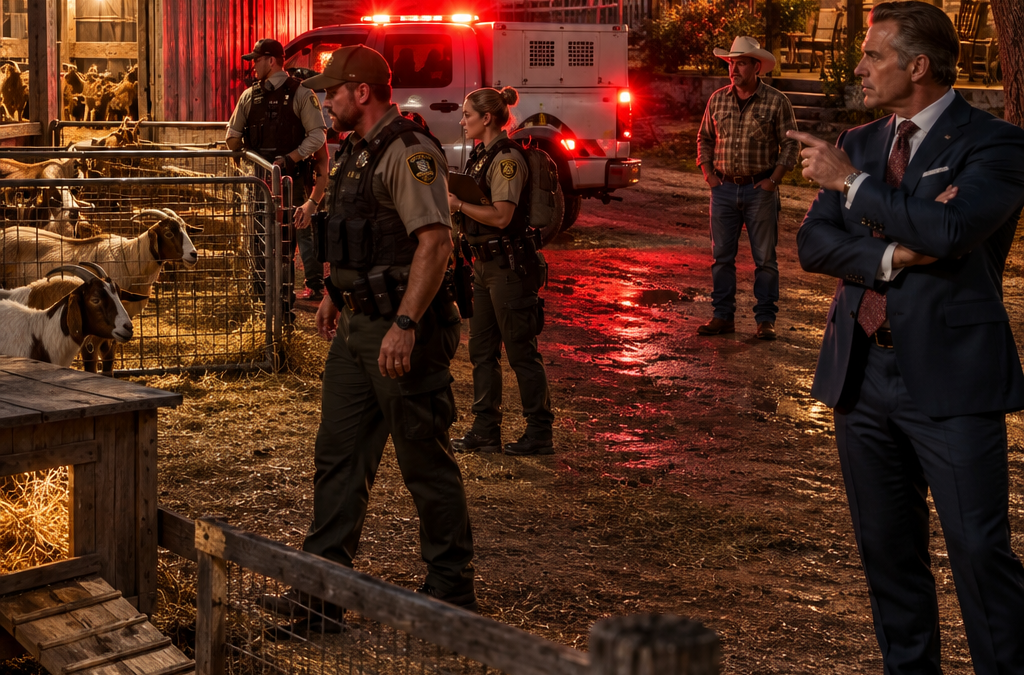
The county truck rolled up my driveway after dark with its siren off and its lights spinning red across my barn. By the time the officers stepped out and said my name was on a criminal complaint, I understood that Marla Dobbs had finally stopped pretending this was about chickens.
Six months earlier, I would have laughed if anyone told me a homeowners association president could turn a fifteen-acre ranch into a battlefield.
I had bought the place outside Waco because I was tired of fluorescent lights, office carpets, stale coffee, and the soft death of spending twenty years in a Dallas cubicle pretending I didn’t want air, dirt, animals, and sky.
My name is Paul Mercer.
For two decades, I had worked in logistics for a shipping company, the kind of job where every day started with a spreadsheet and ended with a headache. I had a decent salary, a good parking spot, and a chair that supposedly supported my lower back. None of it made me feel alive.
So when my divorce finalized and the last of the paperwork dust settled, I did something everyone called irresponsible until they saw me smile for the first time in years.
I bought a small ranch.
Fifteen acres.
A weathered barn.
A two-bedroom ranch house with a tin roof.
A creek along the back boundary.
Enough pasture for goats.
Enough space for chickens.
Enough silence to hear myself think again.
The place sat just beyond Meadowbrook Ranch Estates, one of those Texas developments that wanted the charm of rural living without the inconvenience of actual rural life. The entrance had limestone columns, decorative iron gates, and a sign with a horse silhouette even though most residents seemed terrified of manure.
Still, the property listing said my parcel was adjacent to the development but separately deeded. I read that line three times before I signed anything.
Adjacent.
Not inside.
That mattered.
At least, it should have.
The first week I moved in, Meadowbrook welcomed me with a fruit basket.
Marla Dobbs delivered it herself.
She arrived in a white SUV so clean it looked allergic to gravel. She stepped out wearing a pale linen blouse, pressed jeans, pearl earrings, and boots that had never met mud. Her hair was styled in a smooth silver-blonde bob, and she carried a clipboard tucked under one arm like a weapon disguised as office supplies.
“Paul Mercer?” she asked.
“That’s me.”
She smiled and held up the basket.
“Welcome to Meadowbrook Ranch Estates.”
I wiped my hands on my jeans before taking it.
“That’s kind of you, but technically I’m just outside Meadowbrook.”
Her smile stayed in place, but something behind her eyes cooled.
“Of course. We think of everyone along the perimeter as part of the broader community.”
“That’s neighborly.”
“It is,” she said. “And we’re very protective of our standards.”
I should have heard the warning.
Instead, I thanked her for the fruit.
She looked past me toward the chicken coop I had just finished rebuilding.
“Are those birds already on the property?”
“Chickens, yes.”
“How many?”
“Twelve hens and a rooster.”
Her lips tightened slightly.
“Roosters can create issues.”
“Not for me.”
“I meant for the community.”
I glanced at the nearest Meadowbrook houses, which sat beyond a fence and a line of mesquite trees.
“They’re pretty far off.”
“Sound carries,” she said.
“So does gossip.”
She blinked.
I smiled to soften it.
She did not.
That was the first crack in the welcome.
Within a week, the fruit basket might as well have been a subpoena.
The first violation notice came taped to my gate.
Unauthorized livestock structure visible from community perimeter.
My chicken coop.
A coop that sat on my land, behind my fence, servicing animals I legally owned, on a ranch that was not part of the HOA.
The notice claimed it violated Meadowbrook’s livestock aesthetic ordinance.
I read it standing in the driveway while my rooster, Hank, crowed from the coop as if he had been personally named in the complaint.
I called the HOA office.
A woman answered in a careful voice and transferred me to Marla.
“Marla, this is Paul Mercer. I got a notice about my chicken coop.”
“Yes.”
“I’m not in your HOA.”
“You are adjacent to the Meadowbrook community.”
“That doesn’t make me subject to your rules.”
“Exterior conditions affecting community appearance fall under our perimeter standards.”
I looked out toward the coop.
“Is that written somewhere in my deed?”
“It’s written in our governing documents.”
“Your governing documents don’t govern me.”
She paused.
Then she said, “Mr. Mercer, I’m trying to help you start off on the right foot.”
“That’s funny. It feels like you’re fining me over chickens.”
“The fine is only one hundred dollars if paid within ten days.”
I should have refused.
I should have hired a lawyer that day.
I should have written back demanding proof of jurisdiction.
Instead, I paid it.
One hundred dollars felt cheaper than starting a neighborhood war during my first month on the ranch.
That was my first bad decision.
Marla smelled weakness the way a hawk smells a wounded rabbit.
The fines kept coming.
Fence height.
Gate color.
Visible feed barrels.
A compost bin.
The pitch and frequency of my rooster’s crow, documented in a binder she apparently called the compliance record.
I learned that phrase from a neighbor named Billy Tucker, who stopped by one afternoon to buy eggs.
Billy lived inside Meadowbrook but looked like he regretted it every day.
He leaned against my fence and nodded toward the HOA entrance.
“Marla’s got a binder on you already.”
I laughed.
“You’re joking.”
“I wish I was.”
“A binder?”
“She makes binders. Photos, dates, notes, complaints, printed emails. She walks into meetings like she’s prosecuting murder cases.”
“For a chicken coop?”
“For anything.”
He took his carton of eggs and looked toward the creek.
“You know about the Alvarez family?”
“No.”
“Used to own the place on the far east side. Six acres. Nice little setup. Marla hammered them over mailbox paint, pasture fencing, utility trailer visibility. Fees stacked up. Lien. Foreclosure. Gone.”
I stared at him.
“Over a mailbox?”
“That’s where it started.”
“What happened to the property?”
Billy’s face changed.
“Sold at auction.”
“To who?”
He looked at me for a second too long.
“Some holding company.”
I waited.
He sighed.
“Folks say Marla had an interest.”
“An interest?”
“Folks say lots of things.”
Then he put the eggs in his truck and left.
That was how people talked about Marla Dobbs.
In unfinished sentences.
With glances over their shoulders.
As if saying too much might make a notice appear in their mailbox by morning.
By the second month, letters arrived weekly.
Each one threatened a lien against my property for cumulative violations. Each one used vague language. Each one gave me impossible appeal deadlines. Some arrived after the deadline had already passed.
I started recording HOA meetings on my phone.
Technically, I had no reason to attend. My property wasn’t part of the association. But Marla kept putting me on the agenda as a “perimeter compliance concern,” and when someone publicly discusses your land, your animals, and possible legal action against your property, you show up.
I kept my phone in my shirt pocket, microphone facing out.
Something about Marla’s confidence felt rehearsed.
Like she had done all of this before and already knew which words frightened people into surrender.
At the March meeting, she announced new emergency livestock restrictions.
The timing was not subtle.
Three days earlier, I had rescued two donkeys from a petting zoo that shut down after the owner got sick.
Their names were Biscuit and June.
They were gentle, sunburned, slightly ridiculous creatures who followed me around the pasture for carrots and scratched their necks against the gate like oversized dogs.
Marla called them an escalating livestock concern.
At the meeting, she stood at the front of the Meadowbrook clubhouse wearing a cream blazer and a turquoise necklace, clicking through printed photos on a portable projector.
There was my barn.
My pasture.
My donkeys.
My chickens.
Even my feed shed.
Every picture had been taken from angles just outside my fence.
“Meadowbrook must address the increasing burden of non-compliant animal activity along our perimeter,” she said.
I raised my hand.
Her eyes found me.
“Mr. Mercer, homeowners will be recognized after board discussion.”
“I’m not a homeowner in Meadowbrook.”
“Then your comments are even less appropriate at this time.”
A few people looked down.
Nobody challenged her.
She continued.
“The new emergency restrictions prohibit aggressive, exotic, improperly contained, or nuisance livestock within visibility of Meadowbrook residential common areas.”
I stood.
“Are you calling donkeys exotic?”
She smiled.
“I’m calling them unapproved.”
“By whom?”
“The board.”
“The board has no authority over my ranch.”
“That is your position.”
“No, Marla. That is the deed.”
Her smile sharpened.
“Then you’ll have no objection to formal review.”
I should have known what came next.
Two days later, county animal control arrived.
Not at night. Not yet.
This time it was midafternoon.
A white truck rolled up my driveway while I was carrying hay toward the barn. Two officers stepped out, polite but serious.
“Paul Mercer?”
“Yes.”
“We received a report of aggressive unpermitted exotic livestock endangering children along the green belt.”
I looked at Biscuit and June.
Biscuit was eating hay from a wheelbarrow. June had her head over the fence, trying to determine whether one of the officers had carrots.
“Those are donkeys,” I said.
The younger officer tried not to smile.
The older one sighed.
“We still need to inspect.”
“Go ahead.”
They walked the pasture.
Biscuit followed them hopefully.
June brayed once, then sneezed.
The officers checked the fencing, the water trough, the shelter, and the animals’ condition. I showed adoption paperwork from the petting zoo closure and my vet records.
The older officer closed his clipboard.
“Your animals are fine.”
“So the complaint was false?”
“I’d call it unfounded.”
“Who filed it?”
He hesitated.
“You know we can’t always disclose complainants.”
“I have a guess.”
He looked toward Meadowbrook.
“I imagine you do.”
When they left, I stood by the gate with Biscuit’s nose pressed against my shoulder.
I knew Marla had called.
But knowing wasn’t proof.
That night, I reviewed my meeting recordings.
I wanted the exact wording of the emergency livestock restrictions. I played back the March meeting while sitting at my kitchen table, a cup of black coffee going cold beside me.
Near the end, after residents had begun stacking chairs, my phone kept recording.
The microphone caught voices near the board table.
Marla’s voice.
Quieter than before.
Laughing.
“Once his lien hits, that ranch is basically mine.”
I froze.
Then I replayed it.
Once his lien hits, that ranch is basically mine.
My stomach dropped so hard I had to put one hand on the table.
This was never about chickens.
Or roosters.
Or donkeys.
Or fence height.
Marla wanted my land.
Fifteen acres backing onto the creek, the last unclaimed parcel along the Meadowbrook perimeter. My ranch was the piece she did not control.
And apparently, she had a plan to change that.
The next morning, I drove to the county clerk’s office.
The woman behind the desk helped me pull property records, lien filings, foreclosure notices, and auction transfers connected to Meadowbrook since 2019.
I spent hours at a public terminal, printing documents until my folder split at the seam.
By noon, I had the Alvarez property records.
Then the Chens.
Then two smaller family ranch parcels that had been absorbed after HOA foreclosure actions.
All four had been targeted with escalating violation notices.
All four had liens filed by Meadowbrook Ranch Estates.
All four eventually sold at auction.
And every single one was purchased by Twin Oaks Holdings.
I searched the company registration.
The registered address was Marla Dobbs’s home.
I sat in my truck in the county parking lot with the air conditioner blowing hot at first, coffee untouched in the cup holder, papers spread across the passenger seat.
Twin Oaks Holdings.
Marla’s address.
Four properties.
Four families.
This was not overzealous enforcement.
This was a small-town land grab wearing an HOA badge.
I hired Denise Okafor that afternoon.
She was a real estate attorney in Waco who had fought HOA fraud before and apparently enjoyed making bullies regret paperwork.
Her office was modest, but the walls were lined with framed judgments, settlement orders, and newspaper clippings about property disputes she had won.
She looked through my documents without much expression at first.
The fines.
The lien threats.
The meeting recording transcript.
The county records.
The Twin Oaks registration.
The old foreclosure sales.
By the time she reached the fourth property transfer, her face had changed.
“This is enough to end her career,” she said.
I let out a breath I hadn’t realized I was holding.
“But?”
She looked up.
“But if we want to stop her before she moves against your property, we need proof she is actively fabricating violations or manufacturing grounds for enforcement.”
I leaned back.
“The photos? The complaints?”
“Helpful. But she’ll claim reasonable belief, board discretion, resident complaints, mistake, anything.”
“She said my ranch would be hers.”
“She’ll claim it was a joke.”
“It wasn’t.”
“I know. But we need something current. Something she can’t explain away.”
I stared at the folder.
“What are you suggesting?”
“Don’t confront her yet. Document everything. And if she crosses onto your property, catch it cleanly.”
So I did what any stubborn Texan would do.
I set a trap.
I installed trail cameras around my property line, aimed at the shared fence line, the barn approach, the side gate, and the pasture road. Motion-activated. Infrared. Timestamped. Hidden well enough that even a suspicious HOA president with a clipboard wouldn’t spot them easily.
Then I waited.
Two weeks passed.
Marla sent three more notices.
One for visible hay storage.
One for donkey noise.
One for “unapproved animal expansion,” whatever that meant.
Each one went straight to Denise.
Then, at 2:00 a.m. on a humid Friday night, a trail camera caught movement near the east fence.
I saw the alert when I woke before sunrise.
At first, I thought it would be a raccoon.
Instead, the footage showed Marla Dobbs.
Flashlight in hand.
Garden gloves on.
Monogrammed robe under a dark coat.
Crocs on her feet.
Tiptoeing across my dewy pasture like a cat burglar who had forgotten she was nearly sixty.
For half a second, I almost laughed.
Then I saw what she was dragging.
A dog crate.
A large one.
She pulled it through the side gate, pausing every few steps to look toward the house. The crate shifted. Something moved inside.
My laugh died before it reached my throat.
The next camera caught her closer to the barn.
She dragged the crate into the shadow beside the feed shed and crouched near the latch. Her flashlight beam swept across the ground.
For one second, the camera caught eyes glowing inside the crate.
Not dogs.
Not barn cats.
Something spotted.
Long-legged.
Wild-looking.
I enlarged the still and felt my hands go cold.
Serval hybrids.
African serval hybrid kittens.
Illegal exotic animals in our county without permits. Valuable on the black market. Dangerous enough, legally speaking, to turn an ordinary ranch inspection into a criminal investigation if planted in the right place.
Marla wasn’t setting me up for a fine this time.
She was setting me up for a felony accusation.
Exotic animal trafficking.
Illegal wildlife possession.
A charge serious enough to get my animals seized, my property searched, my name ruined, and maybe my ranch tied up in criminal proceedings until I was too broke to defend it.
I watched the footage three times.
Marla dragged the crate near my barn.
Unlatched my gate.
Left the animals.
Then hurried back toward Meadowbrook before dawn as if the whole world would believe those creatures had magically appeared on my property by accident.
I called Denise immediately.
She answered on the third ring, voice rough with sleep.
“Paul?”
“She did it.”
“Tell me.”
I explained.
Her voice sharpened fast.
“Do not touch that crate.”
“I haven’t.”
“Do not move it. Do not open it. Do not feed them. Do not let anyone say you assumed control of those animals.”
“What do I do?”
“Call animal control yourself. Right now. Report unfamiliar animals discovered on your property overnight. Request immediate pickup and full documentation. Tell them you have trail camera footage showing they were placed there after midnight by another person.”
I looked out the kitchen window toward the barn.
The sun was just starting to lighten the pasture.
Biscuit and June were standing near the fence, ears turned toward the barn, deeply offended by the strange smells.
“Paul,” Denise said, “flip the script before she calls.”
I dialed county animal control at sunrise.
“My name is Paul Mercer,” I said. “I discovered unfamiliar exotic animals in a crate near my barn. They were placed there overnight without my knowledge. I have camera footage. I need officers to come immediately and document everything.”
They arrived within the hour.
Two trucks this time.
Three officers.
The same older officer from the donkey complaint stepped out first.
When he saw my face, he sighed.
“What now?”
“You’re going to want to see the footage before you touch the crate.”
I showed him.
His expression went from tired to alert in about three seconds.
“Is that Marla Dobbs?”
“Yes.”
He looked toward the barn.
“And she brought those animals here?”
“Camera says she did.”
He turned to the younger officer.
“Document the scene before anything moves.”
They photographed the crate. The ground. The gate. The trail camera locations. The timestamp. The animals inside.
The serval hybrids hissed when approached, frightened and confused. They were beautiful in a way that made the situation feel even uglier. They had no idea they were evidence.
Animal control removed them carefully.
The report documented that the animals were discovered by me, reported by me, and appeared on timestamped footage to have been placed near my barn after midnight by someone else.
Then came the funny part.
About an hour later, while the officers were still finishing paperwork, the older officer’s radio crackled. Dispatch relayed a call from Marla Dobbs reporting suspected illegal exotic wildlife on Paul Mercer’s property and demanding immediate investigation.
The officer looked at me.
I looked at him.
Neither of us spoke.
Then dispatch came back.
“Caller disconnected after being asked how she became aware of the animals.”
The younger officer coughed into his hand.
The older one just shook his head.
“She hung up?”
Dispatch confirmed.
I almost laughed, but my hands were still shaking too badly.
Denise filed for an emergency injunction against the HOA’s lien threat that same day.
She attached everything.
The meeting recording.
The Twin Oaks Holdings records.
The prior foreclosure sales.
The trail camera footage.
The animal control confiscation report.
The call log showing Marla called after I had already reported the animals.
The judge scheduled a hearing within the week.
Small counties move fast when attempted property fraud and illegal exotic animals appear in the same filing.
Word spread through Meadowbrook like wildfire.
The Alvarez family called Denise.
The Chens reached out.
Two other evicted families came forward once they smelled Marla’s downfall coming. They had old letters, fines, auction notices, emails, and stories that sounded just like mine.
Every one of them had believed they were alone.
Every one of them had been wrong.
On the night before the hearing, I walked the fence line with Biscuit and June trailing behind me.
The pasture was quiet except for insects and the occasional creak of old wire in the wind.
I stopped near the gate Marla had used.
I thought about how easily it could have gone differently.
If I hadn’t installed the cameras.
If I had opened the crate.
If I had waited until Marla called first.
If animal control had arrived with a complaint already in hand and found illegal exotic cats near my barn.
My name could have been on a criminal complaint before breakfast.
My animals could have been seized.
My ranch could have become a crime scene.
That was the kind of game Marla was playing.
Not neighborly enforcement.
Not strict standards.
Destruction.
I rested one hand on Biscuit’s neck.
He leaned into me, warm and calm and entirely unaware that a woman with a clipboard had nearly used him as part of a plan to steal the land beneath his hooves.
The hearing was packed.
Marla wore her Sunday best.
Cream suit. Pearls. Perfect hair. A face arranged into injured dignity.
I wore jeans, a clean button-down shirt, and the same boots I wore around the ranch. Denise sat beside me with a stack of files that made Marla’s old compliance binder look like a grocery list.
The judge was a woman in her sixties who looked like she had spent a lifetime listening to people lie badly.
Denise presented the case step by step.
My deed.
The HOA notices.
The recording where Marla said the ranch was basically hers once the lien hit.
The county records showing prior foreclosures.
Twin Oaks Holdings registered at Marla’s address.
The trail camera footage.
The animal control report.
The judge watched the footage of Marla dragging the crate toward my barn at 2:00 a.m.
The courtroom was so quiet I could hear the projector fan.
Marla’s attorney stood.
“My client was investigating suspicious noises near the perimeter.”
The judge looked over her glasses.
“In a robe and Crocs?”
A ripple moved through the room.
Marla’s mouth tightened.
Her attorney continued.
“She was concerned for community safety.”
Denise stood.
“Then why did she bring a crate of illegal serval hybrids onto Mr. Mercer’s land?”
“We dispute that characterization.”
Denise clicked the remote.
The footage froze on Marla’s gloved hands dragging the crate.
“Does your client deny she is the person in this video?”
Marla’s attorney looked back at her.
Marla stared at the table.
That answered enough.
Then came twist three.
A forensic accountant hired after Denise’s filing had traced Twin Oaks Holdings and the prior foreclosure approvals. Three board signatures used to approve those sales had been forged.
Not misunderstood.
Not rubber-stamped.
Forged.
The accountant’s report compared known signatures, meeting attendance, travel records, and archived minutes. The votes authorizing enforcement escalation and foreclosure on those old properties had never legally happened.
Marla had fabricated board approval.
The judge’s face hardened as Denise explained it.
When it was over, the judge did not merely dismiss the HOA’s lien threat against me.
She referred the entire matter to the district attorney for criminal fraud, forgery, and related charges.
Marla’s face went the color of the goats she had once complained about.
Then two deputies approached her.
Not with a compliance notice.
Not with a clipboard.
With paperwork.
She was not handcuffed in the courtroom that day, but she was served in front of everyone. Watching her take those papers with trembling hands did something to the room.
People who had feared her for years saw that she was not untouchable.
She was just a woman who had hidden behind process until evidence caught up.
The HOA removed her from the board that same afternoon.
Under court pressure, emergency bylaws, and legal settlement terms, she was barred from serving on any Texas homeowners association board again.
Effective immediately.
Three weeks later, she accepted a plea deal to avoid trial on the most serious charges.
Felony attempted fraud.
Forgery.
Illegal wildlife possession related to the planted serval hybrids.
Additional financial charges remained tied to restitution and civil claims. Twin Oaks Holdings became the center of multiple lawsuits. The Alvarez and Chen families filed to reclaim or recover damages tied to their old properties. The other evicted families joined actions of their own.
My footage became Exhibit A in more filings than I ever expected to be part of.
I never enjoyed that.
People assume justice feels clean.
It doesn’t.
Justice is paperwork, court dates, lawyers, checks you didn’t want to write, memories you didn’t want to relive, and the slow realization that somebody hurt more people than you knew.
But it also feels like breathing again.
My lien vanished.
The fines were voided.
The HOA sent a formal apology, though it came from the temporary board and not from Marla. That suited me fine. I didn’t need an apology from her. I needed her away from my property.
Animal control returned twice afterward, not because they suspected me, but to document that my livestock were legal, healthy, and properly kept.
The older officer scratched Biscuit between the ears during the second visit.
“This the aggressive one?”
“Terrifying,” I said.
Biscuit closed his eyes and leaned against the officer’s chest.
The officer laughed.
“Looks like a hardened criminal.”
June brayed from the far side of the fence like she was agreeing.
Life returned slowly.
Not all at once.
At first, every vehicle coming down the driveway made my shoulders tighten. Every official envelope made my stomach drop. Every time Biscuit brayed toward the Meadowbrook fence, I found myself looking for Marla’s SUV.
But the fear faded.
The pasture became pasture again.
The barn became a barn again.
My chickens scratched in the dust. Hank crowed whenever he felt like it, which was often and with absolutely no respect for Meadowbrook’s acoustic preferences.
The goats ate everything except what they were supposed to eat.
Biscuit and June greeted every morning like it personally belonged to them.
Unpermitted and unbothered.
Grazing on the very grass Marla had tried to steal out from under me.
A new HOA board was elected.
This time, people showed up.
Not just the regulars.
Not just Marla’s old loyalists.
Residents who had stayed quiet for years filled the clubhouse. Former targets spoke. Priya attended. Billy Tucker sat in the back with his arms crossed and said, loudly enough for half the room to hear, that if anyone brought a compliance binder bigger than a church Bible, he was leaving.
The new president was Rosa Martinez, one of Denise Okafor’s former clients from a different HOA dispute. She had moved into Meadowbrook years earlier and kept her head down under Marla’s rule. Now she ran on transparency, record access, and a promise that no one person would ever again control fines, liens, or foreclosure recommendations.
She won by a landslide.
A week after taking office, she mailed me a fruit basket.
When I saw it on my porch, I stood there for a long second.
Same kind of basket.
Apples. Pears. Oranges. A jar of local honey.
For a moment, I remembered Marla standing in my driveway six months earlier, smiling with a clipboard under her arm.
I almost didn’t touch it.
Then I saw the card.
Paul,
This one comes with no violations attached. Meadowbrook owes you more than fruit, but it’s a start.
—Rosa M.
I laughed so hard Biscuit brayed from the pasture.
Later that evening, I sat on the porch with the card in my hand while the sun dropped behind the barn.
The creek glowed orange through the trees.
The chickens settled into the coop.
The donkeys grazed near the fence.
I thought about the night the county truck rolled up my driveway, red lights spinning across the barn. How scared I had been. How furious. How close Marla had come to putting my name on a criminal complaint before I understood the full game.
Six months.
That was all it took for a peaceful ranch to become a battlefield.
Two donkeys.
One crate of confused serval hybrids.
A trail camera Marla never saw.
And enough arrogance to make her believe no one would ever check the paperwork.
That was her fatal mistake.
People like Marla don’t fear anger.
They know how to use anger against you.
They call it hostility. Non-compliance. Threatening behavior. Proof you’re the problem.
What they fear is patience.
Documents.
Timestamps.
Receipts.
Recordings.
A lawyer who knows where to look.
Neighbors who finally stop whispering and start testifying.
Truth, collected carefully enough that it no longer needs to shout.
I kept the trail cameras up.
Not because I expected Marla to return. She had lost her board seat, her reputation, much of her money, and eventually her own home to legal fees and restitution claims. She had more immediate problems than my chicken coop.
I kept them because I had learned what quiet documentation could do.
It could protect a ranch.
It could save animals.
It could expose forged signatures.
It could help families fight for land they lost.
It could turn one man’s lonely suspicion into a case strong enough to make a judge lean forward and listen.
Biscuit wandered up to the porch rail and pushed his nose between the boards.
I gave him a piece of apple from the fruit basket.
June saw that and brayed in protest.
“Hold on,” I said. “You’re next.”
The rooster crowed from the coop even though the sun was going down.
Somewhere beyond the fence, Meadowbrook was quiet.
No clipboard.
No golf cart.
No emergency livestock ordinance.
Just the sound of a Texas evening settling over land that was still mine.
Justice took six months, two donkeys, one very confused pair of servals, and a woman arrogant enough to walk past a trail camera in Crocs.
It cost me sleep.
It cost me money.
It cost me the illusion that rural peace protects itself.
But when the dust settled, my ranch was still here.
My animals were still here.
My name was clear.
And every morning, when Biscuit and June bray across the pasture, I let them be as loud as they want.
They earned it.








