𝗙𝗨𝗟𝗟 𝗦𝗧𝗢𝗥𝗬 The Morning Three Trucks Blocked My Garage, I Realized the HOA President’s Wife Had Stopped Pretending the Neighborhood Wasn’t Hers
𝗙𝗨𝗟𝗟 𝗦𝗧𝗢𝗥𝗬
Nothing ultimately happened to Margaret’s roses.
But the conversation spread.
A few days later, Gerald Bennett received a warning regarding the basketball hoop in his driveway.
Gerald lived two houses across from me. He had two grandsons who visited almost every weekend, and that basketball hoop was probably responsible for more scraped knees and happy arguments than anything else on the street.
He came over one Saturday while I was sanding a cabinet door.
“You hear about this?” he asked.
He held up a printed notice.
I shut off the sander.
“What’d you do?”
“Apparently I am degrading neighborhood aesthetics.”
I took the paper.
“Basketball hoop?”
“Basketball hoop.”
“How long’s it been there?”
“Nine years.”
I handed the notice back.
“Maybe it’s become uglier.”
Gerald stared at me.
Then he laughed.
“That woman is something.”
By then, people had started calling Renata “Karen.”
Never where she could hear it.
Mostly in the neighborhood group chat or in private conversations while people were walking dogs.
I didn’t participate much.
I wasn’t interested in neighborhood politics.
I had spent enough years watching small disagreements become personal wars to understand the value of minding my own business.
My dues were paid.
My property was clean.
I had no violations.
I had no reason to expect that Renata Holloway would care what I did.
The first truck appeared on a Thursday.
I walked outside at about six-thirty in the morning carrying a travel mug in one hand and a stack of narrow oak boards under the other arm.
I planned to load them into the truck before work because I was dropping them off at a friend’s shop that afternoon.
I rounded the side of the house and stopped.
A white commercial pickup was parked directly in front of my center garage door.
Not near it.
Not partly obstructing it.
Directly across it.
The front bumper sat about three feet from the door.
No hazard lights.
No driver.
No note.
For a second, I assumed somebody had pulled into the wrong driveway.
Then I noticed ladders secured to the rack and a paving company logo on the door.
I set the boards down.
The truck was locked.
I walked toward Renata’s house and saw workers near her driveway.
One of them was unloading equipment.
“That your truck?” I called.
A man in a reflective vest looked over.
“The white one?”
“Yeah.”
“One of ours.”
“It’s blocking my garage.”
He looked toward it.
“Oh. Sorry. We were told we could stage over there.”
“By who?”
He nodded toward Renata’s house.
“Homeowner.”
I looked at him.
“That’s my property.”
His expression changed immediately.
“Seriously?”
“Seriously.”
He wiped his hands on his pants.
“Give me two minutes. I’ll move it.”
And he did.
No argument.
No attitude.
He apologized twice.
I told him it was fine.
I assumed Renata had made a careless mistake.
That should have been the end of it.
Two days later, on Saturday morning, I walked outside and found two landscaping trucks in almost the exact same place.
This time, one truck blocked the left bay.
The other sat diagonally across the center and right bays.
Men were carrying bags of soil and rolls of sod toward Renata’s yard.
I stood there staring.
One mistake was careless.
Twice was something else.
I found the crew leader.
“Who told you to park here?”
He pointed without hesitation.
“Mrs. Holloway.”
I felt something tighten behind my ribs.
“Did she tell you this property belonged to her?”
He frowned.
“She said this was overflow parking.”
“It isn’t.”
The man looked embarrassed.
“We’ll move.”
“Please.”
Again, the workers were decent about it.
Again, the problem wasn’t them.
I waited until the trucks were gone.
Then I walked down to Renata’s house.
She answered after the second knock.
Her hair was pulled back. She held a mug in one hand.
And there was that smile.
“Declan.”
“Morning.”
“Everything okay?”
“Not really. Your landscapers were parked in front of my garage.”
She took a small sip from her mug.
“They needed somewhere close.”
“My driveway isn’t contractor parking.”
“They weren’t hurting anything.”
“They blocked all three doors.”
“You weren’t leaving.”
I stared at her.
“You don’t know that.”
“Your garage wasn’t even open.”
For a moment, I thought I had misunderstood what she was saying.
Then I realized I hadn’t.
“The garage being closed doesn’t make the driveway available.”
She tilted her head slightly.
“We’re all part of the same community.”
“We are. That doesn’t make my garage community property.”
Her smile flattened.
“If it’s that important to you, bring it up at the next HOA meeting.”
“I’m bringing it up with you now.”
“Then I suppose we’ve both said what we needed to say.”
She started to close the door.
“Renata.”
She stopped.
“I’m being clear because I don’t want any misunderstanding later. Do not tell anyone they have permission to park on my property or block my garage.”
Her expression changed.
Not much.
Just enough.
The warmth disappeared.
“Noted.”
Then she closed the door.
I stood on the porch for several seconds.
There are people who become embarrassed when they’re caught crossing a boundary.
There are people who apologize.
There are people who become defensive.
Renata had done none of those things.
She had acted as though the boundary itself were unreasonable.
That bothered me more than the trucks.
I went home and opened the neighborhood portal.
Until that morning, I’d never spent more than a few minutes looking through it.
Meeting minutes.
Architectural request forms.
Financial reports.
Board contacts.
I clicked the board roster.
President: Philip Holloway.
I read it twice.
Then I leaned back in my chair.
Philip had been elected three months earlier.
Three months.
Renata and Philip had purchased their house shortly afterward.
Suddenly, her confidence made sense.
When she told Margaret her roses might violate the covenant, she wasn’t just a new resident quoting rules.
When Gerald received his basketball hoop notice, that wasn’t random.
When Renata told contractors my driveway could be used as overflow parking, she knew complaints would eventually travel to a board controlled by her husband.
She had not mistaken my garage for shared property.
She knew it wasn’t hers.
She simply believed nobody could effectively stop her.
I began searching the meeting minutes.
There were several complaints involving parking disputes.
Most had been resolved informally.
One line caught my attention.
“Parking and access complaints subject to board discretion when not specifically governed by common-area regulations.”
Board discretion.
Philip Holloway’s board.
I sat there with my hands resting on the desk.
I’m not impulsive.
That isn’t always a virtue.
Sometimes being patient means allowing people too many opportunities.
But when I finally decide something matters, I become methodical.
I pulled my closing documents from the filing cabinet.
Survey.
Plat map.
Property description.
Garage footprint.
Driveway boundaries.
No easement crossed the paved area in front of the garage.
No shared access rights.
No ambiguity.
I photographed the survey.
Then I called my friend Karen.
Karen was a real estate attorney I’d known for years.
We had met through work, and although she had never represented me formally, she was the person I trusted when a property issue stopped feeling simple.
She answered on the fourth ring.
“Declan. Please tell me you didn’t buy another antique machine without checking whether your garage floor can support it.”
“Different problem.”
“That’s disappointing.”
I explained the first truck.
Then the second incident.
Then Renata.
Then Philip.
Karen became quieter as I spoke.
When I finished, she said, “Do you have cameras?”
“One facing the driveway.”
“Does it cover the garage?”
“Mostly.”
“Mostly isn’t enough.”
“What are you thinking?”
“I’m thinking you should stop treating this like a neighbor dispute and start treating it like a documentation problem.”
I looked out the window toward the garage.
“Meaning?”
“Meaning if somebody repeatedly blocks access to private property after being told not to, you want dates, photographs, video, names, and written notice. Don’t rely on conversations.”
“I already told her.”
“I believe you. That isn’t the same as proving you told her.”
“So send something?”
“Yes.”
I wrote while she spoke.
She explained that the exact legal classification would depend on the circumstances, but knowingly interfering with private access after repeated notice could create civil liability, and continued unauthorized entry could potentially become a trespass issue.
Then she paused.
“What exactly do you want to do?”
“I want it to stop.”
“Good. Keep that as your objective.”
“I was hoping you’d say something more dramatic.”
“I bill for dramatic.”
I laughed despite myself.
Then she said, “And one more thing.”
“What?”
“You are allowed to secure your own property, assuming you’re not damaging somebody else’s vehicle or creating a dangerous situation.”
I stopped writing.
“Secure it how?”
“I didn’t say trap people, Declan.”
“I didn’t say you did.”
“I know that voice.”
“What voice?”
“The voice that means you’re engineering something.”
“I’m not an engineer.”
“You know what I mean.”
I smiled.
“Anything else?”
“Yes. Do not touch their vehicles. Do not threaten anyone. Do not escalate verbally. Document everything.”
“Understood.”
“And send written notice.”
I did.
That evening, I emailed Renata and copied the HOA’s official contact address.
I kept it short.
I documented both dates.
I stated that my driveway and garage were private property.
I stated that neither Renata nor any contractor working for her had permission to park there, stage equipment there, block access, or enter the garage.
I attached a marked survey.
Then I saved the email.
No response came from Renata.
Two days later, I received a one-sentence reply from the HOA account.
“Your concern has been received and will be addressed according to normal board procedure.”
No name.
No apology.
No commitment.
Nothing happened.
So I made some changes.
I called a locksmith first thing Monday.
The garage already had standard keyed access and electric openers, but I wanted a secondary system.
I had the exterior access rekeyed.
Then I had a manual bolt installed on the main rolling door system so that once secured, the doors could not simply be opened through the standard mechanisms.
The locksmith looked at me while finishing the installation.
“You expecting burglars?”
“Contractors.”
He looked at the new bolt.
“Persistent contractors?”
“You have no idea.”
I also installed two new cameras.
One covered the entire garage frontage.
The second captured the driveway from the side, including the approach from the street.
I checked the timestamps.
I checked the night vision.
I made sure video backed up automatically.
Then I located every visible property marker along that side of the lot.
I refreshed the paint around them.
Photographed them.
Photographed the driveway.
Photographed the garage doors.
Photographed the “Private Property—No Parking” sign I added beside the driveway.
It wasn’t enormous.
I didn’t want the front of my property to look like a government checkpoint.
But it was impossible to miss.
Gerald saw me installing it.
He walked over.
“That for Holloway?”
“It’s for anyone who has trouble identifying a driveway.”
He looked down the street.
“She still giving you problems?”
“Not since last weekend.”
He nodded.
“Give it time.”
I glanced at him.
“Why?”
Gerald lowered his voice despite the fact nobody was nearby.
“Margaret filed a complaint about her.”
“What happened?”
“Nothing.”
“Nothing?”
“Philip told her the board didn’t involve itself in ‘interpersonal disagreements.'”
I looked toward the Holloway house.
“What was the complaint?”
“Renata went onto Margaret’s property and started measuring the rose trellises.”
I let out a slow breath.
Gerald shook his head.
“I’m telling you, that woman thinks Philip getting elected made them owners.”
“Maybe she just hasn’t had anyone explain the job description.”
Gerald grinned.
“Planning to volunteer?”
“Not intentionally.”
For almost a week, nothing happened.
I started wondering whether the written notice had worked.
Friday afternoon, I left work a little earlier than usual.
I stopped for groceries.
I remember buying bread, turkey, mustard, coffee, and a bag of apples.
Ordinary things.
The kind of details that stay in your memory because what happens afterward gives them importance they never deserved.
I turned onto my street at 5:21.
I saw the trucks before I reached my driveway.
Three of them.
A large commercial pickup.
A boxy utility truck.
And a heavier flatbed with equipment racks.
For a second, I thought there had been some kind of emergency.
Then I saw men working around Renata’s house.
Exterior renovation.
Ladders.
Scaffolding components.
Power washers.
Stacks of material.
I slowed.
One truck was parked directly across my driveway.
Another sat in front of the garage.
The third was backed into the right-hand garage bay.
Inside.
Actually inside.
I stopped my truck in the street.
My hands tightened around the steering wheel.
There are moments when anger comes hot.
This wasn’t like that.
Mine went cold.
I parked along the curb and walked toward the garage.
The right door stood open.
The truck’s rear end extended several feet inside.
A rolling tool cabinet that normally sat near the side wall had been moved.
Two folding work stands had been pushed out of the way.
A stack of maple boards had been shifted.
Someone had entered my garage.
Touched my property.
Moved my tools.
To store a truck.
A worker came around the vehicle.
“Can I help you?”
I looked at him.
“Who told you to put that truck in here?”
He jerked his thumb toward Renata’s house.
“Homeowner.”
“This isn’t her garage.”
His expression immediately changed.
“What?”
“This is my property.”
He looked from me to the truck.
“She said we could stage here.”
“She lied.”
Another worker came over.
“What’s going on?”
The first man said, “Apparently this isn’t hers.”
The second worker looked toward Renata’s house.
“You serious?”
“Very.”
I could have demanded they move everything immediately.
Maybe I should have.
But I noticed something else.
The workers were packing up.
The engines on two trucks were still warm.
The crew appeared to be leaving the site for the evening.
One of them checked his phone.
“We were told the equipment could stay overnight.”
“By Renata Holloway?”
“Yes.”
I took out my phone.
I photographed the truck inside the garage.
Then the other two.
Then the plates.
Then the equipment.
Then the position of my moved tools.
The foreman approached.
“Look, man, if there’s a problem, we’ll move them.”
I looked at him.
“You have keys?”
He nodded.
“Then why don’t you?”
He hesitated.
“Mrs. Holloway told us we’re supposed to leave them staged.”
I almost laughed.
Not because it was funny.
Because I finally understood how complete her confidence was.
She had received written notice.
She knew the property line.
She had been told directly.
A sign now stood beside the driveway.
And she had instructed a contractor to drive a commercial vehicle inside my garage.
I said, “Your company has been informed this is private property.”
His jaw tightened.
“She told us this was cleared with you.”
“It wasn’t.”
His face changed.
Not fear.
Annoyance.
But still, he didn’t move the trucks.
Maybe he wanted to call his supervisor first.
Maybe he didn’t want to disobey the person paying the invoice.
Maybe he assumed it would all become somebody else’s problem.
Whatever the reason, I had reached the point where I was done negotiating in my own driveway.
I stepped inside my house.
Changed out of my work clothes.
Made a turkey sandwich.
Sat at the kitchen table.
And ate it.
That part surprises people when I tell the story.
They expect me to say I immediately confronted Renata.
I didn’t.
I had already confronted her.
I had already warned her.
I had already documented it.
The one thing I did not want to do was give her the argument she expected.
So I finished my sandwich.
Then I returned to the garage.
The crew had left.
All three trucks remained.
One partly inside the garage.
One positioned close enough to the door that moving it would be necessary to access the bay.
The third angled along the driveway.
I took another complete set of photographs.
Then I closed the garage door.
I engaged the secondary bolt.
The truck that had been left partly inside was now secured behind the locked garage door.
I did not touch it.
I did not move it.
I did not damage it.
I simply locked my own building.
The two vehicles outside remained where the contractor had left them, boxed into a driveway they had no permission to occupy.
Then I called the sheriff’s non-emergency line.
“County sheriff’s office. What’s the nature of your call?”
“I need to report unauthorized commercial vehicles left on private property.”
“Are the vehicles occupied?”
“No.”
“Do you know who owns them?”
“Contractor working for a neighbor.”
“Have you asked them to move?”
“Multiple times over multiple incidents. I also provided written notice. One vehicle is currently inside my private garage.”
There was a brief pause.
“Inside?”
“Yes.”
“Did you permit them to enter?”
“No.”
The dispatcher asked for the address.
I gave it.
“Are there any weapons involved?”
“No.”
“Any confrontation happening now?”
“No.”
“We’ll send someone when available.”
I thanked her.
Then I sat on my porch.
About fifteen minutes later, Renata appeared.
She walked out of her house, looked toward the garage, and then came directly toward me.
Her pace told me she already knew something was wrong.
“Declan.”
I remained seated.
“Renata.”
“Why is your garage closed?”
I looked at her.
There are questions so revealing that answering them immediately feels like interfering with the lesson.
Finally I said, “Because it’s my garage.”
“The contractor has equipment in there.”
“I know.”
“They need access.”
“They shouldn’t have been inside.”
Her mouth tightened.
“I told them they could use the bay temporarily.”
“I know.”
She stared at me.
“I don’t think you’re understanding.”
“No. I understand perfectly.”
“This renovation was scheduled weeks ago.”
“That doesn’t involve me.”
“The contractor needed staging space.”
“That still doesn’t involve me.”
She crossed her arms.
“We are trying to improve property values.”
I almost admired the sentence.
She had managed to turn unauthorized entry into public service.
“Renata, I told you directly not to use my property. I sent written notice. You received it.”
“We received your email.”
“So you knew.”
“I knew you had concerns.”
“Those weren’t concerns. That was notice.”
Her expression hardened.
“My husband is HOA president.”
I looked at her.
“Yes.”
“So if this becomes some sort of formal neighborhood dispute, it will be handled through the board.”
“No, it won’t.”
Her eyebrows lifted.
“And why is that?”
“Because I called the sheriff.”
That was the first time I ever saw Renata Holloway lose her smile completely.
“You what?”
“You left unauthorized vehicles on my property. One is inside my garage. I reported it.”
Her voice dropped.
“You called the police over parking?”
“No. I called the sheriff over repeated unauthorized access to private property.”
“This is ridiculous.”
“Then explaining it should be easy.”
She pulled out her phone.
“Open the garage.”
“No.”
“The contractors need their vehicle.”
“They can discuss it with the deputy.”
“Declan.”
“No.”
The word came out quieter than I expected.
That seemed to bother her more than if I’d shouted.
She stood there for another second.
Then she walked back toward her house.
A patrol SUV arrived about ten minutes later.
The deputy introduced himself and asked me to explain everything from the beginning.
I did.
I showed him the first photographs.
Then the second incident.
The email.
The survey.
The sign.
The camera footage.
The truck entering the garage.
The workers moving equipment.
The deputy watched silently.
“Do you have footage showing who authorized them?”
“No audio from their conversation with Renata. But the foreman told me directly that she did.”
“Okay.”
He walked toward the garage.
“Vehicle still inside?”
“Partly.”
“Any damage?”
“Not that I’ve seen.”
“Did you move it?”
“No.”
“Touch it?”
“No.”
“You just closed the garage?”
“Correct.”
He nodded.
“Open it for me.”
I unlocked the manual bolt.
The door rose.
The deputy looked inside.
The truck sat exactly where it had been left.
My tool cabinet remained pushed sideways.
He took photographs.
Then he walked outside and ran the plates.
That was when the situation changed.
I didn’t know immediately.
The deputy sat in his vehicle longer than I expected.
Then he stepped out and returned to the truck.
Checked the VIN plate.
Walked back to his patrol SUV.
Made another call.
Renata came outside again.
This time Philip was with her.
I had seen him before but rarely spoken with him.
He was the opposite of Renata physically—quiet posture, conservative clothes, the kind of man who always looked as if he had just left a meeting.
They approached the deputy together.
Philip spoke first.
“Officer, I’m Philip Holloway. HOA president.”
The deputy looked at him.
“Okay.”
Philip seemed slightly thrown by the lack of reaction.
“We understand there’s been a misunderstanding involving contractor parking.”
The deputy glanced toward me.
“The property owner has filed a complaint.”
Renata stepped forward.
“We have an arrangement concerning overflow use.”
I laughed once before I could stop myself.
The deputy looked at me.
“Do you?”
“No.”
Renata turned toward me.
“Declan, don’t be difficult.”
The deputy’s expression shifted.
Not dramatically.
But enough.
He asked, “Ma’am, did you tell these contractors they had permission to park here?”
“They needed temporary access.”
“That’s not what I asked.”
She paused.
“I told them the space was available.”
“Did Mr. Declan authorize that?”
“This is an HOA community.”
The deputy looked toward the garage.
“Is that garage common property?”
Philip finally answered.
“No.”
The silence after that was almost perfect.
The deputy nodded.
“Then this is not an HOA parking issue.”
Renata looked at Philip.
He did not look back at her.
A second patrol vehicle turned onto the street.
Then another.
Neighbors began appearing on porches.
Gerald walked to the edge of his driveway.
Margaret stood behind her screen door.
The first deputy went to meet the second.
They spoke quietly near the patrol vehicles.
I couldn’t hear everything.
Then one of them walked back toward the commercial trucks.
The deputy asked me, “Do you know who owns these vehicles?”
“The contractor, I assume.”
“One isn’t registered to the contractor.”
I frowned.
“Okay.”
He didn’t elaborate immediately.
A few minutes later, I learned why.
The registered owner of one vehicle had two outstanding warrants.
The truck itself wasn’t necessarily evidence of a new crime, and I never learned every detail behind the warrants.
But once the plate came back flagged, the officers had to determine how the vehicle had ended up on my property, who had possessed it, and whether the registered owner was connected to the crew working at the Holloway property.
What Renata had expected to be a five-minute argument about parking had suddenly become an actual investigation.
The crew foreman returned shortly afterward.
He arrived in a personal vehicle and got out looking confused by the patrol cars.
“What happened?”
One deputy asked his name.
Then asked who had authorized the trucks to be left.
The foreman pointed toward Renata.
“She did.”
Renata’s head snapped toward him.
“You were told the staging arrangement had been approved.”
He stared at her.
“You told me it was.”
“I told you there was HOA approval.”
The foreman glanced toward my garage.
“You said the owner had cleared it.”
“I said it was handled.”
“No. You specifically told me we could use that garage.”
Renata’s face reddened.
The deputy said, “Sir, did the property owner ever give you permission?”
The foreman looked at me.
“No.”
“Did you know it wasn’t Mrs. Holloway’s property?”
“Not until he came home.”
“And after you learned?”
The foreman’s jaw tightened.
“I called my supervisor.”
“Why didn’t you remove the vehicles?”
“Supervisor said the client told us to leave them until she resolved it.”
The deputy wrote something down.
The foreman looked at Renata again.
“You told us this was cleared.”
She lowered her voice.
“We can discuss this privately.”
“No. You can explain to my company why three vehicles are about to get impounded because you lied about where we could park.”
Her eyes widened.
“Impounded?”
The deputy answered.
“At least temporarily, yes.”
“That is unnecessary.”
“That’s not your decision.”
Philip finally stepped closer.
“Deputy, perhaps we can de-escalate this. If Declan withdraws his complaint—”
I looked at him.
“Philip, your wife entered my garage through contractors after written notice.”
“Nobody entered personally.”
“She directed them.”
“That’s an allegation.”
The foreman spoke immediately.
“It’s not an allegation.”
Philip looked at him.
The foreman pointed toward Renata.
“She told us the garage was available.”
Nobody spoke for several seconds.
Then Gerald called from across the street.
“Philip, want me to print the HOA bylaws for you?”
I turned.
Gerald stood beside his mailbox with his arms folded.
“Not now, Gerald,” Philip said.
Gerald smiled.
“Just offering community assistance.”
Despite everything, I almost laughed.
The tow trucks arrived one after another.
The first commercial vehicle was loaded.
Then the second.
The truck inside my garage required more coordination because the officers wanted it documented before removal.
I opened the bay fully.
A tow operator inspected the position.
They removed it without damaging the building or the vehicle.
I watched it roll backward down my driveway.
Renata stood near her lawn.
For the first time since she’d moved into Maplewood Estates, she looked uncertain.
The foreman was beyond uncertain.
He was furious.
Not with me.
With her.
He walked toward Renata after one of his trucks had been secured.
“You understand we’re getting billed for this?”
“You need to speak to the officers.”
“No. I’m speaking to you.”
“I hired your company.”
“Exactly.”
His voice rose.
Gerald later told me he heard almost every word from his driveway.
“You told us we had permission. My crew asked you twice. You said the garage owner knew.”
“Lower your voice.”
“Don’t tell me to lower my voice. You put my guys in the middle of this.”
“It was a parking misunderstanding.”
“You told us to put equipment inside another man’s garage.”
“I said it was handled.”
“It wasn’t handled!”
Philip stepped between them.
“We will discuss any legitimate expenses with your office.”
The foreman stared at him.
“Oh, you’ll discuss them.”
Then he looked toward the patrol vehicles.
“And if my company gets one dollar in impound fees because of this, the invoice is coming to you.”
He pointed at Renata.
“Not him. You.”
Renata said nothing.
By the time the last truck left, half the street knew what had happened.
I wish I could say I felt triumphant.
I didn’t.
Mostly I felt tired.
The adrenaline had worn off.
My garage looked wrong with the tool cabinet moved.
The boards stacked badly.
Dust tracked across the floor.
I stood inside for a long time after everyone left.
Then I picked up one of my grandfather’s chisels from the bench.
It hadn’t been touched.
That shouldn’t have mattered.
But it did.
I locked the garage and went inside.
The next morning, I filed a formal complaint with the HOA.
Not because I expected Philip to investigate his own wife.
I filed it because I wanted a record.
I included the dates.
Photographs.
The written warning.
The police incident number.
The contractor statements as I understood them.
Then I sent a separate packet to the county office responsible for HOA governance complaints in our area.
My complaint wasn’t simply that Renata had blocked my garage.
It was that the HOA president had an obvious conflict of interest.
His wife had repeatedly used private property without permission.
Formal concerns routed through the HOA had not produced any corrective action.
Philip had then appeared during the sheriff’s response and attempted to characterize the matter as an HOA misunderstanding.
I didn’t accuse him of crimes.
I didn’t need to.
I asked for a governance review.
Karen helped me organize the documents.
When I told her about the truck with the warrant connection, she went silent for a moment.
“Declan.”
“Yeah?”
“I told you to document a parking dispute.”
“I documented it.”
“You somehow turned it into three patrol cars and an impound investigation.”
“I didn’t run the plates.”
“That is technically true.”
“You sound disappointed.”
“I sound like I’m reconsidering giving you legal ideas.”
I laughed.
Then her tone became serious.
“Listen. From here forward, do not gloat.”
“I wasn’t planning to.”
“Good. Don’t post about it. Don’t threaten the board. Don’t embellish anything. You have documentation. Let documentation work.”
That became my rule.
Renata did not follow the same strategy.
Three days later, an HOA notice appeared in my mailbox.
It stated that the board had received complaints regarding “hostile interactions with approved contractors.”
I read that sentence three times.
Then I photographed the notice and sent it to Karen.
She called me within five minutes.
“Do not respond emotionally.”
“I wasn’t going to.”
“Your breathing says otherwise.”
“‘Approved contractors’?”
“I saw it.”
“They were inside my garage.”
“I saw it.”
“The sheriff removed their trucks.”
“I saw it.”
“And Philip’s board is warning me?”
“Which is why you don’t respond emotionally.”
“What do I respond with?”
“Facts.”
We drafted a short answer.
I denied hostile conduct.
I requested the identities of the complainants.
I asked the HOA to specify what authority allowed contractors hired by a private homeowner to enter or obstruct privately owned property.
I asked whether Philip Holloway had participated in preparing or approving the notice.
And I requested that he formally recuse himself from any matter involving his wife.
The HOA never answered the questions.
Instead, the notice quietly disappeared from the portal.
That interested the county reviewer.
About two weeks after I filed the complaint, I received an email requesting documentation.
I sent everything.
Then other neighbors began submitting their own complaints.
Margaret documented Renata entering her yard to measure the rose trellises.
Gerald submitted copies of the basketball hoop notices and communications showing inconsistent enforcement.
Another homeowner provided records involving a temporary trailer.
Another documented an architectural complaint that had apparently stalled after she questioned Renata publicly at a meeting.
The issue stopped being about my garage.
It became a pattern.
Philip had only been board president for a few months, but enough decisions had been handled informally that the county reviewer started asking questions about process.
Were complaints being logged?
Were recusals documented?
Were enforcement standards applied consistently?
Were board members disclosing conflicts?
Who had access to the violation system?
Why were some reports processed immediately while others disappeared?
Then came the meeting that ended Philip’s presidency.
I almost didn’t attend.
Gerald convinced me.
“You have to go.”
“I already gave the county everything.”
“That’s exactly why you have to go.”
“What am I supposed to do? Sit there?”
“Yes.”
“That’s your argument?”
“I want to watch Philip explain the phrase ‘conflict of interest’ while you’re sitting six feet away.”
So I went.
The clubhouse meeting room was fuller than I’d ever seen it.
Normally, HOA meetings attracted the same twelve people.
That night, there were more than forty.
Renata sat in the front row.
Philip was behind the board table.
He looked exhausted.
The county review had apparently not concluded officially, but internal board pressure had already become intense.
Two board members had requested access to complaint records.
One had discovered that Philip participated in discussions involving complaints connected directly to Renata.
Another had questioned whether certain notices had been issued according to required procedures.
The vice president opened the meeting.
Philip said almost nothing during the first twenty minutes.
Then public comment began.
Margaret spoke first.
She stood with both hands around a folder.
“I’ve lived here fourteen years,” she said. “Until this year, no board member’s spouse ever walked onto my property and told me my flowers existed by permission.”
Renata shifted in her chair.
Margaret continued.
“I don’t care about roses anymore. I care that when I complained, I was told the board didn’t handle interpersonal disagreements. But when Mrs. Holloway complained about someone else’s basketball hoop, the board sent a notice.”
Gerald spoke next.
He held up his violation letter.
“My hoop is ugly,” he said.
People laughed.
Even I did.
Gerald waited.
“Apparently it became ugly after nine years.”
More laughter.
Then his voice changed.
“But here’s what isn’t funny. Rules mean something only if they apply the same way to everybody. Otherwise they’re not rules. They’re favors.”
Philip looked down.
Eventually my name was called.
I stood.
I had prepared notes but didn’t use them.
“My complaint is simple,” I said. “I own my garage. I own the driveway in front of it. I told Mrs. Holloway not to direct contractors onto my property after it happened twice. I followed that conversation with written notice.”
I looked at the board.
“After receiving that notice, she directed another contractor to park three vehicles on my property and place one vehicle inside my garage.”
Renata turned around.
“That’s not an accurate characterization.”
The vice president raised a hand.
“Mrs. Holloway, public comment isn’t a debate.”
I continued.
“The contractor told law enforcement she represented that access had been approved. It had not been.”
I looked at Philip.
“When the sheriff responded, Mr. Holloway attempted to characterize the matter as something that could be handled through the HOA.”
Philip finally spoke.
“I was attempting to de-escalate.”
“I understand.”
My voice stayed calm.
“But that is exactly the problem.”
The room became quiet.
“Your wife believed the HOA gave her authority over private property. When she was challenged, she referred me to a board you controlled. When law enforcement became involved, you identified yourself as HOA president before discussing the facts.”
Philip leaned back.
“I never claimed ownership over your property.”
“No. Renata behaved as if your office gave her control over it.”
I paused.
“And nothing the board did before that night gave her reason to think otherwise.”
I sat down.
The board entered executive discussion later that evening.
We waited outside.
Gerald leaned against the clubhouse wall.
“Think he’s done?”
“I don’t know.”
“He looks done.”
“Looking done and being removed are different things.”
About forty minutes later, we were called back inside.
The vice president read a motion.
Philip Holloway would be removed as board president pending formal review of governance and conflict-of-interest concerns.
He would surrender administrative access immediately.
The vote was not unanimous.
But it passed.
Eight weeks had passed since the trucks blocked my garage.
Renata sat perfectly still.
Philip’s face looked gray.
Nobody celebrated.
That surprised me.
After months of frustration, I expected applause.
Instead, the room stayed quiet.
Maybe everyone understood that we weren’t watching somebody lose a game.
We were watching authority being taken from a person because trust had been lost.
Philip gathered his papers.
Renata stood.
She looked toward me.
For a second, I thought she might say something.
She didn’t.
They left together.
The county review continued.
I never learned every internal detail, and frankly I didn’t need to.
The board adopted new conflict-of-interest procedures.
Complaint tracking became visible to all board members.
Recusals had to be entered into meeting records.
No spouse or household member of a board officer could participate informally in enforcement matters.
The HOA also sent a written acknowledgment that contractors working for individual residents had no authority to use private driveways, garages, or lots without permission.
It was the kind of rule that should never have required clarification.
But there it was.
Twelve weeks after the incident, a real estate sign appeared in front of the Holloway house.
Gerald texted me a photograph.
YOU SEE THIS?
I walked outside.
There it stood.
FOR SALE.
I felt less satisfaction than I expected.
Renata had infuriated me.
Philip had enabled her.
But seeing that sign didn’t feel like winning.
It felt like the final stage of something that never should have happened.
They moved several weeks later.
I was standing near my mailbox when the moving truck arrived.
Renata walked outside carrying a small box.
She saw me.
I considered going back inside.
Instead, I stayed where I was.
She crossed the street.
For once, there was no smile.
“I suppose you’re happy.”
I looked at her.
“No.”
She seemed surprised.
“You got what you wanted.”
“What I wanted was for people to stop parking in front of my garage.”
Her jaw tightened.
“You humiliated Philip.”
“No.”
“You filed complaints until he lost his position.”
“I documented what happened.”
“Same thing.”
“It isn’t.”
She looked toward my house.
“Do you know how ridiculous this all was? Three trucks.”
I felt something in me settle.
Maybe that was the first moment I knew the argument was truly over.
“It was never three trucks, Renata.”
She crossed her arms.
“Then what was it?”
“It was the first truck after you knew it wasn’t your property.”
She said nothing.
“It was the second truck after I asked you directly to stop.”
Her eyes shifted away.
“It was sending contractors into my garage after written notice.”
I looked toward her old house.
“And it was believing Philip’s title meant nobody could tell you no.”
Her expression hardened.
“You always thought you were better than us.”
“No.”
I shook my head.
“I barely thought about you at all until you made yourself part of my property.”
That landed.
For once, Renata had no immediate answer.
A mover called her name from the driveway.
She turned.
Then she looked back.
“You could have handled it differently.”
“So could you.”
She walked away.
That was the last conversation we ever had.
I later heard through Gerald that the Holloways had moved into another development with a stricter HOA.
I laughed when he told me.
“Maybe she’ll enjoy the structure.”
Gerald nearly choked on his coffee.
“That woman doesn’t enjoy rules.”
“She quoted them constantly.”
“She enjoyed rules for other people.”
He was right.
Maplewood changed after they left.
Not dramatically.
That was the best part.
Margaret’s roses stayed.
Gerald’s grandsons kept playing basketball.
The board meetings became boring again.
A new president was elected, a retired accountant named Louise Harper who began her first meeting by saying, “If your spouse starts issuing HOA instructions, please assume I will pretend not to know you.”
Apparently that made it into the minutes.
My garage returned to being what it had always been.
A garage.
My truck goes in one bay.
My tools stay where I leave them.
The maple boards that had been pushed aside eventually became a dining table for my sister.
I kept the cameras.
Not because I expected another Renata.
Because once someone teaches you the value of documentation, you don’t easily forget it.
I also kept the manual bolt.
Every Friday evening, I still walk into the garage after work and feel the noise of the week begin to disappear.
I switch on the overhead lights.
The fluorescent fixtures hum.
Wood dust hangs in the air.
Sometimes I run my hand across the edge of my grandfather’s old workbench before I start.
The place feels exactly the way it did before Renata Holloway arrived.
Maybe slightly more secure.
Every once in a while, usually when I’m pulling into the driveway after a long day, I remember those three commercial trucks.
The warm engines.
The locked doors.
The one backed into my garage as though the building belonged to whoever had enough confidence to claim it.
I remember standing there and realizing that politeness had become permission in Renata’s mind.
My silence had become agreement.
The absence of consequences had become ownership.
That was the mistake she made.
She thought power was the same thing as authority.
They aren’t.
Power can come from a title.
A friendship.
A marriage.
A position on a board.
Sometimes it comes from nothing more than being louder than everybody else.
Authority is different.
Authority has boundaries.
Documents.
Responsibilities.
Rules that apply even when they’re inconvenient.
Renata believed Philip’s title allowed her to redraw those boundaries whenever they got in her way.
For a while, nobody challenged that belief strongly enough to make her reconsider it.
Margaret tried to be polite.
Gerald laughed off his notice.
I moved the first contractor truck and let it go.
Then I moved the second problem with another conversation.
Each time Renata pushed past a boundary and met only patience, she interpreted patience as weakness.
That was probably the saddest part.
People like her often misunderstand restraint.
They assume that because somebody hasn’t fought back, they can’t.
Because somebody hasn’t raised his voice, he has nothing to say.
Because somebody prefers peace, he will pay any price to preserve it.
I prefer peace.
I still do.
But peace that exists only because one person is allowed to take whatever he wants from everyone around him isn’t peace.
It’s surrender with landscaping.
I didn’t need revenge against Renata.
I didn’t need to embarrass Philip.
I didn’t need to become the loudest man at an HOA meeting.
I needed one thing.
A line.
A clear line.
My garage was on one side.
Her authority was on the other.
She crossed it anyway.
So I stopped asking her to step back.
I documented where the line was.
I secured what belonged to me.
And I let the facts do the rest.
That is what I remember most clearly now.
Not the tow trucks.
Not the patrol lights.
Not Renata’s face when the deputy told her the vehicles were being impounded.
I remember the quiet moment before all of that, standing alone in my driveway while three trucks occupied space that belonged to me.
For months, Renata had acted as if Maplewood Estates was hers to organize, hers to correct, hers to control.
That evening, looking at my displaced tools and the truck backed into my garage, I finally understood the only response that mattered.
I didn’t need her permission to protect what was mine.
And once I stopped acting as if I did, everything changed.
𝗧𝗛𝗘 𝗘𝗡𝗗
The Morning Three Trucks Blocked My Garage, I Realized the HOA President’s Wife Had Stopped Pretending the Neighborhood Wasn’t Hers
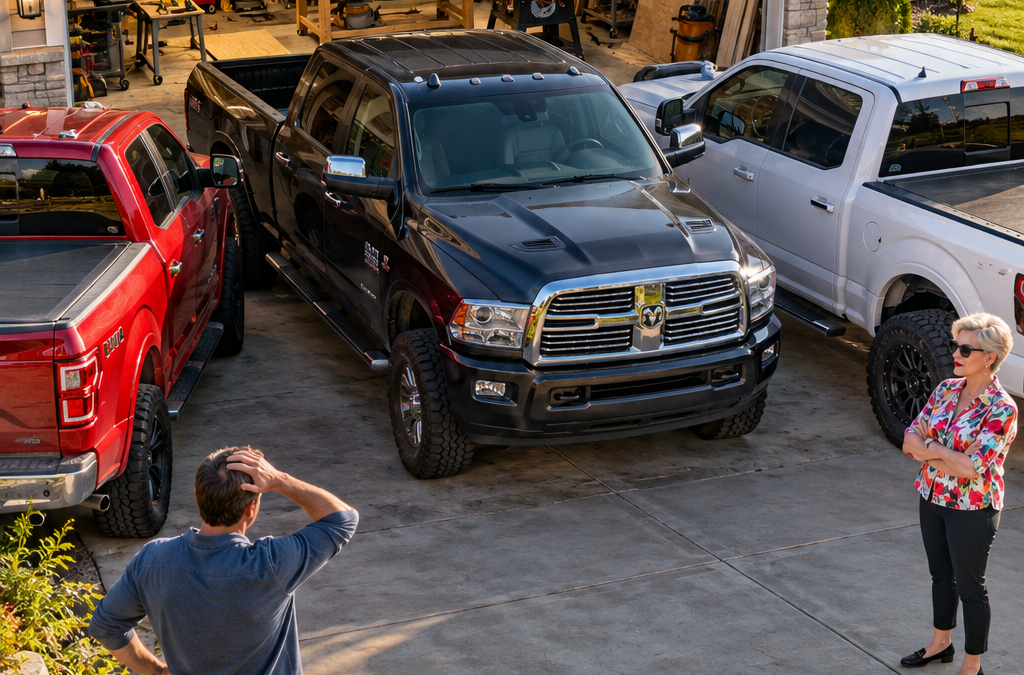
The engines were still warm when I found three locked trucks blocking my private garage, and one of them was sitting far enough inside that the crew had already moved my tools to make room for it.
I stood there staring at what Renata Holloway had done, and for the first time in six years of living in Maplewood Estates, I understood that being reasonable with her had only taught her how far she could push me.
My name is Declan, and until Renata moved into the neighborhood, I had never considered myself the kind of man who could become the center of an HOA dispute.
I paid my dues.
I kept my grass cut.
I brought my trash cans in before the deadline.
I waved at neighbors.
If somebody’s dog wandered into my yard, I walked it home instead of complaining.
Maplewood Estates had its rules, but for the first six years I lived there, those rules were mostly background noise.
The neighborhood sat outside a midsized town where suburban development had slowly swallowed what used to be farmland. The streets curved through mature maples and oak trees, and most of the houses had been built in the same fifteen-year period, which gave everything a comfortable sameness without making the place feel sterile.
The HOA liked that sameness.
Every mailbox was one of three approved styles.
Exterior paint had to come from a specific palette.
Portable basketball hoops were technically supposed to be stored out of sight when they weren’t being used, although nobody had enforced that rule seriously in years.
Holiday decorations had removal deadlines.
Lawn maintenance standards were precise enough that I once joked you could probably determine whether your grass was violating the bylaws with a ruler and a legal education.
Most of us tolerated it because the board had historically been reasonable.
If your grass got too long because you were sick, somebody usually asked whether you needed help before sending a violation letter.
If you left a trailer in your driveway one extra day after a camping trip, nobody acted as if civilization were collapsing.
That was the Maplewood Estates I knew.
And part of the reason I had bought my house was the garage.
It wasn’t attached to the house.
It sat toward the rear corner of my lot, a detached three-car structure that had been built by the original owner. The driveway curved along the side of the property, widened in front of the garage, and then stopped.
There was no through traffic.
No shared access.
No easement.
No community parking designation.
The garage, the driveway, and every foot of pavement leading to it were inside my property lines.
That mattered to me because woodworking was the one thing I did that had absolutely nothing to do with my job.
During the week, I worked forty hours, usually more, in a position that involved enough spreadsheets, phone calls, deadlines, and people asking for things to make the inside of my head feel crowded by Friday afternoon.
Woodworking was different.
Wood didn’t send email.
A table saw didn’t schedule a meeting.
A slab of walnut didn’t care whether a quarterly report had been submitted.
There was a clarity to taking something rough and turning it into something useful.
Measure.
Cut.
Sand.
Fit.
Start again if you had to.
My grandfather had introduced me to it when I was a teenager, and although he had been gone for years, I still used two of his chisels.
They weren’t the best tools I owned.
They weren’t even the most expensive.
But whenever I sharpened them, I remembered standing beside him at his workbench while he showed me how to let the steel do the work instead of forcing it.
That garage was where I kept everything.
My planer.
My jointer.
My cabinet saw.
Clamps hanging along one wall.
Hardwoods stacked by species.
Hand tools arranged above the bench.
My truck occupied one bay when I wasn’t working on a project.
The other two gave me enough space to move lumber without turning every Saturday into a logistical exercise.
It wasn’t glamorous.
It was mine.
That distinction became important after Renata Holloway moved in.
She and her husband, Philip, bought a house four doors down in late September.
I remember the day because three moving trucks arrived before eight in the morning, followed by two nearly identical dark SUVs.
Renata stepped out of one wearing white sneakers that somehow remained spotless despite people carrying furniture across the lawn.
She wasn’t rude that first day.
Not exactly.
She was observant.
That was the word I used at the time.
She stood near the curb and looked slowly up and down the street while movers went in and out behind her.
She wasn’t admiring the neighborhood.
She looked like she was inspecting it.
There is a difference.
I walked over because that’s what neighbors do.
“Welcome to Maplewood,” I said.
She gave me a bright smile.
“Thank you. It’s lovely.”
“Been here long?”
“Six years.”
She looked toward my property.
“You’re the corner house with the detached building?”
“That’s me.”
“What is that, exactly?”
“A garage.”
“Three-car?”
“Yeah.”
Her eyes stayed on it a moment longer than the question required.
“That’s a lot of garage.”
I laughed politely.
“I make good use of it.”
She smiled again.
“I’m sure you do.”
At the time, I didn’t think anything of that conversation.
Later, I remembered it almost word for word.
Within two weeks, Renata attended her first HOA meeting.
Within a month, she was speaking like she’d written the bylaws herself.
The first person she targeted was Margaret Ellis across the street.
Margaret was in her late sixties and had grown roses along the front of her house for as long as I’d lived there. They were beautiful in the spring—deep red climbing roses trained along white trellises.
One afternoon, I saw Renata standing near Margaret’s walkway with a folder tucked against her side.
Margaret looked confused.
I wasn’t close enough to hear the beginning of the conversation, but Renata’s voice carried.
“The covenant specifically discourages plantings that interfere with architectural continuity.”
Margaret stared at her roses.
“They’ve been here thirteen years.”
“That doesn’t mean they’re compliant.”
“They were here when I bought the house.”
Renata smiled.
“Then perhaps previous boards overlooked the issue.”
Nothing ultimately happened to Margaret’s roses.
But the conversation spread.
A few days later, Gerald Bennett received a warning regarding the basketball hoop in his driveway.
Gerald lived two houses across from me. He had two grandsons who visited almost every weekend, and that basketball hoop was probably responsible for more scraped knees and happy arguments than anything else on the street.
He came over one Saturday while I was sanding a cabinet door.
“You hear about this?” he asked.
He held up a printed notice.
I shut off the sander.
“What’d you do?”
“Apparently I am degrading neighborhood aesthetics.”
I took the paper.
“Basketball hoop?”
“Basketball hoop.”
“How long’s it been there?”
“Nine years.”
I handed the notice back.
“Maybe it’s become uglier.”
Gerald stared at me.
Then he laughed.
“That woman is something.”
By then, people had started calling Renata “Karen.”
Never where she could hear it.
Mostly in the neighborhood group chat or in private conversations while people were walking dogs.
I didn’t participate much.
I wasn’t interested in neighborhood politics.
I had spent enough years watching small disagreements become personal wars to understand the value of minding my own business.
My dues were paid.
My property was clean.
I had no violations.
I had no reason to expect that Renata Holloway would care what I did.
The first truck appeared on a Thursday.
I walked outside at about six-thirty in the morning carrying a travel mug in one hand and a stack of narrow oak boards under the other arm.
I planned to load them into the truck before work because I was dropping them off at a friend’s shop that afternoon.
I rounded the side of the house and stopped.
A white commercial pickup was parked directly in front of my center garage door.
Not near it.
Not partly obstructing it.
Directly across it.
The front bumper sat about three feet from the door.
No hazard lights.
No driver.
No note.
For a second, I assumed somebody had pulled into the wrong driveway.
Then I noticed ladders secured to the rack and a paving company logo on the door.
I set the boards down.
The truck was locked.
I walked toward Renata’s house and saw workers near her driveway.
One of them was unloading equipment.
“That your truck?” I called.
A man in a reflective vest looked over.
“The white one?”
“Yeah.”
“One of ours.”
“It’s blocking my garage.”
He looked toward it.
“Oh. Sorry. We were told we could stage over there.”
“By who?”
He nodded toward Renata’s house.
“Homeowner.”
I looked at him.
“That’s my property.”
His expression changed immediately.
“Seriously?”
“Seriously.”
He wiped his hands on his pants.
“Give me two minutes. I’ll move it.”
And he did.
No argument.
No attitude.
He apologized twice.
I told him it was fine.
I assumed Renata had made a careless mistake.
That should have been the end of it.
Two days later, on Saturday morning, I walked outside and found two landscaping trucks in almost the exact same place.
This time, one truck blocked the left bay.
The other sat diagonally across the center and right bays.
Men were carrying bags of soil and rolls of sod toward Renata’s yard.
I stood there staring.
One mistake was careless.
Twice was something else.
I found the crew leader.
“Who told you to park here?”
He pointed without hesitation.
“Mrs. Holloway.”
I felt something tighten behind my ribs.
“Did she tell you this property belonged to her?”
He frowned.
“She said this was overflow parking.”
“It isn’t.”
The man looked embarrassed.
“We’ll move.”
“Please.”
Again, the workers were decent about it.
Again, the problem wasn’t them.
I waited until the trucks were gone.
Then I walked down to Renata’s house.
She answered after the second knock.
Her hair was pulled back. She held a mug in one hand.
And there was that smile.
“Declan.”
“Morning.”
“Everything okay?”
“Not really. Your landscapers were parked in front of my garage.”
She took a small sip from her mug.
“They needed somewhere close.”
“My driveway isn’t contractor parking.”
“They weren’t hurting anything.”
“They blocked all three doors.”
“You weren’t leaving.”
I stared at her.
“You don’t know that.”
“Your garage wasn’t even open.”
For a moment, I thought I had misunderstood what she was saying.
Then I realized I hadn’t.
“The garage being closed doesn’t make the driveway available.”
She tilted her head slightly.
“We’re all part of the same community.”
“We are. That doesn’t make my garage community property.”
Her smile flattened.
“If it’s that important to you, bring it up at the next HOA meeting.”
“I’m bringing it up with you now.”
“Then I suppose we’ve both said what we needed to say.”
She started to close the door.
“Renata.”
She stopped.
“I’m being clear because I don’t want any misunderstanding later. Do not tell anyone they have permission to park on my property or block my garage.”
Her expression changed.
Not much.
Just enough.
The warmth disappeared.
“Noted.”
Then she closed the door.
I stood on the porch for several seconds.
There are people who become embarrassed when they’re caught crossing a boundary.
There are people who apologize.
There are people who become defensive.
Renata had done none of those things.
She had acted as though the boundary itself were unreasonable.
That bothered me more than the trucks.
I went home and opened the neighborhood portal.
Until that morning, I’d never spent more than a few minutes looking through it.
Meeting minutes.
Architectural request forms.
Financial reports.
Board contacts.
I clicked the board roster.
President: Philip Holloway.
I read it twice.
Then I leaned back in my chair.
Philip had been elected three months earlier.
Three months.
Renata and Philip had purchased their house shortly afterward.
Suddenly, her confidence made sense.
When she told Margaret her roses might violate the covenant, she wasn’t just a new resident quoting rules.
When Gerald received his basketball hoop notice, that wasn’t random.
When Renata told contractors my driveway could be used as overflow parking, she knew complaints would eventually travel to a board controlled by her husband.
She had not mistaken my garage for shared property.
She knew it wasn’t hers.
She simply believed nobody could effectively stop her.
I began searching the meeting minutes.
There were several complaints involving parking disputes.
Most had been resolved informally.
One line caught my attention.
“Parking and access complaints subject to board discretion when not specifically governed by common-area regulations.”
Board discretion.
Philip Holloway’s board.
I sat there with my hands resting on the desk.
I’m not impulsive.
That isn’t always a virtue.
Sometimes being patient means allowing people too many opportunities.
But when I finally decide something matters, I become methodical.
I pulled my closing documents from the filing cabinet.
Survey.
Plat map.
Property description.
Garage footprint.
Driveway boundaries.
No easement crossed the paved area in front of the garage.
No shared access rights.
No ambiguity.
I photographed the survey.
Then I called my friend Karen.
Karen was a real estate attorney I’d known for years.
We had met through work, and although she had never represented me formally, she was the person I trusted when a property issue stopped feeling simple.
She answered on the fourth ring.
“Declan. Please tell me you didn’t buy another antique machine without checking whether your garage floor can support it.”
“Different problem.”
“That’s disappointing.”
I explained the first truck.
Then the second incident.
Then Renata.
Then Philip.
Karen became quieter as I spoke.
When I finished, she said, “Do you have cameras?”
“One facing the driveway.”
“Does it cover the garage?”
“Mostly.”
“Mostly isn’t enough.”
“What are you thinking?”
“I’m thinking you should stop treating this like a neighbor dispute and start treating it like a documentation problem.”
I looked out the window toward the garage.
“Meaning?”
“Meaning if somebody repeatedly blocks access to private property after being told not to, you want dates, photographs, video, names, and written notice. Don’t rely on conversations.”
“I already told her.”
“I believe you. That isn’t the same as proving you told her.”
“So send something?”
“Yes.”
I wrote while she spoke.
She explained that the exact legal classification would depend on the circumstances, but knowingly interfering with private access after repeated notice could create civil liability, and continued unauthorized entry could potentially become a trespass issue.
Then she paused.
“What exactly do you want to do?”
“I want it to stop.”
“Good. Keep that as your objective.”
“I was hoping you’d say something more dramatic.”
“I bill for dramatic.”
I laughed despite myself.
Then she said, “And one more thing.”
“What?”
“You are allowed to secure your own property, assuming you’re not damaging somebody else’s vehicle or creating a dangerous situation.”
I stopped writing.
“Secure it how?”
“I didn’t say trap people, Declan.”
“I didn’t say you did.”
“I know that voice.”
“What voice?”
“The voice that means you’re engineering something.”
“I’m not an engineer.”
“You know what I mean.”
I smiled.
“Anything else?”
“Yes. Do not touch their vehicles. Do not threaten anyone. Do not escalate verbally. Document everything.”
“Understood.”
“And send written notice.”
I did.
That evening, I emailed Renata and copied the HOA’s official contact address.
I kept it short.
I documented both dates.
I stated that my driveway and garage were private property.
I stated that neither Renata nor any contractor working for her had permission to park there, stage equipment there, block access, or enter the garage.
I attached a marked survey.
Then I saved the email.
No response came from Renata.
Two days later, I received a one-sentence reply from the HOA account.
“Your concern has been received and will be addressed according to normal board procedure.”
No name.
No apology.
No commitment.
Nothing happened.
So I made some changes.
I called a locksmith first thing Monday.
The garage already had standard keyed access and electric openers, but I wanted a secondary system.
I had the exterior access rekeyed.
Then I had a manual bolt installed on the main rolling door system so that once secured, the doors could not simply be opened through the standard mechanisms.
The locksmith looked at me while finishing the installation.
“You expecting burglars?”
“Contractors.”
He looked at the new bolt.
“Persistent contractors?”
“You have no idea.”
I also installed two new cameras.
One covered the entire garage frontage.
The second captured the driveway from the side, including the approach from the street.
I checked the timestamps.
I checked the night vision.
I made sure video backed up automatically.
Then I located every visible property marker along that side of the lot.
I refreshed the paint around them.
Photographed them.
Photographed the driveway.
Photographed the garage doors.
Photographed the “Private Property—No Parking” sign I added beside the driveway.
It wasn’t enormous.
I didn’t want the front of my property to look like a government checkpoint.
But it was impossible to miss.
Gerald saw me installing it.
He walked over.
“That for Holloway?”
“It’s for anyone who has trouble identifying a driveway.”
He looked down the street.
“She still giving you problems?”
“Not since last weekend.”
He nodded.
“Give it time.”
I glanced at him.
“Why?”
Gerald lowered his voice despite the fact nobody was nearby.
“Margaret filed a complaint about her.”
“What happened?”
“Nothing.”
“Nothing?”
“Philip told her the board didn’t involve itself in ‘interpersonal disagreements.'”
I looked toward the Holloway house.
“What was the complaint?”
“Renata went onto Margaret’s property and started measuring the rose trellises.”
I let out a slow breath.
Gerald shook his head.
“I’m telling you, that woman thinks Philip getting elected made them owners.”
“Maybe she just hasn’t had anyone explain the job description.”
Gerald grinned.
“Planning to volunteer?”
“Not intentionally.”
For almost a week, nothing happened.
I started wondering whether the written notice had worked.
Friday afternoon, I left work a little earlier than usual.
I stopped for groceries.
I remember buying bread, turkey, mustard, coffee, and a bag of apples.
Ordinary things.
The kind of details that stay in your memory because what happens afterward gives them importance they never deserved.
I turned onto my street at 5:21.
I saw the trucks before I reached my driveway.
Three of them.
A large commercial pickup.
A boxy utility truck.
And a heavier flatbed with equipment racks.
For a second, I thought there had been some kind of emergency.
Then I saw men working around Renata’s house.
Exterior renovation.
Ladders.
Scaffolding components.
Power washers.
Stacks of material.
I slowed.
One truck was parked directly across my driveway.
Another sat in front of the garage.
The third was backed into the right-hand garage bay.
Inside.
Actually inside.
I stopped my truck in the street.
My hands tightened around the steering wheel.
There are moments when anger comes hot.
This wasn’t like that.
Mine went cold.
I parked along the curb and walked toward the garage.
The right door stood open.
The truck’s rear end extended several feet inside.
A rolling tool cabinet that normally sat near the side wall had been moved.
Two folding work stands had been pushed out of the way.
A stack of maple boards had been shifted.
Someone had entered my garage.
Touched my property.
Moved my tools.
To store a truck.
A worker came around the vehicle.
“Can I help you?”
I looked at him.
“Who told you to put that truck in here?”
He jerked his thumb toward Renata’s house.
“Homeowner.”
“This isn’t her garage.”
His expression immediately changed.
“What?”
“This is my property.”
He looked from me to the truck.
“She said we could stage here.”
“She lied.”
Another worker came over.
“What’s going on?”
The first man said, “Apparently this isn’t hers.”
The second worker looked toward Renata’s house.
“You serious?”
“Very.”
I could have demanded they move everything immediately.
Maybe I should have.
But I noticed something else.
The workers were packing up.
The engines on two trucks were still warm.
The crew appeared to be leaving the site for the evening.
One of them checked his phone.
“We were told the equipment could stay overnight.”
“By Renata Holloway?”
“Yes.”
I took out my phone.
I photographed the truck inside the garage.
Then the other two.
Then the plates.
Then the equipment.
Then the position of my moved tools.
The foreman approached.
“Look, man, if there’s a problem, we’ll move them.”
I looked at him.
“You have keys?”
He nodded.
“Then why don’t you?”
He hesitated.
“Mrs. Holloway told us we’re supposed to leave them staged.”
I almost laughed.
Not because it was funny.
Because I finally understood how complete her confidence was.
She had received written notice.
She knew the property line.
She had been told directly.
A sign now stood beside the driveway.
And she had instructed a contractor to drive a commercial vehicle inside my garage.
I said, “Your company has been informed this is private property.”
His jaw tightened.
“She told us this was cleared with you.”
“It wasn’t.”
His face changed.
Not fear.
Annoyance.
But still, he didn’t move the trucks.
Maybe he wanted to call his supervisor first.
Maybe he didn’t want to disobey the person paying the invoice.
Maybe he assumed it would all become somebody else’s problem.
Whatever the reason, I had reached the point where I was done negotiating in my own driveway.
I stepped inside my house.
Changed out of my work clothes.
Made a turkey sandwich.
Sat at the kitchen table.
And ate it.
That part surprises people when I tell the story.
They expect me to say I immediately confronted Renata.
I didn’t.
I had already confronted her.
I had already warned her.
I had already documented it.
The one thing I did not want to do was give her the argument she expected.
So I finished my sandwich.
Then I returned to the garage.
The crew had left.
All three trucks remained.
One partly inside the garage.
One positioned close enough to the door that moving it would be necessary to access the bay.
The third angled along the driveway.
I took another complete set of photographs.
Then I closed the garage door.
I engaged the secondary bolt.
The truck that had been left partly inside was now secured behind the locked garage door.
I did not touch it.
I did not move it.
I did not damage it.
I simply locked my own building.
The two vehicles outside remained where the contractor had left them, boxed into a driveway they had no permission to occupy.
Then I called the sheriff’s non-emergency line.
“County sheriff’s office. What’s the nature of your call?”
“I need to report unauthorized commercial vehicles left on private property.”
“Are the vehicles occupied?”
“No.”
“Do you know who owns them?”
“Contractor working for a neighbor.”
“Have you asked them to move?”
“Multiple times over multiple incidents. I also provided written notice. One vehicle is currently inside my private garage.”
There was a brief pause.
“Inside?”
“Yes.”
“Did you permit them to enter?”
“No.”
The dispatcher asked for the address.
I gave it.
“Are there any weapons involved?”
“No.”
“Any confrontation happening now?”
“No.”
“We’ll send someone when available.”
I thanked her.
Then I sat on my porch.
About fifteen minutes later, Renata appeared.
She walked out of her house, looked toward the garage, and then came directly toward me.
Her pace told me she already knew something was wrong.
“Declan.”
I remained seated.
“Renata.”
“Why is your garage closed?”
I looked at her.
There are questions so revealing that answering them immediately feels like interfering with the lesson.
Finally I said, “Because it’s my garage.”
“The contractor has equipment in there.”
“I know.”
“They need access.”
“They shouldn’t have been inside.”
Her mouth tightened.
“I told them they could use the bay temporarily.”
“I know.”
She stared at me.
“I don’t think you’re understanding.”
“No. I understand perfectly.”
“This renovation was scheduled weeks ago.”
“That doesn’t involve me.”
“The contractor needed staging space.”
“That still doesn’t involve me.”
She crossed her arms.
“We are trying to improve property values.”
I almost admired the sentence.
She had managed to turn unauthorized entry into public service.
“Renata, I told you directly not to use my property. I sent written notice. You received it.”
“We received your email.”
“So you knew.”
“I knew you had concerns.”
“Those weren’t concerns. That was notice.”
Her expression hardened.
“My husband is HOA president.”
I looked at her.
“Yes.”
“So if this becomes some sort of formal neighborhood dispute, it will be handled through the board.”
“No, it won’t.”
Her eyebrows lifted.
“And why is that?”
“Because I called the sheriff.”
That was the first time I ever saw Renata Holloway lose her smile completely.
“You what?”
“You left unauthorized vehicles on my property. One is inside my garage. I reported it.”
Her voice dropped.
“You called the police over parking?”
“No. I called the sheriff over repeated unauthorized access to private property.”
“This is ridiculous.”
“Then explaining it should be easy.”
She pulled out her phone.
“Open the garage.”
“No.”
“The contractors need their vehicle.”
“They can discuss it with the deputy.”
“Declan.”
“No.”
The word came out quieter than I expected.
That seemed to bother her more than if I’d shouted.
She stood there for another second.
Then she walked back toward her house.
A patrol SUV arrived about ten minutes later.
The deputy introduced himself and asked me to explain everything from the beginning.
I did.
I showed him the first photographs.
Then the second incident.
The email.
The survey.
The sign.
The camera footage.
The truck entering the garage.
The workers moving equipment.
The deputy watched silently.
“Do you have footage showing who authorized them?”
“No audio from their conversation with Renata. But the foreman told me directly that she did.”
“Okay.”
He walked toward the garage.
“Vehicle still inside?”
“Partly.”
“Any damage?”
“Not that I’ve seen.”
“Did you move it?”
“No.”
“Touch it?”
“No.”
“You just closed the garage?”
“Correct.”
He nodded.
“Open it for me.”
I unlocked the manual bolt.
The door rose.
The deputy looked inside.
The truck sat exactly where it had been left.
My tool cabinet remained pushed sideways.
He took photographs.
Then he walked outside and ran the plates.
That was when the situation changed.
I didn’t know immediately.
The deputy sat in his vehicle longer than I expected.
Then he stepped out and returned to the truck.
Checked the VIN plate.
Walked back to his patrol SUV.
Made another call.
Renata came outside again.
This time Philip was with her.
I had seen him before but rarely spoken with him.
He was the opposite of Renata physically—quiet posture, conservative clothes, the kind of man who always looked as if he had just left a meeting.
They approached the deputy together.
Philip spoke first.
“Officer, I’m Philip Holloway. HOA president.”
The deputy looked at him.
“Okay.”
Philip seemed slightly thrown by the lack of reaction.
“We understand there’s been a misunderstanding involving contractor parking.”
The deputy glanced toward me.
“The property owner has filed a complaint.”
Renata stepped forward.
“We have an arrangement concerning overflow use.”
I laughed once before I could stop myself.
The deputy looked at me.
“Do you?”
“No.”
Renata turned toward me.
“Declan, don’t be difficult.”
The deputy’s expression shifted.
Not dramatically.
But enough.
He asked, “Ma’am, did you tell these contractors they had permission to park here?”
“They needed temporary access.”
“That’s not what I asked.”
She paused.
“I told them the space was available.”
“Did Mr. Declan authorize that?”
“This is an HOA community.”
The deputy looked toward the garage.
“Is that garage common property?”
Philip finally answered.
“No.”
The silence after that was almost perfect.
The deputy nodded.
“Then this is not an HOA parking issue.”
Renata looked at Philip.
He did not look back at her.
A second patrol vehicle turned onto the street.
Then another.
Neighbors began appearing on porches.
Gerald walked to the edge of his driveway.
Margaret stood behind her screen door.
The first deputy went to meet the second.
They spoke quietly near the patrol vehicles.
I couldn’t hear everything.
Then one of them walked back toward the commercial trucks.
The deputy asked me, “Do you know who owns these vehicles?”
“The contractor, I assume.”
“One isn’t registered to the contractor.”
I frowned.
“Okay.”
He didn’t elaborate immediately.
A few minutes later, I learned why.
The registered owner of one vehicle had two outstanding warrants.
The truck itself wasn’t necessarily evidence of a new crime, and I never learned every detail behind the warrants.
But once the plate came back flagged, the officers had to determine how the vehicle had ended up on my property, who had possessed it, and whether the registered owner was connected to the crew working at the Holloway property.
What Renata had expected to be a five-minute argument about parking had suddenly become an actual investigation.
The crew foreman returned shortly afterward.
He arrived in a personal vehicle and got out looking confused by the patrol cars.
“What happened?”
One deputy asked his name.
Then asked who had authorized the trucks to be left.
The foreman pointed toward Renata.
“She did.”
Renata’s head snapped toward him.
“You were told the staging arrangement had been approved.”
He stared at her.
“You told me it was.”
“I told you there was HOA approval.”
The foreman glanced toward my garage.
“You said the owner had cleared it.”
“I said it was handled.”
“No. You specifically told me we could use that garage.”
Renata’s face reddened.
The deputy said, “Sir, did the property owner ever give you permission?”
The foreman looked at me.
“No.”
“Did you know it wasn’t Mrs. Holloway’s property?”
“Not until he came home.”
“And after you learned?”
The foreman’s jaw tightened.
“I called my supervisor.”
“Why didn’t you remove the vehicles?”
“Supervisor said the client told us to leave them until she resolved it.”
The deputy wrote something down.
The foreman looked at Renata again.
“You told us this was cleared.”
She lowered her voice.
“We can discuss this privately.”
“No. You can explain to my company why three vehicles are about to get impounded because you lied about where we could park.”
Her eyes widened.
“Impounded?”
The deputy answered.
“At least temporarily, yes.”
“That is unnecessary.”
“That’s not your decision.”
Philip finally stepped closer.
“Deputy, perhaps we can de-escalate this. If Declan withdraws his complaint—”
I looked at him.
“Philip, your wife entered my garage through contractors after written notice.”
“Nobody entered personally.”
“She directed them.”
“That’s an allegation.”
The foreman spoke immediately.
“It’s not an allegation.”
Philip looked at him.
The foreman pointed toward Renata.
“She told us the garage was available.”
Nobody spoke for several seconds.
Then Gerald called from across the street.
“Philip, want me to print the HOA bylaws for you?”
I turned.
Gerald stood beside his mailbox with his arms folded.
“Not now, Gerald,” Philip said.
Gerald smiled.
“Just offering community assistance.”
Despite everything, I almost laughed.
The tow trucks arrived one after another.
The first commercial vehicle was loaded.
Then the second.
The truck inside my garage required more coordination because the officers wanted it documented before removal.
I opened the bay fully.
A tow operator inspected the position.
They removed it without damaging the building or the vehicle.
I watched it roll backward down my driveway.
Renata stood near her lawn.
For the first time since she’d moved into Maplewood Estates, she looked uncertain.
The foreman was beyond uncertain.
He was furious.
Not with me.
With her.
He walked toward Renata after one of his trucks had been secured.
“You understand we’re getting billed for this?”
“You need to speak to the officers.”
“No. I’m speaking to you.”
“I hired your company.”
“Exactly.”
His voice rose.
Gerald later told me he heard almost every word from his driveway.
“You told us we had permission. My crew asked you twice. You said the garage owner knew.”
“Lower your voice.”
“Don’t tell me to lower my voice. You put my guys in the middle of this.”
“It was a parking misunderstanding.”
“You told us to put equipment inside another man’s garage.”
“I said it was handled.”
“It wasn’t handled!”
Philip stepped between them.
“We will discuss any legitimate expenses with your office.”
The foreman stared at him.
“Oh, you’ll discuss them.”
Then he looked toward the patrol vehicles.
“And if my company gets one dollar in impound fees because of this, the invoice is coming to you.”
He pointed at Renata.
“Not him. You.”
Renata said nothing.
By the time the last truck left, half the street knew what had happened.
I wish I could say I felt triumphant.
I didn’t.
Mostly I felt tired.
The adrenaline had worn off.
My garage looked wrong with the tool cabinet moved.
The boards stacked badly.
Dust tracked across the floor.
I stood inside for a long time after everyone left.
Then I picked up one of my grandfather’s chisels from the bench.
It hadn’t been touched.
That shouldn’t have mattered.
But it did.
I locked the garage and went inside.
The next morning, I filed a formal complaint with the HOA.
Not because I expected Philip to investigate his own wife.
I filed it because I wanted a record.
I included the dates.
Photographs.
The written warning.
The police incident number.
The contractor statements as I understood them.
Then I sent a separate packet to the county office responsible for HOA governance complaints in our area.
My complaint wasn’t simply that Renata had blocked my garage.
It was that the HOA president had an obvious conflict of interest.
His wife had repeatedly used private property without permission.
Formal concerns routed through the HOA had not produced any corrective action.
Philip had then appeared during the sheriff’s response and attempted to characterize the matter as an HOA misunderstanding.
I didn’t accuse him of crimes.
I didn’t need to.
I asked for a governance review.
Karen helped me organize the documents.
When I told her about the truck with the warrant connection, she went silent for a moment.
“Declan.”
“Yeah?”
“I told you to document a parking dispute.”
“I documented it.”
“You somehow turned it into three patrol cars and an impound investigation.”
“I didn’t run the plates.”
“That is technically true.”
“You sound disappointed.”
“I sound like I’m reconsidering giving you legal ideas.”
I laughed.
Then her tone became serious.
“Listen. From here forward, do not gloat.”
“I wasn’t planning to.”
“Good. Don’t post about it. Don’t threaten the board. Don’t embellish anything. You have documentation. Let documentation work.”
That became my rule.
Renata did not follow the same strategy.
Three days later, an HOA notice appeared in my mailbox.
It stated that the board had received complaints regarding “hostile interactions with approved contractors.”
I read that sentence three times.
Then I photographed the notice and sent it to Karen.
She called me within five minutes.
“Do not respond emotionally.”
“I wasn’t going to.”
“Your breathing says otherwise.”
“‘Approved contractors’?”
“I saw it.”
“They were inside my garage.”
“I saw it.”
“The sheriff removed their trucks.”
“I saw it.”
“And Philip’s board is warning me?”
“Which is why you don’t respond emotionally.”
“What do I respond with?”
“Facts.”
We drafted a short answer.
I denied hostile conduct.
I requested the identities of the complainants.
I asked the HOA to specify what authority allowed contractors hired by a private homeowner to enter or obstruct privately owned property.
I asked whether Philip Holloway had participated in preparing or approving the notice.
And I requested that he formally recuse himself from any matter involving his wife.
The HOA never answered the questions.
Instead, the notice quietly disappeared from the portal.
That interested the county reviewer.
About two weeks after I filed the complaint, I received an email requesting documentation.
I sent everything.
Then other neighbors began submitting their own complaints.
Margaret documented Renata entering her yard to measure the rose trellises.
Gerald submitted copies of the basketball hoop notices and communications showing inconsistent enforcement.
Another homeowner provided records involving a temporary trailer.
Another documented an architectural complaint that had apparently stalled after she questioned Renata publicly at a meeting.
The issue stopped being about my garage.
It became a pattern.
Philip had only been board president for a few months, but enough decisions had been handled informally that the county reviewer started asking questions about process.
Were complaints being logged?
Were recusals documented?
Were enforcement standards applied consistently?
Were board members disclosing conflicts?
Who had access to the violation system?
Why were some reports processed immediately while others disappeared?
Then came the meeting that ended Philip’s presidency.
I almost didn’t attend.
Gerald convinced me.
“You have to go.”
“I already gave the county everything.”
“That’s exactly why you have to go.”
“What am I supposed to do? Sit there?”
“Yes.”
“That’s your argument?”
“I want to watch Philip explain the phrase ‘conflict of interest’ while you’re sitting six feet away.”
So I went.
The clubhouse meeting room was fuller than I’d ever seen it.
Normally, HOA meetings attracted the same twelve people.
That night, there were more than forty.
Renata sat in the front row.
Philip was behind the board table.
He looked exhausted.
The county review had apparently not concluded officially, but internal board pressure had already become intense.
Two board members had requested access to complaint records.
One had discovered that Philip participated in discussions involving complaints connected directly to Renata.
Another had questioned whether certain notices had been issued according to required procedures.
The vice president opened the meeting.
Philip said almost nothing during the first twenty minutes.
Then public comment began.
Margaret spoke first.
She stood with both hands around a folder.
“I’ve lived here fourteen years,” she said. “Until this year, no board member’s spouse ever walked onto my property and told me my flowers existed by permission.”
Renata shifted in her chair.
Margaret continued.
“I don’t care about roses anymore. I care that when I complained, I was told the board didn’t handle interpersonal disagreements. But when Mrs. Holloway complained about someone else’s basketball hoop, the board sent a notice.”
Gerald spoke next.
He held up his violation letter.
“My hoop is ugly,” he said.
People laughed.
Even I did.
Gerald waited.
“Apparently it became ugly after nine years.”
More laughter.
Then his voice changed.
“But here’s what isn’t funny. Rules mean something only if they apply the same way to everybody. Otherwise they’re not rules. They’re favors.”
Philip looked down.
Eventually my name was called.
I stood.
I had prepared notes but didn’t use them.
“My complaint is simple,” I said. “I own my garage. I own the driveway in front of it. I told Mrs. Holloway not to direct contractors onto my property after it happened twice. I followed that conversation with written notice.”
I looked at the board.
“After receiving that notice, she directed another contractor to park three vehicles on my property and place one vehicle inside my garage.”
Renata turned around.
“That’s not an accurate characterization.”
The vice president raised a hand.
“Mrs. Holloway, public comment isn’t a debate.”
I continued.
“The contractor told law enforcement she represented that access had been approved. It had not been.”
I looked at Philip.
“When the sheriff responded, Mr. Holloway attempted to characterize the matter as something that could be handled through the HOA.”
Philip finally spoke.
“I was attempting to de-escalate.”
“I understand.”
My voice stayed calm.
“But that is exactly the problem.”
The room became quiet.
“Your wife believed the HOA gave her authority over private property. When she was challenged, she referred me to a board you controlled. When law enforcement became involved, you identified yourself as HOA president before discussing the facts.”
Philip leaned back.
“I never claimed ownership over your property.”
“No. Renata behaved as if your office gave her control over it.”
I paused.
“And nothing the board did before that night gave her reason to think otherwise.”
I sat down.
The board entered executive discussion later that evening.
We waited outside.
Gerald leaned against the clubhouse wall.
“Think he’s done?”
“I don’t know.”
“He looks done.”
“Looking done and being removed are different things.”
About forty minutes later, we were called back inside.
The vice president read a motion.
Philip Holloway would be removed as board president pending formal review of governance and conflict-of-interest concerns.
He would surrender administrative access immediately.
The vote was not unanimous.
But it passed.
Eight weeks had passed since the trucks blocked my garage.
Renata sat perfectly still.
Philip’s face looked gray.
Nobody celebrated.
That surprised me.
After months of frustration, I expected applause.
Instead, the room stayed quiet.
Maybe everyone understood that we weren’t watching somebody lose a game.
We were watching authority being taken from a person because trust had been lost.
Philip gathered his papers.
Renata stood.
She looked toward me.
For a second, I thought she might say something.
She didn’t.
They left together.
The county review continued.
I never learned every internal detail, and frankly I didn’t need to.
The board adopted new conflict-of-interest procedures.
Complaint tracking became visible to all board members.
Recusals had to be entered into meeting records.
No spouse or household member of a board officer could participate informally in enforcement matters.
The HOA also sent a written acknowledgment that contractors working for individual residents had no authority to use private driveways, garages, or lots without permission.
It was the kind of rule that should never have required clarification.
But there it was.
Twelve weeks after the incident, a real estate sign appeared in front of the Holloway house.
Gerald texted me a photograph.
YOU SEE THIS?
I walked outside.
There it stood.
FOR SALE.
I felt less satisfaction than I expected.
Renata had infuriated me.
Philip had enabled her.
But seeing that sign didn’t feel like winning.
It felt like the final stage of something that never should have happened.
They moved several weeks later.
I was standing near my mailbox when the moving truck arrived.
Renata walked outside carrying a small box.
She saw me.
I considered going back inside.
Instead, I stayed where I was.
She crossed the street.
For once, there was no smile.
“I suppose you’re happy.”
I looked at her.
“No.”
She seemed surprised.
“You got what you wanted.”
“What I wanted was for people to stop parking in front of my garage.”
Her jaw tightened.
“You humiliated Philip.”
“No.”
“You filed complaints until he lost his position.”
“I documented what happened.”
“Same thing.”
“It isn’t.”
She looked toward my house.
“Do you know how ridiculous this all was? Three trucks.”
I felt something in me settle.
Maybe that was the first moment I knew the argument was truly over.
“It was never three trucks, Renata.”
She crossed her arms.
“Then what was it?”
“It was the first truck after you knew it wasn’t your property.”
She said nothing.
“It was the second truck after I asked you directly to stop.”
Her eyes shifted away.
“It was sending contractors into my garage after written notice.”
I looked toward her old house.
“And it was believing Philip’s title meant nobody could tell you no.”
Her expression hardened.
“You always thought you were better than us.”
“No.”
I shook my head.
“I barely thought about you at all until you made yourself part of my property.”
That landed.
For once, Renata had no immediate answer.
A mover called her name from the driveway.
She turned.
Then she looked back.
“You could have handled it differently.”
“So could you.”
She walked away.
That was the last conversation we ever had.
I later heard through Gerald that the Holloways had moved into another development with a stricter HOA.
I laughed when he told me.
“Maybe she’ll enjoy the structure.”
Gerald nearly choked on his coffee.
“That woman doesn’t enjoy rules.”
“She quoted them constantly.”
“She enjoyed rules for other people.”
He was right.
Maplewood changed after they left.
Not dramatically.
That was the best part.
Margaret’s roses stayed.
Gerald’s grandsons kept playing basketball.
The board meetings became boring again.
A new president was elected, a retired accountant named Louise Harper who began her first meeting by saying, “If your spouse starts issuing HOA instructions, please assume I will pretend not to know you.”
Apparently that made it into the minutes.
My garage returned to being what it had always been.
A garage.
My truck goes in one bay.
My tools stay where I leave them.
The maple boards that had been pushed aside eventually became a dining table for my sister.
I kept the cameras.
Not because I expected another Renata.
Because once someone teaches you the value of documentation, you don’t easily forget it.
I also kept the manual bolt.
Every Friday evening, I still walk into the garage after work and feel the noise of the week begin to disappear.
I switch on the overhead lights.
The fluorescent fixtures hum.
Wood dust hangs in the air.
Sometimes I run my hand across the edge of my grandfather’s old workbench before I start.
The place feels exactly the way it did before Renata Holloway arrived.
Maybe slightly more secure.
Every once in a while, usually when I’m pulling into the driveway after a long day, I remember those three commercial trucks.
The warm engines.
The locked doors.
The one backed into my garage as though the building belonged to whoever had enough confidence to claim it.
I remember standing there and realizing that politeness had become permission in Renata’s mind.
My silence had become agreement.
The absence of consequences had become ownership.
That was the mistake she made.
She thought power was the same thing as authority.
They aren’t.
Power can come from a title.
A friendship.
A marriage.
A position on a board.
Sometimes it comes from nothing more than being louder than everybody else.
Authority is different.
Authority has boundaries.
Documents.
Responsibilities.
Rules that apply even when they’re inconvenient.
Renata believed Philip’s title allowed her to redraw those boundaries whenever they got in her way.
For a while, nobody challenged that belief strongly enough to make her reconsider it.
Margaret tried to be polite.
Gerald laughed off his notice.
I moved the first contractor truck and let it go.
Then I moved the second problem with another conversation.
Each time Renata pushed past a boundary and met only patience, she interpreted patience as weakness.
That was probably the saddest part.
People like her often misunderstand restraint.
They assume that because somebody hasn’t fought back, they can’t.
Because somebody hasn’t raised his voice, he has nothing to say.
Because somebody prefers peace, he will pay any price to preserve it.
I prefer peace.
I still do.
But peace that exists only because one person is allowed to take whatever he wants from everyone around him isn’t peace.
It’s surrender with landscaping.
I didn’t need revenge against Renata.
I didn’t need to embarrass Philip.
I didn’t need to become the loudest man at an HOA meeting.
I needed one thing.
A line.
A clear line.
My garage was on one side.
Her authority was on the other.
She crossed it anyway.
So I stopped asking her to step back.
I documented where the line was.
I secured what belonged to me.
And I let the facts do the rest.
That is what I remember most clearly now.
Not the tow trucks.
Not the patrol lights.
Not Renata’s face when the deputy told her the vehicles were being impounded.
I remember the quiet moment before all of that, standing alone in my driveway while three trucks occupied space that belonged to me.
For months, Renata had acted as if Maplewood Estates was hers to organize, hers to correct, hers to control.
That evening, looking at my displaced tools and the truck backed into my garage, I finally understood the only response that mattered.
I didn’t need her permission to protect what was mine.
And once I stopped acting as if I did, everything changed.








