PART 2: HOA Karen Demanded My Wife’s Pink Porsche 911 for Free—Then Her Family Used Every Connection They Had to Take It
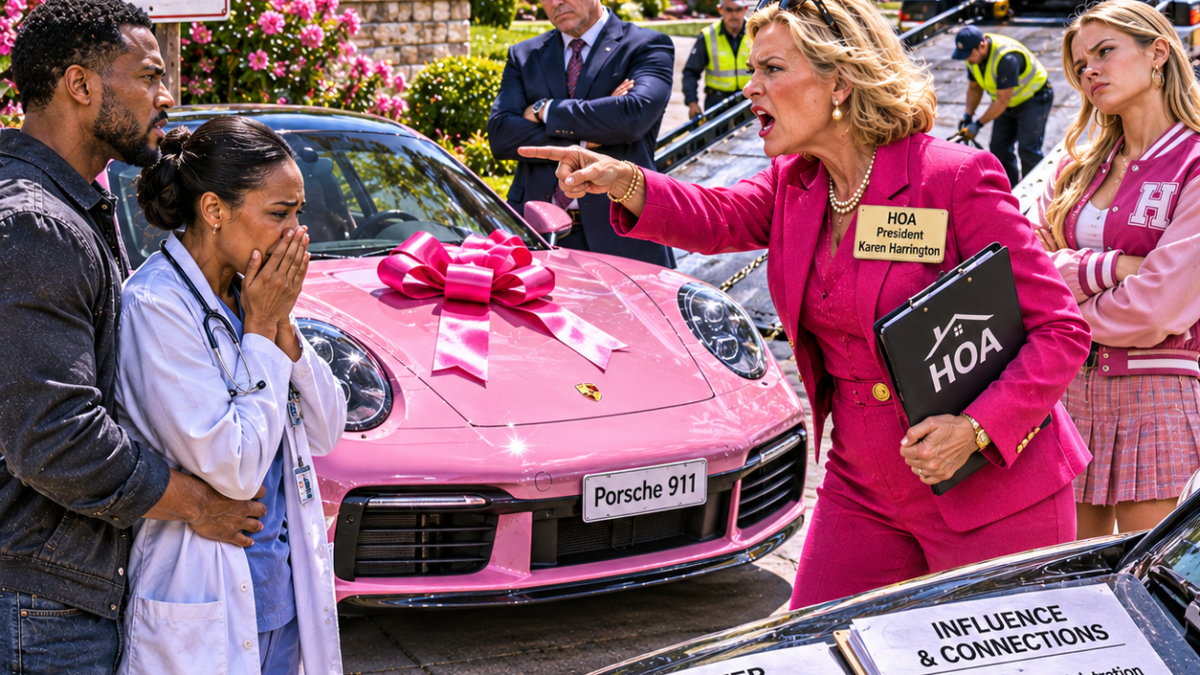
The day I surprised my wife with the custom ballet-slipper-pink Porsche 911 she had dreamed about since medical school, I thought the hardest part had been hiding three years of savings, dealership calls, and paint-shop invoices from a pediatric surgeon who could detect a lie from across a hospital hallway—but eight days later, an HOA woman in a hot-pink blazer marched into our driveway with her eighteen-year-old daughter, pointed at Amara’s anniversary gift, and announced that we should hand over the keys for free because her daughter “deserved it more.”
I laughed because no reasonable person could possibly be serious, until the daughter screamed, “I WANT IT FOR FREE,” her mother told my wife that “people like you” should know their place in Oakridge, and the father showed up two days later offering me twenty percent above the purchase price while calmly explaining how unfortunate it would be if my consulting contracts disappeared or my wife’s hospital suddenly began questioning her professional reputation.
What frightened me most wasn’t their money, their connections, or even the anonymous note that appeared on Amara’s windshield—it was the moment I realized the Harringtons weren’t trying to buy a car anymore, because somewhere between their first tantrum and the paperwork that arrived at our house, they had decided that if we refused to surrender something we had earned, they would simply use every piece of influence they possessed to make refusing them hurt.
My name is Darius Palmer.
I didn’t grow up around Porsches.
I grew up in a cramped apartment above my mother’s sewing shop, where the walls shook whenever the old industrial machines downstairs ran late.
My mother could turn a torn dress into something beautiful, but she couldn’t manufacture money.
She used to tell me, “Hard work doesn’t promise success, baby, but laziness guarantees failure.”
I carried that sentence through college.
Computer science degree.
Freelance jobs.
A tiny consulting company I started out of a dorm room.
Then years of eighty-hour weeks until the business finally became something stable.
Amara worked even harder.
Medical school.
Residency.
Sleepless nights.
Student loans.
Board exams.
Eventually she became a pediatric surgeon in Atlanta.
There were nights when she came home so tired she fell asleep sitting upright at the kitchen table.
Through all of it, she had one ridiculous little dream.
A Porsche 911.
Not red.
Not black.
Pink.
Specifically, the pale ballet-slipper pink she’d seen in a magazine years earlier.
Whenever she mentioned it, she always finished with the same words.
“Maybe one day.”
So I spent three years making “one day” happen.
Every bonus.
Every extra contract.
Every amount I could save without touching retirement, mortgage payments, or our emergency fund.
I coordinated with a dealership and a specialty shop to get the color right.
Then, on our tenth anniversary, a flatbed rolled into our driveway carrying the car beneath a giant bow.
Amara came home wearing wrinkled scrubs after a brutal night shift.
She stepped out of her daily driver.
Stopped.
Then covered her mouth.
“Darius.”
I couldn’t stop smiling.
She walked toward the Porsche slowly, like moving too quickly might wake her from a dream.
“You didn’t.”
“I did.”
Her eyes filled.
“You actually did.”
Then she wrapped both arms around me and cried into my shirt.
Neighbors came outside.
Mrs. Chen applauded from across the street.
Someone shouted, “You two earned it!”
For one perfect week, that car was exactly what it was supposed to be.
A love letter.
Then Trish Harrington saw it.
Trish lived in the oversized colonial at the end of our street with her banker husband, Gregory, and their eighteen-year-old daughter, Britney.
She wasn’t technically the HOA president, but she behaved like Oakridge had issued her a crown.
That Saturday, Amara and I were washing the Porsche when Trish and Britney marched up our driveway dressed almost entirely in pink.
Britney stared at the car.
Then at Amara.
“That’s my color.”
Amara looked at me.
I looked at her.
Britney pointed at the Porsche.
“I’ve been telling everyone Dad’s getting me a pink one.”
“Okay,” I said.
“You stole my idea.”
Amara laughed before she could stop herself.
Britney’s face twisted.
“Give it to me.”
I thought I’d misheard.
“What?”
Trish folded her arms.
“We’re willing to take it off your hands.”
“For how much?”
She smiled.
“Without payment.”
Then Britney screamed:
“I WANT IT FOR FREE!”
I pulled out my phone and hit record.
And that was when Trish stopped pretending this was about a car.
PART 2
Trish saw the phone in my hand immediately.
Her expression changed.
“What are you doing?”
“Recording.”
“Turn that off.”
“No.”
“This is a private conversation.”
“You’re standing in my driveway.”
Britney rolled her eyes.
“Oh my God. Mom, just make them give it to me.”
Amara put down the towel she’d been using on the side mirror.
Her exhaustion had disappeared.
I knew that look.
She used the same expression when someone tried to argue with her about a child’s postoperative instructions.
“Britney,” she said, “this car belongs to me.”
“I know.”
“Then why would I give it to you?”
Britney stared at her as if the answer were obvious.
“Because I want it.”
Amara actually blinked.
Trish stepped forward.
“My daughter has had her heart set on this model for months.”
“Then buy her one.”
“Our order was delayed.”
“That has nothing to do with us.”
“You could simply replace yours later.”
I laughed.
Trish looked offended.
“What exactly is funny?”
“You.”
Her eyes narrowed.
“Excuse me?”
“You’re standing on my property asking my wife to hand your adult daughter an anniversary gift worth well into six figures because your daughter doesn’t want to wait for another one.”
Britney stomped.
“But this one is already here.”
Amara looked at me.
“Darius, please tell me we’re being pranked.”
“I wish.”
Trish’s face hardened.
Then she said the line that changed everything.
“Be reasonable. People like you shouldn’t be creating this kind of spectacle in the neighborhood anyway.”
Silence.
The garden hose continued running beside my feet.
Water trickled toward the curb.
I looked directly at her.
“People like us?”
Trish smiled without warmth.
“You know exactly what I mean.”
I did.
That was the problem.
For years, Amara and I had heard versions of that sentence dressed in nicer clothes.
You’re so articulate.
You must be so proud to have made it this far.
Are you sure this neighborhood is in your budget?
You don’t seem like the typical surgeon.
Nothing explicit enough to fight.
Nothing clean enough to hold.
Until now.
I raised the phone slightly.
“Would you like to explain what kind of people you mean?”
Trish noticed the camera again.
Her confidence flickered.
Britney didn’t have her mother’s restraint.
She spat out a racial slur.
Loud.
Sharp.
Ugly.
Mrs. Chen, two houses over, stopped watering her hydrangeas.
A man walking his dog froze.
Amara’s face changed.
Not fear.
Pain.
Then anger.
“Get off our property.”
Britney started laughing nervously.
Trish grabbed her arm.
“We’ll go.”
She pointed at us.
“But this isn’t finished.”
Amara said:
“It is.”
Trish smiled.
“No, Doctor Palmer.”
Then she looked at the Porsche.
“It isn’t.”
—
They walked away.
I stopped the recording.
For several seconds, neither Amara nor I moved.
Then she sat on the edge of the driveway.
Not against the Porsche.
Away from it.
That hurt me more than the insult.
Eight days earlier, she had touched that car like it represented every exhausted night she’d survived.
Now she didn’t want to stand beside it.
I sat next to her.
“You okay?”
She gave me a look.
“Do I look okay?”
“No.”
“Then why did you ask?”
“Habit.”
She exhaled.
“I’ve had parents scream at me because their child was sick.”
“I’ve had people threaten lawsuits because I wouldn’t give antibiotics for a virus.”
“I’ve had attendings talk down to me.”
“I’ve had patients assume I’m a nurse.”
“I know.”
“But she stood in our driveway…”
Her voice cracked.
“…and acted like I had stolen something simply by owning it.”
I took her hand.
“That is not yours to carry.”
“I know.”
“But it still lands.”
I knew exactly what she meant.
I looked toward the Porsche.
“Do you want me to put it in the garage?”
She nodded.
So I did.
That night, the ballet-slipper-pink Porsche disappeared behind a closed door.
For the first time since it arrived.
—
Two days passed.
Britney drove slowly by our house several times.
Once, she stopped across the street.
Phone out.
Taking pictures.
I photographed her photographing us.
Amara laughed when she saw me.
“We’re becoming those people.”
“What people?”
“The ones with evidence folders.”
“Evidence folders are attractive.”
“You’re deeply strange.”
“You married me.”
“Temporary lapse in judgment.”
It was the first time she’d smiled since the confrontation.
Then Wednesday morning came.
Amara called me from the hospital.
Her voice was tight.
“Darius.”
“What happened?”
“There was something on the windshield.”
My stomach sank.
“What?”
She sent the photograph.
A handwritten note.
Black marker.
**THIS CAR DOESN’T BELONG TO YOU. SELL IT TO ITS RIGHTFUL OWNER OR FACE CONSEQUENCES.**
My hand tightened around my phone.
“Don’t throw it away.”
“I know.”
“Don’t handle it more than necessary.”
“I know.”
“Take pictures.”
“Darius.”
“Sorry.”
“I’m a surgeon, not a toddler.”
“Evidence-folder brain.”
She exhaled.
“I hate this.”
“I know.”
“I don’t want to be scared of leaving my own hospital.”
“You shouldn’t have to be.”
There was a pause.
Then Amara said:
“We’re documenting everything.”
“Already started.”
“Good.”
I opened a new folder on my computer.
**HARRINGTON INCIDENTS**
Date.
Time.
Video.
Note.
Witness names.
Security footage.
I backed it up to the cloud.
Then another drive.
I wasn’t thinking about revenge yet.
I was thinking about a sentence my mother used to repeat whenever someone tried to cheat her sewing shop.
**People lie differently when they know you kept the receipt.**
—
Friday afternoon, Gregory Harrington arrived.
Black Mercedes.
Dark suit.
Perfect tie.
Expensive watch.
The man looked like he’d been born inside a boardroom.
He extended his hand.
“Mr. Palmer.”
I didn’t take it.
“Gregory.”
He lowered his hand smoothly.
“I believe you’ve met my wife and daughter.”
“Unfortunately.”
His jaw moved slightly.
Then the smile returned.
“I wanted to have a more reasonable conversation.”
“There is no conversation.”
“About the Porsche.”
“Exactly.”
I started turning back toward the house.
“I’m prepared to offer twenty percent above your purchase price.”
That stopped me.
Not because I was tempted.
Because the insanity had evolved.
I turned.
“You want to buy my wife’s anniversary gift?”
“I want to resolve unnecessary tension.”
“Your wife demanded it for free.”
“She can be emotional.”
“Your daughter used a racial slur.”
“Teenagers say foolish things.”
“She’s eighteen.”
“Still young.”
“And now you’re offering money.”
“Generous money.”
I shook my head.
“Not for sale.”
Gregory’s smile faded slightly.
“You haven’t heard the number.”
“I don’t need it.”
“Everybody has a number.”
“Maybe.”
“But this isn’t about a number.”
He studied me.
Then lowered his voice.
“Mr. Palmer, I don’t think you understand how interconnected communities like Oakridge are.”
I almost laughed.
“Sounds ominous.”
“I sit on several local business committees.”
“Congratulations.”
“Our family is a substantial donor to your wife’s hospital.”
There it was.
I stopped smiling.
Gregory continued.
“I know people who make decisions about consulting contracts.”
“Bank relationships.”
“Community organizations.”
“Licensing boards.”
“Professional committees.”
Each phrase landed more deliberately than the last.
I said:
“Are you threatening us?”
He smiled.
“Not at all.”
“Because it sounds like you’re telling me my wife could face trouble at work and my company could lose contracts unless I sell you her car.”
“I’m explaining that stubborn decisions sometimes create unnecessary consequences.”
I stared.
“That’s a threat.”
“It’s advice.”
“No.”
I stepped closer.
“Advice would be telling your daughter she can’t have somebody else’s property.”
His face finally dropped the polished mask.
“You think your recent success makes you untouchable.”
I laughed once.
“You walked onto my property because your daughter wants a pink car.”
“I am not the one confused about status here.”
His eyes went cold.
“Think about my offer.”
“No.”
“Talk to your wife.”
“No.”
“You’ll regret being emotional.”
“No, Gregory.”
I pointed toward the street.
“You’ll regret assuming we scare as easily as the people who usually tell you yes.”
He left.
I recorded the entire conversation through the security system.
—
When Amara came home, we sat at the dining table.
No television.
No wine.
Just documents.
She listened to Gregory’s threat.
Once.
Then again.
When it finished, she said:
“Lawyer.”
“Agreed.”
“My hospital too.”
“Your department head?”
“Yes.”
“I don’t want them hearing some twisted version first.”
“That makes sense.”
She opened her own folder.
I looked at her.
“You made one too?”
“Of course.”
I laughed.
“What?”
“I married well.”
“You’re only figuring that out?”
She pushed the folder toward me.
Inside were dates.
Descriptions.
Copies of notes.
Her recollection of every encounter.
The car-order documentation.
Even the date Britney first saw the Porsche.
“Amara.”
“What?”
“This is terrifying.”
She almost smiled.
“I write surgical notes for a living.”
Then she became serious.
“Darius.”
“Yeah?”
“I don’t care about the car anymore.”
I looked at her.
“I mean, I love it.”
“But if this gets worse…”
She stopped.
“What?”
“I don’t want you risking everything because of a machine.”
I reached across the table.
“We’re not fighting for the machine.”
She looked at me.
“We’re fighting because they think they can punish you until you give them what they want.”
Her eyes filled slightly.
“Okay.”
That night we called Raymond Ellis.
Raymond had handled business matters for me for years.
Quiet lawyer.
Sharp.
Almost aggressively boring.
Exactly what I wanted.
He listened.
Then said:
“Do not contact the Harringtons voluntarily again.”
“Fine.”
“Preserve everything.”
“Done.”
“Do not post online.”
“Wasn’t planning to.”
“And Darius?”
“Yes?”
“No revenge.”
“I haven’t done anything.”
“You sound like somebody thinking about something.”
I looked at Amara.
She smirked.
“Fine.”
—
Monday morning destroyed whatever illusion we had that this would remain a neighborhood argument.
Amara had worked nearly thirty-six hours across two emergency cases and one complicated postoperative complication.
She came home before sunrise.
Showered.
Slept.
At 9:15, I heard a diesel engine outside.
Tow truck.
Two men in navy work clothes.
One carried paperwork.
“Mr. Palmer?”
“Yes.”
“We’re here for the Porsche.”
I stared.
“What?”
He handed me an order.
Official formatting.
Court stamp.
Signature.
Judge Whitfield.
**TEMPORARY EX PARTE ORDER REGARDING DISPUTED PROPERTY.**
I read it.
Then read it again.
“Harrington versus Palmer?”
The stockier driver nodded.
“That’s what we were given.”
“We haven’t been sued.”
He shrugged apologetically.
“We don’t decide that.”
I looked at the garage.
“You’re not taking anything until I call counsel.”
“Sir, we’ve got an order.”
“And I have an attorney.”
I called Raymond.
He answered immediately.
“What happened?”
“Tow truck.”
Silence.
“For what?”
“The Porsche.”
Another silence.
Longer.
“Send me the order.”
I photographed every page.
Thirty seconds later, Raymond called back.
His voice had changed.
“Do not consent to anything.”
“Can I physically stop them?”
“No.”
“Then what?”
“Tell them the order is disputed and counsel is on the way.”
“Raymond, it’s signed.”
“I can see that.”
“By Whitfield.”
“Yes.”
“Gregory told me he knows him.”
“I remember.”
I looked toward the street.
My stomach tightened.
This wasn’t a rich family making phone calls anymore.
Somehow, they had acquired a court order touching property they had never owned.
—
Amara came outside in her robe.
“What’s happening?”
I gave her the order.
She read.
Then looked at me.
“No.”
“Raymond’s coming.”
“There was no lawsuit.”
“I know.”
“No service.”
“I know.”
“No hearing.”
“I know.”
“This is insane.”
The tow driver shifted uncomfortably.
“Ma’am, we’re just doing our job.”
Amara looked at him.
“I understand.”
That surprised him.
Then:
“But please understand that my lawyer is telling us this process appears improper.”
“We have to follow the paperwork.”
“Then document that we’ve objected.”
He nodded.
“Fair.”
That moment mattered.
The tow operators weren’t our enemies.
They had received an official-looking order.
People become collateral damage when powerful people misuse systems.
I didn’t want to make them the villains because they happened to be standing in our driveway.
Then the black SUV arrived.
Trish.
Britney.
Of course.
Britney jumped out before the vehicle had fully settled.
“Oh my God!”
She clapped.
“They’re taking it!”
Amara turned toward her.
Something in my wife’s face made Britney stop.
Trish walked up carrying a folder.
“Is there a problem?”
“You know there’s a problem.”
Trish smiled.
“The court reviewed our claim.”
“What claim?”
“The vehicle was promised to Britney first.”
I stared.
“You cannot be serious.”
“You stole the concept.”
I laughed.
“A color?”
“Our family had already planned the purchase.”
“Then show me the purchase agreement.”
Her smile tightened.
“The judge has seen the evidence.”
“Which judge?”
She didn’t answer.
I held up the order.
“Whitfield?”
Britney said proudly:
“Daddy Judge always understands.”
Trish snapped:
“Britney.”
Too late.
I filed that sentence away.
Then Gregory arrived.
Behind him:
Raymond.
My lawyer stepped from his car before Gregory could get close.
Tie crooked.
Laptop bag hanging from one shoulder.
He took the order from me.
Read the bottom again.
Then looked at Gregory.
“Did your counsel request this?”
Gregory said:
“Talk to our attorney.”
“Was my client served?”
“Talk to our attorney.”
“Was there a docketed hearing?”
“Talk to—”
Raymond laughed.
Not humor.
Disbelief.
“This is going to become very expensive for somebody.”
Trish lifted her chin.
“The order is enforceable until another judge says otherwise.”
Raymond looked at me.
That was the terrible part.
She was not entirely wrong.
Even an improper order can create immediate consequences before review.
Raymond called the clerk.
Then another court office.
Then disappeared into his phone for almost fifteen minutes.
Finally, he came back.
“The vehicle goes into neutral impound.”
Amara stared.
“No.”
“I’m sorry.”
“No, Raymond.”
“I can file for emergency review today.”
“But they’re taking it.”
“For now.”
Britney squealed:
“Finally.”
Raymond turned.
“No.”
She frowned.
“What?”
“You are not receiving this car.”
“But—”
“It is impounded pending judicial review.”
Trish said:
“That’s temporary.”
Raymond looked directly at her.
“Yes.”
“Very.”
—
They loaded Amara’s Porsche.
She stood beside me.
Her hand in mine.
The bright pink car rose onto the flatbed.
The anniversary bow was long gone.
The happiness attached to that first day felt gone too.
Britney filmed.
That angered me more than almost anything.
She stood there smiling into her phone while another person’s property was taken under a disputed order her family had engineered.
Amara whispered:
“Don’t.”
I looked at her.
“Don’t what?”
“Give her what she wants.”
“What does she want?”
“To watch you lose control.”
So I stood still.
The truck left.
Amara watched until the Porsche disappeared.
Then went inside.
I followed.
She made it to the kitchen.
Then she cried.
Not loudly.
She leaned against the counter and cried like somebody mourning something much larger than a car.
I held her.
“I’m sorry.”
“You didn’t do this.”
“I bought the stupid thing.”
She pulled away.
“Don’t.”
“What?”
“Don’t let them turn the gift into a mistake.”
That sentence stayed with me.
—
Raymond converted our dining table into a legal command center.
He listed everything wrong with the order.
No proper notice.
No opportunity to respond.
Questionable urgency.
Weak underlying property claim.
Potential undisclosed judicial relationship.
Possible false representations.
“Can we prove corruption?”
I asked.
“No.”
“Yet?”
He looked at me.
“Don’t say that.”
“Why?”
“Because suspicion isn’t proof.”
“But Gregory bragged about knowing Whitfield.”
“Knowing a judge isn’t illegal.”
“Having your attorney send him orders?”
“We don’t know that happened.”
“Then what do we know?”
Raymond tapped the document.
“This order is vulnerable.”
“That’s enough for tomorrow.”
“What about everything else?”
“Evidence first.”
Amara said:
“I want the car back.”
Raymond looked at her.
“We start there.”
—
The next morning, Raymond arrived with Sophia Rodriguez.
Former investigator.
Now licensed private investigator.
She looked at our evidence folder.
Then at us.
“I need you both to understand something.”
“What?”
“This cannot become a fishing expedition.”
I liked her immediately.
“We investigate lawful public connections.”
“Corporate relationships.”
“Public filings.”
“Prior cases.”
“Potential conflicts.”
“Anything requiring subpoena authority waits for counsel and court process.”
“Fine.”
Sophia nodded.
“And no hacking.”
I looked offended.
“I run a tech consultancy.”
“Exactly why I’m saying it.”
Amara laughed.
First time in days.
Sophia pointed at me.
“That laugh is why I’m watching you.”
—
She started with the obvious.
Gregory Harrington.
Banking executive.
Local donor.
Committee memberships.
Charity boards.
Country club.
Judge Whitfield.
Same charity circuit.
Several public photographs together.
One fundraising dinner.
Golf tournament.
Then a lake weekend photo publicly posted by Britney.
Caption:
**Annual lake weekend with Daddy, Judge Whitfield and the crew.**
Amara stared at it.
“Daddy Judge?”
Sophia nodded.
“Not proof of corruption.”
“But proof of a relationship.”
“Yes.”
“A relationship that should have been examined before he touched their case.”
Raymond agreed.
“Exactly.”
Then came something stronger.
Sophia found references suggesting the Harringtons’ attorney had communicated with chambers about expedited relief before the ordinary filing sequence was completed.
Raymond requested the relevant record through proper channels.
That took time.
Not the instant miracle the internet version later claimed.
But when the response came, the chronology looked bad.
Very bad.
An order draft appeared to have circulated before the case was properly before the court.
Raymond stared at the timestamps.
“This is enough to demand review.”
“Enough to prove bribery?”
“No.”
“Enough to establish serious procedural and ethical concerns?”
“Yes.”
That distinction mattered.
—
Meanwhile, the Harrington pressure campaign continued.
My biggest local client paused my contract.
Official reason:
“Board review.”
A director I trusted called privately.
“I’m sorry.”
“Who raised the issue?”
“I can’t say.”
“Gregory?”
Silence.
That was enough.
Amara’s department head received an anonymous complaint about her “professional temperament” and “cultural fit.”
Those two words hit her hardest.
Not competency.
Not patient safety.
Not surgical outcomes.
“Cultural fit.”
She sat on our couch holding the complaint.
“I’ve spent my whole career proving I belong in rooms where people assumed I didn’t.”
I sat beside her.
“You belong because you’re qualified.”
“I know.”
“Then why are you crying?”
She looked at me.
“Because knowing doesn’t make being targeted painless.”
I put my arm around her.
Her department chair didn’t believe the complaint.
That helped.
But an accusation doesn’t have to be credible to cause damage.
Sometimes the purpose is simply to force you to spend time disproving it.
That was Gregory’s strategy.
Cost us time.
Cost us peace.
Make resistance expensive.
—
Then the Porsche was vandalized.
The timing in the source made it happen before seizure, and in our story that evidence became one of the clearest signs the situation had crossed into criminal conduct.
All four tires had deep cuts.
Lipstick across the driver’s door:
**PINK IS BRITNEY’S COLOR.**
Our cameras captured enough movement near the driveway to justify further investigation but not a clean enough face for me to accuse anybody publicly.
I hated that.
Everything inside me wanted to say:
Britney did it.
But wanting certainty isn’t having certainty.
So when officers arrived, I said:
“We suspect the Harrington family because of documented threats.”
Not:
“They did this.”
The officers recognized Gregory’s name.
I noticed the shift.
Less energy.
More caution.
That bothered me.
But I couldn’t prove favoritism simply because two cops looked uncomfortable.
So again:
Document.
Preserve.
Move forward.
—
A breakthrough came from somewhere we didn’t expect.
Dr. Patel.
One of Amara’s colleagues.
He asked us to meet at a coffee shop away from the hospital.
Raymond attended.
Patel looked nervous.
“My wife works at Caldwell’s firm.”
The Harrington attorney.
He continued:
“She won’t violate privilege.”
Raymond said immediately:
“Good.”
Patel looked surprised.
“We don’t want privileged documents obtained improperly.”
That mattered.
Patel relaxed slightly.
“But she’s concerned about conduct she believes should be reported internally and possibly to the State Bar.”
Raymond leaned forward.
“Then she needs independent counsel.”
“Not us.”
“Not anyone directing her to give us material.”
“She should follow proper reporting channels.”
Patel nodded.
“She already has.”
That was better than a stolen folder landing in our laps.
Slower.
Cleaner.
Harder for the Harringtons to attack later.
The emerging issue was simple:
The family’s claimed preexisting plan to buy an identical pink Porsche appeared to have been invented after they saw Amara’s.
Dealership records showed no earlier order.
No deposit.
No specification request.
Nothing.
The entire supposed property dispute was built on a story.
—
We had our real Porsche documentation.
Order dates.
Payment trail.
Customization contract.
Paint specifications.
Insurance.
Title.
Everything.
The car was unequivocally Amara’s.
The Harringtons had:
Gossip.
A claim that Britney “wanted it first.”
And an order that should never have been issued on that basis.
Raymond stared at the evidence pile.
“This isn’t a close case.”
“Then how did they get the order?”
“That’s the question.”
Sophia said:
“They were used to nobody forcing the question.”
—
Neighbors began giving statements.
Mrs. Chen had heard Trish’s comments.
The Johnsons had witnessed the original confrontation.
Another resident had seen Britney repeatedly circling our house.
Someone forwarded an HOA email from Trish complaining that Oakridge needed to preserve its “traditional character.”
Another included language about “changing demographics.”
It was ugly.
Amara read those emails silently.
Then shut the laptop.
“I don’t want to see any more.”
“Okay.”
She looked at me.
“I spent years thinking if I worked hard enough, became good enough, saved enough children, paid every bill, was polite enough…”
Her voice shook.
“…eventually people like this would stop questioning whether I deserve to be where I am.”
I took her hand.
“Some people will never be impressed into decency.”
She looked at me.
“That is depressing.”
“Yes.”
“Helpful.”
“Also yes.”
She leaned her head on my shoulder.
“Promise me something.”
“What?”
“When we win, don’t become obsessed with destroying them.”
I was quiet.
“Darius.”
“I heard you.”
“Promise.”
I looked at her.
“I promise we’ll pursue accountability.”
“That lawyer answer came from Raymond.”
“Possibly.”
She smiled.
“Try again.”
“I promise.”
—
Emergency hearing.
Fulton County courthouse.
Judge Elena Ramirez.
The Harringtons arrived as though clothing could still control the story.
Gregory in a dark suit.
Trish in bright pink.
Britney wearing a pink ribbon.
Their attorney, Caldwell, looked exhausted.
Raymond looked happy.
That worried me.
Lawyers shouldn’t look that happy before hearings.
Judge Ramirez entered.
Everyone rose.
She sat.
Reviewed the file.
Then looked at Caldwell.
“We are here on an emergency motion to vacate an ex parte seizure order concerning a motor vehicle.”
“Yes, Your Honor.”
“I have questions.”
Caldwell swallowed.
The first:
“Why were the Palmers not notified?”
He argued risk of removal.
Ramirez looked at the papers.
“What evidence suggested the Palmers intended to conceal or remove the vehicle?”
Caldwell shuffled.
“The circumstances.”
“What circumstances?”
“The dispute.”
“That is circular.”
Silence.
She continued.
“Your filing says your clients claimed an ownership interest.”
“Yes.”
“What ownership interest?”
“The vehicle had been promised—”
“By whom?”
Caldwell stopped.
Judge Ramirez looked over her glasses.
“Counsel.”
“A promised purchase.”
“That isn’t ownership of someone else’s automobile.”
Britney shifted.
Trish whispered to her.
Ramirez continued.
“Do you have a bill of sale?”
“No.”
“Deposit?”
“No.”
“Title?”
“No.”
“Contract?”
“No.”
“Dealer correspondence predating the Palmers’ purchase?”
Caldwell hesitated.
Raymond stood.
“Your Honor, we have dealership records demonstrating the opposite.”
“Sit for the moment, Mr. Ellis.”
He did.
Barely.
The judge looked back at Caldwell.
“What exactly was the emergency?”
He started speaking.
Then Britney blurted:
“I just want my pink Porsche back.”
The room froze.
Judge Ramirez looked at her.
“It was never your Porsche.”
Britney opened her mouth.
Trish grabbed her arm.
The judge continued:
“This is a courtroom, not a retail dispute between children.”
Britney’s face flushed bright red.
For once, she stopped talking.
—
Raymond presented our title.
Purchase records.
Customization documentation.
Insurance.
Video from the first confrontation.
The threatening note.
Gregory’s recorded “offer.”
Harassment chronology.
Evidence that the Harrington family’s Porsche story emerged only after Amara’s car appeared.
Then the Whitfield issue.
Raymond was careful.
He did not accuse a sitting judge of accepting bribes.
He said:
“There is evidence of an undisclosed personal relationship and an irregular communication history that warrants independent judicial-conduct review.”
That was enough.
Judge Ramirez studied the records.
Then looked at Caldwell.
“Were you aware of Judge Whitfield’s social relationship with your clients?”
Caldwell hesitated.
“Not to the extent suggested.”
“Did you disclose any known relationship when seeking emergency relief?”
“No.”
“Did chambers receive draft language from your side before the application was formally processed?”
Caldwell’s face changed.
“I would need to review—”
“Your name is on the correspondence.”
Silence.
Trish whispered:
“This is ridiculous.”
Judge Ramirez heard her.
“Mrs. Harrington.”
Trish stood.
“Yes?”
“Do you have any documentary evidence that your family had a legal interest in Dr. Palmer’s vehicle?”
“We had intended to purchase that exact car.”
“That’s not what I asked.”
“Britney had been talking about it for months.”
“Conversation does not create title.”
“But they copied her.”
Judge Ramirez paused.
Then said:
“Mrs. Harrington, nobody owns a color.”
That might have been the most satisfying sentence I heard all year.
—
Then Raymond asked permission to play a short piece of the driveway video.
Britney:
**That’s my color.**
Me:
**Is there something you need?**
Britney:
**Give it to me.**
Then:
**I WANT IT FOR FREE.**
The courtroom went painfully quiet.
The judge looked at Britney.
Britney stared at the table.
The recording continued only long enough to capture Trish’s discriminatory comment and the moment I told them to leave.
Raymond stopped it.
No need to replay the slur.
It was documented in the record without turning it into spectacle.
Judge Ramirez’s expression had changed.
Not emotional.
Colder.
Then she listened to Gregory’s threat about the hospital and my contracts.
When it ended, Gregory looked down.
His attorney closed his eyes.
—
Judge Ramirez ruled from the bench.
The seizure order was vacated.
Immediately.
The Porsche was to be released to Amara.
No legal ownership dispute had been demonstrated.
The ex parte process lacked sufficient factual justification.
The record concerning Judge Whitfield’s potential conflict and the communications surrounding the order would be referred for independent judicial-conduct review.
Then she issued temporary protective restrictions barring the Harringtons from approaching our residence or workplaces except through counsel and lawful proceedings.
Trish stood.
“You can’t possibly—”
Ramirez looked at her.
“Sit down.”
Trish did.
Then the judge said:
“Influence does not substitute for evidence.”
Nobody moved.
“Social status does not create property rights.”
“And personal connections do not exempt litigants from due process.”
Her gavel came down.
I felt Amara’s fingers close around mine.
Hard.
I looked at her.
She was crying.
Quietly.
Raymond leaned toward us.
“Go get your car.”
—
At the impound lot, Amara saw the Porsche from fifty yards away.
Ballet-slipper pink.
Dusty, but intact.
She stopped.
I didn’t say anything.
The attendant gave us the release papers.
Amara signed.
Then walked toward the car.
Her fingers touched the hood.
Then the roof.
Then the driver’s door.
She sat inside.
Closed the door.
For almost a minute, she didn’t start it.
I stood outside.
Finally, the window lowered.
“Darius.”
“Yeah?”
“Get in.”
I smiled.
“Yes, doctor.”
She started the engine.
The sound filled the lot.
Not revenge.
Not justice.
Just her car returning to the person who owned it.
But after everything, that ordinary fact felt enormous.
—
We drove home.
Mrs. Chen saw us.
She dropped her hose and started clapping.
“DR. PALMER!”
Amara laughed.
Mrs. Chen pointed at the car.
“Beautiful!”
Then:
“Still yours!”
“Still mine!”
As we passed the Harrington mansion, Britney was outside.
She saw the Porsche.
Her mouth dropped open.
“Why do they have it?”
Even through closed windows, we heard her.
Trish pulled her back.
Gregory didn’t move.
He just watched.
Amara kept driving.
No horn.
No wave.
Nothing.
That made the moment better.
We put the Porsche in our garage.
Closed the door.
Then went inside and ordered pizza.
Sometimes after a courtroom victory, you’re too tired for champagne.
—
The next stage was civil.
Raymond filed claims based on what the evidence supported:
Harassment.
Abuse of process.
Property damage where provable.
Defamation-related conduct.
Potential tortious interference concerning my business.
Other claims connected to the threats and retaliatory pressure.
The amount sought was substantial.
More important than the number was discovery.
Discovery meant records.
Emails.
Messages.
Communications.
And suddenly the Harringtons became much more interested in settlement.
Gregory approached me outside court one day.
“Darius.”
“Through counsel.”
“Please.”
I stopped.
He looked older.
“This has gone too far.”
I stared at him.
“You threatened my wife’s career.”
“I was emotional.”
“You threatened my company.”
“I said things.”
“Your wife harassed us.”
“My daughter made mistakes.”
“You used a court process to take our property.”
His jaw tightened.
“That wasn’t how I saw it.”
“How do you see it now?”
He looked toward Raymond.
“A misunderstanding.”
I laughed.
“No.”
His face fell.
“What do you want?”
That was a dangerous question.
Months earlier, I might have said:
Everything.
I wanted him embarrassed.
Bankrupt.
Powerless.
I wanted Britney to watch her pink world collapse.
But Amara’s promise sat in my head.
Accountability.
Not obsession.
So I said:
“I want you to stop.”
He stared.
“And I want you to answer legally for what you already did.”
Then I walked away.
—
Public scrutiny grew once the court records became accessible.
The story was irresistible.
A wealthy family demanding a surgeon’s custom pink Porsche.
Discriminatory remarks.
Improper court process.
A judge under ethical review.
The headlines were brutal.
Some exaggerated.
We refused most interview requests.
That surprised reporters.
One producer called:
“You have a national story.”
“I know.”
“People need to hear from you.”
“Court records exist.”
“You could control the narrative.”
I looked at Amara.
She shook her head.
I said:
“We’ve spent months living inside somebody else’s obsession with our car.”
“We’re not turning it into our full-time identity.”
Then hung up.
Amara smiled.
“Good.”
“You owe me a Porsche for that level of wisdom.”
She stared.
“Do you want to sleep outside?”
“Never mind.”
—
The hospital responded strongly once the origin and timing of the complaint became clearer.
Amara’s department chair called us in.
He looked genuinely angry.
“Your performance was never in question.”
“I know.”
“We should have told you that more clearly.”
Amara nodded.
He continued.
“The anonymous complaint contained claims we could not substantiate.”
“Good.”
“And we are reviewing how external donor influence is handled in professional complaint processes.”
That mattered more.
Systems shouldn’t need a scandal before installing guardrails.
But sometimes they do.
Before we left, he said:
“Dr. Palmer.”
She turned.
“You belong here.”
Amara’s face changed.
For a second, she looked twenty-five again.
A medical student wondering whether the room had space for her.
“Thank you.”
That night she cried again.
Happy this time.
—
My business recovered too.
The client that paused my contract came back.
I didn’t accept immediately.
The CEO called.
“Darius, I understand why you’re angry.”
“Do you?”
“Yes.”
“Then tell me why the contract was paused.”
Silence.
“Board pressure.”
“From Gregory?”
Another silence.
“Related influence.”
I laughed.
“That’s a corporate phrase for yes.”
“We handled it badly.”
“Correct.”
“We’d like to restore the relationship.”
“Under one condition.”
“What?”
“Your company creates a written conflict-of-interest procedure for outside board pressure affecting vendor contracts.”
He paused.
“That seems reasonable.”
“Then send me the draft.”
Amara heard the call.
Afterward she said:
“Look at you.”
“What?”
“Turning trauma into governance.”
“Very romantic.”
“Extremely.”
—
Sophia’s work uncovered another layer around Gregory.
Financial regulators were already examining transactions associated with his business.
Our dispute didn’t create that investigation.
I want that clear.
Real investigations do not materialize because somebody loses a Porsche case.
But publicity and new evidence can bring additional attention to people already under scrutiny.
Gregory’s financial world began unraveling.
Search warrants were executed later in connection with a broader financial investigation.
Agents removed records and electronic devices from his home and office.
I watched from our window when vehicles arrived at the Harrington mansion.
Amara joined me.
Neither of us smiled.
“You okay?”
She nodded.
“You?”
“I don’t know.”
Gregory emerged with investigators.
Not dragged.
Not theatrically humiliated.
Just a man who had spent years believing connections were armor and had finally discovered that armor has seams.
Amara closed the curtain.
“We don’t need to watch.”
She was right.
—
Judge Whitfield faced judicial-conduct proceedings.
The details took months.
Not every rumor was proven.
What mattered was that the irregularities surrounding our case were independently examined.
The original order became evidence of why judges must disclose conflicts and why ex parte relief demands extraordinary care.
Caldwell faced professional scrutiny too.
Again, process mattered.
I stopped wanting instant punishment.
I wanted records nobody could erase.
—
The civil case eventually moved toward settlement.
The Harringtons’ first offer insulted Raymond.
He called me.
“They offered two hundred fifty.”
“Thousand?”
“Yes.”
I laughed.
“So did I.”
Amara overheard.
“What?”
I told her.
She laughed too.
Raymond said:
“I’m glad we’re all enjoying this.”
“What do you recommend?”
“Reject.”
We did.
Negotiations continued.
The final agreement was substantial—$750,000 in combined compensation and resolved claims, structured through the parties and insurers where applicable.
More important to Amara were the nonfinancial terms.
No gag order preventing us from discussing our own experience.
Written acknowledgement of the harassment.
Recognition that discriminatory conduct had occurred.
No future contact outside lawful channels.
And a public apology.
Britney and Trish also agreed to community-service and educational requirements as part of the broader resolution of their conduct.
I didn’t demand humiliation.
I did demand the truth not be rewritten.
—
The apology appeared publicly.
Trish acknowledged that remarks made toward us had been discriminatory and unacceptable.
She acknowledged misuse of social influence.
Britney acknowledged entitlement and harassment.
Gregory acknowledged applying inappropriate pressure concerning my business and Amara’s workplace.
I read it once.
Amara read it twice.
Then she folded the paper.
“You want to frame it?”
I smiled.
“Maybe.”
She looked at me.
“That’s petty.”
“Yes.”
“Do it.”
So I did.
Not in the living room.
We’re not monsters.
My office.
—
Gregory’s separate financial case eventually produced serious criminal consequences.
He pleaded guilty to multiple financial offenses unrelated to the simple fact that he wanted our car, though the same sense of entitlement had apparently infected much more of his life.
His sentence was lengthy.
News outlets linked everything together.
I resisted that.
Our Porsche dispute exposed one form of abuse.
Financial investigators proved another.
Those facts belonged in separate boxes even if the same man stood in both.
Trish withdrew from the HOA committees she’d treated like a private court.
Their mansion went on the market.
Britney left the private-college social scene people had associated with her and eventually took a retail job.
For a while, Oakridge talked about nothing else.
We tried not to.
—
Then Amara came to me with a spreadsheet.
Of course it was a spreadsheet.
We were sitting in the kitchen.
“What is this?”
“Scholarship fund.”
I looked at the top.
**PALMER FOUNDATION FOR STEM AND MEDICAL SCHOLARSHIPS**
I stared.
“You’re serious.”
“Yes.”
“How long have you been planning this?”
“Since residency.”
“Why didn’t I know?”
“Because unlike you, I can keep surprises.”
“That Porsche required military-grade secrecy.”
She smiled.
Then became serious.
“I keep thinking about students who grew up like us.”
“Kids who see medicine or engineering or computer science as something other people do.”
“Kids who are smart enough but don’t have anyone telling them they belong.”
I looked at the settlement amount.
“How much?”
She told me.
It was a lot.
I didn’t hesitate.
“Do it.”
She looked surprised.
“That’s it?”
“Do it.”
“Darius.”
“What?”
“I was prepared to argue.”
“You married the wrong man.”
She came around the table.
Wrapped her arms around me.
The first scholarship cycle funded twenty students.
When the first thank-you letter arrived from a student named Aaliyah, Amara cried at the dining table.
Again.
I teased her.
“You cry a lot for a surgeon.”
She threw the envelope at me.
—
My own work shifted.
Companies contacted me about ethics, bias, governance, and organizational power.
At first I refused.
“I write systems architecture.”
One executive said:
“You also survived institutional retaliation.”
That sentence bothered me.
Then made me think.
I agreed to one talk.
Then another.
I didn’t become some motivational celebrity.
I didn’t want to.
But I started incorporating what I’d learned into leadership consulting.
Evidence.
Conflict processes.
Outside influence.
Bias.
How small acts of favoritism become structural when nobody challenges them.
It became one part of my business.
Not my identity.
That distinction mattered.
—
Oakridge changed too.
The HOA meeting after the Harrington scandal had the largest attendance anyone could remember.
Fifty people.
Maybe more.
The Harrington seats were empty.
Mr. Taylor, the actual HOA president, looked nervous when Amara and I entered.
“Dr. Palmer.”
“Mr. Palmer.”
“There’s an item on the agenda related to recent events.”
Amara whispered:
“Here we go.”
Routine business came first.
Grass.
Parking.
House paint.
Human civilization remained obsessed with trivial things.
Then Taylor read the proposed community conduct policy.
No harassment.
No discrimination.
No intimidation.
No misuse of HOA office or informal influence against residents.
Clear complaint procedures.
Conflicts disclosed.
Serious matters referred to appropriate authorities rather than buried through personal relationships.
Vote.
Every hand rose.
Even Mr. Jenkins, who voted against everything on principle.
Amara exhaled.
I squeezed her hand.
We hadn’t changed the neighborhood alone.
The Harringtons hadn’t represented everyone.
But a community had watched what silence allowed and decided to tighten the rules.
That felt useful.
—
Months later, I saw Britney.
I was walking our dog.
A red sedan slowed beside me.
Nothing luxurious.
Nothing pink.
Window down.
Britney.
Plain ponytail.
Store polo.
Name tag.
She looked older.
Not physically.
Something else.
“Mr. Palmer?”
I stopped.
The restraining restrictions had long since been modified through counsel, and this encounter wasn’t threatening.
“Yes?”
She swallowed.
“I wanted to apologize.”
I waited.
“I was horrible.”
No argument there.
She continued.
“I thought if I wanted something badly enough, that meant somebody was supposed to get it for me.”
I said nothing.
“My parents…”
She stopped.
Then shook her head.
“No.”
“What?”
“I keep wanting to blame them.”
She looked at the steering wheel.
“They taught me a lot of bad things.”
“But I said those things.”
“I did the things.”
“That was me too.”
That surprised me.
She looked at me.
“I didn’t understand what it meant to work for something.”
“I didn’t understand why the car mattered to Dr. Palmer.”
“I just saw something pink that I wanted.”
I leaned slightly toward the car.
“What do you see now?”
She thought.
“Something I had no right to.”
Good answer.
Then:
“I’m saving for my own car.”
“What kind?”
She smiled nervously.
“Used Honda.”
“Good car.”
“Not pink.”
I laughed.
She almost did.
Then she became serious.
“I’m sorry for the word I used.”
That was harder.
“I won’t tell you it didn’t matter.”
“I know.”
“I won’t tell you we forgot.”
Her eyes watered.
“I know.”
“But you can decide what kind of person you are next.”
She nodded.
“I’m trying.”
Then drove away.
I stood there for a while.
I had imagined that moment hundreds of times.
In every fantasy, I destroyed her with some perfect line.
Reality was quieter.
She looked like a young woman discovering too late that being raised with everything doesn’t prepare you to live with consequences.
I didn’t forgive her completely that afternoon.
Forgiveness isn’t a switch.
But I stopped wanting her destroyed.
That was something.
—
That night, I told Amara.
She listened.
Then said:
“Good.”
“That’s all?”
“What do you want me to say?”
“She apologized.”
“I’m glad.”
“You don’t want to meet her?”
“No.”
“Ever?”
Amara considered.
“Maybe someday.”
“She hurt you more.”
“Yes.”
“Then why are you less angry than me?”
She smiled.
“Pediatric surgery.”
“What?”
“You learn quickly that people can be more than the worst thing they did on their worst day.”
I looked at her.
“That is annoyingly wise.”
“I went to medical school.”
“I noticed.”
—
The Porsche stayed.
Obviously.
We considered selling it once.
Not because of money.
Because it had accumulated too many memories.
Amara mentioned it while we were in the garage.
“I sometimes look at it and see Trish.”
I leaned against the workbench.
“I sometimes see the tow truck.”
“Exactly.”
“So sell?”
She walked around the car.
Touched the hood.
Then looked at me.
“No.”
“Why?”
“Because that lets them change what it means.”
She opened the driver’s door.
“It was yours before they noticed it.”
I said.
She smiled.
“Ours.”
“No.”
I pointed.
“I bought it for you.”
She rolled her eyes.
“You know what I mean.”
I did.
The car belonged to a story that started long before the Harringtons.
Med school.
Residency.
Student debt.
My dorm-room company.
My mother sewing late into the night.
Three years of secret savings.
Ten years of marriage.
A dream Amara always followed with:
“Maybe one day.”
Trish and Britney had entered on page ten.
They did not get to rewrite pages one through nine.
—
On our next anniversary, Amara asked:
“Road trip?”
“In the Porsche?”
“Obviously.”
“Where?”
“Anywhere that isn’t Oakridge.”
We drove north.
Windows down.
Music loud.
The custom pink paint looked ridiculous and beautiful in the mountain light.
At one overlook, Amara parked.
We sat on the hood.
Carefully.
“Do you regret buying it?”
She asked.
I thought.
“The legal bills?”
“Yes.”
“The harassment?”
“Yes.”
“The stress?”
“Yes.”
“The car?”
“No.”
She leaned against me.
“Good.”
“Do you?”
“No.”
Then:
“I hate that something happy became evidence.”
I understood.
A photograph of the anniversary surprise had ended up in legal exhibits.
Dealership invoices became courtroom documents.
Security footage of our driveway replaced the memory of washing the car together.
She looked toward the mountains.
“But maybe we can make new memories.”
So we did.
—
The Palmer Foundation grew.
Not huge.
Purposeful.
Twenty students became thirty.
Then partnerships with two schools.
Amara mentored pre-med students.
I worked with computer science and engineering applicants.
We didn’t tell them our entire story every time.
They didn’t need to carry it.
One scholarship recipient asked why we started the fund.
Amara said:
“Because somebody believing you belong can change your life.”
The girl nodded.
Then asked:
“Did somebody believe in you?”
Amara looked at me.
“Yes.”
That hit harder than I expected.
—
My mother attended one scholarship dinner.
She was older now.
Still judged everyone’s clothing seams.
She stood beside the Porsche afterward.
Pink reflections across her face.
“You spent all that money on a car?”
“Mom.”
“I raised you better.”
Amara laughed.
Then my mother touched the hood.
“You happy?”
Amara nodded.
“Very.”
My mother looked at me.
“Then okay.”
High praise.
As we walked away, she whispered:
“Still too much money.”
Some things never change.
—
Judge Ramirez eventually received an award from a local legal association.
Not for our case.
For judicial ethics work.
I saw the article.
Sent it to Raymond.
He replied:
**Still the scariest eyebrow in Fulton County.**
I laughed.
Raymond remained our lawyer.
Unfortunately.
Every year he sent a bill.
I asked once:
“Do you ever feel guilty?”
“No.”
“Why?”
“I returned a Porsche.”
“Good point.”
—
Sophia moved on to other investigations.
We hired her one final time to review our home security after the case ended.
At the end, she handed me a report.
“Anything bad?”
“You need a better rear camera angle.”
“That’s it?”
“And stop putting your Wi-Fi password on a sticky note.”
I froze.
Amara laughed from the kitchen.
“I told you.”
Sophia pointed at her.
“Marry the surgeon.”
“Already did.”
“Smartest decision you’ve made.”
Amara said:
“Correct.”
I hate when professionals gang up on me.
—
The Harrington mansion sold.
The listing said:
**MOTIVATED SELLER.**
Mrs. Chen found that hilarious.
She became the unofficial historian of the neighborhood.
One morning she walked over with her dog.
“New family coming.”
“Good.”
“Three kids.”
“Good.”
“No HOA committee experience.”
“Excellent.”
She leaned closer.
“Trish is living with her sister.”
“Mrs. Chen.”
“What?”
“We don’t need updates.”
She looked wounded.
“I am providing community information.”
“You’re gossiping.”
“Tomato, tomahto.”
She walked away.
Amara whispered:
“I want updates.”
“I knew it.”
—
The new family painted the Harrington front door blue.
Britney would’ve hated it.
Nobody complained.
Their youngest kid rode a bicycle in circles around the driveway.
The house stopped feeling like the Harrington mansion.
It became somebody’s home.
That helped.
Places recover too.
—
One evening, years later, Amara and I attended another neighborhood barbecue.
Nothing dramatic.
Children.
Music.
Mr. Taylor burning hamburgers.
Mrs. Chen criticizing him.
Normal.
A new neighbor approached us.
“Is that your pink Porsche?”
Amara smiled.
“Yes.”
“My daughter loves it.”
“Thank you.”
“She says she wants one.”
I tensed automatically.
Amara noticed.
Then the woman laughed.
“I told her to start saving.”
Amara looked at me.
We both laughed harder than the joke deserved.
The woman looked confused.
“Long story.”
I said.
“Very long.”
—
On the drive home, Amara said:
“See?”
“What?”
“Normal people.”
“Beautiful.”
“She wanted a Porsche and her mother suggested money.”
“Revolutionary concept.”
We pulled into the garage.
The pink paint caught the light.
Still beautiful.
A little older.
Tiny stone chip near the front bumper.
One scratch on a wheel.
Amara once would have panicked.
Now she called them “evidence of driving.”
I liked that.
—
I kept the framed Harrington apology in my office for years.
One day, I took it down.
Amara noticed.
“Why?”
“I don’t need it anymore.”
“You sure?”
“Yes.”
“What are you replacing it with?”
I hung a photograph.
The anniversary morning.
Amara in wrinkled scrubs.
Hands covering her mouth.
Pink Porsche behind her.
No Trish.
No Britney.
No tow truck.
No judge.
Just us.
Amara stood beside me.
Then smiled.
“That’s better.”
It was.
Much better.
—
The apology went into a file cabinet with the rest of the legal records.
We kept everything because Raymond would haunt us if we destroyed documents.
But history no longer occupied the wall.
That felt important.
—
People who heard the story often asked what the “revenge” was.
Was it getting the car back?
Watching the seizure order collapse?
The settlement?
Gregory’s downfall?
The public apology?
Britney working for her own money?
The scholarship fund?
I understand why people want one moment.
Stories are cleaner that way.
Real life isn’t.
The most satisfying revenge was that the Harringtons failed to change who we were.
They tried to make Amara ashamed of owning something beautiful.
She kept driving it.
They tried to make me afraid of losing business.
I built something stronger.
They tried to use race as a reminder that they believed Oakridge belonged more to them than to us.
We stayed.
They tried to weaponize influence.
The result was stronger oversight.
They tried to turn our anniversary gift into something ugly.
We turned part of the eventual settlement into opportunity for students who might otherwise never reach the careers Amara and I had fought so hard to enter.
That felt better than humiliation.
—
The first time one of our scholarship recipients graduated medical school, Amara and I attended.
Aaliyah.
The shy student from the first class.
She walked across the stage.
Doctor.
Amara cried.
Naturally.
Afterward, Aaliyah hugged her.
“You changed my life.”
Amara shook her head.
“You did the work.”
“But you opened the door.”
I stood behind them.
And suddenly I thought about Trish standing in our driveway telling Amara to know her place.
I wondered what she would think if she could see this.
Then I realized I didn’t care.
That was freedom.
—
Aaliyah later entered pediatric residency.
When Amara told me, she said:
“Full circle.”
“Dangerous.”
“Why?”
“Soon there will be two of you.”
“Children deserve better surgeons.”
“I deserve fewer.”
She hit me with a pillow.
—
My mother died several years later.
Quietly.
She had lived long enough to see what the foundation became.
At her memorial, I repeated the sentence she’d taught me.
“Hard work doesn’t promise success, but laziness guarantees failure.”
Afterward, Amara and I drove home in the Porsche.
Pink car.
Black funeral clothes.
Strange combination.
I looked out the passenger window.
“My mother would’ve hated this car.”
“She loved this car.”
“She tolerated it because you loved it.”
“That’s love.”
I smiled.
Maybe.
At a red light, Amara touched my hand.
“Your mom taught you to build.”
“She taught me to keep receipts.”
Amara laughed through tears.
“That too.”
—
One day, long after the Harringtons disappeared from our daily lives, a letter came from Britney.
Not an email.
Paper.
She had completed college somewhere else.
Working.
Paying her own bills.
She wrote:
**Dr. and Mr. Palmer,**
**I don’t expect a reply. I wanted to tell you that the apology I gave Mr. Palmer years ago was real, but incomplete.**
**I was raised to believe wanting something and deserving something were almost the same thing. I was also raised around attitudes about race and status that I repeated without understanding how ugly they were. Being young explains some of my ignorance. It does not excuse what I said.**
Amara stopped reading.
I watched her.
“You okay?”
She nodded.
Continued.
**I bought my first new car last month with money I saved myself. It isn’t expensive. I waited seven months for it.**
**Waiting made me think about the Porsche.**
**I understand now why what I did was so insulting. It wasn’t only that I wanted your car. I treated the years of work behind it as though they meant nothing because I believed my desire mattered more.**
**I’m sorry.**
**Britney Harrington**
Silence.
I asked:
“What do you think?”
Amara folded the letter.
“I believe her.”
“Forgive her?”
She thought.
“More than I did yesterday.”
That was enough.
—
We didn’t reply immediately.
Weeks later, Amara wrote three sentences.
**Britney,**
**Thank you for taking responsibility without asking us to erase what happened. Keep building a life based on what you earn and how you treat people, not what you were taught to expect.**
**We wish you well.**
She showed me.
“Good?”
“Very.”
“No speech?”
“You’ve become concise.”
“Surgeon.”
Of course.
—
The Porsche eventually became old by sports-car standards.
New generations came out.
New technology.
Faster models.
Collectors asked if we’d sell.
No.
Not because it was priceless.
Everything material has a price eventually.
But we weren’t done with it.
On our twentieth anniversary, I had it professionally detailed.
No bow.
That trick only works once.
Amara came into the garage.
“You did something.”
“I cleaned your car.”
“You paid someone.”
“Yes.”
“Romantic.”
“I also made reservations.”
“Better.”
She walked around the Porsche.
Then looked at me.
“Remember when Britney wanted this for free?”
“Unfortunately.”
“What would you say if she asked now?”
I thought.
“Sure.”
Amara stared.
“Darius.”
“Plus storage fees.”
She laughed.
That laugh sounded exactly like the woman who had come home from residency exhausted twenty years earlier.
Worth every penny.
—
We drove to dinner.
Pink Porsche under Atlanta evening light.
At one intersection, a little girl in the car beside us pressed her face against the window.
She pointed excitedly.
Amara waved.
The girl’s mother smiled.
Green light.
We drove on.
No one demanded the keys.
No one questioned whether Amara belonged behind the wheel.
Just a kid seeing a beautiful pink car.
That was what it should have been from the beginning.
—
After dinner, we parked at an overlook.
Amara leaned against the car.
“You know what I think?”
“Dangerous opening.”
“I think I would’ve loved the Porsche even if none of that happened.”
“I hope so.”
“But now…”
She looked at the paint.
“…it’s like a timeline.”
“Of what?”
“Us.”
She touched the hood.
“We were broke.”
“Then less broke.”
“Then exhausted.”
“Then successful.”
“Then targeted.”
“Then angry.”
“Then stronger.”
I smiled.
“You forgot lawyers.”
“I try to.”
“Raymond would be devastated.”
“Good.”
She laughed.
Then:
“The car didn’t make us successful.”
“No.”
“It just arrived after we had already done the hard part.”
“Exactly.”
“That was what they never understood.”
I knew who “they” meant.
“The Harringtons saw an object.”
Amara nodded.
“They didn’t see the years.”
—
That is why the story has never really been about a Porsche.
Not to me.
It’s about what people believe when they see someone else holding something they want.
Some people think:
Maybe I can work for that too.
Others think:
Why do they have it instead of me?
The first question builds.
The second can rot a person if they feed it long enough.
Britney was eighteen and surrounded by adults who had spent years feeding it.
She eventually learned better.
Trish had a harder time.
Gregory built a professional life around the belief that relationships could move consequences out of his way.
Eventually consequences developed relationships of their own.
With judges.
Investigators.
Regulators.
Lawyers.
Life has a sense of irony.
—
But I also learned something uncomfortable.
Being right does not automatically make every instinct you have righteous.
There were nights when I wanted the Harringtons destroyed.
Not accountable.
Destroyed.
I wanted Gregory bankrupt.
Trish humiliated.
Britney publicly shamed forever.
I wanted everyone who had ever treated Amara like she didn’t belong to know exactly who had won.
Anger does that.
It turns justice into appetite.
Amara stopped me from living there.
Not by telling me I wasn’t angry.
By reminding me why we were fighting.
To keep what was ours.
Our property.
Our careers.
Our dignity.
Our peace.
Not to inherit the Harringtons’ obsession with controlling someone else’s life.
That’s probably the most important thing she gave me during the whole ordeal.
And I was supposedly the one who bought the anniversary gift.
—
The foundation continues today.
Students I may never meet receive help from money that began, in a strange way, with somebody trying to take a pink car.
There’s poetry there.
Not because suffering magically creates good things.
I hate that idea.
Pain is pain.
What matters is what you choose to build afterward.
We could have taken the settlement and bought another Porsche.
Maybe two.
Instead, part of it became tuition.
Books.
Exam fees.
Research opportunities.
Housing assistance.
Twenty students in the first year.
More later.
That’s not because we’re saints.
We still spent money on ourselves.
I still like good restaurants.
Amara still has extremely expensive taste in cars.
Balance.
But the Harringtons tried to tell us what we deserved.
Helping students define their own future felt like a good answer.
—
Sometimes I still catch Amara standing in the garage after a difficult shift.
She doesn’t drive immediately.
She rests one hand on the Porsche roof and breathes.
I asked her once:
“What are you doing?”
She said:
“Remembering.”
“What?”
“That I survived medical school.”
I laughed.
“The Harringtons?”
“No.”
She looked at me.
“Everything before them.”
Exactly.
They were never the most important part.
—
On one particularly exhausting night, she came home after losing a patient.
A child.
Those nights are different.
No Porsche fixes them.
No successful career protects you.
She sat in the driver’s seat after pulling into the garage.
Engine off.
I opened the passenger door.
Sat beside her.
Neither of us spoke.
Eventually she whispered:
“People think surgeons get used to this.”
“You don’t.”
“No.”
We sat.
Then she touched the dashboard.
“You know why I loved this car when I was young?”
“Because you’re shallow?”
She gave me a weak smile.
“Maybe.”
Then:
“Because it looked joyful.”
That surprised me.
“Joyful?”
“Everybody in medicine wore white, blue, gray.”
“Everything felt serious.”
“That ridiculous pink car looked like somebody had decided success could also be fun.”
She looked at me.
“When you bought it, I thought you understood something about me I hadn’t even explained.”
I swallowed.
“Lucky guess.”
“Liar.”
Maybe.
—
That’s the part Trish could never take.
She saw price.
Britney saw color.
Gregory saw leverage.
I saw my wife.
That’s why their offers were meaningless.
Twenty percent above purchase price?
Could have been fifty.
A hundred.
They were pricing the wrong thing.
The Porsche was replaceable.
What it represented wasn’t for sale.
—
Years later, when the ballet-slipper paint finally needed restoration, Amara considered changing the color.
“Black?”
“No.”
“Silver?”
“No.”
“Dark blue?”
I looked horrified.
She smiled.
“You’re attached.”
“It’s your car.”
“You’re attached.”
“Yes.”
She chose the same pink.
Of course.
When the restored car came home, no bow this time.
We stood in the driveway.
Mrs. Chen, still somehow alive and still somehow aware of everything, yelled from down the street:
“DON’T LET ANYBODY STEAL IT!”
Amara doubled over laughing.
I shouted:
“THANK YOU, MRS. CHEN.”
She waved.
Oakridge.
Home.
—
The neighborhood itself became less obsessed with status over the years.
Not perfect.
Never perfect.
But better.
New families.
Different backgrounds.
More children.
The conduct policy remained.
People actually used complaint procedures.
HOA officers disclosed conflicts.
Mr. Taylor eventually stepped down.
A younger board took over.
One meeting considered removing the rule restricting driveway basketball hoops.
It passed.
Civilization survived.
Again.
—
One new board member asked me to serve.
I laughed for nearly a minute.
“Why is that funny?”
“I have history.”
“Exactly.”
“No.”
“We need people who understand governance.”
“I understand enough to avoid it.”
Amara said from behind me:
“He means no.”
Thank God for surgeons.
—
Eventually the story faded.
New scandals replaced ours.
New neighborhood gossip.
New internet outrage.
The national headlines disappeared.
Good.
I didn’t want grandchildren someday searching my name and finding nothing but:
**PINK PORSCHE COUPLE FIGHTS HOA FAMILY.**
Human beings deserve more than one headline.
Even the Harringtons.
Especially Britney.
People should be allowed to become different after the worst version of themselves.
—
I kept one thing from the case outside the file cabinet.
Not the apology.
Not the court order.
The original dealership invoice.
At the bottom was the custom color specification.
Ballet-slipper pink.
Order date almost three years before Trish ever walked into our driveway.
I framed it beside the anniversary photograph.
Why?
Because the invoice proves something simple.
The truth existed before the accusation.
That’s comforting.
People can lie.
Threaten.
Use influence.
Spread rumors.
Even obtain temporary official documents that make the lie look powerful.
But none of that changes what actually happened.
The car was ordered.
Paid for.
Built.
Delivered.
Given to Amara.
Truth doesn’t become true only when a judge recognizes it.
The judge merely catches up.
—
One spring night, Amara and I sat beneath the string lights on our back patio.
Wine.
Fireflies.
The Porsche visible through the garage window.
Pink glow beneath the light.
She asked:
“Do you ever think about how all of this started?”
“With Britney screaming?”
“No.”
“Trish?”
“No.”
“Porsche?”
She shook her head.
“With love.”
I looked at her.
She smiled.
“You spent three years making something happen because you remembered a stupid car I mentioned during med school.”
“It wasn’t stupid.”
“It was extremely stupid.”
“Expensive.”
“That too.”
She leaned against me.
“They tried to turn it into a fight about who deserved what.”
“But it started because you wanted to make me happy.”
She raised her glass.
“To surviving.”
I touched mine to hers.
“To keeping the car.”
She laughed.
Then:
“To becoming better than the people who tried to hurt us.”
I thought about Gregory.
Trish.
Britney.
Judge Whitfield.
Raymond.
Sophia.
Aaliyah.
My mother.
All of it connected by one absurd pink Porsche.
I raised my glass again.
“To that.”
—
The garage light switched off automatically.
For a moment, the Porsche disappeared into darkness.
Then moonlight caught one curve of the hood.
Pink.
Quiet.
Still ours.
And I realized the happiest ending wasn’t that the Harringtons lost.
It wasn’t the settlement.
It wasn’t Gregory’s later criminal case.
It wasn’t watching an improper seizure order collapse in court.
It wasn’t even hearing Britney finally admit she had been wrong.
The happiest ending was much smaller.
Amara could walk out of our house, open her garage, get into the car I had bought because I loved her, and drive wherever she wanted without feeling that she had to justify owning it to anybody.
No explanation.
No permission.
No proving she belonged.
Just keys in her hand.
Her name on the title.
Her life.
Her choice.
That was the thing the Harringtons never understood.
They thought winning meant possessing the Porsche.
We learned that winning meant refusing to let their entitlement possess us.
And every time that ridiculous ballet-slipper-pink 911 rolled out of our driveway beneath the Georgia sun, it reminded me of exactly that.
[END OF STORY]








