𝗙𝗨𝗟𝗟 𝗦𝗧𝗢𝗥𝗬 The Morning the Tow Trucks Came for the HOA Board, Everyone Finally Understood What My Spreadsheet Had Been Proving
𝗙𝗨𝗟𝗟 𝗦𝗧𝗢𝗥𝗬
Her mouth tightened.
“The rule is clear.”
“No, the rule is vague.”
She smiled then.
Small. Controlled. The kind of smile that made it obvious she had already decided the outcome before the conversation began.
“You’ll receive notice.”
She turned and walked away before I could answer.
The next morning, a bright white violation notice was taped to my mailbox.
Two hundred and fifty dollars.
Commercial vehicle display violation.
I stood in the driveway with the paper in my hand and laughed again.
Less because it was funny and more because my brain still refused to believe someone had seriously fined me for parking a truck I used to earn a living in the driveway of the house I paid for.
My neighbor Tom, who lived across the street, saw me holding the notice.
“Marsha?” he called.
“Apparently my truck is ruining the streetscape.”
He winced.
“Oh.”
That should have told me something.
Not “that’s ridiculous.”
Not “fight it.”
Just, “Oh.”
I paid the fine.
I had work. I had bills. I had better things to do than argue over a company logo. Besides, I knew how these stories went. Homeowners refused to pay small fines, fees compounded, and suddenly someone was reading about liens online at two in the morning.
Peace, I told myself, was worth two hundred and fifty dollars.
But peace was never actually for sale with Marsha Weller.
Two weeks later came fine number two.
Improper trash bin placement.
The letter said my bins had been visible from the street before the approved evening window.
I looked at the photo attached to the notice.
The bins were exactly where they had been every trash day for three years, tucked beside the garage until I rolled them out after work.
The timestamp showed 5:42 p.m.
The rule said bins could be placed at the curb after 6:00 p.m.
Eighteen minutes early.
Another two hundred dollars.
I checked my security camera.
There was Marsha’s silver SUV rolling slowly past my house at 5:39 p.m.
Three minutes later, she returned from the opposite direction, stopped near my driveway, and took the picture.
I watched the footage twice.
Then a third time.
Something about her timing bothered me.
At the next board meeting, I asked whether homeowners were being fined for trash bins left out early across the whole neighborhood or whether enforcement was based solely on Marsha’s personal observations.
That question earned me fine number three.
Unauthorized driveway storage.
Apparently, a toolbox in the bed of my truck had been visible from the street.
That was when I started noticing the pattern.
Violation notices always arrived the morning after I said something Marsha didn’t like.
Ask about the trash rule?
Fine.
Question enforcement?
Fine.
Request board minutes?
Fine.
It was almost mechanical.
Input: David asks a question.
Output: Marsha produces a violation.
And like any engineer looking at a malfunctioning system, I started documenting.
I built a spreadsheet.
Date of alleged violation.
Time of photo.
Stated rule.
Fine amount.
Who issued it.
Whether comparable conditions existed at other houses.
Whether Marsha had been challenged before the notice.
I saved photos. Emails. Envelopes. Meeting notices. Screenshots from the community website. Security camera clips showing Marsha’s SUV.
At first, I felt ridiculous.
Then the spreadsheet reached twelve pages.
Then twenty.
Then thirty.
By the time it reached forty-seven pages, I no longer felt ridiculous.
I felt like a man watching a machine reveal how it worked.
The person who pushed me from annoyed to angry was Rosa Delgado.
Rosa lived next door to me. She was an elderly widow with silver hair, a bad hip, and the kind of garden that made spring look intentional. Her husband had died five years earlier, and she stayed in Maple Ridge because, as she put it, “This house knows all my memories.”
One afternoon, I heard her crying through the fence.
Not loud.
Not dramatic.
Just a quiet broken sound that made me stop tightening a bolt on the lawn mower and walk over.
“Rosa?”
She wiped her face quickly when she saw me.
“I’m sorry, David. I didn’t mean to make noise.”
“What happened?”
She held up a letter.
Her hand was shaking.
Lien threat.
Unmowed grass violation.
Eight hundred dollars in accumulated fines and fees.
I looked over the fence at her lawn.
It was perfectly cut.
Fresh lines. Clean edges. Probably neater than mine.
“Your grass is mowed.”
“I know.”
“When was this supposedly taken?”
She showed me the notice.
The photo attached to it was dark, taken from an angle that made a small patch of shadow near her side gate look like overgrowth.
“Marsha said I failed to maintain the lawn.”
“She’s lying.”
Rosa looked toward the street.
“She’s coming for the vulnerable ones first.”
Something cold settled in my stomach.
Until then, I had thought Marsha was targeting me because I annoyed her.
But Rosa wasn’t confrontational.
Rosa didn’t ask hard questions at meetings.
Rosa didn’t challenge rules.
She was alone, elderly, and terrified of losing her house.
That made her useful to someone like Marsha.
I took a photo of Rosa’s lawn that day, with her permission. Then another from the sidewalk. Then I scanned her letter and added it to the spreadsheet.
“Don’t pay yet,” I told her.
“I can’t afford not to.”
“I’m going to talk to someone.”
“What if she makes it worse?”
I looked at the letter again.
“She already has.”
That evening, I walked the neighborhood with my phone camera.
Not creeping around houses. Not trespassing. Just documenting what could be seen from sidewalks and common areas.
That was when I found Marsha’s shed.
It sat in her backyard, visible from the public walking path behind her property. A large gray structure tucked near the fence line, neat but obvious. I compared it to the same setback code she had used to fine three separate households over detached storage units.
Her shed violated the code.
Same setback provision.
Same height issue.
Same exterior-material rule.
The exact same rule.
Twist one.
The woman fining neighbors over sheds had an illegal shed in her own backyard.
I photographed it quietly from the public path, checked the angle, saved the file, and said nothing.
Evidence works best when it’s a surprise.
Marsha escalated anyway.
The certified letter arrived the next week.
It threatened a lien against my home for unpaid fines totaling nearly one thousand dollars.
A lien on my house over a company logo, a trash can that had never moved an inch in three years, and a toolbox she needed binoculars and resentment to see.
I stood on my front steps holding the letter and laughed so hard I had to sit down.
Not because I wasn’t worried.
Because absurdity apparently had no ceiling in Maple Ridge.
I called a real estate attorney named Priya Chandrasekaran that afternoon.
Priya specialized in HOA abuse cases across the state, which I learned was an actual legal niche because apparently neighborhoods were full of people like Marsha.
Her office was in a low brick building downtown. She wore a navy suit, no jewelry except a watch, and had the sharp, alert expression of someone who enjoyed when bullies put their mistakes in writing.
She read the lien threat first.
Then my fine notices.
Then she looked at me.
“Liens like this get thrown out constantly,” she said. “But only if you can prove selective enforcement.”
“I can.”
“Can you?”
I slid the printed spreadsheet across her desk.
Forty-seven pages.
Photos. Timestamps. Copies of notices. Comparisons to other homes. Security footage summaries. Notes from board meetings. Rosa’s lawn. Marsha’s shed.
Priya began reading.
The first few pages, her expression stayed neutral.
By page ten, her eyebrows rose.
By page twenty, she reached for a pen.
By page thirty, she leaned back.
“This isn’t just selective enforcement, David.”
I waited.
“This looks like a pattern of targeted harassment.”
I exhaled for what felt like the first time in weeks.
“Can we stop the lien?”
“Yes.”
“Can we stop her?”
Priya tapped the spreadsheet.
“If the records support what this suggests, yes. But we’ll need more than your file. We need HOA financial records, board minutes, fine ledgers, vendor payments, and other homeowners willing to speak.”
“That’s the hard part.”
“Why?”
“People are scared of her.”
Priya gave a small smile.
“Then we make it scarier to stay silent.”
That night, Marsha posted a community newsletter titled Restoring Order to Maple Ridge.
It praised increased enforcement, warned residents against “individual disregard for neighborhood standards,” and celebrated the HOA’s commitment to “consistent accountability.”
I sat at my kitchen table reading it while my printer hummed, producing three copies for my files.
Marsha had no idea her own yard was Exhibit A.
I almost felt bad for her.
Almost.
Then I remembered Rosa crying at her kitchen table over a lien threat she couldn’t afford to fight.
At the next open board meeting, I stood during homeowner comments.
The room was not full, but fuller than usual. Maybe twenty people sat in folding chairs under fluorescent lights. Marsha sat at the front table with two loyal board members beside her and her husband in a chair along the wall.
I kept my voice calm.
“I have a question about shed setbacks.”
Marsha’s mouth tightened.
“Go ahead.”
“Why do shed setback rules apply to everyone except the HOA president?”
The room went dead silent.
Forty eyes turned toward her.
Marsha’s confident smile cracked for just one second.
“What are you implying?”
“I’m not implying anything. I’m asking why homeowners have been fined for structures that appear to violate the same provisions as the shed visible in your backyard.”
“That is a completely different situation.”
“How?”
She opened her mouth.
Closed it.
Then said, “My property is not the subject of this meeting.”
A silence followed.
Not empty silence.
Heavy silence.
The kind where everyone hears the answer that wasn’t given.
Here’s the funny part.
Her husband, sitting two seats away from her, mouthed the words, “Oh no,” and slowly slid his chair about three inches away.
I nearly lost my composure.
Marsha glared at him.
He stopped moving.
After the meeting, people approached me in the parking lot.
Quietly. Nervously. Like we were trading state secrets instead of talking about lawn fines.
A retired teacher had been charged for unapproved porch lights identical to Marsha’s.
A young couple had paid six hundred dollars over mulch color.
The Quan family, who had repainted their house after Marsha called their shade of blue “borderline turquoise,” showed me the approval letter for their original paint color.
It had been approved by the board two years before Marsha forced them to change it.
“What did you do?” I asked Mr. Quan.
He shrugged sadly.
“We repainted.”
That was the whole power structure in two words.
We repainted.
Two weeks later, Priya’s investigator found something buried in the HOA financial records that changed everything.
Marsha had been diverting fine money.
Nearly forty thousand dollars.
Not directly into her own personal account.
She was smarter than that.
The funds were routed into something called a landscaping consultant fund. From there, payments went to a company owned by Marsha’s brother-in-law, a man named Lyle Brenner.
The company had no full-time employees.
No meaningful equipment.
No substantial landscaping contracts outside Maple Ridge.
Yet it had been receiving thousands of dollars from the HOA under vague descriptions.
Landscape assessment.
Design consultation.
Compliance correction planning.
Beautification strategy.
Priya laid the records across her desk and looked at me.
“This is twist two.”
I stared at the payments.
“So the fines—”
“Appear to be feeding a fund that pays her family.”
I felt heat rise in my face.
“All of us were paying for that?”
“Potentially, yes.”
“Rosa too?”
Priya’s expression softened.
“Yes.”
That made it personal in a different way.
It was bad enough that Marsha had threatened Rosa over grass that was already mowed. But now the money Rosa was terrified of paying might have gone into Marsha’s family pipeline.
This was no longer petty tyranny over trash bins.
This was possible embezzlement wearing a homeowners association mask.
Priya filed a formal complaint with the state HOA oversight board.
At the same time, I quietly began gathering signatures for a recall petition.
I expected resistance.
I expected people to hide.
Instead, the first signature came from Rosa.
She signed slowly, hand trembling, then looked up at me.
“I should have spoken sooner.”
“You’re speaking now.”
The Quans signed next.
Then Tom.
Then Frank.
Then Mrs. Donnelly from the corner house.
Thirty-one of forty-two households signed within four days.
Turns out everyone had a Marsha story.
They had simply been too scared to speak first.
Marsha sensed the ground shifting beneath her sensible loafers.
So she doubled down.
She sent me an emergency foreclosure notice.
Not a lien warning.
Not a collection letter.
A foreclosure notice.
Completely illegal without proper court process.
It claimed the board had voted to accelerate enforcement because I had engaged in “ongoing refusal to satisfy obligations and deliberate obstruction of HOA authority.”
Nobody could produce minutes from that supposed vote.
No one Priya contacted remembered attending it.
One board member said she had not even received notice.
That was Marsha’s final fatal mistake.
Honestly, I almost sent her a thank-you card.
Priya filed an emergency injunction the same afternoon.
The court froze every lien and fine Marsha’s board had issued in the past year pending review.
A local news reporter, tipped off by Rosa’s granddaughter, showed up on Maple Ridge Court with a camera crew.
The first time I saw the news van, I wanted to hide inside.
I am not a public man.
I build systems, solve mechanical problems, grill on weekends, and wave at neighbors. I do not stand in front of cameras accusing HOA presidents of embezzlement.
But Rosa stood beside me on her porch, leaning on her cane.
“If they ask you questions,” she said, “tell the truth.”
“That simple?”
“It usually is, once people stop hiding from it.”
The story aired Tuesday night.
HOA President Accused of Embezzlement and Targeted Harassment
Marsha’s driveway appeared in the background.
Her shed too, briefly.
I watched the segment from my living room, stomach tight, while the reporter described suspicious fine collections, family-connected vendor payments, illegal foreclosure notices, and allegations of selective enforcement.
Marsha gave a statement through email calling the accusations “misleading, politically motivated, and deeply harmful to community harmony.”
Priya laughed when she read it.
“Community harmony is what people invoke after they get caught disturbing it.”
The state auditor’s report confirmed what we already knew.
Misappropriated funds.
Falsified violation records.
Improper lien procedures.
Undocumented board votes.
Family-connected vendor payments.
And yes, one suspiciously noncompliant backyard shed belonging to the HOA president.
Marsha was removed from the board within seventy-two hours.
The recall vote passed 40-2.
The number felt almost cinematic.
I don’t know who the two were.
No one admitted it.
Two days later, the county sheriff’s office arrested Marsha on embezzlement charges.
Neighbors watched from porches as she stepped out of her house in beige slacks and a white blouse, no clipboard in sight.
For once, her hair moved in the wind.
A patrol car waited at the curb.
The cameras were there too.
She tried to keep her chin up, but the effect was ruined when she saw Rosa standing across the street and looked away first.
That mattered to me more than it probably should have.
Rosa had spent weeks afraid of losing her home.
Marsha could not even meet her eyes.
And that brings us back to the tow trucks.
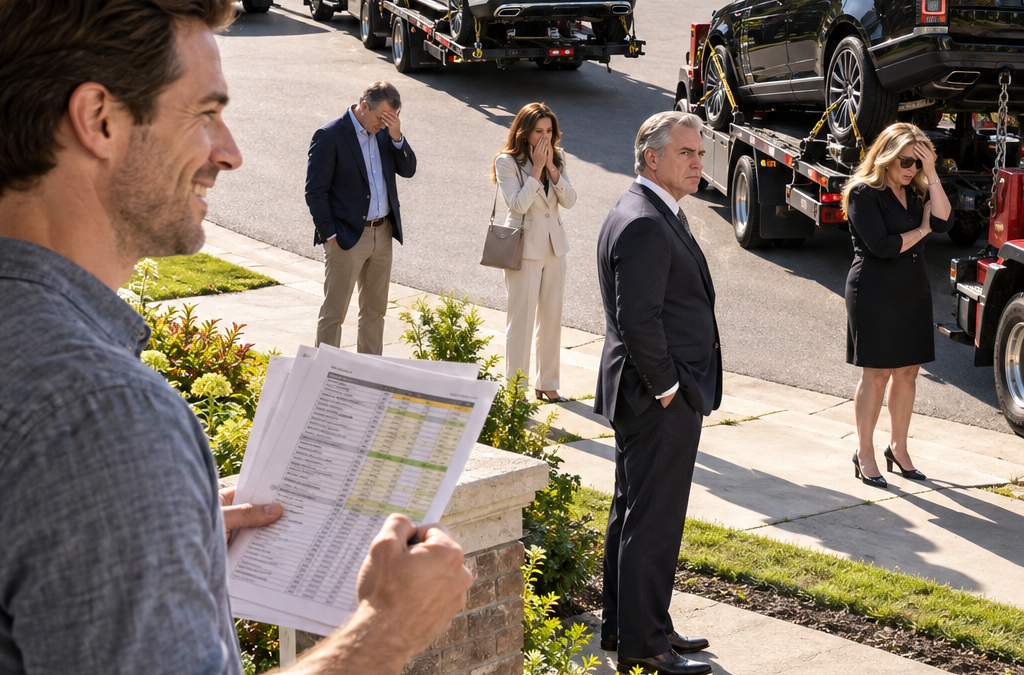
The morning after new leadership took control, Maple Ridge woke to three board members’ SUVs parked along the curb in a restricted zone Marsha’s board had invented during the height of her campaign against my work truck.
She had called it a commercial-visual-management zone, which was a ridiculous name for a stretch of curb near the clubhouse.
According to the rule she herself had pushed through, no oversized, logo-bearing, or non-resident-authorized vehicles could be parked there between 6:00 a.m. and 9:00 a.m.
The three board members who had helped Marsha enforce that rule had parked there overnight after a closed transition meeting.
Two SUVs had dealership logos on temporary plates.
One had a contractor decal on the rear window.
Technically, under Marsha’s own rule, all three were towable.
The new interim president, a quiet man named Leonard Shaw, reviewed the rule, looked at me, and said, “Consistent enforcement, right?”
I smiled.
“Wouldn’t want to create an unprofessional streetscape.”
So the tow trucks came.
Chains rattled against the asphalt.
One SUV lifted.
Then another.
Then another.
Three former board members stood on the sidewalk, furious and confused, demanding to know who authorized it.
Leonard held up the rule.
The same rule they had used on me.
The same rule they had defended when Marsha targeted my truck.
The same rule they never thought would apply to them.
I stood on my porch with a mug of coffee and smiled for the first time in six months.
Not because towing cars fixed everything.
It didn’t.
But because hypocrisy had finally met procedure.
And procedure, applied evenly, has a wonderful sense of humor.
The new HOA leadership rescinded every improper fine.
Lifted every invalid lien.
Withdrew Rosa’s foreclosure threat.
Refunded homeowners where records showed improper charges.
The fine against my work truck was reversed.
So was the trash bin fine.
So were the driveway storage fines, administrative penalties, and lien fees.
Rosa cried when her letter arrived.
This time from relief.
She hugged me on her porch while the afternoon sun hit her perfectly mowed lawn.
“I thought I was going to lose my house,” she whispered.
“I know.”
“I don’t know how to thank you.”
“You signed the petition first.”
She pulled back.
“That doesn’t feel like enough.”
“It was everything.”
Marsha Weller now faced felony charges and forty thousand dollars in restitution claims. Her brother-in-law’s contract was canceled. The landscaping consultant fund was dissolved. A full audit was ordered. The new board changed the rules so no president could issue unilateral fines, direct money to a family vendor, or push lien action without documented board approval and homeowner notice.
Maple Ridge Court became quiet again.
Not the old quiet.
The old quiet had been fear dressed up as order.
This was different.
People talked in driveways.
They attended meetings.
They asked to see records.
They challenged vague rules.
They laughed louder at block gatherings because no one worried Marsha was taking notes behind a shrub.
The Quans painted their front door the same blue Marsha once called borderline turquoise.
Rosa planted lavender along her walkway without asking anyone.
I parked my work truck in my driveway.
Logo facing the street.
Every morning.
For a while, I still expected a notice.
Some part of my brain had learned to tense when I opened the mailbox.
But nothing came.
No fine.
No warning.
No photo taken from across the street.
Just bills, flyers, and the ordinary boring mail of a life no longer being watched.
One evening, months after Marsha’s arrest, I sat on my porch and looked down Maple Ridge Court.
The maple trees were full and green.
Kids rode bikes near the cul-de-sac.
Tom washed his car.
Rosa waved from her garden.
My truck sat in the driveway, exactly where it belonged.
I thought about the system Marsha had built.
It had worked because each person felt alone.
One fine here.
One lien threat there.
One family repainting a house to avoid conflict.
One widow crying over a lawn that was already mowed.
One engineer with a spreadsheet wondering if he was overreacting.
But systems fail when hidden connections become visible.
Marsha had counted on fear.
I counted timestamps.
She counted on people paying quietly.
We compared notes.
She counted on rules applying only downward.
In the end, her own rules reached back up and hooked the bumpers of her allies’ SUVs.
Justice doesn’t always arrive loudly.
Sometimes it arrives as a petition.
Sometimes as an audit.
Sometimes as a reporter with a camera.
Sometimes as an elderly widow signing her name with a shaking hand.
And sometimes, if the universe has a flair for comedy, it arrives as three tow trucks rumbling down a quiet suburban street at sunrise.
Maple Ridge was ours again.
Not perfect.
No neighborhood is.
But ours.
And for the first time in years, nobody needed to be afraid of a clipboard.
𝗧𝗛𝗘 𝗘𝗡𝗗
The Morning the Tow Trucks Came for the HOA Board, Everyone Finally Understood What My Spreadsheet Had Been Proving
The tow truck chains rattled against the asphalt of Maple Ridge Court while three HOA board members watched their SUVs get hooked up one by one.
For the first time in six months, I stood on my own porch and smiled.
My name is David Alvarez, and I am the kind of man who used to believe most problems could be solved with enough patience, enough documentation, and enough common sense.
I was a mechanical engineer by trade, which meant I made a living finding out why systems failed. Cooling systems. conveyor systems. hydraulic systems. manufacturing lines where one small misalignment could shut down an entire facility.
I liked order.
Not the artificial kind that makes every mailbox the same shade of beige, but real order. The kind built on measurements, cause and effect, procedures that make sense, and records that show what actually happened.
That was why I bought my house in Maple Ridge.
The driveway was wide enough for my work truck. The garage had room for tools. The backyard had a maple tree that dropped red leaves in October and shade in July. The street was quiet. People waved when they took walks. Kids rode bikes in lazy circles near the cul-de-sac.
After years of renting apartments with thin walls and parking lots full of dents, Maple Ridge felt like a place where I could finally wake up, drink coffee on my porch, go to work, come home, and not have anybody standing between me and my own peace.
Then Marsha Weller decided my driveway offended her.
Marsha was president of the Maple Ridge HOA.
She had held the position for five years by the time I learned the difference between an HOA president and a neighborhood tyrant with stationery.
She was in her late fifties, tall, narrow-shouldered, and always dressed like she was chairing a committee on national security instead of measuring trash bins. She wore sensible loafers, ironed slacks, pastel blouses, and a pair of sunglasses she pushed into hair that somehow never moved in the wind.
She carried a clipboard everywhere.
Not occasionally.
Everywhere.
At meetings. On walks. During community cleanups. Once, I saw her bring it to a Fourth of July cookout.
People joked that she probably slept with it on her nightstand.
Nobody joked when she could hear.
Because crossing Marsha meant fines.
And fines, under Marsha, had a way of becoming late fees, administrative charges, collection notices, and lien threats before a homeowner could even understand what rule they had supposedly broken.
I should have taken that seriously from the beginning.
Instead, I laughed.
That was my first mistake.
The first notice came on a Monday.
I had just come home from an early site inspection at a packaging plant on the east side of town. My work truck was parked in the driveway, where it had been parked for three years without complaint. It was a dark blue pickup with the company logo on the driver’s door: a clean white emblem, nothing flashy, nothing offensive.
I was unloading my laptop bag when Marsha appeared at the end of my driveway.
Clipboard in hand.
Sunglasses in her hair.
Expression already disappointed.
“David,” she said.
“Marsha.”
She looked at the truck.
“We need to discuss your vehicle.”
I followed her gaze.
“What about it?”
“Commercial vehicles create an unprofessional streetscape.”
I stared at her.
“My truck?”
“Yes.”
“It’s my work truck.”
“I can see that.”
“It’s parked in my driveway.”
“It has commercial branding.”
I actually laughed.
Not rudely, exactly. More out of surprise. The kind of laugh you make when someone says something so absurd your body responds before your brain can stop it.
Marsha did not appreciate that.
“This is not funny,” she said.
“It’s a company logo, Marsha. It’s smaller than half the bumper stickers in this neighborhood.”
“Bumper stickers are not the issue.”
“What rule says I can’t park my own truck in my own driveway?”
She flipped open the laminated sheet attached to her clipboard.
“Section 7.3. Vehicles creating visual disruption or commercial appearance may be restricted from street-facing parking locations.”
“May be restricted?”
“That is correct.”
“By who?”
“The board.”
“Did the board vote on my truck?”
Her mouth tightened.
“The rule is clear.”
“No, the rule is vague.”
She smiled then.
Small. Controlled. The kind of smile that made it obvious she had already decided the outcome before the conversation began.
“You’ll receive notice.”
She turned and walked away before I could answer.
The next morning, a bright white violation notice was taped to my mailbox.
Two hundred and fifty dollars.
Commercial vehicle display violation.
I stood in the driveway with the paper in my hand and laughed again.
Less because it was funny and more because my brain still refused to believe someone had seriously fined me for parking a truck I used to earn a living in the driveway of the house I paid for.
My neighbor Tom, who lived across the street, saw me holding the notice.
“Marsha?” he called.
“Apparently my truck is ruining the streetscape.”
He winced.
“Oh.”
That should have told me something.
Not “that’s ridiculous.”
Not “fight it.”
Just, “Oh.”
I paid the fine.
I had work. I had bills. I had better things to do than argue over a company logo. Besides, I knew how these stories went. Homeowners refused to pay small fines, fees compounded, and suddenly someone was reading about liens online at two in the morning.
Peace, I told myself, was worth two hundred and fifty dollars.
But peace was never actually for sale with Marsha Weller.
Two weeks later came fine number two.
Improper trash bin placement.
The letter said my bins had been visible from the street before the approved evening window.
I looked at the photo attached to the notice.
The bins were exactly where they had been every trash day for three years, tucked beside the garage until I rolled them out after work.
The timestamp showed 5:42 p.m.
The rule said bins could be placed at the curb after 6:00 p.m.
Eighteen minutes early.
Another two hundred dollars.
I checked my security camera.
There was Marsha’s silver SUV rolling slowly past my house at 5:39 p.m.
Three minutes later, she returned from the opposite direction, stopped near my driveway, and took the picture.
I watched the footage twice.
Then a third time.
Something about her timing bothered me.
At the next board meeting, I asked whether homeowners were being fined for trash bins left out early across the whole neighborhood or whether enforcement was based solely on Marsha’s personal observations.
That question earned me fine number three.
Unauthorized driveway storage.
Apparently, a toolbox in the bed of my truck had been visible from the street.
That was when I started noticing the pattern.
Violation notices always arrived the morning after I said something Marsha didn’t like.
Ask about the trash rule?
Fine.
Question enforcement?
Fine.
Request board minutes?
Fine.
It was almost mechanical.
Input: David asks a question.
Output: Marsha produces a violation.
And like any engineer looking at a malfunctioning system, I started documenting.
I built a spreadsheet.
Date of alleged violation.
Time of photo.
Stated rule.
Fine amount.
Who issued it.
Whether comparable conditions existed at other houses.
Whether Marsha had been challenged before the notice.
I saved photos. Emails. Envelopes. Meeting notices. Screenshots from the community website. Security camera clips showing Marsha’s SUV.
At first, I felt ridiculous.
Then the spreadsheet reached twelve pages.
Then twenty.
Then thirty.
By the time it reached forty-seven pages, I no longer felt ridiculous.
I felt like a man watching a machine reveal how it worked.
The person who pushed me from annoyed to angry was Rosa Delgado.
Rosa lived next door to me. She was an elderly widow with silver hair, a bad hip, and the kind of garden that made spring look intentional. Her husband had died five years earlier, and she stayed in Maple Ridge because, as she put it, “This house knows all my memories.”
One afternoon, I heard her crying through the fence.
Not loud.
Not dramatic.
Just a quiet broken sound that made me stop tightening a bolt on the lawn mower and walk over.
“Rosa?”
She wiped her face quickly when she saw me.
“I’m sorry, David. I didn’t mean to make noise.”
“What happened?”
She held up a letter.
Her hand was shaking.
Lien threat.
Unmowed grass violation.
Eight hundred dollars in accumulated fines and fees.
I looked over the fence at her lawn.
It was perfectly cut.
Fresh lines. Clean edges. Probably neater than mine.
“Your grass is mowed.”
“I know.”
“When was this supposedly taken?”
She showed me the notice.
The photo attached to it was dark, taken from an angle that made a small patch of shadow near her side gate look like overgrowth.
“Marsha said I failed to maintain the lawn.”
“She’s lying.”
Rosa looked toward the street.
“She’s coming for the vulnerable ones first.”
Something cold settled in my stomach.
Until then, I had thought Marsha was targeting me because I annoyed her.
But Rosa wasn’t confrontational.
Rosa didn’t ask hard questions at meetings.
Rosa didn’t challenge rules.
She was alone, elderly, and terrified of losing her house.
That made her useful to someone like Marsha.
I took a photo of Rosa’s lawn that day, with her permission. Then another from the sidewalk. Then I scanned her letter and added it to the spreadsheet.
“Don’t pay yet,” I told her.
“I can’t afford not to.”
“I’m going to talk to someone.”
“What if she makes it worse?”
I looked at the letter again.
“She already has.”
That evening, I walked the neighborhood with my phone camera.
Not creeping around houses. Not trespassing. Just documenting what could be seen from sidewalks and common areas.
That was when I found Marsha’s shed.
It sat in her backyard, visible from the public walking path behind her property. A large gray structure tucked near the fence line, neat but obvious. I compared it to the same setback code she had used to fine three separate households over detached storage units.
Her shed violated the code.
Same setback provision.
Same height issue.
Same exterior-material rule.
The exact same rule.
Twist one.
The woman fining neighbors over sheds had an illegal shed in her own backyard.
I photographed it quietly from the public path, checked the angle, saved the file, and said nothing.
Evidence works best when it’s a surprise.
Marsha escalated anyway.
The certified letter arrived the next week.
It threatened a lien against my home for unpaid fines totaling nearly one thousand dollars.
A lien on my house over a company logo, a trash can that had never moved an inch in three years, and a toolbox she needed binoculars and resentment to see.
I stood on my front steps holding the letter and laughed so hard I had to sit down.
Not because I wasn’t worried.
Because absurdity apparently had no ceiling in Maple Ridge.
I called a real estate attorney named Priya Chandrasekaran that afternoon.
Priya specialized in HOA abuse cases across the state, which I learned was an actual legal niche because apparently neighborhoods were full of people like Marsha.
Her office was in a low brick building downtown. She wore a navy suit, no jewelry except a watch, and had the sharp, alert expression of someone who enjoyed when bullies put their mistakes in writing.
She read the lien threat first.
Then my fine notices.
Then she looked at me.
“Liens like this get thrown out constantly,” she said. “But only if you can prove selective enforcement.”
“I can.”
“Can you?”
I slid the printed spreadsheet across her desk.
Forty-seven pages.
Photos. Timestamps. Copies of notices. Comparisons to other homes. Security footage summaries. Notes from board meetings. Rosa’s lawn. Marsha’s shed.
Priya began reading.
The first few pages, her expression stayed neutral.
By page ten, her eyebrows rose.
By page twenty, she reached for a pen.
By page thirty, she leaned back.
“This isn’t just selective enforcement, David.”
I waited.
“This looks like a pattern of targeted harassment.”
I exhaled for what felt like the first time in weeks.
“Can we stop the lien?”
“Yes.”
“Can we stop her?”
Priya tapped the spreadsheet.
“If the records support what this suggests, yes. But we’ll need more than your file. We need HOA financial records, board minutes, fine ledgers, vendor payments, and other homeowners willing to speak.”
“That’s the hard part.”
“Why?”
“People are scared of her.”
Priya gave a small smile.
“Then we make it scarier to stay silent.”
That night, Marsha posted a community newsletter titled Restoring Order to Maple Ridge.
It praised increased enforcement, warned residents against “individual disregard for neighborhood standards,” and celebrated the HOA’s commitment to “consistent accountability.”
I sat at my kitchen table reading it while my printer hummed, producing three copies for my files.
Marsha had no idea her own yard was Exhibit A.
I almost felt bad for her.
Almost.
Then I remembered Rosa crying at her kitchen table over a lien threat she couldn’t afford to fight.
At the next open board meeting, I stood during homeowner comments.
The room was not full, but fuller than usual. Maybe twenty people sat in folding chairs under fluorescent lights. Marsha sat at the front table with two loyal board members beside her and her husband in a chair along the wall.
I kept my voice calm.
“I have a question about shed setbacks.”
Marsha’s mouth tightened.
“Go ahead.”
“Why do shed setback rules apply to everyone except the HOA president?”
The room went dead silent.
Forty eyes turned toward her.
Marsha’s confident smile cracked for just one second.
“What are you implying?”
“I’m not implying anything. I’m asking why homeowners have been fined for structures that appear to violate the same provisions as the shed visible in your backyard.”
“That is a completely different situation.”
“How?”
She opened her mouth.
Closed it.
Then said, “My property is not the subject of this meeting.”
A silence followed.
Not empty silence.
Heavy silence.
The kind where everyone hears the answer that wasn’t given.
Here’s the funny part.
Her husband, sitting two seats away from her, mouthed the words, “Oh no,” and slowly slid his chair about three inches away.
I nearly lost my composure.
Marsha glared at him.
He stopped moving.
After the meeting, people approached me in the parking lot.
Quietly. Nervously. Like we were trading state secrets instead of talking about lawn fines.
A retired teacher had been charged for unapproved porch lights identical to Marsha’s.
A young couple had paid six hundred dollars over mulch color.
The Quan family, who had repainted their house after Marsha called their shade of blue “borderline turquoise,” showed me the approval letter for their original paint color.
It had been approved by the board two years before Marsha forced them to change it.
“What did you do?” I asked Mr. Quan.
He shrugged sadly.
“We repainted.”
That was the whole power structure in two words.
We repainted.
Two weeks later, Priya’s investigator found something buried in the HOA financial records that changed everything.
Marsha had been diverting fine money.
Nearly forty thousand dollars.
Not directly into her own personal account.
She was smarter than that.
The funds were routed into something called a landscaping consultant fund. From there, payments went to a company owned by Marsha’s brother-in-law, a man named Lyle Brenner.
The company had no full-time employees.
No meaningful equipment.
No substantial landscaping contracts outside Maple Ridge.
Yet it had been receiving thousands of dollars from the HOA under vague descriptions.
Landscape assessment.
Design consultation.
Compliance correction planning.
Beautification strategy.
Priya laid the records across her desk and looked at me.
“This is twist two.”
I stared at the payments.
“So the fines—”
“Appear to be feeding a fund that pays her family.”
I felt heat rise in my face.
“All of us were paying for that?”
“Potentially, yes.”
“Rosa too?”
Priya’s expression softened.
“Yes.”
That made it personal in a different way.
It was bad enough that Marsha had threatened Rosa over grass that was already mowed. But now the money Rosa was terrified of paying might have gone into Marsha’s family pipeline.
This was no longer petty tyranny over trash bins.
This was possible embezzlement wearing a homeowners association mask.
Priya filed a formal complaint with the state HOA oversight board.
At the same time, I quietly began gathering signatures for a recall petition.
I expected resistance.
I expected people to hide.
Instead, the first signature came from Rosa.
She signed slowly, hand trembling, then looked up at me.
“I should have spoken sooner.”
“You’re speaking now.”
The Quans signed next.
Then Tom.
Then Frank.
Then Mrs. Donnelly from the corner house.
Thirty-one of forty-two households signed within four days.
Turns out everyone had a Marsha story.
They had simply been too scared to speak first.
Marsha sensed the ground shifting beneath her sensible loafers.
So she doubled down.
She sent me an emergency foreclosure notice.
Not a lien warning.
Not a collection letter.
A foreclosure notice.
Completely illegal without proper court process.
It claimed the board had voted to accelerate enforcement because I had engaged in “ongoing refusal to satisfy obligations and deliberate obstruction of HOA authority.”
Nobody could produce minutes from that supposed vote.
No one Priya contacted remembered attending it.
One board member said she had not even received notice.
That was Marsha’s final fatal mistake.
Honestly, I almost sent her a thank-you card.
Priya filed an emergency injunction the same afternoon.
The court froze every lien and fine Marsha’s board had issued in the past year pending review.
A local news reporter, tipped off by Rosa’s granddaughter, showed up on Maple Ridge Court with a camera crew.
The first time I saw the news van, I wanted to hide inside.
I am not a public man.
I build systems, solve mechanical problems, grill on weekends, and wave at neighbors. I do not stand in front of cameras accusing HOA presidents of embezzlement.
But Rosa stood beside me on her porch, leaning on her cane.
“If they ask you questions,” she said, “tell the truth.”
“That simple?”
“It usually is, once people stop hiding from it.”
The story aired Tuesday night.
HOA President Accused of Embezzlement and Targeted Harassment
Marsha’s driveway appeared in the background.
Her shed too, briefly.
I watched the segment from my living room, stomach tight, while the reporter described suspicious fine collections, family-connected vendor payments, illegal foreclosure notices, and allegations of selective enforcement.
Marsha gave a statement through email calling the accusations “misleading, politically motivated, and deeply harmful to community harmony.”
Priya laughed when she read it.
“Community harmony is what people invoke after they get caught disturbing it.”
The state auditor’s report confirmed what we already knew.
Misappropriated funds.
Falsified violation records.
Improper lien procedures.
Undocumented board votes.
Family-connected vendor payments.
And yes, one suspiciously noncompliant backyard shed belonging to the HOA president.
Marsha was removed from the board within seventy-two hours.
The recall vote passed 40-2.
The number felt almost cinematic.
I don’t know who the two were.
No one admitted it.
Two days later, the county sheriff’s office arrested Marsha on embezzlement charges.
Neighbors watched from porches as she stepped out of her house in beige slacks and a white blouse, no clipboard in sight.
For once, her hair moved in the wind.
A patrol car waited at the curb.
The cameras were there too.
She tried to keep her chin up, but the effect was ruined when she saw Rosa standing across the street and looked away first.
That mattered to me more than it probably should have.
Rosa had spent weeks afraid of losing her home.
Marsha could not even meet her eyes.
And that brings us back to the tow trucks.
The morning after new leadership took control, Maple Ridge woke to three board members’ SUVs parked along the curb in a restricted zone Marsha’s board had invented during the height of her campaign against my work truck.
She had called it a commercial-visual-management zone, which was a ridiculous name for a stretch of curb near the clubhouse.
According to the rule she herself had pushed through, no oversized, logo-bearing, or non-resident-authorized vehicles could be parked there between 6:00 a.m. and 9:00 a.m.
The three board members who had helped Marsha enforce that rule had parked there overnight after a closed transition meeting.
Two SUVs had dealership logos on temporary plates.
One had a contractor decal on the rear window.
Technically, under Marsha’s own rule, all three were towable.
The new interim president, a quiet man named Leonard Shaw, reviewed the rule, looked at me, and said, “Consistent enforcement, right?”
I smiled.
“Wouldn’t want to create an unprofessional streetscape.”
So the tow trucks came.
Chains rattled against the asphalt.
One SUV lifted.
Then another.
Then another.
Three former board members stood on the sidewalk, furious and confused, demanding to know who authorized it.
Leonard held up the rule.
The same rule they had used on me.
The same rule they had defended when Marsha targeted my truck.
The same rule they never thought would apply to them.
I stood on my porch with a mug of coffee and smiled for the first time in six months.
Not because towing cars fixed everything.
It didn’t.
But because hypocrisy had finally met procedure.
And procedure, applied evenly, has a wonderful sense of humor.
The new HOA leadership rescinded every improper fine.
Lifted every invalid lien.
Withdrew Rosa’s foreclosure threat.
Refunded homeowners where records showed improper charges.
The fine against my work truck was reversed.
So was the trash bin fine.
So were the driveway storage fines, administrative penalties, and lien fees.
Rosa cried when her letter arrived.
This time from relief.
She hugged me on her porch while the afternoon sun hit her perfectly mowed lawn.
“I thought I was going to lose my house,” she whispered.
“I know.”
“I don’t know how to thank you.”
“You signed the petition first.”
She pulled back.
“That doesn’t feel like enough.”
“It was everything.”
Marsha Weller now faced felony charges and forty thousand dollars in restitution claims. Her brother-in-law’s contract was canceled. The landscaping consultant fund was dissolved. A full audit was ordered. The new board changed the rules so no president could issue unilateral fines, direct money to a family vendor, or push lien action without documented board approval and homeowner notice.
Maple Ridge Court became quiet again.
Not the old quiet.
The old quiet had been fear dressed up as order.
This was different.
People talked in driveways.
They attended meetings.
They asked to see records.
They challenged vague rules.
They laughed louder at block gatherings because no one worried Marsha was taking notes behind a shrub.
The Quans painted their front door the same blue Marsha once called borderline turquoise.
Rosa planted lavender along her walkway without asking anyone.
I parked my work truck in my driveway.
Logo facing the street.
Every morning.
For a while, I still expected a notice.
Some part of my brain had learned to tense when I opened the mailbox.
But nothing came.
No fine.
No warning.
No photo taken from across the street.
Just bills, flyers, and the ordinary boring mail of a life no longer being watched.
One evening, months after Marsha’s arrest, I sat on my porch and looked down Maple Ridge Court.
The maple trees were full and green.
Kids rode bikes near the cul-de-sac.
Tom washed his car.
Rosa waved from her garden.
My truck sat in the driveway, exactly where it belonged.
I thought about the system Marsha had built.
It had worked because each person felt alone.
One fine here.
One lien threat there.
One family repainting a house to avoid conflict.
One widow crying over a lawn that was already mowed.
One engineer with a spreadsheet wondering if he was overreacting.
But systems fail when hidden connections become visible.
Marsha had counted on fear.
I counted timestamps.
She counted on people paying quietly.
We compared notes.
She counted on rules applying only downward.
In the end, her own rules reached back up and hooked the bumpers of her allies’ SUVs.
Justice doesn’t always arrive loudly.
Sometimes it arrives as a petition.
Sometimes as an audit.
Sometimes as a reporter with a camera.
Sometimes as an elderly widow signing her name with a shaking hand.
And sometimes, if the universe has a flair for comedy, it arrives as three tow trucks rumbling down a quiet suburban street at sunrise.
Maple Ridge was ours again.
Not perfect.
No neighborhood is.
But ours.
And for the first time in years, nobody needed to be afraid of a clipboard.








