𝗣𝗔𝗥𝗧 𝟮 The Morning My Old K9 Wouldn’t Let Me Turn the Key
𝗣𝗔𝗥𝗧 𝟮
That should have been the moment I took Max into the back room, laid him down, and waited safely for the fire department.
But life rarely gives you clean moments.
Outside, I heard the crunch of tires on gravel.
I looked through the window and saw my neighbor, Tom Whitaker, pulling into my driveway in his old pickup.
Tom was seventy-two, half deaf, and had a habit of dropping by unannounced whenever he saw my lights on early. He stepped out holding a travel mug.
And a cigarette.
“Damn it.”
I opened the front door and shouted, “Tom! Stop right there!”
He didn’t hear me over the engine of his truck.
He closed his door and started walking toward the carport.
Max exploded.
He shoved past my leg and barked with everything he had left.
Tom stopped.
His cigarette hand froze midair.
I shouted again, “Fuel leak! Stay back!”
This time he heard enough.
He looked down, saw the dark puddle under my truck, and stumbled backward so fast he nearly dropped his mug.
Max kept barking until Tom retreated past the gravel edge.
Then my old dog swayed.
I grabbed him before he fell.
“Easy, partner.”
His breathing had changed.
Short.
Fast.
Too hard.
I could feel the rapid flutter of his heart beneath my hand.
“Max?”
He looked up at me.
For half a second, I saw him the way he had been on our first day together.
Young.
Alert.
Unbreakable.
Then his back legs gave out.
I lowered him gently onto the porch.
“No, no, no. Stay with me.”
Lily cried out behind me.
“Max!”
I looked over my shoulder.
“Stay inside!”
The order came out like my old police voice. Lily froze.
I hated frightening her.
But I couldn’t think about that yet.
Tom stood near his truck, pale and shaken.
“Jack, you need help?”
“Call the vet clinic. Tell Dr. Harper it’s Max. Tell her possible cardiac episode. I’m calling fire.”
“I’ve got it.”
He moved quickly now.
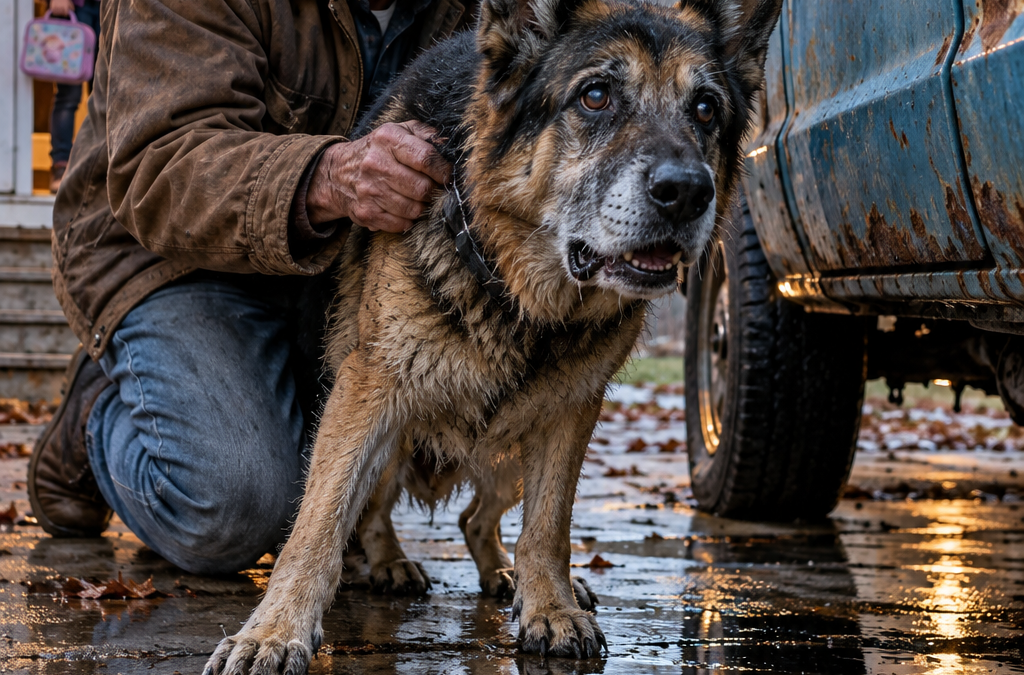
Max lay on his side, chest heaving. His eyes searched my face.
I pressed my hand against his neck.
“Easy, boy. I’ve got you.”
I had said those words to him hundreds of times.
After searches.
After dangerous calls.
After the night he took a deep cut across his shoulder from broken glass.
After he retired and his hips began failing.
Easy, boy. I’ve got you.
But that morning, the words felt thin.
Because I knew what he had done.
He had been lying by the door, weak and tired, when he smelled something wrong.
He had forced himself up.
He had blocked me.
He had barked until I listened.
Then he had stayed alert, even when every movement hurt, because other people were still walking toward danger.
And that effort had cost him.
My hands shook as I stroked his fur.
“You did it, buddy. You did good. You can rest now.”
His eyes remained on mine.
Rainwater dripped from the carport roof.
The gasoline smell lingered in the air.
In the distance, sirens began to rise.
I looked toward the road.
Red lights flashed through the trees.
Then I looked down at Max.
He was still breathing.
But barely.
I first met Max when he was eighteen months old.
Back then, he was all muscle, attitude, and oversized ears.
The department had sent me to a K9 training facility outside Columbus after my old patrol partner transferred to another county. I didn’t want a dog. Not really. I told everyone I did because the K9 unit was respected and useful and because our town needed one.
But the truth was simpler.
I was lonely.
My wife, Ellen, had died the year before after a short, brutal fight with cancer. Our daughter, Sarah, was grown and living two towns away with a husband and a baby on the way. I worked overtime because the house was unbearable when it was quiet.
Then they handed me Max.
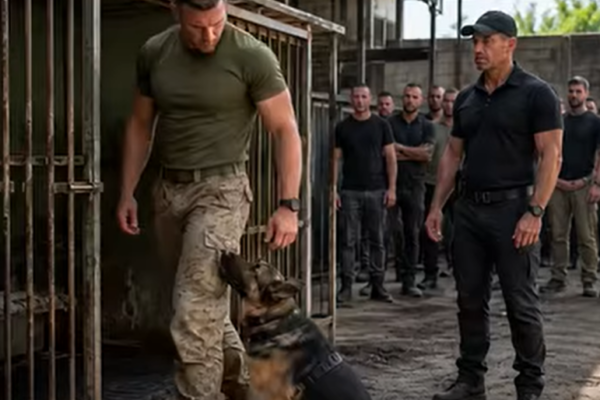
The trainer, Frank Sutter, led me to the far kennel and pointed.
“That’s your candidate.”
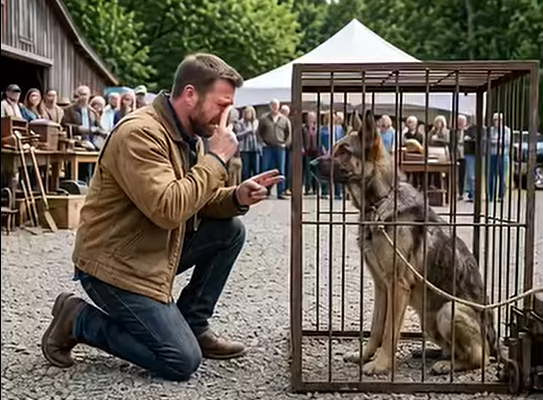
The young German Shepherd stood behind the gate, watching me like he already knew every mistake I had ever made.
I crouched.
“Hey, boy.”
He didn’t bark.
Didn’t wag his tail.
Didn’t come closer.
Frank grinned.
“He’s sizing you up.”
“For what?”
“To see if you’re worth following.”
I looked at the dog.
“Is that right?”
Max tilted his head.
I held out my hand.
He stepped forward, sniffed my fingers, then turned and walked back to his blanket.
Frank laughed.
“Well, Mercer, I’ve seen warmer introductions.”
I should have been insulted.
Instead, I smiled for the first time in weeks.
“Yeah,” I said. “I like him.”
Training with Max nearly broke me.
Not physically.
Emotionally.
He was smart enough to make me feel stupid. If I gave a sloppy command, he hesitated. If I rushed him, he planted his paws. If I tried to drag him toward where I thought the scent went, he would stop and stare at me until I remembered he had the better nose.
Frank told me the same thing every week.
“Trust the dog.”
“I do trust him.”
“No, Jack. You trust him when he agrees with you. That’s not the same thing.”
One rainy afternoon, Max stopped during a tracking exercise and refused to move past an old drainage ditch.
I tugged the leash.
“Come on.”
He sat down.
I looked back at Frank.
“He lost it.”
Frank folded his arms.
“Did he?”
“He stopped.”
“Maybe because you’re about to walk past the person you’re supposed to find.”
I loosened the leash.
Max immediately turned, circled the ditch, and found the training assistant hiding beneath a culvert.
I stood there in the rain feeling like an idiot.
Frank came beside me.
“That dog will save your life someday if you let him.”
I looked at Max.
He stood proudly near the culvert, tail raised, eyes bright.
I had no idea how right Frank was.
The first time Max saved a life, it was a little boy named Aaron Bell.
Five years old.
Red coat.
Blue mittens.
He disappeared from his grandparents’ farm during a late November cold snap. By the time Max and I arrived, volunteers had been searching for almost four hours, and the temperature had dropped below freezing.
Aaron’s mother grabbed my sleeve.
“Can your dog find him?”
There’s no safe answer to that question.
You want to say yes.
You want to give a terrified parent something to hold.
But police work teaches you not to promise what you can’t control.
So I said, “We’re going to do everything we can.”
Max scented Aaron’s jacket and led us across a field, through a line of trees, and toward an old equipment shed near the creek.
The ground was icy.
The dark came early.
My flashlight beam shook because my hands were cold.
Max worked steadily.
Then he stopped beside an abandoned tractor.
He barked three times.
I found Aaron wedged behind the rear tire, unconscious but alive, sheltered just enough from the wind to keep breathing.
Max lay beside that little boy while we waited for paramedics.
Aaron’s tiny hand tangled in his fur.
His mother cried so hard when we brought him back that she couldn’t speak.
Max only wagged his tail once.
That was always his way.
He didn’t need applause.
He needed the search to be over.
Years passed like that.
Call after call.
Winter fields.
Dark houses.
Traffic stops that turned dangerous.
Missing seniors.
Runaways.
Burglars.
Suspects hiding in barns and basements.
Max went where I asked him to go, even when the rest of us hesitated.
He wasn’t reckless. That’s important. Max wasn’t the kind of dog who barked at shadows or lunged at every movement. He was disciplined. Controlled. Careful.
But when he knew something was wrong, he committed every part of himself to warning me.
That was why the morning of the fuel leak hurt so badly.
Because I had almost ignored the truest thing about him.
The fire department arrived within minutes.
Captain Luis Ramirez stepped out first. I knew him from my working years. He took one look at the truck, one breath of the air, and started giving orders.
“Everyone back. Kill any ignition sources. Keep the area clear.”
A firefighter approached me.
“Sir, are you injured?”
“No. My dog is.”
Ramirez looked down.
His face changed.
“Is that Max?”
I nodded.
Max’s breathing had slowed but not in a good way. His eyes were half-open. His body felt too loose beneath my hands.
“Hell,” Ramirez whispered. “He still with us?”
“For now.”
Tom came back from his truck.
“Vet says bring him in now. They’re ready.”
I looked toward the carport.
Firefighters were already establishing distance around the truck. One of them was guiding Lily out through the back door with a blanket around her shoulders. She saw Max and began sobbing.
“Grandpa!”
I wanted to go to her.
I wanted to gather her up and tell her everything was fine.
But Max’s head was in my lap, and I couldn’t leave him.
Ramirez crouched beside me.
“We’ve got the truck. Go.”
“My granddaughter—”
“I’ll have one of my guys stay with her until your daughter gets here.”
I looked at him.
He nodded.
“Jack. Go.”
Tom helped me lift Max into the back seat of his pickup. We used an old quilt to support his body. Max whimpered once, and the sound cut through me worse than any siren.
Lily ran toward us before anyone could stop her.
I held up one hand.
“Careful, sweetheart.”
She stopped beside the open door.
Her face was streaked with tears.
“Is Max going to die?”
I couldn’t lie to her.
Not after what he had just done.
“I don’t know.”
She reached in and touched his paw.
“Max, you saved us.”
His eyes moved toward her.
His tail gave one faint tap against the seat.
That was enough to break me.
I kissed Lily’s forehead.
“Stay with Captain Ramirez. Your mom’s coming.”
She nodded, crying.
Then Tom drove.
I sat in the back beside Max, one hand against his chest, the other holding his collar.
“Stay with me, partner.”
The old habit came back before I could stop it.
“Stay with me.”
Max had been retired for three years by then.
His last official call had come on a winter night at an abandoned motel near the interstate. A robbery suspect had fled into the building after a pursuit. Max located him hiding in a maintenance closet before an officer walked into a blind corner.
No shots were fired.
No one was hurt.
The arrest was clean.
But when we got back to the patrol SUV, Max couldn’t jump in.
He tried once.
His front paws made it to the edge.
His back legs failed.
I caught him.
He looked ashamed.
Dogs probably don’t feel shame the way people do, but if you had seen his face, you would understand why I use that word.
He avoided my eyes.
I helped him into the vehicle and sat on the bumper until my hands stopped shaking.
Two weeks later, the vet recommended retirement.
I fought it.
Of course I did.
“He still wants to work,” I said.
The vet nodded.
“I know.”
“He’s not ready.”
“Jack, Max would work until his body failed completely if you asked him to.”
I looked away.
“That’s why you can’t ask him anymore.”
The retirement ceremony was small.
A plaque.
A few speeches.
A cake shaped like a badge.
Lily was four then, wearing a yellow dress and holding a stuffed police dog. She wrapped both arms around Max’s neck and told everyone he was her best friend.
Max ate two hamburgers and tried to steal a third.
Everyone laughed.
I smiled for photographs.
But when the ceremony ended and I removed his working harness for the last time, I had to turn away.
Max looked at the patrol vehicle.
Then at me.
Waiting.
Ready.
I knelt beside him.
“No more calls, buddy.”
He tilted his head.
“You’re coming home.”
He didn’t understand.
Not that day.
For weeks, every time I picked up my keys, he struggled to follow me. Every time he heard a siren on television, his ears lifted. Every time I started my truck, he looked toward the door.
Eventually, he adjusted.
He learned slower mornings.
Short walks.
Granddaughter visits.
Sunlight on the porch.
He learned that a good life could be quiet.
I thought I had learned the same thing.
Then came the heart disease.
At first, it was a cough.
Then fatigue.
Then days when he couldn’t stand without help.
Dr. Harper explained the diagnosis gently. Medication could help. Diet adjustments could help. Reduced exertion was critical.
“No stress,” she told me.
I almost laughed.
“How do I explain retirement to a dog who thinks every sound is his responsibility?”
She smiled sadly.
“You protect him from himself.”
That became my new job.
Keeping Max calm.
Keeping him comfortable.
Not letting him overdo it.
I failed at that on the morning he saved us.
Or maybe I didn’t fail.
Maybe the truth is more painful than that.
Maybe Max made the decision before I could stop him.
At the veterinary clinic, Dr. Harper met us at the door with two technicians.
They moved Max onto a stretcher and carried him inside.
I followed until one of the techs gently stopped me.
“We need room to work.”
“I’m staying.”
Dr. Harper looked at my face.
“Jack, give us five minutes.”
Five minutes.
It felt longer than most nights I spent waiting for backup.
Tom sat beside me in the waiting room.
His hands were trembling.
“You okay?”
I looked at him.
“My dog just stopped me from starting a truck sitting in a pool of gasoline.”
Tom swallowed.
“I know.”
“He could barely stand yesterday.”
“I know.”
“And he got up anyway.”
Tom looked down.
Neither of us said anything after that.
When Dr. Harper came out, her expression told me the truth before her words did.
“He’s stable for the moment.”
For the moment.
I stood.
“Can I see him?”
“Yes. But Jack…”
I waited.
She took a breath.
“The episode was significant. His heart was already compromised. The exertion, stress, and adrenaline likely pushed him into acute heart failure.”
I closed my eyes.
“How bad?”
“We’re helping him breathe. He’s responding to medication, but he’s very weak.”
“Will he recover?”
She didn’t answer quickly enough.
“Will he recover?” I repeated.
Her voice softened.
“He may improve enough to come home for a little while. But his disease has progressed. This event took a great deal out of him.”
I looked through the doorway behind her.
“He saved my granddaughter.”
“I know.”
“He knew.”
Her eyes filled.
“I believe you.”
I wiped my face with both hands.
“I almost didn’t listen.”
“Jack—”
“I told him no. I told him to stay. I thought he wanted a ride.”
She said nothing.
“I should have trusted him sooner.”
Dr. Harper placed a hand on my arm.
“You did trust him.”
I shook my head.
“Not fast enough.”
She held my gaze.
“He gave you a warning. You listened before starting that truck. That is why your granddaughter is safe.”
I wanted those words to comfort me.
They didn’t.
Not yet.
Max lay in a quiet treatment room on a padded blanket. Oxygen flowed near his muzzle. His breathing was easier than it had been in Tom’s truck, but he looked exhausted in a way I had never seen.
I sat beside him.
“Hey, partner.”
His eyes opened.
His tail moved under the blanket.
Just barely.
“There you are.”
I took his paw in my hand.
“You scared me, old man.”
His eyes stayed on me.
I leaned closer.
“You saved Lily.”
My throat tightened.
“You saved me too.”
He blinked slowly.
I remembered all the times he had looked at me from the back of a patrol vehicle, waiting for my signal. All the times I had clipped on his harness and said, “Ready, Max?”
He had always been ready.
Too ready.
Even now.
I touched the white fur around his muzzle.
“You weren’t supposed to work anymore.”
His breathing remained slow.
“You hear me? You were retired.”
I tried to smile.
It broke into a sob.
“Stubborn dog.”
I lowered my forehead against his.
For a while, I stayed like that.
When Sarah arrived, she came straight into the room with Lily in her arms.
Lily had changed out of her school clothes. Her face was pale. She clung to her mother’s neck until she saw Max.
“Can I pet him?”
Dr. Harper looked at me.
I nodded.
“Gently.”
Lily approached and touched Max’s shoulder.
“Hi, Max.”
His eyes shifted toward her.
She began crying again.
“I’m sorry I was late for school. I didn’t know the truck was dangerous.”
Sarah covered her mouth.
I reached for Lily with my free hand.
“Sweetheart, none of this was your fault.”
Lily sniffled.
“Max knew.”
“Yes.”
She looked at him.
“Thank you.”
Max’s tail moved once.
Sarah turned away, crying silently.
My daughter had grown up with Max almost as much as Lily had. She had been twenty-six when he came into my life, old enough to understand police work, young enough to resent how much of me it still consumed.
But Max had softened something between us.
When Ellen died, Sarah and I had both grieved badly and differently. I worked. She withdrew. We spoke around pain instead of through it.
Max changed that by refusing to choose sides.
When Sarah visited, he greeted her with the same devotion he gave me. When Lily was born, he sat beside the crib like he had been assigned permanent protection detail. When Sarah cried during those early exhausted months of motherhood, Max lay at her feet.
She once told me, “Dad, he knows when people need him.”
I didn’t understand then how true that was.
Now I sat in a veterinary clinic watching him struggle to breathe because he had known we needed him one more time.
Max came home two days later.
Not because he was well.
Because Dr. Harper believed we could keep him comfortable there, and because I asked whether he could spend whatever time he had left in the house he knew.
She agreed with careful instructions.
Medication.
Rest.
No stress.
Call immediately if his breathing worsened.
Sarah wanted me to stay at her house.
I refused.
Not because I didn’t want help.
Because Max needed home.
His bed by the fireplace.
His water bowl beside the chair.
The front window where he watched the yard.
The rug near the door where he had first lifted his head that morning and known something was wrong.
Sarah and Lily came with me.
The truck had been towed away after the fire department made the area safe. Ramirez told me later that a damaged fuel line had failed badly enough to drain a dangerous amount overnight. If Max hadn’t stopped me, starting the engine could have turned that ordinary morning into something unthinkable.
I didn’t need details.
I had imagined enough.
That evening, Max lay on his bed while Lily sat beside him reading from one of her schoolbooks.
She read slowly, stumbling over longer words.
Max couldn’t understand the story.
Maybe he couldn’t hear all of it either.
But he watched her.
His eyes soft.
His body calm.
I stood in the hallway, listening.
Sarah came beside me.
“You okay?”
“No.”
She nodded.
“Me neither.”
I looked at her.
“I almost put her in that truck.”
Sarah’s face tightened.
“But you didn’t.”
“Because of him.”
“Yes.”
I stared toward the living room.
“He was so tired, Sarah.”
“I know.”
“He shouldn’t have had to do that.”
Her eyes filled.
“No. But he chose to.”
I looked down.
She touched my arm.
“Dad, Max has spent his whole life loving by protecting. Maybe this was the only language he knew at the end.”
That sentence broke me.
I had always thought of Max as trained.
Disciplined.
Reliable.
A police dog.
But Sarah was right.
Protection had become his language.
His way of loving.
He didn’t know how to stop watching the door.
He didn’t know how to stop noticing danger.
He didn’t know how to stop being Max.
That night, after Sarah took Lily home, I slept on the floor beside him.
I didn’t really sleep.
I listened.
Every breath.
Every shift.
Every small sound.
Around two in the morning, Max opened his eyes.
I raised my head.
“You need something?”
He looked toward the front door.
For one terrible second, panic shot through me.
Then I realized he wasn’t alerting.
Not like before.
He was just looking.
Remembering, maybe.
Or watching because that was what he had always done.
I placed my hand on his shoulder.
“You can rest, partner.”
His eyes moved toward me.
“No more work.”
He breathed slowly.
“I’ve got the door.”
I said it again.
Because I needed him to believe it.
Because I needed to believe it too.
“I’ve got the door.”
Three days passed.
Max ate a little on the first day.
Less on the second.
Nothing on the third.
Dr. Harper visited the house that afternoon.
She examined him beside the fireplace.
She listened to his heart for a long time.
Too long.
When she lowered the stethoscope, I already knew.
“Jack.”
I nodded.
My throat closed.
“He’s tired.”
She sat beside me on the floor.
“He’s very tired.”
I looked at Max.
His eyes were half-open. His breathing was not panicked, but every breath looked like effort.
“Is he suffering?”
“He’s uncomfortable. We can adjust medication, but his heart is failing. I don’t think we can give him meaningful recovery.”
I rubbed both hands over my face.
“He saved Lily.”
“I know.”
“He deserves more time.”
Dr. Harper’s eyes softened.
“Yes,” she said. “He does.”
That answer surprised me.
Then she continued.
“But what he deserves and what his body can give him are not always the same.”
I looked away.
The room blurred.
“I don’t know how to do this.”
“You don’t have to do it alone.”
Sarah came with Lily an hour later.
I had not planned for Lily to be there. I thought it would be too hard.
But when Sarah asked her whether she wanted to say goodbye, Lily said yes without hesitation.
“She saved my life,” she said.
“She deserves me to come.”
So my granddaughter knelt beside Max with a small drawing in her hands.
It showed a big German Shepherd standing in front of a blue truck. Beside him was a little girl with purple backpack straps. Above them, in uneven letters, Lily had written:
MAX IS MY HERO.
She placed it beside his bed.
“Hi, Max.”
His eyes opened.
She touched his paw.
“I’m not scared of the truck anymore because Grandpa says it’s gone.”
Her voice trembled.
“And I’m not mad you barked so loud.”
Sarah began crying.
Lily leaned closer.
“You can rest now. Grandpa will take care of me.”
Max’s tail moved faintly.
I turned away.
I had seen brave things in my life.
I had watched officers run toward danger.
I had watched firefighters enter burning houses.
I had watched grieving parents stand in courtrooms and speak the truth.
But my granddaughter telling an old dying dog that he could stop protecting her was one of the bravest things I had ever witnessed.
When it was time, Sarah took Lily to the kitchen.
Dr. Harper prepared the medication quietly.
I lay down beside Max on the rug near his bed.
The same rug he had been lying on when he first smelled the danger.
The same place where he had forced himself to stand.
I placed my hand on his chest.
“Hey, partner.”
His eyes found mine.
“You remember our first day?”
His breathing was slow.
“You didn’t like me much.”
I laughed through tears.
“Frank said you were deciding whether I was worth following.”
I stroked his muzzle.
“I spent the rest of your life trying to be.”
Max blinked.
I swallowed hard.
“You found Aaron in the snow.”
His ears remained still.
“You protected half the department.”
My voice shook.
“You watched over Sarah.”
I looked toward the kitchen.
“You watched over Lily.”
A tear fell onto his fur.
“And when your body had almost nothing left, you still got up for us.”
I pressed my forehead against his.
“I’m sorry I didn’t listen right away.”
My voice broke.
“I’m sorry I thought you just wanted a ride.”
He breathed softly.
“But I heard you, Max.”
I lifted my head and looked into his old, tired eyes.
“I heard you in time.”
That mattered.
Not enough to erase the guilt.
But enough to tell him the truth.
“You saved us.”
I kissed the white fur between his eyes.
“And now I need to save you from hurting any longer.”
Dr. Harper gave him the first medication.
Max relaxed slowly beneath my hand.
His breathing eased.
For the first time since the morning of the fuel leak, his body stopped fighting.
I kept talking.
Not because he needed every word.
Because I did.
“You were my best partner.”
His eyes grew heavy.
“My stubborn old friend.”
I smiled through tears.
“My good boy.”
Sarah returned and knelt beside me, Lily tucked against her side.
Dr. Harper asked if we were ready for the final medication.
I wanted to say no.
Every part of me wanted to ask for one more night.
One more morning.
One more chance to see his tail move when I walked into the room.
But I looked at Max.
He had given me more than I ever deserved.
I would not ask him to give me his suffering too.
I nodded.
Dr. Harper administered the medication.
I held him through it.
His breathing slowed.
Then stopped.
The room became impossibly quiet.
Dr. Harper listened with her stethoscope.
After a moment, she whispered, “He’s gone.”
I pressed my face into Max’s fur.
Sarah held my shoulder.
Lily cried softly against her mother.
And my old partner, who had spent his life watching doors, roads, fields, hallways, and dangers the rest of us missed, finally rested.
For a long time, I couldn’t move.
My hand stayed against his chest, waiting for the rise that would not come.
I thought about the first time he had climbed into my patrol SUV.
The way he had looked at me like we had somewhere important to go.
I thought about every mile.
Every call.
Every ordinary afternoon after retirement.
And I thought about that final morning.
The keys in my hand.
The truck waiting under the carport.
Lily’s purple backpack.
Max standing when standing hurt.
Max barking when I didn’t listen.
Max giving the last of his strength to stop us from making one ordinary, fatal mistake.
People later called him a hero.
Captain Ramirez told the story at the firehouse.
Tom told everyone at the diner.
The local paper ran a small piece with an old photograph from Max’s working days.
Retired Police K9 Prevents Possible Tragedy.
I appreciated the words.
But they felt incomplete.
Max was a hero long before that morning.
He was a hero when he found a freezing child beneath an abandoned tractor.
He was a hero when he kept frightened families from losing hope.
He was a hero when he stood between officers and danger.
But he was also a hero in quieter ways.
When he rested his head on Sarah’s lap after Ellen died.
When he let Lily use him as a pillow during Sunday cartoons.
When he learned to accept help getting up because he trusted me not to shame him.
When he stayed beside me through retirement, grief, aging, and the slow narrowing of our world.
His final act did not make him heroic.
It revealed what had always been true.
Max loved by watching.
By noticing.
By staying ready.
Even when his body begged him to stop.
A month after he died, I sold the old truck.
I didn’t hate it.
It was just metal and rubber and failing parts.
But I couldn’t look at it without seeing the puddle beneath it and the dog who had stood between us and disaster.
I bought a smaller SUV with better safety features and room for Lily’s booster seat.
On the first morning I drove her to school again, she climbed in slowly.
“Grandpa?”
“Yeah?”
“Do you think Max knows we’re okay?”
I looked at the empty space behind the seats where he would have sat.
“I hope so.”
She buckled herself in.
“I think he does.”
I started the engine.
For a moment, I waited.
Some part of me expected barking.
A warning.
A correction.
A reminder that I had missed something important.
But there was only the quiet hum of the new vehicle.
Lily looked out the window.
“I miss him.”
I backed carefully out of the driveway.
“Me too, sweetheart.”
“Was he your best friend?”
I swallowed.
“Yes.”
She nodded seriously.
“He was mine too.”
I reached over and squeezed her hand.
After dropping her at school, I drove home and parked beside the house.
The carport had been cleaned and repaired.
The concrete still held a faint stain where the fuel had spread.
I stood looking at it for a long time.
Then I walked inside.
Max’s bed remained beside the fireplace.
I had not moved it yet.
His collar lay on the mantel beside his old K9 badge and a photograph from his retirement ceremony. In the picture, Lily was hugging him around the neck, and Max looked both noble and slightly annoyed.
I picked up the collar.
The leather was worn soft.
The metal tag read:
K9 MAX
MERCER COUNTY POLICE
I ran my thumb over the letters.
“You did good, partner.”
The house was quiet.
Too quiet.
But it no longer felt empty in the same way.
Because Max was everywhere.
In the scratch marks near the door.
In the worn path across the rug.
In Lily’s drawing taped to the refrigerator.
In the safer vehicle in the driveway.
In every morning my granddaughter got to wake up and go to school because an old dog refused to let me turn the key.
I sat beside his bed and held the collar in both hands.
For years, I had believed my job was to bring Max home.
From calls.
From danger.
From injury.
From the long, hard life of service.
But in the end, he brought us home one last time.
Lily.
Me.
All the ordinary days that might have been stolen from us.
He gave those back with a bark I nearly ignored.
That is the part I carry now.
Not just the guilt.
The responsibility.
To listen sooner.
To trust love when it warns me.
To understand that age does not erase purpose.
And to remember that sometimes the weakest body in the room holds the strongest heart.
At night, when the house settles and wind moves through the trees, I sometimes think I hear him by the door.
Not really.
I know better.
But memory has its own sounds.
A collar shifting.
A deep breath.
A low bark that says, Pay attention, Jack.
Something matters.
And when I hear it, I don’t tell him to be quiet anymore.
I sit still.
I listen.
Then I whisper the words I should have said the first moment he blocked my path that morning.
“I trust you, Max.”
I always did.
But now I understand it fully.
My old K9 spent his final strength saving the people I loved most.
And if there is any mercy in this world, I hope his last understanding was not the danger, not the pain, not the failing heart in his chest.
I hope it was Lily’s hand on his paw.
Sarah’s tears.
My voice beside his ear.
I hope he knew the truck never started.
The fire never came.
The little girl made it to another morning.
And his partner finally had the watch.
Good boy, Max.
You can rest now.
I’m listening.
𝗧𝗛𝗘 𝗘𝗡𝗗
The Morning My Old K9 Wouldn’t Let Me Turn the Key
The morning Max saved my granddaughter’s life, I thought he was only being stubborn.
That is the part I still struggle to forgive myself for.
He was fourteen years old then, a retired police K9 with a white muzzle, bad hips, and a heart condition that made every good day feel borrowed. Most mornings, he stayed on the rug near the front door while I made coffee, packed my granddaughter’s lunch, and pretended I wasn’t counting the seconds between his breaths.
But that morning, when I reached for my truck keys, Max lifted his head.
His ears rose.
Not the slow, tired movement I’d grown used to seeing from him. This was sharp. Alert. Familiar.
The kind of look he used to give me when the radio crackled at two in the morning and a dispatcher said our unit number.
“Stay there, old man,” I told him.
He didn’t.
He pushed his front paws beneath him, legs trembling, and forced himself up.
“Max.”
He took one step.
Then another.
His back legs shook so badly that his nails scraped against the hardwood.
My seven-year-old granddaughter, Lily, stood by the kitchen island wearing a purple backpack and holding a half-eaten piece of toast.
“Grandpa, is Max okay?”
I looked down at him.
“He just wants to come with us.”
That made sense.
For almost twelve years, Max had gone wherever I went.
Into patrol cars.
Into woods.
Into abandoned buildings.
Into storms.
Even after retirement, he still thought every set of keys meant we had somewhere important to be.
I crouched and rubbed the white fur between his ears.
“Not today, buddy. I’m just taking Lily to school.”
Max stared past me.
Toward the front door.
Then he barked.
It wasn’t loud at first, but it was different.
Not the weak bark he sometimes made in his sleep.
Not the lonely bark he gave when he wanted help getting up.
This was deep.
Hard.
Angry.
The bark of a working dog.
The bark of a partner who had found something wrong.
I froze for half a second.
Then I made the mistake I still remember with shame.
“Max, enough.”
He barked again.
Lily stepped closer to me.
“Grandpa?”
“It’s okay.”
I clipped my key ring onto my belt, picked up her lunchbox, and moved toward the door.
Max stepped sideways and blocked me.
He was too old to move quickly, but he planted himself in front of me with the full weight of every year we had spent together. His shoulders shook. His breath came fast. His paws slid slightly on the floor.
But he did not move.
I sighed.
“Max, come on. We’re already late.”
He barked toward the truck.
My truck was parked under the carport, maybe twenty feet from the front door. Old blue Ford. Two hundred thousand miles. Rust over the rear wheel wells. A cracked dashboard. Max had spent half his working life riding in it after we both retired from official patrol duty, even though he still preferred the department SUV.
I looked through the front window.
The truck sat exactly where I had left it the night before.
Nothing looked wrong.
Rainwater from an overnight storm dripped from the carport roof. A few brown leaves stuck to the windshield. The morning was gray and cold, but ordinary.
I turned back to Max.
“You’re not coming, partner.”
He barked again.
Then he limped toward the door.
Every step cost him.
I could see it in the way his hind legs dragged, the way his chest worked, the way his body leaned against the wall for balance.
And still he kept going.
That was when something old inside me woke up.
For thirty-one years, I had been a police officer in Mercer County, Ohio. For eleven of those years, Max had been my K9 partner. I had trusted his nose in blizzards, his hearing in dark buildings, and his instincts when my own eyes told me nothing was there.
Max had never barked for nothing.
Not when it mattered.
I set Lily’s lunchbox on the table.
“Stay inside.”
She looked frightened.
“Grandpa?”
“Stay inside, Lily.”
I opened the front door.
Cold air rushed in.
Max pushed forward before I could stop him. He stumbled down the first step, nearly fell, caught himself, and barked toward the truck with such force that his whole body trembled.
“Max!”
I grabbed his collar, afraid he would collapse.
He pulled against me.
Not toward the passenger door.
Not toward the seat where he used to ride.
Toward the front of the truck.
Toward the ground beneath it.
That was when I smelled it.
Gasoline.
Strong.
Raw.
Heavy in the cold morning air.
My stomach dropped.
I looked under the truck.
At first, all I saw was shadow.
Then the light shifted and I saw the dark wet shine spreading across the concrete beneath the engine compartment.
A puddle.
Not a drip.
Not a small leak.
A wide, glistening pool.
Gasoline had run across the sloped concrete and gathered near a stack of old cardboard boxes and a battery charger I’d left beside the wall.
I stopped breathing.
If I had opened the truck door, put Lily in the passenger seat, and turned the key without looking—
I didn’t finish the thought.
I couldn’t.
Max barked again, fierce and ragged, as though he had been trying to shout the truth into my face from the moment I picked up those keys.
I turned toward the open door.
“Lily, back up!”
She appeared in the doorway.
“What happened?”
“Go to the kitchen. Now.”
“But—”
“Now, sweetheart.”
My voice was sharper than I intended.
She ran.
Max kept barking.
I backed away from the truck, pulling him with me. He resisted until I moved toward the house with him. Then he let himself be guided, but his eyes never left the carport.
Inside, I grabbed the cordless phone from the kitchen counter and dialed 911.
The dispatcher answered.
“911, what’s your emergency?”
“This is retired Sergeant Jack Mercer, 1184 County Road 9. I’ve got a major fuel leak under my truck in the carport. Strong gasoline smell. My granddaughter is in the house. I need fire out here.”
“Is anyone injured?”
“Not yet.”
“Is the vehicle running?”
“No. My dog stopped me before I started it.”
There was a pause.
“Sir, move everyone away from the area. Do not start the vehicle. Do not use anything that could create a spark near the leak. Fire department is being dispatched.”
“I understand.”
I hung up and turned to Lily.
She stood near the hallway, clutching her backpack to her chest.
“Grandpa, is the truck broken?”
I knelt in front of her.
“Yes. But we’re okay because Max warned us.”
Her eyes moved toward him.
Max stood just inside the doorway, panting hard.
His legs shook.
His eyes were fixed on the carport.
“Is it dangerous?”
I swallowed.
“It could have been.”
She looked at the keys still hanging from my belt.
Then she looked back at Max.
“He knew?”
I nodded.
My throat tightened.
“Yeah, baby. He knew.”
That should have been the moment I took Max into the back room, laid him down, and waited safely for the fire department.
But life rarely gives you clean moments.
Outside, I heard the crunch of tires on gravel.
I looked through the window and saw my neighbor, Tom Whitaker, pulling into my driveway in his old pickup.
Tom was seventy-two, half deaf, and had a habit of dropping by unannounced whenever he saw my lights on early. He stepped out holding a travel mug.
And a cigarette.
“Damn it.”
I opened the front door and shouted, “Tom! Stop right there!”
He didn’t hear me over the engine of his truck.
He closed his door and started walking toward the carport.
Max exploded.
He shoved past my leg and barked with everything he had left.
Tom stopped.
His cigarette hand froze midair.
I shouted again, “Fuel leak! Stay back!”
This time he heard enough.
He looked down, saw the dark puddle under my truck, and stumbled backward so fast he nearly dropped his mug.
Max kept barking until Tom retreated past the gravel edge.
Then my old dog swayed.
I grabbed him before he fell.
“Easy, partner.”
His breathing had changed.
Short.
Fast.
Too hard.
I could feel the rapid flutter of his heart beneath my hand.
“Max?”
He looked up at me.
For half a second, I saw him the way he had been on our first day together.
Young.
Alert.
Unbreakable.
Then his back legs gave out.
I lowered him gently onto the porch.
“No, no, no. Stay with me.”
Lily cried out behind me.
“Max!”
I looked over my shoulder.
“Stay inside!”
The order came out like my old police voice. Lily froze.
I hated frightening her.
But I couldn’t think about that yet.
Tom stood near his truck, pale and shaken.
“Jack, you need help?”
“Call the vet clinic. Tell Dr. Harper it’s Max. Tell her possible cardiac episode. I’m calling fire.”
“I’ve got it.”
He moved quickly now.
Max lay on his side, chest heaving. His eyes searched my face.
I pressed my hand against his neck.
“Easy, boy. I’ve got you.”
I had said those words to him hundreds of times.
After searches.
After dangerous calls.
After the night he took a deep cut across his shoulder from broken glass.
After he retired and his hips began failing.
Easy, boy. I’ve got you.
But that morning, the words felt thin.
Because I knew what he had done.
He had been lying by the door, weak and tired, when he smelled something wrong.
He had forced himself up.
He had blocked me.
He had barked until I listened.
Then he had stayed alert, even when every movement hurt, because other people were still walking toward danger.
And that effort had cost him.
My hands shook as I stroked his fur.
“You did it, buddy. You did good. You can rest now.”
His eyes remained on mine.
Rainwater dripped from the carport roof.
The gasoline smell lingered in the air.
In the distance, sirens began to rise.
I looked toward the road.
Red lights flashed through the trees.
Then I looked down at Max.
He was still breathing.
But barely.
I first met Max when he was eighteen months old.
Back then, he was all muscle, attitude, and oversized ears.
The department had sent me to a K9 training facility outside Columbus after my old patrol partner transferred to another county. I didn’t want a dog. Not really. I told everyone I did because the K9 unit was respected and useful and because our town needed one.
But the truth was simpler.
I was lonely.
My wife, Ellen, had died the year before after a short, brutal fight with cancer. Our daughter, Sarah, was grown and living two towns away with a husband and a baby on the way. I worked overtime because the house was unbearable when it was quiet.
Then they handed me Max.
The trainer, Frank Sutter, led me to the far kennel and pointed.
“That’s your candidate.”
The young German Shepherd stood behind the gate, watching me like he already knew every mistake I had ever made.
I crouched.
“Hey, boy.”
He didn’t bark.
Didn’t wag his tail.
Didn’t come closer.
Frank grinned.
“He’s sizing you up.”
“For what?”
“To see if you’re worth following.”
I looked at the dog.
“Is that right?”
Max tilted his head.
I held out my hand.
He stepped forward, sniffed my fingers, then turned and walked back to his blanket.
Frank laughed.
“Well, Mercer, I’ve seen warmer introductions.”
I should have been insulted.
Instead, I smiled for the first time in weeks.
“Yeah,” I said. “I like him.”
Training with Max nearly broke me.
Not physically.
Emotionally.
He was smart enough to make me feel stupid. If I gave a sloppy command, he hesitated. If I rushed him, he planted his paws. If I tried to drag him toward where I thought the scent went, he would stop and stare at me until I remembered he had the better nose.
Frank told me the same thing every week.
“Trust the dog.”
“I do trust him.”
“No, Jack. You trust him when he agrees with you. That’s not the same thing.”
One rainy afternoon, Max stopped during a tracking exercise and refused to move past an old drainage ditch.
I tugged the leash.
“Come on.”
He sat down.
I looked back at Frank.
“He lost it.”
Frank folded his arms.
“Did he?”
“He stopped.”
“Maybe because you’re about to walk past the person you’re supposed to find.”
I loosened the leash.
Max immediately turned, circled the ditch, and found the training assistant hiding beneath a culvert.
I stood there in the rain feeling like an idiot.
Frank came beside me.
“That dog will save your life someday if you let him.”
I looked at Max.
He stood proudly near the culvert, tail raised, eyes bright.
I had no idea how right Frank was.
The first time Max saved a life, it was a little boy named Aaron Bell.
Five years old.
Red coat.
Blue mittens.
He disappeared from his grandparents’ farm during a late November cold snap. By the time Max and I arrived, volunteers had been searching for almost four hours, and the temperature had dropped below freezing.
Aaron’s mother grabbed my sleeve.
“Can your dog find him?”
There’s no safe answer to that question.
You want to say yes.
You want to give a terrified parent something to hold.
But police work teaches you not to promise what you can’t control.
So I said, “We’re going to do everything we can.”
Max scented Aaron’s jacket and led us across a field, through a line of trees, and toward an old equipment shed near the creek.
The ground was icy.
The dark came early.
My flashlight beam shook because my hands were cold.
Max worked steadily.
Then he stopped beside an abandoned tractor.
He barked three times.
I found Aaron wedged behind the rear tire, unconscious but alive, sheltered just enough from the wind to keep breathing.
Max lay beside that little boy while we waited for paramedics.
Aaron’s tiny hand tangled in his fur.
His mother cried so hard when we brought him back that she couldn’t speak.
Max only wagged his tail once.
That was always his way.
He didn’t need applause.
He needed the search to be over.
Years passed like that.
Call after call.
Winter fields.
Dark houses.
Traffic stops that turned dangerous.
Missing seniors.
Runaways.
Burglars.
Suspects hiding in barns and basements.
Max went where I asked him to go, even when the rest of us hesitated.
He wasn’t reckless. That’s important. Max wasn’t the kind of dog who barked at shadows or lunged at every movement. He was disciplined. Controlled. Careful.
But when he knew something was wrong, he committed every part of himself to warning me.
That was why the morning of the fuel leak hurt so badly.
Because I had almost ignored the truest thing about him.
The fire department arrived within minutes.
Captain Luis Ramirez stepped out first. I knew him from my working years. He took one look at the truck, one breath of the air, and started giving orders.
“Everyone back. Kill any ignition sources. Keep the area clear.”
A firefighter approached me.
“Sir, are you injured?”
“No. My dog is.”
Ramirez looked down.
His face changed.
“Is that Max?”
I nodded.
Max’s breathing had slowed but not in a good way. His eyes were half-open. His body felt too loose beneath my hands.
“Hell,” Ramirez whispered. “He still with us?”
“For now.”
Tom came back from his truck.
“Vet says bring him in now. They’re ready.”
I looked toward the carport.
Firefighters were already establishing distance around the truck. One of them was guiding Lily out through the back door with a blanket around her shoulders. She saw Max and began sobbing.
“Grandpa!”
I wanted to go to her.
I wanted to gather her up and tell her everything was fine.
But Max’s head was in my lap, and I couldn’t leave him.
Ramirez crouched beside me.
“We’ve got the truck. Go.”
“My granddaughter—”
“I’ll have one of my guys stay with her until your daughter gets here.”
I looked at him.
He nodded.
“Jack. Go.”
Tom helped me lift Max into the back seat of his pickup. We used an old quilt to support his body. Max whimpered once, and the sound cut through me worse than any siren.
Lily ran toward us before anyone could stop her.
I held up one hand.
“Careful, sweetheart.”
She stopped beside the open door.
Her face was streaked with tears.
“Is Max going to die?”
I couldn’t lie to her.
Not after what he had just done.
“I don’t know.”
She reached in and touched his paw.
“Max, you saved us.”
His eyes moved toward her.
His tail gave one faint tap against the seat.
That was enough to break me.
I kissed Lily’s forehead.
“Stay with Captain Ramirez. Your mom’s coming.”
She nodded, crying.
Then Tom drove.
I sat in the back beside Max, one hand against his chest, the other holding his collar.
“Stay with me, partner.”
The old habit came back before I could stop it.
“Stay with me.”
Max had been retired for three years by then.
His last official call had come on a winter night at an abandoned motel near the interstate. A robbery suspect had fled into the building after a pursuit. Max located him hiding in a maintenance closet before an officer walked into a blind corner.
No shots were fired.
No one was hurt.
The arrest was clean.
But when we got back to the patrol SUV, Max couldn’t jump in.
He tried once.
His front paws made it to the edge.
His back legs failed.
I caught him.
He looked ashamed.
Dogs probably don’t feel shame the way people do, but if you had seen his face, you would understand why I use that word.
He avoided my eyes.
I helped him into the vehicle and sat on the bumper until my hands stopped shaking.
Two weeks later, the vet recommended retirement.
I fought it.
Of course I did.
“He still wants to work,” I said.
The vet nodded.
“I know.”
“He’s not ready.”
“Jack, Max would work until his body failed completely if you asked him to.”
I looked away.
“That’s why you can’t ask him anymore.”
The retirement ceremony was small.
A plaque.
A few speeches.
A cake shaped like a badge.
Lily was four then, wearing a yellow dress and holding a stuffed police dog. She wrapped both arms around Max’s neck and told everyone he was her best friend.
Max ate two hamburgers and tried to steal a third.
Everyone laughed.
I smiled for photographs.
But when the ceremony ended and I removed his working harness for the last time, I had to turn away.
Max looked at the patrol vehicle.
Then at me.
Waiting.
Ready.
I knelt beside him.
“No more calls, buddy.”
He tilted his head.
“You’re coming home.”
He didn’t understand.
Not that day.
For weeks, every time I picked up my keys, he struggled to follow me. Every time he heard a siren on television, his ears lifted. Every time I started my truck, he looked toward the door.
Eventually, he adjusted.
He learned slower mornings.
Short walks.
Granddaughter visits.
Sunlight on the porch.
He learned that a good life could be quiet.
I thought I had learned the same thing.
Then came the heart disease.
At first, it was a cough.
Then fatigue.
Then days when he couldn’t stand without help.
Dr. Harper explained the diagnosis gently. Medication could help. Diet adjustments could help. Reduced exertion was critical.
“No stress,” she told me.
I almost laughed.
“How do I explain retirement to a dog who thinks every sound is his responsibility?”
She smiled sadly.
“You protect him from himself.”
That became my new job.
Keeping Max calm.
Keeping him comfortable.
Not letting him overdo it.
I failed at that on the morning he saved us.
Or maybe I didn’t fail.
Maybe the truth is more painful than that.
Maybe Max made the decision before I could stop him.
At the veterinary clinic, Dr. Harper met us at the door with two technicians.
They moved Max onto a stretcher and carried him inside.
I followed until one of the techs gently stopped me.
“We need room to work.”
“I’m staying.”
Dr. Harper looked at my face.
“Jack, give us five minutes.”
Five minutes.
It felt longer than most nights I spent waiting for backup.
Tom sat beside me in the waiting room.
His hands were trembling.
“You okay?”
I looked at him.
“My dog just stopped me from starting a truck sitting in a pool of gasoline.”
Tom swallowed.
“I know.”
“He could barely stand yesterday.”
“I know.”
“And he got up anyway.”
Tom looked down.
Neither of us said anything after that.
When Dr. Harper came out, her expression told me the truth before her words did.
“He’s stable for the moment.”
For the moment.
I stood.
“Can I see him?”
“Yes. But Jack…”
I waited.
She took a breath.
“The episode was significant. His heart was already compromised. The exertion, stress, and adrenaline likely pushed him into acute heart failure.”
I closed my eyes.
“How bad?”
“We’re helping him breathe. He’s responding to medication, but he’s very weak.”
“Will he recover?”
She didn’t answer quickly enough.
“Will he recover?” I repeated.
Her voice softened.
“He may improve enough to come home for a little while. But his disease has progressed. This event took a great deal out of him.”
I looked through the doorway behind her.
“He saved my granddaughter.”
“I know.”
“He knew.”
Her eyes filled.
“I believe you.”
I wiped my face with both hands.
“I almost didn’t listen.”
“Jack—”
“I told him no. I told him to stay. I thought he wanted a ride.”
She said nothing.
“I should have trusted him sooner.”
Dr. Harper placed a hand on my arm.
“You did trust him.”
I shook my head.
“Not fast enough.”
She held my gaze.
“He gave you a warning. You listened before starting that truck. That is why your granddaughter is safe.”
I wanted those words to comfort me.
They didn’t.
Not yet.
Max lay in a quiet treatment room on a padded blanket. Oxygen flowed near his muzzle. His breathing was easier than it had been in Tom’s truck, but he looked exhausted in a way I had never seen.
I sat beside him.
“Hey, partner.”
His eyes opened.
His tail moved under the blanket.
Just barely.
“There you are.”
I took his paw in my hand.
“You scared me, old man.”
His eyes stayed on me.
I leaned closer.
“You saved Lily.”
My throat tightened.
“You saved me too.”
He blinked slowly.
I remembered all the times he had looked at me from the back of a patrol vehicle, waiting for my signal. All the times I had clipped on his harness and said, “Ready, Max?”
He had always been ready.
Too ready.
Even now.
I touched the white fur around his muzzle.
“You weren’t supposed to work anymore.”
His breathing remained slow.
“You hear me? You were retired.”
I tried to smile.
It broke into a sob.
“Stubborn dog.”
I lowered my forehead against his.
For a while, I stayed like that.
When Sarah arrived, she came straight into the room with Lily in her arms.
Lily had changed out of her school clothes. Her face was pale. She clung to her mother’s neck until she saw Max.
“Can I pet him?”
Dr. Harper looked at me.
I nodded.
“Gently.”
Lily approached and touched Max’s shoulder.
“Hi, Max.”
His eyes shifted toward her.
She began crying again.
“I’m sorry I was late for school. I didn’t know the truck was dangerous.”
Sarah covered her mouth.
I reached for Lily with my free hand.
“Sweetheart, none of this was your fault.”
Lily sniffled.
“Max knew.”
“Yes.”
She looked at him.
“Thank you.”
Max’s tail moved once.
Sarah turned away, crying silently.
My daughter had grown up with Max almost as much as Lily had. She had been twenty-six when he came into my life, old enough to understand police work, young enough to resent how much of me it still consumed.
But Max had softened something between us.
When Ellen died, Sarah and I had both grieved badly and differently. I worked. She withdrew. We spoke around pain instead of through it.
Max changed that by refusing to choose sides.
When Sarah visited, he greeted her with the same devotion he gave me. When Lily was born, he sat beside the crib like he had been assigned permanent protection detail. When Sarah cried during those early exhausted months of motherhood, Max lay at her feet.
She once told me, “Dad, he knows when people need him.”
I didn’t understand then how true that was.
Now I sat in a veterinary clinic watching him struggle to breathe because he had known we needed him one more time.
Max came home two days later.
Not because he was well.
Because Dr. Harper believed we could keep him comfortable there, and because I asked whether he could spend whatever time he had left in the house he knew.
She agreed with careful instructions.
Medication.
Rest.
No stress.
Call immediately if his breathing worsened.
Sarah wanted me to stay at her house.
I refused.
Not because I didn’t want help.
Because Max needed home.
His bed by the fireplace.
His water bowl beside the chair.
The front window where he watched the yard.
The rug near the door where he had first lifted his head that morning and known something was wrong.
Sarah and Lily came with me.
The truck had been towed away after the fire department made the area safe. Ramirez told me later that a damaged fuel line had failed badly enough to drain a dangerous amount overnight. If Max hadn’t stopped me, starting the engine could have turned that ordinary morning into something unthinkable.
I didn’t need details.
I had imagined enough.
That evening, Max lay on his bed while Lily sat beside him reading from one of her schoolbooks.
She read slowly, stumbling over longer words.
Max couldn’t understand the story.
Maybe he couldn’t hear all of it either.
But he watched her.
His eyes soft.
His body calm.
I stood in the hallway, listening.
Sarah came beside me.
“You okay?”
“No.”
She nodded.
“Me neither.”
I looked at her.
“I almost put her in that truck.”
Sarah’s face tightened.
“But you didn’t.”
“Because of him.”
“Yes.”
I stared toward the living room.
“He was so tired, Sarah.”
“I know.”
“He shouldn’t have had to do that.”
Her eyes filled.
“No. But he chose to.”
I looked down.
She touched my arm.
“Dad, Max has spent his whole life loving by protecting. Maybe this was the only language he knew at the end.”
That sentence broke me.
I had always thought of Max as trained.
Disciplined.
Reliable.
A police dog.
But Sarah was right.
Protection had become his language.
His way of loving.
He didn’t know how to stop watching the door.
He didn’t know how to stop noticing danger.
He didn’t know how to stop being Max.
That night, after Sarah took Lily home, I slept on the floor beside him.
I didn’t really sleep.
I listened.
Every breath.
Every shift.
Every small sound.
Around two in the morning, Max opened his eyes.
I raised my head.
“You need something?”
He looked toward the front door.
For one terrible second, panic shot through me.
Then I realized he wasn’t alerting.
Not like before.
He was just looking.
Remembering, maybe.
Or watching because that was what he had always done.
I placed my hand on his shoulder.
“You can rest, partner.”
His eyes moved toward me.
“No more work.”
He breathed slowly.
“I’ve got the door.”
I said it again.
Because I needed him to believe it.
Because I needed to believe it too.
“I’ve got the door.”
Three days passed.
Max ate a little on the first day.
Less on the second.
Nothing on the third.
Dr. Harper visited the house that afternoon.
She examined him beside the fireplace.
She listened to his heart for a long time.
Too long.
When she lowered the stethoscope, I already knew.
“Jack.”
I nodded.
My throat closed.
“He’s tired.”
She sat beside me on the floor.
“He’s very tired.”
I looked at Max.
His eyes were half-open. His breathing was not panicked, but every breath looked like effort.
“Is he suffering?”
“He’s uncomfortable. We can adjust medication, but his heart is failing. I don’t think we can give him meaningful recovery.”
I rubbed both hands over my face.
“He saved Lily.”
“I know.”
“He deserves more time.”
Dr. Harper’s eyes softened.
“Yes,” she said. “He does.”
That answer surprised me.
Then she continued.
“But what he deserves and what his body can give him are not always the same.”
I looked away.
The room blurred.
“I don’t know how to do this.”
“You don’t have to do it alone.”
Sarah came with Lily an hour later.
I had not planned for Lily to be there. I thought it would be too hard.
But when Sarah asked her whether she wanted to say goodbye, Lily said yes without hesitation.
“She saved my life,” she said.
“She deserves me to come.”
So my granddaughter knelt beside Max with a small drawing in her hands.
It showed a big German Shepherd standing in front of a blue truck. Beside him was a little girl with purple backpack straps. Above them, in uneven letters, Lily had written:
MAX IS MY HERO.
She placed it beside his bed.
“Hi, Max.”
His eyes opened.
She touched his paw.
“I’m not scared of the truck anymore because Grandpa says it’s gone.”
Her voice trembled.
“And I’m not mad you barked so loud.”
Sarah began crying.
Lily leaned closer.
“You can rest now. Grandpa will take care of me.”
Max’s tail moved faintly.
I turned away.
I had seen brave things in my life.
I had watched officers run toward danger.
I had watched firefighters enter burning houses.
I had watched grieving parents stand in courtrooms and speak the truth.
But my granddaughter telling an old dying dog that he could stop protecting her was one of the bravest things I had ever witnessed.
When it was time, Sarah took Lily to the kitchen.
Dr. Harper prepared the medication quietly.
I lay down beside Max on the rug near his bed.
The same rug he had been lying on when he first smelled the danger.
The same place where he had forced himself to stand.
I placed my hand on his chest.
“Hey, partner.”
His eyes found mine.
“You remember our first day?”
His breathing was slow.
“You didn’t like me much.”
I laughed through tears.
“Frank said you were deciding whether I was worth following.”
I stroked his muzzle.
“I spent the rest of your life trying to be.”
Max blinked.
I swallowed hard.
“You found Aaron in the snow.”
His ears remained still.
“You protected half the department.”
My voice shook.
“You watched over Sarah.”
I looked toward the kitchen.
“You watched over Lily.”
A tear fell onto his fur.
“And when your body had almost nothing left, you still got up for us.”
I pressed my forehead against his.
“I’m sorry I didn’t listen right away.”
My voice broke.
“I’m sorry I thought you just wanted a ride.”
He breathed softly.
“But I heard you, Max.”
I lifted my head and looked into his old, tired eyes.
“I heard you in time.”
That mattered.
Not enough to erase the guilt.
But enough to tell him the truth.
“You saved us.”
I kissed the white fur between his eyes.
“And now I need to save you from hurting any longer.”
Dr. Harper gave him the first medication.
Max relaxed slowly beneath my hand.
His breathing eased.
For the first time since the morning of the fuel leak, his body stopped fighting.
I kept talking.
Not because he needed every word.
Because I did.
“You were my best partner.”
His eyes grew heavy.
“My stubborn old friend.”
I smiled through tears.
“My good boy.”
Sarah returned and knelt beside me, Lily tucked against her side.
Dr. Harper asked if we were ready for the final medication.
I wanted to say no.
Every part of me wanted to ask for one more night.
One more morning.
One more chance to see his tail move when I walked into the room.
But I looked at Max.
He had given me more than I ever deserved.
I would not ask him to give me his suffering too.
I nodded.
Dr. Harper administered the medication.
I held him through it.
His breathing slowed.
Then stopped.
The room became impossibly quiet.
Dr. Harper listened with her stethoscope.
After a moment, she whispered, “He’s gone.”
I pressed my face into Max’s fur.
Sarah held my shoulder.
Lily cried softly against her mother.
And my old partner, who had spent his life watching doors, roads, fields, hallways, and dangers the rest of us missed, finally rested.
For a long time, I couldn’t move.
My hand stayed against his chest, waiting for the rise that would not come.
I thought about the first time he had climbed into my patrol SUV.
The way he had looked at me like we had somewhere important to go.
I thought about every mile.
Every call.
Every ordinary afternoon after retirement.
And I thought about that final morning.
The keys in my hand.
The truck waiting under the carport.
Lily’s purple backpack.
Max standing when standing hurt.
Max barking when I didn’t listen.
Max giving the last of his strength to stop us from making one ordinary, fatal mistake.
People later called him a hero.
Captain Ramirez told the story at the firehouse.
Tom told everyone at the diner.
The local paper ran a small piece with an old photograph from Max’s working days.
Retired Police K9 Prevents Possible Tragedy.
I appreciated the words.
But they felt incomplete.
Max was a hero long before that morning.
He was a hero when he found a freezing child beneath an abandoned tractor.
He was a hero when he kept frightened families from losing hope.
He was a hero when he stood between officers and danger.
But he was also a hero in quieter ways.
When he rested his head on Sarah’s lap after Ellen died.
When he let Lily use him as a pillow during Sunday cartoons.
When he learned to accept help getting up because he trusted me not to shame him.
When he stayed beside me through retirement, grief, aging, and the slow narrowing of our world.
His final act did not make him heroic.
It revealed what had always been true.
Max loved by watching.
By noticing.
By staying ready.
Even when his body begged him to stop.
A month after he died, I sold the old truck.
I didn’t hate it.
It was just metal and rubber and failing parts.
But I couldn’t look at it without seeing the puddle beneath it and the dog who had stood between us and disaster.
I bought a smaller SUV with better safety features and room for Lily’s booster seat.
On the first morning I drove her to school again, she climbed in slowly.
“Grandpa?”
“Yeah?”
“Do you think Max knows we’re okay?”
I looked at the empty space behind the seats where he would have sat.
“I hope so.”
She buckled herself in.
“I think he does.”
I started the engine.
For a moment, I waited.
Some part of me expected barking.
A warning.
A correction.
A reminder that I had missed something important.
But there was only the quiet hum of the new vehicle.
Lily looked out the window.
“I miss him.”
I backed carefully out of the driveway.
“Me too, sweetheart.”
“Was he your best friend?”
I swallowed.
“Yes.”
She nodded seriously.
“He was mine too.”
I reached over and squeezed her hand.
After dropping her at school, I drove home and parked beside the house.
The carport had been cleaned and repaired.
The concrete still held a faint stain where the fuel had spread.
I stood looking at it for a long time.
Then I walked inside.
Max’s bed remained beside the fireplace.
I had not moved it yet.
His collar lay on the mantel beside his old K9 badge and a photograph from his retirement ceremony. In the picture, Lily was hugging him around the neck, and Max looked both noble and slightly annoyed.
I picked up the collar.
The leather was worn soft.
The metal tag read:
K9 MAX
MERCER COUNTY POLICE
I ran my thumb over the letters.
“You did good, partner.”
The house was quiet.
Too quiet.
But it no longer felt empty in the same way.
Because Max was everywhere.
In the scratch marks near the door.
In the worn path across the rug.
In Lily’s drawing taped to the refrigerator.
In the safer vehicle in the driveway.
In every morning my granddaughter got to wake up and go to school because an old dog refused to let me turn the key.
I sat beside his bed and held the collar in both hands.
For years, I had believed my job was to bring Max home.
From calls.
From danger.
From injury.
From the long, hard life of service.
But in the end, he brought us home one last time.
Lily.
Me.
All the ordinary days that might have been stolen from us.
He gave those back with a bark I nearly ignored.
That is the part I carry now.
Not just the guilt.
The responsibility.
To listen sooner.
To trust love when it warns me.
To understand that age does not erase purpose.
And to remember that sometimes the weakest body in the room holds the strongest heart.
At night, when the house settles and wind moves through the trees, I sometimes think I hear him by the door.
Not really.
I know better.
But memory has its own sounds.
A collar shifting.
A deep breath.
A low bark that says, Pay attention, Jack.
Something matters.
And when I hear it, I don’t tell him to be quiet anymore.
I sit still.
I listen.
Then I whisper the words I should have said the first moment he blocked my path that morning.
“I trust you, Max.”
I always did.
But now I understand it fully.
My old K9 spent his final strength saving the people I loved most.
And if there is any mercy in this world, I hope his last understanding was not the danger, not the pain, not the failing heart in his chest.
I hope it was Lily’s hand on his paw.
Sarah’s tears.
My voice beside his ear.
I hope he knew the truck never started.
The fire never came.
The little girl made it to another morning.
And his partner finally had the watch.
Good boy, Max.
You can rest now.
I’m listening.