PART 2: HOA Secretly Dug a Tunnel Under My House—Then the Cracks in My Basement Exposed Their Real Plan
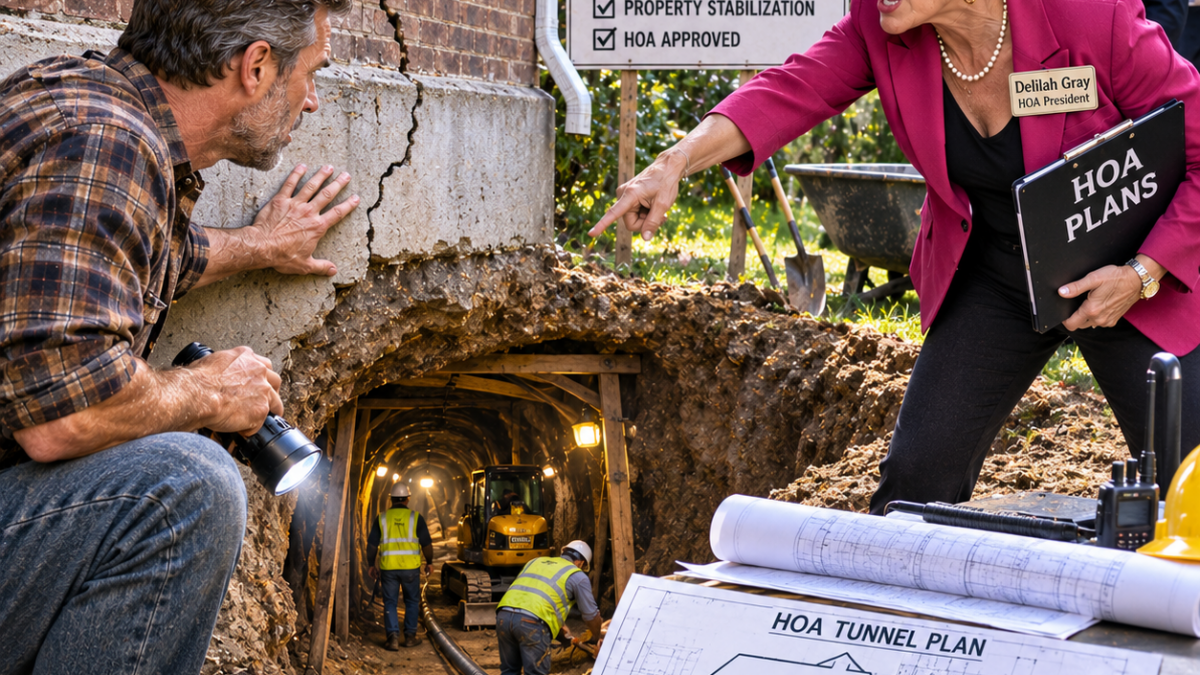
The first crack appeared beneath my basement window three weeks after the HOA began its so-called “infrastructure improvement project,” but I didn’t understand what it meant until the floor started pulsing under my boots and warm air began breathing through a seam in the concrete. When I finally cleared away the loose soil in the back corner, I found a narrow opening descending below my foundation—and farther down, beyond the reach of my flashlight, I could hear machinery running somewhere under the house I had owned for more than twenty years. The worst part was not discovering that someone had dug beneath my property without permission; it was realizing the HOA president had already been preparing documents to make whatever damage they caused look like proof that my home was unsafe.
My name is Keith Wood, and until Delilah Gray became president of Greywood Estates, my biggest HOA problem had been forgetting to roll my trash can behind the fence before dinner.
I bought my house in my early thirties. Three bedrooms, brick exterior, a small backyard, and a basement where I built furniture on weekends. It wasn’t special to anybody else, but it was the first place I had ever owned outright.
For more than twenty years, the foundation never gave me trouble.
Then Delilah took over.
She treated HOA meetings like cabinet sessions and violation notices like criminal indictments. A wreath could be “seasonally incompatible.” A rake leaning against a porch could become “visible yard equipment.” Dark shutters, according to her new beautification rules, threatened neighborhood cohesion.
I ignored most of it.
Then she announced an “infrastructure enhancement plan.”
At the meeting, a polished diagram showed drainage improvements, utility modernization, and something labeled FUTURE ACCESS ZONE.
Delilah pointed at the screen.
“Certain older easement areas may require temporary work.”
I saw my lot number.
Twenty-seven.
“What kind of work?” I asked.
Her smile never reached her eyes.
“Nothing that will affect your home.”
“Can we see the detailed plans?”
“They’re still under review.”
The answer came too quickly.
A week later, fluorescent survey flags appeared behind my fence.
Then two men with measuring equipment showed up along the rear property line.
“Who sent you?”
“HOA assessment.”
“For what?”
“Utility alignment.”
Their instruments weren’t aimed toward the utility corridor.
They were aimed at my house.
That night I felt the first vibration.
Soft.
Almost like a truck idling on the street.
Two nights later, the basement shelves rattled.
Then a hairline crack appeared beside the foundation seam.
I called the city utility office.
“No underground work is scheduled near your property,” the woman told me.
“None?”
“None.”
The following afternoon Delilah knocked on my door carrying a thick folder.
“Keith, we’ve received concerns about your foundation.”
“From whom?”
“The board.”
“My foundation was fine until your project started.”
For half a second, something flashed across her face.
Then the smile returned.
“Older houses shift.”
“So do stories.”
Her lips flattened.
“We strongly recommend an HOA-approved inspection.”
“No.”
“Refusal may be considered noncooperation.”
“You don’t have blanket inspection rights inside my house.”
“Don’t make this harder than it needs to be.”
I shut the door.
That night, a thud knocked a framed photograph off my living-room wall.
I ran downstairs.
The crack had doubled.
Dust covered the floor.
In the far corner, the slab had lifted slightly, and damp soil was pushing through a gap that had not existed the day before.
I knelt.
Warm air moved against my hand.
Then I heard it.
Tap.
Tap.
Tap.
Not pipes.
Not settling.
Tools.
Somebody was working beneath me.
I backed away, called an emergency structural engineer, and started photographing everything before touching another inch of concrete.
Forty minutes later, the engineer arrived with scanning equipment.
He moved slowly across the basement floor, watching the screen.
Then he stopped.
His face changed.
“Keith,” he said, “there’s a void under this slab.”
“How big?”
He rescanned the area.
“Bigger than it should be.”
Then the machine picked up a long disturbance extending beyond the foundation wall toward the rear of my property.
He looked at me.
“This doesn’t look natural.”
A minute later, something metallic struck beneath us.
The floor trembled.
The engineer stared down.
And from somewhere below my house, a woman’s voice came faintly through the crack.
I couldn’t make out the whole sentence.
But I heard the name.
“Delilah.”
PART 2
Greg Saunders—the structural engineer standing beside me—raised one finger to his lips.
For several seconds neither of us moved.
The basement light hummed overhead.
Another metallic strike came from beneath the slab.
Then a man’s voice.
Too muffled to understand.
Greg slowly took out his phone and started recording.
The woman’s voice came again.
Sharper this time.
“Richard, I said another twenty feet.”
I recognized Delilah immediately.
Nobody else in Greywood Estates could make a man’s first name sound like a disciplinary hearing.
Greg looked at me.
“You’re sure that’s your HOA president?”
“Absolutely.”
He motioned toward the stairs.
“Upstairs.”
I didn’t argue.
That surprised even me.
A younger version of myself would probably have taken a flashlight and gone looking for an entrance.
Twenty years of homeownership had taught me that courage and stupidity often feel identical for the first thirty seconds.
We went upstairs.
Greg called the city’s emergency building-safety number from my kitchen.
He gave his license number first.
Then my address.
Then said:
“I have evidence of an active unauthorized excavation beneath an occupied residence with possible loss of foundation support.”
There was a pause.
“Yes, active. I can hear workers.”
Another pause.
“No, I have not entered the void.”
He looked at me while saying that.
I understood the message.
Neither would I.
He ended the call.
“They’re sending building safety and fire-rescue.”
“Fire-rescue?”
“If the cavity is unstable, somebody underneath could be trapped too.”
That irritated me.
Not because he was wrong.
Because part of me didn’t want to care whether the people undermining my house were safe.
Greg saw that.
“You don’t have to like them.”
“I don’t.”
“You still don’t want three bodies under your foundation.”
“No.”
“Good.”
He packed away one scanner but left vibration sensors running.
“I also want you out of the house until the city evaluates this.”
“This is my house.”
“And there may be unsupported soil beneath the load-bearing section.”
That ended the argument.
I called Tom Barrett.
My neighbor.
My best friend in Greywood Estates.
He answered:
“Keith?”
“I need somewhere to sit for an hour.”
“You sound weird.”
“My HOA may have dug a tunnel under my house.”
Silence.
Then:
“I’m sorry, what?”
“I’ll explain outside.”
Tom arrived wearing sweatpants and one untied shoe.
He saw the city truck turning into my driveway at almost the same moment he saw me standing on the lawn with Greg.
“Okay,” he said. “You weren’t exaggerating.”
Inspector Matthew Cole stepped out of the first vehicle.
Mid-fifties.
Gray hair.
Work boots.
No patience for drama.
Behind him came a younger building technician carrying a scanning unit and two firefighters from the technical-rescue team.
Cole shook Greg’s hand.
Then mine.
“You’re Mr. Wood?”
“Yes.”
“Anyone currently inside?”
“No.”
“Anyone known to be below the structure?”
“I heard voices.”
He stopped writing.
“Below?”
“Yes.”
“Recognized anyone?”
“My HOA president.”
Cole looked at me.
Then at Greg.
Greg said:
“I heard a female voice and one male. I cannot personally identify them.”
That was the first of many moments when I learned how much stronger a case becomes when people say only what they actually know.
Cole nodded.
“Show me the basement from a safe position.”
We entered through the exterior basement door one at a time.
The technician scanned.
Greg showed his readings.
Cole photographed the cracks.
The bulged slab.
The soil.
The small opening where the seam had separated.
Then the firefighters lowered a camera through the gap.
Not a person.
A camera.
The screen showed disturbed soil first.
Then timber bracing.
Extension cable.
A work light.
The camera moved farther.
A narrow tunnel stretched beneath my house.
Tom whispered:
“Holy hell.”
Cole told him:
“Please stay upstairs.”
Tom left without arguing.
That was how scared he was.
The camera reached a wider chamber.
Generator.
Plastic fuel container.
Survey tripod.
Plywood.
Stacks of timber.
Then something white lying on a crate.
Rolled paper.
Blueprints.
The camera rotated.
On one wall someone had spray-painted:
**PHASE 2**
Cole’s jaw tightened.
“You know anything about Phase Two?”
“No.”
My mind went back to Delilah’s infrastructure presentation.
Future access zones.
Drainage.
Utility optimization.
Lot 27.
My lot.
Then the camera picked up movement.
A boot.
Everybody froze.
Another boot entered frame.
A man in muddy work pants bent down and unplugged something.
Behind him, just visible for one second, was a bright pink sleeve beneath a reflective safety vest.
My stomach tightened.
Delilah wore pink to everything.
Meetings.
Walkthroughs.
Christmas parties.
Apparently illegal subterranean construction too.
The camera feed jerked.
The worker had noticed it.
“Hey!”
Then the picture swung violently.
Cole pulled the line back.
“Everybody out.”
We moved.
Minutes later, police arrived.
Not because the city had established a crime.
Because there were unauthorized people in an active excavation beneath an occupied home and nobody knew whether they would emerge onto private property.
Officers secured my backyard.
Another team located what appeared to be the construction entrance almost sixty yards behind my fence, concealed by temporary landscape screening near a strip of HOA-owned green space.
That mattered.
The tunnel had started from common property.
Then crossed the boundary.
Then continued beneath mine.
I stood beside Tom watching officers stretch tape between two trees.
He looked at me.
“Keith.”
“Yeah?”
“They really tunneled into your property.”
“Looks that way.”
“No, I mean they actually sat in a meeting and decided underground was easier than asking you.”
“That sounds like Delilah.”
The first man who emerged was not Delilah.
He was around forty.
Mud to his knees.
Reflective vest.
Hard hat.
Terrified face.
He gave officers his name.
Richard Hayes.
Civil engineer.
I recognized it.
Richard had attended two HOA meetings beside Delilah.
He always sat quietly and left before coffee.
Then two laborers came out.
Both looked confused more than criminal.
One kept saying:
“We were told permits were approved.”
Then Delilah emerged.
Pink blazer.
Reflective vest.
Mud on one heel.
She saw the city vehicles.
Police.
Building inspector.
Fire department.
Then me.
For the first time since I’d known her, Delilah Gray had no prepared expression.
She simply stopped.
Inspector Cole approached.
“Ms. Gray?”
She lifted her chin.
“Yes.”
“I’m Matthew Cole with Building Safety. Are you associated with this excavation?”
Her eyes moved toward Richard.
Then toward me.
“Greywood Estates has an authorized infrastructure project.”
Cole asked:
“Permit number?”
“Our contractor maintains permits.”
Richard looked at the ground.
Cole turned.
“Mr. Hayes?”
Richard hesitated.
Delilah snapped:
“Richard.”
Cole looked back at her.
“Please don’t answer for him.”
Richard rubbed mud from his hands.
“I need to call counsel.”
That was the first intelligent thing anyone from Delilah’s project had said all night.
Cole nodded.
“You may.”
Delilah looked at me.
“You had no right to interfere with authorized HOA construction.”
I almost laughed.
Instead I asked:
“Under my house?”
“Your lot contains an older infrastructure easement.”
“No, it doesn’t.”
“You signed access paperwork.”
“No, I didn’t.”
She smiled then.
Small.
Confident.
“We have documentation.”
That smile bothered me more than the tunnel.
Because she believed the document would save her.
Cole asked:
“Do you have a copy?”
“At the clubhouse.”
“Good. We’ll need it.”
Delilah looked at me again.
“You should have allowed the inspection when I offered.”
My skin went cold.
“What inspection?”
“The foundation assessment.”
“Why?”
“Because your home is clearly experiencing structural movement.”
Greg stepped beside me.
“Movement consistent with excavation-induced soil disturbance.”
Delilah’s smile disappeared.
She turned toward him.
“And you are?”
“Greg Saunders. Structural engineer.”
“HOA-approved?”
“No.”
“Then your conclusions are irrelevant to the association.”
Greg gave her a look so flat it almost made me laugh.
“Fortunately, concrete doesn’t care who approved me.”
Cole issued an emergency stop-work order on the spot.
No further excavation.
No equipment removal except for safety reasons.
The site would be preserved pending inspection.
And my house?
Temporarily unsafe for full occupancy.
Those words hurt more than I expected.
Cole said them gently.
“Mr. Wood, until we know how much soil was removed beneath your foundation, I cannot recommend you sleep here.”
I looked at my house.
The same front porch.
Same maple trees.
Same living-room lamp glowing through the window.
Everything looked normal.
That was the horrifying part.
A house can look like home while the ground beneath it has been stolen.
Tom put a hand on my shoulder.
“You’re staying with me.”
“I have a hotel—”
“You’re staying with me.”
I didn’t argue.
Delilah heard the exchange.
She stood near her car talking into her phone.
Then she looked at me.
“You see?”
I stared.
“What?”
“We warned you there were structural concerns.”
For a moment, even Cole looked stunned.
“You dug under my foundation.”
She pointed toward my house.
“Nothing has been established.”
Greg took one step forward.
I stopped him.
Not because I wanted to protect Delilah.
Because suddenly I understood.
This was the story she intended to tell.
Keith’s old house had foundation problems.
The HOA discovered them during infrastructure work.
Keith refused inspection.
The house became unsafe.
The HOA stepped in.
Maybe condemned it.
Maybe forced a sale.
Maybe acquired the lot.
The tunnel wasn’t merely overreach.
It was evidence manufacturing.
I looked at Delilah.
“You needed the cracks.”
Something changed in her eyes.
Tiny.
But real.
“I don’t know what you’re talking about.”
“Yes, you do.”
“Keith—”
“You needed my house to look unstable.”
She turned toward her attorney on the phone.
“I’m done discussing this.”
“Good.”
I walked away.
“Because I’m done discussing it with you too.”
Tom and I left shortly after midnight.
I slept maybe forty minutes.
At 3:17 a.m., I was sitting at his kitchen table drinking terrible coffee when my phone buzzed.
Email.
Sender:
Greywood Estates HOA.
Subject:
**EMERGENCY NOTICE — LOT 27 STRUCTURAL HAZARD**
I opened it.
Delilah had already sent a neighborhood-wide message.
It claimed “previously identified structural concerns” at my home had escalated during a community infrastructure operation.
It said the HOA had attempted for weeks to secure my cooperation.
It said my refusal to permit inspections had increased danger.
And then:
**The Board will evaluate emergency acquisition or condemnation options to protect surrounding property values and community safety.**
Tom read over my shoulder.
“She wrote this tonight?”
“Timestamp 2:51.”
“She crawled out of an illegal tunnel three hours ago and went home to write a newsletter?”
“Yes.”
Tom stared at me.
“She is insane.”
“No.”
I closed the phone.
“She’s building the record.”
“What does that mean?”
“It means every email she sends is supposed to make it look like this started with my foundation instead of her excavation.”
Tom slowly sat down.
“So what do we do?”
I thought about screaming.
Posting pictures.
Knocking on doors.
Demanding everyone choose a side.
Then I remembered Greg.
Cole.
The camera.
Richard asking for counsel.
“Nothing tonight.”
Tom blinked.
“Nothing?”
“We preserve it.”
I forwarded the email to myself.
To Greg.
To Inspector Cole.
Then searched for an attorney.
By six in the morning I had sent an emergency message to Evan Turner, a lawyer whose practice included property disputes and HOA litigation.
At seven forty-two he called.
“Mr. Wood?”
“Yes.”
“I read your message twice because I assumed I misunderstood it the first time.”
“You didn’t.”
“Your HOA dug an unpermitted tunnel beneath your house?”
“That’s what the city found.”
“And then sent a notice suggesting your preexisting foundation defects caused the problem?”
“Yes.”
He exhaled.
“I can meet at nine.”
“Where?”
“Not your house.”
For the first time all night I smiled.
“I like you already.”
We met at Tom’s.
Evan arrived with a leather briefcase, legal pad, and the exhausted expression of a man whose profession had taught him that no sentence beginning with “my HOA president” should ever be underestimated.
I gave him everything.
Original HOA notices.
Infrastructure meeting email.
Photographs of survey flags.
Utility-company confirmation that no work was scheduled.
Delilah’s inspection demand.
Greg’s preliminary findings.
The new emergency email.
And twenty years of property records.
Evan read quietly.
Then looked at me.
“Tell me about the easement she claims you signed.”
“I didn’t.”
“Ever sign anything connected to rear-lot utility work?”
“No.”
“Any drainage agreement?”
“No.”
“Temporary construction permission?”
“No.”
“Do you still have your purchase documents?”
“Yes.”
“Survey?”
“Yes.”
“Title policy?”
“Yes.”
He smiled.
“Good.”
“Why?”
“Because the difference between righteous anger and an expensive court victory is usually a filing cabinet.”
My father would have liked him.
At nine twenty, Inspector Cole called.
They had located the project records Delilah referenced.
There was an easement authorization.
With my name on it.
And a signature.
I drove to city offices with Evan.
Cole showed us a copy.
**KEITH WOOD**
The signature vaguely resembled mine.
If somebody had seen it from twenty feet away.
I stared.
“I didn’t sign this.”
Evan said:
“Do you know either witness?”
Two names.
One was Delilah.
The other Richard Hayes.
“No.”
“Notarized?”
Cole shook his head.
“No notarial block.”
The document supposedly granted Greywood Estates temporary underground access for utility improvements.
But several details were wrong.
My middle initial.
Property description.
Date.
And the email address typed beneath my signature belonged to an account I hadn’t used in six years.
Evan asked:
“Where did the city obtain this?”
“HOA project file.”
“Was it ever submitted for a permit?”
“No permit exists.”
“What about the contractor?”
“That’s another problem.”
Richard Hayes was a licensed civil engineer.
But the excavation contractor listed on internal HOA invoices had no active license for this type of work.
Worse, the laborers told investigators they had been hired as day workers and believed they were constructing a drainage service tunnel authorized by the HOA.
I looked at Cole.
“How long?”
“Preliminary estimate? Forty to fifty feet of excavation.”
My stomach tightened.
“Under the house?”
“Part of it.”
“How bad?”
“We need a geotechnical engineer.”
“When can I go home?”
Cole didn’t answer quickly enough.
That hurt.
“We’ll know more soon.”
Outside, I stood beside Evan’s car.
People were going to work.
Buying coffee.
Living normal Tuesday mornings.
My home was behind caution tape because a woman in a pink blazer wanted my lot.
Evan put his briefcase on the hood.
“Keith.”
“What?”
“We can get emergency relief today.”
“Against Delilah?”
“Against the HOA and anyone acting for it.”
“What kind?”
“Temporary restraining order. No entry onto your property. No alteration of the excavation. No destruction of project records. No attempt to enforce that supposed easement until the court reviews it.”
“Do it.”
“We also notify the HOA’s insurer.”
“Why?”
“Because somebody is eventually paying to stabilize your house.”
I looked toward the road.
“I want Delilah to.”
“Maybe.”
“Personally.”
“Maybe.”
“That’s not satisfying.”
“Law rarely is at nine thirty in the morning.”
He opened the car door.
“Give it time.”
By lunchtime, Delilah’s story was spreading through Greywood Estates.
I knew because Tom showed me the neighborhood group.
Some people believed her.
**Keith refused inspection for months.**
False.
**His basement was already collapsing.**
False.
**The tunnel followed a seventy-year-old utility easement.**
False.
Then one comment appeared from Linda Pierce, an HOA director.
**I am on the board and was never shown any tunnel plans. What exactly did we authorize?**
Another director replied:
**Same question.**
Then Stuart Bell:
**The project we voted on was drainage assessment. I did not vote to excavate beneath a residence.**
Tom smiled.
“She’s losing them.”
“Maybe.”
“You sound disappointed.”
“I don’t want Facebook to decide this.”
“Why?”
“Because Facebook thought my house was collapsing before Delilah touched it.”
Fair.
At two fifteen, Evan called.
The judge had granted temporary restrictions preserving the site and records until a hearing.
Then he said:
“There’s something else.”
“What?”
“The HOA’s insurance carrier wants the project documents.”
“Good.”
“Not good for Delilah.”
“Better.”
That afternoon Richard Hayes called me.
I almost didn’t answer.
Evan told me not to speak with represented parties without counsel.
So I forwarded the number.
An hour later Evan called back.
“Richard has hired his own lawyer.”
“Why is he calling me?”
“He wants to cooperate.”
“With us?”
“With everyone.”
I sat down.
“What does he know?”
“Enough that I want you to hear it in a formal setting, not a phone call.”
Two days later, Richard gave a recorded statement through counsel.
I attended with Evan.
Richard looked terrible.
No blazer.
No engineer confidence.
Just a tired man who had discovered that every compromise eventually sends an invoice.
He began:
“I should have stopped it.”
I didn’t respond.
His lawyer looked at him.
Richard continued.
“Delilah first approached me about a drainage tunnel in March.”
“What drainage tunnel?” Evan asked.
“A service corridor behind lots twenty-four through twenty-nine.”
“Was it approved?”
“The concept was discussed.”
“Did the board approve the excavation beneath Mr. Wood’s residence?”
“No.”
“Did the city?”
“No.”
“Did Mr. Wood?”
Richard looked at me.
“No.”
I felt my jaw tighten.
“Then why?”
Richard rubbed both hands over his face.
“Delilah wanted your lot.”
There it was.
Simple.
Ugly.
He explained.
Greywood Estates owned a narrow common strip behind several houses.
Delilah had developed plans for an expanded clubhouse complex.
Fitness room.
Indoor event space.
Pool equipment building.
Service access.
My property sat in the most convenient place for the proposed expansion.
But I had no interest in selling.
I had told Delilah that months earlier when she casually asked whether I’d ever considered “downsizing.”
“No.”
One word.
Apparently enough to start a conspiracy.
Richard continued.
“She wanted evidence your property was becoming structurally unsafe.”
“Why?”
“So the HOA could pressure you to sell.”
“Pressure?”
“She talked about nuisance proceedings, emergency assessments, condemnation referrals.”
Evan interrupted.
“An HOA cannot condemn private property.”
“I told her that.”
“What did she say?”
Richard swallowed.
“She said the city could.”
My hands tightened under the table.
“So you dug under my house to create damage the city might condemn?”
Richard looked down.
“At first she said the tunnel would remain behind the foundation.”
“But it didn’t.”
“No.”
“Why?”
“She changed the alignment.”
“When?”
“Three weeks ago.”
“Reason?”
He looked at me.
“To create measurable settlement.”
Silence.
My ears rang.
Not metaphorically.
I could hear blood moving.
Evan’s voice stayed steady.
“Did Ms. Gray say that?”
“Yes.”
“What words?”
Richard closed his eyes.
“She said, ‘We need the inspector to see what Keith refuses to see.’”
“Anything else?”
“She said once there were enough cracks, the board could classify the house as a neighborhood safety issue.”
I stared at Richard.
“You knew my house could collapse.”
His eyes lifted.
“I didn’t think it would.”
“That wasn’t my question.”
“I knew there was risk.”
“How much?”
“Keith—”
“How much?”
His attorney started to intervene.
Richard raised a hand.
“I knew enough to stop.”
“But you didn’t.”
“No.”
“Why?”
His voice cracked.
“Money.”
There wasn’t much to say after that.
Greywood Estates had paid Richard’s consulting company nearly $180,000 over eighteen months.
Not all for the tunnel.
But enough that he had allowed dependence to become obedience.
Then Delilah made sure he understood he was already implicated.
Forged access paperwork.
Unpermitted work.
False project descriptions.
Every time he considered backing out, she reminded him his name was on documents.
By the time he realized what she truly intended, he was afraid stopping would expose him.
It was cowardly.
It was also believable.
That made me angrier.
Monsters are easy.
Ordinary people making one compromised decision after another can do much more damage.
Richard handed investigators copies of emails and revised plans.
One plan showed my foundation.
A red shaded section beneath the northwest corner.
Handwritten note:
**INDUCE VISIBLE SETTLEMENT — INSPECTION TRIGGER**
Evan stared at it.
Then at me.
“We’re done playing defense.”
The next HOA meeting was chaos before it started.
Residents packed the clubhouse.
Some stood outside.
Delilah tried to chair it.
Linda stopped her.
“No.”
Delilah stared.
“I am president.”
“Until we vote otherwise.”
“This meeting is about infrastructure compliance.”
“No,” Stuart said. “This meeting is about why city inspectors shut down our projects.”
Delilah slapped a folder onto the table.
“Because Keith Wood weaponized bureaucracy against community improvement.”
I was in the back with Evan.
He leaned toward me.
“Do not speak unless called.”
“I know.”
“You look like you want to speak.”
“I want to do several things.”
“None.”
Linda displayed the board minutes.
The only approved motion had authorized preliminary drainage studies.
No tunnel.
No excavation.
No subfoundation work.
No property acquisition.
Then she displayed invoices.
“Delilah, what is Phase Two?”
“An infrastructure component.”
“Why did it cost eighty-seven thousand dollars?”
“Technical work.”
“Why isn’t it in the approved capital plan?”
“Emergency projects don’t always—”
“Where was the emergency?”
Delilah’s composure tightened.
“Lot 27.”
Every head turned toward me.
Linda stared.
“Keith’s house was the emergency?”
“Yes.”
“And you knew that before the cracking started?”
Delilah hesitated.
Fatal.
Stuart stood.
“How?”
She looked at Richard’s empty chair.
He wasn’t there.
His lawyer had advised him not to attend.
Then Delilah said:
“Engineering projections.”
Linda shook her head.
“Richard says otherwise.”
The room changed.
You could feel it.
Delilah’s face lost color.
“What?”
“He has counsel.”
“That coward.”
“And he’s cooperating.”
Delilah stood.
“You people have no idea what I’ve done for this neighborhood.”
A resident shouted:
“You dug under somebody’s house!”
“It was an infrastructure corridor.”
Another:
“Why?”
“For long-term property value.”
Tom shouted from beside me:
“His property isn’t yours!”
Delilah pointed.
“The community cannot function when one owner blocks necessary expansion.”
There it was.
No misunderstanding anymore.
Necessary expansion.
My lot was an obstacle.
Not a home.
I stood despite Evan touching my sleeve.
He whispered:
“Short.”
I nodded.
“Delilah.”
She looked at me.
I had rehearsed speeches.
Angry ones.
Clever ones.
I used none.
“I’ve lived in that house twenty-two years.”
She crossed her arms.
“So?”
“My mother spent her last Christmas there.”
Something in my throat tightened.
That wasn’t planned.
“My son learned to walk in that living room.”
The room went silent.
“My wife and I built the basement workshop together before she died.”
Delilah looked away.
“You looked at my home and saw square footage for a clubhouse.”
“I saw an inefficient parcel arrangement.”
That sentence destroyed her.
Not legally.
Humanly.
People gasped.
Linda stared at her.
Tom whispered:
“Wow.”
Delilah realized too late.
She tried to recover.
“That isn’t what I meant.”
I nodded.
“I think it is.”
Then I sat.
Linda called for an emergency vote to remove Delilah as HOA president pending investigation.
The result was not close.
Every director except Delilah voted yes.
She remained seated after the vote.
Clipboard in front of her.
Hands flat on the table.
For the first time, nobody waited for her to tell them what to do.
That was the first consequence that seemed to hurt her.
Not the city.
Not lawyers.
Irrelevance.
The investigation expanded rapidly after Richard’s cooperation.
City inspectors referred the forged access document to police.
Financial records showed payments routed through loosely described “infrastructure modernization” accounts.
Board authorization had been misrepresented.
Some invoices had Delilah’s approval where two signatures were required.
The district attorney’s office opened a case.
No dramatic SWAT raid.
No handcuffs at an HOA podium.
Investigators interviewed witnesses.
Subpoenaed emails.
Collected documents.
Compared signatures.
Reviewed bank records.
Then charges were filed.
Forgery-related counts.
Fraud.
Criminal damage to property.
Reckless endangerment theories tied to the excavation.
Conspiracy allegations involving Richard and one contractor supervisor.
The exact counts changed as prosecutors refined the case.
Richard negotiated cooperation.
The laborers weren’t charged after investigators concluded they had been misled about permits and property boundaries.
Delilah surrendered through counsel.
When her booking photo appeared online, Tom sent it to me.
I deleted it.
He called.
“You didn’t save it?”
“No.”
“That’s historic.”
“My cracked basement is historic enough.”
Repairing the house became the next battle.
Winning a lawsuit doesn’t magically put soil back beneath a foundation.
Greg brought in a geotechnical engineer named Dr. Priya Shah.
She studied the voids.
Soil composition.
Load paths.
Foundation movement.
The conclusion was better than my nightmares but worse than my wallet.
The house could be saved.
But it needed stabilization.
Engineered fill.
Pressure grouting in selected zones.
New underpinning beneath affected sections.
Crack repair.
Continuous monitoring.
Partial slab replacement.
And reconstruction of the disturbed rear yard.
Estimated cost:
$386,000.
I laughed when I saw it.
Not because it was funny.
Because sometimes a number is too large for the nervous system.
Evan said:
“We pursue the HOA insurer, contractor insurer, Richard’s professional policy, and responsible parties.”
“I didn’t create this.”
“I know.”
“I’m not paying four hundred thousand dollars because Delilah wanted a gym.”
“I know.”
“That woman better—”
“Keith.”
“What?”
“Breathe.”
I hated him.
Temporarily.
The insurance fight took months.
Each carrier argued another policy should pay first.
The HOA carrier invoked exclusions.
The contractor carrier disputed scope.
Richard’s professional-liability insurer argued excavation work exceeded his covered services.
Evan became happier with every new denial letter.
“You enjoy this.”
“Denials create positions.”
“What does that mean?”
“It means people put arguments in writing.”
“You really are a lawyer.”
“Thank you.”
“That wasn’t praise.”
Eventually the court ordered mediation.
That room was less exciting than television.
No dramatic confession.
No gavel.
Just lawyers in separate conference rooms moving numbers around while I ate stale sandwiches.
At one point an insurer offered $140,000.
I looked at Evan.
“No.”
He nodded.
The mediator asked:
“What would resolve the property portion?”
I handed him Dr. Shah’s repair estimate.
“Make my house what it was before they dug under it.”
Nothing more.
I didn’t ask for a marble kitchen.
New garage.
Swimming pool.
I wanted stable ground.
That clarity helped.
The settlement package eventually funded the structural repairs, temporary housing costs, engineering fees, significant legal fees, and additional compensation for proven property damage and loss of use.
My separate claims against Delilah remained alive where insurance did not cover intentional conduct.
The work took almost eight months.
For eight months, I lived in a rental two miles away.
Every morning I drove past my own house.
Scaffolding.
Concrete pumps.
Excavation equipment.
Engineers.
Yellow tape.
The first few weeks I couldn’t look long.
It felt violated.
Like seeing someone you loved in surgery.
Tom understood.
One Saturday he came to the rental carrying two coffees.
“Want to go over there?”
“No.”
“Okay.”
We sat on the porch.
After ten minutes he asked:
“Want to go over there?”
“No.”
“Okay.”
Another ten minutes.
“Tom.”
“Yeah?”
“Let’s go.”
We stood at the edge of the basement while Dr. Shah showed me the repaired support system.
New underpinning.
Documented fill.
Monitoring points.
The tunnel beneath the slab was gone.
Properly collapsed and filled under engineering control.
Not hidden.
Remediated.
Dr. Shah pointed toward one reinforced section.
“This is stronger now than the original condition.”
I touched the wall.
“Stronger?”
“Yes.”
That should have made me happy.
Instead I cried.
Quietly.
Embarrassingly.
Tom pretended to study a pressure gauge.
Dr. Shah walked upstairs.
Nobody said anything.
I put my hand against the concrete where the crack had been.
My wife, Karen, had helped me paint that basement twenty years earlier.
She died of ovarian cancer six years before Delilah’s tunnel.
After Karen died, I nearly sold the house.
Couldn’t.
Too many ordinary pieces of her remained.
A pencil mark behind the pantry door showing our son’s height.
A dent in the garage trim from the time she backed out with the hatch open.
The maple she insisted we plant too close to the driveway.
The basement shelves she painted blue because I said workshop furniture didn’t need color.
Delilah had looked at all of that and seen:
Lot 27.
Expansion zone.
I had spent months angry about property rights.
Standing in that basement, I understood why the violation hurt so deeply.
She hadn’t tried to take dirt.
She had tried to convert memory into square footage.
Tom finally said:
“You okay?”
“No.”
He nodded.
“Want me to say something wise?”
“No.”
“Good. I don’t have anything.”
I laughed through tears.
That helped.
The criminal case reached resolution almost a year after the tunnel was discovered.
Richard pleaded guilty to reduced charges tied to falsified project documentation and reckless participation in the excavation.
He lost his position and later faced professional licensing discipline.
At sentencing he apologized.
Not the polished kind.
He looked at me and said:
“I kept telling myself I could control the risk.”
I said nothing.
He continued.
“Every time she asked for something worse, I told myself the previous thing meant I was already trapped.”
His eyes filled.
“I should have walked away the first time.”
That was true.
The judge imposed probation conditions, restitution obligations, community service, and professional restrictions consistent with his plea.
Some neighbors wanted prison.
I didn’t.
Richard had done real damage.
He also stopped lying when stopping mattered.
Accountability didn’t require me to pretend both things weren’t true.
Delilah fought longer.
Her attorneys challenged intent.
Argued she believed the HOA had access rights.
Argued she relied on technical professionals.
Argued the condemnation language reflected contingency planning, not sabotage.
Then prosecutors introduced her emails.
One:
**Without visible distress, Wood will never sell.**
Another:
**Do not over-reinforce beneath Lot 27 until after inspection trigger.**
Then the worst:
**Once unsafe status is documented, acquisition becomes a community-benefit argument instead of a negotiation.**
I heard that line read in court.
She was sitting twenty feet away.
For the first time, I felt no anger.
Just distance.
She had reduced my life to strategy language.
Acquisition.
Trigger.
Community benefit.
No room for my wife.
My son.
My workbench.
My twenty-two years.
Delilah eventually accepted a plea agreement rather than proceed to trial on every count.
She pleaded guilty to offenses involving fraudulent documents, property damage, and her role in the unauthorized excavation scheme.
The judge ordered restitution beyond insurance recoveries, imposed incarceration followed by supervision, and barred her from holding fiduciary or board-management roles during the relevant period of supervision.
She was also personally liable for portions of civil damages not insulated by association coverage.
Before sentencing, she spoke.
“I believed Greywood needed modernization.”
Nobody reacted.
She continued.
“The neighborhood was declining.”
Linda sat two rows ahead of me.
Her shoulders stiffened.
Delilah looked toward me.
“Mr. Wood’s property blocked the only logical expansion route.”
Still Mr. Wood’s property.
Not Keith’s home.
Then she said:
“I let the importance of the project justify decisions I should not have made.”
That was as close as she came to saying what happened.
The judge asked:
“Did the importance of the project justify digging beneath an occupied residence?”
“No.”
“Did Mr. Wood consent?”
“No.”
“Did you alter documents to create the appearance of consent?”
A long pause.
“Yes.”
“Did you expect structural damage would pressure him?”
Her lawyer leaned toward her.
She stared at the table.
“Yes.”
I heard Linda start crying.
Not me.
Linda.
Because she had trusted Delilah.
People forget victims aren’t always the obvious person.
The board members had been manipulated too.
Some had been careless.
Some cowardly.
But several had genuinely believed they were approving drainage improvements.
Delilah had used their signatures as scenery.
When my turn came for a victim statement, I brought nothing.
No photographs.
No broken concrete.
No repair invoices.
I said:
“For months, I thought the worst thing you did was damage my house.”
Delilah looked at me.
“It wasn’t.”
The courtroom stayed quiet.
“You made me afraid of the ground underneath it.”
My voice nearly broke.
“I could replace drywall.”
“Concrete.”
“Flooring.”
“But home is supposed to be the place where you stop checking whether the world underneath you is stable.”
I paused.
“You took that feeling.”
Delilah looked away.
“I got the house back.”
I swallowed.
“Getting that feeling back took longer.”
I sat down.
That was enough.
Greywood Estates did not disappear overnight.
The source of my nightmare had been an HOA, but the association also owned actual common property.
Clubhouse.
Pool.
Drainage easements.
Entrance landscaping.
Contracts.
You cannot simply shout “dissolved” and make obligations vanish.
So the members did it properly.
An interim manager was appointed.
Independent accounting.
Project audit.
New election.
Amended bylaws.
Stronger spending controls.
Any capital project above a set threshold required independent review and homeowner disclosure.
No private-property access without written consent verified by counsel.
No emergency easement claims without recorded legal authority.
No president could approve contractor payments alone.
Linda ran for president.
I nearly choked when she told me.
“You?”
She frowned.
“Is that insulting?”
“No.”
“Yes.”
“Little.”
She laughed.
“I’m running because I helped let Delilah happen.”
“You didn’t know about the tunnel.”
“I knew she stopped showing us full documents.”
That was different.
“I told myself she was efficient.”
She looked ashamed.
“I don’t want the next person to tell themselves that.”
She won.
Her first act was not dramatic.
She published the HOA’s entire approved budget online for residents.
Her second was hiring an independent auditor.
Her third was walking to my house after repairs finished.
She stopped at the property line.
“May I come in?”
That simple question nearly undid me.
“Yes.”
She walked inside.
The basement smelled like new concrete.
My blue shelves were back.
Same color Karen had painted them.
Linda touched one.
“Original?”
“Shelves, yes.”
She looked toward the repaired wall.
“I don’t know how to apologize for this.”
“You didn’t dig it.”
“I voted for the infrastructure study.”
“You didn’t vote for this.”
“I should have asked more questions.”
“Yes.”
She looked at me.
Not expecting rescue.
So I gave her the truth.
“Yes. You should have.”
She nodded.
“I will next time.”
“Good.”
Then she handed me an envelope.
The HOA’s formal apology.
Not legal settlement language.
A separate letter approved unanimously by the new board.
It acknowledged that Greywood had no right to enter beneath my property.
That project records had misrepresented my consent.
That residents had been misled.
And that the association accepted responsibility for failing to provide sufficient oversight.
No “if you were offended.”
No “mistakes were made.”
Real nouns.
Real verbs.
I framed it.
Not because I needed an HOA apology on my wall.
Because honest language had finally replaced Delilah’s paperwork.
My house reopened completely fourteen months after the first vibration.
My son, Michael, flew home from Oregon to help me move back.
He was thirty-four.
Married.
Two kids.
He walked into the basement and stared at the repaired slab.
“This is where it was?”
“Yes.”
“How far did it go?”
“About forty-seven feet total. Roughly seventeen beneath or immediately adjacent to foundation influence zones.”
He looked at me.
“You memorized that.”
“Unfortunately.”
He stood where the bulge had appeared.
“Mom would’ve lost her mind.”
I smiled.
“She would have had Delilah crying before I found a lawyer.”
Michael laughed.
Then became quiet.
“Why didn’t you call me sooner?”
“About what?”
“When the vibrations started.”
“I thought it was nothing.”
“Then when you found the void.”
“You had work.”
“Dad.”
“What?”
“You were potentially sitting above a collapsing tunnel.”
“I handled it.”
His face changed.
Not angry exactly.
Hurt.
“You always do that.”
“Do what?”
“Decide protecting us means not telling us you’re scared.”
I looked away.
The basement suddenly felt smaller.
“I wasn’t—”
“Don’t.”
He sounded like his mother.
That shut me up.
Michael leaned against the blue shelf.
“When Mom got sick, you told me everything was fine until it wasn’t.”
I swallowed.
“That was different.”
“No.”
“Yes.”
“You thought if you carried it alone, it would hurt us less.”
He looked at the repaired floor.
“Then you did it again.”
I sat on the workbench stool.
“I didn’t want you flying across the country for an HOA problem.”
He laughed bitterly.
“They excavated under your house.”
“Fair.”
“You could’ve died.”
That part had become easier to discuss in reports than with my son.
I looked down.
“Yes.”
His voice softened.
“Were you scared?”
I thought about lying.
Then didn’t.
“Yes.”
He sat beside me.
“Thank you.”
“For what?”
“For finally saying it.”
We sat in the basement for a long time.
The place where Delilah had tried to manufacture damage became somewhere my son and I stopped manufacturing strength.
Maybe repairs work like that.
Not returning things exactly to what they were.
Making them capable of carrying weight differently.
Michael stayed a week.
Before leaving, he painted one small section of shelving where the old finish had chipped.
Same blue.
Not quite the same shade.
I started to complain.
Then stopped.
Karen would have liked the mismatch.
Life moved forward.
Tom continued coming over on Saturdays.
The first time he heard my table saw running again, he walked straight into the basement.
“You’re working?”
“Apparently.”
He picked up a walnut board.
“What is this?”
“Dining table.”
“For who?”
“Michael.”
“You charging him?”
“No.”
“Bad business model.”
“Get out.”
He didn’t.
He helped.
The city required long-term movement monitoring for another year.
Tiny measurement points were installed along repaired foundation areas.
Every month I checked the readings.
Zero meaningful movement.
One month.
Two.
Six.
Twelve.
Stable.
Greg came for the final inspection.
He looked around.
“Good.”
“That’s it?”
“What do you want?”
“Confetti.”
“I’m an engineer.”
“Right.”
He signed the final report.
**STRUCTURALLY STABLE.**
Two words.
I stared at them.
Greg noticed.
“You okay?”
“Yes.”
He smiled.
“You don’t look okay.”
“I spent a year wanting those words.”
He closed his equipment case.
“Then believe them.”
After he left, I took the report downstairs.
Placed it on my workbench.
Beside the original photograph of the crack.
Then I took the photograph down.
Put it in a drawer.
I didn’t need to look at damage every day to prove I had survived it.
Greywood changed too.
Not perfectly.
An HOA remained an HOA.
People argued about parking.
Pool hours.
Tree removal.
One meeting lasted forty-five minutes because two residents disagreed about whether decorative stone counted as “hardscape.”
Normal nonsense.
I loved normal nonsense.
No forged easements.
No tunnels.
No condemnation strategies.
Just adults spending too much time discussing landscaping.
Linda instituted term limits.
Two years for president.
Maximum two consecutive terms.
When somebody proposed naming the clubhouse after her, she said:
“Absolutely not.”
I liked her more every year.
Richard sent me a letter after completing community service.
I almost threw it away.
Then read it.
No excuses.
He told me he had taken a job outside engineering while his licensing case remained resolved.
He said he had started speaking at professional ethics courses when invited.
One line stayed with me:
**I thought crossing one small line would keep me from losing my career. Crossing it is what cost me the career.**
I put the letter in the same drawer as the crack photograph.
Not forgiveness.
Context.
Delilah sent nothing.
That was fine.
I did not need redemption from her.
Years later, someone asked whether I ever forgave her.
I still don’t know.
Forgiveness is a word people use as though it has a completion date.
I stopped waking up angry.
Stopped checking the basement at midnight.
Stopped imagining machinery every time a truck idled nearby.
Stopped knowing where Delilah was serving her sentence.
If that’s forgiveness, maybe.
If forgiveness means deciding what she did was understandable?
No.
Some things can be understood without being softened.
Three years after the tunnel, Greywood replaced the old clubhouse.
That was ironic.
Not expanded.
Replaced.
The original building had serious roof and accessibility problems.
The new board approached the project carefully.
Engineer.
Architect.
Permits.
Open bids.
Resident votes.
Independent legal review.
The expansion Delilah claimed was so urgent ended up becoming a smaller building that fit entirely on HOA-owned land.
No need for my property.
No need for a tunnel.
No need to destroy anyone’s foundation.
At the opening, Linda asked if I would attend.
“I’m not cutting a ribbon.”
“I wasn’t asking.”
“Good.”
“I wanted you to see something.”
Behind the new clubhouse, the HOA had installed a small plaque.
Not about me.
Thank God.
It read:
**COMMON PROPERTY ENDS AT THE RECORDED BOUNDARY. PRIVATE PROPERTY BEGINS WITH CONSENT.**
I stared.
“That’s very specific.”
Linda smiled.
“We learn.”
Tom appeared behind us.
“Could’ve added NO TUNNELS.”
Linda laughed.
“I suggested it.”
I looked at her.
“Seriously?”
“No.”
Probably.
That afternoon kids swam in the pool.
Neighbors grilled burgers.
Nobody discussed Delilah.
I realized that was what recovery looked like for the neighborhood too.
Not defeating her forever in conversation.
Forgetting to mention her.
Michael eventually brought my grandchildren to visit.
My granddaughter Sophie was eight.
She heard somebody mention the tunnel.
Children hear the word tunnel and immediately assume treasure.
“Grandpa.”
“Yes?”
“Was there really a secret tunnel under your house?”
“Yes.”
“Did it have gold?”
“No.”
“Skeletons?”
“No.”
“Pirates?”
“No.”
She looked disappointed.
“What was in it?”
“Bad decisions.”
Michael laughed so hard he nearly dropped his coffee.
Sophie frowned.
“That’s boring.”
“It wasn’t at the time.”
“Can I see it?”
“It’s gone.”
“Why?”
“We filled it.”
She looked horrified.
“You filled a secret tunnel?”
“Yes.”
“Grandpa!”
“I wanted the house not to fall down.”
She considered.
“Okay.”
Then ran outside.
Michael looked at me.
“You know she’s going to dig a hole in your backyard.”
“I know.”
“She gets that from Mom.”
“Definitely.”
We found Sophie ten minutes later with a plastic shovel.
Her tunnel was six inches deep.
I let her continue.
Boundaries.
Context.
Perspective.
One autumn morning, I was cleaning the basement when I found Delilah’s first violation notice.
The rake.
**YARD EQUIPMENT VISIBLE FROM STREET.**
I had apparently tossed it into an old toolbox instead of the trash.
I held it.
The paper seemed absurdly small.
That was how it started.
Not the tunnel.
Control rarely starts with the worst thing.
It starts with people learning that nobody pushes back.
Twelve minutes late with a trash can.
Wrong wreath.
Wrong shutters.
A rake.
Then inaccessible plans.
Then survey markers.
Then a fake signature.
Then excavation beneath somebody’s house.
Nobody wakes up one morning and decides forty feet of illegal tunnel is normal.
You walk there one justified compromise at a time.
That lesson stayed with me more than the court case.
I threw the violation slip away.
Not framed.
Not preserved.
Trash.
The final chapter came almost five years after I first heard tapping beneath the floor.
Tom was moving.
His daughter had convinced him and his wife to move closer to the grandchildren.
We sat on my porch beside two cardboard boxes.
“You sure?”
“No.”
“Then stay.”
“My wife will kill me.”
“Fair.”
He looked toward my maple trees.
“You remember the night you called?”
“Yeah.”
“You said bring a camera.”
“I was panicking.”
“You sounded insane.”
“I was dealing with a tunnel.”
“Still insane.”
I smiled.
He nudged me.
“You know what I think about sometimes?”
“What?”
“If you hadn’t heard it.”
The smile left.
“If you had gone away for a week.”
I knew.
More excavation.
More settlement.
Maybe a failed slab.
Maybe structural condemnation.
Maybe I would have lost the house.
Maybe worse.
Tom shook his head.
“Timing.”
“Luck.”
“Same thing sometimes.”
We sat quietly.
Then he said:
“You going to die in that house?”
“Hopefully not soon.”
“You know what I mean.”
I looked through the front window.
Inside were twenty-seven years now.
Karen.
Michael.
Grandkids.
Repairs.
Blue shelves.
A dining table waiting for finish.
“Yes.”
Tom nodded.
“Good.”
He stood.
We hugged.
Men our age pretend we’re bad at that.
We aren’t.
His truck disappeared around the corner.
I went downstairs.
The basement was cool.
Still.
No vibrations.
No warm air from below.
I put a walnut board on the workbench and turned on the overhead lights.
One section of concrete remained slightly different in color where repairs had been made.
For years I’d wanted to paint it so the whole floor matched.
Never did.
That patch reminded me of something useful.
Strong repairs don’t always disappear.
Sometimes you can see exactly where something was broken.
That doesn’t make it weaker.
My house had new foundation supports beneath sections Delilah damaged.
The repaired soil was engineered.
Monitored.
Documented.
In a strange way, the house was stronger in the very place she tried to weaken it.
I never liked easy metaphors.
That one earned itself.
I finished sanding the walnut.
Turned off the saw.
And heard nothing.
For a second I stood perfectly still.
Years earlier silence in that basement had meant I was waiting for the next vibration.
Now silence was simply silence.
I walked to the corner where the first bulge had appeared.
Placed my palm against the wall.
Solid.
Above the workbench hung one framed item.
Not the lawsuit.
Not Delilah’s booking photo.
Not the settlement.
Greg’s final structural report.
**STRUCTURALLY STABLE.**
Michael once asked why I framed those words.
I told him because they described more than the house.
He rolled his eyes.
“That’s cheesy, Dad.”
He was right.
I kept it anyway.
I went upstairs and opened the back door.
The two maples out front had grown high enough to shade part of the roof.
Karen had chosen them.
Delilah once wanted one removed because its canopy disrupted neighborhood symmetry.
Linda’s board had officially deleted that rule years ago.
Leaves covered my lawn.
Nobody fined me.
A rake leaned against the porch.
I noticed it.
Considered moving it.
Then laughed.
Left it exactly where it was.
That evening, a new couple walked past.
They had recently bought a house two doors down.
The man waved.
“Keith?”
“Yeah?”
“We’re trying to figure out the HOA rules. Linda said you’ve been here forever.”
“Long enough.”
“Anything we should know?”
I looked at the rake.
Then at him.
“Read what you sign.”
He smiled.
“That’s it?”
“Ask questions when somebody says something is an emergency.”
His wife laughed.
“Anything else?”
I thought about Delilah.
Richard.
The fake easement.
Inspector Cole.
Evan.
Tom.
The night my floor moved beneath me.
“Yeah.”
They waited.
“If somebody says they need access to your property, make them show you exactly why.”
The man nodded.
“Reasonable.”
It should have been.
They kept walking.
I stayed on the porch until sunset.
Greywood Estates looked ordinary.
A basketball bounced in a driveway.
Somebody’s dog barked.
A lawn mower started.
The clubhouse lights came on.
Nothing about the neighborhood suggested that years earlier, men had been tunneling beneath my home while the HOA president prepared paperwork to make the damage look natural.
Maybe that was good.
Places deserve to become more than their worst moments.
So do people.
So do houses.
When darkness settled, I went inside.
Locked the back door.
Walked through the kitchen.
Paused at the basement stairs.
For years after the repairs, I would stop there and listen before going down.
Not anymore.
I descended without thinking.
One step.
Then another.
The blue shelves came into view.
The workbench.
Walnut dust.
Concrete floor.
My home.
Nothing underneath me but reinforced earth and the foundation I had paid to protect.
Delilah had believed power meant getting beneath someone’s defenses without permission.
Dig quietly.
Create weakness.
Then arrive with paperwork pretending the weakness had always been there.
She almost succeeded.
What stopped her wasn’t some spectacular act of revenge.
It was a crack I refused to ignore.
An engineer who documented before guessing.
An inspector who cared about permits.
A neighbor who showed up with a camera.
A lawyer who kept telling me not to do anything stupid.
Board members who finally asked to see what they had supposedly approved.
An engineer who decided telling the truth was better than protecting his career.
Records.
Measurements.
Signatures.
Emails.
Evidence.
Truth is rarely dramatic while you’re collecting it.
It becomes dramatic when somebody who built their power on lies finally has to answer for every page.
I looked once more at the repaired section of floor.
Then turned off the basement light.
Upstairs, the house settled with the ordinary little creak old houses make at night.
Years ago, that sound would have sent me running for a flashlight.
This time I kept walking.
The ground beneath me was solid.
The house was mine.
And nobody was digging underneath it anymore.
[END OF STORY]