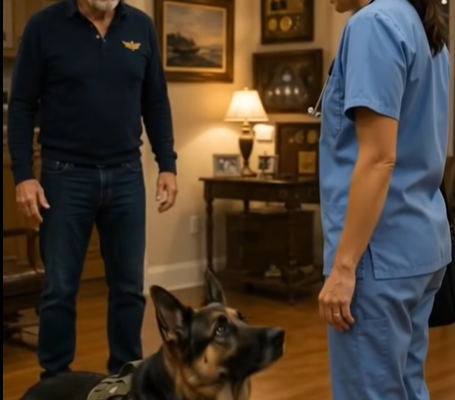
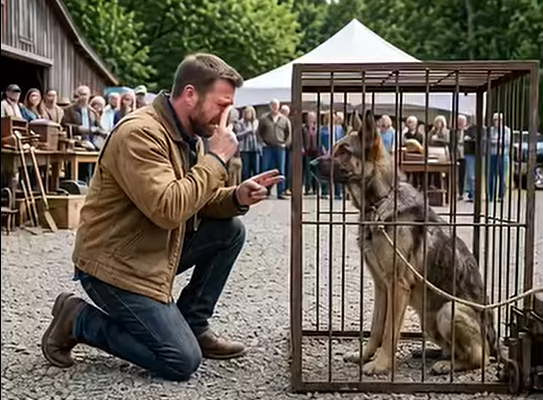
PART 2: HOA Karen Threatened to Seize the Only House Outside Her HOA—She Had No Idea What I Found in the State Records
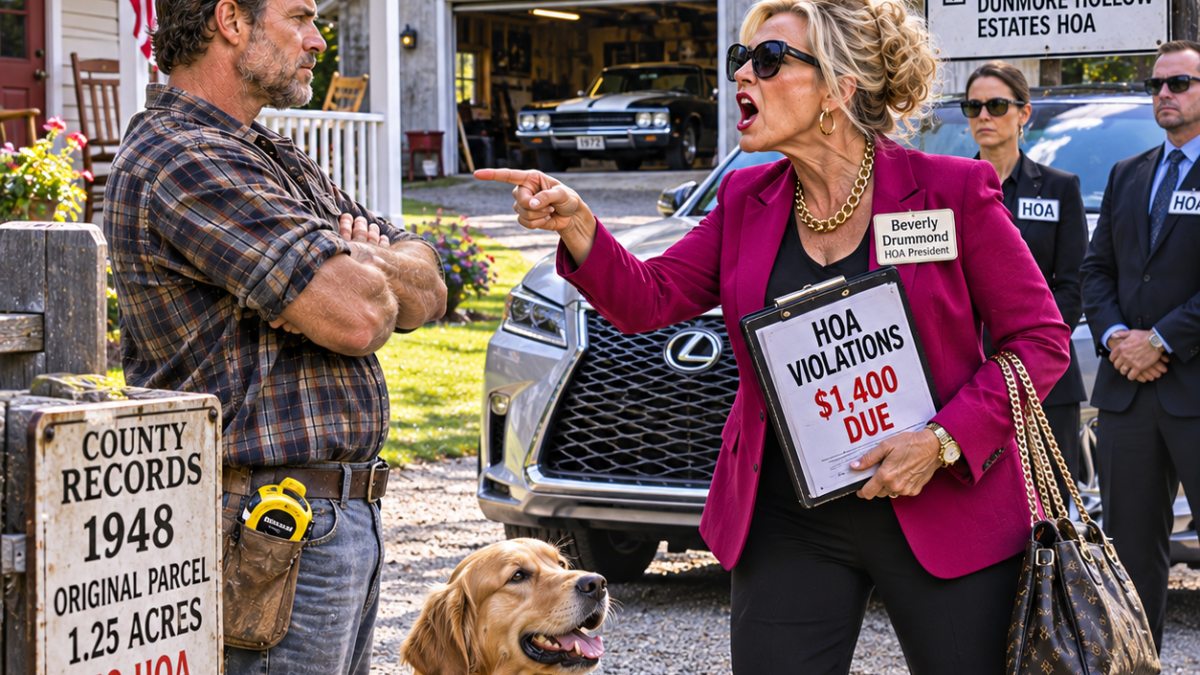
The ink on my deed was barely dry when Beverly Drummond parked her silver Lexus across my gravel driveway, marched onto the porch with a laminated packet of HOA violations, and demanded $1,400 because my truck faced the wrong direction, my garage door was the wrong color, and the road leading to my house was not paved to her standards. When I told her the property had its own parcel number, dated back to 1948, and sat completely outside Dunmore Hollow Estates, she smiled behind her sunglasses and said, “That’s what you think,” before warning me that if I refused to comply, the HOA had ways to make a house like mine “become part of the community.” What bothered me was not the fines—I knew they were nonsense—but the confidence in her voice, because people do not threaten to take a stranger’s home on the second day unless they believe they have done something like it before.
My name is Garrett Flint. I had spent thirty years as a framing carpenter, which meant I knew the difference between someone with real authority and somebody performing it.
Beverly belonged to the second group.
I found the house after my divorce.
I wasn’t looking for anything impressive. I wanted a clean start, enough yard for my golden retriever, Brick, and a detached garage where I could finally rebuild the 1972 Chevelle that had been sitting in pieces since 2009.
The property was one and a quarter acres outside Columbus, Ohio, in a semi-rural pocket called Dunmore Hollow. My gravel driveway connected directly to County Road 14.
And the title work showed one fact I checked three times.
I was not in the HOA.
Dunmore Hollow Estates surrounded part of my parcel, but my property predated the subdivision by decades. My realtor checked. The title company checked. The county records checked.
I closed Thursday.
Saturday, Beverly arrived.
She handed me the packet.
“Fourteen hundred dollars in existing violations.”
I flipped through it.
“Existing since when? I’ve owned the house for two days.”
“The property has been noncompliant for some time.”
“I’m not in your association.”
“That issue is more complicated than you understand.”
She pointed toward my driveway.
“Rule 9.1 requires paved residential access.”
“Not here.”
“My truck?”
“Improper orientation.”
“My garage?”
“Unapproved color.”
Brick sat between us with his head tilted like he was trying to understand why a grown woman was angry at a garage door.
I handed the packet back.
Beverly refused it.
“You should read carefully before deciding how difficult you want this to become.”
Then she left.
That afternoon I pulled the records again.
Same answer.
My parcel was legally separate.
So I sent Beverly a certified letter with the plat, deed history, and subdivision declaration showing the HOA covered 142 lots.
Mine was not one of them.
Three days after she signed for it, she filed a county drainage complaint claiming my gravel driveway sent stormwater onto HOA property.
I hired a civil engineer.
Three hundred dollars later, he confirmed the driveway drained toward the county easement exactly as designed.
The county closed the complaint.
Then Beverly triggered another complaint over my garage apron.
I hired a surveyor.
Fourteen feet two inches from the property line.
Legal.
Another complaint closed.
Another eight hundred dollars gone.
I started keeping a legal pad.
Two columns.
BEVERLY’S ACTION.
MY RESPONSE.
Then I installed a camera.
The first night it ran, Beverly’s Lexus sat at the edge of my property at 11:47 p.m., headlights off.
She stayed four minutes.
Watching my house.
The next morning, an attorney named Rudyard Phelps sent me a letter claiming the HOA could potentially pull my property under its authority because I supposedly benefited from subdivision infrastructure.
My driveway connected directly to the county road.
I used none of their common amenities.
That was when I hired Stacia Brenner, a property attorney from Newark.
She read everything.
Then she looked at me over her glasses.
“Garrett, this is a bluff.”
I relaxed.
She did not.
“The question isn’t whether Beverly can win.”
Stacia tapped the file.
“The question is why she’s willing to spend this much effort pretending she can.”
Ten days later, Beverly answered.
The new certified letter was titled:
NOTICE OF INTENT TO EXERCISE EQUITABLE SERVITUDE CLAIMS.
Halfway down the second page was the sentence that made my hand tighten around the paper.
If I refused HOA jurisdiction, Beverly intended to pursue remedies that could ultimately force the sale of my home.
I called Stacia.
She read it silently.
Then I heard her chair move.
“Garrett.”
“Yeah?”
“Don’t respond to Beverly.”
“Why?”
“Because I want to know exactly who she thinks she’s representing before we answer this.”
PART 2
The next morning I sat across from Stacia in her office with Beverly’s letter between us.
Stacia had the kind of office I trusted immediately.
Nothing decorative except two framed maps and a photograph of an old courthouse.
No motivational quotes.
No fake leather law books.
Real files.
Real coffee.
Real work.
She slid Beverly’s letter back toward me.
“Let’s separate intimidation from law.”
“Please.”
“First, the equitable-servitude argument.”
She tapped the first section.
“They’re claiming the original subdivision developer intended your parcel to be part of Dunmore Hollow Estates and accidentally left it out.”
“Which is ridiculous.”
“Probably.”
“Probably?”
“I don’t get to say ridiculous until we verify the historical documents.”
I leaned back.
“You lawyers have a complicated relationship with satisfying words.”
“We survive because of it.”
She pulled out my deed.
“Your parcel predates the subdivision.”
“Yes.”
“Separate access to County Road 14?”
“Yes.”
“Separate legal description?”
“Yes.”
“Any HOA declaration recorded against your parcel?”
“No.”
“Any amendment signed by a prior owner?”
“No.”
“Any covenant in your title commitment?”
“No.”
She nodded.
“That’s very strong.”
“What about the forced sale threat?”
“Much weaker than they want it to sound.”
She turned the letter around.
“Every remedy they mention depends on first establishing that your property is legally subject to the association.”
“It isn’t.”
“That is our position.”
“So they can’t seize my house.”
“Not because Beverly writes the words ‘forced sale’ on letterhead.”
I exhaled.
For the first time since opening the letter, my shoulders loosened.
Stacia noticed.
“Garrett.”
“What?”
“Don’t relax too much.”
“Why?”
“Because somebody who knows their legal claim is weak but threatens your home anyway may not be trying to win in court.”
“What are they trying to do?”
“Make court expensive enough that you surrender before you get there.”
That landed harder than the legal language.
I looked at the house through a photograph in my file.
One and a quarter acres.
Three-bedroom ranch.
Detached garage.
Gravel driveway.
Nothing Beverly should have cared about.
“What does she actually want?”
“That,” Stacia said, “is what we find out.”
We started with public records.
The original Dunmore Hollow Estates plat.
Recorded declarations.
Developer filings.
Amendments.
Association documents.
County auditor records.
State corporate filings.
I spent evenings at my kitchen table with Brick asleep across my feet while I worked through pages that had apparently been written by people paid by the syllable.
Construction had trained me for it.
Blueprints are complicated until you understand what matters.
Where the loads go.
Where the openings are.
What is structural and what is decoration.
Legal paperwork turned out to be similar.
Beverly’s letters were decoration.
I needed structure.
The original subdivision had been platted in 2008.
One hundred forty-two lots.
My parcel appeared at the southwest edge.
Not inside.
Not shaded.
Not numbered as part of the development.
Separate.
The developer, Prescott Homes, had purchased surrounding acreage but never purchased mine.
No annexation document.
No declaration.
No easement that gave the subdivision control over my driveway.
No evidence of a clerical mistake.
Then I pulled the county auditor’s property records.
My taxes had always been assessed independently.
No shared parcel history.
No HOA common-property percentage.
No indication that my prior owners paid association assessments.
I emailed the documents to Stacia.
She responded:
**Good. Keep going.**
That woman knew how to motivate a carpenter.
Three nights later, I found the thing that changed the whole fight.
I was searching the state business records for the exact corporate name of the association.
Mostly because Stacia wanted to know whether Dunmore Hollow Estates Homeowners Association, Inc. had ever changed registered agents.
I typed the name.
The record loaded.
I stared.
Then leaned closer.
Status:
**CANCELED / DISSOLVED.**
I refreshed the screen.
Same thing.
Effective date:
Eight months earlier.
I looked down at Brick.
He was asleep.
“Brick.”
One ear moved.
“I think Beverly forgot to have an HOA.”
Brick continued sleeping.
I called Stacia.
It was 7:53 in the morning.
She answered:
“You understand normal people wait until nine.”
“Search Dunmore Hollow Estates HOA in the state business records.”
Silence.
Then keyboard clicks.
More silence.
“Oh.”
“What?”
“Oh my.”
I smiled.
“I have never heard you say ‘oh my.’”
“Quiet.”
More typing.
Finally:
“The corporate status was canceled eight months ago.”
“Meaning?”
“Meaning we slow down before declaring the neighborhood liberated.”
My smile faded.
“Of course.”
“Corporate dissolution doesn’t necessarily make every underlying covenant disappear. Property restrictions can survive separately depending on how they’re recorded, and a dissolved corporation may sometimes have procedures for winding up or reinstatement.”
“So Beverly can keep doing this?”
“No.”
That answer came fast.
“What it does mean is that the entity sending you threats may have serious capacity and governance problems, especially if it has continued presenting itself as an active corporation, entering new transactions, collecting money, issuing fines, and threatening litigation without correcting its status.”
I looked at Beverly’s letter.
“Signed by Phelps.”
“Yes.”
“On behalf of Dunmore Hollow Estates HOA.”
“Yes.”
“The dissolved HOA.”
“Yes.”
“That’s bad.”
“For them?”
“Yes.”
“How bad?”
“I don’t know yet.”
She sounded delighted.
That worried me for Beverly.
Stacia ordered certified copies of the corporate record.
Then she told me something unexpected.
“Don’t contact her.”
“I wasn’t planning to.”
“Don’t tell Dorothea.”
That was harder.
Dorothea Speck was my neighbor on the county-road side.
Retired postal carrier.
Seventy-one years old.
Five feet three.
Able to learn neighborhood information faster than modern intelligence agencies.
She had delivered four casseroles since Beverly’s campaign began.
Mostly because, as she told me, “legal problems create poor eating habits.”
“What am I supposed to tell Dorothea?”
“Nothing.”
“She’ll know I’m hiding something.”
“Then practice.”
I failed.
Dorothea arrived at noon carrying baked ziti.
She took one look at me.
“What happened?”
“Nothing.”
“Garrett.”
“County records.”
Her eyes narrowed.
“What county records?”
“I can’t talk about it.”
That was technically true.
She put the casserole on my counter.
“Fine.”
Then she sat.
And waited.
Ten minutes.
Fifteen.
Twenty.
I finally said:
“You know staring isn’t interrogation.”
“Worked on my children.”
“I’m not your child.”
“Eat the ziti.”
I did.
She left without getting the answer.
I considered it one of my greatest victories.
Meanwhile Beverly kept escalating.
A new HOA notice accused me of storing an “unapproved recreational vehicle” because a utility trailer was parked beside my garage.
It was registered.
Road legal.
Mine.
And, once again, irrelevant to HOA rules.
I didn’t intentionally create the trailer as bait the way the original version of events sometimes got told later.
I didn’t need to.
Beverly found targets on her own.
At 6:22 one morning, my south-side camera recorded her walking along the outside of my fence with her phone raised.
She stopped.
Photographed the trailer.
Moved closer.
Stepped over the visible property pin.
Then took more pictures from inside my parcel.
She remained there nearly three minutes.
That afternoon Phelps sent me a certified demand ordering immediate removal of the “prohibited recreational vehicle.”
I forwarded the letter and camera clip to Stacia.
Her response came five minutes later.
**Do not respond. This is useful.**
Beverly’s obsession was becoming evidence.
That changed my attitude.
Before, every envelope made my stomach tighten.
Every Lexus sighting made me angry.
Now each one went into the file.
Date.
Time.
Action.
Response.
My yellow legal pad became three pads.
Drainage complaint.
Closed.
Setback complaint.
Closed.
$1,400 HOA fine.
No jurisdiction.
Late-night surveillance.
Video preserved.
Phelps legal threat.
Preserved.
Forced-sale threat.
Preserved.
Corporate dissolution.
Certified record ordered.
I had spent my life framing buildings.
Measure twice.
Cut once.
Now I was framing a case.
Stacia filed first.
A declaratory-judgment action asking the county court to formally declare that my property was not part of Dunmore Hollow Estates and not subject to its HOA covenants.
She added claims based on the pattern of interference and requested appropriate relief for costs caused by complaints she argued had been filed without a proper basis.
No fireworks.
No dramatic process server kicking down Beverly’s door.
Just a complaint filed with the clerk.
A case number.
A judge.
That was enough to change the balance.
The same afternoon, Stacia sent a written demand asking Beverly and Phelps to preserve:
HOA emails.
Board minutes.
Financial records.
Fine records.
Communications mentioning my property.
Developer correspondence.
Corporate-status communications.
Anything involving annexation.
Anything involving a forced sale.
Phelps responded within a day.
His tone had changed.
No more confident lectures.
He requested an extension.
Stacia granted a reasonable one.
“Why help him?” I asked.
“Because we want to look reasonable.”
“He threatened my house.”
“And now we’re in front of a judge.”
I pointed toward the legal pads.
“I have been reasonable for months.”
“Then don’t ruin your winning streak.”
She was annoyingly good at her job.
While the court case began moving, I kept digging.
The state record wasn’t the end of it.
The HOA’s corporate status had lapsed after required filings were not maintained.
The exact legal consequences would become something lawyers argued over.
But the more troubling question was simpler.
Did Beverly know?
The answer arrived through a homeowner named Clint Yardley.
Clint lived four houses into the subdivision.
Mid-forties.
High-school science teacher.
Sunflowers in the front yard.
Beverly had fined him $300 because the flowers exceeded an aesthetic-height guideline.
He knocked on my door one evening.
“You Garrett?”
“Depends.”
He smiled.
“Dorothea sent me.”
“Then unfortunately yes.”
He held up an envelope.
“I heard you’re fighting Beverly.”
“I’m defending my property.”
“Same thing around here.”
We sat on the porch.
Brick immediately adopted Clint.
Everybody who scratched behind his ears became family.
Clint handed me his fine letter.
Dated three months earlier.
After the HOA corporation had lost active status.
“Does this matter?”
“I’m not giving legal advice.”
“Dorothea said you found something.”
“Dorothea talks too much.”
“She said you wouldn’t tell her what.”
“Correct.”
He laughed.
I called Stacia.
She agreed to speak with him separately.
Within a week, Clint hired her.
Then Ren and Dale Osgood did too.
They were a young couple who had paid $475 after the HOA threatened collection action over a fence that stood a few inches outside Beverly’s preferred height.
Then another homeowner called.
Then another.
The pattern wasn’t just Beverly versus me.
People had been paying because resisting felt more expensive than compliance.
That was Beverly’s real power.
Not law.
Friction.
Every disagreement came with letters.
Deadlines.
Administrative language.
Threats.
Most people had jobs.
Kids.
Mortgages.
Life.
Paying $200 or $400 was often easier than spending weekends researching documents.
Beverly understood that.
I understood something else.
Friction works both directions once people organize.
We didn’t start a mob.
Stacia was firm about that.
No harassment.
No confrontations at Beverly’s house.
No public accusations beyond what records established.
No posting her phone number.
No revenge graffiti.
No threatening comments.
Instead, homeowners requested their records.
Copies of fines.
Board minutes.
Accounting statements.
Corporate filings.
Boring paper.
The most dangerous substance in Dunmore Hollow.
Then the financial questions started.
If the corporation had not been in active status, what happened to dues collected during that period?
Were payments properly deposited?
Were contracts validly approved?
Had the association carried insurance?
Could the entity be reinstated?
Who had authority during the lapse?
The answers were more complicated than the rumor mill wanted.
Some HOA obligations did not magically vanish just because the nonprofit status had lapsed.
Common property still existed.
Recorded covenants didn’t simply evaporate.
The subdivision still had a detention pond, pocket parks, and a playground somebody had to maintain.
But Beverly’s claim that she personally wielded unquestionable enforcement authority became much harder to sustain.
Especially over me.
A man whose parcel wasn’t in the association in the first place.
That distinction mattered.
I didn’t want to tell 142 homeowners they suddenly owned lawless property.
I wanted Beverly to stop using a legal entity like a costume.
So Stacia prepared a one-page factual notice.
No insults.
No cartoons of Beverly.
No revenge slogans.
It listed the publicly available corporate status and recommended residents obtain independent legal advice concerning any fines or enforcement actions taken during the lapse.
We did not put them in mailboxes.
Dorothea nearly had a heart attack when I suggested it.
“Federal mailbox rules, Garrett.”
“I was joking.”
“You weren’t.”
“Maybe.”
Instead, we mailed copies properly to residents whose addresses were public and provided door notices where legally appropriate.
Brick came with me for the walking part.
He took his work seriously.
By noon, phones started ringing.
Not mine.
Stacia’s.
By Monday, eleven homeowners had contacted her office.
By the end of the following week, more than twenty.
Beverly responded on the HOA’s private Facebook group.
Dorothea still had access.
Nobody remembered to remove the retired mail carrier.
Beverly wrote:
**A DISGRUNTLED OUTSIDE PROPERTY OWNER IS CONDUCTING A COORDINATED HARASSMENT CAMPAIGN AGAINST DUNMORE HOLLOW ESTATES.**
Then:
**THE CORPORATE STATUS ISSUE IS A MINOR ADMINISTRATIVE TECHNICALITY CURRENTLY BEING CORRECTED.**
Then she named Dorothea.
**OUTSIDE AGITATORS INCLUDING DOROTHEA SPECK HAVE ASSISTED IN DISTRIBUTING MISLEADING MATERIAL.**
Dorothea printed the post.
Every page.
Landscape orientation.
Date.
Timestamp.
Comments.
Then carried the stack to me with chicken-and-wild-rice casserole.
She placed both on my kitchen counter.
“One is for your lawyer.”
“Which?”
She stared.
“Don’t make me regret feeding you.”
I opened the screenshots.
Homeowners were asking uncomfortable questions.
Why had they not been told about the corporate lapse?
Who was paying Phelps?
Could Beverly collect fines?
Why were legal fees increasing?
Why had the board threatened an outside property owner?
Beverly answered some questions.
Deleted others.
Then turned off comments.
Dorothea smiled.
“That always works.”
I almost felt sorry for Beverly.
Almost.
Then I came home from a job site on a Tuesday afternoon and found a document stapled to my front door.
**NOTICE OF PROPERTY LIEN**
Amount:
$4,750.
Alleged unpaid HOA violations.
Gravel driveway.
Garage color.
Trailer.
Continuing noncompliance.
My hand stopped halfway down the page.
I called Stacia.
She answered:
“What happened?”
“How did you know something happened?”
“You only call without texting when you’re angry.”
“She filed a lien.”
Silence.
“Photograph it.”
“I’m holding it.”
“Put it down and photograph it.”
I did.
“Now send it.”
I sent photographs.
Then waited.
A minute later she called.
“Is there a recorder’s stamp?”
“No.”
“So this may be a notice claiming a lien rather than proof that one has actually been accepted for recording.”
“Does that make it better?”
“For your title, possibly.”
“For Beverly?”
“No.”
She sounded almost cheerful.
“Do not call her.”
“I know.”
“Do not drive over there.”
“I know.”
“Garrett.”
“I said I know.”
“Good.”
Then my work phone rang.
Petra Lawson.
Project manager at a general contractor I subcontracted with on larger jobs.
I answered.
“Petra.”
“Do you have a county licensing problem?”
I closed my eyes.
“Why?”
“Some woman called asking about your regulatory status.”
“Name?”
“She said she was contacting us concerning county compliance.”
“Did she give a county department?”
“She implied code enforcement.”
“What number?”
Petra read it.
I recognized Beverly’s cell.
My anger stopped being hot.
It became precise.
“What did you tell her?”
“That I don’t discuss subcontractor records with unidentified callers.”
“Thank you.”
“I looked up the number.”
“I know who it is.”
“HOA woman?”
“Yes.”
Petra sighed.
“You want the recording?”
My eyes opened.
“You record business calls?”
“Quality and documentation. There’s a notice at the beginning.”
“Yes. I want it.”
That evening I went to the sheriff’s office.
Not to demand Beverly be arrested.
Not to make legal conclusions.
To make a report.
Deputy Aaron Harwick sat across from me.
Quiet.
Small handwriting.
No facial expression.
I gave him the timeline.
The $1,400 fines.
Drainage complaint.
Setback complaint.
Camera footage.
Legal letters.
Forced-sale threat.
State corporate record.
Lien notice.
Then Petra’s recorded call.
Harwick listened twice.
In the recording, Beverly never directly said:
“I am a county employee.”
What she did say was:
“This is Beverly Drummond calling regarding county compliance concerns attached to Garrett Flint.”
Petra asked:
“Are you with the county?”
Beverly answered:
“I’m contacting you in connection with active county concerns.”
Vague.
Deliberate.
Harwick looked at me.
“That’s not as clean as saying she works for the county.”
“I know.”
“But it’s worth documenting.”
“That’s all I’m asking.”
He collected copies.
Then looked at my three legal pads.
“You brought an index?”
“Yes.”
He almost smiled.
“What do you do?”
“Carpenter.”
“Makes sense.”
“Why?”
“You guys label everything.”
He gave me an incident number.
No dramatic promise.
No “she’s going to jail.”
Just:
“Keep your attorney informed. If she comes onto your property, call. Don’t engage.”
Reasonable.
I liked Harwick.
The lien issue moved faster.
Stacia checked the recorder’s office.
Beverly had attempted to file a claim of lien against my property.
The document asserted I owed HOA assessments and fines.
Stacia filed immediately to challenge it and seek removal.
She also amended our civil case.
The petition now asked the court not only to declare my property outside HOA jurisdiction but to address the attempted cloud on my title and the continuing enforcement campaign.
Phelps called her the next morning.
I wasn’t on the call.
Stacia later summarized it.
“He is unhappy.”
“Good.”
“He says Beverly provided him inaccurate facts about your parcel.”
“Do you believe him?”
“I believe he wants that distinction on paper.”
“What does that mean?”
“He’s protecting himself.”
“Can he?”
“Depends what he knew and when.”
Within days, Phelps notified the HOA and Stacia that he was withdrawing from further representation, subject to the normal procedural requirements.
He did not send me another threat.
Stacia filed a professional-conduct grievance based on the letters and circumstances.
She warned me:
“That doesn’t mean discipline.”
“I know.”
“It means the proper body reviews his conduct.”
“Fine.”
I was getting better at not demanding movie endings.
Then came the county hearing.
The one Beverly should have canceled.
Months earlier, she had filed a petition asking county officials to recognize a supposed boundary correction that would bring my parcel into the Dunmore Hollow development map.
Stacia had already explained the weakness.
Private property doesn’t become part of an HOA because a president calls a seventy-year-old parcel description a clerical error.
But Beverly did not withdraw.
Maybe pride.
Maybe desperation.
Maybe she believed the room would respond to confidence the same way HOA meetings had for fifteen years.
The hearing was set for the third Tuesday in October.
Public.
Recorded.
Three county commissioners.
Staff.
Residents.
Reporters.
The night before, I sat in my garage with the Chevelle.
Still on jack stands.
Front clip removed.
Engine on a stand.
The car had followed me through my marriage.
Divorce.
Three rental units.
One storage barn.
Now this house.
I had always said I’d finish it “when life calmed down.”
Brick lay on the concrete beside me.
“You know that’s never happening, right?”
His tail thumped once.
Dorothea appeared in the open garage doorway.
Blazer.
Pearl earrings.
Leather purse.
“What are you wearing?”
“My hearing clothes.”
“You’re not testifying.”
“I’m observing.”
“You look like you’re attending a Supreme Court argument.”
“I spent twenty-two years carrying other people’s certified mail. I have earned this.”
She noticed the Chevelle.
“You ever going to finish that?”
“Apparently everybody asks that.”
“Because it’s been fourteen years.”
“Go home, Dorothea.”
She smiled.
“See you tomorrow.”
I spent another hour sanding a fender.
Not because it needed sanding.
Because my hands needed something familiar.
The next evening, the county meeting room was almost full.
Clint sat with his wife.
Ren and Dale Osgood were two rows behind him.
Dorothea had taken a front-row seat.
At least thirty Dunmore Hollow residents were there.
Two reporters sat near the rear.
Beverly sat at the petitioner’s table.
Navy blazer.
Pearls.
Folder arranged perfectly.
No Phelps.
She had new counsel for limited purposes, a woman named Melissa Grant who looked uncomfortable before the meeting even began.
Stacia sat beside me.
“Remember.”
“I know.”
“What?”
“Answer only what’s asked.”
“Good.”
“No speeches.”
“Fine.”
“No celebrating.”
“You take all the joy out of civic participation.”
The commission chair, Aldis Hennessy, called the matter.
Beverly spoke first.
Eleven minutes.
I timed it because construction people time everything.
She described my parcel as an “inhold anomaly.”
Said it disrupted uniform community administration.
Claimed the original developer had intended a continuous planned development.
Mentioned a road along the subdivision’s east side that she said provided me “substantial infrastructure benefit.”
I had used that road exactly once when a delivery driver missed my driveway.
Then Beverly said:
“Correcting the boundary would protect the expectations of one hundred forty-two law-abiding homeowners who have complied with shared community standards.”
I felt Stacia’s hand touch my arm.
I hadn’t realized I was gripping the table.
Hennessy thanked Beverly.
Then Stacia stood.
Five minutes.
Maybe less.
She showed my 1948 parcel history.
Independent County Road 14 access.
The 2008 subdivision plat.
The recorded declarations.
The absence of my parcel from them.
Then she placed the certified state record on the desk.
“Additionally, commissioners should be aware that the corporate entity purporting to request this boundary action has not maintained active corporate status and is currently shown in the state’s records as canceled or dissolved.”
The room went silent.
No gasp.
Real shock is quieter.
Beverly leaned toward Melissa.
The attorney whispered something rapidly.
Hennessy picked up the record.
“Ms. Drummond.”
Beverly raised her chin.
“Yes?”
“Were you aware of this status?”
“It’s an administrative technicality.”
The chair looked at her over his glasses.
“Was that a yes?”
She hesitated.
“We’ve been working to correct it.”
“Since when?”
“Recently.”
“How recently?”
Beverly’s face tightened.
“After it was brought to our attention.”
Stacia said nothing.
She didn’t need to.
Hennessy looked at the paperwork again.
Then at the proposed boundary change.
“The more basic problem, as staff has already identified, is that this commission has no lawful basis to simply place Mr. Flint’s independently owned parcel into a private association without the required legal foundation and owner consent.”
Beverly’s attorney stood.
“We would characterize this as correction of a mapping error.”
Hennessy looked toward county staff.
The planning director shook his head.
“Our historical records do not support that characterization.”
That sentence ended it.
The commission denied the petition.
Not because Beverly was mean.
Not because residents clapped.
Because there was no sufficient legal basis.
Then Hennessy said something I still remember.
“Uniformity is not itself a property right.”
Dorothea closed her eyes like she had just heard scripture.
Beverly remained seated.
The chair continued.
“The record reflects a long-standing independent parcel. The petition is denied.”
Gavel.
Done.
One person clapped.
Then another.
Hennessy asked for order.
I didn’t clap.
Couldn’t.
My hands were shaking too badly.
Stacia leaned close.
“Breathe.”
“I am.”
“No, you’re not.”
I inhaled.
Across the room Beverly gathered her documents.
For the first time since I’d met her, she did not look angry.
She looked confused.
That affected me more.
Beverly had lived in a world where pushing harder usually worked.
The county had not argued with her.
Had not insulted her.
Had simply said no.
She stood.
The crowd parted.
Dorothea watched her pass without saying a word.
That silence was probably the cruelest thing she had ever done.
Outside, a reporter asked Beverly:
“Ms. Drummond, were homeowners informed the HOA corporation was not in active status?”
She kept walking.
“Do you plan to appeal?”
No answer.
“Did you attempt to lien Mr. Flint’s property?”
She got into the Lexus.
Door slammed.
Gone.
I drove home with the window cracked.
October air.
Wood smoke.
Harvest dust.
Brick met me at the door.
I crouched and buried both hands in his fur.
“We’re still outside the HOA.”
Brick licked my face.
I took that as approval.
The court case continued.
That surprises people.
They hear “petition denied” and think credits roll.
Real life loves paperwork too much.
The declaratory-judgment action still needed resolution.
The lien still needed formal removal.
Homeowners still had disputes over fines.
The association still had common property to maintain.
And the corporate-status mess had to be fixed.
But the power balance had changed.
Beverly could no longer tell residents that I was one clever filing away from being forced into her HOA.
It was on the record.
I was outside.
A month later, the court entered an order confirming my parcel was not subject to Dunmore Hollow’s recorded declaration.
The attempted lien was removed from my title record.
The judge did not write a dramatic opinion.
He didn’t call Beverly a tyrant.
He didn’t declare me a hero.
He looked at deeds.
Plats.
Recorded covenants.
And ruled.
That was enough.
My claims for damages and fees did not produce some multimillion-dollar fantasy payout.
They resolved through a negotiated settlement funded from available sources and individual contributions where appropriate.
I recovered a meaningful portion of the engineering, survey, title, and legal expenses caused by the campaign.
More important, the settlement contained a permanent written acknowledgment:
My parcel was independent.
No Dunmore Hollow entity would send me HOA fines.
No HOA lien would be asserted against my property absent a legitimate future contractual basis I actually agreed to.
No one would enter my land for “compliance inspection” without permission.
That last one mattered.
Beverly’s late-night visits stopped.
The sheriff’s office reviewed the county-official complaint.
Ultimately, prosecutors did not charge her.
The recorded call was misleading but not clear enough, in their view, to prove criminal impersonation beyond the required standard.
Deputy Harwick called me himself.
“You disappointed?”
“Little.”
“Understandable.”
“But I get it.”
“She received a formal warning concerning future representations.”
“Good.”
“And your report stays documented.”
“Good.”
That was another lesson.
Justice isn’t always the harshest possible consequence.
Sometimes it’s a clean record that makes the next lie harder.
The professional grievance involving Phelps also ended less dramatically than neighborhood gossip predicted.
He was not disbarred.
No law license vanished in a flash of lightning.
The disciplinary authorities reviewed the matter.
The result included a formal admonishment tied to aspects of his conduct and representations.
He never worked for Dunmore Hollow again.
I could live with that.
Clint received his $300 fine back through settlement.
The Osgoods got $475.
Other residents challenged assessments and fines individually.
Some recovered money.
Some did not.
The legal status of dues collected for actual common-property expenses was more complicated than people wanted.
Stacia explained it at a meeting.
A man in the back shouted:
“So you’re saying Beverly illegally collected all our money?”
Stacia answered:
“No.”
People groaned.
She continued.
“I’m saying you should not turn one fact—the corporate-status lapse—into twenty facts it does not automatically prove.”
That room didn’t love her.
I did.
“Common-property obligations can still exist. Recorded covenants can still matter. Reinstatement and successor governance can matter. Each fine, assessment, contract, and collection action needs to be evaluated on its actual legal basis.”
Dorothea whispered beside me:
“She is ruining the fun.”
“She keeps doing that.”
But those distinctions protected us.
If we exaggerated, Beverly could call everything exaggeration.
So we stayed precise.
The residents formed a transition committee.
Seventeen homeowners at first.
Then twenty-six.
They hired independent counsel.
An accountant.
A corporate-services firm.
The goal wasn’t to destroy the neighborhood.
It was to build a lawful organization that did what residents actually needed.
Maintain the detention pond.
Insurance.
Common landscaping.
Playground.
Roadside entrance structures.
Nothing about approved garden-hose shades.
Nothing about basketball hoops becoming moral emergencies.
And then came the election.
Beverly ran for president.
Of course she did.
Her campaign email said:
**EXPERIENCE MATTERS IN UNCERTAIN TIMES.**
Dorothea printed it and brought it over.
“She’s running.”
“I heard.”
“What do you think?”
“Not my HOA.”
Dorothea stared.
“Don’t become mature now. It’s unsettling.”
I laughed.
Election night happened at the clubhouse.
I didn’t attend.
Again:
Not my HOA.
At 8:42 p.m., Clint texted me.
**RESULTS ARE IN.**
Then:
**BEVERLY: 4**
I stared at the phone.
Four votes.
After fifteen years of running Dunmore Hollow like a private municipality.
Four.
I expected satisfaction.
What I felt was stranger.
Relief.
Power had finally moved away from her without me taking it.
The homeowners did.
That mattered.
The new president was a woman named Carla Nguyen.
Civil engineer.
Mother of two.
Known for arguing at prior HOA meetings that drainage mattered more than mailbox colors.
I liked her immediately.
Her first email to residents contained three bullet points.
Repair playground fence.
Schedule detention-pond inspection.
Reestablish corporate filings and insurance properly.
No mention of me.
Perfect.
Three days after her election, Carla came to my house.
She parked on County Road 14 and walked up my gravel driveway.
No Lexus blocking the entrance.
No clipboard.
She stopped short of the porch.
“Garrett?”
“Yes.”
“Carla Nguyen.”
“I know.”
“May I come up?”
That question almost made me laugh.
“Yes.”
Brick inspected her.
Approved.
She handed me a letter.
Not a violation.
An apology.
The new board formally acknowledged that my parcel was outside the association and that prior attempts to impose HOA rules, fines, and a lien had been improper.
Then Carla said:
“I’d like us to be neighbors.”
“That’s usually easier than being opposing litigants.”
She smiled.
“We’re organizing a cleanup around the detention pond next month.”
“I’m still not joining.”
“I didn’t ask.”
“Good.”
“You own a wheelbarrow?”
“Several.”
“Then you’re invited.”
I looked at the letter.
Then at her.
“Why?”
“Because we live next to each other.”
That simple.
I showed up.
So did Clint.
The Osgoods.
Dorothea.
Thirty residents.
I brought two wheelbarrows, pruning saws, and a leaf blower.
Clint brought a chainsaw.
A chainsaw is the highest form of neighborhood contribution.
Ren brought cider.
Dale repaired a broken section of split-rail fence.
Nobody inspected my gravel driveway.
Nobody discussed Brick’s leash status.
Nobody asked what color I planned to paint my garage.
We worked for four hours.
At lunch, Carla sat beside me on the curb.
“You know some people still blame you.”
“For what?”
“Legal fees.”
I laughed.
“Of course.”
“I told them you didn’t send yourself the fines.”
“Thank you.”
“You could’ve moved.”
I looked at her.
She smiled.
“That’s what one guy said.”
“And?”
“I asked why the person being harassed should be the one required to leave.”
I liked her more.
The funny part was that I hadn’t bought the house to fight anybody.
I bought it because I was exhausted.
My divorce had been civil by divorce standards, which means two people sat in offices and divided a life into categories.
Furniture.
Savings.
Tools.
Retirement.
Vehicle.
Sentimental items.
The marriage ended quietly.
That almost made it harder.
There wasn’t one dramatic betrayal I could blame.
We had simply become two people spending years trying not to admit we wanted different lives.
When the papers were final, I discovered I had no idea what home meant without “we.”
The Dunmore Hollow house was supposed to answer that.
My porch.
My dog.
My shop.
My Chevelle.
Then Beverly showed up two days later and immediately tried to make ownership conditional on her approval.
That was why I fought so hard.
Not because gravel was sacred.
Not because I loved unpainted garage doors.
Because I had just spent months rebuilding an identity that used the word “mine” without anger.
Then Beverly told me:
**This house isn’t really yours.**
She had no idea how deep that sentence went.
One winter night after everything settled, I was working on the Chevelle when my ex-wife, Laura, called.
We hadn’t spoken in months except about tax paperwork.
“Hey.”
“Hey.”
“I saw an article.”
I groaned.
“Which one?”
“Carpenter defeats HOA.”
“I did not defeat an HOA.”
She laughed.
“You always hated inaccurate framing.”
“Occupational hazard.”
There was a pause.
“I’m glad you’re okay.”
“Thank you.”
“Did somebody really threaten to force-sell your house?”
“Yes.”
“Wow.”
Another pause.
Then:
“You would’ve gone insane.”
“I stayed remarkably professional.”
“You labeled evidence, didn’t you?”
“Three legal pads.”
She laughed harder.
“That is the most Garrett response possible.”
I smiled.
It felt good hearing her laugh.
Not painful.
Just familiar.
She asked:
“Are you happy there?”
I looked around the garage.
Brick snoring beneath the workbench.
Chevelle on stands.
Snow outside.
“Yes.”
“Good.”
She meant it.
That call closed something in me I hadn’t known remained open.
Beverly wasn’t the center of the story anymore.
The house was becoming what I bought it to be.
Home.
The Chevelle became the next project.
I had owned the car since my twenties.
1972.
Deep green originally, though little of that paint remained.
I had promised myself a full restoration for years.
Life kept interrupting.
Marriage.
Mortgage.
Jobs.
Divorce.
Beverly.
One Saturday I rolled the chassis into the middle of the garage.
Brick watched from his bed.
“No more excuses.”
He sneezed.
I took that personally.
Clint came over.
Then Dale.
Then a teenager named Marcus from Dunmore Hollow who wanted to learn welding.
I made him start with grinding.
Nobody begins with the fun part.
We worked through winter.
Frame.
Bushings.
Brake lines.
Engine.
Body panels.
Some Saturdays six neighbors were in my garage.
The only house outside the HOA became the place HOA residents came to escape meetings.
Dorothea provided food.
Carla occasionally stopped by.
Brick stole two work gloves and one spark-plug wire.
When the engine finally started, it was March.
I turned the key.
Nothing.
Again.
Crank.
Cough.
Then the big-block caught.
The garage filled with that heavy uneven idle I’d imagined for fourteen years.
I started laughing.
Clint yelled over the noise:
“Your neighbors are going to complain!”
I looked toward Dunmore Hollow.
“Which rules apply?”
He laughed.
Carla, standing in the driveway, shouted:
“County noise ordinance still exists!”
“Traitor!”
The engine settled.
I put one hand on the steering wheel.
For some reason my eyes watered.
Maybe exhaust.
Probably not.
That car had existed before my marriage.
During it.
After it.
In pieces.
Like parts of my life I kept promising to assemble later.
Now it ran.
Some symbols are embarrassingly obvious.
You still let them matter.
The newspaper story created another unexpected consequence.
A reporter named Jason Bell had attended the county hearing.
His first article focused on the boundary dispute and corporate-status problem.
His second was better.
It explored how homeowners could verify basic public information before assuming an HOA letter carried unquestionable authority.
He interviewed Stacia.
Not me at first.
She explained deeds.
Recorded declarations.
Corporate records.
Public plats.
County auditor files.
She emphasized something important:
“Do not assume an association is powerless simply because its corporate status has problems, and do not assume it is all-powerful simply because a letter says HOA at the top. Read the actual recorded documents and get qualified advice.”
That sentence got shared everywhere.
A community foundation reached out.
They were developing property-literacy workshops for rural and semi-rural Ohio residents.
Not anti-HOA rallies.
Actual education.
How to read a deed.
How to locate recorded covenants.
How to pull parcel maps.
How to identify easements.
How to search public business records.
How to document disputes.
How to know when you need a lawyer.
They wanted somebody from the trades who understood what it felt like to open a legal document and initially think:
I don’t speak this language.
Stacia suggested me.
I said no.
She asked again.
I said no.
Dorothea found out.
I said yes.
The first workshop was held in the Dunmore Hollow community room.
Forty-one people.
Metal folding chairs.
Bad coffee.
A projector that refused to connect until I threatened it.
Stacia handled legal content.
I handled practical organization.
I held up my first yellow legal pad.
“Anybody know why this matters?”
A man said:
“Evidence.”
“Yes.”
A woman said:
“Timeline.”
“Yes.”
Dorothea called from the back:
“Because Garrett is emotionally incapable of throwing paper away.”
“Also yes.”
People laughed.
Then I told them the most important thing I’d learned.
“You don’t need to become a lawyer.”
I held up a deed.
“But you should know what documents control your property.”
Then a county map.
“And where your boundary actually is.”
Then the state corporate record.
“And if an organization claims authority over you, verify what that authority is based on.”
Stacia stepped in.
“And understand that corporate status is only one part of the picture. Recorded covenants, statutes, contracts, and other rights can exist independently.”
I nodded toward her.
“This is why she is here.”
The workshops spread.
Three counties by summer.
Then five.
Not because my story was special.
Because it wasn’t.
Most problems were smaller.
Fence disputes.
Access confusion.
Old easements.
Inherited property.
Unclear road maintenance.
People signing documents they didn’t understand because somebody across a desk said, “Everybody signs this.”
We taught them to slow down.
Ask.
Read.
Verify.
That became more satisfying than beating Beverly.
Beverly still lived in Dunmore Hollow for another year.
I saw her occasionally.
Grocery store.
Gas station.
Once at a county hardware supplier.
We avoided each other.
Then one afternoon her Lexus appeared at my driveway again.
I saw it from the garage.
My stomach tightened automatically.
Old reflex.
She got out.
No clipboard.
No sunglasses.
Just Beverly.
Older somehow.
Not physically much.
But smaller without an organization behind her name.
She stopped at the property line.
“Garrett.”
I wiped my hands.
“What do you need?”
“I came to talk.”
“About?”
“My house is under contract.”
I waited.
“I’m moving.”
“Okay.”
She looked toward the garage.
The Chevelle sat behind me, mostly finished.
“That the car?”
“Yes.”
“You’ve been working on it forever.”
I stared at her.
“How would you know that?”
She realized what she’d admitted.
The surveillance.
Neighborhood knowledge.
Then shook her head.
“People talked.”
“Of course.”
She looked toward Brick.
He watched from the shade.
“I wanted to say something before I left.”
I crossed my arms.
Beverly inhaled.
“I was wrong about your parcel.”
That was technically an apology-shaped sentence.
“Okay.”
“I believed the development should have been continuous.”
“I know.”
“Your property made enforcement inconsistent.”
“For who?”
“For everyone.”
“No.”
Her jaw tightened.
I saw the old Beverly rise.
Then she stopped herself.
“For me.”
That surprised me.
She looked down the gravel driveway.
“I built that HOA from the beginning.”
“You didn’t build the subdivision.”
“No.”
“But I built the community standards.”
She almost smiled.
“People used to thank me.”
“I’m sure some did.”
“They wanted the neighborhood protected.”
“Probably.”
“Then every year there was something new.”
“Rentals.”
“Fences.”
“Parking.”
“People wanted me to fix all of it.”
“And you liked fixing it.”
She looked at me.
“Yes.”
There it was.
Not greed.
Not pure cruelty.
Control rewarded until control became identity.
She continued.
“Then you bought this place.”
“The one lot I couldn’t regulate.”
“You didn’t need to.”
“I know that now.”
I didn’t trust the sentence completely.
But I believed she believed it in that moment.
“Why did you threaten a forced sale?”
Her face changed.
Shame, maybe.
“I thought you’d back down.”
“Like the Hendersons?”
Her eyes lifted sharply.
Dorothea had told me Beverly had driven the Henderson family out after repeated county complaints over a basketball hoop and other issues.
“They chose to move.”
“After you made living there miserable.”
“I thought they were hurting property values.”
“And me?”
“You were different.”
“How?”
“You weren’t afraid of paperwork.”
I almost laughed.
“That was your mistake?”
“One of them.”
Silence sat between us.
Then she said:
“I don’t expect you to forgive me.”
“Good.”
Her face tightened.
I continued.
“I don’t know if I do.”
“That’s fair.”
“But I’m not interested in hating you either.”
She looked surprised.
“Why?”
“Too much maintenance.”
That actually made her laugh.
A small sound.
Human.
I hadn’t heard that from her before.
She nodded toward the house.
“You kept it.”
“Yes.”
“You were always going to.”
“Yes.”
Then:
“I’m sorry I tried to make you feel like it wasn’t yours.”
That was the apology.
Not the legal one.
The real one.
I stood there for a few seconds.
“Thank you.”
She nodded.
Then walked back to the Lexus.
Before getting in, she turned.
“Garrett?”
“Yeah?”
“The gravel driveway looks terrible.”
I stared.
She smiled.
First genuine Beverly smile I’d ever seen.
I laughed.
“Get off my property.”
She left.
I never saw her again.
Dunmore Hollow changed after that.
Not into paradise.
People still complained.
One resident wanted stricter rules on political signs.
Another wanted looser rules on sheds.
Somebody spent three months arguing that the entrance flowers should be red instead of yellow.
Human beings don’t become reasonable because one controlling president leaves.
They just get another chance to practice.
Carla served two terms and stepped down voluntarily.
That impressed me more than anything.
The reconstituted association kept its corporate filings current.
Budgets were published.
Major expenses required multiple approvals.
Fines required notice and an appeal process.
The Facebook group became so boring that Dorothea complained.
“Nothing happens anymore.”
“Good.”
“They posted about leaf pickup yesterday.”
“Excellent.”
“Forty-seven comments.”
“There you go.”
She sighed.
“I miss Beverly a little.”
“No, you don’t.”
“No.”
We sat on my porch with coffee.
Brick was older by then.
White around his muzzle.
Moved slower.
Still believed every visitor existed to pet him.
The Chevelle sat in the driveway.
Finished.
Deep green again.
Not perfect.
I didn’t want perfect.
I wanted mine.
Years later, Brick died on a Tuesday morning.
Quietly.
At home.
He was thirteen.
I knew the week before.
Dogs tell you.
Less appetite.
Longer sleep.
That look they give you when their body has become work.
The vet came to the house.
Brick lay on the rug beside the garage door, where he could smell oil and cut grass whenever I opened it.
I kept my hand on his head.
He left with his nose against my palm.
For months afterward, the house felt too quiet.
That surprised me more than the divorce had.
A dog fills space without speaking.
Then one day the space is still there and the life isn’t.
Dorothea brought a casserole.
Of course.
She didn’t give me a speech.
Just put it in the refrigerator and sat on the porch.
After ten minutes she said:
“He was a good dog.”
“Yeah.”
“You gave him a good place.”
I looked across the yard.
The yard Beverly once claimed had violations.
Brick had run every foot of it.
“Yes.”
That night I went into the garage.
There was still a tooth mark on an old spark-plug box from the Chevelle restoration.
I left it.
Some things don’t need repair.
The property-literacy workshops continued.
Stacia eventually retired from full-time practice but still appeared twice a year.
I took over more of the practical sessions.
People brought folders.
Sometimes terrible folders.
Receipts mixed with birthday cards.
Deeds folded into envelopes from 1989.
Surveys with coffee stains.
We organized.
One older man came after receiving an access demand from a neighboring development.
We found his recorded easement.
A young widow came because she had no idea whether her late husband’s property was inside an association.
We found the declaration.
A couple brought an HOA fine they believed was illegal.
It wasn’t.
Stacia explained why.
They were disappointed.
That mattered too.
Knowing your rights includes learning when the other side actually has one.
The workshops weren’t revenge.
They were friction reduction.
The same thing Beverly used against people became harder once people understood the paper.
On the fifth anniversary of the county hearing, Dorothea gave me a framed photograph.
It showed me walking out of the administration building with Stacia.
I looked exhausted.
Dorothea stood in the background.
Smiling.
“You look evil.”
“I look satisfied.”
“Same picture.”
She pointed to a small line engraved beneath the photograph.
**CHECK THE DEED BEFORE YOU CHECK THE RULES.**
I laughed.
“That’s terrible.”
“You’re hanging it.”
“No.”
It hangs in my garage today.
Beside the Chevelle.
Not because I need to remember Beverly.
Because I need to remember who I was when she arrived.
A man fresh out of a divorce.
Trying to rebuild.
Thinking peace meant being left alone.
I know better now.
Peace isn’t the absence of other people.
It’s being around people who understand where their authority ends.
Carla can ask me to help clear the detention pond.
I can say yes.
Dunmore Hollow can invite me to a picnic.
I can attend.
Their kids can cut across the edge of my yard chasing a baseball.
I can toss it back.
None of that requires surrendering the deed.
Community works better when participation has a door.
Not a cage.
The last official Dunmore Hollow document connected to my case arrived years after everything ended.
It wasn’t a violation.
It wasn’t a demand.
It was a certified copy of an updated subdivision plat associated with later infrastructure work.
My parcel remained exactly where it had always been.
Outside the boundary.
I spread the map across my kitchen table.
Same table where I had once searched state records with Brick sleeping on my feet.
The paper showed 142 lots.
Roads.
Common areas.
Detention pond.
Then my one-and-a-quarter-acre parcel beside them.
Separate.
Clear.
Unremarkable.
I smiled.
Not because I had won.
Because nothing needed to be won anymore.
The county record simply reflected reality.
I folded the map.
Put it with my deed.
Then went outside.
My driveway was still gravel.
The garage door was still a color Beverly would never have approved.
The Chevelle sat inside.
A new dog—a rescue mutt named Hank—was digging a hole near the fence despite repeated objections from management.
Management was me.
I yelled:
“Hank!”
He looked at me.
Continued digging.
“Great. Another authoritarian struggle.”
Dorothea’s voice came from the neighboring yard.
“He learned from Beverly!”
“Don’t insult my dog!”
She laughed.
I stood on the porch.
County Road 14 beyond the trees.
Dunmore Hollow Estates to the east.
My house in between.
The only one outside their HOA.
Exactly the situation Beverly once considered intolerable.
Now nobody cared.
That was the satisfying part.
Not that her HOA collapsed forever.
It didn’t.
It rebuilt properly.
Not that Beverly went to prison.
She didn’t.
Not that I became rich from lawsuits.
I didn’t.
What happened was better.
She threatened to take my home because she assumed authority worked as long as nobody checked it.
So I checked.
The deed.
The plat.
The corporate record.
The complaints.
The lien.
Every letter.
Every date.
Every claim.
And once people started checking too, the fear disappeared.
Beverly’s power had never come from some magical paragraph allowing her to seize anything outside the HOA.
It came from presentation.
Letterhead.
Clipboards.
Deadlines.
Confidence.
The assumption that most people would rather comply than spend Tuesday afternoon at the recorder’s office.
She was right for years.
Then she met a carpenter with a legal pad.
I went into the garage and opened the Chevelle’s driver door.
The old vinyl smell mixed with gasoline and oil.
I started the engine.
Deep rumble.
Hank barked.
Dorothea shouted something about noise ordinances.
I backed down the gravel driveway.
Slowly.
No approved paving.
No approved vehicle orientation.
No HOA sticker.
At the end of the drive I stopped beside the mailbox.
There was one envelope inside.
Return address:
Dunmore Hollow Estates.
For half a second, old instinct tightened my chest.
Then I opened it.
Neighborhood cleanup invitation.
At the bottom, handwritten by Carla’s successor:
**No membership required. Bring the Chevelle if you want.**
I laughed.
Folded it.
Put it on the passenger seat.
Then turned onto County Road 14.
My road.
My car.
My house behind me.
Not because an HOA had finally granted permission.
Because it had never been theirs to grant.
[END OF STORY]