PART 2: HOA Karen Kept Smashing Through My Ranch Gate—So I Built a 24,000-Pound Wall Across My Own Road
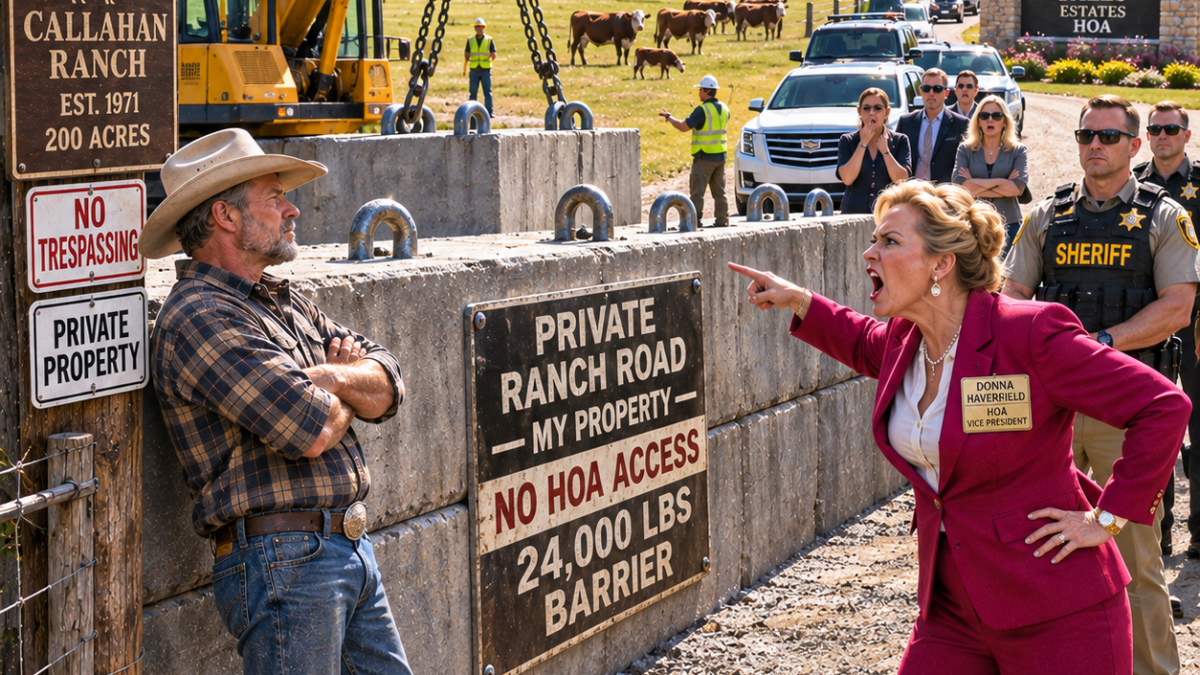
The fifth time HOA vice president Donna Haverfield drove her white Escalade through the locked gate of my Oklahoma cattle ranch, she didn’t just snap another chain—she left my pasture open long enough for a fifteen-hundred-pound Hereford bull to wander toward a residential street full of minivans and children. When I told her somebody could get killed, she responded by having the HOA send me a letter demanding that I surrender permanent access to the private ranch road my family had owned, maintained, and paid taxes on for more than fifty years. After that, I stopped buying stronger padlocks, because I had finally understood that Donna wasn’t testing my gate anymore—she was testing how far I would let her go before I replaced something she could break with something she couldn’t.
My name is Wyatt Callahan.
I was fifty-one then, running two hundred acres of cattle and hay land outside Mays County, Oklahoma, on property my father bought in 1971.
For most of my life, the ranch had been surrounded by timber, pasture, creek bottom, and other farms.
Then Timber Falls appeared to the north.
Two hundred sixteen homes.
Clubhouse.
Splash pad.
Quarter-acre lots.
And an HOA.
Their only public entrance connected to Creek Hollow Road, a winding two-lane county route that could back up badly during school traffic.
My ranch had another road.
A gravel lane cutting between my north and south pastures before ending near the subdivision’s rear service drive.
But there was one important difference.
That road was mine.
It existed so I could move cattle, tractors, hay wagons, and equipment without taking everything onto the county highway.
It was surveyed inside my deeded boundary.
I graded it.
I repaired it.
I paid taxes on the land beneath it.
And at the entrance stood a fourteen-foot steel gate chained between heavy cedar posts.
The sign attached to it said:
**PRIVATE PROPERTY — NO TRESPASSING.**
Donna apparently read that as a suggestion.
The first Friday I heard metal slam against metal, I came out of my barn and saw a white Escalade disappearing down my ranch road in a cloud of red Oklahoma dust.
My gate hung open behind it.
Bent latch.
Broken lock.
Twisted chain.
I followed the tire tracks until they reached Timber Falls.
The Escalade was parked near the splash pad.
Not a scratch visible from where I stood.
A deputy took my report the next morning.
“Get a camera,” he told me. “If she does it again, you want proof.”
So I did.
Twelve days later, the camera caught Donna at 4:47 p.m.
She stopped at my locked gate.
Waited five seconds.
Then eased forward until the Escalade’s bumper touched the steel tubing.
She accelerated.
Both chains stretched.
One snapped.
The padlock tore apart.
Donna drove through.
I saved the footage three different ways.
Then I visited her.
Donna opened the door holding a smoothie.
“I assumed it was a county maintenance road,” she said.
“There is a private-property sign attached to the gate.”
“Maybe you need a larger sign.”
“You broke the lock.”
She shrugged.
“The neighborhood needs a secondary route. Creek Hollow is terrible on Fridays.”
“That doesn’t make my ranch public.”
She smiled.
“You should consider sharing.”
“No.”
Her expression changed.
Not anger.
Something colder.
The look of someone who had already decided my answer wasn’t final.
“We’ll bring it before the board.”
Five days later, the HOA letter arrived.
It requested that I grant Timber Falls a permanent public easement across my ranch to relieve congestion and improve emergency access.
The final paragraph warned that if I refused, the HOA would pursue “all appropriate legal and governmental remedies.”
I took the letter, the video, my deed, and the sheriff’s report to Jack Hargrove, a property lawyer who had spent twenty-eight years untangling land disputes.
He watched Donna’s Escalade break through my gate twice.
Then he leaned back.
“Wyatt, your road has no recorded easement.”
“I know.”
“This subdivision is three years old.”
“I know.”
“And she thinks she can create access rights by repeatedly trespassing?”
“That appears to be the strategy.”
Jack smiled without humor.
“Then stop replacing the lock.”
Three weeks later, after a survey review, structural plans, county approval, and a building permit, concrete trucks rolled onto my ranch.
Donna had no idea what we were building.
By Tuesday afternoon, twenty-four thousand pounds of reinforced masonry stood across the road she had treated like her personal shortcut.
Eleven days later, my trail-camera alert went off.
Donna’s white Escalade was back.
She stopped fifty feet from the new structure, stepped out, stared up at the eight-foot wall, and screamed:
“You can’t block a public road!”
PART 2
I was repairing fence on the east pasture when the alert hit my phone.
By the time I reached the south end of the ranch in my side-by-side, Donna was standing in front of the wall with both hands on her hips.
Her Escalade sat behind her.
Engine running.
Driver’s door open.
She had apparently been there long enough to inspect everything because I could see fingerprints in the thin dust along the concrete-block face.
She spotted me.
“What is this?”
I stopped about thirty feet away.
“A wall.”
“Don’t get smart.”
“You asked.”
She pointed toward it.
“You blocked the road.”
“Yes.”
“You cannot block a public road.”
“It isn’t public.”
“It connects Timber Falls to the county network.”
“No. It connects my north pasture to my south pasture.”
She marched toward me.
“You know exactly what I’m talking about.”
“I do.”
“People use this.”
“People trespass on it.”
“That is your opinion.”
I laughed.
“No, Donna. That is my deed.”
Her jaw tightened.
She pointed at the sign mounted in the center of the wall.
**PRIVATE PROPERTY — NO VEHICULAR ACCESS**
Below it:
**TRESPASSERS WILL BE PROSECUTED**
Then the case number from the sheriff’s office.
Donna read it.
Her face changed slightly.
“What is that number?”
“The criminal trespass complaint.”
“You filed criminal charges against me?”
“I filed a complaint.”
“You are insane.”
“I’ve got eighteen videos.”
Her eyes flicked toward the cameras mounted above the wall.
That was the first moment I saw uncertainty.
Only for a second.
Then she recovered.
“You’re going to take this down.”
“No.”
“The HOA will make you.”
“No.”
“The county will make you.”
“No.”
“You keep saying no like that means something.”
I stared at her.
“On my land, it does.”
She actually laughed.
Not because anything was funny.
Because Donna used laughter the way some people use armor.
“This wall is hostile.”
“It keeps vehicles out.”
“Exactly.”
“That is the purpose.”
“You built this because of me.”
“I built it because somebody repeatedly destroyed my livestock gate.”
“You’re admitting retaliation.”
“No. I’m describing a boundary structure.”
She pointed toward the concrete.
“You spent thousands of dollars on this.”
“Yes.”
“To inconvenience a neighborhood.”
“To keep my cattle where they belong.”
“Same thing.”
That sentence told me more than all the letters she’d sent.
In Donna’s mind, anything interfering with her convenience was unreasonable by definition.
I reached into the side-by-side and pulled out the permit folder.
“I had the boundary verified.”
She stared.
“County permit.”
Silence.
“Structural engineer.”
Silence.
“Insurance classification.”
Still nothing.
“The wall is entirely inside my property.”
Donna looked at the documents without taking them.
Then pointed toward the road behind the wall.
“What happens in an emergency?”
“Emergency vehicles use Creek Hollow Road.”
“What if it’s blocked?”
“Then emergency services follow whatever contingency plans the county established when Timber Falls was approved.”
“That road adds time.”
“Talk to the county.”
“This road is faster.”
“So is driving through someone’s backyard. That doesn’t give you ownership.”
She glared at me for several seconds.
Then raised her phone and photographed the wall again.
“You’ll be hearing from us.”
“I expected that.”
She walked back toward the Escalade.
Then stopped.
“You think concrete makes you untouchable?”
“No.”
I looked at the wall.
“I think concrete makes the road unavailable.”
She slammed her door.
The Escalade reversed hard and disappeared toward Timber Falls.
I watched until the dust settled.
Then I looked up at the wall.
Eight feet high.
Twenty feet wide.
Twelve-inch reinforced block.
Every core filled with rebar and concrete.
Continuous footing three feet deep.
My brother-in-law Travis had estimated the finished structure at around twenty-four thousand pounds.
The wall wasn’t decorative.
It wasn’t elegant.
It was an answer.
And for the first time in months, the answer didn’t have hinges.
—
The problem had started small enough that I almost blamed myself for letting it grow.
After the first camera footage, my attorney, Jack Hargrove, sent Donna and the HOA a formal cease-and-desist letter.
He cited my deed.
Survey.
Sheriff’s report.
Property damage.
Trespass.
No easement.
No public right-of-way.
He demanded reimbursement for the gate damage.
The HOA’s management company responded through its attorney, Shannon Gilchrist.
Unlike Donna, Shannon sounded like somebody who actually understood consequences.
She proposed mediation.
Jack called her.
I wasn’t on the line, but he told me afterward how it went.
“She’s professional,” he said. “And she knows your road isn’t theirs.”
“Then why are we still talking?”
“Because Donna apparently believes confidence creates property rights.”
“Can Shannon stop her?”
“She can advise the board.”
“Same question.”
Jack gave me a look.
“No.”
He was right.
Donna kept driving through.
Three more times in April.
Always Friday.
Always around rush hour.
What changed was the technique.
She stopped ramming the gate outright.
Instead, she eased the Escalade forward until the bumper touched the tubing.
Then she applied power.
Slow pressure.
Then a burst.
Chain failed.
Gate opened.
She drove through.
That was worse in a way.
The first time might have been stupidity.
The later times were method.
Then other residents discovered the shortcut.
Four cars one afternoon.
Six the next Friday.
Pickup trucks.
SUVs.
Sedans.
Some drivers closed the gate.
Most didn’t.
That’s when my cattle started getting out.
The first escape involved three yearlings.
We recovered them before they reached the county road.
The second was worse.
Then came the bull.
Fifteen hundred pounds of muscle wandering onto the Timber Falls service drive while a woman in a minivan leaned on her horn.
When I arrived, the bull had his head low.
Not charging.
Not yet.
The minivan driver shouted through her closed window:
“Do something!”
I parked my side-by-side between them.
“Stop honking.”
“He won’t move!”
“Because you’re honking.”
“He’s dangerous!”
“Yes.”
She stopped.
The bull lifted his head.
I moved slowly.
Talked to him.
Used a feed bucket from the back of the side-by-side and got him turned.
It took twenty minutes to guide him back through the open gate.
Twenty minutes where every nightmare played through my head.
Horn through a windshield.
Child on a bicycle.
Driver swerving.
Bull hit by vehicle.
A person dead.
An animal destroyed.
And my name on the lawsuit because my livestock had escaped my property.
My insurance agent called that week after I told him what happened.
“Wyatt, stop thinking of this as a gate problem.”
“What is it?”
“Liability.”
“I know.”
“No. I don’t think you do.”
His voice became serious.
“If one of those cattle gets loose because residents keep opening that gate and somebody gets hurt, everyone will sue everyone. HOA. Driver. You. Maybe the county.”
“I have camera footage.”
“That helps after the accident.”
He paused.
“You need to prevent the accident.”
That night I sat alone at my kitchen table.
Dad’s old ranch ledger was still in a cabinet near the pantry.
I took it out.
Not because I needed accounting records.
Because when things got complicated, I sometimes liked seeing his handwriting.
Fence wire.
Diesel.
Vet call.
Hay seed.
Normal ranch problems.
My father had owned this place through droughts, ice storms, cattle crashes, and two tornado seasons.
He died believing the ranch would stay a ranch.
Not a shortcut.
I looked at the HOA letter lying beside his old ledger.
**Grant community access.**
The words made me angrier than I expected.
Not because they wanted the road.
Because nobody had asked what the road meant.
Moving cattle between pastures.
Pulling hay equipment.
Accessing water infrastructure.
Keeping residential traffic separated from livestock.
The road wasn’t unused.
It was agricultural infrastructure.
It just didn’t look important to Donna because its value wasn’t measured in commute minutes.
I called Jack the next morning.
“I want to close the road permanently to vehicles.”
“You already have a gate.”
“They keep breaking it.”
Pause.
“What are you thinking?”
“A wall.”
Longer pause.
“A wall.”
“Yes.”
“How big?”
“Big enough.”
He sighed.
“Please tell me you’re calling the county before concrete.”
“I called you first.”
“That’s why I still answer.”
—
I spent three weeks planning because anger is expensive when it pours concrete without permits.
First came the deed.
Jack compared it against my 2017 survey.
The boundary was clean.
The entire ranch road sat inside my parcel.
No access easement.
No utility corridor.
No subdivision rights.
Nothing.
Then we checked county road records.
Creek Hollow Road was public.
The Timber Falls service drive was private subdivision infrastructure.
My ranch road was neither.
It was an agricultural improvement on private land.
Then I called the building inspector.
Hal Prescott had been reviewing permits for longer than some Timber Falls residents had been alive.
I described what I wanted.
“Twenty feet wide?”
“Yes.”
“Eight feet tall?”
“Yes.”
“Reinforced block?”
“Yes.”
“With vehicle exclusion as the purpose?”
“Livestock security and boundary control.”
Hal was silent.
Then:
“Somebody driving where they shouldn’t?”
“Yes.”
He chuckled.
“You’ll need engineering.”
“I expected that.”
“Setback verification.”
“Fine.”
“Site plan.”
“Fine.”
“If the engineer stamps it and it stays inside your property, we’ll review it.”
That was all I needed.
Rebecca Winters, a structural engineer in Tulsa, drew the plans.
My brother-in-law Travis Murdock priced the masonry.
When he arrived to inspect the site, he stood where the gate had been and stared down the road.
“You really want twenty-four thousand pounds of wall?”
“That’s your estimate?”
“About that.”
“Will an Escalade move it?”
He looked offended.
“Wyatt, a highway retaining structure would be jealous.”
“How much?”
“Nine-two.”
“Nine thousand two hundred?”
“Including labor.”
I winced.
“That’s expensive.”
“So are funerals.”
He knew about the bull.
That ended the debate.
We poured the footing.
Let it cure.
Then built.
By Tuesday afternoon, the wall stood complete.
A narrow pedestrian opening with a steel door remained at one side so I could move through on foot and handle fence work.
No vehicle could use it.
The county inspected.
Passed.
Insurance documented it as a permanent livestock-security and boundary structure.
I mounted cameras.
Then the wall waited.
So did I.
Donna arrived eleven days later.
And exactly seventy-two hours after our confrontation, the HOA sent its response.
Four pages.
Five demands.
Remove the wall within forty-five days.
Restore vehicular access.
Recognize the road as a “community thoroughfare.”
Permit survey access.
Submit to legal review concerning emergency access.
The letter also threatened injunctions, damages, and condemnation.
I read it twice.
Then called Jack.
He asked me to email a scan.
Twenty minutes later he called back.
“Wyatt.”
“Yes?”
“This is impressive.”
“What part?”
“The confidence.”
“Not the law?”
“There is almost no law in this letter.”
I laughed.
“They say they’ll condemn the road.”
“They can’t.”
“Shannon signed it?”
“No.”
That got my attention.
“Who did?”
“Donna and Gerald.”
Gerald Pace.
HOA president.
I’d barely dealt with him.
He was the kind of board president who seemed to believe delegating everything to Donna counted as leadership.
Jack continued:
“They threaten condemnation like the HOA has eminent-domain authority.”
“It doesn’t?”
“No.”
“Could the county do it?”
“In theory, government condemnation exists. In practice, they’re not taking a functioning cattle-ranch road so subdivision residents can shave fifteen minutes off rush hour.”
“Twenty-five.”
“That doesn’t improve their argument.”
He told me not to respond personally.
That afternoon he drafted four pages of his own.
Unlike Donna’s letter, every page contained references.
Deed recording number.
Survey.
Permit.
Agricultural use.
Sheriff’s case number.
Trail-camera evidence.
Property damage.
No easement.
No public dedication.
He ended with a line I read twice:
**We invite the board to seek independent legal advice before expending additional association funds on a position lacking factual or legal foundation.**
“That is lawyer language for ‘stop being stupid,’ isn’t it?”
Jack smiled.
“Pretty much.”
We sent it.
Three days later a survey crew appeared on the Timber Falls side.
I didn’t interfere.
That mattered.
A man in an orange vest set up equipment near the service drive and spent four hours measuring.
Donna appeared once.
Talked to him.
Pointed toward my wall.
He didn’t seem impressed.
Ten days later, Greg Mitchell from Prairie Ridge Management called.
“Mr. Callahan, we’ve received the survey results.”
“And?”
“The structure is entirely within your parcel.”
“I know.”
“There is no encroachment.”
“I know.”
“The board is reconsidering its position.”
“Good.”
“We’d like to arrange a facilitated discussion.”
“On what?”
“Potential compromise.”
I looked through my kitchen window toward the pasture.
“What compromise?”
“Access alternatives.”
“No.”
Pause.
“Mr. Callahan—”
“Greg, I’ve spent months buying chains because your vice president deliberately drove through my gate.”
“I understand.”
“No, I don’t think you do.”
I kept my voice calm.
“I’ve had cattle escape. One bull reached a residential street. I’ve paid lawyers. Surveyors. Engineers. Masonry crews. Camera service.”
“I understand your frustration.”
“Then communicate three conditions.”
He waited.
“Withdraw the demand letter.”
“All right.”
“Reimburse my gate damage.”
“I’ll relay that.”
“And Donna acknowledges in writing that the road is private property.”
A longer pause.
“That may be difficult.”
“Then so is mediation.”
He didn’t argue.
“I’ll take that back to the board.”
That night I walked to the wall after dark.
The floodlight switched on.
Concrete turned pale beneath it.
Camera lights blinked green.
The old gate had always looked vulnerable after Donna started using it.
The wall didn’t.
For the first time since March, I slept through a Friday afternoon without checking my phone every ten minutes.
—
Donna changed tactics.
If she couldn’t drive through the wall, she decided to turn the neighborhood against it.
She organized a petition.
I found out from Jack.
He called at seven-thirty one morning.
“Do you get the Gazette?”
“No.”
“You should today.”
“What happened?”
“Donna made the paper.”
I drove to town.
Bought a copy.
The headline:
**TIMBER FALLS HOA PETITIONS COUNTY FOR ALTERNATIVE ROAD ACCESS THROUGH ADJACENT RANCH**
The article quoted Donna.
“This is about the safety of two hundred sixteen families. One landowner should not be permitted to block access that could save lives.”
I read it three times.
No mention of the broken gate.
No mention of the videos.
No mention of my loose cattle.
No mention of the sheriff’s file.
Just Donna.
Civic-minded.
Concerned.
Thinking of families.
For about thirty seconds, I wanted to call the reporter.
Jack stopped me.
“No.”
“She lied.”
“I know.”
“I want them to print the footage.”
“No.”
“Why?”
“Because commissioners decide public petitions. Facebook doesn’t.”
“It is a newspaper.”
“You know what I mean.”
He was right.
Again.
I hated how often lawyers are useful when you’re angry.
Donna collected 129 signatures.
More than half the subdivision.
The petition claimed Creek Hollow Road created dangerous congestion and emergency-response delays.
It described my road as an “existing improved access corridor.”
That phrase made Jack laugh.
“What?”
“Access corridor.”
“What is it?”
“A ranch road.”
“Yes.”
“She keeps renaming things and hoping the vocabulary changes ownership.”
The county scheduled a hearing in July.
That gave us three weeks.
We prepared everything.
Deed.
Survey.
Wall permit.
Road maps.
Trail-camera footage.
Gate-damage invoices.
Sheriff’s report.
Insurance correspondence.
Photos of escaped livestock.
Jack also contacted the county emergency-services office.
This was important.
Donna’s petition implied emergency crews supported alternate access.
They didn’t.
No fire chief had requested my road.
No ambulance service had identified Timber Falls as inaccessible.
No county emergency director had asked for a second entrance through the ranch.
The safety emergency was political packaging.
The traffic was real.
The emergency justification wasn’t.
Jack also hired Dr. Russell Kemp, a retired large-animal veterinarian.
When I asked why, he said:
“Because half those homeowners think a cow is a large dog.”
Dr. Kemp knew cattle.
More importantly, he knew what happens when cattle and vehicles collide.
The hearing was held Wednesday afternoon.
Donna arrived with forty residents carrying printed signs.
**SAFETY ACCESS NOW**
**TWO ROADS SAVE LIVES**
I came with Jack, my neighbor Bud Olsen, and Dr. Kemp.
Donna saw me in the hallway.
She smiled.
“You should have negotiated.”
“I offered conditions.”
“You demanded an apology.”
“An acknowledgment.”
“You built a wall instead of acting like a neighbor.”
I looked at the residents around her.
Most wouldn’t meet my eyes.
I said:
“Did you tell them you drove through the gate eighteen times?”
Her smile disappeared.
“Those accusations are irrelevant to public safety.”
“Did you?”
She turned away.
That told me everything.
Inside, Commissioner June Whitfield called the meeting to order.
Shannon Gilchrist presented the HOA petition.
She was good.
Better than their argument deserved.
She showed traffic maps.
Peak congestion.
Subdivision population.
The proposed route.
She spoke about redundancy in emergency access.
She never lied.
That was smart.
She also never claimed the road already belonged to Timber Falls.
When she finished, Commissioner Whitfield looked at Jack.
“Mr. Hargrove?”
Jack stood.
No theatrics.
No angry speech.
He placed my deed on the projector.
“Before discussing traffic convenience, we need to identify what this road legally is.”
He highlighted the boundary.
“My client’s land.”
Then the survey.
“No public easement.”
Then the subdivision plat.
“No dedicated connection.”
Then county road records.
“No county maintenance.”
Then the building permit.
“Lawfully constructed boundary structure.”
Donna shifted in her seat.
Jack continued:
“This petition describes the ranch road as existing access.”
He paused.
“Existing for whom?”
Nobody answered.
He clicked.
Trail-camera video.
Donna’s Escalade appeared.
The room watched her approach my locked gate.
Stop.
Touch bumper to steel.
Accelerate.
Chain snapped.
The sound of metal cracking played through courthouse speakers.
Several Timber Falls residents turned toward Donna.
Jack played another clip.
Different Friday.
Same vehicle.
Same gate.
Same result.
Third clip.
Donna again.
This time another SUV followed her through.
When the screen went dark, the room remained quiet.
Jack faced the commissioners.
“This is not the history of a public road. This is the history of repeated unauthorized entry.”
Donna whispered something to Gerald.
Commissioner Whitfield asked:
“Mrs. Haverfield, is that your vehicle?”
Shannon stood.
“Commissioner, my client—”
Donna answered anyway.
“Yes.”
Shannon closed her eyes.
Whitfield continued:
“Did you have permission to use the ranch road?”
Donna said:
“The HOA believed there was an access argument.”
“That wasn’t my question.”
Donna looked toward me.
Then:
“No.”
A murmur moved through the residents.
Whitfield asked:
“How many times did you enter?”
“I don’t know.”
Jack said:
“We documented eighteen.”
Donna turned.
“That includes other vehicles!”
“Eighteen recordings of your Escalade.”
Her face flushed.
Whitfield looked at Jack.
“Continue.”
Jack did.
He displayed photographs of the damaged gate.
Then the bull standing on the Timber Falls service road.
People reacted immediately.
That photograph scared them more than the wall.
Good.
It should have.
Dr. Kemp testified next.
He was blunt.
“A mature Hereford bull can exceed fifteen hundred pounds.”
He explained poor visibility.
Stress behavior.
Unfamiliar pavement.
Vehicle collisions.
He described the forces involved if an animal that size met a passenger vehicle at road speed.
One resident lowered her safety sign.
Dr. Kemp ended with:
“The ranch owner’s gate was not merely a property barrier. It was part of a livestock-containment system.”
That sentence mattered.
The wall wasn’t spite.
It was control.
Jack’s final argument was short.
“Timber Falls has a functioning county road.”
He gestured toward the subdivision map.
“The subdivision was built with one approved public access route.”
Then toward my property.
“My client did not create the subdivision’s traffic problem.”
Donna stared at him.
“He did not invite two hundred sixteen homes beside a working cattle ranch.”
One commissioner nodded.
“He did not create twenty-five-minute backups.”
Another nod.
“And he should not lose family land because a private association prefers the shortest path between two points.”
Jack paused.
“Convenience is not necessity.”
There it was.
Simple.
The commissioners recessed.
Five minutes later they returned.
Donna looked confident.
Maybe she had spent so many months winning arguments by exhausting people that she assumed government worked the same way.
Commissioner Whitfield read the ruling.
Petition denied.
No demonstrated public necessity.
Existing lawful county access available.
No easement.
No right-of-way.
No emergency-services request supporting condemnation.
Then she looked directly at Donna.
“The commission is also troubled that the principal advocate for condemnation is documented repeatedly using the subject property without permission before seeking governmental relief.”
Donna stopped moving.
Not anger.
Shock.
The forty residents beside her looked toward her.
Then the trail-camera still appeared again on the screen.
White Escalade.
Gate bending.
Chain stretched.
Jack closed his folder.
Quietly.
That was the moment Donna lost the story.
—
The newspaper ran the ruling that Friday.
This time the headline was different.
**COUNTY DENIES TIMBER FALLS ROAD PETITION; COMMISSIONER CITES HOA OFFICIAL’S TRESPASS RECORD**
The article included a still image from my trail camera.
Donna’s Escalade pushing through the gate.
I didn’t celebrate.
I went to work.
But I did one thing I’d been waiting to do.
I mailed the letters.
Two hundred sixteen envelopes.
Every Timber Falls household.
The letter was calm.
No insults.
No names beyond what was necessary.
It stated:
I owned the ranch.
The road was private.
Vehicles had repeatedly entered without permission.
Gate hardware had repeatedly been destroyed.
Livestock had escaped.
A formal complaint existed.
The wall had been permitted as a livestock-security structure.
The county had rejected the access petition.
I included three photographs.
Broken gate.
Escalade entering.
Finished wall.
The final sentence read:
**I have no dispute with the residents of Timber Falls. My dispute is with the decision to treat privately owned agricultural land as community property.**
Saturday morning, my phone started ringing.
First caller:
Ray Donahue.
Retired Army colonel.
Timber Falls resident.
Petition signer.
His voice was controlled.
“Mr. Callahan?”
“Yes.”
“My name is Ray Donahue.”
“I know the name from the petition.”
Silence.
“I owe you an apology.”
That surprised me.
“Donna told me your road was an abandoned county route.”
“It isn’t.”
“I know that now.”
“She told us you had blocked it after Timber Falls began using it legally.”
“No.”
“I know that too.”
He breathed out.
“I don’t like being lied to.”
“Neither do I.”
“I’d like to see the property boundary.”
“You’re welcome if you come through the front drive.”
“I will.”
Sunday morning Ray arrived.
He was in his late sixties.
Straight-backed.
Direct.
He walked with me to the wall.
Studied it.
Touched the concrete.
Then looked through the pedestrian opening toward the ranch road.
“That’s clearly inside your fence.”
“Yes.”
“And the road continues through your pasture.”
“Yes.”
“And people were driving through here?”
“Until the wall.”
He shook his head.
Then looked at the wall again.
“Outstanding fortification.”
I laughed.
“My brother-in-law will appreciate that.”
Ray became the first resident from Timber Falls I actually trusted.
He wasn’t friendly because he suddenly loved ranchers.
He was angry because his signature had been obtained through false information.
He talked to neighbors.
Then more neighbors called me.
One woman said Donna had told her the road was once maintained by the county.
False.
A man said Donna claimed the developer reserved access before construction.
False.
Another said Donna claimed emergency services had asked for the route.
False.
Gerald Pace had repeated some of those statements too.
Whether he knew they were false was another question.
Ray didn’t wait for the answer.
He organized forty-three homeowners to demand a special HOA meeting.
Their bylaws required thirty-three.
They had ten extra.
I was not invited.
That was correct.
I wasn’t a Timber Falls member.
Their board problem belonged to them.
Tuesday night, while they met, I sat on my porch.
The ranch was quiet.
No headlights on the gravel road.
No gate alerts.
No cattle wandering where they shouldn’t.
At nine thirty, my phone rang.
Ray.
“How’d it go?”
“Donna’s out.”
I sat straighter.
“What?”
“Removed.”
He sounded exhausted.
“Gerald too.”
“What happened?”
Ray gave me the account over the next twenty minutes.
More than 150 residents had packed the clubhouse.
Donna arrived with color-coded folders.
Agenda.
Talking points.
Prepared statements.
She apparently planned to control the meeting.
She lasted three minutes.
Ray read the county ruling aloud.
Then Curtis Howard, another board member, stood.
He had signed one of the earlier demand letters to me.
Curtis said Donna had told the board the ranch road had a long history of shared use.
False.
She told them I had been notified and hadn’t objected.
False.
She said legal counsel believed the HOA had a strong easement claim.
At best, severely distorted.
Curtis looked directly at her and said:
“I signed documents because I trusted your representation of the facts.”
According to Ray, Donna replied:
“You had access to the same information I did.”
Curtis answered:
“No. You controlled the information.”
That changed the room.
Then Gerald tried to distance himself.
“I relied on Donna’s research.”
Ray said a homeowner called from the audience:
“Your signature is on the letter.”
Gerald responded:
“I believed her.”
Ray stood.
“That’s not leadership.”
The vote on Donna came first.
119 to 28.
Removed as vice president.
Gerald’s vote:
104 to 43.
Removed as president.
Donna packed her folders.
No speech.
No final threat.
Kevin followed her out.
For three seconds the clubhouse remained silent.
Then applause started.
I didn’t hear it.
I wasn’t there.
And I’m glad.
Because Donna being humiliated wasn’t the part I cared about.
The part I cared about was that the next morning my cattle were still behind the wall.
—
Ray became interim president.
His first official letter came to me by certified mail.
The Timber Falls HOA acknowledged that prior demands involving my property had lacked adequate factual and legal basis.
The board apologized for the damage and disruption.
Inside was a check for $2,200.
Not the full amount I’d spent.
Not close.
By then my ledger read:
Chains and locks.
Gate repairs.
Camera system.
Engineering.
Permit.
Wall.
Legal fees.
More than fifteen thousand dollars.
But the $2,200 covered direct gate damage and a portion of legal cost.
Jack asked what I wanted to do.
“Take it.”
“You sure?”
“Yes.”
“Why?”
“Because they’re offering it in good faith.”
He nodded.
“That matters.”
Ray’s board passed another resolution.
It formally acknowledged that Timber Falls had no access right over my ranch road.
No implied road.
No community road.
No emergency easement.
Nothing.
The resolution was entered into the minutes.
That mattered more than the check.
The wall could stop vehicles.
Paper would stop future arguments.
The district attorney reviewed my criminal trespass complaint.
Ultimately, no prosecution moved forward.
I was disappointed for about thirty seconds.
Then Jack explained.
“You already have the evidence preserved.”
“Yes.”
“The board removed her.”
“Yes.”
“County denied the petition.”
“Yes.”
“HOA acknowledged the road is private.”
“Yes.”
“And Donna’s gone quiet.”
“For now.”
“Wyatt, sometimes deterrence works without a courtroom.”
I knew he was right.
Still.
I had spent months replacing locks.
Part of me wanted a judge to say the words.
Trespass.
Damage.
Wrong.
Then I realized the county had effectively said most of them already.
Publicly.
In writing.
That was enough.
Donna and Kevin listed their Timber Falls home in August.
I didn’t know until Ray called.
“You hear?”
“No.”
“Haverfield house is for sale.”
I felt nothing at first.
Then something like sadness.
Not for losing Donna.
For how absurd the whole thing had become.
A woman wanted to save twenty-five minutes in traffic.
Five months later:
Gate damage.
Attorney bills.
County hearing.
Petition scandal.
Board removal.
House for sale.
All because she refused to accept one ordinary word.
No.
The house sold five weeks later.
Young family from Claremore.
I met the husband once at the feed store.
He recognized my name.
“Oh. You’re the wall guy.”
I sighed.
“Apparently.”
He laughed.
“Don’t worry. We’re not coming through your ranch.”
“Appreciated.”
“Honestly, my wife saw the wall before we bought.”
“What’d she say?”
“She asked if dinosaurs lived back there.”
That made me laugh.
Donna’s white Escalade disappeared from Timber Falls.
One morning it sat in her driveway.
Two days later, gone.
A moving truck arrived.
Then they were gone too.
No confrontation.
No apology.
No dramatic final visit.
Just an empty driveway.
That felt more real than any ending where she showed up begging forgiveness.
Some people don’t give closure.
They leave.
You make your own.
—
The traffic problem Donna had used to justify everything?
The county eventually fixed it.
Not with my land.
Not with condemnation.
Not with an HOA shortcut.
A turn lane was added near the highway intersection.
Signal timing near the school crossing was adjusted.
Cost:
about thirty thousand dollars.
Average afternoon delay dropped from roughly twenty-five minutes to around ten.
Boring solution.
Engineering.
Traffic study.
Public process.
Exactly the kind of solution Donna had skipped because it required patience.
Ray called afterward.
“You know what bothers me?”
“What?”
“If she’d spent half the energy lobbying for the turn lane that she spent fighting you, we’d have had this fixed months earlier.”
“Probably.”
“She wanted a shortcut.”
“Yes.”
“Literally.”
“Yes.”
He laughed.
Then grew serious.
“I owe you more than the apology letter.”
“You don’t.”
“I signed that petition.”
“You were lied to.”
“I still signed it.”
I understood what he meant.
Responsibility doesn’t disappear because somebody else manipulated you.
But neither does context.
“You corrected it.”
“That enough?”
“For me.”
He nodded.
“Good.”
We became neighbors after that.
Actual neighbors.
Not HOA and ranch.
Ray came by when my tractor battery died near the north pasture.
I loaned him a trailer when his daughter moved.
His wife brought peach cobbler one Christmas.
Nobody drafted a policy.
Nobody needed one.
That’s what normal community looks like.
—
The wall stayed.
People assumed once Donna left, I’d tear it down.
Why would I?
The road still carried agricultural traffic inside the ranch.
The wall protected the vulnerable connection to Timber Falls.
The pedestrian passage gave me access where needed.
Cattle couldn’t wander through.
Cars couldn’t wander in.
The cameras remained.
Insurance liked it.
I liked sleeping.
Bud Olsen loved it.
Every few weeks he’d drive over in his old pickup.
Stand beside the wall.
Cross his arms.
Say:
“Still there.”
“Concrete generally does that.”
“Good concrete.”
“Travis will appreciate the review.”
Bud would nod.
Then leave.
My brother-in-law brought his kids out on the Fourth of July.
His nine-year-old stared up at the wall.
“Uncle Wyatt?”
“Yeah?”
“Is this for dinosaurs?”
I looked at Travis.
He was already laughing.
“Something like that.”
“What kind?”
“White Cadillac.”
The kid looked confused.
Probably for the best.
—
A few months later, a letter arrived.
No HOA logo.
No attorney.
Handwritten return address.
Donna Haverfield.
I almost threw it away unopened.
Then I sat at the kitchen table and opened it.
Three paragraphs.
Not an apology exactly.
Donna rarely did anything in a straight line.
She wrote that moving had given her “perspective.”
That she still believed Timber Falls needed better transportation planning.
Of course.
Then:
**I should not have entered your property after you told me not to.**
I read that sentence twice.
Then:
**I convinced myself that because the road solved a community problem, your refusal was unreasonable, and because I considered your refusal unreasonable, I treated it like it did not count.**
That was more honest than I expected.
The last paragraph said:
**Kevin told me for months that I had turned a traffic problem into a personal battle because I could not tolerate losing an argument. I did not believe him until I lost much more than the argument.**
No request for forgiveness.
No demand that I remove the wall.
No legal threat.
I folded the letter.
Put it in the binder.
Not because I treasured it.
Because it belonged with the rest.
Evidence of how far the whole thing had traveled.
Jack asked later:
“You writing back?”
“No.”
“Nothing?”
“What am I supposed to say?”
He shrugged.
“Received?”
I laughed.
“I think silence is fine.”
It was.
—
The first anniversary of the wall came and went without ceremony.
No party.
No plaque.
No photographs.
I had hay to cut.
One afternoon Ray drove down in a golf cart from Timber Falls.
He parked on his side.
Walked through the pedestrian gate after calling me first.
That part mattered.
We stood near the wall looking over the north pasture.
“Funny,” he said.
“What?”
“People used to talk about this thing like it was Fort Knox.”
“Still do.”
“Now most of them barely notice it.”
“Boundaries get less interesting when people respect them.”
He looked at me.
“That’s annoyingly philosophical for a cattleman.”
“Don’t tell anyone.”
Ray smiled.
Then asked:
“Ever regret spending nine grand?”
“Fifteen.”
“What?”
“Wall was nine. Whole fight was over fifteen.”
He whistled.
“Ever regret it?”
I looked toward the cattle.
“No.”
“Even after Donna left?”
“Yes.”
“Why?”
I pointed toward the pasture.
“Because the reason was never Donna.”
Ray looked confused.
“The reason was livestock security.”
Then he understood.
“That legal classification really got into your head.”
“Insurance agent trained me well.”
We laughed.
But it was true.
Donna was the trigger.
Not the purpose.
If I had built the wall only to punish her, tearing it down after she left might have made sense.
I built it because the gate no longer did its job.
That hadn’t changed.
—
Two years later, I had to replace one camera battery.
That was the closest thing to trouble.
The new family in Donna’s old house had two daughters.
One afternoon I saw them walking along the chain-link fence separating Timber Falls from my boundary.
Their father was with them.
The younger girl pointed at the Herefords.
“Can we pet one?”
Her father said:
“No, honey. That’s private ranch land.”
Simple.
No conflict.
No argument.
No HOA letter.
He saw me near the wall and waved.
I waved back.
Then he asked:
“Mind if the girls look through the fence?”
“Not at all.”
They stood there watching cattle for ten minutes.
One cow came closer.
The girls laughed.
The father didn’t open anything.
Didn’t climb anything.
Didn’t decide proximity created access rights.
People make boundaries sound complicated when they want something on the other side.
They’re usually not.
—
A storm rolled through that September.
Oklahoma thunderstorms can make the whole horizon look like it’s being torn apart.
I drove the ranch checking fences afterward.
Branches down.
Creek high.
One section of wire damaged.
The wall?
Nothing.
Water streaks.
Mud splashed near the base.
Solid.
I sat on the tailgate of my truck near it as evening came.
Same place I’d sat after construction.
The pasture smelled wet.
Herefords grazed farther up the slope.
The floodlight clicked on automatically as daylight faded.
For a second I remembered the old gate.
Bent latch.
Dangling chain.
That sick feeling in my stomach every Friday afternoon.
I remembered chasing the bull.
Donna holding her smoothie.
The HOA letter.
Jack laughing at “community thoroughfare.”
Forty residents holding safety signs.
Donna’s Escalade frozen on the courthouse screen.
Then the 119-to-28 vote I never saw.
So much noise.
All because somebody couldn’t accept where her authority ended.
I heard footsteps from the Timber Falls side.
A woman walking a golden retriever stopped near the fence.
“Excuse me?”
“Yes?”
“Is that the wall from the newspaper?”
I looked behind me.
“That’s it.”
She smiled.
“My neighbor told me a rancher stopped an HOA with concrete and a building permit.”
“That’s a simplified version.”
“Good wall.”
“I’ll tell my brother-in-law.”
Her dog sniffed the fence post.
Then she continued walking.
No drama.
I finished my coffee.
The floodlight shone across twenty-four thousand pounds of reinforced block.
The pedestrian door was locked.
Camera lights blinked green.
Behind me, cattle moved calmly through wet grass.
Ahead of me, residents drove home using the roads that actually belonged to them.
Nobody had touched my gate in years.
Mostly because there wasn’t a gate left to break.
The first time Donna Haverfield drove her white Escalade through my locked ranch gate, I thought I was dealing with one entitled neighbor making one stupid decision.
By the fifth time, I understood I had a much bigger problem.
My name is Wyatt Callahan. I was fifty-one years old then, running two hundred acres of cattle and hay outside Mays County, Oklahoma. My father bought the land in 1971, and three generations of my family had spent more time repairing fence, hauling hay, clearing creek beds, and pulling calves on that property than most people would ever understand.
The ranch wasn’t fancy.
It was work.
Real work.
The kind that started before daylight and sometimes ended under headlights.
For decades, the land around us was mostly pasture, timber, and a few other family farms. Then, in 2019, a developer bought the soybean acreage north of me and built Timber Falls.
Two hundred sixteen houses.
A clubhouse.
A splash pad.
Neatly landscaped entrances.
And an HOA that seemed capable of regulating everything except common sense.
Timber Falls had one public access road, Creek Hollow Road. During rush hour and school pickup, traffic sometimes backed up twenty or twenty-five minutes.
My ranch happened to have a gravel road that ran between my north and south pastures and ended near the backside of their development.
That road wasn’t public.
It wasn’t shared.
It wasn’t abandoned.
I used it for hay wagons, tractors, cattle trailers, and moving livestock between pastures.
At the southern entrance stood a fourteen-foot steel gate with a chain, padlock, and a metal sign that read:
PRIVATE PROPERTY — NO TRESPASSING.
Apparently Donna thought that meant everyone except her.
I first heard the impact on a Friday afternoon.
I was inside the barn changing a hydraulic hose when metal slammed against metal hard enough to make me drop the wrench in my hand.
I stepped outside.
A white Cadillac Escalade was already barreling down my ranch road, kicking up a red cloud of Oklahoma dust.
Behind it, my gate hung crooked.
The chain was twisted.
The padlock had broken.
I jumped into my side-by-side and followed.
By the time I reached the north side of the property, the Escalade had disappeared into Timber Falls.
I found it parked near the splash pad.
White.
Polished.
Not a visible scratch.
My gate wasn’t so lucky.
A sheriff’s deputy came out the next morning.
He studied the damage.
“You know who did it?”
“I have the plate.”
“Any camera?”
“No.”
He nodded.
“Get one.”
That weekend I found out the Escalade belonged to Donna Haverfield, vice president of the Timber Falls HOA.
I went to her house Monday morning.
Her husband, Kevin, answered first.
He seemed normal enough.
Then Donna appeared behind him holding a smoothie and her phone.
I explained who I was.
Then I told her somebody driving her Escalade had broken through my locked ranch gate.
She didn’t deny it.
Instead, she said, “Oh, that gravel road?”
“Yes. My gravel road.”
“I assumed it was county maintenance access.”
“There is a sign.”
She shrugged.
“I didn’t really notice it.”
“You had to hit the gate to get through.”
Her mouth tightened.
“The traffic on Creek Hollow is ridiculous on Fridays.”
“That doesn’t make my ranch a shortcut.”
“You should consider letting the neighborhood use it.”
I stared at her.
“No.”
“We’d help with gravel.”
“No.”
“It would benefit everyone.”
“It wouldn’t benefit my cattle.”
Donna gave me the kind of smile people use when they’ve stopped listening but want you to think the conversation is still happening.
“I’ll bring it up with the board.”
“There is nothing to bring up.”
She raised her smoothie.
“We’ll see.”
I went home, installed a heavier chain, upgraded the lock, and mounted a cellular trail camera facing the gate.
Twelve days later, it happened again.
The camera caught everything.
4:47 p.m.
Donna’s Escalade rolled up.
She stopped.
Waited.
Then slowly eased forward until her bumper touched the gate.
For a second, nothing happened.
Then the vehicle surged.
Both chains stretched.
One snapped.
The lock failed.
The gate swung open.
Donna drove straight through.
That footage changed the situation.
The first incident could have been called confusion.
The second was deliberate.
I saved the video on my phone.
Then on a USB drive.
Then online.
After that I sent Donna a certified letter demanding she stop entering my property and reimburse me for the damage.
Five days later I received a response.
Not from Donna.
From the HOA.
Official letterhead.
Signed by Donna as vice president and Gerald Pace as board president.
The letter asked me to grant Timber Falls a permanent easement across my ranch road to reduce traffic and improve emergency access.
Then came the threat.
If I refused, they would pursue “all appropriate legal and governmental remedies.”
I sat at my kitchen table reading those words over and over.
Somebody had repeatedly broken through my gate.
I complained.
Their answer was to demand the road.
That was when I called Jack Hargrove.
Jack had practiced property law for nearly three decades.
He had handled ranch boundaries, mineral rights, easements, fence disputes, and enough land arguments to know when somebody was bluffing.
I brought him my deed, sheriff’s report, HOA letter, photos, and trail-camera footage.
He watched the video twice.
Then he leaned back.
“Wyatt, your road is private.”
“I know.”
“No easement?”
“None.”
“No recorded access agreement?”
“None.”
“How old is Timber Falls?”
“Three years.”
He shook his head.
“They don’t have a prescriptive-access claim. They don’t have a deeded easement. They don’t have anything.”
“Except my broken gate.”
“Exactly.”
Jack wrote the response.
His version didn’t contain threats dressed as community concern.
It contained facts.
My recorded deed.
Survey.
Property boundary.
Trespass evidence.
Gate damage.
No easement.
No public dedication.
He demanded Donna stop entering and the HOA reimburse me.
Their management company’s attorney responded more cautiously.
She proposed mediation.
Jack spoke with her.
Then he called me.
“She knows their position is weak.”
“So this is over?”
“Not if Donna keeps driving.”
She did.
Three more times in April.
Always Friday.
Always around rush hour.
But she got smarter.
Instead of hitting the gate hard, she’d slowly push against it until the chain tightened and then accelerate just enough to break the weakest point.
That bothered me more than the original crash.
It meant she had turned trespassing into technique.
Then other people followed her.
Once Timber Falls residents realized the road shortened their commute, my trail camera started showing four, five, sometimes six vehicles a day.
People left the gate open.
My cattle got out.
The first two escapes were manageable.
The third almost became a tragedy.
A two-year-old Hereford bull wandered onto the Timber Falls service drive.
He weighed close to fifteen hundred pounds.
I found him standing in front of a minivan while the driver leaned on her horn.
“Stop honking!” I shouted.
“He won’t move!”
“Because you’re scaring him!”
“He shouldn’t be here!”
“No. He shouldn’t.”
And that was the entire problem.
My cattle belonged inside my pasture.
Cars didn’t.
Yet Donna’s shortcut had turned my fence line into an open intersection.
I eventually coaxed the bull back using feed.
That evening my insurance agent called.
“Wyatt, this can’t continue.”
“I know.”
“No, listen to me. If a bull hits a vehicle, everyone gets dragged into the lawsuit.”
“I’ve got cameras.”
“Cameras help after somebody gets hurt.”
He paused.
“You need something that works before somebody gets hurt.”
That night I looked at the mangled gate hardware piled near my barn.
Chains.
Locks.
Bent latch plates.
Every one represented me trying to reinforce a boundary Donna had already decided didn’t apply to her.
I finally understood.
The problem wasn’t that my lock wasn’t strong enough.
The problem was that I kept giving her a gate.
So I called Jack.
“I want to close the road permanently.”
“With what?”
“A wall.”
Silence.
Then:
“How angry are you right now?”
“Not angry.”
“That worries me more.”
“I want it legal.”
“That makes me feel better.”
We checked everything.
Deed.
Survey.
County road records.
Timber Falls subdivision plat.
No easement.
No public road.
No access rights.
Then I called the county building office.
The inspector told me what would be required.
Structural engineer.
Stamped plans.
Setbacks.
Permit.
I hired Rebecca Winters, an engineer from Tulsa.
Then I called my brother-in-law, Travis, who owned a masonry company.
He met me at the site.
“You want a wall across the ranch road?”
“Yes.”
“How serious?”
“Escalade serious.”
He looked toward the broken gate.
“Got it.”
His design was almost ridiculous.
Twenty feet wide.
Eight feet high.
Twelve-inch masonry.
Rebar.
Concrete-filled cores.
A footing three feet deep.
Extensions tying into my existing fence.
Finished weight around twenty-four thousand pounds.
“What does this cost?”
“About ninety-two hundred.”
I winced.
Travis shrugged.
“You want cheap or permanent?”
“Permanent.”
We got the engineer’s stamp.
The county approved the permit.
The sheriff’s office received another packet from me containing eighteen separate recordings of Donna entering the ranch.
Then construction began.
The footing went in first.
Three feet deep.
Two feet wide.
Concrete cured over the weekend.
Monday morning, Travis’s crew started laying block.
By lunch, the wall was waist high.
By evening, more than six feet.
Tuesday afternoon, finished.
Eight feet of concrete and steel stretched across the road.
At one end, Travis built a narrow pedestrian passage with a heavy steel door so I could still move through on foot.
No vehicle could fit.
I mounted a sign in the center.
PRIVATE PROPERTY
NO VEHICULAR ACCESS
TRESPASSERS WILL BE PROSECUTED
Below it was the sheriff’s case number.
Travis stepped back.
“Nobody’s driving through that.”
For the first time in months, I believed him.
Eleven days later, Donna returned.
My phone alerted me while I was working fence.
I opened the camera feed.
White Escalade.
Donna climbed out.
She walked toward the wall.
Stopped.
Looked up.
Then touched it like maybe she suspected I’d built it out of foam.
By the time I reached her, she was furious.
“You can’t do this!”
“I already did.”
“You blocked the road.”
“My road.”
“This is community access.”
“No.”
“I’ll have the county tear it down.”
I reached into the side-by-side and pulled out my permit folder.
“County already approved it.”
She stared.
I showed her the site plan.
Survey.
Engineering stamp.
Inspection paperwork.
Her face tightened.
“This is retaliatory.”
“This is livestock security.”
“You spent nearly ten thousand dollars because I used a road.”
“You destroyed my gate repeatedly.”
“The gate was inconvenient.”
“That was the point.”
Donna folded her arms.
“You think this is over?”
“I think you’re not driving through anymore.”
She took photographs.
Then left.
Three days later, another HOA letter arrived.
Remove the wall within forty-five days.
Restore access.
Recognize the road as a community thoroughfare.
Prepare for possible legal action.
Jack read it.
Then laughed.
“They’re threatening condemnation.”
“Can they do that?”
“An HOA? No.”
“The county?”
“Government has eminent-domain authority in some circumstances. But Timber Falls already has a functioning county road.”
He tapped the letter.
“This is intimidation dressed up as legal language.”
Jack sent the response.
The HOA hired a surveyor.
Good.
I wanted them to.
The surveyor spent hours measuring the boundary.
Ten days later, Prairie Ridge Management called.
Their representative sounded careful.
“The survey confirms the wall is entirely within your property.”
“I know.”
“There was no encroachment.”
“I know.”
“The board would like to discuss compromise.”
“My conditions haven’t changed.”
“What conditions?”
“Withdraw the demand letter. Reimburse my gate damage. Acknowledge in writing that my road is private.”
Silence.
“I’ll communicate that.”
Instead of agreeing, Donna changed strategy.
She went political.
A petition circulated through Timber Falls demanding county action to create a second access route across my ranch.
Donna collected 129 signatures.
Then she went to the newspaper.
The story framed her as a safety advocate.
Two hundred sixteen families.
Traffic congestion.
Emergency response.
One stubborn rancher blocking potentially life-saving access.
I wanted to call the reporter.
Jack stopped me.
“Save it for the hearing.”
Donna’s petition reached the county commissioners.
A hearing was scheduled.
That morning, Donna arrived with forty residents carrying signs.
SAFETY ACCESS NOW.
TWO ROADS SAVE LIVES.
I arrived with Jack, my neighbor Bud, and a retired large-animal veterinarian named Dr. Russell Kemp.
The HOA attorney spoke first.
She showed maps.
Traffic numbers.
Proposed routes.
She argued that a second access point could benefit Timber Falls.
Then Jack stood.
He displayed my deed.
No easement.
Survey.
No encroachment.
County road map.
No public road.
Subdivision plat.
No reserved connection.
Then he played the video.
Donna’s Escalade appeared on the screen.
She approached my locked gate.
Paused.
Pressed forward.
The chain snapped.
Nobody in the chamber spoke.
Another video.
Same vehicle.
Same gate.
Third video.
Same thing.
Residents carrying the safety signs turned toward Donna.
Commissioner June Whitfield asked:
“Mrs. Haverfield, is that your vehicle?”
Donna hesitated.
“Yes.”
“Did you have permission?”
Donna glanced at the HOA attorney.
“No.”
“How often did you use this road?”
“I don’t know.”
Jack answered:
“We preserved eighteen recordings.”
The room changed.
The argument wasn’t about a rancher suddenly blocking a neighborhood road anymore.
It was about somebody repeatedly trespassing, then trying to use political pressure to legalize the shortcut afterward.
Jack showed the photograph of my bull on the Timber Falls service drive.
Dr. Kemp testified next.
He explained what fifteen hundred pounds of frightened cattle could do to a car.
He described livestock containment.
Risk.
Collision forces.
Emergency response.
Then he said something I’ll never forget.
“Mr. Callahan’s gate wasn’t simply a gate. It was part of the safety system keeping livestock separate from residential traffic.”
That sentence destroyed Donna’s entire narrative.
The commissioners recessed briefly.
When they returned, Commissioner Whitfield denied the petition.
No demonstrated public necessity.
Existing county access remained available.
No public easement.
No emergency-services request.
Then she looked directly at Donna.
“The commission is particularly concerned that the principal petitioner appears to have repeatedly used the property without authorization before requesting public access.”
Donna’s expression froze.
I didn’t smile.
I didn’t need to.
The facts had done enough.
Two days later, the newspaper ran another story.
This time the headline mentioned the trespass footage.
Residents who had signed Donna’s petition began calling me.
One man, Ray Donahue, apologized.
Donna had told him my road used to be a county route.
It hadn’t.
Another resident said she’d been told I had recently blocked a road Timber Falls legally used.
False.
Another said Donna claimed emergency services requested access.
Also false.
Ray got angry.
Not at me.
At being manipulated.
He organized forty-three homeowners and demanded a special HOA meeting.
I wasn’t there.
It was their association.
But Ray called me the next morning.
“She’s out.”
“Donna?”
“Removed as vice president.”
“What about Gerald?”
“Gone too.”
More than 150 homeowners had attended.
Board members admitted Donna had misrepresented the road’s legal status.
Gerald admitted he had relied on her claims without independently checking them.
The vote removing Donna was 119 to 28.
Gerald lost separately.
Donna apparently gathered her folders, stood up, and walked out without giving a speech.
That might have been the most surprising part.
Ray became interim president.
His first official act was sending me a written apology.
The HOA acknowledged it had no right to my road.
It withdrew the access demands.
It sent a check covering the gate damage and some of my legal expenses.
Not everything.
Enough to show the new board understood what had happened.
They also passed a formal resolution stating Timber Falls had no access right across my property.
That document mattered almost as much as the wall.
Concrete prevented cars.
Paper prevented future arguments.
A few months later, Donna and Kevin put their house up for sale.
They moved before winter.
No final confrontation.
No dramatic apology at my front door.
They simply disappeared from Timber Falls.
And the traffic problem Donna had used to justify everything?
The county solved it the boring way.
They added a turn lane near the highway and adjusted the school-zone signal timing.
Average delays dropped from roughly twenty-five minutes to around ten.
Nobody lost property.
Nobody drove through a cattle ranch.
Nobody needed an eight-foot wall.
At least, they wouldn’t have if Donna had started by asking the right people instead of deciding my road belonged to her.
The wall is still standing.
Twenty feet wide.
Eight feet tall.
Roughly twenty-four thousand pounds of concrete and steel.
The Herefords graze beside it.
The cameras blink at night.
The pedestrian door stays locked.
Nobody has driven through that road since the last block was laid.
One evening, long after Donna left, I sat on the tailgate of my truck watching a thunderstorm build beyond the hills.
The floodlight clicked on as the sky darkened.
A woman walking a golden retriever along the Timber Falls side stopped near the fence.
“Excuse me?”
I looked up.
“Yeah?”
“Is that the wall from the newspaper?”
I glanced behind me.
“That’s it.”
She smiled.
“My neighbor said some rancher stopped an HOA with concrete and a building permit.”
I laughed.
“That’s the short version.”
Her dog sniffed the fence.
She looked at the wall one more time.
“Seems pretty permanent.”
“It is.”
She waved and continued walking.
I finished my coffee.
The cattle were calm.
The pasture was quiet.
No chains hung broken from a gate.
No headlights were coming down my ranch road.
No white Escalade waited on the other side.
For months, I thought the fight was about Donna.
It wasn’t.
It was about a boundary.
A gate had asked people to respect it.
The wall made respect unnecessary.
And after spending thousands of dollars, months documenting trespass, hours with attorneys, and one afternoon watching my private property debated inside a county courthouse, I finally had exactly what I’d been trying to protect from the beginning.
A ranch road that belonged to my ranch.
And peace on the other side of it.
[END OF STORY]