A Former Navy SEAL Paid $1 for an “Aggressive” Dog at a County Auction—Then the Shepherd Answered a Hand Signal From Afghanistan
A Former Navy SEAL Paid $1 for an “Aggressive” Dog at a County Auction—Then the Shepherd Answered a Hand Signal From Afghanistan
**For three years, I carried my military K9’s collar and the official report saying Titan had died saving my team in Afghanistan, until I found a starving German Shepherd chained behind an Oregon barn with the same scar above his eye and the same titanium-capped tooth I had watched a Navy dentist install.**
**When I gave him a silent hand signal known only to our old detachment, the supposedly “aggressive” auction dog stopped trembling, sat at attention, and made a sound I had not heard since the night I was told he was dead.**
**I bought him for one dollar—but before sunrise, a county sheriff, a veterinary scanner, and something hidden beneath Titan’s skin would uncover why several men were suddenly willing to kill to get a dog worth almost nothing on the auction sheet back.**
The first time I saw my dead dog alive, he was chained to a rusted engine block behind a collapsing barn.
Rain ran from the barn roof in dirty sheets.
Mud surrounded the auction pens.
A row of seized tractors, trailers, generators, and farm equipment stood beyond the fence with fluorescent lot numbers tied to them.
People had come from three counties looking for bargains.
I had come for a wood splitter.
That was the stupid part.
Not destiny.
Not instinct.
A wood splitter.
Three years after the war had ended for me, I had become the kind of man who spent Saturday mornings comparing hydraulic tonnage because splitting firewood was easier than sleeping.
My name is Luke Mercer.
I was thirty-eight years old.
Former Navy.
Former SEAL.
Former everything, depending on how cynical I felt that morning.
A blast outside Kandahar had damaged my left ear badly enough that certain sounds still arrived distorted.
Shrapnel had left pale tracks across my chest and shoulder.
A traumatic brain injury made fluorescent lights unbearable on bad days.
Doctors had words for the rest.
Post-traumatic stress.
Hypervigilance.
Insomnia.
Survivor guilt.
I had simpler words.
Couldn’t sleep.
Hated crowds.
Didn’t like doors behind me.
Could not forgive myself for breathing.
Three years earlier, Titan had supposedly died doing the thing he had been trained to do.
Saving us.
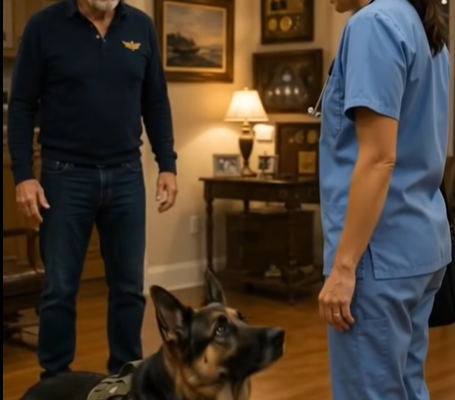
He was a military working dog attached to our detachment for nearly four years.
German Shepherd.
Black saddle.
Tan legs.
Dark mask.
Ninety pounds when healthy.
Too intelligent for his own good.
Hated helicopters until the rotors started moving.
Loved dried chicken.
Would ignore steak on command but steal scrambled eggs if he believed nobody was watching.
He knew my footsteps.
My breathing.
My moods.
He could tell when I was about to lose my temper before I could.
PART2:
And once, during a training accident in Virginia, a piece of metal tore the skin above his left eye and left a crescent-shaped scar that never grew fur correctly again.
Later, in Afghanistan, he cracked a lower canine during a close engagement.
A veterinary dental specialist repaired it with a titanium cap.
I had been there.
I had held his head afterward while he came out of sedation.
I knew that tooth.
I knew that scar.
I knew Titan.
Which was why I stopped walking when I saw the dog behind the barn.
A red-faced man in a camouflage rain jacket stood outside the cage.
He held a broom handle.
“Back up, you worthless mut.”
The Shepherd pressed himself against the rear bars.
His ribs were visible.
One eye swollen.
Fur missing around the neck.
A heavy logging chain ran from his collar to an engine block beside the cage.
The man jabbed the broom handle between the bars.
The dog snapped once.
Not lunging.
Warning.
The man pulled back and laughed.
“See?”
A few auction buyers stood nearby.
Nobody intervened.
“Mean bastard,” one said.
“Probably why they’re selling him for nothing.”
The man lifted the broom handle again.
I caught his wrist.
Hard.
He spun.
“What the hell?”
“Drop it.”
“Get your hand off me.”
“Drop the stick.”
He looked me over.
Six-two.
Two hundred twenty pounds.
Old canvas jacket.
Navy insignia on the sleeve.
Scar reaching above my collar.
Something in my face must have convinced him arguing would require more energy than he wanted to spend.
He let the broom handle fall.
“This is county property.”
“Then why are you hitting it?”
“He bit me.”
“You stuck a broom into his cage.”
“He’s dangerous.”
The Shepherd had not taken his eyes off me.
That bothered me.
Not because he looked aggressive.
Because he looked familiar.
I stepped closer.
The man grabbed my arm.
“Don’t.”
I looked at his hand.
He removed it.
“County says nobody opens the cage until the animal lot comes up.”
“What’s his name?”
“No idea.”
The paperwork stapled to the fence said:
LOT 117B
ADULT MALE GERMAN SHEPHERD
TEMPERAMENT: AGGRESSIVE / UNPREDICTABLE
OWNERSHIP: FORFEITED PROPERTY
NO GUARANTEES
STARTING BID: $1
One dollar.
The dog shifted.
His left side turned toward me.
My chest tightened.
Crescent scar.
Above the eye.
I stepped closer.
“Titan?”
Nothing.
The red-faced man laughed.
“Sure. Call him whatever you want.”
The dog remained still.
His ears flattened.
I crouched.
Slowly.
My knees sank into mud.
“Titan.”
One ear moved.
That could mean anything.
Dogs respond to tone.
Sound.
Attention.
I told myself that.
Then he opened his mouth.
For one second.
Long enough.
Titanium.
Lower canine.
My hearing narrowed.
The auction crowd disappeared.
The rain disappeared.
I was back in a plywood veterinary structure overseas, listening to a Navy dentist explain why a working dog could continue service with a capped tooth.
I remembered joking:
“So he’s got better dental work than I do?”
I remembered Titan waking.
Trying to stand too early.
Pressing his head into my chest.
My dog.
The dog in front of me was too thin.
Older.
Damaged.
But scars do not lie easily.
Neither does titanium.
Still, I needed certainty.
Because grief makes people stupid.
I had learned that.
For three years I had looked at dogs in truck beds.
Airport security lines.
Police K9 demonstrations.
Once I followed a Shepherd through a Home Depot parking lot for fifty yards before realizing his markings were completely wrong.
Grief can make coincidence feel like resurrection.
So I did not call his name again.
Instead, I raised my right fist.
Held it near my chest.
Extended two fingers.
Then pressed them against my sternum.
It was not some universal military gesture.
It was a silent signal our detachment had used in specific training scenarios.
Hold position.
Wait for extraction.
The dog changed.
Instantly.
His ears snapped forward.
His shoulders tightened.
His eyes locked onto me.
Then he sat.
Perfect.
Even with weak hind legs.
Even with mud around his paws.
He sat.
A small sound escaped him.
Not a bark.
Not a growl.
A whine.
Thin.
Almost breathless.
I forgot how to breathe.
“Titan.”
His tail moved once.
The red-faced man stopped smiling.
“What did you do?”
I didn’t answer.
The chain rattled.
Titan leaned forward.
Not enough to pull against it.
Just enough that I knew.
Three years collapsed.
Hospitals.
Funerals.
The folded American flag handed to another family.
The condolence letter.
The report.
The collar they returned to me in a sealed evidence bag.
All of it became impossible.
My dog was alive.
Which meant somebody had lied.
The auctioneer arrived twenty minutes later.
By then, I had called the county sheriff’s office.
Not because I thought anyone would immediately believe me.
Because I wanted a record.
Sheriff Tom Avery showed up personally.
Tom was sixty-one.
Gray mustache.
Former state police.
The kind of rural sheriff who could talk politely while making you understand handcuffs remained an option.
He found me beside the cage.
“What happened?”
I pointed.
“That dog belonged to the United States military.”
Tom looked at the paper.
“Says forfeited property from the Harlan estate.”
“Paper is wrong.”
“You sure?”
“Yes.”
“How sure?”
I showed him a photograph on my phone.
Titan and me.
Afghanistan.
The crescent scar visible.
Tom compared.
Then I zoomed into another.
Open mouth.
Titanium tooth.
Tom exhaled.
“That is interesting.”
The red-faced man, whose name turned out to be Deke Harlan, stepped forward.
“My uncle owned that dog.”
Tom looked at him.
“Thought the estate was forfeited.”
“It was.”
“Then he’s not your dog.”
Deke’s jaw tightened.
“He’s dangerous.”
Tom looked at Titan.
“Has he attacked anyone today?”
“He bit me.”
“Medical treatment?”
“No.”
“Photographs?”
“No.”
“Witness?”
Deke gestured toward the broom handle.
Several people looked away.
Tom nodded slowly.
“Right.”
I wanted the cage opened.
Tom refused.
Correctly.
Until county ownership records were reviewed, the animal remained part of the auction inventory.
I hated hearing that.
But I understood.
The auction was legally disposing of seized property after a tax and fraud judgment against the deceased owner, Vernon Harlan.
That meant process.
Chain of custody.
Paperwork.
I had spent enough years around operations to know that emotional certainty does not replace procedure.
Tom called county animal control.
They were forty minutes away.
Then he looked at me.
“Can you wait?”
“I waited three years.”
He studied me.
“Fair enough.”
Lot 117B came up at 1:37 P.M.
The crowd had doubled because rumors spread fast.
Retired SEAL says auction dog is military.
People wanted entertainment.
Auctioneer Ray McAdams stood beneath a portable canopy with a microphone.
“Next item is the Shepherd listed as aggressive.”
Nobody raised a hand.
Ray looked uncomfortable.
“Opening at one dollar.”
Silence.
I raised my bidder card.
“One.”
Ray waited.
“Do I have two?”
Nothing.
Deke stood near the barn.
Arms folded.
Angry.
Ray looked around.
“One dollar once.”
Rain tapped the canopy.
“One dollar twice.”
Titan stared through the cage.
“Sold.”
The gavel came down.
One dollar.
People laughed softly.
Some applauded.
I did neither.
I signed a transfer sheet.
Paid a dollar bill.
Then handed another county employee fifty dollars for the handling fees.
Tom watched.
“You realize the fees cost fifty times the dog.”
“He’s used to government accounting.”
That was the first joke I had made all day.
Tom almost smiled.
Animal control arrived.
Two officers.
One was cautious after reading the aggression warning.
“Does he have a bite history?”
“Not with me.”
“That isn’t the same answer.”
“No.”
Fair.
We cleared everyone away.
I went to the cage.
Slow.
No direct reach.
Titan watched.
I gave him the old down signal.
He lowered.
Weakly.
The officer unlocked the outer chain.
Then the cage.
I opened the door.
Titan did not leave.
That hurt more than anything.
Three years of captivity had taught him open doors could be traps.
I sat in mud.
No command.
“Take your time.”
His nose moved.
He sniffed.
Me.
Rain.
Air.
Then he crawled forward.
One paw.
Second.
He stopped with his head outside the cage.
I offered the back of my hand.
Titan smelled it.
His whole body shuddered.
Then he pressed his face against my palm.
I broke.
No heroic restraint.
No SEAL toughness.
I put my forehead against his head and cried into filthy fur.
Titan whined.
Tried to climb into me despite barely having strength.
I wrapped my arms around him carefully.
“I’m sorry.”
He licked my chin.
“I’m sorry.”
Three years.
“I thought you were dead.”
His tail moved weakly in the mud.
Tom Avery turned away.
Gave me dignity.
The county officers did too.
Even Deke said nothing.
For a minute.
Then he muttered:
“You don’t know what you’re buying.”
I looked at him.
“No.”
He smiled without humor.
“But I know what somebody stole.”
His expression changed.
That was the first moment I became certain the dog was not the only secret on that property.
We took Titan to Oak Haven Veterinary Center.
Dr. Rachel Kim met us at the side entrance because I had called ahead.
Titan weighed sixty-three pounds.
He should have been around ninety.
Dehydrated.
Flea infestation.
Pressure wounds around the neck.
Old untreated cuts.
One infected puncture near his shoulder.
Swollen left eye from blunt trauma or impact.
No obvious fractures.
His bloodwork suggested malnutrition and chronic stress but nothing immediately terminal.
Rachel scanned for a microchip.
The reader beeped.
A number appeared.
She frowned.
“What?”
“This chip is registered to a private security contractor.”
“What company?”
“North Coast Tactical Canine.”
I had never heard of it.
She scanned again.
Same number.
Tom stood near the door.
“So he’s not yours.”
“He is.”
Rachel looked at me.
“I believe you. But the chip says something else.”
“Military working dogs had government identification.”
“Could have been removed.”
I felt sick.
“Can you scan the whole body?”
She gave me a look.
“That’s what I’m doing.”
She moved the reader along Titan’s shoulder.
Neck.
Back.
Chest.
Then lower, near the left side behind the rib cage.
The scanner beeped again.
Different number.
Everyone froze.
Rachel moved back.
Beep.
“Two chips.”
Tom stepped closer.
“Read it.”
She did.
The second number had the formatting pattern used by older government working-dog records.
I knew because Titan’s original paperwork had one.
I pulled up a photograph from my phone.
The military health certificate I had kept.
Rachel compared.
Last six digits.
Same.
Tom said nothing.
He didn’t need to.
Two microchips.
One civilian registration.
One military identifier buried deeper beneath tissue.
Someone had implanted a new chip without removing the old one.
Rachel ordered X-rays.
I stayed beside Titan.
He put one paw over my boot.
Old habit.
Whenever we waited in clinics overseas, he did that.
I had forgotten.
Or tried to.
Rachel returned with the radiograph.
“There’s another thing.”
My stomach dropped.
“What?”
She pointed near Titan’s upper shoulder.
A tiny metallic object.
Not the chip.
Larger.
Irregular.
Tom leaned closer.
“Bullet?”
“No.”
Rachel zoomed.
“It looks like part of a tracking implant or subdermal device.”
I stared.
Military dogs had used identification and sometimes tracking hardware during specific deployments, but this placement did not match anything I remembered.
“Can you remove it?”
“Not tonight unless medically necessary.”
Tom shook his head.
“Don’t.”
Rachel looked at him.
“If it’s evidence, we preserve chain of custody.”
Tom was already calling someone.
The sheriff had moved from curious to serious.
Deke Harlan’s warning echoed.
You don’t know what you’re buying.
Titan slept at my cabin that night.
Or tried.
I set up blankets beside the wood stove.
Food in small portions.
Water.
Medication.
He refused the dog bed.
Instead, he lay against the front door.
Exactly like before.
I sat on the floor beside him.
For hours.
Sometimes he slept.
Sometimes his eyes opened and checked me.
Still here?
I touched his shoulder.
“Still here.”
At 10:14 P.M., someone drove past my cabin slowly.
I heard gravel.
Headlights crossed the wall.
Titan woke immediately.
No bark.
Head up.
Working posture.
I moved to the side window.
Black pickup.
No plates visible from where I stood.
It continued.
Twenty minutes later, it came back.
I called Tom.
“Someone’s circling.”
“Lock doors.”
“Already done.”
“Don’t go outside.”
“I wasn’t planning to.”
That was a lie.
Tom knew.
“Luke.”
“I’m inside.”
“Stay there.”
“I heard you.”
“Deputy is on the way.”
Titan stood.
His body was weak.
His instincts were not.
I gave him the old stay signal.
He sat.
Reluctantly.
The truck returned.
Stopped.
Headlights off.
That changed everything.
I killed the lights.
Titan’s ears forward.
My body remembered another life.
Dark.
Quiet.
Breathing controlled.
The cabin became geometry.
Door.
Window.
Hallway.
Cover.
I hated how easily that version of me returned.
Then I reminded myself:
Oregon.
Not Afghanistan.
Police coming.
Do not turn a suspicious vehicle into a war.
A man stepped from the truck.
Second figure stayed inside.
The first approached my porch.
Stopped before the steps.
“Mercer?”
I did not answer.
“Luke Mercer?”
Tom’s deputy arrived from the opposite direction with lights off until the final turn.
The man ran.
He reached the truck.
It accelerated.
Deputy followed.
No gunfire.
No dramatic chase through trees.
Just tires throwing gravel.
Titan remained beside me.
After they disappeared, I looked down.
“You’ve been home seven hours.”
He wagged once.
“Already trouble.”
The deputy got a partial plate.
Registered to North Coast Tactical Canine.
Same company on Titan’s false chip.
At 5:40 the next morning, Tom called.
“Get dressed.”
“I am.”
“You sleep?”
“No.”
“Good. Saves time.”
“What happened?”
“We found the truck.”
“Where?”
“Old logging road.”
“People?”
“Gone.”
“What was inside?”
Pause.
“Dog crates.”
My hand tightened around the phone.
“How many?”
“Six.”
Empty.
Chains.
Sedatives.
Microchip injectors.
Veterinary paperwork.
Tom continued.
“And military-style collars with serial numbers filed off.”
I looked at Titan.
He was awake.
Watching.
The war I thought was over had just entered my kitchen.
By seven, federal investigators had been notified.
Not because a former SEAL demanded it.
Because military property identification had been found inside an animal sold through a county auction.
Tom asked me to bring Titan back to the clinic once a federal veterinary evidence specialist arrived.
I hated moving him.
He had finally eaten.
Finally slept twenty minutes without waking.
But evidence mattered.
At the clinic, Titan’s second chip was officially scanned and documented.
The number matched military records.
Then came the report that destroyed three years of my life in one paragraph.
Titan had not died overseas.
Not according to the original internal veterinary evacuation log.
He had survived.
He had been transported from the field hospital after our convoy attack with a serious leg wound and blast injuries.
He was listed as alive forty-eight hours after I was medically evacuated.
The death notification I received came later.
Different document.
Different chain.
Different signature.
“What happened between those records?” I asked.
Federal investigator Dana Reeves looked at me.
“We’re finding out.”
“Who signed the death report?”
“Contract veterinary liaison.”
“Name?”
She turned the page.
Marcus Vale.
I knew him.
Not personally.
A civilian logistics contractor who moved animals and equipment between regional facilities.
He had visited our compound twice.
I remembered because Titan hated him.
Not aggression.
Avoidance.
Titan would leave the room when Vale entered.
At the time, I joked that dogs judged character better than people.
Nobody laughed now.
North Coast Tactical Canine had been founded by Marcus Vale eighteen months after Titan’s supposed death.
Tom swore softly.
Dana looked at him.
“Sheriff.”
“Sorry.”
“No. Appropriate.”
The theory developed carefully.
Not as fact until records supported it.
Several military working dogs medically evacuated from overseas had passed through contracted transport systems.
A small number had records showing death or euthanasia.
Some had incomplete microchip documentation.
North Coast later advertised “elite imported security Shepherds” to private buyers.
Dogs sold for tens of thousands.
Titan’s false civilian chip connected him to the company.
His original chip connected him to the military.
His body connected both records.
But the metallic object near his shoulder could matter too.
Once a veterinary surgeon removed it under documented chain-of-custody procedures, the object turned out to be an old miniature tracking capsule.
Damaged.
Inactive.
Still holding a serial number.
Military property.
More proof.
The dog everyone valued at one dollar had evidence inside him that could connect years of paperwork.
By noon, warrants were being prepared.
Deke Harlan disappeared.
So did his cousin Brent, another man associated with the auction property.
Tom found out Vernon Harlan—the dead uncle whose estate had been seized—had done equipment storage for North Coast Tactical Canine.
The collapsing barn was not simply a random place where Titan ended up.
It had been one of several temporary holding locations.
“How long was he there?” I asked.
Tom looked at me.
“We don’t know.”
That answer haunted me.
Three years is a long time.
Maybe Titan had been moved repeatedly.
Sold.
Returned.
Hidden.
Used as a guard dog.
When older injuries and behavior made him less profitable, somebody chained him behind a barn.
I would never know every day.
I had to live with that.
Just as Titan had.
The warrants went out that afternoon.
By then, local news had heard about “the one-dollar military dog.”
I refused interviews.
Tom refused details.
Dana refused almost everything.
Good.
The case needed evidence more than attention.
At 4:00 P.M., federal and county officers searched North Coast’s primary property sixty miles away.
They found eleven dogs.
Four with suspicious identification histories.
Two microchip scanners.
Blank government veterinary forms.
Sedatives.
Old military equipment.
Transport paperwork.
And a locked office containing archived records.
Marcus Vale was not there.
Deke was.
He ran.
He made it across a muddy pasture before Tom’s youngest deputy caught him near a fence.
Brent Harlan surrendered.
Vale disappeared overnight.
The next morning, Tom stood in my cabin drinking coffee.
Titan slept near the stove.
“He’ll be caught.”
“Maybe.”
“He will.”
I looked at the dog.
Tom followed my gaze.
“You okay?”
“No.”
“Fair.”
I held Titan’s old tactical collar.
The one the Navy had returned to me after his supposed death.
For three years I had carried it.
Sometimes in a duffel.
Sometimes beside my bed.
Once around my wrist during a bad night when I thought I was losing my mind.
Now Titan slept ten feet away wearing a soft medical collar around his wounded neck.
I held up the old one.
“How did they send me this if he was alive?”
Tom had no answer.
Dana did later.
The collar had been removed during Titan’s initial treatment.
A replacement transport collar went with the dog.
The original personal collar was incorrectly included with effects returned to the unit.
That mistake helped make the false death report believable.
Titan’s collar came home.
Titan didn’t.
For years, nobody connected the discrepancy.
Because paperwork said death.
Once a system records death, people stop searching for life.
That sentence stayed with me.
Marcus Vale was arrested four days later at a motel near the California border.
He did not confess immediately.
Men like him rarely do.
But records spoke.
Emails.
Payment transfers.
Dog sales.
Microchip changes.
Transport manifests.
The case widened.
Not dozens of stolen K9s.
Not some giant impossible conspiracy.
A smaller operation.
Which somehow made it worse.
A few people.
A few opportunities.
Dogs moving through a complicated system.
Records nobody expected handlers to cross-check years later.
Some animals had been legitimately retired or transferred.
Others had questionable paperwork.
Investigators sorted them carefully.
No sensational claims.
No assumption every irregularity was theft.
But Titan’s case was clear enough.
He had been alive after the date used in my official notification.
His identity had been altered.
He later appeared in a private security network.
That was evidence.
One dog.
One undeniable chain.
I should have felt triumphant.
Instead, I became angrier every day.
Not movie anger.
Not revenge.
The kind that sits behind the ribs and makes food taste wrong.
I kept thinking:
Three years.
Three years Titan could have been home.
Three years I believed he had died for me.
Three years he had no idea why I never came.
That thought was the worst.
Did he wait?
After the field hospital?
After transport?
When strangers handled him?
Did he listen for my voice?
Did he think I had abandoned him?
The question destroyed me one evening.
I sat on the floor beside him.
Titan was gaining weight slowly.
His eye swelling had improved.
The wounds around his neck were closing.
He still startled when chains rattled.
Still flinched if a broom handle scraped the porch.
Still ate too fast.
I touched the crescent scar above his eye.
“I didn’t leave you.”
Titan looked at me.
“I didn’t know.”
His tail moved.
That made it worse.
“I would have come.”
He leaned his forehead against mine.
“You know that, right?”
Of course he couldn’t answer.
So I kept saying it.
“I would have come.”
Maybe I needed to believe him.
Recovery took months.
For both of us.
Titan gained weight.
Sixty-three pounds became seventy.
Then seventy-eight.
Then eighty-four.
His coat improved.
The raw neck healed.
The puncture wound closed.
His swollen eye recovered.
His hind leg remained stiff from old injuries.
Dr. Kim started physical therapy.
Titan hated underwater treadmill work.
Loved the technician who gave chicken afterward.
He eventually understood the treadmill was a tax.
At home, routines returned strangely fast.
Titan slept near the door.
Waited outside the bathroom.
Inspected groceries.
Stared at my eggs.
The first morning he stole one off my plate, I laughed so hard I scared him.
“Still a thief.”
He retreated two steps.
I stopped immediately.
“Hey.”
Soft voice.
“It’s okay.”
Titan watched.
I took another egg.
Placed it in his bowl.
His tail moved.
It took time to learn each other again.
People imagined reunion should make everything normal instantly.
It didn’t.
Titan had changed.
So had I.
He sometimes woke barking.
I sometimes woke reaching for a weapon that wasn’t there.
He hated being confined.
I hated crowds.
He guarded food for the first month.
I couldn’t tolerate people standing behind me.
We were two damaged veterans sharing a cabin.
It worked better than therapy on some days.
Worse on others.
Dr. Kim referred me to a veterinary behavior specialist.
I almost refused.
Then remembered what arrogance had already cost me in life.
I went.
We learned Titan’s food guarding came from deprivation.
We separated feeding from pressure.
No taking bowls.
No testing him.
Consistency.
The guarding decreased.
I started seeing my own behavior reflected uncomfortably.
Titan did not need somebody proving he could tolerate stress.
He needed somebody reducing unnecessary stress while he healed.
Apparently so did I.
I went back to therapy.
The human kind.
My therapist, Dr. Helen Ward, listened to the entire story.
At the end she said:
“You’ve spent three years grieving a death that didn’t happen.”
“Yes.”
“And now you’re grieving the life he lived while you thought he was dead.”
I stared.
“Yes.”
“That is still grief.”
I hated that.
Mostly because she was right.
The criminal case moved slowly.
Real cases do.
Hearings.
Evidence review.
Jurisdiction.
Military investigators.
Federal prosecutors.
County charges.
Animal cruelty charges.
Fraud.
Property theft.
Identification tampering.
Transport records.
Nobody was sentenced by sunset.
Nobody’s mansion was seized dramatically.
The machine moved.
Slowly.
But this time I could see it moving.
Deke Harlan eventually pleaded to animal cruelty and related charges connected to several dogs kept on the property.
Marcus Vale faced federal counts tied to fraud and stolen government property.
Additional charges depended on specific dogs and records.
Some cases could not be proven.
That frustrated me.
Dana Reeves reminded me:
“Suspicion is not evidence.”
“I know.”
“You say that like you hate it.”
“I hate when reality is inconvenient.”
“That’s most of reality.”
Titan’s identity, however, was restored.
Officially.
Military records corrected.
Not “deceased.”
Recovered.
Retired.
Returned to former handler under authorized placement.
The document arrived by certified mail.
I opened it at the kitchen table.
Titan lay beside me.
I read the line three times.
STATUS: ALIVE.
Absurd.
Two words.
As if life needed administrative confirmation.
I put the paper down.
Titan looked at me.
“Congratulations.”
He blinked.
“You are officially alive.”
He sneezed.
“Strong reaction.”
Three months after the auction, Sheriff Tom Avery came by.
He brought something wrapped in brown paper.
“What?”
“County auction receipt.”
“I already have one.”
“This is framed.”
I stared.
“You framed a receipt?”
“You paid one dollar for federal evidence.”
“I paid fifty-one dollars with fees.”
“Don’t ruin the story.”
He handed it over.
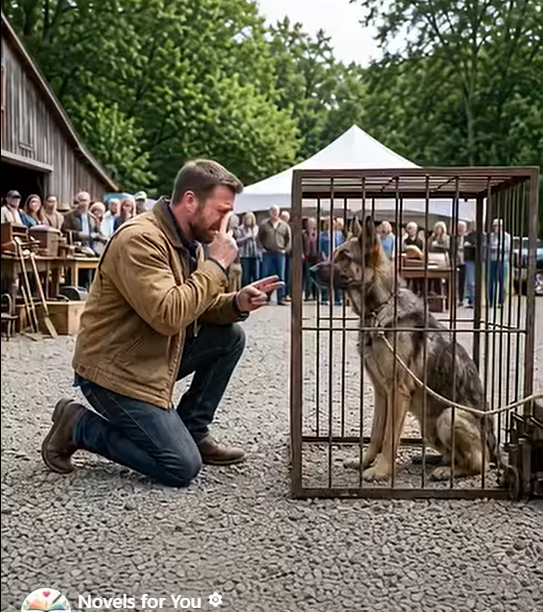
The receipt was mounted beneath a photograph someone had taken at the auction.
Me kneeling in mud.
Titan behind the cage bars.
My hand raised in the old signal.
Underneath, Tom had written:
LOT 117B — BEST DOLLAR EVER SPENT.
I laughed.
Then looked away.
Tom pretended not to notice.
“You keeping him?”
I looked at him.
Tom raised his hands.
“Stupid question.”
“Yes.”
Titan lifted his head at his name.
“Good.”
Tom crouched.
Titan sniffed him.
Allowed one scratch.
“You know,” Tom said, “the first time I saw him, I thought you were wrong.”
“I know.”
“You looked like a man seeing a ghost.”
“I was.”
“Then he sat.”
I nodded.
Tom smiled.
“Dog knew before any of us.”
That signal became famous later because somebody recorded part of the auction.
I hated that.
People online called it classified.
It wasn’t, exactly.
It was simply one of many unit-specific silent cues developed and reinforced during training.
Nothing mystical.
Nothing that would mean anything to the average civilian dog.
But Titan remembered.
That mattered.
A reporter once asked:
“Do you think Titan recognized the signal or recognized you?”
I answered:
“Yes.”
Because separating the two felt pointless.
The signal belonged to us.
The person.
The movement.
The memory.
The years of repetition.
He knew.
That was enough.
Six months after Titan came home, I took him to the Oregon coast.
We had once trained near water.
Titan loved waves until they touched his paws.
Then he acted betrayed.
I wanted to see whether he remembered.
He stood on wet sand.
Wind moving his fur.
Stronger now.
Eighty-eight pounds.
Neck healed.
Scar above the eye still visible.
The titanium tooth flashed when he opened his mouth.
A wave rushed toward us.
Titan jumped backward.
I laughed.
“Still hate it.”
He barked.
First real bark I had heard from him since the auction.
Deep.
Strong.
He ran three steps.
Stopped because the old leg hurt.
I slowed.
He looked at me.
No shame.
Dogs don’t apologize for bodies aging.
Humans could learn from that.
We walked.
Slow.
Two veterans.
No mission.
That was harder than it sounds.
For years, every important movement had purpose.
Objective.
Extraction.
Target.
Route.
Now we walked because the beach was there.
Titan sniffed driftwood.
I watched gulls.
Nothing happened.
It was one of the best days of my life.
Back at the cabin, I took the old collar from the drawer.
The one I had carried for three years.
I had not known what to do with it after Titan returned.
Putting it on him felt wrong.
It belonged to the dog I thought had died.
Throwing it away felt worse.
So it remained wrapped in cloth.
That night I placed it beside his bed.
Titan smelled it.
Long.
Then looked at me.
I sat beside him.
“That was all I had.”
He sniffed again.
Then lay down with one paw touching it.
I stayed there.
For the first time, the collar did not feel like a grave marker.
It was just part of our history.
A terrible part.
But not the ending.
A year after the auction, I returned to the county sale.
Tom invited me.
“Why?”
“Tradition.”
“We have no tradition.”
“Starting one.”
I almost refused.
Crowds still bothered me.
Auction noise.
Metal.
Mud.
Too many memories.
Then Titan walked to the truck when he saw his travel harness.
I laughed.
“You’re making decisions now?”
We went.
The collapsing barn had been demolished.
The cages gone.
The engine block gone.
The property eventually sold after court proceedings.
Standing there felt strange.
The place where I found Titan had become ordinary ground.
Grass.
Mud.
A new fence.
No evidence of what happened.
That is how places work.
People carry the memory.
Not land.
Several auction workers recognized Titan.
Ray McAdams, the auctioneer, walked over.
“He looks different.”
“He weighs twenty-five pounds more.”
“Still aggressive?”
Titan sniffed Ray’s hand.
Then sat.
Ray smiled.
“I got robbed.”
“You sold him for a dollar.”
“Exactly.”
I handed him one dollar.
“What is this?”
“Adjustment.”
He laughed.
“No refunds.”
“Keep it.”
He taped the bill inside his auction booth.
Later he wrote:
TITAN’S SECOND DOLLAR.
People made it sentimental.
Fine.
I had stopped fighting every soft thing.
There was enough hardness in the world without me defending it.
The criminal proceedings ended gradually.
Vale was convicted on multiple federal fraud and stolen-property-related charges tied to Titan and other evidence.
Not every dog in the records was proven stolen.
Some had legitimate transfer histories.
Investigators reunited two animals with authorized former handlers.
Others were placed through official channels.
One had already died years before the investigation.
That one hurt.
No heroic ending.
Just a record finally corrected too late.
Dana told me:
“You gave us a door.”
I shook my head.
“Titan did.”
She looked at him.
“He was the evidence.”
“No.”
“What?”
“He was a dog.”
I needed people to understand that.
Titan did not exist to expose a crime.
He did not survive captivity so humans could have an inspiring story.
He was a dog.
He deserved rescue even if the second microchip had led nowhere.
Even if the tracking capsule had no number.
Even if Vale never existed.
Even if there was no conspiracy.
A starving animal chained behind a barn deserved help without needing to become important evidence.
That lesson mattered to me.
At the auction, people ignored him because the sheet said one dollar.
Aggressive.
Liability.
No guarantees.
Then his military history appeared.
Suddenly he was valuable.
Newsworthy.
Hero.
But Titan’s worth had not changed.
We had.
That thought stayed with me.
How many things do people ignore until someone proves they were once important?
Old dogs.
Disabled veterans.
Poor people.
Broken houses.
Quiet lives.
As if value requires credentials.
Titan had medals attached to his old records.
Deployment history.
Certifications.
None of them mattered when he was starving.
Food mattered.
Safety.
Water.
Medical treatment.
Someone recognizing him.
Maybe that is why finding him changed me more than losing him.
For three years, I believed I had failed to protect my dog.
Then I found out the failure was different.
He had survived.
And life had still hurt him.
I could not undo that.
I could only be there now.
Therapy taught me to stop trying to repair the past through punishment of the present.
Titan taught it better.
He did not ask me to suffer because he suffered.
He wanted breakfast.
Walks.
My chair.
Eggs.
The door open.
Sometimes the simplest needs are merciful.
Two years after the auction, Titan’s muzzle became mostly gray.
His old leg worsened.
We added ramps.
Pain medication when needed.
Physical therapy.
Shorter walks.
He still slept by the door.
Still checked the windows when trucks slowed.
Still watched my hands closely.
One morning I raised the old signal again.
Fist.
Two fingers.
Chest.
Titan was lying near the stove.
His ears lifted.
He sat slowly.
Then looked offended.
I smiled.
“At ease.”
He lay back down.
That was when I realized the signal no longer hurt me.
For years, it belonged to war.
Then grief.
Then reunion.
Now it belonged to an old dog who wanted to nap.
That is healing.
Not forgetting.
Changing what the memory does to you.
The collar eventually went into a shadow box.
Not alone.
Auction receipt.
Corrected military record.
One photograph from Afghanistan.
One from the Oregon coast.
The title plate said only:
TITAN
WORKING DOG
PARTNER
HOME
I refused “hero.”
He had done heroic things.
But hero can become another cage.
I wanted home.
That was the word we had lost.
The cabin changed too.
I installed better lights because my head injury made the old ones terrible.
Started sleeping more.
Started answering calls.
Went to town without choosing the quietest hour every time.
Tom bullied me into volunteering with the county veterans’ program.
I told him I hated groups.
He said:
“Good. Everyone there hates groups.”
Fair.
Titan came sometimes.
No formal therapy certification.
No vest pretending he was something he wasn’t.
He simply lay near my chair.
Veterans noticed.
One man named Chris had lost part of his leg overseas.
He stared at Titan’s stiff gait.
“Old injury?”
“Several.”
Chris nodded.
“Same.”
Titan eventually rested his head on Chris’s boot.
No miracle.
Chris did not suddenly heal.
But he smiled.
Sometimes that is enough for Tuesday.
The one-dollar story followed us.
People asked constantly.
“Would you have bought him if you didn’t recognize him?”
That question annoyed me.
The truthful answer?
I don’t know.
I had gone there for a wood splitter.
Maybe I would have reported the abuse.
Probably.
Would I have adopted an unknown aggressive Shepherd?
Maybe not.
That realization humbled me.
I wanted to imagine I was always the kind of man who would save Titan.
But before I knew he was Titan, I was still another stranger looking through bars.
Recognition changed my obligation.
I think about that often.
Compassion should not require recognition.
The dog did not become more deserving when I knew his name.
He was already starving.
Already frightened.
Already being hit.
That was enough.
I tell that part whenever someone wants the heroic version.
They usually prefer:
SEAL FINDS LOST K9.
It sounds clean.
It wasn’t.
A broken dog and a broken man recognized each other.
Then lawyers, veterinarians, deputies, investigators, shelter workers, and ordinary people did months of boring work.
That was the rescue.
Not one signal.
The signal simply opened the door.
Titan lived almost four more years after I found him.
Longer than Dr. Kim initially expected.
Good years.
Not perfect.
His hips declined.
He developed kidney disease near the end.
We managed it.
Food changes.
Medication.
Fluids.
Appointments.
I knew what was coming before I admitted it.
Veterans are excellent at recognizing losing battles and terrible at accepting them personally.
One winter morning, Titan could not stand.
He tried.
Front legs up.
Back legs failed.
He looked at me.
Not frightened.
Confused.
I helped him.
He ate half breakfast.
Ignored the eggs.
That was when I knew.
Dr. Kim came to the cabin.
Titan hated clinics by then.
He deserved home.
Tom came too, though I did not ask.
He stood outside on the porch until I called him in.
Titan lay on his blanket near the stove.
Old tactical collar beside him.
I put my hand on his chest.
His breathing slow.
Dr. Kim explained everything even though I already knew.
I appreciated that.
Good professionals do not assume knowledge eliminates grief.
Before she began, I raised my right hand.
Fist.
Two fingers.
Chest.
Titan’s ears moved.
His eyes opened.
He looked at me.
Tried to sit.
“Stay.”
My voice broke.
I changed the signal.
Open palm.
Rest.
A command we had used after long movements.
Titan lowered his head.
I pressed my forehead to his.
“No more waiting.”
His tail moved once.
That was the last command I gave him.
He died with my hand against his chest.
Not alone.
That mattered more than everything.
Afterward, Tom helped me carry him to the truck.
I had once carried Titan from helicopters.
Across rocks.
Into veterinary tents.
From an auction cage.
Now I carried him one last time.
His ashes came home two weeks later.
I put them beneath the shadow box.
The one-dollar receipt stayed.
People asked whether losing him again destroyed me.
Yes.
And no.
The first time, I had been given a report and a collar.
No body.
No goodbye.
Only imagination.
The second time hurt differently.
Cleanly, if grief can ever be clean.
I knew where he had been.
I knew he was loved.
I knew he had eaten eggs three days before.
I knew he had slept near my door the night before he died.
I knew the last thing he heard was my voice.
There is mercy in certainty.
Three years after Titan’s real death, I still have the auction receipt.
Sometimes veterans visiting the cabin ask about it.
One dollar.
They laugh.
Then I tell them.
Not all of it.
Not every time.
Usually:
“I went to buy a wood splitter.”
They look at the shadow box.
“And came home with him?”
“Yes.”
“Best dollar you ever spent?”
I look at Titan’s photograph.
“No.”
That surprises them.
“He was never worth a dollar.”
Then I explain.
The dollar didn’t measure Titan.
It measured how little everyone there understood what they were looking at.
A starving dog.
Aggressive label.
Rusted cage.
Lot 117B.
One dollar.
The same animal had once saved lives.
Later carried evidence that exposed a crime.
But even those things were not the reason he mattered.
He mattered before the missions.
Before the titanium tooth.
Before the tracking capsule.
Before federal investigators.
Before the classified-looking hand signal that people online would eventually replay millions of times.
He mattered because he was alive.
Because he trusted.
Because he hurt.
Because somebody had chained him in the mud and called him worthless.
They were wrong.
I had been wrong too.
For three years I believed Titan’s story ended in Afghanistan.
It didn’t.
His story crossed an ocean.
Passed through paperwork.
False identities.
Private kennels.
Chains.
A county seizure.
An auction sheet.
Then eventually reached a muddy Oregon barn on the exact morning an exhausted former SEAL decided he needed a wood splitter.
People call that fate.
I don’t know.
I used to believe in planning.
Routes.
Intelligence.
Contingencies.
Then life taught me how little of it we control.
All I know is this.
I saw a dog.
I recognized a scar.
Then a tooth.
I gave him a signal.
And Titan answered.
In that moment, three years of death certificates, official reports, memorial paperwork, and grief became less trustworthy than one old Shepherd sitting in the mud.
That dog gave me something no report ever could.
The truth.
He was alive.
Then, later, when his real time came, he gave me something else.
A chance to stay.
I had spent years believing he died saving me.
Maybe he did save me.
Just not the way the report said.
He saved me in a rusted cage behind a barn.
He saved me by sitting when I raised two fingers.
By following me into a cabin.
By stealing eggs.
By waking from nightmares beside me.
By getting old.
By forcing me to build ramps.
By making me care about mornings again.
The official report had reduced him to one sentence:
MILITARY WORKING DOG KIA DURING OPERATIONAL ACTION.
The corrected record eventually became longer.
Recovered.
Fraud investigation.
Retired.
Placed with former handler.
But even that wasn’t enough.
No government form could contain the important part.
Titan came home.
And for the years we had left, that was all I needed the record to say.