PART 2: HOA Karen Kept Parking in My Garage—Then She Fell Asleep Inside and Met the Two Things She Never Expected
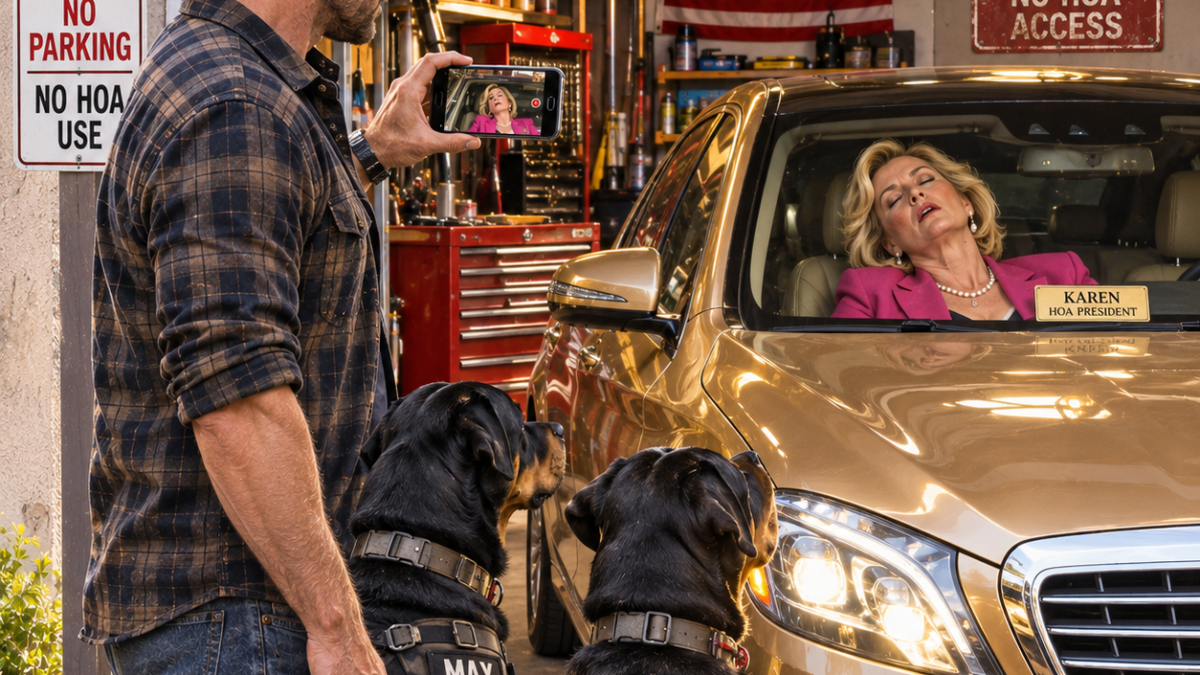
The evening I came home and found HOA president Karen’s gold sedan parked dead center inside my private garage, I thought the worst part was that she had finally crossed the one boundary I had warned her about for months. When I walked closer and realized she was asleep behind the wheel with the engine still running, after repeatedly blocking my driveway and lecturing everyone else about “community rules,” I stopped feeling angry and started thinking very carefully about how I wanted this moment documented. I had no idea that what began as one absurd parking violation would expose something much bigger than Karen’s entitlement, or that before it was over I would find myself standing beside the same woman I had spent a year trying to keep off my property.
My garage had always been the one place in the neighborhood that felt entirely mine.
I worked long shifts, kept mostly to myself, paid my dues on time, mowed the lawn, and never cared much about HOA politics. But when I came home tired, the garage was where the noise stopped. My workbench sat against the back wall. Tools were arranged exactly where I liked them. An old radio lived beside a small refrigerator, and Max and Diesel—my two Rottweilers—usually waited inside the house until I called them out.
Karen became HOA president about a year earlier and immediately treated the position like a promotion to neighborhood governor.
She cited the Johnson kids for sidewalk chalk. She warned an elderly neighbor about a restored pickup that looked “too industrial.” She once stood at the edge of my garage with a stopwatch and told me I’d left the door open too long.
“I’m changing my oil,” I told her.
“The rules say garage doors should remain closed when not actively in use.”
I pointed at the jack, drain pan, and half-disassembled filter.
“What part of this looks inactive?”
She wrote something on her clipboard anyway.
Her parking started the same way: small enough to make me feel petty for objecting.
First her bumper crossed the edge of my driveway during HOA meetings. Then half her sedan blocked me while she “dropped off forms.” Finally, one afternoon, she parked sideways across my driveway while taking a phone call inside her house.
I rang her bell.
“Karen, move the car.”
“I’ll be out in a few minutes.”
“I need to leave now.”
She sighed. “We’re neighbors. We share space.”
“This isn’t shared space.”
When I told her I would call a tow company next time, she gave me a look I still remember.
“You can’t tow the HOA president. We control the towing contract.”
That was when I understood this wasn’t about parking.
It was about whether she believed anyone was allowed to tell her no.
For several weeks she stayed out of my driveway, and I thought the message had finally landed.
Then came that evening.
I turned onto the cul-de-sac after a brutal shift, pressed the garage remote, and watched the door rise.
Karen’s car was inside.
Not halfway.
Not angled by mistake.
Centered perfectly between my tool chest and workbench.
I stopped my truck in the driveway and walked toward her sedan.
She was asleep in the driver’s seat.
The engine was running.
That detail killed any urge I had to play games.
An enclosed garage and a running engine can become dangerous fast, so I left the main garage door fully open and knocked hard on her window.
“Karen.”
Nothing.
I knocked again.
Her chest rose normally, but she didn’t wake.
I pulled out my phone, started recording, and called her name a third time.
This time her eyelids moved.
Then she opened her eyes.
For two seconds she looked confused.
Then she saw me standing outside the glass.
Her expression hardened before she even sat up.
She lowered the window two inches.
“What are you doing?”
I almost laughed.
“In my garage?”
She looked around as though the location had only just occurred to her.
“I needed somewhere quiet for a few minutes.”
“You drove into my garage.”
“The door was open.”
“That is not permission.”
She reached for the gear selector.
I stepped back and said, “Before you leave, we’re going to settle this once.”
Her eyes narrowed.
And from inside my house, Max barked.
Karen froze.
Then Diesel answered him.
Her face changed in a way I had never seen before.
“What,” she whispered, “was that?”
PART 2
“My dogs.”
Karen stared at the door connecting my garage to the house.
“You have dogs?”
“You’ve lived three houses away from me for a year.”
“I don’t inspect people’s pets.”
I raised an eyebrow.
“You sent Mrs. Patterson a warning because her beagle barked during an HOA meeting.”
“That was different.”
“Of course it was.”
Another bark came from inside.
This one was Diesel.
Max had a low, measured bark that sounded like a security system with lungs.
Diesel sounded like someone had just announced a birthday party.
Karen tightened her grip on the steering wheel.
“What kind?”
“Rottweilers.”
All the color drained from her face.
“You have two Rottweilers?”
“Max and Diesel.”
“Keep them inside.”
“They are inside.”
“I mean farther inside.”
I almost smiled.
Then I noticed the engine was still running.
“Turn your car off.”
“What?”
“Turn it off.”
“Why?”
“Because you’re sitting in a running vehicle inside my garage.”
She hesitated, then pressed the button.
The engine died.
The sudden quiet made the situation even stranger.
Karen pushed her window back up.
I leaned against my workbench and crossed my arms.
“Why are you here?”
“I told you. I was tired.”
“That doesn’t explain why you were inside my garage.”
“There were no street spaces.”
“So you parked on private property.”
“I only planned to sit for a minute.”
“You planned to sit inside my garage?”
“The door was open.”
I stared at her.
There it was again.
The same logic she’d used every time she blocked my driveway.
Space existed.
Therefore Karen could use it.
“You know,” I said, “you once threatened the Johnsons with a fine because one bicycle wheel extended over the edge of their driveway.”
“That bicycle was creating a visual obstruction.”
“You’re currently sitting in a sedan beside my table saw.”
“That is completely different.”
“How?”
She had no answer.
Instead she reached for the door handle.
Then Max barked again.
Her hand stopped.
“Make sure they’re secured.”
I sighed.
“They’re trained.”
“That wasn’t my question.”
I turned toward the interior door.
“Max. Diesel.”
Silence.
Then toenails clicked across the tile inside.
Karen’s eyes widened.
“No.”
The door was still closed.
“No what?”
“Don’t bring them out.”
“I need to get into my house eventually.”
“Use another door.”
“Karen, this is my garage.”
“Exactly. You should have multiple exits.”
I laughed despite myself.
Then I opened the interior door only a few inches.
Max’s broad black-and-tan head appeared first.
He looked at me.
Then at the unfamiliar sedan.
Then at Karen through the windshield.
His ears shifted forward.
Diesel shoved his nose beneath Max’s chin and tried to squeeze through too.
“Stay.”
Both dogs stopped at the threshold.
They were not attacking.
They were not growling.
They were waiting for a command.
Karen, however, reacted as though I’d opened the gates of hell.
She screamed.
Max flinched.
Diesel jumped backward.
I shut the door halfway.
“Karen.”
“Get them away!”
“They haven’t moved.”
“They’re staring at me!”
“They’re dogs. That’s what they do when somebody parks in their garage.”
“This is not funny!”
“It wasn’t meant to be.”
Her breathing became fast.
Then she sneezed.
Once.
Hard.
I frowned.
She sneezed again.
Then a third time.
Her eyes started watering.
“Oh, come on,” she muttered.
“What?”
“I’m allergic.”
My irritation disappeared instantly.
“How allergic?”
She waved one hand.
“Very.”
That changed everything.
I closed the interior door completely.
“Max, Diesel, back.”
Their footsteps retreated.
Then I hit the main garage control to make sure the overhead door was fully raised.
“Fresh air. Back out.”
Karen sneezed again.
“My eyes are burning.”
“Do you carry medication?”
“In my purse.”
“Take it.”
She dug frantically through the bag beside her, found an antihistamine, swallowed it with water, then started the car.
Before she moved, I raised one hand.
“Karen.”
She glared at me through streaming eyes.
“You are never parking in my driveway again.”
Another sneeze.
“Fine.”
“And you are never entering my garage without permission.”
“Fine.”
“You understand why?”
“I understand that you apparently operate a kennel.”
I almost lost my temper.
Then she sneezed so violently her visor fell into her lap.
“Karen.”
She closed her eyes.
When she opened them, some of the arrogance was gone.
“Yes.”
“Why?”
“Because it’s your property.”
There it was.
The sentence I’d been trying to get from her for almost a year.
“Thank you.”
She shifted into reverse.
Then stopped.
“Are they really called Max and Diesel?”
“Yes.”
She glanced toward the house door.
“Which one is Diesel?”
“The friendly one.”
Her face somehow became more alarmed.
“There is a friendly one?”
“He likes everybody.”
“That’s worse.”
She backed out carefully.
Halfway down my driveway, she stopped and lowered the window.
“You didn’t need the dogs.”
“I didn’t bring them near you once I knew you were allergic.”
She looked embarrassed.
“I know.”
Then she drove away.
I stood in the garage staring at the empty space where her sedan had been.
Max scratched at the interior door.
I opened it.
He walked out calmly.
Diesel shot past him, sniffed the tire marks, then looked at me as if asking where the exciting visitor had gone.
“Show’s over.”
Diesel wagged.
Max sat beside me.
I looked at both of them.
“You two have no idea what you just accomplished.”
Diesel sneezed.
I laughed so hard I had to sit down.
For the first time in months, my garage felt like mine again.
I expected retaliation the next morning.
A violation notice.
A dangerous-dog complaint.
Maybe an invented rule requiring garages to be allergen neutral.
Nothing came.
Not that day.
Not the next.
Karen disappeared from her usual patrol route.
For forty-eight hours, nobody saw her visor.
No clipboard.
No neighborhood emails.
It was almost unsettling.
On the third afternoon, I was reorganizing sockets when a shadow appeared at the edge of the garage.
I looked up.
Karen.
She stopped at the property line.
That alone was new.
“Can I come closer?”
I nearly dropped the wrench.
“You’re asking?”
Her mouth tightened.
“Yes.”
“Sure.”
She walked halfway up the driveway.
No visor.
No clipboard.
Sunglasses despite the cloudy day.
Her eyes still looked slightly swollen.
Max was lying behind me near the workbench.
The moment Karen saw him, she stopped.
“He’s staying there?”
“Yes.”
Max barely lifted his head.
“Okay.”
She swallowed.
“I came to talk about the other night.”
I leaned against the bench.
“All right.”
She took a breath.
“I shouldn’t have parked in your garage.”
I waited.
She shifted uncomfortably.
“I shouldn’t have parked in your driveway either.”
Still I said nothing.
“And I shouldn’t have told you the HOA towing contract somehow meant you couldn’t tow my car.”
I raised an eyebrow.
“That one was especially creative.”
She looked down.
“I know.”
Then came the word I never expected to hear.
“I’m sorry.”
Quiet.
Almost painful.
Karen Whitmore apologized like someone trying to speak a language she’d only recently discovered.
I asked:
“Why were you really in my garage?”
She looked toward the street.
“I had been dealing with complaints for six hours.”
“That doesn’t explain the garage.”
“I know.”
She rubbed one hand over the other.
“I didn’t want to go home yet.”
That caught me.
“Why?”
“My house felt…”
She searched for the word.
“Loud.”
“You live alone.”
“I know.”
That told me more than she intended.
For the first time, I saw the presidency from her side.
Not sympathetically enough to excuse what she’d done.
But clearly.
Karen had built her days around being necessary.
Complaints.
Notices.
Meetings.
Rules.
Arguments.
She had made herself the center of every neighborhood problem.
Then she’d convinced herself that being needed gave her rights other people didn’t have.
Maybe going home to an empty house after a day of exercising control felt unbearable.
So she’d parked somewhere she considered safe.
Mine.
That did not make it acceptable.
But it made it human.
She said:
“I know I’ve overstepped with other people too.”
I folded my arms.
“That list is long.”
“I know.”
“Sidewalk chalk.”
“I know.”
“Porch light colors.”
“I know.”
“Mr. Lawson’s truck.”
She winced.
“I know.”
“You told a woman her ceramic goose was visually aggressive.”
Karen stared at me.
“It was wearing a neon raincoat.”
I tried not to laugh.
She almost smiled too.
Then the expression disappeared.
“I want to fix some things.”
“Then fix them.”
“I don’t know where to start.”
“Stop treating every neighbor like a violation waiting to happen.”
She nodded.
“And stop inventing authority.”
Another nod.
“And stay out of garages.”
She looked toward Max.
“Trust me. That lesson is permanent.”
Diesel barked from inside.
Karen jumped.
I couldn’t help smiling.
She pointed at me.
“Don’t.”
“I didn’t say anything.”
“You were thinking it.”
“Probably.”
She turned to leave.
Then stopped.
“If you want to file a formal complaint against me, I won’t fight it.”
“I don’t want a complaint.”
She looked surprised.
“I want my property respected.”
“That’s all?”
“That’s enough.”
She nodded and walked away.
The next morning, an HOA email arrived.
I opened it expecting nonsense.
Instead:
**UPDATED GARAGE AND DRIVEWAY ACCESS POLICY**
Effective immediately, no HOA officer, volunteer, contractor, or resident could enter or use another homeowner’s garage or driveway without explicit permission, except in a genuine emergency authorized by law.
I read it twice.
Then laughed.
Karen had written a rule forbidding Karen from behaving like Karen.
There was another paragraph.
**Residents are also reminded to respect household pets and avoid entering private areas where animals may be present without homeowner consent.**
Max slept beside my chair.
Diesel chewed a rubber ball.
“You made policy.”
Neither cared.
Over the next three weeks, something even stranger happened.
Karen changed.
Not completely.
Nobody transforms in twenty-one days.
She still loved lists.
Still loved meetings.
Still spoke as though every sentence deserved minutes.
But the citations slowed.
The sidewalk-chalk warning disappeared.
The Johnson kids drew a twelve-foot dragon across their driveway and lived.
Mr. Lawson parked his restored truck outside without receiving a single photograph.
The bright porch light across from Karen’s house remained bright.
Someone put a pink flamingo in their yard.
Karen walked past it.
She actually walked past it.
People noticed.
The whole street relaxed.
Then Karen vanished from HOA activity almost entirely.
At first, I assumed she had finally learned moderation.
Then one afternoon she returned to my driveway.
She stopped at the edge.
“Can I talk to you?”
I set down the piece of cedar I was sanding.
“What happened?”
She glanced toward Max.
He lay near the garage entrance.
“Can he hear us?”
“He’s a dog, Karen.”
“I know.”
“Yes, he can hear us.”
She lowered her voice anyway.
“Residents have been complaining about someone walking around at night.”
“What kind of someone?”
“Man. Tall. Clipboard. Flashlight.”
“That sounds familiar.”
She grimaced.
“Yes. I know.”
“You?”
“No.”
“Sure?”
“I’m trying to improve.”
“I had to ask.”
She looked genuinely worried.
“He’s checking houses.”
“What does that mean?”
“Looking at windows. Cars. Side gates. Writing things down.”
“Did anyone speak to him?”
“He tells them he’s performing HOA inspections.”
I stopped sanding.
“You didn’t authorize inspections?”
“No.”
“Board?”
“No.”
“Management company?”
“We don’t have one.”
Now I was listening.
“Police?”
“One resident called. He was gone before they arrived.”
Karen clasped her hands.
“I thought maybe you’d keep an eye out.”
“Why me?”
She looked uncomfortable.
“People trust you.”
That landed harder than I expected.
“I don’t patrol neighborhoods.”
“I know.”
“I don’t want your job.”
“I definitely know.”
“But somebody impersonating HOA personnel is different.”
She nodded.
“Exactly.”
“I’ll watch my cameras.”
“Thank you.”
She turned.
“Karen.”
She stopped.
“Do not confront him alone if you see him.”
For once, she didn’t argue.
“All right.”
That night, nothing happened.
Second night, nothing.
Third night, Diesel barked at a raccoon and nearly caused me to declare war on wildlife.
Fourth night, Max stood up at 11:31 p.m.
No bark.
No movement.
Just alert.
That was when I knew.
I stepped onto the porch.
A figure moved near the far end of the street.
Flashlight.
Clipboard.
Tall man.
He paused beside a parked SUV and appeared to write something.
I called the nonemergency police number first.
Then I stepped only as far as my driveway.
Max and Diesel remained behind the gate with me.
“Evening.”
The man looked up.
“Evening.”
“What are you doing?”
“Routine inspection.”
“For who?”
“Neighborhood association.”
“Name?”
He hesitated.
“I’m contracted.”
“By whom?”
“The HOA.”
“What’s your name?”
Another hesitation.
Too long.
I held up my phone.
“Police are on their way.”
His posture changed.
“I don’t want trouble.”
“Then stay where you are.”
Instead he backed away.
Max gave one low bark.
The man flinched.
“I was hired.”
“By who?”
“I don’t know.”
“That doesn’t make sense.”
“Cash job.”
“What job?”
“Walk the street. Take notes.”
“About what?”
“Houses.”
“What specifically?”
“Security cameras. Cars. Lights. When people come home.”
That was no HOA inspection.
“Who gave you the instructions?”
“Envelope.”
“Where?”
He looked toward the road.
Then ran.
I did not chase him.
Neither did the dogs.
I gave police his description and the location of the car he reached.
A patrol officer arrived within minutes.
By then the vehicle was gone.
But my camera had the plate.
So did two neighbors’ doorbell cameras.
That changed things.
The following morning Karen came to my house before eight.
I had barely poured coffee.
“You saw him.”
Not a question.
“Yes.”
“What happened?”
I told her.
Her face lost color.
“He was tracking when people leave?”
“That’s what he said.”
“Why?”
“No idea.”
She sank onto my porch chair.
“This is my fault.”
“Why?”
“Because everyone assumes it’s HOA.”
“He claimed it was.”
“I spent two years making inspections feel normal.”
I didn’t argue.
She looked up.
“So now someone can walk around with a clipboard and people think, Karen.”
That was painfully accurate.
Her authority had created camouflage for somebody else.
“What did police say?”
“They’re checking the plate.”
“Can I help?”
“Give them every email, complaint, contractor record, and board communication related to outside inspections.”
She nodded.
Then whispered:
“I don’t know if I can fix this.”
“Then don’t try to control it.”
Her mouth tightened.
“What does that mean?”
“It means give investigators what you know and let them investigate.”
“I hate that.”
“I know.”
“I’m used to solving things.”
“No. You’re used to directing them.”
She stared at me.
Then laughed once.
“That was rude.”
“Was it wrong?”
“No.”
That afternoon Karen came back.
This time she brought Brandon Cole, the HOA vice president.
Brandon was thirty-something, tall, polished, always dressed as if a real-estate photographer might appear unexpectedly.
He had ambition.
Everyone knew it.
He also had a clipboard.
Of course.
“I heard you encountered the fake inspector,” he said.
“Yes.”
“We should form a security committee.”
“No.”
He blinked.
“That was fast.”
“We have police.”
“But HOA oversight—”
“No.”
Karen almost smiled.
Brandon looked at her.
“You agree?”
“Yes.”
He seemed offended.
“This is exactly when leadership matters.”
I said:
“Leadership matters. Amateur surveillance doesn’t.”
Brandon’s jaw tightened.
He left twenty minutes later.
I didn’t think much of it.
Until that night.
Around eleven, Diesel started barking near my side fence.
Max joined him.
I stepped outside.
A trash can lay on its side.
Movement near the gate.
I turned on the floodlight.
Brandon froze.
He was standing along the side of my property.
Clipboard in hand.
“What are you doing?”
He raised both hands.
“Relax.”
“Answer me.”
“I was checking something.”
“At eleven at night?”
Karen, who happened to be walking over after I’d texted her about the noise, came around the corner.
“Brandon?”
His face changed.
“Karen.”
She folded her arms.
“What are you doing here?”
“Preliminary security review.”
“I didn’t authorize that.”
“I’m vice president.”
“So?”
“I have responsibilities.”
“Not in his side yard.”
Brandon looked at me.
“I wasn’t inside the property.”
My camera would answer that later.
I pointed toward the sidewalk.
“Show us what you’re writing.”
“No.”
Karen stepped forward.
“Brandon.”
He clutched the clipboard.
“This isn’t your concern.”
“You are conducting unauthorized HOA activity while someone is impersonating an HOA inspector. It is absolutely my concern.”
His confidence cracked.
Finally he said:
“I got an email.”
“What email?”
“Anonymous.”
He pulled out his phone.
The message claimed I stored illegal equipment in my garage.
It told Brandon to document “suspicious activity” before the next board meeting.
I stared at him.
“You believed that?”
“I didn’t know.”
“So you came at night?”
“I didn’t want confrontation.”
Karen’s eyes narrowed.
“Who sent it?”
“Burner address.”
She went still.
“What?”
Karen took out her own phone.
She showed us an email.
Different wording.
Same sender domain.
Her message accused Brandon of planning a coup against her presidency.
My stomach tightened.
I checked my inbox.
Buried in spam was another.
Same domain.
Mine accused Karen of preparing to fabricate violations against my property and urged me to document her “secret patrols.”
Someone had been feeding all three of us different stories.
Brandon looked pale.
“I didn’t hire the inspector.”
Karen looked at him.
“I thought you did.”
“I thought you were behind the messages.”
“I wasn’t.”
I held up my phone.
“Stop.”
They both looked at me.
“Somebody wants each of us suspicious of the others.”
Karen whispered:
“Why?”
That was the question.
The answer arrived four days later.
Saturday morning.
Email.
Sender:
**Douglas Harlan**
Former HOA president.
Karen’s predecessor.
He’d moved away more than a year earlier.
Subject:
**WE NEED TO TALK**
The message contained only a few lines.
**You’re in danger.**
**They’re coming for you next.**
**Meet me at six behind the old maintenance shed. Come alone.**
I read it twice.
Max rested his head against my knee.
Diesel dropped a mangled rubber toy beside my foot.
I forwarded the email to the detective working the fake-inspector case.
Then I called Karen.
Before I finished explaining, she said:
“Douglas.”
The speed of her answer bothered me.
“You expected him?”
“No.”
“But you know something.”
She hesitated.
“He warned me when I first became president.”
“About what?”
“He said the board wasn’t what it looked like.”
“What does that mean?”
“I thought he was bitter.”
“Did he give specifics?”
“No. He just said, ‘Watch who benefits when people fight.’”
Brandon joined us later.
When he learned about the meeting, he said:
“You can’t go alone.”
“Douglas asked me to.”
Karen pointed toward my house.
“Take the dogs.”
I looked at her.
“You’re recommending Max and Diesel now?”
“I haven’t completely recovered, but they have useful qualities.”
Diesel wagged as if he’d received an award.
The detective advised me not to play hero.
Officers would remain nearby but out of sight.
I would not carry a weapon.
I would not pursue anyone.
If something felt wrong, I would leave.
That was fine with me.
At six, I walked toward the old maintenance shed with Max and Diesel on leashes.
The place sat behind an abandoned community garden.
Weeds had grown through the path.
The shed’s paint was peeling.
Max stopped twenty feet away.
Low growl.
I tightened the leash.
“Easy.”
The door opened.
Douglas stepped out.
He looked older.
Beard.
Sunken eyes.
Thin.
“You came.”
“You said I was in danger.”
He looked at the dogs.
“Good.”
“What is going on?”
Douglas scanned the tree line.
“I didn’t resign because of stress.”
“What happened?”
“I found invoices.”
“What kind?”
“Vendor contracts.”
He lowered his voice.
“Security. Landscaping. Maintenance. Management consulting.”
“So?”
“Inflated.”
“How inflated?”
“Sometimes double.”
My stomach tightened.
“Who?”
“A company called Northstar Community Services.”
I’d never heard of it.
Douglas continued.
“They target small self-managed HOAs. Create conflict. Push boards toward outside management. Then Northstar arrives with the solution.”
“That’s a business strategy. Not necessarily criminal.”
“It becomes criminal when someone inside the association feeds them private records, helps fabricate incidents, and steers contracts.”
“Did that happen here?”
“Yes.”
“Who?”
“I didn’t know at first.”
He rubbed his palms together.
“When I questioned invoices, anonymous complaints appeared against me. Residents started receiving messages claiming I’d misused funds. Somebody vandalized the clubhouse and blamed my failure to provide security.”
“What happened?”
“I resigned.”
“Why?”
“They threatened my wife.”
That changed the tone.
“What kind of threat?”
“Photos of her leaving work. Our daughter’s school schedule.”
My jaw tightened.
“Did you call police?”
“Yes.”
“Why wasn’t anyone charged?”
“No direct link. Burner phones. Cash payments. No one willing to talk.”
“Why come back now?”
“Because the same pattern started again.”
“Fake inspections.”
“Yes.”
“Anonymous messages.”
“Yes.”
“Turning Karen and Brandon against each other.”
“Yes.”
“Who is the insider?”
Douglas looked toward the houses.
“One of your neighbors.”
Max suddenly stiffened.
A twig snapped.
Douglas’s face changed.
“Did you tell anyone?”
“Police know I’m here.”
That surprised him.
“Good.”
Another sound.
Movement between trees.
Two figures emerged.
Dark clothes.
Not masks.
Not movie assassins.
Just two men who clearly had no reason to be approaching us through an overgrown service path at dusk.
Douglas whispered:
“Leave.”
One man called:
“Douglas.”
I started backing toward the street.
“Police are nearby.”
They stopped.
One reached into his jacket.
I didn’t wait to learn why.
I turned.
“Come on.”
Max and Diesel moved with me.
Douglas followed.
The men advanced several steps.
Then lights appeared beyond the trees.
Police.
The two men turned and ran in the opposite direction.
Officers pursued.
I did not.
Karen and Brandon were waiting farther down the path despite being told to stay home.
Of course they were.
Karen saw my face.
“What happened?”
“Douglas was telling the truth.”
Brandon swallowed.
“About what?”
I looked at Douglas.
He said:
“Somebody inside your HOA has been feeding information to a contractor network.”
Karen’s face hardened.
“Who?”
Douglas looked directly at her.
“That is what we need to prove.”
One of the two men was detained that night.
The second got away initially.
The man police stopped wasn’t some professional killer.
He was a private security subcontractor.
That made the story less cinematic.
And much more useful.
His phone connected him to Northstar Community Services.
Investigators obtained records through proper legal process.
Payment histories.
Messages.
Job instructions.
One of those instructions mentioned our street.
Another mentioned Karen.
Another mentioned me.
Then came a name we recognized.
**Martin Sloan.**
Marty.
Our HOA secretary.
The man who mostly attended meetings for pastries.
Karen stared at the detective.
“No.”
Douglas said nothing.
Brandon sat down.
I remembered Marty as quiet.
Middle-aged.
Pleasant.
Never argued.
Never led anything.
He had been invisible beside Karen’s force of personality.
Maybe that was the point.
The detective explained what the records suggested.
Marty had been sending internal HOA information to a Northstar consultant for months.
Resident contact information.
Board disagreements.
Meeting schedules.
Security complaints.
Financial reserves.
Vendor needs.
Northstar wanted Briarwood to abandon self-management and sign a long-term services agreement.
Karen’s unpopularity gave them an opening.
The strategy appeared simple.
Make the neighborhood feel unstable.
Amplify conflict.
Create security concerns.
Discredit current leadership.
Then offer professional management as the cure.
Marty had been promised paid work coordinating the transition.
Brandon looked sick.
“So the emails accusing me…”
“Likely designed to push you against Karen,” the detective said.
Karen whispered:
“And the fake inspector?”
“Part of the same pressure campaign.”
I asked:
“Why involve me?”
The detective looked at me.
“You confronted him. After that, whoever was coordinating the scheme apparently viewed you as a problem.”
Douglas nodded.
“Exactly what I warned you about.”
Karen sat very still.
Then said:
“I spent two years making everybody angry enough that this was easy.”
Nobody answered.
She was right.
Northstar hadn’t invented the distrust.
Karen had supplied plenty of it herself.
They had simply exploited what already existed.
That mattered.
At the next emergency HOA meeting, the room was packed.
But the atmosphere was different from Karen’s old meetings.
No one person controlled the microphone.
A police detective attended only to explain what could be publicly discussed.
Association counsel sat beside the board.
Douglas came.
Brandon came.
Karen sat in the front row rather than behind the podium.
That was her choice.
Marty arrived late.
He tried to act confused.
“What is this about?”
The board attorney answered.
“Financial and governance concerns.”
Marty looked at Karen.
“You called this?”
Karen shook her head.
“The board did.”
He sat.
The attorney outlined the known facts.
Not accusations beyond what records supported.
Unauthorized sharing of resident information.
Possible coordination with an outside vendor.
Conflicts of interest.
Undisclosed compensation.
The fake inspector.
The anonymous messages.
Marty’s face changed gradually.
Not dramatically.
His jaw tightened.
His hands stopped moving.
Then Douglas stood.
“I recognize one of the vendor accounts.”
Marty looked at him.
Douglas held up old invoices.
“Northstar used a different subsidiary name when I was president.”
Marty said:
“That proves nothing.”
“No,” Douglas answered. “But the investigators have the rest.”
The detective did not reveal private evidence.
He simply confirmed an active fraud and harassment investigation involving outside contractors and a person associated with HOA governance.
Marty stood.
“This is ridiculous.”
Karen spoke for the first time.
“Sit down.”
Every head turned.
Old Karen would’ve shouted it.
New Karen didn’t.
Marty stared at her.
“You’re the reason we’re in this mess.”
Karen nodded.
“I helped create the conditions.”
The room went silent.
“But I didn’t sell resident information.”
Marty laughed nervously.
“You don’t know what you’re talking about.”
Karen held up her phone.
“You sent Northstar the reserve balance two days after our closed budget session.”
“You can’t prove that.”
“The investigators can.”
He looked toward the door.
Brandon stood—not blocking him, just watching.
Marty’s face flushed.
“I was trying to modernize this place.”
Karen almost smiled.
“That used to be my favorite excuse.”
He pointed at her.
“You were destroying the HOA.”
“I nearly did.”
That admission took the air out of the room.
Marty had expected a fight.
Karen gave him none.
She continued:
“I treated people like rules mattered more than they did. I overreached. I made neighbors hate their own association. And you used that.”
Marty shook his head.
“I was fixing it.”
“By hiring people to watch homes at night?”
“I didn’t hire anyone.”
“By feeding Brandon lies about him?”
She pointed toward me.
“By feeding me lies about Brandon?”
Marty looked at the attorney.
“I want a lawyer.”
The attorney said:
“That is your right.”
Marty gathered his things.
No one stopped him.
The board suspended his access to association systems immediately.
Law enforcement handled everything else.
That was far less satisfying than some dramatic citizens’ arrest.
It was also how adults were supposed to handle it.
The investigation lasted months.
Northstar wasn’t some massive nationwide criminal empire.
It was a small network of property-management and security contractors whose owners had discovered that troubled associations were profitable.
Most of their business was legitimate.
Some of it wasn’t.
In several communities, investigators found undisclosed referral payments, manipulated bidding, fake security incidents, and internal information passed by board members or volunteers expecting jobs or commissions.
Briarwood became one piece of a broader fraud case.
Marty eventually admitted he had accepted payments.
Not millions.
Enough to matter.
He had convinced himself he was helping replace incompetent leadership.
That was the remarkable thing about everyone in the story.
Karen said she invaded boundaries for community order.
Brandon snooped because he thought he was protecting residents.
Marty leaked information because he told himself professional management would improve the HOA.
Douglas fled because he believed leaving would protect his family.
Even I had nearly turned two dogs into a lesson because I was tired of being pushed around.
Everybody had an explanation.
Consequences still cared about actions.
Marty resigned from the board before members could remove him.
He later entered a negotiated legal resolution related to the investigation.
Northstar lost contracts and faced civil and criminal scrutiny over the conduct investigators could prove.
The fake inspector cooperated.
The second man from the maintenance shed was identified.
Douglas finally gave a full formal statement about the threats that drove him from office.
For the first time in more than a year, he stopped looking over his shoulder whenever a car slowed near his house.
Brandon resigned as vice president.
That surprised me.
“You don’t have to,” I told him.
He stood in my driveway—at the edge, because apparently everyone had learned something.
“Yes, I do.”
“Why?”
“Because I got an anonymous email and decided that justified creeping around your house at eleven at night.”
“That was stupid.”
“Thank you.”
“You’re welcome.”
He smiled.
“I wanted Karen’s job.”
“I know.”
“I told myself I’d be better.”
“Would you?”
He thought about it.
“Maybe eventually.”
“That isn’t reassuring.”
He laughed.
“I need to learn how to be useful without needing to be in charge.”
That was probably the smartest thing I’d ever heard him say.
Karen made her own announcement at the next regular meeting.
No dramatic entrance.
No visor.
No clipboard.
She stood beside the folding table.
“I am resigning as HOA president.”
Nobody cheered.
That mattered.
Months earlier, half the neighborhood would’ve celebrated.
Now they listened.
Karen continued.
“I’ve spent a lot of time telling myself that everything I did was because I cared about this neighborhood.”
She paused.
“Some of it was.”
Another pause.
“Some of it was because I liked being obeyed.”
No one moved.
She looked toward me.
“When somebody finally told me no, I treated that as disrespect instead of a boundary.”
I knew exactly which boundary she meant.
“My driveway.”
“My garage.”
Probably hundreds of smaller ones belonging to other people.
She continued:
“That made it easy for somebody else to turn everyone against each other. They didn’t have to invent our distrust. They only had to use what was already here.”
Mrs. Johnson, mother of the sidewalk-chalk criminals, asked:
“What happens now?”
Karen smiled faintly.
“You elect someone better.”
A man in the back said:
“That’s a low bar.”
The room laughed.
Karen did too.
That was new.
Sandra—our timid treasurer—became interim president.
She turned out to be excellent precisely because she didn’t want power.
Her first act was appointing a committee to rewrite the ridiculous rules.
I declined membership.
She asked again.
I declined more firmly.
She bribed me with coffee.
I agreed to read the garage section.
Only the garage section.
The new rules were simpler.
No entering private property without permission.
No using driveways as overflow parking.
No invented inspections.
No board officer could authorize surveillance of residents.
No vendor could receive resident data without proper approval.
Board contracts required multiple bids when practical and documented conflict disclosures.
Violation enforcement needed actual governing-document support.
Sidewalk chalk disappeared from the list entirely.
The Johnson kids celebrated by drawing an enormous dinosaur in front of their house.
Sandra walked past.
Stopped.
Looked at it.
Then kept walking.
Progress.
Karen remained in the neighborhood.
That surprised people too.
She could have sold.
Could have disappeared.
Instead she stayed.
But she became quieter.
Not invisible.
Quieter.
She joined the landscaping group as an ordinary volunteer.
The first time somebody disagreed with her about flower colors, I waited for the explosion.
Karen said:
“Okay.”
Then wrote down the other person’s suggestion.
I nearly called a doctor.
Several months after her resignation, she came to my garage again.
She stopped at the driveway.
“Permission to approach?”
I looked up from the motorcycle carburetor I was cleaning.
“You really don’t have to say it like you’re requesting runway clearance.”
“Can I come up?”
“Yes.”
She walked toward me.
Max was asleep near the refrigerator.
Diesel lay beside him.
Karen saw them and stopped.
“Still allergic?”
“Very.”
“I can put them inside.”
“Please.”
I called both dogs into the house and closed the door.
Karen waited until they were gone.
Then came closer.
She carried something.
A small metal sign.
“What is that?”
She handed it to me.
Black letters on white background:
**PRIVATE GARAGE — PARKING BY OWNER PERMISSION ONLY**
I stared.
“You made me a sign?”
“It was supposed to be funny.”
“It is.”
“I wasn’t sure.”
I turned it over.
On the back she’d written:
**Yes, this includes HOA presidents.**
I laughed.
Actually laughed.
Karen smiled.
“Truce?”
“We weren’t at war.”
“Felt like it.”
“You parked in my garage.”
“I know.”
“While your car was running.”
“I know.”
“You fell asleep.”
“I was exhausted.”
“You met Max and Diesel.”
Her smile disappeared.
“We don’t need to relive every detail.”
“Diesel liked you.”
“Diesel tried to look through my window.”
“He was saying hello.”
“He weighs as much as a washing machine.”
“That’s rude.”
“To Diesel?”
“Yes.”
She shook her head.
Then grew serious.
“I wanted to thank you.”
“For what?”
“Not humiliating me more than necessary.”
I stared.
“Karen, you screamed so loudly three houses heard you.”
“That was biological.”
“Fair.”
“I mean afterward.”
She looked toward the street.
“You could have filed complaints. Posted the video. Made sure everyone knew exactly what happened.”
“I wasn’t trying to destroy you.”
“I know that now.”
She rubbed her hands together.
“I wasn’t trying to become the person I became either.”
That sentence stayed with me.
Power rarely transforms somebody overnight.
Usually it rewards a part of them repeatedly until that part grows too large.
Karen liked order.
People thanked her for handling problems.
Then she started seeing disagreement as obstruction.
Then property lines became inconveniences.
Then she drove into my garage because some part of her truly believed she had earned exceptions.
The dogs hadn’t fixed her.
Embarrassment hadn’t fixed her.
What changed her was finally seeing herself from the other side of a boundary.
I hung the sign beside my workbench.
Not outside.
Inside.
A private joke.
For months, life stayed beautifully ordinary.
No fake inspectors.
No midnight clipboard men.
No conspiracy emails.
No committee coup.
The HOA managed pool repairs.
Approved a normal landscaping budget.
Argued for twenty minutes about mulch.
I considered that a major civic achievement.
Douglas visited once.
He stood in my garage looking around.
“So this is where everything started?”
“Unfortunately.”
He saw the sign.
“What’s that about?”
“Long story.”
Karen, passing on the sidewalk, heard him.
“No.”
Douglas looked at her.
“No what?”
“You don’t need that story.”
I smiled.
Douglas looked between us.
“Now I definitely need it.”
Karen pointed at me.
“If you tell him, I will…”
She stopped herself.
Old habit.
Then she laughed.
“Actually, I have no authority over you.”
“Correct.”
“That remains irritating.”
“Growth is painful.”
She walked away.
Douglas stared.
“What happened to her?”
“Two Rottweilers and a governance scandal.”
“I was gone too long.”
“You really were.”
He moved back to the area eventually, though not into Briarwood.
His wife refused.
Understandably.
He started consulting volunteer boards on fraud prevention and vendor controls.
Not glamorous.
Useful.
Brandon got married and moved the following year.
Before leaving, he gave me his old clipboard.
I asked:
“Why?”
“Symbolic.”
“Of what?”
“Bad judgment.”
I threw it into a cabinet.
Karen saw it later and said:
“You should burn it.”
“You own twelve clipboards.”
“Eleven.”
“What happened to the twelfth?”
“I retired it.”
“Emotional growth?”
“Diesel chewed the corner.”
I looked toward the dog.
Diesel wagged.
Justice comes in strange forms.
The police case and Northstar investigation eventually faded from neighborhood conversation.
New families moved in who had no idea any of it happened.
They thought Sandra had always run a quiet HOA.
They couldn’t understand why older residents laughed whenever someone suggested hiring a “neighborhood inspection consultant.”
One new homeowner once asked Karen if she’d ever considered serving on the board.
I watched her face.
She looked at me.
Then at my garage.
Then said:
“No.”
The homeowner looked surprised.
“You seem organized.”
Karen smiled.
“I’ve had enough leadership.”
That might have been the clearest proof she’d changed.
Years later, Max slowed down.
He was the older of the two.
His muzzle turned gray.
He no longer sprang up every time somebody approached the garage.
Mostly he lifted one eyebrow and decided whether the disturbance deserved standing.
Diesel remained Diesel.
Older body.
Puppy brain.
Karen still kept a respectful distance.
Then one summer afternoon, she came over carrying a small paper bag.
She stopped at the driveway.
“Are they inside?”
“Max is.”
“Diesel?”
“Beside me.”
She froze.
Diesel lay under the workbench.
He lifted his head.
Karen held up the bag.
“I brought something.”
“For me?”
“For him.”
I stared.
“You bought Diesel a gift?”
“Don’t make this weird.”
“You are severely allergic.”
“I researched sealed dog treats.”
“That sentence is already weird.”
She placed the bag on the driveway and backed away.
Diesel looked at me.
“Go ahead.”
He trotted over.
Karen retreated another three feet.
Inside were expensive beef treats.
Diesel immediately decided Karen was the greatest HOA president who had ever lived.
“He remembers you,” I said.
“That’s what I’m afraid of.”
“He forgives.”
“He caused half my sinuses to evacuate.”
“You trespassed into his garage.”
Karen sighed.
“You will be eighty years old and still say that.”
“Yes.”
She smiled.
Then looked toward Max through the screen door.
“He okay?”
“Getting old.”
Her expression softened.
“He was the serious one.”
“Still is.”
“He scared me more.”
“He never did anything.”
“I know.”
That was the interesting part.
Max had simply stood there.
Karen’s fear had supplied the rest.
Maybe that was another lesson we both learned.
Sometimes what people imagine behind a boundary is more frightening than the boundary itself.
Years earlier, Karen saw my refusal as hostility.
I saw every Karen approach as an incoming fight.
Brandon saw anonymous accusations and imagined hidden crimes.
Douglas saw threats everywhere because some had been real.
Marty exploited all of it.
Fear creates stories quickly.
Facts arrive slower.
We got better at waiting for facts.
When Max died, the whole street seemed to know before I told anyone.
He passed at home.
Old.
Comfortable.
Diesel beside him.
I buried his ashes beneath a maple in my backyard.
That evening there was a knock.
Karen stood outside.
She didn’t enter the driveway.
In her hand was a small framed photograph.
Max sitting at the garage entrance.
Alert.
Calm.
Strong.
“Where did you get this?”
“One of the Johnson kids took it years ago.”
I stared at the picture.
Behind Max, barely visible, was Karen’s gold sedan.
The night.
That night.
She saw me notice.
“I considered cropping the car.”
“Why didn’t you?”
“Because that’s how I met him.”
My throat tightened.
Karen looked away.
“I hated that dog for about six minutes.”
“Only six?”
“Then I realized he never actually did anything.”
“He was good.”
“I know.”
She handed me the frame.
“I’m sorry.”
This time the apology had nothing to do with parking.
I nodded.
“Thank you.”
She started walking home.
“Karen.”
She turned.
“You can come up the driveway.”
She looked surprised.
Then smiled.
“Maybe another time.”
She walked away.
I placed Max’s photograph above my workbench.
Next to the ridiculous private-parking sign.
Diesel lived several more years.
He never became serious.
I was grateful.
By then Karen had stepped even farther away from HOA life.
Sandra served two terms and refused a third.
The neighborhood adopted term limits voluntarily.
That came from Karen.
She proposed it as a resident.
“Nobody should get too comfortable with authority,” she said.
The entire room looked at her.
She shrugged.
“I know.”
The motion passed unanimously.
At the end of the meeting, she stopped beside me.
“See?”
“What?”
“I learned something.”
“Dangerous.”
She rolled her eyes.
We walked home along the same street where a fake inspector once took notes on houses, where Brandon once crept around with his clipboard, where Douglas came back carrying a secret he’d kept too long.
Everything looked ordinary.
That was the victory.
Not exposing Marty.
Not embarrassing Karen.
Not making Northstar answer for what investigators proved.
Ordinary.
Kids on bicycles.
Porch lights.
Ugly garden decorations.
A truck someone else thought was too industrial.
People disagreeing without assuming disagreement meant war.
When we reached my house, Karen stopped at the driveway.
Old habit.
I pointed toward the garage.
Door open.
Workbench visible.
No dogs anymore.
“Want a drink?”
She looked toward the empty garage.
“Inside?”
“You’ve been inside before.”
“That did not go well.”
I laughed.
“You’re invited this time.”
She stepped onto the driveway.
Slowly.
Then into the garage.
For the first time ever, legally.
She saw the sign she had made years earlier.
**PRIVATE GARAGE — PARKING BY OWNER PERMISSION ONLY**
Below it sat Max’s photograph.
On the shelf beside him was Diesel’s old rubber ball.
Karen stood quietly.
“They really were the two surprises, weren’t they?”
“Yes.”
“You know, your original plan was deeply immature.”
“I didn’t have a plan.”
“You absolutely enjoyed watching me see them.”
“For approximately three seconds.”
“Liar.”
“Five.”
She laughed.
I handed her a cold soda.
She looked around the garage.
“I understand now why you were so angry.”
“About the car?”
“No.”
She touched the edge of my workbench.
“This was yours.”
I nodded.
“You had one place where nobody was telling you what to do.”
“Pretty much.”
“And I drove into it.”
“Yes.”
She winced.
“Still sounds terrible.”
“It was.”
She sat on the rolling stool.
I took the folding chair.
Outside, evening settled over the cul-de-sac.
Somebody’s sprinkler clicked.
A kid bounced a basketball.
The Johnsons still had chalk drawings on their driveway.
A pink flamingo stood proudly in another yard.
No one cared.
Karen noticed it through the open garage.
“I still hate that flamingo.”
“You don’t have to like it.”
She smiled.
“I know.”
That was probably the entire story in four words.
For years Karen had believed disliking something gave her permission to control it.
A garage.
A truck.
A porch light.
A piece of chalk.
Eventually she learned the difference between an opinion and authority.
I learned something too.
The night I found her sleeping in my garage, I thought the satisfying ending would be watching her finally meet a boundary she couldn’t bully her way through.
I was wrong.
The better ending came years later.
Karen sitting inside that same garage because I’d invited her.
No clipboard.
No title.
No argument.
Just two neighbors who had once been ridiculous enemies sharing a drink beside photographs of two dogs who had accidentally started the whole thing.
She looked at Max’s picture one last time.
Then at Diesel’s old ball.
“You miss them?”
“Every day.”
She nodded.
“I do too.”
I stared at her.
“You were terrified of them.”
“I can miss things from a safe distance.”
“That sounds more like you.”
“Some people don’t change completely.”
“Probably for the best.”
The garage door remained open.
Not because an HOA rule allowed it.
Not because Karen had decided forty minutes was acceptable.
Because it was my garage.
And after everything we’d been through, she finally understood that was enough.
[END OF STORY]