PART 2: HOA Karen Stole My Restored Boat for a Girls’ Day—She Had No Idea I Was Coast Guard
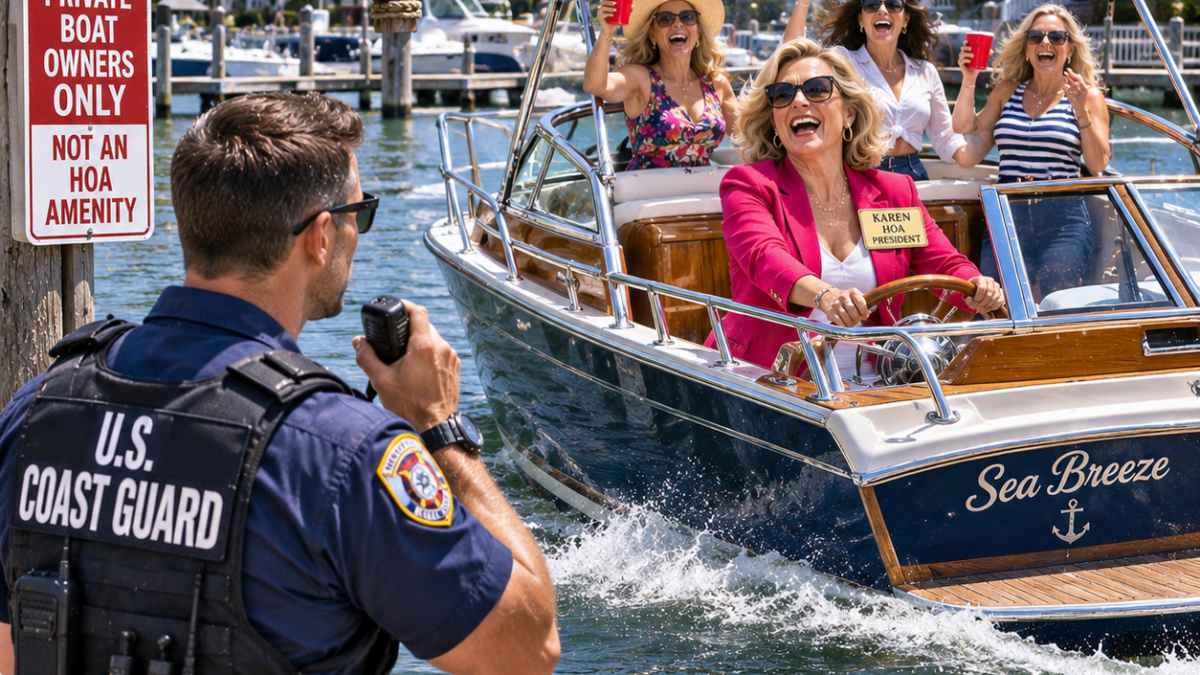
The morning I saw my restored cruiser cutting across the marina with HOA president Karen at the helm, music blasting and three of her friends dancing on my teak deck, I honestly thought my eyes were playing a trick on me until she spotted me on shore and waved like she had borrowed a lawn chair instead of a twenty-four-foot boat. What scared me more than the theft was the way she was handling the wheel—jerking through turns, throwing wake at smaller boats, and laughing while people around her grabbed the rails—because I knew enough about the water to see how quickly her little “girls’ day” could become an emergency. I had spent months telling Karen that my boat was not an HOA amenity, but as I reached for my phone that morning, I realized the argument was no longer about entitlement, and the next few minutes were going to force her into a world where her title meant absolutely nothing.
I wasn’t even supposed to be at the marina that morning.
I had stopped by before work to drop off a replacement fitting for Seab Breeze, the twenty-four-foot cruiser I had spent years restoring piece by piece. New teak. Rebuilt electronics. Fresh upholstery. Updated navigation gear. Enough weekend labor that Jim, my next-door neighbor and unofficial witness to every HOA disaster in my life, joked that I had a second marriage with a fuel tank.
He wasn’t completely wrong.
Seab Breeze was where I went when the neighborhood got loud. Out on the water, nobody cared about lawn height, mailbox colors, or whether a trash can stayed at the curb eleven minutes too long.
Karen cared about all of those things.
Since becoming HOA president, she had treated our waterfront community like a tiny nation under her personal command. Her first complaint about my boat came while I was polishing the rail one Saturday.
“It isn’t fair,” she said, hands on her hips, “that some residents have access to boats and others don’t.”
I looked around, waiting for the joke.
There wasn’t one.
“It’s my boat, Karen.”
“Exactly. But we live in a community. Assets like this should create shared experiences.”
“I pay for the boat, the slip, fuel, insurance, repairs, and registration.”
She smiled as if I had missed the point.
“Then you’re already set up to host community boating days.”
“No.”
That single word offended her more than any speech could have.
After that came notes. Suggestions. Complaints to the board. Once she asked if her nephew could take Seab Breeze out “for an hour or two.” Another time she said refusing to share it created an “elitist atmosphere” along the waterfront.
The board told her private vessels were private property.
Karen apparently heard: try harder.
Jim had watched most of it with an iced coffee in one hand and his phone in the other.
“She is absolutely going to do something insane someday,” he told me.
I thought he meant another fake violation.
Then I turned into the marina that morning and saw a crowd at the dock.
People were pointing toward the channel.
Someone was laughing.
My stomach tightened before I even knew why.
Then I saw Seab Breeze.
Karen stood at the helm in a pink sun hat while three women danced behind her, drinks in hand. Music rolled across the water. One of them held up a phone, livestreaming.
“Girls’ day out!” Karen shouted.
Another woman yelled, “HOA yacht!”
My hands went cold.
Jim somehow appeared beside me like chaos had summoned him.
“Please tell me you rented her the boat.”
“No.”
His smile vanished.
“Oh.”
Karen noticed us on shore.
She lifted one hand from the wheel and shouted, “Relax! We’re only taking her out for a quick spin!”
Jim stared at me.
“She said ‘her.’”
“I heard.”
Then Seab Breeze crossed the wake of a passing boat at the wrong angle.
Karen overcorrected.
Her friends stumbled.
One grabbed the windshield frame.
Another dropped her drink.
A fisherman in a small skiff shouted at Karen to slow down.
She laughed and blew him a kiss.
That was when my anger disappeared.
Fear replaced it.
I knew boats. I knew what bad decisions looked like on moving water. And I knew Karen had no idea how much momentum she was controlling.
Jim said quietly, “Call the police.”
I already had my phone out.
“No.”
He looked at me.
“Then who?”
I kept my eyes on Seab Breeze as Karen accelerated toward the no-wake channel.
“The people who can stop this before somebody ends up in the water.”
PART 2
The number I called was one I knew better than I wanted to admit.
The Coast Guard command center answered within seconds.
“United States Coast Guard. What’s the nature of your emergency?”
I forced myself to stop staring at Karen long enough to speak clearly.
“My vessel has been taken without permission and is being operated recklessly in the marina channel.”
The dispatcher immediately became more focused.
“Are you the registered owner?”
“Yes.”
“Do you currently have visual contact?”
“Yes.”
“Description?”
“Twenty-four-foot white cruiser, teak deck, named Seab Breeze. Registration numbers are—”
I gave them everything.
“Number of persons aboard?”
“Four.”
“Any indication of injuries?”
“Not yet.”
“Alcohol?”
“I can see drinks. I can’t tell you what’s in them.”
“Operator known to you?”
I looked at Karen.
Unfortunately.
“Yes.”
“Does she have permission to operate the vessel?”
“No.”
“Boating experience?”
“Not that I’m aware of.”
Another pause.
Then:
“Remain on shore. Do not attempt to intercept the vessel. A patrol boat is responding.”
“Understood.”
“How far from the marina entrance?”
I estimated.
The dispatcher repeated the instructions.
I thanked him and ended the call.
Jim stared at me.
“You sounded weirdly professional.”
I put my phone away.
“I’ve made that kind of call before.”
“You’ve had a boat stolen before?”
“No.”
He narrowed his eyes.
I didn’t explain.
Most people in the neighborhood knew I worked for the federal government in some maritime capacity.
That was as specific as I usually got.
I had spent enough years with the Coast Guard to learn that bringing your job into every conversation was one of the fastest ways to become unbearable.
At home, I was just the guy who owned Seab Breeze and occasionally complained when Karen put HOA notices under my windshield wiper.
Karen had never asked what I did.
She had decided I was “some kind of boat mechanic.”
I never corrected her.
That morning, I was off duty.
More importantly, it was my property involved, which meant I wanted the responding crew treating the incident exactly as they would if I were any other vessel owner.
No favors.
No shortcuts.
No special handling.
Just stop the boat before somebody got hurt.
Five minutes can feel like an hour when you’re watching an inexperienced person abuse a throttle.
Karen cut across another boat’s wake.
The bow slapped down hard.
One of her friends grabbed the windshield and yelled something at her.
Karen threw her head back and laughed.
A kayak near the edge of the channel rocked violently in her wake.
The paddler lifted both arms.
“NO WAKE!”
Karen gave him a dismissive wave.
Jim stopped filming.
That was when I knew he was worried too.
“She has no clue what she’s doing.”
“No.”
“Can she flip it?”
“Not easily.”
“That’s not reassuring.”
“It wasn’t meant to be.”
Seab Breeze meant more to me than I liked admitting.
I had bought her used and tired years earlier.
The hull was sound, but almost everything else needed work.
I rebuilt her slowly.
One project at a time.
Wiring.
Fuel lines.
Navigation lights.
Electronics.
Teak.
Upholstery.
I had sanded rails after long workweeks because repetitive work cleared my head.
I’d spent mornings offshore watching sunrise with coffee in one hand and nobody demanding anything from me.
The boat wasn’t a luxury prop.
It was the place where I remembered that silence still existed.
Watching Karen use it as a floating party platform felt violating.
Watching her put people in danger with it felt worse.
Then Jim pointed toward the marina entrance.
“There.”
A Coast Guard response boat rounded the breakwater.
Fast.
Controlled.
Two crew members stood forward while another handled the helm.
The contrast between that boat and Seab Breeze was almost painful.
One moved with purpose.
The other moved like Karen thought water obeyed enthusiasm.
The response boat came alongside at a safe distance.
A crew member raised a loudhailer.
“VESSEL SEAB BREEZE, REDUCE SPEED AND PREPARE TO STOP.”
Karen turned toward them.
Even from shore, I saw her confusion.
She looked behind herself as though there might be another Seab Breeze.
The command came again.
“SEAB BREEZE, REDUCE SPEED.”
One of Karen’s friends ran toward the helm.
Karen waved her away.
Then shouted something back.
The wind carried only part of it.
“PRIVATE—”
The Coast Guard repeated the order.
Jim whispered:
“She thinks she’s going to argue with them.”
I didn’t answer.
Karen slowed slightly.
For one second, I thought common sense had finally arrived.
Then she looked toward shore.
Saw me.
And apparently decided I was responsible.
She pointed at me.
Started yelling.
The response boat moved closer.
“MA’AM, REDUCE SPEED AND KEEP YOUR COURSE.”
Karen did the exact opposite.
She pushed the throttle forward.
Seab Breeze surged.
My heart stopped.
“Karen, no.”
She couldn’t hear me.
Her passengers screamed.
The Coast Guard boat accelerated with her.
Karen entered the marked no-wake section too fast.
A fisherman in a small skiff scrambled to get farther from the channel.
Another boat sounded its horn.
Karen looked over her shoulder at the Coast Guard crew.
That was the fatal mistake.
Not because anything fatal actually happened.
Because she stopped looking forward.
Seab Breeze drifted right.
Toward a navigation buoy.
I knew the collision was coming before she did.
“Look ahead.”
Jim lowered his phone.
“Oh, no.”
Karen turned.
Too late.
The bow struck the buoy with a brutal metallic crunch.
Seab Breeze’s nose kicked sideways.
Her three passengers went down.
Karen hit the console.
The engine continued running.
The Coast Guard crew closed the gap immediately.
One officer came aboard while another stabilized alongside.
“ENGINE NEUTRAL!”
Karen shouted:
“Get off!”
“ENGINE NEUTRAL NOW.”
“I have this under control!”
An officer reached the helm area.
“Ma’am, step away from the controls.”
“This is a private HOA excursion.”
“Step away.”
One of Karen’s friends yelled:
“Karen, just listen to them!”
Karen turned on her.
“Stop panicking!”
That friend pointed toward the dented bow.
“We HIT something!”
“It was a buoy!”
“Yes!”
“That’s what buoys are for!”
Jim looked at me.
“Please tell me she did not just say that.”
I closed my eyes.
“She did.”
The Coast Guard crew shut down the engine and checked everyone aboard.
One woman had a bruised knee.
Another had scraped her hand.
No serious injuries.
That was the first piece of good news I’d had all morning.
Then the boarding officer spoke with Karen.
She was still gesturing.
Still arguing.
Still pointing toward shore.
Finally the officer turned toward the dock.
“Registered owner?”
I raised my hand.
He looked at me.
Then paused.
Recognition.
“Chief?”
Karen followed his gaze.
Her head snapped toward me.
Jim slowly turned too.
“Chief?”
I muttered:
“Not now.”
The officer corrected himself immediately.
“Sir, can you confirm that you are the vessel owner?”
“Yes.”
“Did the operator have permission to use this vessel?”
“No.”
Karen screamed:
“That’s not true!”
Every head turned toward her.
“I BORROWED IT!”
The officer asked:
“Did he give you permission?”
Karen hesitated.
“Well, not verbally.”
Jim made a strangled sound.
The officer waited.
Karen added:
“But he knew I wanted to use it.”
I said:
“And told her no.”
Karen shouted:
“Months ago!”
“Yes.”
“That wasn’t today.”
“Exactly.”
Her face twisted.
“That’s ridiculous.”
The officer remained calm.
“Ma’am, we’re asking a simple question. Did the registered owner give you permission today?”
Karen looked at me.
Then at the officer.
Then at her friends.
“No, but he would’ve said no.”
Jim whispered:
“She confessed to logic.”
The officer’s expression didn’t move.
Karen kept going.
“So asking would have been pointless.”
One of her friends covered her face.
I almost did too.
The Coast Guard didn’t magically become the police department for every property crime simply because the property floated.
Their immediate job was maritime safety.
They had stopped an unsafe vessel.
They had documented her refusal to follow directions.
They had a collision with a navigation aid.
The unauthorized use of my boat would also involve local marine law enforcement.
A harbor patrol unit arrived shortly afterward.
The Coast Guard crew coordinated with them.
Karen was escorted off Seab Breeze.
She was not graceful about it.
“You cannot detain me!”
A harbor officer said:
“Ma’am, stop pulling away.”
“I am president of the waterfront HOA!”
“That doesn’t change anything.”
“This is an HOA-approved outing!”
The three friends looked at each other.
One quietly said:
“We never voted on anything.”
Karen whipped around.
“Sharon!”
“What? We didn’t.”
“You knew what this was.”
“You told us he approved it.”
“I said it was approved.”
“By him?”
“By the community.”
Sharon stared.
“You said he knew.”
“He did know.”
I called from the dock:
“I learned about it when I watched you drive away.”
Karen pointed at me.
“You knew I wanted to do this.”
“Wanting my boat isn’t permission to take my boat.”
Todd arrived as Karen was being transferred to the harbor officers.
He came running down the dock, breathing hard.
Todd was Karen’s husband, and I had always liked him despite the impossible package deal.
He worked in commercial insurance and carried himself like a man who apologized to furniture after bumping into it.
He saw Karen.
Saw the officers.
Saw Seab Breeze.
Then stopped.
His shoulders dropped.
“Oh, Karen.”
She brightened.
“Todd! Tell them.”
He walked closer.
“Tell them what?”
“That I was allowed to use the boat.”
Todd looked at me.
I shook my head once.
He looked back at Karen.
“Did he give you permission?”
“I knew he wouldn’t.”
Todd closed his eyes.
“Karen.”
“So I saved everyone the argument.”
Jim turned away because he was about to laugh.
Todd rubbed both hands over his face.
“Sweetheart, that’s called taking it without permission.”
“I was bringing it back.”
“That doesn’t fix it.”
She stared at him.
“Whose side are you on?”
“The side where nobody steals anybody else’s boat.”
“BORROWS.”
The harbor officer beside her said:
“Ma’am, please stop arguing.”
Karen looked at me.
“You’re pressing charges?”
“I haven’t even given my full statement yet.”
“You don’t need to.”
“Actually, I do.”
“I’ll pay for the dent.”
I looked toward Seab Breeze.
The bow had a deep gouge in the fiberglass.
The rail was bent.
One navigation light hung loose.
I didn’t know yet what damage existed underneath.
“It isn’t just a dent.”
“You always overreact about that boat.”
Something in me changed.
Not explosive anger.
The opposite.
I became very calm.
“Karen, you took something that wasn’t yours, operated it without permission, endangered your friends and other boaters, refused a Coast Guard order, and hit a navigation buoy.”
“Nobody died.”
Todd whispered:
“Please stop talking.”
Karen ignored him.
“I can fix this.”
“No.”
Her face changed.
“What do you mean, no?”
“I mean I’m giving an accurate statement.”
“You can’t.”
“I can.”
“I’m your HOA president.”
That sentence sounded almost pathetic now.
“I know.”
“You understand how much trouble I could make for you?”
The harbor officer looked between us.
Todd looked horrified.
Jim’s phone came up.
I said:
“Are you threatening me in front of law enforcement?”
Karen realized it one second too late.
“No.”
“Good.”
She looked away.
An officer asked me to come provide a statement.
I did.
I also handed over registration documents, marina records, security footage access information, and anything else they requested.
Jim volunteered his video.
So did three other people.
Sharon and the other two women gave statements.
What I learned from them made the situation worse.
Karen had told all three women I had finally agreed to an “HOA coastal enrichment day.”
Her exact words.
She claimed Seab Breeze had been made available for a community event.
When one friend asked whether I would be joining them, Karen said:
“He doesn’t need to. He’s always so uptight about the boat. It’ll be good for him to see people enjoying it.”
Karen had known.
That was the part that hurt.
She hadn’t mistakenly believed she had permission.
She had decided my refusal was unreasonable and therefore didn’t count.
The marina’s security footage filled in another gap.
Karen had entered using her resident access credentials.
She knew my slip because everybody did.
The boat had been secured, but she had apparently watched me use the dockside key locker before and knew where the spare ignition key was stored.
I felt stupid when investigators explained it.
I’d trusted a locked marina gate, my neighbors, and the fact that normal people don’t steal boats because they’re annoyed somebody won’t share.
I moved the spare key that afternoon.
Jim stood beside me while I emptied the locker.
“Please don’t say it.”
He held up both hands.
“I wasn’t going to.”
“You were.”
“I was thinking that maybe hiding your boat key three feet from your boat wasn’t ideal.”
“Jim.”
“I’m done.”
I stared at the damaged Seab Breeze.
He became serious.
“You okay?”
“No.”
“Want me to stop filming stuff?”
That surprised me.
“Did you post the video?”
His face told me the answer.
“Jim.”
“The first clip.”
“How much?”
He checked.
“Twenty-eight thousand views.”
I groaned.
“Take it down.”
He hesitated.
“People already downloaded it.”
“Take yours down anyway.”
He did.
Immediately.
That mattered.
Jim loved chaos, but he loved me more.
Unfortunately, the internet had already moved faster than us.
Someone had screen-recorded Karen’s friend’s livestream.
Another person had filmed the Coast Guard interception.
A third had captured Karen shouting “I borrowed it” from the dock.
Within hours, the clips were everywhere.
By dinner, Karen had become a meme.
I hated that almost as much as she did.
Not because she didn’t deserve public criticism.
Because humiliation is a blunt instrument.
It rarely stops where accountability should.
Todd called that evening.
“I’m sorry.”
“You’ve apologized three times.”
“I’ll probably make it thirty.”
“How’s she doing?”
He laughed once without humor.
“Bad.”
“I’m not surprised.”
“She thinks you arranged the videos.”
“I told Jim to remove his.”
“I know.”
“She’ll still blame me.”
“I know.”
There was silence.
Then he said:
“I’m getting a lawyer.”
“For her?”
“For us.”
That sounded heavier.
“Todd…”
“She won’t listen to me.”
“That’s not new.”
“No.”
His voice cracked slightly.
“It isn’t.”
I leaned against my kitchen counter.
Outside, Seab Breeze’s empty trailer space was visible through the window.
The marina had hauled her to a repair yard for assessment.
“She could’ve hurt herself,” Todd said.
“I know.”
“Or those women.”
“I know.”
“I keep thinking about that fisherman.”
“So do I.”
He breathed out.
“I’ve been covering for her for years.”
I didn’t answer.
“Not stealing-boats covering.”
“I figured.”
“HOA fights. Neighbor complaints. Apologies. Paying fines she swore weren’t her fault. Explaining why she said things.”
“Todd, you don’t have to explain her to me.”
“I think I need to explain her to myself.”
That sentence stayed with me.
We ended the call quietly.
The next morning, I reported for duty.
Walking into a Coast Guard facility after your HOA president has been intercepted by Coast Guard personnel in your stolen boat is exactly as awkward as it sounds.
Nobody said anything for nearly seven minutes.
Then Petty Officer Ramirez walked past my desk.
“Morning, Chief.”
“Morning.”
“Nice boat.”
I looked up.
He kept walking.
“Ramirez.”
“Yes, Chief?”
“Don’t.”
“Yes, Chief.”
Three desks away, somebody coughed into their fist to hide a laugh.
I put my head down.
My commanding officer called me into his office later.
The first thing he said was:
“You did the right thing staying out of the response.”
“I know.”
“You will have no operational role in anything related to your vessel.”
“Understood.”
“Any issue with that?”
“No.”
He leaned back.
Then smiled.
“HOA coastal enrichment?”
I closed my eyes.
“Sir.”
“I’m done.”
He wasn’t.
Nobody was.
But behind the jokes was something serious.
On the water, entitlement can kill people.
The Coast Guard didn’t care that Karen was annoying.
It cared about unsafe vessel operation.
Failure to comply.
The collision.
Potential alcohol-related concerns.
Navigation safety.
Local authorities cared about the unauthorized use of the vessel.
Insurance cared about damage.
The marina cared about access violations.
Everybody had a piece.
Karen’s title meant nothing to any of them.
Three days later, I was asked to come to the station to clarify her statement.
Officer Riley met me in a small interview room.
I knew Riley professionally, but she handled me formally.
Exactly as she should have.
“Thanks for coming.”
“No problem.”
She opened a folder.
“Mrs. Whitmore says she had standing permission to operate Seab Breeze.”
“No.”
“Ever?”
“No.”
“Has she previously asked?”
“Several times.”
“Your response?”
“No.”
“Any texts?”
“Yes.”
That was useful.
Months earlier, Karen had sent:
**Would you be willing to make Seab Breeze available for community use one Saturday per month?**
I’d answered:
**No. My boat is private property and will not be used as an HOA amenity.**
Then another message:
**What about occasional board-approved outings?**
My answer:
**No. Please stop asking.**
Riley read both.
“That clarifies standing permission.”
Jim, who had driven me because he insisted I needed “emotional support and tacos,” sat silently in the corner.
Riley continued.
“She also describes the outing as a sanctioned community event called HOA Coastal Enrichment.”
Jim folded in half.
No sound came out.
His shoulders shook.
Riley looked at him.
“Is he okay?”
“No.”
Jim raised one finger.
“I’m sorry.”
Riley waited.
He recovered.
“Coastal enrichment?”
I glared.
He covered his mouth.
Riley turned back to me.
“Was there such a program?”
“Not that I have ever heard of.”
“The current HOA board provided minutes. There is no vote approving a boating program.”
“I’m shocked.”
Riley almost smiled.
“She further claims the Coast Guard intervention caused the collision.”
That erased my humor.
“How?”
“She says being pursued distracted her.”
“She accelerated after being ordered to reduce speed.”
“We have video.”
“Then why ask me?”
“Because we’re documenting every claim.”
Fair.
“She says you targeted her because of HOA disputes.”
“I reported a stolen vessel being operated unsafely.”
“Correct.”
“And I remained on shore.”
“Correct.”
“She knew you were Coast Guard?”
“Apparently not.”
Riley looked at me.
“How does somebody live near you that long and not know?”
“She talks more than she listens.”
Jim whispered:
“That needs to be on a shirt.”
I ignored him.
Riley closed the folder.
“Local authorities will handle the unauthorized-use case. The Coast Guard investigation addresses the maritime side and navigation aid damage. You’ll receive notices if your testimony is required.”
“Understood.”
“One more thing.”
“Yes?”
“She asked to speak with you.”
“No.”
Riley nodded immediately.
“You are under no obligation.”
“Then no.”
We left.
Halfway through the lobby, I heard Karen.
“There he is!”
I stopped.
Jim whispered:
“Oh, no.”
Karen was being escorted toward the exit after processing.
No handcuffs now.
But the fury remained.
She marched toward me until the officer beside her gently blocked her.
“You need to fix this.”
“Fix what?”
“My arrest. The charges. This whole disaster.”
“I didn’t create it.”
“You called them.”
“Yes.”
“You could have called me first.”
“You were driving away in my boat.”
“I would have answered my phone.”
“You were at the helm.”
“I have Bluetooth!”
Jim turned away.
Karen pointed at me.
“Tell them I had permission.”
“No.”
“You know I wasn’t stealing it.”
“You knew I had told you not to use it.”
“That was before!”
“Before what?”
“Before I decided this was for the community.”
I stared.
She realized how it sounded.
Then tried again.
“I was returning it.”
“That doesn’t make it borrowing.”
Her hands trembled.
“People are laughing at me.”
For the first time, I heard fear underneath the rage.
“Karen…”
“They’re sending me videos. Todd’s getting calls. Someone made a song.”
“I’m sorry about the online circus.”
Her expression softened for half a second.
Then:
“So tell them to stop.”
“I can’t control strangers on the internet.”
“Jim can delete his video.”
“He already did.”
She looked at him.
“You did?”
Jim nodded.
“The original. Other people reposted it.”
Karen looked lost.
Then angry again because anger was easier.
“This is your fault.”
She pointed at me.
“You made me a spectacle.”
“No, Karen.”
My voice stayed low.
“I reported my stolen boat.”
“Borrowed.”
“Stop saying that.”
“You always hated me.”
“I didn’t.”
“You wanted to embarrass me.”
“I wanted my boat back before somebody got hurt.”
She stared.
The escorting officer said:
“Ma’am, we need to go.”
Karen pointed one last time.
“This isn’t over.”
I said:
“I know.”
And I did.
Because damage has a long tail.
The repair estimate came two days later.
The visible fiberglass damage was only the beginning.
Bent rail.
Damaged navigation light.
Stress around the bow fitting.
Gelcoat work.
Inspection of steering components after the impact.
Propulsion checks after the way she’d run the engine.
Haul-out.
Storage.
Labor.
Several thousand dollars.
Enough to make my chest tighten.
Insurance would cover much of it, then pursue reimbursement where appropriate.
But money wasn’t the worst part.
The worst part was walking through the repair yard and seeing Seab Breeze sitting on blocks.
Dry.
Silent.
Scarred.
I put my hand on the damaged bow.
Jim stood a few feet away.
For once, he didn’t make a joke.
“I know this sounds stupid,” I said.
“It doesn’t.”
“I haven’t even said it.”
“You’re going to say it feels personal.”
I looked at him.
He shrugged.
“You spent years on this thing.”
“Yeah.”
“It is personal.”
I ran my hand across the gouge.
“When I bought her, the deck leaked.”
“I remember.”
“You fell through one panel.”
“I remember that less fondly.”
“The radio barely worked.”
“It only played country music from 1997.”
“That wasn’t the radio’s fault.”
“It felt targeted.”
I smiled.
Then the smile disappeared.
“I built this place to get away from people like Karen.”
Jim leaned against a workbench.
“And she literally sailed away with it.”
“Exactly.”
He looked at me.
“Then make her repair what she broke.”
“That’s what insurance is doing.”
“I don’t mean fiberglass.”
I understood.
But I didn’t know how.
The HOA scheduled an emergency meeting the following evening.
I considered skipping it.
Then the board secretary called.
“We need you there.”
“Why?”
“Karen is telling people the outing was board authorized.”
“Was it?”
“No.”
“Then say that.”
“We are.”
Pause.
“She is also saying you used your Coast Guard position to retaliate over HOA disputes.”
That got me there.
The clubhouse was packed.
Karen sat at the front wearing her pink blazer.
No sun hat.
Todd sat in the back.
He looked like he’d rather be anywhere else.
Jim took a seat beside me but kept his phone in his pocket.
Good.
The HOA vice president, Frank Delaney, called the meeting to order.
“First item: allegations regarding unauthorized use of a resident’s vessel and statements that the activity was approved by this board.”
Karen raised her hand.
“I’ll explain.”
Frank looked at the association attorney.
The attorney nodded.
Karen stood.
“What happened has been wildly exaggerated by social media and by one homeowner who has had a personal issue with my leadership for months.”
She looked at me.
I kept my face neutral.
Karen continued.
“The board has repeatedly discussed increasing community access to waterfront resources.”
Frank interrupted.
“Not privately owned boats.”
“We discussed amenities.”
“The marina picnic tables are amenities.”
“So are water resources.”
“Karen.”
She tightened her jaw.
“I believed I had implied permission.”
A woman in the audience said:
“How do you imply permission to take someone’s boat?”
Karen ignored her.
She turned toward me.
“He knew I wanted to use it.”
I answered:
“And I told you no.”
“You told me no months ago.”
“Yes.”
“Circumstances change.”
“My ownership didn’t.”
Applause started.
I raised one hand.
“Please don’t.”
It died down.
I didn’t want a mob.
I wanted facts.
Frank held up printed messages.
“The homeowner provided the board with copies of prior communication in which he explicitly declined community use.”
Karen’s face changed.
“You gave them private messages?”
“They concern your claim of permission.”
She looked betrayed.
Frank continued.
“We also contacted the three passengers.”
Karen turned.
“What?”
“One says you told her the owner approved the trip.”
“Sharon misunderstood.”
“Another says you described the boat as an HOA community asset.”
“That was casual language.”
“The third says she asked whether you had a key and you replied, quote, ‘I know where he keeps one.’”
The room went silent.
Karen’s face drained.
Todd lowered his head.
I hadn’t known that part yet.
Frank looked at her.
“Is that accurate?”
“No.”
A board member said:
“We have her written statement.”
“She is trying to save herself.”
Frank asked:
“Did you know where he kept a spare key?”
Karen looked at me.
I felt something twist in my chest.
This was worse than opportunistic stupidity.
She had planned it.
“You watched me,” I said quietly.
“No.”
“How did you know?”
“I saw you open the locker before.”
“When?”
“I don’t remember.”
“So you remembered where my key was, but not when you saw it?”
She snapped:
“You’re twisting this!”
“No.”
I leaned forward.
“You wanted my boat. I repeatedly refused. You watched where I kept the spare key. Then you waited until I wasn’t there.”
Her voice rose.
“I wasn’t stealing anything!”
Todd finally stood.
“Karen.”
She turned.
He looked exhausted.
“Stop.”
She stared at her husband.
Todd said:
“You knew he’d say no.”
Silence.
Karen’s mouth opened.
Closed.
Todd continued.
“You told me Friday night you were going on a boat with the girls.”
Her face tightened.
“You never said whose.”
“Todd…”
“You told me you’d ‘solved the boat problem.’”
Karen whispered:
“Don’t.”
He looked almost sick.
“I asked what that meant.”
“Todd, stop.”
“You said, ‘If people refuse to share, sometimes leadership has to make decisions for them.’”
Nobody moved.
I saw Karen’s shoulders drop.
Her own husband had just turned her private rationalization into evidence.
He wasn’t trying to destroy her.
That made it worse.
He was finally refusing to cover for her.
Karen sank into her chair.
The board attorney spoke quietly with Frank.
Then Frank addressed the room.
“Under our bylaws, the board can temporarily suspend presidential authority when conduct creates substantial legal or financial exposure for the association.”
Karen shot up.
“You cannot remove me over a personal boating disagreement.”
Frank said:
“This is not removal tonight. It is temporary suspension pending board review.”
“No.”
“Karen—”
“I am president.”
“Not during the review.”
“You need me.”
Frank gave her a sad look.
“That may be part of the problem.”
The vote passed.
Four to one.
Karen stared at the board as though they’d committed treason.
Then at the residents.
Then at me.
“You did this.”
I shook my head.
“You took my boat.”
She grabbed her purse.
“This entire community will fall apart without me.”
She walked out.
Todd remained seated.
For several seconds, nobody spoke.
Then somebody in the back whispered:
“Can we talk about pool hours now?”
The room laughed.
Not cruelly.
Mostly from exhaustion.
I went home.
At eleven thirty, my doorbell rang.
Karen.
Still in the pink blazer.
Mascara slightly smudged.
Phone in one hand.
I opened the door but stayed inside.
“What do you want?”
She held up the screen.
The viral clip.
“I want this gone.”
“I didn’t post that version.”
“Tell Jim.”
“He removed his.”
“Then make everyone else remove it.”
“How?”
“I don’t know. You’re Coast Guard.”
I stared at her.
“What does that have to do with the internet?”
“You’re federal.”
“Karen, federal employees do not have a button that deletes embarrassing videos.”
“You could call someone.”
“No.”
“You could issue something.”
“No.”
“A takedown order.”
“No.”
She clenched her jaw.
“Then tell the Coast Guard to drop everything.”
“I can’t.”
“You work there.”
“That’s exactly why I am not involved in enforcement decisions about my own case.”
Her eyes narrowed.
“You’re hiding behind procedure.”
“No. Procedure prevents people in authority from using it for personal revenge.”
She laughed bitterly.
“Convenient.”
“It’s inconvenient. That’s the point.”
She moved closer.
“I will pay for the repairs.”
“Insurance and restitution will handle that.”
“Then say you forgive me.”
“No.”
“Why?”
“Because you’re not asking for forgiveness.”
She flinched.
“You’re asking me to erase consequences.”
Her eyes filled.
Not enough to cry.
Enough that I noticed.
“You ruined my life.”
I felt anger rise.
Then fall again.
“No.”
“Yes.”
“You drove into a marina, used my key, took my boat, lied to your friends, ignored a Coast Guard command, hit a buoy, and then blamed everyone who documented it.”
“You could have handled it privately.”
“You were on the water.”
“I would have come back.”
“You don’t know that.”
“I wasn’t going to steal it permanently.”
I took a slow breath.
“Karen, if somebody takes your car while you’re asleep, drives it recklessly, crashes it, and returns it three hours later, did they borrow it?”
“That isn’t the same.”
“Why?”
“Because…”
She stopped.
No answer.
From across the yard came a familiar crunch.
Jim.
Standing on his porch with a bowl of popcorn.
I stared.
He froze.
“What?”
“Go inside.”
He looked at Karen.
Then me.
“Yep.”
He disappeared.
Karen exhaled shakily.
“Everyone hates me.”
“I don’t.”
She looked surprised.
“I hate what you did.”
“Same thing.”
“No.”
“It feels like the same thing.”
“That doesn’t make it true.”
For a moment, the fight left her.
She looked older.
Tired.
“I don’t know how to fix this.”
“Start with one sentence.”
“What sentence?”
“I was wrong.”
She stared at me.
Her mouth moved.
Nothing came out.
Then the anger returned.
“You’re going to regret humiliating me.”
There she was again.
She spun and left.
I closed the door.
Two days later the Coast Guard contacted me about the damaged navigation buoy.
The impact had bent hardware and damaged its mounting.
Not catastrophic.
Not cheap either.
Federal navigation aids don’t belong to whoever hits them.
The incident required its own documentation and cost assessment.
Karen disputed responsibility.
Naturally.
Her written statement claimed the response boat had “created undue pressure” causing her to strike the buoy.
Video showed otherwise.
She had accelerated before the collision.
She had ignored the instruction to reduce speed.
She had looked backward.
The evidence didn’t care about her wording.
A week later, I returned to the marina repair yard.
Seab Breeze was halfway through fiberglass work.
The damaged section had been ground down.
Fresh layers were being built up.
I stood beside her with the repair manager.
“She’ll be fine,” he said.
“I know.”
“Structural inspection was good.”
“That helps.”
“You look like someone died.”
I laughed softly.
“I’m working on it.”
He patted the hull.
“Boats get fixed.”
“People?”
He shrugged.
“Wrong shop.”
Fair.
As I walked toward the parking lot, I noticed someone in a reflective vest picking trash from between dock cleats.
Karen.
Large sunglasses.
Baseball cap pulled low.
Trash grabber in one hand.
Bucket in the other.
Part of a temporary community-service arrangement tied to the local case while the legal process continued.
She saw me.
Froze.
Then looked away.
I could have kept walking.
Instead I stopped.
“Morning.”
She stabbed a plastic cup with the trash picker.
“It isn’t.”
“I figured.”
She dropped the cup into her bucket.
Two teenagers walking past whispered to each other.
One looked at Karen.
Then at his phone.
She saw.
Her shoulders tightened.
“Don’t.”
They kept moving.
Karen’s face burned.
“People keep recognizing me.”
“I know.”
“This woman asked me yesterday if she could get a picture.”
“What did you say?”
“What do you think?”
“I hope no.”
“I told her to go to hell.”
“That was probably unnecessary.”
Karen jabbed at another piece of trash.
“Everything is unnecessary.”
I leaned against a piling.
“You’re still blaming everyone else.”
“I am picking beer cans out of seaweed while strangers quote me saying ‘borrowed.’”
“You took the boat.”
“I KNOW.”
The words echoed across the dock.
She froze.
So did I.
That was the first time I’d heard her say it without a qualification.
She looked down.
Quieter:
“I know.”
I didn’t speak.
Her hands tightened around the pole.
“I knew you’d say no.”
“Yes.”
“So I didn’t ask.”
“Yes.”
“I told the girls you had agreed because otherwise they wouldn’t come.”
I waited.
“I knew where the key was.”
My chest tightened.
She swallowed.
“I thought we’d go out for an hour.”
“That doesn’t matter.”
“I know.”
She said it again.
“I know.”
For the first time, Karen Whitmore looked at what she had done without trying to rename it.
No HOA coastal enrichment.
No implied consent.
No community sharing.
Just the truth.
“I stole your boat.”
The word hung between us.
She looked sick saying it.
“Yes.”
Her eyes filled.
“I hate that word.”
“You should.”
“I hate that it’s true.”
I didn’t answer.
She wiped under one eye quickly.
“Do you think people will ever stop laughing?”
“Eventually.”
“Do you think they’ll forgive me?”
“Some will.”
“You?”
That caught me.
“I don’t know.”
Her face fell.
I continued:
“But forgiveness isn’t the thing you should chase right now.”
“What is?”
“Being different when nobody is watching.”
She stared at the trash in her bucket.
“That sounds exhausting.”
“Probably.”
A tiny laugh escaped her.
Then she looked toward the repair building.
“How bad is Seab Breeze?”
“Repairable.”
“How much?”
“A lot.”
She nodded.
“I’ll pay whatever the court or insurance says I owe.”
“Okay.”
“No argument.”
“That’s new.”
She almost smiled.
Then Jim’s voice floated from behind a piling.
“Personal growth!”
Karen whipped around.
“Are you SERIOUS?”
Jim emerged holding his iced coffee.
“I was checking on him.”
“You were eavesdropping.”
“Accidentally.”
“You’ve never done anything accidentally.”
He considered that.
“Fair.”
Karen pointed the trash picker at him.
“If you film me—”
His phone remained in his pocket.
“I’m not.”
She stopped.
Jim became serious.
“I took my video down the day he asked.”
“I know.”
“I made jokes I probably shouldn’t have.”
Karen stared at him.
“That is the understatement of the century.”
“Also fair.”
He held out a sealed bottle of water.
“You want this?”
She looked suspicious.
“Why?”
“Because it’s hot.”
Karen took it.
“Thank you.”
Jim nodded.
None of us knew what to do with that moment.
So Karen went back to picking up trash.
Jim and I left.
At the truck he said:
“She actually admitted it.”
“Yeah.”
“You buying it?”
“I believe she meant it today.”
“What about tomorrow?”
“That’s the test.”
Todd found me at the marina later that week.
He looked thinner.
Tired.
“Can I sit?”
I moved over on the bench.
He sat.
For a while we watched boats enter the channel.
Then he said:
“I moved into a hotel.”
I looked at him.
“I’m sorry.”
“Don’t be.”
“You okay?”
“No.”
Honest answer.
He rubbed his hands together.
“I love her.”
I waited.
“But I don’t like who I’ve become around her.”
“What does that mean?”
“I’m always preventing explosions.”
He looked toward the marina.
“Karen wants something. I explain why she can’t have it. She gets angry. I find a compromise. She pushes past it. Something breaks. I apologize to whoever got hurt.”
He laughed weakly.
“Then we do it again.”
I thought about his words from the day of the theft.
Whose side are you on?
Maybe Todd had been choosing sides for twenty years.
Mostly hers.
Even when he knew she was wrong.
“My therapist calls it accommodation.”
“That sounds nicer than enabling.”
“He uses that word too.”
We both smiled.
Then Todd said:
“Her parents never told her no.”
I turned toward him.
“She grew up believing denial meant somebody didn’t value her.”
“That explains something.”
“Doesn’t excuse it.”
“No.”
“She was always intense. Competitive. If someone said she couldn’t do something, she’d make it her life’s purpose.”
He looked at me.
“When she became HOA president, people started coming to her with problems.”
“She liked it.”
“She loved it.”
“Being needed.”
“Yes.”
“Then being needed turned into being obeyed.”
Todd nodded.
“She doesn’t know the difference anymore.”
We sat quietly.
Finally he said:
“I hope this is the thing that makes her learn.”
“I hope so too.”
“You don’t hate her?”
“No.”
He looked surprised.
“I was furious.”
“Reasonable.”
“I still don’t trust her.”
“Also reasonable.”
“But hate takes too much maintenance.”
Todd laughed.
“I need that on a pillow.”
“Jim probably already made a shirt.”
“That man is a menace.”
“Yes.”
A month after the theft, the legal picture finally became clearer.
The local unauthorized-use and reckless-operation charges moved through the normal process.
The Coast Guard handled the maritime safety violations and navigation-aid damage through its own channels.
My insurer handled Seab Breeze’s repair and pursued reimbursement.
Nobody sentenced Karen to some absurd lifetime in federal prison.
Reality is usually less theatrical than internet stories.
It was still painful.
She faced restitution.
Fines.
Probationary conditions through the resolution of the local case.
Required boating-safety education.
Community-service hours.
Responsibility for costs tied to the navigation buoy.
Her attorney negotiated where negotiation was possible.
Where evidence was clear, there wasn’t much to negotiate.
And the evidence was clear.
Marina video.
Jim’s original recording.
The friend’s livestream.
Coast Guard logs.
Boarding documentation.
Passenger statements.
My prior texts refusing her requests.
Even Karen’s own words on video:
“I knew you’d say no.”
That sentence mattered.
At the final hearing connected to the local charges, Karen sat beside her lawyer.
No pink blazer.
Navy suit.
Hair pulled back.
Todd sat two rows behind her, not beside her.
I noticed that.
So did Karen.
Sharon testified.
Karen had told her I approved the outing.
Another passenger confirmed it.
Then a marina employee described seeing Karen access my dock locker.
Karen’s lawyer asked whether it was possible she genuinely believed she had permission.
The employee said:
“I can’t speak to what she believed.”
Good answer.
Then my earlier messages were entered.
**No. My boat is private property.**
**No. Please stop asking.**
Karen stared at the table.
When it was her turn to address the court as part of the negotiated resolution, I expected another speech.
Her lawyer whispered something.
Karen stood.
Her hands shook.
She looked toward me.
Then toward the judge.
“I took the boat without his permission.”
No excuses.
“I knew he had refused before.”
Todd lowered his head.
Karen continued.
“I convinced myself that because I planned to return it, it wasn’t really stealing.”
Her voice tightened.
“I was wrong.”
I felt something shift in my chest.
Not forgiveness.
Not yet.
Something closer to relief.
She continued:
“I also operated it when I wasn’t qualified to do so. I ignored instructions because I was embarrassed and panicked. People could have been hurt.”
The judge listened.
Karen swallowed.
“I blamed him afterward because accepting what I had done felt worse.”
There it was.
The whole case in one sentence.
The judge accepted the resolution.
The consequences remained.
Restitution.
Fines.
Service.
Education.
Monitoring.
Financial responsibility.
No magic eraser because Karen had finally told the truth.
That mattered too.
Accountability wasn’t cancelled by an apology.
But an apology could change what came after.
Outside the courthouse, Karen caught up with me.
“Can I talk to you?”
I stopped.
Jim wasn’t there.
Todd wasn’t there.
No audience.
Good.
Karen held a folder.
“This is the first restitution payment.”
“My insurance handles that.”
“I know.”
She looked embarrassed.
“I wanted you to know I didn’t fight it.”
“Okay.”
She handed me nothing.
Just held the folder against herself.
“Seab Breeze repaired?”
“Almost.”
“Good.”
We stood in uncomfortable silence.
Then Karen said:
“I resigned.”
“From the HOA?”
She nodded.
“When?”
“Yesterday.”
I had expected the board to remove her.
Apparently Karen had beaten them to it.
“Why?”
She laughed softly.
“You really need me to answer that?”
“No.”
“Frank was going to call a formal removal vote anyway.”
“Probably.”
“I didn’t want to force everyone through another fight.”
That was new.
She looked toward the courthouse.
“I thought being president made me important.”
“You were important before.”
She stared at me.
The words seemed to confuse her.
I continued:
“Being important and being in charge aren’t the same thing.”
Her eyes became glassy.
“Todd said something similar.”
“How is he?”
“Still at the hotel.”
“I’m sorry.”
“I earned that too.”
She didn’t say it dramatically.
Just fact.
I almost preferred angry Karen.
This version made everything harder.
“I hope you two figure out what’s healthy.”
“So do I.”
She stepped back.
“I’m not asking you to forgive me.”
“Good.”
She smiled faintly.
“I was going to say I hope one day you can.”
“That sounds more reasonable.”
She nodded.
Then walked toward the parking lot.
I watched until she disappeared between cars.
Seab Breeze came home eleven weeks after Karen took her.
I arrived before sunrise.
The marina was almost empty.
The repair shop had restored the bow beautifully.
New gelcoat matched.
Rail straight.
Navigation light replaced.
Mechanical inspection complete.
The teak had been cleaned.
From ten feet away, you’d never know she’d hit anything.
I knew.
That’s different.
The repair manager handed me the keys.
“Take her easy.”
“I always do.”
He smiled.
“I’ve seen your service record.”
“Then you know I absolutely do.”
I stepped aboard.
The deck felt familiar beneath my shoes.
For a moment, I just stood at the helm.
My hands rested on the wheel.
The last person who had held it before the repair shop was Karen.
I hated that thought.
So I replaced it.
I remembered an early morning three years earlier.
Jim asleep on the rear bench after insisting he could stay awake for sunrise.
I remembered teaching my niece how to read channel markers.
I remembered sitting offshore after one of the hardest weeks of my career, engine off, letting the boat drift while the sky changed color.
Those memories were mine.
Karen got one morning.
She didn’t get the boat’s entire story.
I started the engine.
Smooth.
Quiet.
Perfect.
As I backed out of the slip, somebody called from the dock.
“Hey.”
Karen.
Of course.
Reflective community-service vest.
Trash grabber.
Her final week of marina hours.
I put Seab Breeze in neutral.
Karen stayed on the dock.
She didn’t approach the boat.
Didn’t touch a line.
Didn’t ask to come aboard.
She simply looked.
“She looks good.”
“She does.”
“Everything fixed?”
“Everything they found.”
Karen nodded.
“I really am sorry.”
“I know.”
She looked toward the open water.
“Are you going out?”
“Yes.”
“Have a good trip.”
That was all.
She turned away.
No request for a ride.
No joke about borrowing it.
No attempt to make the moment about her.
For some reason, that mattered more than another apology.
I put Seab Breeze in gear.
Then Jim came sprinting down the dock carrying two iced coffees.
“WAIT!”
I stared at him.
“You were leaving without me?”
“You were supposed to be here twenty minutes ago.”
“I had an emergency.”
“What?”
“Coffee line.”
I looked toward the sky.
“Get aboard.”
He jumped on.
Karen watched from fifty yards away.
Jim noticed her.
Then whispered:
“Should I invite her?”
I turned slowly.
He raised both hands.
“Joke.”
“Bad joke.”
“Understood.”
We left the marina.
For the first time in almost three months, Seab Breeze crossed the breakwater under my control.
The water was nearly flat.
Sunrise colored the horizon.
Jim sat in the passenger seat without speaking for an astonishing four consecutive minutes.
Then:
“Feels good?”
“Yeah.”
“You forgive her?”
I looked ahead.
“I don’t know.”
“Still?”
“Forgiveness isn’t a switch.”
“Fair.”
“I don’t wake up angry anymore.”
“That seems like something.”
“It is.”
Jim sipped his coffee.
“You know she’s become weirdly quiet.”
“I heard.”
“Frank says HOA meetings are twenty minutes shorter.”
“Miracle.”
“People miss her a little.”
I looked over.
“Really?”
“Not the fines. Or inspections. Or speeches.”
“What do they miss?”
“The fact that she actually got things done.”
That was fair.
Karen had never been lazy.
Her problem wasn’t lack of effort.
It was believing effort gave her ownership of everyone else’s decisions.
“Frank asked if she’d join the landscaping committee.”
“What did she say?”
“No.”
I laughed.
“Smart.”
“Then she called back and said she’d volunteer if she wasn’t allowed to issue instructions.”
“That sounds painful for her.”
“Apparently they’re using a timer.”
I looked at him.
“A timer?”
“Five minutes of Karen opinions. Then everyone else talks.”
I laughed so hard I had to wipe my eyes.
It felt good.
Months passed.
The viral clips faded.
Another scandal replaced them.
Then another.
People stopped recognizing Karen at the grocery store.
The marina teenagers found newer memes.
The phrase “HOA Coastal Enrichment” survived longer than it should have, mostly because Jim refused to let it die.
Karen completed her community service.
Paid restitution according to the resolution.
Finished the boating-safety course.
She once mailed me a copy of her completion certificate.
At the bottom she’d written:
**Apparently buoys are not for hitting.**
I laughed.
Then put it in a drawer.
Todd eventually moved home.
Not immediately.
They spent months in counseling.
I only knew because Todd told me.
“I gave her conditions.”
“Good.”
“She gave me some too.”
“Also good.”
“She said I need to stop agreeing with her just to avoid arguments.”
“That sounds wise.”
“I hate therapy.”
“So does everyone who needs it.”
He smiled.
They stayed married.
But something in their dynamic changed.
Todd stopped apologizing automatically for Karen.
Karen stopped expecting him to.
At HOA meetings, she sometimes attended as a homeowner.
The first time Frank disagreed with her, everybody tensed.
Karen opened her mouth.
Paused.
Then said:
“Okay.”
The room nearly applauded.
She glared.
“Don’t make this weird.”
Nobody did.
Almost a year after the theft, our HOA held a waterfront cleanup day.
Voluntary.
Karen was there at seven in the morning.
No pink blazer.
Work gloves.
Trash bags.
She picked plastic from the shoreline beside Mrs. Hernandez, one of the women she’d once fined over a “nonconforming” bird feeder.
I watched them argue about hydrangeas.
Normal neighbor argument.
No citations.
No threats.
No clipboard.
Progress.
I spent most of the day working near the marina.
At noon, Karen approached.
“Can I ask something?”
I looked at her carefully.
“What?”
“It’s not about using the boat.”
“Good start.”
She rolled her eyes.
“I deserve that.”
“Probably.”
She pointed toward a group of teenagers.
“They want to organize a boating-safety afternoon with the marina.”
“That sounds good.”
“They asked if I would help.”
I stared.
Karen laughed.
“I know.”
“You?”
“Apparently my story is considered educational.”
I tried not to smile.
“Extremely.”
“They want me to tell people what not to do.”
“You have extensive expertise.”
“Shut up.”
I laughed.
Then she became serious.
“I told them I’d only do it if somebody qualified handles the actual safety material.”
I looked toward her.
“Who?”
“You.”
“No.”
“See? This is the new me. I asked.”
“And I answered.”
“Yes.”
“And?”
“And I’m accepting it.”
She turned away.
I called:
“Karen.”
She looked back.
“I’ll help for twenty minutes.”
Her face lit up.
Then she caught herself.
“Thank you.”
“No boat access.”
“I don’t even want to look at your keys.”
The safety afternoon happened two weeks later.
A Coast Guard auxiliary volunteer handled most of the education.
Life jackets.
Navigation rules.
Emergency communications.
Wake zones.
Alcohol.
Weather.
Karen stood up for five minutes near the end.
She looked uncomfortable.
Which was probably healthy.
“My name is Karen Whitmore.”
A few teenagers snickered.
She ignored them.
“Last year I took a neighbor’s boat without permission because I convinced myself that borrowing something temporarily wasn’t stealing.”
The marina became quiet.
“I was wrong.”
She pointed toward the navigation channel.
“I also thought being confident meant I could figure out boat handling as I went.”
Someone whispered:
“Buoy.”
Karen heard.
“Yes. I hit the buoy.”
Laughter.
She smiled.
“Thank you for remembering.”
More laughter.
Then she said:
“Here’s the useful part. Water doesn’t care how confident you are. Neither do physics, navigation rules, or property rights.”
I looked at her.
That was actually good.
She continued:
“If someone tells you no, that is not an invitation to decide their boundary is unreasonable.”
No jokes now.
“I wish somebody had taught me that before I became an adult.”
She stepped away from the microphone.
Five minutes.
Done.
No speech about redemption.
No demand for applause.
The kids clapped anyway.
Later she found me near Seab Breeze.
“How bad?”
“You were fine.”
“Fine?”
“For you, excellent.”
“Still rude.”
“You’ll survive.”
She looked at the boat.
Then at me.
“Would you ever let me aboard?”
I stared.
Her eyes widened.
“Not drive!”
I started laughing.
“I mean literally step onto it.”
“You waited almost a year to ask.”
“I was afraid.”
“Of me?”
“Of the answer.”
I considered it.
Then stepped onto Seab Breeze.
Karen stayed on the dock.
I held out one hand.
“One condition.”
“What?”
“You touch the throttle and I throw you overboard.”
She laughed.
“Deal.”
She stepped aboard.
Carefully.
Like she was entering a church.
For the first time, she was on my boat with permission.
That mattered more than I expected.
She looked around.
The deck.
The repaired bow.
The helm.
She didn’t touch anything.
“I didn’t appreciate this.”
“No.”
“I saw a toy.”
“Most people do.”
“You built a lot of it yourself?”
“Restored.”
“How long?”
“Years.”
She ran one hand lightly along the back of a seat after looking at me for permission.
I nodded.
“This is why you were so angry.”
“Partly.”
She looked confused.
“Partly?”
“The bigger issue was that you could’ve killed somebody.”
Her expression fell.
“I know.”
We stood quietly.
Then she stepped back onto the dock.
“That was enough.”
I smiled.
“Good.”
“I don’t think I ever want to be on a moving boat again.”
“The Coast Guard safety program has lost a promising recruit.”
She gave me a look.
Then laughed.
Two years after the incident, Seab Breeze looked better than she had before Karen took her.
I made upgrades during the repair process.
New chartplotter.
Improved radio.
Better lighting.
A revised key-security system that Jim described as “Karen-proof.”
Karen heard him say it once.
She replied:
“It only needs to be idiot-proof.”
Jim nearly dropped his coffee.
I think that was the moment he finally respected her.
The HOA changed too.
Frank completed his term.
A retired teacher became president after him.
Board policies became clearer.
Private property stayed private.
Nobody proposed shared community boats.
Karen never ran again.
At least not while I lived there.
One Saturday morning, I was polishing Seab Breeze at the marina when a new resident walked over.
He had moved into the neighborhood two weeks earlier.
“Beautiful boat.”
“Thanks.”
“HOA own any marina equipment?”
“Some.”
“Boats?”
“No.”
He nodded.
“Shame. Would be nice to have a community boat.”
Behind him, Karen was walking past with Todd.
She stopped dead.
I saw Jim twenty feet away lower his iced coffee.
All three of us looked at Karen.
Karen closed her eyes.
“No.”
The new neighbor turned.
“Sorry?”
Karen pointed at Seab Breeze.
“That man’s boat is his boat.”
“Oh.”
“We do not share it.”
“I wasn’t asking for his specifically.”
“We don’t share anybody’s.”
The man looked confused.
Karen continued:
“Private property. Clear boundaries. Very important.”
Todd was biting his lip.
Jim was shaking silently.
I said:
“Karen.”
She stopped.
“What?”
“Let the man breathe.”
She nodded.
“Right.”
Then to the new neighbor:
“Welcome to the community.”
She walked away.
The man watched her.
“What’s her story?”
I looked at Jim.
He was already reaching for his phone.
“Don’t.”
He put it away.
“Fine.”
The new resident shrugged and left.
I finished polishing the rail.
Late that afternoon, I took Seab Breeze out alone.
No particular destination.
Just open water.
The marina fell behind me.
Houses became smaller.
Noise faded.
There was a Coast Guard patrol boat working farther offshore.
We passed at a distance.
One crew member recognized me and lifted a hand.
I returned the wave.
No emergency.
No stolen vessel.
No Karen shouting about HOA jurisdiction.
Just another calm afternoon.
I throttled back near a quiet stretch of water and let Seab Breeze drift.
For years, I’d thought peace meant keeping difficult people far away.
Maybe sometimes it does.
But the strangest part of the whole experience was that the person who stole my peace ended up teaching me something about boundaries precisely because she finally learned to respect one.
Karen never became my best friend.
That would have been too neat.
She still annoyed me.
Still talked too long at meetings.
Still believed most flowers looked better in coordinated colors.
Still had opinions about mailbox placement that no human being needed.
But when I said no, she heard no.
When she wanted something, she asked.
When someone disagreed with her, she didn’t automatically reach for authority.
Those sound like small changes.
They weren’t.
The sun dropped lower.
I rested one hand on the wheel.
The repaired bow cut gently through a rolling wake.
I remembered that morning years earlier.
Pink sun hat.
Music.
My boat disappearing down the channel.
The fear in my stomach.
The crunch of fiberglass against the buoy.
Karen shouting that she’d only borrowed it.
Then I looked at Seab Breeze now.
Whole.
Mine.
The scars repaired but not forgotten.
My phone buzzed.
A message from Jim.
A photograph.
Karen standing beside the marina’s new sign:
**PRIVATE VESSELS ARE NOT COMMUNITY AMENITIES**
She had apparently volunteered to help install it.
Under the photo, Jim had written:
**Character development.**
I laughed out loud.
Then another message came.
From Karen.
**Before you say anything, I did NOT write the sign.**
I typed:
**Sure.**
Three dots appeared.
Then:
**I suggested the wording.**
I knew it.
I put the phone down.
Ahead of me, the water stretched open and quiet.
I eased the throttle forward.
Seab Breeze responded smoothly beneath my hand.
And this time, the only person deciding where she went was the person who had actually been given permission to take the wheel.
[END OF STORY]