PART 2: HOA Locked Me Out of My Own 25 Acres With a Steel Gate—They Had No Idea What My 40-Year-Old Easement Guaranteed
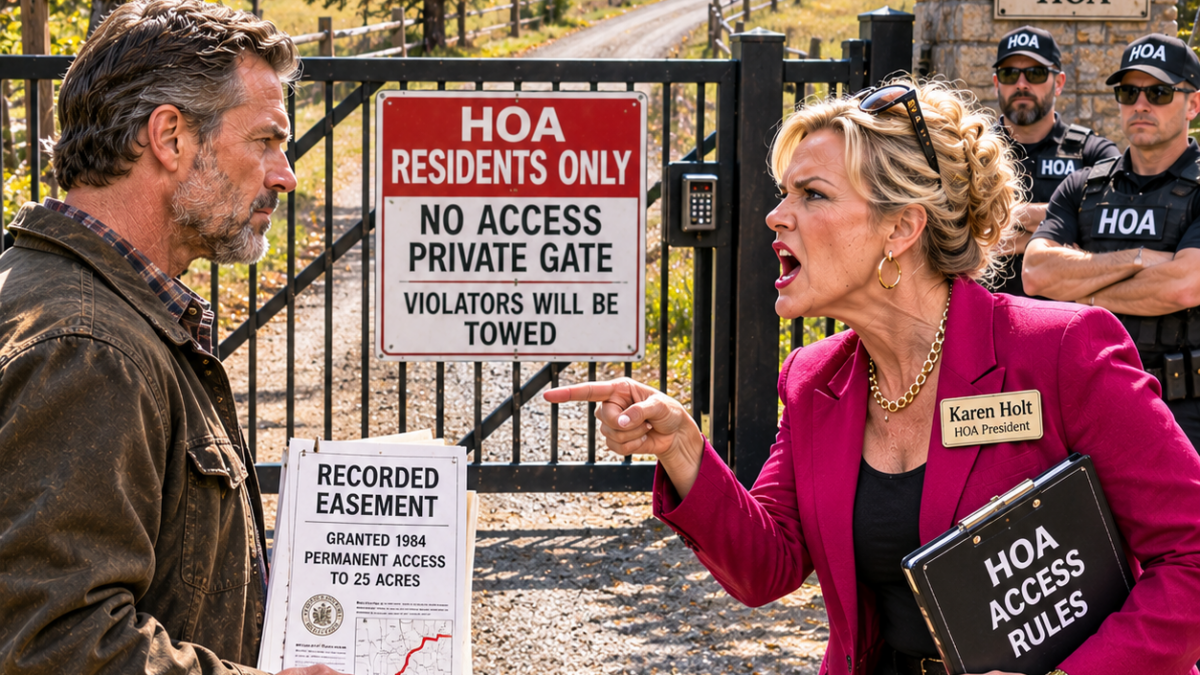
The afternoon I rounded the last bend of the gravel road to my twenty-five acres and found a brand-new steel gate bolted across the only legal access to my home, I thought somebody had made an expensive mistake—until Karen Holt stepped from behind it with a clipboard and told me the road my family had used for more than forty years was now “HOA residents only.” When I showed her the recorded easement that predated every house in her subdivision, she barely glanced at it before saying the community had “outgrown old arrangements” and I would have to cut a new road through two miles of timber, rock, and ravine if I wanted to reach my own front porch. I knew she was wrong about the road, but I did not yet understand how badly the HOA had miscalculated what that old easement actually carried—or how much trouble one locked gate was about to create for the people who installed it.
My name is Daniel Mercer, and the land at the end of that road had belonged to my family since 1978.
My parents bought twenty-five acres when the area was still pasture, woods, and scattered farms. The only practical way in crossed a neighboring tract owned by a farmer named Walter Fletcher. Dad offered to pay him for access. Fletcher refused the money but insisted they put the agreement in writing.
“Someday this place will fill up,” he told Dad. “Paper remembers better than people.”
He was right.
The easement was permanent, recorded with the county, and broad enough for ordinary vehicle access and the utility service needed to reach our property. For decades, nobody questioned it.
Then Fletcher died.
His children sold the farm to a developer, and within two years the old fields became Maple Ridge Estates—new houses, decorative stone entrances, private amenities, and an HOA led by Karen Holt.
At first, I tried to stay out of their way.
Karen did not return the favor.
Her first visit came in a white SUV. She told me residents were uncomfortable with a “nonmember vehicle” passing through their community.
“I’m not passing through for fun,” I said. “I live at the other end.”
She smiled.
“That’s exactly the complication we’re trying to solve.”
Her solution was an offer: twenty-five thousand dollars for me to surrender the easement.
In exchange, she said, the HOA would “assist” me in creating another entrance from the east.
The east side of my property dropped through heavy woods into a ravine.
A road there would have cost hundreds of thousands of dollars.
I told her no.
Her smile disappeared.
After that, the inconveniences began.
Dump trucks sat across the gravel road longer than necessary. Gravel piles appeared in narrow sections. Workers suddenly needed ten minutes to move equipment whenever I came through. Then the letters started—complaints about speed, “unauthorized traffic,” and my refusal to cooperate with community planning.
I saved every one.
A month later, I saw survey flags and utility crews working along the same corridor. The foreman told me Maple Ridge was installing new water and communications lines for the growing subdivision.
That caught my attention, but I still didn’t understand why.
Then I found the gate.
It stretched from one side of the road to the other, anchored into concrete posts with an electronic keypad mounted beside it. A white sign read:
MAPLE RIDGE ESTATES
PRIVATE ROAD
RESIDENTS AND APPROVED VEHICLES ONLY
There was no code waiting for me.
No call.
No notice.
I called Karen four times.
Voicemail.
The temporary construction entrance was locked too.
By dusk, I had parked near the county road, thrown a backpack over my shoulder, and hiked almost two miles through wet woods to get home.
Rain started halfway in.
By the time I reached my porch, my grocery bag had split, my jeans were soaked, and anger had finally replaced disbelief.
I called my attorney, Sarah Chen.
She listened without interrupting.
Then she asked one question.
“Daniel, do you still have the original easement documents your parents recorded?”
“Yes.”
“Every page?”
“I think so.”
“Don’t think. Find them.”
I went to Dad’s old metal filing cabinet in the workshop and pulled out the folder marked FLETCHER ROAD.
The deed was there.
The easement was there.
And behind both was a folded utility map I had not looked at since my father died.
I opened it across the workbench.
Then I saw the note he had written along the margin beside the road.
I called Sarah back before I even finished tracing the lines.
PART 2
She answered on the second ring.
“What did you find?”
I looked at Dad’s handwriting again.
Six words.
**Remember what the road carries underground.**
“Utility rights.”
Sarah went quiet.
“What exactly does the easement say?”
I read from the recorded document.
The legal language was forty years old and painfully dry, but the meaning was clear. My parents had been granted permanent access for vehicles, maintenance, and utilities necessary to serve their property, including water, electric, communications, and future replacements or upgrades reasonably required for residential use.
Then I looked at the old utility map.
“Sarah, my power comes through this corridor.”
“That makes sense.”
“Water too.”
“Okay.”
“And the new subdivision just installed its own water and communications lines along the same corridor.”
Another pause.
“Do you know who owns those newer lines?”
“No.”
“Don’t assume they’re yours.”
“I wasn’t.”
“Good.”
“But they’re sitting inside the same strip of land Karen says no longer matters.”
“That,” Sarah said, “is interesting.”
I could hear typing.
“Photograph every page. Do not alter the originals.”
“Already doing it.”
“And Daniel?”
“Yeah?”
“Do not touch that gate.”
I stared through the workshop window toward the distant woods.
“I wasn’t planning to.”
“That sounded dishonest.”
“I was considering a chain.”
“No.”
“Bolt cutters?”
“No.”
“Tow strap?”
“Especially no.”
“She locked me out of my home.”
“And if you damage their equipment tonight, tomorrow’s headline becomes Landowner Destroys HOA Security Gate.”
“I don’t care about headlines.”
“You’ll care when their attorney puts the photographs in front of a judge.”
I hated that she was right.
“What do I do tonight?”
“Stay home.”
“I am home.”
“You hiked in?”
“Yes.”
“In a thunderstorm?”
“Unfortunately.”
Sarah sighed.
“Document that too.”
“Document being wet?”
“Your lost access. Extra transportation. Any missed work. Any expenses. Anything the obstruction actually costs you.”
“This is why nobody likes lawyers.”
“You called me.”
“Temporary lapse in judgment.”
“Get some sleep.”
I didn’t.
Every gust of wind made branches scrape the roof, and every time I closed my eyes I pictured that steel gate.
The part that bothered me wasn’t only the inconvenience.
It was the arrogance.
My parents had used that road before Maple Ridge Estates existed.
Before Karen’s clubhouse.
Before the decorative stone entrance.
Before anyone had decided a neighborhood needed matching mailboxes.
Then somebody bought land subject to a recorded easement and somehow convinced themselves the old right disappeared because new houses looked prettier.
At five thirty the next morning I made coffee and read Dad’s file again.
Inside was a black-and-white photograph from 1979.
Dad stood beside Walter Fletcher on the gravel road.
Fletcher wore overalls.
Dad wore a T-shirt stained with engine grease.
Between them was a wooden stake marking the route.
On the back, Mom had written:
**Walter and Ray finishing the road agreement. Both too stubborn to admit they like each other.**
I smiled.
Then the anger came back.
Dad had been dead seven years.
Mom four.
The twenty-five acres weren’t just an investment.
Dad had built the workshop.
Mom had planted the apple trees behind the house.
I had learned to drive on that road sitting on Dad’s lap in an old Ford pickup.
And now Karen had hung a sign across it telling me I needed HOA approval to go home.
At seven fifteen, Sarah called.
“I pulled the county records.”
“You work early.”
“I work when clients call me from locked properties.”
“What did you find?”
“The easement is recorded exactly where you said it was. It appears to run with the land, meaning the developer bought Fletcher’s property subject to it.”
“Good.”
“Very.”
“So we sue.”
“First we give them one chance to stop being stupid.”
“That seems generous.”
“Judges like reasonable people.”
“I don’t.”
“You need the judge to.”
Sarah sent a formal demand that morning.
It identified the recorded easement by book and page number.
Attached the legal description.
Attached photographs of the gate.
Demanded immediate access.
And gave the HOA forty-eight hours to remove or modify the barrier so I could use the easement without unreasonable interference.
The letter also required them to preserve records concerning the gate, road restrictions, easement discussions, and any proposal to acquire or extinguish my access rights.
Sarah copied the HOA’s management company and legal counsel.
Karen replied herself twelve minutes later.
Not to Sarah.
To me.
**Daniel, involving attorneys unnecessarily damages the cooperative spirit we have been trying to build. Please reconsider your position before this escalates.**
I forwarded it without answering.
Sarah replied:
**Excellent. Keep doing that.**
By noon, the HOA’s attorney responded.
His name was Spencer Lowe.
His letter was longer.
Much longer.
According to Spencer, the character of the servient property had changed substantially since 1978.
The original rural road now crossed a planned residential community.
The HOA therefore had legitimate security interests and could impose “reasonable controls” on traffic.
That part wasn’t completely absurd.
Sarah admitted it.
“An owner of burdened land can sometimes use gates or reasonable security measures if they don’t unreasonably interfere with easement rights.”
“So I lose?”
“No.”
I stopped pacing.
“What?”
“They didn’t give you a code.”
“Right.”
“They didn’t give you a remote.”
“No.”
“They didn’t arrange access.”
“No.”
“They expressly told you to use another route.”
“Yes.”
“You don’t have another route.”
“Not without building one.”
“And Karen offered to buy the easement before installing the gate?”
“Twice.”
Sarah made a satisfied sound.
“The gate itself isn’t necessarily the issue.”
I frowned.
“It locked me out.”
“Exactly. A gate you can open might be reasonable. A gate deliberately used to extinguish your only legal access is something very different.”
That was the first time I understood the legal distinction.
I didn’t own the gravel underneath the road.
Maple Ridge, through the developer and association structure, owned much of the land around it.
My right was the easement.
A right to use.
Not a right to pretend the surrounding property belonged to me.
That mattered because I wanted to be right for the right reason.
Not because I had lived there first.
Because recorded property rights still mattered after land changed hands.
Spencer’s letter also claimed I could develop “alternate ingress” from my eastern boundary.
Sarah hired a surveyor.
I almost laughed when I saw his estimate.
A viable eastern road would require grading through steep terrain, a culvert system, stream-crossing approvals, tree removal, and significant retaining work.
Preliminary cost range:
$280,000 to $430,000.
And that was before possible environmental review.
Sarah emailed the estimate to Spencer with one sentence:
**Please explain why your client believes a recorded access easement may be replaced by requiring my client to spend several hundred thousand dollars creating a new road.**
Spencer did not answer that question.
The forty-eight hours expired.
The gate remained.
So Sarah filed for emergency injunctive relief.
The hearing was set quickly because the gate blocked the only practical vehicular access to my residence.
Until then, I still had a problem.
My truck sat outside Maple Ridge.
I sat inside my own property.
I could hike out.
But I couldn’t drive.
I couldn’t bring in lumber.
Couldn’t get my tractor serviced.
Couldn’t receive larger deliveries.
If I had needed an ambulance, the route would have become a legal argument with a keypad.
That thought scared me more than I admitted.
I was fifty-three, healthy enough, but Mom had died after a stroke.
Dad’s last year had involved oxygen tanks and paramedics.
A road isn’t only convenience when it’s your only way out.
The next morning, I hiked back through the woods.
No rain this time.
Still miserable.
Halfway down the slope, I slipped on wet leaves and drove my left knee into a rock.
I sat there for five minutes swearing at Karen, the HOA, development, topography, and leaves in general.
When I reached my truck, my jeans were muddy and my knee was bleeding.
A Maple Ridge homeowner was walking his dog near the entrance.
He stared at me.
“You okay?”
“Great.”
He looked toward the locked gate.
“You live back there?”
“Yes.”
“I heard there’s some road dispute.”
“That’s one description.”
He glanced around.
“They really won’t give you the code?”
“No.”
His expression changed.
“I thought Karen said you refused one.”
That stopped me.
“She said what?”
“At the meeting. She said the association offered you controlled access and you refused because you wouldn’t follow security rules.”
I pulled out my phone.
“What’s your name?”
He became cautious.
“Why?”
“Because I may need someone to confirm what you just told me.”
He hesitated.
Then:
“Greg Mason.”
“Board member?”
“Newly elected.”
I remembered seeing him at one meeting.
“Greg, nobody offered me a code.”
He looked at the gate.
“That’s not what we were told.”
There it was.
The first crack.
Not in the easement.
In Karen’s story.
Greg didn’t promise anything.
He walked away with his dog.
But that afternoon Sarah called.
“Someone from the Maple Ridge board contacted me.”
“Greg?”
“Yes.”
“He wants to know if I can send him the demand letter and easement.”
“Can you?”
“They already have them.”
“Apparently not all directors do.”
That surprised me.
“How does the president install a gate without the board seeing the legal warning?”
“That’s one of the questions I’m starting to enjoy.”
Sarah liked questions with documents attached.
Two days before the hearing, the power company sent an easement specialist and engineer to review the utility corridor at Sarah’s request.
I met them outside the gate.
The engineer was named Marcus Bell.
He unfolded current utility mapping across the hood of his truck.
My service line followed the recorded corridor.
So did several utility facilities serving Maple Ridge.
Not because I owned those lines.
I didn’t.
But the corridor was being used exactly for the kind of access and service contemplated by the old grant.
Marcus pointed at the map.
“The subdivision’s electric distribution comes in from the south, follows this strip, and branches near the central transformer bank.”
“What about water?”
“Different utility. Similar alignment.”
“Internet?”
“Likely communications conduit in the same general corridor.”
Sarah asked:
“If the HOA claims the old easement is obsolete because the area changed, does their utility use affect anything?”
Marcus smiled.
“That’s your legal question.”
Sarah nodded.
“Fair.”
Then he added:
“From an engineering perspective, this corridor is definitely not obsolete.”
That was good enough.
The more we looked, the stranger Karen’s position became.
Maple Ridge wanted to argue that development had made my forty-year-old access outdated.
Yet the development itself had expanded infrastructure along the same corridor because the route was useful.
The road wasn’t obsolete.
They simply didn’t want me on it.
At the hearing, the county courthouse hallway was packed with more Maple Ridge residents than I expected.
Karen arrived in a bright pink blazer.
I had never understood why she liked that color.
After the lawsuit, I started associating it with certified mail.
Spencer stood beside her carrying three binders.
Sarah carried one.
“You brought less paperwork.”
“We have the right paperwork.”
The judge was Thomas Whitaker, late sixties, thin glasses, patient until somebody wasted his time.
Spencer went first.
He argued security.
Changed conditions.
Private neighborhood expectations.
Potential liability from nonresident traffic.
Then he said:
“Mr. Mercer retains alternative access possibilities from the eastern portion of his property.”
Judge Whitaker looked down.
“Possibilities?”
“Potential routes, Your Honor.”
Sarah stood.
“May I?”
The judge nodded.
She placed the surveyor’s report on the screen.
Topography.
Ravine.
Estimated construction range.
Permit issues.
Then she said:
“The defendants’ proposal is not an alternative route. It is a demand that my client surrender a recorded property right and spend hundreds of thousands of dollars creating a substitute because the association finds his existing presence aesthetically and administratively inconvenient.”
Spencer objected to “aesthetically.”
The judge ignored the adjective.
Then Sarah displayed the easement.
Recorded in 1978.
Permanent.
Binding successors.
Vehicular and utility purposes.
She displayed the gate.
Then Karen’s first buyout proposal.
Then her letter warning that refusing to sell would make things “complicated.”
Then Spencer’s changed-conditions argument.
Finally Marcus’s utility map.
Sarah did not claim I owned Maple Ridge’s utilities.
She said something smarter.
“The association asks this court to treat the easement corridor as an outdated rural arrangement when dealing with Mr. Mercer’s access while simultaneously benefiting from the same corridor as part of its modern infrastructure network.”
Judge Whitaker studied the map.
Then looked at Spencer.
“Does your client dispute the easement exists?”
Spencer shifted.
“We dispute its modern scope.”
“Does it include vehicular access?”
“It historically did.”
The judge lowered his glasses.
“Historically?”
Spencer corrected himself.
“It contains language permitting access.”
“Today?”
“Yes, Your Honor, but subject to reasonable regulation.”
“Did your client provide Mr. Mercer a code to this gate?”
“No.”
“Remote?”
“No.”
“Key?”
“No.”
“Scheduled access?”
“No.”
“Emergency access protocol?”
Spencer hesitated.
“There is a call system.”
Sarah stood.
“Not operational when my client encountered the gate.”
The judge looked at Karen.
“Did the association tell Mr. Mercer to use another road?”
Spencer began:
“The board discussed—”
Judge Whitaker raised a hand.
“I asked whether they told him that.”
Spencer looked at Karen.
She leaned forward and whispered.
Then he said:
“Yes.”
The judge sat back.
“So your client’s definition of reasonable regulation was to lock the easement holder out and tell him to build a different road.”
Silence.
Spencer tried:
“The association believed—”
“I’m interested in what the association did.”
That sentence decided the hearing.
Judge Whitaker issued a temporary injunction requiring immediate restoration of practical access.
The HOA had until the following afternoon either to remove the gate or provide unrestricted means for me, my guests, emergency responders, utility providers, contractors, and others lawfully serving my property to use the easement consistent with its terms.
The judge also prohibited retaliation or additional obstruction pending the full case.
Then he looked directly at both lawyers.
“I strongly suggest nobody treat a temporary order as an invitation to become creative.”
Sarah looked at me.
I looked straight ahead.
Karen looked furious.
Outside the courthouse, she finally approached.
“You’re proud of yourself?”
Sarah stepped between us slightly.
I said:
“No.”
Karen laughed bitterly.
“You’ve turned a simple security issue into litigation.”
“You locked me out.”
“You refused every compromise.”
“You offered me twenty-five thousand dollars to give up my only road.”
“A generous offer at the time.”
I actually smiled.
“Then why do you need it so badly?”
That landed.
Her expression changed.
Only for a second.
Then she walked away.
Sarah watched her.
“She wants something beyond traffic control.”
“What?”
“I don’t know yet.”
Neither did I.
By six the next evening, contractors were working on the gate.
For one glorious moment, I thought Karen had accepted reality.
Then Greg called.
“Daniel, you need to come down here.”
“I’m already on the road.”
“No. I mean before you drive through.”
That sounded bad.
I parked near the entrance.
The gate was still standing.
But a keypad code had been created for me.
One code.
A printed sheet listed restrictions.
My access was permitted between 6:00 a.m. and 10:00 p.m.
Guests required twenty-four-hour registration.
Commercial vehicles required HOA approval.
Trailers longer than sixteen feet prohibited without authorization.
Construction equipment subject to board review.
I stared at the sheet.
Greg looked embarrassed.
“I voted against it.”
“How many voted for it?”
“Karen, Stuart, Michelle.”
“Does this satisfy the order?”
“I’m not a lawyer.”
“Good answer.”
I photographed the restrictions and sent them to Sarah.
Her reply:
**Do not sign anything. Use the code if you need access tonight. I’m calling Spencer.**
Thirty minutes later Spencer apparently called Karen.
Another hour passed.
A new email arrived.
All restrictions suspended pending clarification.
The gate would remain open until a compliant access system was approved.
At 8:14 p.m., the steel gate swung open.
I drove through.
For the first time in almost a week, my truck went home.
I expected triumph.
Instead, I cried.
Not much.
Enough.
I pulled over halfway up the gravel road beside an old oak.
Dad used to stop there when I was a kid because the truck overheated on hills.
I shut off the engine.
Rainwater still sat in the ditch from the storm.
The subdivision lights glowed through trees that had once belonged to Fletcher.
I thought about Dad telling him he wanted to pay for the road.
Fletcher refusing.
Two men who trusted each other enough to shake hands but respected the future enough to record the agreement.
Then Karen.
Forty years later.
Trying to erase it with a keypad.
I sat there until darkness settled.
Then drove the rest of the way home.
The gate dispute should have ended there.
It didn’t.
Karen didn’t understand losing as information.
She understood it as provocation.
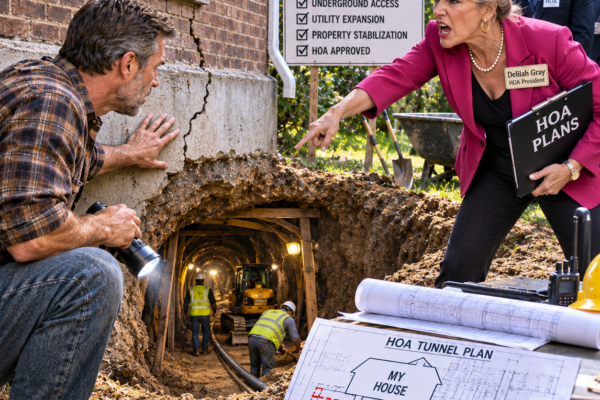
A week later, I found contractors digging beside a utility box within the easement corridor.
“What are you installing?”
The foreman looked at his work order.
“Secondary water-control assembly.”
“For who?”
“Maple Ridge HOA.”
“Who authorized work affecting this corridor?”
He pointed at the paper.
“Karen Holt.”
I photographed it.
Then asked:
“Does your company know there’s a court order concerning interference with this easement?”
His shovel stopped.
“No.”
“Call your supervisor.”
He did.
Within twenty minutes, the crew packed up.
Sarah’s response was less restrained.
“They are testing the edges of the order.”
“What does that mean?”
“It means Karen is trying to discover how much she can do without technically repeating the gate.”
“Can we stop her?”
“We ask the court to clarify and enforce the injunction.”
Sarah filed the photographs and work order.
Spencer called the valve project a misunderstanding.
Judge Whitaker called it “ill-advised.”
The work did not resume.
Then discovery started.
That was when we learned why Karen had been so obsessed with the easement.
It wasn’t just because residents disliked seeing my truck.
Maple Ridge’s developer had designed the subdivision around a future second phase.
Phase Two required another cluster of homes and an expanded recreational complex.
The easiest internal circulation route for that expansion intersected the same corridor I used.
As long as my easement remained active, the HOA couldn’t treat the road as a fully controlled residents-only boulevard.
Emergency vehicles, my visitors, service trucks, contractors, agricultural equipment, and utility maintenance tied to my parcel all retained legitimate access.
To most sane people, that would have been manageable.
To Karen, it was unacceptable.
An internal email from six months earlier said:
**Mercer easement creates permanent nonmember penetration through community security envelope. Long-term solution required before Phase Two marketing.**
I read it twice.
“Nonmember penetration.”
Sarah rolled her eyes.
“Consultant language.”
Another email from Karen:
**Purchase is preferable. If owner refuses, investigate changed-condition restrictions and alternative-access pressure.**
My stomach tightened.
“Alternative-access pressure.”
Sarah nodded.
“Your gate.”
Another email followed after I rejected the $25,000 offer.
**He is emotionally attached to the property. Economic inconvenience may change his calculation.**
I stopped reading.
“She wanted to make using my road painful enough that I’d sell.”
“That appears to be one theory supported by the documents.”
“Say it like a human.”
Sarah looked at me.
“She wanted to squeeze you.”
“Thank you.”
Then came the worst one.
Three days before the gate installation, Karen emailed Spencer—not her current litigation counsel at the time, but an outside development consultant who shared the same first name by coincidence.
**Once controlled access is established, continued use becomes discretionary in practice even if old documents remain technically recorded.**
I stared at Sarah.
“She knew.”
“She knew the easement was recorded.”
“She thought if she controlled the gate, my legal right wouldn’t matter in reality.”
“That is how I read it.”
Something inside me went quiet.
For weeks I had wondered whether Karen was simply ignorant.
Maybe she believed development erased rural easements.
Maybe somebody had given her bad advice.
Maybe she thought a security gate with no code was legally defensible.
The emails answered that.
She knew the recorded right existed.
The strategy was to make exercise of that right so difficult that I surrendered it.
That changed the damages case.
Sarah amended our claims to include evidence of deliberate interference.
The HOA’s insurer became much more interested.
So did Maple Ridge homeowners.
Because legal fees were rising.
And every invoice eventually showed up in their budget.
At the next board meeting, residents demanded answers.
I didn’t attend.
Greg called afterward.
“It was ugly.”
“How ugly?”
“Karen called the injunction judicial overreach.”
I laughed.
“Anything else?”
“Someone asked why the HOA spent thirty-eight thousand dollars in legal fees fighting an easement recorded before the subdivision existed.”
“What did she say?”
“That the principle affects community security.”
“Of course.”
“Then Mrs. Alvarez asked why community security cost more than the pool renovation.”
I liked Mrs. Alvarez already.
Greg continued.
“Then people found out about Phase Two.”
“Was that secret?”
“Not secret exactly.”
“Meaning?”
“Most owners knew future development was possible. They didn’t know your road was part of the plan.”
That explained something else.
Karen wasn’t protecting current residents from me.
She was protecting a future development vision from my easement.
“The board knew?”
“Some.”
“You?”
“Not when I joined.”
“Who did?”
“Karen. Stuart. Developer representative. Maybe Michelle.”
Greg sounded tired.
“Daniel, this is getting worse.”
“For me?”
“For her.”
A few days later Karen arrived at my property.
No clipboard.
That was how I knew she wanted something.
She stopped at the edge of the porch.
At least she had learned that much.
“Can we talk?”
“Through Sarah?”
“I came as a neighbor.”
“You’re not my neighbor. Maple Ridge is between us.”
She forced a smile.
“Fine. As two property owners.”
“What do you want?”
“The board is prepared to make another offer.”
“No.”
“You haven’t heard it.”
“Doesn’t matter.”
“Four hundred thousand dollars.”
That got my attention.
Not because I wanted it.
Because six weeks earlier she thought the easement was worth twenty-five thousand.
I leaned against the porch post.
“For the easement?”
“For your entire property.”
I laughed.
Her face tightened.
“Why is that funny?”
“Because my land is worth more than that without a house.”
“The appraisal—”
“Whose appraisal?”
She didn’t answer.
I continued.
“You blocked my road, spent tens of thousands defending it, got ordered to restore access, and now you’re standing on my property offering to buy the property you were trying to isolate.”
“Buying would solve everyone’s problems.”
“No. It would solve yours.”
“The community needs certainty.”
“You mean control.”
She inhaled.
“Daniel, you’re one person.”
I stared.
“And?”
“Hundreds of families live here now.”
“They bought homes next to a recorded easement.”
“You keep hiding behind that document.”
I almost laughed.
“A property right is not hiding.”
Her voice hardened.
“Things change.”
“Then negotiate.”
“We are negotiating.”
“No. You tried inconvenience first.”
Her eyes flickered.
I knew she remembered the email.
Maybe she didn’t yet know we had it.
I let the silence sit.
Then she said:
“Four hundred thousand is a serious offer.”
“No.”
“Five hundred.”
“No.”
“You haven’t even—”
“No.”
She looked genuinely confused.
That was the difference between us.
Karen thought every objection had a price.
Mine did not.
“My father died in that house,” I said.
Her expression softened slightly.
“My mother planted those trees.”
“I understand sentiment.”
“No, you don’t.”
Her face stiffened.
“I’ve offered you far more than the property is worth to this community.”
“To this community.”
“Yes.”
“That’s exactly the problem.”
She frowned.
I pointed down the road.
“To you, that’s a planning obstacle.”
Then toward the house.
“This is inventory.”
I shook my head.
“To me, it’s home.”
Karen’s voice dropped.
“Home can be somewhere else.”
“Then move yours.”
That ended the meeting.
She walked back to the SUV.
Before leaving, she turned.
“You’re making this harder than it needs to be.”
I said:
“You told me that before you locked the gate.”
She drove away.
Two weeks later, the damages hearing began.
Sarah’s case was brutally simple.
Recorded easement.
Prior purchase attempt.
Written threats of “complications.”
Gate installed.
No access code.
Alternative road economically impractical.
Days of lost vehicular access.
Emergency-access concerns.
Attorney fees.
Survey costs.
Physical inconvenience.
Then internal emails showing that the inconvenience wasn’t accidental.
It was strategy.
Spencer tried to separate Karen’s decisions from the HOA as a whole.
That was understandable.
By then the board’s insurer and directors had their own concerns.
Karen’s lawyer argued she had believed the gate was lawful based on security rights of the underlying property owner.
Sarah showed the email:
**Economic inconvenience may change his calculation.**
The courtroom went quiet.
Judge Whitaker read it himself.
Then looked at Karen.
“Who wrote this?”
Karen’s attorney answered:
“Ms. Holt.”
The judge read the next email.
**Once controlled access is established, continued use becomes discretionary in practice even if old documents remain technically recorded.**
He looked over his glasses.
“Technically recorded?”
Karen said nothing.
Sarah continued.
“The defendants did not misunderstand the easement. They attempted to make it practically useless.”
That was the sentence.
Everything else became accounting.
The court awarded me damages tied to the proven obstruction and related losses, and the final resolution included approximately fifty thousand dollars in compensatory amounts and recoverable costs, with substantial attorney fees addressed separately under the applicable orders and settlement arrangements.
More important to me, the permanent injunction was precise.
The HOA and its successors could not block, materially burden, relocate, or condition my lawful use of the recorded easement without my consent or further lawful order.
Reasonable maintenance measures were still allowed.
Emergency repairs were still allowed.
The servient property owner still had rights.
But nobody could landlock my property again because a board president disliked seeing my truck.
Judge Whitaker looked at both sides before adjourning.
“Property development does not erase recorded rights merely because those rights become inconvenient.”
Karen stared at the table.
The gavel came down.
Outside, Sarah smiled.
“You won.”
I shook my head.
“I got my road back.”
“That is usually what winning looks like in property law.”
I looked toward the courthouse parking lot.
Karen was speaking with her attorney.
Residents had gathered nearby.
Nobody stood beside her.
“Doesn’t feel like revenge.”
Sarah closed her briefcase.
“Good.”
“Why?”
“Revenge is expensive.”
“So are you.”
“That too.”
The strangest thing happened afterward.
People from Maple Ridge began apologizing.
Not all.
Some still believed I had made life difficult for the neighborhood.
One man told me at the gas station:
“You could’ve just taken the money.”
I asked:
“Would you sell your house because somebody blocked your driveway?”
He didn’t answer.
But others understood.
Mrs. Alvarez found me near the road one afternoon.
She was in her sixties, carried gardening gloves in one hand, and looked furious.
“Are you Daniel?”
“Depends who’s asking.”
She smiled.
“Maria Alvarez. Lot forty-two.”
“Nice to meet you.”
“I owe you an apology.”
“For what?”
“I believed Karen.”
I waited.
“She told us you were demanding unrestricted access for commercial vehicles and refusing reasonable security.”
“I wasn’t.”
“I know.”
She looked at the road.
“She said you threatened to shut off utilities.”
That one irritated me.
“I never threatened anything like that.”
“I know that now.”
“For the record, I don’t own your utility lines and I have no right to shut them off.”
“I know.”
“Good.”
Maria smiled.
“You really hate being misquoted.”
“Deeply.”
She became serious.
“We’re trying to recall Karen.”
That surprised me.
“Why tell me?”
“Because people think this is about you versus the HOA.”
“Isn’t it?”
“No.”
She looked toward the subdivision.
“It’s becoming us versus the way she runs it.”
The next board meeting proved her right.
I didn’t attend.
Sarah advised me not to turn their internal political fight into my victory lap.
Smart.
Greg told me what happened.
Residents packed the clubhouse.
They came with legal bills.
Copies of my easement.
Board minutes.
Phase Two presentations.
And Karen’s emails that had entered the public court file.
One homeowner stood and asked:
“Why are we paying for a lawsuit over a road we never owned?”
Karen tried to explain that the HOA owned the land beneath it.
Another homeowner answered:
“Then why did we buy land with an easement on it and pretend the easement didn’t exist?”
Someone else shouted:
“Why didn’t you give him the gate code?”
Karen said the original security plan had been “misimplemented.”
Greg apparently laughed out loud.
Then Maria read Karen’s email about economic inconvenience.
Silence.
“Is this how you negotiate with residents too?” she asked.
Karen accused the meeting of becoming hostile.
Maria replied:
“No. It’s becoming informed.”
I wish I had been there for that line.
The board demanded Karen step aside while an independent review examined the easement litigation and Phase Two expenditures.
She refused.
So homeowners started a recall process under the bylaws.
Karen fought it.
Letters.
Emails.
Meetings.
Claims that outside agitators were undermining Maple Ridge.
I was apparently the outside agitator.
Funny.
I had lived there before “there” existed.
Then another problem surfaced.
The proposed secondary water-control work I had stopped wasn’t merely routine maintenance.
Documents showed Karen wanted a new valve and utility configuration that would make Phase Two construction easier.
Again, no sinister plan to shut off my water.
The truth was less dramatic and more revealing.
She kept authorizing work in the easement corridor as though my recorded rights were obstacles to be managed later.
The new board majority froze every nonessential project connected to Phase Two.
The developer wasn’t happy.
Then the county recorder sent me a certified copy of something that almost made me laugh.
Maple Ridge had submitted a request associated with revised boundary mapping near the easement.
It did not erase my recorded right.
The recorder’s office flagged the conflict.
Sarah reviewed it.
“They’re not literally redrawing your deed with a pen.”
“I know.”
“But the filing package attempts to depict future boundaries and internal road control in a way that ignores the practical effect of your easement.”
“Karen?”
“Her signature is here.”
I leaned back.
“She is still trying.”
“Less effectively.”
Sarah sent formal objections and supporting title documents.
The proposed filing did not move forward in a way that altered my rights.
By then, even Spencer seemed exhausted.
His last letter to Sarah was only four paragraphs.
She called it progress.
Then Greg came to my house.
He parked near the road and walked up carrying a sealed envelope.
“Another threat?”
“No.”
“Offer?”
He looked embarrassed.
“Sort of.”
I opened it.
$500,000.
Purchase offer for my property.
I laughed.
Greg did too.
“Sorry.”
“No, it’s funny now.”
“I voted against sending it.”
“Then why deliver it?”
“Because Karen told the management company you’d claim we didn’t communicate.”
He rubbed his forehead.
“I’m tired, Daniel.”
“I believe you.”
“People are angry about fees.”
“I know.”
“Some blame you.”
“I know.”
“Most blame her.”
I looked at him.
“What do you blame?”
Greg took a long time.
“The board.”
That answer surprised me.
“Not Karen?”
“Her too.”
“But?”
“We let her.”
He looked back toward Maple Ridge.
“She was organized. Confident. Always had documents ready.”
“People liked that.”
“We liked not having to ask questions.”
That was honest.
He continued.
“Then when you said the easement was permanent, she told us her lawyers had handled it.”
“They hadn’t.”
“Not the way she claimed.”
Greg looked at the envelope.
“I’m not asking you to sell.”
“Good.”
“I came to tell you the recall vote is next week.”
“And?”
“She’ll lose.”
He was right.
Karen resigned two days before homeowners could vote her out.
No dramatic speech.
No police.
No escort from the clubhouse.
Just an email.
**Effective immediately, I am resigning as President of the Maple Ridge Estates Homeowners Association due to the increasingly hostile environment surrounding board service and personal attacks directed at volunteer leadership.**
Not one mention of the gate.
The court order.
The emails.
The legal fees.
Nothing.
For about five minutes, I wanted to answer.
Sarah stopped me.
“Why?”
“Because I want to.”
“That’s not a reason.”
“I want her to know exactly why she lost.”
“She knows.”
“What if she doesn’t?”
“Then your email won’t fix her.”
I deleted the draft.
That may have been the hardest thing I did during the entire dispute.
Winning gives you a dangerous urge to explain the loss to the person who caused it.
Sometimes silence does the job better.
The interim board contacted me three days later.
Greg came.
Maria came.
A retired accountant named Leonard Greene came as interim president.
They stopped before the property line.
Leonard asked:
“May we come up?”
That simple question mattered.
“Yes.”
We sat on my porch.
No clipboards.
Leonard placed a folder on the table.
“First, the board apologizes.”
I waited.
“For the gate.”
“For the obstruction.”
“For representations made about your access rights.”
“For legal expenses that should never have been incurred.”
“And for attempts to pressure you into selling property you repeatedly said was not for sale.”
Plain language.
No “miscommunication.”
No “if offense occurred.”
I appreciated that.
Then Leonard said:
“We’d like to develop a written road-management protocol consistent with your easement.”
I stiffened.
He noticed.
“Not new restrictions.”
“What then?”
“Maintenance.”
“Emergency contacts.”
“Construction notice.”
“A way for residents and you not to repeat this.”
Sarah had told me to listen before saying no.
So I listened.
The proposal was reasonable.
No gate unless any future barrier provided me continuous independent access.
No registration requirement for me, my family, guests, contractors, deliveries, or lawful service vehicles traveling to my property.
Reasonable speed and safety rules that applied to everyone using the road, including HOA residents.
Advance notice for planned construction that could temporarily affect passage.
Emergency access always preserved.
Utility maintenance coordinated with the relevant providers.
No alteration of the route without my written consent where my easement rights would be materially affected.
I looked at Leonard.
“You wrote this?”
“Sarah helped.”
I turned toward my lawyer.
She smiled.
“Surprise.”
“I pay you too much.”
“Yes.”
We signed only after revisions and title review.
For the first time since Maple Ridge arrived, the HOA and I had something Karen always claimed to want.
Cooperation.
The difference was consent.
The HOA paid to repair damage heavy construction had caused to portions of the gravel road.
I contributed to maintenance for wear associated specifically with my use where appropriate under the agreement.
Maple Ridge handled its share.
No one pretended generosity.
We simply divided responsibilities.
That was healthier.
The steel gate itself had been sitting in a maintenance yard since the court ordered access restored.
Leonard asked:
“Do you want it?”
I stared at him.
“Why would I want it?”
“Greg thinks you should turn it into yard art.”
Greg raised a hand.
“I was joking.”
Maria said:
“Mostly.”
I thought about it.
Then shook my head.
“Sell it.”
They did.
The money went toward legal expenses.
Appropriate ending.
But my part wasn’t finished emotionally.
Legal victories happen faster than habits disappear.
For months, every time I rounded the last bend, I expected to see steel bars.
Even when I knew the gate was gone.
My foot would lift off the accelerator automatically.
My shoulders tightened.
Then open road appeared.
Nothing blocking it.
Still, my body remembered.
One evening I stopped where the gate had been.
Got out.
Walked to the ditch.
You could still see the concrete scars where the posts had been cut out.
I stood there staring.
Dad’s voice came back to me.
Not from some mystical place.
Memory.
When I was sixteen, a storm had washed part of that gravel road into the ditch.
I complained for an hour while helping him shovel.
“Why don’t we build another road?”
Dad laughed.
“Where?”
“The east side.”
He looked toward the ravine.
“With whose money?”
I shrugged.
He leaned on his shovel.
“This road exists because Walter let us cross his land and because we respected what he still owned.”
I didn’t understand why he said it that way then.
I did now.
An easement wasn’t ownership.
It was a relationship between rights.
Dad had never treated Fletcher’s farm like ours.
He slowed near cattle.
Fixed ruts.
Closed gates.
Helped clear fallen limbs.
Fletcher never treated our access like a favor he could withdraw.
That balance had survived decades.
Karen broke it because she saw any right she didn’t control as an insult.
I took Dad’s old photograph from the house the next morning.
The one with him and Fletcher beside the wooden stake.
I had it enlarged.
Framed.
Hung in my workshop.
Underneath, I mounted a copy of the recorded easement.
Not the court judgment.
Not Karen’s resignation.
The original agreement.
That was what mattered.
Two people had solved the issue forty years before we complicated it.
Maple Ridge eventually elected Leonard president for a full term.
He hated campaigning.
That was one reason people trusted him.
His first board meeting lasted fifty-eight minutes.
Karen’s meetings used to last three hours.
Greg texted me afterward.
**We discussed landscaping for eleven minutes and nobody threatened litigation. Historic evening.**
I replied:
**Proud of you.**
The Phase Two development changed too.
Not canceled entirely.
Redesigned.
The developer built internal circulation away from my easement.
More expensive for them.
Still possible.
Amazing what engineers can accomplish when “force somebody else to surrender a property right” disappears from the option list.
A year later, construction started.
The developer’s project manager called me first.
“Mr. Mercer?”
“Yes.”
“We have concrete trucks scheduled Tuesday. They may briefly cross the easement corridor at the lower intersection.”
“How briefly?”
“Traffic control for maybe five minutes at a time.”
“Will I be able to pass if necessary?”
“Yes.”
“Emergency vehicles?”
“Immediately.”
“Send the plan.”
He did.
I approved the temporary coordination.
No fight.
No lawsuit.
No clipboard standoff.
People sometimes asked why I cooperated after everything.
Because cooperation had never been the problem.
Coercion was.
There is a difference.
Karen sold her Maple Ridge house about eighteen months after resigning.
I only knew because a FOR SALE sign appeared.
Then a moving truck.
I happened to be driving through when she stood beside the driveway.
For a second, I considered continuing.
Then she raised one hand.
I stopped.
Rolled down the window.
“Daniel.”
“Karen.”
She looked older.
Not dramatically.
Just tired.
“You got what you wanted.”
I almost answered angrily.
Instead I said:
“I wanted to drive home.”
Her mouth tightened.
“You know what I mean.”
“No. I don’t.”
“The board.”
“The lawsuit.”
“People turning against me.”
“I didn’t make them.”
“You embarrassed me.”
“You installed a gate.”
Her eyes hardened.
“There were real security concerns.”
“Then you should’ve given me access.”
“You never tried to understand the pressure I was under.”
“What pressure?”
“Property values.”
“Developer expectations.”
“Residents demanding perfection.”
“Everything was my responsibility.”
I looked at her.
“No.”
She frowned.
“What?”
“That’s the problem.”
“What is?”
“You decided everything was your responsibility.”
“The road.”
“My land.”
“What residents should see.”
“Who should drive where.”
“Whether I should sell.”
I shook my head.
“Some things were never yours to solve.”
For once, Karen didn’t immediately answer.
She looked toward the house behind her.
“I thought if I could make the development work perfectly, people would know I was good at this.”
That was the most human thing she had ever said to me.
I didn’t forgive the gate because of it.
But I understood something.
“You didn’t need to prove that with my road.”
“I know that now.”
I wasn’t sure whether she truly did.
Maybe enough.
She asked:
“Do you hate me?”
“No.”
That surprised her.
“Why not?”
“I don’t want to spend that much time on you.”
She almost laughed.
Almost.
Then she said:
“I am sorry you had to walk through the woods.”
I looked at her.
“That is a very specific apology.”
“It’s the one I can give.”
Not enough for everything.
But real enough to accept.
“Thank you.”
She nodded.
I drove away.
That was the last conversation we ever had.
Years passed.
Maple Ridge became just another neighborhood.
Kids rode bicycles near the entrance.
Delivery vans came and went.
People planted trees that grew large enough to hide some of the houses.
The gravel road remained.
My truck still used it.
So did utility crews.
Family.
Friends.
The occasional contractor.
Nobody stopped me.
Nobody checked a list.
The road simply did the job roads are supposed to do.
It connected one place to another.
Mom’s apple trees eventually started failing.
The oldest one split during a windstorm.
I stood beside it longer than necessary.
My daughter, Emily, had driven out to help.
She was thirty by then and lived two counties away.
“Dad, it’s a tree.”
“I know.”
“You look like somebody died.”
“Your grandmother planted it.”
“Oh.”
She stopped teasing.
We cut away the broken section.
One branch remained healthy.
Emily asked:
“Can we save it?”
“Maybe.”
We took cuttings.
Grafted them onto younger rootstock the following spring.
Two survived.
I planted one near the workshop.
Emily took the other home.
That mattered because inheritance changes shape.
My parents left twenty-five acres.
But land isn’t meaningful because no one ever changes it.
It’s meaningful because somebody carries the story forward without selling the parts that matter for convenience.
One day Emily asked what would happen to the road when I died.
I handed her the easement folder.
She stared.
“This is romantic.”
“Property documents usually are.”
She rolled her eyes.
“I’m serious.”
“So am I.”
I showed her the recorded description.
Court order.
Maintenance agreement.
Surveys.
Utility records.
Everything organized.
No mystery.
No Karen pile.
“Why all this?”
“Because paper remembers better than people.”
Emily looked up.
“Grandpa?”
“Walter Fletcher.”
“Who?”
I smiled.
Then told her.
The farmer.
Dad.
The handshake.
The recorded easement.
The wooden stake.
She listened.
When I finished, she said:
“So the entire lawsuit happened because Karen didn’t read something written before she was born.”
“Basically.”
“That is incredible.”
“Read your paperwork.”
“I knew there’d be a lesson.”
“There is always a lesson.”
“You’re becoming Grandpa.”
“Could do worse.”
I gave her copies.
Not the originals.
I wasn’t insane.
The old road needed resurfacing several years later.
Leonard had moved on from the board by then.
Maria was president.
She called.
“We need gravel.”
“Agreed.”
“We got three bids.”
“That sounds dangerously competent.”
“We’ve grown.”
We split responsibilities according to the maintenance agreement.
The work took two days.
On the second afternoon, I stood beside the crew while fresh gravel rolled into place.
The foreman asked:
“How old’s this road?”
“Depends what you mean.”
“This route.”
“More than forty-five years.”
He whistled.
“Still the only way in?”
“The only practical one.”
He looked toward Maple Ridge.
“Wouldn’t know it used to be farmland.”
“No.”
I did.
Sometimes that was enough.
After the roller left, I drove the road slowly.
Fresh gravel cracked under the tires.
At the spot where Karen’s gate had once stood, there was nothing.
Not even the concrete scars anymore.
Resurfacing had covered them.
For years I thought I wanted those marks preserved.
Evidence.
A reminder.
But seeing them disappear didn’t bother me.
I had the documents.
I had Dad’s photograph.
I had the land.
I didn’t need the wound visible forever.
At home, I took the original easement out of the fireproof box.
Careful.
Old paper.
Yellowed edges.
Walter Fletcher’s signature.
Dad’s.
Recording stamp.
Simple legal language.
No dramatic court phrases.
No mention of HOA presidents or gated communities.
Just access.
Utilities.
Successors.
Forever, subject to the written terms.
I thought about the first afternoon Karen blocked me.
Her standing behind that steel gate telling me:
**You’ll need to find another route.**
She believed the newest thing automatically outranked the oldest.
New development.
New HOA.
New gate.
New rules.
But property law doesn’t work like fashion.
Sometimes the older document is exactly the thing everybody who comes later must respect.
I put the easement away.
Then walked to the porch.
Sunset stretched across the western pasture.
The same hills Mom used to watch from her chair.
A truck appeared down the road.
Emily.
She drove up and parked.
My grandson, Caleb, jumped out before she had fully killed the engine.
He was nine.
“Grandpa!”
“What’s wrong?”
“Mom said there’s a secret road.”
Emily climbed out.
“I said old road.”
Caleb pointed.
“That one?”
“Yes.”
“What’s secret about it?”
“Nothing.”
He looked disappointed.
“Mom said there was a battle.”
Emily laughed.
“I said lawsuit.”
“Same thing.”
He ran toward the workshop.
I called:
“Don’t touch anything sharp.”
He shouted:
“Okay!”
Which meant he absolutely would.
Emily walked beside me.
“Remember when you almost sold after Grandma died?”
I stopped.
I had forgotten telling her.
“Yeah.”
“Glad you didn’t.”
“Me too.”
She looked down the road.
“You would’ve regretted it.”
“Probably.”
“Even before Karen?”
“Especially after.”
She smiled.
Then her expression softened.
“You know, Dad, when you first told me about the gate, I thought you were being stubborn.”
“I was.”
“No. I mean unnecessarily stubborn.”
“I was probably that too.”
“I thought, take the money.”
“Lots of people did.”
“Now I get it.”
“What changed?”
She looked at the workshop.
The trees.
The road.
Her son disappearing behind the barn.
“I have a kid.”
That was all she had to say.
Parents understand inheritance differently once they become the person deciding what survives.
We sat on the porch while the light faded.
No HOA drama.
No legal papers.
No angry SUV around the bend.
Just family.
A few weeks later, Maple Ridge installed a new sign near the main entrance.
Not a gate.
A sign.
**MAPLE RIDGE ESTATES**
Below it, a smaller plaque:
**PRIVATE COMMUNITY ROADS — SUBJECT TO RECORDED ACCESS RIGHTS**
Maria sent me a photograph before installation.
“Any objections?”
I stared at the words.
“None.”
“Historic day.”
“Don’t get emotional.”
“Too late.”
The first time I drove past it, I laughed.
Karen had once tried to make my existence disappear from the neighborhood.
Now the sign itself acknowledged that rights could exist beyond HOA membership.
Not my name.
Not my property.
Just the principle.
That was better.
Eventually Sarah retired too.
Her last official act involving me was sending a box of closed files.
On top she placed a sticky note:
**Please try not to acquire any new enemies with real-estate interests.**
I called her.
“You’re abandoning me.”
“I’m retiring.”
“Same thing.”
“You haven’t needed me in years.”
“That’s because people are afraid of you.”
“Excellent.”
“What am I supposed to do if another gate appears?”
“Call a younger lawyer.”
“Cruel.”
She laughed.
Then became serious.
“You did well, Daniel.”
“You did the work.”
“You listened.”
“Eventually.”
“Most clients don’t.”
“I almost cut the gate.”
“I know.”
“You really think that would’ve hurt the case?”
“Yes.”
“How much?”
“Enough that I’m glad you didn’t.”
I smiled.
“Me too.”
After we hung up, I opened the first litigation folder.
Photograph of the gate.
Black steel.
White sign.
HOA RESIDENTS ONLY.
My truck visible on the wrong side.
I had looked at that picture hundreds of times.
It used to make me furious.
Now it looked almost ridiculous.
One piece of steel pretending it could cancel a document recorded forty years earlier.
I put the photograph beneath the rest.
Closed the box.
Stored it in the workshop.
Not destroyed.
Just no longer displayed.
That night a storm rolled through.
Nothing severe.
Hard rain.
Wind.
Power flickered once.
I stood at the kitchen window and watched water run across the yard.
Then headlights appeared down the gravel road.
A utility truck.
Tree limb had fallen near a line farther uphill.
The truck drove straight through Maple Ridge.
No gate.
No delay.
Reached the corridor.
Crew repaired the problem.
Exactly what access was supposed to allow.
I thought about Dad’s note.
**Remember what the road carries underground.**
He hadn’t written it because he expected an HOA fight.
He wrote it because property rights are connected.
Road.
Water.
Electricity.
Communication.
Emergency access.
Family.
A line on a survey can look small until somebody blocks it.
Then you discover how much life depends on that line remaining open.
The storm passed around midnight.
I went outside in the morning.
Branches scattered across the gravel.
One had fallen near the entrance.
I dragged it aside.
No board approval.
No lawyer.
No lawsuit.
Just maintenance.
As I finished, a Maple Ridge resident named Kevin stopped his pickup.
“Need a hand?”
“Got it.”
He climbed out anyway.
Together we moved a heavier branch.
He wiped his hands on his jeans.
“Hard to believe there was a gate here.”
“You lived here then?”
“Just moved in.”
“So you heard stories.”
“Everybody hears stories.”
I groaned.
“What version?”
“That you owned the road and shut off the neighborhood’s utilities until the HOA surrendered.”
I stared at him.
“That is completely wrong.”
He laughed.
“I figured.”
“I don’t own the road.”
“Really?”
“I have an easement.”
“Didn’t shut off utilities?”
“Absolutely not.”
“Did Karen really make you hike two miles home?”
“Yes.”
He winced.
“That’s bad enough.”
“Reality usually is.”
Kevin got back in his truck.
Before leaving, he said:
“My closing lawyer pointed out your easement.”
That stopped me.
“Really?”
“Yep.”
“Said don’t buy here unless you’re comfortable with legal access through the neighborhood.”
I smiled.
“Sounds like a good lawyer.”
He drove away.
I stood beside the open road.
That might have been the most satisfying ending of all.
Not Karen resigning.
Not the damages award.
Not the judge’s order.
A new homeowner being told about the easement before buying.
No surprise.
No resentment.
No fantasy that HOA paperwork outranked recorded rights.
Just informed consent.
The thing that could have prevented the entire mess.
I walked home.
At the workshop, Caleb—my grandson—had left a small toy truck on Dad’s old photograph frame.
I picked it up.
Put it on the bench.
Then noticed something behind the frame.
Dad’s original note.
I had forgotten I put it there.
**Remember what the road carries underground.**
Below it, in smaller handwriting, another sentence I hadn’t noticed in years.
**Access isn’t worth much until somebody tries to take it away.**
I sat down.
Dad had probably been talking about utility planning.
Maybe repairs.
Maybe Walter Fletcher warning him that development would eventually come.
It didn’t matter.
The sentence had waited decades to make sense.
Outside, I heard Emily calling Caleb.
A truck door closed.
Then tires rolled down the gravel road.
Away from the house.
Through the former Fletcher property.
Past Maple Ridge.
Toward the county road.
Nobody stopped them.
Nobody asked for a code.
Nobody decided whether they were approved.
They simply drove.
I remained in the workshop until the sound disappeared.
Then I closed Dad’s file.
Locked the cabinet.
Stepped outside.
The road stretched between the trees, freshly graveled and completely ordinary.
That was exactly what I wanted.
Karen had believed the ultimate display of power was deciding who could pass through a gate.
She had been wrong.
The strongest road was the one that no longer needed anybody standing beside it to explain why I belonged there.
I got into my truck.
Drove down the hill.
Passed the place where the steel posts once stood.
The Maple Ridge sign appeared on my left.
Below it:
**SUBJECT TO RECORDED ACCESS RIGHTS.**
I kept driving.
No victory speech.
No honking.
No glance toward Karen’s old house.
Just gravel beneath the tires and an open road ahead.
The same road Dad had used.
The same road Mom had used.
The same road Walter Fletcher had been wise enough to protect on paper before anyone imagined subdivisions, security gates, or HOA presidents with clipboards.
Forty years later, the road was still doing exactly what they intended.
Getting my family home.
[END OF STORY]