𝗙𝗨𝗟𝗟 𝗦𝗧𝗢𝗥𝗬 The Morning Karen Whitfield Put a Lien on My Home Over a Seventy-Dollar Fine
𝗙𝗨𝗟𝗟 𝗦𝗧𝗢𝗥𝗬
I wasn’t planning to paint the house neon orange or build a chicken coop in the driveway.
I was just a woman who wanted to drink coffee on her porch and grow basil near the steps.
For the first few years, that was exactly what I did.
I went to work.
Paid dues.
Kept the yard tidy.
Attended a few meetings.
Smiled at neighbors.
Avoided drama.
My house became the place where I learned to sleep through the night again.
The place where I unpacked boxes I had carried through too many chapters of my life.
The place where I hung my grandmother’s wind chimes above the porch.
And the place where I kept her ring.
The ring was simple.
A narrow gold band with a small oval garnet.
Grandma Ruth wore it every day after my grandfather died.
She said diamonds were too loud for her hand.
The garnet suited her better.
Deep red.
Quiet.
Stubborn.
When it came to me, I wore it on a chain most days because my knuckles swelled in summer and I was afraid of losing it.
But when I gardened, I sometimes took it off and placed it on the porch rail or beside the basil pot so dirt wouldn’t collect beneath the setting.
That carelessness would later give Karen her chance.
Before any of that, I made one mistake.
I asked a question at an HOA meeting.
It was a Tuesday evening in early spring.
The clubhouse smelled like coffee, carpet cleaner, and whatever artificial lemon scent someone used in the bathrooms.
About thirty residents sat in folding chairs facing the board table.
Karen Whitfield sat in the center.
She had been president of the Maple Ridge HOA for eleven years.
Nobody ran against her anymore.
People said she was organized.
Efficient.
Dedicated.
What they meant was that she was exhausting to oppose.
Karen was in her early fifties, with a careful blond bob, pearl earrings, and the kind of smile that never warmed her eyes.
She wore pastel blazers and pressed slacks to board meetings, as though enforcing mailbox regulations required executive formality.
Her clipboard was famous.
Brown leather.
Gold clip.
Color-coded tabs.
She carried it through the neighborhood like a badge.
That night, the board announced dues would increase by forty percent.
No detailed explanation.
No full financial report.
Just a brief statement about rising maintenance costs and reserve needs.
A murmur moved through the room.
Most people looked down at their hands.
I raised mine.
Karen’s eyes found me.
“Yes, Glenda?”
I stood.
“Could we see the numbers supporting the increase?”
Her smile held.
“The board has reviewed the budget.”
“I understand. But forty percent is a lot. Are the reserve fund statements available?”
A few heads turned.
Karen tilted her head.
“The board is handling those matters appropriately.”
“Can homeowners review the records?”
Her smile tightened.
“Glenda, financial management requires experience. Residents elect a board so every line item does not have to be debated by committee.”
“I’m not asking to debate every line item. I’m asking for documentation.”
The room changed.
Not dramatically.
But enough.
People stopped shifting.
Stopped whispering.
Karen’s fingers tightened around her pen.
“The board will take your concern under advisement.”
That meant no.
I sat down.
My neighbor Dot, who had lived in Maple Ridge since the first homes were built, leaned toward me and whispered, “Careful.”
I looked at her.
“She doesn’t fine people for grass,” Dot said softly. “She fines people who ask questions about money.”
I thought she was being dramatic.
I was wrong.
The first violation arrived five days later.
My grass, according to Karen’s measuring tape, was one-quarter inch over the permitted height.
The notice included a photograph.
The angle was absurdly close, a ruler pressed into the lawn near my walkway.
Fine amount: seventy dollars.
I stood in my kitchen holding the letter and laughed.
A quarter inch.
A person had walked onto my lawn, measured the grass, photographed it, and sent me a bill for seventy dollars.
I almost called Dot to tell her how ridiculous it was.
Instead, I paid it online.
I told myself it was easier.
I told myself I had no interest in becoming known as the woman who started a fight over grass.
That was how it started.
People like Karen depend on reasonable people being reasonable too long.
The next week, a notice arrived for unauthorized holiday lighting.
It was April.
The “holiday lighting” was a string of warm white porch lights I kept along the railing because I liked sitting outside in the evening.
They had been there for four years.
Nobody had cared.
My neighbor across the street had brighter lights wrapped around two columns and a tree.
No fine.
I called the HOA office.
Karen answered personally.
“Maple Ridge Estates. Karen speaking.”
“This is Glenda Mercer on Alder Court. I received a notice about porch lights.”
“Yes.”
“They aren’t holiday lights. They’re just small porch lights.”
“Our exterior illumination guidelines are clear.”
“They’ve been up for years.”
“That doesn’t make them compliant.”
“My neighbor has the same lights.”
“I’m not discussing another resident’s file.”
“I’m asking why the rule applies only to me.”
There was a pause.
Then Karen said, “Rules are rules, Glenda.”
Her voice was smooth.
But underneath it was something colder.
Something pleased.
That was the moment I understood Dot had been right.
This was personal.
The fines started arriving weekly after that.
Trash bins visible too early.
Trash bins removed too late.
Mailbox shade inconsistent with the approved black finish.
Birdseed beneath the feeder creating an alleged nuisance.
A garden hose not properly concealed.
A clay planter too close to the walkway.
Each notice came with a photograph.
Each photograph had been taken from the sidewalk or from the edge of my property.
I began feeling watched.
At first, I tried to comply.
I moved the trash bins.
Coiled the hose.
Swept beneath the bird feeder.
Removed the porch lights.
I even repainted the mailbox post, though it already looked black to every human eye except Karen Whitfield’s.
None of it helped.
The more I complied, the more creative the violations became.
That was when I started my folder.
It began with a plain manila envelope.
Then two.
Then a labeled binder.
Every notice.
Every envelope.
Every date.
Every payment receipt.
Every photograph I took of my own property before and after Karen’s alleged inspections.
I started documenting the lawn height with a ruler of my own.
I photographed the mailbox.
The bins.
The porch.
The bird feeder.
The flower bed.
I saved copies to my laptop and to a cloud folder.
It felt obsessive.
Then again, so did being fined over birdseed.
Karen didn’t know about the folder.
That was important.
She still believed I was only irritated.
Not prepared.
Then she came for the wind chimes.
The note appeared under my front door on a Thursday afternoon.
Not mailed.
Not emailed.
Slipped under the door like a threat from someone too comfortable with my porch.
Remove unauthorized noise device within forty-eight hours.
Below that, handwritten in Karen’s neat script:
Antique wind chimes violate community quiet enjoyment standards.
I stood in my entryway reading the note while the chimes hung above my porch, silent in still air.
Noise device.
My grandmother’s wind chimes had hung there for six years.
They barely made sound unless the wind came from the west, and even then they chimed softly enough that I sometimes had to step outside to hear them.
I walked onto the porch and touched one brass tube.
It moved against another.
A small clear note floated into the afternoon.
For a moment, I was eight years old again, sitting near Grandma Ruth’s kitchen door while she shelled peas.
Listen to whatever the day is trying to tell you.
That day was telling me Karen wanted surrender.
Not compliance.
Surrender.
I took the chimes down.
Not because Karen was right.
Because I was tired.
Because the fines had already passed eight hundred dollars.
Because I had begun waking at three in the morning worrying about envelopes.
Because I told myself one set of wind chimes was not worth risking my home.
I wrapped them in an old towel and placed them on the dining room table.
Then I cried harder than I expected.
A person who has never been harassed over small things may not understand why removing wind chimes could break you.
It wasn’t the chimes alone.
It was the message.
Nothing was safe.
Not my lawn.
Not my porch.
Not my memories.
Not the last ordinary objects that connected me to people I loved.
Karen knew exactly what she was doing.
Two weeks later, the certified letter arrived.
Unpaid fines, late fees, and administrative charges had ballooned to more than two thousand dollars.
The HOA intended to file a lien.
I sat at my kitchen table reading the letter with both hands pressed flat against the paper.
Could a woman with a clipboard really take my house over grass, porch lights, birdseed, and wind chimes?
I wanted to believe the answer was no.
But the letter looked official.
The threat looked real.
And fear has a way of making absurd things feel possible.
That evening, Dot waved me over from her driveway.
She was seventy-six, tall and thin, with sharp cheekbones and white hair pinned neatly at the back of her head.
Dot had survived three decades of Maple Ridge politics and seemed to know everyone’s secrets.
She looked at my face and didn’t bother with small talk.
“What did she send you?”
“A lien warning.”
Dot closed her eyes briefly.
“I was afraid of that.”
“She can’t do this, can she?”
Dot looked toward Karen’s house at the corner.
“Karen can do almost anything if people stay quiet long enough.”
I felt sick.
Dot lowered her voice.
“She doesn’t fine people for grass, Glenda. I told you that.”
“You said she fines people who ask about money.”
“She does.”
I looked at her.
“What money?”
Dot opened her mailbox, removed a stack of envelopes, then shut it again.
“The reserve funds. Landscaping contracts. Special assessments. Numbers that never quite line up.”
My pulse quickened.
“Do you have proof?”
“No. Not enough.”
“Then how do you know?”
She gave me a tired look.
“Because I’ve watched her for eleven years.”
Dot stepped closer.
“Three years ago, a couple on Juniper Lane asked why the entrance landscaping cost had doubled. Within a month, they had violations for shutters, driveway oil, and a fence stain. They sold before winter.”
I said nothing.
“Last year, a man on Meadow Court asked about the pool repair invoices. Suddenly he was fined for improper storage, mailbox condition, and unapproved backyard equipment.”
“What happened?”
“He stopped coming to meetings.”
Dot’s eyes hardened.
“Karen doesn’t want money questions. She wants obedience.”
That night, I opened the HOA newsletter again.
The one announcing the dues increase.
Near the bottom was a paragraph praising the board’s continued partnership with a landscaping company called Evergreen Crest Maintenance.
I had read it before without thinking.
This time, I searched the state business registry.
Evergreen Crest Maintenance.
Registered agent: Karen Whitfield.
Registered address: 114 Maple Ridge Drive.
Karen’s house.
I stared at the screen.
Then checked again.
Same company.
Same address.
The HOA had awarded a landscaping contract to a company registered at Karen’s own home.
Maybe there was some innocent explanation.
Maybe Karen had disclosed everything properly.
Maybe the company belonged to a relative and she had recused herself from the vote.
Maybe.
But after months of fines, threats, and missing financial explanations, I no longer believed in convenient coincidences.
I printed the registry page.
Put it in my folder.
Then opened a new section labeled:
MONEY.
From that night forward, I documented two things.
What Karen did to me.
And what Karen might be doing to the neighborhood.
A few days later, I set up a small porch camera.
I told myself it was for security.
That was partly true.
But mostly, I wanted the truth.
Karen had slipped a note under my door.
Taken photographs from the edge of my property.
Measured my grass.
Cited objects she had no reason to inspect closely.
I wanted to know how often she came near my house when I wasn’t watching.
The camera was discreet.
Mounted beneath the porch eave.
Clear view of the walkway, front steps, and railing.
I tested it twice.
It worked perfectly.
Two days later, it caught the moment that destroyed Karen Whitfield’s kingdom.
It was a Saturday morning.
I had been gardening near the porch, trimming basil and pulling weeds from the flower bed beside the steps.
The weather was warm, and I was wearing thin gloves.
My grandmother’s ring was on a chain around my neck, but the clasp kept catching against my collar.
Without thinking, I removed the chain and placed it on the porch railing beside my watering can.
Then my phone rang.
It was my sister.
She was upset about a family issue, and I walked inside to talk.
One minute became fifteen.
Fifteen became thirty.
By the time we finished, I forgot the ring was outside.
At 10:42 a.m., Karen Whitfield walked up my front path.
The camera showed her clearly.
Pearl earrings.
Cream blouse.
Navy cardigan.
Clipboard tucked under one arm.
She did not knock.
She stood on my porch and looked toward the front window.
Then she turned toward the flower bed.
She took out her phone and photographed the basil pot.
Then the empty hook where the wind chimes had been.
Then the porch railing.
That was when she saw the ring.
I watched the footage later with my heart pounding so hard I could hear it in my ears.
Karen’s expression changed.
Not surprise.
Not concern.
Calculation.
She picked up the chain.
The garnet flashed red in the morning light.
For three seconds, she held it in her palm and looked toward the door.
She could have knocked.
She could have left it where it was.
She could have placed it safely beside the watering can.
Instead, she slipped my grandmother’s ring into the pocket of her cardigan.
Then she looked directly toward the camera without realizing what it was.
A small, smug smile crossed her face.
She turned and walked away.
When I discovered the ring missing, panic hit me first.
I searched the porch.
The flower bed.
Between the boards.
Inside the watering can.
The kitchen counter.
The entry table.
My bedroom.
My purse.
Everywhere.
I kept telling myself I had moved it.
That I must have brought it inside.
That the chain had fallen behind something.
But I knew.
Somewhere beneath the panic, I knew.
I opened the camera app with trembling hands.
The footage loaded.
And there she was.
Karen Whitfield.
Taking my grandmother’s ring.
For a few seconds, I couldn’t move.
Then the panic burned away.
In its place came something sharper.
Resolve.
I saved the footage to three locations.
My phone.
My laptop.
The cloud folder.
Then I called the police.
My voice shook when the dispatcher answered, but I stayed clear.
I explained that my property had been stolen from my porch and that I had video.
Officers arrived within fifteen minutes.
Two of them.
Officer Ramirez and Officer Holt.
They stood on my porch while I played the footage.
Neither interrupted.
When Karen slipped the ring into her pocket, Officer Holt’s face hardened.
“That belongs to you?” he asked.
“Yes.”
“What is it?”
“My grandmother’s ring.”
My voice broke.
I hated that.
Ramirez looked at me more gently.
“Do you have a photograph of yourself wearing it or proof it was yours?”
I nodded.
I had dozens.
Family photos.
Insurance records were unnecessary because the ring wasn’t extremely valuable, but I had pictures of my grandmother wearing it too.
I showed them.
Ramirez nodded.
“Do you know this woman?”
“Karen Whitfield. HOA president.”
Holt looked toward the street.
“She had permission to take the ring?”
“No.”
“Did she notify you she had it?”
“No.”
He watched the clip again.
Then said, “We’ll speak with her.”
Karen answered her door wearing the same pearls she wore to meetings.
She looked surprised to see police, but not frightened.
Not at first.
I stood near the sidewalk with Officer Ramirez while Officer Holt spoke to her.
Through the open doorway, I could hear pieces.
“Property reported missing.”
“Video footage.”
“Ring.”
Karen’s voice rose slightly.
“There must be some misunderstanding.”
Officer Holt asked whether she had entered my porch.
Karen said she had been performing a community inspection.
He asked whether she picked up an item from my railing.
Karen’s face changed.
Just enough.
She recovered quickly.
“That was evidence of a code violation.”
Officer Holt stared at her.
“Evidence?”
“Yes. Unauthorized personal property displayed in a front-facing exterior area.”
I almost laughed.
Not because anything was funny.
Because the explanation was so obscene it broke something in my mind.
My grandmother’s ring.
Evidence of a code violation.
Officer Holt’s tone became colder.
“Where is the ring now, ma’am?”
Karen lifted her chin.
“I intended to document it properly.”
“Where is it?”
She hesitated.
Then stepped back inside.
A minute later, she returned with the chain and ring in a small plastic bag.
My hands clenched.
She had bagged it.
As though my family heirloom were contraband.
Officer Holt took it.
“Ma’am, HOA code enforcement does not authorize you to remove personal property from someone’s porch and put it in your pocket.”
Karen’s smile twitched.
“I did not put it in my pocket as personal property. I collected it as part of—”
“That’s not code enforcement,” he said.
The street went silent around us.
“That’s theft. Plain and simple.”
Karen looked at him as though no one had ever spoken to her that way.
Then she looked at me.
For the first time since all of this began, her eyes showed something like fear.
Not regret.
Fear.
Officer Ramirez asked me to remain available for a statement.
The ring would be handled as evidence briefly, then returned through proper procedure.
I nodded.
I should have felt relieved.
Instead, I felt hollow.
The woman had taken my grandmother’s ring.
Not accidentally.
Not out of confusion.
She had taken it because she believed no one would stop her.
That belief mattered.
Because when a person in power believes they can steal something small, they are usually stealing larger things too.
The police report changed everything.
Not immediately.
Karen still tried to control the story.
By Monday, she had sent an email to the board claiming I had created a hostile encounter during a lawful inspection.
She described the ring incident as a misunderstanding involving improperly stored exterior items.
But the footage existed.
And once footage exists, polished language has a harder time surviving.
I called Dot.
Then two other neighbors Dot trusted.
One was Paul Reeves from Juniper Lane.
His wife had been fined repeatedly after questioning landscaping costs.
The other was Marsha Ellis from Meadow Court, whose brother had stopped attending meetings after asking about pool repair invoices.
We met at my kitchen table with coffee and my folder.
I showed them the ring footage.
Marsha covered her mouth.
Paul whispered, “God.”
Dot’s face went pale with anger.
“She finally got careless.”
I showed them the Evergreen Crest registration next.
Karen’s address.
HOA newsletter.
Dues increase.
Missing reserve explanations.
Then my fines.
The lien notice.
The wind chime note.
The photos.
The pattern.
Paul opened a folder of his own.
He had invoices.
Emails.
Meeting notes.
Marsha had letters her brother had saved.
Dot had years of newsletters and dues statements.
By midnight, my dining room table looked like a legal archive.
The ring theft was no longer an isolated crime.
It was the visible crack in a wall that had been hiding something rotten for years.
The next morning, I contacted an attorney named Lisa Marlowe.
She specialized in property disputes and association misconduct.
When I arrived at her office, I brought two binders, a flash drive, and the police report number.
Lisa was in her early forties, calm, direct, and sharp enough that I felt safer within five minutes of speaking to her.
She reviewed the lien notice first.
Then the violation letters.
Then the video.
When Karen took the ring, Lisa paused the footage.
She didn’t speak for several seconds.
Then she said, “That is not an HOA issue. That is a criminal issue.”
“I know.”
She played it again.
“And this woman filed a lien against your house?”
“Yes.”
“After you asked about dues?”
“Yes.”
Lisa leaned back.
“Glenda, this may be much larger than your fines.”
I placed the Evergreen Crest records in front of her.
“It is.”
Lisa read the company registration.
Her expression changed.
“This address belongs to Karen?”
“Yes.”
“And the HOA awarded this company a landscaping contract?”
“Yes.”
“Do you have board approval records?”
“Not yet.”
“We’ll request them.”
“They’ve ignored me before.”
Lisa gave a small smile with no warmth in it.
“They may find it harder to ignore counsel.”
Within forty-eight hours, Lisa sent formal records requests to the HOA.
Financial statements.
Reserve account records.
Vendor contracts.
Board minutes.
Conflict-of-interest disclosures.
Fine ledgers.
Lien authorization records.
She also provided the police report and video reference to investigators handling the theft complaint.
Meanwhile, other homeowners began filing statements.
Paul.
Marsha’s brother.
The couple from Juniper Lane.
Another resident who had paid hundreds in fines after asking about pool repairs.
The pattern became clearer.
Karen did not target messy properties.
She targeted questions.
Anyone asking about money suddenly found themselves buried under rules.
Grass.
Lights.
Mailboxes.
Bird feeders.
Wind chimes.
Trash bins.
Anything could become a violation if Karen wanted leverage.
Then Lisa found the payment records.
Evergreen Crest Maintenance had received HOA funds for years.
More than anyone expected.
Invoices for seasonal landscaping.
Entrance flowers.
Mulch replacement.
Tree trimming.
Common-area cleanup.
Some work had been done.
Some was vague.
Some invoices repeated language word for word across different months.
And the company’s registered address remained Karen’s house.
When Lisa requested conflict disclosures showing Karen had recused herself from votes involving Evergreen Crest, the HOA could not produce complete records.
When she requested reserve fund reports supporting the forty percent dues increase, the board produced summaries but not full backup.
When she requested lien authorization records for my house, several signatures appeared on documents dated before the board meeting where the lien was supposedly approved.
Lisa called me after reviewing the packet.
“Glenda, I’m sending this to the appropriate state authorities with an embezzlement concern.”
I sat down at my kitchen table.
“Embezzlement?”
“The records raise serious questions about self-dealing and diversion of association funds. Investigators will determine criminal liability, but this is no longer just about improper fines.”
I looked toward the porch.
The empty hook above the door moved slightly in the breeze.
“What about the lien?”
“We’re challenging it immediately. Given the criminal investigation and the irregularities in the fines, we have strong grounds to stop enforcement.”
I closed my eyes.
For the first time in weeks, I felt the ground beneath me become solid again.
Not safe.
Not yet.
But solid.
Karen reacted exactly as Lisa predicted.
She called an emergency board meeting.
The agenda said:
Disciplinary Review and Lien Enforcement — Glenda Mercer Property.
Lisa told me to attend.
“Do I have to speak?”
“Only if needed.”
“I don’t know if I can sit in that room with her.”
“You can.”
Her voice was firm.
“And you won’t be alone.”
The clubhouse was packed that Thursday evening.
Word of the ring theft had spread, though nobody knew all the details yet.
Karen sat at the center of the board table, pearls around her throat, clipboard in front of her, posture perfect.
She looked like a woman trying very hard to appear untouched.
When I walked in with Lisa, Karen’s eyes found mine.
For a moment, her smile returned.
That same tight, polished smile.
The one that used to make neighbors go quiet.
But this time, it didn’t work.
Dot sat in the front row.
Paul sat beside her.
Marsha stood against the wall holding a folder.
Other residents filled every chair.
Karen tapped her pen against the table.
“We are here to address a pattern of noncompliance from Ms. Mercer.”
Lisa stood immediately.
“No. We are here because this board is attempting to enforce a lien built on disputed fines issued by a president currently under criminal theft investigation and financial misconduct review.”
The room went completely silent.
Karen’s face tightened.
“That is inflammatory.”
Lisa placed a stack of documents on the table.
“It is documented.”
Karen gave a brittle laugh.
“Ms. Mercer has created this spectacle because she refuses to follow simple rules.”
Dot stood.
“No, Karen. She created a record because you finally stole from the wrong porch.”
A murmur moved through the room.
Karen looked sharply at Dot.
“I would be very careful with accusations.”
Officer Holt stepped into the room from the back.
Nobody had noticed him arrive.
He was not there to arrest anyone during the meeting.
At least not then.
He was there because the theft complaint had drawn law enforcement attention to the escalating dispute.
His presence changed the room.
Karen saw him.
Her hand froze over the clipboard.
Lisa connected her laptop to the room’s screen.
“I’m going to play a short video.”
Karen stood.
“This is improper.”
Lisa looked at the board vice president.
“You are considering enforcement against my client’s home. The board should understand the conduct of the person driving that enforcement.”
The vice president, a nervous man named Harold, nodded.
“Play it.”
The footage filled the screen.
My porch.
My railing.
Karen walking up the steps.
Karen photographing my flower bed.
Karen picking up my grandmother’s ring.
Karen slipping it into her pocket.
The room remained silent until the clip ended.
Then voices erupted.
“She took it?”
“That’s Glenda’s porch.”
“She didn’t even knock.”
“Oh my God.”
Karen stood rigid behind the table.
“That item was collected during an inspection.”
Officer Holt spoke from the back.
“Ma’am, we’ve already discussed that. That explanation does not make it lawful.”
Karen turned pale.
Lisa then displayed the Evergreen Crest registration.
Karen’s home address.
The HOA newsletter announcing the landscaping contract.
Payment summaries.
Missing conflict disclosures.
Delayed reserve explanations.
Then the lien documents.
Dates that didn’t match.
Fine notices issued after complaints about dues.
Homeowners who had been targeted after questioning money.
Lisa did not shout.
She didn’t need to.
Each document landed harder than the last.
By the time she finished, Karen’s pearls looked less like elegance and more like costume jewelry on a collapsing performance.
Harold cleared his throat.
“The board needs to suspend lien enforcement immediately.”
Karen spun toward him.
“You don’t have authority to do that without a full review.”
He stared at her.
“We are the board.”
For the first time in eleven years, someone at that table said no to Karen Whitfield and meant it.
A motion was made to suspend Karen from all HOA duties pending investigation.
Another board member seconded it.
Karen laughed once.
A short, disbelieving sound.
“You cannot be serious.”
Dot stood again.
“We are very serious.”
Residents began demanding a vote.
Not politely.
Not fearfully.
Loudly.
Years of silence cracked open in that room.
People spoke about fines.
Threats.
Missing records.
Delayed audits.
Special assessments.
Letters that had frightened them into paying.
The vote was not close.
Karen was suspended that night.
Her lien action against my house was frozen immediately.
The board voted to cooperate with investigators and preserve all financial records.
Karen tried to gather her papers with dignity, but her hands shook.
As she walked toward the exit, Officer Holt met her near the door.
He spoke quietly.
I couldn’t hear every word.
But I saw Karen’s face.
Then I saw the handcuffs.
The room went still.
The click of the cuffs was small.
Almost delicate.
But it carried farther than any sound I had heard in that clubhouse.
Karen Whitfield, who had signed fraudulent fine notices and treated neighbors like subjects, stood in front of the community with her wrists behind her back.
Her pearls still gleamed.
Her blazer was still pressed.
But the illusion was gone.
For eleven years, she had mistaken fear for respect.
Now fear had changed sides.
The criminal investigation expanded quickly after that.
The ring theft was simple enough.
Video.
Property.
Possession.
No lawful authority.
But the financial side reached deeper.
Investigators examined Evergreen Crest Maintenance.
HOA payments.
Reserve fund increases.
Missing disclosures.
Board minutes.
Lien threats.
Other homeowners came forward.
At least three reported missing personal items after Karen’s so-called inspections.
A small garden statue.
A decorative copper watering can.
A set of antique porch lanterns removed as alleged exterior violations.
Each item had been dismissed at the time as a misunderstanding or disposal.
Now those complaints looked very different.
My folder joined theirs.
Together, our records became the backbone of a theft and embezzlement investigation.
The lien against my home was dismissed that same week.
Lisa called me with the confirmation.
“It’s gone, Glenda.”
I was standing in my dining room, looking at the towel-wrapped wind chimes still sitting on the table.
“The lien?”
“Dismissed. The board has withdrawn the enforcement, and we’re making sure the release is documented properly.”
I gripped the phone.
“She can’t take the house?”
“No. Not through that lien.”
I sat down because my legs suddenly felt weak.
For months, Karen had made my home feel temporary.
Conditional.
As though every wall belonged partly to her.
Now that threat was gone.
I thanked Lisa three times.
She finally said, “Glenda, breathe.”
So I did.
For what felt like the first time in months.
The officer returned my grandmother’s ring two days later.
Officer Ramirez brought it in a small evidence envelope.
She stood on my porch while I opened it.
The garnet caught the afternoon light, deep red against the gold.
My throat tightened.
I slid the ring onto my finger even though it fit snugly.
Ramirez smiled.
“Ma’am, I’ve never seen someone smile at getting robbed before.”
I laughed through tears.
“I’m smiling because she didn’t get to keep it.”
She nodded.
“That’s fair.”
After she left, I sat on the porch step and held my hand in the sunlight.
The ring looked exactly as it always had.
Small.
Plain.
Stubborn.
I wondered what Grandma Ruth would have said about all of this.
Probably something about how people who steal small things usually think no one is watching.
Then she would have told me to hang the wind chimes back up.
So that evening, I did.
I took them from the towel.
Wiped each brass tube.
Untangled the string.
Climbed onto a chair.
And hung them from the hook above my porch.
The first sound they made was soft.
A clear note.
Then another.
The breeze moved through them gently, as though the house itself had exhaled.
Neighbors began stepping outside.
Dot came over first.
She stood at the bottom of the porch and looked up at the chimes.
“About time.”
I smiled.
“Karen said they were a noise violation.”
Dot folded her arms.
“Karen is currently a criminal defendant.”
I laughed harder than I expected.
Soon Paul arrived.
Then Marsha.
Then two neighbors I barely knew.
Nobody planned it.
People simply drifted toward the sound.
For the first time in months, the cul-de-sac felt like a neighborhood rather than a collection of houses under surveillance.
We talked until sunset.
Not about violations.
Not about liens.
About gardens.
Children.
Weather.
Repairs.
Ordinary things.
Beautiful things.
The news broke the following week.
Karen Whitfield, longtime HOA president of Maple Ridge Estates, faced charges including theft and embezzlement-related offenses tied to HOA funds.
Her mugshot spread through the neighborhood group chat within an hour.
For years, her photo on the HOA website had shown her smiling beside the clubhouse flagpole, pearls neat, blazer immaculate.
Now the image everyone saw was different.
No clipboard.
No pearls arranged for a portrait.
No polished smile.
Just Karen looking smaller than I remembered.
I didn’t feel sorry for her.
But I didn’t celebrate either.
What I felt was relief.
Relief that the person who had made so many people afraid of their own homes was finally being asked to answer for what she had done.
The HOA board removed her permanently at the next official meeting.
The vote was unanimous.
The landscaping contract was suspended pending review.
A forensic audit was ordered.
The dues increase was paused until the finances could be properly explained.
Residents who had paid questionable fines were invited to submit records for review.
The board wasn’t perfect overnight.
No board ever is.
But something fundamental changed.
People asked questions.
And this time, questions were answered.
Dot sat beside me at the first meeting after Karen’s removal.
When the temporary president opened the floor, three hands went up.
Mine was one of them.
I asked about reserve statements.
This time, nobody smiled like a trap snapping shut.
The temporary president nodded and said, “We’ll provide a schedule for document access by the end of the week.”
Dot leaned toward me.
“Imagine that,” she whispered. “A question. Then an answer.”
I smiled.
It sounded simple.
But simple things can feel revolutionary after enough fear.
Months later, Maple Ridge still looked like a postcard from the outside.
Trimmed lawns.
White fences.
Quiet cul-de-sacs.
But it no longer felt like Karen’s kingdom.
It felt like a place where people had remembered they owned their homes.
Where a clipboard was just a clipboard.
Where rules had to survive daylight.
I kept the lien notice in my folder.
I kept the wind chime violation too.
The photographs.
The company registration.
The police report.
The release of lien.
The board minutes removing Karen.
The records mattered.
They had saved me.
Not because they were dramatic.
Because they were patient.
Karen had loud authority.
I had dates.
She had a clipboard.
I had footage.
She had fear.
I had my grandmother’s ring on camera.
In the end, the quiet evidence won.
On the first warm evening after everything settled, I sat on the porch with tea and listened to the wind chimes.
The sun was dropping behind the roofs on Alder Court.
The sky had turned soft gold.
Dot was watering flowers across the street.
A child rode a scooter down the sidewalk.
Somewhere, someone’s dog barked once and stopped.
The ring rested on my finger.
The lien was gone.
The house was safe.
And the wind chimes moved lightly in the breeze.
For a moment, I closed my eyes and heard my grandmother’s voice.
Listen to whatever the day is trying to tell you.
That evening, the day told me I was home.
Not because nobody had tried to take it from me.
Because they had tried, and failed.
Justice did not arrive all at once.
It came through a folder.
A camera.
A neighbor’s warning.
A question at a meeting.
An officer willing to call theft by its real name.
It came through every small truth Karen believed she could bury beneath paperwork.
And when the chimes rang again above my porch, they sounded louder than any clipboard ever could.
𝗧𝗛𝗘 𝗘𝗡𝗗
The Morning Karen Whitfield Put a Lien on My Home Over a Seventy-Dollar Fine
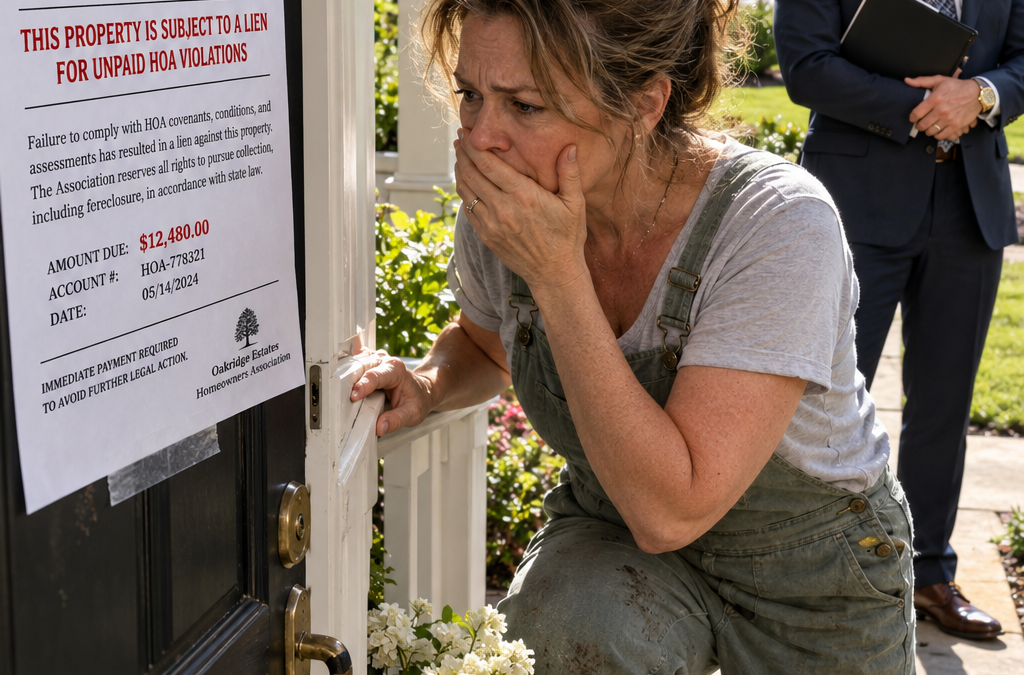
The red-stamped notice was waiting on my porch at seven in the morning, and for a moment I forgot how to breathe. Karen Whitfield had already taken my peace, my savings, and my grandmother’s ring—but now she wanted my house too.
The paper was taped flat against the front door, centered carefully beneath the brass knocker like someone had taken pride in placing it there.
That detail bothered me later.
At the time, all I could see was the red stamp.
LIEN NOTICE.
The words looked too large for the paper.
Too official.
Too final.
I stood on my porch in my garden shoes, one hand still damp from watering the potted basil beside the steps, and read the first paragraph three times before the meaning reached me.
Maple Ridge Estates Homeowners Association claimed I owed more than two thousand dollars in unpaid fines, fees, penalties, and collection costs.
If I failed to pay, the association would proceed with further legal remedies against my home.
My home.
Not a rental.
Not a place I was passing through.
The little brick house at the end of Alder Court that I had bought after my divorce, after my mother died, after my grandmother’s estate was settled, after I convinced myself that peace was still possible for a woman starting over in her late forties.
My knees weakened.
I grabbed the porch rail with one hand.
The morning was quiet around me.
A sprinkler clicked steadily across the street.
Somewhere two houses down, a garage door rumbled open.
A school bus sighed at the far corner.
Everything in Maple Ridge looked normal.
Perfect lawns.
White fences.
American flags hanging from porch columns.
The kind of neighborhood people drove through slowly and said, This must be a nice place to live.
I used to think that too.
I lowered myself onto the porch step, still holding the notice.
The first fine had been seventy dollars.
Seventy.
That was the number I kept returning to.
A seventy-dollar violation over grass that Karen Whitfield claimed was one-quarter inch too tall.
I had paid it because I thought paying it would end the annoyance.
Instead, it had taught Karen that I could be pushed.
And once Karen Whitfield learned that, she pushed until there was nowhere left for me to stand.
Three months earlier, none of this existed.
No lien.
No police report.
No emergency board meeting.
No investigator asking me to identify stolen property.
Just a quiet cul-de-sac, a wind chime that had belonged to my grandmother, and a woman with pearls around her neck pretending a clipboard gave her the right to own everyone else’s life.
I moved into Maple Ridge Estates six years after my grandmother died.
That may seem like an odd way to mark time, but in my family everything important was measured around her.
Before Grandma Ruth died.
After Grandma Ruth died.
Before the house was sold.
After the ring came to me.
Before her wind chimes were wrapped in newspaper and placed in a cardboard box with my name written on the side.
She had been the steady center of our family.
A small woman with silver hair, sharp eyes, and hands that always smelled faintly of rose soap and flour.
She baked when she was happy.
She cleaned when she was angry.
And when she was worried, she sat on the porch and let the wind chimes speak for her.
Those chimes were not expensive.
Thin brass tubes.
A small wooden clapper.
A faded blue glass bead hanging at the bottom.
But they had hung outside her kitchen door for as long as I could remember.
When I was a girl, I used to sit beneath them while she shelled peas into a metal bowl.
“Listen,” she would say whenever the breeze moved through them.
“To what?”
“To whatever the day is trying to tell you.”
At eight years old, I thought that was nonsense.
At forty-eight, I understood.
Some days whispered.
Some warned.
Some told you to stop pretending everything was fine.
The morning the lien notice landed on my door, the wind chimes were gone because Karen Whitfield had ordered me to remove them.
The empty hook above my porch swayed slightly in the breeze.
I looked at it while holding the lien notice and felt a kind of anger I had never known before.
Not loud.
Not reckless.
Cold.
Precise.
The kind of anger that starts organizing evidence.
When I first bought the house, Maple Ridge Estates seemed almost too good for me.
That was the ugly truth.
I had lived for years in a two-bedroom townhouse near a busy road, where headlights swept across my bedroom ceiling at night and the neighbor’s television came through the wall every evening at six.
I was tired of noise.
Tired of people knowing my business.
Tired of feeling like every home I had ever lived in belonged partly to someone else.
Then the house on Alder Court came on the market.
It was modest compared with some of the newer houses in Maple Ridge, but it was mine the moment I stepped inside.
Sunlight in the kitchen.
A little breakfast nook facing the backyard.
A front porch just deep enough for two chairs.
A flower bed along the walkway where I could plant lavender and roses.
My realtor told me there was an HOA.
I read the documents.
At least, I read the version given to me at closing.
The rules seemed strict but ordinary.
Keep the lawn maintained.
No abandoned vehicles.
Exterior changes required approval.
Holiday decorations had to come down within a reasonable time.
Nothing that made me worry.
I wasn’t planning to paint the house neon orange or build a chicken coop in the driveway.
I was just a woman who wanted to drink coffee on her porch and grow basil near the steps.
For the first few years, that was exactly what I did.
I went to work.
Paid dues.
Kept the yard tidy.
Attended a few meetings.
Smiled at neighbors.
Avoided drama.
My house became the place where I learned to sleep through the night again.
The place where I unpacked boxes I had carried through too many chapters of my life.
The place where I hung my grandmother’s wind chimes above the porch.
And the place where I kept her ring.
The ring was simple.
A narrow gold band with a small oval garnet.
Grandma Ruth wore it every day after my grandfather died.
She said diamonds were too loud for her hand.
The garnet suited her better.
Deep red.
Quiet.
Stubborn.
When it came to me, I wore it on a chain most days because my knuckles swelled in summer and I was afraid of losing it.
But when I gardened, I sometimes took it off and placed it on the porch rail or beside the basil pot so dirt wouldn’t collect beneath the setting.
That carelessness would later give Karen her chance.
Before any of that, I made one mistake.
I asked a question at an HOA meeting.
It was a Tuesday evening in early spring.
The clubhouse smelled like coffee, carpet cleaner, and whatever artificial lemon scent someone used in the bathrooms.
About thirty residents sat in folding chairs facing the board table.
Karen Whitfield sat in the center.
She had been president of the Maple Ridge HOA for eleven years.
Nobody ran against her anymore.
People said she was organized.
Efficient.
Dedicated.
What they meant was that she was exhausting to oppose.
Karen was in her early fifties, with a careful blond bob, pearl earrings, and the kind of smile that never warmed her eyes.
She wore pastel blazers and pressed slacks to board meetings, as though enforcing mailbox regulations required executive formality.
Her clipboard was famous.
Brown leather.
Gold clip.
Color-coded tabs.
She carried it through the neighborhood like a badge.
That night, the board announced dues would increase by forty percent.
No detailed explanation.
No full financial report.
Just a brief statement about rising maintenance costs and reserve needs.
A murmur moved through the room.
Most people looked down at their hands.
I raised mine.
Karen’s eyes found me.
“Yes, Glenda?”
I stood.
“Could we see the numbers supporting the increase?”
Her smile held.
“The board has reviewed the budget.”
“I understand. But forty percent is a lot. Are the reserve fund statements available?”
A few heads turned.
Karen tilted her head.
“The board is handling those matters appropriately.”
“Can homeowners review the records?”
Her smile tightened.
“Glenda, financial management requires experience. Residents elect a board so every line item does not have to be debated by committee.”
“I’m not asking to debate every line item. I’m asking for documentation.”
The room changed.
Not dramatically.
But enough.
People stopped shifting.
Stopped whispering.
Karen’s fingers tightened around her pen.
“The board will take your concern under advisement.”
That meant no.
I sat down.
My neighbor Dot, who had lived in Maple Ridge since the first homes were built, leaned toward me and whispered, “Careful.”
I looked at her.
“She doesn’t fine people for grass,” Dot said softly. “She fines people who ask questions about money.”
I thought she was being dramatic.
I was wrong.
The first violation arrived five days later.
My grass, according to Karen’s measuring tape, was one-quarter inch over the permitted height.
The notice included a photograph.
The angle was absurdly close, a ruler pressed into the lawn near my walkway.
Fine amount: seventy dollars.
I stood in my kitchen holding the letter and laughed.
A quarter inch.
A person had walked onto my lawn, measured the grass, photographed it, and sent me a bill for seventy dollars.
I almost called Dot to tell her how ridiculous it was.
Instead, I paid it online.
I told myself it was easier.
I told myself I had no interest in becoming known as the woman who started a fight over grass.
That was how it started.
People like Karen depend on reasonable people being reasonable too long.
The next week, a notice arrived for unauthorized holiday lighting.
It was April.
The “holiday lighting” was a string of warm white porch lights I kept along the railing because I liked sitting outside in the evening.
They had been there for four years.
Nobody had cared.
My neighbor across the street had brighter lights wrapped around two columns and a tree.
No fine.
I called the HOA office.
Karen answered personally.
“Maple Ridge Estates. Karen speaking.”
“This is Glenda Mercer on Alder Court. I received a notice about porch lights.”
“Yes.”
“They aren’t holiday lights. They’re just small porch lights.”
“Our exterior illumination guidelines are clear.”
“They’ve been up for years.”
“That doesn’t make them compliant.”
“My neighbor has the same lights.”
“I’m not discussing another resident’s file.”
“I’m asking why the rule applies only to me.”
There was a pause.
Then Karen said, “Rules are rules, Glenda.”
Her voice was smooth.
But underneath it was something colder.
Something pleased.
That was the moment I understood Dot had been right.
This was personal.
The fines started arriving weekly after that.
Trash bins visible too early.
Trash bins removed too late.
Mailbox shade inconsistent with the approved black finish.
Birdseed beneath the feeder creating an alleged nuisance.
A garden hose not properly concealed.
A clay planter too close to the walkway.
Each notice came with a photograph.
Each photograph had been taken from the sidewalk or from the edge of my property.
I began feeling watched.
At first, I tried to comply.
I moved the trash bins.
Coiled the hose.
Swept beneath the bird feeder.
Removed the porch lights.
I even repainted the mailbox post, though it already looked black to every human eye except Karen Whitfield’s.
None of it helped.
The more I complied, the more creative the violations became.
That was when I started my folder.
It began with a plain manila envelope.
Then two.
Then a labeled binder.
Every notice.
Every envelope.
Every date.
Every payment receipt.
Every photograph I took of my own property before and after Karen’s alleged inspections.
I started documenting the lawn height with a ruler of my own.
I photographed the mailbox.
The bins.
The porch.
The bird feeder.
The flower bed.
I saved copies to my laptop and to a cloud folder.
It felt obsessive.
Then again, so did being fined over birdseed.
Karen didn’t know about the folder.
That was important.
She still believed I was only irritated.
Not prepared.
Then she came for the wind chimes.
The note appeared under my front door on a Thursday afternoon.
Not mailed.
Not emailed.
Slipped under the door like a threat from someone too comfortable with my porch.
Remove unauthorized noise device within forty-eight hours.
Below that, handwritten in Karen’s neat script:
Antique wind chimes violate community quiet enjoyment standards.
I stood in my entryway reading the note while the chimes hung above my porch, silent in still air.
Noise device.
My grandmother’s wind chimes had hung there for six years.
They barely made sound unless the wind came from the west, and even then they chimed softly enough that I sometimes had to step outside to hear them.
I walked onto the porch and touched one brass tube.
It moved against another.
A small clear note floated into the afternoon.
For a moment, I was eight years old again, sitting near Grandma Ruth’s kitchen door while she shelled peas.
Listen to whatever the day is trying to tell you.
That day was telling me Karen wanted surrender.
Not compliance.
Surrender.
I took the chimes down.
Not because Karen was right.
Because I was tired.
Because the fines had already passed eight hundred dollars.
Because I had begun waking at three in the morning worrying about envelopes.
Because I told myself one set of wind chimes was not worth risking my home.
I wrapped them in an old towel and placed them on the dining room table.
Then I cried harder than I expected.
A person who has never been harassed over small things may not understand why removing wind chimes could break you.
It wasn’t the chimes alone.
It was the message.
Nothing was safe.
Not my lawn.
Not my porch.
Not my memories.
Not the last ordinary objects that connected me to people I loved.
Karen knew exactly what she was doing.
Two weeks later, the certified letter arrived.
Unpaid fines, late fees, and administrative charges had ballooned to more than two thousand dollars.
The HOA intended to file a lien.
I sat at my kitchen table reading the letter with both hands pressed flat against the paper.
Could a woman with a clipboard really take my house over grass, porch lights, birdseed, and wind chimes?
I wanted to believe the answer was no.
But the letter looked official.
The threat looked real.
And fear has a way of making absurd things feel possible.
That evening, Dot waved me over from her driveway.
She was seventy-six, tall and thin, with sharp cheekbones and white hair pinned neatly at the back of her head.
Dot had survived three decades of Maple Ridge politics and seemed to know everyone’s secrets.
She looked at my face and didn’t bother with small talk.
“What did she send you?”
“A lien warning.”
Dot closed her eyes briefly.
“I was afraid of that.”
“She can’t do this, can she?”
Dot looked toward Karen’s house at the corner.
“Karen can do almost anything if people stay quiet long enough.”
I felt sick.
Dot lowered her voice.
“She doesn’t fine people for grass, Glenda. I told you that.”
“You said she fines people who ask about money.”
“She does.”
I looked at her.
“What money?”
Dot opened her mailbox, removed a stack of envelopes, then shut it again.
“The reserve funds. Landscaping contracts. Special assessments. Numbers that never quite line up.”
My pulse quickened.
“Do you have proof?”
“No. Not enough.”
“Then how do you know?”
She gave me a tired look.
“Because I’ve watched her for eleven years.”
Dot stepped closer.
“Three years ago, a couple on Juniper Lane asked why the entrance landscaping cost had doubled. Within a month, they had violations for shutters, driveway oil, and a fence stain. They sold before winter.”
I said nothing.
“Last year, a man on Meadow Court asked about the pool repair invoices. Suddenly he was fined for improper storage, mailbox condition, and unapproved backyard equipment.”
“What happened?”
“He stopped coming to meetings.”
Dot’s eyes hardened.
“Karen doesn’t want money questions. She wants obedience.”
That night, I opened the HOA newsletter again.
The one announcing the dues increase.
Near the bottom was a paragraph praising the board’s continued partnership with a landscaping company called Evergreen Crest Maintenance.
I had read it before without thinking.
This time, I searched the state business registry.
Evergreen Crest Maintenance.
Registered agent: Karen Whitfield.
Registered address: 114 Maple Ridge Drive.
Karen’s house.
I stared at the screen.
Then checked again.
Same company.
Same address.
The HOA had awarded a landscaping contract to a company registered at Karen’s own home.
Maybe there was some innocent explanation.
Maybe Karen had disclosed everything properly.
Maybe the company belonged to a relative and she had recused herself from the vote.
Maybe.
But after months of fines, threats, and missing financial explanations, I no longer believed in convenient coincidences.
I printed the registry page.
Put it in my folder.
Then opened a new section labeled:
MONEY.
From that night forward, I documented two things.
What Karen did to me.
And what Karen might be doing to the neighborhood.
A few days later, I set up a small porch camera.
I told myself it was for security.
That was partly true.
But mostly, I wanted the truth.
Karen had slipped a note under my door.
Taken photographs from the edge of my property.
Measured my grass.
Cited objects she had no reason to inspect closely.
I wanted to know how often she came near my house when I wasn’t watching.
The camera was discreet.
Mounted beneath the porch eave.
Clear view of the walkway, front steps, and railing.
I tested it twice.
It worked perfectly.
Two days later, it caught the moment that destroyed Karen Whitfield’s kingdom.
It was a Saturday morning.
I had been gardening near the porch, trimming basil and pulling weeds from the flower bed beside the steps.
The weather was warm, and I was wearing thin gloves.
My grandmother’s ring was on a chain around my neck, but the clasp kept catching against my collar.
Without thinking, I removed the chain and placed it on the porch railing beside my watering can.
Then my phone rang.
It was my sister.
She was upset about a family issue, and I walked inside to talk.
One minute became fifteen.
Fifteen became thirty.
By the time we finished, I forgot the ring was outside.
At 10:42 a.m., Karen Whitfield walked up my front path.
The camera showed her clearly.
Pearl earrings.
Cream blouse.
Navy cardigan.
Clipboard tucked under one arm.
She did not knock.
She stood on my porch and looked toward the front window.
Then she turned toward the flower bed.
She took out her phone and photographed the basil pot.
Then the empty hook where the wind chimes had been.
Then the porch railing.
That was when she saw the ring.
I watched the footage later with my heart pounding so hard I could hear it in my ears.
Karen’s expression changed.
Not surprise.
Not concern.
Calculation.
She picked up the chain.
The garnet flashed red in the morning light.
For three seconds, she held it in her palm and looked toward the door.
She could have knocked.
She could have left it where it was.
She could have placed it safely beside the watering can.
Instead, she slipped my grandmother’s ring into the pocket of her cardigan.
Then she looked directly toward the camera without realizing what it was.
A small, smug smile crossed her face.
She turned and walked away.
When I discovered the ring missing, panic hit me first.
I searched the porch.
The flower bed.
Between the boards.
Inside the watering can.
The kitchen counter.
The entry table.
My bedroom.
My purse.
Everywhere.
I kept telling myself I had moved it.
That I must have brought it inside.
That the chain had fallen behind something.
But I knew.
Somewhere beneath the panic, I knew.
I opened the camera app with trembling hands.
The footage loaded.
And there she was.
Karen Whitfield.
Taking my grandmother’s ring.
For a few seconds, I couldn’t move.
Then the panic burned away.
In its place came something sharper.
Resolve.
I saved the footage to three locations.
My phone.
My laptop.
The cloud folder.
Then I called the police.
My voice shook when the dispatcher answered, but I stayed clear.
I explained that my property had been stolen from my porch and that I had video.
Officers arrived within fifteen minutes.
Two of them.
Officer Ramirez and Officer Holt.
They stood on my porch while I played the footage.
Neither interrupted.
When Karen slipped the ring into her pocket, Officer Holt’s face hardened.
“That belongs to you?” he asked.
“Yes.”
“What is it?”
“My grandmother’s ring.”
My voice broke.
I hated that.
Ramirez looked at me more gently.
“Do you have a photograph of yourself wearing it or proof it was yours?”
I nodded.
I had dozens.
Family photos.
Insurance records were unnecessary because the ring wasn’t extremely valuable, but I had pictures of my grandmother wearing it too.
I showed them.
Ramirez nodded.
“Do you know this woman?”
“Karen Whitfield. HOA president.”
Holt looked toward the street.
“She had permission to take the ring?”
“No.”
“Did she notify you she had it?”
“No.”
He watched the clip again.
Then said, “We’ll speak with her.”
Karen answered her door wearing the same pearls she wore to meetings.
She looked surprised to see police, but not frightened.
Not at first.
I stood near the sidewalk with Officer Ramirez while Officer Holt spoke to her.
Through the open doorway, I could hear pieces.
“Property reported missing.”
“Video footage.”
“Ring.”
Karen’s voice rose slightly.
“There must be some misunderstanding.”
Officer Holt asked whether she had entered my porch.
Karen said she had been performing a community inspection.
He asked whether she picked up an item from my railing.
Karen’s face changed.
Just enough.
She recovered quickly.
“That was evidence of a code violation.”
Officer Holt stared at her.
“Evidence?”
“Yes. Unauthorized personal property displayed in a front-facing exterior area.”
I almost laughed.
Not because anything was funny.
Because the explanation was so obscene it broke something in my mind.
My grandmother’s ring.
Evidence of a code violation.
Officer Holt’s tone became colder.
“Where is the ring now, ma’am?”
Karen lifted her chin.
“I intended to document it properly.”
“Where is it?”
She hesitated.
Then stepped back inside.
A minute later, she returned with the chain and ring in a small plastic bag.
My hands clenched.
She had bagged it.
As though my family heirloom were contraband.
Officer Holt took it.
“Ma’am, HOA code enforcement does not authorize you to remove personal property from someone’s porch and put it in your pocket.”
Karen’s smile twitched.
“I did not put it in my pocket as personal property. I collected it as part of—”
“That’s not code enforcement,” he said.
The street went silent around us.
“That’s theft. Plain and simple.”
Karen looked at him as though no one had ever spoken to her that way.
Then she looked at me.
For the first time since all of this began, her eyes showed something like fear.
Not regret.
Fear.
Officer Ramirez asked me to remain available for a statement.
The ring would be handled as evidence briefly, then returned through proper procedure.
I nodded.
I should have felt relieved.
Instead, I felt hollow.
The woman had taken my grandmother’s ring.
Not accidentally.
Not out of confusion.
She had taken it because she believed no one would stop her.
That belief mattered.
Because when a person in power believes they can steal something small, they are usually stealing larger things too.
The police report changed everything.
Not immediately.
Karen still tried to control the story.
By Monday, she had sent an email to the board claiming I had created a hostile encounter during a lawful inspection.
She described the ring incident as a misunderstanding involving improperly stored exterior items.
But the footage existed.
And once footage exists, polished language has a harder time surviving.
I called Dot.
Then two other neighbors Dot trusted.
One was Paul Reeves from Juniper Lane.
His wife had been fined repeatedly after questioning landscaping costs.
The other was Marsha Ellis from Meadow Court, whose brother had stopped attending meetings after asking about pool repair invoices.
We met at my kitchen table with coffee and my folder.
I showed them the ring footage.
Marsha covered her mouth.
Paul whispered, “God.”
Dot’s face went pale with anger.
“She finally got careless.”
I showed them the Evergreen Crest registration next.
Karen’s address.
HOA newsletter.
Dues increase.
Missing reserve explanations.
Then my fines.
The lien notice.
The wind chime note.
The photos.
The pattern.
Paul opened a folder of his own.
He had invoices.
Emails.
Meeting notes.
Marsha had letters her brother had saved.
Dot had years of newsletters and dues statements.
By midnight, my dining room table looked like a legal archive.
The ring theft was no longer an isolated crime.
It was the visible crack in a wall that had been hiding something rotten for years.
The next morning, I contacted an attorney named Lisa Marlowe.
She specialized in property disputes and association misconduct.
When I arrived at her office, I brought two binders, a flash drive, and the police report number.
Lisa was in her early forties, calm, direct, and sharp enough that I felt safer within five minutes of speaking to her.
She reviewed the lien notice first.
Then the violation letters.
Then the video.
When Karen took the ring, Lisa paused the footage.
She didn’t speak for several seconds.
Then she said, “That is not an HOA issue. That is a criminal issue.”
“I know.”
She played it again.
“And this woman filed a lien against your house?”
“Yes.”
“After you asked about dues?”
“Yes.”
Lisa leaned back.
“Glenda, this may be much larger than your fines.”
I placed the Evergreen Crest records in front of her.
“It is.”
Lisa read the company registration.
Her expression changed.
“This address belongs to Karen?”
“Yes.”
“And the HOA awarded this company a landscaping contract?”
“Yes.”
“Do you have board approval records?”
“Not yet.”
“We’ll request them.”
“They’ve ignored me before.”
Lisa gave a small smile with no warmth in it.
“They may find it harder to ignore counsel.”
Within forty-eight hours, Lisa sent formal records requests to the HOA.
Financial statements.
Reserve account records.
Vendor contracts.
Board minutes.
Conflict-of-interest disclosures.
Fine ledgers.
Lien authorization records.
She also provided the police report and video reference to investigators handling the theft complaint.
Meanwhile, other homeowners began filing statements.
Paul.
Marsha’s brother.
The couple from Juniper Lane.
Another resident who had paid hundreds in fines after asking about pool repairs.
The pattern became clearer.
Karen did not target messy properties.
She targeted questions.
Anyone asking about money suddenly found themselves buried under rules.
Grass.
Lights.
Mailboxes.
Bird feeders.
Wind chimes.
Trash bins.
Anything could become a violation if Karen wanted leverage.
Then Lisa found the payment records.
Evergreen Crest Maintenance had received HOA funds for years.
More than anyone expected.
Invoices for seasonal landscaping.
Entrance flowers.
Mulch replacement.
Tree trimming.
Common-area cleanup.
Some work had been done.
Some was vague.
Some invoices repeated language word for word across different months.
And the company’s registered address remained Karen’s house.
When Lisa requested conflict disclosures showing Karen had recused herself from votes involving Evergreen Crest, the HOA could not produce complete records.
When she requested reserve fund reports supporting the forty percent dues increase, the board produced summaries but not full backup.
When she requested lien authorization records for my house, several signatures appeared on documents dated before the board meeting where the lien was supposedly approved.
Lisa called me after reviewing the packet.
“Glenda, I’m sending this to the appropriate state authorities with an embezzlement concern.”
I sat down at my kitchen table.
“Embezzlement?”
“The records raise serious questions about self-dealing and diversion of association funds. Investigators will determine criminal liability, but this is no longer just about improper fines.”
I looked toward the porch.
The empty hook above the door moved slightly in the breeze.
“What about the lien?”
“We’re challenging it immediately. Given the criminal investigation and the irregularities in the fines, we have strong grounds to stop enforcement.”
I closed my eyes.
For the first time in weeks, I felt the ground beneath me become solid again.
Not safe.
Not yet.
But solid.
Karen reacted exactly as Lisa predicted.
She called an emergency board meeting.
The agenda said:
Disciplinary Review and Lien Enforcement — Glenda Mercer Property.
Lisa told me to attend.
“Do I have to speak?”
“Only if needed.”
“I don’t know if I can sit in that room with her.”
“You can.”
Her voice was firm.
“And you won’t be alone.”
The clubhouse was packed that Thursday evening.
Word of the ring theft had spread, though nobody knew all the details yet.
Karen sat at the center of the board table, pearls around her throat, clipboard in front of her, posture perfect.
She looked like a woman trying very hard to appear untouched.
When I walked in with Lisa, Karen’s eyes found mine.
For a moment, her smile returned.
That same tight, polished smile.
The one that used to make neighbors go quiet.
But this time, it didn’t work.
Dot sat in the front row.
Paul sat beside her.
Marsha stood against the wall holding a folder.
Other residents filled every chair.
Karen tapped her pen against the table.
“We are here to address a pattern of noncompliance from Ms. Mercer.”
Lisa stood immediately.
“No. We are here because this board is attempting to enforce a lien built on disputed fines issued by a president currently under criminal theft investigation and financial misconduct review.”
The room went completely silent.
Karen’s face tightened.
“That is inflammatory.”
Lisa placed a stack of documents on the table.
“It is documented.”
Karen gave a brittle laugh.
“Ms. Mercer has created this spectacle because she refuses to follow simple rules.”
Dot stood.
“No, Karen. She created a record because you finally stole from the wrong porch.”
A murmur moved through the room.
Karen looked sharply at Dot.
“I would be very careful with accusations.”
Officer Holt stepped into the room from the back.
Nobody had noticed him arrive.
He was not there to arrest anyone during the meeting.
At least not then.
He was there because the theft complaint had drawn law enforcement attention to the escalating dispute.
His presence changed the room.
Karen saw him.
Her hand froze over the clipboard.
Lisa connected her laptop to the room’s screen.
“I’m going to play a short video.”
Karen stood.
“This is improper.”
Lisa looked at the board vice president.
“You are considering enforcement against my client’s home. The board should understand the conduct of the person driving that enforcement.”
The vice president, a nervous man named Harold, nodded.
“Play it.”
The footage filled the screen.
My porch.
My railing.
Karen walking up the steps.
Karen photographing my flower bed.
Karen picking up my grandmother’s ring.
Karen slipping it into her pocket.
The room remained silent until the clip ended.
Then voices erupted.
“She took it?”
“That’s Glenda’s porch.”
“She didn’t even knock.”
“Oh my God.”
Karen stood rigid behind the table.
“That item was collected during an inspection.”
Officer Holt spoke from the back.
“Ma’am, we’ve already discussed that. That explanation does not make it lawful.”
Karen turned pale.
Lisa then displayed the Evergreen Crest registration.
Karen’s home address.
The HOA newsletter announcing the landscaping contract.
Payment summaries.
Missing conflict disclosures.
Delayed reserve explanations.
Then the lien documents.
Dates that didn’t match.
Fine notices issued after complaints about dues.
Homeowners who had been targeted after questioning money.
Lisa did not shout.
She didn’t need to.
Each document landed harder than the last.
By the time she finished, Karen’s pearls looked less like elegance and more like costume jewelry on a collapsing performance.
Harold cleared his throat.
“The board needs to suspend lien enforcement immediately.”
Karen spun toward him.
“You don’t have authority to do that without a full review.”
He stared at her.
“We are the board.”
For the first time in eleven years, someone at that table said no to Karen Whitfield and meant it.
A motion was made to suspend Karen from all HOA duties pending investigation.
Another board member seconded it.
Karen laughed once.
A short, disbelieving sound.
“You cannot be serious.”
Dot stood again.
“We are very serious.”
Residents began demanding a vote.
Not politely.
Not fearfully.
Loudly.
Years of silence cracked open in that room.
People spoke about fines.
Threats.
Missing records.
Delayed audits.
Special assessments.
Letters that had frightened them into paying.
The vote was not close.
Karen was suspended that night.
Her lien action against my house was frozen immediately.
The board voted to cooperate with investigators and preserve all financial records.
Karen tried to gather her papers with dignity, but her hands shook.
As she walked toward the exit, Officer Holt met her near the door.
He spoke quietly.
I couldn’t hear every word.
But I saw Karen’s face.
Then I saw the handcuffs.
The room went still.
The click of the cuffs was small.
Almost delicate.
But it carried farther than any sound I had heard in that clubhouse.
Karen Whitfield, who had signed fraudulent fine notices and treated neighbors like subjects, stood in front of the community with her wrists behind her back.
Her pearls still gleamed.
Her blazer was still pressed.
But the illusion was gone.
For eleven years, she had mistaken fear for respect.
Now fear had changed sides.
The criminal investigation expanded quickly after that.
The ring theft was simple enough.
Video.
Property.
Possession.
No lawful authority.
But the financial side reached deeper.
Investigators examined Evergreen Crest Maintenance.
HOA payments.
Reserve fund increases.
Missing disclosures.
Board minutes.
Lien threats.
Other homeowners came forward.
At least three reported missing personal items after Karen’s so-called inspections.
A small garden statue.
A decorative copper watering can.
A set of antique porch lanterns removed as alleged exterior violations.
Each item had been dismissed at the time as a misunderstanding or disposal.
Now those complaints looked very different.
My folder joined theirs.
Together, our records became the backbone of a theft and embezzlement investigation.
The lien against my home was dismissed that same week.
Lisa called me with the confirmation.
“It’s gone, Glenda.”
I was standing in my dining room, looking at the towel-wrapped wind chimes still sitting on the table.
“The lien?”
“Dismissed. The board has withdrawn the enforcement, and we’re making sure the release is documented properly.”
I gripped the phone.
“She can’t take the house?”
“No. Not through that lien.”
I sat down because my legs suddenly felt weak.
For months, Karen had made my home feel temporary.
Conditional.
As though every wall belonged partly to her.
Now that threat was gone.
I thanked Lisa three times.
She finally said, “Glenda, breathe.”
So I did.
For what felt like the first time in months.
The officer returned my grandmother’s ring two days later.
Officer Ramirez brought it in a small evidence envelope.
She stood on my porch while I opened it.
The garnet caught the afternoon light, deep red against the gold.
My throat tightened.
I slid the ring onto my finger even though it fit snugly.
Ramirez smiled.
“Ma’am, I’ve never seen someone smile at getting robbed before.”
I laughed through tears.
“I’m smiling because she didn’t get to keep it.”
She nodded.
“That’s fair.”
After she left, I sat on the porch step and held my hand in the sunlight.
The ring looked exactly as it always had.
Small.
Plain.
Stubborn.
I wondered what Grandma Ruth would have said about all of this.
Probably something about how people who steal small things usually think no one is watching.
Then she would have told me to hang the wind chimes back up.
So that evening, I did.
I took them from the towel.
Wiped each brass tube.
Untangled the string.
Climbed onto a chair.
And hung them from the hook above my porch.
The first sound they made was soft.
A clear note.
Then another.
The breeze moved through them gently, as though the house itself had exhaled.
Neighbors began stepping outside.
Dot came over first.
She stood at the bottom of the porch and looked up at the chimes.
“About time.”
I smiled.
“Karen said they were a noise violation.”
Dot folded her arms.
“Karen is currently a criminal defendant.”
I laughed harder than I expected.
Soon Paul arrived.
Then Marsha.
Then two neighbors I barely knew.
Nobody planned it.
People simply drifted toward the sound.
For the first time in months, the cul-de-sac felt like a neighborhood rather than a collection of houses under surveillance.
We talked until sunset.
Not about violations.
Not about liens.
About gardens.
Children.
Weather.
Repairs.
Ordinary things.
Beautiful things.
The news broke the following week.
Karen Whitfield, longtime HOA president of Maple Ridge Estates, faced charges including theft and embezzlement-related offenses tied to HOA funds.
Her mugshot spread through the neighborhood group chat within an hour.
For years, her photo on the HOA website had shown her smiling beside the clubhouse flagpole, pearls neat, blazer immaculate.
Now the image everyone saw was different.
No clipboard.
No pearls arranged for a portrait.
No polished smile.
Just Karen looking smaller than I remembered.
I didn’t feel sorry for her.
But I didn’t celebrate either.
What I felt was relief.
Relief that the person who had made so many people afraid of their own homes was finally being asked to answer for what she had done.
The HOA board removed her permanently at the next official meeting.
The vote was unanimous.
The landscaping contract was suspended pending review.
A forensic audit was ordered.
The dues increase was paused until the finances could be properly explained.
Residents who had paid questionable fines were invited to submit records for review.
The board wasn’t perfect overnight.
No board ever is.
But something fundamental changed.
People asked questions.
And this time, questions were answered.
Dot sat beside me at the first meeting after Karen’s removal.
When the temporary president opened the floor, three hands went up.
Mine was one of them.
I asked about reserve statements.
This time, nobody smiled like a trap snapping shut.
The temporary president nodded and said, “We’ll provide a schedule for document access by the end of the week.”
Dot leaned toward me.
“Imagine that,” she whispered. “A question. Then an answer.”
I smiled.
It sounded simple.
But simple things can feel revolutionary after enough fear.
Months later, Maple Ridge still looked like a postcard from the outside.
Trimmed lawns.
White fences.
Quiet cul-de-sacs.
But it no longer felt like Karen’s kingdom.
It felt like a place where people had remembered they owned their homes.
Where a clipboard was just a clipboard.
Where rules had to survive daylight.
I kept the lien notice in my folder.
I kept the wind chime violation too.
The photographs.
The company registration.
The police report.
The release of lien.
The board minutes removing Karen.
The records mattered.
They had saved me.
Not because they were dramatic.
Because they were patient.
Karen had loud authority.
I had dates.
She had a clipboard.
I had footage.
She had fear.
I had my grandmother’s ring on camera.
In the end, the quiet evidence won.
On the first warm evening after everything settled, I sat on the porch with tea and listened to the wind chimes.
The sun was dropping behind the roofs on Alder Court.
The sky had turned soft gold.
Dot was watering flowers across the street.
A child rode a scooter down the sidewalk.
Somewhere, someone’s dog barked once and stopped.
The ring rested on my finger.
The lien was gone.
The house was safe.
And the wind chimes moved lightly in the breeze.
For a moment, I closed my eyes and heard my grandmother’s voice.
Listen to whatever the day is trying to tell you.
That evening, the day told me I was home.
Not because nobody had tried to take it from me.
Because they had tried, and failed.
Justice did not arrive all at once.
It came through a folder.
A camera.
A neighbor’s warning.
A question at a meeting.
An officer willing to call theft by its real name.
It came through every small truth Karen believed she could bury beneath paperwork.
And when the chimes rang again above my porch, they sounded louder than any clipboard ever could.








