𝗙𝗨𝗟𝗟 𝗦𝗧𝗢𝗥𝗬 The Morning I Found Holes Drilled Into My Boat, I Finally Understood What My HOA President Was Willing to Destroy
𝗙𝗨𝗟𝗟 𝗦𝗧𝗢𝗥𝗬
A woman named Elaine answered, sounding tired before I even spoke.
“Willow Creek Estates Homeowners Association.”
“Hi, this is Gail Morrison on Maple Court. I received a violation letter about my boat.”
A pause.
“Oh.”
That pause told me something.
“What does ‘oh’ mean?”
“You’ll need to speak with President Whitfield.”
“Fine. Transfer me.”
Another pause.
Then Barbara came on the line.
“Gail.”
She said my name like she had already been expecting trouble.
“Barbara, I got a letter about my boat.”
“Yes.”
“There are at least six visible boats or RVs within three blocks of my house.”
“We address violations as they come to our attention.”
“That doesn’t answer my question.”
“I don’t make exceptions.”
I looked out the window at the beige RV three houses down.
“Your RV is visible from the street.”
Silence.
Then her voice turned icy.
“My RV is stored in accordance with board-approved historic accommodation.”
“Historic accommodation?”
“It predates certain enforcement policies.”
“So does my boat ownership.”
“That is not how our standards work.”
I pressed my fingers against my forehead.
“It’s fifty dollars?”
“If paid within ten days.”
I should have fought it.
Instead, I paid.
I had just moved in. I did not want my first month to turn into a battle. I told myself fifty dollars was annoying, not worth the stress. I wrote the check, mailed it, and assumed Barbara would move on.
That was my first mistake.
Barbara did not interpret cooperation as maturity.
She interpreted it as weakness.
Two weeks later, a new letter arrived.
My porch color was non-compliant.
That almost made me laugh because I had painted the porch railings using a sample chip from the HOA’s own approved exterior palette. I still had the chip taped to the paint can in my garage.
I took a photo and emailed it to the HOA.
Barbara replied that while the base color appeared approved, the “visual effect in natural light” created an inconsistent tone.
Seventy-five-dollar fine.
Then came the mailbox fine.
The mulch fine.
The unauthorized garden gnome fine.
That one hurt my feelings more than I expected.
The gnome was small and ridiculous, holding a fishing pole beside my hydrangeas. My granddaughter had given it to me as a housewarming gift. I had named him Captain Harold.
According to Barbara, Captain Harold disrupted “front elevation harmony.”
I stood in the yard holding that letter while the actual Captain Harold smiled up at me like he had seen worse governments.
Each notice was pettier than the last.
Each one carried the same warning at the bottom.
Continued non-compliance may result in lien action against your property.
Lien.
The first few times, the word felt theatrical.
Then the amounts began adding up.
My neighbor Ruth warned me over the fence.
Ruth lived on my left, a retired school librarian with silver braids, bright cardigans, and a voice that dropped to a whisper whenever Barbara’s name entered conversation. She was watering tomatoes when she saw me holding another envelope.
“That from Barbara?”
“Yes.”
She turned off the hose.
“She’s building a file on you.”
I looked at her.
“A file?”
Ruth glanced toward the street like we were in a spy movie.
“She does that.”
“For what?”
“For leverage.”
I frowned.
“Over a boat?”
“It’s never just the boat.”
She stepped closer to the fence.
“Gail, listen to me. Keep everything. Every letter. Every envelope. Every date. Every picture. Don’t talk to her without a witness.”
I studied her face.
“You sound like you’ve been through this.”
Ruth’s mouth tightened.
“She came after me three years ago over my walkway edging. Said it created drainage issues. It didn’t. I challenged her at a meeting. Suddenly I had six violations in two months.”
“What happened?”
“I paid what I could and kept my head down.”
There was no shame in her voice.
Just fatigue.
“What does she want from me?”
Ruth looked toward my driveway.
“Control.”
That night, I started a folder.
At first it was just a manila envelope labeled HOA. Then it became a binder. Then a digital folder. Then a spreadsheet.
Every letter.
Every date.
Every fine amount.
Every photograph.
Every inconsistent rule.
Every example of another house breaking the same supposed standard without penalty.
The more I documented, the clearer the pattern became.
Barbara’s enforcement was not consistent.
It was targeted.
My boat was a violation, but her RV was protected by some imaginary accommodation.
My porch color was wrong, but a nearly identical porch two streets away was featured in the newsletter.
My mulch shade was unacceptable, but the clubhouse beds used the same color.
My garden gnome was a threat to harmony, but Barbara’s ceramic geese wore seasonal outfits in front of her azaleas every month.
Then came the lien notice.
It arrived on a gray Thursday morning.
I remember the coffee going cold beside me.
The letter claimed I owed eleven hundred dollars in accumulated violations, late fees, and administrative costs. Some were real notices I had received and disputed. Others I had never seen before.
It threatened foreclosure if the balance was not resolved.
Foreclosure.
Over a boat in a driveway, a porch color, mulch, a mailbox, and Captain Harold.
I stood in my kitchen staring at the legal language until the words blurred.
I had bought that house with retirement savings and the proceeds from selling my old condo. I was not wealthy. My budget worked because I had planned it carefully. The thought that an HOA president could manufacture enough paper to threaten my home made my hands shake.
I called an attorney that afternoon.
His name was Marcus Bell.
He specialized in exactly one thing: HOA abuse cases.
His office was small, his voice was calm, and his eyes looked like he had heard every version of my story before. That made me feel better and worse at the same time.
He reviewed my binder for nearly forty minutes without speaking.
I sat across from him twisting a tissue in my hands until it nearly shredded.
Finally, he looked up.
“This happens more than you’d think.”
“That’s comforting.”
“It shouldn’t be.”
“No. It isn’t.”
He tapped my spreadsheet.
“But most people don’t document like this.”
“Ruth told me to keep everything.”
“Ruth gave excellent advice.”
I leaned forward.
“Can she really foreclose on my house?”
“Not lawfully based on this mess without following specific procedures, and I already see problems.”
“What kind of problems?”
“Improper notice. Vague violations. Selective enforcement. Questionable fees. Possibly defective lien procedure.”
I breathed for the first time in what felt like hours.
Marcus turned another page.
“And if she’s refusing records, that may help us.”
“Records?”
“Financials. Board minutes. Fine ledgers. Accounts. If she’s threatening your property, we need to know where the money goes.”
That was when he told me to request the HOA’s financial records under our state’s Planned Community Act and the association’s governing documents.
I submitted the request in writing.
Certified mail.
Email.
Hand-delivered copy to the HOA office.
Barbara stonewalled me for three weeks.
First, she said the records were being compiled.
Then she said the management software was under maintenance.
Then she claimed financial disclosures could not be released during “active enforcement proceedings.”
Marcus laughed when I forwarded that one.
“That’s not how it works,” he said. “Save it.”
I saved everything.
While we waited, I dug through old board meeting minutes Ruth helped me find. She had saved newsletters and packets going back years because, as she put it, “librarians do not throw away institutional memory.”
Buried in a packet from 2019 was the first real financial clue.
A landscaping contract.
Whitfield Landscaping Services.
The signature approving payment was Barbara’s.
The listed owner was her brother-in-law.
I read the document twice.
Then a third time.
The contract had been renewed annually, always under vague categories: beautification, common area improvement, compliance landscaping, seasonal cleanup.
The amounts were not huge individually.
But they appeared again and again.
And the work?
I had no idea where it was.
The common areas did not look newly improved. The clubhouse beds were tired. The walking path behind the pond had weeds pushing through cracks. The entrance sign still had a broken light Barbara had complained about in the newsletter for months.
I called Marcus.
“Tell me you’re sitting down,” I said.
“I’m a lawyer. I’m always sitting down.”
I sent him the contract.
He called me back fifteen minutes later.
“This is useful.”
“Useful? Marcus, she’s paying her brother-in-law.”
“Potentially. We need confirmation. But yes, this raises conflict-of-interest and self-dealing concerns.”
“Every fine she collects goes into board accounts she controls, right?”
“That depends on the bylaws and accounting practices.”
“So if she fines people, threatens liens, collects money, and routes contracts to family—”
“Careful,” he said. “We prove facts first. Conclusions later.”
But I knew what I was looking at.
This was not just a control freak with too much time.
This was money.
This was power.
This was embezzlement wearing a homeowners association badge.
Barbara must have sensed I was getting closer, because she escalated.
She showed up at my property line two days later, camera in hand.
I was in the driveway rinsing pollen off my windshield when her golf cart rolled to the curb.
She stepped out wearing a red windbreaker and white sneakers, holding her phone like evidence before anything had happened.
“You are not authorized to conduct inspections on my property,” I said.
She lifted the phone and took a picture of my boat.
“I’m documenting ongoing violations.”
“From the street?”
“From common view.”
“You mean from the curb.”
She walked along the edge of my lawn, snapping photos.
“You’ve made this personal, Gail.”
I laughed once, sharp and disbelieving.
“I haven’t said one unkind word to you in six months.”
Her eyes narrowed.
“You hired an attorney.”
“You threatened my home.”
“You refused compliance.”
“I refused harassment.”
The word hung in the air.
Barbara lowered the phone.
For one second, I saw something behind the polish.
Not embarrassment.
Not doubt.
Rage.
“You should be careful,” she said.
“So should you.”
She got back into the golf cart and drove away.
Forty-eight hours later, I found the holes.
It was just after sunrise.
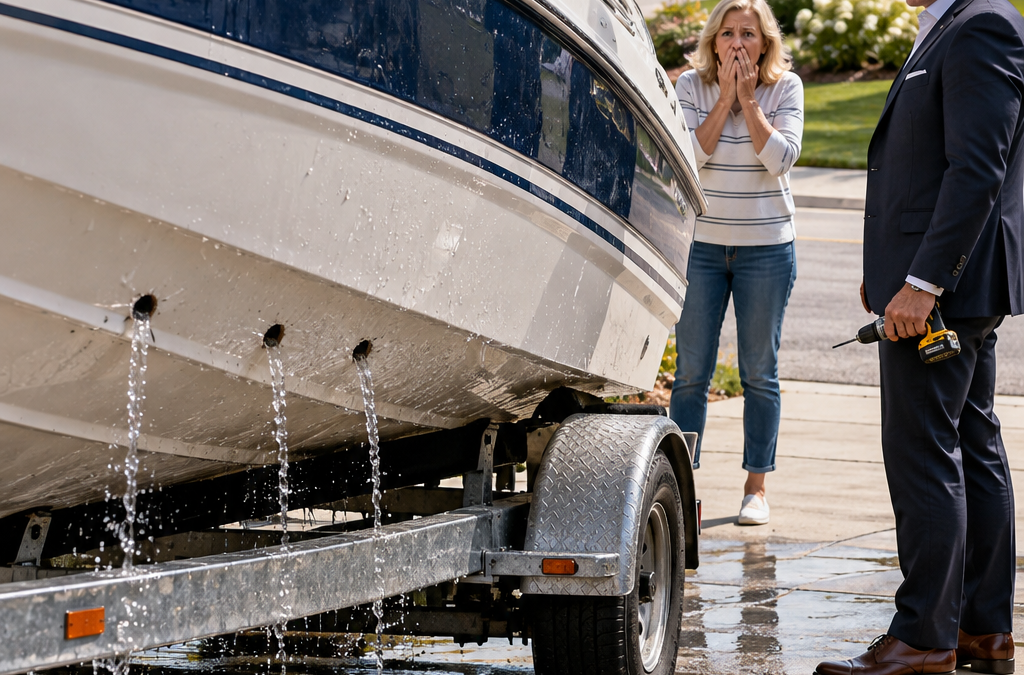
I stepped outside to get the paper and noticed water pooling beneath the back of my Bayliner. At first, I thought rain had collected in the tarp and spilled down. Then I saw the steady drip.
My chest tightened.
I pulled back the tarp.
Three drilled holes in the hull.
Clean.
Deliberate.
Hidden where the tarp would cover them from casual view.
I stood there staring at them while the driveway blurred.
My boat was not just property.
It was weekends with my brother.
Summer mornings on the lake.
Retirement plans.
The one thing I had kept because it reminded me that life still had open water in it.
Someone had knelt in my driveway in the dark and drilled into it.
And I knew who had promised consequences.
My home security camera was tucked discreetly under the eave. Most people noticed the doorbell camera and missed the second one angled toward the driveway.
I pulled the footage with shaking hands.
At 11:47 p.m., a figure entered the driveway.
Dark windbreaker.
Baseball cap.
Gloves.
The person crouched beside the boat.
For nearly three minutes, the camera caught small, deliberate movements near the hull.
Then the figure stood, turned slightly, and walked away with a limp.
Barbara had a distinctive limp in her left leg from an old knee replacement. Everyone on Maple Court knew it. She hated when people mentioned it.
I sent the footage to Marcus.
He called back within twenty minutes.
“Do not touch the boat further. Photograph everything. Call the police.”
“I already know it’s her.”
“We need more than knowing.”
He brought in a forensic video technician he had worked with before. The technician cleaned up the footage enough to show the gait, height, clothing, and face angle as the figure passed beneath a motion light near the driveway.
Not perfect.
But strong.
Strong enough that when I filed the police report, the detective’s eyebrows rose as he read the folder.
I had not brought just a vandalism complaint.
I brought six months of harassment documentation.
The lien letter.
The financial records request.
The Whitfield Landscaping contract.
The selective enforcement spreadsheet.
The security footage.
The boat damage photos.
The detective, a woman named Harris, flipped through the documents quietly.
Then she looked up.
“Ma’am, this isn’t just vandalism.”
“That’s what my attorney said.”
“With the financial records and lien threats, we’re looping in the DA.”
I felt my stomach drop and lift at the same time.
The DA.
That made it real.
While the police began looking at the boat damage, Barbara scheduled an emergency board hearing.
Her final power move.
The agenda said the board would consider formal recommendation of lien enforcement and foreclosure proceedings against my property due to chronic non-compliance.
Chronic non-compliance.
That was what she called refusing to let her bleed me dry.
I walked into that meeting with Marcus at my side and a manila folder thick enough to make Barbara’s face lose color the moment she saw it.
The clubhouse was fuller than usual.
Word had spread that something was happening between me and Barbara. Ruth sat in the front row, hands folded around a notebook. Two other neighbors I barely knew sat behind her, whispering nervously.
Barbara sat at the board table with four other members.
She wore a pale gray blazer and a necklace of blue stones. Her hair was perfect. Her expression was not.
She called the meeting to order.
“This hearing concerns Gail Morrison’s repeated refusal to comply with association standards.”
Marcus stood.
“Before we discuss alleged violations, we need to address preliminary matters involving conflicts of interest, improper funds, and a criminal report connected to Ms. Morrison’s property.”
Barbara’s voice sharpened.
“This is not a courtroom.”
“No,” Marcus said. “But if the board proceeds while ignoring documented misconduct, the liability will be yours.”
The room went quiet.
I stood slowly.
My knees felt weak, but my voice held.
“Before we discuss my alleged violations, let’s discuss the seventeen thousand dollars paid to Whitfield Landscaping since 2019.”
The silence that followed was absolute.
I placed copies of the contracts on the table.
“Barbara approved payments to a company owned by her brother-in-law while issuing fines and lien threats against homeowners whose payments fed the accounts she controlled.”
One board member leaned forward.
“What payments?”
Barbara turned on him.
“Harold, don’t engage with this.”
Marcus slid the documents toward the board.
“Board members should absolutely engage with this.”
Another board member picked up a page.
“I never voted on this contract.”
A third said, “I don’t remember seeing these renewals.”
Barbara laughed.
It was thin and artificial.
“Administrative contracts don’t require full board review every year.”
Ruth stood.
Her voice trembled, but she did not sit back down.
“She threatened my house too.”
Barbara looked at her.
“Ruth, this is not about you.”
“Yes, it is.” Ruth held up a folder. “I thought it was just me.”
A woman in the back stood next.
“She filed a lien threat against me after I asked about clubhouse repairs.”
Then a man near the aisle rose.
“She did the same thing to us after my wife questioned the landscaping budget.”
That was twist three.
I had not been the only one.
Barbara’s pattern had been hiding in separate houses, separate fears, separate kitchen tables where people opened letters alone and blamed themselves for not understanding the rules.
Marcus looked at Barbara.
“How many homeowners received lien threats after questioning spending?”
Barbara’s face flushed.
“This is a misunderstanding.”
Without a word, Marcus slid the police paperwork across the table.
The incident report.
The boat damage photographs.
The stills from the security footage.
The detective’s card.
Barbara stared at the papers.
For once, she did not speak.
The board members read.
The room started buzzing.
“Is that her?”
“That’s Gail’s driveway.”
“She drilled holes in the boat?”
Barbara struck the table with her palm.
“This is outrageous.”
Marcus remained calm.
“What is outrageous is a board president threatening foreclosure while evidence suggests financial self-dealing, harassment, and criminal mischief.”
Barbara stood.
“I will not be slandered in my own meeting.”
I looked at her.
“You came onto my driveway at 11:47 at night.”
Her mouth opened.
Closed.
Opened again.
“I did no such thing.”
Marcus tapped the photo.
“Then you’ll have no problem explaining that to Detective Harris.”
The room shifted.
Power moved.
You could feel it.
For years, Barbara had controlled meetings by making people afraid of consequences. That night, consequences finally entered the room and sat across from her.
The board voted her out unanimously before the meeting ended.
Even the members who had spent years nodding along finally understood that staying loyal to Barbara might mean sharing her liability.
Ruth was appointed interim president after a short, chaotic discussion.
She looked terrified when they asked her.
Then she looked at me.
Then at the other homeowners.
“I’ll do it,” she said, “but the first thing we’re doing is opening the books.”
People applauded.
Barbara gathered her purse and left without looking at anyone.
But she did not get far.
Within a week, the district attorney charged her with embezzlement, criminal mischief for the boat damage, and harassment tied to the targeted enforcement pattern.
Three separate case numbers.
One arraignment date.
The local paper ran the story under a headline that made Willow Creek sound far more dramatic than it had ever been before.
Former HOA President Charged in Boat Vandalism and Funds Investigation.
The article did not mention Captain Harold, which I considered a missed opportunity.
The HOA’s accounts were reviewed.
Whitfield Landscaping was suspended immediately.
Payments were frozen.
The board hired an independent accountant.
Homeowners began submitting their own records.
Lien threats were paused.
Improper fines were reviewed.
For the first time since I had moved in, people on Maple Court spoke openly in driveways.
Not whispering.
Not glancing around first.
Talking.
Ruth came over the day after Barbara’s removal.
She stood beside my boat, looking at the patched hull.
“I’m sorry,” she said.
“For what?”
“For warning you and then still letting you go through it.”
“You didn’t let anything happen.”
“I kept quiet too long.”
I understood that feeling.
But I also understood fear better now.
Barbara had not controlled the neighborhood because everyone agreed with her.
She controlled it because she made each person feel isolated.
One fine.
One letter.
One threat.
One private panic at a time.
My civil suit followed the criminal charges.
Property damage.
Emotional distress.
Bad-faith enforcement.
Marcus said settlement talks were already “looking generous,” which was lawyer language for Barbara had real problems and everyone knew it.
The insurance company did not want to defend intentional vandalism.
The HOA did not want trial exposure.
Barbara’s own attorney did not want the boat footage played in front of a jury.
Six weeks after the emergency meeting, I watched from my porch as a real estate agent pushed a for-sale sign into Barbara’s lawn.
I expected to feel joy.
Instead, I felt quiet.
Control freaks hate consequences most of all, and Barbara had finally met hers. But watching her house go up for sale did not erase the months I spent afraid. It did not undrill the holes in my boat. It did not give Ruth back her years of silence or return the money homeowners had paid just to avoid trouble.
Justice does not rewind.
It repairs what it can.
Then it leaves you to heal around the rest.
My boat is repaired now.
The hull patches are clean and sealed. The mechanic said she is still lakeworthy, which made me cry in the parking lot like a fool. I took her out for the first time again on a clear Saturday morning. Ruth came with me. So did her granddaughter, who brought snacks and asked if Captain Harold was allowed on boats.
He was not.
But I considered it.
When we reached open water, I cut the engine and let the boat drift.
For a while, none of us spoke.
The sun hit the water in bright pieces. The breeze moved across my face. My hands rested on the wheel that had once felt like a promise and then like evidence and now, finally, felt like mine again.
Ruth looked over.
“You okay?”
I nodded.
“Getting there.”
She smiled.
“That counts.”
Back in Willow Creek, the new board changed everything quickly.
Ruth kept her promise.
Financial statements were posted monthly.
No one person could approve a vendor contract.
No fines went into discretionary accounts.
Every violation required photographic evidence, rule citations, notice, and a real appeal process.
No lien action could begin without legal review and a recorded board vote.
Captain Harold returned to the hydrangeas.
My boat stayed in the driveway while the board reviewed the RV and boat policy. It turned out the old rule had been selectively enforced for years and inconsistently written in the first place. The new rule was clear, fair, and applied to everyone.
Even Barbara’s old RV would have violated it.
That made me smile more than it should have.
Some evenings, I still wake at small noises.
A branch tapping the window.
A truck slowing near the driveway.
The creak of the porch railing.
For a second, my body remembers the months when every letter felt dangerous and every sound outside might be someone gathering evidence against me.
Then I breathe.
I look toward the driveway.
The boat is there.
Repaired.
Proud.
Visible from the street.
Unbothered.
I pass it every morning now on my way to get the paper. Sometimes I run my fingers lightly along the patched section of hull. The surface is smooth, but I know where the holes were. I know what happened. I know what it cost to prove it.
And I know what it means that the boat is still there.
Barbara wanted it gone.
Then she wanted me gone.
In the end, she lost both fights.
The folder stays in my office cabinet. I do not look at it often, but I keep it. Every letter, every date, every inconsistency, every photograph, every record.
Not because I expect another Barbara.
Because I learned that documentation is not paranoia when someone is trying to rewrite reality.
It is protection.
It is memory.
It is proof.
The morning I found those holes in my boat, I thought something cold had settled permanently in my chest.
I was wrong.
It was not permanent.
It was fear turning into resolve.
Barbara Whitfield thought she could control people with letters, fines, liens, and the quiet shame of being targeted.
She thought I would pay.
Then hide.
Then sell.
Or at least stop questioning her.
Instead, she gave me a reason to open the books.
And once the books opened, all her power spilled out with the missing money.
These days, Willow Creek is quiet again.
Not the old quiet, where people kept their heads down and whispered over fences.
A better quiet.
The kind that comes after the storm has passed and everyone finally admits how bad the wind really was.
My boat sits in my driveway.
Captain Harold guards the hydrangeas.
Ruth runs the board with common sense and an almost suspicious hatred of unnecessary paperwork.
And every time I walk past that repaired hull, I smile.
Not because damage is funny.
Not because any of this was easy.
Because the sound of justice is not always a gavel.
Sometimes it is a boat engine starting again after someone tried to sink you on dry land.
𝗧𝗛𝗘 𝗘𝗡𝗗
The Morning I Found Holes Drilled Into My Boat, I Finally Understood What My HOA President Was Willing to Destroy
The water pooling beneath my boat was the first warning that Barbara Whitfield had crossed a line no HOA letter could hide. By the time I saw the three drilled holes in the hull, I knew this was no longer about parking, rules, or neighborhood standards.
My name is Gail Morrison, and I was sixty-two years old when I learned that a quiet retirement community could become more stressful than any job I had ever survived.
I moved into Willow Creek Estates because I wanted peace.
That was the whole point.
After thirty-eight years of working as an office manager for a regional medical supply company, I was done with fluorescent lighting, calendar alerts, payroll emergencies, and people knocking on my door every ten minutes because the copier jammed or somebody needed a purchase order approved before noon.
I wanted mornings on the porch.
Coffee without a deadline.
A little gardening.
A little fishing.
And, when the weather cooperated, a few long afternoons on the lake in my old Bayliner, the one thing I had kept through two moves, one divorce, and a retirement party where half the speeches were about how nobody knew where anything was without me.
That boat was not fancy.
It was fifteen years old, white with navy trim, sun-faded in places, repaired more than once, and loved beyond reason. My late brother helped me pick it out. He used to say it had “more heart than horsepower,” and he was right. Every scratch on that hull had a memory attached to it.
So when I bought the little ranch house on Maple Court in Willow Creek Estates, I made sure the driveway was long enough for the boat.
I asked the real estate agent twice.
“Can I park it here?”
She glanced at the driveway.
“I don’t see why not. Plenty of people in the neighborhood have boats.”
She was right.
On the day I toured the house, I saw at least four boats from the street. One bass boat sat under a blue tarp two doors down. A pontoon trailer was parked near a garage on Cedar Lane. Somebody had a camper, somebody else had a small RV, and three houses down from the property I eventually bought, a large beige motorhome sat in a driveway like a second house.
So I signed.
Willow Creek looked like the kind of place people dream about when they say retirement community without meaning assisted living. The lawns were manicured, the mailboxes matched, the clubhouse had a small library, and the HOA newsletter promised “harmony through shared standards.”
I should have read that line more carefully.
Harmony, I learned, can mean peace.
It can also mean silence enforced by fear.
Barbara Whitfield ran the HOA board like a private fiefdom.
She had been president for nine years by the time I arrived. She was in her late sixties, short, sharp-eyed, and always perfectly put together in pressed slacks, colorful jackets, and pearl earrings that looked too delicate for the way she used her voice.
Barbara smiled like a church greeter when new people moved in.
Then she enforced like a debt collector.
Everyone on Maple Court knew better than to question her. They smiled when she passed in her golf cart. They nodded at meetings. They accepted letters without arguing too loudly. At first, I mistook that for respect.
It wasn’t respect.
It was survival.
My first violation letter arrived eleven days after I moved in.
I was unpacking kitchen boxes when I saw the envelope in the mailbox.
RECREATIONAL VEHICLE VISIBLE FROM STREET — SECTION 4.2 VIOLATION.
My boat.
Parked in my driveway.
On my property.
Exactly where it had been since moving day.
The letter said recreational vehicles, boats, trailers, and related equipment visible from the street violated community aesthetic standards unless stored in an approved enclosed structure.
Fifty-dollar fine.
I read it twice, then walked outside and looked up and down the street.
There was the bass boat under the blue tarp.
There was the camper.
There was the RV three houses down.
There was another boat farther toward the cul-de-sac.
All visible.
All apparently invisible to Barbara Whitfield.
I called the HOA office.
A woman named Elaine answered, sounding tired before I even spoke.
“Willow Creek Estates Homeowners Association.”
“Hi, this is Gail Morrison on Maple Court. I received a violation letter about my boat.”
A pause.
“Oh.”
That pause told me something.
“What does ‘oh’ mean?”
“You’ll need to speak with President Whitfield.”
“Fine. Transfer me.”
Another pause.
Then Barbara came on the line.
“Gail.”
She said my name like she had already been expecting trouble.
“Barbara, I got a letter about my boat.”
“Yes.”
“There are at least six visible boats or RVs within three blocks of my house.”
“We address violations as they come to our attention.”
“That doesn’t answer my question.”
“I don’t make exceptions.”
I looked out the window at the beige RV three houses down.
“Your RV is visible from the street.”
Silence.
Then her voice turned icy.
“My RV is stored in accordance with board-approved historic accommodation.”
“Historic accommodation?”
“It predates certain enforcement policies.”
“So does my boat ownership.”
“That is not how our standards work.”
I pressed my fingers against my forehead.
“It’s fifty dollars?”
“If paid within ten days.”
I should have fought it.
Instead, I paid.
I had just moved in. I did not want my first month to turn into a battle. I told myself fifty dollars was annoying, not worth the stress. I wrote the check, mailed it, and assumed Barbara would move on.
That was my first mistake.
Barbara did not interpret cooperation as maturity.
She interpreted it as weakness.
Two weeks later, a new letter arrived.
My porch color was non-compliant.
That almost made me laugh because I had painted the porch railings using a sample chip from the HOA’s own approved exterior palette. I still had the chip taped to the paint can in my garage.
I took a photo and emailed it to the HOA.
Barbara replied that while the base color appeared approved, the “visual effect in natural light” created an inconsistent tone.
Seventy-five-dollar fine.
Then came the mailbox fine.
The mulch fine.
The unauthorized garden gnome fine.
That one hurt my feelings more than I expected.
The gnome was small and ridiculous, holding a fishing pole beside my hydrangeas. My granddaughter had given it to me as a housewarming gift. I had named him Captain Harold.
According to Barbara, Captain Harold disrupted “front elevation harmony.”
I stood in the yard holding that letter while the actual Captain Harold smiled up at me like he had seen worse governments.
Each notice was pettier than the last.
Each one carried the same warning at the bottom.
Continued non-compliance may result in lien action against your property.
Lien.
The first few times, the word felt theatrical.
Then the amounts began adding up.
My neighbor Ruth warned me over the fence.
Ruth lived on my left, a retired school librarian with silver braids, bright cardigans, and a voice that dropped to a whisper whenever Barbara’s name entered conversation. She was watering tomatoes when she saw me holding another envelope.
“That from Barbara?”
“Yes.”
She turned off the hose.
“She’s building a file on you.”
I looked at her.
“A file?”
Ruth glanced toward the street like we were in a spy movie.
“She does that.”
“For what?”
“For leverage.”
I frowned.
“Over a boat?”
“It’s never just the boat.”
She stepped closer to the fence.
“Gail, listen to me. Keep everything. Every letter. Every envelope. Every date. Every picture. Don’t talk to her without a witness.”
I studied her face.
“You sound like you’ve been through this.”
Ruth’s mouth tightened.
“She came after me three years ago over my walkway edging. Said it created drainage issues. It didn’t. I challenged her at a meeting. Suddenly I had six violations in two months.”
“What happened?”
“I paid what I could and kept my head down.”
There was no shame in her voice.
Just fatigue.
“What does she want from me?”
Ruth looked toward my driveway.
“Control.”
That night, I started a folder.
At first it was just a manila envelope labeled HOA. Then it became a binder. Then a digital folder. Then a spreadsheet.
Every letter.
Every date.
Every fine amount.
Every photograph.
Every inconsistent rule.
Every example of another house breaking the same supposed standard without penalty.
The more I documented, the clearer the pattern became.
Barbara’s enforcement was not consistent.
It was targeted.
My boat was a violation, but her RV was protected by some imaginary accommodation.
My porch color was wrong, but a nearly identical porch two streets away was featured in the newsletter.
My mulch shade was unacceptable, but the clubhouse beds used the same color.
My garden gnome was a threat to harmony, but Barbara’s ceramic geese wore seasonal outfits in front of her azaleas every month.
Then came the lien notice.
It arrived on a gray Thursday morning.
I remember the coffee going cold beside me.
The letter claimed I owed eleven hundred dollars in accumulated violations, late fees, and administrative costs. Some were real notices I had received and disputed. Others I had never seen before.
It threatened foreclosure if the balance was not resolved.
Foreclosure.
Over a boat in a driveway, a porch color, mulch, a mailbox, and Captain Harold.
I stood in my kitchen staring at the legal language until the words blurred.
I had bought that house with retirement savings and the proceeds from selling my old condo. I was not wealthy. My budget worked because I had planned it carefully. The thought that an HOA president could manufacture enough paper to threaten my home made my hands shake.
I called an attorney that afternoon.
His name was Marcus Bell.
He specialized in exactly one thing: HOA abuse cases.
His office was small, his voice was calm, and his eyes looked like he had heard every version of my story before. That made me feel better and worse at the same time.
He reviewed my binder for nearly forty minutes without speaking.
I sat across from him twisting a tissue in my hands until it nearly shredded.
Finally, he looked up.
“This happens more than you’d think.”
“That’s comforting.”
“It shouldn’t be.”
“No. It isn’t.”
He tapped my spreadsheet.
“But most people don’t document like this.”
“Ruth told me to keep everything.”
“Ruth gave excellent advice.”
I leaned forward.
“Can she really foreclose on my house?”
“Not lawfully based on this mess without following specific procedures, and I already see problems.”
“What kind of problems?”
“Improper notice. Vague violations. Selective enforcement. Questionable fees. Possibly defective lien procedure.”
I breathed for the first time in what felt like hours.
Marcus turned another page.
“And if she’s refusing records, that may help us.”
“Records?”
“Financials. Board minutes. Fine ledgers. Accounts. If she’s threatening your property, we need to know where the money goes.”
That was when he told me to request the HOA’s financial records under our state’s Planned Community Act and the association’s governing documents.
I submitted the request in writing.
Certified mail.
Email.
Hand-delivered copy to the HOA office.
Barbara stonewalled me for three weeks.
First, she said the records were being compiled.
Then she said the management software was under maintenance.
Then she claimed financial disclosures could not be released during “active enforcement proceedings.”
Marcus laughed when I forwarded that one.
“That’s not how it works,” he said. “Save it.”
I saved everything.
While we waited, I dug through old board meeting minutes Ruth helped me find. She had saved newsletters and packets going back years because, as she put it, “librarians do not throw away institutional memory.”
Buried in a packet from 2019 was the first real financial clue.
A landscaping contract.
Whitfield Landscaping Services.
The signature approving payment was Barbara’s.
The listed owner was her brother-in-law.
I read the document twice.
Then a third time.
The contract had been renewed annually, always under vague categories: beautification, common area improvement, compliance landscaping, seasonal cleanup.
The amounts were not huge individually.
But they appeared again and again.
And the work?
I had no idea where it was.
The common areas did not look newly improved. The clubhouse beds were tired. The walking path behind the pond had weeds pushing through cracks. The entrance sign still had a broken light Barbara had complained about in the newsletter for months.
I called Marcus.
“Tell me you’re sitting down,” I said.
“I’m a lawyer. I’m always sitting down.”
I sent him the contract.
He called me back fifteen minutes later.
“This is useful.”
“Useful? Marcus, she’s paying her brother-in-law.”
“Potentially. We need confirmation. But yes, this raises conflict-of-interest and self-dealing concerns.”
“Every fine she collects goes into board accounts she controls, right?”
“That depends on the bylaws and accounting practices.”
“So if she fines people, threatens liens, collects money, and routes contracts to family—”
“Careful,” he said. “We prove facts first. Conclusions later.”
But I knew what I was looking at.
This was not just a control freak with too much time.
This was money.
This was power.
This was embezzlement wearing a homeowners association badge.
Barbara must have sensed I was getting closer, because she escalated.
She showed up at my property line two days later, camera in hand.
I was in the driveway rinsing pollen off my windshield when her golf cart rolled to the curb.
She stepped out wearing a red windbreaker and white sneakers, holding her phone like evidence before anything had happened.
“You are not authorized to conduct inspections on my property,” I said.
She lifted the phone and took a picture of my boat.
“I’m documenting ongoing violations.”
“From the street?”
“From common view.”
“You mean from the curb.”
She walked along the edge of my lawn, snapping photos.
“You’ve made this personal, Gail.”
I laughed once, sharp and disbelieving.
“I haven’t said one unkind word to you in six months.”
Her eyes narrowed.
“You hired an attorney.”
“You threatened my home.”
“You refused compliance.”
“I refused harassment.”
The word hung in the air.
Barbara lowered the phone.
For one second, I saw something behind the polish.
Not embarrassment.
Not doubt.
Rage.
“You should be careful,” she said.
“So should you.”
She got back into the golf cart and drove away.
Forty-eight hours later, I found the holes.
It was just after sunrise.
I stepped outside to get the paper and noticed water pooling beneath the back of my Bayliner. At first, I thought rain had collected in the tarp and spilled down. Then I saw the steady drip.
My chest tightened.
I pulled back the tarp.
Three drilled holes in the hull.
Clean.
Deliberate.
Hidden where the tarp would cover them from casual view.
I stood there staring at them while the driveway blurred.
My boat was not just property.
It was weekends with my brother.
Summer mornings on the lake.
Retirement plans.
The one thing I had kept because it reminded me that life still had open water in it.
Someone had knelt in my driveway in the dark and drilled into it.
And I knew who had promised consequences.
My home security camera was tucked discreetly under the eave. Most people noticed the doorbell camera and missed the second one angled toward the driveway.
I pulled the footage with shaking hands.
At 11:47 p.m., a figure entered the driveway.
Dark windbreaker.
Baseball cap.
Gloves.
The person crouched beside the boat.
For nearly three minutes, the camera caught small, deliberate movements near the hull.
Then the figure stood, turned slightly, and walked away with a limp.
Barbara had a distinctive limp in her left leg from an old knee replacement. Everyone on Maple Court knew it. She hated when people mentioned it.
I sent the footage to Marcus.
He called back within twenty minutes.
“Do not touch the boat further. Photograph everything. Call the police.”
“I already know it’s her.”
“We need more than knowing.”
He brought in a forensic video technician he had worked with before. The technician cleaned up the footage enough to show the gait, height, clothing, and face angle as the figure passed beneath a motion light near the driveway.
Not perfect.
But strong.
Strong enough that when I filed the police report, the detective’s eyebrows rose as he read the folder.
I had not brought just a vandalism complaint.
I brought six months of harassment documentation.
The lien letter.
The financial records request.
The Whitfield Landscaping contract.
The selective enforcement spreadsheet.
The security footage.
The boat damage photos.
The detective, a woman named Harris, flipped through the documents quietly.
Then she looked up.
“Ma’am, this isn’t just vandalism.”
“That’s what my attorney said.”
“With the financial records and lien threats, we’re looping in the DA.”
I felt my stomach drop and lift at the same time.
The DA.
That made it real.
While the police began looking at the boat damage, Barbara scheduled an emergency board hearing.
Her final power move.
The agenda said the board would consider formal recommendation of lien enforcement and foreclosure proceedings against my property due to chronic non-compliance.
Chronic non-compliance.
That was what she called refusing to let her bleed me dry.
I walked into that meeting with Marcus at my side and a manila folder thick enough to make Barbara’s face lose color the moment she saw it.
The clubhouse was fuller than usual.
Word had spread that something was happening between me and Barbara. Ruth sat in the front row, hands folded around a notebook. Two other neighbors I barely knew sat behind her, whispering nervously.
Barbara sat at the board table with four other members.
She wore a pale gray blazer and a necklace of blue stones. Her hair was perfect. Her expression was not.
She called the meeting to order.
“This hearing concerns Gail Morrison’s repeated refusal to comply with association standards.”
Marcus stood.
“Before we discuss alleged violations, we need to address preliminary matters involving conflicts of interest, improper funds, and a criminal report connected to Ms. Morrison’s property.”
Barbara’s voice sharpened.
“This is not a courtroom.”
“No,” Marcus said. “But if the board proceeds while ignoring documented misconduct, the liability will be yours.”
The room went quiet.
I stood slowly.
My knees felt weak, but my voice held.
“Before we discuss my alleged violations, let’s discuss the seventeen thousand dollars paid to Whitfield Landscaping since 2019.”
The silence that followed was absolute.
I placed copies of the contracts on the table.
“Barbara approved payments to a company owned by her brother-in-law while issuing fines and lien threats against homeowners whose payments fed the accounts she controlled.”
One board member leaned forward.
“What payments?”
Barbara turned on him.
“Harold, don’t engage with this.”
Marcus slid the documents toward the board.
“Board members should absolutely engage with this.”
Another board member picked up a page.
“I never voted on this contract.”
A third said, “I don’t remember seeing these renewals.”
Barbara laughed.
It was thin and artificial.
“Administrative contracts don’t require full board review every year.”
Ruth stood.
Her voice trembled, but she did not sit back down.
“She threatened my house too.”
Barbara looked at her.
“Ruth, this is not about you.”
“Yes, it is.” Ruth held up a folder. “I thought it was just me.”
A woman in the back stood next.
“She filed a lien threat against me after I asked about clubhouse repairs.”
Then a man near the aisle rose.
“She did the same thing to us after my wife questioned the landscaping budget.”
That was twist three.
I had not been the only one.
Barbara’s pattern had been hiding in separate houses, separate fears, separate kitchen tables where people opened letters alone and blamed themselves for not understanding the rules.
Marcus looked at Barbara.
“How many homeowners received lien threats after questioning spending?”
Barbara’s face flushed.
“This is a misunderstanding.”
Without a word, Marcus slid the police paperwork across the table.
The incident report.
The boat damage photographs.
The stills from the security footage.
The detective’s card.
Barbara stared at the papers.
For once, she did not speak.
The board members read.
The room started buzzing.
“Is that her?”
“That’s Gail’s driveway.”
“She drilled holes in the boat?”
Barbara struck the table with her palm.
“This is outrageous.”
Marcus remained calm.
“What is outrageous is a board president threatening foreclosure while evidence suggests financial self-dealing, harassment, and criminal mischief.”
Barbara stood.
“I will not be slandered in my own meeting.”
I looked at her.
“You came onto my driveway at 11:47 at night.”
Her mouth opened.
Closed.
Opened again.
“I did no such thing.”
Marcus tapped the photo.
“Then you’ll have no problem explaining that to Detective Harris.”
The room shifted.
Power moved.
You could feel it.
For years, Barbara had controlled meetings by making people afraid of consequences. That night, consequences finally entered the room and sat across from her.
The board voted her out unanimously before the meeting ended.
Even the members who had spent years nodding along finally understood that staying loyal to Barbara might mean sharing her liability.
Ruth was appointed interim president after a short, chaotic discussion.
She looked terrified when they asked her.
Then she looked at me.
Then at the other homeowners.
“I’ll do it,” she said, “but the first thing we’re doing is opening the books.”
People applauded.
Barbara gathered her purse and left without looking at anyone.
But she did not get far.
Within a week, the district attorney charged her with embezzlement, criminal mischief for the boat damage, and harassment tied to the targeted enforcement pattern.
Three separate case numbers.
One arraignment date.
The local paper ran the story under a headline that made Willow Creek sound far more dramatic than it had ever been before.
Former HOA President Charged in Boat Vandalism and Funds Investigation.
The article did not mention Captain Harold, which I considered a missed opportunity.
The HOA’s accounts were reviewed.
Whitfield Landscaping was suspended immediately.
Payments were frozen.
The board hired an independent accountant.
Homeowners began submitting their own records.
Lien threats were paused.
Improper fines were reviewed.
For the first time since I had moved in, people on Maple Court spoke openly in driveways.
Not whispering.
Not glancing around first.
Talking.
Ruth came over the day after Barbara’s removal.
She stood beside my boat, looking at the patched hull.
“I’m sorry,” she said.
“For what?”
“For warning you and then still letting you go through it.”
“You didn’t let anything happen.”
“I kept quiet too long.”
I understood that feeling.
But I also understood fear better now.
Barbara had not controlled the neighborhood because everyone agreed with her.
She controlled it because she made each person feel isolated.
One fine.
One letter.
One threat.
One private panic at a time.
My civil suit followed the criminal charges.
Property damage.
Emotional distress.
Bad-faith enforcement.
Marcus said settlement talks were already “looking generous,” which was lawyer language for Barbara had real problems and everyone knew it.
The insurance company did not want to defend intentional vandalism.
The HOA did not want trial exposure.
Barbara’s own attorney did not want the boat footage played in front of a jury.
Six weeks after the emergency meeting, I watched from my porch as a real estate agent pushed a for-sale sign into Barbara’s lawn.
I expected to feel joy.
Instead, I felt quiet.
Control freaks hate consequences most of all, and Barbara had finally met hers. But watching her house go up for sale did not erase the months I spent afraid. It did not undrill the holes in my boat. It did not give Ruth back her years of silence or return the money homeowners had paid just to avoid trouble.
Justice does not rewind.
It repairs what it can.
Then it leaves you to heal around the rest.
My boat is repaired now.
The hull patches are clean and sealed. The mechanic said she is still lakeworthy, which made me cry in the parking lot like a fool. I took her out for the first time again on a clear Saturday morning. Ruth came with me. So did her granddaughter, who brought snacks and asked if Captain Harold was allowed on boats.
He was not.
But I considered it.
When we reached open water, I cut the engine and let the boat drift.
For a while, none of us spoke.
The sun hit the water in bright pieces. The breeze moved across my face. My hands rested on the wheel that had once felt like a promise and then like evidence and now, finally, felt like mine again.
Ruth looked over.
“You okay?”
I nodded.
“Getting there.”
She smiled.
“That counts.”
Back in Willow Creek, the new board changed everything quickly.
Ruth kept her promise.
Financial statements were posted monthly.
No one person could approve a vendor contract.
No fines went into discretionary accounts.
Every violation required photographic evidence, rule citations, notice, and a real appeal process.
No lien action could begin without legal review and a recorded board vote.
Captain Harold returned to the hydrangeas.
My boat stayed in the driveway while the board reviewed the RV and boat policy. It turned out the old rule had been selectively enforced for years and inconsistently written in the first place. The new rule was clear, fair, and applied to everyone.
Even Barbara’s old RV would have violated it.
That made me smile more than it should have.
Some evenings, I still wake at small noises.
A branch tapping the window.
A truck slowing near the driveway.
The creak of the porch railing.
For a second, my body remembers the months when every letter felt dangerous and every sound outside might be someone gathering evidence against me.
Then I breathe.
I look toward the driveway.
The boat is there.
Repaired.
Proud.
Visible from the street.
Unbothered.
I pass it every morning now on my way to get the paper. Sometimes I run my fingers lightly along the patched section of hull. The surface is smooth, but I know where the holes were. I know what happened. I know what it cost to prove it.
And I know what it means that the boat is still there.
Barbara wanted it gone.
Then she wanted me gone.
In the end, she lost both fights.
The folder stays in my office cabinet. I do not look at it often, but I keep it. Every letter, every date, every inconsistency, every photograph, every record.
Not because I expect another Barbara.
Because I learned that documentation is not paranoia when someone is trying to rewrite reality.
It is protection.
It is memory.
It is proof.
The morning I found those holes in my boat, I thought something cold had settled permanently in my chest.
I was wrong.
It was not permanent.
It was fear turning into resolve.
Barbara Whitfield thought she could control people with letters, fines, liens, and the quiet shame of being targeted.
She thought I would pay.
Then hide.
Then sell.
Or at least stop questioning her.
Instead, she gave me a reason to open the books.
And once the books opened, all her power spilled out with the missing money.
These days, Willow Creek is quiet again.
Not the old quiet, where people kept their heads down and whispered over fences.
A better quiet.
The kind that comes after the storm has passed and everyone finally admits how bad the wind really was.
My boat sits in my driveway.
Captain Harold guards the hydrangeas.
Ruth runs the board with common sense and an almost suspicious hatred of unnecessary paperwork.
And every time I walk past that repaired hull, I smile.
Not because damage is funny.
Not because any of this was easy.
Because the sound of justice is not always a gavel.
Sometimes it is a boat engine starting again after someone tried to sink you on dry land.








