𝗙𝗨𝗟𝗟 𝗦𝗧𝗢𝗥𝗬 The Morning Deborah Whitlock Put a Foreclosure Notice on My Bakery Window
𝗙𝗨𝗟𝗟 𝗦𝗧𝗢𝗥𝗬
The bakery received flour deliveries twice a week. The truck parked behind the shop for fifteen minutes, always in the service zone.
Deborah called it disruption of resident access.
Four hundred dollars.
Then excessive foot traffic.
That one was my favorite for about ten seconds, until I realized she was serious.
She fined me because too many paying customers were walking into my business.
The notice said the bakery had “created recurring pedestrian congestion inconsistent with the intended quiet-use design of the commercial village.”
I read that sentence out loud to Priya when she came in for her Thursday cinnamon roll.
She stared at me.
“Isn’t foot traffic the point of a bakery?”
“Apparently only quiet foot traffic is allowed.”
“That sounds invented.”
“Everything she writes sounds invented.”
Priya took the notice from me and examined it.
She was not just my customer. She was my accountant, and the only reason my books made sense. She had the kind of brain that made numbers confess.
“Are you tracking all of these?”
“In a folder.”
“Good. Start a spreadsheet too.”
I frowned.
“For HOA fines?”
“For patterns.”
I laughed.
She did not.
“Chad, people don’t use vague rules this aggressively unless there’s a reason.”
At first, I thought the reason was simple.
Deborah didn’t like commercial tenants.
She treated business owners like tolerated guests at a party she did not want them attending. Residents were her subjects. Commercial tenants were servants who needed reminding of their place.
Then her nephew opened a bakery.
Two blocks outside the gated entrance.
Whitlock & Wheat.
Same rustic cream lettering.
Same style of wheat stalk.
Same shade of green on the awning.
When I drove past it the first time, I actually slowed down without meaning to.
It looked like someone had described my bakery to a designer over the phone and said, “Make it less personal, but close enough.”
The owner was named Ethan Whitlock.
Deborah’s nephew.
He had never worked in a bakery, as far as I could tell. He had investment money, a polished Instagram page, and a grand opening banner that read “Artisan Comfort for the Maple Crest Community.”
I stood across the road staring at that sign and felt something unpleasant settle in my stomach.
Maybe it was coincidence.
Maybe Deborah really was just an overzealous HOA president with too much time and a laminated copy of Article 12.
But I had spent years behind bakery counters reading people.
People tell you everything if you watch what they do when they think you’re too busy making change.
Deborah was not enforcing rules.
She was clearing space.
One evening, near closing, she walked into my shop alone.
The case was almost empty. I had six muffins left, two sourdough boules, and a tray of cinnamon roll ends I usually saved for staff, except I had no staff that day because payroll was tight.
Deborah ordered a coffee.
I poured it.
She did not leave.
Instead, she stood at the counter, one hand resting on her handbag, studying me with that soft public-meeting smile.
“Business seems slower lately.”
“We’re doing all right.”
“Are you?”
I put the lid on her cup.
“Anything else?”
She leaned slightly closer.
“Businesses that don’t fit in around here don’t tend to last long.”
The words were quiet.
Sweet.
Nearly gentle.
I looked at her hand around the cup.
Pale pink lipstick on the lid.
Perfect fingerprint on the sleeve.
“Is that advice?”
“It’s an observation.”
I smiled back.
“Funny. I make those too.”
For the first time, her expression flickered.
Then she turned and walked out.
I did not throw that cup away.
I don’t know why.
Maybe because something in me finally understood that Deborah Whitlock only said things out loud when she thought nobody could prove it. I slipped the cup into a paper bag, wrote the date and time on it, stapled the receipt to the outside, and set it in the back office.
Evidence.
I didn’t know yet how much of it I would need.
The fines escalated into a formal lien threat two weeks later.
Twelve thousand dollars in unpaid assessments.
I sat at my desk behind the bakery, surrounded by flour sacks and cooling racks, staring at the letter as if the words might rearrange themselves into something logical.
Unpaid HOA assessments.
I had never received an assessment invoice.
I had never signed a commercial HOA agreement.
My lease said I paid rent, utilities, and a defined shared maintenance fee through the property owner. It did not say I was personally liable for residential HOA assessments.
I pulled out the lease.
Then the addendum.
Then the commercial-use agreement.
Then the emails from the property manager before signing.
Nothing.
No HOA assessment obligation.
No twelve thousand dollars.
No authority for Deborah to treat my bakery as if I were a homeowner behind the gates.
That was the loophole.
My unit sat in a strange residential-commercial gray area. The property itself was within the overall development, but my lease ran through a separate owner who passed along certain maintenance costs. Deborah knew how confusing that arrangement was. She had used it against me for months.
And I soon learned she had used it before.
Two other small businesses had occupied my storefront before me.
A florist.
Then a specialty coffee kiosk.
Both had left suddenly after disputes with the HOA. The landlord had described them as “not a fit for the community.”
I called the former florist, whose name I found on an old business listing.
At first, she did not want to talk.
When I mentioned Deborah, she went quiet.
“She’s after you now?”
“Yes.”
“Get out while you can.”
“What happened to you?”
“Assessments. Parking fines. Signage fines. Threats.”
“Did you owe them?”
“No. But I couldn’t afford to fight. I packed up and moved to Round Rock.”
The coffee kiosk owner told the same story.
Invented fees.
Threats.
A lien letter.
Then silence, because he had shut down before they could do more.
I was not shutting down.
Not my shop.
Not my ovens.
Not my name.
I started recording everything.
Texas law has rules about recording conversations, and I made sure I understood what applied before I did anything stupid. I kept records of meetings I attended, phone calls I was part of, letters, emails, parking tickets, photographs, and every invoice Deborah’s office sent.
I labeled the folder Insurance.
It grew fast.
Priya came in one evening after close. I had given her access to the spreadsheet of fines, supposed assessments, late fees, and administrative charges.
She sat at the little corner table with her laptop, a calculator, and a cinnamon roll she forgot to eat because numbers had offended her.
After twenty minutes, she tapped the screen twice with her pen.
“Chad.”
“That sounds bad.”
“These aren’t fines.”
“What are they?”
“Fiction.”
I sat across from her.
She turned the laptop around.
“The assessment formula doesn’t match the bylaws, the commercial maintenance schedule, the residential fee structure, or any reserve calculation I can find. These numbers are flatly invented.”
I looked at the spreadsheet.
Priya pointed at one column.
“This twelve-thousand-dollar balance? It doesn’t grow like a real ledger. It jumps.”
“Meaning?”
“Meaning someone is adding numbers because they want a number large enough to scare you.”
I leaned back.
Flour dust rose from my apron.
“Deborah.”
Priya did not smile.
“Almost certainly.”
That single sentence changed how hard I decided to fight.
Until then, I had been defending myself.
After that, I started hunting the truth.
I sent a formal written request for the HOA’s full financial disclosures, board minutes, commercial assessment records, reserve account ledgers, vendor contracts, and documents supporting every charge against my bakery.
I cited the Texas Property Code, including Section 209, and requested all records available to members and affected parties under the association’s governing documents and state law.
Maybe a commercial tenant’s rights would be contested.
Maybe Deborah would argue I did not qualify as a residential owner.
But if she wanted to bill me like one, I wanted the records like one.
She stalled.
First, administrative delays.
Then unavailable staff.
Then pending audit.
Then “records under review.”
Then silence.
Every delay made me more certain she was hiding something worth protecting.
Meanwhile, parking tickets appeared.
Not on my truck.
On my customers’ cars.
Little yellow warning slips tucked under windshield wipers.
Improper commercial parking.
Excessive duration near storefront.
Resident access interference.
My regulars started getting them every morning.
Mrs. Alvarez got one while buying donuts.
Mr. Grant got two in one week.
A nurse who stopped in after night shift found a warning on her windshield and never came back.
Deborah could not shut my ovens off.
So she tried starving me of customers one parking ticket at a time.
Then she made a mistake.
She towed Mr. Alvarez.
On a Saturday morning.
During his weekly donut run.
Mr. Alvarez was seventy-eight years old, a retired history teacher, and one of those men who wore ironed shirts even to buy pastries. He came in every Saturday at 8:00, ordered two glazed donuts, sat by the window, and read the local paper on a tablet he barely knew how to use.
That morning, he was halfway through his second donut when a tow truck hooked his sedan outside.
He stood up so fast the chair scraped backward.
“Is that my car?”
I ran outside with him.
The driver already had the front wheels lifted.
“Hey,” I shouted. “What are you doing?”
“HOA tow order.”
“For what?”
“Unauthorized parking.”
Mr. Alvarez gripped his cane.
“I’m parked in front of a bakery.”
The driver shrugged.
“Take it up with management.”
Then Deborah appeared from the side walkway, phone in hand, as if the whole thing had been staged for her entrance.
“Rules apply to everyone,” she said.
Mr. Alvarez looked at her.
“I live here.”
“You are parked in a commercial turnover space beyond permitted time.”
“I have been inside for fourteen minutes.”
She smiled.
“Then you may appeal.”
Something changed that morning.
People had tolerated tickets when they were private annoyances. They had tolerated fines when they belonged to someone else. They had tolerated Deborah because standing up to her seemed like too much work.
But towing an old man’s car during a donut run was a different kind of stupid.
By noon, the neighborhood Facebook page was on fire.
Someone posted a photo of Mr. Alvarez standing beside the tow truck with his cane in one hand and a donut bag in the other.
Comments poured in.
This is insane.
Deborah has gone too far.
Who approved this?
Why are bakery customers being targeted?
Has anyone else gotten these tickets?
That was when residents started comparing notes.
Parking fines. Special assessments. Landscape charges. Reserve fees. Late notices. Vague community improvement costs that seemed to appear and disappear depending on who asked questions.
Priya messaged me that afternoon.
They’re finally talking. Save everything.
I already was.
Three days later, the first reserve fund clue surfaced.
A resident named Martin Bell forwarded Priya an old budget packet. He had saved it because his wife was on a finance committee years earlier.
There were reserve transfers listed for “commercial landscape enhancement.”
The amounts were strange.
Large enough to matter.
Small enough to hide inside a bigger budget.
Priya compared them to the current disclosures Deborah had delayed producing.
Then she came to the bakery after close, eyes sharp, laptop open.
“She’s not just targeting you.”
“I know that.”
“No. I mean financially.”
She showed me transfers routed through a landscaping vendor.
Whitlock Grounds & Stone.
I stared at the name.
“Whitlock?”
“Her husband’s company.”
My chest tightened.
The special assessments Deborah had been inventing weren’t random.
They fed a hidden slush account routed through her husband’s landscaping company. Reserve funds, commercial maintenance charges, and special assessments had been moved through vague improvement categories for three years.
Some invoices were legitimate.
Many were suspicious.
Some billed for services that residents said never happened.
One billed for palm replacement outside the commercial strip during a month when no palms had been replaced.
Another billed for irrigation repairs behind my storefront, where the irrigation system had been broken since before I signed the lease and remained broken.
Deborah wasn’t only trying to drive me out for her nephew.
She was skimming HOA money.
My bakery was simply where her fraud became visible.
I brought everything to a real estate attorney named Renata Cole.
Renata had an office in Austin, a voice like a closing argument, and a habit of reading documents with a pen in her hand like she was cross-examining the paper.
I spread the file across her desk.
Violation letters.
Parking tickets.
The coffee cup in its paper bag.
Priya’s spreadsheet.
Lease documents.
The fabricated assessment ledger.
Customer tow records.
Financial transfers.
Vendor invoices.
Emails.
Photos.
Recordings.
Renata went through them without rushing.
When she finished, she leaned back and looked at me.
“This is not a fine dispute anymore, Chad.”
I swallowed.
“What is it?”
“Fraud.”
Plain and simple.
She filed a formal complaint with the state real estate commission because Deborah held a property management license connected to her HOA work and community operations. Renata also looped in the county district attorney’s office, carefully, quietly, with documentation arranged by date and category.
No accusations without records.
No dramatic claims without evidence.
Every deadline documented.
Every signature preserved.
Every suspicious transfer labeled.
Deborah sensed pressure.
I could tell because she stopped smiling when she came near the bakery.
Her emails got shorter.
The HOA office stopped answering my calls.
Parking enforcement suddenly became aggressive enough that even residents who disliked conflict started complaining openly.
Then she doubled down.
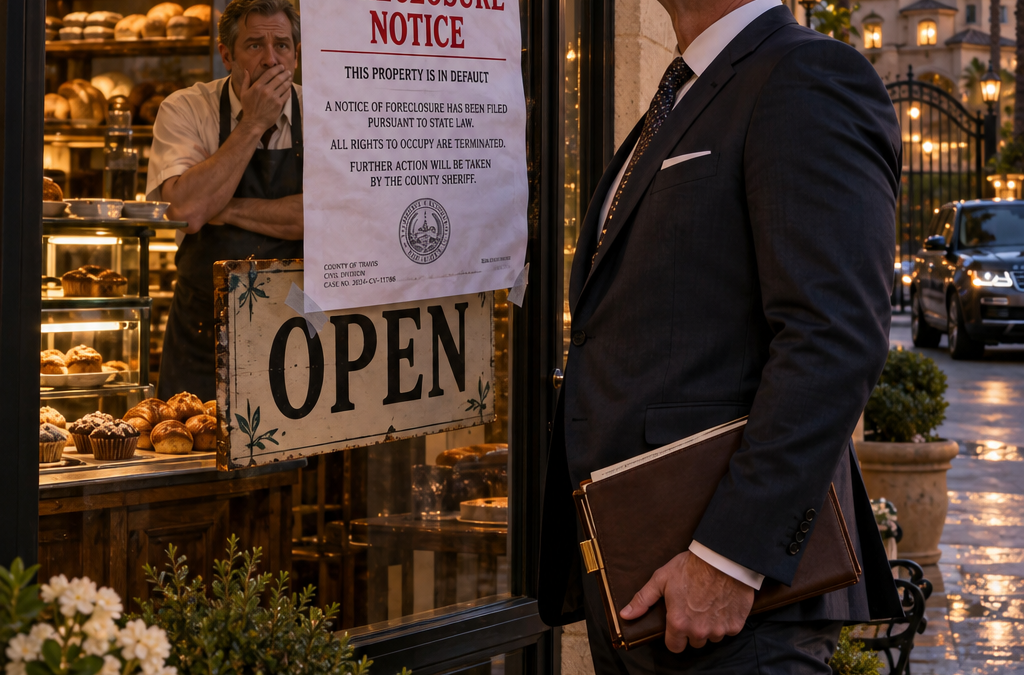
At 7:00 on a Tuesday morning, I arrived to start cinnamon rolls and found a foreclosure notice taped to my front window.
Right over my hand-painted OPEN sign.
For a moment, I just stood there with my key in my hand.
The morning air smelled like cut grass and wet pavement from overnight sprinklers. The palms along the street threw long shadows across the sidewalk.
The notice was bright white.
Official-looking.
Humiliating.
Anyone walking past could see it.
Foreclosure proceedings.
Unpaid assessments.
Commercial compliance default.
Twelve thousand dollars.
Plus attorney fees.
Plus penalties.
I felt heat rise behind my eyes.
Not tears exactly.
Something angrier.
She wanted people to see it.
She wanted customers to hesitate.
She wanted the bakery marked as failing before the doors opened.
I unlocked the door, went inside, and photographed the notice from every angle before removing it.
But I was not fast enough to control the story.
A customer had already taken a picture.
By 8:30, it was on the neighborhood Facebook page.
Why is there a foreclosure notice on Chad’s bakery?
The comments exploded.
Some were furious.
Some were confused.
A surprising number asked whether the cinnamon rolls had survived.
They had.
I posted one comment from the bakery account.
We are open. Cinnamon rolls are fine. So am I. More soon.
That only made the line longer.
By 10:00, people were showing up partly to buy pastries and partly to express outrage.
Mrs. Alvarez bought two dozen donuts “for morale.”
Mr. Grant ordered coffee and told everyone within earshot that Deborah had finally lost her mind.
Someone made a sign from butcher paper and taped it inside the shop window.
OPEN DESPITE NONSENSE.
For the first time in weeks, I laughed.
Deborah tried damage control by noon.
She posted that the notice had been “issued in clerical error.”
But Renata had the signed copy.
The dated copy.
The instruction email.
The ledger.
The delivery note.
The paper trail told a different story.
Emergency board meeting.
That was what came next.
Residents demanded it.
Board members who had ignored Deborah’s behavior for years suddenly discovered urgency once the Facebook page turned against them. Phones rang. Emails flooded in. People wanted explanations for missing reserve funds, parking harassment, special assessments, and why a bakery with no signed commercial HOA agreement had a foreclosure notice on its window.
The meeting was held in the clubhouse two nights later.
It was packed shoulder to shoulder.
Residents stood in the hall.
Phones were raised before Deborah even reached the podium.
She wore a pale blue suit and pearls. Her face was composed, but I had watched enough customers lie about forgotten wallets to recognize panic under polish.
Renata sat beside me.
Priya sat on my other side with a folder full of spreadsheets.
Mr. Alvarez sat in the second row, still angry about his car.
Deborah opened with calm authority.
“Neighbors, I understand there has been confusion.”
The room grumbled.
She continued.
“The notice placed on the bakery window was the result of administrative miscommunication.”
Someone shouted, “You signed it!”
Deborah’s smile tightened.
“I ask for decorum.”
A woman near the back replied, “We asked for honesty.”
That got applause.
Deborah tapped the microphone.
“The board has always acted in the best interest of Maple Crest Village.”
Renata whispered, “That sentence usually ages badly.”
She was right.
The treasurer stood before Deborah could move to the next agenda item.
His name was Owen Price. He was a retired banker, quiet, careful, and for years rumored to be Deborah’s loyal shadow. He had signed budgets without much public discussion and rarely challenged her in meetings.
That night, he looked tired.
“Before we proceed,” Owen said, “I need to correct the record.”
Deborah turned slowly.
“Owen, we discussed the order of—”
“No,” he said. “We didn’t. You told me what would be said.”
The room went silent.
Owen lifted a folder.
“I have bank statements.”
Deborah’s face changed.
Not much.
But enough.
Owen’s hand shook as he placed copies on the table.
“For three years, I accepted explanations for reserve transfers because I trusted the president. That was my failure.”
Deborah said, “Owen, this is not the forum—”
“It is exactly the forum.”
He looked out at the residents.
“Funds were withdrawn from reserve accounts and routed through vendor payments to Whitlock Grounds & Stone. Deborah’s husband’s company.”
The room erupted.
Deborah raised her voice.
“That is a gross mischaracterization!”
Owen turned a page.
“Every withdrawal in question bears your authorization.”
He placed copies on the projector.
There it was.
Her signature.
Again.
And again.
And again.
Dates.
Amounts.
Vendor references.
Reserve transfer approvals.
Some payments matched invoices Priya had already flagged as suspicious. Others were new.
The room went dead silent, then erupted all at once.
People stood.
Shouted.
Demanded answers.
Deborah pointed at Owen, at outside vendors, at the management software, at prior boards, at clerical confusion, at everyone except herself.
Classic deflection.
Textbook.
Almost painful to watch.
Almost satisfying too.
Then I stood.
Not fast.
Not dramatic.
Just enough that the people near me stopped talking.
I walked to the front table and placed three things in front of the board.
The coffee cup evidence bag.
The fabricated ledger Priya had marked up.
The foreclosure notice that had been taped to my window.
“This started with a chalkboard sign,” I said.
My voice sounded calmer than I felt.
“I paid that fine because I thought peace was worth two hundred dollars.”
I looked around the room.
“Then came the awning. The delivery truck. The foot traffic. The parking tickets. The fake assessments. The tow truck. The foreclosure notice.”
Deborah glared at me.
I looked at her.
“You told me businesses that don’t fit in around here don’t last long.”
She said nothing.
I held up the ledger.
“These numbers don’t come from my lease. They don’t come from the bylaws. They don’t come from any valid commercial agreement I signed.”
I placed it down.
“They were fiction.”
Priya stood beside me.
She handed copies of her spreadsheet to the board.
“The assessment formula does not match any governing document provided to residents or commercial tenants,” she said. “The charges were constructed manually and inconsistently.”
Renata stood next.
“Complaints have been filed with the state real estate commission and the county district attorney’s office. The foreclosure notice issued against my client appears unsupported by any valid agreement and connected to a broader pattern of fraudulent assessments and reserve fund diversion.”
Deborah laughed once.
It was sharp and ugly.
“You people have no idea how associations operate.”
The clubhouse doors opened.
A man in a dark jacket stepped inside with two uniformed officers behind him.
Renata did not look surprised.
I did.
The man identified himself as an investigator working with the district attorney’s office.
The room went quiet.
He had already been building a case from resident complaints that went back years.
Parking enforcement abuse.
Disappearing appeals.
Improper assessments.
Vendor irregularities.
Reserve transfers.
Deborah had mistaken silence for safety.
But people had been complaining for a long time.
They simply had not known their stories connected.
The investigator approached the front.
“Deborah Whitlock?”
Her face drained.
“I’m in the middle of a board meeting.”
“Yes, ma’am. We’re aware.”
Those three words ended her reign more completely than any speech could have.
The board voted before she was escorted out.
Unanimous.
Every member present.
Even Owen, maybe especially Owen.
Deborah Whitlock was removed as HOA president that night, stripped of every board authority she had spent years weaponizing, and barred by emergency board action from accessing association accounts or records pending investigation.
She walked out between two officers and one investigator, not in handcuffs yet, but with the whole neighborhood filming.
For a woman who had built her power on public humiliation, the exit felt almost poetic.
Three days later, the state real estate commission suspended her property management license.
The suspension order cited suspected fraud, falsified disclosures, misuse of association funds, and breach of fiduciary duty.
Criminal charges followed soon after.
Embezzlement.
Falsifying HOA records.
Wire fraud.
Related financial charges tied to reserve fund transfers and vendor payments.
Her husband’s landscaping company came under investigation.
So did records connected to her nephew’s bakery.
Ethan Whitlock closed Whitlock & Wheat within a month, claiming online that “the market was oversaturated.”
No one believed him.
My lien was voided within a week.
The unpaid assessments were erased from every record, almost as if they had never existed.
But I kept copies.
All of them.
Fiction can still hurt you if you forget who wrote it.
The HOA issued a formal apology. The landlord apologized too, though his version included too many phrases like “unfortunate confusion” and not enough phrases like “we should have protected our tenant sooner.”
Renata negotiated changes to my lease protections, including written confirmation that no HOA assessments could be billed directly to my business without documented legal authority and prior notice. Parking enforcement near the commercial strip was suspended and rewritten.
Mr. Alvarez got his towing fees refunded.
He also got a dozen donuts from me, which he insisted was the greater victory.
The bakery reopened under a new hand-lettered banner my customers made themselves.
Maple Crest’s Most Honest Business.
It was crooked.
The lettering was uneven.
The spacing was terrible.
I loved it.
We taped it inside the window above the place where Deborah’s foreclosure notice had been.
That morning, the line reached the sidewalk before 7:00.
People came in with flowers, cards, cash tips, handwritten notes, and requests for cinnamon rolls “with extra justice,” which became an unofficial menu item for about two weeks.
The OPEN sign went back on the window.
This time, nobody taped anything over it.
Business boomed after that.
Not because scandal is good marketing, although it apparently doesn’t hurt.
Business boomed because the neighborhood had finally decided what kind of place it wanted to be.
People who had walked past my bakery for months came in and apologized.
Some admitted they had been afraid of Deborah.
Others said they had received strange fines too.
A few told me they had suspected something was wrong but did not want to be the first to say it out loud.
I understood.
Fear works best when everyone thinks they are alone.
Deborah had known that.
She built her power in private.
One letter at a time.
One warning at a time.
One tow slip, one fake assessment, one whispered threat over coffee.
She never attacked the whole neighborhood at once.
She isolated people.
Made each person think their problem was personal, embarrassing, maybe even their fault.
But once the stories were laid side by side, the pattern became impossible to ignore.
The chalkboard sign.
The parking tickets.
The reserve transfers.
The landscaping invoices.
The missing disclosures.
The towing.
The foreclosure notice.
All of it belonged to the same machine.
And once people saw the machine, they stopped feeding it.
Weeks later, after the worst of the chaos had settled, Priya came in for her usual Thursday cinnamon roll.
She sat at the counter this time instead of the corner table.
“You look tired,” she said.
“I own a bakery.”
“No, different tired.”
I poured her coffee.
“Good tired?”
She considered that.
“Maybe recovering tired.”
“That sounds right.”
She broke a piece from the cinnamon roll.
“Do you regret fighting?”
I looked toward the front window.
The handmade banner still hung there.
A little crooked.
The OPEN sign below it glowed warm against the glass.
Outside, residents walked past without checking for tow warnings. Cars sat in the commercial spaces without tickets tucked beneath wipers. Mr. Alvarez’s sedan was parked proudly in front of the shop like a monument to pastry rights.
“No,” I said. “But I regret paying the first fine.”
Priya smiled.
“Everyone pays the first fine.”
“Not everyone.”
“Most people. That’s how people like Deborah start.”
I nodded.
She was right.
Two hundred dollars had seemed like nothing.
A nuisance.
A fee for peace.
But peace purchased from a bully is never peace.
It is only rent paid on fear.
I leaned against the counter.
“You know what she miscalculated?”
“What?”
“She thought I loved this bakery because it made money.”
Priya looked around.
“And why do you love it?”
I watched Mrs. Alvarez walk in, already waving at me before the bell finished ringing.
“Because it’s mine,” I said.
That was the part Deborah never understood.
To her, the bakery was leverage. A storefront. A problem. A commercial unit. A threat to her nephew’s business. A line item in whatever scheme she was running.
To me, it was every morning I woke at 3:45.
Every burn on my forearm.
Every batch that failed before I got the recipe right.
Every customer who became a regular.
Every dollar I saved to make payroll.
Every day I wondered if I had been stupid to risk everything and then opened the oven to find the bread had risen anyway.
She could not measure that on an HOA ledger.
She could only threaten it.
And that was not enough.
A month after Deborah’s removal, Maple Crest elected a new board.
Owen did not run again. He stood at the meeting and apologized publicly for trusting Deborah too long. People were angry, but most accepted that he had helped expose the records when it mattered.
The new board included Priya, which surprised no one and worried anyone who hoped future budgets could hide nonsense.
The first reforms were practical.
Open financial reports.
Independent audits.
Clear parking rules.
No unilateral fines.
No commercial assessments without written authority.
No vendor payments to companies owned by board members or immediate family without disclosure, competitive review, and resident approval.
The community did not become perfect.
No neighborhood does.
People still argued about landscaping.
Someone complained about dog waste near the clubhouse.
A retired engineer submitted a nine-page proposal about speed bumps.
Democracy returned in all its annoying glory.
But that was better than fear.
One morning, not long after the new board took over, I found an envelope slipped under my bakery door.
For half a second, my stomach clenched.
Old reflex.
Then I opened it.
Inside was a note from the former florist who had once occupied my space.
I heard what happened. I wish I had stayed and fought. Thank you for doing what I couldn’t.
I stood alone in the bakery kitchen with that note in my hand while the first trays of cinnamon rolls cooled behind me.
I thought about her.
About the coffee kiosk owner.
About every resident who had paid a fake fee, lost a tow charge, skipped a meeting, or swallowed anger because Deborah made resistance feel impossible.
I had not fought only for myself, even though at the beginning, that was all I thought I was doing.
Sometimes you defend your own door and discover other people were trapped behind theirs too.
I taped the florist’s note inside my office cabinet where customers couldn’t see it.
Not as a trophy.
As a reminder.
The morning Deborah taped that foreclosure notice over my OPEN sign, she wanted me embarrassed.
She wanted customers to doubt me.
She wanted residents to see my bakery as failing, delinquent, dirty with official shame.
Instead, she gave everyone a picture.
One clean image of what she had become.
A woman so confident in her power that she thought she could threaten a small business in public and call it clerical error by lunch.
That arrogance brought her down faster than any accusation could have.
The truth already existed.
She simply taped it to my window.
These days, I still open at 5:30.
I still burn my fingers sometimes.
I still overproof dough when someone distracts me with conversation.
The cinnamon rolls remain the best-selling item, though the sourdough has developed a loyal following among people who enjoy pretending bread is a personality.
Mr. Alvarez still comes every Saturday.
He parks in the same spot.
Sometimes he taps the hood of his car before coming inside, like he is confirming it hasn’t been kidnapped.
Priya still comes Thursdays.
She still audits my books with alarming enthusiasm.
The banner my customers made eventually came down because the paper faded, but I kept it folded in the office.
Maple Crest’s Most Honest Business.
Uneven letters and all.
Last week, a young couple came in after touring a house in the neighborhood.
They asked if Maple Crest was a good place to live.
I looked out the window at the palms, the clean sidewalks, the quiet storefronts, the old people arguing happily over coffee.
“It is now,” I said.
That was true.
Not because bad people never gain power.
They do.
Not because boards never fail.
They do.
Not because paperwork can’t be weaponized.
I knew better than most that it can.
Maple Crest was better because people had finally learned to read the paperwork, question the signatures, follow the money, and stand beside the person being targeted before it was their turn.
That lesson cost us.
It cost some residents money.
It cost Mr. Alvarez a morning of humiliation.
It cost me months of fear, legal bills, and the kind of stress that makes flour feel heavy in your hands.
But it saved the bakery.
It exposed the fraud.
It broke Deborah’s hold.
And it reminded an entire gated community that rules only protect people when they are not controlled by someone using them as weapons.
Sometimes customers still ask me about Deborah.
I usually tell them I have dough in the mixer and can’t gossip.
That is partly true.
The rest is that I no longer want her to be the most interesting thing about my bakery.
She had enough of my mornings.
She doesn’t get the rest.
Justice, it turns out, rises slower than dough.
It needs warmth.
Pressure.
Time.
Patience.
It looks flat for a long while, like nothing is happening at all.
Then suddenly, if you have done the work right, it lifts.
And once it rises, nothing on earth can stop it from baking all the way through.
Golden.
Steady.
And finally, completely done.
𝗧𝗛𝗘 𝗘𝗡𝗗
The Morning Deborah Whitlock Put a Foreclosure Notice on My Bakery Window
The paper was taped directly over my hand-painted OPEN sign before the sun had even cleared the palm trees. By noon, half the neighborhood had seen it, and by the end of that week, the woman who put it there would lose almost everything she had spent years stealing quietly.
My name is Chad Mercer, and I own the only bakery inside Maple Crest Village.
Maple Crest sits outside Austin, Texas, behind stone gates, manicured medians, and rows of palms that always look a little too perfect for the heat. It was the kind of place where every hedge had a shape, every driveway had the right stain, and every resident seemed to own either a golf cart, a golden retriever, or both.
My bakery sat in the little commercial strip near the clubhouse.
There were only four storefronts there. A dry cleaner. A small insurance office. A boutique fitness studio that charged too much for people to sweat in matching clothes. And my place.
Chad’s Hearth.
That was the name painted on the front window in warm cream letters, right beneath a small wheat stalk I had sketched myself before paying a sign painter more than I could afford to make it look professional.
It was not a franchise.
It was not trendy.
It was not backed by investors, influencers, or anyone who used words like concept when they meant sandwich.
It was mine.
I opened at 5:30 every morning. I mixed dough before sunrise, proofed cinnamon rolls while the rest of the neighborhood slept, and brewed coffee strong enough to make retired accountants forgive the heat. My hands always smelled like flour, butter, yeast, and sugar. My apron was permanently dusted white no matter how often I washed it.
For the first year, Maple Crest loved me.
People came in after morning walks. Mothers bought muffins before school drop-off. Contractors grabbed coffee and kolaches before starting repairs inside the gates. Older residents sat at the corner table and argued about football, property taxes, and which doctor in Austin actually listened.
Saturday mornings were the best.
The line sometimes reached the sidewalk.
I knew people’s orders before they reached the counter.
Mrs. Alvarez liked two glazed twists and a black coffee.
Mr. Grant wanted sausage kolaches but always pretended he was buying them for his son.
Priya Raman, my accountant, came in every Thursday at 7:15 for a cinnamon roll and an oat milk latte she claimed was her only weekly vice.
I loved that place.
I loved the oven heat, the glass case, the bell above the door, the sound of neighbors calling each other by name.
After years working in hotel kitchens, grocery bakeries, and one miserable stint supervising frozen dough production for a chain that believed bread could be improved by committee, I finally had something that belonged to me.
That was why I signed the lease.
That was why I drained my savings.
That was why I worked sixteen-hour days until my knees hurt and my wrists ached.
Nobody warned me that the real landlord of Maple Crest was not the man listed on the lease.
It was Deborah Whitlock.
Deborah was president of the Maple Crest Village HOA and chair of the community commercial-use committee, a title she had apparently invented and then acted as though Moses brought it down from a mountain.
She was in her early sixties, always dressed in linen, pearls, and pale colors that somehow never wrinkled in Texas heat. Her hair was a smooth silver bob. Her nails were immaculate. Her smile was warm in public and sharp the second nobody useful was watching.
She had a talent for making threats sound like advice.
The first time I met her, she came in two days after opening.
She ordered coffee, no cream, no sugar, and looked around the bakery as if she were inspecting a hotel room for damages.
“This is charming,” she said.
“Thank you.”
“Very rustic.”
I wasn’t sure whether that was a compliment.
“We were going for warm.”
“Yes. Warm.” She glanced at the chalkboard near the counter. “Handwritten signs can be tricky in a community like this.”
I looked at the board.
Fresh cinnamon rolls, 2 for $7.
“Tricky how?”
“Maple Crest has standards.”
“I checked signage rules before opening.”
Her smile stayed fixed.
“I’m sure you checked what you were given.”
That should have told me everything.
Instead, I poured her coffee and said, “Well, if there’s anything specific I need to know, I’m happy to follow the rules.”
Deborah looked at me over the lid of her cup.
“Oh, Chad. That attitude will serve you well here.”
Then she left.
The first violation letter arrived one week later.
Unauthorized signage.
The chalkboard.
Two hundred dollars.
According to the notice, Article 12 prohibited unapproved exterior advertising visible from common areas. The chalkboard sat inside my shop window, behind glass, and it was smaller than the framed event posters the fitness studio put up every month.
I called the HOA office.
A woman named April answered, voice soft and nervous.
“I’m calling about a violation notice,” I said.
“Property address?”
I gave it.
There was a pause.
“Oh. The bakery.”
“Yes.”
Another pause.
“You’ll need to speak with President Whitlock.”
“Can I appeal it?”
“You can submit a written request.”
“Okay. To who?”
A third pause.
“To President Whitlock.”
That told me enough.
I paid the two hundred dollars.
Not because I thought the fine was valid. Because I had croissants laminating in the back, a mixer motor making a sound I didn’t like, and a flour invoice due Friday. I did not have time to start a war over a chalkboard.
That was my first mistake.
Deborah understood something most bullies understand instinctively.
If someone pays the small fine, they might pay the larger one too.
The next violation concerned the awning color.
The awning had been approved before I signed the lease. I had the email from the property manager.
Deborah said the approval was incomplete because the HOA commercial committee had not confirmed “tone harmony” with nearby roof tiles.
Tone harmony.
Three hundred dollars.
Then delivery truck parking.
The bakery received flour deliveries twice a week. The truck parked behind the shop for fifteen minutes, always in the service zone.
Deborah called it disruption of resident access.
Four hundred dollars.
Then excessive foot traffic.
That one was my favorite for about ten seconds, until I realized she was serious.
She fined me because too many paying customers were walking into my business.
The notice said the bakery had “created recurring pedestrian congestion inconsistent with the intended quiet-use design of the commercial village.”
I read that sentence out loud to Priya when she came in for her Thursday cinnamon roll.
She stared at me.
“Isn’t foot traffic the point of a bakery?”
“Apparently only quiet foot traffic is allowed.”
“That sounds invented.”
“Everything she writes sounds invented.”
Priya took the notice from me and examined it.
She was not just my customer. She was my accountant, and the only reason my books made sense. She had the kind of brain that made numbers confess.
“Are you tracking all of these?”
“In a folder.”
“Good. Start a spreadsheet too.”
I frowned.
“For HOA fines?”
“For patterns.”
I laughed.
She did not.
“Chad, people don’t use vague rules this aggressively unless there’s a reason.”
At first, I thought the reason was simple.
Deborah didn’t like commercial tenants.
She treated business owners like tolerated guests at a party she did not want them attending. Residents were her subjects. Commercial tenants were servants who needed reminding of their place.
Then her nephew opened a bakery.
Two blocks outside the gated entrance.
Whitlock & Wheat.
Same rustic cream lettering.
Same style of wheat stalk.
Same shade of green on the awning.
When I drove past it the first time, I actually slowed down without meaning to.
It looked like someone had described my bakery to a designer over the phone and said, “Make it less personal, but close enough.”
The owner was named Ethan Whitlock.
Deborah’s nephew.
He had never worked in a bakery, as far as I could tell. He had investment money, a polished Instagram page, and a grand opening banner that read “Artisan Comfort for the Maple Crest Community.”
I stood across the road staring at that sign and felt something unpleasant settle in my stomach.
Maybe it was coincidence.
Maybe Deborah really was just an overzealous HOA president with too much time and a laminated copy of Article 12.
But I had spent years behind bakery counters reading people.
People tell you everything if you watch what they do when they think you’re too busy making change.
Deborah was not enforcing rules.
She was clearing space.
One evening, near closing, she walked into my shop alone.
The case was almost empty. I had six muffins left, two sourdough boules, and a tray of cinnamon roll ends I usually saved for staff, except I had no staff that day because payroll was tight.
Deborah ordered a coffee.
I poured it.
She did not leave.
Instead, she stood at the counter, one hand resting on her handbag, studying me with that soft public-meeting smile.
“Business seems slower lately.”
“We’re doing all right.”
“Are you?”
I put the lid on her cup.
“Anything else?”
She leaned slightly closer.
“Businesses that don’t fit in around here don’t tend to last long.”
The words were quiet.
Sweet.
Nearly gentle.
I looked at her hand around the cup.
Pale pink lipstick on the lid.
Perfect fingerprint on the sleeve.
“Is that advice?”
“It’s an observation.”
I smiled back.
“Funny. I make those too.”
For the first time, her expression flickered.
Then she turned and walked out.
I did not throw that cup away.
I don’t know why.
Maybe because something in me finally understood that Deborah Whitlock only said things out loud when she thought nobody could prove it. I slipped the cup into a paper bag, wrote the date and time on it, stapled the receipt to the outside, and set it in the back office.
Evidence.
I didn’t know yet how much of it I would need.
The fines escalated into a formal lien threat two weeks later.
Twelve thousand dollars in unpaid assessments.
I sat at my desk behind the bakery, surrounded by flour sacks and cooling racks, staring at the letter as if the words might rearrange themselves into something logical.
Unpaid HOA assessments.
I had never received an assessment invoice.
I had never signed a commercial HOA agreement.
My lease said I paid rent, utilities, and a defined shared maintenance fee through the property owner. It did not say I was personally liable for residential HOA assessments.
I pulled out the lease.
Then the addendum.
Then the commercial-use agreement.
Then the emails from the property manager before signing.
Nothing.
No HOA assessment obligation.
No twelve thousand dollars.
No authority for Deborah to treat my bakery as if I were a homeowner behind the gates.
That was the loophole.
My unit sat in a strange residential-commercial gray area. The property itself was within the overall development, but my lease ran through a separate owner who passed along certain maintenance costs. Deborah knew how confusing that arrangement was. She had used it against me for months.
And I soon learned she had used it before.
Two other small businesses had occupied my storefront before me.
A florist.
Then a specialty coffee kiosk.
Both had left suddenly after disputes with the HOA. The landlord had described them as “not a fit for the community.”
I called the former florist, whose name I found on an old business listing.
At first, she did not want to talk.
When I mentioned Deborah, she went quiet.
“She’s after you now?”
“Yes.”
“Get out while you can.”
“What happened to you?”
“Assessments. Parking fines. Signage fines. Threats.”
“Did you owe them?”
“No. But I couldn’t afford to fight. I packed up and moved to Round Rock.”
The coffee kiosk owner told the same story.
Invented fees.
Threats.
A lien letter.
Then silence, because he had shut down before they could do more.
I was not shutting down.
Not my shop.
Not my ovens.
Not my name.
I started recording everything.
Texas law has rules about recording conversations, and I made sure I understood what applied before I did anything stupid. I kept records of meetings I attended, phone calls I was part of, letters, emails, parking tickets, photographs, and every invoice Deborah’s office sent.
I labeled the folder Insurance.
It grew fast.
Priya came in one evening after close. I had given her access to the spreadsheet of fines, supposed assessments, late fees, and administrative charges.
She sat at the little corner table with her laptop, a calculator, and a cinnamon roll she forgot to eat because numbers had offended her.
After twenty minutes, she tapped the screen twice with her pen.
“Chad.”
“That sounds bad.”
“These aren’t fines.”
“What are they?”
“Fiction.”
I sat across from her.
She turned the laptop around.
“The assessment formula doesn’t match the bylaws, the commercial maintenance schedule, the residential fee structure, or any reserve calculation I can find. These numbers are flatly invented.”
I looked at the spreadsheet.
Priya pointed at one column.
“This twelve-thousand-dollar balance? It doesn’t grow like a real ledger. It jumps.”
“Meaning?”
“Meaning someone is adding numbers because they want a number large enough to scare you.”
I leaned back.
Flour dust rose from my apron.
“Deborah.”
Priya did not smile.
“Almost certainly.”
That single sentence changed how hard I decided to fight.
Until then, I had been defending myself.
After that, I started hunting the truth.
I sent a formal written request for the HOA’s full financial disclosures, board minutes, commercial assessment records, reserve account ledgers, vendor contracts, and documents supporting every charge against my bakery.
I cited the Texas Property Code, including Section 209, and requested all records available to members and affected parties under the association’s governing documents and state law.
Maybe a commercial tenant’s rights would be contested.
Maybe Deborah would argue I did not qualify as a residential owner.
But if she wanted to bill me like one, I wanted the records like one.
She stalled.
First, administrative delays.
Then unavailable staff.
Then pending audit.
Then “records under review.”
Then silence.
Every delay made me more certain she was hiding something worth protecting.
Meanwhile, parking tickets appeared.
Not on my truck.
On my customers’ cars.
Little yellow warning slips tucked under windshield wipers.
Improper commercial parking.
Excessive duration near storefront.
Resident access interference.
My regulars started getting them every morning.
Mrs. Alvarez got one while buying donuts.
Mr. Grant got two in one week.
A nurse who stopped in after night shift found a warning on her windshield and never came back.
Deborah could not shut my ovens off.
So she tried starving me of customers one parking ticket at a time.
Then she made a mistake.
She towed Mr. Alvarez.
On a Saturday morning.
During his weekly donut run.
Mr. Alvarez was seventy-eight years old, a retired history teacher, and one of those men who wore ironed shirts even to buy pastries. He came in every Saturday at 8:00, ordered two glazed donuts, sat by the window, and read the local paper on a tablet he barely knew how to use.
That morning, he was halfway through his second donut when a tow truck hooked his sedan outside.
He stood up so fast the chair scraped backward.
“Is that my car?”
I ran outside with him.
The driver already had the front wheels lifted.
“Hey,” I shouted. “What are you doing?”
“HOA tow order.”
“For what?”
“Unauthorized parking.”
Mr. Alvarez gripped his cane.
“I’m parked in front of a bakery.”
The driver shrugged.
“Take it up with management.”
Then Deborah appeared from the side walkway, phone in hand, as if the whole thing had been staged for her entrance.
“Rules apply to everyone,” she said.
Mr. Alvarez looked at her.
“I live here.”
“You are parked in a commercial turnover space beyond permitted time.”
“I have been inside for fourteen minutes.”
She smiled.
“Then you may appeal.”
Something changed that morning.
People had tolerated tickets when they were private annoyances. They had tolerated fines when they belonged to someone else. They had tolerated Deborah because standing up to her seemed like too much work.
But towing an old man’s car during a donut run was a different kind of stupid.
By noon, the neighborhood Facebook page was on fire.
Someone posted a photo of Mr. Alvarez standing beside the tow truck with his cane in one hand and a donut bag in the other.
Comments poured in.
This is insane.
Deborah has gone too far.
Who approved this?
Why are bakery customers being targeted?
Has anyone else gotten these tickets?
That was when residents started comparing notes.
Parking fines. Special assessments. Landscape charges. Reserve fees. Late notices. Vague community improvement costs that seemed to appear and disappear depending on who asked questions.
Priya messaged me that afternoon.
They’re finally talking. Save everything.
I already was.
Three days later, the first reserve fund clue surfaced.
A resident named Martin Bell forwarded Priya an old budget packet. He had saved it because his wife was on a finance committee years earlier.
There were reserve transfers listed for “commercial landscape enhancement.”
The amounts were strange.
Large enough to matter.
Small enough to hide inside a bigger budget.
Priya compared them to the current disclosures Deborah had delayed producing.
Then she came to the bakery after close, eyes sharp, laptop open.
“She’s not just targeting you.”
“I know that.”
“No. I mean financially.”
She showed me transfers routed through a landscaping vendor.
Whitlock Grounds & Stone.
I stared at the name.
“Whitlock?”
“Her husband’s company.”
My chest tightened.
The special assessments Deborah had been inventing weren’t random.
They fed a hidden slush account routed through her husband’s landscaping company. Reserve funds, commercial maintenance charges, and special assessments had been moved through vague improvement categories for three years.
Some invoices were legitimate.
Many were suspicious.
Some billed for services that residents said never happened.
One billed for palm replacement outside the commercial strip during a month when no palms had been replaced.
Another billed for irrigation repairs behind my storefront, where the irrigation system had been broken since before I signed the lease and remained broken.
Deborah wasn’t only trying to drive me out for her nephew.
She was skimming HOA money.
My bakery was simply where her fraud became visible.
I brought everything to a real estate attorney named Renata Cole.
Renata had an office in Austin, a voice like a closing argument, and a habit of reading documents with a pen in her hand like she was cross-examining the paper.
I spread the file across her desk.
Violation letters.
Parking tickets.
The coffee cup in its paper bag.
Priya’s spreadsheet.
Lease documents.
The fabricated assessment ledger.
Customer tow records.
Financial transfers.
Vendor invoices.
Emails.
Photos.
Recordings.
Renata went through them without rushing.
When she finished, she leaned back and looked at me.
“This is not a fine dispute anymore, Chad.”
I swallowed.
“What is it?”
“Fraud.”
Plain and simple.
She filed a formal complaint with the state real estate commission because Deborah held a property management license connected to her HOA work and community operations. Renata also looped in the county district attorney’s office, carefully, quietly, with documentation arranged by date and category.
No accusations without records.
No dramatic claims without evidence.
Every deadline documented.
Every signature preserved.
Every suspicious transfer labeled.
Deborah sensed pressure.
I could tell because she stopped smiling when she came near the bakery.
Her emails got shorter.
The HOA office stopped answering my calls.
Parking enforcement suddenly became aggressive enough that even residents who disliked conflict started complaining openly.
Then she doubled down.
At 7:00 on a Tuesday morning, I arrived to start cinnamon rolls and found a foreclosure notice taped to my front window.
Right over my hand-painted OPEN sign.
For a moment, I just stood there with my key in my hand.
The morning air smelled like cut grass and wet pavement from overnight sprinklers. The palms along the street threw long shadows across the sidewalk.
The notice was bright white.
Official-looking.
Humiliating.
Anyone walking past could see it.
Foreclosure proceedings.
Unpaid assessments.
Commercial compliance default.
Twelve thousand dollars.
Plus attorney fees.
Plus penalties.
I felt heat rise behind my eyes.
Not tears exactly.
Something angrier.
She wanted people to see it.
She wanted customers to hesitate.
She wanted the bakery marked as failing before the doors opened.
I unlocked the door, went inside, and photographed the notice from every angle before removing it.
But I was not fast enough to control the story.
A customer had already taken a picture.
By 8:30, it was on the neighborhood Facebook page.
Why is there a foreclosure notice on Chad’s bakery?
The comments exploded.
Some were furious.
Some were confused.
A surprising number asked whether the cinnamon rolls had survived.
They had.
I posted one comment from the bakery account.
We are open. Cinnamon rolls are fine. So am I. More soon.
That only made the line longer.
By 10:00, people were showing up partly to buy pastries and partly to express outrage.
Mrs. Alvarez bought two dozen donuts “for morale.”
Mr. Grant ordered coffee and told everyone within earshot that Deborah had finally lost her mind.
Someone made a sign from butcher paper and taped it inside the shop window.
OPEN DESPITE NONSENSE.
For the first time in weeks, I laughed.
Deborah tried damage control by noon.
She posted that the notice had been “issued in clerical error.”
But Renata had the signed copy.
The dated copy.
The instruction email.
The ledger.
The delivery note.
The paper trail told a different story.
Emergency board meeting.
That was what came next.
Residents demanded it.
Board members who had ignored Deborah’s behavior for years suddenly discovered urgency once the Facebook page turned against them. Phones rang. Emails flooded in. People wanted explanations for missing reserve funds, parking harassment, special assessments, and why a bakery with no signed commercial HOA agreement had a foreclosure notice on its window.
The meeting was held in the clubhouse two nights later.
It was packed shoulder to shoulder.
Residents stood in the hall.
Phones were raised before Deborah even reached the podium.
She wore a pale blue suit and pearls. Her face was composed, but I had watched enough customers lie about forgotten wallets to recognize panic under polish.
Renata sat beside me.
Priya sat on my other side with a folder full of spreadsheets.
Mr. Alvarez sat in the second row, still angry about his car.
Deborah opened with calm authority.
“Neighbors, I understand there has been confusion.”
The room grumbled.
She continued.
“The notice placed on the bakery window was the result of administrative miscommunication.”
Someone shouted, “You signed it!”
Deborah’s smile tightened.
“I ask for decorum.”
A woman near the back replied, “We asked for honesty.”
That got applause.
Deborah tapped the microphone.
“The board has always acted in the best interest of Maple Crest Village.”
Renata whispered, “That sentence usually ages badly.”
She was right.
The treasurer stood before Deborah could move to the next agenda item.
His name was Owen Price. He was a retired banker, quiet, careful, and for years rumored to be Deborah’s loyal shadow. He had signed budgets without much public discussion and rarely challenged her in meetings.
That night, he looked tired.
“Before we proceed,” Owen said, “I need to correct the record.”
Deborah turned slowly.
“Owen, we discussed the order of—”
“No,” he said. “We didn’t. You told me what would be said.”
The room went silent.
Owen lifted a folder.
“I have bank statements.”
Deborah’s face changed.
Not much.
But enough.
Owen’s hand shook as he placed copies on the table.
“For three years, I accepted explanations for reserve transfers because I trusted the president. That was my failure.”
Deborah said, “Owen, this is not the forum—”
“It is exactly the forum.”
He looked out at the residents.
“Funds were withdrawn from reserve accounts and routed through vendor payments to Whitlock Grounds & Stone. Deborah’s husband’s company.”
The room erupted.
Deborah raised her voice.
“That is a gross mischaracterization!”
Owen turned a page.
“Every withdrawal in question bears your authorization.”
He placed copies on the projector.
There it was.
Her signature.
Again.
And again.
And again.
Dates.
Amounts.
Vendor references.
Reserve transfer approvals.
Some payments matched invoices Priya had already flagged as suspicious. Others were new.
The room went dead silent, then erupted all at once.
People stood.
Shouted.
Demanded answers.
Deborah pointed at Owen, at outside vendors, at the management software, at prior boards, at clerical confusion, at everyone except herself.
Classic deflection.
Textbook.
Almost painful to watch.
Almost satisfying too.
Then I stood.
Not fast.
Not dramatic.
Just enough that the people near me stopped talking.
I walked to the front table and placed three things in front of the board.
The coffee cup evidence bag.
The fabricated ledger Priya had marked up.
The foreclosure notice that had been taped to my window.
“This started with a chalkboard sign,” I said.
My voice sounded calmer than I felt.
“I paid that fine because I thought peace was worth two hundred dollars.”
I looked around the room.
“Then came the awning. The delivery truck. The foot traffic. The parking tickets. The fake assessments. The tow truck. The foreclosure notice.”
Deborah glared at me.
I looked at her.
“You told me businesses that don’t fit in around here don’t last long.”
She said nothing.
I held up the ledger.
“These numbers don’t come from my lease. They don’t come from the bylaws. They don’t come from any valid commercial agreement I signed.”
I placed it down.
“They were fiction.”
Priya stood beside me.
She handed copies of her spreadsheet to the board.
“The assessment formula does not match any governing document provided to residents or commercial tenants,” she said. “The charges were constructed manually and inconsistently.”
Renata stood next.
“Complaints have been filed with the state real estate commission and the county district attorney’s office. The foreclosure notice issued against my client appears unsupported by any valid agreement and connected to a broader pattern of fraudulent assessments and reserve fund diversion.”
Deborah laughed once.
It was sharp and ugly.
“You people have no idea how associations operate.”
The clubhouse doors opened.
A man in a dark jacket stepped inside with two uniformed officers behind him.
Renata did not look surprised.
I did.
The man identified himself as an investigator working with the district attorney’s office.
The room went quiet.
He had already been building a case from resident complaints that went back years.
Parking enforcement abuse.
Disappearing appeals.
Improper assessments.
Vendor irregularities.
Reserve transfers.
Deborah had mistaken silence for safety.
But people had been complaining for a long time.
They simply had not known their stories connected.
The investigator approached the front.
“Deborah Whitlock?”
Her face drained.
“I’m in the middle of a board meeting.”
“Yes, ma’am. We’re aware.”
Those three words ended her reign more completely than any speech could have.
The board voted before she was escorted out.
Unanimous.
Every member present.
Even Owen, maybe especially Owen.
Deborah Whitlock was removed as HOA president that night, stripped of every board authority she had spent years weaponizing, and barred by emergency board action from accessing association accounts or records pending investigation.
She walked out between two officers and one investigator, not in handcuffs yet, but with the whole neighborhood filming.
For a woman who had built her power on public humiliation, the exit felt almost poetic.
Three days later, the state real estate commission suspended her property management license.
The suspension order cited suspected fraud, falsified disclosures, misuse of association funds, and breach of fiduciary duty.
Criminal charges followed soon after.
Embezzlement.
Falsifying HOA records.
Wire fraud.
Related financial charges tied to reserve fund transfers and vendor payments.
Her husband’s landscaping company came under investigation.
So did records connected to her nephew’s bakery.
Ethan Whitlock closed Whitlock & Wheat within a month, claiming online that “the market was oversaturated.”
No one believed him.
My lien was voided within a week.
The unpaid assessments were erased from every record, almost as if they had never existed.
But I kept copies.
All of them.
Fiction can still hurt you if you forget who wrote it.
The HOA issued a formal apology. The landlord apologized too, though his version included too many phrases like “unfortunate confusion” and not enough phrases like “we should have protected our tenant sooner.”
Renata negotiated changes to my lease protections, including written confirmation that no HOA assessments could be billed directly to my business without documented legal authority and prior notice. Parking enforcement near the commercial strip was suspended and rewritten.
Mr. Alvarez got his towing fees refunded.
He also got a dozen donuts from me, which he insisted was the greater victory.
The bakery reopened under a new hand-lettered banner my customers made themselves.
Maple Crest’s Most Honest Business.
It was crooked.
The lettering was uneven.
The spacing was terrible.
I loved it.
We taped it inside the window above the place where Deborah’s foreclosure notice had been.
That morning, the line reached the sidewalk before 7:00.
People came in with flowers, cards, cash tips, handwritten notes, and requests for cinnamon rolls “with extra justice,” which became an unofficial menu item for about two weeks.
The OPEN sign went back on the window.
This time, nobody taped anything over it.
Business boomed after that.
Not because scandal is good marketing, although it apparently doesn’t hurt.
Business boomed because the neighborhood had finally decided what kind of place it wanted to be.
People who had walked past my bakery for months came in and apologized.
Some admitted they had been afraid of Deborah.
Others said they had received strange fines too.
A few told me they had suspected something was wrong but did not want to be the first to say it out loud.
I understood.
Fear works best when everyone thinks they are alone.
Deborah had known that.
She built her power in private.
One letter at a time.
One warning at a time.
One tow slip, one fake assessment, one whispered threat over coffee.
She never attacked the whole neighborhood at once.
She isolated people.
Made each person think their problem was personal, embarrassing, maybe even their fault.
But once the stories were laid side by side, the pattern became impossible to ignore.
The chalkboard sign.
The parking tickets.
The reserve transfers.
The landscaping invoices.
The missing disclosures.
The towing.
The foreclosure notice.
All of it belonged to the same machine.
And once people saw the machine, they stopped feeding it.
Weeks later, after the worst of the chaos had settled, Priya came in for her usual Thursday cinnamon roll.
She sat at the counter this time instead of the corner table.
“You look tired,” she said.
“I own a bakery.”
“No, different tired.”
I poured her coffee.
“Good tired?”
She considered that.
“Maybe recovering tired.”
“That sounds right.”
She broke a piece from the cinnamon roll.
“Do you regret fighting?”
I looked toward the front window.
The handmade banner still hung there.
A little crooked.
The OPEN sign below it glowed warm against the glass.
Outside, residents walked past without checking for tow warnings. Cars sat in the commercial spaces without tickets tucked beneath wipers. Mr. Alvarez’s sedan was parked proudly in front of the shop like a monument to pastry rights.
“No,” I said. “But I regret paying the first fine.”
Priya smiled.
“Everyone pays the first fine.”
“Not everyone.”
“Most people. That’s how people like Deborah start.”
I nodded.
She was right.
Two hundred dollars had seemed like nothing.
A nuisance.
A fee for peace.
But peace purchased from a bully is never peace.
It is only rent paid on fear.
I leaned against the counter.
“You know what she miscalculated?”
“What?”
“She thought I loved this bakery because it made money.”
Priya looked around.
“And why do you love it?”
I watched Mrs. Alvarez walk in, already waving at me before the bell finished ringing.
“Because it’s mine,” I said.
That was the part Deborah never understood.
To her, the bakery was leverage. A storefront. A problem. A commercial unit. A threat to her nephew’s business. A line item in whatever scheme she was running.
To me, it was every morning I woke at 3:45.
Every burn on my forearm.
Every batch that failed before I got the recipe right.
Every customer who became a regular.
Every dollar I saved to make payroll.
Every day I wondered if I had been stupid to risk everything and then opened the oven to find the bread had risen anyway.
She could not measure that on an HOA ledger.
She could only threaten it.
And that was not enough.
A month after Deborah’s removal, Maple Crest elected a new board.
Owen did not run again. He stood at the meeting and apologized publicly for trusting Deborah too long. People were angry, but most accepted that he had helped expose the records when it mattered.
The new board included Priya, which surprised no one and worried anyone who hoped future budgets could hide nonsense.
The first reforms were practical.
Open financial reports.
Independent audits.
Clear parking rules.
No unilateral fines.
No commercial assessments without written authority.
No vendor payments to companies owned by board members or immediate family without disclosure, competitive review, and resident approval.
The community did not become perfect.
No neighborhood does.
People still argued about landscaping.
Someone complained about dog waste near the clubhouse.
A retired engineer submitted a nine-page proposal about speed bumps.
Democracy returned in all its annoying glory.
But that was better than fear.
One morning, not long after the new board took over, I found an envelope slipped under my bakery door.
For half a second, my stomach clenched.
Old reflex.
Then I opened it.
Inside was a note from the former florist who had once occupied my space.
I heard what happened. I wish I had stayed and fought. Thank you for doing what I couldn’t.
I stood alone in the bakery kitchen with that note in my hand while the first trays of cinnamon rolls cooled behind me.
I thought about her.
About the coffee kiosk owner.
About every resident who had paid a fake fee, lost a tow charge, skipped a meeting, or swallowed anger because Deborah made resistance feel impossible.
I had not fought only for myself, even though at the beginning, that was all I thought I was doing.
Sometimes you defend your own door and discover other people were trapped behind theirs too.
I taped the florist’s note inside my office cabinet where customers couldn’t see it.
Not as a trophy.
As a reminder.
The morning Deborah taped that foreclosure notice over my OPEN sign, she wanted me embarrassed.
She wanted customers to doubt me.
She wanted residents to see my bakery as failing, delinquent, dirty with official shame.
Instead, she gave everyone a picture.
One clean image of what she had become.
A woman so confident in her power that she thought she could threaten a small business in public and call it clerical error by lunch.
That arrogance brought her down faster than any accusation could have.
The truth already existed.
She simply taped it to my window.
These days, I still open at 5:30.
I still burn my fingers sometimes.
I still overproof dough when someone distracts me with conversation.
The cinnamon rolls remain the best-selling item, though the sourdough has developed a loyal following among people who enjoy pretending bread is a personality.
Mr. Alvarez still comes every Saturday.
He parks in the same spot.
Sometimes he taps the hood of his car before coming inside, like he is confirming it hasn’t been kidnapped.
Priya still comes Thursdays.
She still audits my books with alarming enthusiasm.
The banner my customers made eventually came down because the paper faded, but I kept it folded in the office.
Maple Crest’s Most Honest Business.
Uneven letters and all.
Last week, a young couple came in after touring a house in the neighborhood.
They asked if Maple Crest was a good place to live.
I looked out the window at the palms, the clean sidewalks, the quiet storefronts, the old people arguing happily over coffee.
“It is now,” I said.
That was true.
Not because bad people never gain power.
They do.
Not because boards never fail.
They do.
Not because paperwork can’t be weaponized.
I knew better than most that it can.
Maple Crest was better because people had finally learned to read the paperwork, question the signatures, follow the money, and stand beside the person being targeted before it was their turn.
That lesson cost us.
It cost some residents money.
It cost Mr. Alvarez a morning of humiliation.
It cost me months of fear, legal bills, and the kind of stress that makes flour feel heavy in your hands.
But it saved the bakery.
It exposed the fraud.
It broke Deborah’s hold.
And it reminded an entire gated community that rules only protect people when they are not controlled by someone using them as weapons.
Sometimes customers still ask me about Deborah.
I usually tell them I have dough in the mixer and can’t gossip.
That is partly true.
The rest is that I no longer want her to be the most interesting thing about my bakery.
She had enough of my mornings.
She doesn’t get the rest.
Justice, it turns out, rises slower than dough.
It needs warmth.
Pressure.
Time.
Patience.
It looks flat for a long while, like nothing is happening at all.
Then suddenly, if you have done the work right, it lifts.
And once it rises, nothing on earth can stop it from baking all the way through.
Golden.
Steady.
And finally, completely done.








