𝗙𝗨𝗟𝗟 𝗦𝗧𝗢𝗥𝗬 The Manager Tore Up My Business Card, Pointed Me Toward the Exit, and Never Once Asked Why I Had Come to His Building
𝗙𝗨𝗟𝗟 𝗦𝗧𝗢𝗥𝗬
The kind that allowed him to interrupt people.
Correct them.
Make them wait.
Make them explain themselves.
He crossed the lobby toward me.
I noticed the confidence first.
Four fast steps.
Chin slightly raised.
Tie perfectly centered.
The expression of a man who believed the building around him was evidence of his own importance.
He stopped a few feet away.
“Can I help you?”
The words were polite.
The voice was not.
I held out my card.
“Wanda Collins. I have a two o’clock meeting with Neil Ashford on eleven.”
He didn’t take the card immediately.
His eyes went from my face to the card.
Back to my face.
Then he took it.
“Collins Equity Partners.”
“Yes.”
He read the next line.
“Chief executive officer.”
“That’s correct.”
Something changed in his expression.
Not surprise.
Amusement.
He looked at me again, more slowly this time.
“You’re the CEO?”
“Yes.”
“Of an equity firm?”
“Yes.”
“And you’re meeting Neil Ashford?”
“That’s what I said.”
He turned my card over as if expecting to find instructions printed on the back.
“Where did you get this made?”
For a moment, I assumed I had misunderstood him.
“Excuse me?”
“The card.”
He held it toward the overhead lighting.
“Where’d you have it printed?”
My stomach tightened.
“It’s my business card.”
“I understand what you’re claiming.”
“No. I don’t think you do.”
Three employees near reception were watching now.
Greg noticed them.
That seemed to energize him.
“I’ve worked here six years,” he said. “I know our clients. I know our vendors. I know the people who walk into this building.”
“I am neither a routine client nor a vendor.”
“And I’ve never heard your name.”
“That doesn’t concern me.”
His eyebrows rose.
“Excuse me?”
“I have a private meeting scheduled with Neil Ashford at two. Call his office and confirm it.”
Greg laughed.
Not quietly.
He actually tipped his head back.
One of the employees nearby smiled.
Another looked at me, then quickly away.
“You want me to call our director?”
“Yes.”
“And tell him some random woman is down here claiming she’s a CEO?”
“I’m not claiming it.”
He stared at me.
“I am the CEO.”
His smile disappeared.
Then he stepped closer.
“Let me explain something to you.”
I remember that sentence.
Let me explain something to you.
I had heard versions of it my entire professional life.
Usually from men about to explain my own industry to me.
“You’re in the wrong building,” he said.
“No.”
“You’re wasting my time.”
“No.”
“And this—”
He raised my card.
“—is fake.”
I felt heat rise beneath my collar.
“The card is real.”
“Sure.”
“So is my meeting.”
“Sure.”
“Call Neil.”
A woman at a nearby desk covered her mouth.
I heard a small laugh.
Greg heard it too.
He stepped even closer.
“My director does not waste his time with people like you.”
I looked directly at him.
“People like me.”
He paused.
He had just enough awareness to know the words carried weight.
Not enough awareness to stop.
“People who walk in off the street with fake credentials.”
“I arrived thirteen minutes early for a scheduled meeting.”
“Scammers do research.”
“Call upstairs.”
“Hustlers learn names.”
“Call upstairs.”
“Con artists print cards.”
“Call upstairs.”
His jaw tightened.
He looked down at my blazer.
“What’s that cost?”
I said nothing.
“Thirty dollars? Forty?”
He brushed an imaginary speck from his own sleeve.
The gesture was so childish that for a second I almost felt embarrassed for him.
Then he smiled.
“I’m going to make this easy. You have ten seconds to turn around, walk through those doors and leave.”
“And if I don’t?”
“I’ll call security.”
“Before verifying my meeting?”
“There is no meeting.”
“How do you know?”
“Because I know who belongs here.”
That sentence landed differently.
I could feel people listening.
I looked around.
No one met my eyes for long.
A few appeared uncomfortable.
Others looked entertained.
One young woman three desks from the entrance sat absolutely still, one hand above her keyboard.
I looked back at Greg.
“You haven’t been polite.”
His mouth hardened.
“Five seconds.”
I didn’t move.
He held the card between his fingers.
“You know what I think?”
“I don’t particularly care.”
For the first time, several people stopped smiling.
Greg did not like that answer.
“I think you found Neil’s name online.”
He bent the card.
“I think you looked up this company.”
Another bend.
“I think you printed yourself a little title.”
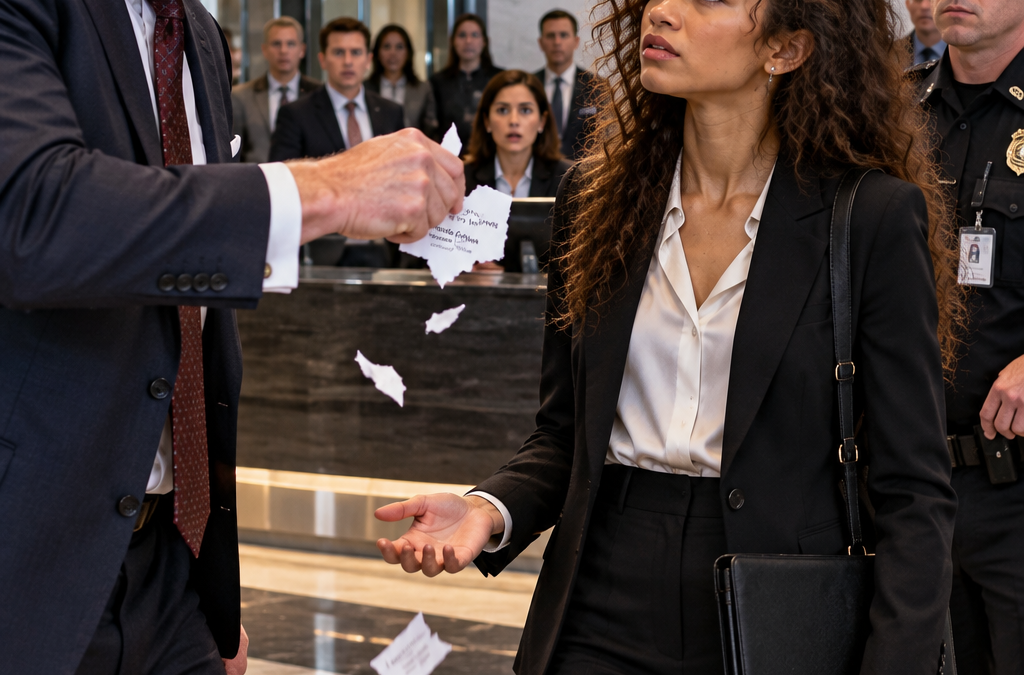
Then he tore it.
Once.
Twice.
Again.
The sound was soft.
Paper separating.
Nothing dramatic.
But I had spent fifteen years building the name printed on that card.
Fifteen years.
Forty rejection letters.
Sleepless nights.
Loans.
Payroll scares.
Investments that nearly failed.
Meetings where people assumed I was an assistant.
Conference rooms where men answered my questions by looking at the white male analyst sitting beside me.
Years of proving that I belonged in rooms nobody expected me to enter.
And now this man was standing in a lobby I was preparing to acquire, ripping my name into pieces because the truth printed beneath it offended his assumptions.
He threw the pieces toward me.
They struck my blazer and fluttered to the marble.
A few landed near my shoes.
Someone laughed.
Someone else gave a slow clap.
My eyes burned.
I refused to blink.
Greg pointed at the pieces.
“There.”
His voice was louder now.
“Problem solved.”
“Are you finished?”
“Almost.”
He rocked back on his heels.
“I want to make sure you understand something.”
I waited.
“This building isn’t for you.”
The lobby seemed to shrink around me.
“This company isn’t for you.”
He spoke almost gently now.
That made it worse.
“You don’t belong here.”
I had been told versions of that sentence before.
At twenty-six, when I had tried to raise my first fund.
At twenty-nine, when an event organizer placed me at the service table because she assumed I worked for the venue.
At thirty-two, when a banker asked whether the actual managing partner would be joining us.
At thirty-five, after my firm had already crossed a billion dollars in assets, when an investor asked whether I was “the diversity partner.”
People imagine success eventually becomes armor.
It doesn’t.
The words still enter.
You simply become better at deciding how long you allow them to remain inside you.
I noticed a young man near the coffee station holding his phone low by his hip.
Recording.
Two more phones were visible.
Nobody intervened.
They were documenting it.
That distinction would matter later.
At the time, it felt like another kind of abandonment.
I pointed toward the elevators.
“Two o’clock. Eleventh floor. Neil Ashford.”
“I don’t take orders from people with fake cards.”
“Then don’t take an order. Verify a fact.”
Greg folded his arms.
“You’re not supposed to be here.”
He turned toward the gathering crowd.
Then raised one surviving piece of my card.
“Everybody see this?”
My chest tightened.
He had turned humiliation into performance.
“This woman walked into Greystone claiming she’s some CEO.”
A few people laughed.
“She printed a fake card, used Neil Ashford’s name and thought nobody would check.”
“I asked you to check.”
His head snapped toward me.
“Quiet.”
Then he looked at the employees again.
“She doesn’t own anything here.”
That sentence would become ironic later.
At that moment, it was simply cruel.
He snapped his fingers.
“Tommy.”
A security guard stood near the east entrance.
Broad shoulders.
Late twenties.
His name, I later learned, was Tommy Pearson.
He had been watching the entire exchange.
Unlike Greg, he did not look pleased.
He looked sick.
“Get over here.”
Tommy approached slowly.
“What’s happening?”
Greg gestured toward me.
“This woman is trespassing.”
“I have a scheduled meeting.”
Greg spoke over me.
“Fake business card. Fake story. Remove her.”
Tommy looked at me.
Then at the paper on the floor.
Then back at Greg.
His jaw tightened.
“Ma’am…”
His voice was low.
Apologetic.
“I’m going to need to ask you to—”
“I understand.”
He stopped.
I wasn’t angry at Tommy in that moment.
Not in the same way.
That would come later.
What I felt then was disappointment.
Because sometimes you can see in a person’s face that they know something is wrong.
And when they do it anyway, their politeness does not make the choice neutral.
I looked at Greg.
He was smiling again.
“You’re going to regret this.”
The smile widened.
“Is that a threat?”
“No.”
I turned toward the doors.
“It’s information.”
I walked across the lobby.
Every step sounded too loud against the marble.
Behind me, nobody spoke until I reached the entrance.
Then I heard Greg.
“And that is how you handle a con artist.”
Laughter.
Two claps.
The doors closed behind me.
Charlotte heat struck my face.
I stood on the sidewalk for several seconds.
My hands were shaking.
That bothered me.
Not because I thought shaking meant weakness.
Because I knew what it was.
Adrenaline with nowhere to go.
I took out my phone.
Called Rachel.
She answered immediately.
“Wanda? Where are you? Neil’s office just—”
“Call Neil Ashford.”
“What happened?”
“His floor manager destroyed my business card.”
Silence.
“He accused me of fraud.”
“What?”
“He had security escort me out.”
Another silence.
Longer.
“Wanda…”
“I’m standing outside.”
“Who did this?”
“I don’t know his name.”
“I’m calling Neil right now.”
“Use his personal line.”
“I will.”
“And tell him exactly what happened.”
My voice remained steady.
“Don’t soften it.”
“I won’t.”
I ended the call.
Then I looked up at Greystone’s tower.
Twelve floors of glass rising into the Carolina sky.
Somewhere on the eleventh floor were three copies of a contract worth $340 million.
Eight months of negotiation.
Hundreds of hours of legal work.
Financial modeling.
Due diligence.
Risk analysis.
And down here, a man entrusted with managing the lobby had concluded that the woman acquiring the company could not possibly belong inside it.
I leaned against a concrete pillar.
And waited.
I had waited outside important rooms before.
That was another thing Greg could not have known.
When I was twenty-nine, an investment conference in San Francisco seated me at a table behind a column near the kitchen.
My badge clearly identified me as a fund manager.
The organizers assumed I was support staff.
My white male associate was placed near the front.
He offered to switch.
I refused.
I sat behind the column.
Ate dinner alone.
Stayed until the last speaker finished.
Then cried in the taxi back to my hotel.
At thirty-one, I arrived for a meeting in Boston and was told to wait with the administrative assistants until “the investors” arrived.
I was the investor.
At thirty-three, a prospective partner spent fifteen minutes describing a complicated debt structure to me before realizing I had designed the financing model he was quoting.
Those things did not stop after I became successful.
They simply became more absurd.
I had learned not to cry immediately.
Not because pain had stopped mattering.
Because results mattered more.
Inside, Greg was apparently celebrating.
I learned the details afterward from interviews, security footage and employees.
He retold the story.
Again.
And again.
Each version made me more ridiculous.
Each version made him more perceptive.
He had exposed the fraud.
Protected the company.
Saved everyone from an obvious scam.
A woman from accounting asked whether I had actually shown him a business card.
Greg produced one torn piece he had picked up from the floor.
A souvenir.
“Collins Equity Partners,” he said.
He laughed.
Someone from IT asked an obvious question.
“Did you call Neil?”
Greg’s smile reportedly changed for half a second.
“I didn’t need to.”
That sentence told me almost everything I eventually needed to know about him.
I didn’t need to.
Bias loves certainty.
It survives by convincing the person holding it that verification is unnecessary.
Three desks from reception, the young woman I had noticed during the confrontation did something Greg had refused to do.
She typed my name into a search engine.
Her name was Sophie Brennan.
Twenty-six.
Junior coordinator.
Six months at Greystone.
The search results appeared instantly.
Collins Equity Partners.
Company website.
Financial press.
Interviews.
Investment history.
Then my photograph.
The same woman Greg had just ordered out of the building.
Sophie later told me she felt physically ill.
She opened a Bloomberg profile.
Then a Financial Times article about my firm’s pursuit of a controlling stake in an unnamed Southeastern software company.
She looked across the lobby toward Greg.
Then she went to him.
“Greg.”
He ignored her.
“I need to talk to you.”
“Not now.”
“Greg, I looked her up.”
That got his attention.
“What?”
“Collins Equity Partners is real.”
He stared at her.
“And Wanda Collins is—”
“I handled it.”
“Greg—”
“Go back to your desk.”
She stood there.
Three seconds.
Maybe four.
Then obeyed.
That silence would haunt her later.
But unlike most people in that lobby, Sophie did something else.
She opened the internal directory.
Found Neil Ashford’s assistant.
And sent an email marked URGENT.
She did not know whether anyone would read it in time.
Eleven floors above her, Neil Ashford’s phone rang.
He was reviewing page 127 of the acquisition agreement.
Three printed copies sat across the conference table.
Collins Equity Partners.
Greystone Technologies.
$340 million.
51 percent controlling interest.
His caller ID showed my firm.
He answered expecting me.
Instead, Rachel spoke.
“Mr. Ashford, this is Rachel Torres, executive assistant to Wanda Collins.”
“Rachel. Is Wanda downstairs?”
“Yes.”
“Good. We’re ready for—”
“She’s outside.”
Neil stopped.
“Outside where?”
“Your building.”
A pause.
“Why?”
“Because your floor manager refused to let her in.”
Neil said nothing.
Rachel continued.
“He accused her of carrying a fake business card.”
According to Neil, that was the moment he stood up.
“He called her a fraud. He destroyed the card in front of employees and ordered security to escort her out.”
“What?”
“He told her she did not belong in the building.”
Neil placed his pen on the table.
“Who?”
“She doesn’t know his name. Ground-floor manager.”
Neil pressed his intercom.
“Claire.”
“Yes?”
“Call the lobby.”
“Okay.”
“Tell them nobody leaves.”
Silence.
“Excuse me?”
“Tell them nobody moves and nobody leaves that lobby until I get there.”
He ended the call.
Buttoned his jacket.
Walked into the elevator.
The ride to the lobby took nineteen seconds.
He later told me he counted all nineteen.
I was still outside when the elevator doors opened.
Through the glass, I saw movement.
Employees turning.
Then Neil.
He walked quickly across the lobby.
Greg apparently tried to intercept him.
“Neil, don’t worry. I handled—”
Neil kept walking.
Didn’t stop.
Didn’t answer.
He passed him.
Came through the glass doors.
Saw me.
His face changed.
“Miss Collins.”
I pushed away from the pillar.
“I am so sorry.”
He held the door.
“Please come inside.”
I looked at him.
“Has anything changed since I left?”
His expression tightened.
“Everything.”
I stepped through the doors again.
The lobby had gone silent.
Greg stood fifteen feet away.
The confidence was still there.
But now it had cracks.
“Neil.”
He gave a nervous laugh.
“You don’t have to do this. I checked her out. Her card was obviously—”
“Greg.”
Neil said his name quietly.
That stopped him.
Neil looked at me.
Then at Greg.
“Do you know who this is?”
Greg’s eyes moved between us.
“She said she was some kind of CEO.”
Neil stared at him.
“This is Wanda Collins.”
Nobody moved.
“Founder and chief executive officer of Collins Equity Partners.”
Greg’s mouth opened slightly.
“A firm managing $2.3 billion in assets.”
The lobby became so quiet I could hear the air-conditioning.
“Miss Collins is here today because we have spent eight months negotiating a $340 million transaction.”
Greg’s face changed.
Neil continued.
“She is acquiring a 51 percent controlling stake in Greystone Technologies.”
Confusion disappeared.
Understanding arrived.
Then fear.
I watched it happen.
Greg’s skin lost color.
He looked at me for the first time that day without contempt.
That moment should have felt satisfying.
It didn’t.
Because what I saw in his face was not remorse.
It was calculation.
He had not suddenly understood that degrading me was wrong.
He had understood that degrading me had become dangerous to him.
Neil took one step closer.
“When this agreement closes, Collins Equity Partners will control this company.”
Greg tried to speak.
“Neil, I didn’t—”
“No.”
Greg stopped.
“I was protecting—”
“No.”
“But she—”
“Stop.”
Neil’s voice never rose.
“You took her business card.”
Greg looked down.
“You accused her of lying.”
Silence.
“You humiliated her in front of our employees.”
Greg’s face tightened.
“You had security remove the person we are expecting upstairs to acquire this company.”
“I didn’t know who she was.”
That was the first sentence Greg spoke that mattered.
I turned toward him.
He looked at me.
And I said nothing.
Because the problem was contained entirely inside his own defense.
I didn’t know who she was.
As if my identity would determine whether cruelty was justified.
As if humiliating a receptionist would have been acceptable.
Or a delivery driver.
Or a cleaner.
Or a woman who had entered the wrong building by mistake.
As if dignity were reserved for CEOs.
Neil understood it too.
“You didn’t know who she was,” he said.
“No.”
“And that made this acceptable?”
Greg said nothing.
I turned toward the elevators.
“Neil.”
He joined me.
As we walked away, I heard nothing behind us.
No laughter.
No slow clap.
Only our footsteps.
Just before the elevator doors closed, Neil turned.
“Greg.”
Greg looked up.
“Stay where you are.”
He swallowed.
“HR is coming down.”
The doors closed.
The eleventh floor felt like another world.
Carpet instead of marble.
Soft lighting.
Glass offices.
Muted voices.
A conference room at the end of the hall had been prepared for the closing.
Mahogany table.
Leather chairs.
Water glasses.
Coffee.
Three copies of the acquisition agreement.
Pens placed neatly beside them.
Eight months of work sat beneath my fingertips.
Neil closed the door.
Then turned to me.
“Wanda…”
It was the first time he used my first name that afternoon.
“I don’t know what to say.”
“Don’t say anything yet.”
He sat across from me.
I remained standing for a moment.
I could feel the adrenaline leaving my body.
That was when the emotional cost arrived.
Not while Greg was yelling.
Not when he tore the card.
Not when people laughed.
Now.
In the quiet.
My hands began trembling again.
I placed them flat on the table.
Neil saw.
His face tightened.
“I am deeply sorry.”
“I know.”
“There is no excuse.”
“No.”
“This is not how Greystone—”
I looked at him.
He stopped.
“Don’t say that.”
His brow furrowed.
“Don’t say this isn’t Greystone.”
“I didn’t mean—”
“It happened in Greystone’s lobby.”
He leaned back.
“In front of Greystone employees.”
“Yes.”
“Under a Greystone manager.”
He lowered his eyes.
“While your security employee followed his order.”
Neil exhaled.
I sat down.
“What happened downstairs is not just about Greg Holloway.”
He nodded slowly.
“I understand.”
“Do you?”
I hated how sharp the question sounded, but I did not withdraw it.
“A man does not behave like that in front of fifteen or twenty colleagues unless experience has taught him he can.”
Neil said nothing.
“He tore up my card in the middle of your lobby.”
“I know.”
“People laughed.”
His jaw tightened.
“People filmed.”
“I know.”
“Nobody stopped him.”
He looked toward the window.
Charlotte stretched below us.
Cars moving.
People walking.
Life continuing.
I looked at the contracts.
“A company’s culture is not what gets printed in the employee handbook.”
Neil looked back at me.
“It isn’t the values statement in the reception area.”
I touched the top copy of the agreement.
“It is what people believe they are allowed to do when senior leadership isn’t standing there.”
He closed his eyes briefly.
“What do you want?”
“An independent review.”
“Of Greg?”
“Of Greystone.”
That surprised him.
“Wanda—”
“Hiring practices. HR complaints. disciplinary history. promotion patterns. management conduct. Retaliation. Vendor treatment. Security procedures.”
“That could take months.”
“Yes.”
He stared at the agreement.
“We have financing tied to this closing.”
“I know.”
“Board approvals.”
“I know.”
“People have worked on this for eight months.”
“So have I.”
He became quiet.
Then looked up.
“Are you walking away?”
I considered the question.
“No.”
Relief appeared too quickly on his face.
I held up a hand.
“I’m not signing today either.”
The relief disappeared.
“The acquisition is suspended.”
“For how long?”
“Until I know what I am buying.”
“You already completed financial due diligence.”
“I know the financial liabilities.”
I looked toward the elevator.
“I clearly don’t know all the human ones.”
Neil sat in silence.
Then nodded.
“I understand.”
Nine floors below us, Human Resources Director Pamela Grant stepped into the lobby.
By then, most employees had returned to their desks.
Greg remained near reception.
The torn pieces of my business card were still on the floor.
Pamela asked him to come into an office.
She suspended him without pay.
Greg reportedly told her he had been protecting the company.
Pamela asked a simple question.
“If she had been a white man wearing a suit, would you have torn up his business card?”
He did not answer.
He surrendered his badge.
Security escorted him through the same doors he had ordered me to use.
But I did not know any of that yet.
I was still upstairs with Neil.
For the next hour, we discussed what would happen next.
External investigators.
Preservation of email.
Security footage.
HR files.
Anonymous employee interviews.
No internal cleanup before auditors arrived.
No conveniently missing documents.
No preselected witnesses.
“If I discover anyone destroyed records,” I told Neil, “the deal ends.”
“I understand.”
“If anyone retaliates against an employee who speaks honestly, the deal ends.”
“Understood.”
“If this review becomes a public-relations exercise instead of an investigation, the deal ends.”
He nodded.
I pushed the unsigned contract away.
Then stood.
Neil did too.
“I wish we’d met under different circumstances.”
“So do I.”
He looked embarrassed.
“Do you need a car?”
“No.”
“Security?”
“No.”
“At least let me walk you out.”
I almost said no.
Then changed my mind.
“All right.”
We rode down together.
When we returned to the lobby, Greg was gone.
Nobody laughed.
Nobody stared directly at me.
The pieces of my business card had been removed.
That bothered me unexpectedly.
Part of me wanted them left there.
I wanted the lobby to remember.
Near reception, Sophie stood when she saw me.
She looked terrified.
“Miss Collins?”
Neil stopped.
I turned.
“My name is Sophie Brennan.”
“Yes?”
She swallowed.
“I tried to warn him.”
Neil looked at her.
Sophie rushed to explain.
“I looked you up after he made you leave. I told Greg your company was real. He wouldn’t listen.”
I studied her.
“Did you say anything while he was doing it?”
Her face fell.
“No.”
“Why?”
She glanced toward the desks.
“Because I was afraid.”
I could have punished her with silence.
Part of me wanted to.
Instead, I asked, “Afraid of what?”
“Greg.”
That answer mattered.
“He’s done things like this before?”
Her eyes filled.
“Not exactly like this.”
“But?”
She looked at Neil.
He said quietly, “Tell her.”
Sophie took a breath.
“He treats people differently.”
“What people?”
She hesitated.
Then forced herself to say it.
“Black employees. Cleaning staff. Some contractors. People he thinks don’t belong.”
Neil’s face changed.
“How long?”
“I don’t know.”
“Sophie.”
“Years.”
“You reported it?”
She shook her head.
“Someone else did.”
“Who?”
“Terrence Walker.”
Neil frowned.
The name meant something.
“Terrence was transferred last year.”
“Two weeks after he complained about Greg.”
Neil looked at me.
I didn’t need to say anything.
The acquisition had just become more complicated.
“How do you know this?” he asked.
“Everyone knew.”
The sentence fell heavily.
Everyone knew.
I looked around the lobby.
People were pretending not to listen.
But they were.
“Thank you, Sophie.”
She looked surprised.
“I’m sorry.”
I nodded.
“You’ll have a chance to decide what you do differently next time.”
Then I left.
The first video appeared online at 4:47 that afternoon.
Forty-three seconds.
Greg taking my card.
Tearing it.
Throwing the pieces at me.
People laughing.
Someone clapping.
Me standing still.
I did not watch it that night.
Rachel did.
My attorneys did.
Our communications director did.
By six o’clock, it had more than a million views.
By midnight, eleven million.
My phone became unusable.
Reporters.
Business networks.
Friends.
Investors.
Board members.
People I had not spoken to in ten years.
Everyone wanted a statement.
I gave none.
Greystone issued one the following morning.
Unacceptable conduct.
Deep regret.
Immediate action.
Those phrases mean very little when a company has not yet discovered whether the behavior it condemns publicly is the same behavior it tolerated privately.
Within forty-eight hours, three former employees contacted investigators.
The first was Terrence Walker.
A junior analyst.
Black.
Two years earlier, he had filed a written complaint accusing Greg of treating Black employees differently.
Public corrections.
Hostile tone.
Unnecessary scrutiny.
Different standards.
Specific incidents.
Dates.
Witnesses.
Two weeks after filing the complaint, Terrence was transferred to a satellite office.
Greystone called it restructuring.
Terrence called it retaliation.
The HR file showed his complaint had been closed.
No significant corrective action.
The second person was Angela Price, a former cleaning supervisor.
She said Greg had repeatedly forced her crew to use the freight elevator because seeing cleaners in the main elevator supposedly made clients uncomfortable.
The problem was that the white night crew used the main elevators without interference.
Security records eventually confirmed sixty-three instances in which Angela’s team had been redirected.
The third was James Okafor.
Delivery contractor.
Company-issued uniform.
Visible badge.
Greg stopped him in the lobby anyway.
Made him wait twenty minutes while calling James’s supervisor to verify he belonged there.
After confirmation, Greg walked away without apology.
One complaint can be dismissed.
Two can be explained.
Three begin to speak to one another.
Then there were more.
Not all racial.
Some were about humiliation.
Intimidation.
Retaliation.
Greg liked finding people with less institutional power than he had.
People he could correct publicly.
People unlikely to fight.
The racial disparity made the pattern worse, but the deeper culture was about hierarchy.
Greystone had given him a small kingdom.
Nobody had bothered to ask how he ruled it.
The board approved the independent investigation unanimously.
Hayes & Porter, an outside workplace-equity firm, began interviewing employees.
They interviewed Sophie.
They interviewed Tommy.
They interviewed Neil.
They interviewed the receptionist.
Security staff.
Cleaning teams.
Contractors.
Former employees.
HR personnel.
Then they interviewed me.
The investigator asked what Greg’s behavior had made me feel.
That question was harder than all the factual ones.
I could explain what happened.
Exact words.
Location.
Time.
Sequence.
But feeling?
“I felt angry.”
The investigator waited.
“Humiliated.”
She continued waiting.
I looked through the conference-room window.
“And tired.”
“Tired?”
“Yes.”
“Why?”
“Because I’ve spent fifteen years proving that people who look at me and assume I’m in the wrong room are wrong.”
I rubbed my thumb against the edge of the table.
“And at forty-one, after building a company managing billions of dollars, I walked into another lobby and discovered that none of those achievements mattered to a stranger who had already decided what kind of woman I was.”
The investigator did not interrupt.
“What hurt wasn’t that Greg didn’t know me.”
I looked at her.
“What hurt was how comfortable he was treating me badly before he knew me.”
That became the center of everything for me.
Not that he had insulted a CEO.
That he believed the woman in front of him had to earn basic respect by proving she was important.
The public conversation increasingly focused on my wealth.
My company.
The acquisition.
People loved the reversal.
Man humiliates woman, discovers woman is buying company.
It was satisfying.
Simple.
Almost cinematic.
But I disliked that version.
Because it implied Greg’s real mistake had been choosing the wrong victim.
As if his behavior would have been less serious if I really were a cleaner.
Or a courier.
Or a woman who had entered the building looking for directions.
My title exposed him.
It did not create my dignity.
Three weeks into the review, our legal team filed a civil action against Greystone.
Racial discrimination.
Hostile environment.
Negligent supervision.
Greystone itself was named.
Greg was not the central defendant.
That decision confused some people.
They thought I wanted revenge.
I didn’t.
Greg could be fired.
The harder question was how he had remained Greg for six years.
How complaints disappeared.
How retaliation became restructuring.
How employees learned silence.
How managers learned that not knowing was safer than asking.
The case moved unusually fast because the evidence was unusually visible.
Five weeks after the lobby incident, I entered a federal courtroom in Charlotte.
This time no one asked whether I belonged.
Carolyn Briggs, our lead attorney, presented the case methodically.
No performance.
No outrage.
Records.
Dates.
Witnesses.
Terrence’s complaint.
His transfer.
Angela’s elevator logs.
James’s documentation.
HR closure notes.
Emails.
Security footage.
Then the lobby video.
Forty-three seconds.
The courtroom watched Greg take the card.
Watched him tear it.
Watched the pieces fall.
Watched me stand there.
Watched employees laugh.
The laughter sounded worse in a courtroom.
Maybe because nobody in the courtroom joined them.
Sophie testified.
She looked smaller in the witness chair than she had behind the reception desk.
Her hands remained clasped.
She described the incident.
Then the previous incidents.
Then Terrence.
Then her own fear.
Carolyn asked her, “Why didn’t you intervene?”
Sophie swallowed.
“Because I’d seen what happened to people who challenged Greg.”
“Were you afraid of losing your job?”
“Yes.”
“Did you believe his behavior was wrong?”
“Yes.”
“Did you laugh?”
“No.”
“Did you stop him?”
Sophie looked down.
“No.”
“Why are you testifying now?”
She lifted her head.
“Because being scared explains why I stayed quiet.”
Her voice trembled.
“It doesn’t make staying quiet right.”
I watched Neil from across the room.
His face remained still.
But I knew that sentence hurt.
It should have.
Leadership often prefers dramatic villains because villains make everyone else innocent.
Greg was easy.
He was loud.
Cruel.
Visible.
But a company culture is built just as much by all the quiet people who decide surviving is more important than speaking.
I understood them.
That did not erase the consequence.
Tommy testified too.
He admitted that he knew Greg was wrong before he escorted me out.
“Why did you comply?”
“He was my supervisor.”
“Were you required to obey an unlawful instruction?”
“No.”
“Did Miss Collins threaten anyone?”
“No.”
“Raise her voice?”
“No.”
“Refuse to leave?”
“No.”
“Then why remove her?”
Tommy looked directly at me.
“Because following the order felt easier than challenging it.”
I appreciated that answer.
Not because it excused him.
Because it was true.
Eventually, the ruling came.
Collins Equity Partners prevailed.
Greystone was ordered to pay $4.8 million in damages.
The company was required to adopt monitored workplace reforms and quarterly bias training for at least three years.
An independent oversight committee would review compliance.
Greg was required to complete extensive court-ordered education focused on racial bias and workplace conduct.
Some people wanted more punishment.
Others thought the judgment went too far.
I was interested in neither reaction.
Punishment alone had never been my objective.
I wanted the structure changed.
Six months after the day Greg tore my card, I returned to Greystone.
Same building.
Same glass doors.
Same marble lobby.
Different atmosphere.
Hayes & Porter had completed its audit.
Seventeen recommendations.
All seventeen adopted.
Anonymous reporting channels.
Independent complaint review.
Anti-retaliation protections.
External bias training.
New promotion procedures.
Vendor-access standards.
Security escalation rules.
Executive review of management complaints.
Clear disciplinary consequences.
None of those things guaranteed goodness.
Policies never do.
But policies can make bad behavior harder to hide.
That matters.
The receptionist smiled when I entered.
“Good morning, Miss Collins.”
“Good morning.”
I stopped beside reception.
The exact spot where my card had fallen was only a few feet away.
The floor had been polished.
No marks.
No evidence.
I remembered the paper touching my shoes.
Then Neil approached.
“Ready?”
“I’ve been ready for eight months.”
He smiled.
“Fair point.”
We rode to eleven.
The conference room looked almost exactly as it had that first day.
Same skyline.
Same mahogany table.
Same leather chairs.
New contracts.
Updated dates.
Three copies.
Page 138 contained my signature line.
I read the final language one more time.
Then signed.
Wanda Collins.
The pen moved smoothly.
No dramatic music.
No applause.
No champagne.
Neil signed next.
Then extended his hand.
I took it.
“Congratulations,” he said.
“Now the work starts.”
He laughed softly.
“I had a feeling you were going to say that.”
Within a month, the company was renamed Collins Greystone Technologies.
The old silver logo came down.
New letters replaced it.
That change made headlines.
The quieter changes mattered more.
Terrence Walker was offered his original position with back pay.
He accepted after negotiating additional protections in writing.
Angela Price’s former cleaning team received unrestricted access to all standard employee elevators.
James Okafor received a formal written apology.
The three original HR complaints were reopened.
Then others.
Some findings changed.
Some did not.
That was important too.
Accountability could not become another form of predetermined judgment.
It had to be real.
Sophie Brennan was promoted.
Not because she had been heroic in the lobby.
She hadn’t.
She would have been the first person to say so.
Neil and I chose her because of what happened afterward.
She admitted where she had failed.
She testified honestly.
She helped auditors locate documents.
She named people she knew might be angry with her.
She stopped using fear as a reason to disappear.
At twenty-six, she became the youngest department head in Greystone’s history, overseeing a new office responsible for workplace inclusion and accountability.
When I told her, she looked stunned.
“I don’t deserve this.”
“Don’t decide that yet.”
“I stayed quiet.”
“Yes.”
“You asked me why.”
“I remember.”
“I still think about it.”
“You should.”
She looked confused.
I continued.
“The point is not to forget what you did.”
I leaned back.
“The point is to become someone who makes a different decision next time.”
Her eyes filled.
“I will.”
“Good.”
Tommy Pearson almost resigned.
I found out because he mailed me a three-page handwritten letter.
No lawyer language.
No excuses.
He wrote that he had known Greg’s order was wrong.
He wrote that he had obeyed because Greg was his supervisor.
He wrote that every time he closed his eyes, he saw himself walking toward me.
He apologized without asking me to forgive him.
I read the letter twice.
Then wrote back.
Thank you for telling the truth.
If you’re serious about doing differently next time, I have work for you.
We moved Tommy into a security oversight role where part of his responsibility involved training guards to challenge improper management directives.
Some board members thought that was too forgiving.
I disagreed.
Accountability and permanent exile are not the same thing.
Tommy had failed.
He admitted it.
Then he was given the chance to prove that failure did not have to become identity.
Greg’s situation was different.
He never contacted me.
I preferred that.
I did not need an apology written under pressure.
I heard through legal channels that losing his job had been devastating.
Perhaps it was.
I did not celebrate that.
But consequences are not cruelty simply because the person experiencing them is finally uncomfortable.
For six years, Greg had used his position to decide who looked legitimate.
Now he no longer had that position.
That was appropriate.
In September, I spoke at the National Black Business Summit in Atlanta.
Three thousand people filled the room.
The organizers expected me to speak about capital allocation.
I did.
For twenty minutes.
Then I put down my prepared remarks.
I looked across the audience.
“When I started my firm,” I said, “I believed success would eventually eliminate doubt.”
The room became quiet.
“I thought there was some level I could reach where nobody would look at me and wonder whether I belonged.”
I smiled slightly.
“That level does not exist.”
A few people laughed.
Not because it was funny.
Because they understood.
“I kept forty rejection letters.”
I told them about Baltimore.
The studio apartment.
The borrowed desk.
The investor who spilled coffee laughing at my projections.
Then I told them about Greystone.
Not every detail.
Just enough.
“A man held my business card in his hand.”
I paused.
“He saw my name.”
“My title.”
“My company.”
“And because the person standing in front of him did not match the person he imagined those words should describe, he concluded the paper must be false.”
The room was silent.
“He tore it apart.”
I looked down at the podium.
“For a few seconds, I watched pieces of something I had spent fifteen years building fall onto the floor.”
Then I looked back up.
“And I realized something.”
I had not planned the sentence.
It simply came.
“When someone tears up your card, they haven’t destroyed your identity.”
The room remained still.
“They’ve revealed theirs.”
The applause began before I finished stepping away from the microphone.
That line traveled farther than I expected.
People printed it.
Shared it.
Put it on walls.
But the part I cared about came afterward.
That month, we launched the Collins Foundation.
Twenty million dollars in first-year funding.
Its purpose was simple.
Find entrepreneurs who had been told no because nobody in the room could imagine them as the person they claimed to be.
Give them access to early-stage capital.
Mentorship.
Networks.
Opportunity.
Two hundred founders in three years.
Some would fail.
That was acceptable.
Failure after opportunity is part of business.
Being denied opportunity because someone cannot imagine you succeeding is something else.
In October, I returned to Charlotte for a quarterly review.
The morning was cool.
The lobby looked ordinary.
Employees moved through security.
Visitors signed in.
A courier entered carrying two boxes.
Tommy was near the security desk.
He greeted the courier.
Checked the manifest.
Thanked him.
No unnecessary questions.
No performance.
He saw me.
We exchanged a nod.
Sophie crossed the lobby holding a folder.
“Morning, Wanda.”
“Morning.”
“Review meeting at ten.”
“I know.”
“Neil says you’re going to hate slide fourteen.”
“I usually hate Neil’s slides.”
She laughed and continued toward the elevators.
I remained near the entrance.
The spot where Greg had stood was empty.
The spot where I had stood was empty too.
For a moment, I saw the old scene anyway.
His hand holding my card.
The employees gathering.
The pieces falling.
My own face reflected in the lobby glass.
I remembered how badly I had wanted one person to speak.
Not to defend my résumé.
Not to announce my net worth.
Not to prove that I was important.
Just to say:
Stop.
Call upstairs.
Check.
Treat her like a person until you know what is happening.
That was all.
The elevator opened.
I stepped inside.
Pressed eleven.
As the doors began closing, I caught my reflection in the polished metal.
Same woman.
Same face.
The difference was not that the building finally knew who I was.
The difference was that I no longer mistook recognition for belonging.
I had belonged before Greg knew my name.
I belonged while he laughed.
I belonged when my card was whole.
I belonged after he tore it apart.
The title did not create that.
The money did not create that.
The acquisition did not create that.
Those things merely forced people who had refused to see me to confront what they had missed.
The elevator climbed.
Two.
Three.
Four.
I thought about the forty rejection letters still inside my desk in Washington.
I had kept them as fuel for years.
But lately, I saw them differently.
Each letter had once seemed like a judgment.
Now it was simply evidence of someone else’s decision at a particular moment.
Nothing more.
Greg had made a decision about me too.
Instantly.
Confidently.
Publicly.
He believed he knew what kind of woman could build a $2.3 billion firm.
He believed he knew what wealth should look like.
What power should look like.
What ownership should look like.
And when reality contradicted him, he attacked reality instead of questioning himself.
That was the lesson I carried from Greystone.
Not that arrogant people eventually get exposed.
Sometimes they don’t.
Not that every person who humiliates someone weaker will someday discover the person was secretly powerful.
Most won’t.
And that should not be required.
The deeper lesson was that character is revealed in the gap between what you know about someone and how you choose to treat them anyway.
Greg knew nothing about me.
That was precisely why his choice mattered.
Tommy knew little.
His choice mattered too.
The employees knew little.
Their choices mattered.
Sophie was afraid.
Her silence mattered.
Then her decision to speak mattered.
Neil had not known what was happening nine floors below him.
What he chose to do after learning mattered.
So did what I chose.
I could have cancelled the acquisition.
Some people told me I should have.
Walk away.
Let Greystone collapse under the consequences.
Make an example of them.
Part of me wanted to.
But buying companies had taught me something else.
You do not create value by pretending damaged things cannot be repaired.
You create value by being ruthless about identifying what is damaged.
Then deciding whether the structure underneath is worth saving.
Greystone was.
Greg was not the entire company.
Neither were the employees who laughed.
Terrence was Greystone too.
Angela.
James.
Sophie.
Tommy.
Neil.
Hundreds of people who had done their jobs without knowing what had been ignored.
The company was not innocent.
But it was capable of becoming better.
That distinction mattered to me.
The elevator reached eleven.
The doors opened.
Neil was standing in the hallway holding a stack of reports.
“You’re early.”
“I’m always early.”
He handed me the top report.
“Quarterly compliance.”
I opened it.
Anonymous complaints.
Response times.
Promotion demographics.
Vendor-access incidents.
Training completion.
Retention.
Numbers.
The language I trusted most.
“Not bad,” I said.
Neil smiled.
“That’s practically a compliment from you.”
“Don’t get comfortable.”
We walked toward the conference room.
Before entering, I stopped beside the windows.
Charlotte stretched below us.
From eleven floors up, I could see the sidewalk where I had waited six months earlier.
The pillar.
The entrance.
People looked small from that height.
That was the danger of executive floors.
Everything looked smaller.
Complaints.
Employees.
Security guards.
Cleaning crews.
A woman standing outside because someone downstairs had decided she didn’t belong.
I understood now why leaders sometimes failed to see what was happening inside their own companies.
Distance makes problems look small.
Until they reach the elevator.
I turned to Neil.
“One thing.”
“What?”
“I want senior leadership rotating through the ground floor.”
He looked confused.
“For what purpose?”
“To watch.”
“Security?”
“People.”
He understood.
“You want executives seeing the building from downstairs.”
“Yes.”
He nodded.
“I like it.”
“Don’t make it ceremonial.”
“I won’t.”
“No scheduled visits.”
“Understood.”
“No entourage.”
He smiled.
“You really don’t trust executives.”
“I am an executive.”
“Exactly.”
I laughed.
Then entered the conference room.
At the end of the meeting, Sophie handed me a folder.
“What’s this?”
“Three complaints reopened from before the acquisition.”
“Findings?”
“Two sustained. One inconclusive.”
I looked at her.
“You’re comfortable with inconclusive?”
“The evidence wasn’t sufficient.”
“Even with pressure to show progress?”
“Yes.”
I smiled.
“Good.”
She seemed surprised.
“Good?”
“Fairness isn’t replacing one predetermined outcome with another.”
I closed the folder.
“If evidence says inconclusive, write inconclusive.”
She nodded.
“Understood.”
“That is how people learn to trust the system.”
Later that afternoon, I rode the elevator down alone.
When I reached the lobby, I noticed a young Black man standing near reception.
Twenty-five, maybe.
Dark jeans.
Polo shirt.
Backpack.
He looked uncertain.
A receptionist approached.
“Can I help you?”
He handed her his phone.
“I have an interview with engineering, but I think I’m early.”
She checked the appointment system.
“Marcus Reed?”
“Yes.”
“You’re twelve minutes early.”
His face tightened slightly.
“Sorry.”
“No need to apologize.”
She smiled.
“Have a seat. I’ll let them know you’re here.”
He relaxed.
“Thank you.”
I watched him sit.
Maybe it meant nothing.
Maybe it meant everything.
Culture rarely changes through speeches.
It changes through small moments repeated until they become ordinary.
Someone arrives early.
Someone checks the system.
Someone confirms the appointment.
Nobody decides what kind of person ought to have one.
I walked toward the doors.
The receptionist called after me.
“Have a good evening, Miss Collins.”
“You too.”
Outside, the air was cooler than the day Greg threw me out.
I paused on the sidewalk.
For months, strangers had told me they loved the ending of my story.
The moment Neil came downstairs.
The moment Greg learned who I was.
The way his face changed.
The power reversal.
I understood why.
People like justice when it is visible.
Immediate.
Clean.
The arrogant man is exposed.
The humiliated woman turns out to hold all the power.
But that had never felt like the ending to me.
The real ending was upstairs in complaint files marked sustained.
It was Terrence returning to the job he should never have lost.
Angela’s crew using the same elevators as everyone else.
James receiving an apology.
Tommy learning that following an order does not erase responsibility.
Sophie learning that fear can explain silence without making silence harmless.
Neil learning that a culture can look healthy from the eleventh floor while something rotten grows in the lobby.
And me learning that even success does not make a person immune to being reduced by someone else’s prejudice.
What success can provide is leverage.
I had it.
Others didn’t.
That was why I could not make the story only about Greg losing his job.
I wanted the people who came after me to need less leverage than I had needed.
That was the standard.
I looked back through the glass doors.
The silver Greystone logo was gone.
COLLINS GREYSTONE TECHNOLOGIES now hung behind reception.
My name was on the wall.
Six months earlier, Greg had ripped that same name into pieces.
For a second, the symmetry almost made me smile.
Then I remembered something more important.
The name on the wall was still not the power.
Walls change.
Logos change.
Titles change.
Companies get sold.
Fortunes rise and fall.
What mattered was the person who had walked through those doors before anyone knew she was buying the company.
The woman who stood alone while strangers laughed.
The woman who did not become more worthy when Neil Ashford stepped out of the elevator.
She had been worthy the whole time.
That understanding settled something in me that I had been carrying far longer than Greg Holloway.
For years, every closed door had made some small part of me want to prove myself harder.
Every skeptical look.
Every misplaced seat card.
Every person asking whether I was really the partner.
Really the investor.
Really the CEO.
Really the owner.
I had answered those questions by building something bigger.
I had turned five million into nineteen.
Raised funds.
Bought companies.
Created jobs.
Managed billions.
I thought winning enough times would make the questions stop.
They hadn’t.
Maybe they never would.
But standing outside Collins Greystone Technologies that evening, I finally understood that I did not need the questions to stop.
I simply needed to stop allowing them to define what I knew about myself.
Greg had held my business card beneath fluorescent lights as though he had the authority to decide whether it was real.
He never had that authority.
That had been his illusion.
Not mine.
I walked toward the waiting car.
Before getting in, I checked my phone.
Rachel had sent me a photograph.
The first cohort of Collins Foundation founders.
Thirty-two people standing together in Washington.
Software engineers.
Medical researchers.
Restaurant owners.
Clean-energy founders.
Two women who had been rejected by more than fifty investors between them.
A former teacher launching an education platform.
A young man building logistics technology from his mother’s garage.
People who had heard no.
People who had been told they were too early.
Too inexperienced.
Too different.
Too risky.
People somebody else had once looked at and decided did not belong.
I enlarged the photograph.
Every face looked nervous.
Proud.
Hungry.
Familiar.
I thought about the forty rejection letters in my drawer.
Then I thought about the card pieces on Greystone’s floor.
Perhaps that was why the incident no longer felt like a wound when I remembered it.
It felt like a line.
A dividing line between proving myself for other people and building opportunities for people who should never have had to prove their humanity in the first place.
I got into the car.
As we pulled away, Greystone disappeared behind another glass tower.
I did not look back again.
There were still acquisitions to evaluate.
Founders to fund.
Boards to challenge.
Employees to protect.
Numbers to study.
Companies to rebuild.
Work.
Real work.
And I had always trusted work more than applause.
Greg Holloway had once told me that the building was not for people like me.
Six months later, my name was on it.
But that was never the victory I cared about most.
The victory was that the next person who entered those doors would not have to own the company before someone bothered to check whether they belonged there.
That was the change worth buying.
And in the end, it cost far more than a torn business card.








