𝗙𝗨𝗟𝗟 𝗦𝗧𝗢𝗥𝗬 The Manager Poured Coffee Down My Shirt and Ordered Security to Drag Me Out Before Anyone Asked Why I Was There
𝗙𝗨𝗟𝗟 𝗦𝗧𝗢𝗥𝗬
Coffee in hand.
Phones against ears.
Morning conversations bouncing off stone.
I stood there for maybe five seconds.
Watching.
Listening.
No one noticed me at first.
That interested me.
Then I approached reception.
The woman behind the desk looked up.
Late forties.
Reading glasses.
Polished nails.
Her badge said Patricia Coleman.
“Good morning.”
“Morning.”
Her smile was professional.
Then her eyes made a quick trip over me.
Shirt.
Jeans.
Sneakers.
Face.
The smile remained.
Something behind it tightened.
“How can I help you?”
“I’m here to see Elliot Graves.”
She typed.
“Do you have an appointment?”
“He’s expecting me.”
“Your name?”
“Byron Ingram.”
She typed again.
Scrolled.
Frowned.
The appointment existed, but under a confidential acquisition code she didn’t have clearance to access.
Of course I knew that.
She didn’t.
“I’m not seeing anything under that name.”
“That’s all right.”
“Could you spell your last name?”
“I-N-G-R-A-M.”
She typed again.
Nothing.
Patricia looked genuinely uncomfortable now.
“I’m sorry, sir. Let me check with Mr. Graves’s office.”
“Of course.”
“Would you mind waiting?”
“Take your time.”
I stepped aside.
No irritation.
No urgency.
Elliot knew I was coming.
I was early.
I stood near the windows with my leather portfolio tucked under my arm.
That was when the elevator doors opened.
Derek Lawson stepped out.
I noticed him before he noticed me because he was impossible not to notice.
Phone pressed to one ear.
Coffee mug in his opposite hand.
Voice loud enough that everyone within twenty feet knew he was discussing a deadline.
Some managers broadcast busyness because they confuse being overheard with being important.
Derek was that type.
He ended his call mid-sentence.
His eyes had found me.
I saw the judgment happen.
Not gradually.
Instantly.
A Black man.
Casual clothes.
No badge.
Standing still in a corporate lobby.
His shoulders squared.
His mouth tightened.
He walked toward me.
Not Patricia.
Me.
“Who let you in here?”
No introduction.
No good morning.
No question to reception.
Just accusation.
I turned.
“Good morning.”
“I asked who let you in.”
“I’m waiting for Mr. Graves.”
He looked me over slowly.
Deliberately.
Like he wanted me to understand the inspection.
Shoes.
Jeans.
Shirt.
Face.
Then he said, “Mr. Graves doesn’t meet with people like you.”
Two employees near the turnstiles stopped talking.
Patricia stopped typing.
The lobby didn’t go silent.
Not yet.
But the volume dropped.
I looked at Derek.
“What kind of people would that be?”
He ignored the question.
“Do you have a badge?”
“No.”
“Appointment?”
“The receptionist is confirming it.”
He turned toward Patricia.
“Pat?”
She looked trapped.
“He says he has an appointment. I couldn’t locate it, so I was about to call upstairs.”
“Don’t.”
She blinked.
“Excuse me?”
“If it’s not in the system, it’s not an appointment.”
I spoke before Patricia could answer.
“The system hasn’t finished checking.”
Derek turned slowly.
His expression changed.
Men like Derek are often comfortable with fear.
Calm bothers them more.
Calm forces them to escalate if they want control.
“Let me make something clear.”
He stepped toward me.
“I’ve worked in this building nine years.”
“Congratulations.”
His eyes narrowed.
“I know every face that belongs here.”
There it was again.
Belongs.
“And yours doesn’t.”
He pointed toward the entrance.
“Door’s there.”
I stayed where I was.
“I’ll wait for Patricia to confirm my meeting.”
The vein at Derek’s temple moved.
“Did you hear what I said?”
“Clearly.”
“Then leave.”
“I have business here.”
His lips curled slightly.
“No, you think you have business here.”
That distinction seemed to satisfy him.
He turned to Patricia.
“Don’t call upstairs.”
“Derek—”
“I’ve got it.”
He faced me again.
“Identification.”
I paused.
“What?”
“ID. Right now.”
He raised his voice when he repeated it.
Not because he needed to.
Because he wanted witnesses.
I understood the performance.
He wasn’t protecting Crestfield.
He was demonstrating authority.
I could have ended it immediately.
I could have given Patricia Naomi’s number.
I could have called Elliot.
I could have said, I signed your company purchase agreement ninety minutes ago.
Instead, I reached into my pocket.
Why?
Because I wanted to know how far Derek would go when he believed I had no power.
I handed him my driver’s license.
He snatched it.
Actually snatched it.
Held it beneath the lobby light.
Tilted it.
Checked my face.
Checked the photo.
Checked my face again.
“Byron Ingram.”
He said my name loudly.
Then didn’t return the license.
“I’m going to hold this.”
“No.”
He looked at me.
“No?”
“That’s my property.”
“This is my building.”
That sentence almost made me smile.
Almost.
“You want it back? Security can give it to you when you leave.”
Now people were watching openly.
A woman beside the elevator held a cup halfway to her lips.
Two younger employees whispered.
An older executive in a pinstripe suit saw what was happening, lowered his eyes, and walked past.
That image stayed with me later.
Because silence has different shapes.
Some people freeze.
Some look away.
Some decide whatever is happening isn’t worth risking their comfort.
Derek whistled.
Actually whistled.
“Glenn.”
A security officer near the far wall came over.
Glenn Tucker.
Mid-forties.
Stocky.
Buzz cut.
The moment he arrived, I knew he understood the situation better than Derek did.
His eyes moved from me to Patricia to Derek.
He saw I wasn’t threatening anyone.
He saw my hands.
My posture.
My distance from the desk.
“What happened?”
Derek jerked his thumb toward me.
“Unauthorized visitor.”
“I’m not unauthorized.”
Derek talked over me.
“No appointment. No badge. Won’t leave.”
Patricia started to speak.
Then stopped.
“Keep an eye on him,” Derek told Glenn.
Glenn hesitated.
“All right.”
He moved behind me.
Two feet.
Close enough that I could feel him.
I had experienced that feeling before.
Being converted from person to threat without doing anything threatening.
Different building.
Same choreography.
Derek folded his arms.
“Who sent you?”
“No one.”
“Courier?”
“No.”
“Delivery?”
“No.”
“Then what are you?”
The question wasn’t asking my profession.
It was asking what category he should put me in.
“I have a meeting with Elliot Graves.”
Derek laughed.
Sharp.
Ugly.
“Elliot Graves is CEO of a four-hundred-million-dollar company.”
“I know who he is.”
“He doesn’t sit down with guys who walk in looking like they’re here to unclog a toilet.”
Something shifted behind me.
Glenn.
A small change in breath.
Near the coffee cart, a young Black woman set down her cup.
Across the lobby, a Black mailroom employee gripped his cart.
I noticed both.
Neither spoke.
I couldn’t blame them yet.
Employees understand power structures better than anyone.
Derek was management.
They were not.
Patricia put her hand on the phone.
Derek saw it.
“Don’t.”
She froze.
“I said I’ve handled it.”
Then he came closer.
Close enough that our chests were nearly touching.
“I don’t know what hustle you’re running.”
“No hustle.”
“Maybe you’re casing offices.”
“I’m standing in front of your receptionist.”
“Maybe you’re waiting for somebody to leave a laptop unattended.”
I stared at him.
“Or maybe you’re just lost.”
“I’m not.”
He pointed at the doors.
“Then let me explain it in a way you understand.”
His voice slowed.
“You don’t belong here.”
The lobby was quiet now.
“Not in this lobby.”
He stepped closer.
“Not on this floor.”
Another inch.
“Not anywhere in this building.”
I could smell his coffee.
“Take your folder, turn around, and crawl back to whatever hole you came from before I have Glenn put you in cuffs and drag you out.”
I held his eyes.
My anger was there.
Of course it was.
I had spent twenty years learning what to do with anger.
Poorly handled, it gives someone like Derek the story he wants.
See?
Aggressive.
Unstable.
Threatening.
I refused to hand him the ending.
The clock behind Patricia said 8:24.
Nine minutes.
That was all Derek had needed.
He could have stopped.
He didn’t.
My refusal to be intimidated was making him angrier.
He pointed at my portfolio.
“What’s in that?”
“Personal belongings.”
“Open it.”
“No.”
The word changed the room.
Glenn shifted behind me.
Derek’s nostrils flared.
“What did you say?”
“No.”
“We’ve had thefts.”
“That has nothing to do with me.”
“Company laptops. Supplies. Equipment.”
“I haven’t been past reception.”
“Open the bag.”
“You have no right to search it.”
His expression hardened.
“I have every right to protect company property.”
“It’s not yours.”
That hit him.
I watched it happen.
Not because he understood what I meant.
Because he heard disrespect.
He snapped his fingers at Glenn.
“Standard protocol. Search it.”
Glenn didn’t move.
“Derek—”
“Search the bag.”
Glenn swallowed.
Then looked at me.
“Sir.”
His voice was apologetic.
“Would you mind opening it?”
I studied him.
He knew.
That mattered.
Cowardice doesn’t always look like cruelty.
Sometimes it looks like a decent person doing something wrong because the wrong person signs his paycheck.
I unzipped the portfolio.
Held it open.
Tablet.
Pen.
Leather notebook.
Nothing else.
Glenn looked inside.
“It’s clean.”
Derek immediately reached past him.
He grabbed the tablet.
My patience thinned.
“Put that down.”
He turned it over.
Examined it.
“This is what? Twelve hundred dollars?”
“Approximately.”
“Where’d you get it?”
The accusation was naked now.
“I bought it.”
“Sure.”
“Put it back.”
“How do I know you didn’t take it upstairs?”
“Because I haven’t been upstairs.”
He looked at me.
“Because Patricia has watched me the entire time.”
I pointed slightly toward Glenn.
“So has he.”
Then around the lobby.
“So have all of them.”
No one moved.
“You know I didn’t steal anything.”
Derek’s grip tightened on the tablet.
“You just don’t care.”
For one second I thought he might throw it.
Instead he dropped it into my portfolio.
“Don’t get smart with me, boy.”
There are words that change temperature depending on who says them and why.
Boy was one of them.
The young Black woman near the coffee cart closed her eyes.
The mailroom worker looked down.
My mother had told me once when I was fourteen that not every insult deserved a response.
“Some people throw mud because they want proof you’re willing to stand in it with them,” she’d said.
I zipped the portfolio.
Derek turned to the lobby.
“Folks, sorry about the disruption.”
His tone changed completely.
Corporate.
Controlled.
“We’re dealing with an unauthorized individual who refuses to cooperate with security.”
Unauthorized individual.
I watched employees accept the phrase because it offered them an easier story than what they were witnessing.
Derek turned back.
Now he moved chest to chest.
“I’ve been patient.”
I almost laughed.
“You call this patience?”
“I call it courtesy.”
His voice dropped.
“Where I come from, when a man tells you to leave, you leave.”
“And where do you think I come from?”
He smiled.
The ugliest smile I’d seen that morning.
“Somewhere without a dress code.”
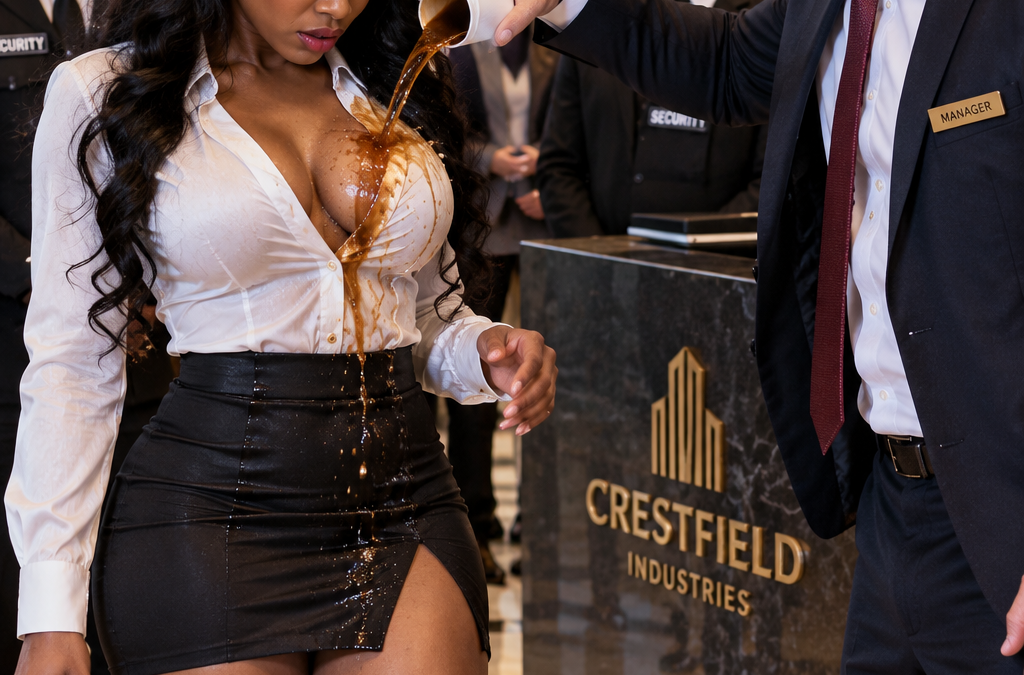
Then he moved the coffee mug.
Quickly.
Too quickly to be accidental.
The lid popped loose.
Hot coffee splashed across my chest.
My shirt darkened instantly.
Coffee ran down my ribs.
Across the portfolio.
Onto the marble.
The lobby gasped.
Patricia stood.
Glenn took half a step forward.
The young woman near the coffee cart covered her mouth.
The mailroom worker’s entire body went rigid.
Derek looked at the stain.
Then looked at me.
“Oops.”
He smiled.
“Maybe if you’d left when I told you, that wouldn’t have happened.”
I looked down.
One drop fell from the bottom of my shirt.
Then another.
Then another.
I could feel heat on my skin.
My heart was pounding.
Not from fear.
From effort.
The effort not to give him what he wanted.
I inhaled once.
Slow.
Then lifted my eyes.
“You should think again.”
Derek’s smile widened.
“About what?”
“Your next decision.”
His face twisted.
“You threatening me?”
“No.”
“I should call the cops.”
“You can.”
“That’s what happens to thugs like you.”
The lobby was completely silent.
He leaned closer.
“People like you make my skin crawl.”
Twenty people heard him.
No one moved.
I looked toward the ceiling.
There was a dark security dome in the upper corner.
I’d noticed it when I entered.
People who spend enough time around lawyers learn to notice cameras.
Then I stepped sideways.
Pulled out my phone.
Called Naomi.
She answered immediately.
“Tell me you didn’t start something.”
“I’m in the Crestfield lobby.”
Her tone changed.
“What happened?”
“Bring the full acquisition file.”
Silence.
“Byron.”
“All of it.”
I looked at Derek.
“Call Elliot. Tell him we’re moving the announcement up.”
“Are you hurt?”
“I’m fine.”
“That wasn’t my question.”
“Coffee. Nothing serious.”
Another silence.
The dangerous kind.
“I’m coming down.”
I ended the call.
Derek watched me.
He assumed I’d called someone to rescue me.
His confidence came back.
He turned to the lobby.
“All right. Show’s over.”
Nobody moved.
“Security has it handled.”
I noticed a young white employee near the water fountain.
She looked straight at me.
Then Derek.
She opened her mouth.
Closed it.
I remember thinking: there is your moment.
Say something.
Anything.
She didn’t.
Clock: 8:31.
I waited.
Derek kept talking quietly with Glenn.
Glenn barely responded.
Patricia stared at her monitor but wasn’t reading anything.
The mailroom worker hadn’t moved.
Seven minutes later, the front doors opened.
Naomi entered.
She didn’t rush.
She never rushed when she was angry.
Charcoal suit.
Hair pulled back.
Leather briefcase in hand.
Every step precise.
She walked directly toward me.
“Mr. Ingram.”
Derek heard that.
So did Patricia.
Naomi’s eyes moved to my shirt.
Her jaw tightened.
“I have everything.”
She put the briefcase on reception.
Opened it.
Removed the bound agreement.
Crestfield Industries.
Acquisition Agreement.
Final Execution Copy.
Gold logo.
Signatures.
Transfer confirmation.
She handed it to me.
Derek approached.
“Excuse me, ma’am. You need to check in.”
Naomi didn’t look at him.
“I’m Mr. Ingram’s attorney.”
“Doesn’t matter. Everyone—”
“Step aside.”
His eyes widened.
“I don’t care who you claim—”
Naomi finally looked at him.
“I said step aside.”
Derek stopped.
Then the elevator chimed.
The doors opened.
Elliot Graves stepped out.
Sixty-two.
Silver hair.
Navy suit.
White pocket square.
The outgoing CEO.
Everyone recognized him.
Quarterly meetings.
Corporate videos.
Holiday addresses.
Derek straightened immediately.
That automatic respect told me more about him than the previous twenty minutes.
Elliot crossed the lobby.
He saw me.
Then the coffee stain.
His face changed.
He extended his hand.
“Byron.”
We shook.
“I’m deeply sorry I kept you waiting.”
“Elliot.”
His eyes returned to my shirt.
“What happened?”
His voice was quiet.
Derek stepped forward.
I glanced toward him.
“Mr. Lawson welcomed me.”
Elliot turned.
“Derek.”
Derek swallowed.
“Sir.”
“Do you know who this is?”
Derek started talking too quickly.
“He had no badge. He wasn’t in the system. He wouldn’t cooperate. I was following security—”
“This is Byron Ingram.”
Elliot didn’t raise his voice.
“As of 6:45 this morning, Mr. Ingram owns Crestfield Industries.”
Nothing moved.
Derek stared.
Elliot continued.
“Every outstanding share.”
He pointed upward.
“Every floor.”
Toward reception.
“Every desk.”
Then directly at Derek.
“Every contract.”
A pause.
“Including yours.”
Patricia covered her mouth.
Glenn stepped backward.
The woman near the water fountain made a small sound.
Derek went pale.
I watched him understand.
Not what he had done.
Who he had done it to.
That distinction mattered.
His mouth opened.
Closed.
Then he looked at me.
“Mr. Ingram.”
I said nothing.
“I—sir, if I’d known—”
That was the sentence.
If I’d known.
I took one step toward him.
“Known what?”
He froze.
“That a Black man standing in your lobby could own the company?”
His eyes dropped.
“That possibility never occurred to you.”
“No. I mean—”
“I came here to meet employees.”
My voice remained calm.
“To learn how this company operates when nobody important is watching.”
I looked around the lobby.
“I got my answer.”
Nobody looked away now.
“I was interrogated.”
Derek’s shoulders dropped.
“My ID was confiscated.”
Glenn stared at the floor.
“My belongings were searched.”
Patricia blinked through tears.
“I was accused of stealing my own tablet.”
I looked back at Derek.
“I was told to crawl back into a hole.”
His lips trembled.
“And then you poured coffee on me.”
“It was an accident.”
I let silence sit between us.
“Your hand slipped?”
“Yes.”
“After everything else?”
“I swear.”
“That’s a lot of accidents.”
His face collapsed.
The confidence disappeared so completely that for a second he seemed physically smaller.
“Mr. Ingram, please.”
I turned to Naomi.
“Preserve all lobby footage.”
She already had her phone out.
“Every camera. Audio. Eight a.m. onward.”
“Done.”
“Legal hold.”
“Already drafting it.”
I looked at Elliot.
“Derek Lawson is suspended effective immediately.”
Elliot nodded.
“HR, legal, compliance.”
“Yes.”
“Pull every complaint involving him.”
“Understood.”
Derek stepped forward.
“Sir, please. I have a family.”
That sentence hit differently.
Because maybe he did.
Maybe there were people who loved him.
People who had never seen this version.
Consequences don’t become wrong because they affect innocent people around the person responsible.
They simply become sadder.
“Badge,” Elliot said.
Derek looked at him.
“Elliot.”
“Badge.”
His hand shook as he reached for the lanyard.
Three attempts before the clip released.
Then the badge landed on reception.
Plastic hitting marble.
The same object he had treated as proof of human legitimacy minutes earlier.
Elliot looked toward Glenn.
“Escort Mr. Lawson out.”
Glenn inhaled.
Then stepped beside Derek.
“This way.”
Derek walked past me.
Past Patricia.
Past the mail cart.
Past the employees who had gathered near the corridor.
His head stayed down.
The glass doors opened.
Morning sunlight washed across his face.
Then he was outside.
Doors closed.
I stood there in a coffee-soaked shirt.
The lobby remained silent.
I turned toward the employees.
“I know this isn’t how any of us expected this morning to begin.”
Nobody laughed.
“What happened here should never happen.”
I looked at Patricia.
Then Glenn.
Then the people near the elevator.
“Not to me.”
I let the sentence settle.
“Not to anyone.”
The mailroom worker met my eyes.
For the first time that morning, someone in the room looked at me without shame or fear.
Just recognition.
“This company changes today.”
Patricia came around the desk.
“Mr. Ingram.”
Her voice cracked.
“I’m sorry.”
I waited.
“I should’ve called upstairs immediately.”
“Yes.”
She flinched slightly.
“I froze.”
I nodded.
“I understand.”
She looked surprised.
Then I added, “Next time, don’t.”
Her eyes filled.
“For the next person.”
She nodded.
“I won’t.”
The lobby incident lasted less than half an hour.
Its consequences lasted months.
Within forty-eight hours, Naomi’s team began reviewing Derek Lawson’s employment history.
I expected poor judgment.
Maybe complaints about temperament.
What we found was worse.
Three prior discrimination complaints.
All buried.
The first involved a Black delivery driver.
Scheduled shipment.
Valid manifest.
Derek refused to verify it.
Called police.
Reported a suspicious individual attempting to gain unauthorized access.
The driver spent forty-five minutes handcuffed on the curb before Crestfield logistics confirmed he belonged there.
He filed a complaint.
HR marked it resolved.
No disciplinary action.
The second complaint came from Renee Castillo.
Latina.
Account executive.
Qualified for a senior promotion.
More experience than the man who got the position.
Derek sat on the selection committee.
Naomi found the email.
Six words.
Not the right cultural fit here.
I read it twice.
That phrase had probably sounded safe to him.
Corporate enough.
Deniable enough.
Renee filed a discrimination complaint.
It disappeared.
The third case was eight months old.
A young Black IT contractor worked late on the fourth floor.
Derek saw him.
Didn’t ask for identification.
Didn’t verify his access.
Called security.
Had him removed.
The contractor had a valid pass in his pocket.
His complaint received a one-paragraph response saying management had acted within its discretion.
Three incidents.
Three people of color.
Three chances for Crestfield to correct the problem.
Three failures.
I sat in my new office with those files spread across the desk.
Naomi stood by the windows.
“This wasn’t Derek,” I said.
She waited.
“Not just Derek.”
“No.”
“This company protected him.”
“Yes.”
That hurt more than I expected.
Buying a broken operation is one thing.
Buying an institution that had learned how to hide harm behind procedure is another.
“How many other complaints?”
“We’re pulling everything.”
“All years.”
“That could be hundreds.”
“Pull them.”
Naomi nodded.
“Every division?”
“Every division.”
“You’re going to make HR hate us.”
“They can hate us while complying.”
For the first time that day, she smiled.
Then the video leaked.
We didn’t release it.
Someone inside Crestfield did.
Forty-three seconds.
High definition.
My ID in Derek’s hand.
The tablet.
The coffee.
The smirk.
And the sentence.
People like you make my skin crawl.
Six million views within a day.
Then national news.
The headline that spread fastest was simple:
NEW OWNER HUMILIATED BY HIS OWN MANAGER ON DAY ONE.
I hated the headline.
Not because it was false.
Because the ownership was what made people care.
That bothered me.
If I had been a courier, would six million people care?
If I had been unemployed?
If I had been a janitor?
Would coffee on my shirt become news only because the man wearing it controlled eight hundred million dollars?
Cable panels called.
Civil rights lawyers.
Workplace culture experts.
Journalists.
I declined almost everything.
Former employees didn’t.
They started speaking.
One person.
Then another.
Then groups.
Stories about Derek.
Stories about other managers.
Stories about HR.
People who had spent years believing nobody would listen suddenly had evidence that somebody might.
Derek hired an attorney.
His statement called the incident “an unfortunate misunderstanding amplified by social media.”
He said the coffee was accidental.
Said security protocols had been followed.
Said he did not know who I was.
That final defense told me he still hadn’t learned the lesson.
He didn’t know who I was.
As if knowing would have justified treating me differently.
Naomi filed a criminal complaint regarding the coffee incident.
Video showed the motion clearly enough.
Simple assault.
Derek was arrested at home on a Tuesday.
Press cameras were waiting.
At the same time, civil action moved forward involving the three earlier victims and former HR leadership.
Eleven weeks.
Depositions.
Motions.
Arguments about context.
Derek’s attorneys said complaints had been exaggerated.
Said the footage did not show the entire interaction.
Said he had an otherwise exemplary employment record.
Three buried complaints made that last argument difficult.
The civil findings went against him.
Restitution.
Liability.
His criminal case ended with a suspended sentence, two hundred hours of community service, and eighteen months of court-ordered anti-bias training.
Crestfield terminated him with cause.
No severance.
No stock options.
No pension benefits he might otherwise have collected.
Nine years of professional accumulation disappeared.
I didn’t celebrate.
That surprised some people.
They expected satisfaction.
Maybe revenge.
But revenge would’ve been easy.
Fire Derek.
Issue a statement.
Hire a diversity consultant.
Change nothing underneath.
I wasn’t interested in that.
Punishing one man while preserving the system that protected him would have been theater.
So we tore the system apart.
Crestfield’s HR structure was dismantled.
New leadership.
Independent ombudsman.
Direct reporting authority outside normal management chains.
Anonymous whistleblower protection.
Mandatory anti-discrimination training every quarter.
Not a one-hour video employees could click through.
Live sessions.
Case reviews.
Manager accountability.
Promotion audits.
Visitor policies rewritten.
Security procedures clarified.
No discretionary search of visitors without legal basis.
No confiscation of personal ID.
No manager improvising authority because somebody “looked wrong.”
We reopened old complaints.
Every one we could locate.
Renee Castillo’s file came across my desk again.
She had stayed.
That amazed me.
Eighteen months after being passed over, she was still outperforming half the people above her.
I called her into my office.
She arrived guarded.
Reasonable.
People who have been failed by systems learn not to trust sudden invitations from powerful men.
“Sit.”
She did.
I slid the old selection committee email across the desk.
She read it.
Her face hardened.
“You found this.”
“Yes.”
“I told HR.”
“I know.”
“They told me I was being emotional.”
I felt anger rise.
“Your promotion decision is being corrected.”
Her eyes lifted.
“What?”
“Senior vice president of client operations.”
She stared.
“That’s the role.”
“The role you should’ve gotten.”
She didn’t answer immediately.
Then she said, “I don’t want pity.”
“Good.”
I leaned back.
“Neither do I.”
She almost smiled.
“I’m offering you the position because your numbers say you’re qualified.”
“What about the complaint?”
“The complaint says Crestfield was unqualified to evaluate you fairly.”
That time she did smile.
Small.
Careful.
She accepted.
The reforms spread beyond us.
Competitors launched their own reviews after seeing the footage.
Two hired outside auditors.
Industry associations began talking about lobby security, visitor discrimination, HR independence.
That fall, I was invited to speak at the National Business Leadership Conference.
The subject was corporate accountability.
I accepted reluctantly.
Naomi asked why.
“Because they’ll listen now.”
“They should’ve listened before.”
“Yes.”
I looked at the invitation.
“But now is what we have.”
Onstage, I didn’t talk much about Derek.
I talked about architecture.
Not buildings.
Systems.
“Bad behavior survives where systems make it inexpensive,” I told them.
“If an employee knows complaints disappear, misconduct becomes cheap.”
The room was quiet.
“If managers learn that performance protects them from consequences, bias becomes an operating expense somebody else pays.”
I looked across hundreds of executives.
“Accountability is not a statement after a scandal.”
“It’s the structure you build before one.”
Six months after the acquisition, I walked into Crestfield’s lobby again on a Tuesday morning.
Same hour.
Different building.
The marble remained.
I didn’t believe stone was guilty.
But everything around it had changed.
Local artwork lined the walls.
Photography.
Paintings.
Mixed media.
Many from artists who had never imagined their work hanging inside a corporate headquarters.
Warm lighting replaced some of the harsh fluorescents.
A living plant wall stretched behind reception.
The space no longer felt like a checkpoint designed to determine who deserved entry.
It felt like a front door.
Patricia looked up.
“Morning, Mr. Ingram.”
Her smile was real now.
“Morning, Patricia.”
Employees greeted me.
Not perfectly.
I didn’t want reverence.
I wanted normal.
Near the service corridor, I saw a familiar face.
The mailroom worker from that first morning.
Except he wasn’t pushing a cart.
He sat beside a workstation.
Operations Coordinator.
Terrence Moore.
I had learned his name during the investigation.
Learned he’d submitted three process improvement proposals over two years.
None had been reviewed.
I recommended him for promotion.
Not because he had watched Derek abuse me.
Because his work justified it.
I stopped at his desk.
“How’s the new role?”
Terrence stood.
We shook hands.
He smiled.
“Feels like I finally belong somewhere, sir.”
That sentence stopped me.
I looked at him.
“You always did.”
His expression changed.
Just slightly.
But I knew he understood.
I took the elevator upstairs.
My office sat on the top floor.
Floor-to-ceiling glass.
City skyline.
Clean desk.
My mother’s picture beside my coffee cup.
There was one other object in the room nobody saw.
Bottom drawer.
Inside a clear garment bag.
The Henley.
Still stained.
Unwashed.
Coffee dark across the chest.
Naomi hated that I kept it.
“You have security footage.”
“I know.”
“You have court records.”
“I know.”
“You have the world’s most documented traumatic shirt.”
“Exactly.”
“That’s disgusting.”
“Probably.”
I didn’t keep it as a trophy.
I didn’t enjoy looking at it.
Most days I forgot it was there.
But occasionally, after a board meeting or a promotion discussion or a complaint review, I’d open the drawer.
The shirt reminded me of something numbers couldn’t.
At 8:15 that morning, Derek Lawson believed I was nobody.
That’s when I met the real Derek.
Not the manager Elliot knew.
Not the employee HR files described as experienced.
Not the professional man in company photographs.
The version without anticipated consequences.
That was the version that mattered.
Derek completed his community service at a workforce nonprofit.
He finished the required training.
Settlements were reached with the three earlier victims.
He applied to eleven companies during the next eighteen months.
Nobody hired him.
Eventually, he found work as a mid-level logistics coordinator for a regional shipping company two states away.
No management role.
No direct reports.
I didn’t track him.
The information reached us through legal closure documents.
People occasionally asked whether I felt sorry for him.
I never knew how to answer that cleanly.
I didn’t hate him.
Hate would have required keeping him emotionally important.
He wasn’t.
But consequences aren’t cruelty simply because the person experiencing them dislikes them.
Derek built his own.
One morning, almost a year later, I was in my office early.
Same hour I had signed the acquisition.
5:30 sunrise turning into 6:45 gold.
I opened the bottom drawer.
Looked at the shirt.
Then at my mother’s photograph.
She had owned a barbershop for thirty-one years.
I remembered sitting behind the counter as a child.
Watching men come in.
Doctors.
Bus drivers.
Lawyers.
Mechanics.
Unemployed men.
Men wearing expensive coats.
Men counting quarters.
My mother greeted them the same.
“Morning, baby.”
Same tone.
Same chair.
Same towel around the shoulders.
Once, when I was maybe twelve, I asked her why she called everybody sir when some of them clearly weren’t important.
She stopped sweeping.
Looked at me.
“Important to who?”
I shrugged.
She pointed the broom handle at my chest.
“Don’t ever make somebody earn basic respect from you.”
I had forgotten that conversation for years.
Crestfield brought it back.
The world told the story as a surprise.
Racist manager humiliates casually dressed Black man.
Shock reveal.
Black man owns company.
Manager destroyed.
I understood why people liked that version.
It was satisfying.
The villain judged the wrong person.
Instant reversal.
Power changed hands.
But the longer I lived with the incident, the less interested I became in that part.
Derek’s biggest mistake was not failing to recognize an owner.
It was believing respect should depend on whether I was one.
If I had been a courier, he would still have been wrong.
If I had been unemployed, he would still have been wrong.
If my tablet had cost fifty dollars instead of twelve hundred, accusing me of stealing it without evidence would still have been wrong.
If I had walked into Crestfield looking for a janitorial job, pouring coffee on me would still have been assault.
Ownership exposed Derek.
It did not create my dignity.
That had been mine before I walked through the doors.
And that became the standard I wanted Crestfield to understand.
Not treat everyone politely because the stranger in jeans might secretly be powerful.
Treat everyone with dignity because they are standing in front of you.
You shouldn’t need a surprise.
You shouldn’t need a title.
You shouldn’t need a billionaire behind the Henley.
Months later, I walked through the lobby one afternoon while a delivery driver was checking in.
Black man.
Work uniform.
Large cart.
Patricia smiled.
“Good afternoon. Company?”
He answered.
She checked the manifest.
“Got you right here. Elevator access is on the left. Do you need somebody to help with the doors?”
“No, ma’am. I’m good.”
“All right. Have a good one.”
Nothing dramatic.
No one applauded.
No cameras.
No viral video.
He rolled his cart inside.
I stood twenty feet away.
Patricia didn’t know I was watching.
That was the moment I knew something had actually changed.
Not when Derek was escorted out.
Not when the lawsuit settled.
Not when a conference applauded a speech.
Change is what people do when they don’t know anyone important is looking.
I took the elevator upstairs.
Terrence joined me on the fourth floor.
“Mr. Ingram.”
“Terrence.”
He pressed seven.
For a few seconds we rode quietly.
Then he said, “Can I tell you something?”
“Sure.”
“That first morning.”
I looked over.
“I wanted to say something.”
“I know.”
His eyes lowered.
“I didn’t.”
“I know that too.”
“I’ve thought about it every day.”
The elevator climbed.
“I had two kids. My wife was between jobs. Derek had already threatened me once.”
“You don’t owe me an explanation.”
“Maybe not.”
He looked at me.
“But I owe myself one.”
I waited.
“I was scared.”
There it was.
No excuses.
Just truth.
“I hated myself for being scared.”
“Don’t.”
He frowned.
“Sir?”
“Courage looks obvious after the danger passes.”
The elevator chimed.
“That doesn’t make it simple while you’re inside it.”
The doors opened.
Terrence stayed where he was.
“So you don’t think I failed?”
I thought before answering.
“I think you learned what your silence cost you.”
He nodded.
“What you do with that next time matters more.”
Terrence stepped out.
Three months later, someone filed a complaint against a regional director for making discriminatory remarks during a team meeting.
Terrence was one of the witnesses.
He reported it the same afternoon.
Signed his name.
Didn’t use the anonymous option.
I heard about it only after compliance opened the investigation.
I never mentioned our elevator conversation.
I didn’t need to.
Patricia changed too.
So did Glenn.
Glenn received a formal reprimand for participating in the unlawful search of my portfolio.
He wasn’t fired.
Some board members wanted him gone.
I didn’t.
Not immediately.
His record showed no prior incidents.
He admitted exactly what happened.
No defensive language.
No excuse about protocol.
He said he knew Derek was wrong and obeyed anyway because he feared losing his job.
We placed him on probation.
Required retraining.
He completed it.
Six months later, he intervened when another manager demanded security remove a visitor without cause.
This time Glenn refused.
That mattered.
Accountability should allow transformation where transformation is real.
Otherwise all you’re doing is sorting people into permanent categories.
Good.
Bad.
Useful.
Disposable.
That’s exactly the kind of thinking that created Derek.
Crestfield returned to profitability during the second year after the acquisition.
That made business headlines.
Operational consolidation.
Modernized logistics systems.
Reduced overhead.
Improved client retention.
Those things mattered.
Twelve hundred jobs mattered.
But the number that meant the most to me never appeared in a financial report.
Internal discrimination complaints increased during our first year.
Some investors saw that statistic and became nervous.
I didn’t.
It meant people finally believed reporting might accomplish something.
By year two, substantiated complaints fell.
Not because people stopped speaking.
Because managers started understanding that behavior had consequences.
Renee became one of our strongest executives.
Terrence continued climbing.
Patricia eventually moved into employee experience and visitor operations, where she helped rewrite the very policies she’d once been afraid to challenge.
Naomi remained Naomi.
Whenever anyone praised our cultural reforms too enthusiastically, she reminded us we had purchased a company that had ignored three discrimination complaints and almost let a fourth become a police incident.
“Don’t congratulate yourself for cleaning a room you bought dirty,” she told me once.
I wrote that down.
She found out.
Threatened to bill me for intellectual property.
Years later, people still occasionally recognized me from the video.
Airports.
Restaurants.
Conferences.
“You’re the coffee guy.”
That always made me laugh.
There are worse legacies.
But whenever somebody asked what I remembered most from that morning, they expected me to say Derek’s face when Elliot revealed the acquisition.
I didn’t.
I remembered the seconds before.
The lobby.
Twenty people.
The silence.
The young woman near the water fountain opening her mouth and closing it.
The executive walking away.
Terrence gripping his cart.
Patricia’s hand hovering over the phone.
Glenn obeying an order he knew was wrong.
Those moments mattered more.
Derek was easy to identify.
He was loud.
Cruel.
Obvious.
The harder question lived in everyone around him.
What do you do when speaking has a cost?
I had power that morning even when Derek couldn’t see it.
Most people in that lobby did not.
That’s why I became less interested in asking why they hadn’t rescued me and more interested in building a company where rescuing someone wouldn’t threaten their livelihood.
Systems don’t remove personal responsibility.
They shape the price of using it.
That was the lesson Crestfield needed.
One evening, long after the offices had emptied, I stood alone in the lobby.
The plant wall lights had dimmed.
City reflections stretched across the glass.
No reception crowd.
No turnstile lines.
No coffee cart.
I walked to the exact spot where Derek had poured coffee on me.
There was no mark.
Marble cleans easily.
I looked up at the camera.
Same corner.
New system.
Better retention.
Independent access.
Then I looked toward the front doors.
I remembered my mother’s barbershop.
Her broom.
Her voice.
Don’t ever make somebody earn basic respect from you.
I had built an entire career around making smart investments.
Companies.
People.
Systems.
Capital.
That morning at Crestfield taught me something finance never could.
The most expensive failures often begin with somebody deciding another human being isn’t worth two minutes of ordinary decency.
Derek thought he was protecting a building.
Instead, he exposed one.
And when I finally walked out through those glass doors that night, the city was dark outside, reflected back at me in the lobby windows.
I could see my own face.
Same man who had entered in jeans.
Same skin.
Same Henley underneath a replacement jacket Naomi had forced me to accept.
Same person Derek had decided did not belong.
The only thing that had changed was that everyone else knew my name.
I pushed open the door.
Then stopped.
Turned back once.
Patricia was finishing paperwork at reception.
Terrence crossed the far corridor.
A cleaning woman emptied a trash bin beside the elevators.
She looked up.
“Good night, Mr. Ingram.”
“Good night.”
She returned to her work.
No hesitation.
No surprise that I answered.
I stepped outside.
I didn’t keep Derek’s badge.
Didn’t keep court documents on display.
Didn’t frame the acquisition agreement.
The only thing I kept was the stained shirt.
Not because I wanted to remember Derek.
Because I never wanted power to make me forget Byron Ingram at 8:15 on a Tuesday morning, standing quietly in a marble lobby while a stranger decided what kind of respect he deserved.
Whenever I opened that drawer, I remembered him.
And I made sure the company did too.
𝗧𝗛𝗘 𝗘𝗡𝗗
The Manager Poured Coffee Down My Shirt and Ordered Security to Drag Me Out Before Anyone Asked Why I Was There
The coffee hit my chest hot enough to make my skin tighten beneath the fabric, but I didn’t move because by then Derek Lawson had already taken my ID, searched my belongings, accused me of theft, and decided humiliation was the safest way to prove I didn’t belong in his lobby. Twenty people watched him smile at the stain spreading down my shirt, and none of them knew that sixty minutes earlier I had signed the papers that gave me ownership of the entire building beneath our feet.
Three hours earlier, I woke at 5:30 without an alarm.
My body had been doing that for almost twenty years.
I sat up, planted my feet on the hardwood floor, and watched the city slowly change color beyond the windows of my penthouse. Pink first, then pale gold, then the hard silver-blue that comes just before the traffic begins.
My home was quiet.
No staff moving through hallways.
No chef in the kitchen.
No assistant standing outside the bedroom with an itinerary.
People tended to imagine wealth as noise.
Drivers.
Housekeepers.
Phones.
Doors opening.
People waiting to be told what to do.
I had spent enough years without money to value quiet more than display.
The only photograph on my nightstand was my mother.
She was standing outside the barbershop she had run for thirty-one years, smiling into sunlight with one hand on her hip and the other holding a broom.
That picture had followed me through every apartment, office, boardroom, and house I’d ever occupied.
It reminded me where my definition of success came from.
Not money.
Not titles.
Ownership of my own time.
The ability to choose.
I showered, dressed in jeans and a dark gray Henley, and went to the kitchen.
No suit.
No tie.
That was intentional.
I ground coffee beans myself and poured the coffee into a plain white mug while my tablet loaded financial news.
The Wall Street Journal.
Market reports.
Three overnight emails from my executive team.
Then the document I had been waiting six months to see.
Crestfield Industries Acquisition Agreement.
Final Execution Copy.
I opened it.
Read the signature pages again.
Even though my lawyers had reviewed every word.
Even though Naomi had called me at 11:40 the night before and told me there was nothing left except execution and transfer.
I still read it.
Crestfield mattered.
Not because it was glamorous.
On paper, it looked respectable enough.
Logistics.
Commercial real estate.
About twelve hundred employees across three states.
A downtown headquarters with enough marble and polished glass to make executives feel prosperous even while the balance sheet bled.
But Crestfield had been losing money for two years.
Operations were outdated.
Costs were bloated.
Several divisions duplicated work.
Middle management had hardened into little kingdoms where people protected titles instead of solving problems.
The board understood what was happening before most employees did.
If no buyer came, layoffs would.
They started searching quietly.
Then they found me.
Apex Venture Capital wasn’t the largest firm in the country, but we managed more than eight hundred million dollars in assets, and we had a reputation for buying companies that still had good bones underneath bad leadership.
I hadn’t inherited Apex.
I hadn’t inherited anything except my mother’s work ethic and a stubborn belief that being underestimated could be useful if I didn’t let it become personal.
I had gone to a state university on scholarship.
My first finance job was answering phones at a brokerage house where I was the only Black employee on my floor.
I applied for an analyst position there after eighteen months.
They rejected me.
Years later, I bought the company.
Not out of revenge.
By then the people who rejected me were long gone.
I bought it because the numbers worked.
That distinction mattered to me.
At 6:45 a.m., I signed Crestfield’s final papers.
The transfer confirmation followed.
Every outstanding share.
Every office.
Every contract.
Every warehouse interest.
Every desk.
Every piece of equipment.
Done.
I sat there with my coffee and looked at the confirmation.
Eight hundred million dollars of experience should have made moments like that feel routine.
They never did.
I thought about the people who worked there.
Twelve hundred lives connected to decisions people like me made inside conference rooms.
Mortgage payments.
College tuition.
Insulin.
Child support.
Parents in nursing homes.
Car loans.
Companies were columns in spreadsheets only until you remembered the people inside them.
I closed the tablet.
Most buyers would have arrived with lawyers.
Corporate communications.
Security.
Photographers.
An introductory town hall.
A polished speech about synergy and shared values.
I didn’t want any of that yet.
I wanted to see Crestfield on a normal Tuesday morning before anyone had time to pretend.
That’s where organizations tell the truth.
Not during leadership retreats.
Not inside company values decks.
Not after managers have been warned the new owner is coming.
I wanted to see how receptionists spoke to delivery people.
How security treated visitors.
Whether executives looked employees in the eye.
Whether people held elevator doors.
Whether managers were polite only when they recognized someone important.
So I texted Naomi.
Going in alone. Keep announcement paused.
She answered almost immediately.
I hate this already.
I smiled.
That was Naomi Watts Davis.
Chief legal counsel.
My right hand.
One of the few people in my life who could disagree with me without spending ten minutes cushioning the disagreement.
Just observing, I wrote.
Her response came seconds later.
That is what you said before Cleveland.
I ignored that.
At 8:15, I drove into Crestfield’s parking garage.
No driver.
No company SUV.
I took the elevator down and entered the main lobby.
It was exactly what corporate headquarters are designed to be.
Polished marble.
Brushed-metal logo.
Glass walls.
Turnstiles.
High ceilings.
Reception desk wide enough to make the person behind it look small.
Employees streamed through the entrance with lanyards swinging from their necks.
Coffee in hand.
Phones against ears.
Morning conversations bouncing off stone.
I stood there for maybe five seconds.
Watching.
Listening.
No one noticed me at first.
That interested me.
Then I approached reception.
The woman behind the desk looked up.
Late forties.
Reading glasses.
Polished nails.
Her badge said Patricia Coleman.
“Good morning.”
“Morning.”
Her smile was professional.
Then her eyes made a quick trip over me.
Shirt.
Jeans.
Sneakers.
Face.
The smile remained.
Something behind it tightened.
“How can I help you?”
“I’m here to see Elliot Graves.”
She typed.
“Do you have an appointment?”
“He’s expecting me.”
“Your name?”
“Byron Ingram.”
She typed again.
Scrolled.
Frowned.
The appointment existed, but under a confidential acquisition code she didn’t have clearance to access.
Of course I knew that.
She didn’t.
“I’m not seeing anything under that name.”
“That’s all right.”
“Could you spell your last name?”
“I-N-G-R-A-M.”
She typed again.
Nothing.
Patricia looked genuinely uncomfortable now.
“I’m sorry, sir. Let me check with Mr. Graves’s office.”
“Of course.”
“Would you mind waiting?”
“Take your time.”
I stepped aside.
No irritation.
No urgency.
Elliot knew I was coming.
I was early.
I stood near the windows with my leather portfolio tucked under my arm.
That was when the elevator doors opened.
Derek Lawson stepped out.
I noticed him before he noticed me because he was impossible not to notice.
Phone pressed to one ear.
Coffee mug in his opposite hand.
Voice loud enough that everyone within twenty feet knew he was discussing a deadline.
Some managers broadcast busyness because they confuse being overheard with being important.
Derek was that type.
He ended his call mid-sentence.
His eyes had found me.
I saw the judgment happen.
Not gradually.
Instantly.
A Black man.
Casual clothes.
No badge.
Standing still in a corporate lobby.
His shoulders squared.
His mouth tightened.
He walked toward me.
Not Patricia.
Me.
“Who let you in here?”
No introduction.
No good morning.
No question to reception.
Just accusation.
I turned.
“Good morning.”
“I asked who let you in.”
“I’m waiting for Mr. Graves.”
He looked me over slowly.
Deliberately.
Like he wanted me to understand the inspection.
Shoes.
Jeans.
Shirt.
Face.
Then he said, “Mr. Graves doesn’t meet with people like you.”
Two employees near the turnstiles stopped talking.
Patricia stopped typing.
The lobby didn’t go silent.
Not yet.
But the volume dropped.
I looked at Derek.
“What kind of people would that be?”
He ignored the question.
“Do you have a badge?”
“No.”
“Appointment?”
“The receptionist is confirming it.”
He turned toward Patricia.
“Pat?”
She looked trapped.
“He says he has an appointment. I couldn’t locate it, so I was about to call upstairs.”
“Don’t.”
She blinked.
“Excuse me?”
“If it’s not in the system, it’s not an appointment.”
I spoke before Patricia could answer.
“The system hasn’t finished checking.”
Derek turned slowly.
His expression changed.
Men like Derek are often comfortable with fear.
Calm bothers them more.
Calm forces them to escalate if they want control.
“Let me make something clear.”
He stepped toward me.
“I’ve worked in this building nine years.”
“Congratulations.”
His eyes narrowed.
“I know every face that belongs here.”
There it was again.
Belongs.
“And yours doesn’t.”
He pointed toward the entrance.
“Door’s there.”
I stayed where I was.
“I’ll wait for Patricia to confirm my meeting.”
The vein at Derek’s temple moved.
“Did you hear what I said?”
“Clearly.”
“Then leave.”
“I have business here.”
His lips curled slightly.
“No, you think you have business here.”
That distinction seemed to satisfy him.
He turned to Patricia.
“Don’t call upstairs.”
“Derek—”
“I’ve got it.”
He faced me again.
“Identification.”
I paused.
“What?”
“ID. Right now.”
He raised his voice when he repeated it.
Not because he needed to.
Because he wanted witnesses.
I understood the performance.
He wasn’t protecting Crestfield.
He was demonstrating authority.
I could have ended it immediately.
I could have given Patricia Naomi’s number.
I could have called Elliot.
I could have said, I signed your company purchase agreement ninety minutes ago.
Instead, I reached into my pocket.
Why?
Because I wanted to know how far Derek would go when he believed I had no power.
I handed him my driver’s license.
He snatched it.
Actually snatched it.
Held it beneath the lobby light.
Tilted it.
Checked my face.
Checked the photo.
Checked my face again.
“Byron Ingram.”
He said my name loudly.
Then didn’t return the license.
“I’m going to hold this.”
“No.”
He looked at me.
“No?”
“That’s my property.”
“This is my building.”
That sentence almost made me smile.
Almost.
“You want it back? Security can give it to you when you leave.”
Now people were watching openly.
A woman beside the elevator held a cup halfway to her lips.
Two younger employees whispered.
An older executive in a pinstripe suit saw what was happening, lowered his eyes, and walked past.
That image stayed with me later.
Because silence has different shapes.
Some people freeze.
Some look away.
Some decide whatever is happening isn’t worth risking their comfort.
Derek whistled.
Actually whistled.
“Glenn.”
A security officer near the far wall came over.
Glenn Tucker.
Mid-forties.
Stocky.
Buzz cut.
The moment he arrived, I knew he understood the situation better than Derek did.
His eyes moved from me to Patricia to Derek.
He saw I wasn’t threatening anyone.
He saw my hands.
My posture.
My distance from the desk.
“What happened?”
Derek jerked his thumb toward me.
“Unauthorized visitor.”
“I’m not unauthorized.”
Derek talked over me.
“No appointment. No badge. Won’t leave.”
Patricia started to speak.
Then stopped.
“Keep an eye on him,” Derek told Glenn.
Glenn hesitated.
“All right.”
He moved behind me.
Two feet.
Close enough that I could feel him.
I had experienced that feeling before.
Being converted from person to threat without doing anything threatening.
Different building.
Same choreography.
Derek folded his arms.
“Who sent you?”
“No one.”
“Courier?”
“No.”
“Delivery?”
“No.”
“Then what are you?”
The question wasn’t asking my profession.
It was asking what category he should put me in.
“I have a meeting with Elliot Graves.”
Derek laughed.
Sharp.
Ugly.
“Elliot Graves is CEO of a four-hundred-million-dollar company.”
“I know who he is.”
“He doesn’t sit down with guys who walk in looking like they’re here to unclog a toilet.”
Something shifted behind me.
Glenn.
A small change in breath.
Near the coffee cart, a young Black woman set down her cup.
Across the lobby, a Black mailroom employee gripped his cart.
I noticed both.
Neither spoke.
I couldn’t blame them yet.
Employees understand power structures better than anyone.
Derek was management.
They were not.
Patricia put her hand on the phone.
Derek saw it.
“Don’t.”
She froze.
“I said I’ve handled it.”
Then he came closer.
Close enough that our chests were nearly touching.
“I don’t know what hustle you’re running.”
“No hustle.”
“Maybe you’re casing offices.”
“I’m standing in front of your receptionist.”
“Maybe you’re waiting for somebody to leave a laptop unattended.”
I stared at him.
“Or maybe you’re just lost.”
“I’m not.”
He pointed at the doors.
“Then let me explain it in a way you understand.”
His voice slowed.
“You don’t belong here.”
The lobby was quiet now.
“Not in this lobby.”
He stepped closer.
“Not on this floor.”
Another inch.
“Not anywhere in this building.”
I could smell his coffee.
“Take your folder, turn around, and crawl back to whatever hole you came from before I have Glenn put you in cuffs and drag you out.”
I held his eyes.
My anger was there.
Of course it was.
I had spent twenty years learning what to do with anger.
Poorly handled, it gives someone like Derek the story he wants.
See?
Aggressive.
Unstable.
Threatening.
I refused to hand him the ending.
The clock behind Patricia said 8:24.
Nine minutes.
That was all Derek had needed.
He could have stopped.
He didn’t.
My refusal to be intimidated was making him angrier.
He pointed at my portfolio.
“What’s in that?”
“Personal belongings.”
“Open it.”
“No.”
The word changed the room.
Glenn shifted behind me.
Derek’s nostrils flared.
“What did you say?”
“No.”
“We’ve had thefts.”
“That has nothing to do with me.”
“Company laptops. Supplies. Equipment.”
“I haven’t been past reception.”
“Open the bag.”
“You have no right to search it.”
His expression hardened.
“I have every right to protect company property.”
“It’s not yours.”
That hit him.
I watched it happen.
Not because he understood what I meant.
Because he heard disrespect.
He snapped his fingers at Glenn.
“Standard protocol. Search it.”
Glenn didn’t move.
“Derek—”
“Search the bag.”
Glenn swallowed.
Then looked at me.
“Sir.”
His voice was apologetic.
“Would you mind opening it?”
I studied him.
He knew.
That mattered.
Cowardice doesn’t always look like cruelty.
Sometimes it looks like a decent person doing something wrong because the wrong person signs his paycheck.
I unzipped the portfolio.
Held it open.
Tablet.
Pen.
Leather notebook.
Nothing else.
Glenn looked inside.
“It’s clean.”
Derek immediately reached past him.
He grabbed the tablet.
My patience thinned.
“Put that down.”
He turned it over.
Examined it.
“This is what? Twelve hundred dollars?”
“Approximately.”
“Where’d you get it?”
The accusation was naked now.
“I bought it.”
“Sure.”
“Put it back.”
“How do I know you didn’t take it upstairs?”
“Because I haven’t been upstairs.”
He looked at me.
“Because Patricia has watched me the entire time.”
I pointed slightly toward Glenn.
“So has he.”
Then around the lobby.
“So have all of them.”
No one moved.
“You know I didn’t steal anything.”
Derek’s grip tightened on the tablet.
“You just don’t care.”
For one second I thought he might throw it.
Instead he dropped it into my portfolio.
“Don’t get smart with me, boy.”
There are words that change temperature depending on who says them and why.
Boy was one of them.
The young Black woman near the coffee cart closed her eyes.
The mailroom worker looked down.
My mother had told me once when I was fourteen that not every insult deserved a response.
“Some people throw mud because they want proof you’re willing to stand in it with them,” she’d said.
I zipped the portfolio.
Derek turned to the lobby.
“Folks, sorry about the disruption.”
His tone changed completely.
Corporate.
Controlled.
“We’re dealing with an unauthorized individual who refuses to cooperate with security.”
Unauthorized individual.
I watched employees accept the phrase because it offered them an easier story than what they were witnessing.
Derek turned back.
Now he moved chest to chest.
“I’ve been patient.”
I almost laughed.
“You call this patience?”
“I call it courtesy.”
His voice dropped.
“Where I come from, when a man tells you to leave, you leave.”
“And where do you think I come from?”
He smiled.
The ugliest smile I’d seen that morning.
“Somewhere without a dress code.”
Then he moved the coffee mug.
Quickly.
Too quickly to be accidental.
The lid popped loose.
Hot coffee splashed across my chest.
My shirt darkened instantly.
Coffee ran down my ribs.
Across the portfolio.
Onto the marble.
The lobby gasped.
Patricia stood.
Glenn took half a step forward.
The young woman near the coffee cart covered her mouth.
The mailroom worker’s entire body went rigid.
Derek looked at the stain.
Then looked at me.
“Oops.”
He smiled.
“Maybe if you’d left when I told you, that wouldn’t have happened.”
I looked down.
One drop fell from the bottom of my shirt.
Then another.
Then another.
I could feel heat on my skin.
My heart was pounding.
Not from fear.
From effort.
The effort not to give him what he wanted.
I inhaled once.
Slow.
Then lifted my eyes.
“You should think again.”
Derek’s smile widened.
“About what?”
“Your next decision.”
His face twisted.
“You threatening me?”
“No.”
“I should call the cops.”
“You can.”
“That’s what happens to thugs like you.”
The lobby was completely silent.
He leaned closer.
“People like you make my skin crawl.”
Twenty people heard him.
No one moved.
I looked toward the ceiling.
There was a dark security dome in the upper corner.
I’d noticed it when I entered.
People who spend enough time around lawyers learn to notice cameras.
Then I stepped sideways.
Pulled out my phone.
Called Naomi.
She answered immediately.
“Tell me you didn’t start something.”
“I’m in the Crestfield lobby.”
Her tone changed.
“What happened?”
“Bring the full acquisition file.”
Silence.
“Byron.”
“All of it.”
I looked at Derek.
“Call Elliot. Tell him we’re moving the announcement up.”
“Are you hurt?”
“I’m fine.”
“That wasn’t my question.”
“Coffee. Nothing serious.”
Another silence.
The dangerous kind.
“I’m coming down.”
I ended the call.
Derek watched me.
He assumed I’d called someone to rescue me.
His confidence came back.
He turned to the lobby.
“All right. Show’s over.”
Nobody moved.
“Security has it handled.”
I noticed a young white employee near the water fountain.
She looked straight at me.
Then Derek.
She opened her mouth.
Closed it.
I remember thinking: there is your moment.
Say something.
Anything.
She didn’t.
Clock: 8:31.
I waited.
Derek kept talking quietly with Glenn.
Glenn barely responded.
Patricia stared at her monitor but wasn’t reading anything.
The mailroom worker hadn’t moved.
Seven minutes later, the front doors opened.
Naomi entered.
She didn’t rush.
She never rushed when she was angry.
Charcoal suit.
Hair pulled back.
Leather briefcase in hand.
Every step precise.
She walked directly toward me.
“Mr. Ingram.”
Derek heard that.
So did Patricia.
Naomi’s eyes moved to my shirt.
Her jaw tightened.
“I have everything.”
She put the briefcase on reception.
Opened it.
Removed the bound agreement.
Crestfield Industries.
Acquisition Agreement.
Final Execution Copy.
Gold logo.
Signatures.
Transfer confirmation.
She handed it to me.
Derek approached.
“Excuse me, ma’am. You need to check in.”
Naomi didn’t look at him.
“I’m Mr. Ingram’s attorney.”
“Doesn’t matter. Everyone—”
“Step aside.”
His eyes widened.
“I don’t care who you claim—”
Naomi finally looked at him.
“I said step aside.”
Derek stopped.
Then the elevator chimed.
The doors opened.
Elliot Graves stepped out.
Sixty-two.
Silver hair.
Navy suit.
White pocket square.
The outgoing CEO.
Everyone recognized him.
Quarterly meetings.
Corporate videos.
Holiday addresses.
Derek straightened immediately.
That automatic respect told me more about him than the previous twenty minutes.
Elliot crossed the lobby.
He saw me.
Then the coffee stain.
His face changed.
He extended his hand.
“Byron.”
We shook.
“I’m deeply sorry I kept you waiting.”
“Elliot.”
His eyes returned to my shirt.
“What happened?”
His voice was quiet.
Derek stepped forward.
I glanced toward him.
“Mr. Lawson welcomed me.”
Elliot turned.
“Derek.”
Derek swallowed.
“Sir.”
“Do you know who this is?”
Derek started talking too quickly.
“He had no badge. He wasn’t in the system. He wouldn’t cooperate. I was following security—”
“This is Byron Ingram.”
Elliot didn’t raise his voice.
“As of 6:45 this morning, Mr. Ingram owns Crestfield Industries.”
Nothing moved.
Derek stared.
Elliot continued.
“Every outstanding share.”
He pointed upward.
“Every floor.”
Toward reception.
“Every desk.”
Then directly at Derek.
“Every contract.”
A pause.
“Including yours.”
Patricia covered her mouth.
Glenn stepped backward.
The woman near the water fountain made a small sound.
Derek went pale.
I watched him understand.
Not what he had done.
Who he had done it to.
That distinction mattered.
His mouth opened.
Closed.
Then he looked at me.
“Mr. Ingram.”
I said nothing.
“I—sir, if I’d known—”
That was the sentence.
If I’d known.
I took one step toward him.
“Known what?”
He froze.
“That a Black man standing in your lobby could own the company?”
His eyes dropped.
“That possibility never occurred to you.”
“No. I mean—”
“I came here to meet employees.”
My voice remained calm.
“To learn how this company operates when nobody important is watching.”
I looked around the lobby.
“I got my answer.”
Nobody looked away now.
“I was interrogated.”
Derek’s shoulders dropped.
“My ID was confiscated.”
Glenn stared at the floor.
“My belongings were searched.”
Patricia blinked through tears.
“I was accused of stealing my own tablet.”
I looked back at Derek.
“I was told to crawl back into a hole.”
His lips trembled.
“And then you poured coffee on me.”
“It was an accident.”
I let silence sit between us.
“Your hand slipped?”
“Yes.”
“After everything else?”
“I swear.”
“That’s a lot of accidents.”
His face collapsed.
The confidence disappeared so completely that for a second he seemed physically smaller.
“Mr. Ingram, please.”
I turned to Naomi.
“Preserve all lobby footage.”
She already had her phone out.
“Every camera. Audio. Eight a.m. onward.”
“Done.”
“Legal hold.”
“Already drafting it.”
I looked at Elliot.
“Derek Lawson is suspended effective immediately.”
Elliot nodded.
“HR, legal, compliance.”
“Yes.”
“Pull every complaint involving him.”
“Understood.”
Derek stepped forward.
“Sir, please. I have a family.”
That sentence hit differently.
Because maybe he did.
Maybe there were people who loved him.
People who had never seen this version.
Consequences don’t become wrong because they affect innocent people around the person responsible.
They simply become sadder.
“Badge,” Elliot said.
Derek looked at him.
“Elliot.”
“Badge.”
His hand shook as he reached for the lanyard.
Three attempts before the clip released.
Then the badge landed on reception.
Plastic hitting marble.
The same object he had treated as proof of human legitimacy minutes earlier.
Elliot looked toward Glenn.
“Escort Mr. Lawson out.”
Glenn inhaled.
Then stepped beside Derek.
“This way.”
Derek walked past me.
Past Patricia.
Past the mail cart.
Past the employees who had gathered near the corridor.
His head stayed down.
The glass doors opened.
Morning sunlight washed across his face.
Then he was outside.
Doors closed.
I stood there in a coffee-soaked shirt.
The lobby remained silent.
I turned toward the employees.
“I know this isn’t how any of us expected this morning to begin.”
Nobody laughed.
“What happened here should never happen.”
I looked at Patricia.
Then Glenn.
Then the people near the elevator.
“Not to me.”
I let the sentence settle.
“Not to anyone.”
The mailroom worker met my eyes.
For the first time that morning, someone in the room looked at me without shame or fear.
Just recognition.
“This company changes today.”
Patricia came around the desk.
“Mr. Ingram.”
Her voice cracked.
“I’m sorry.”
I waited.
“I should’ve called upstairs immediately.”
“Yes.”
She flinched slightly.
“I froze.”
I nodded.
“I understand.”
She looked surprised.
Then I added, “Next time, don’t.”
Her eyes filled.
“For the next person.”
She nodded.
“I won’t.”
The lobby incident lasted less than half an hour.
Its consequences lasted months.
Within forty-eight hours, Naomi’s team began reviewing Derek Lawson’s employment history.
I expected poor judgment.
Maybe complaints about temperament.
What we found was worse.
Three prior discrimination complaints.
All buried.
The first involved a Black delivery driver.
Scheduled shipment.
Valid manifest.
Derek refused to verify it.
Called police.
Reported a suspicious individual attempting to gain unauthorized access.
The driver spent forty-five minutes handcuffed on the curb before Crestfield logistics confirmed he belonged there.
He filed a complaint.
HR marked it resolved.
No disciplinary action.
The second complaint came from Renee Castillo.
Latina.
Account executive.
Qualified for a senior promotion.
More experience than the man who got the position.
Derek sat on the selection committee.
Naomi found the email.
Six words.
Not the right cultural fit here.
I read it twice.
That phrase had probably sounded safe to him.
Corporate enough.
Deniable enough.
Renee filed a discrimination complaint.
It disappeared.
The third case was eight months old.
A young Black IT contractor worked late on the fourth floor.
Derek saw him.
Didn’t ask for identification.
Didn’t verify his access.
Called security.
Had him removed.
The contractor had a valid pass in his pocket.
His complaint received a one-paragraph response saying management had acted within its discretion.
Three incidents.
Three people of color.
Three chances for Crestfield to correct the problem.
Three failures.
I sat in my new office with those files spread across the desk.
Naomi stood by the windows.
“This wasn’t Derek,” I said.
She waited.
“Not just Derek.”
“No.”
“This company protected him.”
“Yes.”
That hurt more than I expected.
Buying a broken operation is one thing.
Buying an institution that had learned how to hide harm behind procedure is another.
“How many other complaints?”
“We’re pulling everything.”
“All years.”
“That could be hundreds.”
“Pull them.”
Naomi nodded.
“Every division?”
“Every division.”
“You’re going to make HR hate us.”
“They can hate us while complying.”
For the first time that day, she smiled.
Then the video leaked.
We didn’t release it.
Someone inside Crestfield did.
Forty-three seconds.
High definition.
My ID in Derek’s hand.
The tablet.
The coffee.
The smirk.
And the sentence.
People like you make my skin crawl.
Six million views within a day.
Then national news.
The headline that spread fastest was simple:
NEW OWNER HUMILIATED BY HIS OWN MANAGER ON DAY ONE.
I hated the headline.
Not because it was false.
Because the ownership was what made people care.
That bothered me.
If I had been a courier, would six million people care?
If I had been unemployed?
If I had been a janitor?
Would coffee on my shirt become news only because the man wearing it controlled eight hundred million dollars?
Cable panels called.
Civil rights lawyers.
Workplace culture experts.
Journalists.
I declined almost everything.
Former employees didn’t.
They started speaking.
One person.
Then another.
Then groups.
Stories about Derek.
Stories about other managers.
Stories about HR.
People who had spent years believing nobody would listen suddenly had evidence that somebody might.
Derek hired an attorney.
His statement called the incident “an unfortunate misunderstanding amplified by social media.”
He said the coffee was accidental.
Said security protocols had been followed.
Said he did not know who I was.
That final defense told me he still hadn’t learned the lesson.
He didn’t know who I was.
As if knowing would have justified treating me differently.
Naomi filed a criminal complaint regarding the coffee incident.
Video showed the motion clearly enough.
Simple assault.
Derek was arrested at home on a Tuesday.
Press cameras were waiting.
At the same time, civil action moved forward involving the three earlier victims and former HR leadership.
Eleven weeks.
Depositions.
Motions.
Arguments about context.
Derek’s attorneys said complaints had been exaggerated.
Said the footage did not show the entire interaction.
Said he had an otherwise exemplary employment record.
Three buried complaints made that last argument difficult.
The civil findings went against him.
Restitution.
Liability.
His criminal case ended with a suspended sentence, two hundred hours of community service, and eighteen months of court-ordered anti-bias training.
Crestfield terminated him with cause.
No severance.
No stock options.
No pension benefits he might otherwise have collected.
Nine years of professional accumulation disappeared.
I didn’t celebrate.
That surprised some people.
They expected satisfaction.
Maybe revenge.
But revenge would’ve been easy.
Fire Derek.
Issue a statement.
Hire a diversity consultant.
Change nothing underneath.
I wasn’t interested in that.
Punishing one man while preserving the system that protected him would have been theater.
So we tore the system apart.
Crestfield’s HR structure was dismantled.
New leadership.
Independent ombudsman.
Direct reporting authority outside normal management chains.
Anonymous whistleblower protection.
Mandatory anti-discrimination training every quarter.
Not a one-hour video employees could click through.
Live sessions.
Case reviews.
Manager accountability.
Promotion audits.
Visitor policies rewritten.
Security procedures clarified.
No discretionary search of visitors without legal basis.
No confiscation of personal ID.
No manager improvising authority because somebody “looked wrong.”
We reopened old complaints.
Every one we could locate.
Renee Castillo’s file came across my desk again.
She had stayed.
That amazed me.
Eighteen months after being passed over, she was still outperforming half the people above her.
I called her into my office.
She arrived guarded.
Reasonable.
People who have been failed by systems learn not to trust sudden invitations from powerful men.
“Sit.”
She did.
I slid the old selection committee email across the desk.
She read it.
Her face hardened.
“You found this.”
“Yes.”
“I told HR.”
“I know.”
“They told me I was being emotional.”
I felt anger rise.
“Your promotion decision is being corrected.”
Her eyes lifted.
“What?”
“Senior vice president of client operations.”
She stared.
“That’s the role.”
“The role you should’ve gotten.”
She didn’t answer immediately.
Then she said, “I don’t want pity.”
“Good.”
I leaned back.
“Neither do I.”
She almost smiled.
“I’m offering you the position because your numbers say you’re qualified.”
“What about the complaint?”
“The complaint says Crestfield was unqualified to evaluate you fairly.”
That time she did smile.
Small.
Careful.
She accepted.
The reforms spread beyond us.
Competitors launched their own reviews after seeing the footage.
Two hired outside auditors.
Industry associations began talking about lobby security, visitor discrimination, HR independence.
That fall, I was invited to speak at the National Business Leadership Conference.
The subject was corporate accountability.
I accepted reluctantly.
Naomi asked why.
“Because they’ll listen now.”
“They should’ve listened before.”
“Yes.”
I looked at the invitation.
“But now is what we have.”
Onstage, I didn’t talk much about Derek.
I talked about architecture.
Not buildings.
Systems.
“Bad behavior survives where systems make it inexpensive,” I told them.
“If an employee knows complaints disappear, misconduct becomes cheap.”
The room was quiet.
“If managers learn that performance protects them from consequences, bias becomes an operating expense somebody else pays.”
I looked across hundreds of executives.
“Accountability is not a statement after a scandal.”
“It’s the structure you build before one.”
Six months after the acquisition, I walked into Crestfield’s lobby again on a Tuesday morning.
Same hour.
Different building.
The marble remained.
I didn’t believe stone was guilty.
But everything around it had changed.
Local artwork lined the walls.
Photography.
Paintings.
Mixed media.
Many from artists who had never imagined their work hanging inside a corporate headquarters.
Warm lighting replaced some of the harsh fluorescents.
A living plant wall stretched behind reception.
The space no longer felt like a checkpoint designed to determine who deserved entry.
It felt like a front door.
Patricia looked up.
“Morning, Mr. Ingram.”
Her smile was real now.
“Morning, Patricia.”
Employees greeted me.
Not perfectly.
I didn’t want reverence.
I wanted normal.
Near the service corridor, I saw a familiar face.
The mailroom worker from that first morning.
Except he wasn’t pushing a cart.
He sat beside a workstation.
Operations Coordinator.
Terrence Moore.
I had learned his name during the investigation.
Learned he’d submitted three process improvement proposals over two years.
None had been reviewed.
I recommended him for promotion.
Not because he had watched Derek abuse me.
Because his work justified it.
I stopped at his desk.
“How’s the new role?”
Terrence stood.
We shook hands.
He smiled.
“Feels like I finally belong somewhere, sir.”
That sentence stopped me.
I looked at him.
“You always did.”
His expression changed.
Just slightly.
But I knew he understood.
I took the elevator upstairs.
My office sat on the top floor.
Floor-to-ceiling glass.
City skyline.
Clean desk.
My mother’s picture beside my coffee cup.
There was one other object in the room nobody saw.
Bottom drawer.
Inside a clear garment bag.
The Henley.
Still stained.
Unwashed.
Coffee dark across the chest.
Naomi hated that I kept it.
“You have security footage.”
“I know.”
“You have court records.”
“I know.”
“You have the world’s most documented traumatic shirt.”
“Exactly.”
“That’s disgusting.”
“Probably.”
I didn’t keep it as a trophy.
I didn’t enjoy looking at it.
Most days I forgot it was there.
But occasionally, after a board meeting or a promotion discussion or a complaint review, I’d open the drawer.
The shirt reminded me of something numbers couldn’t.
At 8:15 that morning, Derek Lawson believed I was nobody.
That’s when I met the real Derek.
Not the manager Elliot knew.
Not the employee HR files described as experienced.
Not the professional man in company photographs.
The version without anticipated consequences.
That was the version that mattered.
Derek completed his community service at a workforce nonprofit.
He finished the required training.
Settlements were reached with the three earlier victims.
He applied to eleven companies during the next eighteen months.
Nobody hired him.
Eventually, he found work as a mid-level logistics coordinator for a regional shipping company two states away.
No management role.
No direct reports.
I didn’t track him.
The information reached us through legal closure documents.
People occasionally asked whether I felt sorry for him.
I never knew how to answer that cleanly.
I didn’t hate him.
Hate would have required keeping him emotionally important.
He wasn’t.
But consequences aren’t cruelty simply because the person experiencing them dislikes them.
Derek built his own.
One morning, almost a year later, I was in my office early.
Same hour I had signed the acquisition.
5:30 sunrise turning into 6:45 gold.
I opened the bottom drawer.
Looked at the shirt.
Then at my mother’s photograph.
She had owned a barbershop for thirty-one years.
I remembered sitting behind the counter as a child.
Watching men come in.
Doctors.
Bus drivers.
Lawyers.
Mechanics.
Unemployed men.
Men wearing expensive coats.
Men counting quarters.
My mother greeted them the same.
“Morning, baby.”
Same tone.
Same chair.
Same towel around the shoulders.
Once, when I was maybe twelve, I asked her why she called everybody sir when some of them clearly weren’t important.
She stopped sweeping.
Looked at me.
“Important to who?”
I shrugged.
She pointed the broom handle at my chest.
“Don’t ever make somebody earn basic respect from you.”
I had forgotten that conversation for years.
Crestfield brought it back.
The world told the story as a surprise.
Racist manager humiliates casually dressed Black man.
Shock reveal.
Black man owns company.
Manager destroyed.
I understood why people liked that version.
It was satisfying.
The villain judged the wrong person.
Instant reversal.
Power changed hands.
But the longer I lived with the incident, the less interested I became in that part.
Derek’s biggest mistake was not failing to recognize an owner.
It was believing respect should depend on whether I was one.
If I had been a courier, he would still have been wrong.
If I had been unemployed, he would still have been wrong.
If my tablet had cost fifty dollars instead of twelve hundred, accusing me of stealing it without evidence would still have been wrong.
If I had walked into Crestfield looking for a janitorial job, pouring coffee on me would still have been assault.
Ownership exposed Derek.
It did not create my dignity.
That had been mine before I walked through the doors.
And that became the standard I wanted Crestfield to understand.
Not treat everyone politely because the stranger in jeans might secretly be powerful.
Treat everyone with dignity because they are standing in front of you.
You shouldn’t need a surprise.
You shouldn’t need a title.
You shouldn’t need a billionaire behind the Henley.
Months later, I walked through the lobby one afternoon while a delivery driver was checking in.
Black man.
Work uniform.
Large cart.
Patricia smiled.
“Good afternoon. Company?”
He answered.
She checked the manifest.
“Got you right here. Elevator access is on the left. Do you need somebody to help with the doors?”
“No, ma’am. I’m good.”
“All right. Have a good one.”
Nothing dramatic.
No one applauded.
No cameras.
No viral video.
He rolled his cart inside.
I stood twenty feet away.
Patricia didn’t know I was watching.
That was the moment I knew something had actually changed.
Not when Derek was escorted out.
Not when the lawsuit settled.
Not when a conference applauded a speech.
Change is what people do when they don’t know anyone important is looking.
I took the elevator upstairs.
Terrence joined me on the fourth floor.
“Mr. Ingram.”
“Terrence.”
He pressed seven.
For a few seconds we rode quietly.
Then he said, “Can I tell you something?”
“Sure.”
“That first morning.”
I looked over.
“I wanted to say something.”
“I know.”
His eyes lowered.
“I didn’t.”
“I know that too.”
“I’ve thought about it every day.”
The elevator climbed.
“I had two kids. My wife was between jobs. Derek had already threatened me once.”
“You don’t owe me an explanation.”
“Maybe not.”
He looked at me.
“But I owe myself one.”
I waited.
“I was scared.”
There it was.
No excuses.
Just truth.
“I hated myself for being scared.”
“Don’t.”
He frowned.
“Sir?”
“Courage looks obvious after the danger passes.”
The elevator chimed.
“That doesn’t make it simple while you’re inside it.”
The doors opened.
Terrence stayed where he was.
“So you don’t think I failed?”
I thought before answering.
“I think you learned what your silence cost you.”
He nodded.
“What you do with that next time matters more.”
Terrence stepped out.
Three months later, someone filed a complaint against a regional director for making discriminatory remarks during a team meeting.
Terrence was one of the witnesses.
He reported it the same afternoon.
Signed his name.
Didn’t use the anonymous option.
I heard about it only after compliance opened the investigation.
I never mentioned our elevator conversation.
I didn’t need to.
Patricia changed too.
So did Glenn.
Glenn received a formal reprimand for participating in the unlawful search of my portfolio.
He wasn’t fired.
Some board members wanted him gone.
I didn’t.
Not immediately.
His record showed no prior incidents.
He admitted exactly what happened.
No defensive language.
No excuse about protocol.
He said he knew Derek was wrong and obeyed anyway because he feared losing his job.
We placed him on probation.
Required retraining.
He completed it.
Six months later, he intervened when another manager demanded security remove a visitor without cause.
This time Glenn refused.
That mattered.
Accountability should allow transformation where transformation is real.
Otherwise all you’re doing is sorting people into permanent categories.
Good.
Bad.
Useful.
Disposable.
That’s exactly the kind of thinking that created Derek.
Crestfield returned to profitability during the second year after the acquisition.
That made business headlines.
Operational consolidation.
Modernized logistics systems.
Reduced overhead.
Improved client retention.
Those things mattered.
Twelve hundred jobs mattered.
But the number that meant the most to me never appeared in a financial report.
Internal discrimination complaints increased during our first year.
Some investors saw that statistic and became nervous.
I didn’t.
It meant people finally believed reporting might accomplish something.
By year two, substantiated complaints fell.
Not because people stopped speaking.
Because managers started understanding that behavior had consequences.
Renee became one of our strongest executives.
Terrence continued climbing.
Patricia eventually moved into employee experience and visitor operations, where she helped rewrite the very policies she’d once been afraid to challenge.
Naomi remained Naomi.
Whenever anyone praised our cultural reforms too enthusiastically, she reminded us we had purchased a company that had ignored three discrimination complaints and almost let a fourth become a police incident.
“Don’t congratulate yourself for cleaning a room you bought dirty,” she told me once.
I wrote that down.
She found out.
Threatened to bill me for intellectual property.
Years later, people still occasionally recognized me from the video.
Airports.
Restaurants.
Conferences.
“You’re the coffee guy.”
That always made me laugh.
There are worse legacies.
But whenever somebody asked what I remembered most from that morning, they expected me to say Derek’s face when Elliot revealed the acquisition.
I didn’t.
I remembered the seconds before.
The lobby.
Twenty people.
The silence.
The young woman near the water fountain opening her mouth and closing it.
The executive walking away.
Terrence gripping his cart.
Patricia’s hand hovering over the phone.
Glenn obeying an order he knew was wrong.
Those moments mattered more.
Derek was easy to identify.
He was loud.
Cruel.
Obvious.
The harder question lived in everyone around him.
What do you do when speaking has a cost?
I had power that morning even when Derek couldn’t see it.
Most people in that lobby did not.
That’s why I became less interested in asking why they hadn’t rescued me and more interested in building a company where rescuing someone wouldn’t threaten their livelihood.
Systems don’t remove personal responsibility.
They shape the price of using it.
That was the lesson Crestfield needed.
One evening, long after the offices had emptied, I stood alone in the lobby.
The plant wall lights had dimmed.
City reflections stretched across the glass.
No reception crowd.
No turnstile lines.
No coffee cart.
I walked to the exact spot where Derek had poured coffee on me.
There was no mark.
Marble cleans easily.
I looked up at the camera.
Same corner.
New system.
Better retention.
Independent access.
Then I looked toward the front doors.
I remembered my mother’s barbershop.
Her broom.
Her voice.
Don’t ever make somebody earn basic respect from you.
I had built an entire career around making smart investments.
Companies.
People.
Systems.
Capital.
That morning at Crestfield taught me something finance never could.
The most expensive failures often begin with somebody deciding another human being isn’t worth two minutes of ordinary decency.
Derek thought he was protecting a building.
Instead, he exposed one.
And when I finally walked out through those glass doors that night, the city was dark outside, reflected back at me in the lobby windows.
I could see my own face.
Same man who had entered in jeans.
Same skin.
Same Henley underneath a replacement jacket Naomi had forced me to accept.
Same person Derek had decided did not belong.
The only thing that had changed was that everyone else knew my name.
I pushed open the door.
Then stopped.
Turned back once.
Patricia was finishing paperwork at reception.
Terrence crossed the far corridor.
A cleaning woman emptied a trash bin beside the elevators.
She looked up.
“Good night, Mr. Ingram.”
“Good night.”
She returned to her work.
No hesitation.
No surprise that I answered.
I stepped outside.
I didn’t keep Derek’s badge.
Didn’t keep court documents on display.
Didn’t frame the acquisition agreement.
The only thing I kept was the stained shirt.
Not because I wanted to remember Derek.
Because I never wanted power to make me forget Byron Ingram at 8:15 on a Tuesday morning, standing quietly in a marble lobby while a stranger decided what kind of respect he deserved.
Whenever I opened that drawer, I remembered him.
And I made sure the company did too.








