𝗙𝗨𝗟𝗟 𝗦𝗧𝗢𝗥𝗬 The Luxury Watch Manager Threw My Birthday Money on the Counter and Ordered Security to Remove Me Before He Ever Asked My Name
𝗙𝗨𝗟𝗟 𝗦𝗧𝗢𝗥𝗬
He leaned closer.
“Where did you get it?”
“From my bank.”
“Your bank.”
“Yes.”
“Did someone give it to you?”
“No.”
“Did you steal it?”
The room went quiet.
That was the first moment I considered walking out.
Not because I was embarrassed.
Because anger is expensive when you’re old.
It takes longer to leave the body.
I had learned to spend mine carefully.
Instead, I said, “I saved it.”
Derek circled me slowly.
I knew what he was doing.
Performing.
He had an audience now.
Two women near a handbag display.
A man wearing sunglasses indoors.
A teenager who had pulled out his phone.
“Our clients,” Derek said, “fly here from Dubai. London. Monaco.”
I said nothing.
“They wear coats worth more than most houses.”
His eyes moved over mine.
“They don’t arrive smelling like bus exhaust.”
A woman in red whispered to the man beside her.
“He’s right.”
He smirked.
Derek heard it.
That gave him energy.
He stepped directly in front of me.
“You are not our customer.”
My jaw tightened.
“You don’t know that.”
“I do.”
“How?”
“I’ve managed luxury retail for eleven years.”
He looked at my hands.
Scarred.
Calloused.
Nails never entirely free of dark lines.
“You learn to recognize who belongs.”
There are sentences that arrive new.
And there are sentences you’ve been hearing your whole life wearing different clothes.
Who belongs.
Where you belong.
People like you.
Your kind.
I was eleven the first time a shopkeeper followed me aisle by aisle.
Twenty-two the first time a bank officer asked whether I understood what a business loan was.
Thirty-one when a supplier told me luxury customers would never buy from a Black owner unless I stayed behind the scenes.
I had built a company partly out of stubbornness.
Partly because I loved watches.
Mostly because I had become tired of other people deciding which rooms were mine.
At seventy-two, I thought I was past being surprised.
I wasn’t.
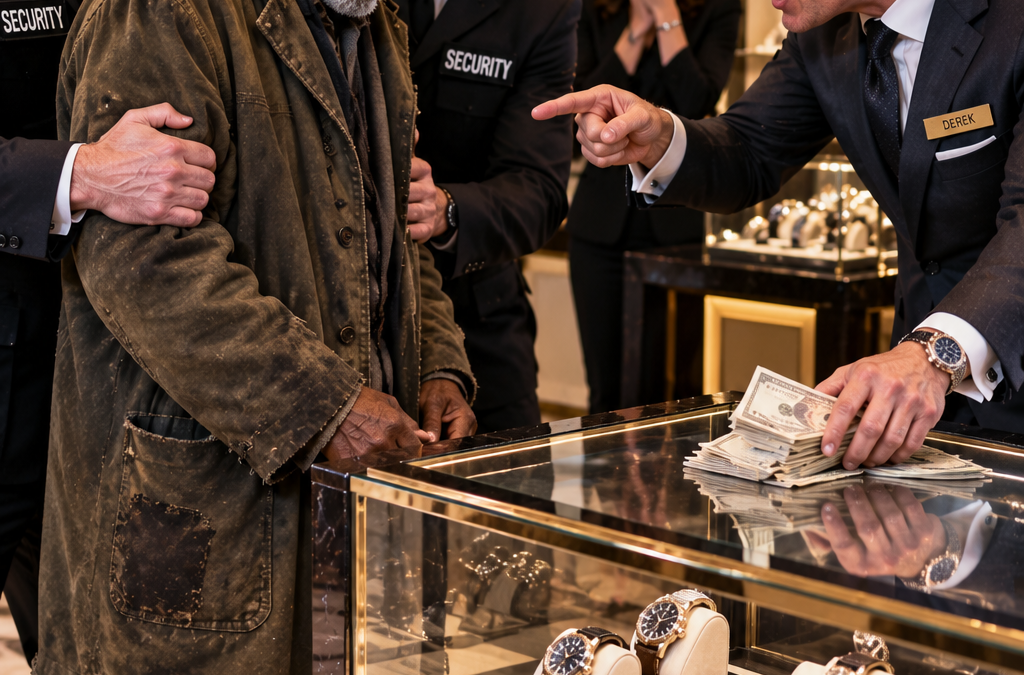
I reached inside my coat.
Derek immediately stepped back.
“Slowly.”
I froze.
Then pulled out the envelope.
“Eight thousand.”
I held it toward him.
“Eleven months of savings.”
The teenager’s phone remained pointed at me.
“I want to buy my son a birthday present.”
For half a second, the room changed.
Not enough.
Derek took the envelope.
Opened it.
Thumbed through the bills.
Then he laughed again.
“Look at this.”
He turned toward the others.
Nobody stopped him.
“Actual cash.”
He fanned the bills.
“Wrinkled cash.”
My stomach tightened.
He continued.
“Our clients use black cards.”
“Money is money.”
“Not here.”
He tossed the envelope onto the counter.
Several bills slid across the glass.
I reached toward them.
He slapped my hand.
Hard enough to make the sound carry.
“Don’t touch the display.”
I looked at him.
His face was cold now.
No longer enjoying himself.
“You’ll leave fingerprints.”
My hand remained suspended for a moment.
Then I lowered it.
I looked at my fingers.
There are hands that spend their lives being admired.
Pianists.
Surgeons.
Artists.
Mine built shelves.
Installed wiring.
Carried boxes.
Repaired watch movements before my eyesight got too weak for the smallest components.
They had held my wife in a hospital bed.
They had carried Nathan asleep from taxis.
They had built the first Sterling & Hale counter because I couldn’t afford a carpenter.
Derek saw dirty hands.
That was all.
A young sales associate stood near the watch case.
Name tag: ALLISON HARPER.
She looked like she wanted to speak.
Her mouth opened.
Then closed.
I did not blame her.
Not yet.
Fear has a way of attaching itself to paychecks.
Derek noticed my old leather satchel on the counter.
Before I understood what he was doing, he grabbed it.
“What’s this?”
“That’s mine.”
He unzipped it.
“Derek.”
That was Megan.
Very quiet.
He ignored her.
Then he dumped the contents across the glass.
My bus pass.
Heart medication.
A folded handkerchief.
A photograph.
The picture landed near his wrist.
Nathan at twenty-two.
Graduation robe.
Smile too large for his face.
His mother had died two years before.
That photograph was the first time I had seen him look happy without guilt afterward.
Derek picked it up.
“This is your son?”
“Give me that.”
He held it higher.
“The one you’re buying the Patek for?”
“Give me the photograph.”
He smirked.
“Looks more like a pawn-shop customer.”
My voice cracked.
“Please.”
I hated that he heard it.
“Give it back.”
He tossed it.
Not onto the counter.
Onto the floor.
The photograph landed face up.
A woman walking past looked down.
Then stepped over it.
Something inside me hurt worse than anything he had said about my coat.
I bent slowly.
My knees weren’t good anymore.
Picked up the photograph.
Smoothed one corner.
Held it against my chest.
Derek snapped his fingers.
“Security.”
Two guards appeared.
He pointed at me.
“Remove him.”
I looked up.
“For what?”
“Trespassing.”
“I walked in through the front door.”
“You’re harassing customers.”
“I haven’t spoken to one customer.”
“And check his pockets.”
That brought my eyes back to him.
“What?”
“I don’t trust that he hasn’t taken anything.”
One guard hesitated.
The other placed a hand on my arm.
“Sir.”
I looked at him.
He was younger than Nathan.
“I’m leaving.”
Derek said, “Search him.”
The guard did not search me.
To his credit.
But he kept his hand on my arm.
Unnecessarily.
They walked me toward the entrance.
Not violently.
Not gently either.
Past the cases.
Past the customers.
Past the teenager still recording.
Past Megan, who stared at the desk.
Then I saw Allison looking toward the wall.
At the founder’s portrait.
Black-and-white.
Brooklyn.
A younger version of me standing in front of the first store.
Same coat.
Different face.
Her eyes moved from the portrait to me.
Then back.
Recognition flickered.
The door opened.
Cold air hit me.
One of the guards pushed me forward.
I caught myself.
The door closed.
Soft click.
Expensive door.
Inside, I saw Derek clap his hands.
Then everybody moved again.
Just like that.
I became outside.
They became inside.
I sat on the bench beside the store.
Took out Nathan’s photograph.
One corner had bent.
I smoothed it across my knee.
I didn’t cry.
Partly because I was angry.
Partly because old men sometimes become too tired even for tears.
Fifth Avenue moved around me.
People carrying shopping bags.
Taxis.
Delivery drivers.
Tourists.
Nobody knew what had happened.
Nobody needed to.
For several minutes, I let myself remember.
The original store had been four hundred square feet.
Leaking roof.
No heating the first winter.
I had two hundred dollars after paying the deposit.
I slept on the floor three nights when the boiler in my apartment broke because I couldn’t afford repairs at both places.
Naomi came after her nursing shifts and painted walls beside me.
She was pregnant with Nathan then.
At twenty-seven, I believed work could solve almost everything.
I was wrong about many things.
But the work mattered.
I had personally carried the original glass display case up three flights because the freight elevator was broken.
I installed the shelves.
I cleaned the floors.
I repaired watches at a small table under a lamp until two in the morning.
And now, forty-five years later, a manager in my company had decided my coat was proof I could not enter.
A woman with a dog stopped across the street.
Looked at me.
Then crossed away.
I almost laughed.
Inside, Derek was retelling the story.
I could see him through the window.
Animated.
Smiling.
Staff gathered nearby.
Later I learned exactly what he said.
That I had been delusional.
That I had saved eleven months and still couldn’t afford the watch.
That poor people sometimes confused desire with entitlement.
At the time, I couldn’t hear the words.
I could see the laughter.
That was enough.
Then an older white woman came out.
She had been shopping near the cashmere section.
She sat beside me.
No introduction.
No permission asked.
Just sat.
“Are you all right?”
“I will be.”
“What they did was wrong.”
I looked at her.
She was maybe late seventies.
Carefully styled gray hair.
Good coat.
Kind eyes.
“I’m sorry I didn’t say anything in there.”
“You’re saying something now.”
“Too late.”
“Maybe.”
She opened her purse.
Pulled out a handkerchief.
Offered it.
I didn’t need it.
I took it anyway.
Sometimes the object is not the kindness.
The offering is.
“That manager,” she said. “I’ve seen him be rude before.”
“Rude isn’t what that was.”
“No.”
She looked toward the window.
“No, it wasn’t.”
After a while she said, “He’s afraid.”
That surprised me.
“Of me?”
“Of anything that doesn’t match the world he thinks he understands.”
I nodded.
“The worst kind of fear.”
“What kind is that?”
“The kind that gets authority.”
She looked at me.
Then smiled sadly.
She stayed another minute.
Then squeezed my shoulder.
“My name is Dorothy.”
“Benjamin.”
She stood.
“Benjamin, I should’ve spoken sooner.”
I nodded.
“I know.”
It wasn’t cruel.
It was true.
After she left, a young employee brought my money outside in a small shopping bag.
Kyle.
I had seen him earlier.
He looked miserable.
He set the bag beside me.
Too abruptly.
Then started to turn.
“Young man.”
He stopped.
“Yes?”
“Thank you.”
He looked back.
For some reason, that seemed to hurt him.
“I’m sorry.”
He whispered it so quietly I nearly missed it.
Then went inside.
I counted the bills.
All there.
Eight thousand dollars.
Eleven months.
I put them back into the envelope.
Through the window, I could see the founder’s portrait.
Me.
Twenty-seven.
Standing in front of that first store.
I smiled.
A private smile.
The whole situation had become so absurd I almost admired it.
I touched Nathan’s photograph.
“Happy birthday, son.”
I whispered.
“I’ll find another watch.”
I didn’t know Allison had already texted him.
Inside, she had recognized me.
Not immediately.
But then she looked at the portrait.
Same eyes.
Same coat.
She sent Nathan a message.
Your father is here.
Then another.
Something happened.
Then:
They threw him out.
Nathan answered:
How long?
She told him.
His next message was simple.
Don’t let anyone touch the footage. I’m fifteen minutes away.
By then Derek had decided the footage needed to disappear.
I learned that later too.
He ordered Megan to delete everything.
“Company policy—”
“I am company policy.”
Allison backed it up before anybody could erase it.
That woman had been working there ninety-one days.
She risked her job while people who had spent ten years in that building looked down and stayed silent.
Titles don’t create courage either.
A police officer approached me outside.
He had been walking the block.
“Sir.”
I looked up.
“Yes?”
“You waiting for someone?”
“My son.”
He studied me.
Store.
Bench.
Coat.
I knew the calculation.
“This bench belongs to the property.”
“I know.”
“If management asked you to leave, you may need to move.”
I almost obeyed.
Habit.
Then I thought about the absurdity of being removed from my own company’s bench because of what I looked like.
I stood.
Took three steps.
Stopped.
Turned around.
Sat again.
The officer’s eyebrows rose.
“With respect, officer, I’m staying until my son arrives.”
His hand moved toward the radio.
Then stopped.
Maybe my voice confused him.
Maybe he was tired.
“Five minutes.”
“Five is enough.”
He stepped aside.
Inside the store, a woman in a white fur coat was praising Derek.
I could see her mouth moving.
Later Allison told me what she said.
“You handled that beautifully.”
These people need to know where they’re welcome.
Derek answered:
“It’s about standards.”
Standards.
That’s another word I’ve heard used to hide uglier ones.
Then I heard the car.
A Maybach.
Low engine.
Heavy.
Smooth.
It pulled to the curb.
The rear door opened.
Nathan stepped out.
Navy suit.
No overcoat.
Patek Philippe on his wrist.
Midnight-blue dial.
Reference 5227G.
The exact watch I had asked Derek to show me.
I had forgotten Nathan already owned one.
He looked at the store.
Then at me.
Everything in his face changed.
He walked toward the bench.
Slow at first.
Then faster.
“Dad.”
His voice cracked.
That one word nearly broke me.
He knelt on one knee.
Right there on Fifth Avenue.
Took my hands.
“I’m here.”
“I know.”
He looked me over.
“Did they touch you?”
“I’m fine.”
“What happened?”
“Words.”
“Words matter.”
He stood and hugged me.
I could feel him trembling.
Not fear.
Anger.
The officer took a step backward.
Nathan saw him.
Then looked at me.
“You okay?”
“I’m seventy-two. Nothing is okay.”
Normally he would’ve laughed.
He didn’t.
Instead, he brushed something from my coat.
“Stay here.”
“Nathan.”
“One minute.”
He turned toward the store.
I knew my son.
The quieter he became, the angrier he was.
The bell chimed when he entered.
Derek saw him.
Instant transformation.
The same man who had looked at me like trash suddenly became hospitality itself.
“Mr. Wells.”
Smile.
Hand extended.
“What an honor.”
Nathan didn’t take his hand.
Derek’s arm slowly lowered.
“We weren’t expecting you until next week.”
Nathan looked around.
“Where is he?”
Derek frowned.
“I’m sorry?”
“The man you threw out.”
Silence.
“The elderly Black man in the green coat.”
Derek tried to recover.
“Oh.”
He laughed nervously.
“There was a situation earlier.”
“A situation.”
“A vagrant wandered in.”
I was still outside, but Allison told me later that Nathan’s face went completely still.
“A vagrant.”
“Yes, sir. He was making unreasonable demands. Didn’t fit the customer profile.”
“What was his name?”
Derek paused.
“I didn’t ask.”
Nathan nodded slowly.
“Of course you didn’t.”
Then he turned.
Came back outside.
Held out his hand to me.
“Come inside.”
“I don’t need to.”
“I do.”
That stopped me.
I took his hand.
He walked beside me through the glass doors.
The room changed.
Same coat.
Same shoes.
Same face.
But now I had entered beside Nathan Wells.
CEO.
Owner.
Photograph in every training manual.
Suddenly everyone saw me.
I hated that.
Nathan stopped in the middle of the floor.
Put his hand on my shoulder.
“This is my father.”
Nobody moved.
“Benjamin Arthur Wells.”
Derek stared.
Nathan pointed toward the portrait.
“Founder of Sterling & Hale.”
Every head turned.
Portrait.
Me.
Portrait.
Me.
I watched the realization travel across faces.
Some faster than others.
Derek looked like somebody had removed the floor beneath him.
Nathan continued.
“In 1981, my father opened the first location with two hundred dollars and a borrowed truck.”
His voice stayed steady.
“He installed his own counters.”
I looked down.
“He repaired watches until two in the morning.”
Derek swallowed.
“He built the company you’re standing inside.”
Nathan stepped toward him.
“And today you told him he didn’t belong here.”
Derek whispered, “I had no idea.”
Nathan’s jaw tightened.
“That’s the problem.”
The room went silent.
“You had no idea.”
He took another step.
“And made no effort to find out.”
Derek looked at me.
“Mr. Wells.”
“No.”
Nathan stopped him.
“You do not get to apologize because you discovered his identity.”
Derek froze.
Nathan’s voice sharpened.
“You called him trash.”
No answer.
“You accused him of stealing.”
Derek looked down.
“You threw his money across a counter.”
A woman in fur placed a bracelet down and started moving toward the exit.
Nathan noticed.
“So did everybody who watched.”
She stopped.
He didn’t embarrass her by name.
Didn’t need to.
Her face did the work.
Nathan continued.
“You dumped his belongings in public.”
His voice broke slightly.
“You threw a photograph of me onto the floor.”
I saw his eyes shine.
That made my throat tighten.
Then he looked at Derek.
“And you ordered security to throw him out of the company he created.”
Derek started talking quickly.
“Sir, I swear, if I had known—”
I spoke.
“If you had known what?”
He turned toward me.
I walked closer.
“That I was wealthy?”
He said nothing.
“That my son owns the business?”
Nothing.
“Would my coat have smelled better?”
A few employees looked down.
“Would my hands have become clean?”
Derek’s face collapsed.
I said, “You knew enough.”
He stared.
“You knew I was seventy-two.”
Silence.
“You knew I asked to look at a watch.”
Silence.
“You knew I had money.”
I gestured toward the counter.
“You knew I wasn’t threatening anybody.”
My voice remained calm.
“You decided none of that mattered because of what you thought I was.”
Derek whispered, “I’m sorry.”
I believed he was sorry.
For consequences.
I wasn’t yet sure he understood the harm.
Nathan turned toward Allison.
“Ms. Harper.”
She came forward.
“I understand you preserved the footage.”
“Yes, sir.”
Derek looked at her.
“I deleted—”
Nathan’s head snapped toward him.
“You ordered footage deleted?”
Derek said nothing.
Allison connected her phone to the display screen.
The recording began.
I watched myself walk in.
It was stranger than I expected.
There I was.
Old coat.
Slow steps.
Quiet.
Then Derek appeared.
The jokes.
The laughter.
The money.
The photograph.
Hearing it again hurt more than living it the first time.
Because now I wasn’t concentrating on surviving the moment.
I was watching what everybody else had watched.
And doing nothing had looked worse than I remembered.
Onscreen, my photograph hit the floor.
Kyle closed his eyes.
Megan began crying.
Derek stared at himself.
Then came the moment he ordered security to remove me.
The footage stopped.
Nobody spoke.
Derek whispered, “I told them to delete that.”
Nathan looked at him.
“You’re confirming you ordered destruction of evidence.”
Derek’s face went blank.
“I panicked.”
“No.”
Nathan’s voice became colder.
“You were perfectly calm.”
He pointed toward the black screen.
“Every insult was deliberate.”
Derek’s chin trembled.
“You were performing.”
That was true.
Nathan gathered every employee.
Security too.
Twelve people stood in a half circle.
Derek at one end.
My son looked at all of them.
“What happened here today cannot become a story about my father’s identity.”
He paused.
“This is not wrong because he founded the company.”
I looked at him.
Pride moved through me.
Not because he defended me.
Because he understood.
Nathan continued.
“If that man had been Benjamin Wells from nowhere—”
He pointed toward the entrance.
“Someone with five dollars.”
Then toward the watch case.
“Someone who could never afford anything behind this glass.”
His voice rose slightly.
“He would still deserve dignity.”
Nobody moved.
“This company sells luxury.”
He looked around.
“It does not sell humanity.”
Then he faced Derek.
“Step forward.”
Derek did.
Barely.
Nathan said, “Tell everyone what happened.”
Derek swallowed.
“There was a misunderstanding.”
“No.”
Nathan shook his head.
“Try again.”
Derek looked at me.
“I judged Mr. Wells based on his appearance.”
Nathan waited.
Derek continued.
“I assumed he was…”
His voice failed.
“Say it.”
“Poor.”
“And?”
“Dishonest.”
“And?”
Derek’s eyes filled.
“That he didn’t belong.”
Nathan nodded.
“If he were not my father, would your behavior be acceptable?”
“No.”
“Then stop using ignorance of his identity as an excuse.”
Derek looked down.
Nathan removed a folded document from inside his jacket.
“Your employment is terminated effective immediately.”
Derek’s knees weakened.
He grabbed the display case.
The same one I had been told not to touch.
Nathan continued.
“There will also be an independent review of your conduct, customer complaints and the attempted deletion of security footage.”
Derek was crying now.
I felt no pleasure in it.
That’s another thing people misunderstand.
Watching someone fall is only satisfying if you haven’t fallen yourself.
Humiliation teaches you not to romanticize humiliation.
Nathan turned to the security guards.
“Did my father resist?”
“No.”
“Threaten anyone?”
“No.”
“Raise his voice?”
“No.”
“Then why did you touch him?”
One guard answered.
“Derek ordered us.”
Nathan stared.
“And your judgment?”
Neither spoke.
“Suspended pending review.”
Then he addressed the employees.
“Anybody who laughed, filmed, encouraged, or participated will be disciplined.”
Faces dropped.
“Anybody who stayed silent needs to ask why.”
He looked toward Allison.
“Except one person.”
She stiffened.
“You recognized something was wrong.”
Her eyes filled.
“You preserved evidence and contacted me.”
Nathan paused.
“Effective immediately, you are acting general manager.”
She stared.
“Sir?”
“You heard me.”
She looked toward me.
I gave her a small nod.
That was all.
Then Nathan turned toward me.
“Dad.”
I stood beneath my own portrait.
Forty-five years between the man on the wall and the man in the worn coat.
Same eyes.
More scars.
Nathan asked, “Do you want to say anything?”
Every face turned.
Earlier, nobody had cared what I said.
Now nobody wanted to miss a word.
Power changes ears.
I looked at my hands.
Then held them up.
“I built my first store with these.”
Nobody moved.
“I carried lumber.”
I touched one scar along my thumb.
“Installed cases.”
I showed my palms.
“Painted walls at two in the morning.”
I touched my coat.
“And I wore this.”
A few people looked at the portrait.
“This coat was with me when I opened that first door.”
My throat tightened.
“It was with me when my wife died.”
Nathan looked away briefly.
“I wore it to my son’s graduation.”
Then I looked at Derek.
“You saw poverty.”
He raised his eyes.
“I saw my life.”
Silence.
“I don’t hate you.”
That surprised him.
“I don’t know you well enough to hate you.”
His mouth trembled.
“But I pity you.”
He looked confused.
“Because you measured a man by his coat and thought that made you wealthy.”
I nodded toward the marble.
“That’s a kind of poverty no suit fixes.”
We closed the store early.
For the first time since the flagship opened.
Nathan drove me home.
Neither of us spoke much.
When we reached my apartment in Brooklyn, he turned off the engine.
“Why didn’t you call me before going?”
I smiled.
“It was supposed to be a surprise.”
“Dad.”
“I wanted to walk into my son’s store like anybody else.”
That silenced him.
“I didn’t think I needed permission.”
Nathan closed his eyes.
“You shouldn’t.”
“No.”
“Not there.”
He looked at me.
“Not anywhere.”
I reached into my coat.
Pulled out the envelope.
Put it in his hand.
He stared.
“What are you doing?”
“Happy birthday.”
“Dad.”
“Take it.”
“I own the company.”
“Then you can afford to listen.”
He laughed.
Wet laugh.
“Dad.”
“I saved that.”
“I know.”
“Eleven months.”
His eyes reddened.
“A gift should cost the giver something.”
I folded his fingers around the envelope.
“Otherwise, it’s inventory.”
He held it against his chest.
Just as I had held his graduation photograph.
“Thank you.”
“You’re welcome.”
The next morning, Nathan called an emergency board meeting.
He showed the footage.
Then introduced a policy he had drafted overnight.
The Wells Dignity Code.
I hated the name.
He refused to change it.
Every Sterling & Hale store would implement mandatory training on racial profiling, customer dignity, bystander responsibility, and security escalation.
Complaint channels would bypass local management.
Security footage could not be deleted by store managers.
Every location would display a dignity statement beside the founder’s portrait.
Every employee would sign it.
Not because signatures magically change hearts.
Because policies make it harder for bad hearts to hide behind procedure.
The board approved everything.
The footage leaked before noon.
By the end of the week, millions had watched it.
The clip everybody shared most wasn’t Derek insulting me.
It was Nathan kneeling on the sidewalk.
“Dad. I’m here.”
I understood why.
Everybody knows what it is to want someone to come when you’re sitting alone.
The internet did what it always does.
Anger.
Analysis.
Judgment.
People found Derek.
People found the store.
People found old complaints.
Black customers described being followed.
Latino customers described being asked for extra identification.
One Muslim family said a salesperson had ignored them entirely.
Again and again, the same sentence appeared.
“I thought it was just me.”
The company took a financial hit.
Then recovered.
Nathan hated when business reporters praised the response.
“We shouldn’t get a medal for cleaning up something that happened under our roof.”
He was right.
Still, what mattered to me was whether anything changed.
Allison proved it did.
She called me three weeks later.
“Mr. Wells?”
“Benjamin.”
“Sorry.”
“Benjamin.”
“Can I ask you something?”
“Go ahead.”
“Would you come by the store?”
I hesitated.
“Why?”
“I want you to see it.”
So I went.
Same coat.
I did that deliberately.
The door opened.
Megan saw me first.
She came around the desk.
“Mr. Wells.”
Her eyes were nervous.
Then she steadied herself.
“Good morning.”
Not because she knew who I was.
At least that was what I chose to believe.
A young man walked in behind me.
Work uniform.
Paint on his boots.
Megan smiled at him too.
“Good morning, sir. Let me know if you’d like help.”
I watched.
No hesitation.
That mattered.
Allison had rearranged the front floor.
The founder’s portrait remained.
Beside it hung the Wells Dignity Code.
The first line read:
EVERY PERSON WHO ENTERS IS A GUEST BEFORE THEY ARE A CUSTOMER.
I stood there for a while.
Allison approached.
“You don’t like it.”
“I don’t like my name that large.”
She smiled.
“Nathan’s decision.”
“Of course.”
Then she became serious.
“I should have spoken sooner that day.”
“You spoke.”
“After.”
“You were ninety-one days into a job with a manager threatening careers.”
“Still.”
I nodded.
“Then remember how it felt next time.”
She did.
Derek completed two hundred hours of community service at a senior facility in the Bronx.
That wasn’t something I requested.
Nathan did.
I told him punishment wasn’t his job.
He told me accountability was.
We argued.
Neither won.
Derek served meals.
Cleaned rooms.
Sat with elderly people.
Many were Black.
Some had stories older than he was.
Being denied entry.
Followed.
Refused medical care.
Rejected from housing.
Told which counters they could use.
Which doors.
Which schools.
Things Derek had probably thought belonged to history.
Eventually, he wrote me a letter.
Three pages.
Handwritten.
He delivered it himself.
I opened the door.
He looked different.
No suit.
Simple sweater.
His shoulders no longer seemed permanently squared for a fight.
He held out the envelope.
“Mr. Wells.”
“Benjamin.”
He swallowed.
“I don’t think I deserve to call you that.”
“Then come inside.”
We sat at my kitchen table.
I made coffee.
For almost ten minutes, he said nothing.
Then he cried.
Not dramatically.
Quietly.
He told me he had grown up poor.
His father had been an alcoholic.
His mother cleaned hotel rooms.
When Derek entered luxury retail, he became terrified of ever being mistaken for the poverty he came from.
So he created categories.
Successful.
Unsuccessful.
Belonging.
Not belonging.
I listened.
“That’s not an excuse,” he said.
“No.”
“I know.”
He looked at his hands.
“I think I hated anybody who reminded me of where I came from.”
“Maybe.”
“I saw your coat.”
He stopped.
“And I saw everything I was afraid people might think about me.”
I took a sip of coffee.
“So you made me carry it.”
His eyes lifted.
“Yes.”
That was the first honest thing I heard him say about that day.
We talked for two hours.
Before he left, I gave him a small wooden box.
I had built it years earlier.
He stared at it.
“I can’t take this.”
“It’s a box, Derek.”
“After what I did?”
“Especially after.”
“Why?”
I thought about Clara.
About Nathan.
About how long people spend becoming who they are.
“Growth is the only apology worth keeping.”
His eyes reddened.
I pointed toward the door.
“Don’t make me regret it.”
He smiled faintly.
“I won’t.”
Every Sunday after that, I began visiting the flagship store.
Not to inspect.
Not to intimidate.
Mostly for coffee.
Allison always had one ready.
Same coat.
Same shoes.
The employees eventually stopped becoming nervous when I entered.
That pleased me more than fear ever could.
Sometimes customers recognized me.
I hated that.
One Sunday, a young Black man stood near the entrance wearing a delivery uniform.
He stared at a watch case for nearly ten minutes.
Nobody approached.
Old habits in me tightened.
Then Megan came around the desk.
“Would you like to see that one?”
He looked startled.
“I can’t buy it.”
“That’s okay.”
She unlocked the case.
“You can still look.”
I watched from the other side of the room.
The young man tried on the watch.
Smiled.
Asked questions.
Then thanked her and left.
No sale.
No commission.
No embarrassment.
That was worth more to me than the eighty thousand dollars another customer spent an hour later.
Nathan turned forty-six the following year.
I bought him the watch.
Not the thirty-two-thousand-dollar one.
He would have killed me.
I found a vintage piece through one of our older suppliers.
Simple.
Elegant.
Eight thousand dollars exactly.
I paid with the same money.
Not literally the same bills.
Nathan had deposited those and refused to spend them.
So I wrote a check.
When I gave him the box, he looked suspicious.
“Dad.”
“Open it.”
He did.
For a long time, he didn’t speak.
Then he turned the watch over.
On the back I had engraved:
TIME COSTS SOMETHING. SPEND IT WELL.
He stared at the words.
“That’s depressing for a birthday.”
“I’m seventy-three. Everything I say is depressing.”
He laughed.
Then hugged me.
I kept the old coat.
Of course I did.
It hangs beside my apartment door.
The missing button is still missing.
One patch has started coming loose.
Nathan has stopped trying to replace it.
He finally understands that some things are worth more because nobody else would want them.
Sterling & Hale now operates under the dignity policy in every country where we have a store.
Does that mean nobody ever profiles anybody anymore?
No.
Policies do not perform miracles.
People still carry assumptions.
Managers still make mistakes.
Customers still complain.
But complaints are investigated.
Footage is preserved.
Security decisions are reviewed.
Employees are trained to challenge treatment that feels wrong.
More importantly, employees know silence is a decision.
That was what I wanted people to understand.
When the story spread online, many focused on the reveal.
The poor-looking old Black man was secretly the founder.
The manager didn’t know.
The son arrived in a Maybach.
Justice.
It made a good story.
But sometimes I wished Nathan had never arrived.
Not because I didn’t need him.
I did.
Because the real moral test happened before anyone knew who I was.
Derek saw me.
The employees saw me.
Customers saw me.
They had all the information required to know I deserved basic dignity.
An old man.
Polite.
Calm.
Carrying his own money.
Asking to look at a watch.
Nothing about my founder status should have mattered.
If I had been homeless, Derek would still have been wrong.
If I had eight dollars instead of eight thousand, he would still have been wrong.
If my son had worked construction instead of owning the company, he would still have been wrong.
If I had walked in simply because I wanted to see something beautiful I could never afford, I should still have been allowed to leave with my dignity intact.
That is what I told Nathan when he asked whether the company should use my story in training.
“Don’t teach them I was the founder.”
He frowned.
“How do we tell it without that?”
“You tell it at the end.”
“Why?”
“Because I want them to decide whether they think I deserve respect before they know.”
He smiled.
“That’s good.”
“I know.”
The training video now pauses just before Nathan enters.
Employees are asked one question.
What should have happened differently?
Only after they answer does the video continue.
Some people understand immediately.
Others become quiet when the reveal happens.
I hope the quiet stays with them.
I still visit Fifth Avenue.
I still take the bus sometimes.
Nathan hates that too.
One morning, I entered wearing the same coat and carrying an umbrella that had turned inside out twice on the walk from the stop.
A new employee greeted me.
He had been hired two days earlier.
He clearly didn’t recognize me.
“Good morning, sir.”
“Morning.”
“Can I help you?”
“I’m just looking.”
“Take your time.”
Then he returned to what he was doing.
I stood there smiling like an idiot.
Allison saw me from across the floor.
She walked over.
“What?”
“Nothing.”
“You’re smiling.”
“I know.”
“Should I be worried?”
“No.”
I looked toward the new employee.
“He passed.”
She laughed.
“It isn’t a test.”
“I know.”
That was the point.
It should never have been a test.
A person should not have to secretly own the building before the door becomes open to them.
I learned that lesson long before I became old enough to need a bench outside my own store.
But that Tuesday on Fifth Avenue gave the lesson a face.
Mine.
Seventy-two.
Cracked shoes.
Scarred hands.
Thirty-year-old coat.
Eight thousand dollars inside an envelope.
A photograph of my son against my chest.
For forty minutes, I sat outside a company I had built and looked through the glass at people who had decided I didn’t belong.
Then Nathan arrived.
The doors opened again.
But the truth is, those doors should never have closed on me in the first place.
Not because my name was Benjamin Wells.
Not because my portrait hung inside.
Not because my son was CEO.
Because I was a human being standing at the counter.
That should have been enough.
𝗧𝗛𝗘 𝗘𝗡𝗗
The Luxury Watch Manager Threw My Birthday Money on the Counter and Ordered Security to Remove Me Before He Ever Asked My Name
I had spent eleven months saving eight thousand dollars to buy my son a birthday watch when the manager looked at my worn coat, called me trash, and ordered security to throw me out of the luxury store I had once built with my own hands.
Forty minutes later, I was sitting on a cold Fifth Avenue bench holding an old photograph against my chest, unaware that my son was only a few blocks away—and that the man laughing behind the glass had no idea whose father he had just humiliated.
I was seventy-two years old the morning I decided to surprise my son.
At that age, surprises are usually supposed to come the other direction.
Children call.
Grandchildren show up.
Somebody buys you dinner.
Somebody tells you to sit down while they carry the heavy box.
But Nathan had spent most of his life doing things for me, and that morning I wanted to do something for him.
His forty-fifth birthday had arrived on a cold Tuesday in late October.
Manhattan smelled the way it always did once autumn settled in properly—roasted chestnuts from street carts, damp stone, exhaust, coffee, and the metallic edge of cold air.
I stepped off the M5 bus on Fifth Avenue with a folded envelope inside the inner pocket of my coat.
Eight thousand dollars.
Cash.
Twenty-dollar bills.
Fifties.
A few hundreds.
Nothing elegant about it.
Some of the bills were creased because I had kept them in a tin box inside my kitchen cabinet before moving them to the bank.
Some still looked as though they had been folded around pension statements and grocery receipts.
I had saved every dollar over eleven months.
Skipped things I didn’t need.
Fixed things instead of replacing them.
Cooked at home.
Told Nathan I was perfectly happy whenever he offered to send money.
I was happy.
That was the truth.
But happiness and pride are cousins, and pride makes old men do strange things.
Nathan could have bought himself any watch in that store.
That wasn’t the point.
A birthday gift from your father should not come from the son’s credit card.
It should cost the father something.
Maybe not pain.
But effort.
Time.
Thought.
That envelope represented eleven months of all three.
My coat was thirty years old.
Olive green.
Faded along the seams.
Patched at both elbows.
One button missing near the collar.
Nathan hated it.
Every Christmas, for at least ten years, he had tried to replace it.
Cashmere.
Wool.
Some Italian coat so soft I was afraid to sit down in it.
I always returned them.
The old one mattered.
I wore it when I opened my first store.
I wore it the winter Nathan was born.
I wore it when my wife, Naomi, died.
I wore it to Nathan’s college graduation.
A good coat doesn’t stop becoming useful because rich people stop approving of it.
Sterling & Hale occupied the corner of Fifth Avenue and 52nd Street.
Floor-to-ceiling glass.
White marble.
Gold-framed mirrors.
Soft lighting that made every watch look like it had been carved out of time itself.
I stood across the street for a moment before going in.
The name above the entrance still made me feel something.
Sterling & Hale.
People assumed the name came from two wealthy European families.
It didn’t.
The original store had been Sterling Watch Repair.
I bought it from Mr. Sterling when he retired.
“Hale” had been added later because a consultant told me Wells sounded too ordinary for luxury retail.
I had laughed for three days.
Then signed the paperwork anyway.
Business teaches you strange compromises.
Eventually, the company expanded.
Then expanded again.
Nathan transformed it far beyond anything I had imagined.
Nine countries.
Flagship stores.
Private clients.
Annual revenue figures containing more zeros than my first bank teller would have believed.
I had stepped away years before.
Completely.
No office.
No board seat.
No title on the website.
I still owned a small founding share because Nathan refused to let me sell everything, but for all practical purposes, Sterling & Hale was his company now.
That was exactly what I wanted.
A parent should build something sturdy enough for a child to climb higher.
I pushed through the front door.
A small bell chimed.
A young receptionist looked up.
She was maybe twenty-four.
Her name tag read MEGAN COLE.
Her smile appeared automatically.
Then her eyes dropped.
Coat.
Shoes.
Hands.
The smile weakened.
Still, she gestured politely.
“Good morning.”
“Morning.”
I took four steps.
Then a man approached from the watch section.
Derek Ashton.
I didn’t know his name yet.
I noticed the suit first.
Charcoal.
Tailored.
Watch visible just below the cuff.
Hair slicked back.
He moved quickly but not hurriedly.
The walk of a man who believed everybody else should make space.
“Sir.”
I stopped.
“Yes?”
He looked at me.
Not into my eyes.
At me.
Head to foot.
Once.
Then again.
“I think you’ve wandered into the wrong store.”
I almost smiled.
“No, I don’t think so.”
“Goodwill is two blocks east.”
Three customers turned.
A sales associate stopped mid-sentence.
For a second, I wondered whether I had misheard him.
Then I realized he wanted the room to hear.
I said, “I’d like to see the Patek Philippe in the front case.”
His eyebrows lifted.
“Which one?”
“The midnight-blue Calatrava. Reference 5227G.”
That surprised him.
I saw it.
Only for a second.
Then his expression tightened.
“You’ve been doing research.”
“I know watches.”
“Anyone can Google a reference number.”
“I suppose.”
“Do you know what it costs?”
“Thirty-two thousand, depending on configuration.”
He folded his arms.
“Then you know you’re wasting my time.”
I looked at him.
“Why?”
His eyes moved toward my shoes.
They were cracked near the toes.
Still clean.
Mostly.
“Because this isn’t a museum.”
“I didn’t say it was.”
“We don’t take expensive watches out of display cases for people who are simply curious.”
“I intend to buy something.”
His mouth twitched.
The beginnings of a laugh.
Behind him, Megan shifted uncomfortably.
Derek looked toward her.
“Did you let him in?”
Her face changed.
“He walked in, sir.”
“And you didn’t stop him?”
“I—”
“That’s your job.”
I watched her cheeks redden.
Derek lowered his voice just enough to make the insult feel private while keeping it audible to everyone.
“When someone looks like he slept under a bridge, you call security before he reaches the merchandise.”
I had heard worse.
That wasn’t what struck me.
What struck me was how natural it sounded coming from him.
No hesitation.
No fear someone might object.
Cruelty becomes most dangerous when the person using it believes it is ordinary.
I said, “Young man.”
He looked back.
“I have money.”
“Wonderful.”
“Cash.”
That made him laugh.
Actually laugh.
“You brought cash.”
“Yes.”
“Into Sterling & Hale.”
“Yes.”
His eyes narrowed.
“Where did you get it?”
I felt something cold settle inside me.
“What?”
“The money.”
He leaned closer.
“Where did you get it?”
“From my bank.”
“Your bank.”
“Yes.”
“Did someone give it to you?”
“No.”
“Did you steal it?”
The room went quiet.
That was the first moment I considered walking out.
Not because I was embarrassed.
Because anger is expensive when you’re old.
It takes longer to leave the body.
I had learned to spend mine carefully.
Instead, I said, “I saved it.”
Derek circled me slowly.
I knew what he was doing.
Performing.
He had an audience now.
Two women near a handbag display.
A man wearing sunglasses indoors.
A teenager who had pulled out his phone.
“Our clients,” Derek said, “fly here from Dubai. London. Monaco.”
I said nothing.
“They wear coats worth more than most houses.”
His eyes moved over mine.
“They don’t arrive smelling like bus exhaust.”
A woman in red whispered to the man beside her.
“He’s right.”
He smirked.
Derek heard it.
That gave him energy.
He stepped directly in front of me.
“You are not our customer.”
My jaw tightened.
“You don’t know that.”
“I do.”
“How?”
“I’ve managed luxury retail for eleven years.”
He looked at my hands.
Scarred.
Calloused.
Nails never entirely free of dark lines.
“You learn to recognize who belongs.”
There are sentences that arrive new.
And there are sentences you’ve been hearing your whole life wearing different clothes.
Who belongs.
Where you belong.
People like you.
Your kind.
I was eleven the first time a shopkeeper followed me aisle by aisle.
Twenty-two the first time a bank officer asked whether I understood what a business loan was.
Thirty-one when a supplier told me luxury customers would never buy from a Black owner unless I stayed behind the scenes.
I had built a company partly out of stubbornness.
Partly because I loved watches.
Mostly because I had become tired of other people deciding which rooms were mine.
At seventy-two, I thought I was past being surprised.
I wasn’t.
I reached inside my coat.
Derek immediately stepped back.
“Slowly.”
I froze.
Then pulled out the envelope.
“Eight thousand.”
I held it toward him.
“Eleven months of savings.”
The teenager’s phone remained pointed at me.
“I want to buy my son a birthday present.”
For half a second, the room changed.
Not enough.
Derek took the envelope.
Opened it.
Thumbed through the bills.
Then he laughed again.
“Look at this.”
He turned toward the others.
Nobody stopped him.
“Actual cash.”
He fanned the bills.
“Wrinkled cash.”
My stomach tightened.
He continued.
“Our clients use black cards.”
“Money is money.”
“Not here.”
He tossed the envelope onto the counter.
Several bills slid across the glass.
I reached toward them.
He slapped my hand.
Hard enough to make the sound carry.
“Don’t touch the display.”
I looked at him.
His face was cold now.
No longer enjoying himself.
“You’ll leave fingerprints.”
My hand remained suspended for a moment.
Then I lowered it.
I looked at my fingers.
There are hands that spend their lives being admired.
Pianists.
Surgeons.
Artists.
Mine built shelves.
Installed wiring.
Carried boxes.
Repaired watch movements before my eyesight got too weak for the smallest components.
They had held my wife in a hospital bed.
They had carried Nathan asleep from taxis.
They had built the first Sterling & Hale counter because I couldn’t afford a carpenter.
Derek saw dirty hands.
That was all.
A young sales associate stood near the watch case.
Name tag: ALLISON HARPER.
She looked like she wanted to speak.
Her mouth opened.
Then closed.
I did not blame her.
Not yet.
Fear has a way of attaching itself to paychecks.
Derek noticed my old leather satchel on the counter.
Before I understood what he was doing, he grabbed it.
“What’s this?”
“That’s mine.”
He unzipped it.
“Derek.”
That was Megan.
Very quiet.
He ignored her.
Then he dumped the contents across the glass.
My bus pass.
Heart medication.
A folded handkerchief.
A photograph.
The picture landed near his wrist.
Nathan at twenty-two.
Graduation robe.
Smile too large for his face.
His mother had died two years before.
That photograph was the first time I had seen him look happy without guilt afterward.
Derek picked it up.
“This is your son?”
“Give me that.”
He held it higher.
“The one you’re buying the Patek for?”
“Give me the photograph.”
He smirked.
“Looks more like a pawn-shop customer.”
My voice cracked.
“Please.”
I hated that he heard it.
“Give it back.”
He tossed it.
Not onto the counter.
Onto the floor.
The photograph landed face up.
A woman walking past looked down.
Then stepped over it.
Something inside me hurt worse than anything he had said about my coat.
I bent slowly.
My knees weren’t good anymore.
Picked up the photograph.
Smoothed one corner.
Held it against my chest.
Derek snapped his fingers.
“Security.”
Two guards appeared.
He pointed at me.
“Remove him.”
I looked up.
“For what?”
“Trespassing.”
“I walked in through the front door.”
“You’re harassing customers.”
“I haven’t spoken to one customer.”
“And check his pockets.”
That brought my eyes back to him.
“What?”
“I don’t trust that he hasn’t taken anything.”
One guard hesitated.
The other placed a hand on my arm.
“Sir.”
I looked at him.
He was younger than Nathan.
“I’m leaving.”
Derek said, “Search him.”
The guard did not search me.
To his credit.
But he kept his hand on my arm.
Unnecessarily.
They walked me toward the entrance.
Not violently.
Not gently either.
Past the cases.
Past the customers.
Past the teenager still recording.
Past Megan, who stared at the desk.
Then I saw Allison looking toward the wall.
At the founder’s portrait.
Black-and-white.
Brooklyn.
A younger version of me standing in front of the first store.
Same coat.
Different face.
Her eyes moved from the portrait to me.
Then back.
Recognition flickered.
The door opened.
Cold air hit me.
One of the guards pushed me forward.
I caught myself.
The door closed.
Soft click.
Expensive door.
Inside, I saw Derek clap his hands.
Then everybody moved again.
Just like that.
I became outside.
They became inside.
I sat on the bench beside the store.
Took out Nathan’s photograph.
One corner had bent.
I smoothed it across my knee.
I didn’t cry.
Partly because I was angry.
Partly because old men sometimes become too tired even for tears.
Fifth Avenue moved around me.
People carrying shopping bags.
Taxis.
Delivery drivers.
Tourists.
Nobody knew what had happened.
Nobody needed to.
For several minutes, I let myself remember.
The original store had been four hundred square feet.
Leaking roof.
No heating the first winter.
I had two hundred dollars after paying the deposit.
I slept on the floor three nights when the boiler in my apartment broke because I couldn’t afford repairs at both places.
Naomi came after her nursing shifts and painted walls beside me.
She was pregnant with Nathan then.
At twenty-seven, I believed work could solve almost everything.
I was wrong about many things.
But the work mattered.
I had personally carried the original glass display case up three flights because the freight elevator was broken.
I installed the shelves.
I cleaned the floors.
I repaired watches at a small table under a lamp until two in the morning.
And now, forty-five years later, a manager in my company had decided my coat was proof I could not enter.
A woman with a dog stopped across the street.
Looked at me.
Then crossed away.
I almost laughed.
Inside, Derek was retelling the story.
I could see him through the window.
Animated.
Smiling.
Staff gathered nearby.
Later I learned exactly what he said.
That I had been delusional.
That I had saved eleven months and still couldn’t afford the watch.
That poor people sometimes confused desire with entitlement.
At the time, I couldn’t hear the words.
I could see the laughter.
That was enough.
Then an older white woman came out.
She had been shopping near the cashmere section.
She sat beside me.
No introduction.
No permission asked.
Just sat.
“Are you all right?”
“I will be.”
“What they did was wrong.”
I looked at her.
She was maybe late seventies.
Carefully styled gray hair.
Good coat.
Kind eyes.
“I’m sorry I didn’t say anything in there.”
“You’re saying something now.”
“Too late.”
“Maybe.”
She opened her purse.
Pulled out a handkerchief.
Offered it.
I didn’t need it.
I took it anyway.
Sometimes the object is not the kindness.
The offering is.
“That manager,” she said. “I’ve seen him be rude before.”
“Rude isn’t what that was.”
“No.”
She looked toward the window.
“No, it wasn’t.”
After a while she said, “He’s afraid.”
That surprised me.
“Of me?”
“Of anything that doesn’t match the world he thinks he understands.”
I nodded.
“The worst kind of fear.”
“What kind is that?”
“The kind that gets authority.”
She looked at me.
Then smiled sadly.
She stayed another minute.
Then squeezed my shoulder.
“My name is Dorothy.”
“Benjamin.”
She stood.
“Benjamin, I should’ve spoken sooner.”
I nodded.
“I know.”
It wasn’t cruel.
It was true.
After she left, a young employee brought my money outside in a small shopping bag.
Kyle.
I had seen him earlier.
He looked miserable.
He set the bag beside me.
Too abruptly.
Then started to turn.
“Young man.”
He stopped.
“Yes?”
“Thank you.”
He looked back.
For some reason, that seemed to hurt him.
“I’m sorry.”
He whispered it so quietly I nearly missed it.
Then went inside.
I counted the bills.
All there.
Eight thousand dollars.
Eleven months.
I put them back into the envelope.
Through the window, I could see the founder’s portrait.
Me.
Twenty-seven.
Standing in front of that first store.
I smiled.
A private smile.
The whole situation had become so absurd I almost admired it.
I touched Nathan’s photograph.
“Happy birthday, son.”
I whispered.
“I’ll find another watch.”
I didn’t know Allison had already texted him.
Inside, she had recognized me.
Not immediately.
But then she looked at the portrait.
Same eyes.
Same coat.
She sent Nathan a message.
Your father is here.
Then another.
Something happened.
Then:
They threw him out.
Nathan answered:
How long?
She told him.
His next message was simple.
Don’t let anyone touch the footage. I’m fifteen minutes away.
By then Derek had decided the footage needed to disappear.
I learned that later too.
He ordered Megan to delete everything.
“Company policy—”
“I am company policy.”
Allison backed it up before anybody could erase it.
That woman had been working there ninety-one days.
She risked her job while people who had spent ten years in that building looked down and stayed silent.
Titles don’t create courage either.
A police officer approached me outside.
He had been walking the block.
“Sir.”
I looked up.
“Yes?”
“You waiting for someone?”
“My son.”
He studied me.
Store.
Bench.
Coat.
I knew the calculation.
“This bench belongs to the property.”
“I know.”
“If management asked you to leave, you may need to move.”
I almost obeyed.
Habit.
Then I thought about the absurdity of being removed from my own company’s bench because of what I looked like.
I stood.
Took three steps.
Stopped.
Turned around.
Sat again.
The officer’s eyebrows rose.
“With respect, officer, I’m staying until my son arrives.”
His hand moved toward the radio.
Then stopped.
Maybe my voice confused him.
Maybe he was tired.
“Five minutes.”
“Five is enough.”
He stepped aside.
Inside the store, a woman in a white fur coat was praising Derek.
I could see her mouth moving.
Later Allison told me what she said.
“You handled that beautifully.”
These people need to know where they’re welcome.
Derek answered:
“It’s about standards.”
Standards.
That’s another word I’ve heard used to hide uglier ones.
Then I heard the car.
A Maybach.
Low engine.
Heavy.
Smooth.
It pulled to the curb.
The rear door opened.
Nathan stepped out.
Navy suit.
No overcoat.
Patek Philippe on his wrist.
Midnight-blue dial.
Reference 5227G.
The exact watch I had asked Derek to show me.
I had forgotten Nathan already owned one.
He looked at the store.
Then at me.
Everything in his face changed.
He walked toward the bench.
Slow at first.
Then faster.
“Dad.”
His voice cracked.
That one word nearly broke me.
He knelt on one knee.
Right there on Fifth Avenue.
Took my hands.
“I’m here.”
“I know.”
He looked me over.
“Did they touch you?”
“I’m fine.”
“What happened?”
“Words.”
“Words matter.”
He stood and hugged me.
I could feel him trembling.
Not fear.
Anger.
The officer took a step backward.
Nathan saw him.
Then looked at me.
“You okay?”
“I’m seventy-two. Nothing is okay.”
Normally he would’ve laughed.
He didn’t.
Instead, he brushed something from my coat.
“Stay here.”
“Nathan.”
“One minute.”
He turned toward the store.
I knew my son.
The quieter he became, the angrier he was.
The bell chimed when he entered.
Derek saw him.
Instant transformation.
The same man who had looked at me like trash suddenly became hospitality itself.
“Mr. Wells.”
Smile.
Hand extended.
“What an honor.”
Nathan didn’t take his hand.
Derek’s arm slowly lowered.
“We weren’t expecting you until next week.”
Nathan looked around.
“Where is he?”
Derek frowned.
“I’m sorry?”
“The man you threw out.”
Silence.
“The elderly Black man in the green coat.”
Derek tried to recover.
“Oh.”
He laughed nervously.
“There was a situation earlier.”
“A situation.”
“A vagrant wandered in.”
I was still outside, but Allison told me later that Nathan’s face went completely still.
“A vagrant.”
“Yes, sir. He was making unreasonable demands. Didn’t fit the customer profile.”
“What was his name?”
Derek paused.
“I didn’t ask.”
Nathan nodded slowly.
“Of course you didn’t.”
Then he turned.
Came back outside.
Held out his hand to me.
“Come inside.”
“I don’t need to.”
“I do.”
That stopped me.
I took his hand.
He walked beside me through the glass doors.
The room changed.
Same coat.
Same shoes.
Same face.
But now I had entered beside Nathan Wells.
CEO.
Owner.
Photograph in every training manual.
Suddenly everyone saw me.
I hated that.
Nathan stopped in the middle of the floor.
Put his hand on my shoulder.
“This is my father.”
Nobody moved.
“Benjamin Arthur Wells.”
Derek stared.
Nathan pointed toward the portrait.
“Founder of Sterling & Hale.”
Every head turned.
Portrait.
Me.
Portrait.
Me.
I watched the realization travel across faces.
Some faster than others.
Derek looked like somebody had removed the floor beneath him.
Nathan continued.
“In 1981, my father opened the first location with two hundred dollars and a borrowed truck.”
His voice stayed steady.
“He installed his own counters.”
I looked down.
“He repaired watches until two in the morning.”
Derek swallowed.
“He built the company you’re standing inside.”
Nathan stepped toward him.
“And today you told him he didn’t belong here.”
Derek whispered, “I had no idea.”
Nathan’s jaw tightened.
“That’s the problem.”
The room went silent.
“You had no idea.”
He took another step.
“And made no effort to find out.”
Derek looked at me.
“Mr. Wells.”
“No.”
Nathan stopped him.
“You do not get to apologize because you discovered his identity.”
Derek froze.
Nathan’s voice sharpened.
“You called him trash.”
No answer.
“You accused him of stealing.”
Derek looked down.
“You threw his money across a counter.”
A woman in fur placed a bracelet down and started moving toward the exit.
Nathan noticed.
“So did everybody who watched.”
She stopped.
He didn’t embarrass her by name.
Didn’t need to.
Her face did the work.
Nathan continued.
“You dumped his belongings in public.”
His voice broke slightly.
“You threw a photograph of me onto the floor.”
I saw his eyes shine.
That made my throat tighten.
Then he looked at Derek.
“And you ordered security to throw him out of the company he created.”
Derek started talking quickly.
“Sir, I swear, if I had known—”
I spoke.
“If you had known what?”
He turned toward me.
I walked closer.
“That I was wealthy?”
He said nothing.
“That my son owns the business?”
Nothing.
“Would my coat have smelled better?”
A few employees looked down.
“Would my hands have become clean?”
Derek’s face collapsed.
I said, “You knew enough.”
He stared.
“You knew I was seventy-two.”
Silence.
“You knew I asked to look at a watch.”
Silence.
“You knew I had money.”
I gestured toward the counter.
“You knew I wasn’t threatening anybody.”
My voice remained calm.
“You decided none of that mattered because of what you thought I was.”
Derek whispered, “I’m sorry.”
I believed he was sorry.
For consequences.
I wasn’t yet sure he understood the harm.
Nathan turned toward Allison.
“Ms. Harper.”
She came forward.
“I understand you preserved the footage.”
“Yes, sir.”
Derek looked at her.
“I deleted—”
Nathan’s head snapped toward him.
“You ordered footage deleted?”
Derek said nothing.
Allison connected her phone to the display screen.
The recording began.
I watched myself walk in.
It was stranger than I expected.
There I was.
Old coat.
Slow steps.
Quiet.
Then Derek appeared.
The jokes.
The laughter.
The money.
The photograph.
Hearing it again hurt more than living it the first time.
Because now I wasn’t concentrating on surviving the moment.
I was watching what everybody else had watched.
And doing nothing had looked worse than I remembered.
Onscreen, my photograph hit the floor.
Kyle closed his eyes.
Megan began crying.
Derek stared at himself.
Then came the moment he ordered security to remove me.
The footage stopped.
Nobody spoke.
Derek whispered, “I told them to delete that.”
Nathan looked at him.
“You’re confirming you ordered destruction of evidence.”
Derek’s face went blank.
“I panicked.”
“No.”
Nathan’s voice became colder.
“You were perfectly calm.”
He pointed toward the black screen.
“Every insult was deliberate.”
Derek’s chin trembled.
“You were performing.”
That was true.
Nathan gathered every employee.
Security too.
Twelve people stood in a half circle.
Derek at one end.
My son looked at all of them.
“What happened here today cannot become a story about my father’s identity.”
He paused.
“This is not wrong because he founded the company.”
I looked at him.
Pride moved through me.
Not because he defended me.
Because he understood.
Nathan continued.
“If that man had been Benjamin Wells from nowhere—”
He pointed toward the entrance.
“Someone with five dollars.”
Then toward the watch case.
“Someone who could never afford anything behind this glass.”
His voice rose slightly.
“He would still deserve dignity.”
Nobody moved.
“This company sells luxury.”
He looked around.
“It does not sell humanity.”
Then he faced Derek.
“Step forward.”
Derek did.
Barely.
Nathan said, “Tell everyone what happened.”
Derek swallowed.
“There was a misunderstanding.”
“No.”
Nathan shook his head.
“Try again.”
Derek looked at me.
“I judged Mr. Wells based on his appearance.”
Nathan waited.
Derek continued.
“I assumed he was…”
His voice failed.
“Say it.”
“Poor.”
“And?”
“Dishonest.”
“And?”
Derek’s eyes filled.
“That he didn’t belong.”
Nathan nodded.
“If he were not my father, would your behavior be acceptable?”
“No.”
“Then stop using ignorance of his identity as an excuse.”
Derek looked down.
Nathan removed a folded document from inside his jacket.
“Your employment is terminated effective immediately.”
Derek’s knees weakened.
He grabbed the display case.
The same one I had been told not to touch.
Nathan continued.
“There will also be an independent review of your conduct, customer complaints and the attempted deletion of security footage.”
Derek was crying now.
I felt no pleasure in it.
That’s another thing people misunderstand.
Watching someone fall is only satisfying if you haven’t fallen yourself.
Humiliation teaches you not to romanticize humiliation.
Nathan turned to the security guards.
“Did my father resist?”
“No.”
“Threaten anyone?”
“No.”
“Raise his voice?”
“No.”
“Then why did you touch him?”
One guard answered.
“Derek ordered us.”
Nathan stared.
“And your judgment?”
Neither spoke.
“Suspended pending review.”
Then he addressed the employees.
“Anybody who laughed, filmed, encouraged, or participated will be disciplined.”
Faces dropped.
“Anybody who stayed silent needs to ask why.”
He looked toward Allison.
“Except one person.”
She stiffened.
“You recognized something was wrong.”
Her eyes filled.
“You preserved evidence and contacted me.”
Nathan paused.
“Effective immediately, you are acting general manager.”
She stared.
“Sir?”
“You heard me.”
She looked toward me.
I gave her a small nod.
That was all.
Then Nathan turned toward me.
“Dad.”
I stood beneath my own portrait.
Forty-five years between the man on the wall and the man in the worn coat.
Same eyes.
More scars.
Nathan asked, “Do you want to say anything?”
Every face turned.
Earlier, nobody had cared what I said.
Now nobody wanted to miss a word.
Power changes ears.
I looked at my hands.
Then held them up.
“I built my first store with these.”
Nobody moved.
“I carried lumber.”
I touched one scar along my thumb.
“Installed cases.”
I showed my palms.
“Painted walls at two in the morning.”
I touched my coat.
“And I wore this.”
A few people looked at the portrait.
“This coat was with me when I opened that first door.”
My throat tightened.
“It was with me when my wife died.”
Nathan looked away briefly.
“I wore it to my son’s graduation.”
Then I looked at Derek.
“You saw poverty.”
He raised his eyes.
“I saw my life.”
Silence.
“I don’t hate you.”
That surprised him.
“I don’t know you well enough to hate you.”
His mouth trembled.
“But I pity you.”
He looked confused.
“Because you measured a man by his coat and thought that made you wealthy.”
I nodded toward the marble.
“That’s a kind of poverty no suit fixes.”
We closed the store early.
For the first time since the flagship opened.
Nathan drove me home.
Neither of us spoke much.
When we reached my apartment in Brooklyn, he turned off the engine.
“Why didn’t you call me before going?”
I smiled.
“It was supposed to be a surprise.”
“Dad.”
“I wanted to walk into my son’s store like anybody else.”
That silenced him.
“I didn’t think I needed permission.”
Nathan closed his eyes.
“You shouldn’t.”
“No.”
“Not there.”
He looked at me.
“Not anywhere.”
I reached into my coat.
Pulled out the envelope.
Put it in his hand.
He stared.
“What are you doing?”
“Happy birthday.”
“Dad.”
“Take it.”
“I own the company.”
“Then you can afford to listen.”
He laughed.
Wet laugh.
“Dad.”
“I saved that.”
“I know.”
“Eleven months.”
His eyes reddened.
“A gift should cost the giver something.”
I folded his fingers around the envelope.
“Otherwise, it’s inventory.”
He held it against his chest.
Just as I had held his graduation photograph.
“Thank you.”
“You’re welcome.”
The next morning, Nathan called an emergency board meeting.
He showed the footage.
Then introduced a policy he had drafted overnight.
The Wells Dignity Code.
I hated the name.
He refused to change it.
Every Sterling & Hale store would implement mandatory training on racial profiling, customer dignity, bystander responsibility, and security escalation.
Complaint channels would bypass local management.
Security footage could not be deleted by store managers.
Every location would display a dignity statement beside the founder’s portrait.
Every employee would sign it.
Not because signatures magically change hearts.
Because policies make it harder for bad hearts to hide behind procedure.
The board approved everything.
The footage leaked before noon.
By the end of the week, millions had watched it.
The clip everybody shared most wasn’t Derek insulting me.
It was Nathan kneeling on the sidewalk.
“Dad. I’m here.”
I understood why.
Everybody knows what it is to want someone to come when you’re sitting alone.
The internet did what it always does.
Anger.
Analysis.
Judgment.
People found Derek.
People found the store.
People found old complaints.
Black customers described being followed.
Latino customers described being asked for extra identification.
One Muslim family said a salesperson had ignored them entirely.
Again and again, the same sentence appeared.
“I thought it was just me.”
The company took a financial hit.
Then recovered.
Nathan hated when business reporters praised the response.
“We shouldn’t get a medal for cleaning up something that happened under our roof.”
He was right.
Still, what mattered to me was whether anything changed.
Allison proved it did.
She called me three weeks later.
“Mr. Wells?”
“Benjamin.”
“Sorry.”
“Benjamin.”
“Can I ask you something?”
“Go ahead.”
“Would you come by the store?”
I hesitated.
“Why?”
“I want you to see it.”
So I went.
Same coat.
I did that deliberately.
The door opened.
Megan saw me first.
She came around the desk.
“Mr. Wells.”
Her eyes were nervous.
Then she steadied herself.
“Good morning.”
Not because she knew who I was.
At least that was what I chose to believe.
A young man walked in behind me.
Work uniform.
Paint on his boots.
Megan smiled at him too.
“Good morning, sir. Let me know if you’d like help.”
I watched.
No hesitation.
That mattered.
Allison had rearranged the front floor.
The founder’s portrait remained.
Beside it hung the Wells Dignity Code.
The first line read:
EVERY PERSON WHO ENTERS IS A GUEST BEFORE THEY ARE A CUSTOMER.
I stood there for a while.
Allison approached.
“You don’t like it.”
“I don’t like my name that large.”
She smiled.
“Nathan’s decision.”
“Of course.”
Then she became serious.
“I should have spoken sooner that day.”
“You spoke.”
“After.”
“You were ninety-one days into a job with a manager threatening careers.”
“Still.”
I nodded.
“Then remember how it felt next time.”
She did.
Derek completed two hundred hours of community service at a senior facility in the Bronx.
That wasn’t something I requested.
Nathan did.
I told him punishment wasn’t his job.
He told me accountability was.
We argued.
Neither won.
Derek served meals.
Cleaned rooms.
Sat with elderly people.
Many were Black.
Some had stories older than he was.
Being denied entry.
Followed.
Refused medical care.
Rejected from housing.
Told which counters they could use.
Which doors.
Which schools.
Things Derek had probably thought belonged to history.
Eventually, he wrote me a letter.
Three pages.
Handwritten.
He delivered it himself.
I opened the door.
He looked different.
No suit.
Simple sweater.
His shoulders no longer seemed permanently squared for a fight.
He held out the envelope.
“Mr. Wells.”
“Benjamin.”
He swallowed.
“I don’t think I deserve to call you that.”
“Then come inside.”
We sat at my kitchen table.
I made coffee.
For almost ten minutes, he said nothing.
Then he cried.
Not dramatically.
Quietly.
He told me he had grown up poor.
His father had been an alcoholic.
His mother cleaned hotel rooms.
When Derek entered luxury retail, he became terrified of ever being mistaken for the poverty he came from.
So he created categories.
Successful.
Unsuccessful.
Belonging.
Not belonging.
I listened.
“That’s not an excuse,” he said.
“No.”
“I know.”
He looked at his hands.
“I think I hated anybody who reminded me of where I came from.”
“Maybe.”
“I saw your coat.”
He stopped.
“And I saw everything I was afraid people might think about me.”
I took a sip of coffee.
“So you made me carry it.”
His eyes lifted.
“Yes.”
That was the first honest thing I heard him say about that day.
We talked for two hours.
Before he left, I gave him a small wooden box.
I had built it years earlier.
He stared at it.
“I can’t take this.”
“It’s a box, Derek.”
“After what I did?”
“Especially after.”
“Why?”
I thought about Clara.
About Nathan.
About how long people spend becoming who they are.
“Growth is the only apology worth keeping.”
His eyes reddened.
I pointed toward the door.
“Don’t make me regret it.”
He smiled faintly.
“I won’t.”
Every Sunday after that, I began visiting the flagship store.
Not to inspect.
Not to intimidate.
Mostly for coffee.
Allison always had one ready.
Same coat.
Same shoes.
The employees eventually stopped becoming nervous when I entered.
That pleased me more than fear ever could.
Sometimes customers recognized me.
I hated that.
One Sunday, a young Black man stood near the entrance wearing a delivery uniform.
He stared at a watch case for nearly ten minutes.
Nobody approached.
Old habits in me tightened.
Then Megan came around the desk.
“Would you like to see that one?”
He looked startled.
“I can’t buy it.”
“That’s okay.”
She unlocked the case.
“You can still look.”
I watched from the other side of the room.
The young man tried on the watch.
Smiled.
Asked questions.
Then thanked her and left.
No sale.
No commission.
No embarrassment.
That was worth more to me than the eighty thousand dollars another customer spent an hour later.
Nathan turned forty-six the following year.
I bought him the watch.
Not the thirty-two-thousand-dollar one.
He would have killed me.
I found a vintage piece through one of our older suppliers.
Simple.
Elegant.
Eight thousand dollars exactly.
I paid with the same money.
Not literally the same bills.
Nathan had deposited those and refused to spend them.
So I wrote a check.
When I gave him the box, he looked suspicious.
“Dad.”
“Open it.”
He did.
For a long time, he didn’t speak.
Then he turned the watch over.
On the back I had engraved:
TIME COSTS SOMETHING. SPEND IT WELL.
He stared at the words.
“That’s depressing for a birthday.”
“I’m seventy-three. Everything I say is depressing.”
He laughed.
Then hugged me.
I kept the old coat.
Of course I did.
It hangs beside my apartment door.
The missing button is still missing.
One patch has started coming loose.
Nathan has stopped trying to replace it.
He finally understands that some things are worth more because nobody else would want them.
Sterling & Hale now operates under the dignity policy in every country where we have a store.
Does that mean nobody ever profiles anybody anymore?
No.
Policies do not perform miracles.
People still carry assumptions.
Managers still make mistakes.
Customers still complain.
But complaints are investigated.
Footage is preserved.
Security decisions are reviewed.
Employees are trained to challenge treatment that feels wrong.
More importantly, employees know silence is a decision.
That was what I wanted people to understand.
When the story spread online, many focused on the reveal.
The poor-looking old Black man was secretly the founder.
The manager didn’t know.
The son arrived in a Maybach.
Justice.
It made a good story.
But sometimes I wished Nathan had never arrived.
Not because I didn’t need him.
I did.
Because the real moral test happened before anyone knew who I was.
Derek saw me.
The employees saw me.
Customers saw me.
They had all the information required to know I deserved basic dignity.
An old man.
Polite.
Calm.
Carrying his own money.
Asking to look at a watch.
Nothing about my founder status should have mattered.
If I had been homeless, Derek would still have been wrong.
If I had eight dollars instead of eight thousand, he would still have been wrong.
If my son had worked construction instead of owning the company, he would still have been wrong.
If I had walked in simply because I wanted to see something beautiful I could never afford, I should still have been allowed to leave with my dignity intact.
That is what I told Nathan when he asked whether the company should use my story in training.
“Don’t teach them I was the founder.”
He frowned.
“How do we tell it without that?”
“You tell it at the end.”
“Why?”
“Because I want them to decide whether they think I deserve respect before they know.”
He smiled.
“That’s good.”
“I know.”
The training video now pauses just before Nathan enters.
Employees are asked one question.
What should have happened differently?
Only after they answer does the video continue.
Some people understand immediately.
Others become quiet when the reveal happens.
I hope the quiet stays with them.
I still visit Fifth Avenue.
I still take the bus sometimes.
Nathan hates that too.
One morning, I entered wearing the same coat and carrying an umbrella that had turned inside out twice on the walk from the stop.
A new employee greeted me.
He had been hired two days earlier.
He clearly didn’t recognize me.
“Good morning, sir.”
“Morning.”
“Can I help you?”
“I’m just looking.”
“Take your time.”
Then he returned to what he was doing.
I stood there smiling like an idiot.
Allison saw me from across the floor.
She walked over.
“What?”
“Nothing.”
“You’re smiling.”
“I know.”
“Should I be worried?”
“No.”
I looked toward the new employee.
“He passed.”
She laughed.
“It isn’t a test.”
“I know.”
That was the point.
It should never have been a test.
A person should not have to secretly own the building before the door becomes open to them.
I learned that lesson long before I became old enough to need a bench outside my own store.
But that Tuesday on Fifth Avenue gave the lesson a face.
Mine.
Seventy-two.
Cracked shoes.
Scarred hands.
Thirty-year-old coat.
Eight thousand dollars inside an envelope.
A photograph of my son against my chest.
For forty minutes, I sat outside a company I had built and looked through the glass at people who had decided I didn’t belong.
Then Nathan arrived.
The doors opened again.
But the truth is, those doors should never have closed on me in the first place.
Not because my name was Benjamin Wells.
Not because my portrait hung inside.
Not because my son was CEO.
Because I was a human being standing at the counter.
That should have been enough.








