𝗙𝗨𝗟𝗟 𝗦𝗧𝗢𝗥𝗬 The Lien on My Lakefront Home Was Only the First Thing He Planned to Take
𝗙𝗨𝗟𝗟 𝗦𝗧𝗢𝗥𝗬
The second violation involved my navy shutters.
Apparently, the color violated Cedar Hollow’s approved exterior palette.
The shutters had been navy when I bought the house.
They were also visible in the MLS photos, inspection report, and closing documents.
I emailed the HOA office and asked for the approved palette.
Karen called me personally.
His voice was warm, almost amused.
“Rachel, it’s in the handbook.”
“I checked the PDF I received at closing. I didn’t see a color palette.”
“Then you should read more carefully next time.”
I hated the way he said it.
Softly.
Like he was giving advice to a slow child.
“I’d still like a copy,” I said.
“Of course,” he replied. “I’ll have the office send one.”
The handbook arrived three days later.
It was six years out of date.
Several sections contradicted one another. The color references were vague, and the appendix mentioned a palette that wasn’t attached. I asked again for the actual approved colors.
No answer.
A week later, another notice arrived.
Two hundred dollars.
I paid that one too.
Not because Karen was right.
Because two hundred dollars seemed cheaper than hiring someone to fight over shutters.
That was how he won, I later realized.
Not always by being correct.
By making resistance feel more expensive than submission.
For a while, I tried to keep my head down.
I trimmed the grass early.
Put my trash bins away before dinner.
Kept the dock neat.
Avoided the clubhouse meetings unless the agenda directly affected my street.
I thought if I stayed quiet, Karen would move on to someone else.
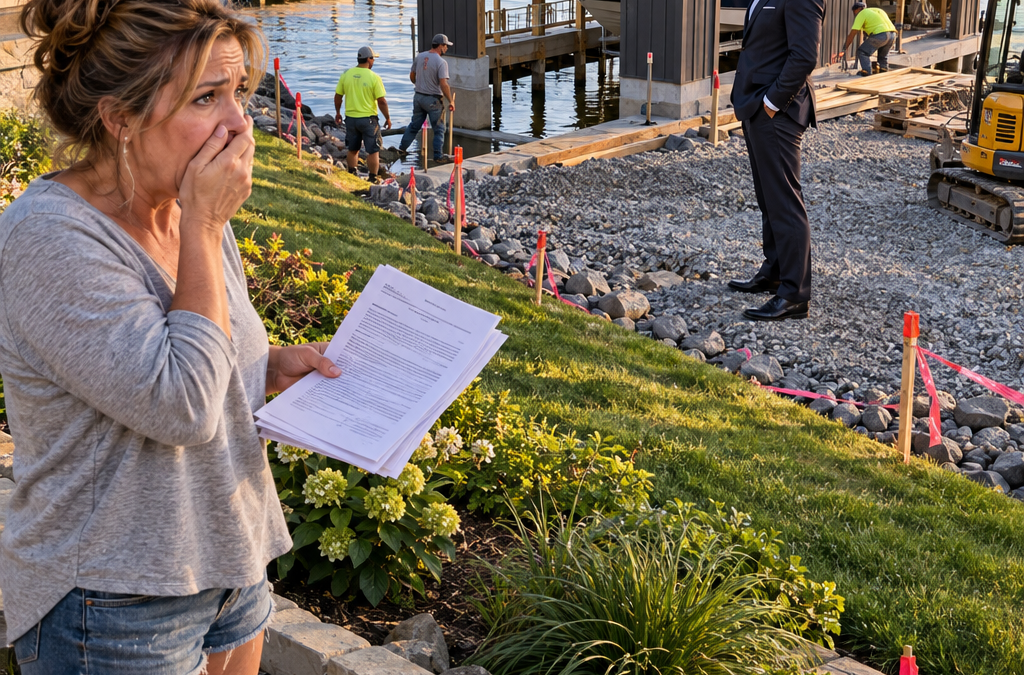
Then, on a Tuesday afternoon, I came home to find three men in orange vests standing on my lakefront.
At first, I thought there had been a utility issue.
One man held a measuring rod.
Another was hammering a wooden stake into the ground near the path to my dock.
A third stood with a rolled plan set tucked under his arm.
I parked crookedly in the driveway and got out.
“Excuse me,” I called. “Can I help you?”
The man with the plans turned.
“Afternoon, ma’am.”
“What are you doing on my property?”
He glanced toward the lake.
“Survey layout.”
“For what?”
“The HOA amenity project.”
I stared at him.
“What amenity project?”
He unrolled the plan and pointed to a rectangular outline near the shoreline.
“Boat-storage garage.”
I walked closer.
The line drawing showed a structure placed near the water, with an access path from the community drive and space for multiple small watercraft.
My stomach tightened.
“That’s on my land.”
He looked uncomfortable.
“I just have the permit packet.”
“Who authorized this?”
He turned the cover sheet toward me.
There, in clean blue ink, was a signature.
Hoa Karen Whitfield.
The permit was dated two weeks earlier.
Two weeks.
Nobody had called me.
Nobody had emailed.
Nobody had mailed a notice I had seen.
There had been no vote I knew about, no hearing, no request for access, and no easement agreement.
The foreman gave me the tired look of a man who had realized he was standing in someone else’s disaster.
“Ma’am, I’m just here to mark the site.”
“Don’t put another stake in the ground.”
He lifted his hands slightly.
“I’ll call my supervisor.”
I was already calling Karen.
He answered on the second ring.
“Rachel,” he said brightly. “Lovely afternoon, isn’t it?”
“There are surveyors on my waterfront.”
“Oh. So they arrived.”
“So they arrived? Karen, they’re measuring my land for a garage.”
“The community boat-storage project, yes.”
“My land.”
A soft pause.
“Didn’t the letter reach you?”
My fingers tightened around the phone.
“What letter?”
“The notice of proposed shoreline amenity development.”
“I never received any notice.”
“Mail is so unreliable lately.”
“I want a copy.”
“I’d have to check the file.”
That phrase.
Calm.
Convenient.
Meaningless.
I would hear it again and again.
“Check it now,” I said.
“I’m not in the office.”
“Then send it when you are.”
“Rachel, this project benefits everyone.”
“It sits on my private waterfront.”
“The board reviewed the location carefully.”
“Did the board review my deed?”
Another pause.
“Your tone is becoming hostile.”
“My tone is what happens when I come home and find strangers measuring land I own.”
He sighed, soft and theatrical.
“Let’s not make this unpleasant.”
“It already is.”
I hung up before he could turn my anger into another lecture.
That night, I pulled out my property survey from 2019.
I spread it across the kitchen table, smoothing the corners with coffee mugs.
The survey showed the house, driveway, side setbacks, lake boundary, dock rights, and a private waterfront easement attached to my parcel.
The proposed garage outline, based on where the stakes had been placed, sat entirely inside the area tied to my deeded waterfront use.
Not common property.
Not HOA land.
Mine.
I checked the deed.
Then the plat map.
Then the closing documents.
Everything matched.
Karen hadn’t made a small mistake.
And that was when I remembered something he’d once said at a clubhouse meeting.
Someone had asked how the board made decisions about waterfront access.
Karen had smiled, touched his gold watch, and said, “I read every deed before approving anything around this lake.”
I had thought it sounded arrogant at the time.
Now it mattered.
If he read every deed, then he knew.
He knew the garage site wasn’t open community land.
He knew my parcel was private.
He knew he had no recorded right to build there.
And he signed the permit anyway.
The construction crew showed up Thursday morning.
I was still in pajamas when I heard diesel engines.
By the time I opened the front door, a dump truck was backing toward my side lawn and a bulldozer was idling six feet from my rose bushes.
A man in a hard hat waved the truck into position.
Gravel spilled over my grass in a gray cascade.
I ran outside barefoot.
“Stop!”
The truck driver looked down from the cab.
The bulldozer operator cut his engine.
The foreman from Tuesday turned and winced when he saw me.
“Ma’am.”
“Don’t ma’am me. Why are you dumping gravel on my lawn?”
He looked genuinely miserable.
“We were told the access issue was cleared.”
“By who?”
He didn’t have to answer.
Karen’s white SUV rolled into view a minute later.
It stopped in front of my house with the confidence of a parade marshal arriving late to his own event.
Karen stepped out wearing sunglasses, cream slacks, loafers, and a pale cardigan draped perfectly over his shoulders. Clipboard in hand. Smile fixed.
“Rachel,” he called, as though we had arranged to meet.
I held up my phone and started recording.
“This is private property.”
He looked at the phone, then back at me.
“Recording isn’t necessary.”
“It is now.”
His smile thinned.
“This project has been approved.”
“Not by me.”
“The HOA board has authority over community amenities.”
“Not on private land.”
He gestured toward the lake.
“This benefits everyone. Boat storage increases property values.”
“Whose property?”
“All waterfront owners benefit from improved shared infrastructure.”
“My waterfront isn’t shared infrastructure.”
He looked toward the workers.
“Continue.”
I stepped in front of the gravel pile.
“No.”
The foreman didn’t move.
Karen’s face hardened.
“Rachel, you’re obstructing an approved vendor.”
“I’m standing on my lawn.”
“You are interfering with HOA business.”
“Your HOA business is trespassing.”
He leaned closer, lowering his voice.
“You should think carefully before making yourself the problem.”
Something cold moved through me.
“I am not the problem.”
He straightened and wrote something on his clipboard.
Thirty minutes later, the citation appeared by email.
Three hundred dollars for obstructing an approved HOA vendor.
I laughed when I saw it.
Not because it was funny.
Because disbelief needed somewhere to go.
Even the bulldozer operator looked uncomfortable when I read it aloud.
He shut the engine down again.
The crew left after my attorney sent an emergency cease-and-desist letter that afternoon.
My attorney’s name was Pria Shah.
She was a land-use attorney in Cleveland with sharp eyes, a calm voice, and the rare ability to make legal threats sound like ordinary weather reports.
I paid for one hour at first.
Just enough time to ask, “Can they legally do this?”
I brought my deed, survey, HOA notices, and photos of the stakes.
Pria read everything twice.
Then she leaned back.
“No.”
Just one word.
It hit me harder than I expected.
“No?”
“No easement on file gives the HOA construction rights on your private waterfront parcel.”
“None?”
“None that you’ve shown me. And none I’m seeing in the records we pulled before this meeting.”
I exhaled.
“Then Karen lied.”
Pria’s expression stayed careful.
“Karen signed a permit package representing authority I do not currently see.”
“That’s lawyer language for lied.”
“It’s lawyer language for we prove it before we say it.”
I nodded.
She tapped the plan sheet.
“We need the board minutes authorizing this project. The permit applications. Any notices they claim were sent. Any vote records. Any easement documentation they believe exists.”
“He told me he’d have to check the file.”
Pria’s mouth tightened slightly.
“Then we ask officially.”
She submitted the request under state HOA transparency requirements and the association’s own inspection provisions.
The response came three days late.
The board minutes arrived as a PDF.
They looked too clean.
Too newly formatted.
The font differed from older minutes.
The margins were inconsistent.
And there, in the attendance list, was my name.
Rachel Mercer.
Present.
A later line stated that I had voiced no objection to the shoreline amenity proposal.
Another indicated unanimous resident support for limited garage access rights.
I stared at the screen.
My mouth went dry.
The meeting date was May 14.
I opened my calendar.
On May 14, I had been in Kentucky at my sister’s wedding.
I had photos.
Hotel receipts.
Gas station transactions.
A bridesmaid group text.
A timestamped picture of me standing beside my sister under a white arch two states away at almost the exact time the HOA minutes claimed I was approving a garage on my waterfront.
I called Pria.
“They put my name in the minutes.”
“What exactly do the minutes say?”
“That I attended. That I didn’t object.”
“Did you?”
“I was at my sister’s wedding.”
“Can you prove that?”
I looked at my phone.
“With about a hundred photos.”
“Good. Send them.”
Her voice became colder.
“Rachel, if these records were altered to create false authority for construction, we may be dealing with fraud.”
I sat down.
The kitchen felt suddenly too quiet.
Fraud was no longer an angry word in my head.
It was a legal possibility.
A serious one.
The next notice arrived before we could even finish organizing the evidence.
Karen escalated the obstruction fines.
He claimed my unpaid charges had reached the threshold for lien enforcement.
The letter said the association could proceed toward foreclosure if I failed to cure the balance.
I read it twice, then placed it on top of the altered minutes.
That was when fear turned into something harder.
I had tried to be polite.
I had paid the early fines.
I had asked for records.
I had stood on my own land and filmed strangers dumping gravel near my roses.
Karen had responded by inventing attendance at a meeting, claiming I approved rights I had never granted, and threatening my home over charges created because I refused to let him build on my property.
Then came the second twist.
I was studying the plat map when I noticed Karen’s parcel.
His house sat two streets over, but the back of his lot bordered the same lakefront strip that would benefit from the proposed storage garage. He didn’t have direct access as convenient as mine. His dock was tucked into a narrow corner with limited storage, awkward slope, and poor turnaround space.
A shared boat garage near my shoreline would change that.
It would create nearby storage.
Improve access.
Make his dock more useful.
And, according to a realtor I later asked, likely increase the market appeal of his already expensive home.
This wasn’t community benefit.
This was Karen quietly annexing waterfront value for himself under the cover of an amenity vote.
Pria found the texts.
Not because Karen handed them over willingly.
Because a board member named Mark Delaney panicked.
Mark had signed off on preliminary approval after Karen told him the waterfront owners had consented. When Pria’s letter arrived, Mark realized the board minutes might be false, and he decided he wanted no part of criminal exposure.
He sent screenshots.
One was from Karen.
Don’t worry about Rachel. I’m handling her quietly.
Another said:
Once the garage is framed, she won’t spend the money to fight it.
And another:
We just need the record clean enough for the permit.
I read that last message in Pria’s office.
We just need the record clean enough.
Not true.
Clean enough.
I felt like I was looking directly at the machinery of how people like Karen operated.
They didn’t need reality.
They needed paperwork that looked official long enough for exhaustion to do the rest.
Pria filed suit.
Fraud.
Trespass.
Breach of fiduciary duty.
Unlawful lien.
Temporary restraining order.
Request for injunctive relief.
Demand to halt construction and preserve records.
The county clerk raised an eyebrow while reviewing the exhibit list.
“HOA case?” she asked.
Pria nodded.
The clerk looked at the stack again.
“Big one.”
“Getting bigger,” Pria said.
Karen’s attorney contacted us within forty-eight hours.
The settlement offer was insulting because it assumed I was scared.
They would remove the garage materials.
They would suspend the obstruction fines.
They would consider revising the shoreline project.
In exchange, I would dismiss the lawsuit, agree not to pursue damages, and keep the matter confidential.
I read the offer at my kitchen table.
Then looked through the window at the gravel scar across my lawn.
My roses were bent where the bulldozer had come too close.
The survey stakes were still visible near the dock.
Quiet.
That was what Karen wanted.
Quiet had let him run Cedar Hollow for six years.
Quiet had let him fine people into submission.
Quiet had allowed official minutes to say I was present at a meeting while I was wearing a bridesmaid dress in Kentucky.
I called Pria.
“No.”
She didn’t ask if I was sure.
She simply said, “Good.”
The hearing was scheduled for the following week.
I barely slept before it.
Every time I closed my eyes, I imagined losing.
Not because the evidence was weak, but because fear doesn’t always respect evidence.
What if the judge saw it as a neighborhood dispute?
What if Karen’s attorney buried the issue in procedural arguments?
What if the lien stayed active long enough to damage my title?
What if the HOA bankrupted me before the truth caught up?
I walked down to the dock at midnight, wrapped in a sweater against the cold.
The lake was black and still.
The half-built garage frame loomed near the shoreline, ugly and skeletal in the moonlight.
I sat on the bench and listened to water tap against the posts.
“I can’t lose this,” I whispered.
Not to the lake.
Not to anyone.
Just to hear the words outside my own head.
At the hearing, Karen looked nothing like a man accused of fraud.
He wore a soft gray cardigan over a white shirt, a patterned pocket square, and polished shoes. His hair was perfect. His face carried the gentle patience of a suburban leader burdened by unreasonable residents.
He sat with his hands folded, occasionally shaking his head as if disappointed in me.
I hated how effective it looked.
Karen had spent years perfecting harmlessness.
Pria opened with the deed.
The survey.
The absence of any construction easement.
The permit packet signed by Karen.
The cease-and-desist letter.
Then the altered minutes.
Karen’s attorney argued that the minutes reflected board records maintained in the ordinary course of business.
Pria projected the document.
My name appeared in the attendance list.
Then she projected a photograph from my sister’s wedding.
There I was, in a blue dress, holding a bouquet, standing beside my sister outside a barn venue in Kentucky.
Timestamped.
Geotagged.
May 14.
She projected the hotel receipt.
The gas station record.
The group text.
Then she turned back to the minutes.
The courtroom went quiet.
The judge looked at Karen.
“Did the plaintiff attend this meeting?”
Karen’s mouth opened.
Closed.
Opened again.
His attorney stood.
“Your Honor, my client may not have personally compiled the final minutes.”
The judge held up one hand.
“I asked a direct question.”
Karen swallowed.
“I would have to check the file.”
There it was.
The same line.
The same escape hatch.
Only this time, he wasn’t on the phone with me.
He was under oath in a courtroom.
The judge’s expression did not change, but the temperature in the room seemed to drop.
Pria projected the texts next.
I’m handling her quietly.
Once the garage is framed, she won’t spend the money to fight it.
We just need the record clean enough for the permit.
Karen’s face lost color.
Then Pria presented the lien notice and obstruction fines.
She explained that the charges were created after I objected to construction on my own land. She tied the alleged unpaid fines to the foreclosure threat. She showed that the garage location directly benefited properties like Karen’s, including his own dock access and future market value.
The judge asked Karen’s attorney whether the HOA had any recorded easement granting construction rights on my parcel.
The attorney tried to talk around it.
The judge asked again.
Finally, the answer came.
“No recorded easement has been produced, Your Honor.”
No recorded easement.
After weeks of fear, that sentence felt like air entering a locked room.
The judge ruled from the bench.
The lien was void.
The foreclosure threat was unlawful.
The garage construction had been authorized through fraudulent misrepresentation.
All work had to stop immediately.
The structure and gravel had to be removed at HOA expense, with recovery preserved against Karen personally and any responsible parties following further proceedings.
The altered minutes were referred for investigation.
Karen’s actions, the judge said, raised serious questions of fiduciary breach and records fraud.
For a moment, I didn’t react.
I just sat there, listening, afraid to believe I had heard correctly.
Then Pria touched my arm.
“It’s done,” she whispered. “For now, it’s done.”
Karen stared straight ahead.
His soft cardigan, careful posture, and polished shoes no longer made him look harmless.
They made him look like a man whose costume had failed.
The consequences came quickly.
The state HOA oversight board opened a criminal referral concerning records fraud and unlawful association practices.
Karen resigned as president within seventy-two hours.
He claimed in his resignation letter that he was stepping aside to protect the community from further distraction.
Nobody believed him.
The board appointed an interim president and immediately froze all shoreline development activity.
Mark Delaney turned over additional records.
The altered minutes were compared against earlier drafts.
The permit packet was reviewed.
The obstruction fines were canceled.
The HOA’s insurer became involved after the judge’s ruling made clear that the association could face substantial liability.
Karen’s attorney tried once more to settle quietly.
Pria showed me the revised offer.
More money.
More apologies without admitting wrongdoing.
More confidentiality.
This time I didn’t laugh.
I simply said no again.
What mattered now wasn’t just my dock.
It was making sure Cedar Hollow could no longer pretend the problem had been a clerical misunderstanding.
Two weeks later, the demolition began.
I stood on my back porch with coffee in both hands because one hand wasn’t steady enough.
The same bulldozer that had once idled six feet from my roses came back.
This time, it came with a court order.
Workers removed the partially framed garage piece by piece.
Posts.
Temporary walls.
Roof supports.
Stacks of lumber.
Then the gravel.
Truckload by truckload, they scraped it off my grass.
The damage beneath was ugly.
Ruts.
Compacted soil.
Broken roots.
Crushed flower beds.
But ugly was fixable.
Stolen land was not.
Karen did not come outside that day.
His house was visible across the lake through bare branches, elegant and quiet, with its narrow dock pointing toward the same water he had tried to improve at my expense.
I wondered if he was watching from behind the curtains.
I hoped he was.
Not because I wanted revenge.
Because I wanted him to see the machine running backward.
The garage he thought would become permanent was being erased.
The gravel was leaving.
The crew he sent onto my land was restoring it under orders he could no longer control.
Pria arrived near noon.
She stood beside me on the porch, watching the last frame come down.
“You okay?”
I looked at the damaged lawn.
Then the lake.
“I don’t know yet.”
“That’s fair.”
“I thought I’d feel happier.”
“You protected your home.”
“I know.”
“But?”
I swallowed.
“But now I know how close I came to losing it.”
She nodded.
“That’s not an easy thing to forget.”
It wasn’t.
For weeks after the hearing, I still flinched when mail arrived.
My body hadn’t caught up with the legal ruling.
Every envelope made my stomach tighten.
Every unknown number on my phone made me wonder if Karen had found another angle.
Trauma sounds too dramatic for an HOA dispute until you’re the one standing barefoot with foreclosure paperwork in your hands.
The board eventually sent written confirmation that all improper fines against me had been withdrawn. The lien was released. The foreclosure process was terminated. The shoreline project was canceled. Cedar Hollow’s records were corrected to remove the fabricated consent tied to my name.
The association hired an outside firm to audit prior votes, enforcement actions, and vendor approvals from Karen’s tenure.
Several homeowners came forward afterward.
A retired couple who had paid thousands in disputed dock-access fees.
A widower fined repeatedly after refusing to support Karen’s preferred landscaping contractor.
A young family denied approval for a small kayak rack while Karen pushed a full boat garage near my shoreline.
It turned out Karen had not invented abuse for me.
He had refined it on others first.
I wasn’t special.
I was simply the person whose documentation finally caught up with him.
That realization made me angry all over again.
Quiet had protected Karen.
Not peace.
Quiet.
There is a difference.
Peace is people respecting one another’s rights.
Quiet is what happens when everyone is too afraid or too tired to speak.
Cedar Hollow had been quiet for years.
It became noisy after Karen fell.
Meetings ran long.
People asked uncomfortable questions.
Board members who had nodded through his decisions had to explain themselves. Some resigned. New members were elected. The handbook was rewritten. Real notice requirements were adopted. Meeting minutes had to be reviewed and approved with source records attached. Any project affecting private land now required recorded easement documentation and written owner consent.
Simple things.
Obvious things.
Things that should never have needed a lawsuit.
Karen put his house on the market that winter.
The for-sale sign went up crooked after the first snow.
I noticed it from my dock one gray morning while the lake was edged with ice.
For a long time, I stood there in my coat, looking across the water.
His house looked smaller than I remembered.
Not physically.
But in my mind.
For months, it had represented power.
Threat.
A man behind curtains moving paperwork around like chess pieces.
Now it was just another house waiting for strangers.
A week later, I repainted my navy shutters.
Not because Karen had demanded it.
Because I wanted to.
I chose a deeper shade of blue than before.
Almost midnight blue.
The revised guidelines allowed it.
More importantly, I allowed it.
I stood back when I finished and smiled for the first time in what felt like months.
The roses took longer.
They had been bent and torn by the construction equipment, and one bush never recovered. I replaced it in spring with a new one, planting it myself in the same spot where the bulldozer had idled.
The soil was harder there because of the gravel compaction.
I worked it loose with a garden fork.
Slow, stubborn work.
The kind that makes your palms ache.
When I finally set the new rose in the ground, I pressed soil around the roots and thought about how easy it is for someone to damage something living, and how much slower repair always is.
By summer, the lawn had mostly recovered.
The dock still needed sealing.
The lake still changed color every evening.
And I started sitting on the bench again after work.
At first, I brought paperwork with me.
Then I stopped.
I had spent enough evenings reading documents.
One night, Rosa from two houses down came over with lemonade.
She had watched most of the case unfold from the edges, like many neighbors, afraid to get too close until the danger had passed.
She sat beside me on the dock.
“I should have said something earlier,” she said.
I looked at her.
“About what?”
“Karen. The way he operated. We all knew pieces.”
I watched a ripple move across the lake.
“He made everyone feel alone.”
She nodded.
“That was his talent.”
We sat quietly.
Then she said, “You changed that.”
I shook my head.
“Pria changed it. The judge changed it. Mark finally sending the texts changed it.”
“You started it.”
I looked across the water toward Karen’s emptying house.
“I just wanted him off my land.”
“Sometimes that’s enough.”
Maybe it was.
The criminal referral continued without me needing to chase every update.
Karen faced investigation over records fraud, falsified minutes, and unlawful HOA actions. Civil proceedings addressed damages and personal liability. I gave statements when asked, provided documents when needed, and otherwise let the process move.
I had learned that justice is not a single moment.
It’s not the judge’s gavel.
Not the resignation email.
Not the bulldozer tearing down the illegal garage.
Those moments matter, but they are not the whole thing.
Justice is also the corrected record.
The released lien.
The repaired lawn.
The new board policy that keeps the next homeowner from being quietly handled.
The ability to sit on your own dock without rehearsing legal arguments in your head.
By late summer, Cedar Hollow felt different.
Not perfect.
HOAs are never perfect.
Someone still complained that a kayak was the wrong color.
Someone else argued about dock lights.
There were still meetings where people sighed too loudly and read rules too literally.
But Karen was gone.
The fear had changed.
People no longer lowered their voices when they questioned the board.
They asked for documents.
They read minutes.
They corrected errors before approving them.
The first time a new homeowner requested clarification about an easement, three people immediately asked whether the records had been checked.
I nearly cried when I heard it.
Not because it was dramatic.
Because it was ordinary accountability.
And ordinary accountability would have saved me months of terror if it had existed before.
On the one-year anniversary of my closing date, I woke before sunrise and walked down to the dock with coffee.
The lake was perfectly still.
Mist drifted low over the surface.
My house stood behind me, quiet and solid.
The illegal garage was gone. The grass had grown back. The new roses were blooming near the path.
I sat on the bench and thought about the morning the lien notice arrived.
Bare feet on cold concrete.
Hands shaking.
My address printed in bold black ink like a threat.
I wished I could go back and tell that version of myself something.
Not that it would be easy.
It wasn’t.
Not that I wouldn’t be scared.
I was.
Not that justice would come quickly.
It didn’t.
I would tell her this:
A forged record is not stronger than the truth just because it is printed on letterhead.
A powerful neighbor is not the same thing as the law.
And a home you fought ten years to buy is worth defending even when your voice shakes.
Across the lake, Karen’s former house had new owners now.
A couple with two kayaks and a golden retriever that barked at geese.
They had painted the back door green.
They waved when they saw me.
They had no idea what the previous owner had tried to build near my shoreline.
That was fine with me.
Some histories do not need to be handed to the next person like a curse.
I finished my coffee and walked to the end of the dock.
The boards creaked under my feet.
The water moved softly against the posts.
For the first time in a long time, I didn’t feel like I was standing guard.
I was just standing there.
On my dock.
Beside my lake.
Behind my house.
On land that no board president, no altered minutes, no fake lien, and no polished man with a clipboard had the right to take.
Karen Whitfield had tried to turn my waterfront into his amenity.
He tried to make me look absent from my own life.
He wrote my consent into minutes I had never seen and counted on fear to do what law would not.
But he forgot something.
I was there.
Not at his fake meeting.
Not in his forged records.
But in the real world.
At my sister’s wedding.
On my property.
In the courtroom.
On my porch, watching the garage come down.
And now, on the dock I had saved ten years to own, watching the sun rise over water that was still exactly where it belonged.
The lake brightened.
The first line of gold spread across the surface.
I breathed in.
Slow.
Steady.
Free.
And for the first time since the lien notice landed in my mailbox, Cedar Hollow felt like home again.
𝗧𝗛𝗘 𝗘𝗡𝗗
The Lien on My Lakefront Home Was Only the First Thing He Planned to Take
The paperwork said I owed money for a garage I had never built. The survey stakes on my private shoreline said something much worse.
My name is Rachel Mercer, and the morning the lien notice hit my mailbox, I was barefoot on cold concrete with foreclosure paperwork trembling in my hands.
My address was typed in bold black ink.
My parcel number was there.
My legal description was there.
My waterfront was there too, reduced to a string of numbers and clauses as if the quiet Ohio lake I had spent ten years saving for was nothing more than a line item someone else could claim.
For a moment, I couldn’t move.
The paper said I had failed to pay accumulated HOA charges related to obstruction, noncompliance, and unauthorized interference with an approved community project.
It said the Cedar Hollow Estates Homeowners Association intended to escalate collection.
It said my property could be subjected to enforcement, lien, and possible foreclosure.
My property.
My home.
My dock.
My piece of lakefront ground that I had bought with a decade of overtime, delayed vacations, cheap dinners, secondhand furniture, and every dollar I could save after rent.
I stood in my driveway, the paper in my hand, staring past the garage I actually owned toward the waterfront where a half-built structure sat on gravel that had been dumped over my grass.
A boat-storage garage.
That was what Karen Whitfield called it.
A community amenity.
A neighborhood improvement.
A benefit for everyone.
Except it was sitting on land that belonged to me.
Three weeks earlier, none of it existed.
Three weeks earlier, Cedar Hollow still felt like the best decision I had ever made.
The community sat around a small private lake in northern Ohio, tucked behind a gated entrance, winding lanes, old maples, and houses with deep lawns leading down to docks and water. It wasn’t flashy in the way some luxury developments are flashy. It was quieter than that. Older. Comfortable. The kind of place where people owned kayaks, complained about geese, and posted sunset photos like they had personally invented orange skies.
I had wanted a place like that for years.
After my divorce, I spent a long time rebuilding.
Financially.
Emotionally.
Practically.
I had moved into a small rental house with leaky windows and beige carpet that always smelled faintly of someone else’s dog. I worked as a project coordinator for a medical supply company, took freelance bookkeeping jobs when I could get them, and saved with a discipline that sometimes felt less like ambition and more like survival.
I didn’t want a mansion.
I didn’t want status.
I wanted a home where I could step outside before work, walk down to the water, and drink coffee with my feet on my own dock.
When I bought the Cedar Hollow house, I cried in the kitchen after closing.
The house itself was modest compared with some of the larger properties along the lake. White siding, navy shutters, a two-car garage, a narrow stone path, and a backyard that sloped gently toward a private dock with weathered boards and a little metal bench at the end.
The dock sold me before the house did.
The first time I walked out onto it, the lake was still. Morning fog hovered over the water. Somewhere across the cove, a bird called from the reeds.
The realtor stood behind me, talking about square footage and HOA dues.
I barely heard her.
I was watching the reflection of the trees ripple around the dock posts.
I thought, I can breathe here.
For the first few months, I did.
I painted the kitchen.
Changed the locks.
Replaced the old porch light.
Planted lavender near the back steps.
Every evening after work, I walked down to the dock, sat on the bench, and let the lake pull the noise out of my head.
Then I met Hoa Karen Whitfield.
Karen was fifty years old and polished in the way some men become when they discover that presentation can be mistaken for integrity.
He had perfectly combed silver-black hair, a trimmed beard, designer loafers, pressed slacks, and a rotating collection of soft cashmere cardigans that made him look harmless from a distance. He wore cologne expensive enough to announce him before he entered a room, and a gold watch he touched whenever he wanted people to remember he had money.
He had been president of the Cedar Hollow HOA for six years.
Everyone called him Karen.
Not to his face, at least not unless they wanted trouble.
His legal name was Harold Whitfield, but somehow the nickname had stuck long before I moved in. Nobody ever explained exactly why. I learned soon enough.
Karen treated the bylaws like scripture when they gave him power, and like vague suggestions when they limited him.
Residents whispered the same warning in different ways.
Don’t cross him.
Don’t embarrass him.
Don’t question him in public.
If you need something approved, flatter him first.
If he fines you, pay quickly.
The first time I heard that, I laughed.
I thought people were being dramatic.
It was an HOA, not a monarchy.
Then my first violation notice arrived.
Grass.
Half an inch too tall.
The citation was taped to my front door in a plastic sleeve, as if the association were serving legal papers instead of commenting on lawn height.
The fine was fifty dollars.
I looked at my yard, then at the notice, then back at the yard.
The lawn had been cut four days earlier.
Was it perfect? No.
Was it a public crisis? Also no.
I paid it.
I told myself that was the price of living somewhere beautiful enough for postcards.
The second violation involved my navy shutters.
Apparently, the color violated Cedar Hollow’s approved exterior palette.
The shutters had been navy when I bought the house.
They were also visible in the MLS photos, inspection report, and closing documents.
I emailed the HOA office and asked for the approved palette.
Karen called me personally.
His voice was warm, almost amused.
“Rachel, it’s in the handbook.”
“I checked the PDF I received at closing. I didn’t see a color palette.”
“Then you should read more carefully next time.”
I hated the way he said it.
Softly.
Like he was giving advice to a slow child.
“I’d still like a copy,” I said.
“Of course,” he replied. “I’ll have the office send one.”
The handbook arrived three days later.
It was six years out of date.
Several sections contradicted one another. The color references were vague, and the appendix mentioned a palette that wasn’t attached. I asked again for the actual approved colors.
No answer.
A week later, another notice arrived.
Two hundred dollars.
I paid that one too.
Not because Karen was right.
Because two hundred dollars seemed cheaper than hiring someone to fight over shutters.
That was how he won, I later realized.
Not always by being correct.
By making resistance feel more expensive than submission.
For a while, I tried to keep my head down.
I trimmed the grass early.
Put my trash bins away before dinner.
Kept the dock neat.
Avoided the clubhouse meetings unless the agenda directly affected my street.
I thought if I stayed quiet, Karen would move on to someone else.
Then, on a Tuesday afternoon, I came home to find three men in orange vests standing on my lakefront.
At first, I thought there had been a utility issue.
One man held a measuring rod.
Another was hammering a wooden stake into the ground near the path to my dock.
A third stood with a rolled plan set tucked under his arm.
I parked crookedly in the driveway and got out.
“Excuse me,” I called. “Can I help you?”
The man with the plans turned.
“Afternoon, ma’am.”
“What are you doing on my property?”
He glanced toward the lake.
“Survey layout.”
“For what?”
“The HOA amenity project.”
I stared at him.
“What amenity project?”
He unrolled the plan and pointed to a rectangular outline near the shoreline.
“Boat-storage garage.”
I walked closer.
The line drawing showed a structure placed near the water, with an access path from the community drive and space for multiple small watercraft.
My stomach tightened.
“That’s on my land.”
He looked uncomfortable.
“I just have the permit packet.”
“Who authorized this?”
He turned the cover sheet toward me.
There, in clean blue ink, was a signature.
Hoa Karen Whitfield.
The permit was dated two weeks earlier.
Two weeks.
Nobody had called me.
Nobody had emailed.
Nobody had mailed a notice I had seen.
There had been no vote I knew about, no hearing, no request for access, and no easement agreement.
The foreman gave me the tired look of a man who had realized he was standing in someone else’s disaster.
“Ma’am, I’m just here to mark the site.”
“Don’t put another stake in the ground.”
He lifted his hands slightly.
“I’ll call my supervisor.”
I was already calling Karen.
He answered on the second ring.
“Rachel,” he said brightly. “Lovely afternoon, isn’t it?”
“There are surveyors on my waterfront.”
“Oh. So they arrived.”
“So they arrived? Karen, they’re measuring my land for a garage.”
“The community boat-storage project, yes.”
“My land.”
A soft pause.
“Didn’t the letter reach you?”
My fingers tightened around the phone.
“What letter?”
“The notice of proposed shoreline amenity development.”
“I never received any notice.”
“Mail is so unreliable lately.”
“I want a copy.”
“I’d have to check the file.”
That phrase.
Calm.
Convenient.
Meaningless.
I would hear it again and again.
“Check it now,” I said.
“I’m not in the office.”
“Then send it when you are.”
“Rachel, this project benefits everyone.”
“It sits on my private waterfront.”
“The board reviewed the location carefully.”
“Did the board review my deed?”
Another pause.
“Your tone is becoming hostile.”
“My tone is what happens when I come home and find strangers measuring land I own.”
He sighed, soft and theatrical.
“Let’s not make this unpleasant.”
“It already is.”
I hung up before he could turn my anger into another lecture.
That night, I pulled out my property survey from 2019.
I spread it across the kitchen table, smoothing the corners with coffee mugs.
The survey showed the house, driveway, side setbacks, lake boundary, dock rights, and a private waterfront easement attached to my parcel.
The proposed garage outline, based on where the stakes had been placed, sat entirely inside the area tied to my deeded waterfront use.
Not common property.
Not HOA land.
Mine.
I checked the deed.
Then the plat map.
Then the closing documents.
Everything matched.
Karen hadn’t made a small mistake.
And that was when I remembered something he’d once said at a clubhouse meeting.
Someone had asked how the board made decisions about waterfront access.
Karen had smiled, touched his gold watch, and said, “I read every deed before approving anything around this lake.”
I had thought it sounded arrogant at the time.
Now it mattered.
If he read every deed, then he knew.
He knew the garage site wasn’t open community land.
He knew my parcel was private.
He knew he had no recorded right to build there.
And he signed the permit anyway.
The construction crew showed up Thursday morning.
I was still in pajamas when I heard diesel engines.
By the time I opened the front door, a dump truck was backing toward my side lawn and a bulldozer was idling six feet from my rose bushes.
A man in a hard hat waved the truck into position.
Gravel spilled over my grass in a gray cascade.
I ran outside barefoot.
“Stop!”
The truck driver looked down from the cab.
The bulldozer operator cut his engine.
The foreman from Tuesday turned and winced when he saw me.
“Ma’am.”
“Don’t ma’am me. Why are you dumping gravel on my lawn?”
He looked genuinely miserable.
“We were told the access issue was cleared.”
“By who?”
He didn’t have to answer.
Karen’s white SUV rolled into view a minute later.
It stopped in front of my house with the confidence of a parade marshal arriving late to his own event.
Karen stepped out wearing sunglasses, cream slacks, loafers, and a pale cardigan draped perfectly over his shoulders. Clipboard in hand. Smile fixed.
“Rachel,” he called, as though we had arranged to meet.
I held up my phone and started recording.
“This is private property.”
He looked at the phone, then back at me.
“Recording isn’t necessary.”
“It is now.”
His smile thinned.
“This project has been approved.”
“Not by me.”
“The HOA board has authority over community amenities.”
“Not on private land.”
He gestured toward the lake.
“This benefits everyone. Boat storage increases property values.”
“Whose property?”
“All waterfront owners benefit from improved shared infrastructure.”
“My waterfront isn’t shared infrastructure.”
He looked toward the workers.
“Continue.”
I stepped in front of the gravel pile.
“No.”
The foreman didn’t move.
Karen’s face hardened.
“Rachel, you’re obstructing an approved vendor.”
“I’m standing on my lawn.”
“You are interfering with HOA business.”
“Your HOA business is trespassing.”
He leaned closer, lowering his voice.
“You should think carefully before making yourself the problem.”
Something cold moved through me.
“I am not the problem.”
He straightened and wrote something on his clipboard.
Thirty minutes later, the citation appeared by email.
Three hundred dollars for obstructing an approved HOA vendor.
I laughed when I saw it.
Not because it was funny.
Because disbelief needed somewhere to go.
Even the bulldozer operator looked uncomfortable when I read it aloud.
He shut the engine down again.
The crew left after my attorney sent an emergency cease-and-desist letter that afternoon.
My attorney’s name was Pria Shah.
She was a land-use attorney in Cleveland with sharp eyes, a calm voice, and the rare ability to make legal threats sound like ordinary weather reports.
I paid for one hour at first.
Just enough time to ask, “Can they legally do this?”
I brought my deed, survey, HOA notices, and photos of the stakes.
Pria read everything twice.
Then she leaned back.
“No.”
Just one word.
It hit me harder than I expected.
“No?”
“No easement on file gives the HOA construction rights on your private waterfront parcel.”
“None?”
“None that you’ve shown me. And none I’m seeing in the records we pulled before this meeting.”
I exhaled.
“Then Karen lied.”
Pria’s expression stayed careful.
“Karen signed a permit package representing authority I do not currently see.”
“That’s lawyer language for lied.”
“It’s lawyer language for we prove it before we say it.”
I nodded.
She tapped the plan sheet.
“We need the board minutes authorizing this project. The permit applications. Any notices they claim were sent. Any vote records. Any easement documentation they believe exists.”
“He told me he’d have to check the file.”
Pria’s mouth tightened slightly.
“Then we ask officially.”
She submitted the request under state HOA transparency requirements and the association’s own inspection provisions.
The response came three days late.
The board minutes arrived as a PDF.
They looked too clean.
Too newly formatted.
The font differed from older minutes.
The margins were inconsistent.
And there, in the attendance list, was my name.
Rachel Mercer.
Present.
A later line stated that I had voiced no objection to the shoreline amenity proposal.
Another indicated unanimous resident support for limited garage access rights.
I stared at the screen.
My mouth went dry.
The meeting date was May 14.
I opened my calendar.
On May 14, I had been in Kentucky at my sister’s wedding.
I had photos.
Hotel receipts.
Gas station transactions.
A bridesmaid group text.
A timestamped picture of me standing beside my sister under a white arch two states away at almost the exact time the HOA minutes claimed I was approving a garage on my waterfront.
I called Pria.
“They put my name in the minutes.”
“What exactly do the minutes say?”
“That I attended. That I didn’t object.”
“Did you?”
“I was at my sister’s wedding.”
“Can you prove that?”
I looked at my phone.
“With about a hundred photos.”
“Good. Send them.”
Her voice became colder.
“Rachel, if these records were altered to create false authority for construction, we may be dealing with fraud.”
I sat down.
The kitchen felt suddenly too quiet.
Fraud was no longer an angry word in my head.
It was a legal possibility.
A serious one.
The next notice arrived before we could even finish organizing the evidence.
Karen escalated the obstruction fines.
He claimed my unpaid charges had reached the threshold for lien enforcement.
The letter said the association could proceed toward foreclosure if I failed to cure the balance.
I read it twice, then placed it on top of the altered minutes.
That was when fear turned into something harder.
I had tried to be polite.
I had paid the early fines.
I had asked for records.
I had stood on my own land and filmed strangers dumping gravel near my roses.
Karen had responded by inventing attendance at a meeting, claiming I approved rights I had never granted, and threatening my home over charges created because I refused to let him build on my property.
Then came the second twist.
I was studying the plat map when I noticed Karen’s parcel.
His house sat two streets over, but the back of his lot bordered the same lakefront strip that would benefit from the proposed storage garage. He didn’t have direct access as convenient as mine. His dock was tucked into a narrow corner with limited storage, awkward slope, and poor turnaround space.
A shared boat garage near my shoreline would change that.
It would create nearby storage.
Improve access.
Make his dock more useful.
And, according to a realtor I later asked, likely increase the market appeal of his already expensive home.
This wasn’t community benefit.
This was Karen quietly annexing waterfront value for himself under the cover of an amenity vote.
Pria found the texts.
Not because Karen handed them over willingly.
Because a board member named Mark Delaney panicked.
Mark had signed off on preliminary approval after Karen told him the waterfront owners had consented. When Pria’s letter arrived, Mark realized the board minutes might be false, and he decided he wanted no part of criminal exposure.
He sent screenshots.
One was from Karen.
Don’t worry about Rachel. I’m handling her quietly.
Another said:
Once the garage is framed, she won’t spend the money to fight it.
And another:
We just need the record clean enough for the permit.
I read that last message in Pria’s office.
We just need the record clean enough.
Not true.
Clean enough.
I felt like I was looking directly at the machinery of how people like Karen operated.
They didn’t need reality.
They needed paperwork that looked official long enough for exhaustion to do the rest.
Pria filed suit.
Fraud.
Trespass.
Breach of fiduciary duty.
Unlawful lien.
Temporary restraining order.
Request for injunctive relief.
Demand to halt construction and preserve records.
The county clerk raised an eyebrow while reviewing the exhibit list.
“HOA case?” she asked.
Pria nodded.
The clerk looked at the stack again.
“Big one.”
“Getting bigger,” Pria said.
Karen’s attorney contacted us within forty-eight hours.
The settlement offer was insulting because it assumed I was scared.
They would remove the garage materials.
They would suspend the obstruction fines.
They would consider revising the shoreline project.
In exchange, I would dismiss the lawsuit, agree not to pursue damages, and keep the matter confidential.
I read the offer at my kitchen table.
Then looked through the window at the gravel scar across my lawn.
My roses were bent where the bulldozer had come too close.
The survey stakes were still visible near the dock.
Quiet.
That was what Karen wanted.
Quiet had let him run Cedar Hollow for six years.
Quiet had let him fine people into submission.
Quiet had allowed official minutes to say I was present at a meeting while I was wearing a bridesmaid dress in Kentucky.
I called Pria.
“No.”
She didn’t ask if I was sure.
She simply said, “Good.”
The hearing was scheduled for the following week.
I barely slept before it.
Every time I closed my eyes, I imagined losing.
Not because the evidence was weak, but because fear doesn’t always respect evidence.
What if the judge saw it as a neighborhood dispute?
What if Karen’s attorney buried the issue in procedural arguments?
What if the lien stayed active long enough to damage my title?
What if the HOA bankrupted me before the truth caught up?
I walked down to the dock at midnight, wrapped in a sweater against the cold.
The lake was black and still.
The half-built garage frame loomed near the shoreline, ugly and skeletal in the moonlight.
I sat on the bench and listened to water tap against the posts.
“I can’t lose this,” I whispered.
Not to the lake.
Not to anyone.
Just to hear the words outside my own head.
At the hearing, Karen looked nothing like a man accused of fraud.
He wore a soft gray cardigan over a white shirt, a patterned pocket square, and polished shoes. His hair was perfect. His face carried the gentle patience of a suburban leader burdened by unreasonable residents.
He sat with his hands folded, occasionally shaking his head as if disappointed in me.
I hated how effective it looked.
Karen had spent years perfecting harmlessness.
Pria opened with the deed.
The survey.
The absence of any construction easement.
The permit packet signed by Karen.
The cease-and-desist letter.
Then the altered minutes.
Karen’s attorney argued that the minutes reflected board records maintained in the ordinary course of business.
Pria projected the document.
My name appeared in the attendance list.
Then she projected a photograph from my sister’s wedding.
There I was, in a blue dress, holding a bouquet, standing beside my sister outside a barn venue in Kentucky.
Timestamped.
Geotagged.
May 14.
She projected the hotel receipt.
The gas station record.
The group text.
Then she turned back to the minutes.
The courtroom went quiet.
The judge looked at Karen.
“Did the plaintiff attend this meeting?”
Karen’s mouth opened.
Closed.
Opened again.
His attorney stood.
“Your Honor, my client may not have personally compiled the final minutes.”
The judge held up one hand.
“I asked a direct question.”
Karen swallowed.
“I would have to check the file.”
There it was.
The same line.
The same escape hatch.
Only this time, he wasn’t on the phone with me.
He was under oath in a courtroom.
The judge’s expression did not change, but the temperature in the room seemed to drop.
Pria projected the texts next.
I’m handling her quietly.
Once the garage is framed, she won’t spend the money to fight it.
We just need the record clean enough for the permit.
Karen’s face lost color.
Then Pria presented the lien notice and obstruction fines.
She explained that the charges were created after I objected to construction on my own land. She tied the alleged unpaid fines to the foreclosure threat. She showed that the garage location directly benefited properties like Karen’s, including his own dock access and future market value.
The judge asked Karen’s attorney whether the HOA had any recorded easement granting construction rights on my parcel.
The attorney tried to talk around it.
The judge asked again.
Finally, the answer came.
“No recorded easement has been produced, Your Honor.”
No recorded easement.
After weeks of fear, that sentence felt like air entering a locked room.
The judge ruled from the bench.
The lien was void.
The foreclosure threat was unlawful.
The garage construction had been authorized through fraudulent misrepresentation.
All work had to stop immediately.
The structure and gravel had to be removed at HOA expense, with recovery preserved against Karen personally and any responsible parties following further proceedings.
The altered minutes were referred for investigation.
Karen’s actions, the judge said, raised serious questions of fiduciary breach and records fraud.
For a moment, I didn’t react.
I just sat there, listening, afraid to believe I had heard correctly.
Then Pria touched my arm.
“It’s done,” she whispered. “For now, it’s done.”
Karen stared straight ahead.
His soft cardigan, careful posture, and polished shoes no longer made him look harmless.
They made him look like a man whose costume had failed.
The consequences came quickly.
The state HOA oversight board opened a criminal referral concerning records fraud and unlawful association practices.
Karen resigned as president within seventy-two hours.
He claimed in his resignation letter that he was stepping aside to protect the community from further distraction.
Nobody believed him.
The board appointed an interim president and immediately froze all shoreline development activity.
Mark Delaney turned over additional records.
The altered minutes were compared against earlier drafts.
The permit packet was reviewed.
The obstruction fines were canceled.
The HOA’s insurer became involved after the judge’s ruling made clear that the association could face substantial liability.
Karen’s attorney tried once more to settle quietly.
Pria showed me the revised offer.
More money.
More apologies without admitting wrongdoing.
More confidentiality.
This time I didn’t laugh.
I simply said no again.
What mattered now wasn’t just my dock.
It was making sure Cedar Hollow could no longer pretend the problem had been a clerical misunderstanding.
Two weeks later, the demolition began.
I stood on my back porch with coffee in both hands because one hand wasn’t steady enough.
The same bulldozer that had once idled six feet from my roses came back.
This time, it came with a court order.
Workers removed the partially framed garage piece by piece.
Posts.
Temporary walls.
Roof supports.
Stacks of lumber.
Then the gravel.
Truckload by truckload, they scraped it off my grass.
The damage beneath was ugly.
Ruts.
Compacted soil.
Broken roots.
Crushed flower beds.
But ugly was fixable.
Stolen land was not.
Karen did not come outside that day.
His house was visible across the lake through bare branches, elegant and quiet, with its narrow dock pointing toward the same water he had tried to improve at my expense.
I wondered if he was watching from behind the curtains.
I hoped he was.
Not because I wanted revenge.
Because I wanted him to see the machine running backward.
The garage he thought would become permanent was being erased.
The gravel was leaving.
The crew he sent onto my land was restoring it under orders he could no longer control.
Pria arrived near noon.
She stood beside me on the porch, watching the last frame come down.
“You okay?”
I looked at the damaged lawn.
Then the lake.
“I don’t know yet.”
“That’s fair.”
“I thought I’d feel happier.”
“You protected your home.”
“I know.”
“But?”
I swallowed.
“But now I know how close I came to losing it.”
She nodded.
“That’s not an easy thing to forget.”
It wasn’t.
For weeks after the hearing, I still flinched when mail arrived.
My body hadn’t caught up with the legal ruling.
Every envelope made my stomach tighten.
Every unknown number on my phone made me wonder if Karen had found another angle.
Trauma sounds too dramatic for an HOA dispute until you’re the one standing barefoot with foreclosure paperwork in your hands.
The board eventually sent written confirmation that all improper fines against me had been withdrawn. The lien was released. The foreclosure process was terminated. The shoreline project was canceled. Cedar Hollow’s records were corrected to remove the fabricated consent tied to my name.
The association hired an outside firm to audit prior votes, enforcement actions, and vendor approvals from Karen’s tenure.
Several homeowners came forward afterward.
A retired couple who had paid thousands in disputed dock-access fees.
A widower fined repeatedly after refusing to support Karen’s preferred landscaping contractor.
A young family denied approval for a small kayak rack while Karen pushed a full boat garage near my shoreline.
It turned out Karen had not invented abuse for me.
He had refined it on others first.
I wasn’t special.
I was simply the person whose documentation finally caught up with him.
That realization made me angry all over again.
Quiet had protected Karen.
Not peace.
Quiet.
There is a difference.
Peace is people respecting one another’s rights.
Quiet is what happens when everyone is too afraid or too tired to speak.
Cedar Hollow had been quiet for years.
It became noisy after Karen fell.
Meetings ran long.
People asked uncomfortable questions.
Board members who had nodded through his decisions had to explain themselves. Some resigned. New members were elected. The handbook was rewritten. Real notice requirements were adopted. Meeting minutes had to be reviewed and approved with source records attached. Any project affecting private land now required recorded easement documentation and written owner consent.
Simple things.
Obvious things.
Things that should never have needed a lawsuit.
Karen put his house on the market that winter.
The for-sale sign went up crooked after the first snow.
I noticed it from my dock one gray morning while the lake was edged with ice.
For a long time, I stood there in my coat, looking across the water.
His house looked smaller than I remembered.
Not physically.
But in my mind.
For months, it had represented power.
Threat.
A man behind curtains moving paperwork around like chess pieces.
Now it was just another house waiting for strangers.
A week later, I repainted my navy shutters.
Not because Karen had demanded it.
Because I wanted to.
I chose a deeper shade of blue than before.
Almost midnight blue.
The revised guidelines allowed it.
More importantly, I allowed it.
I stood back when I finished and smiled for the first time in what felt like months.
The roses took longer.
They had been bent and torn by the construction equipment, and one bush never recovered. I replaced it in spring with a new one, planting it myself in the same spot where the bulldozer had idled.
The soil was harder there because of the gravel compaction.
I worked it loose with a garden fork.
Slow, stubborn work.
The kind that makes your palms ache.
When I finally set the new rose in the ground, I pressed soil around the roots and thought about how easy it is for someone to damage something living, and how much slower repair always is.
By summer, the lawn had mostly recovered.
The dock still needed sealing.
The lake still changed color every evening.
And I started sitting on the bench again after work.
At first, I brought paperwork with me.
Then I stopped.
I had spent enough evenings reading documents.
One night, Rosa from two houses down came over with lemonade.
She had watched most of the case unfold from the edges, like many neighbors, afraid to get too close until the danger had passed.
She sat beside me on the dock.
“I should have said something earlier,” she said.
I looked at her.
“About what?”
“Karen. The way he operated. We all knew pieces.”
I watched a ripple move across the lake.
“He made everyone feel alone.”
She nodded.
“That was his talent.”
We sat quietly.
Then she said, “You changed that.”
I shook my head.
“Pria changed it. The judge changed it. Mark finally sending the texts changed it.”
“You started it.”
I looked across the water toward Karen’s emptying house.
“I just wanted him off my land.”
“Sometimes that’s enough.”
Maybe it was.
The criminal referral continued without me needing to chase every update.
Karen faced investigation over records fraud, falsified minutes, and unlawful HOA actions. Civil proceedings addressed damages and personal liability. I gave statements when asked, provided documents when needed, and otherwise let the process move.
I had learned that justice is not a single moment.
It’s not the judge’s gavel.
Not the resignation email.
Not the bulldozer tearing down the illegal garage.
Those moments matter, but they are not the whole thing.
Justice is also the corrected record.
The released lien.
The repaired lawn.
The new board policy that keeps the next homeowner from being quietly handled.
The ability to sit on your own dock without rehearsing legal arguments in your head.
By late summer, Cedar Hollow felt different.
Not perfect.
HOAs are never perfect.
Someone still complained that a kayak was the wrong color.
Someone else argued about dock lights.
There were still meetings where people sighed too loudly and read rules too literally.
But Karen was gone.
The fear had changed.
People no longer lowered their voices when they questioned the board.
They asked for documents.
They read minutes.
They corrected errors before approving them.
The first time a new homeowner requested clarification about an easement, three people immediately asked whether the records had been checked.
I nearly cried when I heard it.
Not because it was dramatic.
Because it was ordinary accountability.
And ordinary accountability would have saved me months of terror if it had existed before.
On the one-year anniversary of my closing date, I woke before sunrise and walked down to the dock with coffee.
The lake was perfectly still.
Mist drifted low over the surface.
My house stood behind me, quiet and solid.
The illegal garage was gone. The grass had grown back. The new roses were blooming near the path.
I sat on the bench and thought about the morning the lien notice arrived.
Bare feet on cold concrete.
Hands shaking.
My address printed in bold black ink like a threat.
I wished I could go back and tell that version of myself something.
Not that it would be easy.
It wasn’t.
Not that I wouldn’t be scared.
I was.
Not that justice would come quickly.
It didn’t.
I would tell her this:
A forged record is not stronger than the truth just because it is printed on letterhead.
A powerful neighbor is not the same thing as the law.
And a home you fought ten years to buy is worth defending even when your voice shakes.
Across the lake, Karen’s former house had new owners now.
A couple with two kayaks and a golden retriever that barked at geese.
They had painted the back door green.
They waved when they saw me.
They had no idea what the previous owner had tried to build near my shoreline.
That was fine with me.
Some histories do not need to be handed to the next person like a curse.
I finished my coffee and walked to the end of the dock.
The boards creaked under my feet.
The water moved softly against the posts.
For the first time in a long time, I didn’t feel like I was standing guard.
I was just standing there.
On my dock.
Beside my lake.
Behind my house.
On land that no board president, no altered minutes, no fake lien, and no polished man with a clipboard had the right to take.
Karen Whitfield had tried to turn my waterfront into his amenity.
He tried to make me look absent from my own life.
He wrote my consent into minutes I had never seen and counted on fear to do what law would not.
But he forgot something.
I was there.
Not at his fake meeting.
Not in his forged records.
But in the real world.
At my sister’s wedding.
On my property.
In the courtroom.
On my porch, watching the garage come down.
And now, on the dock I had saved ten years to own, watching the sun rise over water that was still exactly where it belonged.
The lake brightened.
The first line of gold spread across the surface.
I breathed in.
Slow.
Steady.
Free.
And for the first time since the lien notice landed in my mailbox, Cedar Hollow felt like home again.








