𝗙𝗨𝗟𝗟 𝗦𝗧𝗢𝗥𝗬 The Judge Told Me to Let My Dying Father Die Somewhere Else, but She Had No Idea Why Her Face Felt Familiar
𝗙𝗨𝗟𝗟 𝗦𝗧𝗢𝗥𝗬
The clasp had tiny words etched into the metal.
DANCE FOR ME, LITTLE STAR.
I wore it every day.
Not because I loved her.
I didn’t know her well enough to love her.
I wore it because Dad had taken something left behind and turned it into something worth keeping.
That was his gift.
He knew how to repair things.
Even memories.
The competition poster appeared on a Tuesday.
I was working at the laundromat when somebody taped it to the front window.
RISE AND SHINE.
National Dance Competition.
Open Auditions.
Atlanta.
Grand Prize: $75,000.
I stared at it so long my manager asked whether I was having a medical emergency.
Seventy-five thousand dollars.
The number made my chest hurt.
Fifty thousand for Dad.
Enough left for recovery expenses.
Rent.
Bills.
Maybe time.
Mostly time.
I tore one of the information slips from the bottom of the poster.
That night I showed Dad.
“No.”
He didn’t even finish reading it.
“Dad.”
“No.”
“Listen.”
“I said no.”
“Seventy-five thousand dollars.”
He looked away.
“That’s why you’re thinking about it.”
“Of course that’s why.”
“You’ve never competed.”
“I dance every night.”
“In a garage.”
“Yes.”
“Paige.”
“Fifty thousand dollars.”
His face tightened.
I hated using the number.
It felt like a weapon.
But I was desperate.
“You heard the doctor.”
“I was there.”
“You know what this could mean.”
“What if you lose?”
I said nothing.
“What if you take a bus to Atlanta, stand in front of people who’ve been training since they were four, and they laugh at you?”
“Then they’ll laugh.”
“And then?”
“I come home.”
His oxygen machine hummed between us.
He looked exhausted.
Not old.
Dad wasn’t old enough to look that old.
Kidney failure had taken weight from his face and strength from his hands.
The same fingers that once tightened pipe fittings above his head now shook when he lifted a glass.
He leaned back.
“You think people like that want to see a girl from Parkway Village on their stage?”
“I don’t know.”
“I do.”
“Then let them tell me.”
“Paige.”
“You raised me alone for nineteen years.”
My voice cracked.
“Let me fight for you once.”
He stared at me.
Then reached for the remote and turned off the television.
That was Dad’s habit.
If something mattered, noise had to stop.
“Come here.”
I knelt beside the recliner.
He took my wrist.
The bracelet rested against his fingers.
“If you go, you dance for yourself.”
“Dad—”
“Listen to me.”
I did.
“You do not turn the thing you love into a debt you owe me.”
I felt tears building.
“You don’t dance because my kidneys are failing.”
“But the money—”
“I know about the money.”
He squeezed my hand.
“You dance because it’s yours.”
I nodded.
“And you come back.”
“I will.”
“No matter what happens.”
“I promise.”
Our neighbor Gloria agreed to check on him.
Gloria Bennett had lived next door since before I started high school.
She had opinions about everybody’s business and a spare key to ours.
At the bus station, she pressed forty dollars into my hand.
“No.”
“Yes.”
“Ms. Gloria—”
“Don’t embarrass me by making me argue with a teenager.”
“I can pay you back.”
“If you come back rich, you can buy me dinner.”
She hugged me.
“Show them what Memphis makes.”
The Greyhound left at 6:14 Wednesday morning.
I had three changes of clothes.
A toothbrush.
My portable charger.
A pair of sneakers held together with black electrical tape.
And enough fear to fill every empty seat on the bus.
I watched Memphis shrink behind the glass.
Dad texted before we reached the interstate.
Come back no matter what.
I answered:
Promise.
The Atlanta Convention Center looked like a place built by people who had never worried about rent.
Glass walls.
Polished stone.
Huge banners hanging from ceilings three stories high.
Hundreds of dancers crowded the lobby.
Some wore jackets with studio names embroidered across the back.
Some had coaches.
Parents.
Managers.
Matching luggage.
Headphones that cost more than my phone.
I stood near the entrance holding my duffel bag.
For the first time since leaving Memphis, I almost turned around.
I looked down at my sneakers.
Black tape around the left toe.
Bleach stain on my leggings.
Gray tank top from Goodwill.
Then I touched the bracelet.
Four beats.
Tap.
Tap.
Tap.
Tap.
I could hear Dad’s wrench.
I got in line.
Contestant 412.
Studio B.
Third group.
That was where I met Derek Ashton.
I heard his voice before I knew his name.
“Somebody tell me this is a joke.”
I kept walking.
He stood with three dancers in matching white jackets.
Tall.
Perfect hair.
Expensive shoes.
The kind of confidence that comes from never wondering whether the world will make room for you.
He looked directly at me.
“They’re letting anyone audition now?”
His friends laughed.
I adjusted my bag.
He stepped closer.
“What studio?”
I said nothing.
“I’m talking to you.”
“I don’t have one.”
He blinked.
Then looked at his friends dramatically.
“No studio?”
More laughter.
“Where’d you train?”
“In a garage.”
That nearly killed him.
He bent forward laughing.
“A garage?”
“Yes.”
He circled me.
“What, between broken washing machines?”
“Mostly concrete.”
“Jesus.”
A girl nearby giggled.
Derek leaned closer.
“You smell like a Greyhound station.”
I held his eyes.
He smiled.
“Go home, sweetheart.”
I stepped around him.
He blocked me.
“This stage isn’t built for girls like you.”
“Girls like me?”
His smile disappeared.
“Poor.”
Then:
“Black.”
His friends went quiet.
“At least I’m saying it.”
I studied his face.
He wanted anger.
Wanted tears.
Wanted proof that he mattered enough to hurt me.
I walked past him.
Behind me, he called:
“She won’t survive the first cut.”
Studio B had three judges.
Mona Sullivan sat on the left.
Silver rings.
Warm face.
A male guest judge sat on the right.
And in the center was Vivian Cole.
I knew her name.
Everybody who followed competitive dance knew Vivian Cole.
Former professional dancer.
Choreographer.
Television personality.
Known for being brutal.
People called it honesty.
She walked in wearing a black blazer.
Hair tight.
Reading glasses hanging from a chain.
She sat without greeting us.
“Contestant 412.”
I stepped forward.
The assistant read:
“Paige Hayes.”
Vivian’s pen stopped.
I noticed.
She looked up.
Her eyes found my face.
Then my clothes.
My shoes.
Then my wrist.
The red bracelet.
Her expression changed.
Only slightly.
A tightening around the mouth.
She looked back at the paper.
Mona smiled at me.
“Whenever you’re ready, Paige.”
I closed my eyes.
The music started.
Cello.
Slow.
Simple.
I thought about Dad.
About the sound he made when he coughed.
About the medicine on the counter.
About waking up at four in the morning because I was terrified he might stop breathing while I slept.
Then I moved.
I didn’t dance like the girls I’d watched stretching in the lobby.
My body didn’t know academy rules.
It knew survival.
When I folded toward the floor, I thought of hospital hallways.
When I reached upward, I thought of Dad trying to lift a glass with shaking hands.
When I turned, I imagined distance.
Memphis.
Atlanta.
Nineteen years of one man staying.
Ninety seconds.
At the end, I dropped to my knees.
One palm against the sprung floor.
The other pressed over the bracelet.
Silence.
Then Mona whispered:
“Oh my God.”
I opened my eyes.
The guest judge was writing quickly.
Scores.
8.9.
9.1.
Vivian stared at me.
For some reason, she looked frightened.
Then she wrote.
7.2.
Enough to pass.
Barely.
She capped her pen and stood.
Mona looked at her.
“Viv?”
Vivian walked out.
I thought she hated me.
I was wrong.
She had recognized me.
I just didn’t know it yet.
I survived the first cut.
Then the second.
Then the third.
Four hundred dancers became two hundred.
Two hundred became one hundred.
One hundred became sixty.
Then twenty.
Weeks passed.
The production housed finalists in shared dorm rooms.
I slept on a thin mattress.
Ate whatever food was available backstage.
Saved every dollar.
Called Dad every night.
His voice changed.
At first, subtly.
Then enough that I couldn’t lie to myself.
His sentences grew shorter.
More space between breaths.
One night I called Gloria after talking to him.
“Tell me the truth.”
She went quiet.
“Ms. Gloria.”
“He’s getting worse.”
“How much worse?”
“The doctor wants dialysis three times a week.”
I pressed my palm against my forehead.
“He told me twice.”
“He lied.”
“He didn’t want you coming home.”
“Can he walk?”
“Some mornings.”
My eyes closed.
“Some?”
“I help him other mornings.”
I sat on the bathroom floor.
The tile was cold beneath my legs.
“I should come back.”
“He’ll kill me if I tell you that.”
“I don’t care.”
“I do.”
Her voice softened.
“Baby, you’re still there because he wants you there.”
“I could lose him.”
“Yes.”
The word cut through me.
No comfort.
No promise.
Just truth.
“You could.”
I cried silently.
Then wiped my face.
“Check him in the morning.”
“I always do.”
“Call me if anything changes.”
“I promise.”
The other dancers knew about Dad.
Once television producers learn you have pain, pain becomes biography.
Derek hated that.
He called me a sympathy contestant.
Never directly after the lobby.
He preferred an audience.
One afternoon, I heard him from two tables away in the cafeteria.
“The producers love it.”
His friends listened.
“Poor Black girl. Dying dad. Garage dancer. Come on. It’s made for television.”
A girl said:
“She is good.”
“Not enough.”
He saw me listening.
His voice got louder.
“Talent isn’t training.”
I finished my sandwich.
Cleared the tray.
Went into the practice room.
Then danced until blood came through the tape around my toes.
That night, Dad called.
Gloria had propped him in the recliner.
He looked skeletal.
I hated the camera for showing me details I could pretend not to see over the phone.
“I watched you.”
His voice sounded rough.
“Which dance?”
“The last one.”
“What’d you think?”
He smiled.
“You move like your mama.”
There it was again.
This time I didn’t let him escape.
“Who was she?”
His smile faded.
“Paige.”
“No.”
I sat straighter.
“You’ve said that twice in my entire life.”
“Little Star—”
“Why did she leave?”
He closed his eyes.
For a long time, the oxygen machine spoke for him.
Then he said:
“She was twenty.”
I waited.
“Her family had money.”
“How much?”
“Enough to believe it made them better.”
I said nothing.
“Germantown people. Old Memphis money.”
He swallowed.
“She married me anyway.”
“You were married?”
“Yes.”
That alone hurt.
I had never known.
“She loved you?”
“I think she tried to.”
“What does that mean?”
“She loved me when it was rebellion.”
My chest tightened.
“Then you were born.”
His eyes met mine through the screen.
“And when they saw you…”
He stopped.
“Dad.”
“Your grandmother told her she’d ruined the family bloodline.”
My stomach turned.
“She said your mother could come home.”
I knew before he finished.
“But not with me.”
His eyes filled.
“Yes.”
I pressed my wrist to my mouth.
The brass clasp touched my lip.
“And she chose them.”
“Yes.”
No excuse.
No softening.
“She chose to leave us.”
“Yes.”
The bathroom felt smaller.
“You let me believe she just wasn’t ready.”
“What was I supposed to tell a five-year-old?”
“The truth.”
“You were five.”
“What about fifteen?”
He looked away.
“I couldn’t make her leaving become your identity.”
I started crying.
“She bought the red thread?”
“The week before she left.”
“Why?”
“I don’t know.”
He smiled sadly.
“You used to dance even as a baby.”
My thumb traced the worn clasp.
“She called you Little Star once.”
My breath caught.
Dad continued.
“After she left, I couldn’t throw the thread away.”
“So you braided it.”
“Took me three nights.”
I laughed through tears.
“You’re terrible at crafts.”
“That’s why it took three nights.”
I wiped my face.
“You should hate her.”
“I did.”
“Do you?”
“No.”
“How?”
He leaned back.
“Hatred charges rent, baby. I got too many bills already.”
That was Dad.
Even dying, he found a way to make me smile.
Then he became serious.
“You owe her nothing.”
I nodded.
“And you owe me nothing.”
“I owe you everything.”
“No.”
He pointed weakly toward the camera.
“That is exactly what I don’t want inside your head.”
I said nothing.
“You stay in Atlanta because Paige Hayes wants to dance.”
“What about the money?”
“If you win, we use it.”
“And if I don’t?”
“Then you come home and we figure out the next thing.”
His eyes softened.
“But you do not make my illness the reason your life begins.”
After we ended the call, I sat on the floor.
Then I opened my phone.
New routine.
I typed a title.
Invisible Daughter.
The next round required us to tell our story.
Four minutes.
Complete creative freedom.
My dance began at an invisible doorway.
I stood reaching toward it.
Waiting.
Wanting.
Then I let the door close.
The rest of the piece wasn’t about abandonment.
It was about what happens when you stop waiting for the person who left to come back.
When I finished, two thousand people stood.
Mona stood first.
The guest judge cried.
Vivian didn’t move.
She sat in the middle.
White-faced.
Her mouth pressed tight.
Her hand shook.
Then she wrote 9.5.
Her highest score all season.
Mona leaned over.
“She earned it,” Vivian said.
Something about her voice made me look at her differently.
Pain recognizes pain even before it understands the source.
After the show, she disappeared.
I didn’t know that in her hotel room she was opening a leather case she had carried for nineteen years.
I didn’t know there was an ultrasound photograph inside.
A hospital bracelet from Memphis.
Or a piece of red thread.
I didn’t know that at 6:47 the next morning, she received confirmation that Paige Elaine Hayes, daughter of Elliot James Hayes, was the child she had abandoned.
I only knew the woman who had treated me with coldness from the first audition had suddenly started looking at me like seeing me hurt.
The semifinal theme was dedication.
I called my piece Broken Pipe, Golden Hands.
It began with Dad’s rhythm.
Four beats.
My hand mimicked a wrench striking copper.
Tap.
Tap.
Tap.
Tap.
Then I turned labor into movement.
His hands had fixed houses all day.
Those same hands had braided my bracelet.
Packed lunches.
Signed school forms.
Held my hair back when I threw up.
Taught me to ride a bike.
Checked my forehead for fever.
Worked.
Stayed.
The dance was about hands.
Not glamorous hands.
Not soft hands.
Working hands.
At the end, I stood perfectly still.
Tears on my face.
The entire audience rose.
Vivian stared at me.
Her eyes were full.
She gave me 9.8.
Mona whispered:
“Viv, are you okay?”
“I’m fine.”
“You’re crying.”
Vivian snapped:
“I said I’m fine.”
I advanced to the final.
So did Derek.
That should have been the biggest event of the night.
It wasn’t.
Derek had noticed Vivian.
Her reactions.
Her scores.
The way she watched me.
Instead of minding his own life, he hired someone to investigate hers.
He found the marriage record.
Vivian Marie Ashworth.
Elliot James Hayes.
He found my birth certificate.
The press event happened the next afternoon.
Two hundred reporters.
Livestream.
Judges and semifinalists sitting on a raised platform.
I was exhausted.
I wanted food and sleep.
The host was closing the session when Derek leaned toward his microphone.
“I think people deserve to know something.”
My stomach tightened.
The host tried to interrupt.
He continued.
“Vivian Cole isn’t her real name.”
Vivian went still.
“Her name was Vivian Hayes.”
I looked at her.
She looked at Derek.
“She married a Black plumber in Memphis.”
Everything inside me became quiet.
“His name is Elliot Hayes.”
I stopped breathing.
Derek turned toward me.
“And Paige Hayes is their daughter.”
There are moments when your body understands before your mind does.
I looked at Vivian.
Her jaw.
Her eyes.
Something about the shape of her face.
My own reflection flashed through my mind.
Derek continued.
“The daughter she abandoned after her wealthy white family decided a mixed-race baby was a disgrace.”
The room vanished.
Lights.
Cameras.
People.
Gone.
There was only Vivian.
Three chairs away.
My mother.
The woman who had looked at me from the judges’ table.
The woman whose name had been an empty space my entire life.
The woman who had left because of the skin I was born wearing.
I heard myself ask:
“Is that true?”
My voice barely existed.
Vivian stood.
Her chair scraped against the platform.
“Paige—”
“Is it true?”
She looked terrified.
Good.
For once, she should have been.
The host asked:
“Vivian?”
Cameras moved.
The livestream count exploded.
Vivian looked at me.
Then said:
“I won’t deny it.”
My hands gripped the chair.
“I was twenty.”
I wanted to scream.
Twenty?
As if age changed nineteen years.
“I was a coward.”
Her voice broke.
“I chose my family’s approval.”
She swallowed.
“Over my husband.”
Another breath.
“Over my child.”
My child.
I hated hearing her say it.
She had no right to the possessive.
“I have no defense.”
She looked at me.
“I am sorry.”
Then she walked away.
The room erupted.
Questions.
Camera flashes.
People calling my name.
I stayed seated.
Derek looked satisfied.
That was when I understood something about him.
He hadn’t exposed the truth because he cared what had happened to me.
He exposed it because he wanted to hurt both of us publicly.
Pain was entertainment to him.
I left.
Locked myself in the dorm bathroom.
Called Dad.
He answered on the third ring.
“Paige?”
“Is the judge my mother?”
Silence.
“Dad.”
His voice cracked.
“I never wanted you to find out this way.”
My eyes closed.
“You knew who she was?”
“I knew who your mother was. I didn’t know Vivian Cole was her.”
“You didn’t recognize her?”
“I haven’t seen her in nineteen years. New hair. New name. Television makeup. I swear to you.”
I pressed my forehead against the tile.
“I want to come home.”
“No.”
“Dad.”
“No.”
“You’re sick.”
“And you’re in the final.”
“I don’t care.”
“Yes, you do.”
“I care about you more.”
“I know.”
His voice strengthened.
“She already took enough.”
I stopped.
“She left. That’s what she took.”
He breathed carefully.
“She does not get your final too.”
My phone buzzed.
Gloria.
I opened the text.
Doctor called.
Numbers worse.
Maybe two weeks.
Come home or come home with the money. But come home.
I closed my eyes.
One performance.
Seventy-five thousand dollars.
Dad said:
“You still there?”
“Yes.”
“Dance.”
I whispered:
“Okay.”
That night, I went into an empty studio.
No cameras.
No judges.
No crowd.
Just fluorescent light and my portable speaker.
The same as the garage.
I danced until three in the morning.
The finale drew twelve million viewers.
Scandal does that.
People who had never cared about dance suddenly wanted to watch the abandoned daughter.
I hated that phrase.
Abandoned daughter.
As though what somebody did to me had become my entire name.
The auditorium was packed.
People held signs.
JUSTICE FOR PAIGE.
STAY LIKE ELLIOT.
One little girl had drawn:
DANCE, PAIGE.
Vivian wasn’t judging.
The production removed her.
Derek performed first.
He was technically perfect.
Sharp.
Expensive.
Professional.
Every move clean.
9.2.
9.4.
9.3.
He smiled as if he’d already won.
Then the lights went dark.
I walked onto the stage barefoot.
White tank top.
Black leggings.
Red bracelet.
Nothing else.
My final piece was called Letter to My Mother.
The title wasn’t for Vivian.
It was for me.
The piano began.
I stood still.
Then reached.
My hand moved toward an invisible person.
A child waiting.
At a window.
At a door.
In a school auditorium.
At birthdays.
Christmas mornings.
Graduation photographs.
All the places a child unconsciously scans a crowd looking for someone she claims not to need.
I moved forward.
Reached.
Again.
Again.
No one answered.
Then the music changed.
I folded inward.
That was grief.
Not grief for Vivian herself.
Grief for the mother-shaped space.
The questions.
Was I too dark?
Too poor?
Too much like Dad?
Not enough like her?
What exactly does a baby do to make her mother leave?
Then came anger.
My body hit the floor.
Hard.
I rolled.
Contracted.
Pushed.
Fell.
Rose halfway.
Fell again.
Because that’s what hurt does.
It doesn’t become strength in one beautiful movement.
You crawl.
You shake.
You fail.
Then something changes.
Dad’s face came into my mind.
His hands.
His wrench.
Four beats.
Tap.
Tap.
Tap.
Tap.
I planted one foot.
Then a hand.
Then stood.
The last minute wasn’t for the mother who left.
It was for the father who stayed.
I stopped reaching.
My movements grew larger.
Not asking.
Not waiting.
Not apologizing.
The bracelet flashed beneath the spotlight as I turned.
On the final count, I stopped center stage.
Arms open.
Palms upward.
Not reaching.
Simply there.
I opened my eyes.
Silence.
One second.
Two.
Then the building exploded.
People stood.
The sound hit my body.
I looked toward the judges.
Mona was crying.
The other two stood.
Scores appeared.
10.0.
10.0.
10.0.
I stared.
The show’s first perfect score.
Somewhere above me, in a balcony I didn’t know she occupied, Vivian was crying.
I learned that later.
At the time, I wasn’t thinking about her.
The host came out with the envelope.
Derek stood on one side.
I stood on the other.
“The winner of Rise and Shine…”
Three seconds.
“Paige Hayes.”
My knees almost gave out.
Confetti fell.
The audience disappeared behind gold and white.
Someone handed me a microphone.
I couldn’t feel my fingers.
I looked into the crowd.
Twelve million viewers.
Thousands in the room.
I thought about Dad in his recliner.
Gloria holding the phone up.
“This money is for one person.”
My voice cracked.
“The man who got up before sunrise for twenty-six years to fix other people’s homes.”
The room quieted.
“The man who came home with tired hands and still cooked dinner.”
I touched the bracelet.
“The man who took a piece of thread someone else left behind and spent three nights turning it into something worth keeping.”
My throat closed.
“The man who stayed.”
I took a breath.
“My father, Elliot Hayes.”
I didn’t say Vivian’s name.
Not once.
I flew home Sunday morning.
Not Greyhound.
Plane.
For the first time in my life, urgency mattered more than price.
Before leaving Atlanta, I transferred fifty thousand dollars to the hospital.
When I reached Dad’s room, he was sleeping.
Above the bed, written on the whiteboard:
SURGERY — TUESDAY — 8:00 A.M.
Gloria stood in the corner.
She saw me.
Pressed a finger to her mouth.
Then hugged me.
“You did it.”
I held her.
“No.”
She pulled back.
“What?”
“We did.”
Dad woke thirty minutes later.
His eyes found me.
A smile appeared.
“There she is.”
I sat beside him.
“You scared me.”
“I’ve been here.”
“Barely.”
He lifted one hand.
I took it.
“I saw the final.”
“Gloria?”
“She nearly dropped the phone twice.”
“I did not,” Gloria snapped from the corner.
Dad ignored her.
“Little Star.”
“Yeah?”
“You stopped reaching.”
I knew exactly what he meant.
“I did.”
He squeezed my fingers.
“Good.”
The surgery lasted four hours.
I spent every minute in a waiting room staring at a clock.
11:42.
11:51.
12:03.
12:17.
The surgeon appeared.
I stood so fast the chair scraped backward.
“He’s stable.”
I couldn’t breathe.
“The kidney is functioning.”
Gloria covered her mouth.
“He’s going to be okay.”
I nodded.
Didn’t cry.
Walked into the bathroom.
Locked the door.
Sat on the floor.
Then pressed the bracelet to my forehead and shook for ten straight minutes.
Dad came home the next week.
Weak.
Thin.
Alive.
That last word mattered more than anything else.
Alive.
Three weeks later, someone knocked on our apartment door.
I opened it.
Vivian Cole stood on the landing.
No television makeup.
No blazer.
No assistant.
Plain coat.
Flat shoes.
She looked smaller.
Not physically.
Human.
“I don’t deserve to be here.”
“No.”
My answer surprised her.
“You don’t.”
From inside, Dad called:
“Who is it?”
I stepped into the hallway.
Pulled the door mostly closed.
“This isn’t about him.”
Vivian nodded.
“I watched your interviews.”
I said nothing.
“Every time someone asked about me, you refused.”
“That wasn’t for you.”
“I know.”
“Everything I did was for him.”
“I know that too.”
She looked at the bracelet.
Her eyes changed.
“I remember buying that thread.”
My wrist suddenly felt exposed.
“You don’t get to do that.”
She looked up.
“What?”
“Don’t turn that into nostalgia.”
Her face collapsed slightly.
“Paige—”
“You want something from me.”
She didn’t deny it.
“So I’m going first.”
She waited.
“You do not call yourself my mother.”
Her eyes filled.
“Not yet.”
She nodded.
“That word is earned.”
“Yes.”
“You come to Memphis.”
“I will.”
“You sit in this apartment.”
“Yes.”
“You learn who I am when there are no cameras.”
“Yes.”
“Not the dancer.”
She nodded.
“Not the girl from the news.”
“Yes.”
“Me.”
“I understand.”
“No.”
I stepped closer.
“You don’t understand anything yet.”
She looked down.
“But you can learn.”
That made her look at me again.
“You call your family.”
Her face tightened.
“The people in Germantown.”
Silence.
“The ones who told you your Black baby ruined the bloodline.”
She swallowed.
“You tell them my name.”
“I will.”
“Full name.”
“Yes.”
“Paige Elaine Hayes.”
“Yes.”
“You tell them Elliot Hayes raised me.”
Tears rolled down her face.
“Yes.”
“And you tell them I won.”
“I will.”
I crossed my arms.
“One more thing.”
“Anything.”
“Don’t say anything in public.”
She looked confused.
“No interviews about your guilt.”
“Okay.”
“No apology tour.”
“Yes.”
“No documentary.”
She almost laughed through the tears.
I didn’t.
“Your regret is not a redemption story.”
Her face sobered.
“I understand.”
“Your tears are not content.”
“Yes.”
“And if you disappear again…”
I stopped.
The hallway was quiet.
She looked at me.
“If you disappear again, never come back.”
She closed her eyes.
“I won’t.”
“We’ll see.”
I went inside.
Closed the door.
Dad looked at me from his recliner.
“You okay?”
“No.”
He nodded.
“That makes sense.”
I sat beside him.
He didn’t ask what she said.
Didn’t tell me what to feel.
That’s what staying looks like sometimes.
Not fixing.
Not advising.
Just remaining in the chair beside somebody while they figure out who they are.
Vivian came back the following Saturday.
Then the Saturday after that.
And the one after that.
She sat at our kitchen table.
Dad read the paper.
I cooked.
Sometimes we spoke.
Sometimes we didn’t.
Nobody called her Mom.
Nobody said everything was forgiven.
Nobody pretended nineteen years could be repaired with consistency measured in weekends.
She just came.
Rain.
Heat.
Silence.
She kept coming.
Three months later, I leased a small storefront on Lamar Avenue.
Three blocks from the laundromat.
Twenty thousand dollars from the prize money.
I turned it into a dance studio.
Not polished.
Not fancy.
Good floor.
Mirrors.
Speakers.
Enough room.
I called it Golden Hands Dance Studio.
Dad pretended not to be emotional about the name.
He failed.
Thirty-two children came on opening day.
Some had dance shoes.
Some wore sneakers.
A few were barefoot.
One girl had tied a red ribbon into her hair.
I stood in front.
Dad sat near the wall.
Gloria beside him.
Vivian stood behind the parents.
Not beside me.
Not in front.
Exactly where she belonged.
I clapped four beats.
Tap.
Tap.
Tap.
Tap.
The children followed.
Again.
Tap.
Tap.
Tap.
Tap.
“That’s rhythm,” I told them.
Dad smiled.
The first class lasted an hour.
Nobody was eliminated.
Nobody was told they didn’t belong.
Nobody was asked what studio had trained them.
Nobody was judged by shoes.
Or money.
Or skin.
At the end, a little boy raised his hand.
“Ms. Paige?”
“Yes?”
“When do we learn the hard stuff?”
I smiled.
“This is the hard stuff.”
He frowned.
“Counting?”
“Listening.”
The parents laughed.
Dad nodded like I’d finally said something intelligent.
After everyone left, I found him staring across the studio.
“What?”
“Nothing.”
“You’re crying.”
“Kidney medication.”
“Dad.”
He laughed.
Then looked at the floor.
“You built yourself a garage.”
I looked around.
Mirrors.
Open room.
Tape marks.
Children’s water bottles forgotten in a corner.
He was right.
Just with better lighting.
On the wall, I placed the original red bracelet inside a glass frame.
I didn’t wear it anymore.
Not because it had lost meaning.
Because its meaning had changed.
Underneath, I wrote:
FOR EVERY CHILD WHO DANCED ALONE.
Vivian came to the opening.
She stood behind everyone.
When our eyes met, she didn’t approach.
Didn’t force a moment.
She simply waited.
I gave her one nod.
Tiny.
Not forgiveness.
Recognition.
You’re here.
That matters.
Later, when the studio was empty, Dad and I sat on the floor.
His recovery was going well.
Not perfect.
Nothing real is.
He still tired easily.
Still had appointments.
Still took more pills than either of us liked.
But his hands didn’t shake as badly.
He tapped the floor.
Four beats.
Tap.
Tap.
Tap.
Tap.
I looked at him.
“You started all this.”
“Don’t blame me.”
“I mean it.”
“So do I.”
I leaned against the mirror.
“You knew I could dance?”
“Before you could walk.”
“Why didn’t you put me in classes?”
He looked offended.
“With what money?”
I laughed.
“Fair.”
Then he became serious.
“I thought about it.”
“When?”
“When you were eight.”
“What happened?”
“Rent happened.”
Of course.
“Then twelve.”
“What happened?”
“Your appendix.”
I remembered.
“Then fifteen.”
“What happened?”
He smiled.
“You decided you hated dance for six months.”
“Oh.”
“You were very dramatic.”
“I was fifteen.”
“Exactly.”
I leaned my head back.
“Do you regret anything?”
He looked at me.
“About you?”
“Life.”
He considered the question.
“I regret being angry as long as I was.”
“At Vivian?”
“Yes.”
“Why?”
“It didn’t bring her back.”
I looked toward the framed bracelet.
“Do you want her back?”
He was quiet.
“No.”
The answer came gently.
“That life ended nineteen years ago.”
“Then why let her come here?”
“I’m not.”
I frowned.
“You are.”
“No.”
He pointed at me.
“You are.”
I understood.
“I’m not forgiving her.”
“I didn’t say you were.”
“Maybe I never will.”
“That belongs to you.”
“What if she keeps showing up?”
He shrugged.
“Then she’ll have kept showing up.”
“That’s enough?”
“For what?”
“To make up for it.”
He shook his head.
“No.”
The answer relieved me.
“Nothing makes up for it.”
He looked toward the front windows.
“But people aren’t bank accounts, Paige.”
“What does that mean?”
“You don’t balance nineteen bad years with nineteen good ones and call it even.”
“So what do you do?”
“Decide what relationship is possible now.”
I stared at him.
“You’ve gotten annoyingly wise since surgery.”
“New kidney.”
I laughed so hard I had to wipe my eyes.
Six months after the competition, Vivian arrived early one Saturday.
I was cleaning mirrors.
She stood near the entrance.
“Can I help?”
“With what?”
“Cleaning.”
I handed her a cloth.
She started wiping the lower mirrors.
After ten minutes, she said:
“I called my mother.”
I stopped.
Vivian’s mother was still alive.
Eighty-two.
Still in Germantown.
“What happened?”
“I told her your name.”
I set my cloth down.
“And?”
“She said she’d seen you on television.”
“Of course.”
Vivian looked at the mirror.
“She said you were talented.”
I waited.
“She didn’t apologize.”
I wasn’t surprised.
“I told her that wasn’t what I called for.”
“What did you call for?”
“To tell her she was wrong.”
My chest tightened.
“She said I embarrassed the family.”
I laughed once.
Bitter.
Vivian looked at me.
“So I told her I had already done that nineteen years ago.”
Silence.
“I told her the embarrassment wasn’t marrying Elliot.”
Her eyes filled.
“It was leaving.”
I didn’t know what to say.
So I picked up my cloth again.
After a while, I said:
“Good.”
That was all.
She didn’t ask for more.
A year later, Golden Hands had eighty-three students.
We started scholarships.
Then free summer classes.
A local arts nonprofit donated a proper sprung floor.
Mona Sullivan came to teach a weekend workshop.
She hugged me so hard I couldn’t breathe.
Derek disappeared from the competition circuit for a while.
His sponsors dropped him.
His privacy violation became part of an investigation into how he obtained confidential records.
I didn’t follow the details.
For months people wanted me to be angry at Derek.
I was.
But eventually he became irrelevant.
The same happened with the comments.
The people who mocked my shoes.
My neighborhood.
My training.
They had been loud when I needed silence.
Then life moved forward without them.
That’s one of the best things about surviving humiliation.
Eventually, the room where it happened becomes smaller than the life you build afterward.
Dad began volunteering at the studio.
Not teaching dance.
God help us.
He handled repairs.
Faucets.
Loose railings.
Speaker wires.
A pipe burst one winter afternoon, and I found him beneath the sink with a wrench.
“Absolutely not.”
He looked up.
“What?”
“You had a transplant.”
“Kidneys aren’t located in my hands.”
“You’re seventy percent scar tissue.”
“That’s medically inaccurate.”
I took the wrench.
He glared.
“Give me that.”
“No.”
“I’ve been a plumber twenty-six years.”
“And I’m the owner.”
He stared at me.
I smiled.
“How does that feel?”
“Like I raised an ungrateful dictator.”
“Sit down.”
He sat.
Five minutes later, he was telling me I was holding the wrench wrong.
Some things survive everything.
Vivian kept coming.
Eventually the children knew her.
Not as my mother.
As Vivian.
She sometimes helped with costumes.
Her professional experience became useful once she learned not to turn usefulness into authority.
That took time.
One afternoon a new student asked:
“Is she your mom?”
I looked at Vivian.
She didn’t answer for me.
Good.
I said:
“She gave birth to me.”
The child frowned.
“That means mom.”
“Not always.”
The child accepted that immediately and ran away.
Kids understand complexity better than adults when nobody teaches them to fear it.
Vivian looked at me.
“Thank you.”
“For what?”
“Not saying no.”
“I didn’t say yes.”
“I know.”
A year earlier, that distinction might have wounded her.
Now she nodded.
Progress.
On the second anniversary of Dad’s surgery, we closed the studio early.
Gloria brought cake.
Dad complained that the frosting was too sweet and then ate two slices.
After everyone left, I sat alone on the floor.
I thought about Atlanta.
The first audition.
Vivian looking at my shoes.
Derek laughing in the lobby.
The final stage.
Twelve million viewers.
People told my story as though winning was the miracle.
It wasn’t.
The trophy was in a cabinet in my office.
Sometimes months passed without me looking at it.
The money mattered because it helped save Dad.
The perfect score mattered for about ten minutes.
What stayed with me was something else.
I had spent years thinking being abandoned meant there had been something in me that wasn’t worth staying for.
Children do that.
Even when adults tell us otherwise.
We turn another person’s failure into evidence against ourselves.
Too loud.
Too dark.
Too poor.
Too difficult.
Too much.
Not enough.
Then I learned the truth.
Vivian didn’t leave because I lacked value.
She left because she lacked courage.
Those are not the same thing.
Understanding that did more for me than winning any competition.
The studio door opened.
Dad walked in.
“I thought you went home.”
“I forgot my jacket.”
He saw me sitting there.
“You okay?”
“Yeah.”
He sat beside me anyway.
For a while, neither of us spoke.
Then I asked:
“Why Little Star?”
He smiled.
“Your mother called you that once.”
“I know.”
“No.”
He shook his head.
“I mean before you were born.”
“What?”
“When you kicked.”
I looked at him.
“She’d lie in bed and watch your foot move under her stomach.”
His eyes softened.
“She’d say you were dancing.”
That hurt.
Not badly.
Just enough.
“She loved me?”
Dad took his time.
“Yes.”
“Then how did she leave?”
He sighed.
“Love and courage aren’t the same thing.”
I looked at him.
“You can love somebody and still fail them?”
“People do it every day.”
“That’s depressing.”
“It’s human.”
I leaned my head against his shoulder.
“So what matters?”
He looked toward the studio floor.
“What you do after you know you’ve failed.”
I thought about Vivian.
All the Saturdays.
The quiet.
The boundaries she had respected.
Her mother.
The phone call.
Showing up without demanding the title she wanted.
Maybe that was all redemption could honestly be.
Not erasing the old choice.
Making different choices now.
Dad stood.
“Come on.”
“Where?”
“Home.”
I looked around.
“This is kind of home.”
“Your bed is home.”
He reached down.
I took his hand.
The same hands that had worked pipes in houses where people sent him through the back door.
The same hands that raised me.
Braided thread.
Held hospital rails.
Clapped from a recliner while I danced on a screen.
Golden hands.
We turned off the studio lights.
On the way out, I passed the framed bracelet.
The red thread had faded even more.
The brass clasp was almost smooth.
But beneath it, the words on the card remained clear.
FOR EVERY CHILD WHO DANCED ALONE.
I locked the door.
Dad waited on the sidewalk.
“Paige?”
“Coming.”
I joined him.
And for the first time in my life, I no longer thought of myself as the daughter someone left.
I was the daughter somebody stayed for.
More importantly, I was Paige Hayes.
Dancer.
Teacher.
Owner.
Daughter.
Little Star.
Not invisible.
Not unwanted.
Not waiting at the door anymore.
And that was a life no judge, no mother, no audience, and no past could ever take away from me.
𝗧𝗛𝗘 𝗘𝗡𝗗
The Judge Told Me to Let My Dying Father Die Somewhere Else, but She Had No Idea Why Her Face Felt Familiar
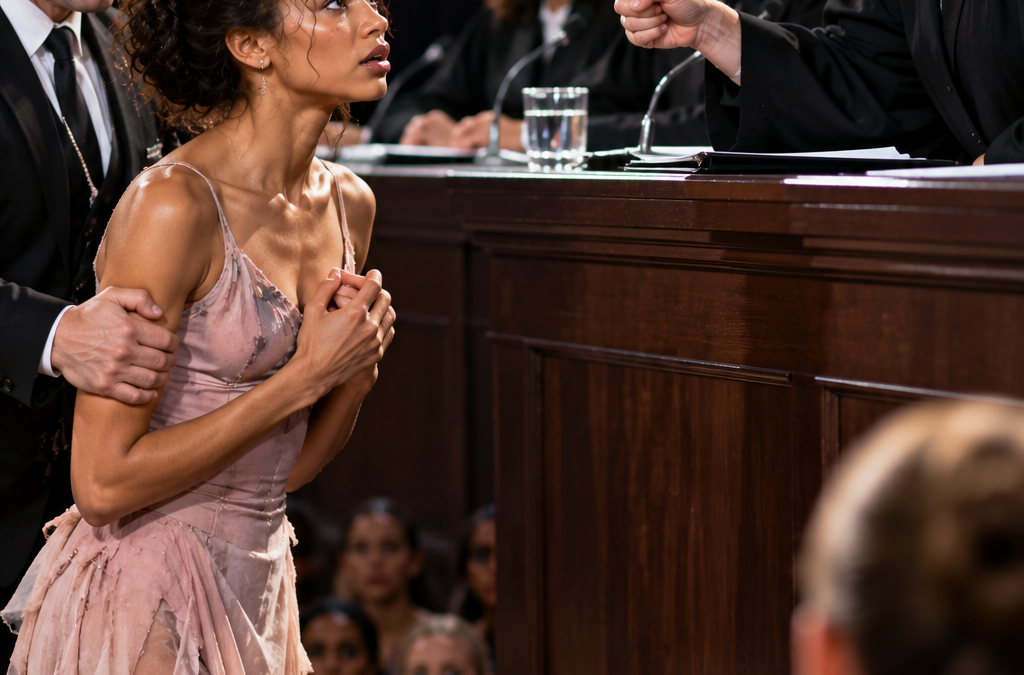
The woman at the center of the judges’ table looked at my taped-up shoes, my secondhand clothes, and the color of my skin, then told security to remove me before I “stained” her stage.
When I told her my father was dying and this competition was the only chance I had left to save him, she barely looked up before saying, “Then let him die somewhere else.”
Three weeks earlier, I was standing in our apartment kitchen in Memphis trying to decide which bill could survive another month unpaid.
The light above the stove had burned out.
The kitchen sink leaked if you turned the faucet too far left.
And on the counter in front of me sat three things I couldn’t make fit together no matter how many times I moved the numbers around.
Rent.
Groceries.
My father’s medication.
I chose the medication.
Again.
My name is Paige Hayes.
I was nineteen years old.
I lived with my father, Elliot, in a two-room apartment in Parkway Village, the kind of building where everybody knew which stair squeaked, which landlord promise meant nothing, and which neighbors would feed you when money disappeared before payday.
Dad had spent twenty-six years as a plumber.
He could look at a wall and tell you where the pipes ran behind it.
He could hear water moving through copper and know whether the pressure was wrong.
He fixed leaks in houses with swimming pools bigger than our apartment.
He repaired bathrooms where the towels probably cost more than our monthly grocery budget.
Some owners made him use the side entrance.
A few wouldn’t let him sit on the furniture.
He never complained to me.
He would come home, wash his hands, and ask what I wanted for dinner.
That was Elliot Hayes.
He showed up.
Every day.
Until his body stopped cooperating.
The diagnosis came four months earlier.
Stage-four kidney failure.
I remember the doctor’s lips moving.
Words like function.
Decline.
Dialysis.
Transplant.
Waiting list.
Then the number.
Eighteen months.
That was the estimated wait.
My father didn’t have eighteen months.
There was another route.
Private transplant coordination.
Additional donor-network access.
Faster treatment.
Eight weeks if everything aligned.
Fifty thousand dollars.
The doctor said the number gently, as if kindness could make it smaller.
I stared at him.
“Fifty?”
“Approximately.”
“Five-zero?”
“Yes.”
I almost laughed.
Not because it was funny.
Because numbers become absurd when they pass beyond anything you’ve ever had.
Fifty thousand dollars.
Dad had worked nearly three decades.
I worked three jobs if you counted dancing as work, which nobody did because nobody paid me for it.
Our savings wouldn’t have covered one month of that plan.
I contacted charities.
Churches.
Hospital funds.
Medical foundations.
Community assistance programs.
Some forms took three hours to complete.
Some asked for documents we didn’t have.
Some promised callbacks.
Most gave us the same sentence.
We’ll keep your family in our prayers.
I stopped liking that sentence.
Prayer had its place.
Prayer didn’t pay hospital invoices.
So I worked.
Mornings at a laundromat on Lamar Avenue.
Nine dollars an hour.
I folded shirts belonging to people who sometimes left twenty-dollar bills in their pockets and came back demanding I find them.
Afternoons, I cleaned office suites downtown.
I emptied trash cans containing restaurant food I couldn’t afford.
Sometimes I’d look at a half-eaten sandwich sitting on top of clean paper and hate myself for wondering whether I could wrap it up.
I never did.
Pride is strange.
It lets you go hungry while convincing you that hunger is better than shame.
Then I came home.
Cooked.
Organized Dad’s medication.
Checked his oxygen.
Sat with him until he fell asleep.
And after midnight, I danced.
There was an abandoned garage beneath our building.
Concrete floor.
One cracked mirror leaning against a wall.
One electrical outlet that worked if you pushed the plug upward.
No heat.
No air-conditioning.
I had a portable speaker with tape around the battery compartment.
That was my studio.
I never took formal lessons.
Couldn’t afford them.
Everything I knew came from videos downloaded on library Wi-Fi, competition recordings, free tutorials, and my own body learning what felt right.
Dad gave me rhythm before I understood dance.
When I was little, I followed him around job sites whenever he could bring me.
He used to tap his wrench against copper pipe.
Four beats.
Tap.
Tap.
Tap.
Tap.
Then again.
I would bounce beside him.
“Look at my little star.”
That was his name for me.
Little Star.
Once, when I was about nine, he watched me dance in our living room and said:
“You move like your mama.”
Then he became very quiet.
He never said it again.
I grew up knowing I had a mother in the biological sense.
Someone had given birth to me.
Beyond that, there was nothing.
No photographs in frames.
No birthday cards.
No Christmas packages.
No late-night phone calls.
No explanation.
When I asked as a child, Dad said:
“She wasn’t ready.”
When I asked when I got older, he said:
“Some people leave because staying requires more courage than they have.”
Eventually I stopped asking.
There was one thing from her.
A bracelet.
Red thread braided tightly around my wrist with a small brass clasp.
Dad made it for my fifth birthday.
He told me the thread had belonged to my mother.
She had bought it shortly before she left.
Dad spent three nights braiding it.
The clasp had tiny words etched into the metal.
DANCE FOR ME, LITTLE STAR.
I wore it every day.
Not because I loved her.
I didn’t know her well enough to love her.
I wore it because Dad had taken something left behind and turned it into something worth keeping.
That was his gift.
He knew how to repair things.
Even memories.
The competition poster appeared on a Tuesday.
I was working at the laundromat when somebody taped it to the front window.
RISE AND SHINE.
National Dance Competition.
Open Auditions.
Atlanta.
Grand Prize: $75,000.
I stared at it so long my manager asked whether I was having a medical emergency.
Seventy-five thousand dollars.
The number made my chest hurt.
Fifty thousand for Dad.
Enough left for recovery expenses.
Rent.
Bills.
Maybe time.
Mostly time.
I tore one of the information slips from the bottom of the poster.
That night I showed Dad.
“No.”
He didn’t even finish reading it.
“Dad.”
“No.”
“Listen.”
“I said no.”
“Seventy-five thousand dollars.”
He looked away.
“That’s why you’re thinking about it.”
“Of course that’s why.”
“You’ve never competed.”
“I dance every night.”
“In a garage.”
“Yes.”
“Paige.”
“Fifty thousand dollars.”
His face tightened.
I hated using the number.
It felt like a weapon.
But I was desperate.
“You heard the doctor.”
“I was there.”
“You know what this could mean.”
“What if you lose?”
I said nothing.
“What if you take a bus to Atlanta, stand in front of people who’ve been training since they were four, and they laugh at you?”
“Then they’ll laugh.”
“And then?”
“I come home.”
His oxygen machine hummed between us.
He looked exhausted.
Not old.
Dad wasn’t old enough to look that old.
Kidney failure had taken weight from his face and strength from his hands.
The same fingers that once tightened pipe fittings above his head now shook when he lifted a glass.
He leaned back.
“You think people like that want to see a girl from Parkway Village on their stage?”
“I don’t know.”
“I do.”
“Then let them tell me.”
“Paige.”
“You raised me alone for nineteen years.”
My voice cracked.
“Let me fight for you once.”
He stared at me.
Then reached for the remote and turned off the television.
That was Dad’s habit.
If something mattered, noise had to stop.
“Come here.”
I knelt beside the recliner.
He took my wrist.
The bracelet rested against his fingers.
“If you go, you dance for yourself.”
“Dad—”
“Listen to me.”
I did.
“You do not turn the thing you love into a debt you owe me.”
I felt tears building.
“You don’t dance because my kidneys are failing.”
“But the money—”
“I know about the money.”
He squeezed my hand.
“You dance because it’s yours.”
I nodded.
“And you come back.”
“I will.”
“No matter what happens.”
“I promise.”
Our neighbor Gloria agreed to check on him.
Gloria Bennett had lived next door since before I started high school.
She had opinions about everybody’s business and a spare key to ours.
At the bus station, she pressed forty dollars into my hand.
“No.”
“Yes.”
“Ms. Gloria—”
“Don’t embarrass me by making me argue with a teenager.”
“I can pay you back.”
“If you come back rich, you can buy me dinner.”
She hugged me.
“Show them what Memphis makes.”
The Greyhound left at 6:14 Wednesday morning.
I had three changes of clothes.
A toothbrush.
My portable charger.
A pair of sneakers held together with black electrical tape.
And enough fear to fill every empty seat on the bus.
I watched Memphis shrink behind the glass.
Dad texted before we reached the interstate.
Come back no matter what.
I answered:
Promise.
The Atlanta Convention Center looked like a place built by people who had never worried about rent.
Glass walls.
Polished stone.
Huge banners hanging from ceilings three stories high.
Hundreds of dancers crowded the lobby.
Some wore jackets with studio names embroidered across the back.
Some had coaches.
Parents.
Managers.
Matching luggage.
Headphones that cost more than my phone.
I stood near the entrance holding my duffel bag.
For the first time since leaving Memphis, I almost turned around.
I looked down at my sneakers.
Black tape around the left toe.
Bleach stain on my leggings.
Gray tank top from Goodwill.
Then I touched the bracelet.
Four beats.
Tap.
Tap.
Tap.
Tap.
I could hear Dad’s wrench.
I got in line.
Contestant 412.
Studio B.
Third group.
That was where I met Derek Ashton.
I heard his voice before I knew his name.
“Somebody tell me this is a joke.”
I kept walking.
He stood with three dancers in matching white jackets.
Tall.
Perfect hair.
Expensive shoes.
The kind of confidence that comes from never wondering whether the world will make room for you.
He looked directly at me.
“They’re letting anyone audition now?”
His friends laughed.
I adjusted my bag.
He stepped closer.
“What studio?”
I said nothing.
“I’m talking to you.”
“I don’t have one.”
He blinked.
Then looked at his friends dramatically.
“No studio?”
More laughter.
“Where’d you train?”
“In a garage.”
That nearly killed him.
He bent forward laughing.
“A garage?”
“Yes.”
He circled me.
“What, between broken washing machines?”
“Mostly concrete.”
“Jesus.”
A girl nearby giggled.
Derek leaned closer.
“You smell like a Greyhound station.”
I held his eyes.
He smiled.
“Go home, sweetheart.”
I stepped around him.
He blocked me.
“This stage isn’t built for girls like you.”
“Girls like me?”
His smile disappeared.
“Poor.”
Then:
“Black.”
His friends went quiet.
“At least I’m saying it.”
I studied his face.
He wanted anger.
Wanted tears.
Wanted proof that he mattered enough to hurt me.
I walked past him.
Behind me, he called:
“She won’t survive the first cut.”
Studio B had three judges.
Mona Sullivan sat on the left.
Silver rings.
Warm face.
A male guest judge sat on the right.
And in the center was Vivian Cole.
I knew her name.
Everybody who followed competitive dance knew Vivian Cole.
Former professional dancer.
Choreographer.
Television personality.
Known for being brutal.
People called it honesty.
She walked in wearing a black blazer.
Hair tight.
Reading glasses hanging from a chain.
She sat without greeting us.
“Contestant 412.”
I stepped forward.
The assistant read:
“Paige Hayes.”
Vivian’s pen stopped.
I noticed.
She looked up.
Her eyes found my face.
Then my clothes.
My shoes.
Then my wrist.
The red bracelet.
Her expression changed.
Only slightly.
A tightening around the mouth.
She looked back at the paper.
Mona smiled at me.
“Whenever you’re ready, Paige.”
I closed my eyes.
The music started.
Cello.
Slow.
Simple.
I thought about Dad.
About the sound he made when he coughed.
About the medicine on the counter.
About waking up at four in the morning because I was terrified he might stop breathing while I slept.
Then I moved.
I didn’t dance like the girls I’d watched stretching in the lobby.
My body didn’t know academy rules.
It knew survival.
When I folded toward the floor, I thought of hospital hallways.
When I reached upward, I thought of Dad trying to lift a glass with shaking hands.
When I turned, I imagined distance.
Memphis.
Atlanta.
Nineteen years of one man staying.
Ninety seconds.
At the end, I dropped to my knees.
One palm against the sprung floor.
The other pressed over the bracelet.
Silence.
Then Mona whispered:
“Oh my God.”
I opened my eyes.
The guest judge was writing quickly.
Scores.
8.9.
9.1.
Vivian stared at me.
For some reason, she looked frightened.
Then she wrote.
7.2.
Enough to pass.
Barely.
She capped her pen and stood.
Mona looked at her.
“Viv?”
Vivian walked out.
I thought she hated me.
I was wrong.
She had recognized me.
I just didn’t know it yet.
I survived the first cut.
Then the second.
Then the third.
Four hundred dancers became two hundred.
Two hundred became one hundred.
One hundred became sixty.
Then twenty.
Weeks passed.
The production housed finalists in shared dorm rooms.
I slept on a thin mattress.
Ate whatever food was available backstage.
Saved every dollar.
Called Dad every night.
His voice changed.
At first, subtly.
Then enough that I couldn’t lie to myself.
His sentences grew shorter.
More space between breaths.
One night I called Gloria after talking to him.
“Tell me the truth.”
She went quiet.
“Ms. Gloria.”
“He’s getting worse.”
“How much worse?”
“The doctor wants dialysis three times a week.”
I pressed my palm against my forehead.
“He told me twice.”
“He lied.”
“He didn’t want you coming home.”
“Can he walk?”
“Some mornings.”
My eyes closed.
“Some?”
“I help him other mornings.”
I sat on the bathroom floor.
The tile was cold beneath my legs.
“I should come back.”
“He’ll kill me if I tell you that.”
“I don’t care.”
“I do.”
Her voice softened.
“Baby, you’re still there because he wants you there.”
“I could lose him.”
“Yes.”
The word cut through me.
No comfort.
No promise.
Just truth.
“You could.”
I cried silently.
Then wiped my face.
“Check him in the morning.”
“I always do.”
“Call me if anything changes.”
“I promise.”
The other dancers knew about Dad.
Once television producers learn you have pain, pain becomes biography.
Derek hated that.
He called me a sympathy contestant.
Never directly after the lobby.
He preferred an audience.
One afternoon, I heard him from two tables away in the cafeteria.
“The producers love it.”
His friends listened.
“Poor Black girl. Dying dad. Garage dancer. Come on. It’s made for television.”
A girl said:
“She is good.”
“Not enough.”
He saw me listening.
His voice got louder.
“Talent isn’t training.”
I finished my sandwich.
Cleared the tray.
Went into the practice room.
Then danced until blood came through the tape around my toes.
That night, Dad called.
Gloria had propped him in the recliner.
He looked skeletal.
I hated the camera for showing me details I could pretend not to see over the phone.
“I watched you.”
His voice sounded rough.
“Which dance?”
“The last one.”
“What’d you think?”
He smiled.
“You move like your mama.”
There it was again.
This time I didn’t let him escape.
“Who was she?”
His smile faded.
“Paige.”
“No.”
I sat straighter.
“You’ve said that twice in my entire life.”
“Little Star—”
“Why did she leave?”
He closed his eyes.
For a long time, the oxygen machine spoke for him.
Then he said:
“She was twenty.”
I waited.
“Her family had money.”
“How much?”
“Enough to believe it made them better.”
I said nothing.
“Germantown people. Old Memphis money.”
He swallowed.
“She married me anyway.”
“You were married?”
“Yes.”
That alone hurt.
I had never known.
“She loved you?”
“I think she tried to.”
“What does that mean?”
“She loved me when it was rebellion.”
My chest tightened.
“Then you were born.”
His eyes met mine through the screen.
“And when they saw you…”
He stopped.
“Dad.”
“Your grandmother told her she’d ruined the family bloodline.”
My stomach turned.
“She said your mother could come home.”
I knew before he finished.
“But not with me.”
His eyes filled.
“Yes.”
I pressed my wrist to my mouth.
The brass clasp touched my lip.
“And she chose them.”
“Yes.”
No excuse.
No softening.
“She chose to leave us.”
“Yes.”
The bathroom felt smaller.
“You let me believe she just wasn’t ready.”
“What was I supposed to tell a five-year-old?”
“The truth.”
“You were five.”
“What about fifteen?”
He looked away.
“I couldn’t make her leaving become your identity.”
I started crying.
“She bought the red thread?”
“The week before she left.”
“Why?”
“I don’t know.”
He smiled sadly.
“You used to dance even as a baby.”
My thumb traced the worn clasp.
“She called you Little Star once.”
My breath caught.
Dad continued.
“After she left, I couldn’t throw the thread away.”
“So you braided it.”
“Took me three nights.”
I laughed through tears.
“You’re terrible at crafts.”
“That’s why it took three nights.”
I wiped my face.
“You should hate her.”
“I did.”
“Do you?”
“No.”
“How?”
He leaned back.
“Hatred charges rent, baby. I got too many bills already.”
That was Dad.
Even dying, he found a way to make me smile.
Then he became serious.
“You owe her nothing.”
I nodded.
“And you owe me nothing.”
“I owe you everything.”
“No.”
He pointed weakly toward the camera.
“That is exactly what I don’t want inside your head.”
I said nothing.
“You stay in Atlanta because Paige Hayes wants to dance.”
“What about the money?”
“If you win, we use it.”
“And if I don’t?”
“Then you come home and we figure out the next thing.”
His eyes softened.
“But you do not make my illness the reason your life begins.”
After we ended the call, I sat on the floor.
Then I opened my phone.
New routine.
I typed a title.
Invisible Daughter.
The next round required us to tell our story.
Four minutes.
Complete creative freedom.
My dance began at an invisible doorway.
I stood reaching toward it.
Waiting.
Wanting.
Then I let the door close.
The rest of the piece wasn’t about abandonment.
It was about what happens when you stop waiting for the person who left to come back.
When I finished, two thousand people stood.
Mona stood first.
The guest judge cried.
Vivian didn’t move.
She sat in the middle.
White-faced.
Her mouth pressed tight.
Her hand shook.
Then she wrote 9.5.
Her highest score all season.
Mona leaned over.
“She earned it,” Vivian said.
Something about her voice made me look at her differently.
Pain recognizes pain even before it understands the source.
After the show, she disappeared.
I didn’t know that in her hotel room she was opening a leather case she had carried for nineteen years.
I didn’t know there was an ultrasound photograph inside.
A hospital bracelet from Memphis.
Or a piece of red thread.
I didn’t know that at 6:47 the next morning, she received confirmation that Paige Elaine Hayes, daughter of Elliot James Hayes, was the child she had abandoned.
I only knew the woman who had treated me with coldness from the first audition had suddenly started looking at me like seeing me hurt.
The semifinal theme was dedication.
I called my piece Broken Pipe, Golden Hands.
It began with Dad’s rhythm.
Four beats.
My hand mimicked a wrench striking copper.
Tap.
Tap.
Tap.
Tap.
Then I turned labor into movement.
His hands had fixed houses all day.
Those same hands had braided my bracelet.
Packed lunches.
Signed school forms.
Held my hair back when I threw up.
Taught me to ride a bike.
Checked my forehead for fever.
Worked.
Stayed.
The dance was about hands.
Not glamorous hands.
Not soft hands.
Working hands.
At the end, I stood perfectly still.
Tears on my face.
The entire audience rose.
Vivian stared at me.
Her eyes were full.
She gave me 9.8.
Mona whispered:
“Viv, are you okay?”
“I’m fine.”
“You’re crying.”
Vivian snapped:
“I said I’m fine.”
I advanced to the final.
So did Derek.
That should have been the biggest event of the night.
It wasn’t.
Derek had noticed Vivian.
Her reactions.
Her scores.
The way she watched me.
Instead of minding his own life, he hired someone to investigate hers.
He found the marriage record.
Vivian Marie Ashworth.
Elliot James Hayes.
He found my birth certificate.
The press event happened the next afternoon.
Two hundred reporters.
Livestream.
Judges and semifinalists sitting on a raised platform.
I was exhausted.
I wanted food and sleep.
The host was closing the session when Derek leaned toward his microphone.
“I think people deserve to know something.”
My stomach tightened.
The host tried to interrupt.
He continued.
“Vivian Cole isn’t her real name.”
Vivian went still.
“Her name was Vivian Hayes.”
I looked at her.
She looked at Derek.
“She married a Black plumber in Memphis.”
Everything inside me became quiet.
“His name is Elliot Hayes.”
I stopped breathing.
Derek turned toward me.
“And Paige Hayes is their daughter.”
There are moments when your body understands before your mind does.
I looked at Vivian.
Her jaw.
Her eyes.
Something about the shape of her face.
My own reflection flashed through my mind.
Derek continued.
“The daughter she abandoned after her wealthy white family decided a mixed-race baby was a disgrace.”
The room vanished.
Lights.
Cameras.
People.
Gone.
There was only Vivian.
Three chairs away.
My mother.
The woman who had looked at me from the judges’ table.
The woman whose name had been an empty space my entire life.
The woman who had left because of the skin I was born wearing.
I heard myself ask:
“Is that true?”
My voice barely existed.
Vivian stood.
Her chair scraped against the platform.
“Paige—”
“Is it true?”
She looked terrified.
Good.
For once, she should have been.
The host asked:
“Vivian?”
Cameras moved.
The livestream count exploded.
Vivian looked at me.
Then said:
“I won’t deny it.”
My hands gripped the chair.
“I was twenty.”
I wanted to scream.
Twenty?
As if age changed nineteen years.
“I was a coward.”
Her voice broke.
“I chose my family’s approval.”
She swallowed.
“Over my husband.”
Another breath.
“Over my child.”
My child.
I hated hearing her say it.
She had no right to the possessive.
“I have no defense.”
She looked at me.
“I am sorry.”
Then she walked away.
The room erupted.
Questions.
Camera flashes.
People calling my name.
I stayed seated.
Derek looked satisfied.
That was when I understood something about him.
He hadn’t exposed the truth because he cared what had happened to me.
He exposed it because he wanted to hurt both of us publicly.
Pain was entertainment to him.
I left.
Locked myself in the dorm bathroom.
Called Dad.
He answered on the third ring.
“Paige?”
“Is the judge my mother?”
Silence.
“Dad.”
His voice cracked.
“I never wanted you to find out this way.”
My eyes closed.
“You knew who she was?”
“I knew who your mother was. I didn’t know Vivian Cole was her.”
“You didn’t recognize her?”
“I haven’t seen her in nineteen years. New hair. New name. Television makeup. I swear to you.”
I pressed my forehead against the tile.
“I want to come home.”
“No.”
“Dad.”
“No.”
“You’re sick.”
“And you’re in the final.”
“I don’t care.”
“Yes, you do.”
“I care about you more.”
“I know.”
His voice strengthened.
“She already took enough.”
I stopped.
“She left. That’s what she took.”
He breathed carefully.
“She does not get your final too.”
My phone buzzed.
Gloria.
I opened the text.
Doctor called.
Numbers worse.
Maybe two weeks.
Come home or come home with the money. But come home.
I closed my eyes.
One performance.
Seventy-five thousand dollars.
Dad said:
“You still there?”
“Yes.”
“Dance.”
I whispered:
“Okay.”
That night, I went into an empty studio.
No cameras.
No judges.
No crowd.
Just fluorescent light and my portable speaker.
The same as the garage.
I danced until three in the morning.
The finale drew twelve million viewers.
Scandal does that.
People who had never cared about dance suddenly wanted to watch the abandoned daughter.
I hated that phrase.
Abandoned daughter.
As though what somebody did to me had become my entire name.
The auditorium was packed.
People held signs.
JUSTICE FOR PAIGE.
STAY LIKE ELLIOT.
One little girl had drawn:
DANCE, PAIGE.
Vivian wasn’t judging.
The production removed her.
Derek performed first.
He was technically perfect.
Sharp.
Expensive.
Professional.
Every move clean.
9.2.
9.4.
9.3.
He smiled as if he’d already won.
Then the lights went dark.
I walked onto the stage barefoot.
White tank top.
Black leggings.
Red bracelet.
Nothing else.
My final piece was called Letter to My Mother.
The title wasn’t for Vivian.
It was for me.
The piano began.
I stood still.
Then reached.
My hand moved toward an invisible person.
A child waiting.
At a window.
At a door.
In a school auditorium.
At birthdays.
Christmas mornings.
Graduation photographs.
All the places a child unconsciously scans a crowd looking for someone she claims not to need.
I moved forward.
Reached.
Again.
Again.
No one answered.
Then the music changed.
I folded inward.
That was grief.
Not grief for Vivian herself.
Grief for the mother-shaped space.
The questions.
Was I too dark?
Too poor?
Too much like Dad?
Not enough like her?
What exactly does a baby do to make her mother leave?
Then came anger.
My body hit the floor.
Hard.
I rolled.
Contracted.
Pushed.
Fell.
Rose halfway.
Fell again.
Because that’s what hurt does.
It doesn’t become strength in one beautiful movement.
You crawl.
You shake.
You fail.
Then something changes.
Dad’s face came into my mind.
His hands.
His wrench.
Four beats.
Tap.
Tap.
Tap.
Tap.
I planted one foot.
Then a hand.
Then stood.
The last minute wasn’t for the mother who left.
It was for the father who stayed.
I stopped reaching.
My movements grew larger.
Not asking.
Not waiting.
Not apologizing.
The bracelet flashed beneath the spotlight as I turned.
On the final count, I stopped center stage.
Arms open.
Palms upward.
Not reaching.
Simply there.
I opened my eyes.
Silence.
One second.
Two.
Then the building exploded.
People stood.
The sound hit my body.
I looked toward the judges.
Mona was crying.
The other two stood.
Scores appeared.
10.0.
10.0.
10.0.
I stared.
The show’s first perfect score.
Somewhere above me, in a balcony I didn’t know she occupied, Vivian was crying.
I learned that later.
At the time, I wasn’t thinking about her.
The host came out with the envelope.
Derek stood on one side.
I stood on the other.
“The winner of Rise and Shine…”
Three seconds.
“Paige Hayes.”
My knees almost gave out.
Confetti fell.
The audience disappeared behind gold and white.
Someone handed me a microphone.
I couldn’t feel my fingers.
I looked into the crowd.
Twelve million viewers.
Thousands in the room.
I thought about Dad in his recliner.
Gloria holding the phone up.
“This money is for one person.”
My voice cracked.
“The man who got up before sunrise for twenty-six years to fix other people’s homes.”
The room quieted.
“The man who came home with tired hands and still cooked dinner.”
I touched the bracelet.
“The man who took a piece of thread someone else left behind and spent three nights turning it into something worth keeping.”
My throat closed.
“The man who stayed.”
I took a breath.
“My father, Elliot Hayes.”
I didn’t say Vivian’s name.
Not once.
I flew home Sunday morning.
Not Greyhound.
Plane.
For the first time in my life, urgency mattered more than price.
Before leaving Atlanta, I transferred fifty thousand dollars to the hospital.
When I reached Dad’s room, he was sleeping.
Above the bed, written on the whiteboard:
SURGERY — TUESDAY — 8:00 A.M.
Gloria stood in the corner.
She saw me.
Pressed a finger to her mouth.
Then hugged me.
“You did it.”
I held her.
“No.”
She pulled back.
“What?”
“We did.”
Dad woke thirty minutes later.
His eyes found me.
A smile appeared.
“There she is.”
I sat beside him.
“You scared me.”
“I’ve been here.”
“Barely.”
He lifted one hand.
I took it.
“I saw the final.”
“Gloria?”
“She nearly dropped the phone twice.”
“I did not,” Gloria snapped from the corner.
Dad ignored her.
“Little Star.”
“Yeah?”
“You stopped reaching.”
I knew exactly what he meant.
“I did.”
He squeezed my fingers.
“Good.”
The surgery lasted four hours.
I spent every minute in a waiting room staring at a clock.
11:42.
11:51.
12:03.
12:17.
The surgeon appeared.
I stood so fast the chair scraped backward.
“He’s stable.”
I couldn’t breathe.
“The kidney is functioning.”
Gloria covered her mouth.
“He’s going to be okay.”
I nodded.
Didn’t cry.
Walked into the bathroom.
Locked the door.
Sat on the floor.
Then pressed the bracelet to my forehead and shook for ten straight minutes.
Dad came home the next week.
Weak.
Thin.
Alive.
That last word mattered more than anything else.
Alive.
Three weeks later, someone knocked on our apartment door.
I opened it.
Vivian Cole stood on the landing.
No television makeup.
No blazer.
No assistant.
Plain coat.
Flat shoes.
She looked smaller.
Not physically.
Human.
“I don’t deserve to be here.”
“No.”
My answer surprised her.
“You don’t.”
From inside, Dad called:
“Who is it?”
I stepped into the hallway.
Pulled the door mostly closed.
“This isn’t about him.”
Vivian nodded.
“I watched your interviews.”
I said nothing.
“Every time someone asked about me, you refused.”
“That wasn’t for you.”
“I know.”
“Everything I did was for him.”
“I know that too.”
She looked at the bracelet.
Her eyes changed.
“I remember buying that thread.”
My wrist suddenly felt exposed.
“You don’t get to do that.”
She looked up.
“What?”
“Don’t turn that into nostalgia.”
Her face collapsed slightly.
“Paige—”
“You want something from me.”
She didn’t deny it.
“So I’m going first.”
She waited.
“You do not call yourself my mother.”
Her eyes filled.
“Not yet.”
She nodded.
“That word is earned.”
“Yes.”
“You come to Memphis.”
“I will.”
“You sit in this apartment.”
“Yes.”
“You learn who I am when there are no cameras.”
“Yes.”
“Not the dancer.”
She nodded.
“Not the girl from the news.”
“Yes.”
“Me.”
“I understand.”
“No.”
I stepped closer.
“You don’t understand anything yet.”
She looked down.
“But you can learn.”
That made her look at me again.
“You call your family.”
Her face tightened.
“The people in Germantown.”
Silence.
“The ones who told you your Black baby ruined the bloodline.”
She swallowed.
“You tell them my name.”
“I will.”
“Full name.”
“Yes.”
“Paige Elaine Hayes.”
“Yes.”
“You tell them Elliot Hayes raised me.”
Tears rolled down her face.
“Yes.”
“And you tell them I won.”
“I will.”
I crossed my arms.
“One more thing.”
“Anything.”
“Don’t say anything in public.”
She looked confused.
“No interviews about your guilt.”
“Okay.”
“No apology tour.”
“Yes.”
“No documentary.”
She almost laughed through the tears.
I didn’t.
“Your regret is not a redemption story.”
Her face sobered.
“I understand.”
“Your tears are not content.”
“Yes.”
“And if you disappear again…”
I stopped.
The hallway was quiet.
She looked at me.
“If you disappear again, never come back.”
She closed her eyes.
“I won’t.”
“We’ll see.”
I went inside.
Closed the door.
Dad looked at me from his recliner.
“You okay?”
“No.”
He nodded.
“That makes sense.”
I sat beside him.
He didn’t ask what she said.
Didn’t tell me what to feel.
That’s what staying looks like sometimes.
Not fixing.
Not advising.
Just remaining in the chair beside somebody while they figure out who they are.
Vivian came back the following Saturday.
Then the Saturday after that.
And the one after that.
She sat at our kitchen table.
Dad read the paper.
I cooked.
Sometimes we spoke.
Sometimes we didn’t.
Nobody called her Mom.
Nobody said everything was forgiven.
Nobody pretended nineteen years could be repaired with consistency measured in weekends.
She just came.
Rain.
Heat.
Silence.
She kept coming.
Three months later, I leased a small storefront on Lamar Avenue.
Three blocks from the laundromat.
Twenty thousand dollars from the prize money.
I turned it into a dance studio.
Not polished.
Not fancy.
Good floor.
Mirrors.
Speakers.
Enough room.
I called it Golden Hands Dance Studio.
Dad pretended not to be emotional about the name.
He failed.
Thirty-two children came on opening day.
Some had dance shoes.
Some wore sneakers.
A few were barefoot.
One girl had tied a red ribbon into her hair.
I stood in front.
Dad sat near the wall.
Gloria beside him.
Vivian stood behind the parents.
Not beside me.
Not in front.
Exactly where she belonged.
I clapped four beats.
Tap.
Tap.
Tap.
Tap.
The children followed.
Again.
Tap.
Tap.
Tap.
Tap.
“That’s rhythm,” I told them.
Dad smiled.
The first class lasted an hour.
Nobody was eliminated.
Nobody was told they didn’t belong.
Nobody was asked what studio had trained them.
Nobody was judged by shoes.
Or money.
Or skin.
At the end, a little boy raised his hand.
“Ms. Paige?”
“Yes?”
“When do we learn the hard stuff?”
I smiled.
“This is the hard stuff.”
He frowned.
“Counting?”
“Listening.”
The parents laughed.
Dad nodded like I’d finally said something intelligent.
After everyone left, I found him staring across the studio.
“What?”
“Nothing.”
“You’re crying.”
“Kidney medication.”
“Dad.”
He laughed.
Then looked at the floor.
“You built yourself a garage.”
I looked around.
Mirrors.
Open room.
Tape marks.
Children’s water bottles forgotten in a corner.
He was right.
Just with better lighting.
On the wall, I placed the original red bracelet inside a glass frame.
I didn’t wear it anymore.
Not because it had lost meaning.
Because its meaning had changed.
Underneath, I wrote:
FOR EVERY CHILD WHO DANCED ALONE.
Vivian came to the opening.
She stood behind everyone.
When our eyes met, she didn’t approach.
Didn’t force a moment.
She simply waited.
I gave her one nod.
Tiny.
Not forgiveness.
Recognition.
You’re here.
That matters.
Later, when the studio was empty, Dad and I sat on the floor.
His recovery was going well.
Not perfect.
Nothing real is.
He still tired easily.
Still had appointments.
Still took more pills than either of us liked.
But his hands didn’t shake as badly.
He tapped the floor.
Four beats.
Tap.
Tap.
Tap.
Tap.
I looked at him.
“You started all this.”
“Don’t blame me.”
“I mean it.”
“So do I.”
I leaned against the mirror.
“You knew I could dance?”
“Before you could walk.”
“Why didn’t you put me in classes?”
He looked offended.
“With what money?”
I laughed.
“Fair.”
Then he became serious.
“I thought about it.”
“When?”
“When you were eight.”
“What happened?”
“Rent happened.”
Of course.
“Then twelve.”
“What happened?”
“Your appendix.”
I remembered.
“Then fifteen.”
“What happened?”
He smiled.
“You decided you hated dance for six months.”
“Oh.”
“You were very dramatic.”
“I was fifteen.”
“Exactly.”
I leaned my head back.
“Do you regret anything?”
He looked at me.
“About you?”
“Life.”
He considered the question.
“I regret being angry as long as I was.”
“At Vivian?”
“Yes.”
“Why?”
“It didn’t bring her back.”
I looked toward the framed bracelet.
“Do you want her back?”
He was quiet.
“No.”
The answer came gently.
“That life ended nineteen years ago.”
“Then why let her come here?”
“I’m not.”
I frowned.
“You are.”
“No.”
He pointed at me.
“You are.”
I understood.
“I’m not forgiving her.”
“I didn’t say you were.”
“Maybe I never will.”
“That belongs to you.”
“What if she keeps showing up?”
He shrugged.
“Then she’ll have kept showing up.”
“That’s enough?”
“For what?”
“To make up for it.”
He shook his head.
“No.”
The answer relieved me.
“Nothing makes up for it.”
He looked toward the front windows.
“But people aren’t bank accounts, Paige.”
“What does that mean?”
“You don’t balance nineteen bad years with nineteen good ones and call it even.”
“So what do you do?”
“Decide what relationship is possible now.”
I stared at him.
“You’ve gotten annoyingly wise since surgery.”
“New kidney.”
I laughed so hard I had to wipe my eyes.
Six months after the competition, Vivian arrived early one Saturday.
I was cleaning mirrors.
She stood near the entrance.
“Can I help?”
“With what?”
“Cleaning.”
I handed her a cloth.
She started wiping the lower mirrors.
After ten minutes, she said:
“I called my mother.”
I stopped.
Vivian’s mother was still alive.
Eighty-two.
Still in Germantown.
“What happened?”
“I told her your name.”
I set my cloth down.
“And?”
“She said she’d seen you on television.”
“Of course.”
Vivian looked at the mirror.
“She said you were talented.”
I waited.
“She didn’t apologize.”
I wasn’t surprised.
“I told her that wasn’t what I called for.”
“What did you call for?”
“To tell her she was wrong.”
My chest tightened.
“She said I embarrassed the family.”
I laughed once.
Bitter.
Vivian looked at me.
“So I told her I had already done that nineteen years ago.”
Silence.
“I told her the embarrassment wasn’t marrying Elliot.”
Her eyes filled.
“It was leaving.”
I didn’t know what to say.
So I picked up my cloth again.
After a while, I said:
“Good.”
That was all.
She didn’t ask for more.
A year later, Golden Hands had eighty-three students.
We started scholarships.
Then free summer classes.
A local arts nonprofit donated a proper sprung floor.
Mona Sullivan came to teach a weekend workshop.
She hugged me so hard I couldn’t breathe.
Derek disappeared from the competition circuit for a while.
His sponsors dropped him.
His privacy violation became part of an investigation into how he obtained confidential records.
I didn’t follow the details.
For months people wanted me to be angry at Derek.
I was.
But eventually he became irrelevant.
The same happened with the comments.
The people who mocked my shoes.
My neighborhood.
My training.
They had been loud when I needed silence.
Then life moved forward without them.
That’s one of the best things about surviving humiliation.
Eventually, the room where it happened becomes smaller than the life you build afterward.
Dad began volunteering at the studio.
Not teaching dance.
God help us.
He handled repairs.
Faucets.
Loose railings.
Speaker wires.
A pipe burst one winter afternoon, and I found him beneath the sink with a wrench.
“Absolutely not.”
He looked up.
“What?”
“You had a transplant.”
“Kidneys aren’t located in my hands.”
“You’re seventy percent scar tissue.”
“That’s medically inaccurate.”
I took the wrench.
He glared.
“Give me that.”
“No.”
“I’ve been a plumber twenty-six years.”
“And I’m the owner.”
He stared at me.
I smiled.
“How does that feel?”
“Like I raised an ungrateful dictator.”
“Sit down.”
He sat.
Five minutes later, he was telling me I was holding the wrench wrong.
Some things survive everything.
Vivian kept coming.
Eventually the children knew her.
Not as my mother.
As Vivian.
She sometimes helped with costumes.
Her professional experience became useful once she learned not to turn usefulness into authority.
That took time.
One afternoon a new student asked:
“Is she your mom?”
I looked at Vivian.
She didn’t answer for me.
Good.
I said:
“She gave birth to me.”
The child frowned.
“That means mom.”
“Not always.”
The child accepted that immediately and ran away.
Kids understand complexity better than adults when nobody teaches them to fear it.
Vivian looked at me.
“Thank you.”
“For what?”
“Not saying no.”
“I didn’t say yes.”
“I know.”
A year earlier, that distinction might have wounded her.
Now she nodded.
Progress.
On the second anniversary of Dad’s surgery, we closed the studio early.
Gloria brought cake.
Dad complained that the frosting was too sweet and then ate two slices.
After everyone left, I sat alone on the floor.
I thought about Atlanta.
The first audition.
Vivian looking at my shoes.
Derek laughing in the lobby.
The final stage.
Twelve million viewers.
People told my story as though winning was the miracle.
It wasn’t.
The trophy was in a cabinet in my office.
Sometimes months passed without me looking at it.
The money mattered because it helped save Dad.
The perfect score mattered for about ten minutes.
What stayed with me was something else.
I had spent years thinking being abandoned meant there had been something in me that wasn’t worth staying for.
Children do that.
Even when adults tell us otherwise.
We turn another person’s failure into evidence against ourselves.
Too loud.
Too dark.
Too poor.
Too difficult.
Too much.
Not enough.
Then I learned the truth.
Vivian didn’t leave because I lacked value.
She left because she lacked courage.
Those are not the same thing.
Understanding that did more for me than winning any competition.
The studio door opened.
Dad walked in.
“I thought you went home.”
“I forgot my jacket.”
He saw me sitting there.
“You okay?”
“Yeah.”
He sat beside me anyway.
For a while, neither of us spoke.
Then I asked:
“Why Little Star?”
He smiled.
“Your mother called you that once.”
“I know.”
“No.”
He shook his head.
“I mean before you were born.”
“What?”
“When you kicked.”
I looked at him.
“She’d lie in bed and watch your foot move under her stomach.”
His eyes softened.
“She’d say you were dancing.”
That hurt.
Not badly.
Just enough.
“She loved me?”
Dad took his time.
“Yes.”
“Then how did she leave?”
He sighed.
“Love and courage aren’t the same thing.”
I looked at him.
“You can love somebody and still fail them?”
“People do it every day.”
“That’s depressing.”
“It’s human.”
I leaned my head against his shoulder.
“So what matters?”
He looked toward the studio floor.
“What you do after you know you’ve failed.”
I thought about Vivian.
All the Saturdays.
The quiet.
The boundaries she had respected.
Her mother.
The phone call.
Showing up without demanding the title she wanted.
Maybe that was all redemption could honestly be.
Not erasing the old choice.
Making different choices now.
Dad stood.
“Come on.”
“Where?”
“Home.”
I looked around.
“This is kind of home.”
“Your bed is home.”
He reached down.
I took his hand.
The same hands that had worked pipes in houses where people sent him through the back door.
The same hands that raised me.
Braided thread.
Held hospital rails.
Clapped from a recliner while I danced on a screen.
Golden hands.
We turned off the studio lights.
On the way out, I passed the framed bracelet.
The red thread had faded even more.
The brass clasp was almost smooth.
But beneath it, the words on the card remained clear.
FOR EVERY CHILD WHO DANCED ALONE.
I locked the door.
Dad waited on the sidewalk.
“Paige?”
“Coming.”
I joined him.
And for the first time in my life, I no longer thought of myself as the daughter someone left.
I was the daughter somebody stayed for.
More importantly, I was Paige Hayes.
Dancer.
Teacher.
Owner.
Daughter.
Little Star.
Not invisible.
Not unwanted.
Not waiting at the door anymore.
And that was a life no judge, no mother, no audience, and no past could ever take away from me.








