𝗙𝗨𝗟𝗟 𝗦𝗧𝗢𝗥𝗬 The Judge Threw My Father’s Defense on the Floor and Called It Trash Before I Had Spoken a Single Word
𝗙𝗨𝗟𝗟 𝗦𝗧𝗢𝗥𝗬
Nobody laughed after that.
Two months earlier, I had not imagined myself inside that courtroom.
I had imagined a much smaller life.
A good life, maybe.
Just not the one I had dreamed about as a kid.
My father and I lived on Clayborn Street in Montgomery, Alabama, in a narrow two-bedroom house that had needed paint since I was fourteen.
Montgomery was the kind of city where you could drive fifteen minutes and feel as if you had crossed into another country.
On one side were gated neighborhoods, private tennis courts, stone entrances, three-car garages, automatic sprinklers and kitchens bigger than our entire living room.
On our side were cracked sidewalks, chain-link fences and porches where people sat outside because sometimes it was cooler than staying indoors.
My father belonged to that side of the city.
So did I.
Raymond Harris was forty-eight years old and had been a plumber for twenty-two years.
His hands looked twenty years older than the rest of him.
The skin across his knuckles was scarred from tools, pipe edges and burns. His palms were rough enough that when I was little, I used to trace the cracks in them with my finger.
He could repair almost anything.
A frozen pipe.
A broken water heater.
A clogged sewer line.
A faucet that had leaked so long the homeowner had stopped hearing it.
He could walk into a house, listen to water moving behind a wall and tell you what was wrong before opening his toolbox.
People trusted those hands.
At least they had.
My mother died when I was seven.
Cancer.
I remembered pieces of her more than I remembered whole days.
The smell of coconut lotion.
Her humming while washing dishes.
The way she tucked blankets beneath my feet.
And the sound of my father crying in the bathroom the night after her funeral because he thought I was asleep.
From that point forward, it was just us.
Dad learned how to pack school lunches.
I learned not to complain when those lunches were strange.
He learned how to iron shirts.
Eventually.
I learned how to cook eggs without burning them.
We were not poor enough to go hungry every week, but money was something that lived in every decision.
Could we buy new shoes now?
Could the water heater survive another month?
Could we pay the electric bill Friday instead of Tuesday?
Could Dad replace the tires on the van before winter?
Those were the mathematics of our house.
I understood them early.
What I did not understand early was why arguments fascinated me.
Not fighting.
I hated shouting.
Arguments.
Structure.
Evidence.
The moment when somebody made a claim and another person asked, “How do you know?”
My fifth-grade teacher, Mrs. Patterson, called Dad into school after I corrected her interpretation of a disciplinary rule.
Dad came home expecting trouble.
Instead, he walked through the door staring at me.
“You corrected your teacher?”
“She read the rule wrong.”
“You told her that?”
“Yes.”
“In front of everybody?”
I nodded.
He rubbed both hands over his face.
“Were you right?”
“Yes.”
He started laughing.
That was the first time I remember him telling me I might become a lawyer.
By twelve, I had joined the debate team.
By fourteen, I was spending afternoons at the Montgomery Public Library.
The legal section became my favorite place in the city.
I read court opinions I barely understood and kept reading until I did.
I bought a cheap composition notebook and started writing down cases.
The cover eventually cracked.
Coffee stained the bottom corner.
The spine began separating from the pages.
I refused to replace it.
Something about that notebook felt permanent.
At sixteen, I won the Alabama state debate championship.
I wore borrowed shoes and a dress shirt Dad had ironed so aggressively that the collar looked polished.
After the final round, one of the judges shook my hand.
He leaned close and said, “Young man, you were born to stand in front of a jury.”
I never told Dad exactly what he said.
My debate coach did.
Dad laughed when he heard it.
He was proud.
I could see that.
But pride did not create tuition money.
“Juries don’t pay plumbing bills yet,” he told me on the drive home.
He said it jokingly.
We both understood the truth underneath.
There was no college fund.
No lawyer in the family.
No relative with connections.
No safety net.
So after high school, I started working with Dad.
I rode beside him in the van.
I learned fittings, valves, pipe sizes and how to smile politely when wealthy homeowners watched every movement of my hands after letting me inside.
I never blamed my father.
He never asked me to abandon anything.
Life did that on its own.
I kept reading.
At night, after twelve-hour workdays, I opened the notebook.
I studied constitutional law, evidence rules, criminal procedure and cross-examinations.
Sometimes the electricity got shut off for a day because we had paid rent first.
I read using a flashlight.
Dad caught me once.
He stood in my doorway wearing an undershirt and work pants.
“You’re going blind doing that.”
“I’m fine.”
“You working tomorrow?”
“Yes.”
“Then sleep.”
“I will.”
He looked at the law book open across my knees.
“You still want it?”
I knew what he meant.
Law school.
Courtrooms.
The life we never said too loudly because saying something makes it easier for the world to take it from you.
“Yeah.”
Dad nodded.
“Good.”
Then he turned off the hallway light.
“Don’t let me be the reason you quit.”
I never forgot that.
Three years later, he drove to the Prescott estate.
Richard Prescott was a wealthy real-estate developer whose name appeared on construction signs across Montgomery.
The Prescott house stood behind stone columns and iron gates on the north side of town.
Dad had been called to replace kitchen plumbing and repair a problem in the master bathroom.
He quoted the job.
They accepted.
He arrived when he said he would.
He completed the work.
He cleaned up after himself.
Then he came home.
Two mornings later, somebody nearly knocked our front door off its hinges.
It was six o’clock.
I was filling Dad’s thermos with coffee.
The second knock rattled the picture frames.
I opened the door.
Two police officers stood on the porch.
Their hands rested near their belts.
“Raymond Harris?”
“That’s my father.”
“Where is he?”
“He’s getting dressed. What’s this about?”
They stepped past me.
I remember that more clearly than almost anything else.
Not what they said.
The fact that they did not answer me.
One officer walked toward Dad’s bedroom.
I followed.
“Sir, I asked what this is about.”
Dad came into the hallway wearing work pants and a white undershirt.
He had only buttoned half his shirt.
The officer told him to turn around.
Dad stared at him.
“For what?”
“Turn around, Mr. Harris.”
“Officer, what happened?”
They handcuffed him in our living room.
Directly beneath a framed picture of my mother.
I stood there holding his coffee thermos.
That detail still makes me sick.
The coffee was steaming.
Our day had been ready to begin.
We had two calls scheduled before lunch.
There were tools already loaded in the van.
Dad’s boots were by the door.
Everything had been ordinary thirty seconds earlier.
Then metal closed around his wrists.
“Dad?”
He looked at me.
I expected fear.
What I saw was embarrassment.
My father was ashamed that I was seeing him like that.
That nearly destroyed me.
“It’s okay, son.”
“What happened?”
“It’s a mistake.”
The officer guided him toward the door.
“I’ll be home before lunch.”
He wasn’t.
Richard Prescott had reported a Rolex missing from his master bedroom.
A watch worth approximately twenty-five thousand dollars.
The police theory was simple.
My father had worked inside the house.
He had been near the bedroom.
The watch disappeared.
Therefore, he took it.
Grand theft.
The bail amount was fifty thousand dollars.
I stared at the number in the clerk’s office until it stopped looking real.
Our savings account contained about eight hundred dollars.
Dad had been saving it for a new water heater because ours sounded as if somebody were kicking it from the inside every morning.
The van was worth a few thousand.
We rented the house.
Fifty thousand might as well have been fifty million.
Dad stayed in jail.
At first I kept expecting the mistake to correct itself.
Surely someone would look at his record.
Twenty-two years working inside customers’ homes.
No theft complaints.
No arrests.
No criminal record.
No disciplinary history.
Surely someone would ask why a man who had spent his life building a reputation would suddenly throw it away for a watch.
But systems do not correct themselves merely because the truth is obvious to the person being crushed underneath them.
The first lawyer wanted fifteen thousand dollars up front.
The second learned who Richard Prescott was and became harder to reach.
Then impossible to reach.
The third told me our smartest move would be a plea agreement.
Eighteen months, maybe.
Possibly less with good behavior.
“He’s innocent,” I said.
The attorney sighed.
“I understand.”
“No. You don’t. He did not take the watch.”
“I’m telling you what I think happens if this goes to trial.”
“So your advice is that an innocent man should say he’s guilty?”
“My advice is that innocent people sometimes make decisions based on risk.”
That sentence stayed with me.
Because he was right.
That was what made it terrifying.
Dad could tell the truth and face ten years.
Or lie and maybe come home in one.
The public defender’s office assigned Sarah Goodwin.
She looked exhausted before she even opened the file.
I later learned she was carrying more than sixty active cases.
Our first meeting lasted eleven minutes.
I know because I checked the time when I sat down.
She flipped through the police report.
“The evidence is circumstantial.”
“Then we fight it.”
“The prosecution is Caroline Ashford.”
“So?”
Sarah looked at me.
“She’s very good.”
“So are facts.”
“I wish that were always enough.”
She recommended the plea.
I walked home afterward because I couldn’t stand sitting on the bus.
When I got there, the house felt wrong.
Dad’s work boots were beside the door.
His coffee mug was in the drying rack.
The newspaper from the morning of his arrest was still on the kitchen table.
He had circled an advertisement for a plumber in red ink.
Probably a competitor he wanted to complain about.
I sat in his recliner.
It smelled like him.
Soap, old fabric and the faint metallic scent that clung to his clothes after work.
I cried there for the first time.
Not loudly.
I pressed both palms over my face because there was nobody around to hide from and I still felt embarrassed.
The neighborhood had already convicted him.
Customers canceled jobs.
People who had trusted Dad with keys to their homes stopped answering our calls.
A church member canceled a bathroom renovation she had scheduled two months earlier.
A neighbor Dad had once helped during a midnight pipe burst suddenly became fascinated with his mailbox whenever he saw me outside.
Then somebody spray-painted THIEF across ours.
I found it before sunrise.
I scrubbed until the skin on my fingers hurt.
Halfway through, I realized something absurd.
I was trying to remove it before Dad saw it.
Dad was in jail.
He couldn’t see anything.
That was when I went inside and pulled my old notebook from the drawer.
I sat on my bedroom floor and opened it.
Five years of notes.
Case law.
Evidence standards.
Constitutional protections.
Cross-examination strategies.
Disclosure obligations.
I stopped on a case involving exculpatory evidence.
Years earlier, I had written three words in the margin.
They hide things.
I stared at those words.
Then I called the clerk’s office.
The woman who answered listened to my questions.
There was a long pause.
“How old are you?”
“Nineteen.”
Another pause.
Then she told me what forms existed and where I could obtain them.
I hung up.
For the first time since Dad’s arrest, I did not feel helpless.
I was still afraid.
But fear had acquired a direction.
The next morning, I walked fourteen blocks to the public library.
Eleanor Mitchell was working at the reference desk.
She was sixty-three, with silver hair she always wore pulled back and reading glasses hanging from a chain.
She had watched me grow up between those shelves.
She knew why I was there before I said anything.
Everybody knew.
She pointed toward my old corner table.
“The legal database is open.”
“Thank you, Ms. Mitchell.”
“I renewed your guest access.”
I swallowed.
“Thank you.”
She studied me.
“You’ll need the printer.”
“Yes, ma’am.”
“I’ll leave it logged in.”
No speech.
No pity.
That was exactly what I needed.
For the next several weeks, that library became my office.
I researched theft prosecutions based primarily on circumstantial evidence.
I read cases until the language followed me into sleep.
I studied police reports.
I studied admissibility.
I studied impeachment.
I watched real courtroom footage instead of television dramas.
I learned how experienced attorneys controlled the pace of questioning.
A weak lawyer asks questions because he wants information.
A strong cross-examiner usually knows the answer before he speaks.
I learned that difference.
Then I built Dad’s timeline.
Not the prosecution’s timeline.
His.
I found his work log in the van before I sold it.
Selling that van felt like cutting away part of our family.
Dad had driven it for almost nine years.
There was a dent near the back bumper from the time I backed into a fire hydrant at sixteen.
A coffee stain permanently darkened the passenger seat.
One of the air vents only blew upward.
I sold it for twenty-two hundred dollars.
Most of that money disappeared immediately into groceries, utilities and transportation to the detention center.
I kept the remaining cash in an envelope marked LEGAL.
Before selling the van, I emptied every compartment.
Receipts.
Registration papers.
Old invoices.
A dead flashlight.
Three pens that did not work.
A folded gas receipt.
At first, I almost threw it away.
Then I saw the date.
The day Dad worked at the Prescott house.
The receipt came from a gas station on Highway 31.
Time stamped 4:05 p.m.
I pulled out the police report.
According to the official timeline, Dad had left the Prescott property at 4:15.
I stared at both pages.
Then checked the driving distance.
Twenty-two minutes.
I checked again.
Same result.
My father could not have been buying gas twenty-two minutes away ten minutes before police claimed he left Prescott’s house.
I sat completely still.
That was the first crack.
The second came from the cameras.
I filed a request for all security footage from the Prescott property on the day of the alleged theft.
Every camera.
Every angle.
The prosecution responded three days later.
Technical malfunction.
No footage available.
Matter resolved.
I read the response three times.
Eleanor found me staring at it.
“What?”
“They say the cameras were broken.”
“Were they?”
“I don’t believe them.”
“That is different from proving it.”
“I know.”
She smiled faintly.
“Good.”
I spent the next forty-eight hours proving it.
Years earlier, the Prescotts had been involved in a property-tax dispute that placed several documents in public records.
Among them was information related to the homeowner’s insurance policy.
I found a security requirement buried in the paperwork.
Continuous camera coverage was required for certain high-value property protections.
Then I found something better.
Richard Prescott had filed an insurance claim for the stolen Rolex six days after Dad’s arrest.
Twenty-five thousand dollars.
Approved.
I laid the documents side by side.
If the security system truly had been nonfunctional in violation of the coverage requirement, the insurance claim became problematic.
If the claim was legitimate and the required system had been operating, then the explanation for missing footage demanded serious scrutiny.
Either possibility damaged the clean story the prosecution had been telling.
I called it the kill shot.
Eleanor hated the phrase.
“This isn’t a movie.”
“I know.”
“Then stop naming evidence like one.”
I changed the binder tab to SECURITY / TIMELINE.
But in my notebook, privately, I still wrote kill shot.
Then I researched Judge Gerald Caldwell.
Twenty-nine years on the bench.
Respected.
Powerful.
And a member of the same country club as Richard Prescott.
Photographs showed them at charity tournaments.
Golf outings.
Fundraisers.
Nothing automatically illegal about it.
Nothing by itself proved misconduct.
But when I saw those photographs, I understood something that made my stomach cold.
Richard Prescott was not entering a foreign institution when he entered that courthouse.
He was entering a world filled with people he knew.
My father was entering in handcuffs.
The morning before trial, I visited Dad.
The detention center smelled like disinfectant and stale air.
We sat across from each other behind plexiglass.
He looked at the binder beside me.
“You’ve gotten skinny.”
“So have you.”
“That food will do it.”
I tried to smile.
He didn’t.
“Donovan, listen to me.”
“I am.”
“If they offer me something reasonable tomorrow, I want you to consider it.”
“No.”
“Son.”
“No.”
His face tightened.
“You think I want to say I did something I didn’t do?”
“Then don’t.”
“I’m thinking about you.”
“So am I.”
“You’re nineteen.”
“I know how old I am.”
“You have a whole life in front of you.”
“And you’re my father.”
He looked down.
I could see his hands beneath the partition.
Those hands had repaired thousands of things.
Now they could not open the door behind him.
“Don’t throw away your future trying to save mine,” he said.
I put my hand through the slot at the bottom of the divider.
He covered it with his.
“You are my future, Dad.”
He closed his eyes.
Neither of us spoke for several seconds.
Then he squeezed my hand.
“Your mother would tell you to eat something.”
I laughed.
It came out broken.
The next morning, I put on Dad’s navy suit.
It was the only one in the house.
He wore it to weddings and funerals.
The sleeves were too long.
The shoulders were too wide.
I rolled the cuffs.
Then I took the bus to court.
Caroline Ashford arrived with two associates, a paralegal and boxes of files.
I arrived with one cracked binder.
Dad was brought through the side door wearing orange.
When he saw me in his suit, his mouth opened slightly.
He did not say anything.
He did not need to.
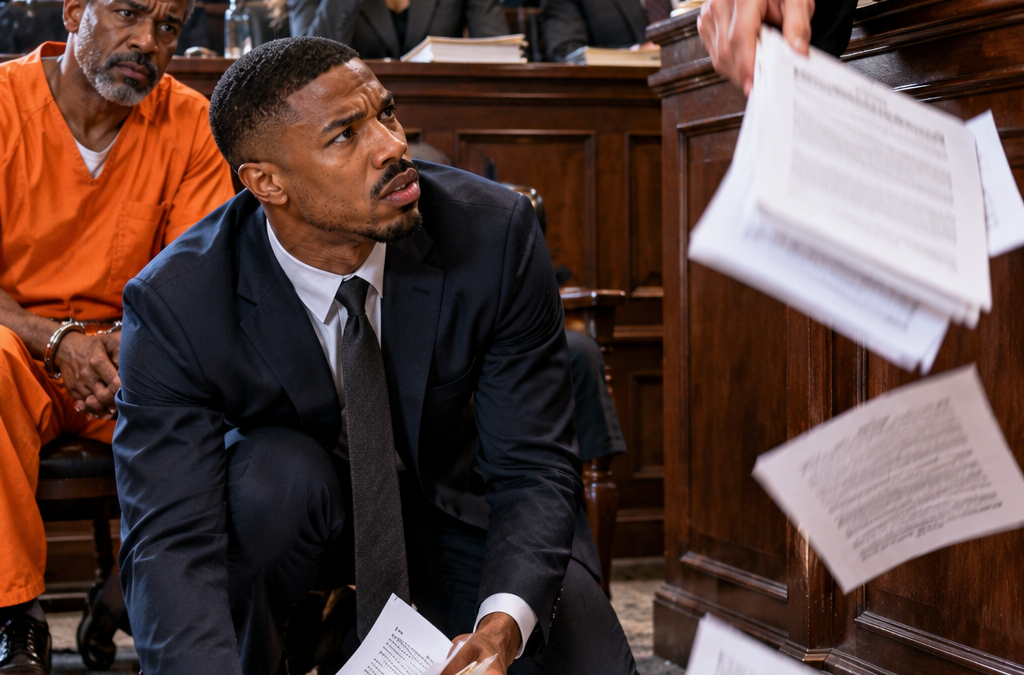
That was the day Judge Caldwell threw my papers on the floor.
That was the day people laughed.
And that was the day I stopped caring whether they thought I belonged there.
Caroline gave the first opening statement.
She was excellent.
I understood why people feared her.
She never rushed.
She built the prosecution’s story brick by brick.
Access.
Opportunity.
Missing watch.
Worker near bedroom.
No alternative suspect.
She transformed assumptions into something that sounded almost like certainty.
Then I stood.
My mouth was dry.
I placed both hands on the table so nobody would see them shake.
“Ladies and gentlemen of the jury, my father has worked as a plumber in this city for twenty-two years.”
I looked at the jurors.
“He has entered churches, businesses, schools and private homes. Customers trusted him around their property and their families. In twenty-two years, he has never been arrested, never been accused of theft and never had a professional complaint for dishonesty.”
Caroline watched me.
I continued.
“The prosecution will give you a story. I am asking you to examine evidence.”
I paused.
“They will ask you to believe that a man with everything to lose suddenly risked his freedom, his livelihood and the only family he has for a wristwatch.”
I glanced at Dad.
“I will ask you one question throughout this trial.”
Then I looked back at the jury.
“Does the evidence actually prove that?”
I sat down.
Dad whispered, “Where did you learn that?”
I whispered back, “Library.”
The prosecution’s first witness was Martha Greer, the Prescott housekeeper.
Caroline established that Martha had seen Dad near the master bedroom.
Then I stood for cross-examination.
Every eye followed me.
“Ms. Greer, you testified that you saw my father near the master bedroom.”
“Yes.”
“You found that suspicious?”
“He had no reason to be there.”
“Are you familiar with the work order?”
She hesitated.
“Not completely.”
I handed the document forward.
“The Prescott work order specifically included plumbing repairs in the master bathroom, correct?”
She looked at it.
“Yes.”
“And the master bathroom is accessed through the master bedroom?”
“Yes.”
“So for my father to complete the work Mr. Prescott hired him to perform, he had to enter the bedroom.”
Martha glanced toward Caroline.
“Yes.”
“Meaning the location you described as suspicious was exactly where his job required him to be.”
She swallowed.
“Yes.”
I sat down.
That was all.
I had prepared twelve more questions.
I did not ask them.
One of the things I had learned during those weeks in the library was to stop when you already had the answer you needed.
The jury changed after that.
Not dramatically.
A woman uncrossed her arms.
A man who had been staring at Dad started looking at Caroline’s files instead.
Small things.
But courtrooms are made of small things.
By the end of the first day, the prosecution still had most of its case intact.
But Dad no longer looked doomed.
That mattered.
Outside the courtroom, I sat alone on a bench.
I had not eaten since before sunrise.
My head hurt.
I closed my eyes.
Caroline’s heels clicked along the marble hallway.
She stopped in front of me.
“That was a good performance.”
I opened my eyes.
“It wasn’t a performance.”
She held a folder against her side.
“You’re smart.”
I said nothing.
“Smarter than I expected.”
“Thank you.”
“That does not mean you understand where this ends.”
She handed me the folder.
I did not take it.
“What is it?”
“A revised offer.”
My stomach tightened.
“Your father pleads to a misdemeanor theft charge. Eighteen months. With credit and good behavior, likely ten. No felony.”
“He didn’t steal the watch.”
Her expression did not change.
“He gets his life back.”
“With a conviction for something he didn’t do.”
“He gets out.”
I stared at the folder.
Ten months.
At that moment, ten months sounded both unbearable and merciful.
That was the cruelty of it.
I understood why people accepted deals.
I finally understood.
The system does not always need to convince you that you are guilty.
Sometimes it only needs to make innocence too expensive.
Caroline lowered her voice.
“Judge Caldwell has been on that bench a long time.”
“I know.”
“You’ve researched him?”
“Yes.”
“Then you know the kind of courtroom you’re standing in.”
I looked at her.
She did not need to say more.
But she did.
“You are asking your father to gamble years of his life.”
“No.”
I stood.
“I am asking you to prove he committed a crime.”
Her jaw tightened.
“This is the best offer you’re going to receive.”
“My father is innocent.”
“I heard you.”
“Then hear me again.”
I pushed the folder back toward her.
“No deal.”
She stared at me for several seconds.
Then she tucked it beneath her arm.
“You’re brave.”
“I’m prepared.”
“Those aren’t the same thing.”
“No.”
I picked up the binder.
“But today I’m both.”
She turned away.
After three steps, she stopped.
“Bravery without power can become suffering very quickly, Donovan.”
Then she walked down the hallway.
That night, I called Dad.
“They offered a deal.”
“How much?”
“Eighteen months. Probably ten.”
Silence.
“And?”
“I refused.”
Longer silence.
“Donovan.”
“I have something.”
“What?”
“Evidence.”
“You sure?”
“I’m sure.”
I heard him breathing.
“Son?”
“Yeah?”
“Whatever happens tomorrow, I’m proud of you.”
I stared at our empty kitchen.
His chair.
His mug.
His work boots.
Then he said, “Your mother would be proud, too.”
I had to press my fist against my mouth before answering.
“I’ll see you tomorrow.”
I did not sleep.
At dawn, I put his suit on again.
I carried the binder to the bus stop.
As I passed the courthouse parking area, I noticed a black Mercedes.
Two men stood beside it.
Richard Prescott.
Judge Caldwell.
They shook hands.
Then laughed.
I kept walking.
Every instinct in my body wanted to stop.
To confront them.
To photograph them.
To shout.
I did none of those things.
Because anger without discipline would destroy me faster than anything they could do.
I gripped the binder.
Then I entered the courthouse.
The courtroom was packed.
Word had spread.
People stood along the back wall.
Dad was already at the defense table when I arrived.
He looked at me.
“You sleep?”
“No.”
“Eat?”
“Not really.”
He sighed.
“You can argue with a judge but you still won’t listen to your father.”
“Apparently.”
For the first time in weeks, he smiled.
Caldwell entered.
Everyone stood.
Day two began.
Caroline introduced the remaining records.
A statement from Prescott.
Valuation documentation for the Rolex.
A supplemental police report.
I did not interrupt.
I waited.
When she finished, I stood.
“Your Honor, the defense requests permission to introduce documentary evidence directly relevant to the prosecution’s timeline and its representation concerning electronic surveillance.”
Caldwell frowned.
“What evidence?”
I opened the binder.
Caroline turned slightly.
I saw her shoulders stiffen.
I removed the insurance documents first.
“This is documentation relating to the Prescott estate’s insurance policy.”
I explained the security provision.
Continuous surveillance protection.
Requirements connected to high-value property.
Then I held up the claim.
“This is the insurance claim Mr. Prescott filed six days after my father’s arrest.”
I looked toward the jury.
“The claim was for the same Rolex at issue here.”
Nobody moved.
“The prosecution told this court that no surveillance footage exists because the system malfunctioned.”
I placed the insurance documents beside the claim.
“But the available insurance records make that explanation significant. If the required system was not operating, the claim raises one set of serious questions. If the system was operating, the missing footage raises another.”
Caroline stood.
“Objection. Counsel is inviting speculation.”
“I am asking why records that should clarify the central factual question in this case have not been produced.”
Caldwell stared at me.
For several seconds, he said nothing.
Then:
“Overruled.”
Caroline sat.
That single word changed the room.
I reached into the binder.
“Now the timeline.”
I held up the gas receipt.
“This receipt was found among my father’s business records. It is dated the day he worked at the Prescott residence.”
I handed it forward.
“Time: 4:05 p.m.”
Then the police report.
“The police report states my father departed the Prescott property at 4:15.”
I turned toward the jury.
“The gas station identified on this receipt is approximately twenty-two minutes from the Prescott residence under normal driving conditions.”
One juror leaned forward.
I continued.
“My father cannot purchase gasoline twenty-two minutes away ten minutes before he supposedly leaves the house.”
The room erupted into whispers.
Caldwell struck the gavel.
“Order.”
I waited.
Then I faced him.
“Your Honor, I ask permission to question Mr. Prescott regarding these discrepancies.”
Richard Prescott’s face had changed.
For the first time since the trial began, he did not look bored.
He looked angry.
That gave me courage.
He took the stand.
I approached slowly.
“Mr. Prescott, you reported a Rolex stolen.”
“Yes.”
“Twenty-five thousand dollars?”
“Approximately.”
“And you filed an insurance claim?”
“Yes.”
“You received payment?”
“I believe so.”
“You believe so?”
“My accountant handles much of that.”
“Did your accountant report the watch stolen?”
Caroline stood.
“Objection.”
“Sustained.”
I nodded.
“Mr. Prescott, was your home security system operating normally that week?”
“I don’t remember.”
“You have cameras throughout the property?”
“Yes.”
“How many?”
“I don’t know.”
“More than five?”
“Probably.”
“More than ten?”
“Possibly.”
“Would any camera record people arriving or leaving?”
He shifted.
“I assume so.”
“Would any camera cover portions of the interior?”
“Some.”
“Did you personally review any footage before accusing my father?”
Caroline rose.
“Objection.”
Caldwell looked at her.
“Basis?”
“Relevance.”
For a moment nobody breathed.
Caldwell glanced at Prescott.
Then at me.
“Overruled.”
Prescott’s mouth tightened.
“No.”
“You did not review the footage?”
“No.”
“Did anyone tell you they had reviewed it?”
“I don’t recall.”
“Yet you identified my father as the thief.”
“He was in my house.”
“So were other people.”
He looked at me.
I opened another document.
“Your property access records identify additional entries that afternoon.”
Caroline stood again.
I continued before she could speak.
“Employees. Household staff. Service access.”
Caldwell raised one hand toward Caroline.
“Sit down for the moment.”
She did.
I turned back to Prescott.
“My father was not the only person with access to your home that day, was he?”
“No.”
The word barely came out.
I let the silence grow.
Then I changed direction.
“Have you filed previous claims for missing valuables?”
His eyes flicked toward Caroline.
“I don’t remember.”
I opened the next tab.
“Records associated with your insurer reflect prior claims involving a gold bracelet and diamond earrings.”
Caroline rose so quickly her chair moved backward.
“Objection.”
I looked at Caldwell.
“These records are relevant to credibility and to whether alternative explanations for the alleged loss were adequately investigated.”
Caldwell stared at the paperwork.
The courtroom felt electrically still.
Then he said, “I’ll allow limited inquiry.”
I faced Prescott again.
“Three high-value-property claims in approximately five years.”
Prescott said nothing.
“And in this case, the person arrested was the plumber working inside your house.”
“My watch disappeared.”
“That wasn’t my question.”
His face reddened.
“My father worked in your home for a few hours.”
I stepped closer.
“He had no criminal history.”
Silence.
“No theft complaints.”
Silence.
“No unexplained property in his possession.”
Silence.
“The police never recovered your Rolex from him.”
“No.”
“They never recovered money from a sale.”
“No.”
“No pawn record?”
“No.”
“No witness saw him take it?”
“No.”
“No camera shows him take it?”
“No.”
I waited.
“So what physical evidence proves my father stole your watch?”
Prescott looked toward Caroline.
She could not answer for him.
Finally he said, “He had the opportunity.”
I nodded.
“Opportunity.”
I returned to the defense table.
Then turned once more.
“Mr. Prescott, opportunity is not evidence of theft.”
Caroline stood.
“Objection. Argumentative.”
Caldwell looked at me.
“Sustained.”
I sat down.
But the sentence was already in the room.
There are moments in a trial when you can feel belief changing.
Not dramatically.
Not like thunder.
More like a door opening somewhere you cannot see.
I felt it then.
Caroline requested a brief recess.
Caldwell denied it.
She returned to her table.
For the first time, she looked tired.
Not defeated.
Caroline Ashford was too experienced to collapse.
But the confidence had left her posture.
I closed the binder.
Judge Caldwell stared at me.
He took off his glasses.
Then he said, almost to himself, “Mr. Harris, you argue like someone who has been practicing for twenty years.”
I heard a sound behind me.
Someone in the gallery exhaled.
I did not smile.
I did not want praise.
I wanted my father home.
Closing arguments came next.
Caroline went first.
She recovered well.
She reminded the jury that Dad had access.
She argued that inconsistencies did not erase the fact that a valuable item disappeared shortly after he worked inside the home.
She warned them not to confuse sympathy with reasonable doubt.
Then I stood for the last time.
I had written a closing argument.
Six pages.
I left it in the binder.
Instead, I looked at the jury.
“When police came to our house, my father told me he would be home before lunch.”
My voice tightened.
I stopped for a moment.
“He believed this would be corrected quickly because he knew he had done nothing wrong.”
I looked at Dad.
“He has now spent weeks in a cell.”
Then back to the jury.
“You have heard that he was near the master bedroom. You also learned that the job required him to be there.”
I took one step toward the jury box.
“You were told the security footage did not exist because of a malfunction. You have now seen records that make the absence of that footage something this court cannot simply ignore.”
Another step.
“You were given an official timeline. You have seen a receipt that contradicts it.”
Nobody moved.
“The watch was never found in my father’s possession.”
I could hear Dad breathing behind me.
“No witness saw him take it.”
I looked directly at the foreman.
“No video shows him taking it.”
Then at each juror.
“No sale. No pawn record. No confession. No physical evidence.”
I paused.
“What the prosecution has is a plumber who entered a wealthy man’s house.”
The silence deepened.
“A plumber who was where his work order required him to be.”
I felt heat behind my eyes.
I refused to look down.
“My father spent twenty-two years building his name one job at a time. He did not inherit wealth. He did not inherit influence. What he had was his reputation.”
My voice cracked once.
I let it.
“An accusation took that reputation away in a morning.”
Dad lowered his head.
“And if you convict him, it will take away years of his life.”
I returned to the defense table.
“Do not decide this case based on who Richard Prescott is.”
Then I looked at my father.
“And do not decide it based on who Raymond Harris is.”
I faced the jury one final time.
“Decide it based on what can actually be proved.”
I closed the binder.
“If evidence matters, there is only one lawful verdict.”
I sat down.
The jury left.
Forty-three minutes.
That was how long they deliberated.
I know because there was a clock above the courtroom door, and despite telling myself not to look at it, I watched almost every minute move.
Dad sat beside me.
His wrists were still cuffed.
“You did good,” he whispered.
“It’s not finished.”
“You did good.”
“Dad.”
He looked at me.
“I mean it.”
I swallowed.
“What if they—”
“No.”
His voice became firm.
“You listen to me now.”
I did.
“Whatever that door opens with, you gave me something nobody else gave me.”
“What?”
“A chance.”
I looked down at my hands.
For weeks I had imagined the verdict as a destination.
In reality, waiting for it felt like standing at the edge of a cliff in darkness.
The jury-room door opened.
Twelve people returned.
Nobody looked at me.
That terrified me.
The foreman stood.
Judge Caldwell asked whether they had reached a unanimous verdict.
“Yes, Your Honor.”
My heartbeat became so violent I could hear it.
Dad’s shoulder touched mine.
The clerk took the form.
Then Caldwell read it.
“On the charge of grand theft…”
Everything slowed.
“…we find the defendant, Raymond Harris…”
Dad stopped breathing.
“…not guilty.”
For half a second, nothing happened.
The words had reached me but my mind did not understand them.
Then Dad collapsed forward.
Not onto the floor.
Into himself.
His shoulders folded.
His chained hands rose to his face.
A sound came out of him I had never heard before.
My father was crying.
Not quietly.
Not trying to hide it.
I grabbed him.
He turned toward me and I put both arms around him.
The gallery disappeared.
The judge disappeared.
Caroline disappeared.
For those few seconds there was nobody in the courtroom except the man who had raised me and the son who had spent weeks terrified he might lose him.
“You’re coming home,” I whispered.
Dad’s whole body shook.
“You’re coming home.”
The bailiff approached.
I instinctively tightened my arms around Dad.
The man shook his head gently.
“It’s okay.”
He unlocked the cuffs.
The metal opened.
Dad rubbed the skin around his wrists.
Red marks circled them.
I stared at those marks.
I think that was when I finally understood what the verdict meant.
He could walk through the door.
He could choose where to sit.
He could touch his own front door.
He could make coffee in our kitchen.
He could complain about the water heater.
He could be ordinary again.
Dad looked at me.
“How did you do that?”
I laughed through tears.
“I read a lot of books.”
He pulled me against him again.
Judge Caldwell struck the gavel once.
The courtroom quieted.
I expected him to dismiss the case and leave.
Instead, he looked directly at me.
“Mr. Harris.”
I stood.
“Yes, Your Honor.”
He removed his glasses.
His face looked older than it had two days earlier.
“I owe you an apology.”
Nobody moved.
Caldwell continued.
“When you first stood in this courtroom, I made assumptions about your age, your experience and your ability.”
I remembered the papers hitting the floor.
The laughter.
The word trash.
“My conduct was inappropriate.”
He paused.
“I have heard arguments from attorneys with decades of experience who were less prepared than you were today.”
I did not know what to say.
So I said nothing.
He nodded toward my father.
“You served him well.”
Dad reached for my arm.
Caldwell looked at him.
“Mr. Harris, you are free to go.”
Someone in the gallery started clapping.
Then another person.
Within seconds the entire back half of the courtroom was on its feet.
I did not feel victorious.
That surprised me.
I thought I would.
For weeks, I had imagined the moment as revenge.
Prescott embarrassed.
The prosecutor defeated.
The judge forced to respect me.
But standing there beside my father, revenge felt small.
All I wanted was to leave.
Caroline gathered her files.
Her associates moved quickly around her.
She walked toward us before leaving.
Dad stiffened.
So did I.
Caroline stopped.
She looked at me.
“You earned that verdict.”
I studied her face.
No sarcasm.
No cruelty.
Just exhaustion.
I held out my hand.
She shook it.
Then she looked at Dad.
“Mr. Harris.”
He nodded.
She walked away.
Richard Prescott had already left.
Dad and I exited through the courthouse doors together.
No handcuffs.
No deputies.
No orange between us.
Just us.
The October sunlight hit my face so hard I had to squint.
Dad stopped halfway down the steps.
For a moment, neither of us moved.
Cars passed.
People talked behind us.
Somebody from the newspaper called my name.
I ignored it.
Dad placed one rough hand on my shoulder.
“Your mother would have been proud.”
I looked toward the sky.
“I know.”
That time I let myself cry.
Dad pulled me close.
After a while, he asked, “How are we getting home?”
I wiped my face.
“The bus.”
“You saved me from prison and couldn’t arrange a ride?”
“I had other things to do.”
He laughed.
It was the first real laugh I had heard from him since the arrest.
We walked toward the bus stop.
The next morning, our lives changed again.
A local newspaper ran the story.
Then regional outlets called.
Then national outlets.
People became fascinated by the image of a nineteen-year-old standing beside his father with a cracked binder and an oversized suit.
I hated the way some headlines made it sound like a miracle.
It wasn’t.
It was work.
It was Eleanor keeping the library computer available.
It was Dad keeping receipts.
It was weeks of reading until my eyes hurt.
It was a housekeeper answering one question honestly.
It was a gas station timestamp nobody else had bothered to notice.
It was evidence.
For several days, reporters waited outside our house.
Dad became irritated almost immediately.
“These people know I’ve got work to do?”
“You don’t have a van.”
“Then I’ve got a van to buy.”
Customers began calling again.
Some apologized.
Others pretended they had never stopped.
Dad accepted the apologies more easily than I did.
One afternoon, I asked him why.
We were replacing the water heater with money a church group had raised after the trial.
He tightened a fitting and shrugged.
“People get scared.”
“That makes it okay?”
“No.”
“Then why forgive them?”
He wiped his hands.
“Because I spent enough time locked in a place I didn’t want to be.”
He looked at me.
“I’m not building another prison in my head.”
That was my father.
Weeks later, Eleanor organized a small gathering at the library.
Nothing elaborate.
Coffee.
Sheet cake.
Twenty folding chairs.
Half the neighborhood came.
She gave me a gift.
A new leather notebook.
I opened it.
Every page was blank.
“I thought you hated my old notebook.”
“I hate that thing.”
She nodded toward the cracked composition book under my arm.
“It looks diseased.”
I laughed.
“Then why this?”
“Because that one got you here.”
She tapped the new notebook.
“This one is for where you go next.”
I looked at the blank pages.
For once, I did not know what to write.
The court case had also raised uncomfortable questions.
Questions about the investigation.
Questions about the missing surveillance material.
Questions about the police timeline.
Questions about relationships inside the local legal system.
I learned that justice after a verdict is complicated.
An acquittal does not erase detention.
It does not return lost wages.
It does not remove graffiti from memory.
It does not restore every customer.
It does not give a man back the nights he slept behind a locked door wondering whether anyone believed him.
Dad was free.
But freedom did not mean nothing had happened.
Sometimes I woke up at six in the morning because I thought someone was pounding on our front door.
Sometimes Dad stopped talking when a police cruiser passed.
Neither of us mentioned it.
We didn’t need to.
Three months after the verdict, an envelope arrived.
Heavy paper.
My name typed across the front.
Colia Law School in New York.
I assumed it was publicity material.
I opened it at the kitchen table while Dad ate cereal.
Then I stopped breathing.
“What?”
I kept reading.
“Donovan?”
I handed him the letter.
He read more slowly than I did.
Then he sat down.
Full scholarship.
Tuition.
Housing.
Books.
The admissions committee had reviewed my academic history, debate record and the publicly available record surrounding Dad’s trial.
Near the bottom was a sentence I read until I memorized it.
My legal reasoning demonstrated a level of discipline they believed deserved formal training.
Dad finished the letter.
He put it down.
Then looked at me.
“You’re going.”
I laughed.
“We haven’t talked about New York.”
“We just did.”
“Dad.”
“You’re going.”
“What about the business?”
“I was fixing toilets before you were born.”
“The house?”
“It leaks. Always has.”
“Money?”
“The letter says covered.”
“Travel?”
“We’ll figure it out.”
I stared at him.
He leaned back.
“You remember what I told you?”
“What?”
“Don’t let me be the reason you quit.”
My eyes burned.
“I almost lost you.”
“And you didn’t.”
“I don’t want to leave.”
Dad nodded.
“I know.”
That hurt more than if he had told me not to go.
On the morning I left Montgomery, everything I owned that mattered fit into one suitcase and a backpack.
Eleanor bought me two new shirts.
Dad insisted I take the navy suit.
“It doesn’t fit.”
“You’ll grow into it.”
“I’m nineteen, Dad.”
“Then find a tailor.”
I packed it.
At the last moment, I went back inside.
My old notebook was still sitting on the kitchen table.
Cracked spine.
Coffee stains.
Bent pages.
I picked it up.
The first entries were written by a fourteen-year-old boy who thought law was elegant.
The later pages belonged to someone who had discovered it could be ugly.
Powerful.
Imperfect.
Necessary.
I placed the notebook inside my suitcase beside the new one Eleanor had given me.
Dad drove me to the bus station in a borrowed truck.
We stood beside it while passengers loaded their luggage.
Neither of us was good at goodbyes.
“You call me when you get there.”
“I will.”
“Not a text.”
“I know.”
“A call.”
“Yes.”
“Eat real food.”
“I will.”
“You won’t.”
“Probably not.”
He nodded.
Then his face changed.
Pride has a strange way of looking like grief when someone you love is leaving.
“You’re going to be one hell of a lawyer,” he said.
I shook my head.
“That’s not the goal.”
“What is?”
I looked at the man who had raised me.
The man whose hands had taught me to hold a wrench.
The man who had sat in a cell because everybody with authority found the easy story more convenient than the difficult question.
“I’m going to become the lawyer you deserved.”
Dad looked away.
He pretended to inspect something across the parking lot until he trusted his voice again.
Then he hugged me.
I boarded the bus.
From the window, I watched him get smaller as we pulled away.
For years, I had believed becoming a lawyer meant learning how to argue.
Dad’s case taught me something different.
Arguments were only tools.
The real work was refusing to stop looking when an answer was convenient.
It was asking why a timestamp did not fit.
Why a camera disappeared.
Why an assumption became an accusation.
Why a reputation built over twenty-two years could be discarded in a morning.
I had walked into that courtroom believing I needed to prove I was smarter than the people who underestimated me.
I walked out understanding that intelligence was not the point.
The point was preparation.
The point was evidence.
The point was standing beside someone when standing beside them cost something.
Years later, whenever I opened that cracked notebook, one memory always came back first.
Not the verdict.
Not the applause.
Not even Judge Caldwell’s apology.
I remembered kneeling on the courtroom floor.
Nineteen years old.
My father in handcuffs three feet away.
Pages scattered around my knees while strangers laughed.
I remembered picking them up one at a time.
At the time, I thought I was gathering paper.
I understand it differently now.
I was gathering every hour I had spent in the library.
Every lesson my father had taught me about finishing a job correctly.
Every night he had come home exhausted and still asked whether I had eaten.
Every argument I had practiced in a mirror.
Every case I had copied into a notebook because we could not afford the books I wanted.
Every piece of a life people in that courtroom had decided was too small to matter.
Judge Caldwell had looked down at those pages and seen trash.
I looked down and saw the only weapons I had.
So I picked them up.
I stood.
And when the most powerful man in the room told me to leave, I finally understood something my father had been teaching me my entire life.
You do not need to be the richest person in the room to know what something is worth.
You do not need the best suit to stand straight.
You do not need powerful friends to recognize the truth.
And sometimes courage is not dramatic at all.
Sometimes courage is nineteen years old.
Terrified.
Exhausted.
Wearing his father’s suit.
Picking his papers up off the floor.
And staying.








