𝗙𝗨𝗟𝗟 𝗦𝗧𝗢𝗥𝗬 The Judge Cut My Mic and Told Me to Sing at My Dying Mother’s Funeral—Then He Heard the Name She Had Hidden From Me for Nineteen Years
𝗣𝗔𝗥𝗧 𝟮
Then I saw the next problem.
Bus ticket.
Forty-eight dollars.
I had thirty-one left in the jar.
I told nobody for two days.
My best friend Tommy Reed figured it out.
Tommy had known me since fourth grade.
He had the kind of personality that arrived five minutes before the rest of him.
Loud.
Reckless.
Loyal.
He found me sitting on the trailer steps.
“What happened?”
“Nothing.”
“You have your ‘something happened’ face.”
“I don’t have a face.”
“You absolutely do.”
I handed him the phone.
He read the email.
Then looked at me.
“How much?”
“What?”
“How much money do you need?”
That was Tommy.
Not congratulations.
Logistics.
By Sunday, he had collected $212.
Forty from his savings.
The rest from Fifth Street Baptist.
Pastor Williams had read the audition email after service.
People who barely had money themselves put bills in a plate for me.
I hated accepting it.
Mom didn’t.
“Take it.”
“I can pay them back.”
“That’s not why they gave it.”
“I know.”
“Then don’t insult them by turning kindness into debt.”
The night before I left, I sat beside her hospital bed.
She looked smaller every time.
Cancer did that.
It reduced people in visible pieces.
Her wrists were so thin I could see bone beneath the skin.
She reached for the chain around her neck.
Slowly unclasped it.
The gold ring slid into her palm.
“Take this.”
I stared.
“No.”
“Mason.”
“That’s yours.”
She held it out.
“For luck.”
I took it.
Warm from her skin.
I rubbed my thumb over the inside.
R + L.
“Who was R?”
Her eyes changed.
There it was.
The wall.
Then, for once, it seemed like she might open the door.
“He was—”
A cough seized her.
Hard.
Painful.
I stood.
“Mom.”
She waved me away.
It took nearly a minute before she could breathe normally again.
By then, she was exhausted.
Her eyes closed.
I waited.
She never finished the sentence.
I kissed her forehead.
“Love you.”
Her lips moved.
“Sing from where it hurts.”
That was the last thing she said before I left for Nashville.
The bus arrived at six in the morning.
I had a backpack.
Two shirts.
Toothbrush.
Granola bar.
Mom’s ring in my pocket.
The Grand Ole Theater looked too large to be real.
Glass entrance.
Marble.
Huge signs.
Contestants arrived with parents.
Coaches.
Stylists.
Rolling luggage.
I stood outside for ten minutes asking myself whether I had made a mistake.
Then I thought about Beth.
Try something impossible.
So I walked inside.
Backstage smelled like hairspray, coffee, and nerves.
People warmed up against walls.
A girl practiced runs while her vocal coach counted breaths.
Another contestant had somebody touching up makeup.
I found an empty chair.
Before I reached it, a guy leaned against a mirror.
Brandon Wells.
Tailored jacket.
White sneakers.
Perfect hair.
He looked at my shoes.
Then my backpack.
“Did you walk here from a cotton field?”
Two girls laughed.
Someone raised a phone.
I kept walking.
That confused him.
People who insult strangers usually need the stranger to participate.
My phone buzzed.
Beth.
Your mom was admitted to ICU last night. Stable for now. I’m sorry. She made me promise not to tell you before you left.
I read it twice.
The hallway blurred.
I sat down.
For one minute, maybe longer, I almost went home.
I could walk back to the bus station.
Get to Meridian by evening.
Sit beside her.
Forget the competition.
Forget the money.
Forget everything.
Then I opened the last photograph of Mom.
Hospital bed.
Oxygen tube.
Thumb up.
Smile forced but still hers.
I stared at it.
Then stood.
The stage manager called my name.
“Mason Harper.”
I walked toward the light.
Five thousand seats.
Every one full.
The audience became a single dark shape beyond the spotlights.
Three judges sat behind a curved desk.
Elena Whitfield on the left.
Seventy-one.
Opera legend.
I knew enough music history to know who she was.
Derek Simmons in the middle.
Producer.
Three Grammys.
Decades in the industry.
Then Richard Cole.
CEO of Pinnacle Records.
The judge everybody feared.
He had a reputation for humiliating weak performers because television audiences loved cruelty when it wore expensive clothes.
He sat with his arms crossed.
Bored.
I walked to the mark on the floor.
Something happened to his expression.
Fast.
So fast I assumed I imagined it.
His eyes sharpened.
Like he recognized something he didn’t want to recognize.
Then it disappeared.
Derek leaned toward his microphone.
“Name?”
“Mason Harper.”
Richard’s pen stopped.
Only for a second.
“From?”
“Meridian, Mississippi.”
That time I saw it.
His jaw tightened.
Elena glanced toward him.
Then back at me.
Derek asked:
“What are you singing?”
“You Are My Sunshine.”
A few people smiled.
Richard leaned toward his microphone.
“You came to a national singing competition with a children’s lullaby?”
“It’s my mother’s song.”
He stared at me.
“She taught it to me.”
Richard wrote something down.
Didn’t respond.
I closed my eyes.
Thought of Mom.
Hospital room.
Ring in my pocket.
Then began.
The first note was wrong.
Not terrible.
Tight.
I felt panic immediately.
Second line.
My voice cracked.
A murmur moved through the theater.
My chest closed further.
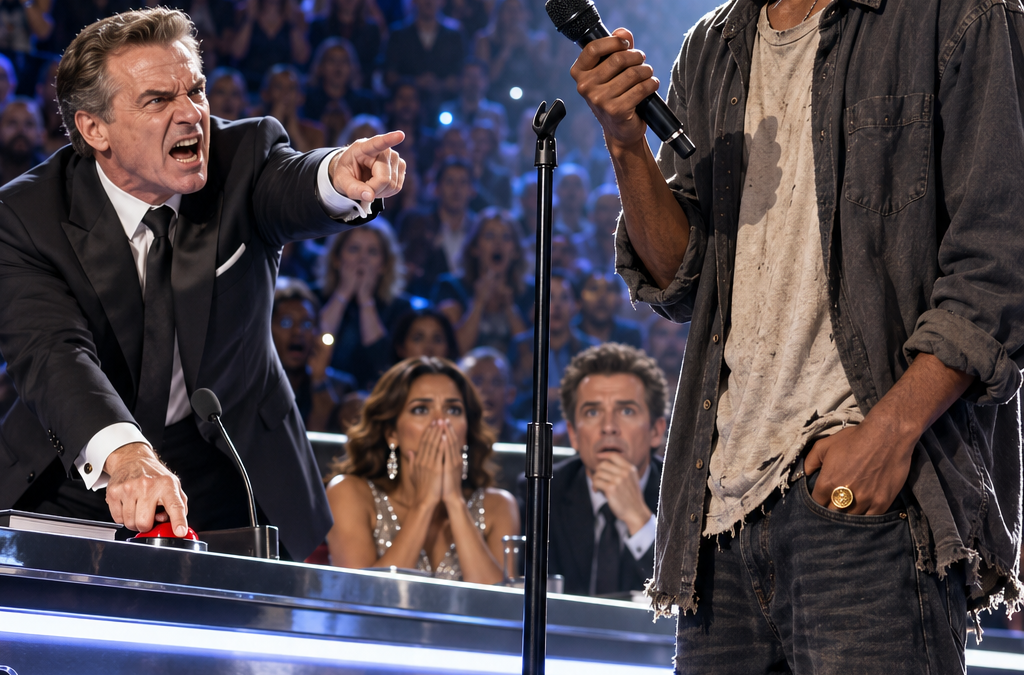
Richard’s hand came down on the red button.
BUZZ.
The sound hit like a gunshot.
I flinched.
“Stop.”
I opened my eyes.
Richard pointed his pen at me.
“Just stop.”
Nobody moved.
“This is a professional competition.”
My face burned.
“Not charity karaoke.”
A few people shifted uncomfortably.
“If you can’t handle pressure, you don’t belong here.”
He waved his hand.
“Next.”
I stood there.
Everything in me wanted to disappear.
Five thousand people.
Cameras.
Hospital bills.
Mom.
I heard my own voice.
“Please.”
Richard looked annoyed.
“My mother is dying.”
The words came out smaller than I wanted.
“This is all I have.”
Richard leaned forward.
And for one moment, there was something strange in his face.
Pain.
Then it hardened.
“I don’t care about your mother.”
The theater went still.
Elena turned toward him.
Richard continued.
“Everybody has a tragedy.”
My hands shook.
“Go home if you can’t perform.”
Then, quieter but still into the microphone:
“Sing at her funeral.”
The reaction was immediate.
Gasps.
A few boos.
Elena’s face changed completely.
“Enough.”
Richard looked at her.
“Let the boy sing.”
Derek nodded.
“One more chance.”
Richard leaned back.
Two votes against one.
The red light from his buzzer was still glowing.
I closed my eyes again.
This time I stopped trying to win.
Stopped thinking about notes.
Technique.
Television.
I thought about Tuesday nights when I was six.
Mom sitting beside me.
Her hand brushing my hair.
Her voice low because she was tired after work.
I breathed.
Then sang again.
But I didn’t sing the lullaby.
I switched.
“Amazing Grace.”
The first note came from lower in my chest.
No strain.
No fear.
The sound opened.
The theater changed.
I felt it.
The strange thing about a large room is that you can hear attention.
Five thousand people being quiet has a sound.
I sang like Mom was the only person listening.
Nothing else existed.
Not Richard.
Not the prize.
Not the cameras.
When I reached the final phrase, my voice cracked.
Not because it failed.
Because I was thinking about losing her.
I let the crack stay.
No correction.
No hiding.
Elena closed her eyes.
Tears moved down her face.
Derek stopped writing.
Then the audience began standing.
Front row.
Middle.
Balcony.
People were not even clapping yet.
They just stood.
As if remaining seated had become impossible.
I opened my eyes.
Richard was staring at me.
His face had gone white.
One hand rested against his chest.
For half a second, I saw something beneath the open edge of his collar.
Dark ink.
Two letters.
R.
L.
Then his jacket shifted.
Gone.
I didn’t understand.
The last note faded.
Silence.
Then the theater erupted.
I wiped my face.
Whispered:
“For you, Mom.”
I advanced.
Top twenty.
That night I slept in a hotel room the show provided.
The mattress didn’t sag.
I lay there fully dressed because part of me expected somebody to tell me there had been a mistake.
The next round assignments went up Thursday.
Mine:
“Autumn Leaves.”
Nat King Cole-style arrangement.
Jazz.
I knew the song.
Barely.
I had never performed jazz.
Everybody else seemed to receive something suited to them.
Pop singers got pop.
Gospel singers got gospel.
R&B singers got R&B.
I got the most technically exposed arrangement on the board.
A production assistant finally told me:
“Mr. Cole requested yours personally.”
“Why?”
“He said he wanted to test your range.”
I knew sabotage when I saw it.
I sat in a concrete stairwell for almost an hour.
Then called Mom’s hospital.
A nurse answered.
Linda was sleeping.
Scan was worse.
Doctor wanted to discuss hospice.
Hospice.
That word emptied me.
I hung up.
Pressed my forehead against the phone.
Go home.
The thought came clearly.
Go home.
Be with her.
This contest is not worth missing goodbye.
Then my phone displayed an old voicemail.
Saved three months earlier.
Mom.
I pressed play.
Her voice came through.
Weak.
She was singing to herself.
Not the lullaby.
Something else.
Loose rhythm.
Sliding notes.
Jazz phrasing.
I sat up.
Played it again.
I had heard Mom sing like that when I was little without understanding what it was.
She bent notes.
Let timing move behind the beat.
Turned melody into conversation.
I went back to my room.
Played the voicemail over and over.
I didn’t try to imitate Nat King Cole.
I listened to Linda.
By Friday night, I had built the song around her phrasing.
Gospel instincts inside jazz.
Not polished.
But mine.
Or ours.
That evening, I passed Richard’s dressing room.
Door half open.
He was on the phone.
His voice stopped me.
“I told you that kid cannot win.”
Silence.
“You don’t understand.”
Another pause.
“It’s complicated.”
My hand moved toward the ring in my pocket.
Richard continued.
“Just make sure he doesn’t get past Saturday.”
I kept walking.
No confrontation.
No evidence.
But now I knew.
It wasn’t simple dislike.
Richard Cole was afraid of me.
I just didn’t know why.
Saturday night, people cheered when I entered.
The first audition clip had already spread online.
Millions of views.
I stood beneath the lights in the same wrinkled shirt.
The band started.
“Autumn Leaves.”
I let Mom’s voicemail guide me.
Low opening.
Loose time.
Then movement.
I did not float over the arrangement.
I dug into it.
Gospel weight.
Jazz space.
Blues edges.
Something between styles.
When the final note ended, Elena removed her glasses.
Her hands were shaking.
“That voice,” she said. “Nobody taught you that.”
“My mother did.”
She nodded slowly.
“I believe you.”
Derek leaned into his microphone.
“I’ve heard thousands of singers.”
He smiled.
“I haven’t heard one quite like you.”
Richard said nothing.
Elena and Derek sent me forward.
Top ten.
The online reaction exploded.
Then things got uglier.
My assigned microphone disappeared before soundcheck.
The replacement had weak output.
I complained once.
Technician shrugged.
“Best we have.”
During my top-ten performance, I was singing a stripped-down arrangement of “Bridge Over Troubled Water.”
Halfway through, everything died.
Backing track.
Monitors.
My microphone.
Silence.
I looked toward the sound booth.
One engineer stared offstage.
Then quickly looked down.
The audience murmured.
Richard leaned back.
I understood.
This was supposed to break me.
For one second, I thought it might.
Then I remembered Mom.
No microphones in our trailer.
No monitors.
No orchestra.
Just her voice.
I unclipped the dead microphone.
Placed it on the floor.
And kept singing.
No amplification.
My voice hit the front rows.
Then the balcony.
The theater acoustics took it farther.
I opened everything.
Every breath.
Every fear.
Every night at the diner.
Every hospital bill.
Every memory of Mom standing at our kitchen sink trying to hide blood.
People started standing again.
Someone screamed from the balcony.
By the final chorus, all five thousand were on their feet.
I finished without accompaniment.
When the last sound faded, Richard’s face told me he knew he had lost control.
Then somebody backstage released a video.
Sound booth footage.
A technician receiving a text.
Then killing my channels.
The phone number was linked to Pinnacle Records.
Richard’s company.
Social media erupted.
The show called it a technical malfunction.
Almost nobody believed them.
Richard went on television the next night.
He called the accusations absurd.
Then he attacked me personally.
“Talented boy.”
Boy.
“But unstable.”
He questioned my story.
The poverty.
The cancer.
The trailer.
“Victim narratives sell.”
I watched the interview alone in my hotel room.
For the first time since the competition began, I hated him.
Not because he attacked me.
Because he called Mom a story.
He had never seen her work two jobs.
Never seen her hands crack from cleaning chemicals.
Never watched her cough blood and still ask whether I had eaten.
He did not get to call her suffering marketing.
I nearly posted something.
Tommy talked me out of it.
“Don’t.”
“He called her a liar.”
“I know.”
“I should answer.”
“With what?”
“The truth.”
Tommy went quiet.
“Mason.”
“What?”
“You’re already singing the truth.”
I hated when Tommy accidentally sounded wise.
So I stayed quiet.
What I didn’t know was that somebody else had watched Richard’s interview.
His wife.
Sandra Cole.
She sat in their Nashville home and looked from Richard’s face on television to mine.
Apparently, she saw what I had not.
Resemblance.
She called an investigative journalist named Claire Bennett.
All she gave Claire was one clue.
Richard had lived in Meridian about twenty years earlier.
Claire started digging.
Rental records.
Old church photographs.
Jazz-club memberships.
Then she found Linda.
A photograph outside Fifth Street Baptist.
Young Linda.
Young Richard.
His arm around her waist.
Then marriage records.
They had been married quietly.
Then separation.
Richard left in 2006.
Mom was pregnant.
He left a ring behind.
R + L.
Richard and Linda.
Claire found my birth certificate.
Father:
Richard A. Cole.
Mother:
Linda M. Harper.
Child:
Mason R. Harper.
I knew none of this.
Not yet.
Back home, Meridian rallied around Mom.
Fifth Street Baptist held prayer services.
Tommy started a fundraiser.
I told him not to.
He ignored me.
Fifty thousand dollars.
Then a hundred thousand.
Eventually enough to wipe out the hospital debt.
Beth filmed Mom watching my dead-microphone performance.
Mom lay in bed with IV bruises along her arms.
My unamplified voice came through a tablet.
She smiled.
Not the tired hospital smile.
Her real smile.
The video spread everywhere.
I watched it alone.
Cried so hard I couldn’t sing for an hour afterward.
Elena began working with me personally before the finale.
Not teaching me how to sing.
Teaching me control.
“Your problem,” she said, “is that you give everything too early.”
I frowned.
“Isn’t that what singing is?”
“No.”
She tapped my chest.
“People cannot feel the release if you never hold anything back.”
We worked on silence.
Breathing.
Phrasing.
The space between notes.
Then one evening she asked:
“Why that ring?”
I looked down.
I had started wearing it on a chain.
“My mother gave it to me.”
“Wedding ring?”
“I think.”
“You don’t know?”
“She never talked about my father.”
Elena looked at the letters.
R + L.
Her face changed slightly.
“What?”
“Nothing.”
I stared at her.
She looked away.
At the time, I assumed she was respecting Mom’s privacy.
Later, I wondered whether she suspected something too.
Finale night.
Fifteen million people watching.
The theater shook with noise before the broadcast even started.
I waited backstage with Mom’s ring in my hand.
The producer touched my shoulder.
“Mason.”
I looked up.
“You’re next.”
I walked out.
The audience roared.
Signs with my name.
People standing.
Phones everywhere.
Then the lights dimmed.
A giant screen behind the stage came alive.
Hospital room.
Meridian General.
Mom.
Room 412.
Propped against pillows.
Oxygen tube.
Beth beside her holding a tablet.
Flowers everywhere.
I stopped walking.
Nobody had told me they were doing that.
Mom lifted one hand.
Waved.
My throat closed.
I walked to the piano.
Yes, I could play.
Mom taught me at seven.
We never had enough money for lessons.
We had an old keyboard with dead keys.
She taught me chords.
I filled in the rest.
I sat.
Placed the ring beside the keys.
Then played the opening of “You Are My Sunshine.”
The melody we started with.
The song that began everything.
I looked at Mom on the screen.
And sang.
Not for judges.
Not for votes.
For her.
I sang softly.
The way she had when I was small.
No big opening.
No tricks.
Just memory.
Onscreen, her lips moved with mine.
She knew every note.
Then I built.
Slowly.
Voice lifting.
Piano opening underneath.
The audience disappeared.
At some point, tears blurred the keys.
I kept playing.
Then I looked toward the judges.
Elena was crying.
Derek had both hands folded beneath his chin.
Richard—
Richard Cole was breaking apart.
Not one television tear.
Not performance.
His face was wet.
Shoulders shaking.
One hand over his mouth.
He was staring at me like every year between us had collapsed at once.
I almost missed a chord.
Something inside me understood before my brain did.
The ring.
R.
L.
Meridian.
His reaction to my name.
His hatred.
His fear.
I looked at him.
He looked back.
And for the first time, I thought:
No.
It can’t be.
I finished the song.
The final note faded.
Mom’s face remained on the screen.
Then the feed changed.
Nashville Tribune logo.
Claire Bennett.
At first, I thought it was part of the show.
Then a document appeared.
Birth certificate.
My birth certificate.
I saw my name.
Mason R. Harper.
Mother:
Linda M. Harper.
Then the line beneath it.
Father:
Richard A. Cole.
The theater disappeared.
Everything disappeared.
I stared at the screen.
Then Richard.
Then the ring beside the piano.
Photographs appeared.
Young Mom outside Fifth Street Baptist.
Richard beside her.
His arm around her.
The ring visible on her hand.
My ears started ringing.
I could hear the audience breathing.
Then a timeline.
Marriage.
Pregnancy.
Richard leaving Meridian.
No contact.
No support.
Nothing.
Nineteen years.
I looked at him.
The man who had buzzed me before I finished two lines.
The man who told me to sing at my mother’s funeral.
The man who deliberately assigned a song to expose me.
The man linked to my sabotaged microphone.
My father.
Richard stared back.
His face collapsed.
I did not ask why.
Did not shout.
Did not call him Dad.
I couldn’t.
There were too many questions and suddenly none of them mattered enough to say first.
The silence lasted eleven seconds.
Later, somebody timed it.
Eleven seconds of live television.
Then Elena stood.
She turned toward me.
Started clapping.
Slow.
One clap.
Then another.
Derek stood.
Then the front row.
Then thousands of people.
They were not applauding the performance anymore.
They were applauding me for surviving the truth in public.
I didn’t feel brave.
I felt nineteen years old.
I felt like a boy who wanted his mother.
Production cut to commercial.
When cameras returned, Richard’s chair was empty.
Thirty minutes after the broadcast, the show announced he had been removed from the judging panel.
By morning, Claire’s full investigation ran.
Marriage records.
Rental records.
Witnesses.
My birth certificate.
Mom pregnant when Richard left.
No child support.
No letters.
Nothing.
Pinnacle Records tried to distance itself.
Artists began leaving.
Board called an emergency meeting.
Richard resigned before the week ended.
I didn’t care.
I did not read his statement.
I sat backstage holding my phone.
Mom’s photograph on the screen.
The host was speaking somewhere beyond the wall.
Then I heard my name.
“Mason Harper.”
For one second, I didn’t understand.
Then the theater exploded.
I had won.
A hundred thousand dollars.
I walked onto the stage.
The host handed me the envelope.
My hands shook.
The prize mattered.
Mom’s treatment.
Bills.
Everything.
But after what had happened, winning felt strangely small.
Elena met me near the stage exit.
She took both my hands.
“I made a call.”
I stared at her.
“Juilliard.”
I laughed because I assumed she was joking.
She wasn’t.
“Full scholarship.”
I couldn’t speak.
“Four years.”
My mouth opened.
Nothing.
She smiled.
“Sometimes silence is enough.”
The following week, Mom was transferred to Vanderbilt.
The fundraiser plus the prize money cleared her medical debt and gave doctors room to try another treatment protocol.
No promises.
Doctors never made those.
But they stopped saying hospice.
They started saying options.
That word became our favorite word.
Options.
Mom was stronger when I finally sat beside her again.
Not strong.
Stronger.
I placed the ring between us.
For a while, neither of us spoke.
Then I asked:
“Why didn’t you tell me?”
She closed her eyes.
“I wanted to.”
“No.”
My voice cracked.
“You had nineteen years.”
She flinched.
I hated that.
But I needed the truth.
“He knew?”
“Yes.”
“About me?”
“Yes.”
That answer hurt worse than I expected.
“From the beginning?”
She nodded.
I stood.
Walked toward the window.
“You told me nothing.”
“I know.”
“You let me watch him tear me apart on television without knowing who he was.”
“I didn’t know he’d be a judge.”
“That’s not the point.”
“No.”
Mom’s voice was weak.
“You’re right.”
I turned.
“Why?”
She looked at the ring.
“Because I was ashamed.”
“Of me?”
Her head snapped up.
“Never.”
“Then what?”
“Of loving him.”
I sat again.
She took a long breath.
“We were young.”
She looked toward the ceiling.
“He wasn’t Richard Cole then. Not like he is now.”
“What was he?”
“Hungry.”
She smiled faintly.
“He wanted music. Money. New York. Los Angeles. Everywhere except Meridian.”
“And you?”
“I wanted him.”
That sentence hurt her to say.
“He said he wanted me too.”
She touched the ring.
“We got married quietly.”
“Why quietly?”
“His family hated it.”
I already knew why before she said more.
“They thought I would hold him back.”
Mom’s voice lowered.
“A poor Black jazz singer from Mississippi was not part of the future they imagined.”
I looked away.
Richard’s cruelty suddenly had older roots.
“He left when you were pregnant.”
“Yes.”
“Did you ask him to stay?”
“Once.”
“What did he say?”
Mom was silent.
“Mom.”
“He said if he stayed, he would hate us both.”
I closed my eyes.
“He left the ring.”
“Yes.”
“Never came back.”
“No.”
“Never sent money?”
“No.”
I stared at the floor.
“Why keep the ring?”
She smiled sadly.
“That took me years to understand.”
I waited.
“I didn’t keep it for him.”
She touched my hand.
“I kept it because that mistake gave me you.”
I cried then.
Not quietly.
Not like television.
I put my head beside her hand on the bed and let myself be her child.
She stroked my hair.
Exactly the way she had when I was six.
Months passed.
Treatment worked slowly.
Tumor response.
Not remission.
Not yet.
But improvement.
That was enough.
Six months later, I walked through the gates of Juilliard with a backpack over one shoulder.
Mom’s ring hung around my neck.
People recognized me.
I hated that at first.
“You’re Mason Harper.”
Sometimes I wanted to say:
No.
I’m just Mason.
But fame doesn’t ask.
My first semester was hard.
Everybody was talented.
Really talented.
People who had studied voice since childhood.
Read music faster than I read English.
Spoke in terminology I had never heard.
The first week, I called Elena.
“I don’t belong here.”
She laughed.
“That again?”
“I’m serious.”
“So am I.”
“I can’t do half of what they can.”
“They can’t do half of what you can.”
“That sounds like something people tell poor kids so they feel better.”
She went silent.
Then:
“Good.”
“What?”
“You’re suspicious of compliments.”
“Shouldn’t I be?”
“Yes.”
Then her voice softened.
“Now get back to work.”
So I did.
Every night, I called Mom.
Some nights she sounded strong.
Other nights she fell asleep while I talked.
On those nights, I sang the old lullaby until her breathing settled.
Tommy visited in October.
He brought the jar.
The one from beneath my bed.
Cleaned.
Empty.
Label taped to the side:
FOR WHEN YOU FORGET WHERE YOU STARTED.
I put it on my desk.
Beside the ring.
Richard wrote to me in November.
Plain envelope.
No return address.
Three pages.
I opened it.
Read every word.
He apologized.
Not elegantly.
Not enough.
There probably wasn’t an enough.
He wrote that he recognized Linda’s eyes the moment I walked onstage.
That when I said Meridian, he knew.
That when I said my name, he was almost certain.
He said fear became cruelty.
He was terrified the truth would surface.
So he tried to remove me.
He claimed he did not arrange everything that happened with the microphone but admitted pressuring people to make my performances harder.
Then one sentence stopped me.
I heard your mother in your voice before I allowed myself to hear my son.
I read that line three times.
Then folded the letter.
Put it in my bottom desk drawer.
I didn’t answer.
Forgiveness is not the same as contact.
Sometimes people apologize because they want relief.
You are not obligated to become the medicine for wounds they caused.
Maybe one day I would write.
Maybe not.
What mattered was that his letter no longer controlled the empty space where my father should have been.
I had spent nineteen years wondering who he was.
Now I knew.
And strangely, knowing made him less important.
The person who raised me was still Linda.
The person who worked herself sick.
Who taught me music.
Who hid bills because she wanted me to remain a child a little longer.
Who gave me everything even when everything was almost nothing.
Richard contributed blood.
Linda built the man.
My first recital at Juilliard was held on a Tuesday night.
Two hundred seats.
No cameras.
No celebrity judges.
No giant red buttons.
Mom could not travel yet.
She watched remotely.
I sat at the piano.
Before beginning, I looked at the empty room between me and the first row.
For a second, I was back in Meridian.
Trailer.
Rain.
Mom on the bed.
Then Nashville.
Richard’s buzzer.
Dead microphone.
Birth certificate.
Everything.
I touched the ring beneath my shirt.
Then played.
Afterward, one of my professors found me backstage.
“You changed something tonight.”
“What?”
“You stopped trying to prove why you belong here.”
I thought about that.
He was right.
For most of the competition, I had been fighting rooms.
Trying to earn permission.
Richard thought I didn’t belong.
Other contestants thought I didn’t belong.
At Juilliard, I assumed everyone else belonged more.
But music is not a courtroom.
You don’t argue your way into truth.
You sing.
The rest is noise.
A year later, Mom came to New York.
Wheelchair through the airport because long walks still exhausted her.
But she came.
Her first time in Manhattan.
She looked up at the buildings.
“These people need shorter houses.”
I laughed.
At Juilliard, I brought her into a practice room.
Small.
Piano.
Two chairs.
No audience.
I sat at the keys.
“You remember teaching me?”
“I taught you three chords.”
“You taught me more than that.”
She smiled.
I played one of the old jazz progressions I had learned from her voicemail.
Her eyebrows lifted.
“That’s mine.”
“I know.”
“Where’d you learn that?”
“You.”
“When?”
“While you were dying.”
She slapped my shoulder.
“Don’t say that.”
“You were.”
“I’m sitting right here.”
“Fair.”
She sat beside me.
Then started singing.
Voice weaker.
Rougher.
But still warm.
I joined.
For ten minutes, there was no cancer.
No competition.
No Richard.
Just us.
That remains the best performance of my life.
Nobody recorded it.
Good.
Some things deserve to stay private.
The youth music program back in Meridian eventually took my name.
I fought that too.
Lost.
They created scholarships for kids whose families could not afford lessons.
I insisted the first money go toward transportation.
People always think poor kids need talent programs.
Sometimes what they need first is bus fare.
Beth became one of the foundation advisers.
Pastor Williams donated rehearsal space.
Tommy appointed himself “director of common sense,” a title nobody approved but nobody could stop him from using.
Mom attended when she was well enough.
She sat in the back.
Always.
Just like when I was fourteen.
One afternoon, a twelve-year-old boy refused to go onstage.
He was shaking.
“I can’t.”
I crouched beside him.
“Yes, you can.”
“No.”
“That’s okay too.”
He looked surprised.
“What?”
“You don’t have to.”
“But everybody’s waiting.”
“They can wait.”
He stared at the floor.
“I’m scared.”
“So was I.”
“You don’t look scared on TV.”
“TV lies.”
That made him laugh.
I pointed toward his chest.
“Breathe.”
He took one breath.
Then another.
Eventually, he walked onto the little church stage.
He sang.
Not perfectly.
Didn’t matter.
Afterward, his mother cried.
I knew that look.
It was Linda’s look.
That was when I understood something about what she had given me.
Not a voice.
Permission.
Permission to feel.
To fail.
To try again.
Richard had tried to weaponize embarrassment against me because he believed shame was stronger than love.
He was wrong.
That first audition should have ended me.
My voice cracked.
He buzzed me.
Humiliated me.
Mentioned my dying mother.
But the second time I opened my mouth, I was no longer singing for him.
That changed everything.
The dead microphone should have ended me too.
Instead, it removed the last piece of equipment between me and the audience.
Then the finale revealed a truth I never asked to receive in front of millions.
But even that did not define me.
For a while, headlines called me:
THE SON RICHARD COLE ABANDONED.
I hated it.
I had been Mason Harper before anyone knew his name belonged on my birth certificate.
I was Linda Harper’s son.
That was enough.
One journalist once asked me whether Richard’s public downfall felt like justice.
I thought about it.
“No.”
She looked surprised.
“What would justice be?”
“My mother getting nineteen healthy years back.”
Silence.
“That can’t happen.”
“I know.”
“So what does justice look like now?”
I looked toward the rehearsal room where kids from Meridian were warming up.
“This.”
She followed my eyes.
“Opportunity?”
“Yes.”
I smiled.
“And fewer people with red buttons deciding who deserves to be heard.”
Mom laughed when she read that interview.
“You were always dramatic.”
“I learned from you.”
“I cleaned offices.”
“Dramatically.”
She rolled her eyes.
Cancer never disappeared completely from our lives.
Treatment bought time.
Good time.
Bad time.
Scans.
Waiting rooms.
Nights when she could eat.
Nights when she couldn’t.
But the debt was gone.
That changed everything.
Illness is terrible enough without opening bills while you’re afraid to die.
I paid for the best care we could access.
Not because money guaranteed survival.
It didn’t.
Because it gave her choices.
Options.
There was that word again.
The first prize had been one hundred thousand dollars.
At nineteen, I thought that number might save my mother.
What saved her, for a while, was more complicated.
Doctors.
Nurses.
Donors.
Strangers.
Research.
Time.
And her own stubbornness.
Especially that.
Three years after Voice of Tomorrow, I performed at a benefit concert in Nashville.
Same city.
Different theater.
Before going onstage, my manager asked:
“Do you want to acknowledge what happened here?”
“No.”
“Sure?”
“Yes.”
“Press will ask.”
“Let them.”
I walked out.
Sang.
No speeches.
Afterward, I returned to my dressing room and found a small envelope.
No sender.
Inside was a photograph.
Young Linda.
Young Richard.
The same Fifth Street Baptist picture from Claire’s investigation.
On the back, handwritten:
She was the best thing I ever walked away from.
Richard.
I stared at it.
Then put it in my bag.
I never learned exactly what became of him.
He lost Pinnacle.
Disappeared from television.
Some articles said he moved to Vermont.
Others said he was consulting privately.
I didn’t search.
That was another kind of freedom.
Not needing to know.
Years earlier, he had been the most powerful person in the room.
He thought that meant he controlled the story.
Then the story survived him.
Mom once asked whether I hated him.
We were sitting outside the trailer after she was well enough to return home for a while.
I thought for a long time.
“No.”
“You sure?”
“No.”
She smiled.
“Honest.”
“I hate what he did.”
“So do I.”
“I hate what he did to you.”
She looked toward the road.
“I used to.”
“Used to?”
“Hate is expensive.”
I stared at her.
“You worked three jobs, but hate was too expensive?”
“Especially then.”
She laughed.
Then became serious.
“You don’t have to forgive him.”
“I know.”
“But don’t let him live in every song.”
That was the most important thing she ever taught me about Richard.
Do not let him live in every song.
Pain can become identity if you feed it long enough.
So can revenge.
I wanted my music to contain more than abandonment.
More than poverty.
More than cancer.
Joy belonged there too.
So did humor.
Desire.
Friendship.
Faith.
Ordinary Tuesday afternoons.
Tommy doing something stupid.
Beth bringing coffee.
Mom complaining about New York rent.
A life cannot be reduced to the person who hurt you most.
That realization changed how I sang.
Critics noticed.
They said my voice became warmer.
I knew why.
I had stopped singing every note like survival depended on it.
Sometimes music could simply be music.
One Sunday, years after the competition, I returned to Fifth Street Baptist.
No cameras announced it.
I sat beside Mom near the back.
Pastor Williams saw us.
Pretended not to.
Halfway through service, he stopped.
“Mason.”
I closed my eyes.
Mom grinned.
“I hate both of you.”
Pastor pointed toward the piano.
“Come on.”
I walked forward.
Same church.
Same place where I first sang publicly at fourteen.
I sat.
Then looked toward Mom.
She touched two fingers to her chest.
Breathe.
I did.
I sang “Amazing Grace.”
The song that saved my first audition.
No orchestra.
No television.
Just church walls.
When I finished, Pastor Williams hugged me.
Then whispered:
“Still a gift.”
I whispered back:
“Still work.”
He laughed.
Mom cried.
After service, a little girl approached me.
Maybe eight.
“Mr. Harper?”
“Mason.”
“My mama says you were on TV.”
“A long time ago.”
“Were you famous?”
“Depends who you ask.”
She frowned.
“Can I sing?”
“Yes.”
“No.”
She looked frustrated.
“I mean, can I sing good?”
I smiled.
“Sing something.”
She sang three nervous lines.
Quiet.
Off-key once.
Then stopped.
“Well?”
I thought about Elena.
Richard.
Mom.
All the rooms that decide too fast.
“You sound like somebody who needs to keep singing.”
She smiled.
That answer felt right.
Not everyone becomes famous.
Not every gift becomes a career.
Worth is not measured by applause.
That was something I wish nineteen-year-old me had understood before stepping onto that Nashville stage.
I thought winning would prove something.
That poor kids mattered.
That Mom’s sacrifices meant something.
That Richard was wrong.
But nobody should have to become extraordinary to deserve respect.
I did not become worthy when five thousand people stood.
I did not become worthy when the microphone failed and I kept singing.
I did not become worthy when America found out Richard Cole was my father.
I had been worthy inside that trailer.
Washing dishes.
Counting coins.
Sitting beside Mom’s hospital bed.
The audience simply discovered it late.
That distinction stayed with me.
Especially when young singers came through our foundation.
I refused to let us build another system where children felt they had to become miracles before adults noticed them.
Some needed lessons.
Some needed hearing tests.
Some needed transportation.
Some needed food.
One teenager needed a safe place to sleep.
Music programs are useless if you ignore the life surrounding the music.
Linda knew that without ever using those words.
She raised the whole person first.
The singer came afterward.
Eventually, I moved her out of the trailer.
She fought me.
Hard.
“This house is ridiculous.”
“It has two bedrooms.”
“It has stairs.”
“You complain about the trailer.”
“I earned the right.”
We settled on a small one-story house outside Meridian.
Porch.
Trees.
Quiet street.
She kept the old kitchen table.
Burn mark and all.
I tried to throw it away.
She threatened me with a wooden spoon.
The ring remained with me.
I offered to return it once.
She closed my fingers around it.
“No.”
“Why?”
“It stopped being mine when I gave it to you.”
I wore it onstage sometimes.
Not because of Richard.
Because of her.
The letters R and L eventually meant something different to me.
Not Richard and Linda.
Remember Linda.
That was my private translation.
Years passed.
My career grew.
Albums.
Tours.
Collaborations.
None of them felt as impossible as that first bus ride to Nashville.
Sometimes before a big performance, I still touch the ring.
Then I hear Mom.
Sing from where it hurts.
I misunderstood that when I was nineteen.
I thought it meant pain made good music.
That isn’t what she meant.
Pain alone does not make art.
Pain can make noise.
What she meant was honesty.
Sing from the place you cannot fake.
Sometimes that place hurts.
Sometimes it is joyful.
Sometimes it is a memory of your mother humming in a trailer while rain taps the roof.
The final time Richard wrote to me, I was twenty-six.
I knew his handwriting by then.
The envelope sat unopened for three days.
Then I read it.
Shorter than the first.
He said he was sick.
Not dying.
Just getting older.
He said he did not expect forgiveness.
He asked whether he could meet me once.
No cameras.
No lawyers.
No request to call him father.
Just once.
I took the letter to Mom.
She read it.
Handed it back.
“What do you think?”
“I asked you.”
“I know.”
She smiled.
“Annoying, isn’t it?”
“Extremely.”
I looked at the page.
“If I meet him, does that betray you?”
Her expression changed.
“Oh, baby.”
“What?”
“You still think love works like that?”
I didn’t answer.
She reached across the table.
“You can meet him.”
“You sure?”
“You can forgive him.”
“I don’t know if I can.”
“You don’t have to.”
She squeezed my hand.
“You can hate him if that’s what you need.”
I looked surprised.
“Really?”
“No.”
She smiled.
“But I can’t stop you.”
I laughed.
Then she became serious again.
“The only thing you cannot do is make your choice for me.”
That was Linda.
Even after everything, she refused to own my decision.
I eventually agreed to meet Richard.
Small diner outside Nashville.
Morning.
No cameras.
He was already there.
Older.
Smaller somehow.
Power had once seemed to widen him.
Without it, he looked like a man.
Just a man.
He stood when I approached.
“Mason.”
“Richard.”
Pain crossed his face.
I sat.
He did too.
For the first minute, neither of us spoke.
Then he said:
“You look like her.”
“I know.”
“I knew the second you walked out.”
“I figured.”
“I should have stopped everything.”
“Yes.”
“I panicked.”
“Yes.”
“I thought if you disappeared from the competition—”
“The truth would disappear too.”
He looked down.
“Yes.”
I studied him.
“You told me to sing at her funeral.”
He closed his eyes.
“I know.”
“You knew she was sick.”
“Yes.”
“And you still said it.”
“Yes.”
His voice broke.
“I have heard that sentence every day since.”
I believed him.
It did not fix anything.
He reached toward his coffee.
His hand trembled.
“I’m sorry.”
I waited.
“I don’t expect anything.”
“Good.”
He nodded.
“I just wanted to say it where you could hear me.”
That mattered more than the televised statements he never made.
Not enough.
But more.
I asked one question.
“Why did you leave?”
He looked out the window.
“Cowardice.”
No long explanation.
No blaming his parents.
No career story.
“Cowardice.”
I appreciated that.
“I wanted a life that made me feel important.”
He looked at me.
“And I thought your mother would remind everyone where I came from.”
That answer was ugly.
It was probably true.
“She would have loved you.”
“I know.”
“Instead, you abandoned her.”
“I know.”
“And me.”
“Yes.”
Silence.
Then I stood.
He stood too.
“Will I see you again?”
“I don’t know.”
He nodded.
That was the truth.
I left.
Outside, I called Mom.
“How was it?”
“Bad.”
“Good bad or bad bad?”
“Both.”
She laughed softly.
“You okay?”
I looked back through the diner window.
Richard was still standing beside the table.
“Yeah.”
And I was.
Not healed.
Life is not that neat.
But lighter.
That meeting never became public.
It did not need to.
Some closure dies when you turn it into content.
I had learned that much.
When I think about Voice of Tomorrow now, I don’t think first about Richard.
I think about the dead microphone.
That moment in the top-ten round.
The sound vanished.
Five thousand people waited.
And I had a decision.
Stop.
Or sing without permission.
That was the moment my life changed.
Not the birth certificate.
Not winning.
Not Juilliard.
I learned something inside that silence.
A microphone can make your voice louder.
It cannot create the voice.
A judge can stop a performance.
He cannot decide whether the song still exists.
A powerful man can abandon a pregnant woman.
He cannot erase what she builds afterward.
Richard built an empire.
Linda built me.
There is no competition between those achievements.
She won before I ever stepped onto a stage.
My mother had little money.
No industry connections.
No national audience.
She cleaned offices before dawn.
Stocked shelves after dark.
She taught piano on a keyboard with broken keys.
She sang lullabies inside a trailer whose walls shook during storms.
And somehow, from that life, she gave me enough music to walk into a theater designed to intimidate me and make five thousand people listen.
That is the inheritance I care about.
Not Richard’s name.
Not Pinnacle Records.
Not whatever talent came through biology.
Linda gave me the courage to use it.
When young musicians ask me how I handled being humiliated on television, I usually disappoint them.
I didn’t handle it beautifully.
I was terrified.
My throat closed.
My first notes cracked.
I wanted to run.
The difference was that I tried again.
That is all courage was for me.
One more breath.
One more note.
One more decision not to leave yet.
I still have the jar Tommy gave me.
It sits in my studio.
Empty.
Beside it is the old competition scorecard from my first audition.
Not Richard’s.
Elena gave me hers years later.
She had written one sentence beneath my name.
He doesn’t know yet how powerful honesty sounds.
I framed that.
Mom laughed when she saw it.
“She was nicer than me.”
“Definitely.”
“I would’ve written: needs work.”
“You did. For nineteen years.”
“And look how you turned out.”
She smiled.
I kissed her forehead.
Some things never change.
If I could go back to that nineteen-year-old boy standing beneath the Grand Ole Theater lights, I would not tell him he was going to win.
I would not tell him Richard was his father.
I would not tell him millions of people would eventually know his name.
I would tell him one thing.
The woman in room 412 already gave you everything you need.
Breathe.
Open your mouth.
And sing.








