𝗙𝗨𝗟𝗟 𝗦𝗧𝗢𝗥𝗬 The Hotel Manager Called Police on Me for Standing in the Lobby and Told Me I Would Never Belong There
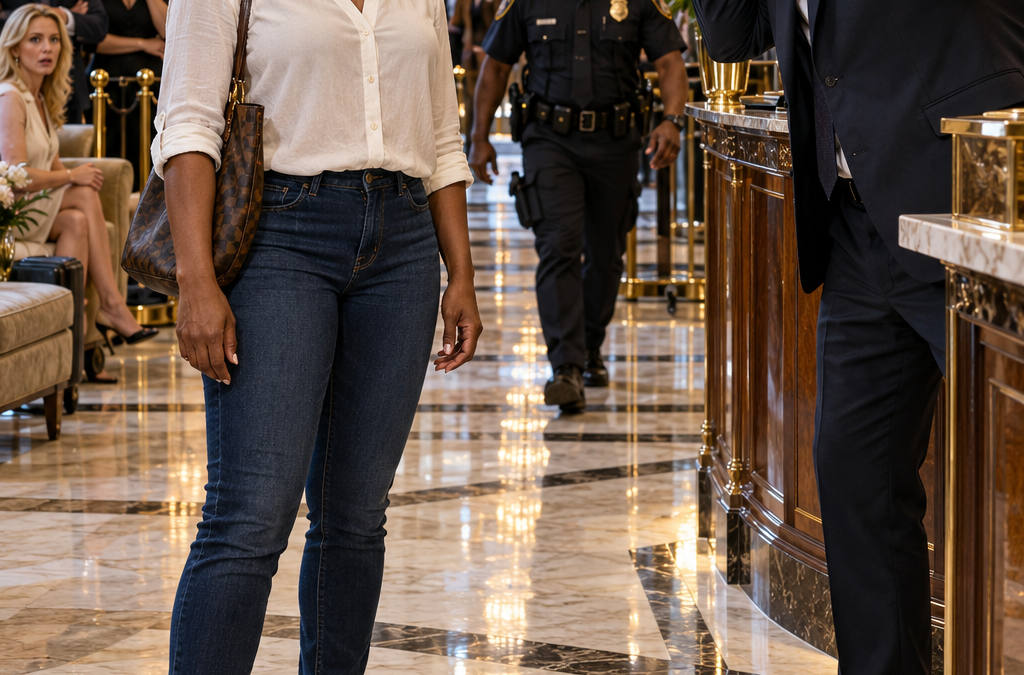
𝗣𝗔𝗥𝗧 𝟮
The Harrington’s exterior looked excellent.
Stone cleaned.
Brass polished.
Valet station organized.
Flower beds maintained.
I stepped through the revolving door.
The lobby opened beneath two enormous chandeliers.
Black-and-white marble.
Dark wood.
A flower arrangement in the center.
Lilies.
Three of them were already browning at the edges.
The water in the vase was cloudy.
Small detail.
But luxury hotels live or die through small details.
Near the elevator stood a young Black bellhop.
Maybe twenty-four.
His name tag read TERRENCE.
He looked at me.
Smiled.
Gave a small nod.
“Good morning, ma’am.”
“Morning.”
That was the first interaction I had inside my new hotel.
It would later matter more than almost anything else.
At the front desk, a young woman was looking at her phone.
She did not notice me approach.
I stood there.
Ten seconds.
Twenty.
Thirty.
Finally she glanced up.
“Can I help you?”
No smile.
Phone still in her hand.
“I’m interested in your room rates.”
Her eyes moved over me.
Sneakers.
Jeans.
Blouse.
Purse.
Three seconds.
Judgment complete.
“We’re fully booked.”
“For tonight?”
“For the foreseeable future.”
I nodded.
Behind her, at least forty room keys hung in their slots.
The Harrington still used decorative brass-backed keys for some suites.
Empty hotel rooms have a look.
So do occupied ones.
I had run hotels too long to miss it.
“Your website shows seventeen rooms available tonight.”
Her jaw tightened.
Before she could answer, a voice came from behind the office door.
“Is there a problem?”
Derek Caldwell walked out.
Tall.
Navy suit.
Gold name tag.
Expensive cuff links.
The heavy kind of cologne that entered a conversation before the man did.
He looked at the clerk first.
Then me.
His entire face changed.
It was subtle enough that a person who had not spent years watching this exact calculation might have missed it.
I did not.
His chin lifted.
His nostrils flared slightly.
His shoulders squared.
Not the posture of a host approaching a guest.
The posture of a man approaching contamination.
“Ma’am.”
He made the word sound hostile.
“What exactly are you doing here?”
“I was asking about room availability.”
His eyes narrowed.
“Room availability.”
“Yes.”
“And why would someone like you need a room at the Harrington Grand?”
There it was.
Someone like you.
Different city.
Different hotel.
Same phrase.
I let it hang.
“Someone like me?”
He stared directly at me.
“You know what I mean.”
“I’m not sure I do.”
His mouth tightened.
I continued.
“I’m interested in seeing the property.”
“The property.”
“Yes.”
He placed both hands on the counter.
“Let me educate you.”
I almost smiled.
Men have been educating me about businesses I owned for most of my career.
“This is not a roadside motel.”
“I’m aware.”
“This is a luxury property.”
“I noticed.”
“Our guests arrive in town cars.”
I said nothing.
“They wear watches worth more than most people’s annual salaries.”
Still nothing.
He looked down at my shoes.
“They don’t wander in off the street wearing filthy sneakers asking to tour the building like this is some yard sale.”
A couple by the fireplace lowered their newspapers.
A man standing near the elevators stopped scrolling through his phone.
Terrence looked toward us.
Derek followed my eyes.
Then returned to me.
“Those shoes are disgusting, by the way.”
I looked down.
They were clean.
Not new.
Not expensive.
Clean.
“You’re tracking dirt across imported marble that probably costs more per square foot than your rent.”
Heat rose beneath my collar.
Not shame.
Anger.
I had experienced prejudice enough times to recognize the physical response before the emotional one.
Hands warming.
Chest tightening.
Jaw wanting to lock.
The trick is learning not to let somebody else choose your next move by choosing your emotion first.
“I’m not here to cause trouble.”
Derek laughed.
“Trouble?”
His voice grew louder.
“You are the trouble.”
The lobby quieted.
“You walked into a five-star hotel smelling like a city bus.”
I had showered less than an hour earlier.
That fact was irrelevant.
He wanted the room to imagine me dirty.
“You’re standing around paying guests who don’t want to look at…”
He waved one hand over me.
“…this.”
He turned toward the couple by the fireplace.
“My apologies.”
The woman gave him a tight smile.
Her husband said nothing.
Neither looked at me.
Derek faced me again.
“Still here?”
“Yes.”
He stepped behind the desk.
“Fine.”
He tapped three keys on the computer.
Maybe four.
Then squinted theatrically.
“No reservation.”
“What name did you search?”
He looked up.
“What?”
“You never asked my name.”
The clerk’s eyes shifted toward him.
Derek said, “I typed enough.”
“No, you didn’t.”
He leaned toward me.
“I’ve managed luxury hotels for fifteen years.”
“Congratulations.”
“I can tell who belongs before they reach the front desk.”
The sentence was so naked in its arrogance that for one second I forgot to be angry.
I was fascinated.
He truly believed that.
“You,” he said, “do not belong here.”
I looked around.
The businessman near the elevator was recording now.
His phone was angled badly, pretending not to be.
The concierge was staring at his monitor without moving his hands.
A woman near the gift shop had covered her mouth.
Terrence remained beside his cart.
I looked back at Derek.
“I’d like to speak with the owner.”
He laughed.
Actually laughed.
“The owner?”
“Yes.”
He turned toward the desk clerk.
“Rachel.”
Her eyes rose.
“She wants the owner.”
Rachel produced a weak smile.
Derek looked delighted.
“That is adorable.”
I said nothing.
“Let me explain how the world works.”
He came around the counter until he stood less than two feet from me.
“I don’t speak to the owner.”
Interesting choice of words.
“Almost nobody does.”
He tapped his chest.
“Some corporate trust bought this place three months ago. Investment people. They do not show up. They do not call. They don’t need to.”
His finger pressed harder against his suit jacket.
“Because I run this hotel.”
I watched him.
“I hire.”
He took a step.
“I fire.”
Another.
“I decide which guests receive upgrades.”
Another.
“I decide who comes through those doors.”
Then he pointed toward me.
“And right now, I’m deciding that you don’t.”
There are moments when a business problem becomes a moral one.
This was one.
Until then, I could have imagined poor training.
Bias.
An isolated manager with bad judgment.
Then he confirmed something deeper.
He believed discretion meant ownership.
He believed the hotel’s reputation depended on keeping certain people outside.
He pulled out his phone.
“You have two choices.”
“I’m listening.”
“You leave now.”
His thumb hovered over the screen.
“Or Charleston Police removes you.”
“For asking about a room.”
“For trespassing.”
I almost laughed.
Instead, I asked quietly:
“Standing in a hotel lobby is trespassing?”
“Being somewhere you have no right to be after management tells you to leave is.”
Terrence moved.
One small step.
“Ma’am, can I get you some water?”
Derek spun.
“Terrence!”
The young man froze.
“What did I just say?”
Terrence’s hand dropped.
“You do not serve people who are not guests.”
Derek pointed toward the luggage cart.
“You do not speak to them.”
Terrence’s jaw tightened.
“Do you understand?”
“Yes, sir.”
“Or would you like to join her outside?”
“No, sir.”
“Then move.”
Terrence stepped back.
His shoulders folded inward.
His eyes went to the floor.
That hurt me differently.
He had tried to do the most basic thing a hospitality employee could do.
Offer water.
And Derek had humiliated him for recognizing my humanity.
I filed that away.
The lobby.
Rachel.
The guests.
The forty keys.
The businessman recording.
Terrence.
All of it.
“Time’s up,” Derek said.
He dialed.
“Charleston Police?”
He looked at me while speaking.
“This is Derek Caldwell, general manager at the Harrington Grand, 215 Meeting Street.”
His voice became more formal.
“I have a Black female, mid-thirties, no reservation, no identification, refusing to vacate private property.”
Rachel flinched.
“She’s trespassing and causing a disturbance.”
I had not raised my voice once.
Derek continued.
“Yes. Immediate assistance.”
He ended the call.
“They know this hotel.”
He smiled.
“They know me.”
I believed him.
That worried me more than the police themselves.
“You should go wait on the curb.”
I did not move.
His voice hardened.
“Like the trash you are.”
For a second, every noise inside me disappeared.
I thought about my father.
He had worked maintenance at an apartment complex when I was a child.
I thought about my mother working twelve-hour nursing shifts.
I thought about the first hotel I bought with money I had spent ten years earning.
I thought about employees cleaning bathrooms while executives called them labor costs.
And I looked at a man standing inside my property telling me I was trash.
“You’re making a mistake,” I said.
“No.”
He smiled.
“I’m correcting one.”
I turned.
Walked toward the revolving door.
Nobody spoke.
Not one guest.
Not one manager.
Not one employee.
Outside, the humidity wrapped around me.
Behind the glass, Derek addressed the lobby.
“Ladies and gentlemen, I apologize for that disturbance.”
I could hear him through the doors.
“The Harrington maintains the highest standards.”
Then applause.
Not much.
Enough.
I stood on the sidewalk and called Raymond Ellis.
Raymond had been Foster Heritage Group’s chief financial officer for nine years.
Fifty-four.
Precise.
Calm.
A man who considered contracts recreational reading.
He answered immediately.
“How’s the inspection?”
“Bring the Harrington deed.”
Silence.
Then his voice changed.
“What happened?”
“Acquisition documents. Corporate charter. Derek Caldwell’s employment contract.”
“Breonna.”
“Every discrimination complaint.”
Another pause.
“Everything Gloria Simmons filed.”
“What happened?”
“Bring it all.”
A police cruiser appeared at the end of Meeting Street.
“And Raymond?”
“Yes?”
“Bring a witness.”
The cruiser entered the circular drive.
Two officers stepped out.
The older man was Sergeant Briggs.
Gray at the temples.
Heavy build.
Comfortable posture.
The younger was Officer Hanley.
Early thirties.
Watchful eyes.
Derek came outside before they reached the steps.
“Gentlemen.”
He extended his hand.
Briggs shook it.
That told me something.
“Derek Caldwell.”
“We’ve met,” Briggs said.
Of course they had.
“What’s going on?”
Derek pointed at me.
“That woman entered my hotel without a reservation or legitimate business purpose.”
His hotel.
I noticed.
“She harassed staff, became combative and refused repeated orders to leave.”
None of it was true.
Sergeant Briggs walked toward me.
“Ma’am.”
“Sergeant.”
“Can you tell me what happened?”
“I entered the lobby and asked about room availability.”
“Were you asked to leave?”
“Yes.”
“Did you leave?”
“I’m standing outside.”
His face remained neutral.
“Identification?”
I handed him my driver’s license.
He took it to the cruiser.
Ran it.
Returned.
“No warrants. No issues.”
Derek threw up both hands.
“I don’t care about her criminal record.”
He walked closer.
“She isn’t a registered guest.”
Briggs turned slightly.
“She’s outside now.”
“I want her formally trespassed.”
“For what?”
Derek looked irritated that the question had been asked.
“South Carolina trespassing statute.”
He quoted a section number.
I watched Officer Hanley’s expression.
Derek had done this before.
Nobody memorizes that language casually.
Briggs looked at me.
“The manager does have authority to ask individuals to leave private property.”
“I understand.”
“If you have a complaint, you can file one with the department.”
“A complaint.”
“Yes, ma’am.”
“I’ll remember that.”
Derek stepped between them.
“You know what the real problem is?”
Nobody answered.
He continued anyway.
“People like her think they can walk into any place and demand to be treated like everybody else.”
Officer Hanley looked down.
Briggs’s face stayed blank.
Derek pointed toward the building.
“The Harrington has standards.”
I stared at him.
“And if protecting those standards makes me the villain, fine.”
He spread his hands.
“I’ll wear that badge.”
Then he faced me.
“If I see your face inside this hotel again, you will be arrested.”
He stepped closer.
“Lobby.”
Closer.
“Parking lot.”
Closer.
“Anywhere on this property.”
He smiled.
“Handcuffed. Processed.”
I said nothing.
“Do you understand me?”
“I heard you.”
Behind him, Raymond’s black sedan turned onto Meeting Street.
I almost smiled.
Derek noticed nothing.
He lowered his voice to Briggs.
“And the best part?”
I listened.
“She asked for the owner.”
Derek laughed.
“The owner.”
Briggs did not laugh.
“Someone in Walmart sneakers thinks she knows the first thing about running a sixty-million-dollar property.”
Raymond parked one block away.
Smart man.
Briggs turned toward me.
“Ma’am, you’ll need to move farther down.”
I nodded.
Walked.
Slowly.
I wanted Derek comfortable.
That sounds vindictive.
It wasn’t.
Comfort reveals people.
When someone believes danger has passed, they stop performing.
Behind me, Derek slapped Briggs lightly on the shoulder.
“Appreciate you boys.”
I stopped far enough away to remain legal.
Close enough to hear.
“Can’t have people like that wandering inside.”
Pause.
“Kills the brand.”
Briggs said something I couldn’t hear.
Then Derek added:
“Tell your captain I said hello. Christmas party’s on us again this year.”
There it was.
Relationship.
Influence.
Habit.
The cruiser pulled away.
Derek went back inside.
I sat in the rental car and waited.
Through the second-floor windows, I could see his office.
He sat behind his desk.
I later learned exactly what he did next.
He opened an incident report.
Typed:
UNAUTHORIZED INDIVIDUAL REMOVED BY LAW ENFORCEMENT.
Then:
Unidentified Black female entered lobby without reservation or legitimate business purpose.
Aggressive.
Confrontational.
Verbally hostile.
Refused repeated instructions.
Law enforcement escorted individual off property.
No physical altercation.
Incident resolved.
He changed “aggressive” to “highly aggressive.”
Then recommended distributing my physical description so employees could prevent me from reentering.
He clicked save.
Case closed.
At 10:02, Raymond entered the Harrington.
I watched from across the street.
Dark gray suit.
Leather portfolio.
Derek saw him immediately.
Of course he did.
Men like Derek recognize the uniforms of power perfectly when they match expectation.
Raymond later told me Derek practically straightened himself into another person.
“Can I help you, sir?”
“My name is Raymond Ellis.”
Raymond placed the portfolio on the counter.
“Chief financial officer, Foster Heritage Group.”
Derek blinked.
“I’m here on behalf of ownership.”
That got his full attention.
“The new ownership group?”
“Yes.”
“Of course.”
Derek adjusted his tie.
“We’ve been waiting for a formal introduction.”
“I’m aware.”
“If you need the conference room—”
“No.”
Raymond opened the portfolio.
“The owner is here.”
Derek looked around.
“Where?”
Raymond turned toward the revolving door.
That was my cue.
I walked inside.
Same blouse.
Same jeans.
Same white sneakers.
No change.
That mattered to me.
I did not want to return wearing a suit.
I did not want diamonds.
No chauffeur.
No costume change proving Derek should have respected me.
The woman he had humiliated deserved respect before he knew anything about my bank account.
I crossed the lobby.
Every head turned.
Derek saw me.
The color left his face.
Not gradually.
All at once.
His mouth opened.
Nothing came.
I stopped three feet away.
“Good morning again, Mr. Caldwell.”
He stared.
Raymond turned the first document toward him.
“This is the recorded deed for the Harrington Grand.”
Derek looked down.
“Transferred March fourteenth to Foster Heritage Group.”
Second document.
“Acquisition agreement.”
Third.
“Corporate charter.”
Raymond tapped the principal’s name.
“Breonna S. Foster.”
The lobby became silent.
“This woman is the sole controlling owner of Foster Heritage Group and this property.”
Derek gripped the counter.
Raymond kept going.
“She owns the building.”
Page.
“The underlying parcel.”
Page.
“The furniture.”
Page.
“The fixtures.”
He looked toward the chandeliers.
“Those.”
Then toward Derek’s office.
“She owns your office.”
Derek’s breathing changed.
“And the desk you sat behind while drafting a false report accusing her of aggressive behavior.”
Rachel covered her mouth.
The businessman near the elevator raised his phone again.
Terrence stood straighter.
I looked at Derek.
“My name is Breonna Foster.”
He said nothing.
“I purchased the Harrington Grand three months ago.”
His eyes moved toward Raymond.
“I came here today to evaluate the property.”
I pointed toward the front desk.
“I watched your employee tell me the hotel was full when rooms were available.”
Rachel lowered her head.
“I heard you tell me I smelled like a bus.”
Derek swallowed.
“You called me trash.”
“I—”
“You threatened Terrence for offering me water.”
He looked toward the young bellhop.
Terrence held his gaze this time.
“You called the police.”
Derek’s lips moved.
“You told them a Black female was trespassing.”
He finally spoke.
“I didn’t know.”
There it was.
The sentence I had been waiting for.
“I didn’t know who you were.”
I nodded.
“You’re right.”
His face changed slightly.
A tiny flash of relief.
Then I removed it.
“You didn’t know.”
I stepped closer.
“And that is exactly the point.”
Nobody moved.
“You had no idea who I was.”
He stared at me.
“So none of the way you treated me was based on my behavior.”
His eyes dropped.
“It was based on what I looked like.”
“Ms. Foster—”
“No.”
My voice remained quiet.
“I asked about a room.”
He swallowed.
“You decided I was poor.”
Silence.
“You decided I was dirty.”
Silence.
“You decided I did not belong.”
Silence.
“Then you used the police to enforce your assumption.”
His face reddened.
“This is a misunderstanding.”
“No.”
I looked toward Rachel.
Then Terrence.
Then the guests.
“A misunderstanding is giving someone the wrong room.”
Back to Derek.
“You understood exactly what you were doing.”
Raymond had already asked Briggs and Hanley to return.
They entered while I was speaking.
Briggs carried copies of the deed.
Hanley looked miserable.
I continued.
“And after I left, you filed an incident report.”
Derek’s eyes widened.
“You described me as highly aggressive.”
“I was documenting—”
“Did I raise my voice?”
He did not answer.
“Threaten anyone?”
Nothing.
“Touch anyone?”
Nothing.
“Refuse to leave the property after police instructed me?”
Nothing.
Raymond opened another page.
“You also recommended distributing Ms. Foster’s description to staff to prevent reentry.”
Officer Hanley closed his eyes for half a second.
I asked Derek:
“Into her own building.”
His hands started trembling.
“I didn’t know.”
Again.
As though ignorance excused everything.
I turned to Raymond.
“Employment contract.”
He produced it.
Section twelve.
Paragraph B.
Morality and reputational conduct clause.
Raymond read it.
Conduct bringing legal liability, disrepute or material public embarrassment to ownership or the property constituted grounds for immediate termination.
Derek finally found anger.
“You can’t do this.”
“Yes.”
“I have rights.”
“Yes.”
“I’ve been here six years.”
“I know.”
“I built this place.”
“No.”
My answer stopped him.
“You managed it.”
He stared.
“The housekeepers built the guest experience.”
I glanced toward the elevator.
“The bell staff carried the bags.”
Front desk.
“The clerks handled arrivals.”
Kitchen doors.
“Cooks fed the guests.”
Then back to Derek.
“You were responsible for leading them.”
I took a breath.
“And you used that position to decide which people deserved dignity.”
His face hardened.
“You’re firing me over one interaction?”
“No.”
That was important.
“I’m terminating you over your conduct today under the authority provided in your employment agreement.”
Raymond placed the contract on the desk.
“And I’m opening a full review of every discrimination complaint, employment action and guest removal made during your management.”
Derek went pale again.
“That’s not necessary.”
“Why?”
“No reason.”
I looked at him.
“Then it should be easy.”
He understood.
I could see it.
He knew what those files contained.
“You’re fired, Mr. Caldwell.”
The words did not feel satisfying.
People imagine firing someone like Derek must feel powerful.
It felt heavy.
Because terminating him was the simple part.
If he had created the culture I suspected, people had been hurt for years.
“Effective immediately.”
He pointed toward me.
“I’ll sue.”
“That is your right.”
“Wrongful termination.”
“Your lawyer may speak with ours.”
“I’ll go to the labor board.”
“Also your right.”
He turned desperately toward Rachel.
“Tell her.”
Rachel looked at the floor.
“Rachel.”
She shook her head.
“Tell her I followed protocol.”
Rachel whispered:
“No.”
He stared at her.
“What?”
Her voice became clearer.
“No.”
Something shifted in the lobby.
Maybe because the first employee had finally contradicted him.
Derek looked toward the guests.
Nobody volunteered.
Then he turned to Terrence.
“You.”
Terrence did not move.
“Your key card,” I said.
Derek looked at me.
“And your name tag.”
His hand reached for the gold tag.
He struggled with the pin.
Removed it.
Placed it on the marble counter.
Small click.
Then the key card.
I looked toward Sergeant Briggs.
“Sergeant.”
His jaw tightened.
“Mr. Caldwell is no longer employed by this property.”
Briggs understood before I finished.
“I’d like him escorted off the premises.”
The irony moved visibly through the room.
Derek stared at Briggs.
The same officer whose hand he had shaken.
The same man he had treated like an ally.
Briggs looked away first.
“Mr. Caldwell.”
He gestured toward the door.
“Let’s go.”
Derek did not move immediately.
Hanley opened the revolving door.
Derek finally walked.
His expensive shoes struck the marble.
Past the desk.
Past Terrence.
Past the exact place where he had told me I would never belong.
Terrence watched him.
No smile.
No celebration.
When Derek reached the revolving door, Terrence gave one small nod.
Not revenge.
Recognition.
The right person was leaving.
The wrong person no longer had to.
The businessman who had been recording approached me afterward.
“My name is Craig Whitmore.”
He looked embarrassed.
“I recorded most of it.”
“I noticed.”
“I should have said something.”
“Yes.”
The answer surprised him.
I did not soften it.
He swallowed.
“I didn’t.”
“No.”
“I’m sorry.”
I believed him.
But apologies after danger passes are easier than intervention while it exists.
“Would you send the footage to Raymond?”
“Yes.”
“Unedited.”
“Of course.”
He handed Raymond his contact information.
Then asked:
“Can I post it?”
I thought about the question.
A few years earlier I might have said no.
Corporate instinct says contain.
Control the narrative.
Protect the brand.
Then I looked around the lobby.
If the video stayed private, Derek’s termination could be rewritten.
Misunderstanding.
Personality conflict.
New ownership cleaning house.
The truth had already spent too many years disappearing into files.
“Post it.”
Craig did.
At 10:47 that morning.
Caption:
Hotel manager calls police on Black woman for trespassing.
She owns the hotel.
By noon, hundreds of thousands had watched.
By afternoon, millions.
By midnight, the footage had crossed eight million views.
News outlets arrived.
Phones rang nonstop.
My communications director wanted talking points.
Attorneys wanted silence.
The hotel wanted barricades outside.
I agreed to one interview.
One.
The reporter sat across from me in the same lobby.
Same marble.
Same front desk.
The spot where Derek had stood remained visible over her shoulder.
She asked:
“Do you feel vindicated?”
I hated the question.
Not because she meant harm.
Because vindicated sounded triumphant.
I did not feel triumphant.
“I feel tired.”
She paused.
“This has happened before?”
“Not exactly like this.”
I looked toward the revolving door.
“But people deciding I don’t belong before I speak?”
“Yes.”
“How often?”
“Enough.”
The reporter waited.
I continued.
“The difference today is somebody recorded it.”
That quote became the headline.
I did not expect what came next.
Raymond filed a formal civil rights complaint within forty-eight hours.
The investigation opened Derek’s files.
Three Black guest complaints emerged immediately.
A couple from Philadelphia denied an upgrade while a white couple arriving later received one.
A Black family from Washington whose children were removed from the pool for being “too disruptive,” while several white children remained.
A retired professor from Savannah stopped by security three times during a single stay and ordered to prove he was registered.
Derek had closed all three.
No action required.
None of the complainants had received meaningful follow-up.
Then Gloria Simmons called.
I still remember our first conversation.
Her voice was guarded.
“Is this really Breonna Foster?”
“Yes.”
“The owner?”
“Yes.”
“Why are you calling me?”
“Because I read your file.”
Silence.
“What did it say?”
“That you had an attitude problem.”
She laughed bitterly.
“Of course.”
“It also says you had no disciplinary record until two weeks after you complained about Derek’s comments.”
More silence.
Then she said:
“So you saw that.”
“Yes.”
“Nobody else seemed to.”
“I’m sorry.”
“For what?”
“For buying the property without finding you sooner.”
Her breathing changed.
I asked:
“Will you tell me what happened?”
She did.
Forty minutes.
Derek had referred to Black guests as lowering the tone.
Told clerks to use discretion.
Encouraged staff to protect the lobby’s appearance.
Complaints about Black guests seemed to receive immediate attention.
Complaints from Black guests disappeared.
Gloria reported the behavior.
Two weeks later, she was terminated.
Previous ownership settled for twelve thousand dollars because Gloria had two children, no savings and bills due.
“They knew I’d take it,” she said.
“Because you needed the money.”
“Yes.”
“Not because you were wrong.”
She became quiet.
“That’s the first time anybody from that hotel has said that.”
That sentence hurt more than anything Derek had said to me.
Because I could answer Derek immediately.
Gloria had waited eighteen months to be believed.
Federal investigators eventually reviewed hiring records.
The pattern was ugly.
Forty-three front desk and management hires under Derek.
Forty-one white.
Two non-white employees.
Neither lasted six months.
Former workers began talking.
A valet described being told to prioritize expensive cars.
A bartender remembered instructions to place certain Black guests near the kitchen instead of windows.
Another employee said Derek repeatedly used words like fit, image, tone and clientele.
Corporate vocabulary can make discrimination sound professional.
It remains discrimination.
Derek released a statement.
He called what happened a misunderstanding.
Claimed standard security procedures.
Said race had nothing to do with his decision.
Then former employees filled the comments beneath his statement.
Stories.
Names.
Dates.
His defense collapsed under volume.
I promoted Terrence three days after the incident.
He came into the temporary office we had set up upstairs.
He looked nervous.
“Sit.”
He sat.
“You offered me water.”
His eyes dropped.
“Yes, ma’am.”
“Why?”
He looked confused.
“You looked upset.”
“That’s all?”
“You were standing there.”
He shrugged.
“I thought maybe water would help.”
I smiled.
“Derek threatened your job.”
“Yes.”
“Did that happen often?”
His face changed.
“With guests?”
“With anyone.”
He hesitated.
“Yes.”
“How often?”
“Enough.”
I let the word sit between us.
“Would you like front desk training?”
He blinked.
“What?”
“I’m moving you into a supervisory track.”
His eyes widened.
“Why?”
“Because your first instinct when someone looked uncomfortable was to help.”
He shook his head.
“Ms. Foster, I’m a bellhop.”
“Today.”
“I don’t know front office systems.”
“You can learn software.”
He said nothing.
“Judgment is harder to teach.”
His eyes filled.
He looked away.
“I thought I was getting fired that morning.”
“For offering water.”
“Yes.”
“That won’t happen here again.”
Terrence became front desk supervisor.
Not because he was kind to the owner.
That would have repeated Derek’s mistake in reverse.
We trained him.
Evaluated him.
He was good.
Very good.
He remembered names.
Caught billing errors.
Handled angry guests without becoming defensive.
And greeted everyone exactly the same way.
Then I called Gloria again.
“I want you back.”
She laughed once.
“No.”
“Fair.”
“You think I’m walking into that place after what happened?”
“No.”
“Then why ask?”
“Because I’m creating a director of housekeeping operations position.”
Silence.
“Full authority over staffing.”
Nothing.
“Back pay for the eighteen months you lost.”
Her breathing changed.
“Thirty percent above your previous salary.”
Still nothing.
“Family health coverage.”
When she finally spoke, her voice broke.
“Why?”
“Because you were right.”
She started crying.
Not loudly.
Just enough that I heard her trying to stop.
That sound stays with me.
People assume financial restitution creates relief.
Sometimes what breaks someone open is simpler.
Being believed.
Gloria returned.
She ran housekeeping better than Derek had ever run the hotel.
Her team grew.
Cleanliness scores rose thirty-one percent.
Turnover dropped.
Every Monday she held a short meeting where housekeepers could speak without supervisors hovering.
She kept coffee and pastries in the break room.
Nothing elaborate.
She had spent too long in places where people doing the hardest physical work were treated like invisible machinery.
She changed that.
The police department launched its own review.
Sergeant Briggs was placed on administrative leave.
Officer Hanley cooperated.
I was interviewed.
They asked whether the officers had used racial language.
“No.”
Threatened me?
“No.”
Handcuffed me?
“No.”
Then why was I concerned?
“Because an officer does not have to use a slur to stop evaluating a Black person independently.”
I explained the relationship.
Derek knew them.
Hosted department events.
Quoted law.
Controlled the story.
Briggs accepted his version too quickly.
Hanley looked uncomfortable but said nothing.
Silence became another recurring character in the story.
Months later, I heard Hanley had transferred into community policing and voluntarily completed additional bias training.
A colleague quoted him saying:
“I knew it felt wrong. I just stood there.”
That sentence mattered.
Because most institutions are not sustained only by obvious people like Derek.
They are sustained by everyone who recognizes something wrong and decides discomfort is sufficient resistance.
It is not.
Six months after the incident, we changed the hotel’s name.
The Harrington Grand came down.
FOSTER GRAND HOTEL went up in brushed bronze.
I argued against using my name at first.
Raymond disagreed.
“This building needs a visible change.”
“Names don’t change culture.”
“No.”
He looked at me.
“But people need to know old ownership is gone.”
He won.
The marble stayed.
The chandeliers stayed.
The rooftop bar stayed.
The flower arrangement changed.
Fresh flowers.
Clear water.
That pleased me more than the sign.
The front desk changed too.
Two employees standing.
Phones away.
Eye contact.
Terrence wore a navy blazer and gold name tag.
The first time I saw him behind the desk, I remembered how Derek had shouted his name across the lobby for offering me water.
Now Terrence was training other people.
At every check-in station, he placed a small card.
I did not authorize it.
I discovered it during another unannounced visit.
It said:
WELCOME TO THE FOSTER GRAND.
EVERYONE BELONGS HERE.
I picked it up.
Terrence was watching.
“You did this?”
He looked nervous.
“Yes, ma’am.”
I read it again.
“Too much?”
“No.”
I put it back.
“Keep it.”
I had to turn away because my eyes had filled.
Gloria noticed.
She never mentioned it.
That is another reason I trusted her.
Guest satisfaction eventually reached its highest level in a decade.
Our new training program expanded to all twelve properties.
We partnered with local civil rights and hospitality organizations.
Not for a one-hour slide deck employees clicked through while checking email.
Real scenarios.
Bias in room availability.
Security escalation.
Differential treatment.
Guest complaints.
Managerial discretion.
Bystander responsibility.
We changed reporting channels too.
Complaints no longer disappeared into the general manager’s inbox.
They went to independent review.
Patterns were tracked across properties.
I had learned something uncomfortable.
Firing Derek was necessary.
It was also insufficient.
A bad leader can be removed in one meeting.
A system capable of hiding him requires rebuilding.
One Thursday afternoon in October, I was sitting near the fireplace at the Foster Grand.
Jeans again.
Sneakers again.
Old habits.
A young Black woman entered.
Twenty-two, maybe.
Sundress.
Small duffel bag.
She stopped just inside the revolving door.
I recognized the look.
People who have always been welcomed into expensive places do not realize there is a particular hesitation in people who have not.
A half-second scan.
Who is watching?
Am I dressed correctly?
Do I need to explain myself before somebody asks?
Terrence saw her.
He walked over.
“Welcome to the Foster Grand.”
She looked surprised.
“Can I help you?”
“I don’t have a reservation.”
“No problem.”
“I wasn’t sure if…”
She stopped.
Terrence smiled.
“We’ll figure it out.”
He took her bag.
Walked her to the desk.
No inspection of her shoes.
No judgment.
No demand to prove she could afford the room before discussing one.
I watched quietly.
That was the moment I finally felt the hotel belonged to me.
Not the deed.
Not Derek’s termination.
Not the bronze sign.
That.
A stranger entering uncertainly and leaving the doorway without being made smaller.
Derek eventually disappeared from public view.
The civil rights case settled.
The amount remained confidential.
He was barred from hospitality management for several years under the settlement terms.
The false incident report he wrote about me became important evidence.
Highly aggressive.
Confrontational.
Hostile.
Words typed while security footage and witnesses showed me speaking calmly.
That discrepancy told investigators more than Derek intended.
Sergeant Briggs retired early.
Hanley stayed with the department.
Craig Whitmore’s video passed tens of millions of views.
It was cited in conversations about racial profiling far beyond Charleston.
I bought a thirteenth hotel the following year.
I still visited anonymously.
That policy never changed.
People asked whether I worried something similar would happen again.
Of course.
But anonymity remains useful.
I do not want staff treating ordinary people well because they are afraid the ordinary person might secretly own the building.
That misses the entire point.
The cashier deserves dignity even when she does not.
The exhausted mother deserves dignity.
The man asking for directions.
The teenager using the restroom.
The person whose credit card eventually gets declined.
The person wearing old sneakers.
The person who smells like the bus because maybe the bus is how they got there.
Respect that depends on discovering wealth is not respect.
It is obedience to status.
There is a difference.
Years later, I still remember that morning with embarrassing precision.
Derek adjusting his cuff links.
Rachel’s phone.
Cloudy flower water.
Terrence taking one step toward me.
Sergeant Briggs shaking Derek’s hand.
Officer Hanley staring at the pavement.
The couple hiding behind their newspapers.
Craig holding a phone instead of speaking.
My own reflection in the revolving door when I walked out.
People always focus on the moment I returned.
They like that part.
The owner walks back in.
The racist manager goes pale.
Documents come out.
Tables turn.
He gets fired.
It is satisfying in a clean, dramatic way.
But that is not the part that changed how I ran my company.
The part that changed me happened before Raymond arrived.
It was standing outside my own hotel after being told I did not belong there and realizing how easily the outcome would have been different if I had actually been the woman Derek thought I was.
If I had been broke.
If I had not owned anything.
If no CFO was coming with a deed.
If I did not have lawyers.
If Craig had not recorded.
If there were no corporate resources waiting one phone call away.
Derek would have won that morning.
The police would have removed me.
His report would have become the official version.
Highly aggressive Black woman.
Problem handled.
Case closed.
That realization stayed with me far longer than the humiliation.
It forced me to ask a question every owner should ask.
What happens to people inside your organization when they cannot call somebody powerful?
That is where culture lives.
Not in executive meetings.
Not mission statements.
Not framed values near elevators.
Culture lives in the five minutes before anyone important arrives.
Derek taught me that.
Terrence did too.
So did Gloria.
One showed me what authority looks like when empathy is absent.
One showed me how much character can exist in a person with almost no authority.
And one showed me the cost of telling the truth inside a system designed to protect the wrong person.
I used to think ownership meant having final authority.
The signature.
The deed.
The power to hire and fire.
Those things matter.
But after Charleston, I began thinking about ownership differently.
If my name sits behind a company, then the person cleaning the bathroom at two in the morning is part of my responsibility.
So is the guest who cannot afford a suite.
So is the employee who notices misconduct and wonders whether telling the truth will destroy their career.
So is the person who walks through the front door wearing shoes someone else considers too cheap for the marble.
That became the standard.
Months after the rebranding, I was walking through the lobby when Terrence called my name.
“Ms. Foster.”
I stopped.
A new bellhop stood beside him.
Nineteen.
Nervous.
Terrence introduced us.
“This is Malik.”
Malik shook my hand.
“Nice to meet you, ma’am.”
“Welcome.”
“He starts today.”
“Good.”
Terrence smiled.
“I was explaining our first rule.”
I looked at him.
“What’s the first rule?”
He glanced toward the revolving door.
“Everybody who walks through there gets treated like they own the place.”
I laughed.
“Careful with that wording.”
He laughed too.
“You know what I mean.”
I did.
As I walked toward the elevator, I heard him continue training Malik.
“Don’t guess who has money.”
“Don’t guess who belongs.”
“Don’t make people earn basic respect.”
Simple things.
Things that should never have required a viral video, a civil rights investigation or an owner being thrown out of her own hotel.
But sometimes organizations learn simple truths expensively.
The elevator doors opened.
Before stepping inside, I looked back.
Fresh flowers.
Clear water.
Staff smiling.
Terrence teaching.
Guests moving through the lobby without anyone studying whether they looked expensive enough to remain.
The marble was the same.
The building was the same.
Almost everything visible was the same.
And yet it felt entirely different.
That morning months earlier, Derek Caldwell had stood behind the front desk and told me he decided who belonged.
He believed ownership lived in authority.
He believed power meant deciding who could enter.
He believed a person’s value could be measured from shoes, clothing and skin before she ever opened her mouth.
I learned something better.
The strongest building is not the one that keeps the wrong people out.
It is the one where no employee is taught to believe another human being must prove they deserve to be treated with dignity before they are allowed through the door.
Derek once pointed toward the curb and told me to wait there like trash.
I remember the words.
I probably always will.
But I remember something else more clearly now.
Terrence stepping forward.
“Ma’am, can I get you some water?”
One sentence.
He had no idea who I was.
That was exactly why it mattered.
𝗧𝗛𝗘 𝗘𝗡𝗗
The Hotel Manager Called Police on Me for Standing in the Lobby and Told Me I Would Never Belong There
The manager looked at my jeans, my sneakers, and the color of my skin, then announced across the lobby that people like me had no business inside a five-star hotel. Thirty minutes later, I would walk back through the same revolving door, but by then I had stopped wondering whether he was fit to run the place and started wondering how many other people he had treated this way when nobody powerful was watching.
Three hours before Derek Caldwell called the Charleston Police Department on me, I was standing in the bathroom of a Hampton Inn two miles from the waterfront, studying myself in the mirror.
No makeup.
Hair pulled into a simple twist.
Plain cotton blouse.
Dark jeans.
White sneakers I had bought more than a year earlier.
No watch anyone would recognize.
No designer handbag.
No assistant waiting outside.
No driver.
No security.
Exactly the way I wanted it.
My name is Breonna Foster.
At forty-two, I owned twelve boutique hotels across the Southeast through Foster Heritage Group.
More than four hundred people worked for us.
Annual revenue had crossed sixty-two million dollars the year before.
Three months earlier, we had completed the acquisition of the Harrington Grand in Charleston through a corporate trust.
The purchase was deliberately quiet.
The general manager knew a new ownership group had taken control.
He knew there was a holding company.
He knew where to send financial reports.
But he had never met me.
Neither had most of the staff.
That was not an accident.
Whenever I bought a hotel, I visited anonymously within the first six months.
I never announced the date.
Never arrived with executives.
Never let the manager prepare the lobby, warn the staff or stage the kind of hospitality people suddenly remember when the owner is watching.
I went in looking ordinary.
Because ordinary people tell you the truth about a business.
Not through what they say.
Through how they are treated.
Seven of my first eleven anonymous visits had been unremarkable.
That was good.
A hotel should be unremarkable when it comes to basic dignity.
Professional greeting.
Consistent service.
No difference between the guest carrying a Louis Vuitton bag and the mother carrying a grocery-store tote.
No difference between a white retired couple and a Black college student.
No difference between someone arriving in a luxury SUV and someone walking in off the bus.
Four visits had exposed problems.
In Savannah, a front desk clerk told me there were no rooms available when the reservation system showed nineteen.
In Birmingham, security followed me through the lobby, restaurant and gift shop for twenty minutes.
In Nashville, a valet refused to take my rental car until a white colleague walked outside and asked why I was still standing there.
Those incidents led to retraining.
Sometimes discipline.
Sometimes terminations.
I did not enjoy firing people.
Anyone who does probably should not control livelihoods.
But hospitality has a simple foundation.
A guest should not have to prove they are wealthy enough, connected enough or harmless enough to deserve respect.
The Harrington worried me before I ever walked through its door.
On paper, it was the crown jewel of our portfolio.
One hundred twenty rooms.
Historic property on Meeting Street.
Italian marble.
Rooftop bar.
Strong revenue.
Excellent location.
Travel magazines loved it.
The numbers beneath the polished surface told another story.
Guest satisfaction had dropped fourteen percent.
Staff turnover was nearly twice our portfolio average.
Housekeeping vacancies remained open longer than they should have.
And three formal complaints alleging discriminatory treatment had been closed under previous ownership without meaningful follow-up.
Every one passed through one man.
Derek Caldwell.
General manager.
Forty-six.
Six years at the Harrington.
Fifteen years in luxury hospitality.
Strong revenue record.
Good relationship with local businesses.
Regular charity participation.
Excellent corporate evaluations.
The sort of résumé boards like.
Then I found Gloria Simmons.
Former head housekeeper.
Black woman.
Four years at the property.
Terminated eighteen months earlier for what Derek described as “persistent attitude problems and insubordination.”
Her file contained something strange.
No disciplinary history.
No written warning.
No poor performance review.
Nothing suggesting four years of problems.
Then suddenly termination.
There had also been a wrongful termination complaint.
Settled for twelve thousand dollars.
Non-disclosure agreement.
Closed.
That phrase appeared too often in the Harrington’s records.
Closed.
Resolved.
No action required.
I do not trust clean endings when the paperwork underneath them is dirty.
So that Tuesday morning, I checked out of the Hampton Inn, got into a plain gray rental sedan and drove to the Harrington.
Charleston humidity pressed against the windshield.
The harbor air smelled faintly of salt.
At 9:15, I parked with ordinary guests.
Nobody met me.
Nobody knew I had arrived.
I sat in the car for a moment.
My mother used to tell me I had a dangerous habit of noticing everything.
She meant it affectionately.
In business, it became useful.
The Harrington’s exterior looked excellent.
Stone cleaned.
Brass polished.
Valet station organized.
Flower beds maintained.
I stepped through the revolving door.
The lobby opened beneath two enormous chandeliers.
Black-and-white marble.
Dark wood.
A flower arrangement in the center.
Lilies.
Three of them were already browning at the edges.
The water in the vase was cloudy.
Small detail.
But luxury hotels live or die through small details.
Near the elevator stood a young Black bellhop.
Maybe twenty-four.
His name tag read TERRENCE.
He looked at me.
Smiled.
Gave a small nod.
“Good morning, ma’am.”
“Morning.”
That was the first interaction I had inside my new hotel.
It would later matter more than almost anything else.
At the front desk, a young woman was looking at her phone.
She did not notice me approach.
I stood there.
Ten seconds.
Twenty.
Thirty.
Finally she glanced up.
“Can I help you?”
No smile.
Phone still in her hand.
“I’m interested in your room rates.”
Her eyes moved over me.
Sneakers.
Jeans.
Blouse.
Purse.
Three seconds.
Judgment complete.
“We’re fully booked.”
“For tonight?”
“For the foreseeable future.”
I nodded.
Behind her, at least forty room keys hung in their slots.
The Harrington still used decorative brass-backed keys for some suites.
Empty hotel rooms have a look.
So do occupied ones.
I had run hotels too long to miss it.
“Your website shows seventeen rooms available tonight.”
Her jaw tightened.
Before she could answer, a voice came from behind the office door.
“Is there a problem?”
Derek Caldwell walked out.
Tall.
Navy suit.
Gold name tag.
Expensive cuff links.
The heavy kind of cologne that entered a conversation before the man did.
He looked at the clerk first.
Then me.
His entire face changed.
It was subtle enough that a person who had not spent years watching this exact calculation might have missed it.
I did not.
His chin lifted.
His nostrils flared slightly.
His shoulders squared.
Not the posture of a host approaching a guest.
The posture of a man approaching contamination.
“Ma’am.”
He made the word sound hostile.
“What exactly are you doing here?”
“I was asking about room availability.”
His eyes narrowed.
“Room availability.”
“Yes.”
“And why would someone like you need a room at the Harrington Grand?”
There it was.
Someone like you.
Different city.
Different hotel.
Same phrase.
I let it hang.
“Someone like me?”
He stared directly at me.
“You know what I mean.”
“I’m not sure I do.”
His mouth tightened.
I continued.
“I’m interested in seeing the property.”
“The property.”
“Yes.”
He placed both hands on the counter.
“Let me educate you.”
I almost smiled.
Men have been educating me about businesses I owned for most of my career.
“This is not a roadside motel.”
“I’m aware.”
“This is a luxury property.”
“I noticed.”
“Our guests arrive in town cars.”
I said nothing.
“They wear watches worth more than most people’s annual salaries.”
Still nothing.
He looked down at my shoes.
“They don’t wander in off the street wearing filthy sneakers asking to tour the building like this is some yard sale.”
A couple by the fireplace lowered their newspapers.
A man standing near the elevators stopped scrolling through his phone.
Terrence looked toward us.
Derek followed my eyes.
Then returned to me.
“Those shoes are disgusting, by the way.”
I looked down.
They were clean.
Not new.
Not expensive.
Clean.
“You’re tracking dirt across imported marble that probably costs more per square foot than your rent.”
Heat rose beneath my collar.
Not shame.
Anger.
I had experienced prejudice enough times to recognize the physical response before the emotional one.
Hands warming.
Chest tightening.
Jaw wanting to lock.
The trick is learning not to let somebody else choose your next move by choosing your emotion first.
“I’m not here to cause trouble.”
Derek laughed.
“Trouble?”
His voice grew louder.
“You are the trouble.”
The lobby quieted.
“You walked into a five-star hotel smelling like a city bus.”
I had showered less than an hour earlier.
That fact was irrelevant.
He wanted the room to imagine me dirty.
“You’re standing around paying guests who don’t want to look at…”
He waved one hand over me.
“…this.”
He turned toward the couple by the fireplace.
“My apologies.”
The woman gave him a tight smile.
Her husband said nothing.
Neither looked at me.
Derek faced me again.
“Still here?”
“Yes.”
He stepped behind the desk.
“Fine.”
He tapped three keys on the computer.
Maybe four.
Then squinted theatrically.
“No reservation.”
“What name did you search?”
He looked up.
“What?”
“You never asked my name.”
The clerk’s eyes shifted toward him.
Derek said, “I typed enough.”
“No, you didn’t.”
He leaned toward me.
“I’ve managed luxury hotels for fifteen years.”
“Congratulations.”
“I can tell who belongs before they reach the front desk.”
The sentence was so naked in its arrogance that for one second I forgot to be angry.
I was fascinated.
He truly believed that.
“You,” he said, “do not belong here.”
I looked around.
The businessman near the elevator was recording now.
His phone was angled badly, pretending not to be.
The concierge was staring at his monitor without moving his hands.
A woman near the gift shop had covered her mouth.
Terrence remained beside his cart.
I looked back at Derek.
“I’d like to speak with the owner.”
He laughed.
Actually laughed.
“The owner?”
“Yes.”
He turned toward the desk clerk.
“Rachel.”
Her eyes rose.
“She wants the owner.”
Rachel produced a weak smile.
Derek looked delighted.
“That is adorable.”
I said nothing.
“Let me explain how the world works.”
He came around the counter until he stood less than two feet from me.
“I don’t speak to the owner.”
Interesting choice of words.
“Almost nobody does.”
He tapped his chest.
“Some corporate trust bought this place three months ago. Investment people. They do not show up. They do not call. They don’t need to.”
His finger pressed harder against his suit jacket.
“Because I run this hotel.”
I watched him.
“I hire.”
He took a step.
“I fire.”
Another.
“I decide which guests receive upgrades.”
Another.
“I decide who comes through those doors.”
Then he pointed toward me.
“And right now, I’m deciding that you don’t.”
There are moments when a business problem becomes a moral one.
This was one.
Until then, I could have imagined poor training.
Bias.
An isolated manager with bad judgment.
Then he confirmed something deeper.
He believed discretion meant ownership.
He believed the hotel’s reputation depended on keeping certain people outside.
He pulled out his phone.
“You have two choices.”
“I’m listening.”
“You leave now.”
His thumb hovered over the screen.
“Or Charleston Police removes you.”
“For asking about a room.”
“For trespassing.”
I almost laughed.
Instead, I asked quietly:
“Standing in a hotel lobby is trespassing?”
“Being somewhere you have no right to be after management tells you to leave is.”
Terrence moved.
One small step.
“Ma’am, can I get you some water?”
Derek spun.
“Terrence!”
The young man froze.
“What did I just say?”
Terrence’s hand dropped.
“You do not serve people who are not guests.”
Derek pointed toward the luggage cart.
“You do not speak to them.”
Terrence’s jaw tightened.
“Do you understand?”
“Yes, sir.”
“Or would you like to join her outside?”
“No, sir.”
“Then move.”
Terrence stepped back.
His shoulders folded inward.
His eyes went to the floor.
That hurt me differently.
He had tried to do the most basic thing a hospitality employee could do.
Offer water.
And Derek had humiliated him for recognizing my humanity.
I filed that away.
The lobby.
Rachel.
The guests.
The forty keys.
The businessman recording.
Terrence.
All of it.
“Time’s up,” Derek said.
He dialed.
“Charleston Police?”
He looked at me while speaking.
“This is Derek Caldwell, general manager at the Harrington Grand, 215 Meeting Street.”
His voice became more formal.
“I have a Black female, mid-thirties, no reservation, no identification, refusing to vacate private property.”
Rachel flinched.
“She’s trespassing and causing a disturbance.”
I had not raised my voice once.
Derek continued.
“Yes. Immediate assistance.”
He ended the call.
“They know this hotel.”
He smiled.
“They know me.”
I believed him.
That worried me more than the police themselves.
“You should go wait on the curb.”
I did not move.
His voice hardened.
“Like the trash you are.”
For a second, every noise inside me disappeared.
I thought about my father.
He had worked maintenance at an apartment complex when I was a child.
I thought about my mother working twelve-hour nursing shifts.
I thought about the first hotel I bought with money I had spent ten years earning.
I thought about employees cleaning bathrooms while executives called them labor costs.
And I looked at a man standing inside my property telling me I was trash.
“You’re making a mistake,” I said.
“No.”
He smiled.
“I’m correcting one.”
I turned.
Walked toward the revolving door.
Nobody spoke.
Not one guest.
Not one manager.
Not one employee.
Outside, the humidity wrapped around me.
Behind the glass, Derek addressed the lobby.
“Ladies and gentlemen, I apologize for that disturbance.”
I could hear him through the doors.
“The Harrington maintains the highest standards.”
Then applause.
Not much.
Enough.
I stood on the sidewalk and called Raymond Ellis.
Raymond had been Foster Heritage Group’s chief financial officer for nine years.
Fifty-four.
Precise.
Calm.
A man who considered contracts recreational reading.
He answered immediately.
“How’s the inspection?”
“Bring the Harrington deed.”
Silence.
Then his voice changed.
“What happened?”
“Acquisition documents. Corporate charter. Derek Caldwell’s employment contract.”
“Breonna.”
“Every discrimination complaint.”
Another pause.
“Everything Gloria Simmons filed.”
“What happened?”
“Bring it all.”
A police cruiser appeared at the end of Meeting Street.
“And Raymond?”
“Yes?”
“Bring a witness.”
The cruiser entered the circular drive.
Two officers stepped out.
The older man was Sergeant Briggs.
Gray at the temples.
Heavy build.
Comfortable posture.
The younger was Officer Hanley.
Early thirties.
Watchful eyes.
Derek came outside before they reached the steps.
“Gentlemen.”
He extended his hand.
Briggs shook it.
That told me something.
“Derek Caldwell.”
“We’ve met,” Briggs said.
Of course they had.
“What’s going on?”
Derek pointed at me.
“That woman entered my hotel without a reservation or legitimate business purpose.”
His hotel.
I noticed.
“She harassed staff, became combative and refused repeated orders to leave.”
None of it was true.
Sergeant Briggs walked toward me.
“Ma’am.”
“Sergeant.”
“Can you tell me what happened?”
“I entered the lobby and asked about room availability.”
“Were you asked to leave?”
“Yes.”
“Did you leave?”
“I’m standing outside.”
His face remained neutral.
“Identification?”
I handed him my driver’s license.
He took it to the cruiser.
Ran it.
Returned.
“No warrants. No issues.”
Derek threw up both hands.
“I don’t care about her criminal record.”
He walked closer.
“She isn’t a registered guest.”
Briggs turned slightly.
“She’s outside now.”
“I want her formally trespassed.”
“For what?”
Derek looked irritated that the question had been asked.
“South Carolina trespassing statute.”
He quoted a section number.
I watched Officer Hanley’s expression.
Derek had done this before.
Nobody memorizes that language casually.
Briggs looked at me.
“The manager does have authority to ask individuals to leave private property.”
“I understand.”
“If you have a complaint, you can file one with the department.”
“A complaint.”
“Yes, ma’am.”
“I’ll remember that.”
Derek stepped between them.
“You know what the real problem is?”
Nobody answered.
He continued anyway.
“People like her think they can walk into any place and demand to be treated like everybody else.”
Officer Hanley looked down.
Briggs’s face stayed blank.
Derek pointed toward the building.
“The Harrington has standards.”
I stared at him.
“And if protecting those standards makes me the villain, fine.”
He spread his hands.
“I’ll wear that badge.”
Then he faced me.
“If I see your face inside this hotel again, you will be arrested.”
He stepped closer.
“Lobby.”
Closer.
“Parking lot.”
Closer.
“Anywhere on this property.”
He smiled.
“Handcuffed. Processed.”
I said nothing.
“Do you understand me?”
“I heard you.”
Behind him, Raymond’s black sedan turned onto Meeting Street.
I almost smiled.
Derek noticed nothing.
He lowered his voice to Briggs.
“And the best part?”
I listened.
“She asked for the owner.”
Derek laughed.
“The owner.”
Briggs did not laugh.
“Someone in Walmart sneakers thinks she knows the first thing about running a sixty-million-dollar property.”
Raymond parked one block away.
Smart man.
Briggs turned toward me.
“Ma’am, you’ll need to move farther down.”
I nodded.
Walked.
Slowly.
I wanted Derek comfortable.
That sounds vindictive.
It wasn’t.
Comfort reveals people.
When someone believes danger has passed, they stop performing.
Behind me, Derek slapped Briggs lightly on the shoulder.
“Appreciate you boys.”
I stopped far enough away to remain legal.
Close enough to hear.
“Can’t have people like that wandering inside.”
Pause.
“Kills the brand.”
Briggs said something I couldn’t hear.
Then Derek added:
“Tell your captain I said hello. Christmas party’s on us again this year.”
There it was.
Relationship.
Influence.
Habit.
The cruiser pulled away.
Derek went back inside.
I sat in the rental car and waited.
Through the second-floor windows, I could see his office.
He sat behind his desk.
I later learned exactly what he did next.
He opened an incident report.
Typed:
UNAUTHORIZED INDIVIDUAL REMOVED BY LAW ENFORCEMENT.
Then:
Unidentified Black female entered lobby without reservation or legitimate business purpose.
Aggressive.
Confrontational.
Verbally hostile.
Refused repeated instructions.
Law enforcement escorted individual off property.
No physical altercation.
Incident resolved.
He changed “aggressive” to “highly aggressive.”
Then recommended distributing my physical description so employees could prevent me from reentering.
He clicked save.
Case closed.
At 10:02, Raymond entered the Harrington.
I watched from across the street.
Dark gray suit.
Leather portfolio.
Derek saw him immediately.
Of course he did.
Men like Derek recognize the uniforms of power perfectly when they match expectation.
Raymond later told me Derek practically straightened himself into another person.
“Can I help you, sir?”
“My name is Raymond Ellis.”
Raymond placed the portfolio on the counter.
“Chief financial officer, Foster Heritage Group.”
Derek blinked.
“I’m here on behalf of ownership.”
That got his full attention.
“The new ownership group?”
“Yes.”
“Of course.”
Derek adjusted his tie.
“We’ve been waiting for a formal introduction.”
“I’m aware.”
“If you need the conference room—”
“No.”
Raymond opened the portfolio.
“The owner is here.”
Derek looked around.
“Where?”
Raymond turned toward the revolving door.
That was my cue.
I walked inside.
Same blouse.
Same jeans.
Same white sneakers.
No change.
That mattered to me.
I did not want to return wearing a suit.
I did not want diamonds.
No chauffeur.
No costume change proving Derek should have respected me.
The woman he had humiliated deserved respect before he knew anything about my bank account.
I crossed the lobby.
Every head turned.
Derek saw me.
The color left his face.
Not gradually.
All at once.
His mouth opened.
Nothing came.
I stopped three feet away.
“Good morning again, Mr. Caldwell.”
He stared.
Raymond turned the first document toward him.
“This is the recorded deed for the Harrington Grand.”
Derek looked down.
“Transferred March fourteenth to Foster Heritage Group.”
Second document.
“Acquisition agreement.”
Third.
“Corporate charter.”
Raymond tapped the principal’s name.
“Breonna S. Foster.”
The lobby became silent.
“This woman is the sole controlling owner of Foster Heritage Group and this property.”
Derek gripped the counter.
Raymond kept going.
“She owns the building.”
Page.
“The underlying parcel.”
Page.
“The furniture.”
Page.
“The fixtures.”
He looked toward the chandeliers.
“Those.”
Then toward Derek’s office.
“She owns your office.”
Derek’s breathing changed.
“And the desk you sat behind while drafting a false report accusing her of aggressive behavior.”
Rachel covered her mouth.
The businessman near the elevator raised his phone again.
Terrence stood straighter.
I looked at Derek.
“My name is Breonna Foster.”
He said nothing.
“I purchased the Harrington Grand three months ago.”
His eyes moved toward Raymond.
“I came here today to evaluate the property.”
I pointed toward the front desk.
“I watched your employee tell me the hotel was full when rooms were available.”
Rachel lowered her head.
“I heard you tell me I smelled like a bus.”
Derek swallowed.
“You called me trash.”
“I—”
“You threatened Terrence for offering me water.”
He looked toward the young bellhop.
Terrence held his gaze this time.
“You called the police.”
Derek’s lips moved.
“You told them a Black female was trespassing.”
He finally spoke.
“I didn’t know.”
There it was.
The sentence I had been waiting for.
“I didn’t know who you were.”
I nodded.
“You’re right.”
His face changed slightly.
A tiny flash of relief.
Then I removed it.
“You didn’t know.”
I stepped closer.
“And that is exactly the point.”
Nobody moved.
“You had no idea who I was.”
He stared at me.
“So none of the way you treated me was based on my behavior.”
His eyes dropped.
“It was based on what I looked like.”
“Ms. Foster—”
“No.”
My voice remained quiet.
“I asked about a room.”
He swallowed.
“You decided I was poor.”
Silence.
“You decided I was dirty.”
Silence.
“You decided I did not belong.”
Silence.
“Then you used the police to enforce your assumption.”
His face reddened.
“This is a misunderstanding.”
“No.”
I looked toward Rachel.
Then Terrence.
Then the guests.
“A misunderstanding is giving someone the wrong room.”
Back to Derek.
“You understood exactly what you were doing.”
Raymond had already asked Briggs and Hanley to return.
They entered while I was speaking.
Briggs carried copies of the deed.
Hanley looked miserable.
I continued.
“And after I left, you filed an incident report.”
Derek’s eyes widened.
“You described me as highly aggressive.”
“I was documenting—”
“Did I raise my voice?”
He did not answer.
“Threaten anyone?”
Nothing.
“Touch anyone?”
Nothing.
“Refuse to leave the property after police instructed me?”
Nothing.
Raymond opened another page.
“You also recommended distributing Ms. Foster’s description to staff to prevent reentry.”
Officer Hanley closed his eyes for half a second.
I asked Derek:
“Into her own building.”
His hands started trembling.
“I didn’t know.”
Again.
As though ignorance excused everything.
I turned to Raymond.
“Employment contract.”
He produced it.
Section twelve.
Paragraph B.
Morality and reputational conduct clause.
Raymond read it.
Conduct bringing legal liability, disrepute or material public embarrassment to ownership or the property constituted grounds for immediate termination.
Derek finally found anger.
“You can’t do this.”
“Yes.”
“I have rights.”
“Yes.”
“I’ve been here six years.”
“I know.”
“I built this place.”
“No.”
My answer stopped him.
“You managed it.”
He stared.
“The housekeepers built the guest experience.”
I glanced toward the elevator.
“The bell staff carried the bags.”
Front desk.
“The clerks handled arrivals.”
Kitchen doors.
“Cooks fed the guests.”
Then back to Derek.
“You were responsible for leading them.”
I took a breath.
“And you used that position to decide which people deserved dignity.”
His face hardened.
“You’re firing me over one interaction?”
“No.”
That was important.
“I’m terminating you over your conduct today under the authority provided in your employment agreement.”
Raymond placed the contract on the desk.
“And I’m opening a full review of every discrimination complaint, employment action and guest removal made during your management.”
Derek went pale again.
“That’s not necessary.”
“Why?”
“No reason.”
I looked at him.
“Then it should be easy.”
He understood.
I could see it.
He knew what those files contained.
“You’re fired, Mr. Caldwell.”
The words did not feel satisfying.
People imagine firing someone like Derek must feel powerful.
It felt heavy.
Because terminating him was the simple part.
If he had created the culture I suspected, people had been hurt for years.
“Effective immediately.”
He pointed toward me.
“I’ll sue.”
“That is your right.”
“Wrongful termination.”
“Your lawyer may speak with ours.”
“I’ll go to the labor board.”
“Also your right.”
He turned desperately toward Rachel.
“Tell her.”
Rachel looked at the floor.
“Rachel.”
She shook her head.
“Tell her I followed protocol.”
Rachel whispered:
“No.”
He stared at her.
“What?”
Her voice became clearer.
“No.”
Something shifted in the lobby.
Maybe because the first employee had finally contradicted him.
Derek looked toward the guests.
Nobody volunteered.
Then he turned to Terrence.
“You.”
Terrence did not move.
“Your key card,” I said.
Derek looked at me.
“And your name tag.”
His hand reached for the gold tag.
He struggled with the pin.
Removed it.
Placed it on the marble counter.
Small click.
Then the key card.
I looked toward Sergeant Briggs.
“Sergeant.”
His jaw tightened.
“Mr. Caldwell is no longer employed by this property.”
Briggs understood before I finished.
“I’d like him escorted off the premises.”
The irony moved visibly through the room.
Derek stared at Briggs.
The same officer whose hand he had shaken.
The same man he had treated like an ally.
Briggs looked away first.
“Mr. Caldwell.”
He gestured toward the door.
“Let’s go.”
Derek did not move immediately.
Hanley opened the revolving door.
Derek finally walked.
His expensive shoes struck the marble.
Past the desk.
Past Terrence.
Past the exact place where he had told me I would never belong.
Terrence watched him.
No smile.
No celebration.
When Derek reached the revolving door, Terrence gave one small nod.
Not revenge.
Recognition.
The right person was leaving.
The wrong person no longer had to.
The businessman who had been recording approached me afterward.
“My name is Craig Whitmore.”
He looked embarrassed.
“I recorded most of it.”
“I noticed.”
“I should have said something.”
“Yes.”
The answer surprised him.
I did not soften it.
He swallowed.
“I didn’t.”
“No.”
“I’m sorry.”
I believed him.
But apologies after danger passes are easier than intervention while it exists.
“Would you send the footage to Raymond?”
“Yes.”
“Unedited.”
“Of course.”
He handed Raymond his contact information.
Then asked:
“Can I post it?”
I thought about the question.
A few years earlier I might have said no.
Corporate instinct says contain.
Control the narrative.
Protect the brand.
Then I looked around the lobby.
If the video stayed private, Derek’s termination could be rewritten.
Misunderstanding.
Personality conflict.
New ownership cleaning house.
The truth had already spent too many years disappearing into files.
“Post it.”
Craig did.
At 10:47 that morning.
Caption:
Hotel manager calls police on Black woman for trespassing.
She owns the hotel.
By noon, hundreds of thousands had watched.
By afternoon, millions.
By midnight, the footage had crossed eight million views.
News outlets arrived.
Phones rang nonstop.
My communications director wanted talking points.
Attorneys wanted silence.
The hotel wanted barricades outside.
I agreed to one interview.
One.
The reporter sat across from me in the same lobby.
Same marble.
Same front desk.
The spot where Derek had stood remained visible over her shoulder.
She asked:
“Do you feel vindicated?”
I hated the question.
Not because she meant harm.
Because vindicated sounded triumphant.
I did not feel triumphant.
“I feel tired.”
She paused.
“This has happened before?”
“Not exactly like this.”
I looked toward the revolving door.
“But people deciding I don’t belong before I speak?”
“Yes.”
“How often?”
“Enough.”
The reporter waited.
I continued.
“The difference today is somebody recorded it.”
That quote became the headline.
I did not expect what came next.
Raymond filed a formal civil rights complaint within forty-eight hours.
The investigation opened Derek’s files.
Three Black guest complaints emerged immediately.
A couple from Philadelphia denied an upgrade while a white couple arriving later received one.
A Black family from Washington whose children were removed from the pool for being “too disruptive,” while several white children remained.
A retired professor from Savannah stopped by security three times during a single stay and ordered to prove he was registered.
Derek had closed all three.
No action required.
None of the complainants had received meaningful follow-up.
Then Gloria Simmons called.
I still remember our first conversation.
Her voice was guarded.
“Is this really Breonna Foster?”
“Yes.”
“The owner?”
“Yes.”
“Why are you calling me?”
“Because I read your file.”
Silence.
“What did it say?”
“That you had an attitude problem.”
She laughed bitterly.
“Of course.”
“It also says you had no disciplinary record until two weeks after you complained about Derek’s comments.”
More silence.
Then she said:
“So you saw that.”
“Yes.”
“Nobody else seemed to.”
“I’m sorry.”
“For what?”
“For buying the property without finding you sooner.”
Her breathing changed.
I asked:
“Will you tell me what happened?”
She did.
Forty minutes.
Derek had referred to Black guests as lowering the tone.
Told clerks to use discretion.
Encouraged staff to protect the lobby’s appearance.
Complaints about Black guests seemed to receive immediate attention.
Complaints from Black guests disappeared.
Gloria reported the behavior.
Two weeks later, she was terminated.
Previous ownership settled for twelve thousand dollars because Gloria had two children, no savings and bills due.
“They knew I’d take it,” she said.
“Because you needed the money.”
“Yes.”
“Not because you were wrong.”
She became quiet.
“That’s the first time anybody from that hotel has said that.”
That sentence hurt more than anything Derek had said to me.
Because I could answer Derek immediately.
Gloria had waited eighteen months to be believed.
Federal investigators eventually reviewed hiring records.
The pattern was ugly.
Forty-three front desk and management hires under Derek.
Forty-one white.
Two non-white employees.
Neither lasted six months.
Former workers began talking.
A valet described being told to prioritize expensive cars.
A bartender remembered instructions to place certain Black guests near the kitchen instead of windows.
Another employee said Derek repeatedly used words like fit, image, tone and clientele.
Corporate vocabulary can make discrimination sound professional.
It remains discrimination.
Derek released a statement.
He called what happened a misunderstanding.
Claimed standard security procedures.
Said race had nothing to do with his decision.
Then former employees filled the comments beneath his statement.
Stories.
Names.
Dates.
His defense collapsed under volume.
I promoted Terrence three days after the incident.
He came into the temporary office we had set up upstairs.
He looked nervous.
“Sit.”
He sat.
“You offered me water.”
His eyes dropped.
“Yes, ma’am.”
“Why?”
He looked confused.
“You looked upset.”
“That’s all?”
“You were standing there.”
He shrugged.
“I thought maybe water would help.”
I smiled.
“Derek threatened your job.”
“Yes.”
“Did that happen often?”
His face changed.
“With guests?”
“With anyone.”
He hesitated.
“Yes.”
“How often?”
“Enough.”
I let the word sit between us.
“Would you like front desk training?”
He blinked.
“What?”
“I’m moving you into a supervisory track.”
His eyes widened.
“Why?”
“Because your first instinct when someone looked uncomfortable was to help.”
He shook his head.
“Ms. Foster, I’m a bellhop.”
“Today.”
“I don’t know front office systems.”
“You can learn software.”
He said nothing.
“Judgment is harder to teach.”
His eyes filled.
He looked away.
“I thought I was getting fired that morning.”
“For offering water.”
“Yes.”
“That won’t happen here again.”
Terrence became front desk supervisor.
Not because he was kind to the owner.
That would have repeated Derek’s mistake in reverse.
We trained him.
Evaluated him.
He was good.
Very good.
He remembered names.
Caught billing errors.
Handled angry guests without becoming defensive.
And greeted everyone exactly the same way.
Then I called Gloria again.
“I want you back.”
She laughed once.
“No.”
“Fair.”
“You think I’m walking into that place after what happened?”
“No.”
“Then why ask?”
“Because I’m creating a director of housekeeping operations position.”
Silence.
“Full authority over staffing.”
Nothing.
“Back pay for the eighteen months you lost.”
Her breathing changed.
“Thirty percent above your previous salary.”
Still nothing.
“Family health coverage.”
When she finally spoke, her voice broke.
“Why?”
“Because you were right.”
She started crying.
Not loudly.
Just enough that I heard her trying to stop.
That sound stays with me.
People assume financial restitution creates relief.
Sometimes what breaks someone open is simpler.
Being believed.
Gloria returned.
She ran housekeeping better than Derek had ever run the hotel.
Her team grew.
Cleanliness scores rose thirty-one percent.
Turnover dropped.
Every Monday she held a short meeting where housekeepers could speak without supervisors hovering.
She kept coffee and pastries in the break room.
Nothing elaborate.
She had spent too long in places where people doing the hardest physical work were treated like invisible machinery.
She changed that.
The police department launched its own review.
Sergeant Briggs was placed on administrative leave.
Officer Hanley cooperated.
I was interviewed.
They asked whether the officers had used racial language.
“No.”
Threatened me?
“No.”
Handcuffed me?
“No.”
Then why was I concerned?
“Because an officer does not have to use a slur to stop evaluating a Black person independently.”
I explained the relationship.
Derek knew them.
Hosted department events.
Quoted law.
Controlled the story.
Briggs accepted his version too quickly.
Hanley looked uncomfortable but said nothing.
Silence became another recurring character in the story.
Months later, I heard Hanley had transferred into community policing and voluntarily completed additional bias training.
A colleague quoted him saying:
“I knew it felt wrong. I just stood there.”
That sentence mattered.
Because most institutions are not sustained only by obvious people like Derek.
They are sustained by everyone who recognizes something wrong and decides discomfort is sufficient resistance.
It is not.
Six months after the incident, we changed the hotel’s name.
The Harrington Grand came down.
FOSTER GRAND HOTEL went up in brushed bronze.
I argued against using my name at first.
Raymond disagreed.
“This building needs a visible change.”
“Names don’t change culture.”
“No.”
He looked at me.
“But people need to know old ownership is gone.”
He won.
The marble stayed.
The chandeliers stayed.
The rooftop bar stayed.
The flower arrangement changed.
Fresh flowers.
Clear water.
That pleased me more than the sign.
The front desk changed too.
Two employees standing.
Phones away.
Eye contact.
Terrence wore a navy blazer and gold name tag.
The first time I saw him behind the desk, I remembered how Derek had shouted his name across the lobby for offering me water.
Now Terrence was training other people.
At every check-in station, he placed a small card.
I did not authorize it.
I discovered it during another unannounced visit.
It said:
WELCOME TO THE FOSTER GRAND.
EVERYONE BELONGS HERE.
I picked it up.
Terrence was watching.
“You did this?”
He looked nervous.
“Yes, ma’am.”
I read it again.
“Too much?”
“No.”
I put it back.
“Keep it.”
I had to turn away because my eyes had filled.
Gloria noticed.
She never mentioned it.
That is another reason I trusted her.
Guest satisfaction eventually reached its highest level in a decade.
Our new training program expanded to all twelve properties.
We partnered with local civil rights and hospitality organizations.
Not for a one-hour slide deck employees clicked through while checking email.
Real scenarios.
Bias in room availability.
Security escalation.
Differential treatment.
Guest complaints.
Managerial discretion.
Bystander responsibility.
We changed reporting channels too.
Complaints no longer disappeared into the general manager’s inbox.
They went to independent review.
Patterns were tracked across properties.
I had learned something uncomfortable.
Firing Derek was necessary.
It was also insufficient.
A bad leader can be removed in one meeting.
A system capable of hiding him requires rebuilding.
One Thursday afternoon in October, I was sitting near the fireplace at the Foster Grand.
Jeans again.
Sneakers again.
Old habits.
A young Black woman entered.
Twenty-two, maybe.
Sundress.
Small duffel bag.
She stopped just inside the revolving door.
I recognized the look.
People who have always been welcomed into expensive places do not realize there is a particular hesitation in people who have not.
A half-second scan.
Who is watching?
Am I dressed correctly?
Do I need to explain myself before somebody asks?
Terrence saw her.
He walked over.
“Welcome to the Foster Grand.”
She looked surprised.
“Can I help you?”
“I don’t have a reservation.”
“No problem.”
“I wasn’t sure if…”
She stopped.
Terrence smiled.
“We’ll figure it out.”
He took her bag.
Walked her to the desk.
No inspection of her shoes.
No judgment.
No demand to prove she could afford the room before discussing one.
I watched quietly.
That was the moment I finally felt the hotel belonged to me.
Not the deed.
Not Derek’s termination.
Not the bronze sign.
That.
A stranger entering uncertainly and leaving the doorway without being made smaller.
Derek eventually disappeared from public view.
The civil rights case settled.
The amount remained confidential.
He was barred from hospitality management for several years under the settlement terms.
The false incident report he wrote about me became important evidence.
Highly aggressive.
Confrontational.
Hostile.
Words typed while security footage and witnesses showed me speaking calmly.
That discrepancy told investigators more than Derek intended.
Sergeant Briggs retired early.
Hanley stayed with the department.
Craig Whitmore’s video passed tens of millions of views.
It was cited in conversations about racial profiling far beyond Charleston.
I bought a thirteenth hotel the following year.
I still visited anonymously.
That policy never changed.
People asked whether I worried something similar would happen again.
Of course.
But anonymity remains useful.
I do not want staff treating ordinary people well because they are afraid the ordinary person might secretly own the building.
That misses the entire point.
The cashier deserves dignity even when she does not.
The exhausted mother deserves dignity.
The man asking for directions.
The teenager using the restroom.
The person whose credit card eventually gets declined.
The person wearing old sneakers.
The person who smells like the bus because maybe the bus is how they got there.
Respect that depends on discovering wealth is not respect.
It is obedience to status.
There is a difference.
Years later, I still remember that morning with embarrassing precision.
Derek adjusting his cuff links.
Rachel’s phone.
Cloudy flower water.
Terrence taking one step toward me.
Sergeant Briggs shaking Derek’s hand.
Officer Hanley staring at the pavement.
The couple hiding behind their newspapers.
Craig holding a phone instead of speaking.
My own reflection in the revolving door when I walked out.
People always focus on the moment I returned.
They like that part.
The owner walks back in.
The racist manager goes pale.
Documents come out.
Tables turn.
He gets fired.
It is satisfying in a clean, dramatic way.
But that is not the part that changed how I ran my company.
The part that changed me happened before Raymond arrived.
It was standing outside my own hotel after being told I did not belong there and realizing how easily the outcome would have been different if I had actually been the woman Derek thought I was.
If I had been broke.
If I had not owned anything.
If no CFO was coming with a deed.
If I did not have lawyers.
If Craig had not recorded.
If there were no corporate resources waiting one phone call away.
Derek would have won that morning.
The police would have removed me.
His report would have become the official version.
Highly aggressive Black woman.
Problem handled.
Case closed.
That realization stayed with me far longer than the humiliation.
It forced me to ask a question every owner should ask.
What happens to people inside your organization when they cannot call somebody powerful?
That is where culture lives.
Not in executive meetings.
Not mission statements.
Not framed values near elevators.
Culture lives in the five minutes before anyone important arrives.
Derek taught me that.
Terrence did too.
So did Gloria.
One showed me what authority looks like when empathy is absent.
One showed me how much character can exist in a person with almost no authority.
And one showed me the cost of telling the truth inside a system designed to protect the wrong person.
I used to think ownership meant having final authority.
The signature.
The deed.
The power to hire and fire.
Those things matter.
But after Charleston, I began thinking about ownership differently.
If my name sits behind a company, then the person cleaning the bathroom at two in the morning is part of my responsibility.
So is the guest who cannot afford a suite.
So is the employee who notices misconduct and wonders whether telling the truth will destroy their career.
So is the person who walks through the front door wearing shoes someone else considers too cheap for the marble.
That became the standard.
Months after the rebranding, I was walking through the lobby when Terrence called my name.
“Ms. Foster.”
I stopped.
A new bellhop stood beside him.
Nineteen.
Nervous.
Terrence introduced us.
“This is Malik.”
Malik shook my hand.
“Nice to meet you, ma’am.”
“Welcome.”
“He starts today.”
“Good.”
Terrence smiled.
“I was explaining our first rule.”
I looked at him.
“What’s the first rule?”
He glanced toward the revolving door.
“Everybody who walks through there gets treated like they own the place.”
I laughed.
“Careful with that wording.”
He laughed too.
“You know what I mean.”
I did.
As I walked toward the elevator, I heard him continue training Malik.
“Don’t guess who has money.”
“Don’t guess who belongs.”
“Don’t make people earn basic respect.”
Simple things.
Things that should never have required a viral video, a civil rights investigation or an owner being thrown out of her own hotel.
But sometimes organizations learn simple truths expensively.
The elevator doors opened.
Before stepping inside, I looked back.
Fresh flowers.
Clear water.
Staff smiling.
Terrence teaching.
Guests moving through the lobby without anyone studying whether they looked expensive enough to remain.
The marble was the same.
The building was the same.
Almost everything visible was the same.
And yet it felt entirely different.
That morning months earlier, Derek Caldwell had stood behind the front desk and told me he decided who belonged.
He believed ownership lived in authority.
He believed power meant deciding who could enter.
He believed a person’s value could be measured from shoes, clothing and skin before she ever opened her mouth.
I learned something better.
The strongest building is not the one that keeps the wrong people out.
It is the one where no employee is taught to believe another human being must prove they deserve to be treated with dignity before they are allowed through the door.
Derek once pointed toward the curb and told me to wait there like trash.
I remember the words.
I probably always will.
But I remember something else more clearly now.
Terrence stepping forward.
“Ma’am, can I get you some water?”
One sentence.
He had no idea who I was.
That was exactly why it mattered.








