𝗙𝗨𝗟𝗟 𝗦𝗧𝗢𝗥𝗬 The Hotel Director Threw My Résumé Into Dishwater and Told Me to Wash Pans—He Never Asked Why I Had Driven Fourteen Hours for That Kitchen
𝗙𝗨𝗟𝗟 𝗦𝗧𝗢𝗥𝗬
No business license for most of the first decade.
No menu.
People lined up anyway.
Taxi drivers.
Teachers.
Musicians.
Judges.
Nurses.
Tourists who heard about her through somebody’s cousin.
Black.
White.
Rich.
Broke.
They all sat at the same tables.
Her gumbo made grown men close their eyes.
Her red beans were so simple people tried to copy them and never could.
Her beignets were not delicate.
They were alive.
At six, my great-uncle Terry put a wooden spoon in my hand.
“Slow.”
I stirred too fast.
He caught my wrist.
“Food knows when you’re rushing.”
I thought he was joking.
Odette did not.
“She’ll learn you if you listen.”
I grew up inside that kitchen.
By fourteen, I could break down a chicken in under two minutes.
By seventeen, I knew every recipe in Odette’s leather journal.
The cover had gone dark from decades of hands.
Pages stained.
Margins crowded.
Some measurements precise.
Others useless unless you knew her.
“Enough.”
“Until it smells right.”
“One good handful.”
“Cook until the ancestors approve.”
That was how Odette wrote.
When I won the scholarship to Paris, she placed the journal in my hands.
“This is everything I know.”
I stared.
“I can’t take this.”
“Yes, you can.”
“What if I lose it?”
“Then don’t.”
“That’s your advice?”
“That’s all you need.”
She closed my fingers around the cover.
“Take this kitchen somewhere bigger.”
I promised.
Paris almost broke me.
Le Cordon Bleu was everything New Orleans was not.
Measurement.
Discipline.
Hierarchy.
Silence.
My first month, instructors corrected the angle of my knife like surgeons correcting bone.
Sauces were not allowed to be “close.”
Temperature was law.
Technique had names.
Every movement had history.
I was the youngest in my class.
And the only Black student.
I was watched differently.
I knew that.
Some classmates assumed I was there through some diversity program.
Others were polite until competition started.
Then politeness sharpened.
I learned quickly.
Finished top three.
But my life changed during the final practical examination.
Béarnaise.
Simple enough on paper.
Shallot reduction.
Egg yolks.
Tarragon.
Butter.
Heat control.
My instructor wanted classical wrist motion.
I used something Odette had taught me stirring roux.
Subtle circular fold.
Less air.
More control.
I didn’t realize someone was watching.
Chef August Morell.
Two Michelin stars.
Lyon.
Legend.
Difficult.
Reclusive.
He had refused apprentices for fifteen years.
After the exam, he called me over.
“Do that again.”
“What?”
“The wrist.”
I did.
“Who taught you?”
“My grandmother.”
He stared.
“French?”
“New Orleans.”
He smiled.
“Better.”
Three weeks later, I was in Lyon.
Morell did not treat me gently.
He believed praise was dangerous if served too early.
Five years under him changed my hands.
Classical French technique became instinct.
Stocks.
Sauces.
Butchery.
Fish.
Pastry.
Reduction.
He also forced me to stop hiding where I came from.
The first year, I tried to cook like France had erased Louisiana.
He tasted one of my dishes.
Then pushed it away.
“Whose food is this?”
“Mine.”
“No.”
He looked at me.
“This is imitation.”
I said nothing.
“Where is Odette?”
That shocked me.
I had told him about her.
He remembered everything.
“Chef—”
“Where is she?”
I looked down.
“Not here.”
“Then bring her.”
The next day, I cooked duck with a Creole-spiced cherry sauce.
Morell tasted.
Said nothing.
Tasted again.
Then nodded once.
That was the beginning.
He began annotating Odette’s journal.
Tiny handwriting in French and English.
He wrote beside her recipes.
Classical equivalents.
Temperature notes.
Emulsion theory.
Alternative technique.
Two traditions started talking on the same pages.
Five years later, the journal was no longer Odette’s book or Morell’s book.
It was ours.
Then Morell got cancer.
By the time he told me, everybody else already knew.
He hated pity.
During his final month, he gave me two things.
First, the journal.
His handwriting now filled half the margins.
Second, a sealed envelope.
Wax.
My name.
“What is it?”
“You open it when needed.”
“When is that?”
“When the world tries to tell you who you are.”
I laughed.
He didn’t.
“You will know.”
He died three weeks later.
I carried that envelope for two years.
Never opened it.
Not through grief.
Not through failed interviews.
Not through kitchens where managers loved my résumé until I arrived in person.
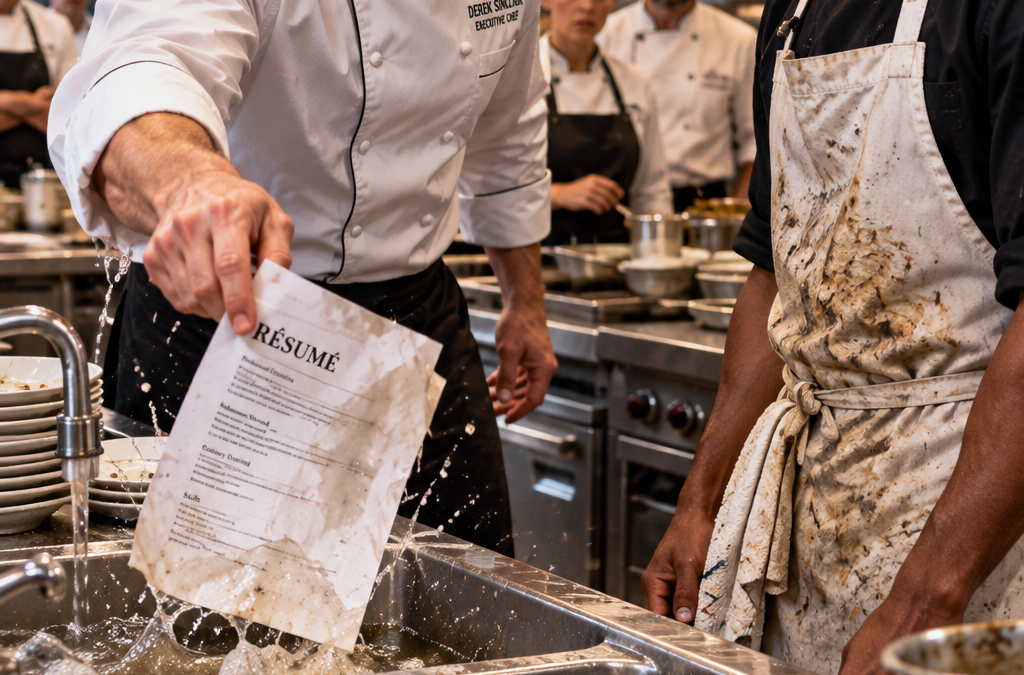
Not even when Derek dropped that résumé into dishwater.
For the first three days at the Harrow Grand, I existed only as “dishwasher.”
Derek told the staff I had walked in looking for hourly work.
No training.
No credentials.
Nothing worth discussing.
So nobody asked.
I scrubbed hotel pans.
Sheet trays.
Burnt sauce.
Fond hardened into corners.
Water hot enough to open the cracks in my hands.
By the end of the second shift, my skin had peeled near the knuckles.
The irony was almost funny.
Those hands had once plated tasting menus at one of Lyon’s finest restaurants.
Now I was scraping dried hollandaise from pans prepared badly enough to embarrass a culinary-school student.
I kept quiet.
Day two, Derek held a meeting for the Centennial Gala.
One hundred years.
Two hundred guests.
Press.
Politicians.
Donors.
Vivian Holt attending.
Every chef on the East Coast knew Vivian Holt.
Her reviews launched restaurants or ended them.
She did not insult.
That was worse.
She simply described.
Precision made cruelty unnecessary.
The owner, Eleanor Peton, would also attend.
Seventy-four.
Reclusive.
Rarely visited the hotel anymore.
This gala was supposed to restore the Peton Room’s reputation.
Derek presented seven courses.
Classical French.
Safe.
Expensive.
Soulless.
When he reached the duck course, something bothered me immediately.
Pan-seared duck.
Cherry gastrique.
Heavy Cabernet.
Wrong.
Not criminal.
Just clumsy.
The wine would flatten the acidity.
I forgot my position for one second.
“A Pinot Noir might work better.”
Silence.
Every head turned.
Derek stared.
“What?”
I knew I had made a mistake.
“The gastrique.”
He walked toward me.
“The Cabernet may overpower it.”
Someone snorted.
Derek smiled.
“Did the dishwasher just correct my wine pairing?”
Half the kitchen laughed.
Glenn Archer laughed first.
He was Derek’s senior sous chef in everything but title.
Tall.
Thin.
Always angry.
Derek stopped inches from me.
“You do not have opinions in my kitchen.”
I held his gaze.
“You scrub.”
“Yes, chef.”
“You do not speak.”
“Yes, chef.”
“You are nothing in here.”
That word again.
Nothing.
I lowered my eyes.
Not because I agreed.
Because Odette had taught me some battles are just ego dressed as principle.
“Understood.”
“Back to your hole.”
I returned to the pit.
Laughter followed.
On day four, cruelty became routine.
Glenn began sending clean pans back.
“Still greasy.”
I rewound them.
Again.
Again.
Sometimes four times.
Other cooks watched.
Nobody defended me.
I understood.
Derek ruled through fear.
Speaking up made you visible.
In kitchens like that, visibility can end a paycheck.
That afternoon, Nora Brisco was fighting hollandaise.
Senior line cook.
Ten years at the hotel.
Tired eyes.
Excellent knife work.
Zero confidence left.
Her sauce broke.
Again.
She cursed under her breath.
Forty minutes to service.
I watched from fifteen feet away.
Too hot.
Simple.
She tried to rescue it by whisking harder.
Made it worse.
Glenn stepped away to the walk-in.
I dried my hands.
Walked close enough to whisper.
“Kill the heat.”
Nora looked at me.
“Teaspoon cold water.”
She hesitated.
“Center out.”
She did it.
The emulsion came back.
Thirty seconds.
Silky.
She stared.
“How did—”
Glenn returned.
“What the hell are you doing?”
He grabbed my apron.
Shoved me into the rack.
Pans crashed.
“Get away from my station.”
Derek appeared.
“What happened?”
Glenn pointed.
“Dishwasher put his filthy hands on mise en place.”
Derek did not ask Nora.
Did not inspect the sauce.
Did not ask me.
“One more time.”
His face was inches from mine.
“Touch food.”
Pause.
“Talk to my cooks.”
Pause.
“Step outside that pit.”
His voice dropped.
“You’re gone.”
I looked at him.
No reference.
No final check.
No chance.
I had driven fourteen hours and already spent four days sleeping in a rented room I could barely afford.
I thought about leaving.
Then thought about Morell’s envelope.
Not yet.
I returned to work.
The next morning was worse.
I opened my locker.
My journal was gone.
I turned.
Glenn stood in the middle of the kitchen holding it.
He flipped through Odette’s handwriting.
“What’s this?”
My body went cold.
He exaggerated his reading.
“Grandma’s secret gumbo.”
A few cooks laughed.
“Look at this.”
He held up a page.
“Little dishwasher thinks he’s a chef because Grandma taught him to boil crawfish.”
My fists closed.
I took one step.
Then stopped.
The fire cooks the meal.
The fire burns the house.
Same fire.
You choose.
Glenn waved the journal.
“French writing too.”
He deliberately butchered Morell’s notes.
Then tossed the book.
It hit the wet floor beside the drain.
Pages opened.
Gray water spread through the paper.
Something inside me came very close to breaking.
I crossed the kitchen.
Nobody laughed now.
I crouched.
Lifted the book with both hands.
The leather was wet.
Ink beginning to bleed along some edges.
I carried it to a dry table.
Pressed clean towels between pages.
One.
Then another.
Then another.
Nobody spoke.
Glenn looked almost disappointed I had not swung at him.
That night, I sat in my rented room beneath a yellow lamp.
The journal lay open on the bed.
Pages wrinkled from water.
Still readable.
I found one of Odette’s notes.
Baby, food is the only language that don’t need translation.
Cook with love and the world will hear you.
I closed the book.
Sat in darkness.
Breathed.
Someone in the hotel had been watching.
Raymond Cross.
Sixty-eight.
Retired sommelier.
Technically.
In reality, he still spent more hours in the cellar than most employees.
He had been at the Peton Room when it still mattered.
He knew what excellence looked like.
He had noticed me correcting copper-pan angles without thinking.
Noticed the hollandaise.
Noticed the way I smelled sauces before looking at them.
One afternoon, he sat across from me in the staff room.
Placed a glass of red wine down.
No explanation.
I looked at it.
“Am I allowed to drink on shift?”
“You’re on break.”
“That doesn’t answer the question.”
He smiled.
“Smell it.”
I swirled.
Ruby edge.
Earth.
Dark cherry.
Leather.
Minerality.
I tasted.
“Southern Rhône.”
His face did not move.
“2016.”
I tasted again.
“Grenache dominant.”
He leaned back.
“Continue.”
“Clay and limestone.”
Another sip.
“Could be Beaucastel.”
Raymond’s eyebrows rose slightly.
“But tannin feels firmer.”
I looked at the glass.
“Maybe Vieux Télégraphe.”
He set down his own wine.
“You’re no dishwasher.”
I looked at my hands.
Cracked.
Peeling.
“Right now I am.”
He nodded.
That evening, he made a phone call.
I did not know.
Day six nearly exposed everything.
Friday dinner.
Full room.
Kitchen loud.
Then a line cook burned the cherry gastrique.
Not slightly.
Destroyed.
Black sugar.
Smoke.
No backup.
Twenty-six duck covers waiting.
Derek exploded.
Glenn searched the walk-in.
No cherries left in prep.
Tickets stacked.
Servers began asking questions.
Then a plate came back.
Charleston city councilwoman.
Longtime guest.
Three words:
Flavorless and overcooked.
Derek stared at the plate like betrayal had become ceramic.
I stood at the dish pit.
Every instinct I had said move.
Every warning from Derek said don’t.
Then another ticket printed.
And another.
I dried my hands.
Walked to prep.
No permission.
Clean pan.
Fresh garnish cherries.
Red wine.
Not Derek’s cooking wine.
A better bottle from the speed rack.
High heat.
Reduction.
Black pepper.
Aged cherry vinegar.
Then Odette.
One whisper of allspice.
Barely enough to identify.
Enough to change everything.
Ninety seconds.
I set the sauce at the pass.
Returned to the pit.
Nora tasted it.
Her face changed.
She plated.
Sent two dishes.
Four minutes later, a server rushed back.
“Table twelve says it’s the best sauce they’ve had here in years.”
Derek straightened his coat.
“What table?”
“Twelve.”
He walked into the dining room and accepted the compliment.
I watched through the pass.
He smiled.
Nodded.
Took credit.
I felt no anger.
That surprised me.
Maybe because I had seen Morell do the opposite.
When one of his cooks improved something, he told the dining room exactly whose idea it was.
Confidence shares credit.
Insecurity hoards it.
Nora had seen everything.
Raymond too.
That night Nora searched my name.
She found an old Lyon article.
Photograph.
Me beside Morell.
Headline about his American apprentice.
She printed it.
Brought it to Raymond.
After that, people started looking at me differently.
Not openly.
Small glances.
Questions they didn’t ask.
On day seven, the A5 Wagyu arrived mislabeled.
Two cases.
Thousands of dollars.
Glenn reached for his boning knife.
Standard ribeye cuts.
Wrong approach.
A5 marbling is different.
Delicate fat webs.
Cut carelessly and you destroy the reason anyone paid for it.
I saw what he was about to do.
Forgot every warning.
“Stop.”
Glenn looked up.
I crossed the kitchen.
“You’ll lose a third of the yield.”
His face hardened.
“Get away.”
“The grain runs lateral.”
“Nobody asked you.”
I picked up a second knife.
Demonstrated one edge cut.
Single stroke.
Marbling intact.
Perfect.
Glenn’s cut lay beside mine.
The difference was embarrassing.
Two cooks stopped working.
One whispered:
“Where did he learn that?”
Glenn heard.
That made it worse.
He shoved my hand away.
Derek arrived.
Glenn immediately pointed.
“He touched my station again.”
Derek looked at me.
Not the meat.
Not the cuts.
Me.
“I warned you.”
I stared at him.
Three full seconds.
Something changed in that stare.
I was no longer proving patience.
I was measuring whether patience had become cowardice.
Derek felt it.
His eyes shifted.
I returned to the pit.
That night, Raymond verified everything on my résumé.
Le Cordon Bleu.
Lyon.
Morell.
All real.
Then he prepared an envelope for Eleanor Peton.
Certificate.
Article.
Note.
There is a man in your building who trained under August Morell. For ten days, he has been washing your dishes.
He instructed the front desk to deliver it the morning of the Centennial Gala.
Not earlier.
Timing matters in kitchens.
Apparently Raymond believed it mattered in justice too.
Derek felt control slipping before he knew why.
Cooks glanced toward me.
Nora used techniques he never taught.
Raymond was suddenly everywhere.
Derek responded the way insecure men often do.
He removed the perceived threat.
I was reassigned to garbage duty.
Outdoor.
Entire gala preparation.
No kitchen access.
I read the notice.
Then stood beside my locker.
My hand closed around the metal.
For the first time, anger showed.
I wanted to walk into Derek’s office.
Open Morell’s letter.
Drop every credential on his desk.
Force him to know.
Then Odette’s voice again.
Cook.
Don’t perform.
I took the garbage cart.
Went outside.
Cold November rain.
Bag after bag.
Luxury hotels produce astonishing amounts of trash.
Spoiled produce.
Wine crates.
Flowers.
Disposable packaging.
Half-eaten food worth more than some families’ weekly groceries.
I hauled it through the alley.
Nora watched from inside.
That night, she confronted Derek.
“The gala menu needs more depth.”
He stared.
She continued carefully.
“We have talent here you’re not using.”
“If you want to haul garbage too, keep talking.”
Nora left.
But she did not stop.
She found Raymond.
He showed her the envelope.
“Two days.”
That was all.
Two days.
Then another problem arrived.
Vivian Holt confirmed.
Table one.
Direct view of the pass.
Derek panicked.
Double prep.
Triple checks.
Forty-five-minute staff speech about standards.
Meanwhile, the person most capable of meeting those standards was outside carrying garbage through rain.
The night before the gala, everything began collapsing.
Four in the afternoon.
One line cook doubled over.
Vomiting.
Then another.
Then a third.
Contaminated oysters.
Cheap supplier.
No HACCP certification.
Nora had warned Derek six weeks earlier.
He ignored her.
Three of five line cooks gone.
Ambulance.
Six hours until the biggest dinner in hotel history.
Derek called everyone.
Temp agencies.
Chefs.
Old colleagues.
Nobody could produce Michelin-level cooks on six hours’ notice.
Glenn could work a station.
He could not lead.
Everyone knew it.
At five, Eleanor Peton entered the kitchen.
Seventy-four.
Silver hair.
Silk blouse.
No entourage.
She walked through panic without absorbing it.
Looked at the empty stations.
Half-prepped mise en place.
Glenn pretending not to be scared.
Derek pretending to have a plan.
Then asked:
“Where is your contingency?”
Derek opened his mouth.
Nothing.
Raymond entered.
Envelope in hand.
He walked directly past Derek.
Placed it before Eleanor.
“There is a man in this hotel.”
She looked at him.
“He trained at Le Cordon Bleu.”
Derek’s face changed.
“Apprenticed five years under August Morell.”
Eleanor stopped moving.
Raymond continued.
“For ten days, he has been washing dishes.”
Silence.
“And now hauling garbage.”
Eleanor opened the envelope.
Read the certificate.
The article.
Raymond’s note.
Her eyes rested on Morell’s name.
She knew him.
Not by reputation.
Personally.
She had eaten in Lyon twice.
Called one of his meals the finest of her life.
“Where is he?”
Derek tried to speak.
Eleanor looked at him once.
He stopped.
They found me in the alley.
Rain soaked through my work clothes.
I was lifting a black garbage bag into the dumpster.
When I turned, Eleanor Peton was standing three feet from me holding a photograph of myself beside Morell.
For a moment, the scene made no sense.
“Curtis Lancaster?”
“Yes, ma’am.”
“You trained under August?”
“Yes.”
“I was his last apprentice.”
Her face changed.
“He told me once he had a student who understood food the way a poet understands grief.”
My throat tightened.
“He said that?”
“He did.”
She looked at me.
“Was it you?”
I didn’t answer.
Instead, I reached into my locker bag.
Morell’s sealed envelope.
Still unopened.
Two years.
I handed it to her.
“What is this?”
“He told me to open it when the world tried to tell me who I was.”
“Have you read it?”
“No.”
“Why not?”
“I thought maybe I hadn’t needed it yet.”
She studied me.
Then broke the wax.
Read.
Her hand began trembling.
That scared me more than anything else.
She finished.
Folded the letter.
Looked at Derek, who had followed us outside.
“This man leads the kitchen tonight.”
Derek’s mouth opened.
Eleanor continued.
“If that creates a problem for you, I will accept your resignation before first course.”
No shouting.
No insult.
No drama.
Just authority.
Derek said nothing.
I set down the garbage bag.
Walked inside.
Not through the dish-pit entrance.
Through the main kitchen doors.
Everyone looked up.
Glenn went pale.
Nora closed her eyes.
Exhaled.
Three hours to service.
Two hundred guests.
A gutted kitchen.
No rehearsal.
No second chance.
I placed Odette’s journal on the stainless counter.
The pages were still warped from gray water.
Morell’s notes still visible.
I looked at Derek’s seven-course menu.
Read it once.
French.
Correct.
Dead.
I unpinned it.
Set it aside.
Nora stepped closer.
“What are you doing?”
“Changing everything.”
Her eyes widened.
“How much?”
“All of it.”
Three hours.
Seven courses.
Two hundred people.
Either brilliant or suicidal.
I opened the journal.
“Tonight is Odette and August.”
Nora nodded.
“What do you need?”
That mattered.
Not “Are you sure?”
Not “Can you do it?”
What do you need?
That was the first time anyone at Harrow Grand had spoken to me like I belonged.
“Every crawfish cleaned.”
“How fast?”
“Twenty minutes.”
She tied her apron tighter.
“Done.”
“Wilson.”
A young cook looked up.
“Stock.”
“From scratch?”
“Yes.”
He looked at the clock.
Then at me.
“Yes, chef.”
Chef.
The word nearly stopped me.
I hadn’t heard it directed at me in years.
“Chicken bones. Celery. Thyme. Bay.”
I moved toward the stove.
“Low.”
Then:
“Nobody touches the short ribs.”
Glenn stood in the corner.
Arms crossed.
I ignored him.
I lit the first burner.
The kitchen woke up.
Course one:
Smoked oyster.
Micro herbs.
Tabasco oil.
Pecan-shell smoke, Odette’s method.
French velouté beneath.
New Orleans on top.
Course two:
Louisiana crawfish tail.
Celery-root purée.
Brown butter.
Chive blossom.
Nora learned Odette’s cleaning technique in minutes.
Pinch.
Twist.
Pull.
She started at two minutes per tail.
Then forty seconds.
Then thirty-five.
I saw her smiling.
Course three:
She-crab bisque.
Charleston’s own language.
I did not want to invade the city with Louisiana.
I wanted conversation.
So the base stayed Charleston.
Then smoked paprika cream.
Fried sage.
Something familiar.
Something slightly dangerous.
Course four:
Gulf redfish.
Sauce meunière.
Compressed cucumber.
Preserved lemon.
I filleted six fish in minutes.
Wilson stopped watching his station.
“Wilson.”
He snapped back.
“Sorry, chef.”
“Admire later.”
He smiled.
“Yes, chef.”
Course five:
Blood-orange sorbet.
Cayenne.
Not enough to hurt.
Enough to surprise.
A reset before the main course.
Course six:
Short rib.
Morell’s reduction.
Odette’s grits.
That dish mattered most.
I started the reduction immediately.
Low flame.
Red wine.
Bone depth.
No timer.
Morell’s method.
Fold every four minutes.
Do not stir.
Fold.
Patiently.
Three hours.
No shortcuts.
The truffle grits came from Odette.
Stone ground.
Cream.
Salt.
One tiny amount of white truffle oil.
Morell had once written beside that recipe:
Parfait.
Perfect.
Course seven:
Beignets.
No deconstruction.
No foam.
No architectural nonsense.
Beignets.
Powdered sugar.
Café au lait cream.
Odette exactly as she was.
At 8:45, every station was ready.
Fifteen minutes.
I looked around.
Nora on fish.
Wilson vegetables.
Another cook plating.
Then Glenn.
He had silently set up dessert.
He did not look at me.
I noticed.
Said nothing.
Sometimes shame does not need humiliation.
Nine o’clock.
First course out.
Through the pass window, I watched.
Polite reaction.
Fine.
Second course.
People slowed.
Good.
Third.
A woman closed her eyes.
Excellent.
Fourth.
Vivian Holt stopped writing.
That terrified everyone except me.
Critics stop writing for two reasons.
Disaster.
Or attention.
She kept eating.
Fifth course.
The cayenne arrived late.
People laughed.
A room full of wealthy strangers suddenly looked less formal.
That was Odette.
She always believed food should make people drop their performance.
Then course six.
Short rib.
Truffle grits.
Morell reduction.
Eleanor cut one piece.
Ate.
Stopped.
Put down her fork.
Closed her eyes.
I watched from the pass.
She knew.
I could tell.
She had tasted Morell’s reduction.
But beneath it was allspice.
Creole warmth.
Odette inside August.
August inside Odette.
Then Eleanor leaned toward Vivian.
I could not hear her.
Later, Raymond told me what she said.
“This is the finest bite I’ve had in thirty years.”
Vivian did not answer.
She was eating.
That was better.
Then dessert.
Beignets.
Warm.
Simple.
Powdered sugar.
One guest from Louisiana started crying.
Not because the dessert was technically astonishing.
Because memory had entered the room.
That is what great food does.
Technique impresses.
Memory stays.
Then applause started.
One table.
Then another.
Then the entire Peton Room stood.
Two hundred people.
Not for a celebrity.
Not for spectacle.
For dinner.
In the kitchen, nobody moved at first.
Nora was crying.
Wilson looked stunned.
Glenn stared at the floor.
I picked up Odette’s journal.
Pressed it against my chest.
Closed my eyes.
“We did it, Grandma.”
That was all.
Derek stood outside the kitchen window.
Alone.
For the first time since I arrived, nobody was looking toward him for instructions.
His authority had disappeared before anyone officially removed it.
Sometimes that is how power ends.
Not with confrontation.
With irrelevance.
After service, Eleanor entered the kitchen.
Everyone parted.
I was wiping down my station.
Odette’s rule.
Leave the kitchen cleaner than you found it.
Eleanor placed Morell’s letter on the counter.
Wax seal broken.
Paper creased.
“May I?”
I nodded.
She read aloud.
“If this man ever stands before you asking for a chance, know that I have given my life to food, and he is the only one I trust to carry it forward.”
My throat closed.
“August Morell.”
Nobody spoke.
I had carried that letter two years.
Never knew.
Part of me had been afraid to open it because I thought perhaps it contained ordinary praise.
And ordinary praise from Morell would somehow make his death final.
Instead, it carried his trust.
Eleanor looked at me.
“Executive chef.”
I thought I misheard.
“Ma’am?”
“The Peton Room.”
I stared.
“Full creative control.”
Silence.
“Leadership seat.”
Derek was standing near the door.
She didn’t look at him.
“Not the head-chef position you applied for.”
She continued.
“The one above it.”
I looked toward Nora.
Then the cooks.
Then the journal.
“I accept.”
Eleanor smiled slightly.
“On one condition.”
Her eyebrow lifted.
“I choose my own team.”
Nora’s face changed.
Eleanor nodded once.
“Done.”
Derek’s meeting lasted less than three minutes.
I wasn’t there.
Didn’t need to be.
Eleanor later told me she said only one thing.
“You buried the most talented chef I have encountered since August Morell in a dish pit.”
Then:
“I need you to understand that before you leave.”
He was fired.
No dramatic security escort.
No screaming.
He packed knives.
Left through the lobby.
Glenn was reassigned to another property sixty miles away.
I stopped Eleanor.
“No.”
She looked at me.
“What?”
“Keep Glenn.”
Her expression sharpened.
“Why?”
I thought about the journal hitting the wet floor.
The shove.
The insults.
Then the dessert station.
“He worked tonight.”
“That erases nothing.”
“I know.”
“Then why?”
“Because if I build a kitchen where nobody gets a chance to become better, I build his kitchen again.”
Eleanor watched me for a long moment.
“Your decision.”
I kept him.
Not as sous chef.
Not yet.
Line cook.
Probation.
Zero tolerance.
He accepted.
Three months later, the Peton Room was different.
Same walls.
Same chandeliers.
Different heartbeat.
I rewrote the menu from the journal outward.
French technique.
Louisiana Creole soul.
Not fusion for novelty.
Conversation.
History.
Memory.
Nora became sous chef.
My first promotion.
She deserved it.
The hollandaise method I whispered to her became standard training.
Raymond returned officially as head sommelier.
He pretended he had not been waiting for me to ask.
He rebuilt the wine program around the food.
Vivian Holt’s review ran five weeks after the gala.
Two pages.
Longest review she had published in years.
She wrote:
“The short rib contains more truth than most chefs produce in a lifetime.”
Then:
“The beignets are so simple and devastating that I forgot I was working.”
Reservations disappeared within hours.
Six-week waiting list.
Then eight.
People flew in.
New York.
Chicago.
Los Angeles.
Paris.
Some came because of Morell.
They wanted to know whether the rumors were true.
A former apprentice.
A journal.
French technique haunted by New Orleans.
I avoided interviews.
I did not want celebrity.
I wanted service.
Then Michelin inspectors came.
Unannounced.
Tuesday.
Full tasting.
Three hours.
No special treatment.
They left.
Nobody said anything.
Months later, the star returned.
The Peton Room had not earned one in years.
Eleanor cried.
Nora screamed.
Raymond opened Champagne he had apparently been hiding for that exact moment.
I called a disconnected phone number.
Odette’s old line.
I knew nobody would answer.
I let it ring anyway.
Tone.
Tone.
Tone.
Then silence.
I said:
“We got it back.”
No one answered.
I did not need one.
The journal went into a glass case near the kitchen entrance.
I resisted at first.
“Books are meant to be used.”
So we made a digital copy for daily work.
The original remained protected.
Beneath it, a brass plaque:
ODETTE LANCASTER
AUGUST MORELL
TWO KITCHENS. ONE LANGUAGE.
Morell’s letter hung beside it.
Every new cook stopped there on the first morning.
I made them read both.
Not because history makes food better.
Because gratitude makes arrogance harder.
Glenn stayed.
That surprised everyone.
Including Glenn.
For the first month, he barely spoke to me beyond:
“Yes, chef.”
“No, chef.”
“Behind.”
“Hot.”
“Corner.”
One night after service, he came into my office.
“I need to say something.”
I waited.
He looked toward the glass case.
“What I did to that journal…”
His voice stopped.
I said nothing.
“There’s no excuse.”
“No.”
“I thought you were lying.”
“That doesn’t excuse it.”
“I know.”
He looked down.
“Derek made it easy to become ugly.”
I leaned back.
“That’s not his fault.”
Glenn looked up.
“He created the culture.”
“Yes.”
“But you chose how you behaved.”
He nodded.
“I know.”
Silence.
“I’m sorry.”
I believed him.
Forgiveness did not mean pretending it had not happened.
So I said:
“Thank you.”
Nothing else.
He continued working.
Slowly, he changed.
That became one of the things I was proudest of.
Not the star.
Not the reviews.
A kitchen becoming less afraid.
When cooks made mistakes, we corrected them.
We did not humiliate.
When somebody offered an idea, we tasted before dismissing.
Dishwashers ate family meal with line cooks.
Servers joined tastings.
Nobody became invisible because of their station.
Once, a dishwasher named Marcus corrected a stock.
Too salty.
One of the cooks rolled his eyes.
I stopped service.
“Taste it.”
He did.
Marcus was right.
The cook looked embarrassed.
I said:
“Thank him.”
He did.
That became culture.
Not because everyone became kind.
Kitchens are stressful.
People snap.
Service burns.
But respect became the rule instead of fear.
One afternoon, Eleanor found me in the kitchen after lunch.
“You know Derek saw the magazine cover.”
I kept chopping.
“I heard.”
“He’s working in Atlanta.”
“I know.”
“Does that satisfy you?”
I looked at her.
“No.”
She seemed surprised.
“Why not?”
“Because his failure doesn’t improve my food.”
She smiled.
“August would’ve liked that.”
“He would’ve told me my knife angle was wrong.”
“Also true.”
Eleanor laughed.
Derek faded from my life.
That was enough.
His real punishment was not losing the Harrow Grand.
It was knowing the person he decided did not belong had become central to the place he once controlled.
I did not need him ruined.
I needed him irrelevant.
Years later, I opened a second restaurant in New Orleans.
Not Charleston.
Home.
I bought a narrow building three blocks from where Odette had served Friday supper.
Five tables in the front room.
That part was deliberate.
The menu was not identical.
It couldn’t be.
You cannot recreate a grandmother.
But Friday nights, we served one thing exactly her way.
Gumbo.
No reinterpretation.
No foam.
No truffle.
No French name.
Gumbo.
People lined up.
Just like before.
At opening, I stood outside beneath the sign.
LANCASTER.
Ruthless simplicity.
Odette would have liked that.
Raymond came down from Charleston.
Nora too.
Eleanor sat at the first table.
Glenn surprised me by arriving early and setting up dish.
I laughed.
“You’re a guest.”
“Not today.”
He tied an apron.
I let him.
Before service, I placed Odette’s wooden spoon above the pass.
The same one Uncle Terry had put in my hand when I was six.
I stared at it.
Then whispered:
“Somewhere bigger.”
Promise kept.
A culinary school invited me to speak the next year.
Students expected inspiration.
I gave them reality.
I told them Le Cordon Bleu mattered.
Morell mattered.
Odette mattered.
I said:
“Never let anyone romanticize struggle.”
The room got quiet.
“Being underestimated does not automatically make you stronger.”
I looked across the students.
“Sometimes it just makes the road longer.”
Then:
“Craft is what carries you.”
I told them about the dish pit.
Not to say I had been secretly superior.
Because every station teaches something.
Dish taught me how badly ego had damaged that kitchen.
How cooks treated the people beneath them.
How much waste existed.
How fear moved through service.
I learned the system from the bottom.
That made me a better executive chef.
Then I said something Morell had once told me.
“Talent gets noticed.”
Pause.
“Craft survives being ignored.”
That was the difference.
Talent is what people clap for.
Craft is what you still have when nobody claps.
When Derek threw my résumé into water, my résumé became useless.
My hands did not.
My palate did not.
My memory did not.
My grandmother’s lessons did not.
Morell’s training did not.
That is why I could tie on an apron and wash dishes without becoming what Derek thought I was.
A job can be beneath your training.
No honest work is beneath your dignity.
That distinction saved me.
At the Harrow Grand, I became known for interviewing differently.
Applicants expected résumés.
I read them.
Credentials matter.
But eventually, I took every candidate into the kitchen.
“Cook something.”
“What?”
“Anything.”
One young woman came with no culinary degree.
Community-college classes.
Five years cooking in her mother’s diner.
Her résumé was ordinary.
She made eggs.
Just eggs.
Perfectly.
Soft.
Seasoned.
Controlled.
I hired her.
A man with multiple certifications made a complicated fish dish.
Beautiful.
Tasted empty.
I asked:
“What do you cook when you’re sad?”
He stared.
“What?”
“Food is memory. What do you cook?”
He eventually said:
“Rice and lentils.”
“Cook that.”
It was exceptional.
I hired him too.
Morell taught me technique.
Odette taught me truth.
You need both.
The Peton Room earned another star years later.
People asked if I wanted three.
I laughed.
“Morell turned down his third twice.”
“Why?”
“He said stars attract the wrong people.”
“Do you agree?”
“Partly.”
I looked around the dining room.
“They’re useful until you start cooking for the inspector instead of the guest.”
That became my rule.
Reviews are information.
Not identity.
Vivian Holt returned every year.
Never announced herself.
One evening, after dinner, she asked me to sit.
I did.
“You know what I remember most from the gala?”
“The short rib?”
“No.”
“Beignets?”
“No.”
I smiled.
“What?”
“You cleaning your station afterward.”
I stared.
“Two hundred people applauding.”
She continued.
“And you were wiping stainless steel.”
“Odette.”
“Exactly.”
Vivian looked toward the kitchen.
“That told me more than dinner.”
I understood.
Craft continues after applause.
That was Odette too.
Years later, I finally read Morell’s full letter again.
Not the passage Eleanor read aloud.
Everything.
It began in French.
Then English.
Curtis,
If you are reading this, somebody has mistaken appearance for ability again.
I laughed.
Even dead, he knew me.
He wrote about talent.
Discipline.
Failure.
Then one paragraph stopped me.
Never waste your life trying to make blind people see you. Cook. The seeing is their responsibility.
I sat alone in my office for a long time.
That sentence explained the eleven days better than I ever had.
I had thought my silence was about patience.
Maybe some of it was.
But there is another form of freedom in refusing to audition your humanity for people committed to misunderstanding it.
Derek did not deserve my life story on day one.
He deserved a fair look at my résumé.
He refused.
That failure was his.
I did not need to scream my credentials after him.
The truth remained true.
That became more important as my career grew.
Fame creates a new version of the same problem.
People decide who you are from the other direction.
Before, they saw Black.
Poor-looking.
Dishwasher.
Nothing.
Later, they saw Michelin.
Magazine cover.
Executive chef.
Genius.
Both are shallow.
I was never nothing.
I was never genius every second either.
I burned sauces.
Overseasoned.
Misjudged staff.
Made arrogant decisions.
Apologized.
Learned.
The goal was never to become undeniable.
The goal was to keep becoming better.
Nora eventually opened her own restaurant.
Charleston seafood.
Small.
Beautiful.
At her opening, she pulled me aside.
“You remember the hollandaise?”
“How could I forget?”
“You changed my life with a teaspoon of cold water.”
I shook my head.
“No.”
She smiled.
“You did.”
“No.”
I pointed toward her kitchen.
“You listened.”
That mattered.
Advice only works where pride makes room.
Raymond retired again.
This time for real.
We threw him a dinner.
He complained about every wine pairing.
We ignored him.
At the end, he gave me the empty bottle from the Burgundy he had chosen for the Centennial Gala.
I still keep it.
Eleanor Peton died at eighty-one.
I cooked her memorial dinner.
No press.
No critics.
Family.
Hotel staff.
Seven courses.
For dessert:
Beignets.
She had requested them months earlier.
“Don’t make them fancy.”
“I never do.”
“Good.”
The Harrow Grand later placed her portrait near the entrance.
I asked that the staff entrance get something too.
A small plaque.
Nothing dramatic.
It reads:
NO JOB TITLE DEFINES THE PERSON WEARING IT.
Management thought it was too pointed.
I said that was the point.
The dish pit changed too.
Better ventilation.
Proper staffing.
Break schedules.
No more sending damaged pans back as punishment.
Nobody laughs when dish speaks.
Not in my kitchen.
One evening, I saw a young dishwasher tasting a stock.
A new line cook snapped:
“Get away from that.”
I stopped.
Memory hit instantly.
I walked over.
“What did he say?”
The cook froze.
The dishwasher looked nervous.
“He said the stock tastes flat.”
I handed the line cook a spoon.
“Taste.”
He did.
The dishwasher was right.
I looked at the cook.
“What do you say?”
He swallowed.
“Thank you.”
The dishwasher smiled.
I walked away.
No speech.
Culture is built in small moments.
Derek had built his through small cruelty.
I built mine through small corrections.
Years after the gala, I visited Lyon.
Morell’s restaurant had changed owners.
The dining room looked familiar but not his.
I sat at a corner table.
Ordered dinner.
Then asked permission to visit the old kitchen.
The new chef knew my name.
He led me back.
Different equipment.
Same bones.
I stood near the station where I had first made béarnaise for Morell.
For a moment, I could hear him.
Where is Odette?
I smiled.
“She’s everywhere now.”
The chef looked confused.
I didn’t explain.
On the flight home, I opened the digital copy of the journal.
Blank pages remained at the end.
For years, I had hesitated to write there.
Odette’s handwriting felt sacred.
Morell’s notes too.
Then one night after service, I finally picked up a pen.
First new recipe.
Not French.
Not Creole.
Mine.
I wrote slowly.
Ingredients.
Technique.
Temperature.
Then, in the margin, something Odette would have written:
Don’t rush this. It knows.
I laughed.
Closed the journal.
That was when I realized inheritance is not preservation.
You do not honor what people gave you by freezing it.
You carry it forward.
Change it carefully.
Add your own hand.
Leave something for whoever comes next.
That was the real meaning of the Centennial Gala.
Not revenge.
Not Derek losing his job.
Not a standing ovation.
A door opened.
Odette walked through me.
Morell walked through me.
Two dead teachers entered a hundred-year-old dining room in Charleston and spoke through seven courses.
That was the miracle.
Years later, food writers still asked about that dinner.
I always gave them the same answer.
“The menu already existed.”
They would frown.
“No, it didn’t.”
“Yes, it did.”
“In your head?”
“In my history.”
That usually ended up in articles sounding more poetic than I meant it.
But it was true.
Nothing I cooked that night appeared suddenly.
The smoked oyster came from pecan shells in New Orleans.
The reduction came from Morell folding wine in Lyon.
The grits came from Odette.
The beignets came from Friday nights.
The discipline came from France.
The patience came from grief.
Even the dish pit mattered.
Eleven days of watching a kitchen fail taught me exactly what it needed.
People like dramatic breakthroughs.
They imagine the moment talent is “discovered.”
That word bothers me.
Eleanor did not discover me.
Raymond did not discover me.
Vivian did not discover me.
Morell did not create me.
Odette did not create me alone either.
They saw.
They taught.
They opened doors.
But the years happened whether anybody noticed or not.
That is what Derek never understood.
He thought authority gave him the power to define what stood in front of him.
Dishwasher.
Nothing.
Filthy.
Unqualified.
The labels were wrong.
But even if they had been right, the contempt would still have been wrong.
That distinction matters.
If I had actually been an untrained dishwasher, my résumé did not deserve dirty water.
My grandmother’s book did not deserve mockery.
My hands did not deserve disgust.
You do not need hidden greatness to deserve dignity.
I say that to every manager who works under me.
“Respect people before you know what they can do for you.”
Because if you wait until they prove useful, that is not respect.
It is calculation.
I learned that lesson in the dish pit.
Maybe that was why I stayed eleven days when anyone sensible would have left.
Part of me needed to know whether my identity could survive being ignored.
It could.
But I would not recommend the test.
Nobody should have to endure humiliation to earn a chance.
The better lesson is what we changed afterward so the next person didn’t have to.
The Harrow Grand eventually created blind first-round culinary evaluations for kitchen hires.
Candidates submitted dishes and technical assessments before photographs or demographic information entered the process.
Eleanor approved it before she died.
I insisted.
Not because systems eliminate prejudice.
They don’t.
But good systems can make prejudice work harder.
That matters.
One year, a candidate scored highest in the blind assessment.
When he arrived for the interview, he was sixty-two.
Former prison cook.
No fine-dining background.
One manager whispered:
“Are we serious?”
I looked at her.
“Taste his food again.”
We hired him into training.
He became one of the strongest stock cooks I ever had.
The point was not that everyone hides genius.
Most people don’t.
The point is you cannot know until you look honestly.
Derek never looked.
That was his failure.
My life became larger than I imagined in Odette’s kitchen.
But I never forgot the small things.
The smell of roux.
Wooden spoon.
Friday line outside.
Morell’s cramped handwriting.
Nora’s broken hollandaise.
Raymond’s wine glass.
The journal drying under towels after Glenn threw it down.
The garbage alley in November rain.
The moment Eleanor broke Morell’s wax seal.
And the sound of two hundred people standing after beignets.
Not because I needed applause.
Because somewhere inside it, I heard Odette.
The world heard you, baby.
That is how I choose to remember it.
Not Derek.
Not dirty water.
Not humiliation.
A language finally reaching the room it was meant to enter.
And if I ever doubt where I belong, I open the journal.
The first page is still Odette.
The margins still carry Morell.
The final pages carry me.
Three hands.
Three kitchens.
One conversation.
No amount of dirty water ever washed that away.








