𝗙𝗨𝗟𝗟 𝗦𝗧𝗢𝗥𝗬 The Hospital Administrator Tried to Erase Me From His ER Before He Ever Learned Who I Was
𝗣𝗔𝗥𝗧 𝟮
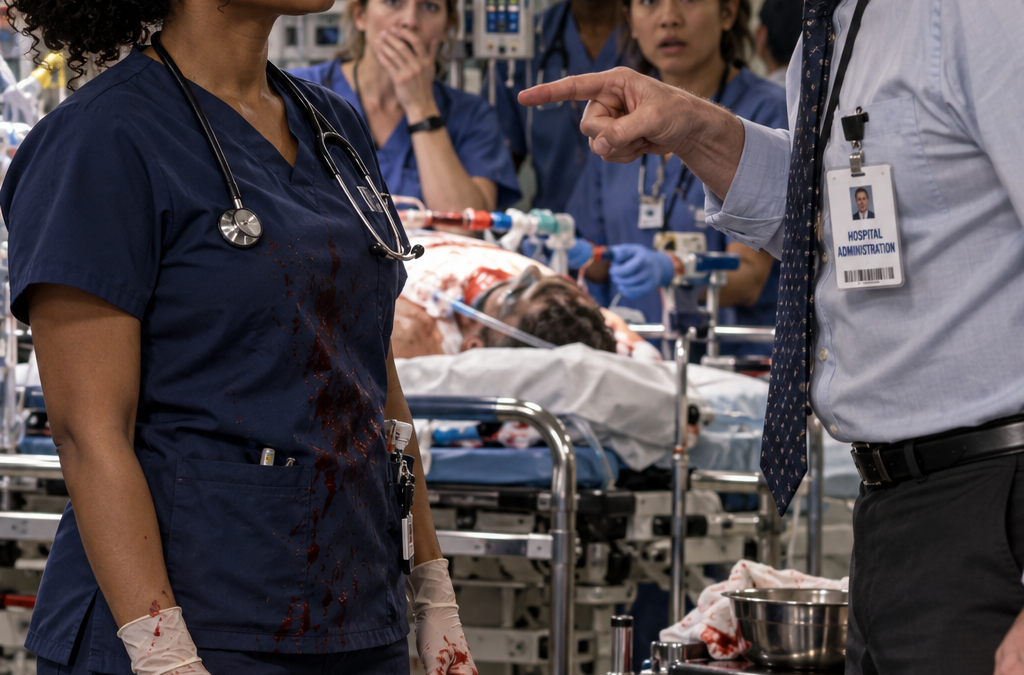
I turned my head.
His face held something colder than irritation.
“Let someone qualified handle this.”
The room changed.
Not medically.
Socially.
Every person close enough to hear him became aware of every other person.
I kept my voice level.
“I’m the senior ER nurse on this shift, sir.”
His eyebrows rose.
“You?”
“Yes.”
A short laugh escaped him.
There was no humor in it.
“I find that extremely hard to believe.”
The patient’s monitor alarmed.
I looked down.
“Pressure’s dropping.”
Sawyer moved closer.
Crawford did not.
He stood in the path of people trying to save a dying man and looked at me as though I were the problem.
“Step aside right now,” he said, “before I have security drag you out of here.”
Sawyer straightened.
She was shorter than Crawford, but there are people who become physically larger when they get angry.
“She is my nurse,” Sawyer said. “She stays.”
Crawford looked at her.
Sawyer pointed toward the door.
“You are not gowned. You are not gloved. You are contaminating my trauma area. Get out.”
His face tightened.
He looked through the glass.
The donors were watching.
That mattered to him more than the bleeding man.
I could see it.
He straightened his tie and stepped out.
Before he left, he looked directly at me.
I have been around anger.
I have seen men lose control under conditions that would break most people.
This was different.
Crawford’s expression was not impulsive.
It was organized.
He had been embarrassed in front of people whose approval he wanted.
And somehow, in his mind, the embarrassment belonged to me.
The patient survived.
We got him stable enough for surgery.
The vascular team took over.
Once the room was empty, I cleaned the blood off the floor with the environmental staff because nobody should have to handle what I could help handle.
Twenty minutes later, Rita found me alone in the break room.
I was sitting with my thermos between my hands.
“You okay, baby?”
“Fine.”
“Look at me.”
I looked.
“I’m fine.”
She studied me.
I had been saying those words for years.
Sometimes people believed them because they wanted to.
Rita did not.
The next morning, Brenda Hollands was waiting at the ER entrance.
She held a printed memo.
“Ms. Turner.”
I stopped.
“Effective immediately, you are reassigned from emergency services pending competency review.”
I took the paper.
Read it once.
Then again.
“Records management. Sublevel One.”
The basement.
No patients.
No nursing.
Just filing cabinets.
“Who authorized this?”
“Mr. Crawford.”
“On what grounds?”
Brenda’s eyes moved away from mine.
“It’s in the memo.”
“It says competency review. It does not say what competency is being questioned.”
Her grip tightened on the tablet.
“I was asked to deliver it.”
That was all I was going to get.
I folded the paper and put it in my pocket.
Behind the ER doors, people were already calling my name.
Not because they knew what was happening.
Because the shift was starting.
I turned toward the elevator.
Rita stepped forward.
“Naomi.”
I shook my head once.
Not here.
Not yet.
The basement had no windows.
The overhead fluorescent tube flickered every few seconds.
A vent rattled above me.
Gray filing cabinets ran in long rows.
I sat in a metal chair and stared at a stack of paper charts.
My hands shook.
I pressed them flat against my thighs until they stopped.
People who have never experienced humiliation sometimes confuse quiet with weakness.
Quiet can be many things.
Sometimes it is discipline.
Sometimes it is shock.
Sometimes it is the only barrier between what you feel and what you might do if you let yourself feel all of it at once.
I wanted to walk upstairs.
I wanted to put the trauma report in front of Crawford.
I wanted to make him explain exactly which part of saving that patient’s life had demonstrated incompetence.
But I also knew men like him.
He had authority.
I had anger.
Authority can make anger look unstable.
So I sat.
Upstairs, the ER began to collapse.
I did not know the full extent until later.
Within an hour, triage had backed into the hallway.
An elderly woman with chest pain waited forty-three minutes before assessment.
A junior nurse missed an IV twice.
A teenager with a dislocated shoulder sobbed in the waiting room while staff scrambled to find coverage.
By noon, Sawyer had had enough.
I learned later that she walked directly into Crawford’s office without knocking.
“You pulled the best ER nurse in this hospital off my floor.”
Crawford barely looked up.
“Competency review.”
“She saved a man’s life yesterday. You watched her.”
“What I watched,” he said, “was a nurse who showed blatant insubordination in front of three major donors.”
“She followed medical protocol while you interfered with a trauma.”
He leaned forward.
And then he said the part he had been circling from the beginning.
According to Sawyer, his exact words were, “She does not match the image this department needs to present to the people who keep its lights on.”
Sawyer filed a complaint with HR.
It went nowhere.
Rita confronted him that evening.
She asked why I had been removed.
Crawford told her he was restructuring the department to meet donor expectations.
Then he warned a woman who had given twenty-two years to that hospital that maybe her role no longer made sense if she had a problem with it.
Rita did not argue.
She did something better.
She documented it.
She already had a folder.
Dates.
Names.
Direct quotes.
She had started keeping records within Crawford’s first week.
That evening, she added me.
In the basement, I knew none of that.
I knew only that fluorescent light.
The dust.
The sound of my own breathing.
And, eventually, Kandahar.
Memory is cruel that way.
It waits for quiet.
I was back on a rooftop under a black sky.
Rounds struck a wall close enough to throw stone chips against my face.
A soldier lay beside me with his lower leg destroyed.
Bone visible.
Blood pumping.
He was trying not to scream because he thought noise would give away our position.
I remember putting both hands around what was left of his leg.
I remember telling him, “You do not die here.”
I remember not knowing whether I was promising him or ordering him.
I remember another blast.
Shrapnel entered my own calf.
Heat first.
Then pressure.
Then blood filling my boot.
Captain Elliot Dawson was heavier than he looked.
Over two hundred pounds with gear.
When the order came to move, he could not walk.
So I put him on my back.
Two hundred meters.
Open ground.
Gunfire.
My own leg bleeding.
Every step felt like something tearing wider.
But I carried him.
He lived.
Six men lived that night.
I received a Bronze Star with Valor.
Then, years later, I sat in a hospital basement because a man in a polished suit had decided I did not look like someone who belonged in his emergency department.
I almost laughed.
Instead, I filed paper.
Crawford’s competency review lasted three days.
It was not a review.
It was a search for a weapon.
He requested my nursing school transcripts.
My licensing records.
My clinical hours.
Exam scores.
State disciplinary history.
Everything.
Every result came back clean.
My board scores were in the ninety-fourth percentile.
My license had no disciplinary actions.
My evaluations were strong.
He found nothing.
So he changed tactics.
On Wednesday, I was pulled from records management.
Brenda met me near the elevator.
“New assignment.”
She handed me a gray smock.
I stared at it.
“What is this?”
“Environmental transport.”
I already knew.
I just wanted to hear her say it.
“Soiled linen transfer between the ER and laundry.”
For the first time, Brenda looked ashamed.
“Naomi…”
“Did Crawford assign it?”
She nodded.
“Then say that.”
“Yes.”
I put on the smock.
The cart had one bad wheel.
It squealed every time I pushed it.
That sound followed me through the hospital.
I collected bloody sheets from the same trauma bays where I had worked days earlier.
Nurses avoided looking at me.
Not because they agreed with Crawford.
Because shame spreads strangely.
Sometimes witnesses carry part of it simply because they do not know how to stop what they are seeing.
I passed the nurses’ station.
A young tech looked at me and whispered, “This is wrong.”
I kept walking.
“Naomi.”
I stopped.
His face was red.
“I’m sorry.”
I looked at him.
“You didn’t do it.”
“No. But nobody’s saying anything.”
That hurt more than he meant it to.
I nodded once.
“Take care of your patients.”
At lunch, I stopped going to the break room.
I ate in the stairwell between the basement and the first floor.
Granola bar.
Water.
Concrete step.
Cold wall.
I told myself I liked the quiet.
That was a lie.
I did not want anyone to see me.
There is a particular kind of exhaustion that comes from having to hold yourself upright while someone actively tries to make you feel small.
It does not look dramatic.
You still walk.
Still breathe.
Still answer questions.
But every action costs more.
By Thursday, I had begun counting how many shifts I could survive before I simply stopped coming back.
That morning, the supply manager assigned me to restock sterile gloves and dressings on the ER floor.
I almost refused.
Not because I did not want to see the ER.
Because I wanted to see it too much.
I missed the noise.
I missed the urgency.
I missed being useful.
I was putting boxes of gloves on a shelf when Crawford appeared in the doorway.
“What are you doing here?”
I kept facing the shelf.
“Supply restock.”
“I told you that you were not permitted on this floor.”
“The supply manager sent me.”
“I don’t care who sent you.”
His voice carried into the hall.
People stopped moving.
I turned.
Two nurses and an orderly were behind him.
Crawford knew they were there.
That was why he raised his voice.
“When I tell you that you are not permitted on this floor,” he said, “you do not sneak back in under some excuse. Do you understand?”
“I’m not sneaking anywhere.”
His expression sharpened.
“Excuse me?”
“My assignment brought me here. I’m completing it.”
“Your problem,” he said, “is that you seem incapable of following basic instructions.”
I felt something inside me move.
Not break.
Move.
A door opening toward a place I had kept locked.
He stepped closer.
“Maybe the problem is not your credentials. Maybe the problem is you.”
No one spoke.
I looked past him.
One nurse stared at the floor.
The orderly turned his face away.
I could hear my pulse.
I wanted to ask Crawford what exactly he meant by me.
My skin?
My face?
My refusal to lower my eyes?
My competence?
My existence in a space where he had decided I did not belong?
Instead, I set down the box.
“I understand, sir.”
I stepped around him.
Walked to the elevator.
The doors closed.
Only then did I let myself breathe.
One long, shaking exhale.
My hands were fists.
I opened them.
Closed them.
Opened them again.
That evening, I went home and wrote a resignation letter.
Two paragraphs.
Professional.
Grateful for the opportunity.
Effective immediately.
No accusations.
No explanation.
I hated how polite it was.
But I had reached the point where leaving on my own terms felt like the only dignity I still controlled.
What I did not know was that while I was writing my resignation, Dr. Sawyer was sitting at her kitchen table looking at a copy of my personnel file.
She had saved it weeks earlier while reviewing staffing credentials.
She told me later that she almost closed the laptop.
Then one page caught her eye.
United States Army.
Bronze Star with Valor.
Staff Sergeant Naomi Turner.
68 Whiskey.
Combat Medic.
Kandahar Province.
She read the citation.
She read about the shrapnel.
The wounded soldiers.
The officer I carried across two hundred meters of exposed ground.
Captain Elliot Dawson.
Sawyer recognized the name.
She searched it.
And in less than two minutes, she discovered something neither of us knew.
Elliot Dawson was chairman of Dawson Health Alliance.
Dawson Health Alliance owned fourteen hospitals.
One of them was St. Edmund Regional Medical Center.
The man I had carried through gunfire owned the hospital where Gerald Crawford was trying to fire me.
Sawyer called him that night.
When she told me later about the conversation, she said there was one moment she would never forget.
She introduced herself.
She told Dawson she was calling about a former combat medic named Naomi Turner.
There was silence.
Then Dawson said my name again.
“Naomi Turner?”
His voice changed.
“Is she all right?”
Sawyer told him.
Everything.
The removal from the ER.
The competency review.
The linen cart.
The gray smock.
Crawford’s comments.
The humiliation in the supply closet.
And the termination meeting scheduled for Friday morning.
Then she told him where it was happening.
St. Edmund.
Dawson went quiet.
“You said St. Edmund Regional?”
“Yes.”
“That’s my hospital.”
Sawyer told me his next question was almost a whisper.
“Naomi is working in my hospital?”
“Yes.”
“And I didn’t know?”
“No.”
When he spoke again, his voice had changed.
Military.
Controlled.
Operational.
He told Sawyer he was activating the corporate legal team immediately.
Every personnel action Crawford had taken.
Every email.
Every memo.
Every reassignment.
Every complaint.
He wanted all of it reviewed overnight.
Then he said, “I’m coming personally.”
Sawyer asked when.
“Tomorrow.”
He paused.
“And I’m not coming alone.”
Dawson made other calls that night.
One went to Sergeant Luis Vega.
I had not seen Vega since Afghanistan.
He answered immediately.
By midnight, others from our old unit had agreed to come.
Meanwhile, Crawford sat in his office and drafted my termination recommendation.
Three pages.
Insubordination.
Failure to meet competency standards.
Conduct unbecoming of a medical professional.
He signed it.
Put it in a folder.
And went home believing Friday would be the day he removed me permanently.
Friday morning, I arrived at 5:45.
Same parking spot.
Same thermos.
I sat in the car longer than usual.
The old photograph beneath the mirror caught the first gray light of morning.
For the first time in months, I picked it up.
My thumb passed over the crease near the edge.
Six soldiers.
One version of me.
I put the picture back.
Then I went inside.
At 8:41, I was sitting in the basement with my resignation letter folded on the table.
I had decided I would submit it before Crawford could terminate me.
If I was leaving, I would leave standing.
At 8:52, three black SUVs pulled into the front drive.
I did not see them.
The receptionist did.
Security did.
Half the lobby did.
Elliot Dawson stepped out of the lead vehicle in a charcoal suit.
His chief legal counsel walked beside him.
Then the doors of the other vehicles opened.
Luis Vega stepped out first.
Behind him came six soldiers.
Army dress uniforms.
Medals.
Gold buttons.
Straight backs.
They entered the lobby together.
The room fell silent.
Dawson went to reception.
“I’m here for Naomi Turner.”
The receptionist began searching.
“Which department?”
“Sublevel One. Records management.”
She looked confused.
He did not.
“Call her up.”
Before she could, Crawford came down the east hallway.
He saw the uniforms.
The attorneys.
The vehicles outside.
His entire body changed.
He became charming.
That kind of man can switch quickly when power enters the room.
He approached Dawson with his hand extended.
“Good morning. Gerald Crawford, hospital administrator. This is quite an unexpected visit. I’d be happy to—”
Dawson did not take his hand.
“Bring Naomi Turner up here.”
Crawford’s smile tightened.
“Miss Turner is currently under competency review. I don’t believe this is an appropriate—”
“I didn’t ask what you believe.”
The lobby went quieter.
Dawson took one step closer.
“I said bring her up.”
Crawford looked at legal counsel.
Then the soldiers.
Then the receptionist.
She was already dialing.
The basement phone rang.
I answered.
“Records.”
“Naomi?”
It was the receptionist.
“Yeah?”
“Can you come to the main lobby?”
“Why?”
Her voice sounded strange.
“I think you should just come.”
I looked at the resignation letter.
Picked it up.
Got into the elevator.
When the doors opened, I saw the uniforms first.
For one second, I thought my mind had finally betrayed me.
Then I saw Luis Vega.
He was older.
Broader.
Gray at the temples.
But it was Vega.
The same man who had once held a flashlight between his teeth while I tried to stop another soldier from bleeding out.
My hand tightened around the letter.
Then I saw Elliot.
Everything around me seemed to become very quiet.
He looked different.
Of course he did.
Years had passed.
But I knew him.
You do not forget the face of someone whose heartbeat you once checked with bloody fingers while wondering whether you would both live long enough to see sunrise.
I took two steps out of the elevator.
Stopped.
Dawson stepped forward.
He straightened.
Heels together.
His right hand rose slowly to his brow.
A salute.
Vega snapped to attention.
Then the others.
One after another.
Seven soldiers saluted me in the middle of St. Edmund’s lobby while I stood there wearing a gray linen smock over my scrubs.
My throat closed.
Vega spoke.
His voice carried through the marble lobby.
“Staff Sergeant Naomi Turner. Combat Medic. Sixty-Eight Whiskey. Bronze Star with Valor.”
My eyes burned.
Muscle memory took over.
My spine straightened.
My feet aligned.
I returned the salute.
For several seconds, nobody moved.
Then Dawson lowered his hand.
He came toward me.
“I looked for you.”
I could barely speak.
“What?”
“After I got out.”
His voice broke slightly.
“I looked for you, Naomi.”
I stared at him.
“You were alive. That was enough.”
“No.”
He shook his head.
“You carried me.”
“You would’ve done the same.”
“I couldn’t walk.”
“Then it’s good I could.”
That was when he laughed once through tears he was trying not to show.
He took my hands.
“This whole time,” he said, “you were here.”
I looked around.
Rita stood near the corridor with one hand over her mouth.
Sawyer was beside her.
Then Dawson said the words I did not understand.
“In my hospital.”
I looked back at him.
“Your hospital?”
His jaw tightened.
Before he could answer, he looked toward Crawford.
Every trace of warmth left his face.
“The termination meeting is canceled.”
Crawford went white.
Dawson continued.
“Effective immediately, I am convening an internal hearing regarding Gerald Crawford.”
The folder in Crawford’s hand slipped.
Pages spread across the lobby floor.
My termination papers.
Nobody moved to pick them up.
I looked down at the resignation letter crushed in my own hand.
For several seconds, I could not process what was happening.
The boardroom had been prepared for my dismissal.
Instead, Crawford sat at the far end of the table.
Dawson sat at the head.
Corporate counsel was beside him.
Five board members filled the remaining seats.
I was asked if I wanted to attend.
At first, I said no.
Then Rita touched my arm.
“You need to hear this.”
So I stayed.
Dawson opened a leather folder.
“In twenty-two days,” he said, “Mr. Crawford initiated disciplinary action against four employees.”
He looked down.
“Every one of them was Black or Latino.”
Crawford shifted.
Dawson continued.
“Two resigned under pressure. One was reassigned to non-clinical labor despite an unblemished record. None had prior disciplinary history.”
He placed printed emails on the table.
“One of these emails reads, ‘We need to rebalance the floor. The ER does not reflect the caliber our donors expect.’”
Crawford’s face went still.
Dawson lifted another page.
“Another says, ‘I want a different look by the end of the quarter.’”
One board member closed her eyes.
Crawford leaned forward.
“That language is being deliberately misinterpreted.”
Dawson looked at him.
“How?”
“I was discussing presentation.”
“What presentation?”
“Professional image. Staffing mix. Donor expectations.”
I felt sick hearing him say it so easily.
He still believed there was a corporate phrase smooth enough to hide what he meant.
Then the boardroom door opened.
Rita walked in carrying her manila folder.
“I have records.”
Crawford turned.
Rita placed the folder in front of Dawson.
“Dates. Names. Direct quotes. Everyone he targeted.”
Dawson opened it.
Page by page, Rita’s notes matched the corporate audit.
Same dates.
Same employees.
Same comments.
The story Crawford might have dismissed as one angry nurse’s accusation now existed in two independent records.
His face changed.
“This is out of context.”
Dawson repeated the phrase.
“Out of context.”
“Yes.”
Crawford straightened.
“I had broad administrative discretion to restructure this department according to corporate standards.”
Dawson leaned forward.
“I wrote those standards.”
Crawford stopped.
“I built this healthcare system.”
No one moved.
Dawson’s voice became quiet.
“And there is not one line in any policy I created that says skin color is a measure of professional caliber.”
Crawford opened his mouth.
Nothing came.
Dawson closed the folder.
“You are terminated.”
Crawford looked at the board.
No one defended him.
“Effective immediately.”
Security removed his badge.
Corporate counsel took possession of his laptop.
His access credentials were disabled before he left the room.
Brenda Hollands was placed on administrative leave pending investigation.
Crawford walked out through the lobby.
The soldiers were still there.
Seven men in dress uniform stood at parade rest as he passed.
Nobody shouted at him.
Nobody insulted him.
Sometimes silence is the most complete judgment available.
As he reached the glass doors, Dawson spoke behind him.
“You should have asked her name before you tried to erase it.”
Crawford did not turn around.
After he left, Dawson faced the board chair.
“Reinstate Naomi Turner to full ER duty. Immediately.”
The chairwoman nodded.
“And issue a formal institutional apology.”
“Yes.”
I stood near the nurses’ station still holding my resignation letter.
Rita looked at it.
“What’s that?”
I unfolded it.
She read the first sentence.
Then looked at me.
“You weren’t leaving.”
“I was.”
“No.”
She took the paper out of my hand.
“You were escaping.”
I almost argued.
Then I did something I had not allowed myself to do all week.
I cried.
Not loudly.
No collapse.
No dramatic release.
Just tears I could not stop.
Rita put both arms around me.
“I’m tired,” I whispered.
“I know.”
“I’m so tired.”
“I know, baby.”
The lobby scene should have ended there.
It did not.
A patient’s daughter had recorded most of it on her phone.
The soldiers arriving.
The salutes.
Vega announcing my rank.
Dawson embracing me.
Crawford standing behind his scattered termination papers.
She posted the video before noon.
By midafternoon, hundreds of thousands of people had watched it.
By evening, millions.
I hated that part.
At first.
I had spent years keeping my military history private.
Suddenly my face was on television.
The local NBC affiliate called.
Then national networks.
The headline was everywhere.
Decorated Combat Medic Removed From ER.
Hospital Owner Learns She Saved His Life.
The story spread because the contrast was too sharp for people to ignore.
A hospital administrator had treated me like I was unqualified.
The owner of the hospital knew me as the medic who had once carried him through enemy fire.
But Dawson did something that changed the tone.
He did not present himself as the hero who arrived and fixed everything.
He went on television that week and accepted responsibility.
“I built fourteen hospitals because a woman saved my life in Kandahar,” he said. “My own system nearly destroyed that same woman. That failure belongs to me.”
I watched the interview alone.
When he said that, I turned off the television.
Not because I was angry.
Because I understood what it cost him to say it.
People in power are taught to make failure sound passive.
Mistakes were made.
Processes failed.
Communication broke down.
Dawson said, “That failure belongs to me.”
I respected him for that.
The state department of health opened an investigation within days.
Investigators reviewed every personnel file Crawford had touched.
They found what Rita had already documented.
Then they found more.
Falsified performance reviews.
Unsupported competency complaints.
Disciplinary measures that consistently fell hardest on employees of color.
Four employees targeted in twenty-two days.
Two driven to resign.
Denise Avery, a radiology technician.
Carlos Reyes, a patient transport aide.
I met them after the investigation began.
Denise shook my hand and immediately started crying.
“They made me think I was losing my mind,” she said.
I knew exactly what she meant.
When mistreatment is systematic but individually delivered, every victim is encouraged to believe the problem exists inside them.
Your attitude.
Your competence.
Your sensitivity.
Your failure to fit.
Carlos was angrier.
“He smiled when he told me I wasn’t a team player.”
We sat together in Sandra Wells’s law office.
Sandra was a civil rights attorney who agreed to take the case pro bono.
Rita joined us.
Four plaintiffs.
One pattern.
The investigation also uncovered a separation agreement from Crawford’s previous hospital in another state.
It had been protected by a nondisclosure agreement.
Reporters could not reveal the contents.
They did not need to.
The existence of the agreement, combined with complaints from that institution, told its own story.
Crawford had not become Crawford at St. Edmund.
He had simply been allowed to move.
The federal civil rights case went to trial four months later.
I had faced gunfire with less dread.
At least on a battlefield, danger admits what it is.
A courtroom turns pain into evidence.
Your worst days become exhibits.
Your humiliation is numbered.
Your memories are questioned.
Crawford arrived in a navy suit and red tie.
He looked calm.
His attorney had clearly prepared him.
Stay controlled.
Stay technical.
Deny intent.
Frame everything as management.
For twelve minutes, it worked.
Then Sandra put his emails on the screen.
Large enough for the jury to read.
“We need to rebalance the floor.”
“The ER does not reflect the caliber our donors expect.”
“I want a different look by the end of the quarter.”
Sandra stood several feet from the witness stand.
“What did you mean by ‘a different look,’ Mr. Crawford?”
“Professional appearance.”
“Uniforms?”
“Presentation.”
She nodded.
Then turned to the screen.
“Four employees disciplined or removed in less than three weeks.”
She read our names.
Denise.
Carlos.
Me.
Another employee.
“All people of color.”
Crawford shifted.
Sandra looked back at him.
“And you are telling this jury the ‘different look’ you wanted referred to uniforms?”
He said nothing.
Five seconds.
Ten.
His attorney moved.
Sandra waited.
The jury watched.
Silence can be evidence too.
Expert witnesses testified about discriminatory patterns in healthcare administration.
Statistical review of Crawford’s actions showed non-white employees were dramatically more likely to be disciplined under his management at St. Edmund.
The number presented in court was eleven times.
Eleven.
I sat beside Rita when the statistic appeared.
She whispered, “There it is.”
“What?”
“The thing he kept pretending wasn’t there.”
The jury deliberated for less than five hours.
When they returned, I held Rita’s hand under the table.
Unanimous verdict.
For us.
All counts.
I did not feel triumphant.
That surprised me.
I felt empty for about thirty seconds.
Then Denise began to cry.
Carlos covered his face.
Rita squeezed my fingers so hard it hurt.
Only then did relief arrive.
Crawford was ordered to pay substantial damages.
The hospital reached a separate settlement.
Mandatory reforms.
Independent oversight.
Bias training across departments.
Anonymous reporting systems.
Formal apology.
Review procedures preventing a single administrator from unilaterally reassigning or terminating staff without panel oversight.
Then the state licensing board acted.
Crawford’s healthcare administrator license was permanently revoked.
His disciplinary record entered the national database.
He would never again be able to walk into a hospital with the same authority he had used against us without that history following him.
Dawson did not limit the reforms to St. Edmund.
He ordered a personnel audit across all fourteen hospitals in Dawson Health Alliance.
Two years of staffing decisions were reviewed.
Corporate oversight was expanded.
Termination and reassignment policies changed.
Then he created the Naomi Turner Scholarship Fund.
I argued about the name.
He ignored me.
The program was designed for military veterans transitioning into healthcare careers.
The first year funded forty scholarships.
At the press conference, a reporter asked Dawson why he named it after me.
He answered before I could stop him.
“Because she never asked for recognition. She just wanted to help people.”
I leaned toward him afterward.
“You know I hate that.”
“Yes.”
“You did it anyway.”
“Yes.”
“You’re impossible.”
“You carried me two hundred meters. I think I’m allowed one scholarship fund.”
I stared at him.
“That logic makes no sense.”
“It does to me.”
For the first time since Kandahar, we laughed together.
Six months after Crawford first entered the ER, I was back where I belonged.
Full-time emergency department.
Assistant nurse manager.
I had not applied for the promotion.
When Sawyer told me, I said no.
She stared at me.
“No?”
“I don’t want management.”
“You already manage half this floor without the title.”
“That’s different.”
“How?”
“I can walk away.”
Sawyer folded her arms.
“You aren’t going anywhere.”
Rita, standing behind her, said, “Take the promotion, baby.”
I did.
But I kept taking patients.
That was nonnegotiable.
My old military photograph eventually moved from the dashboard of my car to the nurses’ station.
Someone put it in a small black frame.
New residents noticed it.
They would ask.
“Is that you?”
“Yes.”
“Army?”
“A long time ago.”
Most learned quickly not to push.
Sawyer framed a copy of my Bronze Star citation in her office.
When I protested, she said it was educational material.
“For what?”
“For residents who think qualifications are always obvious.”
Rita retired three months after the trial.
Her last day nearly broke me more than everything Crawford had done.
She walked into the oversight committee office carrying that same manila folder.
The edges were worn.
The pages inside had helped expose a pattern everyone else had been willing to overlook.
She placed it on the chairperson’s desk.
“Do not let this happen again.”
Then she came down to the ER.
I was pretending not to cry.
She pointed at me.
“Don’t start.”
“You’re leaving.”
“I’m retiring.”
“Same thing.”
“No. Leaving means somebody ran me off. Nobody ran Rita Coleman anywhere.”
That made me laugh.
Then she hugged me.
“Keep your eyes open,” she whispered.
“I will.”
“Not just for patients.”
I knew what she meant.
After she left, I stood in the hallway for a long time.
Crawford had nearly taught me the wrong lesson.
He had almost convinced me survival meant keeping my head down until cruelty got bored and moved on.
Rita taught me the opposite.
Watch.
Document.
Speak.
Stand next to people when power tries to isolate them.
Dawson returned to Washington.
He kept running the alliance.
But I noticed a difference in him too.
Before St. Edmund, he talked about healthcare in numbers.
Growth.
Beds.
Markets.
Expansion.
Afterward, he talked about people first.
Every year on the anniversary of the night in Kandahar, he sends me the same message.
Still breathing because of you.
My answer is always the same.
Always will.
Before he left St. Edmund that first Friday, he offered me a job directing a national training program for veterans entering healthcare.
Corner office.
Six-figure salary.
My name on the door.
I turned him down.
He stared at me.
“Can I ask why?”
“I don’t need a corner office.”
“You’d be good at it.”
“I might be.”
“Then why stay here?”
I looked through the glass toward the ER.
A nurse was wheeling in an elderly man.
A child was crying somewhere behind Curtain Four.
A monitor alarmed.
Someone called for respiratory.
The familiar noise surrounded me.
“I need to save people,” I said. “That’s what I know how to do.”
Dawson smiled.
A real smile.
“That’s exactly why you’re better than me.”
“I’m not.”
“You are.”
“Go run your hospitals.”
He laughed.
“Yes, Staff Sergeant.”
Gerald Crawford disappeared from public view.
No interviews.
No statements.
Eventually I heard he was working for a private insurance consulting company several states away.
Far from hospital administration.
I did not look him up.
I did not need to know more.
For a while, I thought healing would require seeing him punished every possible way.
It didn’t.
What I needed was to stop carrying him.
Eight months after the soldiers walked through those lobby doors, I finished a twelve-hour Tuesday shift.
It had been brutal.
Two traumas.
One overdose.
Three respiratory cases.
A frightened nursing student who thought one mistake meant she had chosen the wrong career.
I sat with her for six minutes.
“Did the patient die?”
“No.”
“Did you correct the mistake?”
“Yes.”
“Did you learn?”
“Yes.”
“Then go back out there.”
She stared at me.
“That’s it?”
“That’s it.”
“What if I mess up again?”
“You will.”
Her face fell.
“So will I.”
That surprised her.
I continued.
“The goal isn’t never making mistakes. The goal is never becoming too proud to see them.”
She nodded.
Then went back to work.
At the end of my shift, I peeled off my gloves.
Washed my hands.
Hung up my stethoscope.
Picked up my thermos.
The same dented one.
Some things survive.
I walked through the side exit.
The evening air was cooler than I expected.
I reached my car.
Then stopped.
Behind me, the second-floor ER windows glowed amber against the dark.
I could see shadows moving.
Nurses.
Doctors.
Patients.
Families.
Lives intersecting in the place where people come when something has gone terribly wrong and they need strangers to care enough to help.
For years, I had believed the strongest thing about me was my ability to endure.
Kandahar taught me endurance.
Pain taught me endurance.
Crawford nearly used that strength against me.
Because endurance can become a trap when you start believing surviving mistreatment is the same thing as defeating it.
It isn’t.
Sometimes strength is carrying a wounded man two hundred meters.
Sometimes it is controlling arterial bleeding while everyone around you is afraid.
Sometimes it is pushing a linen cart without giving the person humiliating you the explosion he wants.
And sometimes strength is admitting you should never have been forced to push that cart in the first place.
I stood beside my car and looked at the hospital for another moment.
I thought about the resignation letter I had never submitted.
About Rita’s folder.
Sawyer’s phone call.
Vega’s salute.
Dawson standing in that lobby.
Denise crying in the lawyer’s office.
Carlos saying they had made him question himself.
I thought about Crawford looking directly at me the first morning and deciding, before learning a single thing about me, that I did not fit the image he wanted.
He had been wrong about my qualifications.
Wrong about my history.
Wrong about my place in that hospital.
But the deepest wrong had nothing to do with the Bronze Star.
That medal should never have been necessary to prove I deserved dignity.
I should not have needed to save a hospital owner in combat before somebody decided I was worth defending.
Denise should not have needed a viral video.
Carlos should not have needed a federal lawsuit.
No one should have to reveal an extraordinary past simply to earn ordinary respect.
That was the lesson I carried with me.
Not that Gerald Crawford chose the wrong woman to humiliate.
That would have been too simple.
He should not have humiliated anyone.
I opened the car door.
Before getting in, I looked once more at the lights.
Inside that building, somebody was frightened.
Somebody was bleeding.
Somebody was waiting for news.
And somebody wearing scrubs was walking toward them instead of away.
That was where I belonged.
Not because Elliot Dawson said so.
Not because a jury said so.
Not because soldiers saluted me in a crowded lobby.
Because I had known who I was before Gerald Crawford ever walked through those doors.
I had simply allowed him, for a few terrible days, to make me forget.
I got into my car.
Set the thermos in the cup holder.
Started the engine.
The old photograph was still beneath the mirror.
Six soldiers.
Dust.
Mountains.
A younger version of me standing in the center.
For once, I looked directly at her.
Then I drove home.
𝗧𝗛𝗘 𝗘𝗡𝗗
The Hospital Administrator Tried to Erase Me From His ER Before He Ever Learned Who I Was
Gerald Crawford looked at me across a trauma bay soaked in another man’s blood and told me someone “qualified” should take over, even though I was the reason that patient still had a pulse. Four days later, I was pushing carts of soiled sheets through the same emergency room while Crawford prepared to end my career, and for the first time in years, I wondered whether staying silent was costing me more than walking away.
At 5:45 every morning, I parked in the same place.
Third row.
Far left corner.
Close enough to the side entrance that I could get inside quickly if the weather turned bad, but far enough from the main doors that patients and families could use the closer spaces.
Routine mattered to me.
It always had.
I would switch off the engine of my dark blue sedan, sit for a few seconds, and wrap both hands around the dented metal thermos I had carried for years.
Black coffee.
No sugar.
Some habits come from preference.
Others come from places where comfort was a luxury and sleep was something you stole in fragments.
That morning, the sky over St. Edmund Regional Medical Center was still purple with the last hour of night. Fog lay thin across the parking lot. The hospital windows glowed pale against it.
On my dashboard, just beneath the rearview mirror, was an old photograph.
Six soldiers.
Dusty fatigues.
A mud-colored wall.
Mountains behind us.
I stood in the center with a medical bag over one shoulder.
I was younger then.
Thinner.
Harder in ways I had not yet learned to hide.
I rarely looked directly at the picture anymore.
I did not need to.
I knew every face.
Every voice.
Every wound.
I knew which one of those men had cried for his mother while I packed gauze into a hole in his side.
I knew which one had tried to joke after losing three fingers because he was afraid silence would make the pain real.
And I knew which one I had carried across open ground while rounds struck stone around us.
Those things belonged to another life.
At St. Edmund, I was Naomi Turner.
ER nurse.
Fourteen months on staff.
Reliable.
Quiet.
Good in a crisis.
That was enough for me.
I clipped my badge to my scrubs, grabbed my thermos, and walked through the side entrance.
The hallway smelled like disinfectant, old coffee, and recycled air.
Night-shift nurses were gathering their bags.
A few looked too tired to speak.
I never clocked in first.
I went to the floor.
That morning a little boy with a broken wrist was sitting on a gurney near intake, crying so hard he could barely breathe. His father paced beside him, asking questions faster than the new nurse could answer them.
The nurse looked twenty-two.
Maybe twenty-three.
Her clipboard trembled.
I set down my thermos and crouched beside the boy.
“Hey,” I said. “I’m Naomi.”
He sniffed and looked at me.
“I’m going to help you, okay? Can you wiggle your fingers?”
He moved them a fraction.
“That’s perfect. Don’t do it again. I just needed to see it once.”
His father stopped pacing long enough to listen.
I stabilized the wrist, showed the new nurse what I was doing, and explained to the father that the circulation looked good but we still needed imaging.
Three sentences.
That was all it took to bring his breathing down.
Fear gets louder when nobody gives it a shape.
Give people a next step, and sometimes they can stand again.
Twenty feet down the hall, Dr. Helen Sawyer was closing a deep laceration on a construction worker’s forearm.
I moved beside her before she asked.
Tray ready.
Antiseptic.
Gauze.
Sutures.
Sawyer glanced over.
She gave me the same small nod she always did.
“Don’t know what we’d do without you.”
I handed her the next instrument.
“You’d complain more.”
She almost smiled.
That was our friendship.
No speeches.
No dramatic praise.
Just trust built shift by shift.
St. Edmund was not a glamorous hospital.
It was a midsized regional facility in a southern city where the ER was almost always full and the budget was almost always short.
We had too many patients.
Not enough beds.
Not enough nurses.
Not enough time.
The good employees got tired.
The great ones got tired and kept moving.
Rita Coleman had been doing that for twenty-two years.
She found me near the break room around six-thirty.
Rita was our senior charge nurse, in her fifties, with reading glasses on a chain and a pen permanently tucked behind one ear.
She had the kind of authority nobody needed to announce.
“Morning, baby.”
“Morning.”
She lowered her voice.
“New administrator started last week.”
I poured more coffee.
“I heard.”
“Gerald Crawford.”
“Sounds expensive.”
She gave me a look.
“Been walking the floors with a clipboard and acting like somebody died and left him the building.”
“As long as he stays out of the ER.”
Rita’s face changed slightly.
That should have warned me.
“Don’t count on it.”
He arrived less than five minutes later.
Tailored charcoal suit.
Polished shoes.
A glossy hospital donor brochure tucked under one arm.
His assistant, Brenda Hollands, walked beside him carrying a tablet.
Behind them were three donors.
I remember that because Crawford was performing for them before he ever said a word to us.
He did not introduce himself.
Did not shake hands.
Did not ask who was in charge.
He simply looked.
His eyes moved across the nurses’ station, across the orderlies, techs, and patients.
Then they reached me.
They stayed there half a second longer than they should have.
His jaw tightened.
He leaned toward Brenda.
He thought he spoke quietly.
He did not.
“We need to talk about the face of this department.”
I looked at Rita.
She had heard it too.
Neither of us said anything.
There are moments in life when your body understands danger before your mind agrees to name it.
That was one of them.
Two hours into my shift, the trauma radio came alive.
Static first.
Then dispatch.
“Two-vehicle collision, Route Nine. Two incoming. First patient, arterial bleed, left femoral, heavy blood loss. ETA four minutes.”
Everything around us changed instantly.
Curtains flew open.
Trauma bays cleared.
Monitors rolled into position.
Boxes opened.
Gloves snapped over hands.
The sound of an ER preparing for catastrophic blood loss has a rhythm.
If you know it, you stop hearing individual noises.
You hear only what matters.
I was in Trauma One before the supply cart was fully unlocked.
“Crossmatch ordered. O-negative on standby. Two large-bore IVs. Crash cart here, not across the hall.”
A nurse moved the crash cart.
Someone called blood bank.
I pulled on gloves.
The ambulance doors opened hard enough to echo through the corridor.
The first stretcher came in fast.
Man in his forties.
Construction vest.
Pale skin.
Blood everywhere.
The pressure bandage around his thigh was already saturated.
I saw the pattern before anyone said it.
Bright red.
Pulsing.
Arterial.
His eyes rolled.
His mouth moved without sound.
I cut away the bandage.
Blood surged.
For a split second, another room replaced that trauma bay in my head.
Dust.
Darkness.
Gunfire.
A man screaming through clenched teeth.
I shut the memory down.
Not now.
“Tourniquet.”
Someone handed it to me.
I placed it high.
Tightened.
The patient jerked weakly.
“Stay with me,” I told him.
His eyes moved toward my voice.
“That’s it. Look at me.”
The bleeding slowed.
“Two IVs now. Hang O-negative.”
Hands moved around me.
Nobody argued.
Nobody needed to.
Sawyer entered half a minute later, already gowned.
She looked at the tourniquet.
At the IV lines.
At the controlled hemorrhage.
She nodded once.
Then Gerald Crawford stepped into the trauma bay.
No gown.
No gloves.
Phone in one hand.
Donor brochure in the other.
Behind the glass, his donors watched us.
He stared at the blood on the floor.
Then at my hands.
They were red past the wrists.
“Step back.”
For a second, I did not know he was speaking to me.
I kept pressure where it needed to be.
“Excuse me?”
“I said step back.”
I turned my head.
His face held something colder than irritation.
“Let someone qualified handle this.”
The room changed.
Not medically.
Socially.
Every person close enough to hear him became aware of every other person.
I kept my voice level.
“I’m the senior ER nurse on this shift, sir.”
His eyebrows rose.
“You?”
“Yes.”
A short laugh escaped him.
There was no humor in it.
“I find that extremely hard to believe.”
The patient’s monitor alarmed.
I looked down.
“Pressure’s dropping.”
Sawyer moved closer.
Crawford did not.
He stood in the path of people trying to save a dying man and looked at me as though I were the problem.
“Step aside right now,” he said, “before I have security drag you out of here.”
Sawyer straightened.
She was shorter than Crawford, but there are people who become physically larger when they get angry.
“She is my nurse,” Sawyer said. “She stays.”
Crawford looked at her.
Sawyer pointed toward the door.
“You are not gowned. You are not gloved. You are contaminating my trauma area. Get out.”
His face tightened.
He looked through the glass.
The donors were watching.
That mattered to him more than the bleeding man.
I could see it.
He straightened his tie and stepped out.
Before he left, he looked directly at me.
I have been around anger.
I have seen men lose control under conditions that would break most people.
This was different.
Crawford’s expression was not impulsive.
It was organized.
He had been embarrassed in front of people whose approval he wanted.
And somehow, in his mind, the embarrassment belonged to me.
The patient survived.
We got him stable enough for surgery.
The vascular team took over.
Once the room was empty, I cleaned the blood off the floor with the environmental staff because nobody should have to handle what I could help handle.
Twenty minutes later, Rita found me alone in the break room.
I was sitting with my thermos between my hands.
“You okay, baby?”
“Fine.”
“Look at me.”
I looked.
“I’m fine.”
She studied me.
I had been saying those words for years.
Sometimes people believed them because they wanted to.
Rita did not.
The next morning, Brenda Hollands was waiting at the ER entrance.
She held a printed memo.
“Ms. Turner.”
I stopped.
“Effective immediately, you are reassigned from emergency services pending competency review.”
I took the paper.
Read it once.
Then again.
“Records management. Sublevel One.”
The basement.
No patients.
No nursing.
Just filing cabinets.
“Who authorized this?”
“Mr. Crawford.”
“On what grounds?”
Brenda’s eyes moved away from mine.
“It’s in the memo.”
“It says competency review. It does not say what competency is being questioned.”
Her grip tightened on the tablet.
“I was asked to deliver it.”
That was all I was going to get.
I folded the paper and put it in my pocket.
Behind the ER doors, people were already calling my name.
Not because they knew what was happening.
Because the shift was starting.
I turned toward the elevator.
Rita stepped forward.
“Naomi.”
I shook my head once.
Not here.
Not yet.
The basement had no windows.
The overhead fluorescent tube flickered every few seconds.
A vent rattled above me.
Gray filing cabinets ran in long rows.
I sat in a metal chair and stared at a stack of paper charts.
My hands shook.
I pressed them flat against my thighs until they stopped.
People who have never experienced humiliation sometimes confuse quiet with weakness.
Quiet can be many things.
Sometimes it is discipline.
Sometimes it is shock.
Sometimes it is the only barrier between what you feel and what you might do if you let yourself feel all of it at once.
I wanted to walk upstairs.
I wanted to put the trauma report in front of Crawford.
I wanted to make him explain exactly which part of saving that patient’s life had demonstrated incompetence.
But I also knew men like him.
He had authority.
I had anger.
Authority can make anger look unstable.
So I sat.
Upstairs, the ER began to collapse.
I did not know the full extent until later.
Within an hour, triage had backed into the hallway.
An elderly woman with chest pain waited forty-three minutes before assessment.
A junior nurse missed an IV twice.
A teenager with a dislocated shoulder sobbed in the waiting room while staff scrambled to find coverage.
By noon, Sawyer had had enough.
I learned later that she walked directly into Crawford’s office without knocking.
“You pulled the best ER nurse in this hospital off my floor.”
Crawford barely looked up.
“Competency review.”
“She saved a man’s life yesterday. You watched her.”
“What I watched,” he said, “was a nurse who showed blatant insubordination in front of three major donors.”
“She followed medical protocol while you interfered with a trauma.”
He leaned forward.
And then he said the part he had been circling from the beginning.
According to Sawyer, his exact words were, “She does not match the image this department needs to present to the people who keep its lights on.”
Sawyer filed a complaint with HR.
It went nowhere.
Rita confronted him that evening.
She asked why I had been removed.
Crawford told her he was restructuring the department to meet donor expectations.
Then he warned a woman who had given twenty-two years to that hospital that maybe her role no longer made sense if she had a problem with it.
Rita did not argue.
She did something better.
She documented it.
She already had a folder.
Dates.
Names.
Direct quotes.
She had started keeping records within Crawford’s first week.
That evening, she added me.
In the basement, I knew none of that.
I knew only that fluorescent light.
The dust.
The sound of my own breathing.
And, eventually, Kandahar.
Memory is cruel that way.
It waits for quiet.
I was back on a rooftop under a black sky.
Rounds struck a wall close enough to throw stone chips against my face.
A soldier lay beside me with his lower leg destroyed.
Bone visible.
Blood pumping.
He was trying not to scream because he thought noise would give away our position.
I remember putting both hands around what was left of his leg.
I remember telling him, “You do not die here.”
I remember not knowing whether I was promising him or ordering him.
I remember another blast.
Shrapnel entered my own calf.
Heat first.
Then pressure.
Then blood filling my boot.
Captain Elliot Dawson was heavier than he looked.
Over two hundred pounds with gear.
When the order came to move, he could not walk.
So I put him on my back.
Two hundred meters.
Open ground.
Gunfire.
My own leg bleeding.
Every step felt like something tearing wider.
But I carried him.
He lived.
Six men lived that night.
I received a Bronze Star with Valor.
Then, years later, I sat in a hospital basement because a man in a polished suit had decided I did not look like someone who belonged in his emergency department.
I almost laughed.
Instead, I filed paper.
Crawford’s competency review lasted three days.
It was not a review.
It was a search for a weapon.
He requested my nursing school transcripts.
My licensing records.
My clinical hours.
Exam scores.
State disciplinary history.
Everything.
Every result came back clean.
My board scores were in the ninety-fourth percentile.
My license had no disciplinary actions.
My evaluations were strong.
He found nothing.
So he changed tactics.
On Wednesday, I was pulled from records management.
Brenda met me near the elevator.
“New assignment.”
She handed me a gray smock.
I stared at it.
“What is this?”
“Environmental transport.”
I already knew.
I just wanted to hear her say it.
“Soiled linen transfer between the ER and laundry.”
For the first time, Brenda looked ashamed.
“Naomi…”
“Did Crawford assign it?”
She nodded.
“Then say that.”
“Yes.”
I put on the smock.
The cart had one bad wheel.
It squealed every time I pushed it.
That sound followed me through the hospital.
I collected bloody sheets from the same trauma bays where I had worked days earlier.
Nurses avoided looking at me.
Not because they agreed with Crawford.
Because shame spreads strangely.
Sometimes witnesses carry part of it simply because they do not know how to stop what they are seeing.
I passed the nurses’ station.
A young tech looked at me and whispered, “This is wrong.”
I kept walking.
“Naomi.”
I stopped.
His face was red.
“I’m sorry.”
I looked at him.
“You didn’t do it.”
“No. But nobody’s saying anything.”
That hurt more than he meant it to.
I nodded once.
“Take care of your patients.”
At lunch, I stopped going to the break room.
I ate in the stairwell between the basement and the first floor.
Granola bar.
Water.
Concrete step.
Cold wall.
I told myself I liked the quiet.
That was a lie.
I did not want anyone to see me.
There is a particular kind of exhaustion that comes from having to hold yourself upright while someone actively tries to make you feel small.
It does not look dramatic.
You still walk.
Still breathe.
Still answer questions.
But every action costs more.
By Thursday, I had begun counting how many shifts I could survive before I simply stopped coming back.
That morning, the supply manager assigned me to restock sterile gloves and dressings on the ER floor.
I almost refused.
Not because I did not want to see the ER.
Because I wanted to see it too much.
I missed the noise.
I missed the urgency.
I missed being useful.
I was putting boxes of gloves on a shelf when Crawford appeared in the doorway.
“What are you doing here?”
I kept facing the shelf.
“Supply restock.”
“I told you that you were not permitted on this floor.”
“The supply manager sent me.”
“I don’t care who sent you.”
His voice carried into the hall.
People stopped moving.
I turned.
Two nurses and an orderly were behind him.
Crawford knew they were there.
That was why he raised his voice.
“When I tell you that you are not permitted on this floor,” he said, “you do not sneak back in under some excuse. Do you understand?”
“I’m not sneaking anywhere.”
His expression sharpened.
“Excuse me?”
“My assignment brought me here. I’m completing it.”
“Your problem,” he said, “is that you seem incapable of following basic instructions.”
I felt something inside me move.
Not break.
Move.
A door opening toward a place I had kept locked.
He stepped closer.
“Maybe the problem is not your credentials. Maybe the problem is you.”
No one spoke.
I looked past him.
One nurse stared at the floor.
The orderly turned his face away.
I could hear my pulse.
I wanted to ask Crawford what exactly he meant by me.
My skin?
My face?
My refusal to lower my eyes?
My competence?
My existence in a space where he had decided I did not belong?
Instead, I set down the box.
“I understand, sir.”
I stepped around him.
Walked to the elevator.
The doors closed.
Only then did I let myself breathe.
One long, shaking exhale.
My hands were fists.
I opened them.
Closed them.
Opened them again.
That evening, I went home and wrote a resignation letter.
Two paragraphs.
Professional.
Grateful for the opportunity.
Effective immediately.
No accusations.
No explanation.
I hated how polite it was.
But I had reached the point where leaving on my own terms felt like the only dignity I still controlled.
What I did not know was that while I was writing my resignation, Dr. Sawyer was sitting at her kitchen table looking at a copy of my personnel file.
She had saved it weeks earlier while reviewing staffing credentials.
She told me later that she almost closed the laptop.
Then one page caught her eye.
United States Army.
Bronze Star with Valor.
Staff Sergeant Naomi Turner.
68 Whiskey.
Combat Medic.
Kandahar Province.
She read the citation.
She read about the shrapnel.
The wounded soldiers.
The officer I carried across two hundred meters of exposed ground.
Captain Elliot Dawson.
Sawyer recognized the name.
She searched it.
And in less than two minutes, she discovered something neither of us knew.
Elliot Dawson was chairman of Dawson Health Alliance.
Dawson Health Alliance owned fourteen hospitals.
One of them was St. Edmund Regional Medical Center.
The man I had carried through gunfire owned the hospital where Gerald Crawford was trying to fire me.
Sawyer called him that night.
When she told me later about the conversation, she said there was one moment she would never forget.
She introduced herself.
She told Dawson she was calling about a former combat medic named Naomi Turner.
There was silence.
Then Dawson said my name again.
“Naomi Turner?”
His voice changed.
“Is she all right?”
Sawyer told him.
Everything.
The removal from the ER.
The competency review.
The linen cart.
The gray smock.
Crawford’s comments.
The humiliation in the supply closet.
And the termination meeting scheduled for Friday morning.
Then she told him where it was happening.
St. Edmund.
Dawson went quiet.
“You said St. Edmund Regional?”
“Yes.”
“That’s my hospital.”
Sawyer told me his next question was almost a whisper.
“Naomi is working in my hospital?”
“Yes.”
“And I didn’t know?”
“No.”
When he spoke again, his voice had changed.
Military.
Controlled.
Operational.
He told Sawyer he was activating the corporate legal team immediately.
Every personnel action Crawford had taken.
Every email.
Every memo.
Every reassignment.
Every complaint.
He wanted all of it reviewed overnight.
Then he said, “I’m coming personally.”
Sawyer asked when.
“Tomorrow.”
He paused.
“And I’m not coming alone.”
Dawson made other calls that night.
One went to Sergeant Luis Vega.
I had not seen Vega since Afghanistan.
He answered immediately.
By midnight, others from our old unit had agreed to come.
Meanwhile, Crawford sat in his office and drafted my termination recommendation.
Three pages.
Insubordination.
Failure to meet competency standards.
Conduct unbecoming of a medical professional.
He signed it.
Put it in a folder.
And went home believing Friday would be the day he removed me permanently.
Friday morning, I arrived at 5:45.
Same parking spot.
Same thermos.
I sat in the car longer than usual.
The old photograph beneath the mirror caught the first gray light of morning.
For the first time in months, I picked it up.
My thumb passed over the crease near the edge.
Six soldiers.
One version of me.
I put the picture back.
Then I went inside.
At 8:41, I was sitting in the basement with my resignation letter folded on the table.
I had decided I would submit it before Crawford could terminate me.
If I was leaving, I would leave standing.
At 8:52, three black SUVs pulled into the front drive.
I did not see them.
The receptionist did.
Security did.
Half the lobby did.
Elliot Dawson stepped out of the lead vehicle in a charcoal suit.
His chief legal counsel walked beside him.
Then the doors of the other vehicles opened.
Luis Vega stepped out first.
Behind him came six soldiers.
Army dress uniforms.
Medals.
Gold buttons.
Straight backs.
They entered the lobby together.
The room fell silent.
Dawson went to reception.
“I’m here for Naomi Turner.”
The receptionist began searching.
“Which department?”
“Sublevel One. Records management.”
She looked confused.
He did not.
“Call her up.”
Before she could, Crawford came down the east hallway.
He saw the uniforms.
The attorneys.
The vehicles outside.
His entire body changed.
He became charming.
That kind of man can switch quickly when power enters the room.
He approached Dawson with his hand extended.
“Good morning. Gerald Crawford, hospital administrator. This is quite an unexpected visit. I’d be happy to—”
Dawson did not take his hand.
“Bring Naomi Turner up here.”
Crawford’s smile tightened.
“Miss Turner is currently under competency review. I don’t believe this is an appropriate—”
“I didn’t ask what you believe.”
The lobby went quieter.
Dawson took one step closer.
“I said bring her up.”
Crawford looked at legal counsel.
Then the soldiers.
Then the receptionist.
She was already dialing.
The basement phone rang.
I answered.
“Records.”
“Naomi?”
It was the receptionist.
“Yeah?”
“Can you come to the main lobby?”
“Why?”
Her voice sounded strange.
“I think you should just come.”
I looked at the resignation letter.
Picked it up.
Got into the elevator.
When the doors opened, I saw the uniforms first.
For one second, I thought my mind had finally betrayed me.
Then I saw Luis Vega.
He was older.
Broader.
Gray at the temples.
But it was Vega.
The same man who had once held a flashlight between his teeth while I tried to stop another soldier from bleeding out.
My hand tightened around the letter.
Then I saw Elliot.
Everything around me seemed to become very quiet.
He looked different.
Of course he did.
Years had passed.
But I knew him.
You do not forget the face of someone whose heartbeat you once checked with bloody fingers while wondering whether you would both live long enough to see sunrise.
I took two steps out of the elevator.
Stopped.
Dawson stepped forward.
He straightened.
Heels together.
His right hand rose slowly to his brow.
A salute.
Vega snapped to attention.
Then the others.
One after another.
Seven soldiers saluted me in the middle of St. Edmund’s lobby while I stood there wearing a gray linen smock over my scrubs.
My throat closed.
Vega spoke.
His voice carried through the marble lobby.
“Staff Sergeant Naomi Turner. Combat Medic. Sixty-Eight Whiskey. Bronze Star with Valor.”
My eyes burned.
Muscle memory took over.
My spine straightened.
My feet aligned.
I returned the salute.
For several seconds, nobody moved.
Then Dawson lowered his hand.
He came toward me.
“I looked for you.”
I could barely speak.
“What?”
“After I got out.”
His voice broke slightly.
“I looked for you, Naomi.”
I stared at him.
“You were alive. That was enough.”
“No.”
He shook his head.
“You carried me.”
“You would’ve done the same.”
“I couldn’t walk.”
“Then it’s good I could.”
That was when he laughed once through tears he was trying not to show.
He took my hands.
“This whole time,” he said, “you were here.”
I looked around.
Rita stood near the corridor with one hand over her mouth.
Sawyer was beside her.
Then Dawson said the words I did not understand.
“In my hospital.”
I looked back at him.
“Your hospital?”
His jaw tightened.
Before he could answer, he looked toward Crawford.
Every trace of warmth left his face.
“The termination meeting is canceled.”
Crawford went white.
Dawson continued.
“Effective immediately, I am convening an internal hearing regarding Gerald Crawford.”
The folder in Crawford’s hand slipped.
Pages spread across the lobby floor.
My termination papers.
Nobody moved to pick them up.
I looked down at the resignation letter crushed in my own hand.
For several seconds, I could not process what was happening.
The boardroom had been prepared for my dismissal.
Instead, Crawford sat at the far end of the table.
Dawson sat at the head.
Corporate counsel was beside him.
Five board members filled the remaining seats.
I was asked if I wanted to attend.
At first, I said no.
Then Rita touched my arm.
“You need to hear this.”
So I stayed.
Dawson opened a leather folder.
“In twenty-two days,” he said, “Mr. Crawford initiated disciplinary action against four employees.”
He looked down.
“Every one of them was Black or Latino.”
Crawford shifted.
Dawson continued.
“Two resigned under pressure. One was reassigned to non-clinical labor despite an unblemished record. None had prior disciplinary history.”
He placed printed emails on the table.
“One of these emails reads, ‘We need to rebalance the floor. The ER does not reflect the caliber our donors expect.’”
Crawford’s face went still.
Dawson lifted another page.
“Another says, ‘I want a different look by the end of the quarter.’”
One board member closed her eyes.
Crawford leaned forward.
“That language is being deliberately misinterpreted.”
Dawson looked at him.
“How?”
“I was discussing presentation.”
“What presentation?”
“Professional image. Staffing mix. Donor expectations.”
I felt sick hearing him say it so easily.
He still believed there was a corporate phrase smooth enough to hide what he meant.
Then the boardroom door opened.
Rita walked in carrying her manila folder.
“I have records.”
Crawford turned.
Rita placed the folder in front of Dawson.
“Dates. Names. Direct quotes. Everyone he targeted.”
Dawson opened it.
Page by page, Rita’s notes matched the corporate audit.
Same dates.
Same employees.
Same comments.
The story Crawford might have dismissed as one angry nurse’s accusation now existed in two independent records.
His face changed.
“This is out of context.”
Dawson repeated the phrase.
“Out of context.”
“Yes.”
Crawford straightened.
“I had broad administrative discretion to restructure this department according to corporate standards.”
Dawson leaned forward.
“I wrote those standards.”
Crawford stopped.
“I built this healthcare system.”
No one moved.
Dawson’s voice became quiet.
“And there is not one line in any policy I created that says skin color is a measure of professional caliber.”
Crawford opened his mouth.
Nothing came.
Dawson closed the folder.
“You are terminated.”
Crawford looked at the board.
No one defended him.
“Effective immediately.”
Security removed his badge.
Corporate counsel took possession of his laptop.
His access credentials were disabled before he left the room.
Brenda Hollands was placed on administrative leave pending investigation.
Crawford walked out through the lobby.
The soldiers were still there.
Seven men in dress uniform stood at parade rest as he passed.
Nobody shouted at him.
Nobody insulted him.
Sometimes silence is the most complete judgment available.
As he reached the glass doors, Dawson spoke behind him.
“You should have asked her name before you tried to erase it.”
Crawford did not turn around.
After he left, Dawson faced the board chair.
“Reinstate Naomi Turner to full ER duty. Immediately.”
The chairwoman nodded.
“And issue a formal institutional apology.”
“Yes.”
I stood near the nurses’ station still holding my resignation letter.
Rita looked at it.
“What’s that?”
I unfolded it.
She read the first sentence.
Then looked at me.
“You weren’t leaving.”
“I was.”
“No.”
She took the paper out of my hand.
“You were escaping.”
I almost argued.
Then I did something I had not allowed myself to do all week.
I cried.
Not loudly.
No collapse.
No dramatic release.
Just tears I could not stop.
Rita put both arms around me.
“I’m tired,” I whispered.
“I know.”
“I’m so tired.”
“I know, baby.”
The lobby scene should have ended there.
It did not.
A patient’s daughter had recorded most of it on her phone.
The soldiers arriving.
The salutes.
Vega announcing my rank.
Dawson embracing me.
Crawford standing behind his scattered termination papers.
She posted the video before noon.
By midafternoon, hundreds of thousands of people had watched it.
By evening, millions.
I hated that part.
At first.
I had spent years keeping my military history private.
Suddenly my face was on television.
The local NBC affiliate called.
Then national networks.
The headline was everywhere.
Decorated Combat Medic Removed From ER.
Hospital Owner Learns She Saved His Life.
The story spread because the contrast was too sharp for people to ignore.
A hospital administrator had treated me like I was unqualified.
The owner of the hospital knew me as the medic who had once carried him through enemy fire.
But Dawson did something that changed the tone.
He did not present himself as the hero who arrived and fixed everything.
He went on television that week and accepted responsibility.
“I built fourteen hospitals because a woman saved my life in Kandahar,” he said. “My own system nearly destroyed that same woman. That failure belongs to me.”
I watched the interview alone.
When he said that, I turned off the television.
Not because I was angry.
Because I understood what it cost him to say it.
People in power are taught to make failure sound passive.
Mistakes were made.
Processes failed.
Communication broke down.
Dawson said, “That failure belongs to me.”
I respected him for that.
The state department of health opened an investigation within days.
Investigators reviewed every personnel file Crawford had touched.
They found what Rita had already documented.
Then they found more.
Falsified performance reviews.
Unsupported competency complaints.
Disciplinary measures that consistently fell hardest on employees of color.
Four employees targeted in twenty-two days.
Two driven to resign.
Denise Avery, a radiology technician.
Carlos Reyes, a patient transport aide.
I met them after the investigation began.
Denise shook my hand and immediately started crying.
“They made me think I was losing my mind,” she said.
I knew exactly what she meant.
When mistreatment is systematic but individually delivered, every victim is encouraged to believe the problem exists inside them.
Your attitude.
Your competence.
Your sensitivity.
Your failure to fit.
Carlos was angrier.
“He smiled when he told me I wasn’t a team player.”
We sat together in Sandra Wells’s law office.
Sandra was a civil rights attorney who agreed to take the case pro bono.
Rita joined us.
Four plaintiffs.
One pattern.
The investigation also uncovered a separation agreement from Crawford’s previous hospital in another state.
It had been protected by a nondisclosure agreement.
Reporters could not reveal the contents.
They did not need to.
The existence of the agreement, combined with complaints from that institution, told its own story.
Crawford had not become Crawford at St. Edmund.
He had simply been allowed to move.
The federal civil rights case went to trial four months later.
I had faced gunfire with less dread.
At least on a battlefield, danger admits what it is.
A courtroom turns pain into evidence.
Your worst days become exhibits.
Your humiliation is numbered.
Your memories are questioned.
Crawford arrived in a navy suit and red tie.
He looked calm.
His attorney had clearly prepared him.
Stay controlled.
Stay technical.
Deny intent.
Frame everything as management.
For twelve minutes, it worked.
Then Sandra put his emails on the screen.
Large enough for the jury to read.
“We need to rebalance the floor.”
“The ER does not reflect the caliber our donors expect.”
“I want a different look by the end of the quarter.”
Sandra stood several feet from the witness stand.
“What did you mean by ‘a different look,’ Mr. Crawford?”
“Professional appearance.”
“Uniforms?”
“Presentation.”
She nodded.
Then turned to the screen.
“Four employees disciplined or removed in less than three weeks.”
She read our names.
Denise.
Carlos.
Me.
Another employee.
“All people of color.”
Crawford shifted.
Sandra looked back at him.
“And you are telling this jury the ‘different look’ you wanted referred to uniforms?”
He said nothing.
Five seconds.
Ten.
His attorney moved.
Sandra waited.
The jury watched.
Silence can be evidence too.
Expert witnesses testified about discriminatory patterns in healthcare administration.
Statistical review of Crawford’s actions showed non-white employees were dramatically more likely to be disciplined under his management at St. Edmund.
The number presented in court was eleven times.
Eleven.
I sat beside Rita when the statistic appeared.
She whispered, “There it is.”
“What?”
“The thing he kept pretending wasn’t there.”
The jury deliberated for less than five hours.
When they returned, I held Rita’s hand under the table.
Unanimous verdict.
For us.
All counts.
I did not feel triumphant.
That surprised me.
I felt empty for about thirty seconds.
Then Denise began to cry.
Carlos covered his face.
Rita squeezed my fingers so hard it hurt.
Only then did relief arrive.
Crawford was ordered to pay substantial damages.
The hospital reached a separate settlement.
Mandatory reforms.
Independent oversight.
Bias training across departments.
Anonymous reporting systems.
Formal apology.
Review procedures preventing a single administrator from unilaterally reassigning or terminating staff without panel oversight.
Then the state licensing board acted.
Crawford’s healthcare administrator license was permanently revoked.
His disciplinary record entered the national database.
He would never again be able to walk into a hospital with the same authority he had used against us without that history following him.
Dawson did not limit the reforms to St. Edmund.
He ordered a personnel audit across all fourteen hospitals in Dawson Health Alliance.
Two years of staffing decisions were reviewed.
Corporate oversight was expanded.
Termination and reassignment policies changed.
Then he created the Naomi Turner Scholarship Fund.
I argued about the name.
He ignored me.
The program was designed for military veterans transitioning into healthcare careers.
The first year funded forty scholarships.
At the press conference, a reporter asked Dawson why he named it after me.
He answered before I could stop him.
“Because she never asked for recognition. She just wanted to help people.”
I leaned toward him afterward.
“You know I hate that.”
“Yes.”
“You did it anyway.”
“Yes.”
“You’re impossible.”
“You carried me two hundred meters. I think I’m allowed one scholarship fund.”
I stared at him.
“That logic makes no sense.”
“It does to me.”
For the first time since Kandahar, we laughed together.
Six months after Crawford first entered the ER, I was back where I belonged.
Full-time emergency department.
Assistant nurse manager.
I had not applied for the promotion.
When Sawyer told me, I said no.
She stared at me.
“No?”
“I don’t want management.”
“You already manage half this floor without the title.”
“That’s different.”
“How?”
“I can walk away.”
Sawyer folded her arms.
“You aren’t going anywhere.”
Rita, standing behind her, said, “Take the promotion, baby.”
I did.
But I kept taking patients.
That was nonnegotiable.
My old military photograph eventually moved from the dashboard of my car to the nurses’ station.
Someone put it in a small black frame.
New residents noticed it.
They would ask.
“Is that you?”
“Yes.”
“Army?”
“A long time ago.”
Most learned quickly not to push.
Sawyer framed a copy of my Bronze Star citation in her office.
When I protested, she said it was educational material.
“For what?”
“For residents who think qualifications are always obvious.”
Rita retired three months after the trial.
Her last day nearly broke me more than everything Crawford had done.
She walked into the oversight committee office carrying that same manila folder.
The edges were worn.
The pages inside had helped expose a pattern everyone else had been willing to overlook.
She placed it on the chairperson’s desk.
“Do not let this happen again.”
Then she came down to the ER.
I was pretending not to cry.
She pointed at me.
“Don’t start.”
“You’re leaving.”
“I’m retiring.”
“Same thing.”
“No. Leaving means somebody ran me off. Nobody ran Rita Coleman anywhere.”
That made me laugh.
Then she hugged me.
“Keep your eyes open,” she whispered.
“I will.”
“Not just for patients.”
I knew what she meant.
After she left, I stood in the hallway for a long time.
Crawford had nearly taught me the wrong lesson.
He had almost convinced me survival meant keeping my head down until cruelty got bored and moved on.
Rita taught me the opposite.
Watch.
Document.
Speak.
Stand next to people when power tries to isolate them.
Dawson returned to Washington.
He kept running the alliance.
But I noticed a difference in him too.
Before St. Edmund, he talked about healthcare in numbers.
Growth.
Beds.
Markets.
Expansion.
Afterward, he talked about people first.
Every year on the anniversary of the night in Kandahar, he sends me the same message.
Still breathing because of you.
My answer is always the same.
Always will.
Before he left St. Edmund that first Friday, he offered me a job directing a national training program for veterans entering healthcare.
Corner office.
Six-figure salary.
My name on the door.
I turned him down.
He stared at me.
“Can I ask why?”
“I don’t need a corner office.”
“You’d be good at it.”
“I might be.”
“Then why stay here?”
I looked through the glass toward the ER.
A nurse was wheeling in an elderly man.
A child was crying somewhere behind Curtain Four.
A monitor alarmed.
Someone called for respiratory.
The familiar noise surrounded me.
“I need to save people,” I said. “That’s what I know how to do.”
Dawson smiled.
A real smile.
“That’s exactly why you’re better than me.”
“I’m not.”
“You are.”
“Go run your hospitals.”
He laughed.
“Yes, Staff Sergeant.”
Gerald Crawford disappeared from public view.
No interviews.
No statements.
Eventually I heard he was working for a private insurance consulting company several states away.
Far from hospital administration.
I did not look him up.
I did not need to know more.
For a while, I thought healing would require seeing him punished every possible way.
It didn’t.
What I needed was to stop carrying him.
Eight months after the soldiers walked through those lobby doors, I finished a twelve-hour Tuesday shift.
It had been brutal.
Two traumas.
One overdose.
Three respiratory cases.
A frightened nursing student who thought one mistake meant she had chosen the wrong career.
I sat with her for six minutes.
“Did the patient die?”
“No.”
“Did you correct the mistake?”
“Yes.”
“Did you learn?”
“Yes.”
“Then go back out there.”
She stared at me.
“That’s it?”
“That’s it.”
“What if I mess up again?”
“You will.”
Her face fell.
“So will I.”
That surprised her.
I continued.
“The goal isn’t never making mistakes. The goal is never becoming too proud to see them.”
She nodded.
Then went back to work.
At the end of my shift, I peeled off my gloves.
Washed my hands.
Hung up my stethoscope.
Picked up my thermos.
The same dented one.
Some things survive.
I walked through the side exit.
The evening air was cooler than I expected.
I reached my car.
Then stopped.
Behind me, the second-floor ER windows glowed amber against the dark.
I could see shadows moving.
Nurses.
Doctors.
Patients.
Families.
Lives intersecting in the place where people come when something has gone terribly wrong and they need strangers to care enough to help.
For years, I had believed the strongest thing about me was my ability to endure.
Kandahar taught me endurance.
Pain taught me endurance.
Crawford nearly used that strength against me.
Because endurance can become a trap when you start believing surviving mistreatment is the same thing as defeating it.
It isn’t.
Sometimes strength is carrying a wounded man two hundred meters.
Sometimes it is controlling arterial bleeding while everyone around you is afraid.
Sometimes it is pushing a linen cart without giving the person humiliating you the explosion he wants.
And sometimes strength is admitting you should never have been forced to push that cart in the first place.
I stood beside my car and looked at the hospital for another moment.
I thought about the resignation letter I had never submitted.
About Rita’s folder.
Sawyer’s phone call.
Vega’s salute.
Dawson standing in that lobby.
Denise crying in the lawyer’s office.
Carlos saying they had made him question himself.
I thought about Crawford looking directly at me the first morning and deciding, before learning a single thing about me, that I did not fit the image he wanted.
He had been wrong about my qualifications.
Wrong about my history.
Wrong about my place in that hospital.
But the deepest wrong had nothing to do with the Bronze Star.
That medal should never have been necessary to prove I deserved dignity.
I should not have needed to save a hospital owner in combat before somebody decided I was worth defending.
Denise should not have needed a viral video.
Carlos should not have needed a federal lawsuit.
No one should have to reveal an extraordinary past simply to earn ordinary respect.
That was the lesson I carried with me.
Not that Gerald Crawford chose the wrong woman to humiliate.
That would have been too simple.
He should not have humiliated anyone.
I opened the car door.
Before getting in, I looked once more at the lights.
Inside that building, somebody was frightened.
Somebody was bleeding.
Somebody was waiting for news.
And somebody wearing scrubs was walking toward them instead of away.
That was where I belonged.
Not because Elliot Dawson said so.
Not because a jury said so.
Not because soldiers saluted me in a crowded lobby.
Because I had known who I was before Gerald Crawford ever walked through those doors.
I had simply allowed him, for a few terrible days, to make me forget.
I got into my car.
Set the thermos in the cup holder.
Started the engine.
The old photograph was still beneath the mirror.
Six soldiers.
Dust.
Mountains.
A younger version of me standing in the center.
For once, I looked directly at her.
Then I drove home.








