𝗙𝗨𝗟𝗟 𝗦𝗧𝗢𝗥𝗬 The HOA Told Me My Home Didn’t Exist After 11 Years, and One Missing Lot on the County Map Made Me Stop Laughing
𝗙𝗨𝗟𝗟 𝗦𝗧𝗢𝗥𝗬
“I’ve lived here for eleven years.”
“Yes, sir.”
“I’ve paid HOA dues for eleven years.”
“I understand.”
“You’ve mailed those bills to this address.”
“I’m only telling you what our records show.”
“So what am I supposed to do?”
“You’ll need to provide documentation establishing the property’s legal community designation.”
That irritated me.
“Establishing it to whom?”
“The board.”
“The county already established it.”
“Then you should submit those records.”
I took a slow breath.
“Fine. I’ll do that.”
“Until the discrepancy is resolved, the violation remains active.”
“And the four hundred dollars?”
“Also active.”
I hung up believing the conversation had been ridiculous but fixable.
Three days later, another letter arrived.
This one was signed personally by the HOA president.
Claudette Marsh.
I had known Claudette for years in the way people in neighborhoods know someone they never choose to spend time with.
She was in her late fifties, precise in everything she did, and almost unnaturally composed.
Her gray-blond hair was always cut to the same length.
She wore narrow glasses and carried meeting folders with color-coded tabs.
Whenever someone asked a question at an HOA meeting that she considered inconvenient, she had a habit of looking over the top of those glasses before answering.
She had been board president for six years.
At first, I had thought she was simply organized.
Then I began noticing that organization and control were not the same thing.
The letter she sent me was worse than the violation notice.
It stated that until the property-address discrepancy was resolved, I would be considered a non-member of the Clearwater Ridge Community Association.
I read that sentence twice.
Then the consequences.
No voting rights.
No access to common amenities.
No right to request association records as a member.
No eligibility to participate in board elections.
And the fine would continue accruing at fifty dollars per week.
I stood in the same kitchen where I had received the phone call and felt something shift.
Four hundred dollars was irritating.
Fifty dollars a week was offensive.
But losing membership because somebody had suddenly decided my house might not be part of the community?
That didn’t feel administrative.
It felt deliberate.
I called Claudette directly.
She answered on the fourth ring.
“Claudette Marsh.”
“This is Garrett Holloway.”
A pause.
“Yes, Garrett.”
“I got your letter.”
“I’m sure you have questions.”
“I have one. How can I be a non-member of an association I’ve paid dues to for eleven years?”
“The issue is more technical than that.”
“Then explain the technical part.”
“Your recorded address doesn’t correspond cleanly with our internal property schedule.”
“Then your internal schedule is wrong.”
“That has not been established.”
“The county sends me property tax statements.”
“County tax records and HOA membership records are separate matters.”
“Not when you’re telling me my house isn’t recognized.”
“I’m not saying the house doesn’t exist.”
“Your violation literally says invalid property address.”
“Please don’t oversimplify the issue.”
I almost laughed.
“I’m standing inside the house you’re telling me may not be a recognized lot.”
“Garrett, nobody is trying to create a problem for you.”
“Then remove the fine.”
“We can’t do that until the records are reconciled.”
“How long will that take?”
“As long as necessary.”
That phrase stayed with me.
As long as necessary.
Necessary for what?
I asked for the exact document she believed conflicted with my deed.
She wouldn’t provide it over the phone.
I asked when the discrepancy had first been identified.
She said it was part of an “ongoing records review.”
I asked whether other homes were affected.
She said she couldn’t discuss other owners’ records.
Every question produced an answer that sounded official without actually telling me anything.
Finally, I said, “I’m going to the county recorder tomorrow.”
“You’re entitled to do that.”
“I’m bringing everything to the next meeting.”
“You’re welcome to submit documentation.”
Then she hung up.
The next afternoon, I drove to the county recorder’s office.
I expected the trip to take twenty minutes.
I stayed nearly three hours.
I pulled my deed first.
Garrett Holloway.
14 Birchwood Court, Unit A.
Legal description.
Parcel number.
Recording stamp.
No discrepancy.
Then the survey.
Same.
Tax record.
Same.
Subdivision plat.
Same.
My property was a valid recorded parcel.
There was nothing ambiguous about it.
I paid for certified copies.
I also requested tax-payment records going back to 2013.
Every year paid.
Every record connected the parcel to me.
I walked out carrying a thick folder and feeling almost relieved.
I thought the problem was over.
That belief lasted until the next HOA meeting.
It was held in the Clearwater Ridge community center, a low brick building beside the pool.
About twenty residents were there.
I sat near the front.
Claudette was at the long folding table with four other board members.
When public comments began, I raised my hand.
She knew exactly why.
“Mr. Holloway.”
I stood and carried my folder forward.
“I have the certified county records you requested.”
Claudette folded her hands.
“You can leave copies with the secretary.”
“I’d rather review them now.”
Her eyes narrowed slightly.
“This is not the appropriate forum for an extended property-record dispute.”
“You made it an HOA matter when you fined me.”
A few residents looked up from their phones.
I placed the deed on the table.
“This is the recorded deed.”
Then the plat.
“This is the recorded subdivision map.”
Then the tax record.
“This is eleven years of county recognition.”
Claudette glanced at the first page.
I watched her face.
No surprise.
No confusion.
That was the first moment I knew something was wrong.
If she had sincerely believed my property was invalid, those records should have mattered.
She should have looked relieved.
She should have asked questions.
Instead, she picked up the deed, looked at it for perhaps five seconds, then placed it facedown.
“These do not align with our internal records.”
I stared at her.
“What internal records?”
“The matter remains under review.”
“By whom?”
“The board.”
“For what reason?”
“We have another agenda item.”
“Claudette, you’ve taken away my voting rights.”
“We’ve temporarily suspended them pending clarification.”
“My county-certified deed is clarification.”
“Not necessarily.”
I felt heat move into my face.
“What exactly would satisfy you?”
She looked at me over the top of her glasses.
“We will notify you when the review is complete.”
Then she looked toward the next person.
“Mrs. Patterson, you had a drainage concern?”
That was it.
She moved on.
My documents sat facedown on the table.
I stood there another second before returning to my chair.
People sometimes imagine anger as explosive.
Shouting.
Slamming fists.
Walking out.
I didn’t feel any of that.
I felt cold.
Focused.
For eleven years, I had done everything homeowners were always told responsible residents should do.
Paid dues.
Maintained the property.
Followed rules.
Attended occasional meetings.
Asked questions politely.
And Claudette had just demonstrated that none of it mattered if she controlled the definition of what counted.
I left before the meeting ended.
At home, I poured a drink and sat at my dining table with the county documents spread around me.
For almost an hour, I stared at them.
There was no address problem.
That much was obvious.
So I asked myself a different question.
Why would Claudette need there to be one?
That question changed everything.
Instead of researching my property, I began researching Clearwater Ridge.
I started with the county property database.
Lot by lot.
Parcel by parcel.
I wasn’t looking for anything specific.
I wanted to understand the subdivision structure.
There were sixty-three developed residential parcels.
Common-area parcels.
Drainage easements.
Pool property.
A maintenance strip near the back of the neighborhood.
Then I found Lot 7B.
At first, it looked like an ordinary undeveloped parcel.
Approximately a quarter acre.
Located behind the northern row of homes near an HOA maintenance area.
But something was strange.
The original 2009 subdivision plat showed Lot 7B clearly.
Yet when I searched the county’s ownership history, I couldn’t immediately find a standard deed of sale.
No obvious resident owner.
No long-term tax-payment history under a homeowner’s name.
No house.
No mailing address.
I zoomed in on the map.
The parcel sat adjacent to HOA-managed land.
I had seen that area before.
The association landscapers maintained it.
Mulching.
Trimming.
Drainage work.
At two meetings years earlier, I had asked why our maintenance budget had increased so sharply despite the common areas not appearing significantly different.
Claudette had given vague answers about contractor costs.
I hadn’t thought much about it.
Now I did.
I wrote down the parcel number.
For the next two nights, I kept digging.
Property records.
Board minutes.
Old newsletters.
Budget summaries.
Anything public.
Lot 7B barely existed in HOA documents.
That was strange because I knew money had been spent maintaining the area.
I could see landscaping improvements on historical aerial imagery.
I could see grading.
Planting.
Drainage.
Somebody was paying for it.
But why?
More importantly, who owned it?
I submitted a formal written request to the HOA for three years of financial records.
Budgets.
Meeting minutes.
Contractor invoices.
Expenditure ledgers.
Bank summaries.
Under our state’s applicable HOA disclosure requirements, members were entitled to inspect association records.
I sent the request certified mail.
Claudette responded three days later.
Request denied.
Reason:
Garrett Holloway’s membership status is currently suspended pending verification of property eligibility.
I sat at the table holding the letter.
Then I laughed again.
This time there was no humor in it.
They had created the membership problem.
Then they used the problem they created to prevent me from seeing the records that might explain why they created it.
That was when I called Priya Nambiar.
Priya was a property and association attorney in Nashville.
A coworker had used her several years earlier during a condominium dispute.
I expected a twenty-minute consultation.
We spoke for almost an hour.
She listened without interrupting while I explained everything.
The address notice.
The fine.
The suspension.
The county records.
The meeting.
The financial-record denial.
When I finished, she was silent.
Then she said, “First, stop speaking to Claudette by phone.”
“Why?”
“Because written records don’t forget.”
“Okay.”
“Second, save every letter.”
“I have.”
“Emails?”
“Yes.”
“Certified-mail receipts?”
“Yes.”
“Meeting notices?”
“Most of them.”
“Good.”
She paused.
“They cannot simply declare you a non-member because their internal spreadsheet conflicts with a recorded deed.”
“That’s what I thought.”
“And they certainly don’t get to create a status problem, then rely on that same status problem to deny statutory or contractual rights without a legitimate basis.”
“So what do we do?”
“We establish exactly what they’re claiming.”
I hesitated.
“There’s something else.”
“What?”
I told her about Lot 7B.
Priya became noticeably more interested.
“What makes you think it’s relevant?”
“I don’t know that it is.”
“Then tell me the facts.”
I explained what I had found.
Original plat.
Unclear ownership history.
HOA maintenance activity.
My previous budget questions.
She asked for the parcel number.
I gave it to her.
Then she said, “Don’t accuse anyone of anything yet.”
“I wasn’t planning to.”
“Good. Facts first.”
I hired a title researcher the next morning.
Her name was Rebecca Shaw.
Three hundred dollars.
At the time, I wondered whether I was becoming obsessive.
Six days later, Rebecca asked me to meet her at her office.
She had a manila envelope waiting on the desk.
“You need to sit down,” she said.
Those words are never followed by anything comforting.
I sat.
Rebecca removed a chain-of-title report.
“Lot 7B was created during a subdivision adjustment in 2009.”
“I saw that.”
“For years, title treatment was messy. There were references connecting it to developer-controlled reserve land.”
“Okay.”
“Then in 2021, this happened.”
She slid a deed toward me.
Lot 7B.
Transfer date: 2021.
Grantee: Marsh Land Holdings LLC.
My eyes stopped at the name.
“Marsh?”
Rebecca nodded.
“Registered agent.”
She handed me another page.
Claudette Marsh.
I stared at it.
The office suddenly felt very quiet.
“She owns the lot?”
“Her LLC does.”
“How did she get it?”
“That’s where things become interesting.”
“Interesting isn’t the word I would use.”
Rebecca pointed at the transfer record.
“It doesn’t appear to have been sold through an ordinary arms-length listing.”
“What was the consideration?”
“Nominal.”
“How nominal?”
“Enough that I’d want an attorney to review the transaction history before making conclusions.”
I leaned back.
The room felt colder.
For several minutes, I said nothing.
The puzzle wasn’t complete.
But pieces were beginning to touch.
Claudette had acquired an undeveloped parcel next to HOA-maintained land.
The transfer had never been discussed at any meeting I remembered.
The association appeared to have been spending money maintaining that area.
And now, years later, after I had asked questions about maintenance costs, Claudette suddenly decided my property address was invalid.
I drove home with the title report on the passenger seat.
For forty-eight hours, I did nothing.
That mattered.
I wanted to call Claudette.
I wanted to ask her exactly when she planned to tell sixty homeowners that she had a private ownership interest in land bordering association property.
I wanted to accuse her.
Instead, I called Priya.
She read the documents.
Then she became quiet.
“This is no longer just an HOA fine dispute.”
“I figured.”
“We need to be precise here.”
“Tell me what you see.”
“I see a private LLC controlled by the association president acquiring property that may have received association-funded maintenance.”
“That’s what I see.”
“But we do not yet know whether HOA funds were actually spent on that parcel.”
“Not without the financial records.”
“Correct.”
“The records she denied me.”
“Correct.”
“So what now?”
“Now we stop asking politely.”
Priya sent a formal legal demand.
Immediate reinstatement of my membership.
Suspension of the $400 fine and weekly penalties.
Production of requested records.
Preservation of emails, invoices, bank records, vendor agreements, board minutes, and communications regarding Lot 7B.
She also demanded clarification of what supposed “internal record” contradicted my deed.
At the same time, she helped me file complaints with the appropriate state regulatory authorities and county officials.
We attached the title documents.
The county-certified proof of my property address.
Claudette’s suspension letter.
The financial-record denial.
Four days later, Priya received a response from Claudette’s attorney.
The letter claimed the Lot 7B transaction was a private matter entirely unrelated to Clearwater Ridge Community Association.
It stated that the HOA had no knowledge of, participation in, or financial connection to the transaction.
I remember reading that paragraph.
“The HOA had no knowledge?”
“That’s what they’re saying,” Priya replied.
“Claudette is the HOA president.”
“Her attorney is drawing a distinction between her private capacity and her board role.”
“Is that distinction real?”
“Potentially.”
“So she could own property privately.”
“Of course.”
“Then why hide it?”
Priya looked at me.
“That is not the question I care about most.”
“What is?”
“Whether association money touched that property.”
The county audit answered that question.
Two weeks later, financial records were produced through official channels.
Records Claudette had refused to show me.
Three years of statements.
Checks.
Electronic transfers.
Vendor payments.
Invoices.
We sat in Priya’s office scrolling through a spreadsheet when she stopped.
“Greenfield Property Services.”
“What about it?”
“Look.”
There were payments.
Dozens of them.
$850.
$1,200.
$975.
$1,450.
Some small.
Some large.
Repeated over three years.
Forty-seven separate payments.
Total: just under $60,000.
“What did they do?”
Priya opened the vendor descriptions.
Landscaping.
Drainage improvement.
Grading.
Retaining work.
Vegetation management.
Site preparation.
I felt my stomach tighten.
“Where?”
“That’s what the invoices don’t clearly say.”
The county auditor had obtained more detailed work records.
Those did.
Lot 7B.
The same parcel owned by Marsh Land Holdings LLC.
The same LLC registered to Claudette Marsh.
I sat perfectly still.
Nearly sixty thousand dollars.
Money paid by homeowners.
Money from dues I had contributed to for years.
Used to maintain and improve land Claudette’s private LLC controlled.
And when I had gotten close enough to ask about maintenance spending, my home had suddenly become “invalid.”
I looked at Priya.
“She removed me from the voting pool.”
“We don’t know motive yet.”
“Come on.”
“I know what it looks like.”
“She made me a non-member after I asked questions about maintenance.”
“I know.”
“Then refused financial records because I wasn’t a member.”
“I know.”
“How much is Lot 7B worth?”
Priya pulled up the current county assessment.
She stared at the screen.
“Two hundred eighty thousand.”
I felt sick.
For the first time, the situation stopped feeling satisfying.
Until then, part of me had viewed it as a puzzle.
A ridiculous HOA dispute where eventually the right documents would expose the mistake and everyone would move on.
This was different.
If what the records suggested was true, people I knew had been paying for improvements on private land without knowing it.
Retirees.
Young families.
People budgeting for dues.
People who trusted the numbers presented at meetings.
Sixty thousand dollars isn’t abstract when you know the people who contributed it.
Gerald Fitch lived two streets over.
He was seventy-two, retired, and complained every year when dues increased because he was living on a fixed income.
I remembered him standing at an annual meeting asking whether the landscaping contract really needed another eight-percent increase.
Claudette had told him costs were rising everywhere.
Now I wondered how much of that increase had gone behind Lot 7B.
I felt ashamed that my first reaction had been excitement at proving Claudette wrong.
This wasn’t about my four-hundred-dollar fine anymore.
Priya must have seen something change in my face.
“You okay?”
“No.”
“That’s probably the correct reaction.”
“I’ve been paying into this.”
“So has everybody else.”
“How long?”
“We’re still determining that.”
I looked at the statement again.
Forty-seven payments.
Each one ordinary enough to disappear inside an annual budget.
No single dramatic withdrawal.
No giant check.
Just money leaking away in amounts small enough not to trigger attention.
That was what made it sophisticated.
Or maybe just patient.
The county attorney’s office requested more records.
Emails.
Contracts.
Vendor communications.
Board authorizations.
The state HOA regulator opened its own review.
Claudette’s attorney sent increasingly careful letters.
The tone changed.
At first, confident.
Then defensive.
Then technical.
She claimed landscaping work near Lot 7B benefited adjacent common areas.
She claimed boundaries were misunderstood.
She claimed certain improvements were necessary for drainage affecting the neighborhood.
Some of that might even have been partially true.
But then investigators obtained Greenfield Property Services’ client records.
Greenfield had one relevant private client associated with those projects.
Marsh Land Holdings LLC.
Claudette’s company.
The invoices aligned.
The payments aligned.
The work locations aligned.
And there were emails.
That was when Claudette’s explanation started collapsing.
One email from her to Greenfield instructed the company to bill specific work through the HOA’s maintenance account.
Another discussed “preparing the rear lot.”
Another referenced future value.
Priya did not let me keep copies of everything because the investigation was active, but she showed me enough.
I read one line twice.
Then I pushed the page away.
“She knew.”
Priya said nothing.
“She knew exactly what she was doing.”
“That’s what investigators will determine.”
“Priya.”
She looked at me.
“I understand.”
The board scheduled an emergency meeting.
The county required the association to present audit findings to residents.
By then, rumors had spread.
People knew something was wrong.
They didn’t know how wrong.
My membership had quietly been reinstated a few days earlier.
No apology.
No explanation.
Just an email stating that after “additional record reconciliation,” 14 Birchwood Court, Unit A was recognized as an association property in good standing.
I stared at that email for a long time.
Eleven years of existence restored in three sentences.
The $400 fine remained technically pending.
Priya told me not to pay it.
I had no intention of doing so.
The night before the emergency meeting, Gerald texted me at 8:17.
You should know there are two police cars outside Claudette’s house.
I called him immediately.
“What?”
“Two unmarked cars. Look like detectives.”
“How do you know?”
“Because I’m retired, not blind.”
“Did they arrest her?”
“Not that I saw.”
“How long have they been there?”
“Twenty minutes.”
I called Priya.
She had heard nothing.
“Don’t speculate,” she told me.
“I’m not.”
“You sound like you’re speculating.”
“I’m trying very hard not to.”
The next morning, I learned what had happened.
A detective assigned to the county investigation had attempted to contact Claudette.
She wasn’t home when they arrived.
No arrest.
No dramatic confrontation.
Nothing like that.
But the fact that detectives were now involved changed the entire atmosphere.
That evening, I drove to the Clearwater Ridge community center.
I had attended dozens of meetings there.
Never like this one.
Every chair was occupied.
People stood against the walls.
More than sixty residents packed inside.
Some were whispering.
Others sat with arms crossed.
Gerald wore his usual cardigan and reading glasses and had somehow managed to secure a front-row seat.
He pointed toward the empty chair beside him.
“Saved you one.”
I sat.
At the board table, Claudette was already there.
Her attorney sat beside her.
For the first time since I had known her, Claudette looked tired.
Not disorganized.
Never that.
But smaller.
Her face was pale.
Her shoulders rigid.
She wasn’t wearing her usual expression of effortless authority.
Behind us, two plainclothes detectives stood near the wall.
Nobody needed to explain who they were.
The meeting began at seven.
The interim board secretary read the agenda.
Audit findings.
Financial irregularities.
Lot 7B.
Vendor payments.
Governance review.
No one mentioned my address dispute at first.
That almost made sense.
Compared with sixty thousand dollars, four hundred seemed trivial.
Then the county representative began speaking.
He was a middle-aged man named Paul Ellis.
No drama in his voice.
No accusations.
Just numbers.
Forty-seven payments.
Dates.
Amounts.
Vendor names.
Account categories.
Total expenditures.
He explained that association funds appeared to have been used for work benefiting property not clearly held as common association property during the relevant period.
He identified Marsh Land Holdings LLC.
A woman behind me whispered, “Oh my God.”
Paul continued.
The registered agent.
Claudette Marsh.
People began shifting in their chairs.
Someone muttered something I couldn’t hear.
Gerald sat absolutely still.
Then Paul showed a map.
Lot 7B.
I knew every line of that map by then.
But most residents had never seen it.
A man across the aisle raised his hand.
“Are you saying our dues paid for private land?”
Paul answered carefully.
“The audit identified association payments tied to work performed in connection with that parcel. The legal characterization of those transactions is under review.”
A woman near the back called out.
“Who approved them?”
The board members stared at their papers.
Claudette’s attorney leaned toward her.
Paul continued.
Another resident stood.
“Was there a board vote?”
No immediate answer.
“Was there a vote?”
The interim secretary said she had found no complete record of one.
The room became louder.
Claudette finally spoke.
“This is being presented without proper context.”
Every voice stopped.
She sounded almost like herself again.
Controlled.
Measured.
“The association has long maintained portions of the rear reserve area for drainage and community preservation purposes.”
A man shouted, “Then why is it in your LLC?”
Her attorney raised a hand.
“Please direct questions through the chair.”
Someone laughed bitterly.
Claudette continued.
“The ownership issues surrounding Lot 7B are complex and predate some of the current records.”
I watched her.
For years, that tone had worked.
Complex.
Technical.
Under review.
She used uncertainty like a locked door.
If she made an issue sound complicated enough, people assumed she understood it better than they did.
But that night, everyone had the map in front of them.
Everyone had the numbers.
The door was open.
Paul finished his presentation.
Then one of the detectives stepped away from the back wall.
The room changed instantly.
He walked toward the board table.
“Ms. Marsh?”
Claudette looked at him.
“Yes.”
“I’m Detective Alvarez with the county investigator’s office.”
Her attorney moved slightly closer.
“I’d like to confirm your identity for the record.”
Claudette’s face lost what little color remained.
Her attorney put a hand lightly on her forearm.
“Do not answer substantive questions.”
Detective Alvarez nodded.
“That’s her right.”
He looked at Claudette again.
“Are you Claudette Marsh?”
She looked at her attorney.
Then at the room.
Sixty neighbors.
People she had presided over for years.
People she had fined.
Corrected.
Lectured.
Silenced.
The same room where she had placed my certified deed facedown.
Finally she said, “On advice of counsel, I won’t be answering questions tonight.”
Detective Alvarez nodded once.
“Understood. You will be contacted regarding a formal interview associated with the ongoing investigation.”
That was all.
No handcuffs.
No arrest.
No shouting.
Nothing theatrical.
But the silence afterward felt enormous.
Claudette stared down at the table.
And then Gerald started clapping.
One slow clap.
Then another.
I turned toward him.
“Gerald.”
He didn’t stop.
A woman across the room joined.
Then somebody behind us.
Within seconds, most of the room was applauding.
I didn’t.
Not because I felt sorry for Claudette.
Because standing there in that moment, I didn’t feel triumphant.
I felt exhausted.
For weeks, I had imagined what it would feel like when the truth became public.
I thought vindication would be clean.
It wasn’t.
The room was full of people realizing someone they trusted may have used their money against them.
That doesn’t feel like winning.
It feels like discovering the floor beneath your feet wasn’t as solid as you thought.
Claudette resigned that night.
Her attorney read a short statement before she left.
She denied intentional wrongdoing.
She said she did not want the community disrupted by controversy surrounding her leadership.
Then she walked out.
Nobody stopped her.
I watched the door close.
Gerald leaned toward me.
“You all right?”
“I don’t know.”
“That’s fair.”
The legal process took four more months.
Those four months taught me how slow accountability actually is.
People expect dramatic cases to end dramatically.
Usually they end in conference rooms.
Documents.
Negotiations.
Phone calls.
Revised agreements.
Signatures.
The civil side resolved first.
Marsh Land Holdings LLC agreed to deed Lot 7B back for community benefit as part of the settlement framework.
The misused funds—roughly sixty thousand dollars—were repaid.
The association hired an independent accounting firm.
New financial-control procedures were adopted.
No single board officer could approve certain categories of expenditure without secondary authorization.
Vendor relationships had to be disclosed.
Any board member with a financial interest in property or a contractor had to formally recuse themselves.
Then came the criminal matter.
The county filed a fraud-related charge connected to the financial transactions.
Eventually, Claudette entered a plea agreement.
I was not involved in negotiating it.
I didn’t ask to be.
The agreement included probation, community service, financial restitution obligations, and restrictions preventing her from holding future HOA leadership positions under the terms imposed in the resolution of the matter.
Some residents thought she deserved worse.
Others believed she had already lost enough.
I stopped caring about punishment.
I cared about records.
I cared about the community getting its money back.
I cared about the fact that what happened could not quietly happen again.
The new interim board sent me a letter.
Not an email.
A real letter.
It began:
Dear Mr. Holloway,
The Clearwater Ridge Community Association formally rescinds the violation issued regarding the validity of your property address.
I read slowly.
My property at 14 Birchwood Court, Unit A was acknowledged as a valid, recorded property.
My membership had never been legally terminated.
All fines were cancelled.
The letter apologized for the manner in which the matter had been handled.
I sat at my kitchen counter holding the page.
Lily happened to call while I was reading it.
“Hey, Dad.”
“Hey.”
“You sound weird.”
“I’m reading the HOA apology.”
She laughed.
“They admitted your house exists?”
“Apparently.”
“Congratulations.”
“Thank you.”
“You’ve only lived there my entire childhood.”
“These things take time.”
She laughed again.
Then she became quiet.
“That whole thing really bothered you, didn’t it?”
I looked around the kitchen.
The room where she used to sit.
The faded mark on the counter from a hot pan.
The dent in the refrigerator door from when she was twelve and tried moving it herself because she had lost an earring.
“Yeah.”
“Because of the money?”
“No.”
“Then what?”
I thought about Claudette turning my deed facedown.
“Because someone looked at something I knew was true and acted like their authority mattered more than reality.”
Lily was silent.
Then she said, “You hate that.”
“I really do.”
After we hung up, I placed the apology letter in the same folder as the original violation.
I kept both.
People thought that was strange.
Maybe it was.
But I wanted the two documents together.
One said my home was invalid.
The other admitted it wasn’t.
Between them sat the entire story of what happens when someone confuses control with truth.
The recovered money went back into the association.
Residents voted on how part of it would be used.
The pool deck had needed resurfacing for years.
That finally happened.
The cracked concrete was removed.
New drainage installed.
Non-slip surface added.
A portion of the recovered funds went toward a small landscaped garden along the entrance walking path.
Nothing extravagant.
Native shrubs.
Benches.
A few dogwoods.
Gerald complained that the benches were too expensive.
Some things never change.
I started walking past the garden most mornings.
Not because I suddenly became interested in landscaping.
Because Lot 7B was visible from part of that path.
The parcel looked ordinary.
That fascinated me.
A quarter acre.
Grass.
Drainage.
A few trees.
No mansion.
No giant structure.
Nothing that looked like it could nearly destroy an HOA board.
That’s how most things are, I suppose.
The physical object is often less important than what people do around it.
One morning, Gerald joined me.
We walked slowly.
His knees had been bothering him.
When we reached the new garden, he stopped.
“You know,” he said, “I still don’t understand why she picked you.”
“I don’t think she picked me at first.”
“Then what happened?”
“I asked questions.”
“You always asked questions.”
“Exactly.”
Gerald nodded.
“You remember that meeting two years ago? Landscaping budget?”
“Unfortunately.”
“You asked why maintenance increased seventeen percent.”
“I did.”
“Claudette hated that.”
“I remember.”
He adjusted his glasses.
“Maybe you were already on her list.”
That thought stayed with me.
I had assumed the address dispute began in October.
Maybe it began years earlier.
Maybe every question mattered.
Not because I had uncovered anything then.
I hadn’t.
But people who depend on nobody looking too closely often remember the people who look.
That realization changed how I understood the whole experience.
Claudette hadn’t needed to remove me from my house.
She only needed to remove my standing.
My vote.
My right to inspect records.
My ability to challenge decisions.
Calling my address invalid was almost elegant in its simplicity.
If I wasn’t a legitimate member, my questions no longer required answers.
The $400 fine wasn’t really the threat.
The fifty dollars a week wasn’t either.
The real power was administrative erasure.
You don’t belong.
Your address isn’t valid.
Your membership is suspended.
Your records request is denied.
The language looked procedural.
Its effect was personal.
I thought about all the times people are told something is impossible because a database says so.
Wrong address.
Wrong parcel.
Wrong account.
Wrong classification.
Most of us assume official systems are more accurate than we are.
Usually that’s reasonable.
But systems are maintained by people.
And people can make mistakes.
Or manipulate them.
That was the lesson I carried forward.
Not that every HOA is corrupt.
Not that every board member is hiding money.
The new Clearwater Ridge board included people I trusted.
Linda Cho, a retired school principal, became president.
The first time I attended a meeting under her leadership, she did something so ordinary it almost moved me.
A homeowner asked about a landscaping expenditure.
Linda opened the budget packet.
She showed him the invoice.
Explained the line item.
Asked whether he wanted a copy.
That was it.
No defensiveness.
No lecture about procedure.
No suggestion that asking was disrespectful.
Just transparency.
Afterward, I told her I appreciated it.
She smiled.
“Shouldn’t that be normal?”
“Yes.”
“Then let’s make it normal.”
Clearwater Ridge eventually became quiet again.
Children returned to bicycles.
People argued about pool hours.
A debate broke out over whether residents should be allowed to leave basketball hoops near the curb.
Someone complained about holiday lights staying up until February.
Normal neighborhood problems.
Beautifully boring problems.
The kind I had once taken for granted.
I still live at 14 Birchwood Court, Unit A.
The address is printed on my tax bill.
My driver’s license.
My insurance.
My HOA account.
Exactly where it has always been.
Sometimes I think about the first woman who answered the management-office phone.
“It means your address may not be a recognized lot in this community, sir.”
At the time, the sentence made me question something I had never needed to question before.
For several minutes after that call, I actually looked through old documents wondering whether I had somehow misunderstood my own property.
That’s the strange power of official language.
It can make you doubt your own floor beneath your feet.
Claudette understood that.
She used it.
At the emergency meeting, after everyone had gone home, I remained in the community center for a few minutes.
The folding chairs were scattered.
Coffee cups abandoned.
Financial reports left on tables.
The board table stood at the front.
I walked toward it.
I stopped where Claudette had been sitting months earlier when I showed her my deed.
I could still remember the exact motion.
She looked at the page.
Turned it facedown.
“These don’t align with our internal records.”
At the time, the gesture had made me feel powerless.
Now I understood something I hadn’t understood then.
She had needed me to believe that the paper in front of me mattered less than her interpretation of it.
That was the whole mechanism.
Not only with my deed.
With the budget.
The lot.
The board records.
Everything.
As long as residents accepted that she knew more than they did, nobody needed to look underneath.
The second we did, the system failed.
Not because I was clever.
I wasn’t.
I happened to be annoyed enough to check.
That was all.
I went to the recorder’s office.
I read the plat.
I searched the parcels.
I hired a title researcher.
I kept the letters.
I mailed things certified.
I asked for financial records.
None of that was dramatic.
But truth often isn’t dramatic at first.
Sometimes it is a parcel number on a county website.
Sometimes it is a payment line buried in a spreadsheet.
Sometimes it is forty-seven ordinary-looking transactions that only become meaningful when placed beside each other.
And sometimes it is the address on a deed that someone hoped you would stop believing.
A year after the case ended, I repainted the kitchen again.
The old gray had started looking tired.
Lily came home one weekend and helped.
At least, she claimed to help.
Mostly she complained about my color choice and got paint on the floor.
At one point, she climbed onto a stool near the counter where she used to do homework.
“You going to cover the height marks too?”
She was looking toward the pantry.
“No.”
“Why not?”
“Those stay.”
“Dad, I’m nineteen.”
“Exactly.”
She rolled her eyes.
Later that afternoon, I stood in the doorway looking at those pencil lines.
Eight years old.
Nine.
Ten.
Eleven.
Each labeled with a date.
Evidence.
Small records of a life.
I thought about how ridiculous it had been for someone to tell me this house wasn’t real.
Everything real to me had happened inside it.
Birthdays.
Arguments.
Homework.
Christmas mornings.
Flu seasons.
College acceptance letters.
The night Lily told me she wanted to become a physical therapist.
The night my father died and I sat alone at this kitchen table until sunrise.
A database entry wasn’t what made the house real.
But legally, the database entry existed too.
That was the absurdity.
Claudette wasn’t opposing sentiment with paperwork.
I had both.
Memory and proof.
She simply assumed I wouldn’t fight hard enough to connect them.
I keep a file now.
Not just digital copies.
Paper.
The deed.
Survey.
Tax records.
HOA documents.
Apology letter.
Original violation.
The Lot 7B title report.
Priya once looked at the folder and said, “You know most of this is backed up electronically.”
“I know.”
“Then why the binder?”
“Because binders don’t have password problems.”
She laughed.
“Fair.”
The title page says PROPERTY RECORDS.
Nothing dramatic.
But every time I see it, I remember what eleven years of being a compliant homeowner taught me in one month.
Paying dues does not guarantee fairness.
Following rules does not guarantee the person enforcing them is acting honestly.
Being polite does not mean you have to be passive.
And documentation is not paranoia when someone is trying to rewrite what already happened.
People sometimes ask whether I would do anything differently.
Yes.
I would have started asking harder questions earlier.
At the first unexplained budget increase.
At the first vague answer.
At the first time Claudette responded to a homeowner as though curiosity itself were disrespectful.
Power rarely announces that it is becoming unhealthy.
It reveals itself in smaller habits.
Questions treated as disloyalty.
Records made difficult to obtain.
Rules interpreted by one person.
Votes managed rather than discussed.
Information centralized.
People excluded.
None of those things individually prove corruption.
Together, they tell you where to look.
I didn’t understand that in 2013.
I do now.
The garden near the entrance has grown in.
The dogwoods flower every spring.
The pool deck looks better.
The new board posts financial reports online.
Lot 7B is listed transparently among community-controlled parcels.
Every annual meeting packet includes a conflict-of-interest disclosure page.
Gerald still complains about dues.
I think he would complain if they dropped to zero.
A few months ago, he stopped me near the mailbox.
“You know what your real problem is?”
“I’m sure you’re going to tell me.”
“You can’t leave things alone.”
I smiled.
“Look what happened last time I tried.”
He laughed.
Then he became serious.
“You did good.”
I shook my head.
“I checked a parcel.”
“Most people wouldn’t.”
Maybe that was true.
Most of us are busy.
We assume someone else checked.
Someone else read the minutes.
Someone else looked at the invoice.
Someone else asked why.
That assumption is what people like Claudette depend on.
Not stupidity.
Fatigue.
People have jobs.
Children.
Mortgages.
Parents getting older.
Health problems.
Dinner to cook.
The last thing anyone wants after a ten-hour day is to analyze HOA accounting.
That’s why trust matters.
And that’s why abusing it matters even more.
One rainy October morning, almost exactly two years after the first violation arrived, I found myself standing at my mailbox again.
There was another envelope from Clearwater Ridge.
For a second, my stomach tightened automatically.
Old reflex.
I opened it.
Annual meeting notice.
Nothing more.
At the bottom, there was a reminder:
All members are entitled to review association financial records upon written request.
I read that line twice.
Then I laughed.
This time, genuinely.
I carried the envelope inside and placed it on the kitchen counter.
Same counter.
Same house.
Same address.
Fourteen Birchwood Court, Unit A.
Still there.
Still valid.
Still mine.
And I finally understood why the first accusation had bothered me so deeply.
Claudette wasn’t merely saying there was a mistake in a document.
She was trying to make me doubt whether I had standing to speak.
Whether I belonged.
Whether my questions counted.
Whether eleven years of ownership could be erased because she said an internal record disagreed.
That was the thing she never understood about me.
I didn’t need her to tell me I existed.
I needed proof.
And once I started looking, the proof did much more than protect my house.
It exposed every place where her story stopped matching the record.
One parcel.
One LLC.
Forty-seven payments.
Nearly sixty thousand dollars.
One deed turned facedown on a folding table.
That was all it took.
Claudette spent years building a system in which people trusted her version of the paperwork because checking the paperwork themselves was inconvenient.
I dismantled it the same way she built it.
One document at a time.
And today, whenever I walk past the little garden funded with the money the community recovered, I remember the night she told me my certified deed didn’t align with her records.
She was right about one thing.
They didn’t align.
Her records told the story she needed.
Mine told the truth.
In the end, only one of those survived.
𝗧𝗛𝗘 𝗘𝗡𝗗
The HOA Told Me My Home Didn’t Exist After 11 Years, and One Missing Lot on the County Map Made Me Stop Laughing
For eleven years, I paid taxes, raised my daughter, planted trees, repaired the roof, and mailed every HOA payment from the same address—then one October morning, the board sent me a $400 fine claiming my house was not a legally recognized property.
At first I thought somebody had made a clerical mistake, but when the HOA president looked at my county-certified deed and deliberately turned it facedown on the table, I realized they did not want to correct the record—they wanted me to disappear from it.
My name is Garrett Holloway.
I moved into Clearwater Ridge in 2013.
At the time, I was thirty-eight years old, recently divorced, raising an eight-year-old daughter named Lily, and looking for the kind of place where the two of us could rebuild something that felt stable.
Clearwater Ridge seemed almost painfully ordinary.
That was what I liked about it.
The subdivision sat outside a midsized Tennessee town, far enough from the commercial strip that evenings stayed quiet, but close enough that Lily’s elementary school was less than fifteen minutes away.
There were sixty-three homes.
Most had brick fronts, two-car garages, and small lawns bordered by the same kinds of maples and Bradford pears developers planted everywhere in the early 2000s.
People waved when they drove past.
Children left bicycles on sidewalks.
Someone was always grilling on Saturday afternoon.
The community pool opened every Memorial Day weekend.
Nothing about Clearwater Ridge suggested that eleven years later I would be sitting across from an attorney discussing fraud, hidden land transfers, and nearly sixty thousand dollars in association money.
Back then, I wanted quiet.
And for a long time, that was exactly what I got.
My house was 14 Birchwood Court, Unit A.
I knew the address because I had written it thousands of times.
Mortgage documents.
Insurance forms.
School records.
Tax returns.
Utility bills.
Driver’s license renewals.
Packages.
Medical paperwork.
HOA checks.
It was not some disputed shack in the woods.
It was a legally recorded home in a planned subdivision.
The county sent me tax bills there.
The state mailed my vehicle registration there.
The HOA itself had mailed eleven years of newsletters and assessment notices there.
If you had asked me whether someone could simply decide one day that the address didn’t exist, I would have laughed.
Which is exactly what I did when the first envelope arrived.
It was a Tuesday in October.
I had come home from work late enough that the sun was already dropping behind the roofs across the street.
Lily was nineteen by then and away at college, so the house had become much quieter.
Too quiet, sometimes.
I still hadn’t gotten used to walking inside and not hearing music from upstairs or finding three different mugs abandoned in places mugs had no business being.
The envelope was clipped beneath my mailbox lid.
Clearwater Ridge Community Association.
NOTICE OF VIOLATION.
I opened it standing in the driveway.
The first line made no sense.
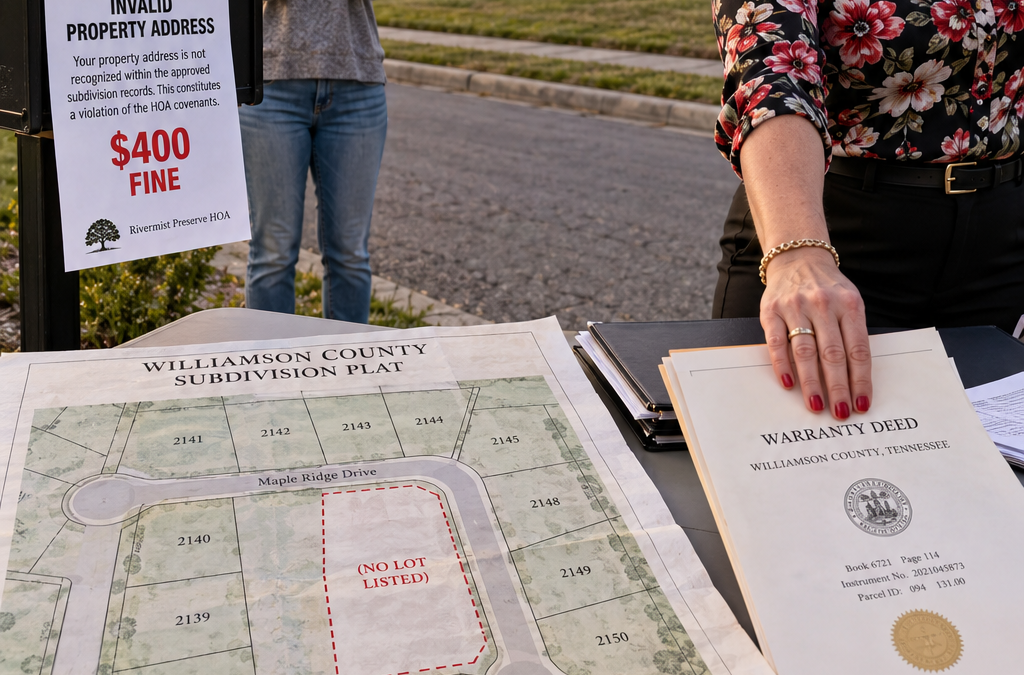
INVALID PROPERTY ADDRESS.
Then:
Fine assessed: $400.
I read it again.
Then a third time.
The notice claimed that my property designation did not conform to the official subdivision records maintained by the association and that I was occupying a residence under an invalid community address.
I actually laughed.
Not because the fine was funny.
Because the alternative was believing someone had lost his mind.
I went inside, dropped the envelope on the kitchen counter, and made dinner.
The next morning, I called the HOA management office.
A woman answered.
“Clearwater Ridge Community Association. How may I assist you?”
“Hi. My name is Garrett Holloway. I received a violation notice yesterday, and I think there’s been some kind of administrative error.”
“Address?”
I almost laughed again.
“Fourteen Birchwood Court, Unit A.”
I heard typing.
Then silence.
“Yes, Mr. Holloway. I see the violation.”
“Good. Then hopefully you can explain it.”
“Your property address does not match the official subdivision plat currently maintained in our association records.”
I leaned against the kitchen counter.
“I’m sorry. What exactly does that mean?”
“It means your address may not correspond to a recognized lot in the Clearwater Ridge community.”
For several seconds, I genuinely did not know how to respond.
I looked around my kitchen.
Same cabinets I had painted twice.
Same breakfast bar where Lily had done algebra homework until midnight.
Same wall where faint pencil marks inside the pantry still recorded her height every birthday until she turned sixteen and complained that I was embarrassing her.
“I’ve lived here for eleven years.”
“Yes, sir.”
“I’ve paid HOA dues for eleven years.”
“I understand.”
“You’ve mailed those bills to this address.”
“I’m only telling you what our records show.”
“So what am I supposed to do?”
“You’ll need to provide documentation establishing the property’s legal community designation.”
That irritated me.
“Establishing it to whom?”
“The board.”
“The county already established it.”
“Then you should submit those records.”
I took a slow breath.
“Fine. I’ll do that.”
“Until the discrepancy is resolved, the violation remains active.”
“And the four hundred dollars?”
“Also active.”
I hung up believing the conversation had been ridiculous but fixable.
Three days later, another letter arrived.
This one was signed personally by the HOA president.
Claudette Marsh.
I had known Claudette for years in the way people in neighborhoods know someone they never choose to spend time with.
She was in her late fifties, precise in everything she did, and almost unnaturally composed.
Her gray-blond hair was always cut to the same length.
She wore narrow glasses and carried meeting folders with color-coded tabs.
Whenever someone asked a question at an HOA meeting that she considered inconvenient, she had a habit of looking over the top of those glasses before answering.
She had been board president for six years.
At first, I had thought she was simply organized.
Then I began noticing that organization and control were not the same thing.
The letter she sent me was worse than the violation notice.
It stated that until the property-address discrepancy was resolved, I would be considered a non-member of the Clearwater Ridge Community Association.
I read that sentence twice.
Then the consequences.
No voting rights.
No access to common amenities.
No right to request association records as a member.
No eligibility to participate in board elections.
And the fine would continue accruing at fifty dollars per week.
I stood in the same kitchen where I had received the phone call and felt something shift.
Four hundred dollars was irritating.
Fifty dollars a week was offensive.
But losing membership because somebody had suddenly decided my house might not be part of the community?
That didn’t feel administrative.
It felt deliberate.
I called Claudette directly.
She answered on the fourth ring.
“Claudette Marsh.”
“This is Garrett Holloway.”
A pause.
“Yes, Garrett.”
“I got your letter.”
“I’m sure you have questions.”
“I have one. How can I be a non-member of an association I’ve paid dues to for eleven years?”
“The issue is more technical than that.”
“Then explain the technical part.”
“Your recorded address doesn’t correspond cleanly with our internal property schedule.”
“Then your internal schedule is wrong.”
“That has not been established.”
“The county sends me property tax statements.”
“County tax records and HOA membership records are separate matters.”
“Not when you’re telling me my house isn’t recognized.”
“I’m not saying the house doesn’t exist.”
“Your violation literally says invalid property address.”
“Please don’t oversimplify the issue.”
I almost laughed.
“I’m standing inside the house you’re telling me may not be a recognized lot.”
“Garrett, nobody is trying to create a problem for you.”
“Then remove the fine.”
“We can’t do that until the records are reconciled.”
“How long will that take?”
“As long as necessary.”
That phrase stayed with me.
As long as necessary.
Necessary for what?
I asked for the exact document she believed conflicted with my deed.
She wouldn’t provide it over the phone.
I asked when the discrepancy had first been identified.
She said it was part of an “ongoing records review.”
I asked whether other homes were affected.
She said she couldn’t discuss other owners’ records.
Every question produced an answer that sounded official without actually telling me anything.
Finally, I said, “I’m going to the county recorder tomorrow.”
“You’re entitled to do that.”
“I’m bringing everything to the next meeting.”
“You’re welcome to submit documentation.”
Then she hung up.
The next afternoon, I drove to the county recorder’s office.
I expected the trip to take twenty minutes.
I stayed nearly three hours.
I pulled my deed first.
Garrett Holloway.
14 Birchwood Court, Unit A.
Legal description.
Parcel number.
Recording stamp.
No discrepancy.
Then the survey.
Same.
Tax record.
Same.
Subdivision plat.
Same.
My property was a valid recorded parcel.
There was nothing ambiguous about it.
I paid for certified copies.
I also requested tax-payment records going back to 2013.
Every year paid.
Every record connected the parcel to me.
I walked out carrying a thick folder and feeling almost relieved.
I thought the problem was over.
That belief lasted until the next HOA meeting.
It was held in the Clearwater Ridge community center, a low brick building beside the pool.
About twenty residents were there.
I sat near the front.
Claudette was at the long folding table with four other board members.
When public comments began, I raised my hand.
She knew exactly why.
“Mr. Holloway.”
I stood and carried my folder forward.
“I have the certified county records you requested.”
Claudette folded her hands.
“You can leave copies with the secretary.”
“I’d rather review them now.”
Her eyes narrowed slightly.
“This is not the appropriate forum for an extended property-record dispute.”
“You made it an HOA matter when you fined me.”
A few residents looked up from their phones.
I placed the deed on the table.
“This is the recorded deed.”
Then the plat.
“This is the recorded subdivision map.”
Then the tax record.
“This is eleven years of county recognition.”
Claudette glanced at the first page.
I watched her face.
No surprise.
No confusion.
That was the first moment I knew something was wrong.
If she had sincerely believed my property was invalid, those records should have mattered.
She should have looked relieved.
She should have asked questions.
Instead, she picked up the deed, looked at it for perhaps five seconds, then placed it facedown.
“These do not align with our internal records.”
I stared at her.
“What internal records?”
“The matter remains under review.”
“By whom?”
“The board.”
“For what reason?”
“We have another agenda item.”
“Claudette, you’ve taken away my voting rights.”
“We’ve temporarily suspended them pending clarification.”
“My county-certified deed is clarification.”
“Not necessarily.”
I felt heat move into my face.
“What exactly would satisfy you?”
She looked at me over the top of her glasses.
“We will notify you when the review is complete.”
Then she looked toward the next person.
“Mrs. Patterson, you had a drainage concern?”
That was it.
She moved on.
My documents sat facedown on the table.
I stood there another second before returning to my chair.
People sometimes imagine anger as explosive.
Shouting.
Slamming fists.
Walking out.
I didn’t feel any of that.
I felt cold.
Focused.
For eleven years, I had done everything homeowners were always told responsible residents should do.
Paid dues.
Maintained the property.
Followed rules.
Attended occasional meetings.
Asked questions politely.
And Claudette had just demonstrated that none of it mattered if she controlled the definition of what counted.
I left before the meeting ended.
At home, I poured a drink and sat at my dining table with the county documents spread around me.
For almost an hour, I stared at them.
There was no address problem.
That much was obvious.
So I asked myself a different question.
Why would Claudette need there to be one?
That question changed everything.
Instead of researching my property, I began researching Clearwater Ridge.
I started with the county property database.
Lot by lot.
Parcel by parcel.
I wasn’t looking for anything specific.
I wanted to understand the subdivision structure.
There were sixty-three developed residential parcels.
Common-area parcels.
Drainage easements.
Pool property.
A maintenance strip near the back of the neighborhood.
Then I found Lot 7B.
At first, it looked like an ordinary undeveloped parcel.
Approximately a quarter acre.
Located behind the northern row of homes near an HOA maintenance area.
But something was strange.
The original 2009 subdivision plat showed Lot 7B clearly.
Yet when I searched the county’s ownership history, I couldn’t immediately find a standard deed of sale.
No obvious resident owner.
No long-term tax-payment history under a homeowner’s name.
No house.
No mailing address.
I zoomed in on the map.
The parcel sat adjacent to HOA-managed land.
I had seen that area before.
The association landscapers maintained it.
Mulching.
Trimming.
Drainage work.
At two meetings years earlier, I had asked why our maintenance budget had increased so sharply despite the common areas not appearing significantly different.
Claudette had given vague answers about contractor costs.
I hadn’t thought much about it.
Now I did.
I wrote down the parcel number.
For the next two nights, I kept digging.
Property records.
Board minutes.
Old newsletters.
Budget summaries.
Anything public.
Lot 7B barely existed in HOA documents.
That was strange because I knew money had been spent maintaining the area.
I could see landscaping improvements on historical aerial imagery.
I could see grading.
Planting.
Drainage.
Somebody was paying for it.
But why?
More importantly, who owned it?
I submitted a formal written request to the HOA for three years of financial records.
Budgets.
Meeting minutes.
Contractor invoices.
Expenditure ledgers.
Bank summaries.
Under our state’s applicable HOA disclosure requirements, members were entitled to inspect association records.
I sent the request certified mail.
Claudette responded three days later.
Request denied.
Reason:
Garrett Holloway’s membership status is currently suspended pending verification of property eligibility.
I sat at the table holding the letter.
Then I laughed again.
This time there was no humor in it.
They had created the membership problem.
Then they used the problem they created to prevent me from seeing the records that might explain why they created it.
That was when I called Priya Nambiar.
Priya was a property and association attorney in Nashville.
A coworker had used her several years earlier during a condominium dispute.
I expected a twenty-minute consultation.
We spoke for almost an hour.
She listened without interrupting while I explained everything.
The address notice.
The fine.
The suspension.
The county records.
The meeting.
The financial-record denial.
When I finished, she was silent.
Then she said, “First, stop speaking to Claudette by phone.”
“Why?”
“Because written records don’t forget.”
“Okay.”
“Second, save every letter.”
“I have.”
“Emails?”
“Yes.”
“Certified-mail receipts?”
“Yes.”
“Meeting notices?”
“Most of them.”
“Good.”
She paused.
“They cannot simply declare you a non-member because their internal spreadsheet conflicts with a recorded deed.”
“That’s what I thought.”
“And they certainly don’t get to create a status problem, then rely on that same status problem to deny statutory or contractual rights without a legitimate basis.”
“So what do we do?”
“We establish exactly what they’re claiming.”
I hesitated.
“There’s something else.”
“What?”
I told her about Lot 7B.
Priya became noticeably more interested.
“What makes you think it’s relevant?”
“I don’t know that it is.”
“Then tell me the facts.”
I explained what I had found.
Original plat.
Unclear ownership history.
HOA maintenance activity.
My previous budget questions.
She asked for the parcel number.
I gave it to her.
Then she said, “Don’t accuse anyone of anything yet.”
“I wasn’t planning to.”
“Good. Facts first.”
I hired a title researcher the next morning.
Her name was Rebecca Shaw.
Three hundred dollars.
At the time, I wondered whether I was becoming obsessive.
Six days later, Rebecca asked me to meet her at her office.
She had a manila envelope waiting on the desk.
“You need to sit down,” she said.
Those words are never followed by anything comforting.
I sat.
Rebecca removed a chain-of-title report.
“Lot 7B was created during a subdivision adjustment in 2009.”
“I saw that.”
“For years, title treatment was messy. There were references connecting it to developer-controlled reserve land.”
“Okay.”
“Then in 2021, this happened.”
She slid a deed toward me.
Lot 7B.
Transfer date: 2021.
Grantee: Marsh Land Holdings LLC.
My eyes stopped at the name.
“Marsh?”
Rebecca nodded.
“Registered agent.”
She handed me another page.
Claudette Marsh.
I stared at it.
The office suddenly felt very quiet.
“She owns the lot?”
“Her LLC does.”
“How did she get it?”
“That’s where things become interesting.”
“Interesting isn’t the word I would use.”
Rebecca pointed at the transfer record.
“It doesn’t appear to have been sold through an ordinary arms-length listing.”
“What was the consideration?”
“Nominal.”
“How nominal?”
“Enough that I’d want an attorney to review the transaction history before making conclusions.”
I leaned back.
The room felt colder.
For several minutes, I said nothing.
The puzzle wasn’t complete.
But pieces were beginning to touch.
Claudette had acquired an undeveloped parcel next to HOA-maintained land.
The transfer had never been discussed at any meeting I remembered.
The association appeared to have been spending money maintaining that area.
And now, years later, after I had asked questions about maintenance costs, Claudette suddenly decided my property address was invalid.
I drove home with the title report on the passenger seat.
For forty-eight hours, I did nothing.
That mattered.
I wanted to call Claudette.
I wanted to ask her exactly when she planned to tell sixty homeowners that she had a private ownership interest in land bordering association property.
I wanted to accuse her.
Instead, I called Priya.
She read the documents.
Then she became quiet.
“This is no longer just an HOA fine dispute.”
“I figured.”
“We need to be precise here.”
“Tell me what you see.”
“I see a private LLC controlled by the association president acquiring property that may have received association-funded maintenance.”
“That’s what I see.”
“But we do not yet know whether HOA funds were actually spent on that parcel.”
“Not without the financial records.”
“Correct.”
“The records she denied me.”
“Correct.”
“So what now?”
“Now we stop asking politely.”
Priya sent a formal legal demand.
Immediate reinstatement of my membership.
Suspension of the $400 fine and weekly penalties.
Production of requested records.
Preservation of emails, invoices, bank records, vendor agreements, board minutes, and communications regarding Lot 7B.
She also demanded clarification of what supposed “internal record” contradicted my deed.
At the same time, she helped me file complaints with the appropriate state regulatory authorities and county officials.
We attached the title documents.
The county-certified proof of my property address.
Claudette’s suspension letter.
The financial-record denial.
Four days later, Priya received a response from Claudette’s attorney.
The letter claimed the Lot 7B transaction was a private matter entirely unrelated to Clearwater Ridge Community Association.
It stated that the HOA had no knowledge of, participation in, or financial connection to the transaction.
I remember reading that paragraph.
“The HOA had no knowledge?”
“That’s what they’re saying,” Priya replied.
“Claudette is the HOA president.”
“Her attorney is drawing a distinction between her private capacity and her board role.”
“Is that distinction real?”
“Potentially.”
“So she could own property privately.”
“Of course.”
“Then why hide it?”
Priya looked at me.
“That is not the question I care about most.”
“What is?”
“Whether association money touched that property.”
The county audit answered that question.
Two weeks later, financial records were produced through official channels.
Records Claudette had refused to show me.
Three years of statements.
Checks.
Electronic transfers.
Vendor payments.
Invoices.
We sat in Priya’s office scrolling through a spreadsheet when she stopped.
“Greenfield Property Services.”
“What about it?”
“Look.”
There were payments.
Dozens of them.
$850.
$1,200.
$975.
$1,450.
Some small.
Some large.
Repeated over three years.
Forty-seven separate payments.
Total: just under $60,000.
“What did they do?”
Priya opened the vendor descriptions.
Landscaping.
Drainage improvement.
Grading.
Retaining work.
Vegetation management.
Site preparation.
I felt my stomach tighten.
“Where?”
“That’s what the invoices don’t clearly say.”
The county auditor had obtained more detailed work records.
Those did.
Lot 7B.
The same parcel owned by Marsh Land Holdings LLC.
The same LLC registered to Claudette Marsh.
I sat perfectly still.
Nearly sixty thousand dollars.
Money paid by homeowners.
Money from dues I had contributed to for years.
Used to maintain and improve land Claudette’s private LLC controlled.
And when I had gotten close enough to ask about maintenance spending, my home had suddenly become “invalid.”
I looked at Priya.
“She removed me from the voting pool.”
“We don’t know motive yet.”
“Come on.”
“I know what it looks like.”
“She made me a non-member after I asked questions about maintenance.”
“I know.”
“Then refused financial records because I wasn’t a member.”
“I know.”
“How much is Lot 7B worth?”
Priya pulled up the current county assessment.
She stared at the screen.
“Two hundred eighty thousand.”
I felt sick.
For the first time, the situation stopped feeling satisfying.
Until then, part of me had viewed it as a puzzle.
A ridiculous HOA dispute where eventually the right documents would expose the mistake and everyone would move on.
This was different.
If what the records suggested was true, people I knew had been paying for improvements on private land without knowing it.
Retirees.
Young families.
People budgeting for dues.
People who trusted the numbers presented at meetings.
Sixty thousand dollars isn’t abstract when you know the people who contributed it.
Gerald Fitch lived two streets over.
He was seventy-two, retired, and complained every year when dues increased because he was living on a fixed income.
I remembered him standing at an annual meeting asking whether the landscaping contract really needed another eight-percent increase.
Claudette had told him costs were rising everywhere.
Now I wondered how much of that increase had gone behind Lot 7B.
I felt ashamed that my first reaction had been excitement at proving Claudette wrong.
This wasn’t about my four-hundred-dollar fine anymore.
Priya must have seen something change in my face.
“You okay?”
“No.”
“That’s probably the correct reaction.”
“I’ve been paying into this.”
“So has everybody else.”
“How long?”
“We’re still determining that.”
I looked at the statement again.
Forty-seven payments.
Each one ordinary enough to disappear inside an annual budget.
No single dramatic withdrawal.
No giant check.
Just money leaking away in amounts small enough not to trigger attention.
That was what made it sophisticated.
Or maybe just patient.
The county attorney’s office requested more records.
Emails.
Contracts.
Vendor communications.
Board authorizations.
The state HOA regulator opened its own review.
Claudette’s attorney sent increasingly careful letters.
The tone changed.
At first, confident.
Then defensive.
Then technical.
She claimed landscaping work near Lot 7B benefited adjacent common areas.
She claimed boundaries were misunderstood.
She claimed certain improvements were necessary for drainage affecting the neighborhood.
Some of that might even have been partially true.
But then investigators obtained Greenfield Property Services’ client records.
Greenfield had one relevant private client associated with those projects.
Marsh Land Holdings LLC.
Claudette’s company.
The invoices aligned.
The payments aligned.
The work locations aligned.
And there were emails.
That was when Claudette’s explanation started collapsing.
One email from her to Greenfield instructed the company to bill specific work through the HOA’s maintenance account.
Another discussed “preparing the rear lot.”
Another referenced future value.
Priya did not let me keep copies of everything because the investigation was active, but she showed me enough.
I read one line twice.
Then I pushed the page away.
“She knew.”
Priya said nothing.
“She knew exactly what she was doing.”
“That’s what investigators will determine.”
“Priya.”
She looked at me.
“I understand.”
The board scheduled an emergency meeting.
The county required the association to present audit findings to residents.
By then, rumors had spread.
People knew something was wrong.
They didn’t know how wrong.
My membership had quietly been reinstated a few days earlier.
No apology.
No explanation.
Just an email stating that after “additional record reconciliation,” 14 Birchwood Court, Unit A was recognized as an association property in good standing.
I stared at that email for a long time.
Eleven years of existence restored in three sentences.
The $400 fine remained technically pending.
Priya told me not to pay it.
I had no intention of doing so.
The night before the emergency meeting, Gerald texted me at 8:17.
You should know there are two police cars outside Claudette’s house.
I called him immediately.
“What?”
“Two unmarked cars. Look like detectives.”
“How do you know?”
“Because I’m retired, not blind.”
“Did they arrest her?”
“Not that I saw.”
“How long have they been there?”
“Twenty minutes.”
I called Priya.
She had heard nothing.
“Don’t speculate,” she told me.
“I’m not.”
“You sound like you’re speculating.”
“I’m trying very hard not to.”
The next morning, I learned what had happened.
A detective assigned to the county investigation had attempted to contact Claudette.
She wasn’t home when they arrived.
No arrest.
No dramatic confrontation.
Nothing like that.
But the fact that detectives were now involved changed the entire atmosphere.
That evening, I drove to the Clearwater Ridge community center.
I had attended dozens of meetings there.
Never like this one.
Every chair was occupied.
People stood against the walls.
More than sixty residents packed inside.
Some were whispering.
Others sat with arms crossed.
Gerald wore his usual cardigan and reading glasses and had somehow managed to secure a front-row seat.
He pointed toward the empty chair beside him.
“Saved you one.”
I sat.
At the board table, Claudette was already there.
Her attorney sat beside her.
For the first time since I had known her, Claudette looked tired.
Not disorganized.
Never that.
But smaller.
Her face was pale.
Her shoulders rigid.
She wasn’t wearing her usual expression of effortless authority.
Behind us, two plainclothes detectives stood near the wall.
Nobody needed to explain who they were.
The meeting began at seven.
The interim board secretary read the agenda.
Audit findings.
Financial irregularities.
Lot 7B.
Vendor payments.
Governance review.
No one mentioned my address dispute at first.
That almost made sense.
Compared with sixty thousand dollars, four hundred seemed trivial.
Then the county representative began speaking.
He was a middle-aged man named Paul Ellis.
No drama in his voice.
No accusations.
Just numbers.
Forty-seven payments.
Dates.
Amounts.
Vendor names.
Account categories.
Total expenditures.
He explained that association funds appeared to have been used for work benefiting property not clearly held as common association property during the relevant period.
He identified Marsh Land Holdings LLC.
A woman behind me whispered, “Oh my God.”
Paul continued.
The registered agent.
Claudette Marsh.
People began shifting in their chairs.
Someone muttered something I couldn’t hear.
Gerald sat absolutely still.
Then Paul showed a map.
Lot 7B.
I knew every line of that map by then.
But most residents had never seen it.
A man across the aisle raised his hand.
“Are you saying our dues paid for private land?”
Paul answered carefully.
“The audit identified association payments tied to work performed in connection with that parcel. The legal characterization of those transactions is under review.”
A woman near the back called out.
“Who approved them?”
The board members stared at their papers.
Claudette’s attorney leaned toward her.
Paul continued.
Another resident stood.
“Was there a board vote?”
No immediate answer.
“Was there a vote?”
The interim secretary said she had found no complete record of one.
The room became louder.
Claudette finally spoke.
“This is being presented without proper context.”
Every voice stopped.
She sounded almost like herself again.
Controlled.
Measured.
“The association has long maintained portions of the rear reserve area for drainage and community preservation purposes.”
A man shouted, “Then why is it in your LLC?”
Her attorney raised a hand.
“Please direct questions through the chair.”
Someone laughed bitterly.
Claudette continued.
“The ownership issues surrounding Lot 7B are complex and predate some of the current records.”
I watched her.
For years, that tone had worked.
Complex.
Technical.
Under review.
She used uncertainty like a locked door.
If she made an issue sound complicated enough, people assumed she understood it better than they did.
But that night, everyone had the map in front of them.
Everyone had the numbers.
The door was open.
Paul finished his presentation.
Then one of the detectives stepped away from the back wall.
The room changed instantly.
He walked toward the board table.
“Ms. Marsh?”
Claudette looked at him.
“Yes.”
“I’m Detective Alvarez with the county investigator’s office.”
Her attorney moved slightly closer.
“I’d like to confirm your identity for the record.”
Claudette’s face lost what little color remained.
Her attorney put a hand lightly on her forearm.
“Do not answer substantive questions.”
Detective Alvarez nodded.
“That’s her right.”
He looked at Claudette again.
“Are you Claudette Marsh?”
She looked at her attorney.
Then at the room.
Sixty neighbors.
People she had presided over for years.
People she had fined.
Corrected.
Lectured.
Silenced.
The same room where she had placed my certified deed facedown.
Finally she said, “On advice of counsel, I won’t be answering questions tonight.”
Detective Alvarez nodded once.
“Understood. You will be contacted regarding a formal interview associated with the ongoing investigation.”
That was all.
No handcuffs.
No arrest.
No shouting.
Nothing theatrical.
But the silence afterward felt enormous.
Claudette stared down at the table.
And then Gerald started clapping.
One slow clap.
Then another.
I turned toward him.
“Gerald.”
He didn’t stop.
A woman across the room joined.
Then somebody behind us.
Within seconds, most of the room was applauding.
I didn’t.
Not because I felt sorry for Claudette.
Because standing there in that moment, I didn’t feel triumphant.
I felt exhausted.
For weeks, I had imagined what it would feel like when the truth became public.
I thought vindication would be clean.
It wasn’t.
The room was full of people realizing someone they trusted may have used their money against them.
That doesn’t feel like winning.
It feels like discovering the floor beneath your feet wasn’t as solid as you thought.
Claudette resigned that night.
Her attorney read a short statement before she left.
She denied intentional wrongdoing.
She said she did not want the community disrupted by controversy surrounding her leadership.
Then she walked out.
Nobody stopped her.
I watched the door close.
Gerald leaned toward me.
“You all right?”
“I don’t know.”
“That’s fair.”
The legal process took four more months.
Those four months taught me how slow accountability actually is.
People expect dramatic cases to end dramatically.
Usually they end in conference rooms.
Documents.
Negotiations.
Phone calls.
Revised agreements.
Signatures.
The civil side resolved first.
Marsh Land Holdings LLC agreed to deed Lot 7B back for community benefit as part of the settlement framework.
The misused funds—roughly sixty thousand dollars—were repaid.
The association hired an independent accounting firm.
New financial-control procedures were adopted.
No single board officer could approve certain categories of expenditure without secondary authorization.
Vendor relationships had to be disclosed.
Any board member with a financial interest in property or a contractor had to formally recuse themselves.
Then came the criminal matter.
The county filed a fraud-related charge connected to the financial transactions.
Eventually, Claudette entered a plea agreement.
I was not involved in negotiating it.
I didn’t ask to be.
The agreement included probation, community service, financial restitution obligations, and restrictions preventing her from holding future HOA leadership positions under the terms imposed in the resolution of the matter.
Some residents thought she deserved worse.
Others believed she had already lost enough.
I stopped caring about punishment.
I cared about records.
I cared about the community getting its money back.
I cared about the fact that what happened could not quietly happen again.
The new interim board sent me a letter.
Not an email.
A real letter.
It began:
Dear Mr. Holloway,
The Clearwater Ridge Community Association formally rescinds the violation issued regarding the validity of your property address.
I read slowly.
My property at 14 Birchwood Court, Unit A was acknowledged as a valid, recorded property.
My membership had never been legally terminated.
All fines were cancelled.
The letter apologized for the manner in which the matter had been handled.
I sat at my kitchen counter holding the page.
Lily happened to call while I was reading it.
“Hey, Dad.”
“Hey.”
“You sound weird.”
“I’m reading the HOA apology.”
She laughed.
“They admitted your house exists?”
“Apparently.”
“Congratulations.”
“Thank you.”
“You’ve only lived there my entire childhood.”
“These things take time.”
She laughed again.
Then she became quiet.
“That whole thing really bothered you, didn’t it?”
I looked around the kitchen.
The room where she used to sit.
The faded mark on the counter from a hot pan.
The dent in the refrigerator door from when she was twelve and tried moving it herself because she had lost an earring.
“Yeah.”
“Because of the money?”
“No.”
“Then what?”
I thought about Claudette turning my deed facedown.
“Because someone looked at something I knew was true and acted like their authority mattered more than reality.”
Lily was silent.
Then she said, “You hate that.”
“I really do.”
After we hung up, I placed the apology letter in the same folder as the original violation.
I kept both.
People thought that was strange.
Maybe it was.
But I wanted the two documents together.
One said my home was invalid.
The other admitted it wasn’t.
Between them sat the entire story of what happens when someone confuses control with truth.
The recovered money went back into the association.
Residents voted on how part of it would be used.
The pool deck had needed resurfacing for years.
That finally happened.
The cracked concrete was removed.
New drainage installed.
Non-slip surface added.
A portion of the recovered funds went toward a small landscaped garden along the entrance walking path.
Nothing extravagant.
Native shrubs.
Benches.
A few dogwoods.
Gerald complained that the benches were too expensive.
Some things never change.
I started walking past the garden most mornings.
Not because I suddenly became interested in landscaping.
Because Lot 7B was visible from part of that path.
The parcel looked ordinary.
That fascinated me.
A quarter acre.
Grass.
Drainage.
A few trees.
No mansion.
No giant structure.
Nothing that looked like it could nearly destroy an HOA board.
That’s how most things are, I suppose.
The physical object is often less important than what people do around it.
One morning, Gerald joined me.
We walked slowly.
His knees had been bothering him.
When we reached the new garden, he stopped.
“You know,” he said, “I still don’t understand why she picked you.”
“I don’t think she picked me at first.”
“Then what happened?”
“I asked questions.”
“You always asked questions.”
“Exactly.”
Gerald nodded.
“You remember that meeting two years ago? Landscaping budget?”
“Unfortunately.”
“You asked why maintenance increased seventeen percent.”
“I did.”
“Claudette hated that.”
“I remember.”
He adjusted his glasses.
“Maybe you were already on her list.”
That thought stayed with me.
I had assumed the address dispute began in October.
Maybe it began years earlier.
Maybe every question mattered.
Not because I had uncovered anything then.
I hadn’t.
But people who depend on nobody looking too closely often remember the people who look.
That realization changed how I understood the whole experience.
Claudette hadn’t needed to remove me from my house.
She only needed to remove my standing.
My vote.
My right to inspect records.
My ability to challenge decisions.
Calling my address invalid was almost elegant in its simplicity.
If I wasn’t a legitimate member, my questions no longer required answers.
The $400 fine wasn’t really the threat.
The fifty dollars a week wasn’t either.
The real power was administrative erasure.
You don’t belong.
Your address isn’t valid.
Your membership is suspended.
Your records request is denied.
The language looked procedural.
Its effect was personal.
I thought about all the times people are told something is impossible because a database says so.
Wrong address.
Wrong parcel.
Wrong account.
Wrong classification.
Most of us assume official systems are more accurate than we are.
Usually that’s reasonable.
But systems are maintained by people.
And people can make mistakes.
Or manipulate them.
That was the lesson I carried forward.
Not that every HOA is corrupt.
Not that every board member is hiding money.
The new Clearwater Ridge board included people I trusted.
Linda Cho, a retired school principal, became president.
The first time I attended a meeting under her leadership, she did something so ordinary it almost moved me.
A homeowner asked about a landscaping expenditure.
Linda opened the budget packet.
She showed him the invoice.
Explained the line item.
Asked whether he wanted a copy.
That was it.
No defensiveness.
No lecture about procedure.
No suggestion that asking was disrespectful.
Just transparency.
Afterward, I told her I appreciated it.
She smiled.
“Shouldn’t that be normal?”
“Yes.”
“Then let’s make it normal.”
Clearwater Ridge eventually became quiet again.
Children returned to bicycles.
People argued about pool hours.
A debate broke out over whether residents should be allowed to leave basketball hoops near the curb.
Someone complained about holiday lights staying up until February.
Normal neighborhood problems.
Beautifully boring problems.
The kind I had once taken for granted.
I still live at 14 Birchwood Court, Unit A.
The address is printed on my tax bill.
My driver’s license.
My insurance.
My HOA account.
Exactly where it has always been.
Sometimes I think about the first woman who answered the management-office phone.
“It means your address may not be a recognized lot in this community, sir.”
At the time, the sentence made me question something I had never needed to question before.
For several minutes after that call, I actually looked through old documents wondering whether I had somehow misunderstood my own property.
That’s the strange power of official language.
It can make you doubt your own floor beneath your feet.
Claudette understood that.
She used it.
At the emergency meeting, after everyone had gone home, I remained in the community center for a few minutes.
The folding chairs were scattered.
Coffee cups abandoned.
Financial reports left on tables.
The board table stood at the front.
I walked toward it.
I stopped where Claudette had been sitting months earlier when I showed her my deed.
I could still remember the exact motion.
She looked at the page.
Turned it facedown.
“These don’t align with our internal records.”
At the time, the gesture had made me feel powerless.
Now I understood something I hadn’t understood then.
She had needed me to believe that the paper in front of me mattered less than her interpretation of it.
That was the whole mechanism.
Not only with my deed.
With the budget.
The lot.
The board records.
Everything.
As long as residents accepted that she knew more than they did, nobody needed to look underneath.
The second we did, the system failed.
Not because I was clever.
I wasn’t.
I happened to be annoyed enough to check.
That was all.
I went to the recorder’s office.
I read the plat.
I searched the parcels.
I hired a title researcher.
I kept the letters.
I mailed things certified.
I asked for financial records.
None of that was dramatic.
But truth often isn’t dramatic at first.
Sometimes it is a parcel number on a county website.
Sometimes it is a payment line buried in a spreadsheet.
Sometimes it is forty-seven ordinary-looking transactions that only become meaningful when placed beside each other.
And sometimes it is the address on a deed that someone hoped you would stop believing.
A year after the case ended, I repainted the kitchen again.
The old gray had started looking tired.
Lily came home one weekend and helped.
At least, she claimed to help.
Mostly she complained about my color choice and got paint on the floor.
At one point, she climbed onto a stool near the counter where she used to do homework.
“You going to cover the height marks too?”
She was looking toward the pantry.
“No.”
“Why not?”
“Those stay.”
“Dad, I’m nineteen.”
“Exactly.”
She rolled her eyes.
Later that afternoon, I stood in the doorway looking at those pencil lines.
Eight years old.
Nine.
Ten.
Eleven.
Each labeled with a date.
Evidence.
Small records of a life.
I thought about how ridiculous it had been for someone to tell me this house wasn’t real.
Everything real to me had happened inside it.
Birthdays.
Arguments.
Homework.
Christmas mornings.
Flu seasons.
College acceptance letters.
The night Lily told me she wanted to become a physical therapist.
The night my father died and I sat alone at this kitchen table until sunrise.
A database entry wasn’t what made the house real.
But legally, the database entry existed too.
That was the absurdity.
Claudette wasn’t opposing sentiment with paperwork.
I had both.
Memory and proof.
She simply assumed I wouldn’t fight hard enough to connect them.
I keep a file now.
Not just digital copies.
Paper.
The deed.
Survey.
Tax records.
HOA documents.
Apology letter.
Original violation.
The Lot 7B title report.
Priya once looked at the folder and said, “You know most of this is backed up electronically.”
“I know.”
“Then why the binder?”
“Because binders don’t have password problems.”
She laughed.
“Fair.”
The title page says PROPERTY RECORDS.
Nothing dramatic.
But every time I see it, I remember what eleven years of being a compliant homeowner taught me in one month.
Paying dues does not guarantee fairness.
Following rules does not guarantee the person enforcing them is acting honestly.
Being polite does not mean you have to be passive.
And documentation is not paranoia when someone is trying to rewrite what already happened.
People sometimes ask whether I would do anything differently.
Yes.
I would have started asking harder questions earlier.
At the first unexplained budget increase.
At the first vague answer.
At the first time Claudette responded to a homeowner as though curiosity itself were disrespectful.
Power rarely announces that it is becoming unhealthy.
It reveals itself in smaller habits.
Questions treated as disloyalty.
Records made difficult to obtain.
Rules interpreted by one person.
Votes managed rather than discussed.
Information centralized.
People excluded.
None of those things individually prove corruption.
Together, they tell you where to look.
I didn’t understand that in 2013.
I do now.
The garden near the entrance has grown in.
The dogwoods flower every spring.
The pool deck looks better.
The new board posts financial reports online.
Lot 7B is listed transparently among community-controlled parcels.
Every annual meeting packet includes a conflict-of-interest disclosure page.
Gerald still complains about dues.
I think he would complain if they dropped to zero.
A few months ago, he stopped me near the mailbox.
“You know what your real problem is?”
“I’m sure you’re going to tell me.”
“You can’t leave things alone.”
I smiled.
“Look what happened last time I tried.”
He laughed.
Then he became serious.
“You did good.”
I shook my head.
“I checked a parcel.”
“Most people wouldn’t.”
Maybe that was true.
Most of us are busy.
We assume someone else checked.
Someone else read the minutes.
Someone else looked at the invoice.
Someone else asked why.
That assumption is what people like Claudette depend on.
Not stupidity.
Fatigue.
People have jobs.
Children.
Mortgages.
Parents getting older.
Health problems.
Dinner to cook.
The last thing anyone wants after a ten-hour day is to analyze HOA accounting.
That’s why trust matters.
And that’s why abusing it matters even more.
One rainy October morning, almost exactly two years after the first violation arrived, I found myself standing at my mailbox again.
There was another envelope from Clearwater Ridge.
For a second, my stomach tightened automatically.
Old reflex.
I opened it.
Annual meeting notice.
Nothing more.
At the bottom, there was a reminder:
All members are entitled to review association financial records upon written request.
I read that line twice.
Then I laughed.
This time, genuinely.
I carried the envelope inside and placed it on the kitchen counter.
Same counter.
Same house.
Same address.
Fourteen Birchwood Court, Unit A.
Still there.
Still valid.
Still mine.
And I finally understood why the first accusation had bothered me so deeply.
Claudette wasn’t merely saying there was a mistake in a document.
She was trying to make me doubt whether I had standing to speak.
Whether I belonged.
Whether my questions counted.
Whether eleven years of ownership could be erased because she said an internal record disagreed.
That was the thing she never understood about me.
I didn’t need her to tell me I existed.
I needed proof.
And once I started looking, the proof did much more than protect my house.
It exposed every place where her story stopped matching the record.
One parcel.
One LLC.
Forty-seven payments.
Nearly sixty thousand dollars.
One deed turned facedown on a folding table.
That was all it took.
Claudette spent years building a system in which people trusted her version of the paperwork because checking the paperwork themselves was inconvenient.
I dismantled it the same way she built it.
One document at a time.
And today, whenever I walk past the little garden funded with the money the community recovered, I remember the night she told me my certified deed didn’t align with her records.
She was right about one thing.
They didn’t align.
Her records told the story she needed.
Mine told the truth.
In the end, only one of those survived.








