𝗙𝗨𝗟𝗟 𝗦𝗧𝗢𝗥𝗬 The HOA Threatened to Take My Home Over Three Inches of Pool Fence, and I Learned Too Late How Far Their President Would Go
𝗣𝗔𝗥𝗧 𝟮
Then I emailed the HOA.
I attached the pictures.
I asked for the violation photograph and the specific rule.
Deborah replied forty minutes later.
The fine remained.
No explanation.
Just:
The violation was observed and documented. Please remit payment within ten days.
I wrote back.
Could you please provide the observation photo?
No response.
Two days later, I saw Deborah walking the sidewalk.
Clipboard in hand.
She stopped in front of my house.
“Did you get my email?” I asked.
She turned slowly.
“Which email?”
“About the grass.”
“Oh.”
She gave me that same smile.
“Yes.”
“I asked for the photo.”
“The board doesn’t have to debate every observation with homeowners.”
“I’m not asking for a debate.”
I pointed at the lawn.
“I’m asking how this is two inches over.”
She looked at the grass.
Then at me.
“Katie, one of the biggest mistakes new residents make is treating every small correction like a personal attack.”
“I don’t.”
“Good.”
She tapped her clipboard.
“Then pay the fifty dollars, trim the lawn, and move forward.”
“I already trimmed it.”
“Excellent.”
“So can the fine be removed?”
“No.”
“Why?”
“Because the violation occurred.”
I stared at her.
“According to you.”
Her eyes hardened.
Only for a second.
“According to the association.”
Then she smiled again.
“Have a nice day.”
I paid the fifty dollars.
Not because I thought she was right.
Because I worked forty-eight hours that week and didn’t have enough energy to turn grass into a legal argument.
But I saved everything.
The notice.
My email.
Her reply.
My photographs.
The payment confirmation.
I didn’t know why.
Habit, maybe.
In the ER, if something feels wrong, you chart it.
Not because you know what will happen.
Because if something happens later, memory isn’t enough.
Three weeks after the grass fine, I received another notice.
Mailbox color.
My mailbox was beige.
The house was beige.
Half the neighborhood had beige mailboxes.
Apparently mine was a shade not approved in the association’s current exterior palette.
Fine: seventy-five dollars.
I called the office.
Deborah answered.
“Peach Tree Village.”
“It’s Katie.”
“Hello, sweetheart.”
I hated that word already.
“I’m looking at a violation for my mailbox.”
“Yes.”
“It’s the same color it was when I bought the house.”
“Ownership transfers don’t grandfather every exterior feature.”
“Was it approved before?”
“I’d have to check.”
“So you’re fining me before checking?”
“We observed noncompliance.”
“How do you know it’s noncompliant if you haven’t checked whether it was previously approved?”
Silence.
Then:
“Katie, you’re making this more complicated than it is.”
“No. I’m asking a simple question.”
“The board isn’t required to research the history of every violation.”
“Then homeowners are just supposed to assume you’re right?”
She laughed softly.
“This attitude will make living in an HOA very difficult for you.”
Something in my stomach tightened.
“Was that advice?”
“It was experience.”
The line went dead.
I did not repaint the mailbox immediately.
Instead, I walked the neighborhood.
I took pictures of twelve beige mailboxes.
Three looked nearly identical to mine.
None had violation notices.
At least none that I could see.
That was when documentation stopped being a habit and became strategy.
I began taking dated photographs every Saturday.
Front lawn.
Mailbox.
Driveway.
Fence.
Trash cans.
I downloaded the HOA rules and saved a copy locally.
I created a folder on my laptop called PEACH TREE.
Not because I was planning a lawsuit.
Because something about Deborah’s certainty made me uneasy.
The next fine involved a wind chime.
Forty dollars.
Unauthorized decorative exterior object.
It hung under the covered patio in my backyard.
You couldn’t see it from the street.
I asked how anyone even knew it was there.
Deborah replied:
Routine compliance observation.
That phrase bothered me.
Routine compliance observation.
To inspect that wind chime from a public area, she would have needed either to stand at an angle near my side gate or peer through a narrow opening between fence sections.
I checked my security camera.
There she was.
7:14 a.m.
Walking slowly beside the side of my property.
Stopping near the gate.
Leaning slightly.
Photographing.
I watched the clip three times.
Then I saved it.
The violation after that was Emma’s chalk.
Unauthorized driveway marking.
Fifty dollars.
That was the first one that made me genuinely angry.
Emma had drawn a family.
Three stick figures.
Me.
Her.
Noah.
Above them she’d written OUR HOME in purple chalk.
I came home from a shift and found the violation notice attached to the garage.
I stood there in scrubs, exhausted, staring down at my daughter’s drawing.
Emma came outside.
“Mom?”
“Yeah?”
“Are you mad?”
“No.”
She looked at the notice.
“Is that because of my picture?”
I wanted to lie.
Instead I crouched.
“Somebody says we’re not supposed to draw here.”
Her face fell.
“But it’s our driveway.”
“I know.”
“Do I have to wash it?”
I looked toward the street.
Deborah’s house wasn’t visible from ours.
Still, I felt watched.
“We’ll take a picture first.”
Emma smiled a little.
I photographed the drawing.
Then we washed it away together.
Purple water ran into the gutter.
Something about that image stayed with me.
A child erasing the words OUR HOME because an HOA president had decided temporary chalk qualified as unauthorized modification.
That night I told myself Deborah was just power hungry.
Annoying.
Controlling.
But ultimately harmless.
Then the pool fence notice arrived.
It was different.
Longer.
Formal.
The HOA claimed my six-foot fence exceeded the maximum permitted visible height by three inches under an obscure aesthetic restriction related to backyard structures.
Three inches.
The notice demanded alteration within fifteen days.
Failure to comply would result in escalating fines.
I sat at my dining table reading it.
Then I laughed.
Not because it was funny.
Because I was too tired to believe it.
I opened my HOUSE folder.
County permit.
Inspection approval.
Contractor invoice.
The fence had been installed legally.
I pulled up state and county pool barrier guidance.
My fence didn’t merely satisfy the safety requirements.
It exceeded the minimum in ways that made accidental access less likely.
The HOA wanted it lowered.
I emailed Deborah.
The fence is code-compliant and was approved by the county. Reducing the height may reduce the safety margin around the pool. Please provide the specific HOA provision and explain whether the association is demanding alteration despite county safety approval.
She replied twelve minutes later.
County code and association aesthetic standards are separate. Compliance with one does not excuse noncompliance with the other.
I wrote:
Are you ordering me to make a pool barrier less secure?
Her response:
We are ordering compliance with community standards.
I stared at that sentence for a long time.
The next morning, I called the county building office.
A man named Steven confirmed my permit.
“Everything was signed off,” he said.
“Would you recommend lowering it?”
“If you’re asking whether county code requires you to lower an already approved safety barrier, no.”
“Could lowering it create a problem?”
“Depends on final dimensions and configuration. You’d need to maintain all applicable barrier standards.”
“Can an HOA make me change it?”
“That’s a private covenant question. Talk to a lawyer if they’re threatening enforcement.”
That was the first time anyone said lawyer.
I wasn’t ready.
Lawyers cost money.
I had hospital bills of my own from Emma’s fractured wrist the previous year.
I had groceries.
School clothes.
Property taxes.
I didn’t want to spend thousands defending three inches of vinyl.
So I requested an internal review.
Deborah denied it.
I requested a board hearing.
She scheduled one for the following month.
Then Frank told me about the Rodriguez family.
Frank lived behind us.
Retired electrician.
Sixty-three.
Gray mustache.
Baseball cap in every season.
We were both outside one evening when he leaned over the fence.
“She on you about that pool barrier?”
“How’d you know?”
He gave me a tired look.
“Deborah talks.”
“Apparently it’s three inches too high.”
Frank shook his head.
“Don’t touch it.”
“Why?”
“Because she’ll find something else.”
I put down the garden hose.
“What does that mean?”
“She did this to the Rodriguez family.”
“I don’t know them.”
“House near the south entrance. Sold last year.”
“What happened?”
“Started with patio lights.”
He counted on his fingers.
“Then landscaping. Then trailer parking. Then architectural fees. Then late charges.”
“How much?”
“Thousands.”
“Did they owe it?”
Frank looked toward the fence.
“Depends whether you ask Deborah.”
“What happened?”
“They sold.”
“Because of fines?”
“Because they got tired of waking up afraid of the mail.”
That sentence landed hard.
I understood it immediately.
I’d started feeling the same thing.
Frank lowered his voice.
“Three families left after fights with her.”
“Why doesn’t the board stop her?”
“You’ll find out at your hearing.”
“What does that mean?”
He hesitated.
“People don’t like crossing her.”
I went inside after sunset.
I should have gone to bed.
Instead, I opened my laptop.
I searched county permit records.
First my property.
There was my pool fence permit.
Approved.
Then I searched Deborah’s address.
She had a pool.
I knew because aerial images showed it clearly.
I expected to find permits for pool construction, fencing, electrical work, something.
I found old property permits.
Roof.
HVAC.
Interior remodel.
No pool barrier permit.
I searched again.
Nothing.
My pulse quickened.
I checked archived records.
Still nothing.
Maybe it predated current digital records.
Maybe there was a paper permit somewhere.
I knew better than to assume.
So I filed a public-records request.
I asked for all pool and pool barrier permits connected to Deborah’s address.
Two days later, the county responded.
No responsive fence permit had been located.
I sat at my kitchen table staring at the email.
The woman threatening me over three inches of a legally permitted safety fence appeared to have no permit on file for her own pool barrier.
That was the first moment I stopped believing the dispute was merely about control.
There was hypocrisy here.
Potentially something worse.
I did something I would later wish I had timed differently.
I emailed Deborah.
I kept it short.
Before further enforcement, please explain whether the HOA applies pool barrier standards uniformly, including to board members, and whether all board properties are properly permitted.
She didn’t respond.
Forty-eight hours later, I received a new notice.
Five thousand dollars.
I actually said the number aloud.
“Five thousand?”
The notice classified my pool fence violation as continuing and aggravated.
It imposed accumulated penalties and administrative enforcement charges.
Thirty-day deadline.
Failure to pay could result in lien filing.
My knees went weak.
I sat down on the kitchen floor.
Not a chair.
The floor.
The envelope was still in my hand.
Emma walked in.
“Mom?”
I looked up.
“Hey.”
“Why are you sitting there?”
“Long day.”
She came closer.
“Are you crying?”
I touched my cheek.
I hadn’t realized I was.
“No.”
She looked at the paper.
“Is it the fence?”
I folded it quickly.
“Go finish your homework, baby.”
She didn’t move.
“Are we in trouble?”
“No.”
I said it too fast.
She knew.
Kids always know.
“Go finish homework.”
She left slowly.
I stayed on the floor for another minute.
Then I called Deborah.
She answered on the third ring.
“Peach Tree Village.”
“What did you do?”
A pause.
“Katie?”
“Five thousand dollars?”
Her voice became smooth.
“The violation has escalated.”
“In two days?”
“You were previously notified.”
“You gave me a fifteen-day correction window.”
“Your challenge to the violation demonstrates refusal to comply.”
I stood.
“So asking whether your own pool is permitted increases my fine?”
Silence.
Then:
“I strongly advise you not to make personal accusations.”
“I’m asking why the woman enforcing pool rules appears to have no fence permit.”
“That is none of your concern.”
“It becomes my concern when you’re threatening my house.”
Her voice sharpened.
“You need to understand something, sweetheart.”
There it was again.
Sweetheart.
“You purchased property in a covenant-controlled community. That means your personal opinions do not supersede the association’s authority.”
“My personal opinion didn’t issue the county permit.”
“The county does not govern our aesthetics.”
“Does the HOA govern county safety law?”
“Katie.”
“No. Answer me.”
“You are becoming hostile.”
My grip tightened around the phone.
“I’m becoming terrified.”
That stopped her for a second.
I continued.
“I’m a single mother. You know that. I’m working double shifts. You’re threatening to put a lien on my house over three inches of fence that exists to keep my children safe.”
“You should have considered that before refusing compliance.”
The cruelty of it stunned me.
Not anger.
Cruelty.
I spoke quietly.
“Do you enjoy this?”
She laughed.
A soft, incredulous sound.
“I think this conversation is over.”
She hung up.
I attended the board meeting the following Thursday.
The clubhouse was half full.
Maybe twenty-five residents.
Deborah sat in the center of the board table.
She wore a red blazer, pearl earrings, and the same polished smile she used whenever she wanted an audience to believe she was reasonable.
Three other board members sat beside her.
Thomas Bell.
Carol Ames.
Richard Foster.
I knew their names from newsletters.
All three looked uncomfortable before I even began.
When public comments opened, I approached the microphone carrying my folder.
“My name is Katie Morgan. I’m here regarding the pool fence violation and five-thousand-dollar fine.”
Deborah smiled.
“We know, Katie.”
I ignored the tone.
“My fence was installed by a licensed contractor, permitted by the county, and inspected for pool safety compliance.”
Deborah leaned toward her microphone.
“County compliance does not eliminate HOA requirements.”
“I understand that. But your notice cites a height requirement that isn’t in the version of the covenants I was given at closing.”
“It appears in the architectural interpretation guidelines.”
“Where?”
“You were provided the governing documents.”
“I have them.”
I held them up.
“Show me the rule.”
Her smile faded slightly.
“This isn’t a discovery proceeding.”
“I’m asking you to identify the rule that supposedly creates a five-thousand-dollar debt against my house.”
Several residents murmured.
Deborah glanced at them.
“Katie, your time is limited.”
“I also requested records regarding uniform enforcement.”
“That request is under review.”
“And the county has no pool barrier permit on record for your property.”
The room went silent.
Deborah’s face changed.
Not much.
But enough.
Carol Ames looked toward her.
“What?”
Deborah immediately reached down and switched off my microphone.
The red light disappeared.
I stared at it.
Then at her.
“You just turned me off.”
Deborah leaned back.
“Your comment period has expired.”
“I had more time.”
“You’re making personal allegations unrelated to your violation.”
I raised my voice without the microphone.
“They’re directly related to selective enforcement.”
“Sit down.”
“Why doesn’t your pool have a permit?”
She struck the table once with the gavel.
“Katie, sit down or leave.”
Thomas Bell looked at his folded hands.
Carol stared at a notebook.
Richard wouldn’t meet my eyes.
I looked at all three of them.
“Does nobody on this board have anything to say?”
Deborah answered for them.
“The board has spoken.”
“No. You have.”
She smiled.
“Rules are rules.”
I understood something in that moment.
The three people beside her weren’t agreeing.
They were afraid.
After the meeting, Thomas found me near the parking lot.
He glanced back toward the clubhouse before speaking.
“Ms. Morgan.”
“Katie.”
He nodded.
“Katie.”
“Why didn’t anybody speak?”
He rubbed the back of his neck.
“This board has internal procedures.”
“That’s not an answer.”
“No.”
He looked exhausted.
Then he lowered his voice.
“Deborah has made it clear that board members are subject to enforcement like everyone else.”
I stared at him.
“She’s threatened you?”
“I didn’t say that.”
“You didn’t have to.”
He looked toward the clubhouse again.
“I have a detached workshop.”
“So?”
“She claims part of it was approved incorrectly eight years ago.”
My stomach turned.
“She uses violations against board members too.”
Thomas didn’t answer.
“Why don’t you remove her?”
“It’s complicated.”
“No. It’s scary.”
He finally looked at me.
“Yes.”
That night, after the children were asleep, I searched for real-estate attorneys.
I found Marcus Chun.
He specialized in property disputes, HOA litigation, and real-estate fraud.
His reviews described him as aggressive.
I didn’t want aggressive.
I wanted someone who could make this stop.
But by then I was learning those might be the same thing.
His office was downtown.
I arrived after a night shift with two coffees in my system and no sleep.
Marcus looked to be in his early forties.
Calm face.
Dark suit.
No unnecessary small talk.
I placed my folder on his table.
He began reading.
Grass.
Mailbox.
Wind chime.
Chalk.
Pool fence.
Five-thousand-dollar fine.
County permit.
Security footage.
Public-record response.
Board meeting.
He read for nearly forty minutes.
Then he leaned back.
“Deborah Whitfield.”
“You know her?”
He looked at me.
“Unfortunately.”
A chill moved through me.
“How?”
He turned toward his computer.
“Give me a minute.”
He searched legal databases.
Then rotated the monitor.
There she was.
Same name.
Same woman.
Two previous civil cases in other states.
Different HOAs.
Different homeowners.
But the allegations were eerily familiar.
Aggressive fines.
Threatened liens.
Selective enforcement.
Financial irregularities.
One case had settled.
Another resulted in findings against the association and restrictions on certain enforcement practices.
I stared at the screen.
“She’s done this before.”
Marcus nodded.
“At minimum, she’s been accused of substantially similar conduct before.”
“Why is she running another HOA?”
“Because people move.”
I didn’t understand.
He explained.
“Boards change. Records aren’t centralized the way most homeowners assume. A person can leave one community, move to another jurisdiction, and reinvent themselves.”
I looked at Deborah’s photograph from an old filing.
Same polished smile.
Same confidence.
“This isn’t just some control freak.”
Marcus closed the file.
“No.”
“What is it?”
He tapped my folder.
“This looks like a pattern.”
He paused.
“And if the money follows the fines, it may be worse than harassment.”
I felt my heart accelerate.
“What do we do?”
“We start with records.”
He requested association financial disclosures.
Bank statements available to members.
Fine revenue.
Vendor payments.
Board minutes.
Election certifications.
Contracts.
Enforcement records.
Conflict disclosures.
Deborah resisted almost immediately.
She claimed the request was burdensome.
Then privileged.
Then invasive.
Then somehow harmful to residents’ privacy.
Marcus narrowed it.
She delayed again.
The lien was filed before the records arrived.
I found out because a certified copy came in the mail.
Five thousand dollars had become more than six thousand once collection expenses were added.
The association’s letter warned that continued nonpayment could trigger further legal enforcement and potential sale procedures.
I stopped sleeping.
I would get home after midnight from the hospital and sit at my kitchen table eating dry cereal because cooking required energy I no longer had.
Foreclosure paperwork spread around me.
Legal letters.
HOA notices.
Printouts of county code.
The house felt different.
Every room had a price attached.
The sofa.
The refrigerator.
The staircase.
Emma’s drawings on the wall.
Noah’s shoes by the door.
I imagined boxing everything.
I imagined telling the kids we had to move.
I imagined Deborah standing at the next board meeting explaining my departure as evidence that enforcement worked.
One night Noah came downstairs at two in the morning.
He found me at the table.
“Mom?”
I looked up.
“What are you doing awake?”
“You’re awake.”
“Different rules for moms.”
He sat across from me.
His hair stuck up in three directions.
He looked at the paperwork.
“Are they still mad about the fence?”
“Yeah.”
“Can we just cut it shorter?”
I felt the question in my chest.
“Maybe.”
“Then why don’t we?”
Because it was safe.
Because it was permitted.
Because Deborah’s own pool apparently wasn’t.
Because five thousand dollars wasn’t about vinyl anymore.
Because if I cut it, she would find something else.
I said none of that.
Instead I told him, “Sometimes giving someone what they want doesn’t make them stop.”
He frowned.
“Can we sue them for being mean to Mommy’s fence?”
I laughed.
A real laugh.
The first one in weeks.
“I don’t think that’s the legal term.”
“It should be.”
“It definitely should be.”
He smiled.
Then he got serious.
“Are we going to lose the house?”
I swallowed.
“No.”
I didn’t know if that was true.
But I knew he needed me to believe it.
Marcus called three days later.
“We got the financials.”
I stood in a supply closet at the hospital.
“Is that good?”
“For us? Possibly.”
“What’s in them?”
“Come to my office.”
I arrived still wearing scrubs.
Marcus had spreadsheets projected on a wall.
Fine revenue appeared as its own category.
Thousands.
Tens of thousands.
More than I expected.
Then he showed me transfers.
Administrative account.
Special enforcement account.
Internal management expenses.
Money moving into an account controlled solely by Deborah.
Not jointly by the treasurer.
Not subject to ordinary dual-signature procedures.
Deborah alone.
“Is that legal?” I asked.
“Not necessarily illegal by itself, depending on the authorization and account purpose.”
“But?”
“But I don’t see clear board authorization matching these transfers.”
He clicked to another document.
“There are also unexplained disbursements.”
“To who?”
“That’s what we’re tracing.”
He showed me fine revenue from multiple homeowners.
Rodriguez.
Patterson.
Names I recognized from Frank.
My own eight-hundred-dollar administrative charge appeared there too.
I felt sick.
“She was making money off this?”
“We don’t know yet whether she personally received it.”
“But she controlled the account.”
“Yes.”
“Alone.”
“Yes.”
I sat down.
Marcus was still looking at the screen.
Then he said something that chilled me more than everything else.
“I’ve seen structures like this before.”
“What do you mean?”
“People create enforcement revenue, isolate control of the funds, then use vague administrative categories to obscure where money goes.”
I stared at him.
“So what now?”
“We subpoena more records if necessary.”
“And the lien?”
“We challenge it.”
“Can she foreclose before we stop her?”
“We’re seeking emergency relief.”
I put my face in my hands.
“I can’t do this for months.”
“I know.”
“No, Marcus. I’m serious. I work twelve hours and then come home and spend four more hours reading HOA documents. My kids are scared. I’m scared.”
He waited.
Then said quietly, “Katie, we’re not just defending the fence anymore.”
I looked up.
“What are we doing?”
“We’re preparing claims for fraud, abuse of authority, wrongful enforcement, and any financial misconduct the evidence supports.”
He paused.
“And we’re notifying the state attorney general.”
That should have frightened me.
Instead, for the first time, I felt like Deborah might have finally pushed far enough that someone outside Peach Tree Village would look at what she was doing.
We built the complaint carefully.
Not emotionally.
Marcus insisted on that.
Dates.
Amounts.
Rules.
Comparators.
Public permits.
Financial transfers.
Testimony.
Four former or current homeowners agreed to provide statements.
Frank connected us with the Rodriguez family.
They had moved two towns away.
Mrs. Rodriguez cried when Marcus called.
Not because she missed the house.
Because someone finally believed them.
She described the escalation.
Small violations.
Then fines.
Then attorney charges.
Then threats against their property.
Their account had ballooned until selling felt like the only way to stop the bleeding.
Another family told nearly the same story.
Then another.
Same pattern.
Different violation.
Same escalation.
Same president.
That was when Marcus found the election records.
He called me late afternoon.
“Katie, sit down.”
I was at home folding laundry.
“Why?”
“Just do it.”
I sat on the edge of my bed.
“What happened?”
“The last two board elections were never properly certified.”
I frowned.
“What does that mean?”
“The governing documents require election certification, member notice, and recorded board acceptance.”
“Okay.”
“Those steps weren’t completed.”
My brain took several seconds to catch up.
“Deborah wasn’t legally president?”
Marcus chose his words carefully.
“Her authority is severely compromised, and we have substantial grounds to argue that actions taken under that supposed authority are invalid.”
I stood again.
“Every fine?”
“Potentially every action that depended on authority she did not lawfully hold.”
“The lien?”
“That’s the big one.”
I paced the bedroom.
“How did nobody notice?”
“Because most homeowners assume the person sitting in the president’s chair belongs there.”
I stopped.
“She controlled the election too, didn’t she?”
“We don’t know yet.”
“But she didn’t certify it.”
“No.”
My fear changed.
Not disappeared.
Changed.
For months Deborah had made me feel as though I were trapped inside rules only she understood.
Now it appeared she might not even have held the office she used to enforce them.
The court hearing was scheduled three weeks later.
Those three weeks were worse than the previous three months.
Deborah escalated everything.
Letters.
Legal notices.
Claims that my unpaid balance had increased.
Warnings that I could be responsible for additional attorney fees.
One morning, a process server appeared while Emma was eating breakfast.
She froze when the doorbell rang.
“Is that the house lady?”
“No.”
She had started calling Deborah that.
The house lady.
As if Deborah were some creature associated with threatening our home.
I hated it.
The night before court, I barely slept.
At four in the morning, I went outside.
The pool was still.
Moonlight reflected off the water.
The fence stood around it, white and solid.
I ran my hand along the top rail.
Three inches.
Everything had come down to three inches.
Except it hadn’t.
Not really.
The fence was just the excuse that had finally made me stop yielding.
At eight-thirty the next morning, I walked into court beside Marcus.
Deborah was already there.
Pressed ivory blazer.
Dark skirt.
Pearls.
Hair perfect.
She looked like she was attending a charity luncheon.
When she saw me, she smiled.
Not warmly.
Triumphantly.
Like the outcome had already been decided.
Her attorney spoke first.
He framed the case as a simple contract dispute.
I had purchased property subject to recorded covenants.
I violated those covenants.
The association imposed lawful penalties.
I refused payment.
The lien followed.
Clean.
Orderly.
Almost boring.
If I hadn’t lived through it, I might have believed him.
Then Marcus stood.
He began with the fence.
County permit.
Inspection.
Safety compliance.
Then the fine schedule.
No clear support for the five-thousand-dollar escalation.
Then the board procedures.
My denied hearing rights.
My microphone being cut.
The selective enforcement.
Deborah’s own unpermitted pool barrier records.
Her attorney objected.
The judge allowed Marcus to continue where relevant.
Then came the election documents.
Marcus placed them before the court.
No valid certification for Deborah’s claimed term.
No proper acceptance into the minutes.
No completed process establishing the authority she had exercised.
The judge looked over his glasses.
“Counsel, are you telling me the association cannot produce certified records establishing Ms. Whitfield’s presidency during the period in question?”
Deborah’s attorney stood.
“There were technical administrative deficiencies.”
Marcus responded.
“Technical deficiencies that go directly to the authority used to impose thousands of dollars in penalties and encumber my client’s home.”
The judge looked at Deborah.
For the first time, her expression wasn’t smug.
Her attorney tried to redirect.
Then Marcus presented the financial records.
The room changed.
He didn’t accuse wildly.
He didn’t use theatrical language.
He simply explained that fine revenue had been routed through an account under Deborah’s exclusive control and that significant transactions remained insufficiently explained.
The judge spent a long time reviewing the exhibits.
So long I could hear my pulse.
Then he looked at Deborah.
“Ms. Whitfield.”
She straightened.
“Your Honor.”
“Did you have exclusive access to this account?”
Her attorney started to speak.
The judge raised a hand.
“I asked Ms. Whitfield.”
Deborah swallowed.
“Operational access, yes.”
“Did the treasurer have equivalent access?”
“Not in the same capacity.”
“Why?”
“It was an administrative account.”
“Created under whose authority?”
“The board’s.”
Marcus slid a document forward.
“We have no corresponding resolution.”
Deborah’s jaw tightened.
The judge read again.
Silence.
I looked at Marcus.
He didn’t move.
Then the judge set the papers down.
“The lien against Ms. Morgan’s property is void.”
I stopped breathing.
The judge continued.
“The fines presently before this court are unenforceable on the record presented.”
My eyes filled immediately.
“The association is ordered to release the lien, cease collection activity related to these disputed charges, and reimburse reasonable legal fees subject to submission and review.”
I covered my mouth.
Marcus touched my forearm.
Stay calm.
The judge wasn’t finished.
He looked at Deborah.
“Ms. Whitfield, this court has serious concerns regarding the governance failures demonstrated here.”
Her face had gone pale.
“The apparent defects in your authority, the selective enforcement allegations, and particularly the financial records require scrutiny beyond the narrow civil question before me.”
Her attorney stood.
“Your Honor—”
“I’m not making a criminal finding.”
The judge’s voice sharpened.
“I’m referring relevant financial records to the appropriate prosecutorial authorities for review.”
The courtroom murmured.
Deborah looked toward her attorney.
For the first time since I’d met her, she looked afraid.
Not angry.
Afraid.
The judge continued.
“If the explanations for these transactions are legitimate, the appropriate investigation can establish that. If they are not, this court will not ignore evidence merely because it emerged from an HOA dispute.”
My knees felt weak.
The woman who had spent six months acting as though her title placed her above questioning was now listening to a judge explain that someone else would examine her records.
Deborah turned toward me as we left court.
Her face was white.
“This isn’t over,” she said.
Marcus stepped slightly between us.
“Do not speak to my client.”
She ignored him.
“You think you’ve won?”
I looked at her.
There were a hundred things I wanted to say.
I wanted to tell her about Emma washing chalk off the driveway.
About Noah waking at two in the morning asking if we would lose the house.
About the cereal dinners.
About the panic every time the mail arrived.
Instead, I said one thing.
“No, Deborah.”
I held her gaze.
“I think you finally lost control.”
Weeks later, Peach Tree Village held an emergency membership meeting.
That room was packed.
Not twenty people.
Nearly the whole neighborhood.
Deborah didn’t preside.
She sat in the second row beside her attorney.
The board’s counsel explained the election failures.
Members voted to remove her from any remaining leadership role and establish new elections under independent supervision.
The vote wasn’t close.
Three board members who had once been too afraid to look up during my hearing voted publicly against her.
Thomas spoke first.
“I should have stopped this sooner.”
His voice shook.
“I didn’t.”
He looked toward me.
“I’m sorry.”
That mattered.
Not because apology erased anything.
Because fear had kept good people quiet.
Hearing one admit it made the room feel different.
Financial reviews continued.
More irregular transactions surfaced.
The attorney general’s office began examining the association’s records.
The district attorney received the referral.
Accounts connected to disputed funds were frozen while investigators traced transfers.
Deborah’s lawyers tried to characterize everything as accounting mistakes.
Investigators clearly believed the questions were serious enough to continue.
Eventually, felony fraud and embezzlement-related charges followed from the evidence authorities developed.
The first time I saw Deborah in handcuffs was outside a courthouse months later.
I had not gone there to celebrate.
Marcus had asked me to attend because part of the proceeding touched records relevant to the restitution case.
She exited through a side corridor accompanied by deputies.
No blazer.
No clipboard.
No perfect HOA smile.
Her wrists were restrained in front of her.
For several seconds, I felt almost nothing.
That surprised me.
I had imagined vindication would feel electric.
It didn’t.
It felt quiet.
I looked at her and thought about the first time she appeared at my house with a fruit basket.
We take our covenants very seriously here, sweetheart.
Back then I thought she was ridiculous.
Later, I thought she was terrifying.
Now she simply looked smaller than the power she had convinced everyone she possessed.
She saw me.
Stopped.
A deputy gestured for her to continue.
Deborah’s expression twisted.
“This is because of you.”
I shook my head.
“No.”
She stared at me.
“It’s because of what you did.”
The deputy moved her forward.
That was the last conversation we ever had.
The state action eventually barred her from holding certain association leadership responsibilities as part of the legal consequences imposed in connection with the misconduct findings and related proceedings.
The HOA itself had to undertake major financial reforms.
Independent bookkeeping.
Dual authorization for account transfers.
Mandatory disclosure of related-party vendors.
Published fine schedules.
Recorded votes.
Proper elections.
Appeal procedures homeowners could actually use.
The kind of safeguards that should have existed before Deborah ever gained control.
My lien disappeared from the county record.
Every disputed pool-fence fine was erased.
The HOA paid my approved legal costs.
And the fence remained exactly where it had always been.
Six feet.
White vinyl.
County permitted.
Code compliant.
Safe.
The first evening after I received confirmation that the lien had been formally released, I came home from work before sunset.
Noah and Emma were already in swimsuits.
Emma stood near the back door holding goggles.
“Can we swim?”
I looked at the pool.
For months, I had barely seen it as a pool.
It had become evidence.
A violation.
A threat.
A reason lawyers called me.
But that evening the water was blue and calm.
Just water again.
“Go.”
They ran outside.
I followed more slowly.
Noah cannonballed into the deep end.
Emma screamed when the splash hit her.
I sat in a patio chair watching them.
My hand rested against the white fence.
The same fence Deborah had claimed was destroying neighborhood aesthetics.
The same fence she had used to threaten my home.
The same fence a judge had refused to let the association weaponize against me.
Frank appeared on the other side.
“Still three inches too tall?” he asked.
I laughed.
“Apparently.”
“Scandalous.”
I looked at him.
“Why didn’t anyone fight her before?”
His smile faded.
“Some tried.”
“What happened?”
“They fought alone.”
That answer stayed with me.
Because that was the part I had misunderstood.
I kept thinking courage was the difference.
That maybe I had been braver than the Rodriguez family.
I wasn’t.
I had Marcus.
Frank.
Four former homeowners willing to testify.
Board members who eventually stopped being afraid.
Public records.
County documents.
Financial evidence.
The law.
People rarely beat systems like Deborah’s through bravery alone.
They beat them when isolation ends.
That autumn, Peach Tree Village held its first properly certified board election in years.
Thomas didn’t run.
He said he needed time away.
Frank refused too.
“Too many meetings,” he told me.
Ruth Bennett, who lived near the entrance and had spent years avoiding HOA politics, did run.
She won.
I teased her afterward.
“Congratulations. You’re part of the machine.”
She pointed at me.
“Don’t make me fine your fence.”
We both laughed.
The new board reviewed old enforcement files.
Several homeowners received refunds or credits.
The Rodriguez family couldn’t get back the house they had sold, but the association reached a settlement over disputed charges.
Mrs. Rodriguez called me afterward.
“I wish we’d known you then,” she said.
I swallowed.
“I wish I’d known you.”
“We thought it was just us.”
“So did I.”
That was Deborah’s most effective weapon.
Not fines.
Not liens.
Not even money.
Isolation.
Every family believed it was the only one being targeted.
Every board member believed they were the only one being threatened.
Every homeowner assumed everyone else accepted Deborah’s authority.
Once people started comparing stories, the kingdom collapsed quickly.
Months passed.
Life became normal in the strange way life eventually does after something you thought would destroy you.
I worked.
The kids went to school.
The pool needed chlorine.
Noah broke a sprinkler head kicking a soccer ball.
Emma discovered slime and nearly ruined the dining table.
Bills arrived.
Laundry multiplied.
Ordinary problems returned.
I loved them.
One Saturday morning, I was trimming a hedge when Emma came outside carrying sidewalk chalk.
She stopped near the driveway.
“Mom?”
“Yeah?”
“Can I draw?”
The question hurt.
She used to just draw.
Now she asked.
I turned off the trimmer.
“Of course.”
“Are you sure?”
“Very.”
She knelt.
“What are you making?”
“Secret.”
I went back to the hedge.
Twenty minutes later she called me.
“Done.”
I walked over.
She had drawn our house.
The pool behind it.
Three stick figures.
And along one side, a huge white fence.
She’d made it much taller than the house.
I laughed.
“That fence seems a little high.”
“It’s safe.”
“Good point.”
Above the drawing, she’d written:
OUR HOME.
Same words as before.
This time, nobody washed them away.
That evening I sat beside the pool while the kids swam.
The fence cast long shadows across the patio.
I thought about the Tuesday morning when the lien notice arrived.
At the time, I believed the most frightening thing was losing the house.
I was wrong.
The worst part was how close I came to believing Deborah had the right to make me surrender it.
There is a kind of authority that comes from law.
A kind that comes from consent.
And then there’s the counterfeit version.
The kind built from intimidation, silence, and repetition.
Deborah had repeated her authority so often that everyone around her eventually stopped asking where it came from.
I almost did too.
If she had fined me five hundred instead of five thousand, I might have paid.
If she had stopped before threatening the lien, I might have lowered the fence.
If she had allowed me to speak at the meeting, maybe I would have convinced myself compromise was possible.
But she couldn’t stop.
Control like hers never knows when enough is enough.
That was her mistake.
She needed the final word so badly that she kept escalating until the people around her finally started looking at the paperwork beneath the power.
And once we did, there wasn’t much holding her throne together.
A few months after the criminal case began, I found the original fruit basket card in a drawer.
Welcome to Peach Tree Village.
—Deborah Whitfield, HOA President.
I almost threw it away.
Instead, I put it in the same folder as the lien release.
Not because I wanted a souvenir.
Because those two pieces of paper told the whole story.
One represented the woman Deborah pretended to be.
Welcoming.
Professional.
Responsible.
The other represented what happened when someone finally forced her authority to survive scrutiny.
It couldn’t.
I still work double shifts.
I still fix dinner too late some nights.
I still forget laundry in the washer.
I’m still the mother who occasionally signs school forms at six in the morning because nobody remembered them the night before.
Nothing about surviving Deborah turned me into some fearless person.
I still worry.
I still hate legal envelopes.
I still feel my stomach tighten if I see official mail unexpectedly attached to my door.
But I don’t confuse fear with helplessness anymore.
That’s different.
And every summer evening, when I sit outside and hear Noah and Emma laughing behind that same three-inches-too-tall fence, I remember exactly what almost happened.
A woman with a clipboard nearly convinced me that my home belonged to whoever could manufacture the largest number on HOA letterhead.
She nearly made my daughter believe chalk was dangerous.
She nearly made me believe safety was a violation.
She nearly drove another family out of Peach Tree Village.
Nearly.
But not this one.
The fence is still there.
The pool is still there.
The chalk is back on my driveway.
My house is still mine.
And Deborah Whitfield no longer decides what any of those things are worth.
𝗧𝗛𝗘 𝗘𝗡𝗗
The HOA Threatened to Take My Home Over Three Inches of Pool Fence, and I Learned Too Late How Far Their President Would Go
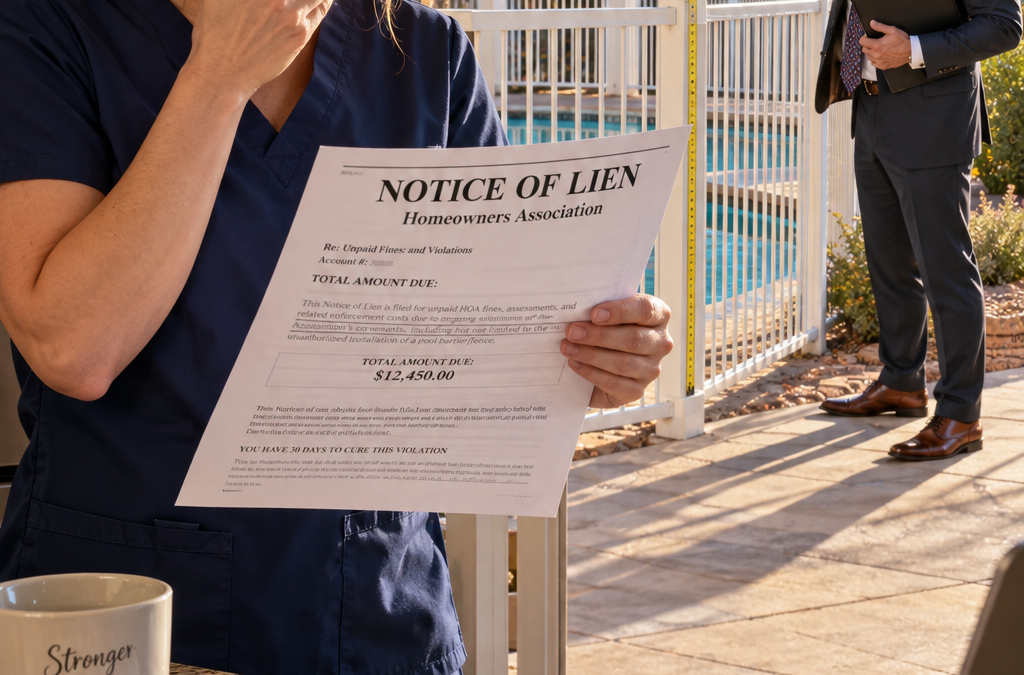
The lien notice arrived on a Tuesday.
Not a warning.
Not a courtesy letter.
A lien.
The kind of document that turns a house into collateral for someone else’s accusation.
I stood in my kitchen at six-thirty that morning wearing navy-blue scrubs, one shoe on and one shoe off, reading the same paragraph for the fourth time while my coffee went cold beside the sink.
The Peach Tree Village Homeowners Association claimed I owed five thousand dollars in fines, administrative penalties, late fees, and enforcement costs.
The alleged offense at the center of it all was my backyard pool fence.
Three inches.
That was the difference they claimed separated my home from compliance.
Three inches of white vinyl fencing.
And because of those three inches, the HOA was threatening my house.
My name is Katie Morgan.
I was thirty-eight years old then, a single mother of two, an emergency-room nurse, and the kind of person who believed rules mattered because I’d spent most of my adult life watching what happened when people ignored important ones.
Medication doses.
Sterile procedure.
Blood type.
Allergies.
You don’t get casual about details when a three-digit error can kill somebody.
But that was exactly why the letter in my hand felt so wrong.
My fence wasn’t dangerous.
It was safer than required.
I knew because I had checked the county code myself.
Twice.
Yet somehow I was the one being threatened.
My children were still asleep upstairs.
Noah was ten.
Emma was seven.
Their swimsuits were hanging over the laundry-room sink from the night before.
Outside the kitchen window, I could see the top of the pool fence glowing faintly in the Arizona sunrise.
White vinyl.
Six feet high.
Locked gate.
Self-closing latch.
Every safety feature the county required.
Every feature I had installed because I spent my working life treating accidents that happened in seconds.
And now someone wanted me to remove part of that protection because the HOA preferred a lower visual profile.
I read the last line of the notice again.
Failure to satisfy the outstanding balance could result in further collection action against the property.
My hands began to shake.
Not dramatically.
Just enough that the paper rattled.
I laid it on the counter and pressed both palms flat against the granite.
I had seen fear in patients before.
Real fear.
The expression people wore when a doctor stepped into a room and closed the door before speaking.
This was different.
Slower.
Colder.
The fear of realizing something you had worked years to build might be taken away not by disaster, but by paperwork.
Six months earlier, none of this existed.
Six months earlier, Peach Tree Village was the answer to a prayer I hadn’t admitted I was still saying.
After my divorce, I had spent almost three years renting a cramped townhouse near the hospital.
The kids shared a bedroom.
The walls were thin.
Our patio was barely large enough for two chairs.
I worked double shifts whenever I could because I wanted a down payment large enough to buy somewhere I could stay.
Not flip.
Not upgrade in two years.
Stay.
A forever home.
Peach Tree Village looked like one when I first drove through it.
Quiet cul-de-sacs.
Mature crepe myrtles.
Wide sidewalks.
Families riding bicycles in the evenings.
A small community clubhouse near the entrance.
Nothing extravagant.
Just settled.
Safe.
The house I bought sat near the end of Hawthorne Court.
Three bedrooms.
A small den.
A fenced backyard.
And the feature that sold my children before I had even finished touring the kitchen:
a swimming pool.
Noah ran to the back window the first time we toured it.
“Mom.”
I was talking to the real estate agent.
“Mom.”
“One second.”
“Mom.”
“What?”
He pointed.
“We have to buy this house.”
Emma pressed both hands against the glass.
“There’s a pool.”
“I can see that.”
“We can swim every day.”
“We don’t own it yet.”
“But we should.”
I laughed.
For the first time in a long time, buying a house felt less like a financial transaction and more like giving my kids something they’d lost when their father and I separated.
Space.
Normalcy.
A place friends could come over.
A backyard where I could hear them laughing while I made dinner.
I made an offer two days later.
The house needed cosmetic work, but the pool was in excellent condition.
The existing fence, however, was old.
A low decorative metal barrier that technically complied with an older standard but didn’t make me comfortable.
I’d treated a toddler near-drowning once.
I still remembered his mother’s scream.
I never forgot it.
So before we even moved in, I contacted the county and asked what the safest compliant replacement would be.
The answer was straightforward.
A secure barrier meeting current height, gate, latch, and spacing requirements.
I installed six-foot white vinyl fencing around the pool area.
It was clean.
Private.
Strong.
And, most importantly, difficult for a child to climb.
The contractor pulled the proper permit.
The county inspector signed off.
I saved the paperwork in a folder labeled HOUSE because that’s what nurses do.
We document.
I didn’t know then that the habit would eventually save me.
I met Deborah Whitfield on moving day.
At least, that was how I knew her then.
She arrived around four in the afternoon carrying a fruit basket and wearing cream slacks, a pastel blouse, oversized sunglasses, and lipstick bright enough to be visible from the end of the street.
She looked to be in her mid-fifties.
Perfectly styled blond hair.
Perfect nails.
Perfect posture.
She had a smile that appeared generous until you looked at her eyes.
Then it seemed measured.
Calculated.
“Welcome to Peach Tree Village,” she said.
She extended the basket.
“Deborah Whitfield. HOA president.”
I wiped my hand on my jeans before shaking hers.
“Katie Morgan.”
“Oh, I know.”
That should have bothered me.
It didn’t.
Not yet.
“Two children?” she asked.
“Yes.”
“Single mother?”
The question was casual enough to sound conversational.
Still, it landed strangely.
“That’s right.”
She smiled.
“We have several lovely families here.”
Noah ran past carrying a pillow.
Deborah watched him.
“Active children.”
“They’re excited.”
“Of course.”
Then she looked toward the backyard.
“I understand you’ve already done some work.”
“The pool fence.”
“Yes.”
Her smile thinned slightly.
“Six feet, isn’t it?”
“That’s what the county recommended.”
“We generally prefer five-foot-six.”
I thought she was making small talk.
“The contractor said this was safer.”
“Safety matters.”
She paused.
“So do covenants.”
I laughed lightly.
“I’m sure we’ll be fine.”
Deborah’s smile sharpened.
“We take them very seriously here, sweetheart.”
Sweetheart.
I remember the word because of the way she said it.
Not warmly.
Possessively.
Like I had just entered a room she controlled and needed to understand the hierarchy.
Still, I thanked her for the fruit basket.
We moved in.
For two weeks, life was exactly what I had hoped.
I came home tired from twelve-hour shifts and heard the kids splashing in the pool.
Emma drew flowers with sidewalk chalk.
Noah made friends with two boys nearby.
We ate pizza on the patio.
The house smelled like moving boxes and chlorine.
I felt, for the first time in years, like we had landed somewhere.
Then the first violation letter arrived.
Grass length.
According to the notice, my front lawn exceeded the permitted maximum by approximately two inches.
Fine: fifty dollars.
I stood on the porch reading it while looking at the grass.
It did not look long.
I mowed every Saturday.
Sometimes Friday if I was scheduled for a weekend shift.
I pulled out my phone.
Took pictures.
Then grabbed a ruler.
I felt ridiculous kneeling in my yard measuring grass, but I did it anyway.
Most of it was well within the limit listed in the landscaping guidelines.
One small patch near the mailbox was slightly higher.
Maybe half an inch.
Not two.
I photographed that too.
Then I emailed the HOA.
I attached the pictures.
I asked for the violation photograph and the specific rule.
Deborah replied forty minutes later.
The fine remained.
No explanation.
Just:
The violation was observed and documented. Please remit payment within ten days.
I wrote back.
Could you please provide the observation photo?
No response.
Two days later, I saw Deborah walking the sidewalk.
Clipboard in hand.
She stopped in front of my house.
“Did you get my email?” I asked.
She turned slowly.
“Which email?”
“About the grass.”
“Oh.”
She gave me that same smile.
“Yes.”
“I asked for the photo.”
“The board doesn’t have to debate every observation with homeowners.”
“I’m not asking for a debate.”
I pointed at the lawn.
“I’m asking how this is two inches over.”
She looked at the grass.
Then at me.
“Katie, one of the biggest mistakes new residents make is treating every small correction like a personal attack.”
“I don’t.”
“Good.”
She tapped her clipboard.
“Then pay the fifty dollars, trim the lawn, and move forward.”
“I already trimmed it.”
“Excellent.”
“So can the fine be removed?”
“No.”
“Why?”
“Because the violation occurred.”
I stared at her.
“According to you.”
Her eyes hardened.
Only for a second.
“According to the association.”
Then she smiled again.
“Have a nice day.”
I paid the fifty dollars.
Not because I thought she was right.
Because I worked forty-eight hours that week and didn’t have enough energy to turn grass into a legal argument.
But I saved everything.
The notice.
My email.
Her reply.
My photographs.
The payment confirmation.
I didn’t know why.
Habit, maybe.
In the ER, if something feels wrong, you chart it.
Not because you know what will happen.
Because if something happens later, memory isn’t enough.
Three weeks after the grass fine, I received another notice.
Mailbox color.
My mailbox was beige.
The house was beige.
Half the neighborhood had beige mailboxes.
Apparently mine was a shade not approved in the association’s current exterior palette.
Fine: seventy-five dollars.
I called the office.
Deborah answered.
“Peach Tree Village.”
“It’s Katie.”
“Hello, sweetheart.”
I hated that word already.
“I’m looking at a violation for my mailbox.”
“Yes.”
“It’s the same color it was when I bought the house.”
“Ownership transfers don’t grandfather every exterior feature.”
“Was it approved before?”
“I’d have to check.”
“So you’re fining me before checking?”
“We observed noncompliance.”
“How do you know it’s noncompliant if you haven’t checked whether it was previously approved?”
Silence.
Then:
“Katie, you’re making this more complicated than it is.”
“No. I’m asking a simple question.”
“The board isn’t required to research the history of every violation.”
“Then homeowners are just supposed to assume you’re right?”
She laughed softly.
“This attitude will make living in an HOA very difficult for you.”
Something in my stomach tightened.
“Was that advice?”
“It was experience.”
The line went dead.
I did not repaint the mailbox immediately.
Instead, I walked the neighborhood.
I took pictures of twelve beige mailboxes.
Three looked nearly identical to mine.
None had violation notices.
At least none that I could see.
That was when documentation stopped being a habit and became strategy.
I began taking dated photographs every Saturday.
Front lawn.
Mailbox.
Driveway.
Fence.
Trash cans.
I downloaded the HOA rules and saved a copy locally.
I created a folder on my laptop called PEACH TREE.
Not because I was planning a lawsuit.
Because something about Deborah’s certainty made me uneasy.
The next fine involved a wind chime.
Forty dollars.
Unauthorized decorative exterior object.
It hung under the covered patio in my backyard.
You couldn’t see it from the street.
I asked how anyone even knew it was there.
Deborah replied:
Routine compliance observation.
That phrase bothered me.
Routine compliance observation.
To inspect that wind chime from a public area, she would have needed either to stand at an angle near my side gate or peer through a narrow opening between fence sections.
I checked my security camera.
There she was.
7:14 a.m.
Walking slowly beside the side of my property.
Stopping near the gate.
Leaning slightly.
Photographing.
I watched the clip three times.
Then I saved it.
The violation after that was Emma’s chalk.
Unauthorized driveway marking.
Fifty dollars.
That was the first one that made me genuinely angry.
Emma had drawn a family.
Three stick figures.
Me.
Her.
Noah.
Above them she’d written OUR HOME in purple chalk.
I came home from a shift and found the violation notice attached to the garage.
I stood there in scrubs, exhausted, staring down at my daughter’s drawing.
Emma came outside.
“Mom?”
“Yeah?”
“Are you mad?”
“No.”
She looked at the notice.
“Is that because of my picture?”
I wanted to lie.
Instead I crouched.
“Somebody says we’re not supposed to draw here.”
Her face fell.
“But it’s our driveway.”
“I know.”
“Do I have to wash it?”
I looked toward the street.
Deborah’s house wasn’t visible from ours.
Still, I felt watched.
“We’ll take a picture first.”
Emma smiled a little.
I photographed the drawing.
Then we washed it away together.
Purple water ran into the gutter.
Something about that image stayed with me.
A child erasing the words OUR HOME because an HOA president had decided temporary chalk qualified as unauthorized modification.
That night I told myself Deborah was just power hungry.
Annoying.
Controlling.
But ultimately harmless.
Then the pool fence notice arrived.
It was different.
Longer.
Formal.
The HOA claimed my six-foot fence exceeded the maximum permitted visible height by three inches under an obscure aesthetic restriction related to backyard structures.
Three inches.
The notice demanded alteration within fifteen days.
Failure to comply would result in escalating fines.
I sat at my dining table reading it.
Then I laughed.
Not because it was funny.
Because I was too tired to believe it.
I opened my HOUSE folder.
County permit.
Inspection approval.
Contractor invoice.
The fence had been installed legally.
I pulled up state and county pool barrier guidance.
My fence didn’t merely satisfy the safety requirements.
It exceeded the minimum in ways that made accidental access less likely.
The HOA wanted it lowered.
I emailed Deborah.
The fence is code-compliant and was approved by the county. Reducing the height may reduce the safety margin around the pool. Please provide the specific HOA provision and explain whether the association is demanding alteration despite county safety approval.
She replied twelve minutes later.
County code and association aesthetic standards are separate. Compliance with one does not excuse noncompliance with the other.
I wrote:
Are you ordering me to make a pool barrier less secure?
Her response:
We are ordering compliance with community standards.
I stared at that sentence for a long time.
The next morning, I called the county building office.
A man named Steven confirmed my permit.
“Everything was signed off,” he said.
“Would you recommend lowering it?”
“If you’re asking whether county code requires you to lower an already approved safety barrier, no.”
“Could lowering it create a problem?”
“Depends on final dimensions and configuration. You’d need to maintain all applicable barrier standards.”
“Can an HOA make me change it?”
“That’s a private covenant question. Talk to a lawyer if they’re threatening enforcement.”
That was the first time anyone said lawyer.
I wasn’t ready.
Lawyers cost money.
I had hospital bills of my own from Emma’s fractured wrist the previous year.
I had groceries.
School clothes.
Property taxes.
I didn’t want to spend thousands defending three inches of vinyl.
So I requested an internal review.
Deborah denied it.
I requested a board hearing.
She scheduled one for the following month.
Then Frank told me about the Rodriguez family.
Frank lived behind us.
Retired electrician.
Sixty-three.
Gray mustache.
Baseball cap in every season.
We were both outside one evening when he leaned over the fence.
“She on you about that pool barrier?”
“How’d you know?”
He gave me a tired look.
“Deborah talks.”
“Apparently it’s three inches too high.”
Frank shook his head.
“Don’t touch it.”
“Why?”
“Because she’ll find something else.”
I put down the garden hose.
“What does that mean?”
“She did this to the Rodriguez family.”
“I don’t know them.”
“House near the south entrance. Sold last year.”
“What happened?”
“Started with patio lights.”
He counted on his fingers.
“Then landscaping. Then trailer parking. Then architectural fees. Then late charges.”
“How much?”
“Thousands.”
“Did they owe it?”
Frank looked toward the fence.
“Depends whether you ask Deborah.”
“What happened?”
“They sold.”
“Because of fines?”
“Because they got tired of waking up afraid of the mail.”
That sentence landed hard.
I understood it immediately.
I’d started feeling the same thing.
Frank lowered his voice.
“Three families left after fights with her.”
“Why doesn’t the board stop her?”
“You’ll find out at your hearing.”
“What does that mean?”
He hesitated.
“People don’t like crossing her.”
I went inside after sunset.
I should have gone to bed.
Instead, I opened my laptop.
I searched county permit records.
First my property.
There was my pool fence permit.
Approved.
Then I searched Deborah’s address.
She had a pool.
I knew because aerial images showed it clearly.
I expected to find permits for pool construction, fencing, electrical work, something.
I found old property permits.
Roof.
HVAC.
Interior remodel.
No pool barrier permit.
I searched again.
Nothing.
My pulse quickened.
I checked archived records.
Still nothing.
Maybe it predated current digital records.
Maybe there was a paper permit somewhere.
I knew better than to assume.
So I filed a public-records request.
I asked for all pool and pool barrier permits connected to Deborah’s address.
Two days later, the county responded.
No responsive fence permit had been located.
I sat at my kitchen table staring at the email.
The woman threatening me over three inches of a legally permitted safety fence appeared to have no permit on file for her own pool barrier.
That was the first moment I stopped believing the dispute was merely about control.
There was hypocrisy here.
Potentially something worse.
I did something I would later wish I had timed differently.
I emailed Deborah.
I kept it short.
Before further enforcement, please explain whether the HOA applies pool barrier standards uniformly, including to board members, and whether all board properties are properly permitted.
She didn’t respond.
Forty-eight hours later, I received a new notice.
Five thousand dollars.
I actually said the number aloud.
“Five thousand?”
The notice classified my pool fence violation as continuing and aggravated.
It imposed accumulated penalties and administrative enforcement charges.
Thirty-day deadline.
Failure to pay could result in lien filing.
My knees went weak.
I sat down on the kitchen floor.
Not a chair.
The floor.
The envelope was still in my hand.
Emma walked in.
“Mom?”
I looked up.
“Hey.”
“Why are you sitting there?”
“Long day.”
She came closer.
“Are you crying?”
I touched my cheek.
I hadn’t realized I was.
“No.”
She looked at the paper.
“Is it the fence?”
I folded it quickly.
“Go finish your homework, baby.”
She didn’t move.
“Are we in trouble?”
“No.”
I said it too fast.
She knew.
Kids always know.
“Go finish homework.”
She left slowly.
I stayed on the floor for another minute.
Then I called Deborah.
She answered on the third ring.
“Peach Tree Village.”
“What did you do?”
A pause.
“Katie?”
“Five thousand dollars?”
Her voice became smooth.
“The violation has escalated.”
“In two days?”
“You were previously notified.”
“You gave me a fifteen-day correction window.”
“Your challenge to the violation demonstrates refusal to comply.”
I stood.
“So asking whether your own pool is permitted increases my fine?”
Silence.
Then:
“I strongly advise you not to make personal accusations.”
“I’m asking why the woman enforcing pool rules appears to have no fence permit.”
“That is none of your concern.”
“It becomes my concern when you’re threatening my house.”
Her voice sharpened.
“You need to understand something, sweetheart.”
There it was again.
Sweetheart.
“You purchased property in a covenant-controlled community. That means your personal opinions do not supersede the association’s authority.”
“My personal opinion didn’t issue the county permit.”
“The county does not govern our aesthetics.”
“Does the HOA govern county safety law?”
“Katie.”
“No. Answer me.”
“You are becoming hostile.”
My grip tightened around the phone.
“I’m becoming terrified.”
That stopped her for a second.
I continued.
“I’m a single mother. You know that. I’m working double shifts. You’re threatening to put a lien on my house over three inches of fence that exists to keep my children safe.”
“You should have considered that before refusing compliance.”
The cruelty of it stunned me.
Not anger.
Cruelty.
I spoke quietly.
“Do you enjoy this?”
She laughed.
A soft, incredulous sound.
“I think this conversation is over.”
She hung up.
I attended the board meeting the following Thursday.
The clubhouse was half full.
Maybe twenty-five residents.
Deborah sat in the center of the board table.
She wore a red blazer, pearl earrings, and the same polished smile she used whenever she wanted an audience to believe she was reasonable.
Three other board members sat beside her.
Thomas Bell.
Carol Ames.
Richard Foster.
I knew their names from newsletters.
All three looked uncomfortable before I even began.
When public comments opened, I approached the microphone carrying my folder.
“My name is Katie Morgan. I’m here regarding the pool fence violation and five-thousand-dollar fine.”
Deborah smiled.
“We know, Katie.”
I ignored the tone.
“My fence was installed by a licensed contractor, permitted by the county, and inspected for pool safety compliance.”
Deborah leaned toward her microphone.
“County compliance does not eliminate HOA requirements.”
“I understand that. But your notice cites a height requirement that isn’t in the version of the covenants I was given at closing.”
“It appears in the architectural interpretation guidelines.”
“Where?”
“You were provided the governing documents.”
“I have them.”
I held them up.
“Show me the rule.”
Her smile faded slightly.
“This isn’t a discovery proceeding.”
“I’m asking you to identify the rule that supposedly creates a five-thousand-dollar debt against my house.”
Several residents murmured.
Deborah glanced at them.
“Katie, your time is limited.”
“I also requested records regarding uniform enforcement.”
“That request is under review.”
“And the county has no pool barrier permit on record for your property.”
The room went silent.
Deborah’s face changed.
Not much.
But enough.
Carol Ames looked toward her.
“What?”
Deborah immediately reached down and switched off my microphone.
The red light disappeared.
I stared at it.
Then at her.
“You just turned me off.”
Deborah leaned back.
“Your comment period has expired.”
“I had more time.”
“You’re making personal allegations unrelated to your violation.”
I raised my voice without the microphone.
“They’re directly related to selective enforcement.”
“Sit down.”
“Why doesn’t your pool have a permit?”
She struck the table once with the gavel.
“Katie, sit down or leave.”
Thomas Bell looked at his folded hands.
Carol stared at a notebook.
Richard wouldn’t meet my eyes.
I looked at all three of them.
“Does nobody on this board have anything to say?”
Deborah answered for them.
“The board has spoken.”
“No. You have.”
She smiled.
“Rules are rules.”
I understood something in that moment.
The three people beside her weren’t agreeing.
They were afraid.
After the meeting, Thomas found me near the parking lot.
He glanced back toward the clubhouse before speaking.
“Ms. Morgan.”
“Katie.”
He nodded.
“Katie.”
“Why didn’t anybody speak?”
He rubbed the back of his neck.
“This board has internal procedures.”
“That’s not an answer.”
“No.”
He looked exhausted.
Then he lowered his voice.
“Deborah has made it clear that board members are subject to enforcement like everyone else.”
I stared at him.
“She’s threatened you?”
“I didn’t say that.”
“You didn’t have to.”
He looked toward the clubhouse again.
“I have a detached workshop.”
“So?”
“She claims part of it was approved incorrectly eight years ago.”
My stomach turned.
“She uses violations against board members too.”
Thomas didn’t answer.
“Why don’t you remove her?”
“It’s complicated.”
“No. It’s scary.”
He finally looked at me.
“Yes.”
That night, after the children were asleep, I searched for real-estate attorneys.
I found Marcus Chun.
He specialized in property disputes, HOA litigation, and real-estate fraud.
His reviews described him as aggressive.
I didn’t want aggressive.
I wanted someone who could make this stop.
But by then I was learning those might be the same thing.
His office was downtown.
I arrived after a night shift with two coffees in my system and no sleep.
Marcus looked to be in his early forties.
Calm face.
Dark suit.
No unnecessary small talk.
I placed my folder on his table.
He began reading.
Grass.
Mailbox.
Wind chime.
Chalk.
Pool fence.
Five-thousand-dollar fine.
County permit.
Security footage.
Public-record response.
Board meeting.
He read for nearly forty minutes.
Then he leaned back.
“Deborah Whitfield.”
“You know her?”
He looked at me.
“Unfortunately.”
A chill moved through me.
“How?”
He turned toward his computer.
“Give me a minute.”
He searched legal databases.
Then rotated the monitor.
There she was.
Same name.
Same woman.
Two previous civil cases in other states.
Different HOAs.
Different homeowners.
But the allegations were eerily familiar.
Aggressive fines.
Threatened liens.
Selective enforcement.
Financial irregularities.
One case had settled.
Another resulted in findings against the association and restrictions on certain enforcement practices.
I stared at the screen.
“She’s done this before.”
Marcus nodded.
“At minimum, she’s been accused of substantially similar conduct before.”
“Why is she running another HOA?”
“Because people move.”
I didn’t understand.
He explained.
“Boards change. Records aren’t centralized the way most homeowners assume. A person can leave one community, move to another jurisdiction, and reinvent themselves.”
I looked at Deborah’s photograph from an old filing.
Same polished smile.
Same confidence.
“This isn’t just some control freak.”
Marcus closed the file.
“No.”
“What is it?”
He tapped my folder.
“This looks like a pattern.”
He paused.
“And if the money follows the fines, it may be worse than harassment.”
I felt my heart accelerate.
“What do we do?”
“We start with records.”
He requested association financial disclosures.
Bank statements available to members.
Fine revenue.
Vendor payments.
Board minutes.
Election certifications.
Contracts.
Enforcement records.
Conflict disclosures.
Deborah resisted almost immediately.
She claimed the request was burdensome.
Then privileged.
Then invasive.
Then somehow harmful to residents’ privacy.
Marcus narrowed it.
She delayed again.
The lien was filed before the records arrived.
I found out because a certified copy came in the mail.
Five thousand dollars had become more than six thousand once collection expenses were added.
The association’s letter warned that continued nonpayment could trigger further legal enforcement and potential sale procedures.
I stopped sleeping.
I would get home after midnight from the hospital and sit at my kitchen table eating dry cereal because cooking required energy I no longer had.
Foreclosure paperwork spread around me.
Legal letters.
HOA notices.
Printouts of county code.
The house felt different.
Every room had a price attached.
The sofa.
The refrigerator.
The staircase.
Emma’s drawings on the wall.
Noah’s shoes by the door.
I imagined boxing everything.
I imagined telling the kids we had to move.
I imagined Deborah standing at the next board meeting explaining my departure as evidence that enforcement worked.
One night Noah came downstairs at two in the morning.
He found me at the table.
“Mom?”
I looked up.
“What are you doing awake?”
“You’re awake.”
“Different rules for moms.”
He sat across from me.
His hair stuck up in three directions.
He looked at the paperwork.
“Are they still mad about the fence?”
“Yeah.”
“Can we just cut it shorter?”
I felt the question in my chest.
“Maybe.”
“Then why don’t we?”
Because it was safe.
Because it was permitted.
Because Deborah’s own pool apparently wasn’t.
Because five thousand dollars wasn’t about vinyl anymore.
Because if I cut it, she would find something else.
I said none of that.
Instead I told him, “Sometimes giving someone what they want doesn’t make them stop.”
He frowned.
“Can we sue them for being mean to Mommy’s fence?”
I laughed.
A real laugh.
The first one in weeks.
“I don’t think that’s the legal term.”
“It should be.”
“It definitely should be.”
He smiled.
Then he got serious.
“Are we going to lose the house?”
I swallowed.
“No.”
I didn’t know if that was true.
But I knew he needed me to believe it.
Marcus called three days later.
“We got the financials.”
I stood in a supply closet at the hospital.
“Is that good?”
“For us? Possibly.”
“What’s in them?”
“Come to my office.”
I arrived still wearing scrubs.
Marcus had spreadsheets projected on a wall.
Fine revenue appeared as its own category.
Thousands.
Tens of thousands.
More than I expected.
Then he showed me transfers.
Administrative account.
Special enforcement account.
Internal management expenses.
Money moving into an account controlled solely by Deborah.
Not jointly by the treasurer.
Not subject to ordinary dual-signature procedures.
Deborah alone.
“Is that legal?” I asked.
“Not necessarily illegal by itself, depending on the authorization and account purpose.”
“But?”
“But I don’t see clear board authorization matching these transfers.”
He clicked to another document.
“There are also unexplained disbursements.”
“To who?”
“That’s what we’re tracing.”
He showed me fine revenue from multiple homeowners.
Rodriguez.
Patterson.
Names I recognized from Frank.
My own eight-hundred-dollar administrative charge appeared there too.
I felt sick.
“She was making money off this?”
“We don’t know yet whether she personally received it.”
“But she controlled the account.”
“Yes.”
“Alone.”
“Yes.”
I sat down.
Marcus was still looking at the screen.
Then he said something that chilled me more than everything else.
“I’ve seen structures like this before.”
“What do you mean?”
“People create enforcement revenue, isolate control of the funds, then use vague administrative categories to obscure where money goes.”
I stared at him.
“So what now?”
“We subpoena more records if necessary.”
“And the lien?”
“We challenge it.”
“Can she foreclose before we stop her?”
“We’re seeking emergency relief.”
I put my face in my hands.
“I can’t do this for months.”
“I know.”
“No, Marcus. I’m serious. I work twelve hours and then come home and spend four more hours reading HOA documents. My kids are scared. I’m scared.”
He waited.
Then said quietly, “Katie, we’re not just defending the fence anymore.”
I looked up.
“What are we doing?”
“We’re preparing claims for fraud, abuse of authority, wrongful enforcement, and any financial misconduct the evidence supports.”
He paused.
“And we’re notifying the state attorney general.”
That should have frightened me.
Instead, for the first time, I felt like Deborah might have finally pushed far enough that someone outside Peach Tree Village would look at what she was doing.
We built the complaint carefully.
Not emotionally.
Marcus insisted on that.
Dates.
Amounts.
Rules.
Comparators.
Public permits.
Financial transfers.
Testimony.
Four former or current homeowners agreed to provide statements.
Frank connected us with the Rodriguez family.
They had moved two towns away.
Mrs. Rodriguez cried when Marcus called.
Not because she missed the house.
Because someone finally believed them.
She described the escalation.
Small violations.
Then fines.
Then attorney charges.
Then threats against their property.
Their account had ballooned until selling felt like the only way to stop the bleeding.
Another family told nearly the same story.
Then another.
Same pattern.
Different violation.
Same escalation.
Same president.
That was when Marcus found the election records.
He called me late afternoon.
“Katie, sit down.”
I was at home folding laundry.
“Why?”
“Just do it.”
I sat on the edge of my bed.
“What happened?”
“The last two board elections were never properly certified.”
I frowned.
“What does that mean?”
“The governing documents require election certification, member notice, and recorded board acceptance.”
“Okay.”
“Those steps weren’t completed.”
My brain took several seconds to catch up.
“Deborah wasn’t legally president?”
Marcus chose his words carefully.
“Her authority is severely compromised, and we have substantial grounds to argue that actions taken under that supposed authority are invalid.”
I stood again.
“Every fine?”
“Potentially every action that depended on authority she did not lawfully hold.”
“The lien?”
“That’s the big one.”
I paced the bedroom.
“How did nobody notice?”
“Because most homeowners assume the person sitting in the president’s chair belongs there.”
I stopped.
“She controlled the election too, didn’t she?”
“We don’t know yet.”
“But she didn’t certify it.”
“No.”
My fear changed.
Not disappeared.
Changed.
For months Deborah had made me feel as though I were trapped inside rules only she understood.
Now it appeared she might not even have held the office she used to enforce them.
The court hearing was scheduled three weeks later.
Those three weeks were worse than the previous three months.
Deborah escalated everything.
Letters.
Legal notices.
Claims that my unpaid balance had increased.
Warnings that I could be responsible for additional attorney fees.
One morning, a process server appeared while Emma was eating breakfast.
She froze when the doorbell rang.
“Is that the house lady?”
“No.”
She had started calling Deborah that.
The house lady.
As if Deborah were some creature associated with threatening our home.
I hated it.
The night before court, I barely slept.
At four in the morning, I went outside.
The pool was still.
Moonlight reflected off the water.
The fence stood around it, white and solid.
I ran my hand along the top rail.
Three inches.
Everything had come down to three inches.
Except it hadn’t.
Not really.
The fence was just the excuse that had finally made me stop yielding.
At eight-thirty the next morning, I walked into court beside Marcus.
Deborah was already there.
Pressed ivory blazer.
Dark skirt.
Pearls.
Hair perfect.
She looked like she was attending a charity luncheon.
When she saw me, she smiled.
Not warmly.
Triumphantly.
Like the outcome had already been decided.
Her attorney spoke first.
He framed the case as a simple contract dispute.
I had purchased property subject to recorded covenants.
I violated those covenants.
The association imposed lawful penalties.
I refused payment.
The lien followed.
Clean.
Orderly.
Almost boring.
If I hadn’t lived through it, I might have believed him.
Then Marcus stood.
He began with the fence.
County permit.
Inspection.
Safety compliance.
Then the fine schedule.
No clear support for the five-thousand-dollar escalation.
Then the board procedures.
My denied hearing rights.
My microphone being cut.
The selective enforcement.
Deborah’s own unpermitted pool barrier records.
Her attorney objected.
The judge allowed Marcus to continue where relevant.
Then came the election documents.
Marcus placed them before the court.
No valid certification for Deborah’s claimed term.
No proper acceptance into the minutes.
No completed process establishing the authority she had exercised.
The judge looked over his glasses.
“Counsel, are you telling me the association cannot produce certified records establishing Ms. Whitfield’s presidency during the period in question?”
Deborah’s attorney stood.
“There were technical administrative deficiencies.”
Marcus responded.
“Technical deficiencies that go directly to the authority used to impose thousands of dollars in penalties and encumber my client’s home.”
The judge looked at Deborah.
For the first time, her expression wasn’t smug.
Her attorney tried to redirect.
Then Marcus presented the financial records.
The room changed.
He didn’t accuse wildly.
He didn’t use theatrical language.
He simply explained that fine revenue had been routed through an account under Deborah’s exclusive control and that significant transactions remained insufficiently explained.
The judge spent a long time reviewing the exhibits.
So long I could hear my pulse.
Then he looked at Deborah.
“Ms. Whitfield.”
She straightened.
“Your Honor.”
“Did you have exclusive access to this account?”
Her attorney started to speak.
The judge raised a hand.
“I asked Ms. Whitfield.”
Deborah swallowed.
“Operational access, yes.”
“Did the treasurer have equivalent access?”
“Not in the same capacity.”
“Why?”
“It was an administrative account.”
“Created under whose authority?”
“The board’s.”
Marcus slid a document forward.
“We have no corresponding resolution.”
Deborah’s jaw tightened.
The judge read again.
Silence.
I looked at Marcus.
He didn’t move.
Then the judge set the papers down.
“The lien against Ms. Morgan’s property is void.”
I stopped breathing.
The judge continued.
“The fines presently before this court are unenforceable on the record presented.”
My eyes filled immediately.
“The association is ordered to release the lien, cease collection activity related to these disputed charges, and reimburse reasonable legal fees subject to submission and review.”
I covered my mouth.
Marcus touched my forearm.
Stay calm.
The judge wasn’t finished.
He looked at Deborah.
“Ms. Whitfield, this court has serious concerns regarding the governance failures demonstrated here.”
Her face had gone pale.
“The apparent defects in your authority, the selective enforcement allegations, and particularly the financial records require scrutiny beyond the narrow civil question before me.”
Her attorney stood.
“Your Honor—”
“I’m not making a criminal finding.”
The judge’s voice sharpened.
“I’m referring relevant financial records to the appropriate prosecutorial authorities for review.”
The courtroom murmured.
Deborah looked toward her attorney.
For the first time since I’d met her, she looked afraid.
Not angry.
Afraid.
The judge continued.
“If the explanations for these transactions are legitimate, the appropriate investigation can establish that. If they are not, this court will not ignore evidence merely because it emerged from an HOA dispute.”
My knees felt weak.
The woman who had spent six months acting as though her title placed her above questioning was now listening to a judge explain that someone else would examine her records.
Deborah turned toward me as we left court.
Her face was white.
“This isn’t over,” she said.
Marcus stepped slightly between us.
“Do not speak to my client.”
She ignored him.
“You think you’ve won?”
I looked at her.
There were a hundred things I wanted to say.
I wanted to tell her about Emma washing chalk off the driveway.
About Noah waking at two in the morning asking if we would lose the house.
About the cereal dinners.
About the panic every time the mail arrived.
Instead, I said one thing.
“No, Deborah.”
I held her gaze.
“I think you finally lost control.”
Weeks later, Peach Tree Village held an emergency membership meeting.
That room was packed.
Not twenty people.
Nearly the whole neighborhood.
Deborah didn’t preside.
She sat in the second row beside her attorney.
The board’s counsel explained the election failures.
Members voted to remove her from any remaining leadership role and establish new elections under independent supervision.
The vote wasn’t close.
Three board members who had once been too afraid to look up during my hearing voted publicly against her.
Thomas spoke first.
“I should have stopped this sooner.”
His voice shook.
“I didn’t.”
He looked toward me.
“I’m sorry.”
That mattered.
Not because apology erased anything.
Because fear had kept good people quiet.
Hearing one admit it made the room feel different.
Financial reviews continued.
More irregular transactions surfaced.
The attorney general’s office began examining the association’s records.
The district attorney received the referral.
Accounts connected to disputed funds were frozen while investigators traced transfers.
Deborah’s lawyers tried to characterize everything as accounting mistakes.
Investigators clearly believed the questions were serious enough to continue.
Eventually, felony fraud and embezzlement-related charges followed from the evidence authorities developed.
The first time I saw Deborah in handcuffs was outside a courthouse months later.
I had not gone there to celebrate.
Marcus had asked me to attend because part of the proceeding touched records relevant to the restitution case.
She exited through a side corridor accompanied by deputies.
No blazer.
No clipboard.
No perfect HOA smile.
Her wrists were restrained in front of her.
For several seconds, I felt almost nothing.
That surprised me.
I had imagined vindication would feel electric.
It didn’t.
It felt quiet.
I looked at her and thought about the first time she appeared at my house with a fruit basket.
We take our covenants very seriously here, sweetheart.
Back then I thought she was ridiculous.
Later, I thought she was terrifying.
Now she simply looked smaller than the power she had convinced everyone she possessed.
She saw me.
Stopped.
A deputy gestured for her to continue.
Deborah’s expression twisted.
“This is because of you.”
I shook my head.
“No.”
She stared at me.
“It’s because of what you did.”
The deputy moved her forward.
That was the last conversation we ever had.
The state action eventually barred her from holding certain association leadership responsibilities as part of the legal consequences imposed in connection with the misconduct findings and related proceedings.
The HOA itself had to undertake major financial reforms.
Independent bookkeeping.
Dual authorization for account transfers.
Mandatory disclosure of related-party vendors.
Published fine schedules.
Recorded votes.
Proper elections.
Appeal procedures homeowners could actually use.
The kind of safeguards that should have existed before Deborah ever gained control.
My lien disappeared from the county record.
Every disputed pool-fence fine was erased.
The HOA paid my approved legal costs.
And the fence remained exactly where it had always been.
Six feet.
White vinyl.
County permitted.
Code compliant.
Safe.
The first evening after I received confirmation that the lien had been formally released, I came home from work before sunset.
Noah and Emma were already in swimsuits.
Emma stood near the back door holding goggles.
“Can we swim?”
I looked at the pool.
For months, I had barely seen it as a pool.
It had become evidence.
A violation.
A threat.
A reason lawyers called me.
But that evening the water was blue and calm.
Just water again.
“Go.”
They ran outside.
I followed more slowly.
Noah cannonballed into the deep end.
Emma screamed when the splash hit her.
I sat in a patio chair watching them.
My hand rested against the white fence.
The same fence Deborah had claimed was destroying neighborhood aesthetics.
The same fence she had used to threaten my home.
The same fence a judge had refused to let the association weaponize against me.
Frank appeared on the other side.
“Still three inches too tall?” he asked.
I laughed.
“Apparently.”
“Scandalous.”
I looked at him.
“Why didn’t anyone fight her before?”
His smile faded.
“Some tried.”
“What happened?”
“They fought alone.”
That answer stayed with me.
Because that was the part I had misunderstood.
I kept thinking courage was the difference.
That maybe I had been braver than the Rodriguez family.
I wasn’t.
I had Marcus.
Frank.
Four former homeowners willing to testify.
Board members who eventually stopped being afraid.
Public records.
County documents.
Financial evidence.
The law.
People rarely beat systems like Deborah’s through bravery alone.
They beat them when isolation ends.
That autumn, Peach Tree Village held its first properly certified board election in years.
Thomas didn’t run.
He said he needed time away.
Frank refused too.
“Too many meetings,” he told me.
Ruth Bennett, who lived near the entrance and had spent years avoiding HOA politics, did run.
She won.
I teased her afterward.
“Congratulations. You’re part of the machine.”
She pointed at me.
“Don’t make me fine your fence.”
We both laughed.
The new board reviewed old enforcement files.
Several homeowners received refunds or credits.
The Rodriguez family couldn’t get back the house they had sold, but the association reached a settlement over disputed charges.
Mrs. Rodriguez called me afterward.
“I wish we’d known you then,” she said.
I swallowed.
“I wish I’d known you.”
“We thought it was just us.”
“So did I.”
That was Deborah’s most effective weapon.
Not fines.
Not liens.
Not even money.
Isolation.
Every family believed it was the only one being targeted.
Every board member believed they were the only one being threatened.
Every homeowner assumed everyone else accepted Deborah’s authority.
Once people started comparing stories, the kingdom collapsed quickly.
Months passed.
Life became normal in the strange way life eventually does after something you thought would destroy you.
I worked.
The kids went to school.
The pool needed chlorine.
Noah broke a sprinkler head kicking a soccer ball.
Emma discovered slime and nearly ruined the dining table.
Bills arrived.
Laundry multiplied.
Ordinary problems returned.
I loved them.
One Saturday morning, I was trimming a hedge when Emma came outside carrying sidewalk chalk.
She stopped near the driveway.
“Mom?”
“Yeah?”
“Can I draw?”
The question hurt.
She used to just draw.
Now she asked.
I turned off the trimmer.
“Of course.”
“Are you sure?”
“Very.”
She knelt.
“What are you making?”
“Secret.”
I went back to the hedge.
Twenty minutes later she called me.
“Done.”
I walked over.
She had drawn our house.
The pool behind it.
Three stick figures.
And along one side, a huge white fence.
She’d made it much taller than the house.
I laughed.
“That fence seems a little high.”
“It’s safe.”
“Good point.”
Above the drawing, she’d written:
OUR HOME.
Same words as before.
This time, nobody washed them away.
That evening I sat beside the pool while the kids swam.
The fence cast long shadows across the patio.
I thought about the Tuesday morning when the lien notice arrived.
At the time, I believed the most frightening thing was losing the house.
I was wrong.
The worst part was how close I came to believing Deborah had the right to make me surrender it.
There is a kind of authority that comes from law.
A kind that comes from consent.
And then there’s the counterfeit version.
The kind built from intimidation, silence, and repetition.
Deborah had repeated her authority so often that everyone around her eventually stopped asking where it came from.
I almost did too.
If she had fined me five hundred instead of five thousand, I might have paid.
If she had stopped before threatening the lien, I might have lowered the fence.
If she had allowed me to speak at the meeting, maybe I would have convinced myself compromise was possible.
But she couldn’t stop.
Control like hers never knows when enough is enough.
That was her mistake.
She needed the final word so badly that she kept escalating until the people around her finally started looking at the paperwork beneath the power.
And once we did, there wasn’t much holding her throne together.
A few months after the criminal case began, I found the original fruit basket card in a drawer.
Welcome to Peach Tree Village.
—Deborah Whitfield, HOA President.
I almost threw it away.
Instead, I put it in the same folder as the lien release.
Not because I wanted a souvenir.
Because those two pieces of paper told the whole story.
One represented the woman Deborah pretended to be.
Welcoming.
Professional.
Responsible.
The other represented what happened when someone finally forced her authority to survive scrutiny.
It couldn’t.
I still work double shifts.
I still fix dinner too late some nights.
I still forget laundry in the washer.
I’m still the mother who occasionally signs school forms at six in the morning because nobody remembered them the night before.
Nothing about surviving Deborah turned me into some fearless person.
I still worry.
I still hate legal envelopes.
I still feel my stomach tighten if I see official mail unexpectedly attached to my door.
But I don’t confuse fear with helplessness anymore.
That’s different.
And every summer evening, when I sit outside and hear Noah and Emma laughing behind that same three-inches-too-tall fence, I remember exactly what almost happened.
A woman with a clipboard nearly convinced me that my home belonged to whoever could manufacture the largest number on HOA letterhead.
She nearly made my daughter believe chalk was dangerous.
She nearly made me believe safety was a violation.
She nearly drove another family out of Peach Tree Village.
Nearly.
But not this one.
The fence is still there.
The pool is still there.
The chalk is back on my driveway.
My house is still mine.
And Deborah Whitfield no longer decides what any of those things are worth.








