𝗙𝗨𝗟𝗟 𝗦𝗧𝗢𝗥𝗬 The HOA Started Selling Fishing Permits to My Family’s Private Lake, and Their President Was Certain the Water Belonged to Him
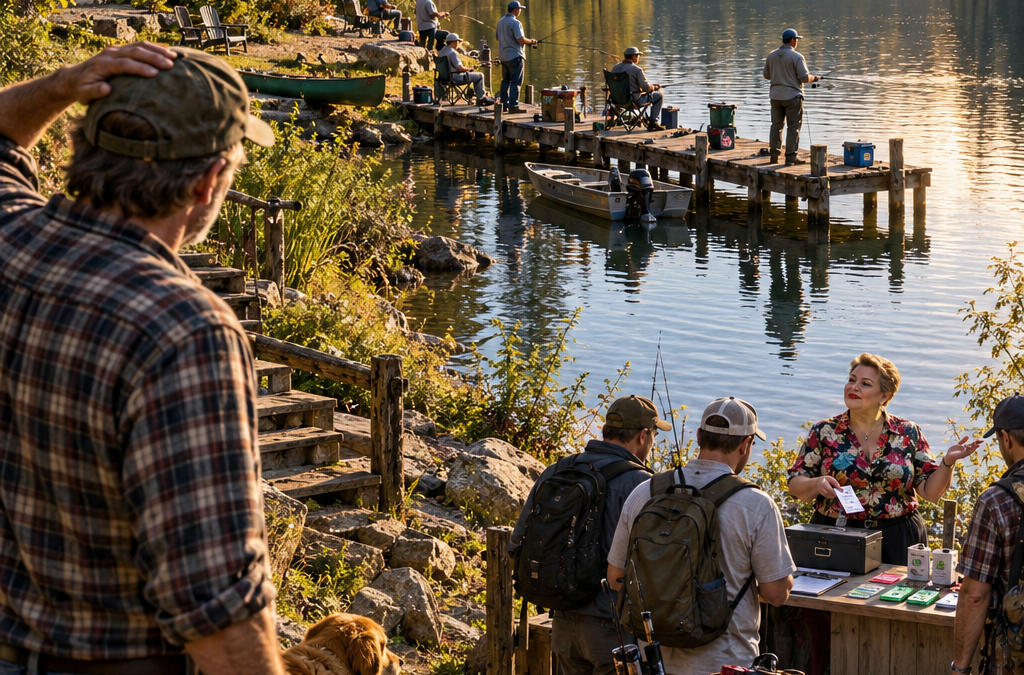
𝗙𝗨𝗟𝗟 𝗦𝗧𝗢𝗥𝗬
The subdivision became Maplewood Estates.
It was the kind of development designed to look established before anyone had actually lived there long enough to establish anything.
Stone entrance pillars.
Decorative streetlights.
Identical mailboxes.
Carefully landscaped medians.
Large homes with manicured lawns.
The promotional signs described it as an “exclusive lake-adjacent residential community.”
That phrase made me laugh the first time I saw it.
Lake-adjacent.
Not lakefront.
Not lake-access.
Because the lake wasn’t part of Maplewood Estates.
It was mine.
Our property sat like an old island inside newer development parcels.
The county records made that perfectly clear.
The original twelve acres had never been sold to the developer.
No easement granted public access.
No community covenant attached to our deed.
No agreement gave residents recreational rights.
Maplewood Estates simply happened to have houses near a privately owned lake.
Apparently that distinction bothered someone.
A few months after residents began moving in, I received a letter.
It was professionally printed on heavy paper with a green Maplewood Estates HOA logo across the top.
WELCOME TO MAPLEWOOD ESTATES.
That was the headline.
The letter went on to explain that the association was excited to welcome all neighborhood property owners and asked me to complete an enclosed registration form.
They wanted my phone number.
Email address.
Vehicle information.
Emergency contact.
And, most importantly, acknowledgment of HOA bylaws.
I read the letter twice.
Then I laughed.
We weren’t in Maplewood Estates.
My property had existed long before Maplewood Estates existed.
I hadn’t purchased a home from their developer.
I hadn’t signed covenants.
I wasn’t a member.
I threw the registration packet into a kitchen drawer.
That should have been the end of it.
Three weeks later, another letter arrived.
This one was slightly less friendly.
According to Maplewood Estates HOA records, I had failed to complete mandatory community registration.
I called the number printed at the bottom.
A woman answered.
I gave her the property address.
There was a pause while she typed.
“Yes, sir,” she said. “I see the issue.”
“Good.”
“You haven’t returned your registration documents.”
“That’s not the issue.”
Another pause.
I explained that my twelve-acre parcel wasn’t part of Maplewood Estates.
She told me all properties within the community boundary were subject to HOA oversight.
I asked her where she got that boundary.
She said from association records.
I asked whether she’d looked at the county parcel map.
She hesitated.
“I’d have to speak with the board.”
“Do that.”
I thought the matter was finished.
Instead, that’s when Randall entered my life.
Randall Pierce was the president of Maplewood Estates HOA.
I didn’t meet him immediately.
At first, he existed only as a signature beneath increasingly irritating letters.
RANDALL PIERCE
PRESIDENT
MAPLEWOOD ESTATES HOMEOWNERS ASSOCIATION
The first fine arrived on a Tuesday.
Forty dollars.
I remember standing in the cabin kitchen reading it while coffee brewed behind me.
The violation was listed as:
UNSANCTIONED WATERFRONT STRUCTURE.
I assumed they meant the dock.
I actually laughed out loud.
My grandfather had built that dock in 1986.
It had stood there for thirty-eight years without offending anybody.
Now a homeowners association created less than three years earlier had decided it was unauthorized.
I called the HOA office again.
The same woman answered.
“I received a fine for my dock.”
“Yes, sir.”
“My dock isn’t in your HOA.”
“The waterfront structure is visible from association property.”
I thought perhaps I had misunderstood her.
“Visible?”
“Yes.”
“You’re fining me because people in your subdivision can see my dock?”
“The board requires waterfront structures to meet approved design standards.”
“It’s not your waterfront.”
There was silence.
Then she said the sentence I would hear in different forms for months.
“I understand your concern, sir.”
“No,” I said. “I don’t think you do.”
I refused to pay.
Two weeks later, another fine arrived.
Sixty dollars.
This time the violation concerned my cabin.
The letter stated that the exterior appearance failed to comply with “community aesthetic standards.”
I stood on the porch holding that notice and looking at the house my grandfather had built with his hands.
The cedar siding had faded naturally over four decades.
The stone chimney was darkened from years of winter fires.
One porch post still had a shallow notch where my father had accidentally struck it with a trailer when I was sixteen.
It wasn’t perfect.
That was part of what made it ours.
And now a group of people who had arrived three years earlier had decided it wasn’t attractive enough.
I didn’t laugh that time.
I put both fines into a folder.
The third letter changed everything.
It wasn’t a citation.
It was a formal association notice.
The first paragraph talked about recreation.
The second discussed “equitable community access.”
Then I reached the sentence that made me sit down.
Maplewood Estates HOA was designating the lake as a shared community amenity.
I read it again.
Then again.
Shared community amenity.
My lake.
The lake wholly contained within my family’s twelve-acre parcel.
The letter announced that all waterfront usage would now require a registered Maplewood Estates recreational permit.
Attached was a fee schedule.
Seasonal fishing permit: twenty-five dollars.
Boat access permit: fifty dollars.
Guest waterfront pass: fifteen dollars.
I stared at the page for what felt like a full minute.
Then I looked through the cabin window toward the water.
There were three people fishing near the eastern bank.
A man.
A woman.
A boy who looked about ten.
They had folding chairs set up.
A cooler.
Two tackle boxes.
I had seen residents walking near the shoreline before.
I had assumed they were confused about where the subdivision property ended.
I had never imagined they had paid someone for permission.
I walked down the hill.
The man noticed me approaching and smiled.
“Morning.”
“Morning.”
I stopped several feet away.
“Can I ask how you got down here?”
His expression changed slightly.
“Through the access trail.”
“What access trail?”
He pointed toward the trees.
The developer had cleared a narrow maintenance path near the eastern boundary during construction.
Apparently the HOA had begun using it as a lake entrance.
I looked at their fishing gear.
“Did somebody tell you you’re allowed to fish here?”
He reached into his tackle box and pulled out a laminated card.
“HOA permit.”
I took it from him.
MAPLEWOOD ESTATES
SEASONAL FISHING ACCESS
AUTHORIZED HOLDER
Randall Pierce’s signature was printed at the bottom.
Something inside me went cold.
“How much did you pay for this?”
“Twenty-five.”
“To the HOA?”
“Yeah.”
The woman looked worried.
“Are we not supposed to be here?”
I looked at their son.
He was holding a blue fishing rod and watching me carefully.
They weren’t the people I was angry at.
They had purchased homes in a neighborhood where the HOA told them the lake was a community amenity.
They had no reason to assume the board was lying.
“This lake is private property,” I said. “My family owns it.”
The man stared at me.
“The HOA said residents had access.”
“They don’t.”
He looked at the permit in my hand.
“I paid for this.”
“I know.”
“Then I think I need to make a phone call.”
“So do I.”
I gave the permit back.
I didn’t order them away.
Not that morning.
Instead, I walked back to the cabin, took photographs of everything I had received, gathered the deed and survey documents from the metal file box my father had kept in the bedroom closet, and drove straight into town.
My attorney’s name was Constance Hale.
She had handled my father’s estate, so she already knew the history of the property.
Constance was in her late fifties and had spent most of her career working real estate and land disputes.
She wasn’t dramatic.
She didn’t slam files onto tables.
She didn’t make big speeches.
She had the kind of calm that made other people nervous because it usually meant she already knew more than they did.
I placed the documents on her desk.
She read the permit notice first.
Then the fines.
Then the deed.
Then the county survey.
When she finished, she leaned back.
“Did you ever sign anything with this HOA?”
“No.”
“Your father?”
“No.”
“Grandfather?”
“The HOA didn’t exist.”
“Any easement allowing recreational access?”
“No.”
“Any agreement with the developer?”
“No.”
She looked through the survey again.
Then she said, very quietly, “They have no legal claim to that lake.”
I felt my shoulders loosen.
“None?”
“Not from anything I’m looking at.”
“So I tell them to stop.”
“You will.”
I expected her to start writing immediately.
Instead, she closed the folder.
“But not today.”
I frowned.
“Why?”
“Because they’re collecting money.”
That changed the situation.
A stupid violation notice was one thing.
An HOA selling permits to use private land was something else entirely.
Constance wanted proof.
Not assumptions.
Not anger.
Evidence.
“If we send a letter today,” she explained, “they remove every sign tomorrow and deny half of this happened. We document first.”
So for three weeks, I watched strangers use my lake.
That was harder than I expected.
Every Saturday morning, I would sit inside the cabin and see families walking down the unauthorized access path.
Some carried fishing rods.
Some brought kayaks.
One couple showed up with an inflatable paddleboard.
Near the trail, the HOA had installed a small sign.
MAPLEWOOD ESTATES RESIDENT WATERFRONT ACCESS.
Another sign near the shoreline listed rules.
Fishing hours.
Boat restrictions.
No glass containers.
Children under twelve required adult supervision.
They had regulations for my lake.
The arrogance of it was almost impressive.
But I did what Constance told me.
I photographed every sign.
Recorded dates.
Took video showing residents entering from association property.
Constance’s office requested county records.
We collected copies of every deed tied to the original twelve acres.
We verified there had never been a recorded easement.
Two Maplewood residents agreed to provide written statements confirming they had paid permit fees directly to the HOA.
One of them was Diane Mercer.
Diane had moved into Maplewood Estates with her husband shortly after the development opened.
She was a retired teacher.
The first time we spoke, she seemed embarrassed.
“I honestly thought the HOA owned the access,” she told me.
“They told everyone the lake had become a community resource.”
“Did Randall say that?”
“Repeatedly.”
She hesitated.
“At one meeting, somebody asked whether the lake belonged to the development. Randall said the ownership issue had been ‘administratively resolved.'”
I almost laughed.
“Administratively resolved.”
“Those were his words.”
“Did he explain what that meant?”
“No.”
Of course he didn’t.
By the end of the third week, our file was thick.
Photographs.
Witness statements.
HOA notices.
Permit cards.
County documents.
Survey maps.
Constance finally drafted the letter.
Eleven pages.
The first section established ownership.
The second addressed trespass.
The third addressed unauthorized commercial collection of fees for access to private property.
The fourth demanded immediate removal of all signage.
The fifth demanded an accounting of every dollar collected.
Then came the paragraph I read three times because it gave me a strange kind of satisfaction.
Maplewood Estates HOA was formally notified that it possessed no ownership interest, recreational easement, access right, management authority, or regulatory jurisdiction over the lake, dock, cabin, shoreline, or any portion of my twelve-acre parcel.
Constance gave them ten business days.
Randall responded in four.
His letter was two pages long.
And somehow, every paragraph made things worse.
He claimed Maplewood Estates had assumed “community stewardship” of the lake due to my family’s “lack of active engagement with surrounding residential stakeholders.”
I called Constance.
“Have you read this?”
“I’m reading it now.”
“What does community stewardship mean?”
“Nothing.”
“He says because we haven’t participated in the neighborhood, they assumed responsibility.”
“I see that.”
“Can they actually argue that?”
“They can argue anything they want.”
There was a pause.
Then she added, “Winning is different.”
Randall’s letter suggested our refusal to participate in HOA governance had created an “administrative vacuum.”
According to him, the board had acted in the best interest of residents by managing an underutilized local resource.
Underutilized.
That word bothered me almost as much as everything else.
A private lake wasn’t abandoned because I didn’t fill it with people every weekend.
It wasn’t unused because I sat alone on the dock.
It wasn’t wasted because my grandfather had wanted silence.
Ownership didn’t disappear when something wasn’t monetized.
I asked Constance what we should do.
Her answer was simple.
“See you in court.”
But before filing anything, she pointed out a right I had never really considered.
Because I was the sole owner of the lake and surrounding access, I could close it.
Completely.
No fishing.
No swimming.
No boating.
No HOA access.
No exceptions.
Until the dispute was resolved, there was no reason I had to allow strangers onto private property simply because they had been misled by Randall.
So on a Saturday morning, I drove to the cabin with six professionally printed signs.
PRIVATE PROPERTY.
NO TRESPASSING.
NO FISHING.
NO SWIMMING.
NO WATERCRAFT.
UNAUTHORIZED ENTRY SUBJECT TO PROSECUTION.
I posted one at the driveway.
Two along the eastern boundary.
One beside the unauthorized access trail.
Two near the shoreline.
I also installed a chain across the maintenance path where it crossed onto my property.
By Sunday afternoon, my phone started ringing.
The first call came from Randall.
I recognized his name from caller ID.
I let it go to voicemail.
“Hello, this is Randall Pierce, president of Maplewood Estates Homeowners Association. I need you to return my call immediately regarding the improper restriction of community waterfront access.”
Improper restriction.
I saved the message.
Twenty minutes later, he called again.
Then one of his board members.
Then another.
By Monday morning, I had seven calls.
One came from a resident who sounded genuinely confused.
“We paid for the season,” he said. “Are we getting refunded?”
“You need to ask the people who sold you the permit.”
“The HOA says you’re preventing access.”
“I’m preventing trespassing.”
There was a long silence.
“So the lake really is yours?”
“Every inch.”
He exhaled.
“I think we’ve been lied to.”
“You have.”
That afternoon, Diane called.
“They’re holding an emergency meeting tonight.”
“Why?”
“Randall says you’re threatening community property.”
I almost corrected her.
Then realized she was quoting him.
“Are you going?”
“Absolutely.”
The meeting apparently became chaotic.
Diane called me afterward.
She had taken notes.
Residents demanded to know whether the HOA actually owned lake rights.
Randall avoided answering directly.
One board member asked for the deed.
Randall said ownership records were complicated.
Someone else asked whether an attorney had reviewed the permit program.
Randall said the board had broad authority to manage neighborhood amenities.
Then Diane stood up.
“Is the lake legally part of Maplewood Estates?”
According to her, Randall stared at her for several seconds.
Then he said, “The situation is more nuanced than that.”
That answer turned half the room against him.
Diane said people started shouting.
One resident wanted his fifty-dollar boat permit refunded.
Another asked whether the HOA could be sued.
Then somebody asked the question Randall should have answered months earlier.
“If the lake isn’t ours, why were you charging us?”
Randall ended the meeting.
But before he did, he made one final mistake.
He told the board not to worry because he had “a relationship with the county.”
When Diane repeated those words to me, I told Constance.
She was quiet.
Then she said, “Interesting.”
There was something in her voice.
“What?”
“I’ve been reviewing the development survey.”
“And?”
“I want the county surveyor to confirm something before I say more.”
Two days later, she called.
“Come to my office.”
I drove there immediately.
A large map was spread across her conference table.
It showed my property boundary in black.
The newer Maplewood parcels were outlined around it.
Constance pointed to one particular lot.
Randall’s.
“Look here.”
At first, I didn’t understand what I was seeing.
Then she placed the original survey from my grandfather’s purchase beside the development plat.
The lines didn’t match.
Not by inches.
By feet.
“When Maplewood was surveyed,” she said, “someone used an incorrect reference point along the western boundary.”
I followed the lines with my finger.
Randall’s backyard crossed ours.
His rear fence.
Part of his landscaping.
And a large portion of his patio.
“How much?”
“Approximately eighteen feet at the widest point.”
I stared at the map.
“You mean his house is on my land?”
“Not the house itself.”
She tapped the drawing.
“But a significant portion of the rear improvements are.”
I sat back.
For the first time since the first fine arrived, I didn’t know what to say.
Randall Pierce had spent months claiming authority over my dock.
My cabin.
My lake.
He had fined me for structures on land he didn’t own.
He had sold fishing access to water he didn’t own.
And during all of it, he had apparently been sitting on a patio partly built on my property.
“Does he know?”
Constance shook her head.
“I doubt it.”
“What happens now?”
“We give him the same respect he gave your boundary.”
The encroachment claim was filed Thursday morning.
The formal notice identified the survey discrepancy and demanded resolution.
Randall retained an attorney before the end of the day.
By Friday afternoon, Diane called again.
“You need to hear this.”
“What?”
“The board suspended Randall.”
I thought I’d misheard her.
“They what?”
“Emergency vote. He’s suspended as president until the legal matter is reviewed.”
Apparently Randall had spent Thursday evening insisting the survey was wrong.
His attorney had apparently advised him not to discuss the matter publicly.
That did not calm the board.
It terrified them.
Once members understood that the man who had authorized the lake permit program might also have a personal property dispute with me, the entire situation looked different.
Questions multiplied.
Who approved the fishing permits?
Where had the money gone?
Had the board voted?
Had any attorney reviewed the program?
Did the HOA’s insurance cover trespass claims?
Could residents who had paid for access demand reimbursement?
Had Randall knowingly misrepresented ownership?
By the following Monday, two board members resigned.
The permit signs disappeared from the lake access trail.
Then came the letter we had been waiting for.
Maplewood Estates HOA acknowledged that the lake was privately owned.
Not partially private.
Not subject to stewardship.
Not administratively shared.
Private.
The HOA admitted it had no recorded recreational easement.
No ownership interest.
No enforcement jurisdiction.
And no authority to issue access permits.
Every resident who had purchased a fishing, boating, or guest permit would receive a refund from association funds.
I read that paragraph twice.
Then once more.
Not because I needed to understand it.
Because I wanted to remember what accountability looked like when finally written down.
Randall was less cooperative.
His attorney argued that the encroachment had resulted from developer surveying errors and that Randall had purchased his lot in good faith.
Constance never disputed that possibility.
Neither did I.
I didn’t want his house.
I didn’t want revenge.
I wanted the property line recognized.
That distinction mattered to me.
It would have been easy to become like him.
Easy to treat the mistake as leverage for humiliation.
Easy to demand things simply because I suddenly could.
But I kept thinking about my grandfather.
He had saved for thirty years because he wanted peace.
Not domination.
Not power over neighbors.
Peace.
So I told Constance what I wanted.
Correct the boundary issue.
Cover our legal expenses.
Remove every claim the HOA had made against our land.
Put the lake rights in writing permanently.
And leave us alone.
Negotiations lasted several weeks.
In the final settlement, Randall paid the cost of the boundary correction and the professional survey work.
His rear fence was moved.
A portion of the patio that crossed the legal line was modified.
He also contributed toward our legal fees under the settlement terms.
More importantly, both Randall and Maplewood Estates signed a formal acknowledgment.
No portion of the HOA.
No board member.
No resident.
No successor association.
No developer representative.
Had any ownership interest, recreational right, access easement, permitting authority, or regulatory jurisdiction over my twelve acres.
The document specifically identified the cabin.
The dock.
The shoreline.
And the lake.
I kept a certified copy in the cabin.
Another stayed with Constance.
A third went into the safe at my house.
I wasn’t interested in having the same argument twice.
Randall resigned before the settlement was finalized.
I only saw him once after that.
I was at the property repairing one of the posts near the driveway when a black SUV stopped on the subdivision road.
He got out.
For a moment, neither of us said anything.
He looked older than I remembered.
Not dramatically.
Just tired.
The confidence that had existed in his letters wasn’t there in person.
“You made your point,” he said.
I put the wrench down.
“I wasn’t trying to make a point.”
He gave me a skeptical look.
“You shut down the lake.”
“I closed private property.”
“You embarrassed the entire association.”
“The association sold access to something it didn’t own.”
“You could have handled this differently.”
That almost made me laugh.
“I tried.”
“No, you hired a lawyer.”
“After you fined me for my grandfather’s dock.”
He looked toward the water.
“The community needed amenities.”
“Then the community should have bought some.”
His jaw tightened.
“The lake was sitting there.”
That sentence told me everything.
I stepped closer.
“So was my cabin.”
He looked back at me.
“Was that available too?”
He didn’t answer.
“That’s what you never understood, Randall. Something being there doesn’t make it yours.”
“We were trying to improve the neighborhood.”
“My family wasn’t part of your neighborhood.”
“You were surrounded by it.”
“Geography isn’t consent.”
That silenced him.
For a few seconds, the only sound was wind moving through the trees.
Then he said something quieter.
“I didn’t think you’d fight this hard.”
There it was.
Not a legal theory.
Not community stewardship.
Not administrative authority.
The truth.
I studied him.
“Why?”
He looked uncomfortable.
“I don’t know.”
“Yes, you do.”
He didn’t answer.
So I answered for him.
“You thought I wasn’t paying attention.”
His eyes shifted toward the lake.
I continued.
“You sent the registration letter. I ignored it. You sent a fine. I didn’t respond. You sent another. I didn’t show up screaming at your board meeting. So you kept going.”
“That’s not—”
“You thought silence meant permission.”
He looked at me again.
I could see from his face that I was right.
Maybe Randall hadn’t started with some elaborate plan to steal the lake.
Maybe it began with a smaller assumption.
The old cabin owner probably wouldn’t care.
The lake looked unused.
Residents wanted recreation.
Nobody was objecting loudly.
So the HOA pushed a little.
Then a little more.
A registration request.
A fine.
Another fine.
A permit.
A fee.
A sign.
An access trail.
Every step became justification for the next.
By the time I objected, Randall had apparently convinced himself the arrangement was legitimate simply because nobody had stopped him earlier.
That frightened me more than if he had been an obvious criminal.
People imagine property can only be taken dramatically.
A forged deed.
A bulldozer.
A locked gate.
But sometimes it happens through paperwork.
A notice.
A fee.
A new rule.
A phrase like community stewardship.
Someone acts as though a right exists.
Then they act again.
And again.
Eventually people stop asking where that right came from.
Randall put his hands in his pockets.
“I was trying to run the HOA.”
“You were trying to control things that weren’t yours.”
He didn’t argue.
After a moment, he returned to his SUV.
Before opening the door, he turned.
“For what it’s worth, I’m sorry about your grandfather.”
That surprised me.
I nodded once.
“Thank you.”
Then he drove away.
I never spoke to him again.
The strangest part came afterward.
Without Randall, Maplewood Estates HOA began falling apart.
At first, I assumed somebody else would become president.
Nobody wanted the job.
The permit scandal had damaged trust.
Residents demanded records.
They questioned landscaping expenses.
Management charges.
Legal bills.
Maintenance contracts.
People who had once ignored board meetings began attending every one.
The remaining board members couldn’t agree on anything.
Dues went unpaid.
The management company issued warnings.
Then resigned when the association fell behind on its obligations.
Within six months, Maplewood Estates began the process of dissolving the HOA.
Before the end of the year, it was officially gone.
The houses remained.
The lawns remained.
The decorative streetlights remained.
But the organization that had tried to fine me for my grandfather’s dock no longer existed.
The valley gradually became quiet again.
Not as quiet as when I was a child.
There were too many houses now.
Too many cars.
Too many porch lights visible through the trees at night.
But something important had returned.
A boundary.
Not just the line on a survey.
A boundary in people’s minds.
Residents stopped wandering down to the water.
The access trail grew over.
The HOA signs disappeared.
Eventually, I replaced them with something simpler.
PRIVATE PROPERTY
PLEASE RESPECT THE BOUNDARY
No threats.
No legal language.
Just the truth.
A few Maplewood residents became people I actually liked.
Diane and her husband occasionally stopped by the cabin.
Once, during the spring, I invited them to fish.
Diane laughed when I handed her a rod.
“Do I need a permit?”
“Absolutely.”
She raised an eyebrow.
I pulled a scrap of paper from my pocket.
On it, I had written:
DIANE MERCER
AUTHORIZED TO FISH
PRICE: ONE CUP OF COFFEE
She laughed so hard she nearly dropped it.
That afternoon reminded me of something I had almost forgotten during the legal fight.
I didn’t mind sharing.
That had never been the issue.
My grandfather invited people to fish all the time.
Friends.
Neighbors.
Coworkers.
Kids from church.
He once let a delivery driver stay two hours because the man mentioned he hadn’t fished since his father died.
The difference was simple.
Invitation.
Permission.
Respect.
You could ask.
What you couldn’t do was declare.
You couldn’t stand on someone else’s land and announce that it belonged to everybody now.
You couldn’t sell strangers permission to use something you didn’t own.
You couldn’t transform generosity into entitlement.
That distinction mattered.
It still does.
Last weekend, I woke before sunrise and drove to the cabin.
The weather had turned cool.
Early fall.
The kind of morning my grandfather loved.
I made coffee in the same dented metal pot my father kept for years, carried the mug down the hill, and walked onto the dock.
A few boards have been replaced since Grandpa built it.
Most of the original posts remain.
I sat near the end.
Mist covered the lake.
For several minutes, I couldn’t see the far bank.
Everything beyond thirty yards disappeared into pale gray.
Then the sun began climbing over the ridge.
Light touched the surface.
The mist slowly pulled apart.
I remembered being nine years old.
Grandpa had taken me fishing before dawn.
I had complained about being tired.
He told me to stop talking because I’d scare the fish.
I believed him.
We sat without speaking for almost an hour.
Then I asked why he had worked so long to buy the property.
He didn’t answer immediately.
Grandpa rarely answered serious questions quickly.
Finally he said, “Because a man ought to have one place where the world doesn’t get to tell him what to do.”
At nine, I didn’t understand.
I thought he meant adults.
Bosses.
Rules.
Maybe my grandmother.
Decades later, sitting on the same dock, I finally understood.
He wasn’t talking about being lawless.
He respected rules.
Probably more than most people.
He meant ownership.
Responsibility.
A place earned honestly and cared for properly.
A place where silence didn’t need justification.
Where peace wasn’t something another person could reclassify as an unused resource.
My grandfather spent thirty years saving for that lake.
My father spent years maintaining it.
And when my turn came, I spent three weeks gathering evidence and several months forcing people to recognize something that should never have been questioned.
There were moments when I wondered whether it was worth the trouble.
Attorney meetings.
Survey expenses.
Photographs.
Phone calls.
Letters.
Arguments.
Residents angry because the lake suddenly closed.
A man accusing me of hurting an entire neighborhood simply because I refused to let him commercialize my property.
It would have been easier to compromise.
I could have accepted limited HOA access.
Negotiated a fee.
Allowed residents to fish certain weekends.
Maybe that would have made everybody happy.
But every time I considered it, I came back to the same problem.
A compromise made under pressure is not generosity.
It’s surrender dressed politely.
If I wanted to invite Maplewood residents to fish, that choice belonged to me.
If I wanted the lake empty for an entire year, that choice also belonged to me.
That’s what ownership meant.
Not selfishness.
Responsibility paired with authority.
Randall’s mistake wasn’t believing the lake could benefit his neighborhood.
Maybe it could have.
His mistake was believing potential benefit gave him a right to take control.
It didn’t.
I finished my coffee as the mist disappeared.
A fish broke the surface twenty feet from the dock.
Then another.
Somewhere uphill, an acorn struck the cabin roof.
I smiled.
The place sounded exactly as I remembered.
No announcements.
No permit signs.
No HOA meetings.
No violation notices.
Just water against wood.
Wind in the leaves.
And the occasional splash of a fish moving beneath the surface.
I thought about the forty-dollar fine that had started everything.
UNSANCTIONED WATERFRONT STRUCTURE.
I still have it.
It’s framed now.
Constance thought that was hilarious.
I hung it inside the cabin beside an old photograph of Grandpa standing on the dock shortly after he finished building it in 1986.
He’s younger than I remember him.
Thick hair.
Work shirt.
Fishing rod in one hand.
Behind him is the structure that would become an HOA violation thirty-eight years later.
Whenever I look at that photograph, I think about how temporary authority can be.
Randall had a title.
President.
He had letterhead.
A board.
Rules.
Meetings.
A management company.
People answered his calls.
They paid fees because he told them to.
For a while, all of that made him look powerful.
My grandfather had none of those things.
He had a deed.
A survey.
And thirty years of savings.
In the end, those pieces of paper mattered more.
The law wasn’t complicated.
The boundary wasn’t philosophical.
The lake didn’t belong to whoever created the nicest brochure.
It belonged to the person whose land surrounded it.
The association had arrived decades later and mistaken proximity for ownership.
That mistake cost them.
But I don’t look at what happened as a victory over Randall.
At least not anymore.
For a while, I did.
I’ll admit that.
When he was suspended, I felt satisfaction.
When the permit refunds went out, I felt vindicated.
When the boundary survey showed his patio crossing onto our parcel, the irony was almost impossible not to enjoy.
But time changes the emotional shape of things.
Now, what I mostly feel is relief.
The property survived another challenge.
That’s how I think of it.
My grandfather protected it by earning it.
My father protected it by maintaining it.
I protected it by refusing to let paperwork rewrite history.
Maybe one day it will belong to someone after me.
I hope whoever that is understands the responsibility.
Land isn’t immortal because your name appears on a deed.
Rights disappear when people fail to understand them.
Boundaries become vulnerable when nobody checks the survey.
Bad assumptions become traditions when nobody challenges them.
And authority expands fastest where everyone assumes somebody else will object.
Randall had counted on that.
He thought I was absent.
He thought the cabin was old.
He thought the lake was underused.
He thought because I wasn’t standing at the boundary every weekend, the boundary didn’t matter.
He was wrong.
Silence isn’t surrender.
Privacy isn’t abandonment.
And ownership doesn’t expire because someone with a clipboard decides your property would be more useful to other people.
That morning, I stayed on the dock until almost noon.
Eventually I picked up my fishing rod.
The old one.
Dad’s.
The cork handle is worn smooth from years of use.
I tied on a lure and cast toward the northern bank.
The line landed exactly where Grandpa used to tell me the bass stayed when the water turned cool.
I waited.
Nothing.
Cast again.
Still nothing.
On the third cast, the line tightened.
I pulled back and felt the fish turn beneath the surface.
For thirty seconds, I was twelve years old again.
Dad behind me.
Grandpa telling me not to rush.
The fish broke the surface.
A largemouth bass.
Not enormous.
Maybe three pounds.
I brought it alongside the dock, lifted it carefully, removed the hook, and held it for a moment.
Then I lowered it back into the water.
It disappeared beneath the surface.
A few ripples spread outward.
Then the lake became still again.
Exactly the way my grandfather had wanted it.
Exactly the way he had left it to us.
And for the first time since that ridiculous forty-dollar fine arrived, I sat there without thinking about Randall, lawyers, survey lines, permits, or HOA rules.
I simply listened to the water.
The cabin behind me.
The lake in front of me.
And forty-one years of family history exactly where it belonged.
𝗧𝗛𝗘 𝗘𝗡𝗗
The HOA Started Selling Fishing Permits to My Family’s Private Lake, and Their President Was Certain the Water Belonged to Him
The first time the HOA fined me for fishing from my grandfather’s dock, I thought someone had made an embarrassing mistake.
Then I discovered they had been selling permits to strangers for the right to fish in the private lake my family had owned for forty-one years.
My grandfather bought the property in 1983.
He was sixty-one years old then, recently retired after spending three decades as an electrician. He had worked industrial sites, schools, warehouses, and more houses than he could count. He had spent most of those years waking before sunrise, carrying toolboxes through rain and snow, climbing ladders with knees that hurt more every winter, and coming home smelling faintly of copper, dust, and machine oil.
He never earned a fortune.
What he did was save.
Ten dollars here.
Twenty there.
Overtime checks.
Christmas bonuses.
Money other men might have spent on newer trucks, vacations, or expensive hobbies.
Grandpa had one dream.
He wanted a place where nobody could tell him when he was allowed to fish.
That sounds small until you understand him.
Fishing was the one thing that made him still.
The rest of his life was motion. Work orders. Deadlines. Broken wiring. Bills. Family responsibilities. Repairs around the house.
But put him beside quiet water with a thermos of coffee and a fishing rod, and he became somebody else.
Patient.
Peaceful.
Content.
So when he found twelve acres in a narrow wooded valley with a small private lake sitting almost perfectly in the middle of the property, he knew immediately.
This was it.
The cabin came later.
He built most of it himself.
Not because he couldn’t afford contractors, although money was always a consideration, but because he wanted his hands in every part of it.
He framed the walls.
Ran the electrical.
Installed the windows.
Built the porch.
My father helped him with the roof.
I was a child then, old enough to carry boards but young enough that everyone understood I was mostly in the way.
Some of my clearest memories are from that place.
Grandpa standing over a workbench measuring a piece of cedar.
Dad laughing because I’d hammered a nail sideways.
The three of us eating sandwiches on overturned buckets because there wasn’t any furniture yet.
When the cabin was finally finished, it wasn’t impressive in the way expensive lake houses are impressive.
It had two small bedrooms.
A stone fireplace.
A kitchen with cabinets Grandpa built himself.
A screened porch facing the water.
And a dock he added in 1986, using thick treated posts sunk deep into the lakebed.
To me, it was perfect.
For almost four decades, very little changed.
My grandfather died first.
The property passed to my father.
Dad maintained it almost exactly as Grandpa had left it.
When a board warped on the dock, he replaced one board.
When the roof needed work, he matched the old shingles as closely as he could.
When people told him he could probably make good money renting the place during the summer, he shook his head.
“This isn’t a business,” he would say.
Then my father died.
And the cabin became mine.
There are inheritances that make you feel richer.
This one made me feel responsible.
The deed had my name on it, but I never really thought of the place as belonging only to me.
I thought of myself as the third person entrusted with taking care of it.
Three generations.
Forty-one years.
Same cabin.
Same lake.
Same dock.
Same morning mist settling over the water.
For most of that time, privacy had never been something we needed to defend.
There simply weren’t many people around.
The valley was rural enough that our nearest neighbor used to be almost a mile away.
That changed around 2021.
A developer purchased a large tract surrounding the eastern and northern sides of our property.
Within months, trees disappeared.
Survey flags appeared.
Then bulldozers.
Then roads.
Then foundations.
My father had already passed by then, and I remember sitting on our porch one morning listening to construction equipment echo through the valley.
I didn’t like it.
But I also understood something important.
They owned their land.
We owned ours.
People had the right to build houses on property they legally purchased.
As long as everyone respected the boundaries, there didn’t have to be a problem.
For the first year, there wasn’t.
The subdivision became Maplewood Estates.
It was the kind of development designed to look established before anyone had actually lived there long enough to establish anything.
Stone entrance pillars.
Decorative streetlights.
Identical mailboxes.
Carefully landscaped medians.
Large homes with manicured lawns.
The promotional signs described it as an “exclusive lake-adjacent residential community.”
That phrase made me laugh the first time I saw it.
Lake-adjacent.
Not lakefront.
Not lake-access.
Because the lake wasn’t part of Maplewood Estates.
It was mine.
Our property sat like an old island inside newer development parcels.
The county records made that perfectly clear.
The original twelve acres had never been sold to the developer.
No easement granted public access.
No community covenant attached to our deed.
No agreement gave residents recreational rights.
Maplewood Estates simply happened to have houses near a privately owned lake.
Apparently that distinction bothered someone.
A few months after residents began moving in, I received a letter.
It was professionally printed on heavy paper with a green Maplewood Estates HOA logo across the top.
WELCOME TO MAPLEWOOD ESTATES.
That was the headline.
The letter went on to explain that the association was excited to welcome all neighborhood property owners and asked me to complete an enclosed registration form.
They wanted my phone number.
Email address.
Vehicle information.
Emergency contact.
And, most importantly, acknowledgment of HOA bylaws.
I read the letter twice.
Then I laughed.
We weren’t in Maplewood Estates.
My property had existed long before Maplewood Estates existed.
I hadn’t purchased a home from their developer.
I hadn’t signed covenants.
I wasn’t a member.
I threw the registration packet into a kitchen drawer.
That should have been the end of it.
Three weeks later, another letter arrived.
This one was slightly less friendly.
According to Maplewood Estates HOA records, I had failed to complete mandatory community registration.
I called the number printed at the bottom.
A woman answered.
I gave her the property address.
There was a pause while she typed.
“Yes, sir,” she said. “I see the issue.”
“Good.”
“You haven’t returned your registration documents.”
“That’s not the issue.”
Another pause.
I explained that my twelve-acre parcel wasn’t part of Maplewood Estates.
She told me all properties within the community boundary were subject to HOA oversight.
I asked her where she got that boundary.
She said from association records.
I asked whether she’d looked at the county parcel map.
She hesitated.
“I’d have to speak with the board.”
“Do that.”
I thought the matter was finished.
Instead, that’s when Randall entered my life.
Randall Pierce was the president of Maplewood Estates HOA.
I didn’t meet him immediately.
At first, he existed only as a signature beneath increasingly irritating letters.
RANDALL PIERCE
PRESIDENT
MAPLEWOOD ESTATES HOMEOWNERS ASSOCIATION
The first fine arrived on a Tuesday.
Forty dollars.
I remember standing in the cabin kitchen reading it while coffee brewed behind me.
The violation was listed as:
UNSANCTIONED WATERFRONT STRUCTURE.
I assumed they meant the dock.
I actually laughed out loud.
My grandfather had built that dock in 1986.
It had stood there for thirty-eight years without offending anybody.
Now a homeowners association created less than three years earlier had decided it was unauthorized.
I called the HOA office again.
The same woman answered.
“I received a fine for my dock.”
“Yes, sir.”
“My dock isn’t in your HOA.”
“The waterfront structure is visible from association property.”
I thought perhaps I had misunderstood her.
“Visible?”
“Yes.”
“You’re fining me because people in your subdivision can see my dock?”
“The board requires waterfront structures to meet approved design standards.”
“It’s not your waterfront.”
There was silence.
Then she said the sentence I would hear in different forms for months.
“I understand your concern, sir.”
“No,” I said. “I don’t think you do.”
I refused to pay.
Two weeks later, another fine arrived.
Sixty dollars.
This time the violation concerned my cabin.
The letter stated that the exterior appearance failed to comply with “community aesthetic standards.”
I stood on the porch holding that notice and looking at the house my grandfather had built with his hands.
The cedar siding had faded naturally over four decades.
The stone chimney was darkened from years of winter fires.
One porch post still had a shallow notch where my father had accidentally struck it with a trailer when I was sixteen.
It wasn’t perfect.
That was part of what made it ours.
And now a group of people who had arrived three years earlier had decided it wasn’t attractive enough.
I didn’t laugh that time.
I put both fines into a folder.
The third letter changed everything.
It wasn’t a citation.
It was a formal association notice.
The first paragraph talked about recreation.
The second discussed “equitable community access.”
Then I reached the sentence that made me sit down.
Maplewood Estates HOA was designating the lake as a shared community amenity.
I read it again.
Then again.
Shared community amenity.
My lake.
The lake wholly contained within my family’s twelve-acre parcel.
The letter announced that all waterfront usage would now require a registered Maplewood Estates recreational permit.
Attached was a fee schedule.
Seasonal fishing permit: twenty-five dollars.
Boat access permit: fifty dollars.
Guest waterfront pass: fifteen dollars.
I stared at the page for what felt like a full minute.
Then I looked through the cabin window toward the water.
There were three people fishing near the eastern bank.
A man.
A woman.
A boy who looked about ten.
They had folding chairs set up.
A cooler.
Two tackle boxes.
I had seen residents walking near the shoreline before.
I had assumed they were confused about where the subdivision property ended.
I had never imagined they had paid someone for permission.
I walked down the hill.
The man noticed me approaching and smiled.
“Morning.”
“Morning.”
I stopped several feet away.
“Can I ask how you got down here?”
His expression changed slightly.
“Through the access trail.”
“What access trail?”
He pointed toward the trees.
The developer had cleared a narrow maintenance path near the eastern boundary during construction.
Apparently the HOA had begun using it as a lake entrance.
I looked at their fishing gear.
“Did somebody tell you you’re allowed to fish here?”
He reached into his tackle box and pulled out a laminated card.
“HOA permit.”
I took it from him.
MAPLEWOOD ESTATES
SEASONAL FISHING ACCESS
AUTHORIZED HOLDER
Randall Pierce’s signature was printed at the bottom.
Something inside me went cold.
“How much did you pay for this?”
“Twenty-five.”
“To the HOA?”
“Yeah.”
The woman looked worried.
“Are we not supposed to be here?”
I looked at their son.
He was holding a blue fishing rod and watching me carefully.
They weren’t the people I was angry at.
They had purchased homes in a neighborhood where the HOA told them the lake was a community amenity.
They had no reason to assume the board was lying.
“This lake is private property,” I said. “My family owns it.”
The man stared at me.
“The HOA said residents had access.”
“They don’t.”
He looked at the permit in my hand.
“I paid for this.”
“I know.”
“Then I think I need to make a phone call.”
“So do I.”
I gave the permit back.
I didn’t order them away.
Not that morning.
Instead, I walked back to the cabin, took photographs of everything I had received, gathered the deed and survey documents from the metal file box my father had kept in the bedroom closet, and drove straight into town.
My attorney’s name was Constance Hale.
She had handled my father’s estate, so she already knew the history of the property.
Constance was in her late fifties and had spent most of her career working real estate and land disputes.
She wasn’t dramatic.
She didn’t slam files onto tables.
She didn’t make big speeches.
She had the kind of calm that made other people nervous because it usually meant she already knew more than they did.
I placed the documents on her desk.
She read the permit notice first.
Then the fines.
Then the deed.
Then the county survey.
When she finished, she leaned back.
“Did you ever sign anything with this HOA?”
“No.”
“Your father?”
“No.”
“Grandfather?”
“The HOA didn’t exist.”
“Any easement allowing recreational access?”
“No.”
“Any agreement with the developer?”
“No.”
She looked through the survey again.
Then she said, very quietly, “They have no legal claim to that lake.”
I felt my shoulders loosen.
“None?”
“Not from anything I’m looking at.”
“So I tell them to stop.”
“You will.”
I expected her to start writing immediately.
Instead, she closed the folder.
“But not today.”
I frowned.
“Why?”
“Because they’re collecting money.”
That changed the situation.
A stupid violation notice was one thing.
An HOA selling permits to use private land was something else entirely.
Constance wanted proof.
Not assumptions.
Not anger.
Evidence.
“If we send a letter today,” she explained, “they remove every sign tomorrow and deny half of this happened. We document first.”
So for three weeks, I watched strangers use my lake.
That was harder than I expected.
Every Saturday morning, I would sit inside the cabin and see families walking down the unauthorized access path.
Some carried fishing rods.
Some brought kayaks.
One couple showed up with an inflatable paddleboard.
Near the trail, the HOA had installed a small sign.
MAPLEWOOD ESTATES RESIDENT WATERFRONT ACCESS.
Another sign near the shoreline listed rules.
Fishing hours.
Boat restrictions.
No glass containers.
Children under twelve required adult supervision.
They had regulations for my lake.
The arrogance of it was almost impressive.
But I did what Constance told me.
I photographed every sign.
Recorded dates.
Took video showing residents entering from association property.
Constance’s office requested county records.
We collected copies of every deed tied to the original twelve acres.
We verified there had never been a recorded easement.
Two Maplewood residents agreed to provide written statements confirming they had paid permit fees directly to the HOA.
One of them was Diane Mercer.
Diane had moved into Maplewood Estates with her husband shortly after the development opened.
She was a retired teacher.
The first time we spoke, she seemed embarrassed.
“I honestly thought the HOA owned the access,” she told me.
“They told everyone the lake had become a community resource.”
“Did Randall say that?”
“Repeatedly.”
She hesitated.
“At one meeting, somebody asked whether the lake belonged to the development. Randall said the ownership issue had been ‘administratively resolved.'”
I almost laughed.
“Administratively resolved.”
“Those were his words.”
“Did he explain what that meant?”
“No.”
Of course he didn’t.
By the end of the third week, our file was thick.
Photographs.
Witness statements.
HOA notices.
Permit cards.
County documents.
Survey maps.
Constance finally drafted the letter.
Eleven pages.
The first section established ownership.
The second addressed trespass.
The third addressed unauthorized commercial collection of fees for access to private property.
The fourth demanded immediate removal of all signage.
The fifth demanded an accounting of every dollar collected.
Then came the paragraph I read three times because it gave me a strange kind of satisfaction.
Maplewood Estates HOA was formally notified that it possessed no ownership interest, recreational easement, access right, management authority, or regulatory jurisdiction over the lake, dock, cabin, shoreline, or any portion of my twelve-acre parcel.
Constance gave them ten business days.
Randall responded in four.
His letter was two pages long.
And somehow, every paragraph made things worse.
He claimed Maplewood Estates had assumed “community stewardship” of the lake due to my family’s “lack of active engagement with surrounding residential stakeholders.”
I called Constance.
“Have you read this?”
“I’m reading it now.”
“What does community stewardship mean?”
“Nothing.”
“He says because we haven’t participated in the neighborhood, they assumed responsibility.”
“I see that.”
“Can they actually argue that?”
“They can argue anything they want.”
There was a pause.
Then she added, “Winning is different.”
Randall’s letter suggested our refusal to participate in HOA governance had created an “administrative vacuum.”
According to him, the board had acted in the best interest of residents by managing an underutilized local resource.
Underutilized.
That word bothered me almost as much as everything else.
A private lake wasn’t abandoned because I didn’t fill it with people every weekend.
It wasn’t unused because I sat alone on the dock.
It wasn’t wasted because my grandfather had wanted silence.
Ownership didn’t disappear when something wasn’t monetized.
I asked Constance what we should do.
Her answer was simple.
“See you in court.”
But before filing anything, she pointed out a right I had never really considered.
Because I was the sole owner of the lake and surrounding access, I could close it.
Completely.
No fishing.
No swimming.
No boating.
No HOA access.
No exceptions.
Until the dispute was resolved, there was no reason I had to allow strangers onto private property simply because they had been misled by Randall.
So on a Saturday morning, I drove to the cabin with six professionally printed signs.
PRIVATE PROPERTY.
NO TRESPASSING.
NO FISHING.
NO SWIMMING.
NO WATERCRAFT.
UNAUTHORIZED ENTRY SUBJECT TO PROSECUTION.
I posted one at the driveway.
Two along the eastern boundary.
One beside the unauthorized access trail.
Two near the shoreline.
I also installed a chain across the maintenance path where it crossed onto my property.
By Sunday afternoon, my phone started ringing.
The first call came from Randall.
I recognized his name from caller ID.
I let it go to voicemail.
“Hello, this is Randall Pierce, president of Maplewood Estates Homeowners Association. I need you to return my call immediately regarding the improper restriction of community waterfront access.”
Improper restriction.
I saved the message.
Twenty minutes later, he called again.
Then one of his board members.
Then another.
By Monday morning, I had seven calls.
One came from a resident who sounded genuinely confused.
“We paid for the season,” he said. “Are we getting refunded?”
“You need to ask the people who sold you the permit.”
“The HOA says you’re preventing access.”
“I’m preventing trespassing.”
There was a long silence.
“So the lake really is yours?”
“Every inch.”
He exhaled.
“I think we’ve been lied to.”
“You have.”
That afternoon, Diane called.
“They’re holding an emergency meeting tonight.”
“Why?”
“Randall says you’re threatening community property.”
I almost corrected her.
Then realized she was quoting him.
“Are you going?”
“Absolutely.”
The meeting apparently became chaotic.
Diane called me afterward.
She had taken notes.
Residents demanded to know whether the HOA actually owned lake rights.
Randall avoided answering directly.
One board member asked for the deed.
Randall said ownership records were complicated.
Someone else asked whether an attorney had reviewed the permit program.
Randall said the board had broad authority to manage neighborhood amenities.
Then Diane stood up.
“Is the lake legally part of Maplewood Estates?”
According to her, Randall stared at her for several seconds.
Then he said, “The situation is more nuanced than that.”
That answer turned half the room against him.
Diane said people started shouting.
One resident wanted his fifty-dollar boat permit refunded.
Another asked whether the HOA could be sued.
Then somebody asked the question Randall should have answered months earlier.
“If the lake isn’t ours, why were you charging us?”
Randall ended the meeting.
But before he did, he made one final mistake.
He told the board not to worry because he had “a relationship with the county.”
When Diane repeated those words to me, I told Constance.
She was quiet.
Then she said, “Interesting.”
There was something in her voice.
“What?”
“I’ve been reviewing the development survey.”
“And?”
“I want the county surveyor to confirm something before I say more.”
Two days later, she called.
“Come to my office.”
I drove there immediately.
A large map was spread across her conference table.
It showed my property boundary in black.
The newer Maplewood parcels were outlined around it.
Constance pointed to one particular lot.
Randall’s.
“Look here.”
At first, I didn’t understand what I was seeing.
Then she placed the original survey from my grandfather’s purchase beside the development plat.
The lines didn’t match.
Not by inches.
By feet.
“When Maplewood was surveyed,” she said, “someone used an incorrect reference point along the western boundary.”
I followed the lines with my finger.
Randall’s backyard crossed ours.
His rear fence.
Part of his landscaping.
And a large portion of his patio.
“How much?”
“Approximately eighteen feet at the widest point.”
I stared at the map.
“You mean his house is on my land?”
“Not the house itself.”
She tapped the drawing.
“But a significant portion of the rear improvements are.”
I sat back.
For the first time since the first fine arrived, I didn’t know what to say.
Randall Pierce had spent months claiming authority over my dock.
My cabin.
My lake.
He had fined me for structures on land he didn’t own.
He had sold fishing access to water he didn’t own.
And during all of it, he had apparently been sitting on a patio partly built on my property.
“Does he know?”
Constance shook her head.
“I doubt it.”
“What happens now?”
“We give him the same respect he gave your boundary.”
The encroachment claim was filed Thursday morning.
The formal notice identified the survey discrepancy and demanded resolution.
Randall retained an attorney before the end of the day.
By Friday afternoon, Diane called again.
“You need to hear this.”
“What?”
“The board suspended Randall.”
I thought I’d misheard her.
“They what?”
“Emergency vote. He’s suspended as president until the legal matter is reviewed.”
Apparently Randall had spent Thursday evening insisting the survey was wrong.
His attorney had apparently advised him not to discuss the matter publicly.
That did not calm the board.
It terrified them.
Once members understood that the man who had authorized the lake permit program might also have a personal property dispute with me, the entire situation looked different.
Questions multiplied.
Who approved the fishing permits?
Where had the money gone?
Had the board voted?
Had any attorney reviewed the program?
Did the HOA’s insurance cover trespass claims?
Could residents who had paid for access demand reimbursement?
Had Randall knowingly misrepresented ownership?
By the following Monday, two board members resigned.
The permit signs disappeared from the lake access trail.
Then came the letter we had been waiting for.
Maplewood Estates HOA acknowledged that the lake was privately owned.
Not partially private.
Not subject to stewardship.
Not administratively shared.
Private.
The HOA admitted it had no recorded recreational easement.
No ownership interest.
No enforcement jurisdiction.
And no authority to issue access permits.
Every resident who had purchased a fishing, boating, or guest permit would receive a refund from association funds.
I read that paragraph twice.
Then once more.
Not because I needed to understand it.
Because I wanted to remember what accountability looked like when finally written down.
Randall was less cooperative.
His attorney argued that the encroachment had resulted from developer surveying errors and that Randall had purchased his lot in good faith.
Constance never disputed that possibility.
Neither did I.
I didn’t want his house.
I didn’t want revenge.
I wanted the property line recognized.
That distinction mattered to me.
It would have been easy to become like him.
Easy to treat the mistake as leverage for humiliation.
Easy to demand things simply because I suddenly could.
But I kept thinking about my grandfather.
He had saved for thirty years because he wanted peace.
Not domination.
Not power over neighbors.
Peace.
So I told Constance what I wanted.
Correct the boundary issue.
Cover our legal expenses.
Remove every claim the HOA had made against our land.
Put the lake rights in writing permanently.
And leave us alone.
Negotiations lasted several weeks.
In the final settlement, Randall paid the cost of the boundary correction and the professional survey work.
His rear fence was moved.
A portion of the patio that crossed the legal line was modified.
He also contributed toward our legal fees under the settlement terms.
More importantly, both Randall and Maplewood Estates signed a formal acknowledgment.
No portion of the HOA.
No board member.
No resident.
No successor association.
No developer representative.
Had any ownership interest, recreational right, access easement, permitting authority, or regulatory jurisdiction over my twelve acres.
The document specifically identified the cabin.
The dock.
The shoreline.
And the lake.
I kept a certified copy in the cabin.
Another stayed with Constance.
A third went into the safe at my house.
I wasn’t interested in having the same argument twice.
Randall resigned before the settlement was finalized.
I only saw him once after that.
I was at the property repairing one of the posts near the driveway when a black SUV stopped on the subdivision road.
He got out.
For a moment, neither of us said anything.
He looked older than I remembered.
Not dramatically.
Just tired.
The confidence that had existed in his letters wasn’t there in person.
“You made your point,” he said.
I put the wrench down.
“I wasn’t trying to make a point.”
He gave me a skeptical look.
“You shut down the lake.”
“I closed private property.”
“You embarrassed the entire association.”
“The association sold access to something it didn’t own.”
“You could have handled this differently.”
That almost made me laugh.
“I tried.”
“No, you hired a lawyer.”
“After you fined me for my grandfather’s dock.”
He looked toward the water.
“The community needed amenities.”
“Then the community should have bought some.”
His jaw tightened.
“The lake was sitting there.”
That sentence told me everything.
I stepped closer.
“So was my cabin.”
He looked back at me.
“Was that available too?”
He didn’t answer.
“That’s what you never understood, Randall. Something being there doesn’t make it yours.”
“We were trying to improve the neighborhood.”
“My family wasn’t part of your neighborhood.”
“You were surrounded by it.”
“Geography isn’t consent.”
That silenced him.
For a few seconds, the only sound was wind moving through the trees.
Then he said something quieter.
“I didn’t think you’d fight this hard.”
There it was.
Not a legal theory.
Not community stewardship.
Not administrative authority.
The truth.
I studied him.
“Why?”
He looked uncomfortable.
“I don’t know.”
“Yes, you do.”
He didn’t answer.
So I answered for him.
“You thought I wasn’t paying attention.”
His eyes shifted toward the lake.
I continued.
“You sent the registration letter. I ignored it. You sent a fine. I didn’t respond. You sent another. I didn’t show up screaming at your board meeting. So you kept going.”
“That’s not—”
“You thought silence meant permission.”
He looked at me again.
I could see from his face that I was right.
Maybe Randall hadn’t started with some elaborate plan to steal the lake.
Maybe it began with a smaller assumption.
The old cabin owner probably wouldn’t care.
The lake looked unused.
Residents wanted recreation.
Nobody was objecting loudly.
So the HOA pushed a little.
Then a little more.
A registration request.
A fine.
Another fine.
A permit.
A fee.
A sign.
An access trail.
Every step became justification for the next.
By the time I objected, Randall had apparently convinced himself the arrangement was legitimate simply because nobody had stopped him earlier.
That frightened me more than if he had been an obvious criminal.
People imagine property can only be taken dramatically.
A forged deed.
A bulldozer.
A locked gate.
But sometimes it happens through paperwork.
A notice.
A fee.
A new rule.
A phrase like community stewardship.
Someone acts as though a right exists.
Then they act again.
And again.
Eventually people stop asking where that right came from.
Randall put his hands in his pockets.
“I was trying to run the HOA.”
“You were trying to control things that weren’t yours.”
He didn’t argue.
After a moment, he returned to his SUV.
Before opening the door, he turned.
“For what it’s worth, I’m sorry about your grandfather.”
That surprised me.
I nodded once.
“Thank you.”
Then he drove away.
I never spoke to him again.
The strangest part came afterward.
Without Randall, Maplewood Estates HOA began falling apart.
At first, I assumed somebody else would become president.
Nobody wanted the job.
The permit scandal had damaged trust.
Residents demanded records.
They questioned landscaping expenses.
Management charges.
Legal bills.
Maintenance contracts.
People who had once ignored board meetings began attending every one.
The remaining board members couldn’t agree on anything.
Dues went unpaid.
The management company issued warnings.
Then resigned when the association fell behind on its obligations.
Within six months, Maplewood Estates began the process of dissolving the HOA.
Before the end of the year, it was officially gone.
The houses remained.
The lawns remained.
The decorative streetlights remained.
But the organization that had tried to fine me for my grandfather’s dock no longer existed.
The valley gradually became quiet again.
Not as quiet as when I was a child.
There were too many houses now.
Too many cars.
Too many porch lights visible through the trees at night.
But something important had returned.
A boundary.
Not just the line on a survey.
A boundary in people’s minds.
Residents stopped wandering down to the water.
The access trail grew over.
The HOA signs disappeared.
Eventually, I replaced them with something simpler.
PRIVATE PROPERTY
PLEASE RESPECT THE BOUNDARY
No threats.
No legal language.
Just the truth.
A few Maplewood residents became people I actually liked.
Diane and her husband occasionally stopped by the cabin.
Once, during the spring, I invited them to fish.
Diane laughed when I handed her a rod.
“Do I need a permit?”
“Absolutely.”
She raised an eyebrow.
I pulled a scrap of paper from my pocket.
On it, I had written:
DIANE MERCER
AUTHORIZED TO FISH
PRICE: ONE CUP OF COFFEE
She laughed so hard she nearly dropped it.
That afternoon reminded me of something I had almost forgotten during the legal fight.
I didn’t mind sharing.
That had never been the issue.
My grandfather invited people to fish all the time.
Friends.
Neighbors.
Coworkers.
Kids from church.
He once let a delivery driver stay two hours because the man mentioned he hadn’t fished since his father died.
The difference was simple.
Invitation.
Permission.
Respect.
You could ask.
What you couldn’t do was declare.
You couldn’t stand on someone else’s land and announce that it belonged to everybody now.
You couldn’t sell strangers permission to use something you didn’t own.
You couldn’t transform generosity into entitlement.
That distinction mattered.
It still does.
Last weekend, I woke before sunrise and drove to the cabin.
The weather had turned cool.
Early fall.
The kind of morning my grandfather loved.
I made coffee in the same dented metal pot my father kept for years, carried the mug down the hill, and walked onto the dock.
A few boards have been replaced since Grandpa built it.
Most of the original posts remain.
I sat near the end.
Mist covered the lake.
For several minutes, I couldn’t see the far bank.
Everything beyond thirty yards disappeared into pale gray.
Then the sun began climbing over the ridge.
Light touched the surface.
The mist slowly pulled apart.
I remembered being nine years old.
Grandpa had taken me fishing before dawn.
I had complained about being tired.
He told me to stop talking because I’d scare the fish.
I believed him.
We sat without speaking for almost an hour.
Then I asked why he had worked so long to buy the property.
He didn’t answer immediately.
Grandpa rarely answered serious questions quickly.
Finally he said, “Because a man ought to have one place where the world doesn’t get to tell him what to do.”
At nine, I didn’t understand.
I thought he meant adults.
Bosses.
Rules.
Maybe my grandmother.
Decades later, sitting on the same dock, I finally understood.
He wasn’t talking about being lawless.
He respected rules.
Probably more than most people.
He meant ownership.
Responsibility.
A place earned honestly and cared for properly.
A place where silence didn’t need justification.
Where peace wasn’t something another person could reclassify as an unused resource.
My grandfather spent thirty years saving for that lake.
My father spent years maintaining it.
And when my turn came, I spent three weeks gathering evidence and several months forcing people to recognize something that should never have been questioned.
There were moments when I wondered whether it was worth the trouble.
Attorney meetings.
Survey expenses.
Photographs.
Phone calls.
Letters.
Arguments.
Residents angry because the lake suddenly closed.
A man accusing me of hurting an entire neighborhood simply because I refused to let him commercialize my property.
It would have been easier to compromise.
I could have accepted limited HOA access.
Negotiated a fee.
Allowed residents to fish certain weekends.
Maybe that would have made everybody happy.
But every time I considered it, I came back to the same problem.
A compromise made under pressure is not generosity.
It’s surrender dressed politely.
If I wanted to invite Maplewood residents to fish, that choice belonged to me.
If I wanted the lake empty for an entire year, that choice also belonged to me.
That’s what ownership meant.
Not selfishness.
Responsibility paired with authority.
Randall’s mistake wasn’t believing the lake could benefit his neighborhood.
Maybe it could have.
His mistake was believing potential benefit gave him a right to take control.
It didn’t.
I finished my coffee as the mist disappeared.
A fish broke the surface twenty feet from the dock.
Then another.
Somewhere uphill, an acorn struck the cabin roof.
I smiled.
The place sounded exactly as I remembered.
No announcements.
No permit signs.
No HOA meetings.
No violation notices.
Just water against wood.
Wind in the leaves.
And the occasional splash of a fish moving beneath the surface.
I thought about the forty-dollar fine that had started everything.
UNSANCTIONED WATERFRONT STRUCTURE.
I still have it.
It’s framed now.
Constance thought that was hilarious.
I hung it inside the cabin beside an old photograph of Grandpa standing on the dock shortly after he finished building it in 1986.
He’s younger than I remember him.
Thick hair.
Work shirt.
Fishing rod in one hand.
Behind him is the structure that would become an HOA violation thirty-eight years later.
Whenever I look at that photograph, I think about how temporary authority can be.
Randall had a title.
President.
He had letterhead.
A board.
Rules.
Meetings.
A management company.
People answered his calls.
They paid fees because he told them to.
For a while, all of that made him look powerful.
My grandfather had none of those things.
He had a deed.
A survey.
And thirty years of savings.
In the end, those pieces of paper mattered more.
The law wasn’t complicated.
The boundary wasn’t philosophical.
The lake didn’t belong to whoever created the nicest brochure.
It belonged to the person whose land surrounded it.
The association had arrived decades later and mistaken proximity for ownership.
That mistake cost them.
But I don’t look at what happened as a victory over Randall.
At least not anymore.
For a while, I did.
I’ll admit that.
When he was suspended, I felt satisfaction.
When the permit refunds went out, I felt vindicated.
When the boundary survey showed his patio crossing onto our parcel, the irony was almost impossible not to enjoy.
But time changes the emotional shape of things.
Now, what I mostly feel is relief.
The property survived another challenge.
That’s how I think of it.
My grandfather protected it by earning it.
My father protected it by maintaining it.
I protected it by refusing to let paperwork rewrite history.
Maybe one day it will belong to someone after me.
I hope whoever that is understands the responsibility.
Land isn’t immortal because your name appears on a deed.
Rights disappear when people fail to understand them.
Boundaries become vulnerable when nobody checks the survey.
Bad assumptions become traditions when nobody challenges them.
And authority expands fastest where everyone assumes somebody else will object.
Randall had counted on that.
He thought I was absent.
He thought the cabin was old.
He thought the lake was underused.
He thought because I wasn’t standing at the boundary every weekend, the boundary didn’t matter.
He was wrong.
Silence isn’t surrender.
Privacy isn’t abandonment.
And ownership doesn’t expire because someone with a clipboard decides your property would be more useful to other people.
That morning, I stayed on the dock until almost noon.
Eventually I picked up my fishing rod.
The old one.
Dad’s.
The cork handle is worn smooth from years of use.
I tied on a lure and cast toward the northern bank.
The line landed exactly where Grandpa used to tell me the bass stayed when the water turned cool.
I waited.
Nothing.
Cast again.
Still nothing.
On the third cast, the line tightened.
I pulled back and felt the fish turn beneath the surface.
For thirty seconds, I was twelve years old again.
Dad behind me.
Grandpa telling me not to rush.
The fish broke the surface.
A largemouth bass.
Not enormous.
Maybe three pounds.
I brought it alongside the dock, lifted it carefully, removed the hook, and held it for a moment.
Then I lowered it back into the water.
It disappeared beneath the surface.
A few ripples spread outward.
Then the lake became still again.
Exactly the way my grandfather had wanted it.
Exactly the way he had left it to us.
And for the first time since that ridiculous forty-dollar fine arrived, I sat there without thinking about Randall, lawyers, survey lines, permits, or HOA rules.
I simply listened to the water.
The cabin behind me.
The lake in front of me.
And forty-one years of family history exactly where it belonged.








