𝗙𝗨𝗟𝗟 𝗦𝗧𝗢𝗥𝗬 The HOA Spent $2.5 Million Building Beside My Farm After Laughing at My Warning About the Land
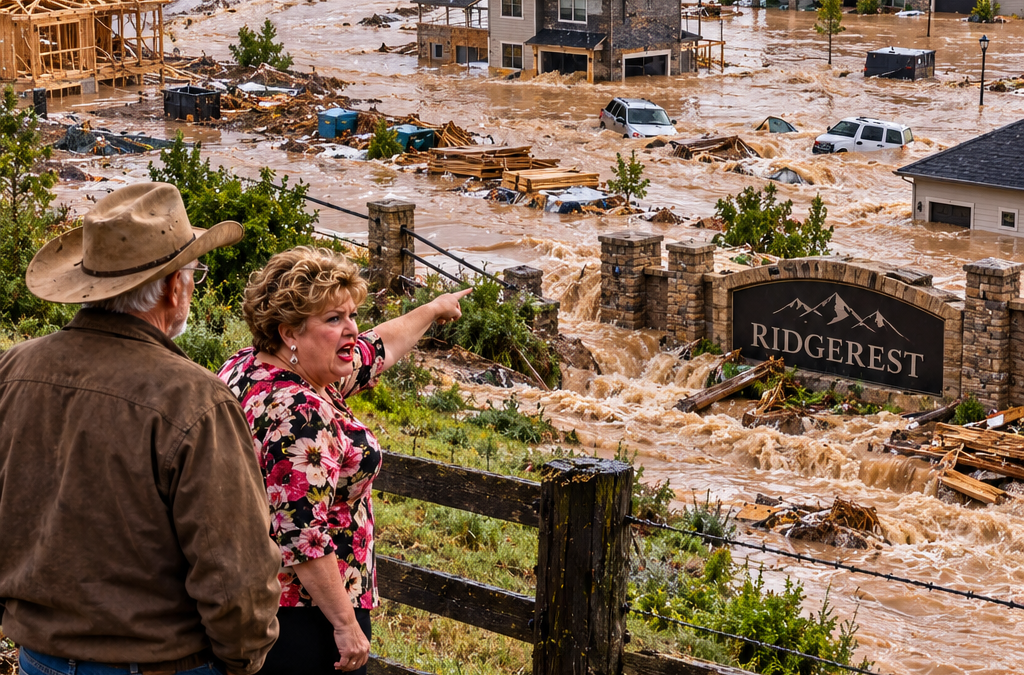
𝗙𝗨𝗟𝗟 𝗦𝗧𝗢𝗥𝗬
Devon had worked in commercial real estate.
I learned later that he had the kind of confidence people often confuse with competence.
He used phrases like strategic growth, asset activation, community footprint, revenue diversification.
He talked about an HOA as though it were a corporation.
Residents loved him at first.
He promised bigger reserves.
Better amenities.
Higher property values.
More influence with the county.
He did not want Ridgerest to remain a neighborhood.
He wanted it to become a brand.
So when the twenty-five-hundred-acre Bell tract came up at auction east of Ridgerest’s existing property, Devon moved fast.
I knew the land was for sale.
Everyone nearby did.
I considered buying part of it years earlier but never had the money or need.
The auction price surprised me.
Ridgerest paid $2.5 million.
Cash and financing arranged through association-backed development entities, according to what later came out in court.
The board voted unanimously.
Their plans appeared almost immediately.
Premium residential expansion.
Two hundred planned home sites in the first phase.
Large lots.
A private lake feature.
Trails.
A second clubhouse eventually.
Landscaped entrances.
The renderings looked beautiful.
They always do.
Renderings do not show mud.
The first Ridgerest survey truck arrived on a clear February morning.
I was checking fence near the eastern pasture when I saw it.
White truck.
Orange flags.
Two men carrying GPS equipment.
Another setting stakes.
I knew where they were standing.
The flood corridor.
I leaned against the fence and watched for maybe twenty minutes.
Then another vehicle arrived.
Black SUV.
Devon Ashcraft stepped out.
I recognized him from the county paper.
Nice jacket.
Polished boots that had never met cattle manure.
He talked with the survey crew while pointing toward different sections of the property.
I thought about going back to the barn.
It wasn’t my land.
Not my problem.
Then I remembered 1968.
And 1997.
I drove over.
There was a county road separating part of our boundary, then fence.
I parked, crossed at the gate, and called toward them.
“Morning.”
One surveyor waved.
Devon looked at me.
“I’m Clarence Whitfield. I farm next door.”
Devon extended a hand.
“Devon Ashcraft. Ridgerest.”
“I know.”
He smiled.
“I suppose everybody does at this point.”
“Seems that way.”
He looked at his watch.
I should have understood that gesture.
“What can I do for you, Mr. Whitfield?”
“I wanted to tell you something about that ground.”
He glanced toward the surveyors.
“I’ve got about five minutes.”
“Won’t need them all.”
I pointed across the depression.
“You see that low cut running southeast to northwest?”
Devon looked.
“The drainage feature?”
“Flood channel.”
His smile stayed.
“The engineering team is reviewing hydrology.”
“Good. Then they’ll know about the Corps survey.”
“What survey?”
“Army Corps. Nineteen forty-nine.”
That got one surveyor’s attention.
He turned slightly.
I continued.
“They mapped this whole watershed after the flood in ’48. That low ground was designated as a secondary overflow channel for Hatchet Creek.”
Devon looked toward it again.
“It hasn’t flooded recently.”
“Not recently enough for you to remember.”
“How often?”
“I’ve seen it carry deep water twice.”
“Twice in how many years?”
“Sixty or so.”
He smiled.
Not rudely at first.
More like a man who had already decided the answer supported him.
“So we’re talking about a very rare event.”
“We’re talking about water six feet deep where you’re standing.”
One of the surveyors stopped writing.
Devon crossed his arms.
“Our civil consultants will model the drainage.”
“I hope they do.”
“We’re not building blindly.”
“I’m not saying you are.”
“You seem concerned.”
“I am.”
He looked at me.
“Why?”
“Because I’ve watched that land longer than your consultants have.”
That was when his expression changed.
Just a little.
There are men who hear experience as help.
There are men who hear it as challenge.
Devon was the second kind.
“With respect, Mr. Whitfield, modern stormwater design is a little different from what farmers were dealing with fifty years ago.”
I felt heat rise in my face.
Not much.
I was too old to waste anger on every foolish sentence.
“I expect water works about the same.”
One surveyor looked down to hide a smile.
Devon did not.
“We appreciate you stopping by.”
I nodded.
Then pointed again toward the low ground.
“If Hatchet Creek gets out, that’s where it’ll go.”
“We’ll take it into consideration.”
“Do more than that.”
His eyebrows rose.
“Excuse me?”
“Get the old survey. Read it before you put anything expensive down there.”
A board member who had arrived behind him laughed softly.
“Mr. Whitfield, we’re not exactly building barns without plans.”
Devon smiled at him.
Then back at me.
“I think we’ve got this under control.”
That should have been the end of it.
I put my hat back on.
“All right.”
As I turned away, I heard the board member say something.
Not loudly.
But loud enough.
“Relic.”
I stopped.
Devon murmured, “Let it go.”
Maybe he was talking to the man.
Maybe to me.
I kept walking.
I had spent enough years around animals to know you cannot force something to respect a fence before it touches the wire.
Eight weeks later, construction started.
On the eastern section first.
Exactly where I had warned them.
The reason became obvious.
Devon wanted visible progress.
The proposed lake feature sat there.
Roads would curve around it.
Several of the most expensive lots faced the water.
Investors and homeowners could be shown machinery moving before the rest of the infrastructure was complete.
The first graders came in March.
Then excavators.
Then culverts.
Then utility crews.
I watched from my property because it was impossible not to.
They cut temporary roads across the depression.
They installed stormwater pipe.
They began trenching for electrical and water lines that would eventually serve around two hundred houses.
They built berms.
Moved soil.
Changed grades.
Not enough to erase the old channel.
You cannot erase a watershed with bulldozers.
You can only make yourself believe you have.
I said nothing in person again.
But I did write a letter.
March 14.
I remember the date because Sylvia made that date important later.
I sat at my kitchen table with the old Corps survey reference beside me and wrote one page.
No threats.
No insults.
No lecture.
I identified myself.
I described the flood channel.
I gave them the Army Corps file number.
ACE-TN-49-2281.
I wrote that I had personally observed significant flood flow through that corridor twice.
I recommended they stop major infrastructure work there until an independent hydrologic assessment confirmed the risk.
Then I signed it.
I made two copies.
One went into my farm file.
One went certified mail to the Ridgerest HOA board.
They received it.
I had the card.
The reply came from their attorney.
One paragraph.
“Mr. Whitfield:
Ridgerest has completed all environmental and development review required by applicable county and state authorities. Your continued unsolicited interference with lawful development activities is neither necessary nor appropriate. Further communications of this nature may be treated as harassment.”
I read that last sentence twice.
Harassment.
I had warned them once in person.
Once in writing.
That was enough to become harassment.
I folded the letter.
Put it with my copy.
Then I stopped talking.
For three months, construction continued.
Spring grew humid.
The ground dried.
Crews worked six days a week.
Devon gave interviews to local business publications about Ridgerest’s expansion.
One photograph showed him standing beside a rendering of the future lake.
He called the development “a model for environmentally conscious growth.”
I clipped that article.
Not because I was planning a lawsuit.
Because Dad had taught me to save paperwork when something felt wrong.
Then the rain started.
It was late June.
The first day did not concern anyone.
Heavy rain in Tennessee is not unusual.
The second day was different.
The ground stopped absorbing.
Water stood in my lower pasture.
Ditches ran full.
Hatchet Creek darkened and widened.
Weather reports said a slow-moving low-pressure system had stalled across the region.
No hurricane.
No tornado outbreak.
Just rain.
Continuous rain.
It drummed on my roof through the night.
By the third morning, I drove down to the creek before breakfast.
The water was high.
Too high.
I stood under an umbrella and watched branches move past in the current.
My neighbor Earl pulled up behind me.
“She’s coming up.”
“Yep.”
“Ridgerest know?”
“They’ve got engineers.”
He looked at me.
“That’s not what I asked.”
I said nothing.
By noon, Hatchet Creek crossed its eastern bank.
Not violently at first.
Water slipped into the lowest ground.
Then widened.
I knew exactly where it was going before I saw it.
The old corridor.
The depression.
The place Devon had called a drainage feature.
Water found it.
It always had.
By evening, the temporary construction road was under.
I stood near my fence in a raincoat while brown water moved across Ridgerest’s land.
Workers were scrambling to move equipment.
One bulldozer made it.
An excavator did not.
A skid steer stalled near a utility trench and had to be abandoned.
On the fourth day, the eastern third of the new acreage was under as much as four feet of water in places.
The lake excavation disappeared beneath a much larger lake nobody had designed.
Fresh grading washed away.
Trenches filled.
Culverts clogged with debris.
Pipe floated.
Access roads became channels.
A stack of construction materials drifted a quarter mile and collected against trees.
I watched.
I did not smile.
People assume I must have felt satisfaction.
I did not.
There is nothing satisfying about watching millions of dollars become mud.
I kept thinking about the workers.
About whoever would have to clean it up.
About the residents whose dues were tied into the project.
About how avoidable it had been.
Earl stood beside me one afternoon.
“You told them.”
“Yep.”
“They listen?”
“You know the answer.”
He looked toward the flood.
“Think they’ll admit it?”
I watched an orange traffic barrel float past.
“No.”
I did not know how right I was.
When the water finally receded, the land looked stripped.
The construction site smelled like wet clay and diesel.
The damage estimate reached approximately $1.4 million.
That number spread quickly.
Then Devon Ashcraft made the decision that turned an engineering failure into something much larger.
He decided the flood needed a human culprit.
And he chose me.
I first heard about it from the local newspaper.
The headline said RIDGEREST INVESTIGATING POSSIBLE DRAINAGE INTERFERENCE.
I opened the article over breakfast.
Devon was quoted.
He said preliminary information suggested modifications on adjacent agricultural land may have redirected stormwater toward the development.
Adjacent agricultural land.
There was only one.
Mine.
Two days later, another article used my name.
Devon called me a “disgruntled neighboring landowner.”
He suggested I had opposed the expansion from the beginning.
Then came the phrase that nearly made me spit out my coffee.
Vindictive conduct.
I read that line again.
Vindictive.
I had warned them.
They had threatened to call my warning harassment.
Now the creek did exactly what I warned them it would do, and somehow I had become the cause.
Three days later, I was served.
Ridgerest HOA v. Clarence Whitfield.
Damages demanded: $1.4 million.
The complaint accused me of intentional interference with natural drainage.
Negligent land management.
Alteration of runoff.
Obstruction of natural outlets.
It claimed I had manipulated conditions on my farm in retaliation for Ridgerest’s development.
I sat on my porch with the complaint across my knees.
For the first time in the entire matter, I felt something close to fear.
Not because their accusations were true.
Because I was seventy-one years old.
I had spent my life working land.
I did not want the last years of it consumed by lawyers and courtrooms.
One-point-four million dollars.
Even a false accusation with that number attached to it can make your stomach feel hollow.
I called Sylvia Okafor.
Sylvia had handled agricultural land cases in our county for two decades.
Quiet woman.
Never wasted a sentence.
Her office walls were filled with survey maps rather than diplomas.
I brought her the lawsuit.
The newspaper articles.
My certified letter.
Their response.
And the old survey.
She looked at the file number.
“Where did you get this?”
“My father had a copy of the original survey reference.”
“Recorded?”
“County deed office should have it.”
She picked up the phone.
Then looked at me.
“Anything else?”
“They bought the property three years ago.”
“I know.”
“Closing documents are public?”
“Some.”
I waited.
She was already thinking.
“Clarence, go home.”
“That’s it?”
“For today.”
“What do I do?”
“Nothing.”
“That’s difficult.”
“I know.”
Three days later, she called.
“Come in.”
I drove to her office.
She had documents spread across her conference table.
The first was the Army Corps survey.
Same file number.
Same flood corridor.
Recorded with the Harwell County Register of Deeds.
Then she slid another document toward me.
Ridgerest’s own property purchase record.
Title materials.
Schedule B exceptions.
Page eleven.
Paragraph four.
Subject to the conditions, limitations, and designations noted in Army Corps of Engineers Survey ACE-TN-49-2281 recorded Harwell County.
I looked at it.
Then at her.
“They had it?”
“It’s in their title package.”
“They bought land subject to this?”
“Yes.”
“They’re suing me over water following a corridor listed in their own closing papers.”
“Yes.”
“Can I ask a legal question?”
“You may.”
“Are they stupid?”
For the first time, Sylvia smiled.
“That is not the legal term I would use.”
“What is?”
“Poorly positioned.”
I laughed.
Then stopped.
“What happens now?”
“I file a motion to dismiss.”
“That easy?”
“No lawsuit is easy.”
“But?”
“But they accused you of creating a drainage event their own recorded title documents identify as a preexisting watershed feature.”
She tapped my certified letter.
“And you warned them in writing.”
Then tapped the attorney’s response.
“And they acknowledged the warning.”
I stared at the documents.
“They knew.”
“At minimum, they should have known.”
“Same thing?”
“In court? Not always. In a title file? Often close enough to become very uncomfortable.”
Sylvia filed the motion.
Ridgerest’s Nashville firm responded aggressively.
They argued that the flood corridor designation did not exclude the possibility of upstream interference.
Sylvia asked them to identify what specific modification I had made.
They could not.
They hired an expert.
The expert inspected my farm.
He found no diversion ditch.
No berm redirecting water.
No new obstruction.
No altered culvert.
No earthwork capable of producing the event they described.
The water had followed topography.
Exactly what the 1949 survey predicted.
The hearing lasted less than thirty minutes.
The judge reviewed the survey.
Reviewed the title exception.
Reviewed the hydrologic evidence.
Then dismissed Ridgerest’s complaint.
I thought that would be the end.
Outside the courthouse, I told Sylvia, “Good.”
She looked at me.
“We aren’t finished.”
“I am.”
“No.”
I frowned.
“Their case is gone.”
“Their lawsuit is gone.”
“Same thing.”
“No.”
She handed me a folder.
Inside were copies of the newspaper articles.
The press release.
The statement calling me vindictive.
The board authorization.
My certified warning.
Their harassment response.
“What is this?”
“The reason we’re not finished.”
I sat on a bench.
“Sylvia, I don’t want revenge.”
“Good.”
“Then why keep going?”
“Because they publicly accused you of intentionally causing a flood after receiving documentary warning that the flood path existed naturally.”
“They lost.”
“That does not restore your name.”
I looked toward the courthouse steps.
People were walking past.
Most had no idea who I was.
But our county was small enough that plenty did.
At the feed store, people had asked.
At church, people had looked at me differently.
A man I had known thirty years had joked about whether I planned to flood anyone else.
He meant nothing by it.
It still hurt.
Sylvia continued.
“They used legal process and public statements to shift responsibility for their own development decision onto you.”
I looked at her.
“What are you proposing?”
“A counterclaim.”
I was silent.
“For what?”
“Defamation. Abuse of process. Harassment-related claims where supported. Fees.”
“Sue the HOA.”
“Yes.”
Then she paused.
“And potentially individuals.”
That got my attention.
“Who?”
“Devon Ashcraft and the board members who authorized the press release.”
“Personally?”
“If evidence supports bad faith conduct outside protected board functions.”
I leaned back.
“Sylvia.”
“Yes?”
“You enjoy this more than you admit.”
“No.”
A pause.
“I enjoy documents.”
That was Sylvia.
She filed the counterclaim that afternoon.
Ridgerest stopped talking to newspapers immediately.
Then discovery began.
What came out made their original lawsuit look worse.
The board had received my March 14 letter.
It had been circulated by email.
One member asked whether the Corps survey should be reviewed.
Devon replied that construction already had approvals and that reopening hydrology would create unnecessary delay.
Another board member asked whether insurance would cover flood damage in the low section.
No answer appeared in the minutes.
The title exception was in the acquisition file.
Ridgerest’s closing attorney had acknowledged it.
A due-diligence checklist included the Corps survey reference.
Yet no one had obtained the full historical survey before construction started.
They spent $2.5 million buying the land.
Then millions more preparing development.
And they did not read the document their own title told them to read.
Worse, after the flood, board emails showed Devon discussing “narrative control.”
That phrase appeared three times.
One email said:
WE NEED TO ESTABLISH EXTERNAL CAUSATION BEFORE HOMEOWNERS ASSUME THIS WAS A DUE-DILIGENCE FAILURE.
External causation.
Me.
In another, a board member asked whether there was evidence I had redirected water.
Devon responded:
WE HAVE ENOUGH CIRCUMSTANTIAL FACTS TO APPLY PRESSURE AND FORCE DISCLOSURE.
They did not have evidence.
They had a strategy.
Pressure first.
Proof later.
Sylvia printed that email.
Placed it in front of me.
“Still think we’re finished?”
I read it twice.
“No.”
Then came the insurance problem.
Ridgerest expected its liability carrier to cover the counterclaim.
The carrier reviewed the allegations and reservation-of-rights issues.
It questioned whether intentionally defamatory public statements and certain board conduct fell within covered governance activity.
Coverage became disputed.
Suddenly some legal bills were no longer safely somebody else’s problem.
Ridgerest had already spent approximately $340,000 with the Nashville law firm by the time our counterclaim gained momentum.
That number stunned homeowners when it became public.
Then costs kept rising.
Depositions.
Experts.
Document review.
Flood engineering.
Insurance counsel.
Development counsel.
Sylvia’s fees.
Over the next eight months, Ridgerest’s combined legal exposure moved past $800,000.
The flood repairs were separate.
So were carrying costs on the undeveloped land.
So were loan payments.
The project stopped.
Not slowed.
Stopped.
Orange fencing surrounded abandoned sections.
Utility trenches were filled for safety.
Equipment left.
The future lake became a muddy excavation collecting weeds.
Then the HOA sent its first special assessment.
Homeowners were furious.
I learned that from a man named Thomas Reed who lived in Ridgerest and stopped by my farm one afternoon.
He stood at the gate awkwardly.
“Mr. Whitfield?”
“Clarence is fine.”
“I’m Thomas.”
He removed his hat.
“I wanted to apologize.”
“For what?”
“I’m a Ridgerest homeowner.”
“Didn’t figure you were selling fertilizer.”
He laughed nervously.
“I believed what they said about you.”
I waited.
“After the flood.”
“I figured some people did.”
“They told us you changed drainage.”
“They told everybody.”
“I voted in favor of funding the lawsuit at the special meeting.”
“All right.”
“I didn’t know about your letter.”
“No.”
“Or the title exception.”
“No.”
He stared toward the east.
“Devon never mentioned any of it.”
“That’s between you and Devon.”
Thomas looked surprised.
“You’re not angry?”
“I was.”
“Not now?”
“I’m too old to keep anger fed.”
He nodded slowly.
“Our second assessment notice came yesterday.”
“I’m sorry.”
“You mean that?”
“Why wouldn’t I?”
He looked at me.
“Because this started with us.”
“No. It started with people making decisions in your name.”
That sentence seemed to land heavily.
Thomas left.
A month later, Devon resigned.
Tuesday morning.
Email.
No explanation.
Just a statement that personal obligations required him to step away immediately.
I read it because someone forwarded it.
The man who had given interviews about Ridgerest’s future disappeared from the board in four paragraphs.
Three other directors remained named in our case.
The HOA elected an interim president.
The new board’s attorney contacted Sylvia about settlement.
She asked me what I wanted.
“Legal fees.”
“Yes.”
“Public correction.”
“Yes.”
“And I want them to stop calling what happened sabotage.”
“That can be addressed.”
“Anything else?”
She looked at me.
“Damages.”
“I don’t need their money.”
“This isn’t charity, Clarence.”
“I know.”
“They accused you publicly of intentionally causing more than a million dollars in destruction.”
“I know.”
“They dragged you through litigation.”
“I know.”
“Then don’t confuse compensation with greed.”
That was one of the few times Sylvia spoke to me sharply.
She was right.
We settled.
The amount remained confidential.
I kept that promise.
The HOA issued a formal statement withdrawing its accusations and acknowledging that no evidence established that I had altered drainage or intentionally contributed to the flood.
The statement did not say they were sorry.
Lawyers rarely write the sentences people actually need.
But it cleared my name.
I thought the worst was over for Ridgerest.
It wasn’t.
The development itself had become poisonous.
Financing tightened.
Flood-risk disclosures became unavoidable.
Engineering costs rose.
Prospective development partners walked away.
Homeowners resisted another special assessment.
Lenders grew impatient.
A lien was recorded against remaining association-controlled assets in connection with outstanding obligations.
The twenty-five hundred acres became less an asset than a weight tied to Ridgerest’s balance sheet.
Eighteen months after the flood, it went to auction.
I had no intention of bidding.
At least that’s what I told Sylvia.
Then the auction notice arrived.
I put it on my kitchen table.
Walked past it for three days.
On the fourth, I drove the fence line.
The Bell tract looked different.
Construction scars remained.
Some roads had washed into rough tracks.
The abandoned lake excavation held reeds.
Volunteer grass covered parts of the graded ground.
But the flood corridor was still there.
Of course it was.
A depression in the land does not care who owns it.
My father had known it.
The Corps had documented it.
I had warned them.
Ridgerest had spent years and millions of dollars learning the same thing.
I called my daughter.
“Thinking about buying the land.”
Silence.
Then, “All twenty-five hundred acres?”
“Maybe.”
“Dad.”
“What?”
“You are seventy-three.”
“I noticed.”
“What are you going to do with twenty-five hundred more acres?”
“Nothing.”
“That’s not an answer.”
“It is.”
She sighed.
“You want it because of them.”
“No.”
“You sure?”
I thought about it.
“Mostly.”
“Mostly is dangerous.”
She was right too.
I called Sylvia.
“Tell me not to bid.”
“No.”
“You aren’t helping.”
“Why do you want it?”
“Because it belongs with the farm.”
“That wasn’t true five years ago.”
“It feels true now.”
“Are you financially comfortable doing it?”
“If the price stays low.”
“Do you intend to develop it?”
“No.”
“Then I don’t see a legal reason to tell you not to bid.”
“I asked for a personal reason.”
“I’m your attorney.”
“Convenient.”
The auction happened on a cold morning.
Far fewer bidders than I expected.
Flood designation.
Failed project.
Title complications.
Infrastructure damage.
Everybody knew the story.
The bidding climbed slowly.
Then stopped.
My final bid was $340,000.
For land Ridgerest had purchased for $2.5 million.
The auctioneer looked around.
Nobody answered.
“Sold.”
Just like that.
I owned the Bell tract.
Again, people assume that moment must have felt like victory.
It did not.
Not exactly.
I felt sad.
So much waste.
Ridgerest could have done things differently.
They could have built outside the corridor.
Designed around it.
Used it as open space.
Created trails along higher ground.
Turned the floodplain into a natural feature instead of trying to force expensive infrastructure across it.
They had twenty-five hundred acres.
They had options.
What they lacked was humility.
I did not develop the land.
I did not build houses.
I did not carve my name into the gate.
I pulled out failed construction debris.
Removed dangerous leftover materials.
Closed unnecessary temporary roads.
Reseeded disturbed soil.
Worked with conservation people on erosion.
Then I let most of it alone.
The flood corridor remained exactly what it had always been.
A flood corridor.
A few people from Ridgerest asked whether I would sell pieces.
No.
One developer offered nearly twice what I paid.
No.
I had seen what the land did when people valued its market potential more than its nature.
I was not interested.
A year later, my neighbor Earl and I stood at the same fence where we had watched construction begin.
The boundary no longer separated my farm from Ridgerest-owned expansion land.
Both sides belonged to me now.
Earl leaned against his truck.
“Feel good?”
“What?”
“Owning it.”
“Feels like more taxes.”
He laughed.
“You know what I mean.”
I looked across the low ground.
“No.”
“No?”
“Not the way people think.”
“They laughed at you.”
“Yep.”
“Called you an old relic.”
“That was one man.”
“They sued you.”
“That was more men.”
“Blamed you for the flood.”
“Yep.”
“And now you own their land.”
I nodded.
Earl shook his head.
“If that happened to me, I’d put up a billboard.”
“What would it say?”
“I told you so.”
I laughed.
“You should never own a billboard.”
He became quiet.
Then asked, “You really don’t feel satisfaction?”
I looked toward Hatchet Creek.
“Some.”
“Ah.”
“But mostly I wish they’d listened.”
The truth was simpler than revenge.
I had tried to save them money.
That sounds strange considering how everything ended, but it’s true.
The morning I walked over to Devon, I was not protecting my land.
I wasn’t trying to stop Ridgerest.
I wasn’t jealous of development.
I didn’t care whether they built luxury houses.
I was telling them something the land had taught my family over generations.
Water goes there.
That was all.
They heard something else.
Old farmer hates progress.
Old man distrusts engineers.
Neighbor protecting his view.
Relic afraid of change.
They mistook my warning for resistance because they had already decided what kind of man I was.
That was their first mistake.
The flood was not punishment.
Rain does not punish.
Terrain does not hold grudges.
Hatchet Creek did not know Devon’s name.
The water simply followed the easiest path downhill.
The consequences came from pretending it would not.
Years later, a young county engineer visited the farm.
He was studying watershed mitigation and wanted access to the old flood corridor.
I walked out with him.
He carried a tablet and modern GPS unit.
We stood near the depression.
“This is it?” he asked.
“This is it.”
He looked around.
“Doesn’t look like much.”
“No.”
“The model shows a huge flow capacity.”
“Yep.”
He walked lower.
“You actually saw six feet through here?”
“About that.”
“When?”
“Sixty-eight. Ninety-seven. Then the Ridgerest flood.”
He shook his head.
“We’re trying to update hazard mapping.”
“Good.”
He looked at me.
“Can I ask you something?”
“Go ahead.”
“Why do you think they built here?”
I thought about Devon.
The polished boots.
The renderings.
The phrase modern stormwater design.
“Because most disasters don’t look like disasters when the weather is nice.”
The young engineer smiled.
Then wrote something down.
I pointed toward the ground.
“You can stand here three hundred sixty days a year and think somebody was foolish for calling this a flood channel.”
“And the other five?”
“You learn why.”
That was the lesson Ridgerest paid millions to learn.
Nature’s warnings are often quiet.
A low place.
An old map.
A line in a title exception.
A farmer standing beside a fence.
Nothing dramatic.
Nothing that looks urgent enough to delay a profitable project.
Then one day the conditions arrive that make every ignored detail matter at once.
I still have Devon’s attorney’s letter.
The one warning that future correspondence might be considered harassment.
It sits in the same folder as my certified-mail receipt.
Beside it is the dismissal order.
Beside that, the settlement paperwork.
And under all of them is a copy of the 1949 Corps survey.
Sometimes my grandson looks through those files.
He’s twenty now.
Studying agricultural engineering.
Last Christmas he asked me about them.
“You really knew they’d flood?”
“I knew they could.”
“That’s different.”
“Very.”
“Did you expect it that year?”
“No.”
“So Devon could say he was unlucky.”
“He was unlucky.”
My grandson looked surprised.
“You think so?”
“Of course.”
“After everything he did?”
“Luck and foolishness can happen at the same time.”
He thought about that.
“What was foolish?”
“Building expensive things where your own deed tells you water goes.”
He nodded.
Then pointed to the lawsuit.
“And suing you?”
“More foolish.”
“Press release?”
“Much more foolish.”
He smiled.
“Buying the land back for three-forty was pretty good.”
“I didn’t buy it back. It wasn’t ours before.”
“You know what I mean.”
I did.
He looked out the window toward the fields.
“Will you leave it undeveloped?”
“That’s the plan.”
“Forever?”
“Nothing is forever.”
“Then what?”
I pointed toward the shelf.
“Read the survey.”
He laughed.
But I meant it.
The next person who owns that land should not have to rely on my memory.
Or my stories.
The documents are there.
The floodplain is mapped.
The title references it.
The county knows.
And now, after Ridgerest, everybody else does too.
The scars from their construction have faded.
Grass covers most of the old graded areas.
The temporary utility trenches are hard to see.
Willows have started growing around the failed lake excavation.
Deer cross the old access road.
Coyotes use it at night.
The land is recovering.
It does that when you let it.
Ridgerest still exists west of there.
The original neighborhood survived.
People still live in those houses.
Most had nothing to do with Devon’s decisions beyond trusting the board they elected.
I never blamed them.
Some lost money through assessments.
Some were angry at me anyway.
Others apologized.
A few started waving when they drove past my place.
Life moved on.
Devon left the county, from what I heard.
I never spoke to him again.
I sometimes wonder what he remembers about our first conversation.
Whether he remembers my hat in my hands.
Whether he remembers me pointing across the low ground.
Whether he remembers exactly what I said.
I do.
“If Hatchet Creek gets out, that’s where it’ll go.”
Nothing clever.
No threat.
No prophecy.
Just a fact.
The kind farmers build their lives around.
A few summers after I bought the tract, we had another heavy rain.
Not as bad as the one that destroyed the Ridgerest development.
But enough.
Hatchet Creek rose.
I drove to the ridge before daylight.
Rain tapped against the windshield.
The old flood channel began carrying water.
Slow at first.
Then stronger.
I parked on high ground and stood beneath my raincoat.
Brown water moved diagonally through the field.
Exactly where it had in 1968.
Exactly where the Corps mapped it in 1949.
Exactly where I had pointed that morning to Devon.
There were no houses there.
No utility crews.
No submerged equipment.
No access road to wash away.
Just grass bending beneath water.
The channel filled.
Carried the overflow.
Then, hours later, slowly emptied.
Nothing was damaged.
Because nothing that mattered had been put in its way.
Earl called me that afternoon.
“How’s your new property?”
“Wet.”
“Flooding?”
“Doing what it’s supposed to do.”
That was the difference.
People call something a disaster when nature interferes with their plans.
Sometimes the disaster was the plan.
The land had been telling the truth all along.
It was there in the contours.
In the creek.
In the Corps survey.
In the title papers Ridgerest signed.
In my father’s memory.
In mine.
Devon believed experience without credentials was ignorance.
He believed newer meant smarter.
He believed enough money, engineers, lawyers, and confidence could make inconvenient facts negotiable.
For a while, they can.
You can argue about risk in a conference room.
You can remove language from a presentation.
You can ignore a letter.
You can call a farmer a relic.
You can even file a lawsuit when reality embarrasses you.
What you cannot do is negotiate with elevation.
Water does not care about a board vote.
It does not read development projections.
It does not know what a premium lot costs.
It goes downhill.
That is why, when people ask me whether I got revenge on Ridgerest, I tell them no.
I never touched their roads.
Never blocked their drainage.
Never redirected a gallon of water.
Never sabotaged a machine.
Never delayed a permit.
I warned them twice.
Then I stepped back.
Everything that happened after that came from decisions they made themselves.
The $2.5 million purchase.
The rushed construction.
The ignored title exception.
The letter calling my warning harassment.
The public accusations.
The lawsuit.
The legal fees.
The assessments.
The collapse of the project.
Those were human choices.
The flood was just water.
Today, when I walk the eastern edge of the farm, there is no Ridgerest development beyond the fence.
Not there.
The land has become part of the farm again.
Cattle graze on some of the high ground.
Other sections stay untouched.
I repaired a few fences.
Cleared construction trash.
That is about it.
People occasionally ask why I did not turn the property into something profitable.
I tell them it already does what it needs to do.
It carries water.
That answer confuses people who measure land only by what can be built on it.
My father would have understood.
Land has value beyond what you can put on top of it.
Sometimes its most valuable job is remaining empty.
I am an old man now.
Older than I was when Devon first called me a relic.
My knees hurt in winter.
I don’t work cattle alone anymore.
My grandson handles more every year.
There are mornings when I sit on the porch instead of checking fence before breakfast.
I have learned to accept that.
But whenever storms gather over Hatchet Creek, I still look east.
Not because I am afraid.
Because I know what the land is doing.
I know where the water will go.
And somewhere in a file drawer inside my house is a letter from a lawyer telling me that warning people about it could be considered harassment.
That still makes me smile.
Not because Ridgerest failed.
Because the truth outlasted their confidence.
My neighbor once asked me if I regretted not saying anything when their construction site went underwater.
“Not even ‘I told you so’?” he asked.
“No.”
“Why not?”
I looked at the flood channel.
“What would be the point?”
He shrugged.
“Might feel good.”
“Maybe.”
“So why didn’t you?”
I thought about Devon standing beside that survey truck years earlier.
About the smile.
The five minutes.
The man behind him calling me a relic.
About all the paper and money and anger that came afterward.
Then I gave Earl the only answer that ever made sense.
“I already told them.”
And the land always gets the last word.
𝗧𝗛𝗘 𝗘𝗡𝗗
The HOA Spent $2.5 Million Building Beside My Farm After Laughing at My Warning About the Land
I told the HOA president exactly what would happen if he built across the low ground beside my farm, and he smiled at me like I was an old man afraid of progress.
Three years later, when the rain came down hard enough to wake Hatchet Creek, I stood at my fence and watched the land answer him for me.
My name is Clarence Whitfield.
By the time Ridgerest came into my life, I was seventy-one years old and had spent almost every one of those years on the same stretch of central Tennessee dirt.
My father farmed it before me.
His father had worked parts of it before him.
We were never wealthy.
People hear that a family owns several hundred acres and imagine money.
Land does not always mean money.
Sometimes it means taxes.
Equipment repairs.
Diesel.
Feed.
Fence posts.
Long summer days when rain refuses to come and winter mornings when you break ice with a steel bar before sunrise because cattle still need water whether your hands hurt or not.
But I loved it.
The farm sat west of Hatchet Creek, mostly pasture broken by wooded ridges and bottomland.
My house was an old two-story place with a tin roof and a porch my father rebuilt in 1968.
The barn leaned slightly north because of a storm that hit when I was twelve.
I had meant to straighten it for fifty years.
At some point, a leaning barn becomes a family member and you stop trying to fix its posture.
I raised cattle most of my life.
Hay too.
A little corn when prices made sense.
Nothing about my operation was modern enough to impress anyone from Nashville.
But it worked.
I knew where water stood after three inches of rain.
I knew which field crusted hard after drought.
I knew which cattle would test a weak gate.
I knew that if clouds came black over the southwest ridge in May, you had about twenty minutes before the first drop hit the barn roof.
And I knew Hatchet Creek.
That creek was as much a part of my life as any person.
Most of the year, it was harmless.
A winding ribbon fifteen to thirty feet across depending on the season.
Children could wade parts of it in summer.
Deer crossed it.
Cattle drank from quieter bends before we fenced them away.
But Hatchet Creek had another personality.
Not every year.
Sometimes not for a decade.
You could almost forget.
Then enough rain would fall upstream, the tributaries would fill, the soil would saturate, and the creek would stop behaving like a creek.
It spread.
And when it spread, it remembered old paths.
One of those paths ran across the land east of my farm.
The property changed hands several times while I was growing up.
Locals called it the Bell tract after the family that had farmed it for years.
Roughly twenty-five hundred acres.
Rolling ground near the road.
Trees farther east.
And one broad, shallow depression cutting diagonally through the eastern third.
You could walk across it on a dry summer day and barely notice the grade.
Maybe your boots would be ten feet lower than they had been a quarter mile earlier.
Nothing dramatic.
But water noticed.
Water always notices.
My father taught me that.
“People look at land from eye level,” he once said. “Water sees it from underneath.”
I did not understand him when I was young.
I did after the flood of 1968.
Hatchet Creek came over its banks after three days of hard rain.
I was fifteen.
The channel across the Bell tract filled first.
By the second day, brown water was moving through that depression deep enough to cover fence posts.
We watched from our hill.
Dad pointed toward it.
“That’s why nobody builds down there.”
The second time I saw it happen was decades later.
Same corridor.
Same direction.
Different storm.
The land had not forgotten.
Most people had.
That mattered when Ridgerest arrived.
Ridgerest began west of town as a modest planned subdivision.
Maybe eighty homes at first.
Nice houses.
Clean streets.
A little clubhouse.
Matching mailboxes.
Nothing unusual.
For years, I had no issue with them.
Why would I?
Their community was miles away.
Then it grew.
New phase.
Another road.
Another set of homes.
A larger pool.
Walking trails.
Then Devon Ashcraft became president of their HOA.
I first heard his name from a neighboring farmer.
“Ridgerest got themselves a businessman now,” he told me at the feed store.
“What were they before?”
“Apparently not business enough.”
Devon had worked in commercial real estate.
I learned later that he had the kind of confidence people often confuse with competence.
He used phrases like strategic growth, asset activation, community footprint, revenue diversification.
He talked about an HOA as though it were a corporation.
Residents loved him at first.
He promised bigger reserves.
Better amenities.
Higher property values.
More influence with the county.
He did not want Ridgerest to remain a neighborhood.
He wanted it to become a brand.
So when the twenty-five-hundred-acre Bell tract came up at auction east of Ridgerest’s existing property, Devon moved fast.
I knew the land was for sale.
Everyone nearby did.
I considered buying part of it years earlier but never had the money or need.
The auction price surprised me.
Ridgerest paid $2.5 million.
Cash and financing arranged through association-backed development entities, according to what later came out in court.
The board voted unanimously.
Their plans appeared almost immediately.
Premium residential expansion.
Two hundred planned home sites in the first phase.
Large lots.
A private lake feature.
Trails.
A second clubhouse eventually.
Landscaped entrances.
The renderings looked beautiful.
They always do.
Renderings do not show mud.
The first Ridgerest survey truck arrived on a clear February morning.
I was checking fence near the eastern pasture when I saw it.
White truck.
Orange flags.
Two men carrying GPS equipment.
Another setting stakes.
I knew where they were standing.
The flood corridor.
I leaned against the fence and watched for maybe twenty minutes.
Then another vehicle arrived.
Black SUV.
Devon Ashcraft stepped out.
I recognized him from the county paper.
Nice jacket.
Polished boots that had never met cattle manure.
He talked with the survey crew while pointing toward different sections of the property.
I thought about going back to the barn.
It wasn’t my land.
Not my problem.
Then I remembered 1968.
And 1997.
I drove over.
There was a county road separating part of our boundary, then fence.
I parked, crossed at the gate, and called toward them.
“Morning.”
One surveyor waved.
Devon looked at me.
“I’m Clarence Whitfield. I farm next door.”
Devon extended a hand.
“Devon Ashcraft. Ridgerest.”
“I know.”
He smiled.
“I suppose everybody does at this point.”
“Seems that way.”
He looked at his watch.
I should have understood that gesture.
“What can I do for you, Mr. Whitfield?”
“I wanted to tell you something about that ground.”
He glanced toward the surveyors.
“I’ve got about five minutes.”
“Won’t need them all.”
I pointed across the depression.
“You see that low cut running southeast to northwest?”
Devon looked.
“The drainage feature?”
“Flood channel.”
His smile stayed.
“The engineering team is reviewing hydrology.”
“Good. Then they’ll know about the Corps survey.”
“What survey?”
“Army Corps. Nineteen forty-nine.”
That got one surveyor’s attention.
He turned slightly.
I continued.
“They mapped this whole watershed after the flood in ’48. That low ground was designated as a secondary overflow channel for Hatchet Creek.”
Devon looked toward it again.
“It hasn’t flooded recently.”
“Not recently enough for you to remember.”
“How often?”
“I’ve seen it carry deep water twice.”
“Twice in how many years?”
“Sixty or so.”
He smiled.
Not rudely at first.
More like a man who had already decided the answer supported him.
“So we’re talking about a very rare event.”
“We’re talking about water six feet deep where you’re standing.”
One of the surveyors stopped writing.
Devon crossed his arms.
“Our civil consultants will model the drainage.”
“I hope they do.”
“We’re not building blindly.”
“I’m not saying you are.”
“You seem concerned.”
“I am.”
He looked at me.
“Why?”
“Because I’ve watched that land longer than your consultants have.”
That was when his expression changed.
Just a little.
There are men who hear experience as help.
There are men who hear it as challenge.
Devon was the second kind.
“With respect, Mr. Whitfield, modern stormwater design is a little different from what farmers were dealing with fifty years ago.”
I felt heat rise in my face.
Not much.
I was too old to waste anger on every foolish sentence.
“I expect water works about the same.”
One surveyor looked down to hide a smile.
Devon did not.
“We appreciate you stopping by.”
I nodded.
Then pointed again toward the low ground.
“If Hatchet Creek gets out, that’s where it’ll go.”
“We’ll take it into consideration.”
“Do more than that.”
His eyebrows rose.
“Excuse me?”
“Get the old survey. Read it before you put anything expensive down there.”
A board member who had arrived behind him laughed softly.
“Mr. Whitfield, we’re not exactly building barns without plans.”
Devon smiled at him.
Then back at me.
“I think we’ve got this under control.”
That should have been the end of it.
I put my hat back on.
“All right.”
As I turned away, I heard the board member say something.
Not loudly.
But loud enough.
“Relic.”
I stopped.
Devon murmured, “Let it go.”
Maybe he was talking to the man.
Maybe to me.
I kept walking.
I had spent enough years around animals to know you cannot force something to respect a fence before it touches the wire.
Eight weeks later, construction started.
On the eastern section first.
Exactly where I had warned them.
The reason became obvious.
Devon wanted visible progress.
The proposed lake feature sat there.
Roads would curve around it.
Several of the most expensive lots faced the water.
Investors and homeowners could be shown machinery moving before the rest of the infrastructure was complete.
The first graders came in March.
Then excavators.
Then culverts.
Then utility crews.
I watched from my property because it was impossible not to.
They cut temporary roads across the depression.
They installed stormwater pipe.
They began trenching for electrical and water lines that would eventually serve around two hundred houses.
They built berms.
Moved soil.
Changed grades.
Not enough to erase the old channel.
You cannot erase a watershed with bulldozers.
You can only make yourself believe you have.
I said nothing in person again.
But I did write a letter.
March 14.
I remember the date because Sylvia made that date important later.
I sat at my kitchen table with the old Corps survey reference beside me and wrote one page.
No threats.
No insults.
No lecture.
I identified myself.
I described the flood channel.
I gave them the Army Corps file number.
ACE-TN-49-2281.
I wrote that I had personally observed significant flood flow through that corridor twice.
I recommended they stop major infrastructure work there until an independent hydrologic assessment confirmed the risk.
Then I signed it.
I made two copies.
One went into my farm file.
One went certified mail to the Ridgerest HOA board.
They received it.
I had the card.
The reply came from their attorney.
One paragraph.
“Mr. Whitfield:
Ridgerest has completed all environmental and development review required by applicable county and state authorities. Your continued unsolicited interference with lawful development activities is neither necessary nor appropriate. Further communications of this nature may be treated as harassment.”
I read that last sentence twice.
Harassment.
I had warned them once in person.
Once in writing.
That was enough to become harassment.
I folded the letter.
Put it with my copy.
Then I stopped talking.
For three months, construction continued.
Spring grew humid.
The ground dried.
Crews worked six days a week.
Devon gave interviews to local business publications about Ridgerest’s expansion.
One photograph showed him standing beside a rendering of the future lake.
He called the development “a model for environmentally conscious growth.”
I clipped that article.
Not because I was planning a lawsuit.
Because Dad had taught me to save paperwork when something felt wrong.
Then the rain started.
It was late June.
The first day did not concern anyone.
Heavy rain in Tennessee is not unusual.
The second day was different.
The ground stopped absorbing.
Water stood in my lower pasture.
Ditches ran full.
Hatchet Creek darkened and widened.
Weather reports said a slow-moving low-pressure system had stalled across the region.
No hurricane.
No tornado outbreak.
Just rain.
Continuous rain.
It drummed on my roof through the night.
By the third morning, I drove down to the creek before breakfast.
The water was high.
Too high.
I stood under an umbrella and watched branches move past in the current.
My neighbor Earl pulled up behind me.
“She’s coming up.”
“Yep.”
“Ridgerest know?”
“They’ve got engineers.”
He looked at me.
“That’s not what I asked.”
I said nothing.
By noon, Hatchet Creek crossed its eastern bank.
Not violently at first.
Water slipped into the lowest ground.
Then widened.
I knew exactly where it was going before I saw it.
The old corridor.
The depression.
The place Devon had called a drainage feature.
Water found it.
It always had.
By evening, the temporary construction road was under.
I stood near my fence in a raincoat while brown water moved across Ridgerest’s land.
Workers were scrambling to move equipment.
One bulldozer made it.
An excavator did not.
A skid steer stalled near a utility trench and had to be abandoned.
On the fourth day, the eastern third of the new acreage was under as much as four feet of water in places.
The lake excavation disappeared beneath a much larger lake nobody had designed.
Fresh grading washed away.
Trenches filled.
Culverts clogged with debris.
Pipe floated.
Access roads became channels.
A stack of construction materials drifted a quarter mile and collected against trees.
I watched.
I did not smile.
People assume I must have felt satisfaction.
I did not.
There is nothing satisfying about watching millions of dollars become mud.
I kept thinking about the workers.
About whoever would have to clean it up.
About the residents whose dues were tied into the project.
About how avoidable it had been.
Earl stood beside me one afternoon.
“You told them.”
“Yep.”
“They listen?”
“You know the answer.”
He looked toward the flood.
“Think they’ll admit it?”
I watched an orange traffic barrel float past.
“No.”
I did not know how right I was.
When the water finally receded, the land looked stripped.
The construction site smelled like wet clay and diesel.
The damage estimate reached approximately $1.4 million.
That number spread quickly.
Then Devon Ashcraft made the decision that turned an engineering failure into something much larger.
He decided the flood needed a human culprit.
And he chose me.
I first heard about it from the local newspaper.
The headline said RIDGEREST INVESTIGATING POSSIBLE DRAINAGE INTERFERENCE.
I opened the article over breakfast.
Devon was quoted.
He said preliminary information suggested modifications on adjacent agricultural land may have redirected stormwater toward the development.
Adjacent agricultural land.
There was only one.
Mine.
Two days later, another article used my name.
Devon called me a “disgruntled neighboring landowner.”
He suggested I had opposed the expansion from the beginning.
Then came the phrase that nearly made me spit out my coffee.
Vindictive conduct.
I read that line again.
Vindictive.
I had warned them.
They had threatened to call my warning harassment.
Now the creek did exactly what I warned them it would do, and somehow I had become the cause.
Three days later, I was served.
Ridgerest HOA v. Clarence Whitfield.
Damages demanded: $1.4 million.
The complaint accused me of intentional interference with natural drainage.
Negligent land management.
Alteration of runoff.
Obstruction of natural outlets.
It claimed I had manipulated conditions on my farm in retaliation for Ridgerest’s development.
I sat on my porch with the complaint across my knees.
For the first time in the entire matter, I felt something close to fear.
Not because their accusations were true.
Because I was seventy-one years old.
I had spent my life working land.
I did not want the last years of it consumed by lawyers and courtrooms.
One-point-four million dollars.
Even a false accusation with that number attached to it can make your stomach feel hollow.
I called Sylvia Okafor.
Sylvia had handled agricultural land cases in our county for two decades.
Quiet woman.
Never wasted a sentence.
Her office walls were filled with survey maps rather than diplomas.
I brought her the lawsuit.
The newspaper articles.
My certified letter.
Their response.
And the old survey.
She looked at the file number.
“Where did you get this?”
“My father had a copy of the original survey reference.”
“Recorded?”
“County deed office should have it.”
She picked up the phone.
Then looked at me.
“Anything else?”
“They bought the property three years ago.”
“I know.”
“Closing documents are public?”
“Some.”
I waited.
She was already thinking.
“Clarence, go home.”
“That’s it?”
“For today.”
“What do I do?”
“Nothing.”
“That’s difficult.”
“I know.”
Three days later, she called.
“Come in.”
I drove to her office.
She had documents spread across her conference table.
The first was the Army Corps survey.
Same file number.
Same flood corridor.
Recorded with the Harwell County Register of Deeds.
Then she slid another document toward me.
Ridgerest’s own property purchase record.
Title materials.
Schedule B exceptions.
Page eleven.
Paragraph four.
Subject to the conditions, limitations, and designations noted in Army Corps of Engineers Survey ACE-TN-49-2281 recorded Harwell County.
I looked at it.
Then at her.
“They had it?”
“It’s in their title package.”
“They bought land subject to this?”
“Yes.”
“They’re suing me over water following a corridor listed in their own closing papers.”
“Yes.”
“Can I ask a legal question?”
“You may.”
“Are they stupid?”
For the first time, Sylvia smiled.
“That is not the legal term I would use.”
“What is?”
“Poorly positioned.”
I laughed.
Then stopped.
“What happens now?”
“I file a motion to dismiss.”
“That easy?”
“No lawsuit is easy.”
“But?”
“But they accused you of creating a drainage event their own recorded title documents identify as a preexisting watershed feature.”
She tapped my certified letter.
“And you warned them in writing.”
Then tapped the attorney’s response.
“And they acknowledged the warning.”
I stared at the documents.
“They knew.”
“At minimum, they should have known.”
“Same thing?”
“In court? Not always. In a title file? Often close enough to become very uncomfortable.”
Sylvia filed the motion.
Ridgerest’s Nashville firm responded aggressively.
They argued that the flood corridor designation did not exclude the possibility of upstream interference.
Sylvia asked them to identify what specific modification I had made.
They could not.
They hired an expert.
The expert inspected my farm.
He found no diversion ditch.
No berm redirecting water.
No new obstruction.
No altered culvert.
No earthwork capable of producing the event they described.
The water had followed topography.
Exactly what the 1949 survey predicted.
The hearing lasted less than thirty minutes.
The judge reviewed the survey.
Reviewed the title exception.
Reviewed the hydrologic evidence.
Then dismissed Ridgerest’s complaint.
I thought that would be the end.
Outside the courthouse, I told Sylvia, “Good.”
She looked at me.
“We aren’t finished.”
“I am.”
“No.”
I frowned.
“Their case is gone.”
“Their lawsuit is gone.”
“Same thing.”
“No.”
She handed me a folder.
Inside were copies of the newspaper articles.
The press release.
The statement calling me vindictive.
The board authorization.
My certified warning.
Their harassment response.
“What is this?”
“The reason we’re not finished.”
I sat on a bench.
“Sylvia, I don’t want revenge.”
“Good.”
“Then why keep going?”
“Because they publicly accused you of intentionally causing a flood after receiving documentary warning that the flood path existed naturally.”
“They lost.”
“That does not restore your name.”
I looked toward the courthouse steps.
People were walking past.
Most had no idea who I was.
But our county was small enough that plenty did.
At the feed store, people had asked.
At church, people had looked at me differently.
A man I had known thirty years had joked about whether I planned to flood anyone else.
He meant nothing by it.
It still hurt.
Sylvia continued.
“They used legal process and public statements to shift responsibility for their own development decision onto you.”
I looked at her.
“What are you proposing?”
“A counterclaim.”
I was silent.
“For what?”
“Defamation. Abuse of process. Harassment-related claims where supported. Fees.”
“Sue the HOA.”
“Yes.”
Then she paused.
“And potentially individuals.”
That got my attention.
“Who?”
“Devon Ashcraft and the board members who authorized the press release.”
“Personally?”
“If evidence supports bad faith conduct outside protected board functions.”
I leaned back.
“Sylvia.”
“Yes?”
“You enjoy this more than you admit.”
“No.”
A pause.
“I enjoy documents.”
That was Sylvia.
She filed the counterclaim that afternoon.
Ridgerest stopped talking to newspapers immediately.
Then discovery began.
What came out made their original lawsuit look worse.
The board had received my March 14 letter.
It had been circulated by email.
One member asked whether the Corps survey should be reviewed.
Devon replied that construction already had approvals and that reopening hydrology would create unnecessary delay.
Another board member asked whether insurance would cover flood damage in the low section.
No answer appeared in the minutes.
The title exception was in the acquisition file.
Ridgerest’s closing attorney had acknowledged it.
A due-diligence checklist included the Corps survey reference.
Yet no one had obtained the full historical survey before construction started.
They spent $2.5 million buying the land.
Then millions more preparing development.
And they did not read the document their own title told them to read.
Worse, after the flood, board emails showed Devon discussing “narrative control.”
That phrase appeared three times.
One email said:
WE NEED TO ESTABLISH EXTERNAL CAUSATION BEFORE HOMEOWNERS ASSUME THIS WAS A DUE-DILIGENCE FAILURE.
External causation.
Me.
In another, a board member asked whether there was evidence I had redirected water.
Devon responded:
WE HAVE ENOUGH CIRCUMSTANTIAL FACTS TO APPLY PRESSURE AND FORCE DISCLOSURE.
They did not have evidence.
They had a strategy.
Pressure first.
Proof later.
Sylvia printed that email.
Placed it in front of me.
“Still think we’re finished?”
I read it twice.
“No.”
Then came the insurance problem.
Ridgerest expected its liability carrier to cover the counterclaim.
The carrier reviewed the allegations and reservation-of-rights issues.
It questioned whether intentionally defamatory public statements and certain board conduct fell within covered governance activity.
Coverage became disputed.
Suddenly some legal bills were no longer safely somebody else’s problem.
Ridgerest had already spent approximately $340,000 with the Nashville law firm by the time our counterclaim gained momentum.
That number stunned homeowners when it became public.
Then costs kept rising.
Depositions.
Experts.
Document review.
Flood engineering.
Insurance counsel.
Development counsel.
Sylvia’s fees.
Over the next eight months, Ridgerest’s combined legal exposure moved past $800,000.
The flood repairs were separate.
So were carrying costs on the undeveloped land.
So were loan payments.
The project stopped.
Not slowed.
Stopped.
Orange fencing surrounded abandoned sections.
Utility trenches were filled for safety.
Equipment left.
The future lake became a muddy excavation collecting weeds.
Then the HOA sent its first special assessment.
Homeowners were furious.
I learned that from a man named Thomas Reed who lived in Ridgerest and stopped by my farm one afternoon.
He stood at the gate awkwardly.
“Mr. Whitfield?”
“Clarence is fine.”
“I’m Thomas.”
He removed his hat.
“I wanted to apologize.”
“For what?”
“I’m a Ridgerest homeowner.”
“Didn’t figure you were selling fertilizer.”
He laughed nervously.
“I believed what they said about you.”
I waited.
“After the flood.”
“I figured some people did.”
“They told us you changed drainage.”
“They told everybody.”
“I voted in favor of funding the lawsuit at the special meeting.”
“All right.”
“I didn’t know about your letter.”
“No.”
“Or the title exception.”
“No.”
He stared toward the east.
“Devon never mentioned any of it.”
“That’s between you and Devon.”
Thomas looked surprised.
“You’re not angry?”
“I was.”
“Not now?”
“I’m too old to keep anger fed.”
He nodded slowly.
“Our second assessment notice came yesterday.”
“I’m sorry.”
“You mean that?”
“Why wouldn’t I?”
He looked at me.
“Because this started with us.”
“No. It started with people making decisions in your name.”
That sentence seemed to land heavily.
Thomas left.
A month later, Devon resigned.
Tuesday morning.
Email.
No explanation.
Just a statement that personal obligations required him to step away immediately.
I read it because someone forwarded it.
The man who had given interviews about Ridgerest’s future disappeared from the board in four paragraphs.
Three other directors remained named in our case.
The HOA elected an interim president.
The new board’s attorney contacted Sylvia about settlement.
She asked me what I wanted.
“Legal fees.”
“Yes.”
“Public correction.”
“Yes.”
“And I want them to stop calling what happened sabotage.”
“That can be addressed.”
“Anything else?”
She looked at me.
“Damages.”
“I don’t need their money.”
“This isn’t charity, Clarence.”
“I know.”
“They accused you publicly of intentionally causing more than a million dollars in destruction.”
“I know.”
“They dragged you through litigation.”
“I know.”
“Then don’t confuse compensation with greed.”
That was one of the few times Sylvia spoke to me sharply.
She was right.
We settled.
The amount remained confidential.
I kept that promise.
The HOA issued a formal statement withdrawing its accusations and acknowledging that no evidence established that I had altered drainage or intentionally contributed to the flood.
The statement did not say they were sorry.
Lawyers rarely write the sentences people actually need.
But it cleared my name.
I thought the worst was over for Ridgerest.
It wasn’t.
The development itself had become poisonous.
Financing tightened.
Flood-risk disclosures became unavoidable.
Engineering costs rose.
Prospective development partners walked away.
Homeowners resisted another special assessment.
Lenders grew impatient.
A lien was recorded against remaining association-controlled assets in connection with outstanding obligations.
The twenty-five hundred acres became less an asset than a weight tied to Ridgerest’s balance sheet.
Eighteen months after the flood, it went to auction.
I had no intention of bidding.
At least that’s what I told Sylvia.
Then the auction notice arrived.
I put it on my kitchen table.
Walked past it for three days.
On the fourth, I drove the fence line.
The Bell tract looked different.
Construction scars remained.
Some roads had washed into rough tracks.
The abandoned lake excavation held reeds.
Volunteer grass covered parts of the graded ground.
But the flood corridor was still there.
Of course it was.
A depression in the land does not care who owns it.
My father had known it.
The Corps had documented it.
I had warned them.
Ridgerest had spent years and millions of dollars learning the same thing.
I called my daughter.
“Thinking about buying the land.”
Silence.
Then, “All twenty-five hundred acres?”
“Maybe.”
“Dad.”
“What?”
“You are seventy-three.”
“I noticed.”
“What are you going to do with twenty-five hundred more acres?”
“Nothing.”
“That’s not an answer.”
“It is.”
She sighed.
“You want it because of them.”
“No.”
“You sure?”
I thought about it.
“Mostly.”
“Mostly is dangerous.”
She was right too.
I called Sylvia.
“Tell me not to bid.”
“No.”
“You aren’t helping.”
“Why do you want it?”
“Because it belongs with the farm.”
“That wasn’t true five years ago.”
“It feels true now.”
“Are you financially comfortable doing it?”
“If the price stays low.”
“Do you intend to develop it?”
“No.”
“Then I don’t see a legal reason to tell you not to bid.”
“I asked for a personal reason.”
“I’m your attorney.”
“Convenient.”
The auction happened on a cold morning.
Far fewer bidders than I expected.
Flood designation.
Failed project.
Title complications.
Infrastructure damage.
Everybody knew the story.
The bidding climbed slowly.
Then stopped.
My final bid was $340,000.
For land Ridgerest had purchased for $2.5 million.
The auctioneer looked around.
Nobody answered.
“Sold.”
Just like that.
I owned the Bell tract.
Again, people assume that moment must have felt like victory.
It did not.
Not exactly.
I felt sad.
So much waste.
Ridgerest could have done things differently.
They could have built outside the corridor.
Designed around it.
Used it as open space.
Created trails along higher ground.
Turned the floodplain into a natural feature instead of trying to force expensive infrastructure across it.
They had twenty-five hundred acres.
They had options.
What they lacked was humility.
I did not develop the land.
I did not build houses.
I did not carve my name into the gate.
I pulled out failed construction debris.
Removed dangerous leftover materials.
Closed unnecessary temporary roads.
Reseeded disturbed soil.
Worked with conservation people on erosion.
Then I let most of it alone.
The flood corridor remained exactly what it had always been.
A flood corridor.
A few people from Ridgerest asked whether I would sell pieces.
No.
One developer offered nearly twice what I paid.
No.
I had seen what the land did when people valued its market potential more than its nature.
I was not interested.
A year later, my neighbor Earl and I stood at the same fence where we had watched construction begin.
The boundary no longer separated my farm from Ridgerest-owned expansion land.
Both sides belonged to me now.
Earl leaned against his truck.
“Feel good?”
“What?”
“Owning it.”
“Feels like more taxes.”
He laughed.
“You know what I mean.”
I looked across the low ground.
“No.”
“No?”
“Not the way people think.”
“They laughed at you.”
“Yep.”
“Called you an old relic.”
“That was one man.”
“They sued you.”
“That was more men.”
“Blamed you for the flood.”
“Yep.”
“And now you own their land.”
I nodded.
Earl shook his head.
“If that happened to me, I’d put up a billboard.”
“What would it say?”
“I told you so.”
I laughed.
“You should never own a billboard.”
He became quiet.
Then asked, “You really don’t feel satisfaction?”
I looked toward Hatchet Creek.
“Some.”
“Ah.”
“But mostly I wish they’d listened.”
The truth was simpler than revenge.
I had tried to save them money.
That sounds strange considering how everything ended, but it’s true.
The morning I walked over to Devon, I was not protecting my land.
I wasn’t trying to stop Ridgerest.
I wasn’t jealous of development.
I didn’t care whether they built luxury houses.
I was telling them something the land had taught my family over generations.
Water goes there.
That was all.
They heard something else.
Old farmer hates progress.
Old man distrusts engineers.
Neighbor protecting his view.
Relic afraid of change.
They mistook my warning for resistance because they had already decided what kind of man I was.
That was their first mistake.
The flood was not punishment.
Rain does not punish.
Terrain does not hold grudges.
Hatchet Creek did not know Devon’s name.
The water simply followed the easiest path downhill.
The consequences came from pretending it would not.
Years later, a young county engineer visited the farm.
He was studying watershed mitigation and wanted access to the old flood corridor.
I walked out with him.
He carried a tablet and modern GPS unit.
We stood near the depression.
“This is it?” he asked.
“This is it.”
He looked around.
“Doesn’t look like much.”
“No.”
“The model shows a huge flow capacity.”
“Yep.”
He walked lower.
“You actually saw six feet through here?”
“About that.”
“When?”
“Sixty-eight. Ninety-seven. Then the Ridgerest flood.”
He shook his head.
“We’re trying to update hazard mapping.”
“Good.”
He looked at me.
“Can I ask you something?”
“Go ahead.”
“Why do you think they built here?”
I thought about Devon.
The polished boots.
The renderings.
The phrase modern stormwater design.
“Because most disasters don’t look like disasters when the weather is nice.”
The young engineer smiled.
Then wrote something down.
I pointed toward the ground.
“You can stand here three hundred sixty days a year and think somebody was foolish for calling this a flood channel.”
“And the other five?”
“You learn why.”
That was the lesson Ridgerest paid millions to learn.
Nature’s warnings are often quiet.
A low place.
An old map.
A line in a title exception.
A farmer standing beside a fence.
Nothing dramatic.
Nothing that looks urgent enough to delay a profitable project.
Then one day the conditions arrive that make every ignored detail matter at once.
I still have Devon’s attorney’s letter.
The one warning that future correspondence might be considered harassment.
It sits in the same folder as my certified-mail receipt.
Beside it is the dismissal order.
Beside that, the settlement paperwork.
And under all of them is a copy of the 1949 Corps survey.
Sometimes my grandson looks through those files.
He’s twenty now.
Studying agricultural engineering.
Last Christmas he asked me about them.
“You really knew they’d flood?”
“I knew they could.”
“That’s different.”
“Very.”
“Did you expect it that year?”
“No.”
“So Devon could say he was unlucky.”
“He was unlucky.”
My grandson looked surprised.
“You think so?”
“Of course.”
“After everything he did?”
“Luck and foolishness can happen at the same time.”
He thought about that.
“What was foolish?”
“Building expensive things where your own deed tells you water goes.”
He nodded.
Then pointed to the lawsuit.
“And suing you?”
“More foolish.”
“Press release?”
“Much more foolish.”
He smiled.
“Buying the land back for three-forty was pretty good.”
“I didn’t buy it back. It wasn’t ours before.”
“You know what I mean.”
I did.
He looked out the window toward the fields.
“Will you leave it undeveloped?”
“That’s the plan.”
“Forever?”
“Nothing is forever.”
“Then what?”
I pointed toward the shelf.
“Read the survey.”
He laughed.
But I meant it.
The next person who owns that land should not have to rely on my memory.
Or my stories.
The documents are there.
The floodplain is mapped.
The title references it.
The county knows.
And now, after Ridgerest, everybody else does too.
The scars from their construction have faded.
Grass covers most of the old graded areas.
The temporary utility trenches are hard to see.
Willows have started growing around the failed lake excavation.
Deer cross the old access road.
Coyotes use it at night.
The land is recovering.
It does that when you let it.
Ridgerest still exists west of there.
The original neighborhood survived.
People still live in those houses.
Most had nothing to do with Devon’s decisions beyond trusting the board they elected.
I never blamed them.
Some lost money through assessments.
Some were angry at me anyway.
Others apologized.
A few started waving when they drove past my place.
Life moved on.
Devon left the county, from what I heard.
I never spoke to him again.
I sometimes wonder what he remembers about our first conversation.
Whether he remembers my hat in my hands.
Whether he remembers me pointing across the low ground.
Whether he remembers exactly what I said.
I do.
“If Hatchet Creek gets out, that’s where it’ll go.”
Nothing clever.
No threat.
No prophecy.
Just a fact.
The kind farmers build their lives around.
A few summers after I bought the tract, we had another heavy rain.
Not as bad as the one that destroyed the Ridgerest development.
But enough.
Hatchet Creek rose.
I drove to the ridge before daylight.
Rain tapped against the windshield.
The old flood channel began carrying water.
Slow at first.
Then stronger.
I parked on high ground and stood beneath my raincoat.
Brown water moved diagonally through the field.
Exactly where it had in 1968.
Exactly where the Corps mapped it in 1949.
Exactly where I had pointed that morning to Devon.
There were no houses there.
No utility crews.
No submerged equipment.
No access road to wash away.
Just grass bending beneath water.
The channel filled.
Carried the overflow.
Then, hours later, slowly emptied.
Nothing was damaged.
Because nothing that mattered had been put in its way.
Earl called me that afternoon.
“How’s your new property?”
“Wet.”
“Flooding?”
“Doing what it’s supposed to do.”
That was the difference.
People call something a disaster when nature interferes with their plans.
Sometimes the disaster was the plan.
The land had been telling the truth all along.
It was there in the contours.
In the creek.
In the Corps survey.
In the title papers Ridgerest signed.
In my father’s memory.
In mine.
Devon believed experience without credentials was ignorance.
He believed newer meant smarter.
He believed enough money, engineers, lawyers, and confidence could make inconvenient facts negotiable.
For a while, they can.
You can argue about risk in a conference room.
You can remove language from a presentation.
You can ignore a letter.
You can call a farmer a relic.
You can even file a lawsuit when reality embarrasses you.
What you cannot do is negotiate with elevation.
Water does not care about a board vote.
It does not read development projections.
It does not know what a premium lot costs.
It goes downhill.
That is why, when people ask me whether I got revenge on Ridgerest, I tell them no.
I never touched their roads.
Never blocked their drainage.
Never redirected a gallon of water.
Never sabotaged a machine.
Never delayed a permit.
I warned them twice.
Then I stepped back.
Everything that happened after that came from decisions they made themselves.
The $2.5 million purchase.
The rushed construction.
The ignored title exception.
The letter calling my warning harassment.
The public accusations.
The lawsuit.
The legal fees.
The assessments.
The collapse of the project.
Those were human choices.
The flood was just water.
Today, when I walk the eastern edge of the farm, there is no Ridgerest development beyond the fence.
Not there.
The land has become part of the farm again.
Cattle graze on some of the high ground.
Other sections stay untouched.
I repaired a few fences.
Cleared construction trash.
That is about it.
People occasionally ask why I did not turn the property into something profitable.
I tell them it already does what it needs to do.
It carries water.
That answer confuses people who measure land only by what can be built on it.
My father would have understood.
Land has value beyond what you can put on top of it.
Sometimes its most valuable job is remaining empty.
I am an old man now.
Older than I was when Devon first called me a relic.
My knees hurt in winter.
I don’t work cattle alone anymore.
My grandson handles more every year.
There are mornings when I sit on the porch instead of checking fence before breakfast.
I have learned to accept that.
But whenever storms gather over Hatchet Creek, I still look east.
Not because I am afraid.
Because I know what the land is doing.
I know where the water will go.
And somewhere in a file drawer inside my house is a letter from a lawyer telling me that warning people about it could be considered harassment.
That still makes me smile.
Not because Ridgerest failed.
Because the truth outlasted their confidence.
My neighbor once asked me if I regretted not saying anything when their construction site went underwater.
“Not even ‘I told you so’?” he asked.
“No.”
“Why not?”
I looked at the flood channel.
“What would be the point?”
He shrugged.
“Might feel good.”
“Maybe.”
“So why didn’t you?”
I thought about Devon standing beside that survey truck years earlier.
About the smile.
The five minutes.
The man behind him calling me a relic.
About all the paper and money and anger that came afterward.
Then I gave Earl the only answer that ever made sense.
“I already told them.”
And the land always gets the last word.








