𝗙𝗨𝗟𝗟 𝗦𝗧𝗢𝗥𝗬 The HOA Sold VIP Parking on My $4,000 Abandoned Runway—Then My Deed Destroyed Their Entire Festival Plan
𝗣𝗔𝗥𝗧 𝟮
I took photographs.
Wide shots.
Close shots.
The sign.
The cone lines.
The runway pavement.
The parcel markers I had already found along the edge.
Then I called the county property office and left a message asking for confirmation of my recorded parcel boundaries.
While I was still on the phone, Karen arrived.
Her white SUV came down the access road too fast, dust rolling behind it. She stepped out wearing sunglasses, heels, a cream blazer over the red dress, and the expression of a woman arriving to discipline a trespasser.
She looked at me.
Then at my truck.
Then at the sign.
“You can’t park there.”
I looked around.
“On my own land?”
Her smile tightened.
“This area is reserved.”
“For whom?”
“Festival VIP guests.”
“Who reserved it?”
“The HOA.”
“From me?”
She laughed softly.
“Don’t start.”
That was her first mistake.
She didn’t ask who I was.
She didn’t ask why I was there.
She assumed I was another person to be managed.
I folded my arms.
“Karen, who gave the HOA permission to use this runway?”
Her eyes narrowed.
“So you are the new buyer.”
“I am.”
“We were wondering when you’d show up.”
“Before or after you sold parking spaces on my property?”
Her face hardened.
“This runway has always served Willow Ridge events.”
“No, it hasn’t.”
“It has been treated as community overflow space for years.”
“By whom?”
“The association.”
“That doesn’t answer the question.”
She opened her folder.
“We have event authorization.”
“From the property owner?”
“The HOA board approved the festival plan.”
“The HOA board doesn’t own this parcel.”
“The runway is within the Willow Ridge activity zone.”
I almost admired the phrase.
Activity zone.
Meaningless, but confident.
“Show me the document giving the HOA control of the runway.”
She pulled out several pages clipped together and slapped them against the hood of her SUV.
“Here.”
I looked at them.
Festival map.
Parking plan.
Vendor schedule.
Security layout.
HOA approval sheet.
No deed.
No lease.
No license agreement.
No temporary-use contract.
No recorded easement.
Nothing with my name.
Nothing with the parcel number I had purchased.
“This is your event paperwork,” I said.
“Correct.”
“It doesn’t authorize use of my land.”
“It authorizes festival operations.”
“On HOA land.”
“On festival-designated property.”
“Karen.”
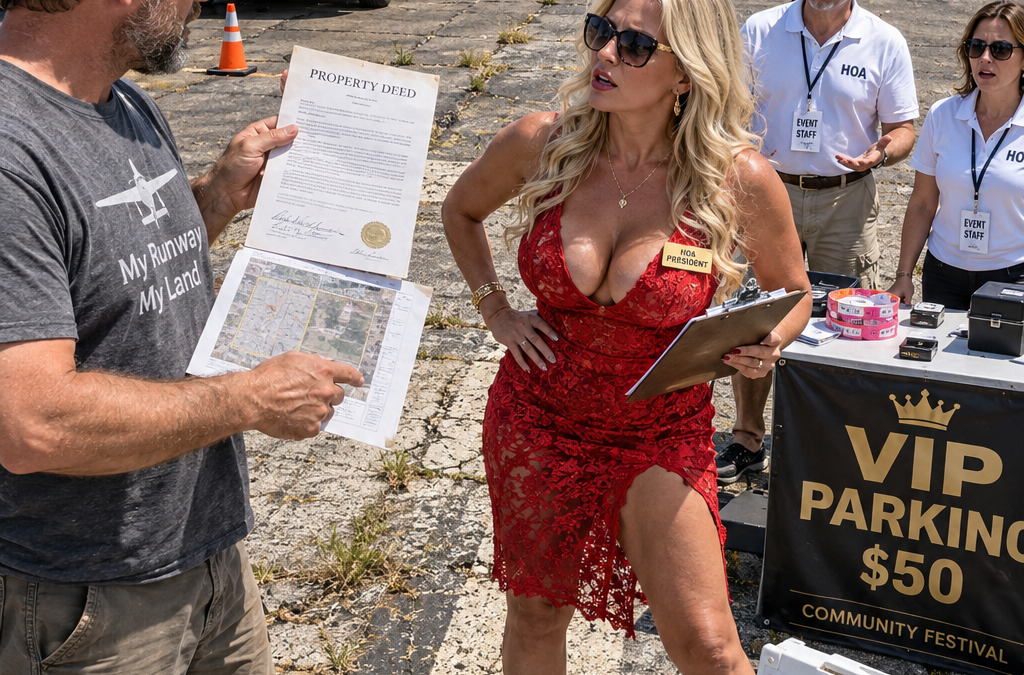
I reached into my truck and pulled out a copy of the deed.
“I bought this parcel.”
She looked at the document as if it smelled bad.
I opened to the parcel number.
“This number matches the runway property.”
She barely glanced.
“That’s outdated.”
I stared at her.
“Outdated?”
“The HOA has managed this space for years.”
“Managing something you don’t own doesn’t make it yours.”
“The community has relied on this airstrip for overflow parking.”
“Then the community has been trespassing.”
Her eyes flashed.
“Do not use inflammatory language.”
“Then don’t use my property without permission.”
She leaned closer.
“Listen to me carefully. This festival has been planned for six months. Every VIP parking space is sold. Sponsors are arriving. Guests are arriving. Vendors are already set up. You are not going to sabotage a community event because you found some old paperwork and want attention.”
My jaw tightened.
“Some old paperwork is my deed.”
“Your deed does not override established community use.”
“Yes, Karen. It does.”
She smiled coldly.
“You really don’t understand how things work here yet.”
I looked down the runway at the freshly placed cones.
“I understand exactly how things work. You assumed nobody would notice until cars were already parked.”
For the first time, her expression flickered.
Just slightly.
Enough.
I had hit the truth.
She had not intended to ask.
She had intended to use the land first and argue later.
By nine o’clock, the first cars started arriving.
Luxury SUVs.
Sports cars.
Polished sedans.
People holding prepaid passes out their windows.
The attendants waved them through.
I stepped toward the entrance.
Karen moved in front of me.
“Do not interfere with traffic.”
“This is my property.”
“You can take it up with the board after the festival.”
“No.”
She lowered her voice.
“Daniel, you need to think very carefully. If you disrupt an event with hundreds of residents and paying guests, people will remember.”
“Good.”
She blinked.
“I want them to remember who sold them parking on land she didn’t own.”
Her cheeks flushed.
“You’re being unreasonable.”
“No, Karen. You are charging people for my runway.”
She snapped her fingers at one of the attendants.
“Keep the line moving.”
The attendant hesitated.
“Ma’am, he says he owns it.”
“He says many things. Move the cars.”
Cars rolled onto the runway.
One after another.
Every vehicle that passed felt like another dollar collected from my property without permission.
I didn’t step in front of them.
I didn’t shout at the guests.
I didn’t damage the signs.
I simply kept recording.
Karen watched me.
“What are you doing?”
“Documenting.”
“For what?”
“Whatever comes next.”
That made her angry.
People like Karen hate documentation because documentation does not get intimidated.
By 10:30, the runway looked like a luxury dealership.
Rows of SUVs and private cars stretched along the cracked pavement. Temporary signs directed guests toward the festival entrance. A volunteer golf cart shuttled people to the clubhouse.
The HOA had turned my four-thousand-dollar airstrip into a paid parking operation.
Without permission.
Without a lease.
Without even the courtesy of a phone call.
I stepped away and called the county property office again.
This time, I reached a clerk named Marlene.
I gave her the parcel number.
She pulled the record.
“Yes,” she said. “That parcel includes the former runway strip.”
“All of it?”
“According to the recorded description, yes.”
“Does Willow Ridge HOA appear as owner?”
“No.”
“Any recorded easement for festival parking?”
“I don’t see one in the index.”
“Can you email confirmation?”
“I can send the public parcel summary and recording references.”
“Please.”
Five minutes later, the email arrived.
I opened it on my phone.
Parcel number.
Owner: Daniel Mercer.
Description including the runway boundary.
Recorded document reference.
No HOA ownership.
No recorded parking easement.
I walked back toward Karen.
She was speaking with two board members near the VIP table.
When she saw my face, her smile disappeared.
“The county confirms the runway is mine.”
She took one look at the phone and immediately looked away.
“We are not litigating by email.”
“No. We’re litigating by deed.”
“The festival is already underway.”
“That is your problem.”
“Do you have any idea what moving these cars would do?”
“Yes.”
“It would create chaos.”
“You created it.”
She stepped close enough that the board members could not easily hear.
“If you force this issue today, I will make sure every resident in Willow Ridge knows you ruined their festival.”
I looked past her at the rows of cars.
“You sold every one of those spaces without checking who owned the runway.”
“We relied on association maps.”
“Your maps are wrong.”
“They have been accepted for years.”
“Not by the county.”
Her lips tightened.
“You’re enjoying this.”
“No.”
I pointed at the sign.
“I bought quiet land. You put a VIP parking sign on it.”
One board member, a man named Peter, finally stepped forward.
“Karen, maybe we should check the association property map.”
She turned on him.
“Not now.”
“Now seems like exactly when.”
Her eyes narrowed.
“Peter.”
He flinched.
But another board member, Denise, joined him.
“If the parcel number isn’t ours, we need to know.”
Karen’s face went red.
“We cannot move hundreds of cars based on his phone screen.”
I said, “Call the county yourself.”
Nobody moved.
So I held out my phone.
“Here. Call Marlene.”
Karen didn’t take it.
Denise did.
Ten minutes later, the board members were huddled inside the HOA event office, surrounded by printed maps, festival schedules, vendor paperwork, and panic.
I stood outside the door and listened to the controlled collapse.
Peter: “The boundary stops before the runway.”
Karen: “That’s the old version.”
Denise: “This is from our own file.”
Karen: “Then the file is incomplete.”
Another member: “Did we ever lease the runway?”
Silence.
Karen: “The community has always used it.”
Peter: “That doesn’t answer the question.”
Another silence.
Then Denise said the sentence that mattered.
“We sold premium parking on land we don’t own.”
Nobody spoke after that.
I walked back to the runway entrance.
The VIP lot was still filling.
More guests were arriving.
More attendants were waving cars through.
More people were walking from my land to the festival with wristbands and drink tickets.
I did not want to punish them.
Most had no idea.
They had paid for parking because the HOA sold it to them.
My issue was not with families trying to attend a festival.
It was with the woman who had monetized my property and then tried to bully me into accepting it because the fraud was already profitable.
So I did the simplest thing possible.
I placed a clear private-property notice at the entrance.
PRIVATE PROPERTY
RUNWAY PARCEL OWNED BY DANIEL MERCER
NO PARKING OR EVENT USE WITHOUT OWNER PERMISSION
I did not block cars already inside.
I did not trap anyone.
I did not damage a single cone.
I did not confront guests.
I simply posted the truth where everyone entering could see it.
Within minutes, Karen came storming back.
“What do you think you’re doing?”
“Notifying people.”
“You are creating panic.”
“No. I’m creating clarity.”
“You cannot post hostile signage during a community event.”
“It’s my property.”
“Stop saying that.”
I stared at her.
That sentence told me everything.
Stop saying that.
Not because it was false.
Because it was true, and the truth was destroying her plan.
She reached for the sign.
I stepped between her and it.
“Do not touch it.”
Her eyes widened.
“Are you threatening me?”
“No. I’m warning you not to remove a private-property notice from private property.”
She looked around.
People were watching now.
Guests.
Volunteers.
Board members.
Even a sheriff’s deputy working festival traffic had begun walking toward us.
Karen saw him and immediately changed her tone.
“Deputy, thank goodness.”
I almost laughed.
Karen always believed uniforms existed for her benefit.
The deputy approached.
“What’s going on?”
Karen spoke first.
“This man is disrupting our authorized festival parking operation.”
I handed him the deed copy.
“This is my runway parcel. The HOA sold parking on it without permission.”
The deputy looked from me to Karen.
Then at the rows of cars.
Then at the sign.
“Who owns the property?”
Karen said, “The HOA has used it for years.”
The deputy looked at her.
“That wasn’t my question.”
Her expression tightened.
“We have community-use rights.”
“Do you have documentation?”
She opened her folder and produced the festival map.
The deputy examined it.
Then looked at my deed.
“This is an event map.”
“It shows the runway inside the festival zone.”
“Does it show ownership?”
“It shows the approved parking area.”
He handed it back.
“That’s not ownership.”
Karen’s jaw flexed.
I showed him the county email.
He read it.
“County confirms the parcel is yours?”
“Yes.”
“Any lease agreement with the HOA?”
“No.”
“Did you give permission?”
“No.”
The deputy looked at Karen.
“Ma’am?”
Karen’s voice sharpened.
“This is a civil property dispute.”
“Maybe. But if you don’t have authority to use the land, you can’t continue sending vehicles onto it after being notified.”
Her eyes flashed.
“The event is already underway.”
“Then you need to solve the parking problem without creating a bigger one.”
Peter arrived carrying the HOA’s own property map.
His face looked pale.
“Deputy?”
Karen turned.
“Peter, don’t.”
He ignored her.
“Our map shows the boundary stopping before the runway.”
That sentence cut through the air.
Karen looked at him like he had betrayed her.
Maybe in her mind he had.
He had chosen the map over the performance.
The deputy nodded.
“Then start redirecting incoming cars.”
Karen said, “Absolutely not.”
Everyone looked at her.
She lifted her chin.
“We cannot dismantle VIP parking in the middle of the festival.”
The deputy’s voice stayed calm.
“You can move future arrivals and arrange for vehicles already parked to leave safely.”
“We sold these spaces.”
“That doesn’t create permission.”
“We’ll refund if necessary.”
“That may be wise.”
Karen glared at me.
“This is extortion.”
I laughed once despite myself.
“You charged people to park on my land, and I’m extorting you?”
Her face burned.
The deputy stepped slightly between us.
“Let’s keep this calm.”
A county property representative arrived thirty minutes later because Marlene had apparently escalated the issue after my second call.
His name was Harold Jenkins, and he carried a tablet, a printed parcel map, and the weary expression of a man who had seen too many people argue with recorded boundaries.
He walked the entrance.
Checked the parcel number.
Located the survey marker near the north edge.
Compared it with the runway line.
Then another marker near the drainage easement.
Karen followed him the entire time, talking.
“The HOA has relied on this area for community functions.”
“The previous developer represented this as available.”
“The residents understand it as part of Willow Ridge.”
“The festival plan was approved.”
Harold let her talk until he finished measuring.
Then he looked up.
“The runway is inside Mr. Mercer’s parcel.”
Karen stopped.
The board members stopped.
The deputy stopped.
Even I felt the finality of it.
Harold pointed toward the line.
“The HOA boundary stops before the runway. Your event plan crosses onto private property.”
Karen’s mouth opened.
No sound came out.
That was the first time all day she had no sentence ready.
The deputy turned to the board.
“Incoming parking needs to be redirected.”
Denise nodded immediately.
“Yes.”
Peter said, “We’ll move signs.”
Karen spun toward them.
“We are not surrendering our premium lot because of one man’s opportunism.”
Denise stared at her.
“Karen, it’s his land.”
“He bought it for nothing.”
I looked at her.
That sentence revealed the rot underneath everything.
Because I bought it cheaply, she thought it mattered less.
Because everyone else overlooked it, she thought it was available.
Because the HOA wanted it, she thought desire could replace ownership.
“I paid what the seller accepted,” I said.
“And I recorded the deed.”
Karen’s eyes narrowed.
“You knew the festival was coming.”
“No, Karen. You knew I owned the land and hoped the festival would be too far underway by the time I objected.”
That landed.
Several people turned toward her.
For the first time, suspicion moved openly through the board.
Had she known?
Had she gambled?
Had she assumed I would cave because the parking spaces were already sold?
Karen didn’t answer.
She didn’t need to.
Her silence did enough.
The collapse happened faster than I expected.
First, the VIP PARKING sign came down.
Then the attendants stopped allowing new cars onto the runway.
Then volunteers began redirecting incoming vehicles toward a gravel overflow area near the south festival entrance.
It was less convenient.
Farther walk.
Less glamorous.
Not what guests had paid for.
But it was on land the HOA actually controlled.
Golf carts were reassigned to shuttle people from the new lot.
Board members scrambled with radios.
Guests complained.
Sponsors asked questions.
Someone demanded refunds.
Someone else yelled about “premium parking” becoming “premium confusion.”
Through it all, Karen stood near the runway entrance, furious and powerless, watching her beautiful parking plan disappear one sign at a time.
She tried to save the optics.
“We are making a temporary adjustment due to an unexpected title issue.”
Harold Jenkins heard her and said dryly, “It isn’t unexpected now.”
I liked him immediately.
By sunset, the runway was clear again.
The last parked SUV rolled off my property under volunteer direction.
The cones were removed.
The velvet rope vanished.
The check-in table folded.
The orange fencing came down.
No luxury cars.
No VIP attendants.
No HOA signs.
Just the old abandoned runway, cracked and quiet under the evening light.
Exactly as it had been when I bought it.
I stood in the middle of the asphalt and looked down its length.
Four thousand dollars.
That was all I had paid.
Everyone thought I had bought nothing.
Karen thought she could use it because, in her mind, worthless land became valuable only when the HOA found a use for it.
But the deed had been valuable from the moment it was recorded.
The land had been mine before her festival signs touched it.
The runway had been mine before the first prepaid parking pass was sold.
The truth had been sitting in the closing documents the whole time.
That evening, the HOA board held an emergency meeting in the event office.
I wasn’t invited.
I didn’t need to be.
Peter later told me what happened.
The board reviewed their maps.
Their boundary line stopped before the runway.
Their festival plan extended beyond the boundary.
Their VIP parking revenue had been collected for land not under HOA control.
Karen insisted it had been an honest mistake.
Denise asked why nobody checked the parcel after I bought it.
Karen said she had assumed historical use would continue.
Peter asked whether “historical use” had ever been documented.
No answer.
Another board member asked whether guests would need refunds.
Karen said refunds would make the HOA look guilty.
Denise replied that selling parking on private land already did that.
By the end of the night, the board had removed Karen from unilateral festival-planning authority and required legal review of all future event maps.
I didn’t hear that part until the next morning.
By then, I was back at the airstrip.
Just walking.
The sun had burned the dew off the weeds.
Tire marks from the VIP lot remained faintly visible in dust along the runway.
I picked up a forgotten plastic parking tag near the edge.
VIP – ROW B.
I turned it over in my hand.
Someone had paid the HOA for Row B.
Row B had never belonged to them.
That was the entire story in one object.
I kept it.
Not as a trophy.
As a reminder.
Assumption is expensive when it starts collecting money.
Over the next week, I went back through every closing document.
Not because I doubted ownership.
Because I wanted to understand exactly how everyone else had missed it.
The deed was clear.
The parcel number was clear.
The runway boundary was clear.
The county record was clear.
The survey markers matched.
The HOA’s mistake wasn’t hidden in some obscure legal maze.
It was visible to anyone who cared enough to check.
That was why Karen’s behavior bothered me more than an ordinary misunderstanding would have.
Mistakes happen.
Maps can be old.
Boundaries can be confusing.
But when I showed her the deed, she didn’t pause.
She didn’t say, “Let’s verify.”
She didn’t call the county.
She didn’t halt the parking operation until the facts were clear.
She looked at the document, called it outdated, and kept selling access to land she didn’t own because stopping would embarrass her.
That was Karen.
The truth mattered only after it became impossible to ignore.
A few days later, she came to the airstrip alone.
No clipboard this time.
No board members.
No SUV blocking the entrance.
Just Karen in sunglasses, standing at the edge of the runway as though stepping fully onto it might admit defeat.
“You made your point,” she said.
I looked up from measuring a section of pavement.
“Did I?”
“The board is rewriting event procedures.”
“Good.”
“Guests were inconvenienced.”
“You should apologize to them.”
Her mouth tightened.
“The festival lost money.”
“You should have checked the deed.”
She took off her sunglasses.
For once, she looked tired.
Still angry.
But tired.
“Do you know how much work goes into planning something like that?”
“Yes.”
“No, you don’t.”
“I know it should include asking permission before using private land.”
Her eyes flashed.
“There it is again. Private land. Private land. Private land. You’re enjoying saying it.”
“I’m enjoying the fact that it’s true.”
She stepped closer.
“You bought this for four thousand dollars.”
“Yes.”
“Do you know what that parking operation was worth?”
“Apparently more than the HOA was willing to pay me.”
“Would you have agreed?”
“If someone had asked? Maybe.”
She froze.
That hit harder than I expected.
Because it exposed the stupidity of all of it.
Had Karen come to me before the festival and said, “We need overflow parking, can we lease the runway for one weekend?” I might have negotiated. I might have said yes for a fee. I might have even let them use part of it for free if they handled insurance, cleanup, and safety correctly.
But Karen never asked.
Because asking would have acknowledged I had the right to say no.
She could not tolerate that.
“You could have helped the community,” she said.
“I could have.”
“You chose not to.”
“No. You chose not to ask.”
For a long moment, she had no answer.
Then she put her sunglasses back on.
“This isn’t over.”
I smiled.
“Karen, the survey marker is right there.”
I pointed toward the edge of the runway.
“The deed is recorded. The county confirmed it. The board changed the plan. The VIP signs are gone. It is over.”
She looked down the runway, jaw tight.
Then she turned and walked back to her SUV.
That was the last time she tried to call the airstrip HOA property.
Not the last time she glared at me during neighborhood events.
But words matter less when the record is settled.
In the months after the festival, the airstrip became oddly famous around Willow Ridge.
People called it “the four-thousand-dollar runway.”
Some said it like a joke.
Some said it with admiration.
A few residents approached me quietly and apologized.
One man told me he had paid for VIP parking and had no idea the HOA didn’t own the land.
A woman said she had always assumed the runway belonged to Willow Ridge because Karen talked about it like it did.
That was the dangerous part.
Karen had said it often enough that people believed it.
Not because she had proof.
Because she had confidence.
Confidence can build a false reality if nobody checks the paperwork.
But false realities collapse fast when a county map gets unfolded.
I eventually cleared part of the runway.
Not all of it.
Just enough to make access easier and mark the property clearly.
I installed signs of my own.
PRIVATE PROPERTY
NO PARKING WITHOUT WRITTEN PERMISSION
Simple.
Direct.
Hard to misinterpret.
I also had a surveyor re-mark the boundaries.
Bright stakes.
Recorded map update.
No more “activity zone.”
No more “festival-designated space.”
No more vague HOA language.
Line here.
My land here.
HOA land there.
Amazing how peaceful things become when imaginary authority meets physical markers.
People asked what I planned to do with the airstrip.
I still wasn’t sure.
Maybe lease it occasionally for approved events.
Maybe store equipment.
Maybe restore enough of it for private use someday if regulations allowed.
Maybe nothing.
That was the part Karen never understood.
I didn’t need an immediate plan to own it.
I didn’t need to justify my purchase by making it useful to her.
Ownership is not conditional on somebody else’s imagination.
The runway could sit quietly for another ten years, and it would still be mine.
That was enough.
The next summer, Willow Ridge held the festival again.
This time, the parking map stopped at the HOA boundary.
There was an overflow lot on actual HOA land.
Smaller.
Less glamorous.
More walking.
No velvet rope.
No “premium runway experience.”
And not one tire crossed my parcel.
Karen didn’t run the parking plan that year.
Denise did.
She sent me a courtesy letter two months before the event with a copy of their route map and a note:
We have confirmed the revised festival layout does not use your runway parcel. Please let us know if you see any issue.
I laughed when I read it.
Not because it was funny.
Because that was all Karen had needed to do.
Ask.
Verify.
Respect the answer.
Three simple steps that could have saved the HOA an entire public embarrassment.
I wrote back:
No issue. Thank you for confirming.
That was it.
No fight.
No drama.
No deputy.
No county representative.
No collapsing VIP operation.
Just adults using documents the way they were meant to be used.
Sometimes people ask whether buying that airstrip was the best investment I ever made.
Financially, maybe.
Maybe not.
I don’t know what it’s worth now.
The land is still odd.
Still narrow.
Still cracked.
Still covered in weeds along the edges.
But value isn’t always immediate resale value.
Sometimes value is control.
Sometimes value is knowing exactly where your boundary runs.
Sometimes value is being able to stand in front of a woman like Karen Whitfield while she waves a glossy event map in your face and say, calmly, “No.”
No, you don’t own this.
No, your board approval doesn’t override my deed.
No, your festival revenue doesn’t create permission.
No, your assumption doesn’t become law because you printed signs.
That four-thousand-dollar runway taught Willow Ridge something it should have learned long before.
Property is not determined by confidence.
It is not determined by convenience.
It is not determined by how long someone has been getting away with using something.
It is determined by records.
Deeds.
Surveys.
Parcel numbers.
Boundaries.
The HOA sold VIP parking before learning who owned the runway.
One deed and one county confirmation changed the entire festival plan.
And by sunset, the airstrip everyone thought was worthless had done something very valuable.
It reminded Karen Whitfield that pretending to own land is not the same thing as owning it.
𝗧𝗛𝗘 𝗘𝗡𝗗
The HOA Sold VIP Parking on My $4,000 Abandoned Runway—Then My Deed Destroyed Their Entire Festival Plan
I bought the abandoned airstrip for four thousand dollars, and everyone in town laughed like I had just paid money for weeds.
They said I had bought a strip of cracked pavement.
A useless runway no plane had touched in years.
A dead piece of land behind a subdivision that nobody wanted, nobody maintained, and nobody had any real use for.
One man at the county office actually chuckled when I signed the closing paperwork.
“Planning to start an airline?” he asked.
I smiled and said, “No. I just like quiet land.”
That was true enough.
At least, it was true then.
I had no idea that a few weeks later, the Willow Ridge HOA would try to turn that same forgotten runway into a paid VIP parking lot for their biggest community festival of the year.
I had no idea they would charge hundreds of visitors to park on land they didn’t own.
I had no idea Karen Whitfield would stand in the middle of my runway with a clipboard in her hand, look me straight in the eye, and tell me the deed in my pocket didn’t matter because the HOA had already sold the spaces.
And I definitely had no idea that the most valuable thing I bought for four thousand dollars wasn’t the land.
It was the recorded boundary description everybody else had been too arrogant to read.
My name is Daniel Mercer, and the first time I walked the old airstrip, I thought it was beautiful in the sad, stubborn way abandoned places can be beautiful.
The runway stretched through tall grass at the edge of Willow Ridge Estates, long and straight, its faded asphalt cracked by weeds and sun. The white markings were almost gone. Rusted tie-down rings sat half buried along one side. A collapsed windsock pole leaned near the far end like it had simply gotten tired of standing.
It had once been a private airstrip back when the surrounding land was mostly farms, fields, and scattered homes. Then the subdivision came in. The airport activity stopped. The hangar was torn down. The access road became overgrown. For years, people treated the place like a leftover scar behind the neighborhood.
When the parcel came up for sale through a county tax process, nobody wanted it.
Too narrow for a normal development.
Too rough for easy resale.
Too odd for most buyers.
I saw it differently.
I wasn’t trying to build houses.
I wasn’t trying to start a business.
I liked the idea of owning a long, quiet piece of land where I could store equipment, maybe restore part of the old pavement someday, maybe just keep it as open space.
Four thousand dollars was not nothing to me.
But compared with what land usually cost near Willow Ridge, it felt almost impossible.
So I bought it.
The paperwork was plain.
Parcel number.
Legal description.
Boundaries.
Access language.
The entire runway sat inside the parcel.
Not beside it.
Not partially touching it.
Inside it.
The deed included the runway strip from the north marker to the drainage easement near the south tree line. The recorded map matched the description. The old airstrip, ugly as it looked, was mine.
I walked it the day after closing with the documents folded in my back pocket.
There were no HOA signs.
No private-event signs.
No community-property markers.
No posted claim from Willow Ridge.
Just weeds, cracked asphalt, birds, and the hot smell of summer rising off old pavement.
I thought that meant the issue was simple.
The land was mine.
The runway was mine.
The HOA had nothing to do with it.
That assumption lasted exactly three weeks.
The first strange thing I noticed was traffic.
Willow Ridge had been preparing for its annual summer festival, the kind of event suburban HOAs treat like a cross between a county fair and a royal coronation.
Food trucks.
Craft booths.
Bounce houses.
Live music.
Wine tent.
Local sponsors.
A classic-car display.
A ridiculous “premium hospitality zone” near the clubhouse for people willing to pay extra.
I didn’t care.
Their festival was their business.
Then, two days before the event, I drove past the old access road and saw men in reflective vests cutting back weeds near my runway entrance.
I slowed down.
One of them was pounding a wooden stake into the ground.
Another was unrolling orange temporary fencing.
A third was carrying metal sign frames from a trailer.
I pulled over.
“Who authorized this?”
The nearest worker looked up.
“HOA event prep.”
“On this property?”
He pointed toward the subdivision.
“Festival parking.”
I stared at him.
“Parking where?”
He gestured down the old runway.
“VIP lot.”
For a second, I thought I had misheard.
“VIP lot?”
“Yeah. Premium parking. Sold out, I think.”
I got out of the truck.
The worker noticed my expression and immediately stopped talking.
“Who’s in charge?”
“Uh… Mrs. Whitfield.”
Of course.
Karen Whitfield.
HOA president.
Self-appointed ruler of Willow Ridge.
A woman who could turn a missing trash-can lid into a legal threat if it gave her a reason to stand in front of people and announce rules.
She was forty, polished, blonde, and beautiful in a way she wielded like a blade. She wore expensive perfume, red lipstick, and the same fitted red lace dress so often that half the neighborhood had started calling it her “enforcement uniform” behind her back.
Nobody said it to her face.
Karen didn’t forgive humiliation.
If she disliked you, violation notices appeared like weeds after rain.
If you challenged her at a meeting, your mailbox was suddenly the wrong color.
If you asked for documents, she called you hostile.
If you beat her with documents, she called you dangerous.
I had never had any reason to deal with her directly before buying the airstrip.
That changed the next morning.
I arrived just after sunrise to find a huge sign installed at the entrance to my runway.
WILLOW RIDGE SUMMER FESTIVAL
PREMIUM VIP PARKING
PREPAID PASSES ONLY
Below that, in smaller letters:
HOA AUTHORIZED ACCESS
I stood in front of the sign and laughed once.
Not because it was funny.
Because the alternative was ripping it out of the ground.
Cars were not arriving yet, but the setup was already obvious. The HOA had marked parking rows along the old runway with cones and flags. Temporary attendants had been assigned. A portable check-in station stood near the entrance. Someone had even placed a velvet rope beside a folding table as if my cracked abandoned airstrip had become a luxury venue overnight.
I took photographs.
Wide shots.
Close shots.
The sign.
The cone lines.
The runway pavement.
The parcel markers I had already found along the edge.
Then I called the county property office and left a message asking for confirmation of my recorded parcel boundaries.
While I was still on the phone, Karen arrived.
Her white SUV came down the access road too fast, dust rolling behind it. She stepped out wearing sunglasses, heels, a cream blazer over the red dress, and the expression of a woman arriving to discipline a trespasser.
She looked at me.
Then at my truck.
Then at the sign.
“You can’t park there.”
I looked around.
“On my own land?”
Her smile tightened.
“This area is reserved.”
“For whom?”
“Festival VIP guests.”
“Who reserved it?”
“The HOA.”
“From me?”
She laughed softly.
“Don’t start.”
That was her first mistake.
She didn’t ask who I was.
She didn’t ask why I was there.
She assumed I was another person to be managed.
I folded my arms.
“Karen, who gave the HOA permission to use this runway?”
Her eyes narrowed.
“So you are the new buyer.”
“I am.”
“We were wondering when you’d show up.”
“Before or after you sold parking spaces on my property?”
Her face hardened.
“This runway has always served Willow Ridge events.”
“No, it hasn’t.”
“It has been treated as community overflow space for years.”
“By whom?”
“The association.”
“That doesn’t answer the question.”
She opened her folder.
“We have event authorization.”
“From the property owner?”
“The HOA board approved the festival plan.”
“The HOA board doesn’t own this parcel.”
“The runway is within the Willow Ridge activity zone.”
I almost admired the phrase.
Activity zone.
Meaningless, but confident.
“Show me the document giving the HOA control of the runway.”
She pulled out several pages clipped together and slapped them against the hood of her SUV.
“Here.”
I looked at them.
Festival map.
Parking plan.
Vendor schedule.
Security layout.
HOA approval sheet.
No deed.
No lease.
No license agreement.
No temporary-use contract.
No recorded easement.
Nothing with my name.
Nothing with the parcel number I had purchased.
“This is your event paperwork,” I said.
“Correct.”
“It doesn’t authorize use of my land.”
“It authorizes festival operations.”
“On HOA land.”
“On festival-designated property.”
“Karen.”
I reached into my truck and pulled out a copy of the deed.
“I bought this parcel.”
She looked at the document as if it smelled bad.
I opened to the parcel number.
“This number matches the runway property.”
She barely glanced.
“That’s outdated.”
I stared at her.
“Outdated?”
“The HOA has managed this space for years.”
“Managing something you don’t own doesn’t make it yours.”
“The community has relied on this airstrip for overflow parking.”
“Then the community has been trespassing.”
Her eyes flashed.
“Do not use inflammatory language.”
“Then don’t use my property without permission.”
She leaned closer.
“Listen to me carefully. This festival has been planned for six months. Every VIP parking space is sold. Sponsors are arriving. Guests are arriving. Vendors are already set up. You are not going to sabotage a community event because you found some old paperwork and want attention.”
My jaw tightened.
“Some old paperwork is my deed.”
“Your deed does not override established community use.”
“Yes, Karen. It does.”
She smiled coldly.
“You really don’t understand how things work here yet.”
I looked down the runway at the freshly placed cones.
“I understand exactly how things work. You assumed nobody would notice until cars were already parked.”
For the first time, her expression flickered.
Just slightly.
Enough.
I had hit the truth.
She had not intended to ask.
She had intended to use the land first and argue later.
By nine o’clock, the first cars started arriving.
Luxury SUVs.
Sports cars.
Polished sedans.
People holding prepaid passes out their windows.
The attendants waved them through.
I stepped toward the entrance.
Karen moved in front of me.
“Do not interfere with traffic.”
“This is my property.”
“You can take it up with the board after the festival.”
“No.”
She lowered her voice.
“Daniel, you need to think very carefully. If you disrupt an event with hundreds of residents and paying guests, people will remember.”
“Good.”
She blinked.
“I want them to remember who sold them parking on land she didn’t own.”
Her cheeks flushed.
“You’re being unreasonable.”
“No, Karen. You are charging people for my runway.”
She snapped her fingers at one of the attendants.
“Keep the line moving.”
The attendant hesitated.
“Ma’am, he says he owns it.”
“He says many things. Move the cars.”
Cars rolled onto the runway.
One after another.
Every vehicle that passed felt like another dollar collected from my property without permission.
I didn’t step in front of them.
I didn’t shout at the guests.
I didn’t damage the signs.
I simply kept recording.
Karen watched me.
“What are you doing?”
“Documenting.”
“For what?”
“Whatever comes next.”
That made her angry.
People like Karen hate documentation because documentation does not get intimidated.
By 10:30, the runway looked like a luxury dealership.
Rows of SUVs and private cars stretched along the cracked pavement. Temporary signs directed guests toward the festival entrance. A volunteer golf cart shuttled people to the clubhouse.
The HOA had turned my four-thousand-dollar airstrip into a paid parking operation.
Without permission.
Without a lease.
Without even the courtesy of a phone call.
I stepped away and called the county property office again.
This time, I reached a clerk named Marlene.
I gave her the parcel number.
She pulled the record.
“Yes,” she said. “That parcel includes the former runway strip.”
“All of it?”
“According to the recorded description, yes.”
“Does Willow Ridge HOA appear as owner?”
“No.”
“Any recorded easement for festival parking?”
“I don’t see one in the index.”
“Can you email confirmation?”
“I can send the public parcel summary and recording references.”
“Please.”
Five minutes later, the email arrived.
I opened it on my phone.
Parcel number.
Owner: Daniel Mercer.
Description including the runway boundary.
Recorded document reference.
No HOA ownership.
No recorded parking easement.
I walked back toward Karen.
She was speaking with two board members near the VIP table.
When she saw my face, her smile disappeared.
“The county confirms the runway is mine.”
She took one look at the phone and immediately looked away.
“We are not litigating by email.”
“No. We’re litigating by deed.”
“The festival is already underway.”
“That is your problem.”
“Do you have any idea what moving these cars would do?”
“Yes.”
“It would create chaos.”
“You created it.”
She stepped close enough that the board members could not easily hear.
“If you force this issue today, I will make sure every resident in Willow Ridge knows you ruined their festival.”
I looked past her at the rows of cars.
“You sold every one of those spaces without checking who owned the runway.”
“We relied on association maps.”
“Your maps are wrong.”
“They have been accepted for years.”
“Not by the county.”
Her lips tightened.
“You’re enjoying this.”
“No.”
I pointed at the sign.
“I bought quiet land. You put a VIP parking sign on it.”
One board member, a man named Peter, finally stepped forward.
“Karen, maybe we should check the association property map.”
She turned on him.
“Not now.”
“Now seems like exactly when.”
Her eyes narrowed.
“Peter.”
He flinched.
But another board member, Denise, joined him.
“If the parcel number isn’t ours, we need to know.”
Karen’s face went red.
“We cannot move hundreds of cars based on his phone screen.”
I said, “Call the county yourself.”
Nobody moved.
So I held out my phone.
“Here. Call Marlene.”
Karen didn’t take it.
Denise did.
Ten minutes later, the board members were huddled inside the HOA event office, surrounded by printed maps, festival schedules, vendor paperwork, and panic.
I stood outside the door and listened to the controlled collapse.
Peter: “The boundary stops before the runway.”
Karen: “That’s the old version.”
Denise: “This is from our own file.”
Karen: “Then the file is incomplete.”
Another member: “Did we ever lease the runway?”
Silence.
Karen: “The community has always used it.”
Peter: “That doesn’t answer the question.”
Another silence.
Then Denise said the sentence that mattered.
“We sold premium parking on land we don’t own.”
Nobody spoke after that.
I walked back to the runway entrance.
The VIP lot was still filling.
More guests were arriving.
More attendants were waving cars through.
More people were walking from my land to the festival with wristbands and drink tickets.
I did not want to punish them.
Most had no idea.
They had paid for parking because the HOA sold it to them.
My issue was not with families trying to attend a festival.
It was with the woman who had monetized my property and then tried to bully me into accepting it because the fraud was already profitable.
So I did the simplest thing possible.
I placed a clear private-property notice at the entrance.
PRIVATE PROPERTY
RUNWAY PARCEL OWNED BY DANIEL MERCER
NO PARKING OR EVENT USE WITHOUT OWNER PERMISSION
I did not block cars already inside.
I did not trap anyone.
I did not damage a single cone.
I did not confront guests.
I simply posted the truth where everyone entering could see it.
Within minutes, Karen came storming back.
“What do you think you’re doing?”
“Notifying people.”
“You are creating panic.”
“No. I’m creating clarity.”
“You cannot post hostile signage during a community event.”
“It’s my property.”
“Stop saying that.”
I stared at her.
That sentence told me everything.
Stop saying that.
Not because it was false.
Because it was true, and the truth was destroying her plan.
She reached for the sign.
I stepped between her and it.
“Do not touch it.”
Her eyes widened.
“Are you threatening me?”
“No. I’m warning you not to remove a private-property notice from private property.”
She looked around.
People were watching now.
Guests.
Volunteers.
Board members.
Even a sheriff’s deputy working festival traffic had begun walking toward us.
Karen saw him and immediately changed her tone.
“Deputy, thank goodness.”
I almost laughed.
Karen always believed uniforms existed for her benefit.
The deputy approached.
“What’s going on?”
Karen spoke first.
“This man is disrupting our authorized festival parking operation.”
I handed him the deed copy.
“This is my runway parcel. The HOA sold parking on it without permission.”
The deputy looked from me to Karen.
Then at the rows of cars.
Then at the sign.
“Who owns the property?”
Karen said, “The HOA has used it for years.”
The deputy looked at her.
“That wasn’t my question.”
Her expression tightened.
“We have community-use rights.”
“Do you have documentation?”
She opened her folder and produced the festival map.
The deputy examined it.
Then looked at my deed.
“This is an event map.”
“It shows the runway inside the festival zone.”
“Does it show ownership?”
“It shows the approved parking area.”
He handed it back.
“That’s not ownership.”
Karen’s jaw flexed.
I showed him the county email.
He read it.
“County confirms the parcel is yours?”
“Yes.”
“Any lease agreement with the HOA?”
“No.”
“Did you give permission?”
“No.”
The deputy looked at Karen.
“Ma’am?”
Karen’s voice sharpened.
“This is a civil property dispute.”
“Maybe. But if you don’t have authority to use the land, you can’t continue sending vehicles onto it after being notified.”
Her eyes flashed.
“The event is already underway.”
“Then you need to solve the parking problem without creating a bigger one.”
Peter arrived carrying the HOA’s own property map.
His face looked pale.
“Deputy?”
Karen turned.
“Peter, don’t.”
He ignored her.
“Our map shows the boundary stopping before the runway.”
That sentence cut through the air.
Karen looked at him like he had betrayed her.
Maybe in her mind he had.
He had chosen the map over the performance.
The deputy nodded.
“Then start redirecting incoming cars.”
Karen said, “Absolutely not.”
Everyone looked at her.
She lifted her chin.
“We cannot dismantle VIP parking in the middle of the festival.”
The deputy’s voice stayed calm.
“You can move future arrivals and arrange for vehicles already parked to leave safely.”
“We sold these spaces.”
“That doesn’t create permission.”
“We’ll refund if necessary.”
“That may be wise.”
Karen glared at me.
“This is extortion.”
I laughed once despite myself.
“You charged people to park on my land, and I’m extorting you?”
Her face burned.
The deputy stepped slightly between us.
“Let’s keep this calm.”
A county property representative arrived thirty minutes later because Marlene had apparently escalated the issue after my second call.
His name was Harold Jenkins, and he carried a tablet, a printed parcel map, and the weary expression of a man who had seen too many people argue with recorded boundaries.
He walked the entrance.
Checked the parcel number.
Located the survey marker near the north edge.
Compared it with the runway line.
Then another marker near the drainage easement.
Karen followed him the entire time, talking.
“The HOA has relied on this area for community functions.”
“The previous developer represented this as available.”
“The residents understand it as part of Willow Ridge.”
“The festival plan was approved.”
Harold let her talk until he finished measuring.
Then he looked up.
“The runway is inside Mr. Mercer’s parcel.”
Karen stopped.
The board members stopped.
The deputy stopped.
Even I felt the finality of it.
Harold pointed toward the line.
“The HOA boundary stops before the runway. Your event plan crosses onto private property.”
Karen’s mouth opened.
No sound came out.
That was the first time all day she had no sentence ready.
The deputy turned to the board.
“Incoming parking needs to be redirected.”
Denise nodded immediately.
“Yes.”
Peter said, “We’ll move signs.”
Karen spun toward them.
“We are not surrendering our premium lot because of one man’s opportunism.”
Denise stared at her.
“Karen, it’s his land.”
“He bought it for nothing.”
I looked at her.
That sentence revealed the rot underneath everything.
Because I bought it cheaply, she thought it mattered less.
Because everyone else overlooked it, she thought it was available.
Because the HOA wanted it, she thought desire could replace ownership.
“I paid what the seller accepted,” I said.
“And I recorded the deed.”
Karen’s eyes narrowed.
“You knew the festival was coming.”
“No, Karen. You knew I owned the land and hoped the festival would be too far underway by the time I objected.”
That landed.
Several people turned toward her.
For the first time, suspicion moved openly through the board.
Had she known?
Had she gambled?
Had she assumed I would cave because the parking spaces were already sold?
Karen didn’t answer.
She didn’t need to.
Her silence did enough.
The collapse happened faster than I expected.
First, the VIP PARKING sign came down.
Then the attendants stopped allowing new cars onto the runway.
Then volunteers began redirecting incoming vehicles toward a gravel overflow area near the south festival entrance.
It was less convenient.
Farther walk.
Less glamorous.
Not what guests had paid for.
But it was on land the HOA actually controlled.
Golf carts were reassigned to shuttle people from the new lot.
Board members scrambled with radios.
Guests complained.
Sponsors asked questions.
Someone demanded refunds.
Someone else yelled about “premium parking” becoming “premium confusion.”
Through it all, Karen stood near the runway entrance, furious and powerless, watching her beautiful parking plan disappear one sign at a time.
She tried to save the optics.
“We are making a temporary adjustment due to an unexpected title issue.”
Harold Jenkins heard her and said dryly, “It isn’t unexpected now.”
I liked him immediately.
By sunset, the runway was clear again.
The last parked SUV rolled off my property under volunteer direction.
The cones were removed.
The velvet rope vanished.
The check-in table folded.
The orange fencing came down.
No luxury cars.
No VIP attendants.
No HOA signs.
Just the old abandoned runway, cracked and quiet under the evening light.
Exactly as it had been when I bought it.
I stood in the middle of the asphalt and looked down its length.
Four thousand dollars.
That was all I had paid.
Everyone thought I had bought nothing.
Karen thought she could use it because, in her mind, worthless land became valuable only when the HOA found a use for it.
But the deed had been valuable from the moment it was recorded.
The land had been mine before her festival signs touched it.
The runway had been mine before the first prepaid parking pass was sold.
The truth had been sitting in the closing documents the whole time.
That evening, the HOA board held an emergency meeting in the event office.
I wasn’t invited.
I didn’t need to be.
Peter later told me what happened.
The board reviewed their maps.
Their boundary line stopped before the runway.
Their festival plan extended beyond the boundary.
Their VIP parking revenue had been collected for land not under HOA control.
Karen insisted it had been an honest mistake.
Denise asked why nobody checked the parcel after I bought it.
Karen said she had assumed historical use would continue.
Peter asked whether “historical use” had ever been documented.
No answer.
Another board member asked whether guests would need refunds.
Karen said refunds would make the HOA look guilty.
Denise replied that selling parking on private land already did that.
By the end of the night, the board had removed Karen from unilateral festival-planning authority and required legal review of all future event maps.
I didn’t hear that part until the next morning.
By then, I was back at the airstrip.
Just walking.
The sun had burned the dew off the weeds.
Tire marks from the VIP lot remained faintly visible in dust along the runway.
I picked up a forgotten plastic parking tag near the edge.
VIP – ROW B.
I turned it over in my hand.
Someone had paid the HOA for Row B.
Row B had never belonged to them.
That was the entire story in one object.
I kept it.
Not as a trophy.
As a reminder.
Assumption is expensive when it starts collecting money.
Over the next week, I went back through every closing document.
Not because I doubted ownership.
Because I wanted to understand exactly how everyone else had missed it.
The deed was clear.
The parcel number was clear.
The runway boundary was clear.
The county record was clear.
The survey markers matched.
The HOA’s mistake wasn’t hidden in some obscure legal maze.
It was visible to anyone who cared enough to check.
That was why Karen’s behavior bothered me more than an ordinary misunderstanding would have.
Mistakes happen.
Maps can be old.
Boundaries can be confusing.
But when I showed her the deed, she didn’t pause.
She didn’t say, “Let’s verify.”
She didn’t call the county.
She didn’t halt the parking operation until the facts were clear.
She looked at the document, called it outdated, and kept selling access to land she didn’t own because stopping would embarrass her.
That was Karen.
The truth mattered only after it became impossible to ignore.
A few days later, she came to the airstrip alone.
No clipboard this time.
No board members.
No SUV blocking the entrance.
Just Karen in sunglasses, standing at the edge of the runway as though stepping fully onto it might admit defeat.
“You made your point,” she said.
I looked up from measuring a section of pavement.
“Did I?”
“The board is rewriting event procedures.”
“Good.”
“Guests were inconvenienced.”
“You should apologize to them.”
Her mouth tightened.
“The festival lost money.”
“You should have checked the deed.”
She took off her sunglasses.
For once, she looked tired.
Still angry.
But tired.
“Do you know how much work goes into planning something like that?”
“Yes.”
“No, you don’t.”
“I know it should include asking permission before using private land.”
Her eyes flashed.
“There it is again. Private land. Private land. Private land. You’re enjoying saying it.”
“I’m enjoying the fact that it’s true.”
She stepped closer.
“You bought this for four thousand dollars.”
“Yes.”
“Do you know what that parking operation was worth?”
“Apparently more than the HOA was willing to pay me.”
“Would you have agreed?”
“If someone had asked? Maybe.”
She froze.
That hit harder than I expected.
Because it exposed the stupidity of all of it.
Had Karen come to me before the festival and said, “We need overflow parking, can we lease the runway for one weekend?” I might have negotiated. I might have said yes for a fee. I might have even let them use part of it for free if they handled insurance, cleanup, and safety correctly.
But Karen never asked.
Because asking would have acknowledged I had the right to say no.
She could not tolerate that.
“You could have helped the community,” she said.
“I could have.”
“You chose not to.”
“No. You chose not to ask.”
For a long moment, she had no answer.
Then she put her sunglasses back on.
“This isn’t over.”
I smiled.
“Karen, the survey marker is right there.”
I pointed toward the edge of the runway.
“The deed is recorded. The county confirmed it. The board changed the plan. The VIP signs are gone. It is over.”
She looked down the runway, jaw tight.
Then she turned and walked back to her SUV.
That was the last time she tried to call the airstrip HOA property.
Not the last time she glared at me during neighborhood events.
But words matter less when the record is settled.
In the months after the festival, the airstrip became oddly famous around Willow Ridge.
People called it “the four-thousand-dollar runway.”
Some said it like a joke.
Some said it with admiration.
A few residents approached me quietly and apologized.
One man told me he had paid for VIP parking and had no idea the HOA didn’t own the land.
A woman said she had always assumed the runway belonged to Willow Ridge because Karen talked about it like it did.
That was the dangerous part.
Karen had said it often enough that people believed it.
Not because she had proof.
Because she had confidence.
Confidence can build a false reality if nobody checks the paperwork.
But false realities collapse fast when a county map gets unfolded.
I eventually cleared part of the runway.
Not all of it.
Just enough to make access easier and mark the property clearly.
I installed signs of my own.
PRIVATE PROPERTY
NO PARKING WITHOUT WRITTEN PERMISSION
Simple.
Direct.
Hard to misinterpret.
I also had a surveyor re-mark the boundaries.
Bright stakes.
Recorded map update.
No more “activity zone.”
No more “festival-designated space.”
No more vague HOA language.
Line here.
My land here.
HOA land there.
Amazing how peaceful things become when imaginary authority meets physical markers.
People asked what I planned to do with the airstrip.
I still wasn’t sure.
Maybe lease it occasionally for approved events.
Maybe store equipment.
Maybe restore enough of it for private use someday if regulations allowed.
Maybe nothing.
That was the part Karen never understood.
I didn’t need an immediate plan to own it.
I didn’t need to justify my purchase by making it useful to her.
Ownership is not conditional on somebody else’s imagination.
The runway could sit quietly for another ten years, and it would still be mine.
That was enough.
The next summer, Willow Ridge held the festival again.
This time, the parking map stopped at the HOA boundary.
There was an overflow lot on actual HOA land.
Smaller.
Less glamorous.
More walking.
No velvet rope.
No “premium runway experience.”
And not one tire crossed my parcel.
Karen didn’t run the parking plan that year.
Denise did.
She sent me a courtesy letter two months before the event with a copy of their route map and a note:
We have confirmed the revised festival layout does not use your runway parcel. Please let us know if you see any issue.
I laughed when I read it.
Not because it was funny.
Because that was all Karen had needed to do.
Ask.
Verify.
Respect the answer.
Three simple steps that could have saved the HOA an entire public embarrassment.
I wrote back:
No issue. Thank you for confirming.
That was it.
No fight.
No drama.
No deputy.
No county representative.
No collapsing VIP operation.
Just adults using documents the way they were meant to be used.
Sometimes people ask whether buying that airstrip was the best investment I ever made.
Financially, maybe.
Maybe not.
I don’t know what it’s worth now.
The land is still odd.
Still narrow.
Still cracked.
Still covered in weeds along the edges.
But value isn’t always immediate resale value.
Sometimes value is control.
Sometimes value is knowing exactly where your boundary runs.
Sometimes value is being able to stand in front of a woman like Karen Whitfield while she waves a glossy event map in your face and say, calmly, “No.”
No, you don’t own this.
No, your board approval doesn’t override my deed.
No, your festival revenue doesn’t create permission.
No, your assumption doesn’t become law because you printed signs.
That four-thousand-dollar runway taught Willow Ridge something it should have learned long before.
Property is not determined by confidence.
It is not determined by convenience.
It is not determined by how long someone has been getting away with using something.
It is determined by records.
Deeds.
Surveys.
Parcel numbers.
Boundaries.
The HOA sold VIP parking before learning who owned the runway.
One deed and one county confirmation changed the entire festival plan.
And by sunset, the airstrip everyone thought was worthless had done something very valuable.
It reminded Karen Whitfield that pretending to own land is not the same thing as owning it.








