𝗙𝗨𝗟𝗟 𝗦𝗧𝗢𝗥𝗬 The HOA Sent Guards to Block Me From My Family’s 37-Acre Ranch—Then Karen Called the Sheriff and Claimed I Was the Trespasser
𝗣𝗔𝗥𝗧 𝟮
The first was soft.
Warm.
Almost playful.
That was the voice she used with contractors, male board members, county clerks, and anybody she thought she could manipulate.
The second was colder.
Sharper.
That was the voice she used when people said no.
I heard both during our first real conversation.
She called the ranch two days after I spoke with the office.
“Mr. Walker?”
“Speaking.”
“This is Karen Doyle with Silver Creek.”
“I figured.”
A pause.
“Excuse me?”
“I was told you’d call.”
“Good. Then you understand this concerns your repeated access violations.”
“No.”
Silence.
“No?”
“No.”
I leaned against the kitchen counter.
“This ranch is not in your HOA.”
Karen laughed softly.
“That’s a common misunderstanding.”
“It isn’t a misunderstanding.”
“Your entrance connects to a road system that services Silver Creek.”
“My road existed before Silver Creek.”
“That doesn’t make it exempt.”
“Exempt from what?”
“Our access standards.”
I actually smiled.
“Karen, you’re talking about a private ranch road.”
“Partially.”
“No. Entirely.”
She exhaled as though I were exhausting her.
“You’re looking at this too narrowly.”
“I’m looking at the deed.”
“Community control isn’t always limited to deed lines.”
That sentence stayed with me.
At the time, I thought it was absurd.
Later, I realized it was Karen’s entire philosophy.
Authority wasn’t limited by law.
Not in her mind.
Authority extended as far as she could convince people it extended.
I asked, “Do you have a recorded easement?”
“We have legal documents.”
“Which one?”
“Our attorney handles that.”
“Then have the attorney send me the recorded instrument.”
Karen’s voice became noticeably colder.
“You know, most neighboring property owners find cooperation easier.”
“Most neighboring property owners may belong to your HOA.”
“You’re benefiting from our infrastructure.”
“No.”
“Security patrol.”
“I didn’t ask for it.”
“Improved road access.”
“My family built the road.”
“Property values.”
I laughed.
“My cattle don’t care about Silver Creek property values.”
Silence.
Then she said, “That attitude is exactly the problem.”
I should have ended the call.
Instead, I asked, “What problem?”
“You believe because your family has been there a long time, nobody can tell you anything.”
“I believe my deed tells you where your authority stops.”
Karen became quiet.
Then said, “We’ll see.”
She hung up.
After that, the notices became personal.
My pickup was photographed.
My livestock trailer was photographed.
A hay truck that came in one morning received a printed warning tucked under the windshield wiper.
The driver called me.
“Some blonde lady told me I was using restricted HOA access.”
I laughed.
“You’re on my ranch.”
“That’s what I told her.”
“What’d she say?”
“She said property ownership was under review.”
That was the first time I stopped finding it funny.
Ownership under review.
By whom?
Karen?
The HOA?
A neighborhood that didn’t exist when my grandfather built the house?
I pulled out the ranch records that night.
Original deed.
Later transfer documents.
Property-tax records.
Old survey.
Boundary descriptions.
Everything was clean.
Thirty-seven acres.
Family property.
Private entrance.
No Silver Creek.
No HOA.
No easement granting them control of the gate.
I made copies.
Then life got busy.
Calving season.
Equipment repair.
A fence washed out after heavy rain.
I let the issue sit.
Karen didn’t.
One afternoon, I drove home and saw a white notice attached to my ranch gate.
Not tucked into the fence.
Attached with plastic ties so it looked official.
Bold black letters.
ACCESS CONTROL NOTICE
Underneath:
UNAUTHORIZED VEHICLES PROHIBITED BEYOND THIS POINT WITHOUT HOA APPROVAL
At the bottom sat the Silver Creek logo.
I got out of the truck.
Read it.
Then looked around.
No HOA land in sight.
Just my fence.
My gate.
My dirt road.
My grandfather’s cottonwoods.
Someone had physically attached an HOA enforcement notice to private ranch property.
I took photos before removing it.
Then I called Karen.
She answered on the third ring.
“Silver Creek.”
“You put a sign on my gate.”
“Access notice.”
“Take it off.”
“It’s informational.”
“It’s trespassing.”
She laughed.
“Putting a notice on a boundary structure isn’t trespassing.”
“My boundary structure.”
“The gate interfaces with the Silver Creek corridor.”
“What corridor?”
“The eastern access corridor.”
I looked down my road.
“You people just keep inventing phrases.”
Karen’s voice sharpened.
“Watch your tone.”
“No.”
“What?”
“No. I’m done pretending any of this is legitimate.”
“Then you’re forcing escalation.”
“I’m forcing nothing.”
“You continue ignoring community access policy.”
“Because I don’t belong to the community.”
“Your property touches our controlled roadway.”
“No recorded easement.”
“Our counsel disagrees.”
“Then send the document.”
Silence.
“Karen?”
“You’ve already been warned.”
“That’s not a document.”
“Goodbye.”
She hung up.
The next morning, I found two security guards parked across my private entrance.
Not beside it.
Across it.
Their SUV sat perpendicular to the gate, completely blocking my pickup from entering.
I had gone into town before sunrise to pick up hydraulic fluid and fencing staples.
When I came back, they were there.
Gray uniforms.
Black utility belts.
HOA logo.
Not deputies.
Not police.
Private security.
I stopped my truck twenty feet from them.
One guard got out.
“Morning.”
“Move the vehicle.”
He lifted one hand.
“We’ve been instructed not to permit unauthorized access.”
I stared at him.
“Unauthorized access to what?”
“This road.”
“My road.”
He looked uncomfortable already.
“We’re following instructions.”
“Whose?”
“Association management.”
“Name.”
He hesitated.
“Karen.”
Of course.
The second guard got out.
Older.
Bigger.
More confident.
“Sir, we need you to remain outside the gate until your access status is resolved.”
I laughed.
“My access status?”
“Yes.”
“I own the property behind you.”
“That’s disputed.”
“No.”
I pointed toward the ranch house visible in the distance.
“That house has been in my family for decades.”
“We’re not here to debate ownership.”
“Then move.”
“We can’t.”
“Can’t?”
“Won’t.”
The older guard squared his shoulders slightly.
Not threatening.
But deliberately official.
I opened the truck door and stepped out.
“Who gave you permission to park on my entrance?”
“We’re on controlled access.”
“Whose controlled access?”
He gestured toward the HOA sign still tied to the fence.
“Silver Creek.”
I stared at the sign.
Then him.
“You think the sign created ownership?”
He didn’t answer.
The younger guard looked away.
I pulled out my phone.
“I’m recording.”
The older guard’s posture changed.
“That’s unnecessary.”
“No.”
I raised the phone.
“What’s unnecessary is two private security guards blocking a rancher from his own property.”
He said, “Sir, please don’t escalate.”
I almost laughed again.
Every time the HOA did something insane, they accused me of escalation for objecting.
Then the white SUV appeared.
Karen.
She drove up behind the security vehicle and parked partly in the road.
The driver’s door opened.
Red lace dress.
High heels.
Blonde hair.
Sunglasses.
She stepped out like she was arriving at a press conference.
The older guard relaxed visibly.
His boss had arrived.
Karen didn’t even say hello.
She pointed at me.
“There he is.”
I stared.
“There who is?”
“The trespasser.”
For a second, I genuinely thought I had misheard.
“What?”
“You were specifically told not to enter restricted property.”
I looked around slowly.
My cattle pasture to the left.
My ranch road behind the gate.
My fence.
My cottonwoods.
My house.
Then back at her.
“Restricted property.”
“Yes.”
“You’re calling me a trespasser on my own ranch.”
“Until the access issue is resolved, you have no authorization to cross the controlled corridor.”
My phone was still recording.
Good.
“Show me the property line.”
She pointed toward the sign.
“Right there.”
I laughed.
“No. The actual recorded property line.”
“Don’t play games.”
“You’re standing at my gate telling me I don’t own access to my ranch.”
“The HOA owns the road connection.”
“Show me.”
“You’ve been shown.”
“No.”
I stepped closer.
“You’ve sent notices. That’s not the same thing.”
Karen removed her sunglasses.
Her blue eyes were cold.
“Our documents establish access control.”
“Which document?”
“I am not carrying the full legal file.”
“You brought security.”
“Because you repeatedly refuse to comply.”
“You brought guards but not the deed.”
“You’re becoming combative.”
“You’re blocking my ranch.”
She folded her arms.
“I knew you’d do this.”
“Do what?”
“Create a scene.”
The arrogance was breathtaking.
She had parked guards across my gate, called me a trespasser, and now I was creating a scene by standing there.
I took a breath.
“Karen, move the vehicle.”
“No.”
“Remove the guards.”
“No.”
“Remove your sign.”
“No.”
“Then show me the recorded easement.”
Her jaw tightened.
“Stop repeating yourself.”
“I’ll stop when you answer.”
“Silver Creek controls the approach road.”
“Up to my boundary.”
“It continues through the access corridor.”
“No.”
“Yes.”
“Survey.”
She pointed toward the subdivision.
“We have maps.”
“Not the same thing.”
“You are not a lawyer.”
“And you’re not the county recorder.”
One of the guards looked down.
Karen saw it.
Her voice sharpened.
“Is something funny?”
He immediately shook his head.
“No, ma’am.”
She turned back toward me.
“You have spent months undermining community authority.”
“Because it doesn’t apply here.”
“You think thirty-seven acres makes you some kind of sovereign nation?”
“No.”
I pointed at the gate.
“It makes this my property.”
Her face changed.
“I’ve had enough.”
“Good.”
I thought she meant she would leave.
Instead, she pulled out her phone.
“What are you doing?”
“Calling the sheriff.”
I stared at her.
“For what?”
“Trespassing.”
I couldn’t help it.
I laughed.
Actually laughed.
Karen’s face turned red.
“You think that’s funny?”
“Yes.”
“You won’t when he arrives.”
“Please call him.”
That answer bothered her.
She expected panic.
Maybe she expected me to beg.
Instead, I walked to the side of my truck, leaned against the fender, and waited.
Karen made the call dramatically.
“Yes, I need an officer at the Silver Creek east access.”
Pause.
“We have a trespasser refusing to leave restricted property.”
I looked toward the gate.
My grandfather’s gate.
The absurdity became almost peaceful.
She gave the dispatcher the location.
Then added:
“He’s becoming confrontational.”
I called out, “Tell them I’m the deeded owner.”
She turned away from me.
“He claims to own adjoining property.”
Claims.
She ended the call.
“You’re making a serious mistake.”
I smiled.
“I was about to tell you the same thing.”
Karen started pacing.
The guards stayed at the entrance.
Nobody moved.
Dust hung lightly in the morning air.
From inside the ranch, I could hear cattle farther down the pasture.
Ten minutes passed.
Then twenty.
Karen made two calls.
One sounded like it was to the HOA attorney.
Her voice became soft.
Almost flirtatious.
“Yes, I know. He’s being impossible.”
Pause.
“I just need the sheriff to reinforce access authority.”
Another pause.
“No, I don’t have the whole file with me.”
She looked at me.
“We have it.”
Pause.
“Of course.”
When she hung up, the confidence returned.
“You should probably reconsider before law enforcement gets here.”
“Reconsider what?”
“Leaving.”
I stared at her.
“You want me to leave the entrance to my own ranch.”
“Until access is legally clarified.”
“Already clarified.”
“By you.”
“By the deed.”
Karen rolled her eyes.
“Old documents don’t automatically override modern access agreements.”
That sentence made me smile.
“Perfect.”
“What?”
“Say that again when the sheriff arrives.”
Her face tightened.
A county sheriff’s SUV appeared through the dust five minutes later.
Karen straightened immediately.
The red dress.
The posture.
The practiced smile.
Everything about her changed.
Charm mode.
The SUV stopped.
Sheriff Daniel Cole stepped out.
He looked to be in his late fifties.
Calm face.
Gray at the temples.
The kind of man who didn’t hurry unless something was on fire.
He took in the scene.
Two guards.
Karen.
Me.
Blocked gate.
HOA sign.
My truck.
His eyebrows lifted slightly.
Karen walked toward him before he could ask a question.
“Sheriff, thank you so much for coming.”
Her voice had transformed.
Warm.
Soft.
Almost relieved.
“We’ve been dealing with a very difficult situation.”
Cole looked at her.
“Who called?”
“I did.”
“Name?”
“Karen Doyle. Silver Creek management.”
He nodded.
“And the trespasser?”
She pointed directly at me.
“Him.”
Cole looked at me.
I almost smiled.
He walked over.
“Sir?”
I handed him my driver’s license.
“My name is Jack Walker.”
He examined it.
Address matched the ranch.
He looked toward the house.
“This your place?”
“Yes.”
Karen immediately interrupted.
“He owns property behind the access corridor. That’s not the same thing as owning this road.”
Cole looked at her.
“Ma’am, I’ll speak with you in a minute.”
Karen went quiet.
That alone was worth the wait.
Cole looked back at me.
“What’s going on?”
“Silver Creek claims this entrance is theirs. It isn’t.”
“You have documents?”
“Yes.”
I opened the passenger door of my truck and pulled out the folder I’d started carrying after the first notices.
Copy of the deed.
Survey.
Parcel description.
Tax map.
Cole took the first page.
Read silently.
Then looked toward Karen.
“What recorded property description is the HOA relying on?”
Karen blinked.
“I’m sorry?”
“What deed or recorded property description shows this entrance belongs to Silver Creek?”
Her smile became slightly tighter.
“Our complete legal documents are maintained by association counsel.”
“So you don’t have them?”
“I have the relevant access map.”
She opened her folder.
Pulled out a glossy site plan.
Color-coded.
Subdivision lots.
Roads.
Green spaces.
An arrow labeled EAST ACCESS CONTROL ZONE ran toward my ranch entrance.
Cole studied it.
Then looked at her.
“This recorded?”
Karen hesitated.
“It’s part of our planning documents.”
“Recorded with the county?”
“The attorney would need to confirm.”
Cole handed it back.
Then looked at my deed again.
Karen stepped closer.
“Sheriff, with respect, this is an established community access issue. We’ve already served multiple notices.”
Cole didn’t look up.
“Notices don’t establish title.”
Her smile disappeared for half a second.
I stayed quiet.
The deed could speak.
Exactly as I’d expected.
Cole read the legal description slowly.
Thirty-seven acres.
Boundary markers.
Private ranch entrance.
Original transfer history.
He asked, “You have the original?”
“In the truck.”
Karen looked at me sharply.
“Don’t make this more complicated than it needs to be.”
I stared at her.
“Why?”
“You know why.”
“No.”
I walked to the truck.
“Explain it.”
She said nothing.
I retrieved the old deed.
Not the modern certified copy.
The original family document we had preserved.
Heavy paper.
Folded carefully.
Stored in a protective sleeve.
My grandfather’s name appeared in the chain of title.
My father’s later transfer documents were attached.
I handed it to Cole.
Karen actually stepped forward.
“Is that necessary?”
Cole looked at her.
“You called me.”
Silence.
He unfolded the deed.
Read.
Then unfolded the attached survey.
My pulse slowed.
This was the part Karen never understood.
She believed whoever talked the most confidently controlled the truth.
But the land didn’t care.
The boundary had existed before her.
Before Silver Creek.
Before the HOA’s glossy map.
Cole walked toward the gate with the survey.
I followed.
Karen and the guards did too.
He located one marker.
Then another.
Compared direction.
Looked down the ranch road.
Then toward the HOA-controlled section farther east.
He pointed.
“So according to this, Silver Creek’s road ends here.”
“Correct.”
“And this entrance begins inside your parcel.”
“Correct.”
Karen stepped in.
“The HOA has an easement.”
Cole looked at her.
“Recorded easement?”
“Yes.”
“Number?”
She blinked.
“What?”
“Book and page, instrument number, anything.”
Her confidence flickered.
“The attorney handles recordings.”
“Do you have a copy?”
“Not here.”
“Where?”
“Association files.”
Cole nodded.
“What type of easement?”
“Access.”
“Public?”
“No.”
“Utility?”
“No.”
“Road maintenance?”
“It’s broader than that.”
“How broad?”
Karen’s cheeks started turning red.
“It gives the HOA control over ingress.”
“Then it should be easy to identify.”
She looked toward the guards.
Neither helped.
One of them suddenly seemed fascinated by the gravel.
Karen said, “This is becoming unnecessarily technical.”
Cole’s eyebrows rose.
“Property ownership usually is.”
I had to look away to keep from smiling.
Karen heard the tone.
“With respect, Sheriff, the association cannot maintain safety if adjacent landowners ignore access controls.”
Cole looked back at the survey.
“Adjacent landowners don’t automatically belong to an HOA.”
“He benefits from our roads.”
“Does that create ownership?”
“It creates authority.”
“Show me.”
There it was again.
The two words Karen hated most.
Show me.
She opened her folder.
Pulled out notices.
Bylaws.
A security policy.
Nothing tied directly to my parcel.
Nothing granting control of the private gate.
Cole looked through them.
Then handed everything back.
“None of these establish an easement.”
Karen’s voice sharpened.
“You’re not our attorney.”
“No.”
He looked at her.
“I’m the sheriff you called because you accused this man of trespassing.”
That shut her up.
Cole took several steps away and called the county records office.
Karen immediately came toward me.
Low voice.
“You’ve taken this too far.”
I stared at her.
“I called nobody.”
“You could have complied.”
“With what?”
“Temporary access restrictions.”
“To my ranch.”
“You don’t understand the liability you’re creating.”
“No.”
I looked toward Cole.
“I think yours is becoming clearer.”
Her eyes flashed.
“Don’t threaten me.”
“I’m not.”
“You think because you have some antique deed—”
I stepped closer.
“That antique deed is the reason you’re standing outside my property instead of owning it.”
Her face went rigid.
“You have no idea how many resources this association has.”
There it was.
Money.
Lawyers.
Security.
Power.
Karen wanted me to understand the imbalance.
She had an HOA behind her.
I had a ranch.
“That supposed to scare me?”
Her voice dropped.
“It should make you realistic.”
I looked toward the thirty-seven acres behind the gate.
“Reality is exactly what I’m relying on.”
Cole ended the call.
He walked back slowly.
The expression on his face had changed.
Not anger.
Certainty.
He looked at Karen first.
“County records don’t support your claim.”
Her jaw tightened.
“What exactly did they check?”
“The parcel map.”
“Our easement may be filed separately.”
“They checked easements associated with the parcel.”
Silence.
“No recorded HOA easement giving Silver Creek control over this entrance.”
Karen laughed nervously.
“There must be an indexing issue.”
Cole looked at her.
“Maybe.”
For half a second, relief crossed her face.
Then he continued.
“But unless you can produce an actual recorded right, I have no basis to treat this man as a trespasser on his own land.”
Karen stared.
The older security guard shifted.
Cole turned toward both guards.
“Move your vehicle.”
The younger one moved immediately.
The older guard looked at Karen.
That was a mistake.
Cole’s voice hardened.
“Don’t look at her. I told you to clear the private entrance.”
The guard nodded.
“Yes, sir.”
They moved the security SUV.
Karen stood in the dust, perfectly still.
I had never seen her that quiet.
Cole pointed toward the HOA sign.
“Who installed that?”
Karen said, “The association.”
“On whose fence?”
She didn’t answer.
I did.
“Mine.”
Cole looked at her.
“Remove it.”
Her face flushed.
“This is an enforcement notice.”
“On private property.”
“We believed—”
“I understand what you believed.”
Cole’s voice stayed calm.
“Take it down.”
For the first time, one of the guards moved without waiting for Karen.
He cut the plastic ties.
Removed the sign.
Held it awkwardly under one arm.
Karen looked at him like he had betrayed her.
I walked toward the gate.
The old chain was exactly where I’d left it.
I unlocked it.
The gate swung inward.
Dust moved lightly across the road.
My pickup sat waiting.
Karen finally spoke.
“This doesn’t resolve the larger issue.”
I turned.
“What larger issue?”
“The HOA still has concerns about commercial and agricultural traffic affecting residents.”
“Then send a polite letter.”
“You’ve ignored letters.”
“Because they claim authority you don’t have.”
“Our counsel may still challenge the road status.”
“Good.”
I looked at her.
“Do it in court.”
She flinched.
That was the line.
Until then, Karen had survived on threats, notices, guards, and administrative pressure.
Court meant evidence.
Recorded rights.
Legal standards.
Things she couldn’t invent with a committee vote.
Cole looked at her.
“If the association believes it has a civil claim, that’s the proper channel.”
Karen crossed her arms.
“This man has been deliberately antagonistic from the beginning.”
Cole looked at me.
Then at her.
“He asked for documents.”
“He refused cooperation.”
“Those aren’t the same thing.”
Her cheeks turned red again.
I stepped toward my truck.
Karen called after me.
“Jack.”
I stopped.
She had never used my first name before.
“What?”
“You think this is some kind of victory?”
I looked at the ranch.
“No.”
I looked back.
“I think I’m going home.”
That hurt her more than any insult could have.
Because that’s all I had wanted.
Not to beat the HOA.
Not to humiliate Karen.
Not to become a hero.
Just to drive through my own gate and go home.
I climbed into the pickup.
Started the engine.
Then rolled forward.
The security guards stood aside.
Cole watched.
Karen didn’t move.
My truck crossed the exact line she had claimed belonged to Silver Creek.
Nothing happened.
No alarm.
No magical boundary.
No HOA authority descended from the sky.
Just tires on gravel.
My gravel.
I drove slowly down the ranch road.
Past the cottonwoods.
Past the equipment shed.
Past the first cattle pasture.
The farther I went, the smaller the people at the gate became in my mirror.
By the time I reached the house, they were barely visible.
I parked.
Then stood on the porch and watched from a distance.
Cole spoke with Karen for another ten minutes.
She gestured repeatedly.
Pointed toward the ranch.
Pointed toward the subdivision.
Held up papers.
Cole listened.
Then got back into his SUV.
The guards left.
Karen remained alone for almost a minute.
She stared toward the ranch house.
Even from that distance, I could feel the anger.
Then she got into her SUV and drove away.
I thought that would be the end.
It wasn’t.
Karen had been embarrassed in front of her guards and a county sheriff.
People like Karen don’t absorb humiliation.
They convert it into retaliation.
The next afternoon, an email arrived from Silver Creek.
NOTICE OF CONTINUING ACCESS REVIEW
It claimed the HOA was evaluating historical road-control rights, traffic impacts, safety concerns, and potential easements.
At the bottom:
All prior notices remain under legal review.
I forwarded it to a property attorney.
His answer came back two hours later.
Do not engage informally. Ask them to produce the recorded easement.
So I did.
One sentence.
Please provide the instrument number for the easement you claim.
No reply.
The next day:
Our counsel is reviewing historical documents.
I responded:
Please contact me when you locate a recorded interest affecting Parcel 37-A.
Nothing.
For three weeks, silence.
Meanwhile, word spread inside Silver Creek.
Not because I posted anything.
Because security guards talk.
Neighbors saw the sheriff.
Someone had recorded part of the confrontation from the subdivision entrance.
Apparently Karen’s accusation that I was a trespasser became a neighborhood joke.
One ranch neighbor called me.
“Heard you’re trespassing on your own place now.”
“Apparently.”
“Need bail?”
“Maybe later.”
We laughed.
Karen did not.
At the next Silver Creek board meeting, the road issue appeared on the agenda.
I wasn’t planning to attend.
Then the board secretary invited me.
That interested me.
The meeting room was full when I arrived.
Karen sat at the front.
Red lace dress.
Blonde hair perfect.
Clipboard in front of her.
The moment she saw me, her expression hardened.
The board president, Richard Hale, opened the discussion.
“Mr. Walker, thank you for coming.”
Karen interrupted.
“I don’t understand why a nonmember is addressing the board.”
Richard looked at her.
“Because we’re discussing his property.”
She didn’t like that.
He asked me to explain.
I didn’t give a speech.
I placed copies of the deed, survey, and county confirmation on the table.
“Thirty-seven acres.”
I pointed.
“Family property.”
Another page.
“Private entrance.”
Another.
“No recorded HOA easement.”
Richard looked at Karen.
“You told us the east entrance was association-controlled.”
“It is under our planning map.”
“Recorded?”
She sighed.
“Why is everyone suddenly obsessed with that word?”
I almost laughed.
A board member named Susan answered.
“Because the sheriff asked the same thing.”
Karen turned.
“The sheriff doesn’t interpret private association agreements.”
Susan said, “Do we have one?”
Karen’s face tightened.
“The attorney is researching.”
Richard frowned.
“So when security blocked the gate, we didn’t have the document?”
“We had established practice.”
“Whose practice?”
“Silver Creek’s.”
I spoke.
“Silver Creek is three years old.”
A few people laughed.
Karen glared at me.
Richard looked down at the deed.
“This ranch has been in his family how long?”
“Generations,” I said.
Karen waved one hand.
“Age is irrelevant.”
Susan looked at her.
“So is our map if it isn’t recorded.”
That was the beginning.
The first crack inside Karen’s own system.
Karen had built authority by speaking as though every answer had already been decided.
Once the board started asking questions instead of accepting her summaries, everything changed.
Richard asked counsel to speak.
The HOA attorney stood.
He looked uncomfortable.
“We have reviewed the county filings.”
Karen turned toward him.
He continued.
“At this time, we have not identified a recorded easement granting Silver Creek control over Mr. Walker’s private ranch entrance.”
The room murmured.
Karen stared.
“That’s not what you told me.”
The attorney remained calm.
“I told you we were reviewing road-adjacency documents.”
“You said there were historical rights.”
“I said there might be.”
Karen’s face reddened.
“That is not how I understood the conversation.”
He looked at her.
“That’s why I recommended no enforcement action until review was complete.”
Silence.
I looked at Karen.
There it was.
She had been warned.
Maybe not explicitly.
But enough.
She blocked my gate anyway.
Richard leaned back.
“Karen, did you authorize security?”
She crossed her arms.
“I responded to an ongoing access violation.”
“Without counsel confirming jurisdiction?”
“The man was ignoring notices.”
“That isn’t what I asked.”
Her voice rose.
“I was protecting the community.”
Susan asked, “From what?”
Karen turned.
“Unauthorized traffic.”
“My pickup,” I said.
She ignored me.
“Commercial ranch activity.”
“My ranch existed before your houses.”
“That doesn’t mean residents should tolerate everything.”
Richard rubbed his forehead.
“Karen.”
She snapped toward him.
“What?”
“This isn’t about whether you like ranch traffic.”
“It affects property values.”
“That’s not the legal question.”
Karen stared at him.
She had lost the room.
You could feel it.
So could she.
She changed tactics.
Flirtation first.
She softened her voice.
“Richard, you know what we’ve dealt with along that boundary.”
He remained expressionless.
“The trucks.”
“The trailers.”
“The dust.”
No response.
“Residents complain constantly.”
Susan asked, “Then why didn’t we work with the county?”
Karen’s smile disappeared.
“Because we’re capable of enforcing our own standards.”
“On our property.”
Karen’s face hardened.
“You’re all acting as though one outdated deed invalidates years of community planning.”
I stood.
“That deed is not outdated.”
She glared at me.
“It’s old.”
“So is the property.”
A few residents laughed.
She pointed at me.
“This is exactly the disrespect I’ve been dealing with.”
I looked around.
Then back at her.
“You sent guards to block me from my own ranch.”
“You refused to cooperate.”
“You called the sheriff and reported me as a trespasser.”
“You were crossing a controlled area.”
“The sheriff checked.”
I paused.
“It wasn’t controlled by you.”
Silence.
Karen opened her mouth.
Nothing came out.
The board president ended the discussion with a formal decision.
No further HOA access enforcement against my ranch.
No security presence at the gate.
No notices attached to private property.
Any future claim had to be supported by a recorded legal interest and reviewed by counsel before action.
Karen looked like she’d been slapped.
“This destroys our ability to manage the perimeter.”
Susan looked at her.
“No.”
She closed her folder.
“It stops us from managing property we don’t own.”
That line spread through Silver Creek faster than anything else.
I heard it later from three different people.
Stops us from managing property we don’t own.
Simple.
Obvious.
Apparently revolutionary.
Karen left the meeting before it ended.
Her heels struck the floor hard enough to echo.
She didn’t look at me.
That was probably wise.
The HOA eventually sent a letter.
Not an apology.
Lawyers rarely write those unless absolutely necessary.
But it confirmed that no recorded Silver Creek easement had been located over my ranch entrance and that the association would not claim access-control authority absent future legal documentation.
I filed it with the deed.
Right behind the original survey.
The security guards never returned.
The sign never came back.
Karen stopped driving past the ranch gate for a while.
When she eventually did, she didn’t slow down.
Months later, I replaced the old gate hinges.
Not because the HOA had complained.
Because after fifty years, they finally needed replacing.
I kept the original steel frame.
Sandblasted it.
Repainted it black.
Mounted it exactly where it had always stood.
Tom helped me.
He laughed while we worked.
“Think you need HOA approval for the color?”
“Definitely.”
“Should’ve gone with beige.”
“Approved beige?”
“Obviously.”
We laughed.
It felt good.
Not triumphant.
Normal.
That was what I’d wanted from the beginning.
Normal.
The ranch went back to ranch problems.
Water pump failure.
Fence repair.
Feed prices.
A tractor transmission that decided to die at the worst possible time.
Real things.
I preferred every one of them to Karen’s manufactured authority.
One evening, Sheriff Cole stopped by.
Not officially.
He had been passing through.
He parked outside the gate instead of driving in.
That small act told me something.
Respect.
I walked down.
“Everything quiet?”
“Mostly.”
He looked toward the ranch road.
“HOA staying away?”
“Yep.”
“Good.”
I thanked him again.
He shrugged.
“Didn’t do much.”
“You checked.”
“That’s the job.”
I smiled.
“Apparently that’s more than some people do.”
Cole looked toward Silver Creek.
“Folks get into trouble when they start treating internal paperwork like public law.”
I nodded.
“Karen still says there was an access right.”
“Maybe she believes it.”
“Does that matter?”
Cole thought about it.
“Belief matters less than records when you’re blocking somebody’s property.”
Exactly.
He left.
I stood at the gate for a while after his SUV disappeared.
The ranch stretched behind me.
Thirty-seven acres.
Not enormous by western standards.
Not a giant operation.
But every acre had history.
My grandfather had built the house near the highest point because he wanted to see storms coming.
My father planted windbreak trees along the north side.
My mother kept a vegetable garden near the old well.
I learned to shoot behind the lower field.
Learned to ride near the creek.
Learned to fix fence because cattle always find the one weak spot.
Nothing about that land was abstract.
Karen’s map reduced it to a colored boundary beside an upscale neighborhood.
A “perimeter.”
An “access corridor.”
A “community impact zone.”
Words.
That was how she tried to take control.
Rename something.
Then regulate the new name.
A private gate becomes controlled access.
A ranch road becomes an HOA corridor.
A rancher becomes an unauthorized vehicle operator.
The owner becomes a trespasser.
It sounds absurd when you say it plainly.
But that’s how overreach works.
Not always with bulldozers.
Not always with lawsuits.
Sometimes with vocabulary.
Paper.
Uniforms.
Confidence.
Enough people acting like authority exists that you start wondering whether you somehow missed something.
For one moment that morning, while two guards stood across my gate and Karen pointed at me calling me a trespasser, I actually felt disoriented.
Not because I believed her.
Because the scene was so official-looking.
Security uniforms.
HOA signage.
Her clipboard.
Her certainty.
It was designed to make me feel like the outsider.
On my family’s land.
That’s what still bothers me.
Not that Karen was wrong.
People are wrong every day.
What bothered me was how aggressively she used the appearance of authority before confirming she had any.
If I had been less certain of my records, maybe I would have backed down.
Maybe I would have waited somewhere else.
Maybe I would have started asking permission to drive onto my own ranch.
Maybe after enough weeks of that, the false arrangement would start feeling normal.
That’s why the deed mattered.
Not because old paper is magical.
Because it anchored reality.
When Karen said the road belonged to the HOA, the deed said no.
When the guards said I needed authorization, the deed said no.
When the sign said unauthorized vehicles prohibited, the deed said no.
When Karen called the sheriff and said I was trespassing, the deed still said no.
She had guards.
I had a recorded description.
She had a glossy community map.
I had a survey.
She had a title.
HOA manager.
I had the title that mattered.
Ownership.
The strangest part came nearly a year later.
Silver Creek held a community picnic near its east entrance.
I drove past pulling a livestock trailer.
Not through their neighborhood.
Along the county road near my gate.
I saw Karen standing near the stone entrance sign.
Red lace dress.
Wine glass.
Talking to residents.
Our eyes met.
She watched the trailer pass.
For a moment, I expected her to say something.
Wave.
Frown.
Call somebody.
Instead, she looked away.
That was it.
No confrontation.
No notice.
No guards.
Maybe she had finally learned.
Or maybe she had simply learned that I kept records.
Either way worked for me.
That evening, I sat on the porch.
The same porch my grandfather built.
The sun went down over the pasture.
The ranch road turned gold for a few minutes before the shadows deepened.
I could see the gate in the distance.
Small from the house.
Almost insignificant.
Funny.
That little opening had become the center of a fight over thirty-seven acres.
Karen thought controlling the gate meant controlling the ranch.
In one sense, she was right.
Access matters.
That’s exactly why property rights around access have to be real.
Recorded.
Defined.
Not invented because a nearby HOA dislikes dust.
My grandfather understood that.
That’s why the original deed described the entrance so carefully.
That’s why the survey markers were preserved.
That’s why my father taught me never to throw away property documents.
He used to say:
“Fence lines aren’t rude. They keep honest people clear about what’s theirs.”
As a kid, I thought he was talking about cattle.
I understand it differently now.
Boundaries aren’t hostility.
They’re clarity.
The ranch is ours.
Silver Creek is theirs.
Their rules can govern their roads.
Their homes.
Their common property.
Their landscaping.
Their residents.
Fine.
But authority stops somewhere.
It has to.
Otherwise every confident person with a clipboard eventually becomes a landlord over land they never bought.
Karen forgot that.
Or maybe she never believed it.
She thought two guards could change a property line.
They couldn’t.
She thought an HOA sign could convert a private entrance into controlled access.
It couldn’t.
She thought calling the sheriff would frighten me into submission.
Instead, the sheriff checked the records.
That was all it took.
No dramatic courtroom.
No secret loophole.
No surprise inheritance.
Just a deed.
A survey.
A county record.
And a line on the ground that had existed long before Karen arrived.
The next spring, I installed a small metal plaque on the inside of the ranch gate.
Not facing Silver Creek.
Facing inward.
Only visible after you entered.
It reads:
WALKER RANCH — ESTABLISHED 1958
Underneath:
PRIVATE PROPERTY
Tom laughed when he saw it.
“Too subtle.”
“That’s the point.”
“Should’ve added ‘HOA MEMBERS WELCOME BY APPOINTMENT.'”
“No.”
“Or ‘TRESPASSERS WILL BE REPORTED TO KAREN.'”
I nearly dropped the drill laughing.
“No.”
He shrugged.
“Missed opportunity.”
We finished mounting the plaque.
Then stepped back.
Nothing flashy.
Nothing aggressive.
Just the truth.
My family had owned those thirty-seven acres for generations.
The ranch house still stood where my grandfather built it.
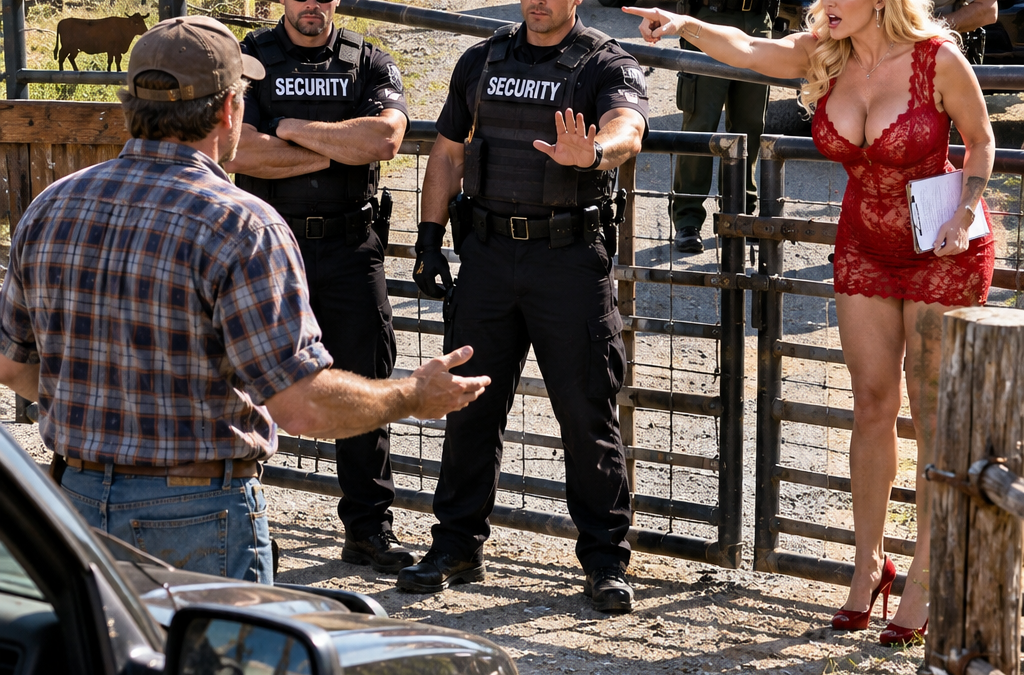
The fences still followed the same recorded lines.
The dirt road still ran from the county road to the house.
And the gate Karen once tried to turn into an HOA checkpoint still opened when I wanted it open and closed when I wanted it closed.
That was the ending.
Not Karen being humiliated.
Not the board overruling her.
Not even the sheriff forcing the guards away.
The ending was simpler.
I still drove home.
Every day.
Through my own gate.
Across my own road.
Onto the same land my family had protected for decades.
Karen arrived believing a few notices, two uniforms, and a confident accusation could change ownership.
She learned otherwise.
A property line doesn’t move because somebody points at a sign.
A private road doesn’t become HOA property because a new subdivision appears nearby.
And a man standing at the entrance to land his family has owned for generations does not become a trespasser simply because an HOA manager says the word loudly enough.
The deed had the final say.
And Karen never blocked my gate again.
H
The HOA Sent Guards to Block Me From My Family’s 37-Acre Ranch—Then Karen Called the Sheriff and Claimed I Was the Trespasser
My family had owned those thirty-seven acres for longer than anyone in the new subdivision had been alive.
My grandfather built the ranch house himself.
Not hired it out.
Built it.
He hauled lumber in on a flatbed, poured part of the foundation with help from two cousins, and spent an entire summer putting up the first barn because he refused to borrow money for labor he believed he could do himself.
The old ranch road had been there just as long.
A narrow dirt-and-gravel lane that ran from the county road through our front gate, past two cottonwoods, around the equipment shed, and toward the main house.
Every rut was familiar to me.
Every bend.
Every fence post.
Every low spot that collected water after a hard rain.
I had learned to drive on that road with my father’s hand resting lightly on the steering wheel beside mine.
I had ridden horses down it.
Driven feed trucks down it.
Pulled trailers down it.
Walked cattle across it.
Buried two ranch dogs beneath a tree twenty yards from it.
That road wasn’t abstract property to me.
It was part of the family.
So when an HOA that had existed for less than three years tried to tell me I no longer had the right to drive through my own gate, I honestly thought someone had lost their mind.
The trouble started with the subdivision.
Silver Creek Preserve.
That was the name.
Luxury homes.
Stone entrance pillars.
Decorative streetlights.
Artificial ponds.
Perfect landscaping.
Houses priced high enough that the sales brochures used phrases like exclusive lifestyle and curated community experience without irony.
It had been built several miles east of the ranch on land that used to be scrub pasture and old farmland.
I barely cared.
Developers build.
People move in.
Neighborhoods change.
None of that bothered me.
My ranch was separate.
Different parcel.
Different title history.
Different road access.
Different everything.
At least, legally.
But the Silver Creek HOA had a habit of looking at every piece of land around it as though proximity created authority.
The first letter arrived six months after the neighborhood opened.
It said vehicles entering the “Silver Creek access corridor” were expected to comply with HOA road-use standards.
I read it twice.
Then threw it on the kitchen table.
My wife at the time asked, “Does that apply to us?”
“No.”
“You’re sure?”
“Completely.”
The ranch road wasn’t theirs.
The entrance wasn’t theirs.
The parcel wasn’t theirs.
I figured the letter was mass-mailed nonsense.
Then came another.
Then another.
The language became more aggressive.
UNAUTHORIZED COMMERCIAL VEHICLE ACTIVITY
NONCOMPLIANT AGRICULTURAL TRAILER TRAFFIC
EXCESSIVE DUST IMPACTING COMMUNITY EXPERIENCE
That last one almost made me laugh.
Dust.
On a ranch road.
Beside open country.
Apparently the existence of dirt had become an HOA violation.
I called the management office.
A woman answered.
“Silver Creek Preserve.”
“I’ve received several notices.”
“Property address?”
I gave it.
There was typing.
Then a pause.
“Yes. You’re on the perimeter.”
“No. I’m on a separate thirty-seven-acre parcel.”
“You’re adjacent to HOA-controlled access.”
“My access road is private.”
“That’s not what our map shows.”
“Then your map is wrong.”
That sentence caused a silence.
The woman on the phone clearly wasn’t used to hearing it.
She said, “I’ll have Karen contact you.”
I should have known that wasn’t going to improve anything.
Karen Doyle was the HOA manager.
Not technically the board president, though she behaved as though the elected board existed mostly to approve whatever she wanted.
She was around forty, blonde, strikingly attractive, and permanently dressed as if she expected cameras.
Her favorite outfit seemed to be a fitted red lace dress that was far more appropriate for a cocktail bar than a property inspection. She wore it with high heels, expensive sunglasses, and the kind of flirtatious confidence that made people underestimate how vindictive she could become the moment somebody stopped responding to charm.
Karen had two voices.
The first was soft.
Warm.
Almost playful.
That was the voice she used with contractors, male board members, county clerks, and anybody she thought she could manipulate.
The second was colder.
Sharper.
That was the voice she used when people said no.
I heard both during our first real conversation.
She called the ranch two days after I spoke with the office.
“Mr. Walker?”
“Speaking.”
“This is Karen Doyle with Silver Creek.”
“I figured.”
A pause.
“Excuse me?”
“I was told you’d call.”
“Good. Then you understand this concerns your repeated access violations.”
“No.”
Silence.
“No?”
“No.”
I leaned against the kitchen counter.
“This ranch is not in your HOA.”
Karen laughed softly.
“That’s a common misunderstanding.”
“It isn’t a misunderstanding.”
“Your entrance connects to a road system that services Silver Creek.”
“My road existed before Silver Creek.”
“That doesn’t make it exempt.”
“Exempt from what?”
“Our access standards.”
I actually smiled.
“Karen, you’re talking about a private ranch road.”
“Partially.”
“No. Entirely.”
She exhaled as though I were exhausting her.
“You’re looking at this too narrowly.”
“I’m looking at the deed.”
“Community control isn’t always limited to deed lines.”
That sentence stayed with me.
At the time, I thought it was absurd.
Later, I realized it was Karen’s entire philosophy.
Authority wasn’t limited by law.
Not in her mind.
Authority extended as far as she could convince people it extended.
I asked, “Do you have a recorded easement?”
“We have legal documents.”
“Which one?”
“Our attorney handles that.”
“Then have the attorney send me the recorded instrument.”
Karen’s voice became noticeably colder.
“You know, most neighboring property owners find cooperation easier.”
“Most neighboring property owners may belong to your HOA.”
“You’re benefiting from our infrastructure.”
“No.”
“Security patrol.”
“I didn’t ask for it.”
“Improved road access.”
“My family built the road.”
“Property values.”
I laughed.
“My cattle don’t care about Silver Creek property values.”
Silence.
Then she said, “That attitude is exactly the problem.”
I should have ended the call.
Instead, I asked, “What problem?”
“You believe because your family has been there a long time, nobody can tell you anything.”
“I believe my deed tells you where your authority stops.”
Karen became quiet.
Then said, “We’ll see.”
She hung up.
After that, the notices became personal.
My pickup was photographed.
My livestock trailer was photographed.
A hay truck that came in one morning received a printed warning tucked under the windshield wiper.
The driver called me.
“Some blonde lady told me I was using restricted HOA access.”
I laughed.
“You’re on my ranch.”
“That’s what I told her.”
“What’d she say?”
“She said property ownership was under review.”
That was the first time I stopped finding it funny.
Ownership under review.
By whom?
Karen?
The HOA?
A neighborhood that didn’t exist when my grandfather built the house?
I pulled out the ranch records that night.
Original deed.
Later transfer documents.
Property-tax records.
Old survey.
Boundary descriptions.
Everything was clean.
Thirty-seven acres.
Family property.
Private entrance.
No Silver Creek.
No HOA.
No easement granting them control of the gate.
I made copies.
Then life got busy.
Calving season.
Equipment repair.
A fence washed out after heavy rain.
I let the issue sit.
Karen didn’t.
One afternoon, I drove home and saw a white notice attached to my ranch gate.
Not tucked into the fence.
Attached with plastic ties so it looked official.
Bold black letters.
ACCESS CONTROL NOTICE
Underneath:
UNAUTHORIZED VEHICLES PROHIBITED BEYOND THIS POINT WITHOUT HOA APPROVAL
At the bottom sat the Silver Creek logo.
I got out of the truck.
Read it.
Then looked around.
No HOA land in sight.
Just my fence.
My gate.
My dirt road.
My grandfather’s cottonwoods.
Someone had physically attached an HOA enforcement notice to private ranch property.
I took photos before removing it.
Then I called Karen.
She answered on the third ring.
“Silver Creek.”
“You put a sign on my gate.”
“Access notice.”
“Take it off.”
“It’s informational.”
“It’s trespassing.”
She laughed.
“Putting a notice on a boundary structure isn’t trespassing.”
“My boundary structure.”
“The gate interfaces with the Silver Creek corridor.”
“What corridor?”
“The eastern access corridor.”
I looked down my road.
“You people just keep inventing phrases.”
Karen’s voice sharpened.
“Watch your tone.”
“No.”
“What?”
“No. I’m done pretending any of this is legitimate.”
“Then you’re forcing escalation.”
“I’m forcing nothing.”
“You continue ignoring community access policy.”
“Because I don’t belong to the community.”
“Your property touches our controlled roadway.”
“No recorded easement.”
“Our counsel disagrees.”
“Then send the document.”
Silence.
“Karen?”
“You’ve already been warned.”
“That’s not a document.”
“Goodbye.”
She hung up.
The next morning, I found two security guards parked across my private entrance.
Not beside it.
Across it.
Their SUV sat perpendicular to the gate, completely blocking my pickup from entering.
I had gone into town before sunrise to pick up hydraulic fluid and fencing staples.
When I came back, they were there.
Gray uniforms.
Black utility belts.
HOA logo.
Not deputies.
Not police.
Private security.
I stopped my truck twenty feet from them.
One guard got out.
“Morning.”
“Move the vehicle.”
He lifted one hand.
“We’ve been instructed not to permit unauthorized access.”
I stared at him.
“Unauthorized access to what?”
“This road.”
“My road.”
He looked uncomfortable already.
“We’re following instructions.”
“Whose?”
“Association management.”
“Name.”
He hesitated.
“Karen.”
Of course.
The second guard got out.
Older.
Bigger.
More confident.
“Sir, we need you to remain outside the gate until your access status is resolved.”
I laughed.
“My access status?”
“Yes.”
“I own the property behind you.”
“That’s disputed.”
“No.”
I pointed toward the ranch house visible in the distance.
“That house has been in my family for decades.”
“We’re not here to debate ownership.”
“Then move.”
“We can’t.”
“Can’t?”
“Won’t.”
The older guard squared his shoulders slightly.
Not threatening.
But deliberately official.
I opened the truck door and stepped out.
“Who gave you permission to park on my entrance?”
“We’re on controlled access.”
“Whose controlled access?”
He gestured toward the HOA sign still tied to the fence.
“Silver Creek.”
I stared at the sign.
Then him.
“You think the sign created ownership?”
He didn’t answer.
The younger guard looked away.
I pulled out my phone.
“I’m recording.”
The older guard’s posture changed.
“That’s unnecessary.”
“No.”
I raised the phone.
“What’s unnecessary is two private security guards blocking a rancher from his own property.”
He said, “Sir, please don’t escalate.”
I almost laughed again.
Every time the HOA did something insane, they accused me of escalation for objecting.
Then the white SUV appeared.
Karen.
She drove up behind the security vehicle and parked partly in the road.
The driver’s door opened.
Red lace dress.
High heels.
Blonde hair.
Sunglasses.
She stepped out like she was arriving at a press conference.
The older guard relaxed visibly.
His boss had arrived.
Karen didn’t even say hello.
She pointed at me.
“There he is.”
I stared.
“There who is?”
“The trespasser.”
For a second, I genuinely thought I had misheard.
“What?”
“You were specifically told not to enter restricted property.”
I looked around slowly.
My cattle pasture to the left.
My ranch road behind the gate.
My fence.
My cottonwoods.
My house.
Then back at her.
“Restricted property.”
“Yes.”
“You’re calling me a trespasser on my own ranch.”
“Until the access issue is resolved, you have no authorization to cross the controlled corridor.”
My phone was still recording.
Good.
“Show me the property line.”
She pointed toward the sign.
“Right there.”
I laughed.
“No. The actual recorded property line.”
“Don’t play games.”
“You’re standing at my gate telling me I don’t own access to my ranch.”
“The HOA owns the road connection.”
“Show me.”
“You’ve been shown.”
“No.”
I stepped closer.
“You’ve sent notices. That’s not the same thing.”
Karen removed her sunglasses.
Her blue eyes were cold.
“Our documents establish access control.”
“Which document?”
“I am not carrying the full legal file.”
“You brought security.”
“Because you repeatedly refuse to comply.”
“You brought guards but not the deed.”
“You’re becoming combative.”
“You’re blocking my ranch.”
She folded her arms.
“I knew you’d do this.”
“Do what?”
“Create a scene.”
The arrogance was breathtaking.
She had parked guards across my gate, called me a trespasser, and now I was creating a scene by standing there.
I took a breath.
“Karen, move the vehicle.”
“No.”
“Remove the guards.”
“No.”
“Remove your sign.”
“No.”
“Then show me the recorded easement.”
Her jaw tightened.
“Stop repeating yourself.”
“I’ll stop when you answer.”
“Silver Creek controls the approach road.”
“Up to my boundary.”
“It continues through the access corridor.”
“No.”
“Yes.”
“Survey.”
She pointed toward the subdivision.
“We have maps.”
“Not the same thing.”
“You are not a lawyer.”
“And you’re not the county recorder.”
One of the guards looked down.
Karen saw it.
Her voice sharpened.
“Is something funny?”
He immediately shook his head.
“No, ma’am.”
She turned back toward me.
“You have spent months undermining community authority.”
“Because it doesn’t apply here.”
“You think thirty-seven acres makes you some kind of sovereign nation?”
“No.”
I pointed at the gate.
“It makes this my property.”
Her face changed.
“I’ve had enough.”
“Good.”
I thought she meant she would leave.
Instead, she pulled out her phone.
“What are you doing?”
“Calling the sheriff.”
I stared at her.
“For what?”
“Trespassing.”
I couldn’t help it.
I laughed.
Actually laughed.
Karen’s face turned red.
“You think that’s funny?”
“Yes.”
“You won’t when he arrives.”
“Please call him.”
That answer bothered her.
She expected panic.
Maybe she expected me to beg.
Instead, I walked to the side of my truck, leaned against the fender, and waited.
Karen made the call dramatically.
“Yes, I need an officer at the Silver Creek east access.”
Pause.
“We have a trespasser refusing to leave restricted property.”
I looked toward the gate.
My grandfather’s gate.
The absurdity became almost peaceful.
She gave the dispatcher the location.
Then added:
“He’s becoming confrontational.”
I called out, “Tell them I’m the deeded owner.”
She turned away from me.
“He claims to own adjoining property.”
Claims.
She ended the call.
“You’re making a serious mistake.”
I smiled.
“I was about to tell you the same thing.”
Karen started pacing.
The guards stayed at the entrance.
Nobody moved.
Dust hung lightly in the morning air.
From inside the ranch, I could hear cattle farther down the pasture.
Ten minutes passed.
Then twenty.
Karen made two calls.
One sounded like it was to the HOA attorney.
Her voice became soft.
Almost flirtatious.
“Yes, I know. He’s being impossible.”
Pause.
“I just need the sheriff to reinforce access authority.”
Another pause.
“No, I don’t have the whole file with me.”
She looked at me.
“We have it.”
Pause.
“Of course.”
When she hung up, the confidence returned.
“You should probably reconsider before law enforcement gets here.”
“Reconsider what?”
“Leaving.”
I stared at her.
“You want me to leave the entrance to my own ranch.”
“Until access is legally clarified.”
“Already clarified.”
“By you.”
“By the deed.”
Karen rolled her eyes.
“Old documents don’t automatically override modern access agreements.”
That sentence made me smile.
“Perfect.”
“What?”
“Say that again when the sheriff arrives.”
Her face tightened.
A county sheriff’s SUV appeared through the dust five minutes later.
Karen straightened immediately.
The red dress.
The posture.
The practiced smile.
Everything about her changed.
Charm mode.
The SUV stopped.
Sheriff Daniel Cole stepped out.
He looked to be in his late fifties.
Calm face.
Gray at the temples.
The kind of man who didn’t hurry unless something was on fire.
He took in the scene.
Two guards.
Karen.
Me.
Blocked gate.
HOA sign.
My truck.
His eyebrows lifted slightly.
Karen walked toward him before he could ask a question.
“Sheriff, thank you so much for coming.”
Her voice had transformed.
Warm.
Soft.
Almost relieved.
“We’ve been dealing with a very difficult situation.”
Cole looked at her.
“Who called?”
“I did.”
“Name?”
“Karen Doyle. Silver Creek management.”
He nodded.
“And the trespasser?”
She pointed directly at me.
“Him.”
Cole looked at me.
I almost smiled.
He walked over.
“Sir?”
I handed him my driver’s license.
“My name is Jack Walker.”
He examined it.
Address matched the ranch.
He looked toward the house.
“This your place?”
“Yes.”
Karen immediately interrupted.
“He owns property behind the access corridor. That’s not the same thing as owning this road.”
Cole looked at her.
“Ma’am, I’ll speak with you in a minute.”
Karen went quiet.
That alone was worth the wait.
Cole looked back at me.
“What’s going on?”
“Silver Creek claims this entrance is theirs. It isn’t.”
“You have documents?”
“Yes.”
I opened the passenger door of my truck and pulled out the folder I’d started carrying after the first notices.
Copy of the deed.
Survey.
Parcel description.
Tax map.
Cole took the first page.
Read silently.
Then looked toward Karen.
“What recorded property description is the HOA relying on?”
Karen blinked.
“I’m sorry?”
“What deed or recorded property description shows this entrance belongs to Silver Creek?”
Her smile became slightly tighter.
“Our complete legal documents are maintained by association counsel.”
“So you don’t have them?”
“I have the relevant access map.”
She opened her folder.
Pulled out a glossy site plan.
Color-coded.
Subdivision lots.
Roads.
Green spaces.
An arrow labeled EAST ACCESS CONTROL ZONE ran toward my ranch entrance.
Cole studied it.
Then looked at her.
“This recorded?”
Karen hesitated.
“It’s part of our planning documents.”
“Recorded with the county?”
“The attorney would need to confirm.”
Cole handed it back.
Then looked at my deed again.
Karen stepped closer.
“Sheriff, with respect, this is an established community access issue. We’ve already served multiple notices.”
Cole didn’t look up.
“Notices don’t establish title.”
Her smile disappeared for half a second.
I stayed quiet.
The deed could speak.
Exactly as I’d expected.
Cole read the legal description slowly.
Thirty-seven acres.
Boundary markers.
Private ranch entrance.
Original transfer history.
He asked, “You have the original?”
“In the truck.”
Karen looked at me sharply.
“Don’t make this more complicated than it needs to be.”
I stared at her.
“Why?”
“You know why.”
“No.”
I walked to the truck.
“Explain it.”
She said nothing.
I retrieved the old deed.
Not the modern certified copy.
The original family document we had preserved.
Heavy paper.
Folded carefully.
Stored in a protective sleeve.
My grandfather’s name appeared in the chain of title.
My father’s later transfer documents were attached.
I handed it to Cole.
Karen actually stepped forward.
“Is that necessary?”
Cole looked at her.
“You called me.”
Silence.
He unfolded the deed.
Read.
Then unfolded the attached survey.
My pulse slowed.
This was the part Karen never understood.
She believed whoever talked the most confidently controlled the truth.
But the land didn’t care.
The boundary had existed before her.
Before Silver Creek.
Before the HOA’s glossy map.
Cole walked toward the gate with the survey.
I followed.
Karen and the guards did too.
He located one marker.
Then another.
Compared direction.
Looked down the ranch road.
Then toward the HOA-controlled section farther east.
He pointed.
“So according to this, Silver Creek’s road ends here.”
“Correct.”
“And this entrance begins inside your parcel.”
“Correct.”
Karen stepped in.
“The HOA has an easement.”
Cole looked at her.
“Recorded easement?”
“Yes.”
“Number?”
She blinked.
“What?”
“Book and page, instrument number, anything.”
Her confidence flickered.
“The attorney handles recordings.”
“Do you have a copy?”
“Not here.”
“Where?”
“Association files.”
Cole nodded.
“What type of easement?”
“Access.”
“Public?”
“No.”
“Utility?”
“No.”
“Road maintenance?”
“It’s broader than that.”
“How broad?”
Karen’s cheeks started turning red.
“It gives the HOA control over ingress.”
“Then it should be easy to identify.”
She looked toward the guards.
Neither helped.
One of them suddenly seemed fascinated by the gravel.
Karen said, “This is becoming unnecessarily technical.”
Cole’s eyebrows rose.
“Property ownership usually is.”
I had to look away to keep from smiling.
Karen heard the tone.
“With respect, Sheriff, the association cannot maintain safety if adjacent landowners ignore access controls.”
Cole looked back at the survey.
“Adjacent landowners don’t automatically belong to an HOA.”
“He benefits from our roads.”
“Does that create ownership?”
“It creates authority.”
“Show me.”
There it was again.
The two words Karen hated most.
Show me.
She opened her folder.
Pulled out notices.
Bylaws.
A security policy.
Nothing tied directly to my parcel.
Nothing granting control of the private gate.
Cole looked through them.
Then handed everything back.
“None of these establish an easement.”
Karen’s voice sharpened.
“You’re not our attorney.”
“No.”
He looked at her.
“I’m the sheriff you called because you accused this man of trespassing.”
That shut her up.
Cole took several steps away and called the county records office.
Karen immediately came toward me.
Low voice.
“You’ve taken this too far.”
I stared at her.
“I called nobody.”
“You could have complied.”
“With what?”
“Temporary access restrictions.”
“To my ranch.”
“You don’t understand the liability you’re creating.”
“No.”
I looked toward Cole.
“I think yours is becoming clearer.”
Her eyes flashed.
“Don’t threaten me.”
“I’m not.”
“You think because you have some antique deed—”
I stepped closer.
“That antique deed is the reason you’re standing outside my property instead of owning it.”
Her face went rigid.
“You have no idea how many resources this association has.”
There it was.
Money.
Lawyers.
Security.
Power.
Karen wanted me to understand the imbalance.
She had an HOA behind her.
I had a ranch.
“That supposed to scare me?”
Her voice dropped.
“It should make you realistic.”
I looked toward the thirty-seven acres behind the gate.
“Reality is exactly what I’m relying on.”
Cole ended the call.
He walked back slowly.
The expression on his face had changed.
Not anger.
Certainty.
He looked at Karen first.
“County records don’t support your claim.”
Her jaw tightened.
“What exactly did they check?”
“The parcel map.”
“Our easement may be filed separately.”
“They checked easements associated with the parcel.”
Silence.
“No recorded HOA easement giving Silver Creek control over this entrance.”
Karen laughed nervously.
“There must be an indexing issue.”
Cole looked at her.
“Maybe.”
For half a second, relief crossed her face.
Then he continued.
“But unless you can produce an actual recorded right, I have no basis to treat this man as a trespasser on his own land.”
Karen stared.
The older security guard shifted.
Cole turned toward both guards.
“Move your vehicle.”
The younger one moved immediately.
The older guard looked at Karen.
That was a mistake.
Cole’s voice hardened.
“Don’t look at her. I told you to clear the private entrance.”
The guard nodded.
“Yes, sir.”
They moved the security SUV.
Karen stood in the dust, perfectly still.
I had never seen her that quiet.
Cole pointed toward the HOA sign.
“Who installed that?”
Karen said, “The association.”
“On whose fence?”
She didn’t answer.
I did.
“Mine.”
Cole looked at her.
“Remove it.”
Her face flushed.
“This is an enforcement notice.”
“On private property.”
“We believed—”
“I understand what you believed.”
Cole’s voice stayed calm.
“Take it down.”
For the first time, one of the guards moved without waiting for Karen.
He cut the plastic ties.
Removed the sign.
Held it awkwardly under one arm.
Karen looked at him like he had betrayed her.
I walked toward the gate.
The old chain was exactly where I’d left it.
I unlocked it.
The gate swung inward.
Dust moved lightly across the road.
My pickup sat waiting.
Karen finally spoke.
“This doesn’t resolve the larger issue.”
I turned.
“What larger issue?”
“The HOA still has concerns about commercial and agricultural traffic affecting residents.”
“Then send a polite letter.”
“You’ve ignored letters.”
“Because they claim authority you don’t have.”
“Our counsel may still challenge the road status.”
“Good.”
I looked at her.
“Do it in court.”
She flinched.
That was the line.
Until then, Karen had survived on threats, notices, guards, and administrative pressure.
Court meant evidence.
Recorded rights.
Legal standards.
Things she couldn’t invent with a committee vote.
Cole looked at her.
“If the association believes it has a civil claim, that’s the proper channel.”
Karen crossed her arms.
“This man has been deliberately antagonistic from the beginning.”
Cole looked at me.
Then at her.
“He asked for documents.”
“He refused cooperation.”
“Those aren’t the same thing.”
Her cheeks turned red again.
I stepped toward my truck.
Karen called after me.
“Jack.”
I stopped.
She had never used my first name before.
“What?”
“You think this is some kind of victory?”
I looked at the ranch.
“No.”
I looked back.
“I think I’m going home.”
That hurt her more than any insult could have.
Because that’s all I had wanted.
Not to beat the HOA.
Not to humiliate Karen.
Not to become a hero.
Just to drive through my own gate and go home.
I climbed into the pickup.
Started the engine.
Then rolled forward.
The security guards stood aside.
Cole watched.
Karen didn’t move.
My truck crossed the exact line she had claimed belonged to Silver Creek.
Nothing happened.
No alarm.
No magical boundary.
No HOA authority descended from the sky.
Just tires on gravel.
My gravel.
I drove slowly down the ranch road.
Past the cottonwoods.
Past the equipment shed.
Past the first cattle pasture.
The farther I went, the smaller the people at the gate became in my mirror.
By the time I reached the house, they were barely visible.
I parked.
Then stood on the porch and watched from a distance.
Cole spoke with Karen for another ten minutes.
She gestured repeatedly.
Pointed toward the ranch.
Pointed toward the subdivision.
Held up papers.
Cole listened.
Then got back into his SUV.
The guards left.
Karen remained alone for almost a minute.
She stared toward the ranch house.
Even from that distance, I could feel the anger.
Then she got into her SUV and drove away.
I thought that would be the end.
It wasn’t.
Karen had been embarrassed in front of her guards and a county sheriff.
People like Karen don’t absorb humiliation.
They convert it into retaliation.
The next afternoon, an email arrived from Silver Creek.
NOTICE OF CONTINUING ACCESS REVIEW
It claimed the HOA was evaluating historical road-control rights, traffic impacts, safety concerns, and potential easements.
At the bottom:
All prior notices remain under legal review.
I forwarded it to a property attorney.
His answer came back two hours later.
Do not engage informally. Ask them to produce the recorded easement.
So I did.
One sentence.
Please provide the instrument number for the easement you claim.
No reply.
The next day:
Our counsel is reviewing historical documents.
I responded:
Please contact me when you locate a recorded interest affecting Parcel 37-A.
Nothing.
For three weeks, silence.
Meanwhile, word spread inside Silver Creek.
Not because I posted anything.
Because security guards talk.
Neighbors saw the sheriff.
Someone had recorded part of the confrontation from the subdivision entrance.
Apparently Karen’s accusation that I was a trespasser became a neighborhood joke.
One ranch neighbor called me.
“Heard you’re trespassing on your own place now.”
“Apparently.”
“Need bail?”
“Maybe later.”
We laughed.
Karen did not.
At the next Silver Creek board meeting, the road issue appeared on the agenda.
I wasn’t planning to attend.
Then the board secretary invited me.
That interested me.
The meeting room was full when I arrived.
Karen sat at the front.
Red lace dress.
Blonde hair perfect.
Clipboard in front of her.
The moment she saw me, her expression hardened.
The board president, Richard Hale, opened the discussion.
“Mr. Walker, thank you for coming.”
Karen interrupted.
“I don’t understand why a nonmember is addressing the board.”
Richard looked at her.
“Because we’re discussing his property.”
She didn’t like that.
He asked me to explain.
I didn’t give a speech.
I placed copies of the deed, survey, and county confirmation on the table.
“Thirty-seven acres.”
I pointed.
“Family property.”
Another page.
“Private entrance.”
Another.
“No recorded HOA easement.”
Richard looked at Karen.
“You told us the east entrance was association-controlled.”
“It is under our planning map.”
“Recorded?”
She sighed.
“Why is everyone suddenly obsessed with that word?”
I almost laughed.
A board member named Susan answered.
“Because the sheriff asked the same thing.”
Karen turned.
“The sheriff doesn’t interpret private association agreements.”
Susan said, “Do we have one?”
Karen’s face tightened.
“The attorney is researching.”
Richard frowned.
“So when security blocked the gate, we didn’t have the document?”
“We had established practice.”
“Whose practice?”
“Silver Creek’s.”
I spoke.
“Silver Creek is three years old.”
A few people laughed.
Karen glared at me.
Richard looked down at the deed.
“This ranch has been in his family how long?”
“Generations,” I said.
Karen waved one hand.
“Age is irrelevant.”
Susan looked at her.
“So is our map if it isn’t recorded.”
That was the beginning.
The first crack inside Karen’s own system.
Karen had built authority by speaking as though every answer had already been decided.
Once the board started asking questions instead of accepting her summaries, everything changed.
Richard asked counsel to speak.
The HOA attorney stood.
He looked uncomfortable.
“We have reviewed the county filings.”
Karen turned toward him.
He continued.
“At this time, we have not identified a recorded easement granting Silver Creek control over Mr. Walker’s private ranch entrance.”
The room murmured.
Karen stared.
“That’s not what you told me.”
The attorney remained calm.
“I told you we were reviewing road-adjacency documents.”
“You said there were historical rights.”
“I said there might be.”
Karen’s face reddened.
“That is not how I understood the conversation.”
He looked at her.
“That’s why I recommended no enforcement action until review was complete.”
Silence.
I looked at Karen.
There it was.
She had been warned.
Maybe not explicitly.
But enough.
She blocked my gate anyway.
Richard leaned back.
“Karen, did you authorize security?”
She crossed her arms.
“I responded to an ongoing access violation.”
“Without counsel confirming jurisdiction?”
“The man was ignoring notices.”
“That isn’t what I asked.”
Her voice rose.
“I was protecting the community.”
Susan asked, “From what?”
Karen turned.
“Unauthorized traffic.”
“My pickup,” I said.
She ignored me.
“Commercial ranch activity.”
“My ranch existed before your houses.”
“That doesn’t mean residents should tolerate everything.”
Richard rubbed his forehead.
“Karen.”
She snapped toward him.
“What?”
“This isn’t about whether you like ranch traffic.”
“It affects property values.”
“That’s not the legal question.”
Karen stared at him.
She had lost the room.
You could feel it.
So could she.
She changed tactics.
Flirtation first.
She softened her voice.
“Richard, you know what we’ve dealt with along that boundary.”
He remained expressionless.
“The trucks.”
“The trailers.”
“The dust.”
No response.
“Residents complain constantly.”
Susan asked, “Then why didn’t we work with the county?”
Karen’s smile disappeared.
“Because we’re capable of enforcing our own standards.”
“On our property.”
Karen’s face hardened.
“You’re all acting as though one outdated deed invalidates years of community planning.”
I stood.
“That deed is not outdated.”
She glared at me.
“It’s old.”
“So is the property.”
A few residents laughed.
She pointed at me.
“This is exactly the disrespect I’ve been dealing with.”
I looked around.
Then back at her.
“You sent guards to block me from my own ranch.”
“You refused to cooperate.”
“You called the sheriff and reported me as a trespasser.”
“You were crossing a controlled area.”
“The sheriff checked.”
I paused.
“It wasn’t controlled by you.”
Silence.
Karen opened her mouth.
Nothing came out.
The board president ended the discussion with a formal decision.
No further HOA access enforcement against my ranch.
No security presence at the gate.
No notices attached to private property.
Any future claim had to be supported by a recorded legal interest and reviewed by counsel before action.
Karen looked like she’d been slapped.
“This destroys our ability to manage the perimeter.”
Susan looked at her.
“No.”
She closed her folder.
“It stops us from managing property we don’t own.”
That line spread through Silver Creek faster than anything else.
I heard it later from three different people.
Stops us from managing property we don’t own.
Simple.
Obvious.
Apparently revolutionary.
Karen left the meeting before it ended.
Her heels struck the floor hard enough to echo.
She didn’t look at me.
That was probably wise.
The HOA eventually sent a letter.
Not an apology.
Lawyers rarely write those unless absolutely necessary.
But it confirmed that no recorded Silver Creek easement had been located over my ranch entrance and that the association would not claim access-control authority absent future legal documentation.
I filed it with the deed.
Right behind the original survey.
The security guards never returned.
The sign never came back.
Karen stopped driving past the ranch gate for a while.
When she eventually did, she didn’t slow down.
Months later, I replaced the old gate hinges.
Not because the HOA had complained.
Because after fifty years, they finally needed replacing.
I kept the original steel frame.
Sandblasted it.
Repainted it black.
Mounted it exactly where it had always stood.
Tom helped me.
He laughed while we worked.
“Think you need HOA approval for the color?”
“Definitely.”
“Should’ve gone with beige.”
“Approved beige?”
“Obviously.”
We laughed.
It felt good.
Not triumphant.
Normal.
That was what I’d wanted from the beginning.
Normal.
The ranch went back to ranch problems.
Water pump failure.
Fence repair.
Feed prices.
A tractor transmission that decided to die at the worst possible time.
Real things.
I preferred every one of them to Karen’s manufactured authority.
One evening, Sheriff Cole stopped by.
Not officially.
He had been passing through.
He parked outside the gate instead of driving in.
That small act told me something.
Respect.
I walked down.
“Everything quiet?”
“Mostly.”
He looked toward the ranch road.
“HOA staying away?”
“Yep.”
“Good.”
I thanked him again.
He shrugged.
“Didn’t do much.”
“You checked.”
“That’s the job.”
I smiled.
“Apparently that’s more than some people do.”
Cole looked toward Silver Creek.
“Folks get into trouble when they start treating internal paperwork like public law.”
I nodded.
“Karen still says there was an access right.”
“Maybe she believes it.”
“Does that matter?”
Cole thought about it.
“Belief matters less than records when you’re blocking somebody’s property.”
Exactly.
He left.
I stood at the gate for a while after his SUV disappeared.
The ranch stretched behind me.
Thirty-seven acres.
Not enormous by western standards.
Not a giant operation.
But every acre had history.
My grandfather had built the house near the highest point because he wanted to see storms coming.
My father planted windbreak trees along the north side.
My mother kept a vegetable garden near the old well.
I learned to shoot behind the lower field.
Learned to ride near the creek.
Learned to fix fence because cattle always find the one weak spot.
Nothing about that land was abstract.
Karen’s map reduced it to a colored boundary beside an upscale neighborhood.
A “perimeter.”
An “access corridor.”
A “community impact zone.”
Words.
That was how she tried to take control.
Rename something.
Then regulate the new name.
A private gate becomes controlled access.
A ranch road becomes an HOA corridor.
A rancher becomes an unauthorized vehicle operator.
The owner becomes a trespasser.
It sounds absurd when you say it plainly.
But that’s how overreach works.
Not always with bulldozers.
Not always with lawsuits.
Sometimes with vocabulary.
Paper.
Uniforms.
Confidence.
Enough people acting like authority exists that you start wondering whether you somehow missed something.
For one moment that morning, while two guards stood across my gate and Karen pointed at me calling me a trespasser, I actually felt disoriented.
Not because I believed her.
Because the scene was so official-looking.
Security uniforms.
HOA signage.
Her clipboard.
Her certainty.
It was designed to make me feel like the outsider.
On my family’s land.
That’s what still bothers me.
Not that Karen was wrong.
People are wrong every day.
What bothered me was how aggressively she used the appearance of authority before confirming she had any.
If I had been less certain of my records, maybe I would have backed down.
Maybe I would have waited somewhere else.
Maybe I would have started asking permission to drive onto my own ranch.
Maybe after enough weeks of that, the false arrangement would start feeling normal.
That’s why the deed mattered.
Not because old paper is magical.
Because it anchored reality.
When Karen said the road belonged to the HOA, the deed said no.
When the guards said I needed authorization, the deed said no.
When the sign said unauthorized vehicles prohibited, the deed said no.
When Karen called the sheriff and said I was trespassing, the deed still said no.
She had guards.
I had a recorded description.
She had a glossy community map.
I had a survey.
She had a title.
HOA manager.
I had the title that mattered.
Ownership.
The strangest part came nearly a year later.
Silver Creek held a community picnic near its east entrance.
I drove past pulling a livestock trailer.
Not through their neighborhood.
Along the county road near my gate.
I saw Karen standing near the stone entrance sign.
Red lace dress.
Wine glass.
Talking to residents.
Our eyes met.
She watched the trailer pass.
For a moment, I expected her to say something.
Wave.
Frown.
Call somebody.
Instead, she looked away.
That was it.
No confrontation.
No notice.
No guards.
Maybe she had finally learned.
Or maybe she had simply learned that I kept records.
Either way worked for me.
That evening, I sat on the porch.
The same porch my grandfather built.
The sun went down over the pasture.
The ranch road turned gold for a few minutes before the shadows deepened.
I could see the gate in the distance.
Small from the house.
Almost insignificant.
Funny.
That little opening had become the center of a fight over thirty-seven acres.
Karen thought controlling the gate meant controlling the ranch.
In one sense, she was right.
Access matters.
That’s exactly why property rights around access have to be real.
Recorded.
Defined.
Not invented because a nearby HOA dislikes dust.
My grandfather understood that.
That’s why the original deed described the entrance so carefully.
That’s why the survey markers were preserved.
That’s why my father taught me never to throw away property documents.
He used to say:
“Fence lines aren’t rude. They keep honest people clear about what’s theirs.”
As a kid, I thought he was talking about cattle.
I understand it differently now.
Boundaries aren’t hostility.
They’re clarity.
The ranch is ours.
Silver Creek is theirs.
Their rules can govern their roads.
Their homes.
Their common property.
Their landscaping.
Their residents.
Fine.
But authority stops somewhere.
It has to.
Otherwise every confident person with a clipboard eventually becomes a landlord over land they never bought.
Karen forgot that.
Or maybe she never believed it.
She thought two guards could change a property line.
They couldn’t.
She thought an HOA sign could convert a private entrance into controlled access.
It couldn’t.
She thought calling the sheriff would frighten me into submission.
Instead, the sheriff checked the records.
That was all it took.
No dramatic courtroom.
No secret loophole.
No surprise inheritance.
Just a deed.
A survey.
A county record.
And a line on the ground that had existed long before Karen arrived.
The next spring, I installed a small metal plaque on the inside of the ranch gate.
Not facing Silver Creek.
Facing inward.
Only visible after you entered.
It reads:
WALKER RANCH — ESTABLISHED 1958
Underneath:
PRIVATE PROPERTY
Tom laughed when he saw it.
“Too subtle.”
“That’s the point.”
“Should’ve added ‘HOA MEMBERS WELCOME BY APPOINTMENT.'”
“No.”
“Or ‘TRESPASSERS WILL BE REPORTED TO KAREN.'”
I nearly dropped the drill laughing.
“No.”
He shrugged.
“Missed opportunity.”
We finished mounting the plaque.
Then stepped back.
Nothing flashy.
Nothing aggressive.
Just the truth.
My family had owned those thirty-seven acres for generations.
The ranch house still stood where my grandfather built it.
The fences still followed the same recorded lines.
The dirt road still ran from the county road to the house.
And the gate Karen once tried to turn into an HOA checkpoint still opened when I wanted it open and closed when I wanted it closed.
That was the ending.
Not Karen being humiliated.
Not the board overruling her.
Not even the sheriff forcing the guards away.
The ending was simpler.
I still drove home.
Every day.
Through my own gate.
Across my own road.
Onto the same land my family had protected for decades.
Karen arrived believing a few notices, two uniforms, and a confident accusation could change ownership.
She learned otherwise.
A property line doesn’t move because somebody points at a sign.
A private road doesn’t become HOA property because a new subdivision appears nearby.
And a man standing at the entrance to land his family has owned for generations does not become a trespasser simply because an HOA manager says the word loudly enough.
The deed had the final say.
And Karen never blocked my gate again𝗧𝗛𝗘 𝗘𝗡𝗗








