𝗙𝗨𝗟𝗟 𝗦𝗧𝗢𝗥𝗬 The HOA Sent Bulldozers Through My Cornfield for a $15 Million Mall—Then Their Own Survey Became the Evidence Against Them
𝗙𝗨𝗟𝗟 𝗦𝗧𝗢𝗥𝗬
Her mouth tightened.
Then she smiled again.
“Enjoy your pictures.”
She turned away.
Another hundred yards of corn disappeared.
What Victoria didn’t know was that less than twenty-four hours earlier, a property attorney named Sarah Bennett had looked at my deed, looked at my grandfather’s survey and told me something that changed the entire fight.
The HOA’s shopping mall crossed my legal property line.
And that bulldozer was driving directly into the evidence.
The fight had actually started weeks earlier.
Until then, I lived a life so repetitive most people would probably have called it boring.
I called it mine.
I woke before sunrise.
Checked irrigation.
Walked the fields.
Fixed whatever had broken overnight.
Drove into town when I needed parts.
Came home tired enough to sleep.
My family had grown corn on that farm for generations.
Not some enormous corporate operation.
Just good farmland, carefully managed.
There were places on that property I could identify with my eyes closed.
A drainage ditch my grandfather had dug by hand.
A cottonwood struck by lightning when I was twelve.
An old iron boundary pin near the north field.
A shallow rise where my father used to park the tractor at sunset because he liked the view.
People saw acreage.
I saw memory.
Then Maple Crest Estates expanded onto neighboring property.
At first, the HOA had nothing to do with me.
Their subdivision sat east of my farm behind landscaped stone walls and rows of large houses with identical mailboxes.
I didn’t care what color their shutters were.
They didn’t care what I planted.
That arrangement worked perfectly.
Then Victoria became HOA president.
She had been elected several years earlier and apparently decided the title gave her authority over everything she could see from her subdivision.
The first time she came to my farm, she arrived in the same black SUV she would later use to watch the bulldozers.
She stepped out wearing a red lace dress and heels that sank slightly into the gravel.
I was repairing a fence.
“Mr. Miller?”
“Jack.”
“Victoria Hale. President of Maple Crest.”
“I know who you are.”
She smiled.
“I’m glad.”
She handed me a glossy packet.
On the front was an architectural rendering.
A shopping center.
Stone façade.
Restaurants.
Boutique stores.
A grocery anchor.
Landscaped parking lots.
A huge sign reading MAPLE CREST COMMONS.
“What is this?”
“The future.”
I looked at her.
“Of what?”
“This area.”
I flipped through the packet.
The proposed mall appeared to extend directly across part of my eastern field.
“This crosses my farm.”
Victoria didn’t even blink.
“The board has approved redevelopment of the corridor.”
“That wasn’t what I said.”
“There are overlapping planning zones.”
“You’re drawing buildings on my cornfield.”
“We’re improving underutilized land.”
I looked around.
Corn stretched behind her almost to the tree line.
“Underutilized?”
“For its potential value.”
“To you.”
“To the community.”
I handed the packet back.
“No.”
She looked at my hand as if nobody had ever returned something she offered.
“No?”
“You’re not building a mall on my farm.”
“Jack, this project is worth approximately fifteen million dollars.”
“That doesn’t change who owns the dirt.”
“The HOA has development authorization.”
“From whom?”
“The relevant parties.”
“Meaning?”
She gave me a slow smile.
“You really should have an attorney explain land planning to you.”
I wiped my hands on a rag.
“I have a better idea.”
“What?”
“You show me the deed.”
Her smile disappeared.
“The what?”
“The document giving you ownership.”
“This isn’t that simple.”
“It is to me.”
I walked toward the farmhouse and returned with a laminated property map I kept in the office.
I unfolded it across the hood of my truck.
“Here.”
Victoria reluctantly looked down.
I pointed at the boundary.
“My line runs from the creek north to this marker, then east along the old fence.”
“We have updated development maps.”
“Development maps don’t change ownership.”
“They can reflect boundary adjustments.”
“Show me the adjustment.”
Her eyes lifted.
“This project has already been approved.”
“Then show me what gives you the right to use my land.”
Victoria straightened.
Her voice cooled.
“You need to understand something, Jack. Maple Crest is growing. Your farm is surrounded by development now. You cannot hold back progress forever because your grandfather planted corn here.”
That sentence stayed with me.
Not because she was wrong about development.
Things change.
Towns grow.
Farms become subdivisions.
Roads widen.
But there is a legal difference between buying land for development and deciding someone else’s land is inconvenient.
“You want my farm?”
“Part of it.”
“Make an offer.”
“We don’t need to.”
There it was.
I stared at her.
Victoria slipped on her sunglasses.
“The board has authorized the project.”
Then she got into her SUV.
That evening, I opened the fireproof cabinet in my office.
Inside were records my grandfather had saved obsessively.
Tax receipts.
Old deeds.
Surveys.
Easements.
Handwritten notes.
Some of the pages smelled like dust and old paper.
I found the original deed.
Then the survey.
The line was unmistakable.
The proposed mall crossed well inside our documented property.
Not by a few feet.
By a substantial amount.
Parking.
Access lanes.
Utility corridors.
A significant portion of the actual building footprint.
All of it overlapped my farm.
I called Sarah Bennett the next morning.
Sarah specialized in property and land-use disputes.
I had never met her before.
She came recommended by a neighboring farmer who had fought a highway easement case years earlier.
Her office was forty minutes away.
I brought a cardboard box of records.
Sarah opened the deed first.
Then the survey.
Then county parcel maps.
Then the mall rendering.
She spread everything across a conference table.
“How long has your family owned this?”
“Decades.”
“Any partial sales?”
“No.”
“Boundary adjustment?”
“Not that I know of.”
“Easement granted to Maple Crest?”
“No.”
She checked again.
Then leaned back.
“Do not sign anything.”
“I haven’t.”
“Not a permission form. Not a temporary access agreement. Not a construction waiver. Nothing.”
“What are you seeing?”
She turned the survey toward me.
“The proposed construction crosses your documented property line.”
“How far?”
“Enough that this isn’t a fence dispute.”
“So they can’t build.”
“I didn’t say that yet.”
I frowned.
“The deed says it’s mine.”
“It appears strong. But we verify everything before making aggressive claims.”
She tapped the document.
“I want certified copies, current county records, and an independent survey.”
“What do I do if they show up?”
“Document.”
“And stop them?”
“Call law enforcement if necessary. But don’t put yourself in front of machinery.”
I nodded.
“Jack.”
She waited until I looked at her.
“I mean it. Don’t turn a property case into a physical confrontation.”
Less than twenty-four hours later, the bulldozers arrived.
By sunrise, two full strips of ripe corn were gone.
I photographed everything.
Machine tracks.
Broken stalks.
Boundary posts.
License plates.
Company logos.
Victoria standing beside her SUV.
The foreman holding site plans.
I photographed the exact place where the machines crossed the old fence line.
Then I called the sheriff.
Deputy Daniel Brooks arrived around seven.
He stepped from his cruiser and looked over the field.
Victoria reached him first.
Of course she did.
“Officer, thank you. We have a landowner interfering with permitted construction.”
Daniel looked at me.
I held up my folder.
“My deed. Survey. They’re on my property.”
Victoria cut in.
“This development was legally approved.”
I looked at her.
“Approval is not ownership.”
She turned toward Daniel.
“You see what we’re dealing with?”
Daniel took the documents.
To his credit, he actually studied them.
But after several minutes, he shook his head.
“I’m not qualified to make a boundary determination on the side of the road.”
Victoria smiled triumphantly.
“Exactly.”
Daniel continued.
“That does not mean construction is authorized.”
Her smile faded.
He looked at the foreman.
“Until this gets clarified, you need to understand you could be exposing yourselves to liability if you’re crossing a disputed boundary.”
Victoria stepped forward.
“The HOA accepts responsibility.”
That caught my attention.
So I recorded it.
Daniel noticed my phone but said nothing.
Victoria pointed toward the machines.
“You can continue.”
The foreman hesitated.
She snapped.
“Did you hear me?”
He looked at Daniel.
The deputy held up both hands.
“I’m not issuing a stop-work order. I’m also not telling you this is your land.”
Victoria looked at the foreman again.
“Continue.”
And they did.
That was when I understood the kind of opponent I was dealing with.
Victoria did not need to know she was right.
She only needed everybody around her to be afraid of treating her as if she might be wrong.
Sarah was furious when I called.
“She continued after the sheriff warned them?”
“Yes.”
“Did you record it?”
“Yes.”
“Good.”
She corrected herself.
“Not good that it happened. Good that you recorded it.”
The independent surveyor arrived the following day.
He spent hours working the boundary.
By afternoon, red flags appeared across the landscape.
One after another.
They ran straight through the construction zone.
Beyond them lay my land.
And machinery had crossed well past those flags.
The surveyor stood beside me staring at the tracks.
“No ambiguity here.”
Sarah requested certified survey records immediately.
I thought that would be enough to slow the project.
Victoria did the opposite.
She accelerated it.
Three days later, Maple Crest announced the mall publicly.
A promotional video appeared online.
Music.
Renderings.
Smiling families.
Storefronts.
Then Victoria appeared.
Red lace dress.
White blazer.
Perfect smile.
“Maple Crest Commons represents the future of our community. Through strong leadership and careful planning, the board has secured the land necessary to bring fifteen million dollars in new retail development to this area.”
Secured the land.
I replayed those words.
Then saved the video.
Sarah watched it that afternoon.
“She said they secured it?”
“On camera.”
Sarah smiled without humor.
“Save three copies.”
She sent the HOA formal notice.
The letter was direct.
Ownership disputed.
Construction crossing the Miller property line.
Cease activity on the contested area pending resolution.
Preserve records.
Do not alter boundary markers.
Do not destroy evidence.
The HOA’s attorney responded.
The project had already been approved.
The board believed it possessed sufficient development rights.
Construction would continue.
Sarah read the response twice.
“They’re not answering the question.”
“What question?”
“What gives them the land?”
The board met two nights later.
Victoria convinced them not to pause construction.
I know because one of the members later admitted what happened.
A few directors wanted to stop until the title issue was resolved.
Victoria refused.
“We cannot let one farmer hold a fifteen-million-dollar development hostage.”
Someone asked what happened if the survey was correct.
Victoria reportedly answered:
“Then we deal with him afterward.”
Afterward.
Meaning after my crop was gone.
After the ground was cleared.
After construction money had been spent.
After the situation became expensive enough that they assumed I would surrender.
That was their strategy.
Create the irreversible fact first.
Negotiate with the landowner second.
I walked the field every evening.
It was getting harder.
Corn that should have stood shoulder-high lay shredded into the mud.
Irrigation lines had been crushed.
Tire tracks cut through the soil.
Places where I had worked with my father were becoming graded dirt.
One evening I found part of the old row he had planted with me when I was seventeen.
Most of it was gone.
I crouched beside the last surviving section and ran a hand along one of the stalks.
Farmers understand loss in units other people rarely think about.
Bushels.
Acres.
Rainfall.
Yield.
But some losses don’t fit neatly into a spreadsheet.
I could replant corn.
I could replace irrigation.
I could not recreate the years that field contained.
I stood there until sunset.
Then I made myself one promise.
Whatever happened, the destruction would not become free.
Sarah began building the case.
Original deed.
Certified deed copy.
Historical boundary survey.
Independent survey.
Photographs.
Videos.
Machine locations.
Construction notices.
The sheriff incident.
Victoria’s promotional video.
Crop-loss estimates.
Irrigation damage.
Everything.
The lawsuit sought compensation and court intervention regarding the trespass.
When the first hearing arrived, Victoria sat behind the HOA’s lawyers wearing another red dress and the same expression she had worn beside the bulldozers.
Confident.
Almost amused.
Their attorney argued that the board believed it had valid development authority.
Sarah stood.
“Belief does not move a recorded property boundary.”
She handed the judge the original deed.
Then the certified survey.
Then the independent survey.
The judge studied them.
He didn’t make a final ruling immediately.
Instead, he requested further evidence.
That frustrated me.
Outside the courtroom, Victoria approached while Sarah was speaking to the surveyor.
“Was all this really necessary?”
I stared at her.
“You bulldozed my corn.”
“You could have negotiated.”
“You never made an offer.”
“We were willing to compensate you.”
“When?”
She shrugged.
“Eventually.”
I almost laughed.
“So you destroy first and pay whatever you feel like later?”
She lowered her sunglasses slightly.
“Jack, you need to be practical.”
“I am.”
“No, you’re emotional.”
That word.
Emotional.
Coming from the person who had ordered bulldozers to continue across disputed land because she couldn’t tolerate a delay.
She stepped closer.
“The mall is happening.”
“Maybe.”
“It is.”
“You sound nervous.”
Her expression changed.
“I’m not nervous.”
“Good.”
I looked toward the courthouse doors.
“Then court should be easy.”
Sarah called my name.
Victoria walked away.
The next stage focused on exactly where construction had crossed.
The independent surveyor testified.
He described the original monuments.
The historical records.
The line measurements.
The red markers.
Sarah displayed photographs showing bulldozers beyond those markers.
Then she overlaid the mall site plan on the property survey.
Even I was surprised by how obvious it looked.
A large portion of the proposed project crossed my boundary.
The HOA attorney tried to argue that planning documents had created confusion.
The surveyor didn’t budge.
“A planning map does not convey title.”
The judge asked for verified damage calculations.
That was when the case stopped being theoretical.
An agricultural expert inspected the farm.
He measured destroyed acreage.
Estimated lost crop yield.
Calculated damage to irrigation.
Soil compaction.
Restoration costs.
Lost production.
Every damaged section became a number.
I hated seeing my farm reduced to figures.
But numbers were what the case needed.
Sarah added every legally supportable loss.
The total grew.
Meanwhile, questions about the development authorization became more uncomfortable.
During questioning, the developer was asked how the mall site had been selected.
He explained that the HOA had provided the site.
Sarah asked:
“Did you independently verify ownership?”
“We reviewed materials supplied to us.”
“Did those materials include a deed conveying Mr. Miller’s farmland to Maple Crest?”
“I don’t recall.”
“That’s not my question.”
The developer shifted.
“I would have to review the file.”
Sarah had the file.
There was no deed.
She moved to the construction agreements.
Then the authorization records.
Who instructed crews to clear?
Who identified the land as available?
Who told the developer the HOA controlled it?
Again and again, the paper trail moved toward the board.
And toward Victoria.
At one point, Sarah showed an email.
Victoria had written:
Proceed according to schedule. Landowner objections should not delay site preparation.
I remember looking at Victoria.
For the first time, she wasn’t looking back.
Legal costs started climbing for everybody.
The developer had lawyers.
The HOA had lawyers.
Insurers became involved.
Board members started blaming one another.
Victoria still tried to maintain control.
At meetings she called the lawsuit “an opportunistic land claim.”
She suggested I had waited intentionally for construction to begin so I could demand money.
That accusation infuriated me more than almost anything else.
I had objected before clearing.
I had shown her the property map.
My attorney had sent written notice.
An independent survey had marked the boundary.
The sheriff had warned everyone a dispute existed.
And Victoria had told them to keep going.
Sarah told me not to respond publicly.
“She wants you angry.”
“I am angry.”
“I know.”
“She’s telling people I set them up.”
“And our evidence shows otherwise.”
“She destroyed my crop.”
“I know.”
“She knew there was a dispute.”
Sarah leaned forward.
“Jack, this is why the emails matter.”
I looked at her.
“You don’t beat someone like Victoria by becoming louder than Victoria.”
She tapped the file.
“You beat her by making it impossible for anyone neutral to believe her.”
Settlement talks started months into the dispute.
Not because anyone suddenly became reasonable.
Because the numbers had become dangerous.
The evidence was documented.
The boundary evidence was strong.
The crop destruction was photographed.
The warnings were written.
The board’s decision to continue after notice was now part of the record.
Everyone understood trial could make things worse.
Sarah asked what I wanted.
“My farm back.”
“Anything else?”
“What they destroyed.”
“Meaning compensation?”
“Everything we can prove.”
She nodded.
“That’s exactly how we approach it.”
The first settlement offer insulted me.
I rejected it.
The second was better.
Still not enough.
Victoria attended one negotiation session.
She spent the first half acting as though the HOA was doing me a favor by negotiating at all.
At one point she leaned across the table.
“You understand this development brings enormous value to the region?”
I looked at her.
“That doesn’t give you the right to bulldoze my farm.”
“You keep saying ‘my farm’ as though nothing around you can ever change.”
“Things can change.”
“Exactly.”
“When the owner agrees.”
Her lips tightened.
She turned toward Sarah.
“Can you please explain to your client that litigation has risks?”
Sarah smiled.
“I have.”
“Then why is he being unreasonable?”
Sarah’s smile disappeared.
“Because your definition of reasonable appears to be ‘accept whatever the HOA decides after the damage is already done.’”
Victoria sat back.
Nobody spoke for several seconds.
Negotiations continued.
Numbers went back and forth.
Crop losses.
Irrigation.
Restoration.
Legal exposure.
Development disruption.
Documented damages.
The agreement became more complex because the dispute had become more complex.
Eventually, we reached terms Sarah believed properly addressed the proven losses and the parties’ obligations going forward.
She reviewed every page with me.
Slowly.
Paragraph by paragraph.
Just as she had told me at the beginning:
Don’t sign anything until you understand it.
This time, I understood.
I signed.
The pen felt surprisingly light.
Afterward, I sat in Sarah’s office staring at my name on the last page.
“That’s it?”
“That’s it.”
“Feels strange.”
“It usually does.”
“I thought I’d feel better.”
“You will.”
“When?”
“When you stop having to think about this every morning.”
The settlement money arrived later.
It compensated me for losses recognized in the agreement.
It did not restore the corn that had been crushed.
It didn’t give me back those mornings standing beside torn irrigation lines.
It didn’t erase Victoria’s voice saying the HOA had approved the land.
But it meant the destruction had consequences.
Real ones.
Financial ones.
Documented ones.
The HOA had wanted my farmland for its mall.
In the end, the decisions its leadership made forced it to pay for the damage those decisions caused.
The project that had been presented as a fifteen-million-dollar triumph became a case study in what happens when development moves faster than ownership records.
People sometimes ask whether I hate Victoria.
I don’t think about it that way anymore.
Hatred takes energy.
Farming teaches you not to waste energy on things that don’t produce anything.
What I remember is her certainty.
That was always the most dangerous thing about her.
Not the red dresses.
Not the expensive SUV.
Not the way she spoke to board members.
Not even the fact that she seemed to enjoy humiliating people who challenged her.
It was the certainty.
She believed a board vote could create rights the board never possessed.
She believed a development schedule was more important than a deed.
She believed that once enough money had been spent, the owner of the land would have no practical choice except surrender.
And she believed the man growing corn would never have the patience or resources to prove otherwise.
She was wrong.
The farm changed after the case.
Some sections had to be restored.
Damaged irrigation was replaced.
Soil compacted by heavy machinery took time to recover.
There were mornings when I walked past the scarred ground and still felt my chest tighten.
But crops return.
That is the thing about farmland.
Treat it properly and it tries again.
The next planting season, I stood at the edge of the field before sunrise.
A row of fresh corn pushed through the soil where bulldozer tracks had once crossed.
Small.
Green.
Fragile-looking.
But alive.
I crouched and touched one of the leaves.
My grandfather used to say farming required a strange kind of faith.
You bury something valuable in dirt and trust that patience will bring it back.
For months, that was exactly what the lawsuit felt like.
We buried documents in court filings.
Surveys.
Photographs.
Emails.
Damage estimates.
Testimony.
Then waited.
Victoria had wanted speed.
Bulldozers before sunrise.
Construction schedules.
Board approvals.
Announcements.
Momentum.
My side had patience.
And records.
In the end, records lasted longer than momentum.
The original deed lasted longer than Victoria’s assurances.
The survey flags mattered more than her speeches.
The photographs mattered more than the HOA’s press releases.
And the emails mattered more than every argument she made after the fact.
There was no dramatic moment when fifty people applauded and Victoria suddenly admitted she had been wrong.
People like Victoria rarely do that.
She never stood in front of me and said:
Jack, I should have stopped the machines.
She never said:
I should have checked the title.
She never said:
I knew there was a dispute and pushed forward anyway.
She didn’t have to.
Her own paperwork had already said enough.
The strangest thing was how ordinary my life became afterward.
No attorneys calling every afternoon.
No certified letters.
No survey crews.
No hearing dates.
No photographs of bulldozers.
Just weather.
Fuel prices.
Irrigation.
Corn.
The things I had wanted to worry about all along.
One evening near harvest, I stood beside the field while the sun dropped behind the western tree line.
The corn moved in the wind.
Thousands of stalks bending and rising together.
My father would have recognized the sound instantly.
I thought about Victoria standing beside her SUV that first morning.
The machines behind her.
The confidence in her voice.
The way she told me the site had been approved.
As though approval settled everything.
It didn’t.
A board can approve a plan.
A developer can announce a project.
A contractor can start an engine.
A bulldozer can destroy a crop in minutes.
But none of those things changes a property line simply because someone powerful wishes it would.
That was the lesson Maple Crest learned at my expense.
Victoria believed fifteen million dollars made the mall inevitable.
I believed a deed meant something.
In the end, the court records, surveys and settlement proved which belief had a legal foundation.
I never wanted a fight with the HOA.
I wanted to grow corn.
They brought the fight onto my property.
They brought bulldozers.
They brought lawyers.
They brought development maps and board resolutions.
So I brought the one thing they had failed to respect from the beginning.
Proof.
And once the proof was placed in front of people Victoria could not intimidate, her authority ended exactly where my property line began.
𝗧𝗛𝗘 𝗘𝗡𝗗
The HOA Sent Bulldozers Through My Cornfield for a $15 Million Mall—Then Their Own Survey Became the Evidence Against Them
The first bulldozer entered my cornfield at 5:42 in the morning.
I know the exact time because I was standing barefoot on my back porch with a coffee mug in my hand when the sound reached the house.
At first, I thought it was thunder.
Then I heard the diesel engines.
Deep.
Heavy.
Close.
I set the mug down and walked toward the edge of the porch.
That was when I saw the headlights moving through the corn.
Not beside it.
Through it.
Thirty-foot rows my family had planted and harvested for generations were folding beneath steel tracks.
One machine pushed forward.
Then another.
Corn stalks snapped under the blades with a dry, violent sound I could hear from hundreds of feet away.
I ran.
My name is Jack Miller.
At that point, I had been farming that land for twenty years.
My father had farmed it before me.
My grandfather had farmed it before him.
And on that morning, an HOA president named Victoria Hale stood beside a black SUV watching bulldozers tear through it because she had decided my farmland was where her association’s fifteen-million-dollar shopping mall belonged.
She didn’t look surprised to see me.
That was the part I remember most.
She looked prepared.
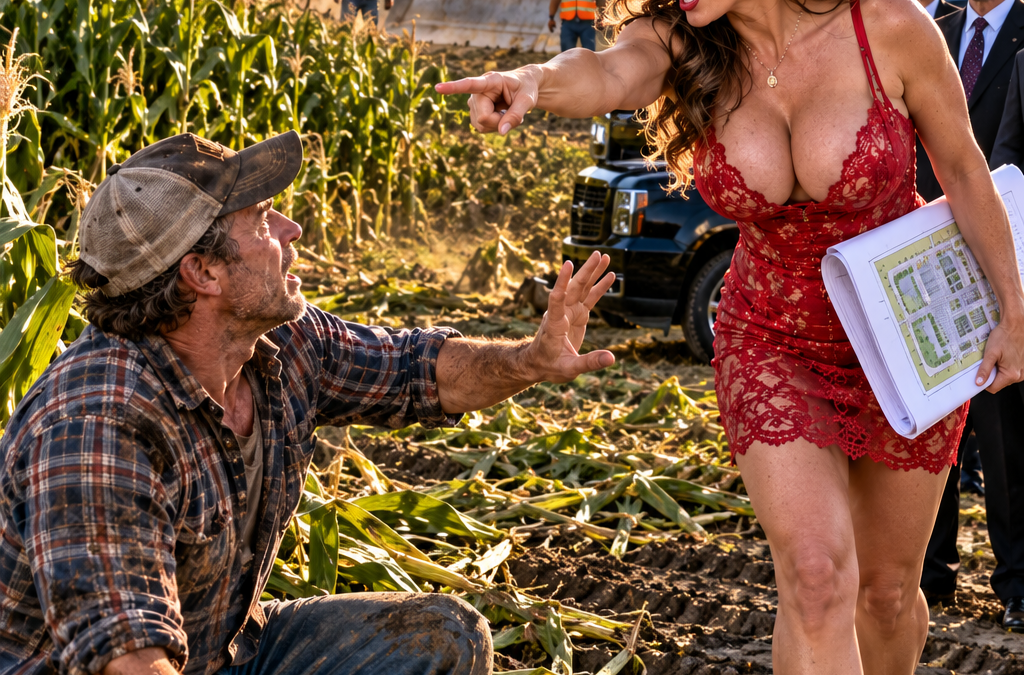
Victoria was about forty, strikingly beautiful, always perfectly put together and fully aware of the effect she had on people. She wore her dark hair long, expensive sunglasses even before sunrise, and seemed to own an entire closet of red lace dresses that were tight, low-cut and absurdly inappropriate for construction sites.
She dressed like someone who expected everyone in the room to look at her.
Then she spoke like someone who expected them to obey.
I reached the edge of the field breathing hard.
“Stop those machines!”
Victoria slowly turned toward me.
“Good morning, Jack.”
“Stop them!”
One of the bulldozers continued forward.
I pointed toward it.
“That is my crop!”
Victoria barely glanced over.
“The site has been approved for clearing.”
“By who?”
“The HOA board.”
“The HOA board doesn’t own my farm.”
Her smile appeared.
Small.
Condescending.
“We’ve already discussed this.”
“No. You told me what you planned to do. I told you no.”
“You objected.”
“I own the land.”
“You believe you own the land.”
I stared at her.
“What does that mean?”
Victoria lifted one shoulder.
“It means property boundaries are more complicated than farmers sometimes understand.”
Farmers.
The way she said it made the word sound like an insult.
I had spent twenty years managing acreage, irrigation, crop insurance, leases, drainage, easements, equipment financing and agricultural taxes.
But in Victoria’s mind, I was apparently some idiot who knew how to drive a tractor and nothing else.
She turned toward the foreman.
“Keep going.”
I stepped forward.
“Don’t.”
Victoria looked back at me.
“Excuse me?”
“Do not tell them to keep destroying my crop.”
Her expression hardened.
“You are interfering with an approved development.”
“On my land.”
“Jack, we are not doing this again.”
She said it the way a school principal might speak to a child throwing a tantrum.
I could feel anger pushing against my ribs.
For one second I wanted to walk straight into the path of the bulldozer.
Make them stop physically.
Force Victoria to look me in the eye while she ordered a machine through a man standing on his own farm.
Then I remembered what my attorney had told me the night before.
Don’t give them a confrontation.
Give me evidence.
So instead of grabbing Victoria’s clipboard out of her hands, I took out my phone.
I started recording.
Victoria noticed.
Her eyes narrowed.
“What are you doing?”
“Documenting.”
“You don’t have permission to film an HOA project.”
I looked down at the soil beneath my boots.
“I don’t need HOA permission to photograph my own land.”
Her mouth tightened.
Then she smiled again.
“Enjoy your pictures.”
She turned away.
Another hundred yards of corn disappeared.
What Victoria didn’t know was that less than twenty-four hours earlier, a property attorney named Sarah Bennett had looked at my deed, looked at my grandfather’s survey and told me something that changed the entire fight.
The HOA’s shopping mall crossed my legal property line.
And that bulldozer was driving directly into the evidence.
The fight had actually started weeks earlier.
Until then, I lived a life so repetitive most people would probably have called it boring.
I called it mine.
I woke before sunrise.
Checked irrigation.
Walked the fields.
Fixed whatever had broken overnight.
Drove into town when I needed parts.
Came home tired enough to sleep.
My family had grown corn on that farm for generations.
Not some enormous corporate operation.
Just good farmland, carefully managed.
There were places on that property I could identify with my eyes closed.
A drainage ditch my grandfather had dug by hand.
A cottonwood struck by lightning when I was twelve.
An old iron boundary pin near the north field.
A shallow rise where my father used to park the tractor at sunset because he liked the view.
People saw acreage.
I saw memory.
Then Maple Crest Estates expanded onto neighboring property.
At first, the HOA had nothing to do with me.
Their subdivision sat east of my farm behind landscaped stone walls and rows of large houses with identical mailboxes.
I didn’t care what color their shutters were.
They didn’t care what I planted.
That arrangement worked perfectly.
Then Victoria became HOA president.
She had been elected several years earlier and apparently decided the title gave her authority over everything she could see from her subdivision.
The first time she came to my farm, she arrived in the same black SUV she would later use to watch the bulldozers.
She stepped out wearing a red lace dress and heels that sank slightly into the gravel.
I was repairing a fence.
“Mr. Miller?”
“Jack.”
“Victoria Hale. President of Maple Crest.”
“I know who you are.”
She smiled.
“I’m glad.”
She handed me a glossy packet.
On the front was an architectural rendering.
A shopping center.
Stone façade.
Restaurants.
Boutique stores.
A grocery anchor.
Landscaped parking lots.
A huge sign reading MAPLE CREST COMMONS.
“What is this?”
“The future.”
I looked at her.
“Of what?”
“This area.”
I flipped through the packet.
The proposed mall appeared to extend directly across part of my eastern field.
“This crosses my farm.”
Victoria didn’t even blink.
“The board has approved redevelopment of the corridor.”
“That wasn’t what I said.”
“There are overlapping planning zones.”
“You’re drawing buildings on my cornfield.”
“We’re improving underutilized land.”
I looked around.
Corn stretched behind her almost to the tree line.
“Underutilized?”
“For its potential value.”
“To you.”
“To the community.”
I handed the packet back.
“No.”
She looked at my hand as if nobody had ever returned something she offered.
“No?”
“You’re not building a mall on my farm.”
“Jack, this project is worth approximately fifteen million dollars.”
“That doesn’t change who owns the dirt.”
“The HOA has development authorization.”
“From whom?”
“The relevant parties.”
“Meaning?”
She gave me a slow smile.
“You really should have an attorney explain land planning to you.”
I wiped my hands on a rag.
“I have a better idea.”
“What?”
“You show me the deed.”
Her smile disappeared.
“The what?”
“The document giving you ownership.”
“This isn’t that simple.”
“It is to me.”
I walked toward the farmhouse and returned with a laminated property map I kept in the office.
I unfolded it across the hood of my truck.
“Here.”
Victoria reluctantly looked down.
I pointed at the boundary.
“My line runs from the creek north to this marker, then east along the old fence.”
“We have updated development maps.”
“Development maps don’t change ownership.”
“They can reflect boundary adjustments.”
“Show me the adjustment.”
Her eyes lifted.
“This project has already been approved.”
“Then show me what gives you the right to use my land.”
Victoria straightened.
Her voice cooled.
“You need to understand something, Jack. Maple Crest is growing. Your farm is surrounded by development now. You cannot hold back progress forever because your grandfather planted corn here.”
That sentence stayed with me.
Not because she was wrong about development.
Things change.
Towns grow.
Farms become subdivisions.
Roads widen.
But there is a legal difference between buying land for development and deciding someone else’s land is inconvenient.
“You want my farm?”
“Part of it.”
“Make an offer.”
“We don’t need to.”
There it was.
I stared at her.
Victoria slipped on her sunglasses.
“The board has authorized the project.”
Then she got into her SUV.
That evening, I opened the fireproof cabinet in my office.
Inside were records my grandfather had saved obsessively.
Tax receipts.
Old deeds.
Surveys.
Easements.
Handwritten notes.
Some of the pages smelled like dust and old paper.
I found the original deed.
Then the survey.
The line was unmistakable.
The proposed mall crossed well inside our documented property.
Not by a few feet.
By a substantial amount.
Parking.
Access lanes.
Utility corridors.
A significant portion of the actual building footprint.
All of it overlapped my farm.
I called Sarah Bennett the next morning.
Sarah specialized in property and land-use disputes.
I had never met her before.
She came recommended by a neighboring farmer who had fought a highway easement case years earlier.
Her office was forty minutes away.
I brought a cardboard box of records.
Sarah opened the deed first.
Then the survey.
Then county parcel maps.
Then the mall rendering.
She spread everything across a conference table.
“How long has your family owned this?”
“Decades.”
“Any partial sales?”
“No.”
“Boundary adjustment?”
“Not that I know of.”
“Easement granted to Maple Crest?”
“No.”
She checked again.
Then leaned back.
“Do not sign anything.”
“I haven’t.”
“Not a permission form. Not a temporary access agreement. Not a construction waiver. Nothing.”
“What are you seeing?”
She turned the survey toward me.
“The proposed construction crosses your documented property line.”
“How far?”
“Enough that this isn’t a fence dispute.”
“So they can’t build.”
“I didn’t say that yet.”
I frowned.
“The deed says it’s mine.”
“It appears strong. But we verify everything before making aggressive claims.”
She tapped the document.
“I want certified copies, current county records, and an independent survey.”
“What do I do if they show up?”
“Document.”
“And stop them?”
“Call law enforcement if necessary. But don’t put yourself in front of machinery.”
I nodded.
“Jack.”
She waited until I looked at her.
“I mean it. Don’t turn a property case into a physical confrontation.”
Less than twenty-four hours later, the bulldozers arrived.
By sunrise, two full strips of ripe corn were gone.
I photographed everything.
Machine tracks.
Broken stalks.
Boundary posts.
License plates.
Company logos.
Victoria standing beside her SUV.
The foreman holding site plans.
I photographed the exact place where the machines crossed the old fence line.
Then I called the sheriff.
Deputy Daniel Brooks arrived around seven.
He stepped from his cruiser and looked over the field.
Victoria reached him first.
Of course she did.
“Officer, thank you. We have a landowner interfering with permitted construction.”
Daniel looked at me.
I held up my folder.
“My deed. Survey. They’re on my property.”
Victoria cut in.
“This development was legally approved.”
I looked at her.
“Approval is not ownership.”
She turned toward Daniel.
“You see what we’re dealing with?”
Daniel took the documents.
To his credit, he actually studied them.
But after several minutes, he shook his head.
“I’m not qualified to make a boundary determination on the side of the road.”
Victoria smiled triumphantly.
“Exactly.”
Daniel continued.
“That does not mean construction is authorized.”
Her smile faded.
He looked at the foreman.
“Until this gets clarified, you need to understand you could be exposing yourselves to liability if you’re crossing a disputed boundary.”
Victoria stepped forward.
“The HOA accepts responsibility.”
That caught my attention.
So I recorded it.
Daniel noticed my phone but said nothing.
Victoria pointed toward the machines.
“You can continue.”
The foreman hesitated.
She snapped.
“Did you hear me?”
He looked at Daniel.
The deputy held up both hands.
“I’m not issuing a stop-work order. I’m also not telling you this is your land.”
Victoria looked at the foreman again.
“Continue.”
And they did.
That was when I understood the kind of opponent I was dealing with.
Victoria did not need to know she was right.
She only needed everybody around her to be afraid of treating her as if she might be wrong.
Sarah was furious when I called.
“She continued after the sheriff warned them?”
“Yes.”
“Did you record it?”
“Yes.”
“Good.”
She corrected herself.
“Not good that it happened. Good that you recorded it.”
The independent surveyor arrived the following day.
He spent hours working the boundary.
By afternoon, red flags appeared across the landscape.
One after another.
They ran straight through the construction zone.
Beyond them lay my land.
And machinery had crossed well past those flags.
The surveyor stood beside me staring at the tracks.
“No ambiguity here.”
Sarah requested certified survey records immediately.
I thought that would be enough to slow the project.
Victoria did the opposite.
She accelerated it.
Three days later, Maple Crest announced the mall publicly.
A promotional video appeared online.
Music.
Renderings.
Smiling families.
Storefronts.
Then Victoria appeared.
Red lace dress.
White blazer.
Perfect smile.
“Maple Crest Commons represents the future of our community. Through strong leadership and careful planning, the board has secured the land necessary to bring fifteen million dollars in new retail development to this area.”
Secured the land.
I replayed those words.
Then saved the video.
Sarah watched it that afternoon.
“She said they secured it?”
“On camera.”
Sarah smiled without humor.
“Save three copies.”
She sent the HOA formal notice.
The letter was direct.
Ownership disputed.
Construction crossing the Miller property line.
Cease activity on the contested area pending resolution.
Preserve records.
Do not alter boundary markers.
Do not destroy evidence.
The HOA’s attorney responded.
The project had already been approved.
The board believed it possessed sufficient development rights.
Construction would continue.
Sarah read the response twice.
“They’re not answering the question.”
“What question?”
“What gives them the land?”
The board met two nights later.
Victoria convinced them not to pause construction.
I know because one of the members later admitted what happened.
A few directors wanted to stop until the title issue was resolved.
Victoria refused.
“We cannot let one farmer hold a fifteen-million-dollar development hostage.”
Someone asked what happened if the survey was correct.
Victoria reportedly answered:
“Then we deal with him afterward.”
Afterward.
Meaning after my crop was gone.
After the ground was cleared.
After construction money had been spent.
After the situation became expensive enough that they assumed I would surrender.
That was their strategy.
Create the irreversible fact first.
Negotiate with the landowner second.
I walked the field every evening.
It was getting harder.
Corn that should have stood shoulder-high lay shredded into the mud.
Irrigation lines had been crushed.
Tire tracks cut through the soil.
Places where I had worked with my father were becoming graded dirt.
One evening I found part of the old row he had planted with me when I was seventeen.
Most of it was gone.
I crouched beside the last surviving section and ran a hand along one of the stalks.
Farmers understand loss in units other people rarely think about.
Bushels.
Acres.
Rainfall.
Yield.
But some losses don’t fit neatly into a spreadsheet.
I could replant corn.
I could replace irrigation.
I could not recreate the years that field contained.
I stood there until sunset.
Then I made myself one promise.
Whatever happened, the destruction would not become free.
Sarah began building the case.
Original deed.
Certified deed copy.
Historical boundary survey.
Independent survey.
Photographs.
Videos.
Machine locations.
Construction notices.
The sheriff incident.
Victoria’s promotional video.
Crop-loss estimates.
Irrigation damage.
Everything.
The lawsuit sought compensation and court intervention regarding the trespass.
When the first hearing arrived, Victoria sat behind the HOA’s lawyers wearing another red dress and the same expression she had worn beside the bulldozers.
Confident.
Almost amused.
Their attorney argued that the board believed it had valid development authority.
Sarah stood.
“Belief does not move a recorded property boundary.”
She handed the judge the original deed.
Then the certified survey.
Then the independent survey.
The judge studied them.
He didn’t make a final ruling immediately.
Instead, he requested further evidence.
That frustrated me.
Outside the courtroom, Victoria approached while Sarah was speaking to the surveyor.
“Was all this really necessary?”
I stared at her.
“You bulldozed my corn.”
“You could have negotiated.”
“You never made an offer.”
“We were willing to compensate you.”
“When?”
She shrugged.
“Eventually.”
I almost laughed.
“So you destroy first and pay whatever you feel like later?”
She lowered her sunglasses slightly.
“Jack, you need to be practical.”
“I am.”
“No, you’re emotional.”
That word.
Emotional.
Coming from the person who had ordered bulldozers to continue across disputed land because she couldn’t tolerate a delay.
She stepped closer.
“The mall is happening.”
“Maybe.”
“It is.”
“You sound nervous.”
Her expression changed.
“I’m not nervous.”
“Good.”
I looked toward the courthouse doors.
“Then court should be easy.”
Sarah called my name.
Victoria walked away.
The next stage focused on exactly where construction had crossed.
The independent surveyor testified.
He described the original monuments.
The historical records.
The line measurements.
The red markers.
Sarah displayed photographs showing bulldozers beyond those markers.
Then she overlaid the mall site plan on the property survey.
Even I was surprised by how obvious it looked.
A large portion of the proposed project crossed my boundary.
The HOA attorney tried to argue that planning documents had created confusion.
The surveyor didn’t budge.
“A planning map does not convey title.”
The judge asked for verified damage calculations.
That was when the case stopped being theoretical.
An agricultural expert inspected the farm.
He measured destroyed acreage.
Estimated lost crop yield.
Calculated damage to irrigation.
Soil compaction.
Restoration costs.
Lost production.
Every damaged section became a number.
I hated seeing my farm reduced to figures.
But numbers were what the case needed.
Sarah added every legally supportable loss.
The total grew.
Meanwhile, questions about the development authorization became more uncomfortable.
During questioning, the developer was asked how the mall site had been selected.
He explained that the HOA had provided the site.
Sarah asked:
“Did you independently verify ownership?”
“We reviewed materials supplied to us.”
“Did those materials include a deed conveying Mr. Miller’s farmland to Maple Crest?”
“I don’t recall.”
“That’s not my question.”
The developer shifted.
“I would have to review the file.”
Sarah had the file.
There was no deed.
She moved to the construction agreements.
Then the authorization records.
Who instructed crews to clear?
Who identified the land as available?
Who told the developer the HOA controlled it?
Again and again, the paper trail moved toward the board.
And toward Victoria.
At one point, Sarah showed an email.
Victoria had written:
Proceed according to schedule. Landowner objections should not delay site preparation.
I remember looking at Victoria.
For the first time, she wasn’t looking back.
Legal costs started climbing for everybody.
The developer had lawyers.
The HOA had lawyers.
Insurers became involved.
Board members started blaming one another.
Victoria still tried to maintain control.
At meetings she called the lawsuit “an opportunistic land claim.”
She suggested I had waited intentionally for construction to begin so I could demand money.
That accusation infuriated me more than almost anything else.
I had objected before clearing.
I had shown her the property map.
My attorney had sent written notice.
An independent survey had marked the boundary.
The sheriff had warned everyone a dispute existed.
And Victoria had told them to keep going.
Sarah told me not to respond publicly.
“She wants you angry.”
“I am angry.”
“I know.”
“She’s telling people I set them up.”
“And our evidence shows otherwise.”
“She destroyed my crop.”
“I know.”
“She knew there was a dispute.”
Sarah leaned forward.
“Jack, this is why the emails matter.”
I looked at her.
“You don’t beat someone like Victoria by becoming louder than Victoria.”
She tapped the file.
“You beat her by making it impossible for anyone neutral to believe her.”
Settlement talks started months into the dispute.
Not because anyone suddenly became reasonable.
Because the numbers had become dangerous.
The evidence was documented.
The boundary evidence was strong.
The crop destruction was photographed.
The warnings were written.
The board’s decision to continue after notice was now part of the record.
Everyone understood trial could make things worse.
Sarah asked what I wanted.
“My farm back.”
“Anything else?”
“What they destroyed.”
“Meaning compensation?”
“Everything we can prove.”
She nodded.
“That’s exactly how we approach it.”
The first settlement offer insulted me.
I rejected it.
The second was better.
Still not enough.
Victoria attended one negotiation session.
She spent the first half acting as though the HOA was doing me a favor by negotiating at all.
At one point she leaned across the table.
“You understand this development brings enormous value to the region?”
I looked at her.
“That doesn’t give you the right to bulldoze my farm.”
“You keep saying ‘my farm’ as though nothing around you can ever change.”
“Things can change.”
“Exactly.”
“When the owner agrees.”
Her lips tightened.
She turned toward Sarah.
“Can you please explain to your client that litigation has risks?”
Sarah smiled.
“I have.”
“Then why is he being unreasonable?”
Sarah’s smile disappeared.
“Because your definition of reasonable appears to be ‘accept whatever the HOA decides after the damage is already done.’”
Victoria sat back.
Nobody spoke for several seconds.
Negotiations continued.
Numbers went back and forth.
Crop losses.
Irrigation.
Restoration.
Legal exposure.
Development disruption.
Documented damages.
The agreement became more complex because the dispute had become more complex.
Eventually, we reached terms Sarah believed properly addressed the proven losses and the parties’ obligations going forward.
She reviewed every page with me.
Slowly.
Paragraph by paragraph.
Just as she had told me at the beginning:
Don’t sign anything until you understand it.
This time, I understood.
I signed.
The pen felt surprisingly light.
Afterward, I sat in Sarah’s office staring at my name on the last page.
“That’s it?”
“That’s it.”
“Feels strange.”
“It usually does.”
“I thought I’d feel better.”
“You will.”
“When?”
“When you stop having to think about this every morning.”
The settlement money arrived later.
It compensated me for losses recognized in the agreement.
It did not restore the corn that had been crushed.
It didn’t give me back those mornings standing beside torn irrigation lines.
It didn’t erase Victoria’s voice saying the HOA had approved the land.
But it meant the destruction had consequences.
Real ones.
Financial ones.
Documented ones.
The HOA had wanted my farmland for its mall.
In the end, the decisions its leadership made forced it to pay for the damage those decisions caused.
The project that had been presented as a fifteen-million-dollar triumph became a case study in what happens when development moves faster than ownership records.
People sometimes ask whether I hate Victoria.
I don’t think about it that way anymore.
Hatred takes energy.
Farming teaches you not to waste energy on things that don’t produce anything.
What I remember is her certainty.
That was always the most dangerous thing about her.
Not the red dresses.
Not the expensive SUV.
Not the way she spoke to board members.
Not even the fact that she seemed to enjoy humiliating people who challenged her.
It was the certainty.
She believed a board vote could create rights the board never possessed.
She believed a development schedule was more important than a deed.
She believed that once enough money had been spent, the owner of the land would have no practical choice except surrender.
And she believed the man growing corn would never have the patience or resources to prove otherwise.
She was wrong.
The farm changed after the case.
Some sections had to be restored.
Damaged irrigation was replaced.
Soil compacted by heavy machinery took time to recover.
There were mornings when I walked past the scarred ground and still felt my chest tighten.
But crops return.
That is the thing about farmland.
Treat it properly and it tries again.
The next planting season, I stood at the edge of the field before sunrise.
A row of fresh corn pushed through the soil where bulldozer tracks had once crossed.
Small.
Green.
Fragile-looking.
But alive.
I crouched and touched one of the leaves.
My grandfather used to say farming required a strange kind of faith.
You bury something valuable in dirt and trust that patience will bring it back.
For months, that was exactly what the lawsuit felt like.
We buried documents in court filings.
Surveys.
Photographs.
Emails.
Damage estimates.
Testimony.
Then waited.
Victoria had wanted speed.
Bulldozers before sunrise.
Construction schedules.
Board approvals.
Announcements.
Momentum.
My side had patience.
And records.
In the end, records lasted longer than momentum.
The original deed lasted longer than Victoria’s assurances.
The survey flags mattered more than her speeches.
The photographs mattered more than the HOA’s press releases.
And the emails mattered more than every argument she made after the fact.
There was no dramatic moment when fifty people applauded and Victoria suddenly admitted she had been wrong.
People like Victoria rarely do that.
She never stood in front of me and said:
Jack, I should have stopped the machines.
She never said:
I should have checked the title.
She never said:
I knew there was a dispute and pushed forward anyway.
She didn’t have to.
Her own paperwork had already said enough.
The strangest thing was how ordinary my life became afterward.
No attorneys calling every afternoon.
No certified letters.
No survey crews.
No hearing dates.
No photographs of bulldozers.
Just weather.
Fuel prices.
Irrigation.
Corn.
The things I had wanted to worry about all along.
One evening near harvest, I stood beside the field while the sun dropped behind the western tree line.
The corn moved in the wind.
Thousands of stalks bending and rising together.
My father would have recognized the sound instantly.
I thought about Victoria standing beside her SUV that first morning.
The machines behind her.
The confidence in her voice.
The way she told me the site had been approved.
As though approval settled everything.
It didn’t.
A board can approve a plan.
A developer can announce a project.
A contractor can start an engine.
A bulldozer can destroy a crop in minutes.
But none of those things changes a property line simply because someone powerful wishes it would.
That was the lesson Maple Crest learned at my expense.
Victoria believed fifteen million dollars made the mall inevitable.
I believed a deed meant something.
In the end, the court records, surveys and settlement proved which belief had a legal foundation.
I never wanted a fight with the HOA.
I wanted to grow corn.
They brought the fight onto my property.
They brought bulldozers.
They brought lawyers.
They brought development maps and board resolutions.
So I brought the one thing they had failed to respect from the beginning.
Proof.
And once the proof was placed in front of people Victoria could not intimidate, her authority ended exactly where my property line began.








