𝗙𝗨𝗟𝗟 𝗦𝗧𝗢𝗥𝗬 The HOA Sent Bulldozers Onto My Private Farmland to Build 35 Luxury Homes and Threatened to Destroy My Life If I Tried to Stop Them
𝗙𝗨𝗟𝗟 𝗦𝗧𝗢𝗥𝗬
He glanced at his clipboard.
“Development management. HOA approval. We’ve got the paperwork.”
“You’re standing on private property.”
“Yes, sir. This is private development.”
“My private property.”
His expression changed slightly.
“Are you one of the neighboring owners?”
“I’m the owner of the ground your excavator is digging up.”
He stopped smiling.
For several seconds, neither of us spoke.
The bulldozer continued moving behind him.
Finally, he said, “You need to take that up with the development office.”
“I need those machines shut down.”
“Sir, I don’t have the authority to shut down an entire job site because somebody says there’s a property dispute.”
I reached into my truck, retrieved a copy of my deed, and placed it against the hood.
“Then call somebody who does.”
He studied the first page without touching it.
“Look, I understand you’re upset.”
“No. You don’t. I woke up this morning and found a construction company excavating my pasture. I haven’t sold this land. I haven’t leased it. I haven’t signed an easement. And nobody has contacted me about building anything here.”
He took out his phone.
I watched him walk several yards away and speak quietly.
When he returned, his manner had changed.
“The development manager says the boundaries were verified.”
“By whom?”
“I don’t know.”
“Then show me the verification.”
“I can’t give you documents that don’t belong to you.”
I stared at him.
“You’re building on land that belongs to me, and you’re telling me the documents explaining why are none of my business?”
He looked uncomfortable.
“That’s not what I said.”
“Then shut down the equipment until somebody can answer a basic question.”
He shook his head.
“I can’t do that.”
Behind him, an excavator lowered its bucket.
The teeth bit into the earth.
I felt that sound in my chest.
It was an ugly sensation, watching machinery cut through ground you had worked for years to protect while the people operating it insisted the matter was already settled.
I wanted to walk in front of that excavator.
I wanted to stand there until somebody listened.
Instead, I stepped back.
Getting myself arrested or injured wasn’t going to help.
I photographed the equipment, license numbers, work signs, trenches, and temporary roads.
Then I called the county planning office.
That was when the situation became truly disturbing.
The woman who answered found the development application almost immediately.
“Brookhaven Estates, Phase Four,” she said. “Thirty-five residential lots.”
“Thirty-five?”
“Yes, sir.”
“Who is listed as the property owner?”
There was a pause.
“I’m seeing the Brookhaven development entity on the submitted application.”
“That entity doesn’t own the property.”
“I’m sorry?”
“I’m the legal owner. The construction is happening inside my deeded boundaries.”
She asked for the parcel identification number.
I read it to her.
I heard typing.
More silence.
Then she said something I would remember for a long time.
“Those records aren’t matching the boundary shown on the development submission.”
“Exactly.”
“Sir, you’ll need to file a formal ownership objection.”
“How long does that take?”
“I can’t give you an exact timeline.”
“Do you understand there are bulldozers on the property right now?”
“I understand, but the permitting office can’t resolve a title dispute over the phone.”
I looked through my windshield toward the field.
A second excavator had started working.
“Then tell me who can.”
She gave me the names of two departments and a reference number.
I wrote everything down.
By noon, I had submitted a written objection.
By three, I had emailed photographs, survey references, and copies of my property description.
By sunset, another section of pasture had been stripped bare.
That night, I barely slept.
Every time I closed my eyes, I saw the excavator tearing through my land.
The next morning, the machines were still working.
And the morning after that.
I called again.
Filed another complaint.
Requested an inspection.
Contacted the sheriff’s office to document the suspected trespass.
A deputy came out, listened carefully, and photographed the construction boundary.
He was professional, but he couldn’t resolve the ownership dispute on the spot.
“If they’ve got permits and you’re saying the property description is wrong, this is going to involve the county and probably a judge,” he told me.
“Meanwhile, they keep building?”
“I’d recommend getting an attorney involved immediately.”
I already knew he was right.
What I hadn’t expected was how quickly the damage would grow while the paperwork caught up.
Within days, concrete trucks appeared.
Forms went into the excavated ground.
Steel reinforcement was installed.
Foundation crews began pouring slabs.
I watched the first one from across the fence.
Then the second.
Then the third.
By the end of the following week, the field that had produced hay for years was covered with construction access roads, foundations, utility trenches, and stacks of lumber.
I counted thirty-five marked lots on the site plan posted near the construction entrance.
Thirty-five houses.
Not five.
Not ten.
Thirty-five.
And not one person had asked me to sign anything.
That was when I first met Hoa Karen.
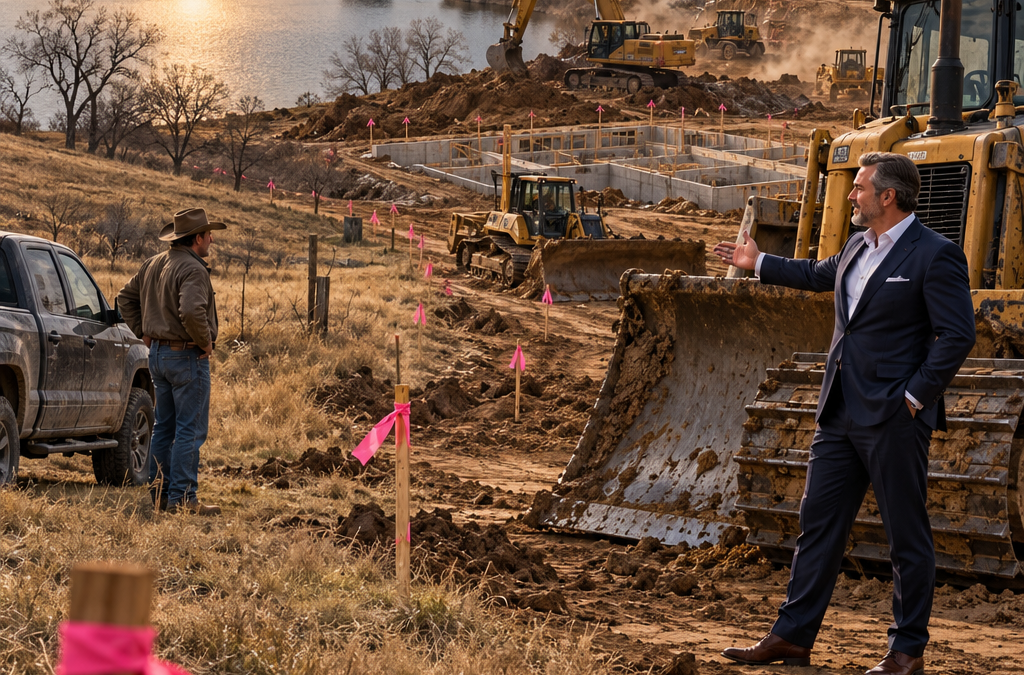
He arrived late on a Thursday morning in a black luxury SUV polished so thoroughly that it reflected the clouds.
He was fifty years old, perhaps a little older, with silver beginning to show at his temples and a face that looked carefully maintained.
His hair was combed back with meticulous precision.
His dark navy suit fit perfectly.
His shoes shone.
A heavy watch flashed beneath his cuff when he reached to straighten his tie.
Everything about him suggested expensive grooming and absolute confidence.
He looked like a man who expected doors to open before he reached them.
He parked directly in front of my equipment barn, climbed out, and surveyed the property with the expression of someone inspecting a purchase he had already made.
“You’re the owner?” he asked.
I stood beside my truck.
“Who are you?”
“Hoa Karen. President of the Brookhaven Estates Homeowners Association.”
He extended his hand.
I didn’t take it.
His smile tightened.
“I understand you’ve been creating difficulties for our contractors.”
“Your contractors are digging up my property.”
“That’s what I’d like to discuss.”
“Then start by explaining why they’re here.”
He opened a leather portfolio.
“I prefer to handle these matters professionally.”
“Good. So do I.”
He removed a large laminated development map and spread it across the hood of his SUV.
The drawing showed a polished residential community.
Curved streets.
Landscaped intersections.
A central green space.
Thirty-five individual residential lots.
A decorative stone entrance connected to Brookhaven Estates.
The entire project was colored in pale green.
I recognized the outline of my eastern pasture immediately.
“There,” he said, tapping the map. “Phase Four. It’s an important part of the community’s long-term development strategy.”
“Whose land is it?”
He looked at me as though the question were a waste of time.
“It’s been incorporated into the approved expansion area.”
“That wasn’t my question.”
“Brookhaven’s development committee has been working on this for months.”
“Who owns the land?”
His smile faded.
“The association has approved the development.”
I leaned closer.
“Approval doesn’t mean ownership.”
He exhaled through his nose.
“You’re thinking too narrowly. This community has grown significantly. We have families waiting for homes, investors committed to infrastructure, and a substantial amount of capital already deployed.”
“None of that answers my question.”
He straightened his cuffs.
“The board voted in favor of expansion.”
“Your board doesn’t get to vote on whether you own my farm.”
His eyes hardened.
For a moment, the polished smile disappeared entirely.
Then he leaned against the SUV and folded his arms.
“You’re obviously attached to this property.”
“Yes.”
“I respect that.”
“No, you don’t.”
He ignored the interruption.
“But you need to recognize the reality of what’s happening around you. This town isn’t a farming village anymore. People want quality housing. Businesses want growth. Property values are increasing. You have a chance to be part of something beneficial.”
“By giving you land I never offered for sale?”
“I wouldn’t use that wording.”
“What wording would you use?”
“Cooperating with planned development.”
I stared at him.
He said it without embarrassment.
As though changing the vocabulary changed the theft.
I placed my finger on the map.
“This boundary is wrong.”
“It was prepared by professionals.”
“Professionals can make mistakes.”
“The plans have been approved.”
“By an HOA.”
“By the appropriate development authorities as well.”
“Then somebody submitted false ownership information.”
His jaw moved.
“You should be careful making accusations.”
“You should be careful building houses on someone else’s property.”
The silence between us thickened.
Behind him, a framing crew was unloading lumber.
He followed my gaze.
“Stopping this project now would be extremely expensive.”
“That sounds like your problem.”
“It will become yours if you interfere.”
I looked back at him.
“Is that a threat?”
“It’s a practical observation.”
“No. It’s a threat dressed up in a nice suit.”
His expression went cold.
“I came here hoping we could resolve this like reasonable men.”
“Then remove your equipment.”
He slowly folded the map.
“I don’t think you understand how far this project has progressed.”
“I understand exactly how far your machines have gone into my property.”
He slid the map into his portfolio.
“We’ll be in contact.”
He walked back to his SUV.
Before he opened the door, he turned.
“One more thing. Brookhaven is a respected community. You’d be wise not to make yourself an obstacle to its future.”
I didn’t respond.
I watched him drive away.
Then I looked across the torn-up field.
He hadn’t come to ask permission.
He had come to tell me resistance was pointless.
That afternoon, I called an attorney.
I brought every document I possessed to the first meeting.
The original deed.
Previous surveys.
Tax records.
Parcel maps.
Photographs of construction.
Copies of my written complaints.
My attorney listened without interrupting while I described the equipment, the permits, and Hoa Karen’s visit.
When I finished, she arranged the documents in neat stacks.
“Let’s establish one thing first,” she said. “Have you ever sold, transferred, leased, or granted a development easement over this portion of the property?”
“No.”
“Any boundary agreement with Brookhaven?”
“No.”
“Any disputed inheritance or outstanding claim from a previous owner?”
“Nothing I’m aware of.”
She opened the deed.
“Then we start with the legal description and the title history. We don’t start with what the HOA claims.”
I leaned forward.
“They’re pouring foundations while we’re sitting here.”
“I know.”
“How do we stop them?”
“First, we establish the record. Then we seek immediate legal relief.”
“How long?”
“I won’t promise you a timeline I can’t control.”
That answer frustrated me, but I appreciated that she didn’t pretend the situation was simple.
She studied the old survey.
“One important question. Have you moved any survey markers?”
“No.”
“Confronted the workers physically?”
“No.”
“Blocked public roads?”
“No.”
“Good. Keep it that way.”
I rubbed my hands together.
“So I just watch?”
“You document. You preserve evidence. And you let us put the ownership dispute in front of the people who can enforce an order.”
I stared at the map.
“What if they finish before that happens?”
She was quiet for a moment.
“Then the consequences become more complicated for everyone. That’s why we’re moving now.”
We retained an independent surveyor and ordered a title examination.
The surveyor spent two days comparing the deed’s legal description with existing monuments and recorded boundary information.
When he finished, he brought me a marked drawing.
He placed the two maps side by side.
One was the HOA’s proposed subdivision.
The other was the actual boundary survey.
The difference was impossible to miss.
All thirty-five lots were inside my property line.
The private access road.
The foundations.
The drainage structures.
The temporary staging area.
Everything.
My attorney examined the survey and looked at me.
“This is strong evidence.”
“Strong enough to stop them?”
“It’s strong enough that they should never have started.”
Unfortunately, knowing I was right didn’t make the construction disappear.
Brookhaven’s development team continued operating while the dispute moved through formal channels.
A written demand went to the HOA, its development partners, and the contractors.
We requested that work stop immediately.
The response came through their legal representatives.
They disputed our interpretation of the property boundaries and maintained that they had relied on approved development materials.
My attorney read the letter twice.
Then she set it down.
“They’re buying time.”
“For what?”
“Possibly to finish enough work that they think the financial pressure will force you to compromise.”
I looked at the photographs spread across her desk.
The first houses had begun to take shape.
Walls were rising where grass had stood only weeks earlier.
“You think Hoa Karen knows?”
“I think he has been given ample notice.”
That distinction mattered.
An initial boundary mistake might have been negligence.
Continuing after receiving a deed, a survey, and a formal objection was something else.
I drove home that evening feeling as though my own property had become enemy territory.
The town had changed dramatically over the previous decade.
New apartment buildings lined the highway.
Shopping centers occupied former soybean fields.
Road crews had widened intersections that once had nothing more than stop signs.
I understood growth.
I wasn’t against it.
People needed places to live.
Families needed schools, stores, roads, and jobs.
I had never believed that farmland should remain untouched simply because someone like me preferred looking at open fields.
But there was an enormous difference between a willing landowner selling property and a powerful organization deciding that ownership was an inconvenience.
Hoa Karen didn’t seem to recognize that difference.
Or perhaps he recognized it perfectly and believed he could intimidate me into surrendering.
Three days later, he arrived again.
This time, he brought two men in business clothes.
I was repairing a gate near the southern pasture when his SUV stopped beside the fence.
He stepped out holding his portfolio.
“Good afternoon,” he said.
“What do you want?”
“To prevent an unfortunate situation from getting worse.”
“Then stop construction.”
He smiled at the other men, as though I had made a predictable joke.
“We need to talk about the bigger picture.”
“There isn’t a bigger picture. You’re building on my land.”
One of the men shifted uncomfortably.
Hoa Karen walked closer.
“Thirty-five families have been told they may soon have homes here.”
“Then somebody told them something they had no right to promise.”
“These are real people.”
“So am I.”
He ignored that.
“Some have already arranged financing. Others are planning to relocate. Children are expecting new schools. You’re not just challenging a development agreement. You’re disrupting lives.”
I felt anger rising behind my ribs.
He was trying to make me responsible for promises his own organization had made.
“Did you tell those families you didn’t own the land?”
“That’s an inflammatory characterization.”
“Did you?”
He adjusted his watch.
“Ownership is being reviewed.”
“Ownership was established long before you drew your map.”
“You’re being inflexible.”
“No. I’m refusing to give away my property.”
He stepped closer.
There was nothing physically intimidating about his posture.
That wasn’t his style.
He spoke softly, almost pleasantly, as though he were the only adult in the conversation.
“Listen carefully. There are significant commercial interests behind this expansion. You can continue fighting and spend years tied up in litigation, or you can accept that the community is moving forward.”
I looked directly at him.
“Are you offering to buy the property?”
He hesitated.
Then he said, “We’re prepared to discuss an accommodation.”
“An accommodation?”
“A resolution that allows the project to proceed.”
“What would that involve?”
“Compensation for your inconvenience, perhaps revisions to access arrangements.”
I almost laughed.
“My inconvenience?”
He frowned.
“There’s no need for hostility.”
“You’ve excavated my fields, torn out topsoil, poured concrete, and started thirty-five houses without my permission. Now you’re offering to compensate me for being inconvenienced?”
“We’re trying to solve a problem.”
“You’re trying to make your problem disappear.”
His cheeks reddened.
“You are putting dozens of families in a difficult position.”
“Then you should have thought about those families before building on someone else’s land.”
He stopped pretending to smile.
“Do you understand what refusing this agreement could cost you?”
I opened the gate and stepped through.
“Get off my property.”
His voice sharpened.
“You cannot stop progress because you’re sentimental about an empty field.”
I turned back.
“That field isn’t empty.”
He looked around theatrically.
“What am I missing?”
“Years of work. Soil my family maintained. Fences I repaired. Grass I cut. Trees I protected. And the simple fact that it belongs to me.”
He gave a dismissive shake of his head.
“Emotional arguments won’t survive a development dispute.”
“Neither will a development map that contradicts the deed.”
He stared at me.
Then he turned sharply and walked away.
His companions followed.
The SUV disappeared down the access road.
I stood at the gate until the dust settled.
My hands were shaking.
Not because I was afraid of Hoa Karen himself.
I was afraid of what a man like him could accomplish with lawyers, contractors, money, and enough time.
That night, I walked down to the reservoir.
The water was almost still.
A few ripples spread from the bank where small fish moved beneath the surface.
The old dam stood across the southern end, its concrete face pale in the fading light.
Beyond it, the land dropped toward the eastern fields.
Toward the construction.
I had always considered the reservoir the heart of the property.
It collected runoff from the surrounding hills.
The dam regulated water levels.
The outlet system carried controlled releases into an established channel that ran downhill before connecting with the area’s broader drainage network.
The system had existed for generations.
Long before Brookhaven Estates.
Long before the road was widened.
Long before anybody started selling luxury homes near the tree line.
My grandfather had taught me to respect that water.
He used to take me down to the control house after heavy rain and explain why the gates, outlet structures, and drainage channels had to be maintained.
“Water doesn’t care who owns the ground,” he’d say. “You can own the dam, but you still have to respect what it’s built to do.”
I hadn’t thought about those words in years.
Standing there, looking toward the construction lights in the distance, I suddenly remembered a section of the original property documents.
Not the main boundary description.
An older attachment.
A recorded description of the reservoir and its water management infrastructure.
I turned and hurried back to the house.
The folder was thicker than I remembered.
Inside were historical surveys, maintenance notes, recorded property descriptions, and documents relating to the dam’s original purpose.
I spread them across my dining table.
The handwriting on some pages was old-fashioned, but the engineering drawings were clear enough.
The reservoir.
The outlet works.
The designated drainage channel.
The area below the dam.
I followed the route with my finger.
Then I opened the HOA’s development map.
My stomach tightened.
The new streets and residential lots had been placed downhill from the reservoir.
Several planned improvements were close to the established water management corridor.
The plans I’d been given showed decorative drainage features and new underground infrastructure.
But I couldn’t find a meaningful explanation of how the existing reservoir’s controlled water releases had been incorporated into the subdivision design.
Maybe their engineers had accounted for it somewhere else.
Maybe there were documents I hadn’t seen.
But the omission was serious enough that I knew I couldn’t ignore it.
I called my attorney first thing the following morning.
“I found something.”
“What?”
“The reservoir records. The dam and outlet system were documented with the property. I don’t think the subdivision plans properly account for them.”
She didn’t answer immediately.
Then she asked, “Is the dam operating normally?”
“Yes.”
“Any concern about structural safety?”
“Not that I’m aware of. It’s inspected and maintained.”
“Have you changed any controls?”
“No.”
“Don’t.”
“I wasn’t planning to.”
“Good. We need the documents and a qualified inspection before anyone draws conclusions.”
I looked out the window toward the distant construction.
“They’re building downhill from the outlet channel.”
“Then we need to determine exactly what they’ve built, what the existing drainage requirements are, and whether the development can safely coexist with them.”
“Could they block the water?”
“That’s what the engineers need to evaluate.”
“Could the water damage the houses?”
“We are not going to speculate. And we are absolutely not going to use the reservoir as leverage.”
I understood what she meant.
She continued.
“Your ownership claim is legitimate. Your obligation to manage the reservoir safely is legitimate. We handle both through the proper process.”
I said, “I want my land back. I don’t want anybody hurt.”
“Then we’re in agreement.”
She arranged for the original records to be examined and for a qualified dam inspector and drainage engineer to visit the site.
Until then, I left every control exactly as it was.
Meanwhile, construction continued.
Every day it became harder to look at the eastern pasture.
The houses were no longer simply concrete slabs.
Two-story frames rose over several lots.
Workers installed roof trusses.
Temporary electrical service had been brought into the construction area.
Piles of pipe and building materials lined the unfinished streets.
The noise began before seven most mornings.
Hammers.
Engines.
Backup alarms.
The constant grinding of a neighborhood forcing itself into existence.
I stopped taking my usual evening walk through that part of the farm.
I couldn’t stand seeing it.
That loss embarrassed me more than I wanted to admit.
It was my land.
Yet I had begun avoiding it because the people trespassing there made me feel powerless.
One afternoon, I found myself sitting on the porch long after dark, staring toward the distant glow of construction lights.
I thought about how easy it would be to surrender.
Take whatever money they eventually offered.
Sign something.
Move the fence.
Pretend the fields had never mattered.
I could almost hear Hoa Karen telling me that was the reasonable choice.
But every time I considered it, I remembered the way he had stood beside his SUV and described the destruction of my property as an inconvenience.
Not a mistake.
Not an injustice.
An inconvenience.
That single word stayed with me.
It told me exactly how he saw people who stood in his way.
My attorney called the next morning.
“We have the title search.”
I gripped the phone.
“And?”
“Your ownership is clear. We found no recorded transfer giving Brookhaven title to the disputed area.”
I closed my eyes.
For the first time in weeks, I felt a small release of tension.
Then she continued.
“There’s more. The historical water infrastructure documents are part of the recorded property history. The independent survey supports the boundaries shown in your deed.”
“So there’s no question?”
“There’s always room for someone to make an argument. But the documents strongly support your position.”
“Will they stop?”
“We’re preparing the next legal step. We also have the HOA meeting scheduled. I want their board to see these records before they claim they didn’t know.”
I looked toward the field.
“What if Karen still refuses?”
“Then he refuses in front of witnesses.”
The dam inspector arrived two days later.
He was an older man with weathered hands, a heavy field notebook, and the deliberate manner of someone who preferred measurements to opinions.
He inspected the concrete structure, control mechanisms, outlet works, maintenance records, and surrounding channel.
I walked with him while he worked.
At the control house, he examined the operating mechanism and asked when the outlet system had last received maintenance.
I showed him the records.
He reviewed the inspection history.
Then he looked toward the subdivision.
“That’s new.”
“Very.”
He studied the topography.
“Who’s developing it?”
“The HOA next door.”
“Do they know about this reservoir?”
“They’ve been given notice.”
He looked at me.
“That wasn’t quite what I asked.”
I understood.
Being told a reservoir existed wasn’t the same as designing a neighborhood around its actual operating requirements.
The drainage engineer joined us later that afternoon.
Together, they reviewed the documented release route and compared it with the subdivision grading plans available to us.
The inspector’s immediate conclusion was reassuring in one respect.
The dam was maintained and operational.
There was no structural emergency.
No uncontrolled release.
No reason to take extraordinary action.
But the engineer had concerns about the development below.
He pointed at several marked locations.
“These new grading changes need to be checked against the established drainage corridor.”
I looked at the drawing.
“Is it unsafe?”
“I’m not going to give you that answer until I’ve finished the analysis.”
“Could the houses stay?”
“That depends on their actual locations, the legal requirements, and what corrective engineering might be possible. But someone should have resolved these questions before placing residential lots here.”
He traced the outlet channel.
“The existing system doesn’t stop functioning because somebody draws a new subdivision over the top of it.”
That sentence stayed with me.
It was the first time I’d heard a professional describe the problem without treating my property rights as an obstacle.
The reservoir wasn’t a weapon.
It wasn’t a threat I could unleash against the construction.
It was an existing, documented piece of infrastructure that required responsible management.
And the people designing thirty-five homes below it appeared to have treated that infrastructure as an inconvenient detail.
The preliminary engineering findings added another serious concern to the ownership dispute.
My attorney incorporated the inspection records and technical documents into our case.
She also notified the relevant water management authorities and requested formal coordination regarding the system’s upcoming routine operating needs.
Nothing would be changed without the proper procedures.
But the subdivision could no longer pretend the reservoir didn’t exist.
The HOA meeting took place on a Tuesday evening.
Brookhaven’s clubhouse looked more like a private hotel than a neighborhood meeting room.
Stone columns framed the entrance.
Large windows overlooked a landscaped courtyard.
Inside, leather chairs lined the walls, and a long polished table stood beneath recessed lighting.
When I arrived with my attorney, nearly every seat was occupied.
Board members.
Development representatives.
Several homeowners.
A few people I recognized from the construction site.
Hoa Karen sat at the head of the table.
He wore a charcoal suit this time, with a pale blue tie and a folded white pocket square.
His hair was immaculate.
He greeted us with the same practiced smile.
“Glad you could join us.”
My attorney placed her case beside a chair.
“We appreciate the opportunity to present the documentation.”
Hoa Karen glanced at the case.
“I hope this meeting will help everyone understand the necessity of cooperation.”
I said nothing.
He opened the meeting by discussing the development’s supposed benefits.
New homes.
Increased property values.
Improved amenities.
Additional investment in Brookhaven.
He spoke smoothly, using phrases like community vision and responsible growth.
At one point, he displayed a rendering of Phase Four on the screen behind him.
Beautiful houses stood beneath mature trees.
Children rode bicycles along curved streets.
A couple walked a dog beside a landscaped pond.
It was the kind of picture designed to make opposition look selfish.
Then he turned toward me.
“Unfortunately, we have encountered resistance from an adjacent property owner who disputes our approved boundaries.”
My attorney lifted her eyes.
“He’s not merely an adjacent owner.”
Hoa Karen held up one hand.
“You’ll have your opportunity.”
He continued.
“This individual has demanded that construction cease, despite the significant financial and personal consequences that would result.”
I felt every person in the room looking at me.
He let the silence stretch.
Then he said, “Thirty-five families could be affected.”
I leaned forward.
“Did you tell them the land wasn’t yours?”
A few people shifted in their chairs.
Hoa Karen’s smile tightened.
“We’re not conducting this meeting through interruptions.”
“Then stop making me responsible for promises you had no authority to make.”
His voice became sharper.
“Mr. Karen,” my attorney said calmly, “we’re prepared to address the actual property records.”
He looked irritated by her composure.
“Very well.”
She stood.
First, she placed the original deed on the table.
Then the historical survey.
Then the updated independent boundary survey.
She arranged the documents carefully, ensuring every board member could see the relevant sections.
“This is the recorded property description,” she began. “It establishes the boundaries of my client’s land.”
Hoa Karen crossed his arms.
“We’ve already reviewed maps.”
“Not this controlling record, apparently.”
She placed the survey beside the subdivision drawing.
“These are the boundary calls and surveyed positions. Now compare them with the approved Phase Four layout.”
The room became quiet.
One board member leaned forward.
Another adjusted his glasses.
My attorney pointed to the construction area.
“All thirty-five residential lots are located inside my client’s deeded property.”
Nobody spoke.
She continued.
“The roads, foundations, grading work, and associated improvements are also within those boundaries.”
A man near the far end of the table frowned.
“Are you saying none of that land was transferred?”
“We have found no recorded conveyance transferring ownership of this area to the HOA or its development partners.”
He looked toward Hoa Karen.
“Then what did we approve?”
Hoa Karen answered immediately.
“We approved a development plan based on professional surveys and representations.”
My attorney turned a page.
“We’ve also obtained an independent survey and reviewed the historical title records.”
She pushed the documents across the table.
“Those records don’t support the ownership claim underlying your project.”
One of the developers reached for the map.
He studied it.
Then he pulled the HOA’s drawing closer.
I watched his expression change.
“These boundaries don’t line up,” he said quietly.
Hoa Karen leaned toward him.
“There are different ways to interpret older parcel descriptions.”
The developer shook his head.
“Not like this.”
My attorney remained standing.
“There’s another issue.”
Hoa Karen looked up.
“Of course there is.”
She opened the folder containing the reservoir records.
“The property includes a longstanding reservoir and controlled water management system. Its infrastructure and operating corridor are documented in the historical records.”
She placed the dam inspection report on the table.
“The dam has been inspected. It is maintained and operational. There is no emergency.”
A woman on the board frowned.
“Why are we discussing a dam?”
“Because your subdivision lies downhill from it, and the engineering review indicates that the development design has not adequately accounted for the existing water management requirements.”
The woman looked at the construction map.
“Was that included in the approval package?”
No one answered immediately.
Hoa Karen straightened in his chair.
“Brookhaven has retained qualified professionals.”
“Then their work can be reviewed,” my attorney said. “But the recorded infrastructure cannot simply be omitted from consideration.”
He tapped his fingers against the table.
“Let’s not exaggerate. There’s been no flooding.”
“And no one is proposing flooding,” she replied. “We’re discussing the legal and engineering requirements governing an existing water control system.”
The developer was still studying the survey.
He finally looked up.
“Mr. Karen, did the association verify ownership before committing this parcel to Phase Four?”
Hoa Karen turned toward him.
“The project was reviewed through the appropriate channels.”
“That’s not what I asked.”
The room fell silent again.
Hoa Karen’s jaw tightened.
“Are you suggesting I personally conducted the survey?”
“I’m asking whether title was verified.”
“We relied on the development team.”
The developer looked down at the documents.
My attorney said, “Whatever internal process was followed, my client did not transfer this land. He did not consent to construction. And he has repeatedly notified the parties involved.”
She placed copies of our formal objections on the table.
Dates.
Recipients.
Delivery confirmations.
Photographs.
Every ignored warning.
One board member read through the pages.
“You received all of these?”
Hoa Karen didn’t answer.
I looked directly at him.
“You came to my property twice.”
He met my eyes.
“You’ve made your position very clear.”
“Yes. And you kept building.”
He leaned forward.
“Because stopping construction over every disputed claim would make development impossible.”
My attorney answered before I could.
“This is not an unsupported claim. It is a documented ownership dispute involving recorded title and a completed independent survey.”
A man sitting near the back raised his hand.
“My daughter is interested in one of those homes. Are you saying she’s planning to buy a house on land the builder doesn’t own?”
The question hit the room harder than anything I had said.
Hoa Karen turned quickly.
“Nobody should jump to conclusions.”
The man stood.
“Then answer him.”
Hoa Karen’s composure cracked.
“We’re addressing it.”
“You’ve been telling people the project is approved.”
“It is approved.”
“Approved on whose land?”
Several people began speaking at once.
Hoa Karen struck the table with his palm.
“Enough.”
The room went silent.
His face had turned a deep red.
“This association has invested months of work and significant resources into this development. I’m not going to allow one individual to derail it through procedural objections.”
I stood slowly.
My attorney looked at me, but she didn’t stop me.
I placed both hands on the table.
“Mr. Karen, I have listened to you call my ownership a procedural objection. I’ve heard you describe my destroyed fields as an inconvenience. I’ve watched you use families who want homes as a reason I should surrender property that you never bought.”
He glared at me.
I continued.
“You keep talking about the future of your community. What about the past of mine? What about the land my family spent generations maintaining? What about the people who trusted me to look after it?”
“Sentiment doesn’t establish title,” he snapped.
“No,” I said. “The deed does.”
My attorney gently slid the document forward.
For several seconds, nobody moved.
Then one of the board members asked the question Hoa Karen had avoided from the beginning.
“Do we have a deed proving Brookhaven owns those thirty-five lots?”
The president looked toward the development representatives.
Nobody answered.
Finally, the developer said, “Not one that resolves the discrepancy in these records.”
A long silence followed.
Hoa Karen stared at the table.
His expensive suit, polished shoes, and carefully rehearsed confidence suddenly seemed very small beside the documents spread in front of him.
My attorney closed her folder.
“We’ve requested that construction stop. If the association refuses, we’ll pursue the available court remedies.”
One board member spoke quietly.
“I think work needs to be suspended until this is resolved.”
Another agreed.
Hoa Karen turned toward them.
“You cannot make that decision without considering the consequences.”
The first man looked at him.
“We should have considered the consequences before construction started.”
That was the moment the room changed.
Until then, Hoa Karen had controlled the conversation.
Now people were asking questions he couldn’t answer.
The board agreed that the development issue required immediate legal and technical review, and the development representatives were instructed to suspend work while the dispute was addressed.
The following morning, the excavators went silent.
I didn’t believe it at first.
For weeks, the machinery had been the first thing I heard after waking.
That Wednesday, there was nothing.
No engines.
No backup alarms.
No dump trucks.
I stood on the porch holding my coffee and listened.
Then I drove to the eastern pasture.
The equipment was parked.
The workers were gone.
Half-built houses stood along the unfinished streets, their exposed framing casting long shadows across the gravel.
Plastic sheeting fluttered from one roof.
A stack of lumber sat beside a foundation.
A portable restroom stood near the construction entrance.
Without workers, the place looked abandoned.
Like somebody had tried to force a neighborhood into existence and then walked away halfway through.
I should have felt triumphant.
Instead, I felt sick.
The grass was gone.
The soil had been cut apart.
Fences had been removed.
Drainage patterns had been changed.
Thirty-five houses in different stages of construction occupied land that had once been open pasture.
Stopping the machinery didn’t restore any of that.
It only stopped the damage from growing.
I called my attorney.
“They’ve stopped.”
“Good.”
“Now what?”
“Now we secure that position and address the existing encroachment.”
I looked through the windshield at the wooden frames.
“How?”
“Through a formal resolution or court order. The structures can’t simply be wished away.”
I swallowed.
“Could they still win?”
“They can still contest the facts or seek a negotiated outcome. Nothing is final until the legal process reaches a binding resolution.”
I looked toward the reservoir.
“And the water system?”
“That remains a separate responsibility. The engineering review is continuing, and the routine water management schedule must be handled correctly.”
I leaned back against the seat.
For the first time in weeks, I realized how exhausted I was.
Not tired in the ordinary sense.
Exhausted from waking every day knowing somebody was destroying something I couldn’t replace.
The silence should have brought relief.
Instead, it revealed how much damage had already been done.
Hoa Karen came back that afternoon.
He drove onto the property without calling.
I was standing near the equipment barn when his SUV stopped.
He stepped out.
His expression was different.
The same polished hair.
The same immaculate clothes.
But there was anger beneath the surface now, raw enough that he couldn’t quite hide it.
“I hope you’re satisfied,” he said.
I looked at him.
“With what?”
“Construction has stopped.”
“I noticed.”
“Thirty-five homes are sitting unfinished. Contractors are losing money. Families are calling the association. Our legal expenses are mounting.”
“Then maybe you should have checked the deed.”
His face tightened.
“You’ve turned this into a disaster.”
“No. I discovered one.”
He walked toward me.
“Do you understand what this is going to cost?”
“I’ve been asking myself that since your bulldozers arrived.”
“Don’t be clever.”
“I’m not trying to be.”
He gestured toward the half-built houses.
“Look at that. Months of work. Millions of dollars committed. An entire neighborhood’s expansion frozen because you won’t compromise.”
I felt something inside me harden.
“Compromise about what?”
“Land use.”
“Ownership isn’t a decoration you can move around on a planning map.”
“We can negotiate.”
“You had months to negotiate before you started building.”
His jaw flexed.
“You don’t seem to care about anyone but yourself.”
I laughed once.
It wasn’t a happy sound.
“That’s an extraordinary thing to hear from the man who sent an excavation crew onto my property without asking.”
He stepped closer.
“I have worked for years to make Brookhaven one of the most desirable communities in this county.”
“And you think that gives you the right to take whatever land you want?”
“I think responsible people recognize when the world is changing.”
I looked past him toward the empty field.
“The world changes. Ownership doesn’t disappear because someone wants a new subdivision.”
He stared at me.
For a moment, I thought he might finally acknowledge what had happened.
Instead, he said, “You’re going to regret making an enemy of this association.”
I took one step toward him.
“Mr. Karen, I didn’t make an enemy of your association. Your association came onto my land, started building houses, and threatened me when I objected.”
His eyes narrowed.
“You should consider your next move very carefully.”
“I have been.”
He turned and walked back to his SUV.
I watched him leave.
Then I drove toward the dam.
The routine water management inspection was scheduled for the following week.
And unlike Hoa Karen, the engineers working on that system intended to respect the records before making a decision.
My attorney had been explicit about the process.
The reservoir wasn’t part of a personal dispute.
It was existing infrastructure with established operating procedures.
Any release would be performed according to those procedures, coordinated with the appropriate authorities, and monitored by qualified personnel.
Nothing would be done to damage the development.
Nothing would be done to pressure the HOA through danger.
The goal was safe operation.
But the existence of that requirement created a difficult reality for Brookhaven.
Its subdivision had been designed as though the reservoir’s operating needs were insignificant.
They weren’t.
During the technical review, engineers compared the existing outlet channel, permitted water management procedures, site elevations, and subdivision grading plans.
Their findings were serious.
The development’s drainage design had not properly incorporated the existing water management system.
Certain grading and infrastructure decisions were incompatible with the established drainage corridor without additional engineering changes and legal approvals.
The problem wasn’t that the dam had suddenly become dangerous.
The problem was that the subdivision had been planned without adequately respecting what was already there.
I read the preliminary report at my kitchen table.
The wording was technical.
Contours.
Flow paths.
Drainage capacity.
Infrastructure conflicts.
But its central conclusion was straightforward.
The original water control system had not been properly accounted for.
I called my attorney.
“Does this mean they have to remove the houses?”
“The property ownership issue remains the primary basis for requiring removal. This report establishes another major problem with their planning.”
“So even if I’d agreed to sell, they’d still have engineering work to do?”
“Potentially significant engineering and approvals, yes.”
I looked at the report again.
“Karen kept telling me the development was professionally designed.”
“Professional plans still have to account for existing conditions.”
The scheduled release was approved to proceed under the normal operating requirements, with the necessary monitoring and precautions.
The half-finished development would remain under observation.
Temporary site controls would be checked.
No one would be allowed to treat the release as an opportunity for confrontation.
My attorney made one final point.
“You’re going to follow the operators’ instructions. You are not opening anything yourself.”
“I understand.”
“And if the conditions aren’t right, the operation gets delayed.”
“That’s fine.”
She paused.
“Are you okay?”
The question caught me off guard.
For weeks, almost every conversation had been about permits, surveys, legal descriptions, and construction.
Nobody had asked me that.
I looked through the kitchen window.
The pasture beyond the fence was torn apart.
“No,” I said.
She didn’t interrupt.
“I know we’re doing everything correctly. I know the documents support me. But every morning I look out there and see those houses. Sometimes it feels like they built something on my land just to prove they could.”
Her voice softened.
“That’s why the record matters.”
I swallowed.
“I just want it back.”
“I know.”
On the morning of the scheduled water release, I woke before daylight.
The sky was low and gray.
A thin mist rested above the reservoir.
The air smelled of wet leaves and cold stone.
The inspection team arrived shortly after sunrise.
The dam operator reviewed the approved operating plan.
The engineer checked the monitoring arrangements.
Personnel confirmed conditions along the designated outlet channel and drainage route.
Everything was deliberate.
Measured.
Documented.
No rushing.
No improvisation.
I stood near the control house with my hands in my jacket pockets.
The operator looked at the instruments.
“Conditions are within the approved operating range.”
The engineer reviewed the monitoring information.
“Downstream observers are in position.”
I looked toward the hillside.
Beyond it lay the silent development.
For a moment, I remembered my grandfather standing here years earlier, explaining why water management required patience.
I had been young enough then to think dams were about controlling nature.
He had corrected me.
“They’re about working with it,” he’d said.
Now, decades later, I understood what he meant.
The operator began the approved release.
At first, there was only a low mechanical sound.
Then water moved through the designated outlet.
A steady flow entered the established channel.
It wasn’t dramatic.
There was no wall of water.
No roaring catastrophe.
No sudden collapse.
Just the controlled movement of water through infrastructure designed for exactly that purpose.
The channel carried the flow downhill.
The monitoring team remained in contact.
Measurements were recorded.
The dam continued operating normally.
I watched the process with an unexpected feeling of sadness.
For years, I had maintained this system without thinking much about it.
Now a routine operation had become part of a battle to prove that my property still existed beneath somebody else’s plans.
An hour later, one of the engineers received a report from the downstream team.
“The flow is reaching the designated drainage network.”
He checked the information.
“Within the expected range.”
I exhaled.
The system was working.
Exactly as it had been designed to work.
Then my phone rang.
It was my attorney.
“Hoa Karen is at the development.”
I closed my eyes.
“Of course he is.”
“He apparently heard the scheduled release was underway. He’s asking questions about the drainage observations.”
“Is there a problem?”
“No emergency has been reported. The engineers are monitoring the system.”
“Should I go down there?”
“Not to confront him. Let the professionals handle the operation.”
I agreed.
But later, once the appropriate site personnel confirmed it was safe to observe from the designated area, I drove to the lower access road.
The scene was almost surreal.
Thirty-five unfinished houses stood against the cloudy sky.
Exposed framing.
Unfinished roofs.
Empty window openings.
Beyond them, water moved through the established drainage route.
Engineers watched the flow and reviewed their measurements.
A monitoring vehicle was parked near the temporary construction entrance.
And beside it stood Hoa Karen.
His expensive shoes were planted in the gravel.
His suit jacket hung open.
For once, he wasn’t smiling.
I parked a short distance away.
When he saw me, his expression hardened.
“What have you done?”
I stopped several feet from him.
“The scheduled reservoir operation is underway.”
He pointed toward the drainage channel.
“There’s water coming through the development area.”
“Through the designated drainage system.”
“Do you understand how much property is at risk here?”
I looked at the engineer standing nearby.
“Is the operation proceeding within the approved limits?”
The engineer answered calmly.
“Yes. The release is controlled and monitored. There is no reported emergency.”
Hoa Karen turned toward him.
“Then why wasn’t the subdivision designed to account for this?”
The engineer hesitated.
My attorney, who had arrived earlier, stepped beside us.
“That’s one of the issues addressed in the technical review.”
Hoa Karen stared at her.
“You’re telling me this was known?”
“The reservoir and its infrastructure have been recorded for generations.”
He looked at me.
“You could have warned us.”
I felt my face grow hot.
“Warned you?”
“About the water.”
I stared at him.
For a moment, I couldn’t speak.
Then I said, “I warned you that you were building on my property. I showed you my deed. I filed objections. My attorney sent you documents. You stood in my pasture and told me to get out of your way.”
He opened his mouth.
I continued.
“The reservoir is on the property records. The dam is on the historical surveys. The drainage system is documented. Your people had the responsibility to examine those records before designing houses beneath it.”
He looked toward the flowing water.
“Nobody told me the system was still operational.”
“That’s not my failure.”
The engineer opened a folder.
“The inspection confirmed that the dam and outlet works are maintained and functioning. The development review identifies unresolved conflicts between the existing water management requirements and the subdivision’s design.”
Hoa Karen reached for the report.
He read the first page.
Then the second.
His face changed.
The anger didn’t vanish immediately.
It drained away in stages.
First confusion.
Then disbelief.
Then something that looked very much like fear.
Not fear of the water.
Fear of the scale of the mistake.
He looked toward the unfinished houses.
“These plans were approved.”
The engineer answered carefully.
“Approval doesn’t eliminate the need to account for existing infrastructure and recorded property conditions.”
Hoa Karen looked at my attorney.
“What happens now?”
She held his gaze.
“The ownership dispute continues through the legal process. The engineering issues will also have to be addressed. The development cannot proceed on the assumption that my client’s property and water infrastructure don’t exist.”
He lowered the report.
For the first time since meeting him, I saw Hoa Karen with no prepared speech.
No polished argument.
No warning about property values.
No accusation that I was standing in the way of progress.
He simply stood there while the water moved through the drainage channel.
The reservoir was doing what it had always done.
And the subdivision he had championed had failed to respect it.
I looked across the half-built neighborhood.
I didn’t feel the satisfaction I had expected.
I felt tired.
Because none of this had needed to happen.
One title examination.
One honest boundary verification.
One serious engineering review.
Those ordinary steps could have prevented the entire disaster.
Instead, Hoa Karen had spent months treating my refusal to surrender my land as the problem.
He finally looked at me.
“You’re enjoying this.”
I shook my head.
“No.”
“Don’t pretend.”
“I’m not.”
I pointed toward the houses.
“Every one of those structures represents money, labor, and promises that should never have been committed to my land. I don’t enjoy seeing that wasted.”
He said nothing.
“But I didn’t make those promises. I didn’t draw that map. And I didn’t authorize those machines.”
His eyes fell to the report.
I said the words slowly.
“You did.”
He didn’t answer.
The water continued flowing quietly below us.
That afternoon, the reservoir operation proceeded according to the approved plan.
The monitoring team documented its observations.
There was no uncontrolled flooding.
No destruction.
No emergency.
The system operated as intended.
But the engineering record now made one thing impossible to ignore.
The subdivision’s planners had failed to properly account for the property’s existing water management requirements.
The mistake was theirs.
The land was still mine.
And neither fact could be erased by Hoa Karen’s confidence.
The legal proceedings continued.
They weren’t quick.
I had imagined that showing a deed and an independent survey would end the matter immediately.
Instead, there were more filings.
More meetings.
More requests for documents.
More explanations of what should have been obvious.
Brookhaven’s representatives reviewed the title history.
The development company’s attorneys examined the survey.
Engineers submitted their findings.
Contractors documented the construction work.
The county records were compared with the materials originally used in the development application.
Little by little, the story behind Phase Four became clear.
The association and its development partners had relied on an expansion map that treated my property as available for their project.
That map had been used as a foundation for planning decisions and construction commitments.
But it hadn’t changed the deed.
It hadn’t transferred title.
It hadn’t created my consent.
And it hadn’t eliminated the reservoir or its operating requirements.
I attended every meeting my attorney believed required my presence.
Sometimes Hoa Karen was there.
Sometimes he sent legal representatives.
When he appeared, he rarely looked directly at me.
His anger had become a quieter kind of resistance.
He still wanted the development to survive.
He still argued about the financial consequences of removal.
He still spoke about families and neighborhood expectations.
But the conversation had changed.
Nobody was seriously suggesting that an HOA vote alone could make my land belong to Brookhaven.
The dispute became a question of how to remedy what had already been done.
At one meeting, a development representative suggested that I sell the affected property so the project might proceed.
My attorney explained the proposal.
I studied the numbers.
The sum was large enough to make most people stop and think.
I did.
For several days.
I wasn’t too proud to acknowledge what money could do.
It could replace old farm equipment.
Repair every fence.
Improve the reservoir maintenance fund.
Allow me to live comfortably without worrying about another bad season.
But the offer didn’t resolve the more important question.
Could I trust the people behind the project to respect the property and water infrastructure after everything that had happened?
I thought about Hoa Karen’s threats.
The ignored objections.
The excavation.
The way he had tried to use prospective homeowners against me.
And the fact that even after the ownership records were presented, he had continued describing me as unreasonable.
I turned down the proposal.
Not out of revenge.
Not because I wanted to punish the families who had been promised homes.
Because I had never wanted a subdivision there.
And because the land was not for sale.
When I told my attorney, she nodded.
“Then we continue seeking removal and restoration.”
“Can they force me to accept compensation instead?”
“That depends on the applicable law and the court’s findings. But our position is that you should not be compelled to surrender this property because another party constructed improvements without establishing the right to do so.”
I looked at the paperwork on her desk.
“I don’t want to destroy anything myself.”
“You won’t.”
“I want this handled legally.”
“That’s exactly what we’re pursuing.”
Eventually, the matter reached a binding resolution through the proper legal process.
The recorded ownership boundaries were recognized.
The unauthorized development could not remain on my land.
A removal and restoration process was established under the applicable orders and agreements.
Responsibility for the work fell to the parties involved in the unauthorized construction.
They were required to address the structures, infrastructure, debris, grading, and affected land.
It was the result I had fought for.
Yet when my attorney called with the final confirmation, I sat in silence.
“Are you there?” she asked.
“Yes.”
“Do you understand what this means?”
I looked out toward the eastern pasture.
“Yes.”
“They have to remove the development.”
I pressed my hand over my eyes.
For several seconds, I couldn’t answer.
Then I said, “I thought I’d feel different.”
“Different how?”
“Happy.”
She was quiet.
I looked at the thirty-five unfinished houses in the distance.
“I just keep thinking about how much of this could have been avoided.”
“You’re right.”
The answer surprised me.
She didn’t tell me to celebrate.
She didn’t try to make the ordeal sound worthwhile.
She simply agreed.
That was what I needed.
The removal process began several weeks later.
It looked nothing like the morning the first bulldozers arrived.
This time, I knew who was coming.
I knew what they were authorized to do.
I knew who was supervising the work.
And I had copies of the relevant documents before the first truck entered the property.
The crews started by securing the site.
Utilities were made safe.
Construction materials were inventoried and removed.
Temporary facilities were dismantled.
Then the buildings came down.
Not through reckless destruction.
Not with explosives or dramatic collapses.
The work was controlled and methodical.
Framing was dismantled.
Roof materials were taken away.
Concrete was broken and removed where required.
Pipes, temporary structures, and incompatible site improvements were addressed under the restoration plan.
Every stage was documented.
I watched from a distance.
The first house disappeared slowly.
One morning, its roof framing was there.
By afternoon, much of it had been removed.
The following day, only the lower structure remained.
Eventually, the lot was clear.
Then the second house.
The third.
The fourth.
Each removal exposed a little more of the land I remembered.
But it also exposed the damage beneath.
Compacted soil.
Deep equipment tracks.
Stripped vegetation.
Disturbed drainage areas.
Concrete fragments buried in the ground.
Restoration would take time.
I knew that.
Land didn’t recover simply because the people who damaged it left.
It needed attention.
Patience.
Sometimes years.
Still, there was something powerful about watching the unauthorized development disappear.
Not because I enjoyed seeing the buildings dismantled.
But because every cleared lot represented the return of something I had nearly lost.
The right to decide what happened on my own property.
The restoration crews worked with the approved plans and engineering requirements.
They removed inappropriate fill.
Addressed grading changes.
Reestablished affected drainage features.
Prepared disturbed soil for revegetation.
Reseeded the damaged fields.
They repaired access areas and removed the temporary construction roads that had cut through the pasture.
Not every scar vanished immediately.
Some remained visible long after the equipment departed.
But the land was being returned to agricultural use.
And no one was pretending the reservoir didn’t exist.
Throughout that process, I continued maintaining the dam.
Routine inspections were recorded.
The outlet system remained operational.
The reservoir stayed within its established management requirements.
I found myself spending more time there than I had in years.
Sometimes I carried a folding chair to the bank.
Sometimes I walked the old maintenance path.
On quiet evenings, I would stand beside the water and watch the light fade behind the hills.
I thought about how close I’d come to losing the peace of that place.
Not to a storm.
Not to a flood.
Not to a drought.
To a map drawn by people who believed the land was theirs because they wanted it.
The last major structure was removed on a cold morning several months after the legal resolution.
I watched the final truck leave.
The gate swung closed behind it.
For a moment, I remained standing beside the fence.
The eastern pasture looked strange.
It was open again, but not yet familiar.
Freshly graded earth stretched across the former subdivision.
Young grass was beginning to appear in scattered green patches.
The old fence line had been restored.
The construction signs were gone.
No more framed houses.
No stacks of lumber.
No concrete trucks.
No sales banners announcing Brookhaven’s next exclusive neighborhood.
Thirty-five houses had been planned and partially built.
Now there were none.
I walked into the field.
The soil was damp beneath my boots.
I knelt and touched it.
For weeks, I had looked at this ground and seen something stolen from me.
Now I could feel it beneath my hand again.
There was no audience.
No cheering.
No dramatic speech.
Only wind moving across the open land.
I stayed there until the sun dropped behind the hills.
Over the following months, the field changed slowly.
Grass spread across the disturbed areas.
Wildflowers returned along the creek.
Birds began settling in places that had been filled with construction noise.
The reservoir reflected the sky without cranes or rooftops appearing beyond the trees.
The property was not exactly as it had been before.
I knew it never would be.
Some damage required more than one growing season to heal.
But it was mine to maintain again.
And that mattered.
Hoa Karen came back one final time.
I saw his black SUV approaching along the access road on a clear afternoon.
For a moment, I felt the familiar tension in my shoulders.
Old habits.
I had spent so many weeks expecting another threat that the sight of his vehicle brought the feeling back before I could stop it.
But he parked beside the gate and remained inside for a while.
When he finally stepped out, he looked different.
Still well dressed.
Still carefully groomed.
His hair remained combed into place, and his shoes were polished.
But he no longer carried himself like a man who expected the world to rearrange itself around him.
He approached slowly.
I was standing near the fence.
He stopped beside me and looked across the pasture.
Neither of us spoke.
The wind moved through the young grass.
In the distance, the reservoir shone beneath the afternoon sun.
Finally, he said, “It looks different.”
I glanced at him.
“Yes.”
He nodded toward the field.
“Hard to believe there were houses standing here.”
“Thirty-five.”
He lowered his eyes.
“I know.”
Another silence followed.
I wasn’t going to rescue him from it.
For months, he had been the one controlling conversations, issuing warnings, and demanding answers.
Now I was content to let him decide what he wanted to say.
He looked toward the far boundary.
“We made a terrible mistake.”
The words were quiet.
I studied his face.
He wasn’t smiling.
There was no prepared argument waiting behind the statement.
No attempt to explain why the mistake wasn’t really his responsibility.
Just an admission.
I said, “Yes, you did.”
He nodded.
“The board relied on information we should have verified independently.”
“That would have been a good place to start.”
He rubbed his hands together.
“I thought the expansion was the right thing for the community.”
“I believe you wanted it.”
He looked at me.
“There’s a difference?”
“Wanting something badly doesn’t make it yours.”
His expression tightened slightly.
Then softened.
“I suppose that’s fair.”
I looked across the pasture.
“You know what bothered me most?”
He waited.
“It wasn’t the construction itself. I’ve seen farms sold and developed. I understand that towns grow.”
I pointed toward the field.
“It was the way you treated me when I told you the land belonged to me. You acted as though I was committing some offense by refusing to surrender it.”
He looked away.
“I was under pressure.”
“So was I.”
He didn’t answer.
“Every morning, I woke up wondering how much more of my property would be destroyed before somebody listened. Every day, another foundation went in. Every day, another wall went up. You told me the families mattered.”
“They did.”
“Of course they did. But you used them to make me feel guilty for a decision I never made.”
His shoulders lowered.
“I didn’t think about it that way.”
“I know.”
I paused.
“That was the problem.”
For a long time, he watched the wind moving through the grass.
Then he said, “The engineering report was difficult to read.”
I almost smiled.
“I can imagine.”
“We spent months planning those homes. All that money. All those meetings. And we missed something that had been recorded for generations.”
“The reservoir?”
He nodded.
“The reservoir. The drainage system. And the property boundary itself.”
I looked toward the water.
“My grandfather helped maintain that dam. He taught me how it worked when I was a boy.”
Hoa Karen glanced at me.
“He did?”
“Yes. He believed you shouldn’t change land until you understood it.”
He looked back at the pasture.
“Sounds like he was right.”
“He usually was.”
We stood quietly.
For once, I didn’t feel the need to argue.
The argument was over.
The records had been examined.
The construction had stopped.
The legal process had reached its conclusion.
The houses were gone.
The land was recovering.
There was nothing left for either of us to prove.
Finally, Hoa Karen turned toward me.
“I owe you an apology.”
I looked at him.
He continued.
“Not just for the development. For the way I handled it. I should have listened when you first told me the boundary was wrong.”
I considered his words.
Part of me had imagined this moment many times.
In those imagined conversations, I had speeches ready.
Sharp answers.
Every insult he had delivered.
Every warning he had made.
Every night I had spent awake worrying about my property.
But standing there, I found that I didn’t want another fight.
I just wanted the afternoon back.
I said, “You should have checked the deed before building.”
He nodded slowly.
“Yes.”
“That would have saved everybody a lot of trouble.”
“Yes, it would.”
I looked toward the repaired gate.
“That’s all I ever asked.”
He extended his hand.
This time, I considered it.
Then I shook it briefly.
Not because everything had been forgiven.
Not because his actions had become harmless.
But because the dispute was finished, and I had no intention of carrying him around in my thoughts for the rest of my life.
He walked back to his SUV.
Before climbing inside, he looked across the field one last time.
“I hope the grass comes back well.”
I followed his gaze.
“It will.”
He nodded.
Then he drove away.
I watched until the vehicle disappeared beyond the trees.
I never needed another conversation with him.
In the months that followed, I organized every document from the dispute.
The original deed.
The historical surveys.
The independent boundary survey.
The reservoir records.
The dam inspection reports.
The engineering analysis.
The county correspondence.
The legal orders.
The restoration documentation.
I placed the originals and certified copies where they belonged, protected from fire, water, and ordinary damage.
Digital copies went into secure storage.
My attorney told me that careful records had played a decisive role.
I already knew.
For years, those papers had seemed like quiet administrative necessities.
Things you kept because responsible landowners were supposed to keep them.
I had never imagined a time when the difference between my owning a farm and someone else turning it into a neighborhood would come down to documents in a folder.
But that was exactly what had happened.
Hoa Karen had brought development maps.
I had brought a deed.
He had brought promises of thirty-five houses.
I had brought recorded boundaries.
He had brought the authority of an HOA board.
I had brought the ownership records, the surveys, and the law.
And in the end, the difference mattered.
The experience changed the way I looked at the property.
I no longer assumed that obvious boundaries would be respected.
I checked records more carefully.
Maintained markers.
Documented inspections.
Kept better copies of everything.
Not because I expected another battle.
Because I understood how quickly ordinary neglect could become an opportunity for someone determined to take advantage.
The reservoir remained the center of the land.
The old dam was still maintained.
Its water control system continued operating according to the appropriate procedures.
The drainage channel remained part of the property, doing the quiet work it had been designed to do.
No catastrophe had been necessary.
No revenge.
No reckless decision.
Just accurate records, qualified engineering, patient legal work, and the refusal to surrender something that had never belonged to the people demanding it.
By the next growing season, the eastern pasture was green again.
Not perfectly.
There were still places where the grass grew thinner, where the soil needed more time to recover.
But from the old stone wall, I could look across the field and see open land instead of unfinished houses.
I started walking there again in the evenings.
The first time I crossed the full length of the pasture without stepping around construction debris or equipment tracks, I stopped near the spot where I had found that first orange survey stake.
Nothing marked it now.
No painted wooden post.
No ribbon.
No lot number.
Only grass.
I stood there for a while, listening to the breeze move through the field.
Farther uphill, the reservoir lay still beneath the evening sky.
Behind me, the farmhouse lights glowed through the trees.
It was the same view I had known for years.
And yet it meant more to me than it ever had.
I thought about the morning I had found those stakes.
How small the first warning had seemed.
How quickly confusion had turned into fear.
How fear had become anger.
How anger had nearly driven me into a confrontation that could have ruined everything.
I remembered the silent construction site, the HOA meeting, the dam inspector’s careful measurements, and the look on Hoa Karen’s face when the engineering report finally forced him to confront what his development plans had ignored.
Most of all, I remembered how close I had come to believing that money and influence mattered more than ownership.
The HOA had nearly convinced me that the fight was too large.
Too expensive.
Too exhausting.
That I should surrender because they had already started building.
But beginning construction doesn’t create a right to finish.
Spending money doesn’t create title.
And making promises to buyers doesn’t give anyone permission to take another person’s land.
I bent down and touched the grass.
It was thickening around the old fence line.
Small roots were holding the restored soil together.
The field was healing.
Slowly.
Naturally.
Without asking anyone’s permission.
I stood and looked toward the reservoir.
For generations, that water had moved through its outlet system and down the same hillside.
The dam had been maintained.
The records had been preserved.
The land had passed through years of change without losing its identity.
Then a group of people arrived with a glossy development map and decided thirty-five houses should occupy a place they had never purchased.
They thought their approval made the decision final.
They thought construction would make resistance impossible.
They thought I would eventually become too frightened, too exhausted, or too overwhelmed to challenge them.
What they never understood was that my property didn’t become theirs simply because they had drawn it inside a neighborhood boundary.
I started walking home as the sun dropped behind the hills.
The reservoir was quiet.
The pasture was green.
The gate stood where it belonged.
And for the first time since that orange stake appeared, I could cross my own land without wondering who would try to stop me.
Thirty-five houses had come and gone.
The ownership records had never changed.
And neither had the simple truth written in the deed.
The land was mine.








