𝗙𝗨𝗟𝗟 𝗦𝗧𝗢𝗥𝗬 The HOA Put a Sheriff’s Notice on My Door and Gave Me Thirty Days to Leave the Home I Had Already Paid Off
𝗣𝗔𝗥𝗧 𝟮
I laughed.
Not loudly.
Just a short involuntary laugh.
Christopher went silent.
I shouldn’t have done it.
Not because he deserved respect.
Because he remembered humiliation.
“You find this amusing?” he asked.
“No. I just think fifty bucks over an inch of grass is a little much.”
“Rules are not evaluated according to how entertaining you find them, Mr. Alvarez.”
“Did the board inspect it?”
“I did.”
“So you’re the one who decides?”
“As president, I oversee compliance.”
I looked across the street.
Ruth was watering a plant near her porch.
She glanced at me and shook her head slightly.
A warning.
I didn’t understand it yet.
“Whatever,” I said. “I’ll cut it.”
“The fine remains due.”
I paid.
Fifty dollars wasn’t worth missing half a day’s work arguing over it.
That was my thinking.
Keep the peace.
Protect my time.
Move on.
What I didn’t understand was that Christopher didn’t interpret payment as resolution.
He interpreted it as proof that pressure worked.
The next notice involved Sofia’s chalk.
A hundred dollars.
I called again.
This time Christopher sounded almost prepared for me.
“It’s temporary chalk.”
“The markings altered the visible appearance of the property.”
“Rain removes it.”
“Arizona doesn’t get much rain.”
I almost laughed again, but stopped myself.
“She’s eleven.”
“Her age is irrelevant.”
I looked through the kitchen window.
Sofia was kneeling on the driveway adding rings around Saturn.
“You want me to wash away my daughter’s drawings?”
“I want you to comply with the governing documents.”
“Where exactly does it say kids can’t use sidewalk chalk?”
“Article seven grants the board authority over visible exterior modifications.”
“Chalk isn’t a modification.”
“That’s your interpretation.”
“And yours is apparently that a purple chalk moon can destroy property values.”
His voice cooled.
“Mr. Alvarez, I’ve noticed a pattern of resistance from you.”
My grip tightened around the phone.
“I paid everything you’ve sent.”
“Compliance is more than payment.”
That sentence stayed with me.
Compliance is more than payment.
He wanted submission too.
I washed Sofia’s drawings away that evening.
She stood beside me holding the hose.
“Did someone complain?”
“The HOA.”
“Why?”
“They have rules about how things look.”
She stared at the colored water running toward the gutter.
“They don’t like planets?”
I smiled because I didn’t want her to see how angry I was.
“Apparently they’re more of a beige community.”
She laughed.
I didn’t.
By summer, Christopher’s inspections became a regular part of my life.
A patio umbrella visible above the wall.
Seventy-five dollars.
A work van parked in my driveway overnight.
One hundred and fifty.
A hose left attached to the front spigot.
Warning.
An allegedly unapproved porch light bulb temperature.
One hundred dollars.
Every letter had Christopher’s electronic signature.
Every photograph appeared to have been taken from the street.
Sometimes before sunrise.
Sometimes after dinner.
I began checking my front camera footage whenever a violation arrived.
There he was.
Walking slowly past my home with his clipboard.
Stopping.
Photographing.
Writing.
I showed Ruth one morning.
She sighed.
“I told you not to fight him.”
“I’m not fighting him.”
“You questioned him.”
“That’s fighting Christopher.”
Ruth was sixty-seven, retired from an insurance office, with the direct manner of someone who had spent decades explaining deductibles to angry people.
She had lived in Desert Willow almost fifteen years.
“Why is everybody scared of him?” I asked.
She lowered her voice even though Christopher was nowhere nearby.
“Because he doesn’t stop.”
“What does that mean?”
“You know the Pattersons?”
“Used to live near the entrance?”
She nodded.
“They argued with him over a backyard shed.”
“What happened?”
“Fines. Hearings. Late fees. Attorney letters. They finally sold.”
“Over a shed?”
“Not really.”
Ruth looked toward the street.
“Over refusing to let him win.”
I shook my head.
“I’m not selling because some guy with a clipboard doesn’t like my grass.”
“That’s what they said.”
I should have listened more carefully.
Instead I went back to work.
The violation that changed everything arrived when Christopher knocked on my door personally.
It was Saturday morning.
I had just returned from replacing a leaking kitchen faucet for a woman two streets away.
I occasionally did small plumbing jobs on weekends.
Nothing complicated.
Someone called because a faucet leaked, a toilet ran, or a garbage disposal stopped working.
I drove over.
Fixed it.
They paid me.
Sometimes cash.
Sometimes Zelle.
My actual plumbing business operated through the company I worked for during the week.
These weekend jobs were side work.
Christopher stood on my porch wearing cream trousers, a pale blue polo, sunglasses, and loafers that probably cost more than my first set of professional tools.
“Morning, Danny.”
He had stopped calling me Mr. Alvarez.
I didn’t know whether that was supposed to seem friendly.
“What can I do for you?”
His eyes moved toward my truck.
“I understand you’re operating a business from the residence.”
I frowned.
“What?”
“Commercial activity.”
“I don’t run a business here.”
“We’ve documented customers visiting the property and commercial equipment being stored onsite.”
“My tools are in my truck.”
“You also accept paid jobs within the community.”
“I’m a plumber.”
“Exactly.”
I stared at him.
“So?”
“Article eleven prohibits residential properties from being used for commercial enterprise without board authorization.”
“I’m not running a shop out of my garage.”
“The distinction is irrelevant.”
“No, it’s pretty relevant.”
His smile narrowed.
“You’re receiving income from services connected to this address.”
“I receive mail here too. Does that make the mailbox a corporation?”
He removed his sunglasses.
That was the moment I realized I’d gone too far.
His eyes were surprisingly cold.
“You have a habit of treating enforcement like a joke.”
“I have a habit of thinking ridiculous things are ridiculous.”
He nodded slowly.
“I see.”
He pulled an envelope from a leather folder.
“I had hoped we could resolve this informally.”
I took it.
Eight hundred dollars.
Unauthorized operation of a commercial enterprise.
My stomach tightened.
“Eight hundred?”
“The schedule allows enhanced penalties for ongoing commercial violations.”
“Show me.”
“It is available through management.”
“Then show it to me now.”
“I don’t carry every governing document door to door.”
“You brought the fine.”
“Because I’m extending you the courtesy of personal notice.”
I looked at him.
“Courtesy?”
His smile came back.
“Thirty days.”
Then he put his sunglasses on and walked away.
I wanted to fight it.
I should have.
Instead I paid the eight hundred dollars.
Sofia needed dental work that month.
My truck needed new front brakes.
Eight hundred dollars hurt.
But legal trouble frightened me more.
So I sent the payment.
I remember sitting at my kitchen table afterward staring at the confirmation screen.
It felt wrong.
Not financially.
Morally.
Like paying someone who had threatened you just to prevent another threat.
Within two weeks, another notice arrived.
Then another.
The frequency increased.
Parking.
Landscaping.
Noise.
A supposed failure to obtain approval before replacing a cracked irrigation cover.
Some fines were fifty dollars.
Some two hundred.
Administrative fees appeared beside them.
Then late fees.
Then something called enforcement processing.
I called the HOA management number and asked for a full accounting.
Christopher emailed me a spreadsheet.
The numbers didn’t make sense.
Charges were duplicated.
Categories changed from one statement to another.
One fine listed as one hundred dollars became two hundred fifty after a board meeting.
Another received an unexplained three-hundred-dollar administrative surcharge.
I started noticing dates.
Every major increase seemed to happen immediately after a board meeting.
It was almost as if Christopher was using meetings to bless decisions he’d already made.
I printed the statements and spread them across my dining table.
Sofia walked in.
“Homework?”
“Sort of.”
She looked at the HOA logo.
“Bad homework.”
I smiled.
“Very bad homework.”
That night, I found the newsletter.
I wasn’t searching for it.
I was looking through an old drawer for the original architectural approval from when I’d replaced my backyard gate.
Beneath warranty papers and utility bills was a stack of neighborhood newsletters left by the previous homeowner.
One issue was nearly six years old.
There was Christopher.
Younger.
Same controlled smile.
He had run for an open board seat.
His opponent’s name stopped me.
Miguel Ramirez.
My late father-in-law.
Sofia’s grandfather.
I sat down.
Miguel had owned a home in Desert Willow years before I moved there.
He died four years before I bought my house.
He and I had been close.
Stubborn man.
Former mechanic.
The kind of guy who could argue for forty minutes over twelve cents on a hardware receipt.
According to the newsletter, Miguel and Christopher had run against each other for the same board position.
Miguel won.
I searched through the stack.
The next issue contained a short recap of the election and a paragraph about “heated debate regarding board transparency.”
Christopher had argued for expanded enforcement authority.
Miguel had argued for member access to financial records and limits on unilateral penalties.
I sat alone at my dining table staring at those words.
Suddenly, Christopher’s interest in me felt different.
He knew who I was.
He had known from the beginning.
My last name was Alvarez, not Ramirez, but Sofia carried her grandfather’s surname as a middle name, and old neighborhood records connected the families.
Had Christopher remembered?
Had he recognized me before I recognized him?
I called Ruth.
It was after nine, but she answered.
“Sorry it’s late.”
“What happened?”
“Did Christopher know Miguel Ramirez?”
Silence.
Then Ruth sighed.
“Oh, Danny.”
My stomach dropped.
“He did.”
“Why didn’t you tell me?”
“I didn’t think it mattered anymore.”
“What happened between them?”
“They hated each other.”
“Why?”
“Your father-in-law kept questioning financial approvals. Christopher wanted more authority over enforcement. Miguel blocked him several times.”
I looked down at the newsletter.
“Christopher lost the election.”
“Yes.”
“Did he take it badly?”
Ruth gave a humorless laugh.
“Christopher takes everything badly if somebody else wins.”
I leaned back.
“Do you think that’s why he’s targeting me?”
“I think Christopher remembers every person who ever embarrassed him.”
That night I barely slept.
Until then, I had tried to explain the fines logically.
Maybe Christopher was obsessive.
Maybe the board had unusually strict standards.
Maybe I really was unlucky.
But if the history with Miguel mattered, then the pattern wasn’t random.
It was personal.
The next morning, I bought a large binder.
I divided it into sections.
Notices.
Emails.
Payments.
Photographs.
Camera footage.
Board meetings.
Fine schedules.
I began documenting everything.
If Christopher photographed my yard at 7:02 a.m., I saved the security footage.
If he claimed a violation existed on a certain day, I photographed the property that day.
I compared notices with the governing documents.
Then I went to the next open board meeting.
Christopher sat at the center of the front table wearing a navy suit and silver tie.
He looked completely comfortable.
Twenty residents sat in folding chairs.
When public comments opened, I stood.
Christopher’s eyes found me immediately.
“Danny.”
“I’d like a copy of the official fine schedule currently being used.”
He smiled.
“Those materials are available to members.”
“Great. I’d like one.”
“Submit a written request.”
“I did.”
“When?”
“Nine days ago.”
He glanced toward the property manager.
“I haven’t seen it.”
“I emailed you directly.”
“We receive considerable correspondence.”
“Then I’m asking now.”
Several people turned toward him.
His smile became thinner.
“The schedule is not available tonight.”
“Why?”
“Because I don’t carry every administrative document to every meeting.”
“You brought violation ledgers.”
“Those are required.”
“So what fine schedule were those violations based on?”
He leaned toward the microphone.
“Mr. Alvarez, if you have a specific dispute about your account, this is not the appropriate forum.”
“I’m asking what schedule you’re using.”
“You are becoming disruptive.”
“No. I’m asking for a document.”
Thomas Keller, one of the quieter board members, looked at Christopher.
“Shouldn’t management have that?”
Christopher didn’t turn toward him.
“We’ll address it after the meeting.”
Then he stared directly at me.
“Next speaker.”
I sat down.
Ruth, two rows back, mouthed, Careful.
But I was done being careful in the way Christopher wanted.
The woman who ran the local copy and print shop was my cousin, Elena.
Two days later, I mentioned the fine schedule while she was making coffee in the back office.
“Desert Willow?” she asked.
“Yeah.”
She frowned.
“I printed something like that for Marsh.”
My attention sharpened.
“When?”
“More than once.”
“Do you remember what it looked like?”
She walked to an archived order computer.
After several minutes, she found the job.
The shop retained customer-approved print files for a limited period.
Christopher had ordered copies of a Desert Willow Estates violation and fine schedule twice.
Once eight months earlier.
Again three months later.
Elena couldn’t just hand over customer materials casually, so I obtained the version that was separately available through association records and compared the descriptions she remembered from the print orders.
What I eventually received was devastatingly simple.
The official schedule did not match my account.
Not close.
The category Christopher used for my weekend plumbing work carried a maximum fine far below eight hundred dollars.
The chalk violation wasn’t listed as an exterior modification at all.
Several administrative charges appearing on my ledger had no corresponding amount in the approved schedule.
I sat at my kitchen table with a highlighter.
One line.
Then another.
Then another.
Nothing matched.
My phone rang.
Christopher.
I stared at the screen.
Then answered.
“Hello.”
“You requested another copy of the fine schedule.”
“Yes.”
“I understand you’ve also been asking questions around town.”
“Is that illegal now?”
His voice stayed calm.
“I’d recommend directing association questions through proper channels.”
“I tried. You wouldn’t give me the schedule.”
“You received one.”
“After I asked in front of twenty people.”
“What exactly are you trying to accomplish, Danny?”
I looked at the papers.
“Understanding why my fines don’t match your own schedule.”
Silence.
Only for a second.
But I heard it.
Then he said, “Your account includes enhanced administrative charges.”
“Show me the authorization.”
“Those are board-approved.”
“Which meeting?”
“I don’t have that information in front of me.”
“I do.”
His tone changed.
“Danny.”
“Yeah?”
“You need to think very carefully about the direction you’re taking this.”
There was no smile to hear now.
“Is that a threat?”
“It’s advice.”
“Sounds like a threat.”
“I’m telling you that repeatedly challenging legitimate enforcement can create additional costs.”
I looked around my house.
The kitchen Sofia ate breakfast in.
The hallway where I’d marked her height on a doorframe.
The living room where we’d opened Christmas presents.
“Are you threatening my house?”
“I’m telling you unpaid obligations may become liens.”
My chest went cold.
“How much do you claim I owe?”
“You’ll receive an updated statement.”
It arrived certified mail three days later.
Five thousand dollars.
Accumulated fines.
Administrative charges.
Collection fees.
And language stating that continued nonpayment could result in lien enforcement and foreclosure procedures where legally permitted.
I read the letter in my truck outside the post office.
Then I read it again.
Five thousand dollars.
I had already paid hundreds.
The numbers seemed to grow every time I questioned them.
I stopped sleeping normally.
I would wake at two in the morning and walk through the house.
Sofia’s room.
Kitchen.
Back patio.
Garage.
I imagined strangers carrying boxes out.
I imagined explaining to my daughter that the home I’d promised would always be ours was gone because I couldn’t defeat a man with a spreadsheet and an HOA title.
One evening Ruth knocked carrying a pitcher of sweet tea.
She found me at the dining table surrounded by papers.
“You look awful.”
“Thanks.”
“I mean it kindly.”
She poured us both a glass.
Then she noticed the foreclosure language.
Her face changed.
“How much?”
“Five thousand.”
“Already?”
“What does that mean?”
She sat down.
“He did this to three families.”
“The Pattersons?”
“And two before them.”
“What happened?”
“They sold before it got this far.”
I stared at her.
“He pressured them out.”
“I can’t prove what his intent was.”
“But that’s what happened.”
Ruth nodded.
I looked around my dining room.
“I’m not selling.”
“Danny—”
“No.”
“I’m not telling you to.”
“I paid this house off. Sofia has lived here half her life. I’m not letting him run us out because he hated her grandfather.”
Ruth studied me.
“Then stop trying to beat him by yourself.”
That was when I called Priya Rao.
She was a real estate attorney in Phoenix with experience in association disputes.
I brought two binders to our first meeting.
She was in her late thirties, calm, precise, and not easily impressed by dramatic language.
She spent almost an hour reading without saying much.
Then she went back to the beginning and read portions again.
Finally she removed her glasses.
“This isn’t sloppy management.”
I waited.
She tapped my account ledger.
“This is targeted harassment, selective enforcement, and potentially improper assessment activity.”
My mouth went dry.
“You think we can prove it?”
“I think you’ve already documented a substantial portion of it.”
I leaned back.
“So what do we do?”
“We stop treating Christopher as though he’s the final authority.”
That sentence changed something in me.
For months, Christopher’s letters had arrived with the weight of law.
Official logo.
Deadlines.
Bold warnings.
Legal terminology.
Priya treated them for what they were.
Claims.
Claims had to be supported.
“We’ll request the complete enforcement history,” she said. “Board minutes, fine schedules, account ledgers, vendor agreements, financial statements, bank records available to members, conflict disclosures, everything we’re entitled to review.”
“Why financial records?”
“Because patterns matter.”
I told her about Miguel.
Her expression sharpened.
“Document that too.”
“You think this is revenge?”
“I think motive could matter if we establish disparate treatment. But don’t jump ahead. Evidence first.”
She sent the records request.
Christopher fought it immediately.
First he claimed member records were available only through the management company.
The management company said the board needed to approve release.
The board claimed sensitive information required redaction.
Then Christopher argued that Priya’s request was overly broad.
Priya narrowed specific categories.
He delayed again.
Days became weeks.
Meanwhile, the balance on my account increased.
Six thousand.
Then nearly seven.
One Friday afternoon I received another certified letter warning that collection counsel had become involved.
Sofia found me staring at it.
“Are we losing the house?”
I looked up so fast my chair scraped the floor.
“What?”
“I heard you talking to Aunt Elena.”
I folded the letter.
“No.”
“But can they take it?”
I couldn’t lie completely.
“They’re trying to claim money I don’t believe we owe.”
Her face tightened.
“So maybe?”
I walked around the table and crouched beside her.
“Listen to me. This is our home.”
She nodded.
“And I’m fighting this the right way.”
“Because of the chalk?”
Despite everything, I almost smiled.
“No, sweetheart. This is bigger than chalk.”
She looked toward the driveway.
“I won’t draw anymore.”
That broke something in me.
I took her shoulders gently.
“You didn’t do anything wrong.”
“But if it makes him mad—”
“No.”
My voice came out harder than I intended.
She flinched.
I softened it.
“No, Sofia. You don’t live your life trying not to make a bully angry. Understand?”
She studied my face.
“Okay.”
That night I called Priya.
“He got inside my daughter’s head.”
There was silence.
Then she said, “Stay focused.”
“I want to go to his house.”
“Don’t.”
“I’m not saying I’m going to hurt him.”
“I know. Don’t go anyway.”
“He sits there smiling while my kid thinks her drawings could cost us our house.”
“Danny.”
Her voice was firmer now.
“Men like Christopher benefit when the people they target become emotional in ways they can weaponize. Give him evidence. Not ammunition.”
I closed my eyes.
She was right.
So I documented more.
The records finally arrived eighteen days later.
Three years of financial material dumped into digital folders and spreadsheets so disorganized that Priya suspected the volume itself was intended to discourage review.
I spent an entire weekend at my dining table.
Operating expenses.
Legal fees.
Pool maintenance.
Landscaping.
Administrative services.
Collections.
One spreadsheet contained a category labeled Resident Compliance Administration.
Large amounts moved through it.
I traced individual entries.
Fifty dollars.
Two hundred.
Eight hundred.
Three hundred twenty-five.
One entry matched my plumbing fine almost exactly.
The recipient wasn’t the landscaping fund.
It wasn’t the reserve account.
It was an outside entity.
Marsh Administrative Solutions LLC.
My heart started pounding.
I searched the Arizona corporation database.
Registered agent:
Daniel Marsh.
Christopher’s husband.
The address listed for correspondence was two houses from the clubhouse.
I stared at the screen.
Then called Priya.
“You need to look at this.”
She asked me to email everything.
Twenty minutes later she called back.
Her voice was different.
Controlled.
Focused.
“Do not contact Christopher.”
“I wasn’t planning to.”
“I’m serious.”
“What is this?”
“We need to verify the structure, authorization, disclosures, and services allegedly provided. But if mandatory association charges were routed to an entity connected to the president’s spouse without proper authorization or disclosure, that’s significant.”
“How much?”
“We need complete reconciliation.”
I had already begun adding totals.
“More than sixty thousand in administrative payments over three years.”
Silence.
“Send me your calculation.”
My hands were shaking.
I thought about the Pattersons.
Ruth.
My eight hundred dollars.
All those residents who had paid because fighting felt more expensive.
Christopher hadn’t simply created fear.
He may have monetized it.
Priya and I worked through the records line by line.
Payments to Marsh Administrative Solutions appeared repeatedly.
Descriptions included processing services, compliance administration, enforcement support, document handling, and special collections coordination.
Some board minutes referenced outside administrative assistance.
None of the records we possessed showed clear disclosure that Christopher’s husband controlled the LLC.
The deeper we looked, the worse it became.
Ruth’s account showed administrative charges linked to the same payment stream.
So did several other homeowners.
The Pattersons’ old enforcement file contained thousands of dollars in charges.
I felt physically sick.
“This is why the fines kept changing,” I said.
Priya didn’t answer immediately.
“Possibly.”
“He could increase charges and money flowed to his husband’s company.”
“We need to be precise. We know money moved. We know the ownership connection. We still need to establish who authorized each payment and whether the services were legitimate.”
I nodded.
Then I looked at my own ledger.
“And my house?”
“We’re filing.”
“For what?”
“Emergency relief against the lien and foreclosure activity, plus claims related to improper enforcement and access to records. We’ll also put the financial issues before the appropriate authorities.”
For the first time, I felt like Christopher was no longer controlling the pace.
That didn’t last long.
At 6:02 the next morning, somebody pounded on my front door.
I woke immediately.
Three hard knocks.
I pulled on shorts and walked toward the entry.
Through the glass I saw a county sheriff’s deputy stepping away from the porch.
My stomach dropped.
I opened the door.
“Deputy?”
He turned.
“Danny Alvarez?”
“Yes.”
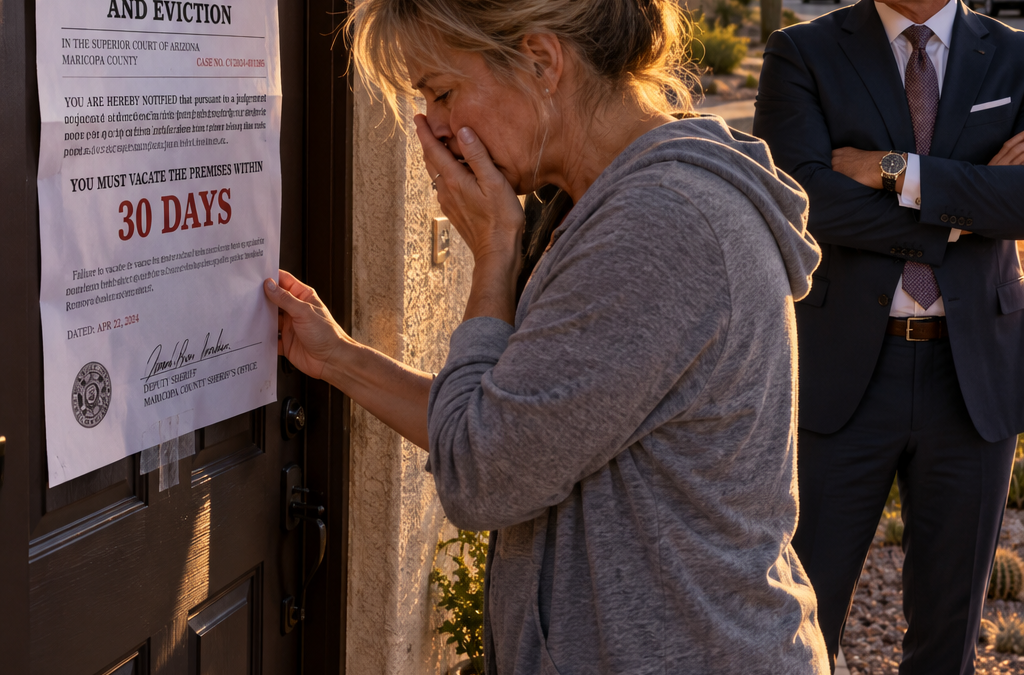
He gestured toward the notice taped to my door.
“You’ve been served with notice related to a property enforcement proceeding. Instructions and response information are included.”
“What does it mean?”
“I’m not your attorney, sir. You should contact counsel immediately.”
“Am I being evicted?”
“Read the documents and call your lawyer.”
He wasn’t rude.
He wasn’t threatening.
He was doing his job.
But as he walked away, my hands began trembling.
The amount on the latest papers was nearly nine thousand dollars.
The HOA was escalating toward forcing a sale or foreclosure process based on the claimed debt.
Thirty days appeared in bold.
Behind me, Sofia woke.
That was the morning I finally felt fear turn into something else.
Not courage.
Not yet.
Rage.
Clean, cold rage.
Christopher had spent months increasing numbers on pieces of paper.
Now those numbers had brought a sheriff’s deputy to my daughter’s front door.
I called Priya before sunrise.
She answered.
“They served me.”
“I know.”
“You know?”
“The association’s counsel filed yesterday. I received electronic notice overnight.”
“They’re giving me thirty days.”
“We’re seeking emergency court intervention.”
“My daughter saw the sheriff.”
“Danny, listen to me.”
I paced the living room.
“He wants me out.”
“I know what the documents seek.”
“No. You don’t understand. This is personal.”
“I do understand.”
“Then let’s expose everything.”
A pause.
“We will.”
“No quiet settlement.”
“Danny—”
“No. If I just save my house, he does this to somebody else.”
Priya was silent.
Then she said, “All right.”
We filed suit.
Not only to challenge the claimed debt.
Not only to stop the foreclosure effort.
We challenged the enforcement process, the inconsistent fines, the unexplained charges, the selective treatment, and the association’s handling of records.
And through appropriate channels, the financial records involving Marsh Administrative Solutions were provided for further investigation.
Word spread quickly.
Desert Willow Estates had always been the kind of neighborhood where everybody pretended not to know everyone else’s business while knowing almost everything.
Within forty-eight hours, residents were texting each other copies of old violations.
Ruth helped collect names.
Thomas Keller, a board member who had rarely challenged Christopher publicly, requested an emergency meeting.
Forty residents showed up.
The clubhouse had never been that full.
People stood along walls.
Phones were recording before the meeting even began.
Christopher arrived five minutes late.
Of course he looked perfect.
Dark navy suit.
White shirt.
Deep red tie.
Hair brushed back.
Polished brown shoes.
He carried a leather folio under one arm and walked into the room with the measured confidence of a man who had survived years by convincing people that his composure meant he was right.
He sat at the center of the board table.
Then he smiled.
“Ladies and gentlemen, I understand emotions are elevated.”
Someone behind me muttered, “You think?”
Christopher ignored it.
“There appears to be substantial misinformation circulating regarding routine administrative operations.”
Ruth leaned toward me.
“Routine.”
I didn’t respond.
Priya sat beside me with her laptop connected to the clubhouse projector.
Christopher noticed.
His smile tightened.
“I wasn’t aware counsel would be presenting.”
Thomas spoke.
“Members requested answers.”
“The board decides meeting procedure.”
Thomas stared at him.
“The board did.”
For the first time, Christopher looked unsettled.
Only slightly.
But I saw it.
He adjusted his tie.
“Very well.”
Then he began his script.
Clerical errors.
Misunderstandings.
Standard third-party processing.
Legitimate administrative costs.
Aggressive homeowners misinterpreting technical records.
He described my case as an unfortunate dispute that had become unnecessarily personal.
That almost made me laugh.
The man who had inspected my lawn at dawn because he hated my dead father-in-law was accusing me of making things personal.
Then Priya stood.
“Mr. Marsh, is Marsh Administrative Solutions LLC an association vendor?”
Christopher hesitated.
“It provides certain administrative support.”
“Who owns it?”
“That’s not relevant to Mr. Alvarez’s violation history.”
Priya looked toward Thomas.
“May I display a public corporate filing?”
Thomas nodded.
Christopher leaned forward.
“I object to this.”
Priya clicked.
The projector lit the wall.
MARSH ADMINISTRATIVE SOLUTIONS LLC.
Registered agent:
DANIEL MARSH.
Christopher’s husband.
Yellow highlight around the name.
Nobody spoke.
It wasn’t dramatic at first.
No shouting.
No gasps.
Just forty people staring at the screen while their brains caught up.
Priya displayed payment records.
One year.
Then another.
Then another.
Administrative charges flowing from HOA accounts into the LLC.
Tens of thousands of dollars.
Christopher stood.
“This is being deliberately misrepresented.”
Priya looked at him.
“Then explain it.”
“These payments were for legitimate contracted services.”
“Was the relationship disclosed to homeowners?”
“The board was aware of our service arrangements.”
Thomas shook his head.
“No, we weren’t.”
Christopher turned.
“Thomas, don’t do this.”
“I’m looking at this for the first time.”
“That is not true.”
Elaine Porter, another board member, spoke quietly.
“I didn’t know either.”
Christopher stared at her.
“You approved budgets containing those expenditures.”
“I approved administrative expenses. I didn’t know your husband owned the vendor.”
The room erupted.
Voices overlapped.
“Are you kidding me?”
“How much money?”
“Was that our fine money?”
“My roof!”
A man near the back stood up.
“That’s my new-roof money you took, Christopher!”
Christopher raised both hands.
“Everyone needs to calm down.”
That made things worse.
“You calm down!”
“You fined my mother four hundred dollars!”
“You threatened my house!”
“How much did your husband get?”
Christopher turned toward Thomas.
“Control this meeting.”
Thomas stared at him.
“No.”
Christopher looked shocked.
“I’m the president.”
“Not tonight you’re not controlling anything.”
Priya raised her voice.
“Please. Let the record be presented.”
The room slowly quieted.
She displayed my ledger.
My eight-hundred-dollar commercial fine.
The approved fine schedule.
The mismatch.
Then Ruth’s.
Then another resident’s.
Then payment classifications tied to Marsh Administrative Solutions.
Christopher started speaking over her.
“Those are processing charges.”
“Authorized where?” Priya asked.
“Under administrative discretion.”
“Show us.”
He opened his leather folio.
Flipped pages.
“These matters were handled according to longstanding procedure.”
“Show the authority.”
“I don’t have every document immediately available.”
Ruth laughed bitterly.
“You’ve been saying that for three years.”
Christopher glared at her.
“This is exactly the kind of hostile behavior that prevents orderly governance.”
I stood.
His eyes snapped toward me.
He pointed.
“And there he is.”
I almost smiled.
“There who is?”
“The man who created this spectacle because he refused to follow basic neighborhood standards.”
I looked around the room.
Then back at him.
“No, Christopher.”
My voice was surprisingly calm.
“You created this.”
“You operated an unauthorized business.”
“I fixed neighbors’ faucets.”
“You accumulated repeated violations.”
“You invented amounts that weren’t in the fine schedule.”
“Administrative surcharges—”
“You threatened my paid-off house.”
His jaw tightened.
“Because you refused lawful payment obligations.”
“You put a sheriff’s notice on my door.”
“That is the legal collection process.”
“My daughter thought her chalk drawings were going to make us homeless.”
The room went completely quiet.
Christopher looked away for half a second.
That was the first time I saw something crack.
Not guilt.
Annoyance.
As though my daughter’s fear was inconvenient.
I continued.
“You came after my trash cans.”
“My grass.”
“My daughter’s driveway drawings.”
“My truck.”
“My weekend plumbing jobs.”
“And every time I paid, you found something else.”
“Because you kept violating rules.”
“No.”
I walked one step forward.
“You kept needing me to obey.”
His face reddened.
“You have no idea what it takes to maintain property values for an entire association.”
“I know what it takes to maintain a house.”
I pointed toward the screen.
“And I know money collected from homeowners shouldn’t disappear into your husband’s company without people knowing where it’s going.”
Christopher pushed his chair back.
“This meeting is over.”
Thomas stood too.
“No, it isn’t.”
“I am adjourning it.”
“You don’t have unilateral authority to adjourn a properly called emergency meeting simply because you don’t like the questions.”
Christopher picked up his folder.
“Then continue without me.”
He stepped away from the table.
Toward the door.
A county sheriff’s deputy stood near it.
Priya had asked that law enforcement be present only to preserve order because tensions were high and because of the ongoing property dispute.
The deputy didn’t block Christopher.
He simply watched.
Christopher stopped.
Something about seeing the uniform seemed to remind him that the room was no longer his.
He turned back.
“This is a civil association matter.”
The deputy nodded.
“Then I suggest you handle it civilly.”
Several people laughed.
Christopher’s face hardened.
Priya closed her laptop.
“The financial records have been referred to the appropriate authorities for review.”
That stopped him.
“What authorities?”
“You’ll receive whatever notices you’re legally entitled to receive.”
For once, Christopher had no answer.
The board moved to suspend his presidential authority immediately pending formal removal procedures and financial review.
Thomas made the motion.
Elaine seconded it.
The vote was unanimous among the eligible board members present.
Christopher stood near the doorway while the title he had wielded like a weapon disappeared in less than five minutes.
President.
Gone.
Authority to issue unilateral enforcement directions.
Suspended.
Access to association financial accounts.
Restricted pending review.
He stared at the board.
“You’ll regret this.”
Thomas looked exhausted.
“We already regret enough.”
Christopher looked at me last.
There was hatred in his face.
Not embarrassment.
Not sadness.
Hatred.
“You think this makes you a hero?”
I shook my head.
“No.”
“Then what do you think you are?”
I thought about Sofia standing in the hallway asking whether her chalk had caused the sheriff to come.
“A homeowner.”
Then I added, “That’s all I ever wanted to be.”
Christopher walked out.
The room stayed silent until the door closed.
Then everyone started talking at once.
The next month moved quickly.
Once independent accountants and investigators began reviewing the records, the scale of the problem became clearer.
Marsh Administrative Solutions had received more than sixty thousand dollars connected to administrative and enforcement-related expenses over roughly three years.
Whether every dollar constituted theft was for investigators and courts to determine.
But serious questions existed about disclosure, authorization, conflicts of interest, invoicing, and whether services billed to residents had actually been performed as represented.
The state attorney general’s office opened an investigation into the LLC and related transactions.
Remaining disputed assets connected to the investigation became subject to legal restrictions.
The HOA hired independent counsel.
My alleged violations were reviewed one by one.
Trash cans.
Lawn.
Chalk.
Commercial enterprise.
Vehicle.
Administrative fees.
Late charges.
Processing surcharges.
The more independent counsel examined the file, the more absurd it looked.
Several fines had no valid schedule basis.
Others had been imposed without required notice or hearing procedures.
Charges had been increased without proper authorization.
The board formally withdrew the enforcement action against my home.
The claimed lien balance was erased.
The threatened foreclosure process stopped.
I received the written confirmation on a Thursday afternoon.
Priya called before the email even arrived.
“It’s over.”
I sat in my truck outside a plumbing supply store.
“What do you mean?”
“The association has withdrawn the disputed lien claim and foreclosure action against you.”
I couldn’t speak.
“Danny?”
“I’m here.”
“Your house is safe from this enforcement action.”
I put my forehead against the steering wheel.
For months, I had imagined that sentence.
I thought I’d shout.
Laugh.
Call Ruth.
Instead I cried.
Quietly.
Sitting behind the wheel of a work truck with pipe fittings stacked on the passenger seat.
I thought about every night I’d walked through the house checking rooms as though memorizing them.
Every envelope.
Every time Sofia asked whether we were moving.
Every payment I had made because peace felt cheaper than resistance.
“I almost sold,” I said.
Priya was quiet.
“More than once.”
“I know.”
“I actually looked at listings.”
“You stayed.”
“Because Ruth told me about the others.”
I wiped my face.
“If I’d left, he’d still be doing it.”
“Maybe.”
“I don’t ever want to see another HOA letter.”
That made her laugh.
“I can’t promise that.”
“Thanks for ruining the moment.”
“You’re welcome.”
The legal and criminal investigations continued beyond my individual case.
Eventually, restitution proceedings required Christopher to repay substantial amounts associated with the improper transactions, including more than forty-five thousand dollars owed back to the association under the resulting orders and settlements.
More importantly to most of us, he could no longer hide behind the HOA presidency.
No clipboard.
No special enforcement authority.
No control over our accounts.
No private interpretation of rules becoming reality because people were too afraid to challenge him.
The day I saw him outside court months later, he looked different.
Still well dressed.
Still groomed.
But the polish no longer created the illusion it once had.
Investigators had developed sufficient evidence for criminal allegations involving the diversion of association funds and related fraud.
When Christopher emerged from the courthouse in custody, his wrists restrained, there was nothing satisfying about the handcuffs themselves.
I didn’t cheer.
I didn’t take a photograph.
For all the anger I had carried, watching another human being lose his freedom wasn’t entertaining.
What I felt was relief.
Because the man who had spent years making ordinary families afraid of losing their homes had finally reached a place where his title couldn’t protect him.
The legal system would determine the final punishment.
Not me.
Not Ruth.
Not the board.
And that mattered.
Christopher’s entire system had been based on the opposite idea.
That whoever controlled the process could decide the outcome.
I drove home afterward.
When I entered Desert Willow Estates, the clubhouse appeared on my right.
The same low stucco building where Christopher had once sat beneath the association seal and talked down to residents as though he owned every roof in sight.
Now new notices were posted beside the door.
Financial review meetings.
Open record procedures.
Conflict-of-interest policies.
Board election information.
Boring things.
Wonderful things.
Accountability is often boring when it’s working correctly.
The new board didn’t abolish rules.
Trash cans still had collection times.
Lawns still needed basic maintenance.
People couldn’t paint their homes neon orange without architectural review.
But violations required documentation.
Fines had to match the approved schedule.
Homeowners had hearing rights.
Board members had to disclose financial relationships.
Vendor contracts received independent review.
No president could quietly invent charges and then hide the documentation.
Ruth ran for the board.
I tried to talk her out of it.
“You spent years complaining about those people.”
“Exactly why I should join.”
“You’re going to become one of them.”
She pointed a finger at me.
“Don’t you dare.”
She won.
At her first meeting, I sat in the back with Sofia.
Ruth saw us and rolled her eyes.
Sofia whispered, “Is Ms. Ruth the HOA Karen now?”
I nearly choked.
“No.”
“How do you know?”
“Because she’s wearing sneakers.”
Sofia giggled.
I hadn’t heard that kind of carefree laugh from her around anything HOA-related in months.
One Saturday, I came home from a plumbing job and found Sofia kneeling in the driveway.
Boxes of chalk surrounded her.
Blue.
Pink.
Purple.
Green.
Yellow.
She froze when she saw my truck.
I parked.
Got out.
She looked guilty.
“I can wash it off.”
I stared down.
She had drawn the solar system again.
Larger this time.
Saturn almost reached the garage.
Earth sat near the walkway.
A huge yellow sun covered the corner beside my truck.
At the top she’d written:
SOFIA’S UNIVERSE — AGAIN
I laughed.
“Again?”
She smiled cautiously.
“Ms. Ruth said chalk is allowed.”
“Did she?”
“She said she checked.”
“Smart woman.”
Sofia held out a blue piece.
“Help me?”
I crouched beside her.
“I can’t draw.”
“You can draw plumbing.”
“That’s insulting.”
She laughed.
I took the chalk.
Then I drew the worst rocket ship in Arizona.
She stared at it.
“What is that?”
“Spacecraft.”
“Looks like a toilet.”
“Occupational hazard.”
We sat on the driveway until sunset.
Blue chalk covered my fingers.
Purple dust marked one knee of my jeans.
Neighbors walked past.
Nobody photographed us.
Nobody took notes.
Nobody warned me that my daughter had altered the visible appearance of the property.
At one point, I leaned back against the garage and looked at the house.
Same stucco.
Same windows.
Same roof.
Same front door where the sheriff’s notice had been taped.
Only now the door looked like a door again.
Not an expiration date.
A few weeks later, I started accepting small weekend plumbing jobs again.
At first, I hesitated.
Years of Christopher’s voice had trained me to wonder whether somebody would report my truck.
Then Ruth caught me loading a tool bag.
“Going somewhere?”
“Leaky faucet.”
She smiled.
“Commercial enterprise?”
I stared at her.
“Don’t start.”
She laughed.
I completed the job.
Got paid.
Came home.
Nothing happened.
No violation.
No certified letter.
No eight-hundred-dollar charge.
I hadn’t realized how deeply Christopher had changed my behavior until I began reclaiming ordinary things.
Parking my work truck.
Leaving a hose connected for an afternoon.
Letting Sofia draw.
Not checking security cameras every time an unfamiliar vehicle slowed down.
Sleeping through the night.
Those were victories nobody puts in court documents.
But they mattered more than most judgments.
One evening, Ruth brought sweet tea over again.
Same pitcher.
Same glasses.
This time we sat in lawn chairs while Sofia rode her bicycle around the cul-de-sac.
“You know,” Ruth said, “your father-in-law would have enjoyed this.”
I looked at her.
“Miguel?”
“Oh, absolutely.”
“You think so?”
“He hated Christopher.”
I laughed.
“So I’ve learned.”
“He’d sit in those board meetings smiling while Christopher got angrier and angrier.”
I imagined Miguel.
Grease permanently under his fingernails.
Arms crossed.
That stubborn little grin.
“Why didn’t he ever tell me?”
“Probably thought the whole thing was finished.”
Ruth drank her tea.
“Men like Christopher have long memories.”
“Apparently.”
She looked toward my driveway.
“Good thing you did too.”
I thought about the binder still sitting in my office.
Every notice.
Every photograph.
Every email.
I had considered throwing it away.
Priya told me to retain the records.
Part of me hated seeing them.
Another part wanted Sofia to have them someday.
Not because I wanted her remembering Christopher.
Because I wanted her remembering the lesson.
Authority should survive questions.
If asking to see the rule makes someone angry, ask to see it twice.
If somebody claims you owe money, demand the accounting.
If a person says their title means they don’t have to explain themselves, that’s usually when explanations matter most.
And peace isn’t the same as surrender.
I had misunderstood that for years.
When Christopher fined me fifty dollars, I paid because I wanted peace.
When he fined me eight hundred, I paid because I wanted peace.
Every time I complied without questioning whether the demand was legitimate, I told myself I was protecting my family from conflict.
But real peace doesn’t require you to live afraid of the next envelope.
That’s quiet.
There’s a difference.
Christopher offered quiet in exchange for obedience.
The moment I stopped paying that price, he tried to take my home.
Eventually, the investigations and court proceedings produced consequences none of us could have imagined when the first trash-can notice appeared.
Christopher lost his position.
Financial control was removed from him.
Improper charges were reversed.
Restitution obligations followed.
The LLC that had received association money became the subject of state scrutiny and asset restrictions.
And Christopher faced criminal accountability based on evidence gathered through the investigation.
I didn’t celebrate his destruction.
I celebrated the end of his control.
There’s a difference there too.
Several months after everything settled, I woke at six on a Saturday morning.
Habit.
Plumbers don’t sleep late.
I made coffee and stepped outside.
The Arizona sky was pale pink beyond the rooftops.
The street was silent.
My truck sat in the driveway.
Sofia’s faded chalk drawings still covered portions of the concrete.
A blue planet near the curb.
A purple comet.
My terrible toilet-shaped rocket.
I smiled.
Across the street, Ruth opened her front door.
She saw me and raised her coffee.
“Inspection!” she shouted.
I looked down at my clothes.
“Am I in violation?”
“Definitely.”
“For what?”
She pretended to examine an invisible clipboard.
“Ugly bathrobe.”
“How much?”
“Nine thousand dollars.”
I laughed so loudly a dog started barking down the street.
Sofia opened her bedroom window.
“You’re both annoying!”
Ruth called back, “Violation!”
“Ms. Ruth!”
I stood there laughing.
Then I looked at the front door.
For a split second, I could still see the sheriff’s notice.
White paper.
Black lettering.
Thirty days.
I remembered the fear in my stomach.
The certainty that Christopher had finally pushed me farther than I could fight.
But the notice wasn’t there anymore.
The door was empty.
The house was mine.
Not because Christopher had allowed me to keep it.
Because it had always been mine.
That was the truth he had spent months trying to make me forget.
Later that morning Sofia came outside with another box of chalk.
“What are you drawing now?” I asked.
She grinned.
“A city.”
“Big project.”
“Very.”
“Need a permit?”
She stared at me.
Then slowly smiled.
“Nope.”
“Good.”
She dropped to her knees and started drawing buildings.
I sat on the porch drinking coffee.
Somewhere two streets away, a lawn mower started.
A garage door opened.
A truck backed out.
Nothing dramatic happened.
Nobody arrived with paperwork.
Nobody inspected my grass.
Nobody told my daughter her imagination required architectural approval.
Desert Willow Estates finally sounded like what I had believed I was buying years earlier.
A neighborhood.
Not a kingdom.
And every time I saw the chalk on my driveway after that, I left it there a little longer than necessary.
Not to prove anything.
Not to provoke anyone.
Just because my daughter had drawn it.
And because after everything Christopher Marsh tried to take from us, there was something deeply satisfying about knowing that the brightest thing on our street was once again something he would have fined.








