𝗙𝗨𝗟𝗟 𝗦𝗧𝗢𝗥𝗬 The HOA Put a Fake Shutoff Notice on My Meter and Thought They Had Finally Cut My Power
𝗙𝗨𝗟𝗟 𝗦𝗧𝗢𝗥𝗬 .
During the first county inspection, the inspector found two minor labeling issues and asked for a different protective barrier near one cable route.
I corrected both.
The second inspection passed.
The county signed everything.
The utility company required separate paperwork because I intended to disconnect entirely rather than use net metering.
I filled it out.
Paid the disconnection fee.
Scheduled the final service termination.
A utility technician came out, confirmed everything, closed the account, and documented that the property would no longer receive grid power.
That was it.
The old meter enclosure remained on the side of the house because removing service equipment required additional exterior work I didn’t consider necessary.
But electrically, it no longer mattered.
The house had separated from the grid.
For the first few weeks, I checked the system constantly.
Battery percentage before bed.
Charge level at sunrise.
Generator runtime.
Panel output.
Weather forecast.
Then the anxiety disappeared.
The system worked.
Summer was easy.
Spring was almost effortless.
Winter required more attention, especially during several consecutive cloudy days, but the generator handled the gaps exactly as designed.
I stopped thinking of the house as off-grid.
It was simply my power system.
Then Dorian Westfield moved into Briar Ridge.
He bought a large brick house three lots down from me.
I met him about two weeks after he arrived.
He was standing near my driveway one afternoon while I was trimming weeds around the road ditch.
He was probably in his early fifties.
Tall.
Carefully dressed even though it was hot.
The kind of man who spoke with the confidence of someone accustomed to being listened to.
He nodded toward the rear of my property.
“Those your solar panels?”
“Yeah.”
“That’s quite an installation.”
“It does the job.”
“How many?”
“Forty-two.”
His eyebrows rose.
“That’s a lot.”
“I don’t buy electricity anymore.”
That caught his attention.
“You’re fully off-grid?”
“Completely.”
He looked at the panels for several seconds.
“Interesting.”
The word didn’t sound like praise.
Then he asked, “HOA approved that?”
I stopped trimming.
“The county approved it.”
“I asked about the HOA.”
“I checked the governing documents before I built it.”
“So you didn’t get board approval?”
“There was no board approval requirement that applied.”
His expression changed slightly.
Not enough that most people would notice.
I did.
People who work around electrical systems learn to watch for small changes.
A vibration.
A heat signature.
A slight discoloration.
Tiny signs usually appear before larger failures.
Dorian smiled.
“Well, I’m sure everything’s fine.”
Then he walked away.
Within four months, he was on the HOA board.
Two months after that, he was president.
The previous president, an older man named Dennis Palmer, had been tired of the job for years.
Dorian volunteered.
Then he campaigned.
That surprised me because I hadn’t realized HOA president was a position anyone campaigned for.
Dorian did.
He knocked on doors.
Sent emails.
Talked about property values.
Neighborhood character.
Consistent enforcement.
Professional standards.
A stronger community.
He won.
Sixty days later, I received my first violation notice.
The envelope was taped to my front door.
I opened it while standing on the porch.
The notice said my solar installation was “aesthetically disruptive to neighborhood cohesion.”
I read that sentence three times.
Neighborhood cohesion.
There was a rusted camper visible from the road two houses beyond mine.
Another property had a shed with one wall painted blue and the other three unpainted.
A neighbor across the road had a satellite dish large enough to communicate with Jupiter.
My solar panels were almost two hundred feet from the nearest public-facing boundary and partially screened by trees.
I checked the cited section of the HOA handbook.
The section referred generally to exterior harmony.
Not solar panels.
Not power systems.
Not equipment setbacks.
Nothing specific.
I wrote a response.
I attached the county permit.
Inspection approval.
Site plan.
Photos.
Relevant portions of Tennessee law protecting reasonable use of solar energy.
I also quoted the actual Briar Ridge covenants.
My tone was polite.
Probably too polite.
I ended by requesting written confirmation that the violation had been withdrawn.
No response.
Thirty days later, another notice arrived.
This one was different.
The HOA now claimed my array violated a twenty-five-foot equipment setback from a “community visual corridor.”
I had never heard that phrase before.
I searched the documents.
Nothing.
I downloaded another copy.
Nothing.
I drove to the county recorder’s office and obtained the original recorded declaration from when Briar Ridge was created.
No twenty-five-foot solar equipment setback.
No community visual corridor.
No amendment creating either one.
I sent a certified letter to the board.
I explained that the provision Dorian cited did not exist in any recorded governing document I could locate.
I requested a copy of the amendment supposedly authorizing it.
I asked for the date of adoption.
Vote totals.
Recordation information.
Everything.
The certified mail receipt showed it had been delivered.
Nobody answered.
For six weeks, things became strangely quiet.
That bothered me more than the notices.
Dorian was not the kind of man who reconsidered.
He was the kind who changed tactics.
I saw him twice during those six weeks.
Once while collecting mail.
Once at a gas station.
Both times, he smiled.
Friendly.
Casual.
As though nothing was happening.
Then came Tuesday morning.
I woke around six thirty.
The kitchen was still dim because it was early spring and the sun hadn’t cleared the trees.
I started coffee.
The grinder ran.
The lights were on.
Refrigerator humming.
Battery monitor showed eighty-two percent.
Everything normal.
A few minutes later, I stepped outside because I wanted to check the weather before deciding whether to mow that afternoon.
That’s when I saw orange on the side of the house.
Bright orange.
Impossible to miss.
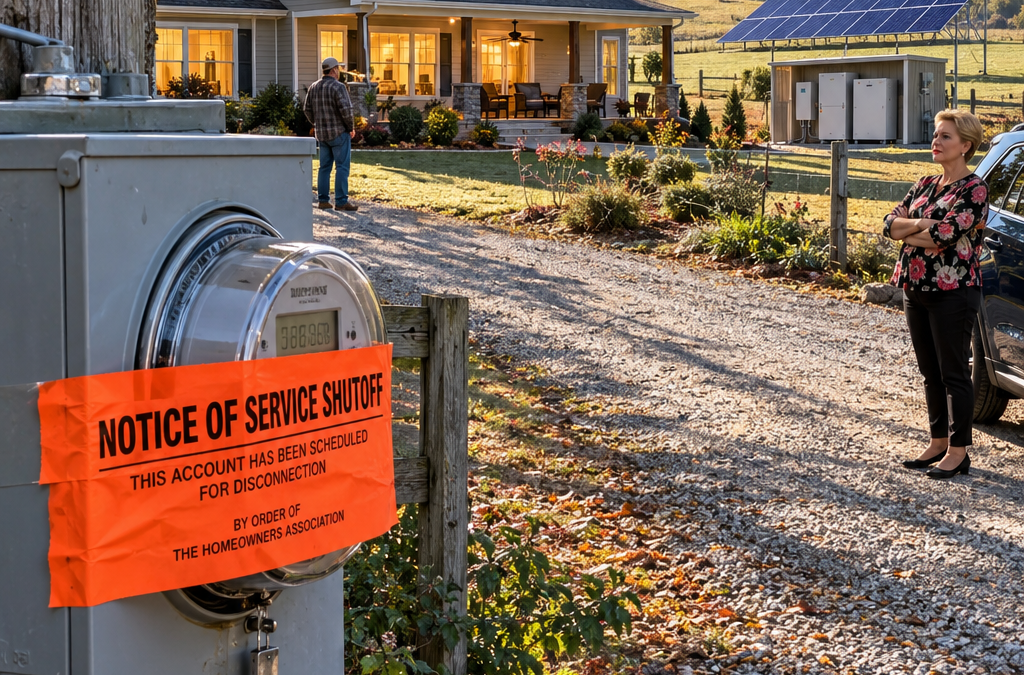
Someone had placed a large adhesive notice directly across the old utility meter enclosure.
I walked closer.
DISCONNECTED.
CODE VIOLATION.
DO NOT RESTORE SERVICE.
Below that was language suggesting the action had been taken under authority associated with utility and HOA enforcement.
I stood there staring at it.
Then I looked toward the road.
Dorian was outside.
Three houses down.
Standing near his front lawn.
Coffee cup in one hand.
Watching me.
Even from that distance, I could see the expression on his face.
Satisfied.
Almost amused.
He raised the cup slightly.
I looked back at the sticker.
Then toward my kitchen window.
The light over the sink was still on.
Of course it was.
The meter box had not carried utility electricity in more than a year.
Whatever Dorian believed he had accomplished, my house didn’t know anything had happened.
The batteries didn’t know.
The panels didn’t know.
The refrigerator didn’t know.
The coffee machine certainly didn’t know.
Everything inside continued operating exactly as it had ten minutes earlier.
But the fact that my power remained on did not make the sticker harmless.
Someone had entered my property.
Touched electrical service equipment.
Affixed what appeared to be an official disconnection notice.
And represented that some authority had ordered my service terminated.
I took out my phone.
Photographed the sticker from every angle.
The meter box.
The wall around it.
The ground.
The driveway.
Tire impressions near the shoulder.
Then I took several wide shots showing the location relative to the house.
I activated timestamp metadata.
Recorded video.
Made sure I captured the wording clearly.
I did not touch the sticker.
Then I called my attorney.
Her name was Priya Nambiar.
I had first met her through work after she helped resolve a commercial easement dispute for one of our clients.
When the HOA sent me the second solar notice, I had called her casually and asked whether I should be concerned.
Her answer had been simple.
“Concerned? No. Organized? Absolutely.”
That morning, she answered before seven.
“Garrett?”
“Somebody put a utility disconnection sticker on my meter box.”
There was a pause.
“Did the utility disconnect you?”
“I’m not connected to the utility.”
Another pause.
Longer.
“Don’t touch anything.”
“I haven’t.”
“Photographs?”
“Already taken.”
“Video?”
“Yes.”
“Good. Send them.”
I sent everything while we were still on the phone.
She studied the images.
“Who does that logo belong to?”
“The notice mentions HOA authority, but it looks like a utility shutoff tag.”
“Does it identify a technician?”
“No.”
“Work order number?”
“No.”
“Utility name?”
“No actual company name.”
“Then do not assume anything.”
Across the road, I saw movement.
Dorian had gone inside.
Priya asked, “Do you have your utility disconnection paperwork?”
“Every page.”
“County permits?”
“Yes.”
“Inspection reports?”
“Yes.”
“Original covenants?”
“Yes.”
“Good. Make coffee.”
“I was already doing that.”
“Finish it. Then email me everything.”
That might have been the moment I realized she was enjoying the problem.
Not because she enjoyed what had happened.
Because lawyers like Priya appreciated facts that organized themselves.
And Dorian had just given her a very clean set.
Before eight that morning, I received a text from my neighbor, Ellen Marshall, who lived two lots over.
You okay?
I called her.
“What happened?”
She sounded uncomfortable.
“I don’t know whether I should tell you this.”
“Tell me.”
“Dorian’s been talking.”
“About what?”
“Your solar system.”
“That’s not new.”
“No. This is.”
I waited.
“He was at Walker’s Market yesterday telling people the board had finally dealt with it.”
“Dealt with what?”
“He said you were running an illegal power setup.”
I laughed once.
“Illegal?”
“He said your property was unsafe and that the HOA had gotten your electricity shut off.”
There it was.
Not speculation.
Not a mistake.
Celebration.
“What exactly did he say?”
“I don’t remember word for word.”
“Anything close helps.”
“He said something like, ‘Garrett wanted to play power company, so now he can see what happens when someone actually enforces the rules.'”
My hand tightened around the phone.
“Who heard him?”
“At least four people.”
“Ellen, would you be willing to write down what you remember?”
Another pause.
“Is this becoming legal?”
“I think Dorian already made it legal.”
“I’ll write it.”
“Thank you.”
After we hung up, I walked through the house.
Everything was still running.
The battery inverter displayed normal output.
The coffee machine clicked off.
Ceiling fan rotating.
Computer charging.
There was something absurd about it.
Dorian had apparently spent days arranging to shut off electricity I didn’t use.
He had declared victory over a system he didn’t understand.
But underneath the absurdity was something darker.
He believed he had the right to punish me by making my home unlivable.
That was the part I couldn’t shake.
This was no longer about whether he liked the appearance of solar panels.
He wanted control.
And when documents didn’t give it to him, he had decided to manufacture the appearance of authority.
Priya contacted the utility company that morning.
By early afternoon, she called me back.
“You’re going to like this.”
“I doubt that.”
“Your utility account was officially closed fourteen months ago.”
“I know.”
“I have written confirmation.”
“Okay.”
“They have no disconnection order.”
I looked toward the orange sticker through my office window.
“So who put that there?”
“That’s what we’re finding out.”
“Could one of their technicians have done it by mistake?”
“No work order. No site visit. No contractor authorization from them.”
“Then someone faked it.”
“That appears increasingly likely.”
Two days later, we had the answer.
The sticker had been placed by a private contractor.
Not a power company employee.
Not a county official.
Not anyone acting under utility authority.
A man who did property maintenance, minor electrical work, lock changes, and HOA compliance jobs.
His invoice described the work as:
SERVICE DISCONNECT TAGGING – HOLLOWAY PROPERTY.
Authorized by Briar Ridge HOA.
The invoice had been paid from the HOA operating account.
The authorization contact was listed as Dorian Westfield.
I read it twice.
“He actually paid for this?”
“Yes,” Priya said.
“From HOA funds?”
“Yes.”
“So he knew the utility hadn’t done it.”
“Probably. But we need more.”
“He hired somebody to put a fake shutoff notice on my meter.”
“I know.”
“How much more do you need?”
“For anger? Nothing. For litigation? I like layers.”
She sent a cease-and-desist letter to the entire HOA board.
The letter was not emotional.
That made it worse.
It listed dates.
Documents.
The county permit number.
Utility termination record.
Contractor invoice.
Unauthorized entry.
False representation of official action.
Potential property tampering.
Potential defamation.
It demanded preservation of all emails, messages, invoices, call logs, meeting minutes, payment records, and communications related to me or my solar installation.
It instructed the HOA to stop entering my property.
Stop issuing unsupported violation notices.
Stop representing that my solar system was illegal.
Stop interfering with electrical equipment.
I thought that would finally force someone on the board to slow Dorian down.
Instead, he called an emergency meeting.
I didn’t attend.
Priya advised against it.
“We’re past garage diplomacy,” she said.
I later obtained the minutes.
Dorian told the board that I had become “openly hostile to legitimate community governance.”
He characterized Priya’s letter as intimidation.
He claimed my solar installation constituted an unauthorized commercial-scale power generation facility.
Commercial-scale.
For one house.
He proposed that the HOA authorize legal action against me.
Two board members voted yes.
Three abstained.
Nobody voted no.
That bothered me at first.
Then I understood what the abstentions meant.
Fear.
Not fear of me.
Fear that Dorian had dragged them somewhere they no longer wanted to be.
One of those board members, Linda Price, called me privately the following evening.
“I probably shouldn’t be doing this,” she said.
“Then you should decide whether you want to.”
“I need to ask you something.”
“Go ahead.”
“Do you actually have permits?”
“Yes.”
“Inspection records?”
“Yes.”
“Utility paperwork?”
“Yes.”
“Everything?”
“Everything.”
She became quiet.
“Dorian told us you refused inspection.”
“That’s false.”
“He said the county had concerns.”
“False.”
“He said the power company disconnected you.”
“Also false.”
I heard her exhale.
“Garrett, I think we have a problem.”
“You do.”
Not long after that, Dorian made the move that ended the argument.
He filed a formal complaint with the county building authority.
The complaint alleged that my solar installation was unpermitted, unsafe, improperly grounded, and potentially hazardous to neighboring properties.
The allegation about neighboring properties was particularly ridiculous given the distance.
But county complaints involving electrical safety had to be examined.
Four days later, a county inspector named Horatio Beckett arrived.
Horatio was probably in his late fifties.
Quiet.
Patient.
No interest in HOA politics.
He introduced himself, showed me the complaint, and asked whether I would allow a full inspection.
“Absolutely.”
I handed him a binder.
He looked at it.
“What’s this?”
“Everything.”
Inside were permits.
Stamped drawings.
Equipment specifications.
Inspection certificates.
Utility disconnection documents.
Battery manufacturer compliance sheets.
Generator installation documents.
Grounding diagrams.
Photographs from construction.
He looked at me.
“You expecting company?”
“Lately, yes.”
He almost smiled.
Then he spent two hours walking the system.
He inspected the array.
Measured clearances.
Checked conductor protection.
Reviewed disconnect labeling.
Examined the battery enclosure.
Generator connection.
Grounding electrode system.
Ventilation.
Fire access.
Emergency shutoff.
He asked technical questions.
I answered.
He compared the installation to the approved plans.
Once, he crouched near one of the enclosures for almost five minutes.
I started wondering whether he had found something.
Finally he stood.
“Who did the installation?”
“I did.”
“Professionally?”
“I work in electrical systems, but not residential solar installation.”
He nodded.
“Shows.”
I couldn’t tell whether that was good.
He walked back toward his truck.
I followed.
Horatio pulled out a form.
“Your permit is valid.”
“Okay.”
“System matches approved documents.”
“Good.”
“Electrical work is compliant based on what I inspected.”
I felt tension leave my shoulders.
Then he added, “This is one of the cleaner residential off-grid systems I’ve seen.”
“How long have you been inspecting?”
“Twelve years.”
That meant more to me than I expected.
He signed the report.
Then his expression changed.
“Mr. Holloway.”
“Yeah?”
“This complaint states you’ve been operating an unpermitted system despite repeated warnings from county authorities.”
“Nobody from the county warned me.”
“I know.”
“Can I get a copy of that complaint?”
“You can request it through records.”
“Did Dorian Westfield file it?”
Horatio looked at the page.
“I can’t discuss more than what’s releasable through the proper process.”
Fair enough.
Then he said something more important.
“False statements in a formal safety complaint are not something our office appreciates.”
He handed me my clean report.
“Keep your paperwork.”
“I will.”
“You already do.”
He got into his truck and left.
I stood beside the driveway holding that report.
For the first time since the orange sticker appeared, I felt something close to relief.
Not because I had doubted the system.
I had built it.
I knew what it was.
The relief came from having an outsider confirm reality.
That matters when someone spends months trying to convince everyone around you that what is legal is illegal.
That your documents don’t matter.
That the rules mean whatever they say the rules mean.
Dorian had been trying to create an alternate version of the facts.
Horatio’s inspection brought everything back to earth.
Permitted.
Inspected.
Compliant.
End of technical argument.
But Priya still wasn’t finished.
While the county inspection was happening, she had requested records from the utility.
The first batch was routine.
Account closure.
Final service date.
Nothing unusual.
Then she found communication logs.
Dorian had contacted the utility company before the sticker appeared.
Not once.
Multiple times.
He represented himself as someone acting on behalf of property management for the community.
He reported an alleged code violation.
He requested that electrical service at my address be terminated.
The utility representative checked the account.
There was no active service.
They told him that.
According to the call summary, Dorian insisted the property still had utility equipment and asked whether they could tag or lock it anyway.
They refused.
There was no active account.
No utility violation.
No authority to perform the action he wanted.
He had been told no.
And that was the moment the case changed.
If Dorian had misunderstood something, he had a chance to stop.
If he believed I still had grid power, the utility corrected him.
If he believed they had authority to disconnect me, they told him they didn’t.
He had received the answer.
No.
Then he went around them.
He hired a private contractor.
Used HOA money.
Placed a notice on my property designed to resemble an official disconnection.
Then told neighbors he had gotten my power shut off.
Priya called me the evening she received the log.
“I want you to sit down.”
“I’m already sitting.”
“He called the utility first.”
“I assumed he did.”
“They refused.”
I said nothing.
“He knew there was no active account.”
“Then why the sticker?”
“You know why.”
Because he wanted the appearance of victory.
Because he wanted me frightened.
Because he wanted the neighborhood to believe he could turn my house off.
“What happens now?” I asked.
“Now we stop writing letters.”
Priya filed suit.
Against the HOA.
And against Dorian personally.
The complaint included claims based on fraudulent misrepresentation, unauthorized interference with private property, harassment, and defamation.
Priya attached documentation until the filing looked like a technical manual.
The contractor invoice.
HOA payment record.
Utility call logs.
My account closure.
The county permit.
Original inspection.
Horatio’s new inspection.
The certified letters I had sent months earlier.
The false setback notice.
The first aesthetic violation.
Witness statements from neighbors who heard Dorian claim I was operating illegally.
Photos of the orange sticker.
The cease-and-desist letter.
Board meeting minutes.
Everything.
Twelve pages of my correspondence alone demonstrated the same thing again and again.
I had tried to resolve the issue quietly.
I had answered their notices.
Provided documents.
Asked for authority.
Requested clarification.
Dorian had responded by escalating.
The lawsuit was served on a Monday.
By Wednesday, Linda Price resigned from the board.
Two other members followed before the end of the week.
One of them sent a short letter to homeowners saying he no longer had confidence in the HOA’s decision-making process.
The other said nothing.
Dorian stayed.
So did one board member who had supported him.
For eleven days.
Those eleven days were strange.
Dorian stopped waving.
Stopped smiling.
Stopped watching from his yard.
His attorney contacted Priya.
Then contacted her again.
The HOA’s insurer became involved.
Records were requested.
Questions were asked.
The sort of questions Dorian should have asked himself before hiring a contractor to impersonate utility enforcement.
Who authorized the expenditure?
What authority did the HOA believe it possessed?
Why was the utility contacted?
Why was a private contractor used after the utility refused?
Why did the notice imply an official disconnection?
Why did Dorian tell residents the property was operating illegally after receiving documentation otherwise?
Why did he file a county safety complaint after being given permits?
Paper is patient.
That was something my father used to say.
People can shout.
People can change stories.
People can insist they remember things differently.
Paper waits.
The contractor invoice waited.
The utility log waited.
My certified mail receipts waited.
Horatio’s inspection waited.
Every time Dorian had been offered a chance to stop, he had created another record instead.
On the eleventh day, Priya called.
“They want to discuss settlement.”
I stared through the back window at the solar array.
“Already?”
“His personal attorney is probably explaining exposure.”
“What about the HOA?”
“The association wants this finished.”
I thought about all the months I had spent responding to nonsense.
The letters.
The invented setback.
The implication that I had done something irresponsible.
The sticker.
The smug look across the lawn.
“What do you recommend?”
“Settlement isn’t surrender if the terms fix the problem.”
“What terms?”
“Full legal fees.”
“Yes.”
“Withdrawal of every violation associated with your solar installation.”
“Yes.”
“Written acknowledgment that the system is lawful and compliant.”
“Yes.”
“Written retraction of the statements characterizing your installation as illegal.”
“Absolutely.”
“No further interference with your power system.”
“Obviously.”
“And governance changes.”
That last part surprised me.
“What kind?”
“That depends on what the board agrees to.”
The final settlement included confidentiality provisions involving some financial terms, so I never discussed those publicly.
But the important parts were not confidential.
My legal fees were paid.
Every solar-related violation was withdrawn.
The HOA acknowledged in writing that my installation was permitted, inspected, and compliant.
The board retracted the claim that I was operating an illegal power generation system.
The association agreed that it would not interfere with equipment located entirely on my property absent legitimate legal authority.
Dorian resigned.
The remaining board member followed not long afterward.
Sixty days later, Briar Ridge held a new election.
For the first time since I had moved there, more residents attended than could fit comfortably in the garage.
People stood in the driveway.
Some brought folding chairs.
The mood was uncomfortable at first.
Dorian had divided the neighborhood more than I realized.
Some people had believed him.
Others had disliked him but stayed quiet.
A few admitted they had supported stricter enforcement until they saw where it led.
Ellen sat beside me.
At one point she leaned over.
“You know everybody thought your house would go dark that morning.”
I looked at her.
“Everybody?”
“Okay. Not everybody.”
“You did.”
She laughed.
“For about five minutes.”
The new board included Linda Price, who had resigned during the lawsuit.
Before running, she came to my house.
“I should’ve voted no,” she told me.
“You abstained.”
“Exactly.”
I knew what she meant.
Sometimes abstaining feels neutral only to the person doing it.
To the person being targeted, silence can look a lot like permission.
“I was afraid of getting pulled into it,” she said.
“I understand.”
“That’s not an excuse.”
“No.”
She looked toward the solar panels.
“I want the association to adopt something that makes this impossible again.”
That became the solar rights resolution.
The board passed it after consulting counsel.
It required any future HOA objection involving residential solar equipment to cite an actual recorded authority.
No invented standards.
No vague aesthetic language stretched beyond recognition.
No unauthorized entry onto private property.
No interference with utility or privately owned energy equipment.
No threats of disconnection without lawful authority.
If the board disputed a solar installation, it had to identify the governing provision in writing.
Simple.
Boring.
Exactly how rules should be.
Dorian listed his house for sale a few months later.
It sold eight months after the lawsuit ended.
I watched the moving truck arrive one morning.
I didn’t walk over.
Didn’t confront him.
Didn’t ask whether he regretted anything.
There was nothing I needed from him.
A few days before he moved, I happened to see him at the mailbox cluster.
We were alone.
For several seconds, neither of us said anything.
Then he looked toward my property.
“Still running that system?”
I almost laughed.
“Every day.”
He nodded.
“It got out of hand.”
That sentence irritated me more than an apology would have helped.
Got out of hand.
As though events had developed their own legs.
As though some independent force had printed notices, made phone calls, hired contractors, filed complaints, and spread rumors.
“It didn’t get out of hand,” I said.
He looked at me.
“You kept pushing after people showed you the documents.”
His jaw tightened.
“I was trying to enforce standards.”
“No. You were trying to prove you could make me obey you.”
He didn’t answer.
“You called the utility.”
Silence.
“They told you there was nothing to disconnect.”
Still silence.
“And you did it anyway.”
His face hardened.
“You got what you wanted.”
“No.”
That surprised him.
“I wanted you to leave me alone.”
He looked away.
A week later, he was gone.
I thought the whole experience would make me hate Briar Ridge.
It didn’t.
It made me understand something about small systems of power.
Most abuse does not start with some dramatic act.
It starts with language.
Standards.
Cohesion.
Compliance.
Community expectations.
Reasonable appearance.
Safety concerns.
Terms broad enough that the person using them can stretch them around almost anything.
The first letter Dorian sent me did not say, “I want control over your property.”
It said my solar panels disturbed neighborhood cohesion.
The second didn’t say, “I invented a rule.”
It cited a setback that sounded official.
The sticker didn’t say, “Your HOA president hired someone to scare you.”
It said disconnected.
Code violation.
Authority.
The words were designed to stop questions.
That was their function.
And for a few seconds, standing beside my meter box that morning, they almost did.
The sticker was bright.
Official-looking.
Confident.
Confidence has power when you don’t know your own records.
But I did.
That was the difference.
I knew my utility account was closed.
I knew the county permit number.
I knew when the inspections happened.
I knew what the original covenants said.
I knew where the documents were.
Dorian’s authority depended on me doubting what I already knew.
Once I didn’t, the sticker became just adhesive and orange paper.
Months after everything ended, I carefully removed it from the meter box.
The sun had faded it slightly.
One corner tore.
I considered throwing it away.
Instead, I kept it.
I placed it in a file with the utility records.
Then I changed my mind.
I took it to a framing shop.
The woman behind the counter looked at it.
“You want to frame this?”
“Yes.”
She read the words.
DISCONNECTED.
CODE VIOLATION.
“Problem with the power company?”
“No.”
She waited for an explanation.
I smiled.
“Long story.”
The finished frame hangs in my office now.
The orange sticker sits beneath Horatio Beckett’s clean inspection report.
I didn’t frame it as a trophy.
I framed it because I never wanted to forget the gap between appearance and reality.
Appearance said my power had been shut off.
Reality said the house never lost electricity.
Appearance said the solar system was illegal.
Reality said two inspections and a county permit proved otherwise.
Appearance said Dorian acted with official authority.
Reality said the utility had refused him and he had hired somebody else to manufacture the image he wanted.
Appearance said the HOA was protecting the neighborhood.
Reality was preserved in invoices, call logs, and certified letters.
The day after I hung the frame, a heavy storm crossed central Tennessee.
Rain hammered the windows.
Wind bent the trees.
Around midnight, the grid failed across part of the area.
I knew because Ellen called.
“Please don’t laugh.”
I already knew what she wanted.
“Your power’s out?”
“Since eleven twenty.”
“Need anything?”
“We’re okay. Just checking whether your system is running.”
I looked at the battery monitor.
Seventy-three percent.
“Fine.”
There was a pause.
“Of course it is.”
I smiled.
“Of course.”
The outage lasted nearly six hours.
Several Briar Ridge homes went dark.
Mine didn’t.
The batteries carried the overnight load.
When morning came, the panels began charging again.
Nothing dramatic.
Exactly what the system had been designed to do.
I stood in the kitchen making coffee while rainwater slid down the glass.
Same coffee machine.
Same kitchen.
Same house.
For a moment, I remembered that Tuesday morning months earlier.
Orange sticker.
Dorian across the lawn.
That smirk.
He had believed electricity was something he could take away from me.
That belief was the perfect summary of everything he misunderstood.
He didn’t understand the system.
He didn’t understand the law.
Most importantly, he didn’t understand that control only works when the person being controlled accepts the premise.
I didn’t need his permission to generate legal power on my own property.
I needed permits.
Inspections.
Compliance.
Documentation.
I had all four.
Today, the solar system is still operating.
I’ve replaced one charge controller.
Upgraded monitoring.
Added better lightning protection.
The batteries have aged better than I expected.
I still inspect the array every few months and clean vegetation around the mounts.
Sometimes people from the neighborhood ask questions.
A few installed smaller systems of their own.
The new HOA has never interfered.
Once, Linda stopped by while I was replacing a breaker in the equipment enclosure.
She looked at the framed sticker through my office window.
“You seriously framed it?”
“Yes.”
“That’s petty.”
“Absolutely.”
She laughed.
Then her expression softened.
“I’m glad you fought it.”
I looked at her.
“So am I.”
Not because I wanted a fight.
I didn’t.
People sometimes misunderstand that part.
Standing up to someone doesn’t mean you wanted conflict.
Sometimes conflict arrives at your house already printed in orange letters.
All you decide is whether you’re going to believe what it says.
For months, Dorian tried to convince me that his title gave him more authority than my permits, my deed, the county, the utility company, and the recorded rules.
He was wrong.
But he was able to keep going as long as nobody demanded that he prove himself.
The moment proof became the standard, everything collapsed.
The fake setback.
The supposed code violation.
The alleged utility action.
The safety complaint.
Every layer disappeared when somebody asked the same basic question.
Show me where that authority comes from.
I think about that often.
Because the most dangerous people in small positions of power are not always the loudest.
Sometimes they’re the people who sound certain.
They use official language.
They cite committees.
They refer to policies.
They talk about enforcement.
They trust that most people are too tired, too busy, or too intimidated to open the documents themselves.
I almost became one of those people.
If the first violation had only been fifty dollars, I might have paid it.
If the second had been vague enough, I might have ignored it.
But electricity mattered to me.
Not because I feared losing the lights.
Because I had spent eighteen months building that system with my own hands.
Every cable.
Every disconnect.
Every mounting rail.
Every label.
Every permit correction.
I knew exactly how much care had gone into it.
Dorian looked across a field and saw something he disliked.
I looked at the same panels and saw hundreds of hours of work.
He saw disobedience.
I saw independence.
He thought he could shut it down with a phone call.
That misunderstanding cost him more than he ever expected.
I still make coffee the same way every morning.
Grind the beans.
Fill the machine.
Check the battery display almost unconsciously.
Most days, I don’t think about Dorian anymore.
But every now and then, when the grinder starts and the kitchen lights are glowing before sunrise, I remember that orange notice.
DISCONNECTED.
The word looks almost funny now.
Because the wildest part of everything that happened is still the simplest.
Dorian bragged that he had shut off my power.
He hired a contractor to make it look true.
He told the neighborhood he had finally dealt with me.
He stood on his lawn waiting to watch my house go dark.
And inside, my coffee kept brewing.
My refrigerator kept running.
My lights never flickered.
My batteries didn’t even notice him.
Not for one second.
𝗧𝗛𝗘 𝗘𝗡𝗗
The HOA Put a Fake Shutoff Notice on My Meter and Thought They Had Finally Cut My Power
The orange sticker across my meter box said my electricity had been disconnected for a code violation, and my HOA president stood three houses away smiling as though he had finally found the switch that could make me obey him.
What he did not know was that no utility current had passed through that meter in more than a year, and the house he thought he had shut down was still humming quietly on power I generated myself.
My name is Garrett Holloway.
Three years before the morning that sticker appeared, I bought four acres on the edge of a planned community in central Tennessee.
The property was exactly what I wanted.
Not spectacular.
Not polished.
Just enough distance from town to feel private, enough open southern exposure to make solar worthwhile, and enough land that I could build without feeling like every decision belonged to the people living on either side of me.
The house was a modest single-story place built in the late nineties, set back from the road behind two old maples and a gravel driveway.
Behind it, the land opened into a broad field that sloped gently south.
The previous owner had kept horses there.
I saw something different.
Energy independence.
I had been thinking about an off-grid system for almost ten years by then.
Not because I believed civilization was ending.
Not because I hated utility companies.
I was an electrical systems technician by trade, and I had spent most of my adult life working around industrial backup systems, battery storage, transfer switches, control panels, and generators.
The more I learned, the more the idea fascinated me.
I wanted to know whether I could build a residential system that was reliable enough to operate like its own tiny power station.
No shortcuts.
No improvised wiring.
No internet tutorial held together with extension cords.
Something legal.
Inspected.
Engineered correctly.
Something I could depend on.
The property listing disclosed that the home was associated with an HOA called Briar Ridge Community Association.
That almost made me walk away.
I had heard enough HOA stories to know how quickly small organizations could become unreasonable when the wrong personalities took control.
But Briar Ridge didn’t look threatening.
There were only about forty homes scattered over a fairly wide area.
The original development had been planned loosely in the early nineties, and my parcel sat near the outer boundary.
The association maintained two entrance signs, a drainage area, and part of a private access road.
That was about it.
Their meetings were held in somebody’s garage.
Annual dues were modest.
The governing documents were thin.
I read them before closing.
No prohibition on solar.
No architectural language broad enough to clearly prohibit ground-mounted energy equipment.
No requirement that homes remain connected to a public utility.
I asked the real estate attorney handling the closing to verify that.
He did.
“Your biggest issue,” he told me, “is probably going to be visibility.”
“Meaning?”
“People complain when they can see things they aren’t used to.”
“I can landscape around the installation.”
“Then document everything.”
That was good advice.
For the first year, I had almost no trouble with the HOA.
I paid my dues.
Kept the roadside portion of the property clean.
Attended one annual meeting.
Met a few neighbors.
Most were decent people.
Some were retirees.
Some younger families.
Nobody seemed interested in policing how everyone else lived.
The board at the time consisted of six homeowners who mostly argued about drainage and whether the entrance sign needed repainting.
I thought I had gotten lucky.
Then I started building the solar system.
I spent nearly eighteen months on it.
Every Saturday.
Most Sundays.
Vacations.
Evenings when daylight lasted long enough.
First came planning.
Load calculations.
Seasonal consumption estimates.
Battery capacity.
Generator sizing.
Fault protection.
Grounding.
Disconnect locations.
Fire clearance.
Equipment setbacks.
I submitted drawings to the county.
Revised them after the first review.
Submitted them again.
The permit was approved.
Then I ordered forty-two photovoltaic panels.
Not roof-mounted.
Ground-mounted.
I wanted them positioned at the back of the property where I could optimize angle and access them easily for maintenance.
I built the racking system myself from engineered components.
The panels fed into two large battery banks installed in a dedicated ventilated enclosure.
The system included redundant overcurrent protection, multiple disconnects, a backup generator, automatic transfer capability, a sophisticated charge controller arrangement, and monitoring equipment that let me track every major part of the system from inside the house.
It was excessive.
I knew that.
That was part of the point.
I wasn’t trying to save a few dollars on my power bill.
I wanted autonomy.
During the first county inspection, the inspector found two minor labeling issues and asked for a different protective barrier near one cable route.
I corrected both.
The second inspection passed.
The county signed everything.
The utility company required separate paperwork because I intended to disconnect entirely rather than use net metering.
I filled it out.
Paid the disconnection fee.
Scheduled the final service termination.
A utility technician came out, confirmed everything, closed the account, and documented that the property would no longer receive grid power.
That was it.
The old meter enclosure remained on the side of the house because removing service equipment required additional exterior work I didn’t consider necessary.
But electrically, it no longer mattered.
The house had separated from the grid.
For the first few weeks, I checked the system constantly.
Battery percentage before bed.
Charge level at sunrise.
Generator runtime.
Panel output.
Weather forecast.
Then the anxiety disappeared.
The system worked.
Summer was easy.
Spring was almost effortless.
Winter required more attention, especially during several consecutive cloudy days, but the generator handled the gaps exactly as designed.
I stopped thinking of the house as off-grid.
It was simply my power system.
Then Dorian Westfield moved into Briar Ridge.
He bought a large brick house three lots down from me.
I met him about two weeks after he arrived.
He was standing near my driveway one afternoon while I was trimming weeds around the road ditch.
He was probably in his early fifties.
Tall.
Carefully dressed even though it was hot.
The kind of man who spoke with the confidence of someone accustomed to being listened to.
He nodded toward the rear of my property.
“Those your solar panels?”
“Yeah.”
“That’s quite an installation.”
“It does the job.”
“How many?”
“Forty-two.”
His eyebrows rose.
“That’s a lot.”
“I don’t buy electricity anymore.”
That caught his attention.
“You’re fully off-grid?”
“Completely.”
He looked at the panels for several seconds.
“Interesting.”
The word didn’t sound like praise.
Then he asked, “HOA approved that?”
I stopped trimming.
“The county approved it.”
“I asked about the HOA.”
“I checked the governing documents before I built it.”
“So you didn’t get board approval?”
“There was no board approval requirement that applied.”
His expression changed slightly.
Not enough that most people would notice.
I did.
People who work around electrical systems learn to watch for small changes.
A vibration.
A heat signature.
A slight discoloration.
Tiny signs usually appear before larger failures.
Dorian smiled.
“Well, I’m sure everything’s fine.”
Then he walked away.
Within four months, he was on the HOA board.
Two months after that, he was president.
The previous president, an older man named Dennis Palmer, had been tired of the job for years.
Dorian volunteered.
Then he campaigned.
That surprised me because I hadn’t realized HOA president was a position anyone campaigned for.
Dorian did.
He knocked on doors.
Sent emails.
Talked about property values.
Neighborhood character.
Consistent enforcement.
Professional standards.
A stronger community.
He won.
Sixty days later, I received my first violation notice.
The envelope was taped to my front door.
I opened it while standing on the porch.
The notice said my solar installation was “aesthetically disruptive to neighborhood cohesion.”
I read that sentence three times.
Neighborhood cohesion.
There was a rusted camper visible from the road two houses beyond mine.
Another property had a shed with one wall painted blue and the other three unpainted.
A neighbor across the road had a satellite dish large enough to communicate with Jupiter.
My solar panels were almost two hundred feet from the nearest public-facing boundary and partially screened by trees.
I checked the cited section of the HOA handbook.
The section referred generally to exterior harmony.
Not solar panels.
Not power systems.
Not equipment setbacks.
Nothing specific.
I wrote a response.
I attached the county permit.
Inspection approval.
Site plan.
Photos.
Relevant portions of Tennessee law protecting reasonable use of solar energy.
I also quoted the actual Briar Ridge covenants.
My tone was polite.
Probably too polite.
I ended by requesting written confirmation that the violation had been withdrawn.
No response.
Thirty days later, another notice arrived.
This one was different.
The HOA now claimed my array violated a twenty-five-foot equipment setback from a “community visual corridor.”
I had never heard that phrase before.
I searched the documents.
Nothing.
I downloaded another copy.
Nothing.
I drove to the county recorder’s office and obtained the original recorded declaration from when Briar Ridge was created.
No twenty-five-foot solar equipment setback.
No community visual corridor.
No amendment creating either one.
I sent a certified letter to the board.
I explained that the provision Dorian cited did not exist in any recorded governing document I could locate.
I requested a copy of the amendment supposedly authorizing it.
I asked for the date of adoption.
Vote totals.
Recordation information.
Everything.
The certified mail receipt showed it had been delivered.
Nobody answered.
For six weeks, things became strangely quiet.
That bothered me more than the notices.
Dorian was not the kind of man who reconsidered.
He was the kind who changed tactics.
I saw him twice during those six weeks.
Once while collecting mail.
Once at a gas station.
Both times, he smiled.
Friendly.
Casual.
As though nothing was happening.
Then came Tuesday morning.
I woke around six thirty.
The kitchen was still dim because it was early spring and the sun hadn’t cleared the trees.
I started coffee.
The grinder ran.
The lights were on.
Refrigerator humming.
Battery monitor showed eighty-two percent.
Everything normal.
A few minutes later, I stepped outside because I wanted to check the weather before deciding whether to mow that afternoon.
That’s when I saw orange on the side of the house.
Bright orange.
Impossible to miss.
Someone had placed a large adhesive notice directly across the old utility meter enclosure.
I walked closer.
DISCONNECTED.
CODE VIOLATION.
DO NOT RESTORE SERVICE.
Below that was language suggesting the action had been taken under authority associated with utility and HOA enforcement.
I stood there staring at it.
Then I looked toward the road.
Dorian was outside.
Three houses down.
Standing near his front lawn.
Coffee cup in one hand.
Watching me.
Even from that distance, I could see the expression on his face.
Satisfied.
Almost amused.
He raised the cup slightly.
I looked back at the sticker.
Then toward my kitchen window.
The light over the sink was still on.
Of course it was.
The meter box had not carried utility electricity in more than a year.
Whatever Dorian believed he had accomplished, my house didn’t know anything had happened.
The batteries didn’t know.
The panels didn’t know.
The refrigerator didn’t know.
The coffee machine certainly didn’t know.
Everything inside continued operating exactly as it had ten minutes earlier.
But the fact that my power remained on did not make the sticker harmless.
Someone had entered my property.
Touched electrical service equipment.
Affixed what appeared to be an official disconnection notice.
And represented that some authority had ordered my service terminated.
I took out my phone.
Photographed the sticker from every angle.
The meter box.
The wall around it.
The ground.
The driveway.
Tire impressions near the shoulder.
Then I took several wide shots showing the location relative to the house.
I activated timestamp metadata.
Recorded video.
Made sure I captured the wording clearly.
I did not touch the sticker.
Then I called my attorney.
Her name was Priya Nambiar.
I had first met her through work after she helped resolve a commercial easement dispute for one of our clients.
When the HOA sent me the second solar notice, I had called her casually and asked whether I should be concerned.
Her answer had been simple.
“Concerned? No. Organized? Absolutely.”
That morning, she answered before seven.
“Garrett?”
“Somebody put a utility disconnection sticker on my meter box.”
There was a pause.
“Did the utility disconnect you?”
“I’m not connected to the utility.”
Another pause.
Longer.
“Don’t touch anything.”
“I haven’t.”
“Photographs?”
“Already taken.”
“Video?”
“Yes.”
“Good. Send them.”
I sent everything while we were still on the phone.
She studied the images.
“Who does that logo belong to?”
“The notice mentions HOA authority, but it looks like a utility shutoff tag.”
“Does it identify a technician?”
“No.”
“Work order number?”
“No.”
“Utility name?”
“No actual company name.”
“Then do not assume anything.”
Across the road, I saw movement.
Dorian had gone inside.
Priya asked, “Do you have your utility disconnection paperwork?”
“Every page.”
“County permits?”
“Yes.”
“Inspection reports?”
“Yes.”
“Original covenants?”
“Yes.”
“Good. Make coffee.”
“I was already doing that.”
“Finish it. Then email me everything.”
That might have been the moment I realized she was enjoying the problem.
Not because she enjoyed what had happened.
Because lawyers like Priya appreciated facts that organized themselves.
And Dorian had just given her a very clean set.
Before eight that morning, I received a text from my neighbor, Ellen Marshall, who lived two lots over.
You okay?
I called her.
“What happened?”
She sounded uncomfortable.
“I don’t know whether I should tell you this.”
“Tell me.”
“Dorian’s been talking.”
“About what?”
“Your solar system.”
“That’s not new.”
“No. This is.”
I waited.
“He was at Walker’s Market yesterday telling people the board had finally dealt with it.”
“Dealt with what?”
“He said you were running an illegal power setup.”
I laughed once.
“Illegal?”
“He said your property was unsafe and that the HOA had gotten your electricity shut off.”
There it was.
Not speculation.
Not a mistake.
Celebration.
“What exactly did he say?”
“I don’t remember word for word.”
“Anything close helps.”
“He said something like, ‘Garrett wanted to play power company, so now he can see what happens when someone actually enforces the rules.'”
My hand tightened around the phone.
“Who heard him?”
“At least four people.”
“Ellen, would you be willing to write down what you remember?”
Another pause.
“Is this becoming legal?”
“I think Dorian already made it legal.”
“I’ll write it.”
“Thank you.”
After we hung up, I walked through the house.
Everything was still running.
The battery inverter displayed normal output.
The coffee machine clicked off.
Ceiling fan rotating.
Computer charging.
There was something absurd about it.
Dorian had apparently spent days arranging to shut off electricity I didn’t use.
He had declared victory over a system he didn’t understand.
But underneath the absurdity was something darker.
He believed he had the right to punish me by making my home unlivable.
That was the part I couldn’t shake.
This was no longer about whether he liked the appearance of solar panels.
He wanted control.
And when documents didn’t give it to him, he had decided to manufacture the appearance of authority.
Priya contacted the utility company that morning.
By early afternoon, she called me back.
“You’re going to like this.”
“I doubt that.”
“Your utility account was officially closed fourteen months ago.”
“I know.”
“I have written confirmation.”
“Okay.”
“They have no disconnection order.”
I looked toward the orange sticker through my office window.
“So who put that there?”
“That’s what we’re finding out.”
“Could one of their technicians have done it by mistake?”
“No work order. No site visit. No contractor authorization from them.”
“Then someone faked it.”
“That appears increasingly likely.”
Two days later, we had the answer.
The sticker had been placed by a private contractor.
Not a power company employee.
Not a county official.
Not anyone acting under utility authority.
A man who did property maintenance, minor electrical work, lock changes, and HOA compliance jobs.
His invoice described the work as:
SERVICE DISCONNECT TAGGING – HOLLOWAY PROPERTY.
Authorized by Briar Ridge HOA.
The invoice had been paid from the HOA operating account.
The authorization contact was listed as Dorian Westfield.
I read it twice.
“He actually paid for this?”
“Yes,” Priya said.
“From HOA funds?”
“Yes.”
“So he knew the utility hadn’t done it.”
“Probably. But we need more.”
“He hired somebody to put a fake shutoff notice on my meter.”
“I know.”
“How much more do you need?”
“For anger? Nothing. For litigation? I like layers.”
She sent a cease-and-desist letter to the entire HOA board.
The letter was not emotional.
That made it worse.
It listed dates.
Documents.
The county permit number.
Utility termination record.
Contractor invoice.
Unauthorized entry.
False representation of official action.
Potential property tampering.
Potential defamation.
It demanded preservation of all emails, messages, invoices, call logs, meeting minutes, payment records, and communications related to me or my solar installation.
It instructed the HOA to stop entering my property.
Stop issuing unsupported violation notices.
Stop representing that my solar system was illegal.
Stop interfering with electrical equipment.
I thought that would finally force someone on the board to slow Dorian down.
Instead, he called an emergency meeting.
I didn’t attend.
Priya advised against it.
“We’re past garage diplomacy,” she said.
I later obtained the minutes.
Dorian told the board that I had become “openly hostile to legitimate community governance.”
He characterized Priya’s letter as intimidation.
He claimed my solar installation constituted an unauthorized commercial-scale power generation facility.
Commercial-scale.
For one house.
He proposed that the HOA authorize legal action against me.
Two board members voted yes.
Three abstained.
Nobody voted no.
That bothered me at first.
Then I understood what the abstentions meant.
Fear.
Not fear of me.
Fear that Dorian had dragged them somewhere they no longer wanted to be.
One of those board members, Linda Price, called me privately the following evening.
“I probably shouldn’t be doing this,” she said.
“Then you should decide whether you want to.”
“I need to ask you something.”
“Go ahead.”
“Do you actually have permits?”
“Yes.”
“Inspection records?”
“Yes.”
“Utility paperwork?”
“Yes.”
“Everything?”
“Everything.”
She became quiet.
“Dorian told us you refused inspection.”
“That’s false.”
“He said the county had concerns.”
“False.”
“He said the power company disconnected you.”
“Also false.”
I heard her exhale.
“Garrett, I think we have a problem.”
“You do.”
Not long after that, Dorian made the move that ended the argument.
He filed a formal complaint with the county building authority.
The complaint alleged that my solar installation was unpermitted, unsafe, improperly grounded, and potentially hazardous to neighboring properties.
The allegation about neighboring properties was particularly ridiculous given the distance.
But county complaints involving electrical safety had to be examined.
Four days later, a county inspector named Horatio Beckett arrived.
Horatio was probably in his late fifties.
Quiet.
Patient.
No interest in HOA politics.
He introduced himself, showed me the complaint, and asked whether I would allow a full inspection.
“Absolutely.”
I handed him a binder.
He looked at it.
“What’s this?”
“Everything.”
Inside were permits.
Stamped drawings.
Equipment specifications.
Inspection certificates.
Utility disconnection documents.
Battery manufacturer compliance sheets.
Generator installation documents.
Grounding diagrams.
Photographs from construction.
He looked at me.
“You expecting company?”
“Lately, yes.”
He almost smiled.
Then he spent two hours walking the system.
He inspected the array.
Measured clearances.
Checked conductor protection.
Reviewed disconnect labeling.
Examined the battery enclosure.
Generator connection.
Grounding electrode system.
Ventilation.
Fire access.
Emergency shutoff.
He asked technical questions.
I answered.
He compared the installation to the approved plans.
Once, he crouched near one of the enclosures for almost five minutes.
I started wondering whether he had found something.
Finally he stood.
“Who did the installation?”
“I did.”
“Professionally?”
“I work in electrical systems, but not residential solar installation.”
He nodded.
“Shows.”
I couldn’t tell whether that was good.
He walked back toward his truck.
I followed.
Horatio pulled out a form.
“Your permit is valid.”
“Okay.”
“System matches approved documents.”
“Good.”
“Electrical work is compliant based on what I inspected.”
I felt tension leave my shoulders.
Then he added, “This is one of the cleaner residential off-grid systems I’ve seen.”
“How long have you been inspecting?”
“Twelve years.”
That meant more to me than I expected.
He signed the report.
Then his expression changed.
“Mr. Holloway.”
“Yeah?”
“This complaint states you’ve been operating an unpermitted system despite repeated warnings from county authorities.”
“Nobody from the county warned me.”
“I know.”
“Can I get a copy of that complaint?”
“You can request it through records.”
“Did Dorian Westfield file it?”
Horatio looked at the page.
“I can’t discuss more than what’s releasable through the proper process.”
Fair enough.
Then he said something more important.
“False statements in a formal safety complaint are not something our office appreciates.”
He handed me my clean report.
“Keep your paperwork.”
“I will.”
“You already do.”
He got into his truck and left.
I stood beside the driveway holding that report.
For the first time since the orange sticker appeared, I felt something close to relief.
Not because I had doubted the system.
I had built it.
I knew what it was.
The relief came from having an outsider confirm reality.
That matters when someone spends months trying to convince everyone around you that what is legal is illegal.
That your documents don’t matter.
That the rules mean whatever they say the rules mean.
Dorian had been trying to create an alternate version of the facts.
Horatio’s inspection brought everything back to earth.
Permitted.
Inspected.
Compliant.
End of technical argument.
But Priya still wasn’t finished.
While the county inspection was happening, she had requested records from the utility.
The first batch was routine.
Account closure.
Final service date.
Nothing unusual.
Then she found communication logs.
Dorian had contacted the utility company before the sticker appeared.
Not once.
Multiple times.
He represented himself as someone acting on behalf of property management for the community.
He reported an alleged code violation.
He requested that electrical service at my address be terminated.
The utility representative checked the account.
There was no active service.
They told him that.
According to the call summary, Dorian insisted the property still had utility equipment and asked whether they could tag or lock it anyway.
They refused.
There was no active account.
No utility violation.
No authority to perform the action he wanted.
He had been told no.
And that was the moment the case changed.
If Dorian had misunderstood something, he had a chance to stop.
If he believed I still had grid power, the utility corrected him.
If he believed they had authority to disconnect me, they told him they didn’t.
He had received the answer.
No.
Then he went around them.
He hired a private contractor.
Used HOA money.
Placed a notice on my property designed to resemble an official disconnection.
Then told neighbors he had gotten my power shut off.
Priya called me the evening she received the log.
“I want you to sit down.”
“I’m already sitting.”
“He called the utility first.”
“I assumed he did.”
“They refused.”
I said nothing.
“He knew there was no active account.”
“Then why the sticker?”
“You know why.”
Because he wanted the appearance of victory.
Because he wanted me frightened.
Because he wanted the neighborhood to believe he could turn my house off.
“What happens now?” I asked.
“Now we stop writing letters.”
Priya filed suit.
Against the HOA.
And against Dorian personally.
The complaint included claims based on fraudulent misrepresentation, unauthorized interference with private property, harassment, and defamation.
Priya attached documentation until the filing looked like a technical manual.
The contractor invoice.
HOA payment record.
Utility call logs.
My account closure.
The county permit.
Original inspection.
Horatio’s new inspection.
The certified letters I had sent months earlier.
The false setback notice.
The first aesthetic violation.
Witness statements from neighbors who heard Dorian claim I was operating illegally.
Photos of the orange sticker.
The cease-and-desist letter.
Board meeting minutes.
Everything.
Twelve pages of my correspondence alone demonstrated the same thing again and again.
I had tried to resolve the issue quietly.
I had answered their notices.
Provided documents.
Asked for authority.
Requested clarification.
Dorian had responded by escalating.
The lawsuit was served on a Monday.
By Wednesday, Linda Price resigned from the board.
Two other members followed before the end of the week.
One of them sent a short letter to homeowners saying he no longer had confidence in the HOA’s decision-making process.
The other said nothing.
Dorian stayed.
So did one board member who had supported him.
For eleven days.
Those eleven days were strange.
Dorian stopped waving.
Stopped smiling.
Stopped watching from his yard.
His attorney contacted Priya.
Then contacted her again.
The HOA’s insurer became involved.
Records were requested.
Questions were asked.
The sort of questions Dorian should have asked himself before hiring a contractor to impersonate utility enforcement.
Who authorized the expenditure?
What authority did the HOA believe it possessed?
Why was the utility contacted?
Why was a private contractor used after the utility refused?
Why did the notice imply an official disconnection?
Why did Dorian tell residents the property was operating illegally after receiving documentation otherwise?
Why did he file a county safety complaint after being given permits?
Paper is patient.
That was something my father used to say.
People can shout.
People can change stories.
People can insist they remember things differently.
Paper waits.
The contractor invoice waited.
The utility log waited.
My certified mail receipts waited.
Horatio’s inspection waited.
Every time Dorian had been offered a chance to stop, he had created another record instead.
On the eleventh day, Priya called.
“They want to discuss settlement.”
I stared through the back window at the solar array.
“Already?”
“His personal attorney is probably explaining exposure.”
“What about the HOA?”
“The association wants this finished.”
I thought about all the months I had spent responding to nonsense.
The letters.
The invented setback.
The implication that I had done something irresponsible.
The sticker.
The smug look across the lawn.
“What do you recommend?”
“Settlement isn’t surrender if the terms fix the problem.”
“What terms?”
“Full legal fees.”
“Yes.”
“Withdrawal of every violation associated with your solar installation.”
“Yes.”
“Written acknowledgment that the system is lawful and compliant.”
“Yes.”
“Written retraction of the statements characterizing your installation as illegal.”
“Absolutely.”
“No further interference with your power system.”
“Obviously.”
“And governance changes.”
That last part surprised me.
“What kind?”
“That depends on what the board agrees to.”
The final settlement included confidentiality provisions involving some financial terms, so I never discussed those publicly.
But the important parts were not confidential.
My legal fees were paid.
Every solar-related violation was withdrawn.
The HOA acknowledged in writing that my installation was permitted, inspected, and compliant.
The board retracted the claim that I was operating an illegal power generation system.
The association agreed that it would not interfere with equipment located entirely on my property absent legitimate legal authority.
Dorian resigned.
The remaining board member followed not long afterward.
Sixty days later, Briar Ridge held a new election.
For the first time since I had moved there, more residents attended than could fit comfortably in the garage.
People stood in the driveway.
Some brought folding chairs.
The mood was uncomfortable at first.
Dorian had divided the neighborhood more than I realized.
Some people had believed him.
Others had disliked him but stayed quiet.
A few admitted they had supported stricter enforcement until they saw where it led.
Ellen sat beside me.
At one point she leaned over.
“You know everybody thought your house would go dark that morning.”
I looked at her.
“Everybody?”
“Okay. Not everybody.”
“You did.”
She laughed.
“For about five minutes.”
The new board included Linda Price, who had resigned during the lawsuit.
Before running, she came to my house.
“I should’ve voted no,” she told me.
“You abstained.”
“Exactly.”
I knew what she meant.
Sometimes abstaining feels neutral only to the person doing it.
To the person being targeted, silence can look a lot like permission.
“I was afraid of getting pulled into it,” she said.
“I understand.”
“That’s not an excuse.”
“No.”
She looked toward the solar panels.
“I want the association to adopt something that makes this impossible again.”
That became the solar rights resolution.
The board passed it after consulting counsel.
It required any future HOA objection involving residential solar equipment to cite an actual recorded authority.
No invented standards.
No vague aesthetic language stretched beyond recognition.
No unauthorized entry onto private property.
No interference with utility or privately owned energy equipment.
No threats of disconnection without lawful authority.
If the board disputed a solar installation, it had to identify the governing provision in writing.
Simple.
Boring.
Exactly how rules should be.
Dorian listed his house for sale a few months later.
It sold eight months after the lawsuit ended.
I watched the moving truck arrive one morning.
I didn’t walk over.
Didn’t confront him.
Didn’t ask whether he regretted anything.
There was nothing I needed from him.
A few days before he moved, I happened to see him at the mailbox cluster.
We were alone.
For several seconds, neither of us said anything.
Then he looked toward my property.
“Still running that system?”
I almost laughed.
“Every day.”
He nodded.
“It got out of hand.”
That sentence irritated me more than an apology would have helped.
Got out of hand.
As though events had developed their own legs.
As though some independent force had printed notices, made phone calls, hired contractors, filed complaints, and spread rumors.
“It didn’t get out of hand,” I said.
He looked at me.
“You kept pushing after people showed you the documents.”
His jaw tightened.
“I was trying to enforce standards.”
“No. You were trying to prove you could make me obey you.”
He didn’t answer.
“You called the utility.”
Silence.
“They told you there was nothing to disconnect.”
Still silence.
“And you did it anyway.”
His face hardened.
“You got what you wanted.”
“No.”
That surprised him.
“I wanted you to leave me alone.”
He looked away.
A week later, he was gone.
I thought the whole experience would make me hate Briar Ridge.
It didn’t.
It made me understand something about small systems of power.
Most abuse does not start with some dramatic act.
It starts with language.
Standards.
Cohesion.
Compliance.
Community expectations.
Reasonable appearance.
Safety concerns.
Terms broad enough that the person using them can stretch them around almost anything.
The first letter Dorian sent me did not say, “I want control over your property.”
It said my solar panels disturbed neighborhood cohesion.
The second didn’t say, “I invented a rule.”
It cited a setback that sounded official.
The sticker didn’t say, “Your HOA president hired someone to scare you.”
It said disconnected.
Code violation.
Authority.
The words were designed to stop questions.
That was their function.
And for a few seconds, standing beside my meter box that morning, they almost did.
The sticker was bright.
Official-looking.
Confident.
Confidence has power when you don’t know your own records.
But I did.
That was the difference.
I knew my utility account was closed.
I knew the county permit number.
I knew when the inspections happened.
I knew what the original covenants said.
I knew where the documents were.
Dorian’s authority depended on me doubting what I already knew.
Once I didn’t, the sticker became just adhesive and orange paper.
Months after everything ended, I carefully removed it from the meter box.
The sun had faded it slightly.
One corner tore.
I considered throwing it away.
Instead, I kept it.
I placed it in a file with the utility records.
Then I changed my mind.
I took it to a framing shop.
The woman behind the counter looked at it.
“You want to frame this?”
“Yes.”
She read the words.
DISCONNECTED.
CODE VIOLATION.
“Problem with the power company?”
“No.”
She waited for an explanation.
I smiled.
“Long story.”
The finished frame hangs in my office now.
The orange sticker sits beneath Horatio Beckett’s clean inspection report.
I didn’t frame it as a trophy.
I framed it because I never wanted to forget the gap between appearance and reality.
Appearance said my power had been shut off.
Reality said the house never lost electricity.
Appearance said the solar system was illegal.
Reality said two inspections and a county permit proved otherwise.
Appearance said Dorian acted with official authority.
Reality said the utility had refused him and he had hired somebody else to manufacture the image he wanted.
Appearance said the HOA was protecting the neighborhood.
Reality was preserved in invoices, call logs, and certified letters.
The day after I hung the frame, a heavy storm crossed central Tennessee.
Rain hammered the windows.
Wind bent the trees.
Around midnight, the grid failed across part of the area.
I knew because Ellen called.
“Please don’t laugh.”
I already knew what she wanted.
“Your power’s out?”
“Since eleven twenty.”
“Need anything?”
“We’re okay. Just checking whether your system is running.”
I looked at the battery monitor.
Seventy-three percent.
“Fine.”
There was a pause.
“Of course it is.”
I smiled.
“Of course.”
The outage lasted nearly six hours.
Several Briar Ridge homes went dark.
Mine didn’t.
The batteries carried the overnight load.
When morning came, the panels began charging again.
Nothing dramatic.
Exactly what the system had been designed to do.
I stood in the kitchen making coffee while rainwater slid down the glass.
Same coffee machine.
Same kitchen.
Same house.
For a moment, I remembered that Tuesday morning months earlier.
Orange sticker.
Dorian across the lawn.
That smirk.
He had believed electricity was something he could take away from me.
That belief was the perfect summary of everything he misunderstood.
He didn’t understand the system.
He didn’t understand the law.
Most importantly, he didn’t understand that control only works when the person being controlled accepts the premise.
I didn’t need his permission to generate legal power on my own property.
I needed permits.
Inspections.
Compliance.
Documentation.
I had all four.
Today, the solar system is still operating.
I’ve replaced one charge controller.
Upgraded monitoring.
Added better lightning protection.
The batteries have aged better than I expected.
I still inspect the array every few months and clean vegetation around the mounts.
Sometimes people from the neighborhood ask questions.
A few installed smaller systems of their own.
The new HOA has never interfered.
Once, Linda stopped by while I was replacing a breaker in the equipment enclosure.
She looked at the framed sticker through my office window.
“You seriously framed it?”
“Yes.”
“That’s petty.”
“Absolutely.”
She laughed.
Then her expression softened.
“I’m glad you fought it.”
I looked at her.
“So am I.”
Not because I wanted a fight.
I didn’t.
People sometimes misunderstand that part.
Standing up to someone doesn’t mean you wanted conflict.
Sometimes conflict arrives at your house already printed in orange letters.
All you decide is whether you’re going to believe what it says.
For months, Dorian tried to convince me that his title gave him more authority than my permits, my deed, the county, the utility company, and the recorded rules.
He was wrong.
But he was able to keep going as long as nobody demanded that he prove himself.
The moment proof became the standard, everything collapsed.
The fake setback.
The supposed code violation.
The alleged utility action.
The safety complaint.
Every layer disappeared when somebody asked the same basic question.
Show me where that authority comes from.
I think about that often.
Because the most dangerous people in small positions of power are not always the loudest.
Sometimes they’re the people who sound certain.
They use official language.
They cite committees.
They refer to policies.
They talk about enforcement.
They trust that most people are too tired, too busy, or too intimidated to open the documents themselves.
I almost became one of those people.
If the first violation had only been fifty dollars, I might have paid it.
If the second had been vague enough, I might have ignored it.
But electricity mattered to me.
Not because I feared losing the lights.
Because I had spent eighteen months building that system with my own hands.
Every cable.
Every disconnect.
Every mounting rail.
Every label.
Every permit correction.
I knew exactly how much care had gone into it.
Dorian looked across a field and saw something he disliked.
I looked at the same panels and saw hundreds of hours of work.
He saw disobedience.
I saw independence.
He thought he could shut it down with a phone call.
That misunderstanding cost him more than he ever expected.
I still make coffee the same way every morning.
Grind the beans.
Fill the machine.
Check the battery display almost unconsciously.
Most days, I don’t think about Dorian anymore.
But every now and then, when the grinder starts and the kitchen lights are glowing before sunrise, I remember that orange notice.
DISCONNECTED.
The word looks almost funny now.
Because the wildest part of everything that happened is still the simplest.
Dorian bragged that he had shut off my power.
He hired a contractor to make it look true.
He told the neighborhood he had finally dealt with me.
He stood on his lawn waiting to watch my house go dark.
And inside, my coffee kept brewing.
My refrigerator kept running.
My lights never flickered.
My batteries didn’t even notice him.
Not for one second.








