𝗙𝗨𝗟𝗟 𝗦𝗧𝗢𝗥𝗬 The HOA President Waited Until Midnight to Tear Down My Family’s Wall, Never Realizing Three Cameras Were Already Watching
𝗙𝗨𝗟𝗟 𝗦𝗧𝗢𝗥𝗬
That was Vanessa.
Every sentence sounded like it belonged in a meeting transcript.
She opened the rear door of her SUV and removed a cardboard tube.
“I wanted to discuss the association’s secondary access project.”
“I don’t have an association.”
“Crestview’s.”
“Then why are we discussing it on my property?”
She ignored that.
Instead, she unrolled a large site map across the hood of my truck.
A thick red line ran from Crestview’s internal road system toward my eastern boundary.
Then it continued directly through my wall.
“This corridor,” Vanessa said, tapping it with one manicured fingernail, “has been identified as the most practical location for secondary service access.”
I stared at the map.
“Practical for whom?”
“The community.”
“Your community.”
“Crestview Ridge.”
“Exactly.”
She gave me a patient expression.
“The access corridor follows an existing common-use alignment.”
“No, it doesn’t.”
Her face changed slightly.
“It’s on our survey.”
“It’s not on mine.”
I went into the house.
My recorded survey was in a file cabinet beside the office.
I brought it outside and spread it beside hers.
The difference was obvious.
On Vanessa’s site plan, her red corridor extended through the stone wall as though the land beyond belonged naturally to Crestview.
On my recorded survey, the wall was clearly inside my boundary.
More importantly, a dashed line followed almost the same route.
But it wasn’t a road easement.
It was labeled:
COUNTY DRAINAGE EASEMENT.
Vanessa looked at it for perhaps three seconds.
“That doesn’t necessarily conflict with vehicular access.”
“It does if you don’t own vehicular access.”
“Our attorney reviewed this.”
“Good. Then your attorney can send me whatever recorded easement gives you the right to drive across my property.”
She rolled up her plan.
“We’ve already invested significant resources in the clubhouse project.”
“I’m sure.”
“We cannot redesign every time an adjacent landowner raises an objection.”
I stared at her.
“Vanessa, you’re not redesigning because I’m raising an objection. You’re redesigning because you don’t own my land.”
Her mouth tightened.
“The wall is deteriorating anyway.”
“What does that have to do with ownership?”
“It may present a safety hazard.”
“It has stood there for decades.”
“That doesn’t make it safe.”
“And calling it unsafe doesn’t make it yours.”
For the first time, I saw real irritation in her face.
Then it disappeared.
She gave me a thin smile.
“I hope we can resolve this cooperatively.”
“So do I.”
She left.
Three days later, I walked outside with coffee and saw orange paint across my wall.
At first, I thought someone had marked utilities.
Then I got closer.
Large block letters had been sprayed directly across the stone.
REMOVE 138 FT.
I stood there staring at the words.
Someone had crossed my property.
Measured my wall.
Marked it.
And left without speaking to me.
The coffee in my hand suddenly tasted bitter.
I called Crestview’s office.
Vanessa answered.
“Did your people spray paint my wall?”
There was no hesitation.
“The board authorized preliminary site marking.”
“You entered my property.”
“Our team marked the portion conflicting with the access corridor.”
“You entered my property without permission and painted my wall.”
She sighed.
“Garrett, we’ve been through this.”
“No, we haven’t. You showed me a map. I showed you a recorded survey. I asked you to produce an easement. You didn’t.”
“The association’s attorney is comfortable with our position.”
“I’m not asking whether he’s comfortable.”
“The board has classified the wall as an access-blocking structure.”
I actually laughed.
“Access to what?”
“Our service route.”
“The route that doesn’t exist?”
“It is approved in the clubhouse site plan.”
“By whom?”
“The association.”
“Vanessa, you approving a road across my land does not create a road across my land.”
Her voice cooled.
“We’re not going to litigate this by telephone.”
“Good.”
I hung up.
That afternoon, a certified letter arrived.
I opened it at my kitchen table.
The HOA was imposing a fine of $1,500 per day for obstructing what it called a community traffic-safety project.
I read the letter twice because I assumed I had misunderstood it.
I had not.
An HOA I did not belong to was fining me for refusing to remove a structure on my own property.
That was the moment I stopped treating Vanessa’s behavior as confusion.
She knew.
She had seen my survey.
She knew I wasn’t a member.
She knew there was a title dispute.
She had simply decided none of it mattered.
I called an attorney.
Paige Whitmore had represented my family years earlier in a boundary dispute involving timber rights.
She was in her mid-forties, precise, practical, and almost impossible to intimidate.
When I brought her the certified letter, she read the first page.
Then the second.
Then looked at me.
“You’re not a member of this HOA.”
“No.”
“You’ve never signed a covenant agreement with them.”
“No.”
“They know that?”
“They have my survey.”
She removed her glasses.
“And they’re fining you fifteen hundred dollars a day.”
“Apparently.”
Paige leaned back.
“This is either extremely stupid or they’re counting on you being afraid of legal expenses.”
“What do you think?”
“I think we find out.”
She sent Vanessa a formal notice disputing the HOA’s authority and instructing the association not to enter my property while the boundary and easement records were reviewed.
Vanessa ignored it.
The following Monday, at a little after seven in the morning, I heard a diesel engine approaching from the east.
I went outside.
An excavator was coming through the Crestview service area toward my wall.
A dump truck followed.
I did not walk in front of the equipment.
I did not threaten anyone.
My father had taught me something else besides stone walls.
When people want you angry, anger is usually expensive.
I parked my truck across my own gravel drive, pulled out my phone, and started recording.
Then I called the county public works office.
The excavator stopped approximately thirty feet from the wall.
A broad-shouldered man in a work vest climbed out.
“Brett Danner,” he said. “Danner Site Services.”
“Garrett Vale.”
He looked toward the stones.
“You the owner?”
“Yes.”
“We’re contracted through Crestview Ridge.”
“Did Crestview give you a signed access agreement from me?”
Brett’s expression changed.
“No.”
“Did they tell you the boundary is disputed?”
Before he could answer, a white SUV appeared.
Vanessa.
She parked, walked directly toward us, and said, “This is your last opportunity to cooperate voluntarily.”
I held out my survey.
“You mean the document you refused to read?”
She barely looked at it.
Brett stepped closer.
“Ms. Calder, I need to clarify something.”
“What?”
“Has Mr. Vale signed a consent or access release?”
“The association has full authority.”
“I understand that’s your position. I’m asking about paperwork.”
Vanessa’s jaw tightened.
“Continue staging the equipment.”
Brett did not move.
Then another vehicle arrived.
A county SUV.
Colton Ree stepped out carrying rolled plans.
Colton was one of those men who never seemed hurried, even when everybody around him was.
He introduced himself, looked at my survey, and asked me to show him the wall.
We walked the entire length.
He stopped twice to examine the slope.
Then he crouched near the old culvert.
He unrolled a faded county drawing across the hood of his vehicle and compared measurements.
Finally he stood.
“This isn’t just a private retaining wall.”
Vanessa crossed her arms.
“What exactly does that mean?”
Colton pointed toward the lower section.
“This retaining structure is incorporated into an older county drainage system. There’s a recorded drainage easement through here.”
“I’ve already seen the easement,” Vanessa said.
“Then you should know you can’t alter this without review.”
“We’re not altering drainage.”
“You’re removing the retaining structure that directs runoff into the culvert.”
“It’s unsafe.”
“Who determined that?”
“Our contractor.”
Brett looked startled.
“I didn’t say that.”
Vanessa ignored him.
Colton’s voice remained calm.
“If you want to modify this wall, you’ll need landowner consent, engineering review, and county approval.”
“Our attorney believes—”
“I’m telling the contractor not to touch it.”
That ended the conversation.
Brett backed the excavator away.
Vanessa stood beside her SUV staring at me.
For a few seconds, I thought she might finally understand.
Instead she said, “This isn’t finished.”
Then she left.
That evening, every household in Crestview Ridge received an email.
I saw it because a neighbor forwarded it to me.
The HOA warned residents that an “outside landowner” was obstructing a critical transportation and safety improvement.
My name wasn’t included.
It didn’t need to be.
The next morning, two people who had waved to me for years looked away when I passed them on the county road.
By lunch, Crestview announced demolition would proceed Friday.
Paige filed for an emergency court order.
The hearing happened quickly.
The HOA’s lawyer argued that the wall was unstable and interfered with a planned emergency-access route.
Paige answered with documents.
My recorded survey.
County easement records.
Colton Ree’s letter.
Photographs of the orange paint.
The certified notice demanding removal.
Judge Miriam H. Hallstead listened without interrupting.
Then she turned toward Vanessa.
“Ms. Calder, does the association intend to enter Mr. Vale’s property or alter the wall before this ownership dispute is resolved?”
Vanessa leaned toward the microphone.
“Your Honor, Crestview Ridge has significant contractual obligations connected to the clubhouse project, and this access corridor is necessary to ensure—”
“That wasn’t my question.”
The courtroom went still.
Judge Hallstead repeated herself.
“Does the association intend to alter or demolish the wall?”
Vanessa glanced at her attorney.
“No, Your Honor.”
The judge issued the order.
It was simple.
The HOA, its employees, contractors, agents, and anyone acting on its behalf were prohibited from entering the disputed area or demolishing, moving, altering, or damaging the wall.
Judge Hallstead looked directly at Vanessa.
“Do you understand this order?”
“Yes, Your Honor.”
I watched her face.
That was the part I remembered later.
She did not look defeated.
She looked patient.
Outside the courthouse, Vanessa brushed past me.
Then she slowed just enough to say quietly:
“Orders expire. Projects don’t.”
Paige heard it.
She turned.
“Excuse me?”
Vanessa kept walking.
I asked Paige, “Should I be worried?”
“Yes.”
That answer surprised me.
“About what?”
“Someone who thinks a judge just inconvenienced her instead of restrained her.”
By the time I got home, I had made a decision.
I installed cameras.
One overlooking the front approach.
One aimed directly at the wall.
And one battery-powered trail camera hidden in a tree near the lower drainage area.
I did not tell Vanessa.
I did not tell Crestview.
I simply turned them on.
Later, I learned what Vanessa was doing at almost exactly the same time.
She called a closed-door board meeting.
She did not tell board members Judge Hallstead had explicitly prohibited demolition.
Instead, she described the ruling as an “administrative delay.”
The clubhouse grand opening was less than a month away.
Wedding vendors had contracts.
A regional charity had scheduled a gala.
Caterers were already complaining about access.
Vanessa told the board delays could expose Crestview to financial penalties.
Then the treasurer, Lillian Frost, saw something strange.
A payment request for $180,000 had been entered against the association reserve fund.
The description read:
EMERGENCY SITE STABILIZATION.
There was no emergency site stabilization.
Lillian refused to approve it.
Vanessa used a secondary presidential authorization and pushed the payment through anyway.
Then she called Brett Danner.
Brett reminded her about the court order.
Vanessa said the work involved removing a safety hazard.
Brett did not believe her.
He demanded written instructions.
That request probably saved him later.
And destroyed Vanessa.
She texted:
I NEED THE WALL GONE BEFORE SUNRISE.
Another message followed:
ONCE IT’S GONE THERE’S NOTHING LEFT FOR HIM TO STOP.
Then:
DO NOT STOP BECAUSE VALE COMPLAINS. FINISH FIRST. LAWYERS CAN ARGUE LATER.
Brett saved every message.
He wasn’t noble.
He still accepted the job.
Vanessa doubled his payment.
But Brett had been in contracting long enough to understand how blame works.
When illegal work becomes expensive, people with clean offices suddenly forget what they told people operating machines.
So he kept everything.
At 11:50 that night, I was shutting off my kitchen lights when my phone vibrated.
Motion alert.
I opened the camera feed.
A flatbed truck entered through Crestview’s service gate.
Then an excavator.
Then a dump truck.
Portable floodlights came on.
My property lit up as though someone were building a highway.
I stared at the screen.
Then a black SUV appeared.
Vanessa stepped out.
For one second, I genuinely could not believe what I was seeing.
A judge had spoken to her less than nine hours earlier.
Not through a lawyer.
Not through a letter.
Face to face.
She had said she understood.
And now she was standing beside an excavator on my land.
I called Paige.
She answered almost immediately.
“They’re here.”
“Who?”
“Vanessa. Contractor. Excavator.”
A pause.
“Are they on your property?”
“Yes.”
“Listen carefully. Do not touch anyone. Do not stand in front of equipment. Record everything.”
“They’re going to destroy the wall.”
“I know.”
“I can’t just watch.”
“Garrett.”
Her voice sharpened.
“If you physically interfere, she gets to turn tonight into a story about a dangerous landowner confronting workers. Do not give her that.”
I looked at the screen.
Vanessa raised her hand toward Brett.
At 12:17 a.m., the excavator bucket lifted.
I walked outside.
Cold air hit my face.
Floodlights shone through the trees.
The machine’s engine echoed across the field.
I held up my phone and started recording.
“My name is Garrett Vale. It is 12:17 a.m. I am standing on my property at the eastern boundary. Earlier today Judge Miriam Hallstead issued an order prohibiting Crestview Ridge and its contractors from entering this area or altering the retaining wall.”
The excavator bucket struck.
The sound was deeper than I expected.
Stone breaking against stone.
A hollow crack traveled through the ground.
I felt it in my chest.
The first section collapsed.
I wanted to run toward them.
I wanted to drag Vanessa away from the machine.
I wanted to do something.
Instead I stood there.
Recording.
The bucket struck again.
Stones my father had reset with his own hands rolled into the mud.
I called to Brett.
“There is a court order prohibiting this work.”
The excavator stopped.
For several seconds, Brett sat motionless.
Vanessa walked across the torn ground.
She climbed onto the track.
I could not hear every word from where I stood, but my closer camera could.
“The association accepts responsibility,” she told him.
Brett said something.
Vanessa pointed at the wall.
“Keep going.”
The machine moved again.
I called the police.
Twenty minutes later, a patrol car came down the access lane.
Blue lights flashed against the stones.
The officer stepped out.
Vanessa met him before he reached me.
She carried a folder.
“This is a civil dispute involving association property.”
I walked over and handed him Judge Hallstead’s order.
He read it beneath his flashlight.
Every page.
Then he looked at Vanessa.
“Ma’am, this says you are prohibited from altering this wall.”
“Our attorney has advised us regarding the emergency nature of the work.”
“I don’t care what your attorney told you. I’m telling you I’m documenting this.”
“I understand.”
“You understand this could have consequences?”
“Yes.”
Then she turned toward Brett.
“Continue.”
Even the officer looked stunned.
From that point forward, nobody could call it a misunderstanding.
I had warned her.
Colton Ree had warned her.
A judge had ordered her.
A police officer had warned her again while the work was happening.
She continued.
At approximately 1:06 a.m., more than half the wall was gone.
Then the excavator bucket hit something beneath the old footing.
A sharp metallic crack cut through the engine noise.
Brett stopped.
A section of buried drainage pipe had been exposed.
Part of it was crushed.
Water and mud began seeping through.
I knew immediately what it was.
The county system.
Brett climbed down.
He called Vanessa over.
She looked at the pipe.
Then said, “Cover it.”
My camera recorded her.
At 1:43 a.m., almost nothing remained of the wall.
Just broken stone.
Mud.
Pieces of footing.
Vanessa walked toward me.
The floodlights cast her shadow twenty feet across the ground.
She smiled.
“Now you can take your court order and protect a wall that doesn’t exist.”
I looked at my watch.
2:03 a.m.
“Good.”
Her smile faded.
“What?”
“Now there’s no question when you did it.”
She stared at me.
Then turned away.
Before leaving, she made one more decision.
She ordered Brett’s crew to grade the disturbed land flat so trucks could use it.
Judge Hallstead’s order had protected the entire disputed area.
Not just the stones.
The camera captured Vanessa pointing to exactly where the excavator should push soil.
By dawn, everything looked different.
The wall was gone.
The slope was scarred.
The drainage pipe was crushed.
Mud filled the area where my father and I had once worked on spring Saturdays.
Paige arrived before sunrise.
She did not hug me.
Did not offer sympathy.
Not yet.
She photographed everything.
Measured distances.
Copied license plates.
Collected names.
Backed up my camera files in three locations.
Then she stood beside what remained of the wall.
“Yesterday,” she said, “we had a property case.”
I looked at the rubble.
“And today?”
“Today we have evidence of deliberate contempt of court.”
At 5:41 a.m., she filed an emergency motion.
By 8:15, Vanessa was ordered back before Judge Hallstead.
I sat behind Paige.
Vanessa entered with the HOA attorney.
Her posture was straight.
Her expression controlled.
The lawyer argued that contractors had performed emergency stabilization of an unsafe structure.
Judge Hallstead listened.
Then asked:
“Who determined an emergency existed?”
The attorney paused.
He looked toward Vanessa.
Vanessa looked at her notes.
Nobody answered clearly.
Paige stood.
“Your Honor, may I play the recording?”
The courtroom monitor came on.
12:17:36 a.m.
There was Vanessa beneath the floodlights.
Her hand went up.
The excavator struck.
The next clip showed me announcing the court order.
The next showed the officer reading it.
Then Vanessa waving Brett back to work.
Judge Hallstead folded her hands.
Her voice remained low.
“Ms. Calder, did you understand my order yesterday?”
Vanessa swallowed.
“Yes.”
“Were you at Mr. Vale’s property last night?”
“Yes.”
“Did demolition continue while you were present?”
The HOA attorney stood.
“Your Honor, I object to—”
“Sit down.”
He did.
Judge Hallstead looked at Vanessa.
“Answer.”
A long pause.
“Yes.”
The judge immediately froze the site.
Nothing could be removed.
Nothing could be relocated.
No debris could be hauled away.
Every email, message, recording, financial document, contractor communication, and project file had to be preserved.
An independent engineer would inspect the property.
And Vanessa personally was ordered to preserve her phone.
That was the first moment I saw fear on her face.
Two days later, Colton Ree and an independent engineer inspected the site.
Their findings were worse than I expected.
The wall had not simply been knocked over.
The demolition had crushed sections of the old drainage system.
The slope had been undercut.
The county easement had been damaged.
Soil had been destabilized exactly where Crestview intended to build its service road.
The repair was not a matter of stacking stones.
The site required redesign.
Excavation.
Drainage replacement.
Reinforced footing.
Slope stabilization.
Engineering.
County review.
The preliminary estimate came in between $940,000 and $1.2 million.
Vanessa had told her board the wall could be removed for approximately $35,000.
Now Crestview was potentially looking at more than twenty-five times that amount.
And several board members had never authorized demolition at all.
Lillian Frost began asking questions.
Who had approved the overnight work?
Where had the $180,000 payment come from?
Why did the official meeting minutes say the board unanimously authorized emergency stabilization?
Lillian had been at that meeting.
There had been no unanimous vote.
When the court ordered the original electronic file, metadata showed the paragraph describing board approval had been added after the demolition.
That changed everything.
Vanessa had not only violated the court order.
Someone had altered official association records afterward to make it appear that the full board had approved her decision.
The HOA’s lawyer began distancing the association from its own president.
That told me more than anything else.
Then Brett Danner was ordered to produce his communications.
Vanessa seemed convinced he would protect her.
He did not.
Brett came to court with his own lawyer and a thick folder.
He never looked at Vanessa.
The first printed page contained her message:
I NEED THE WALL GONE BEFORE SUNRISE.
The next:
ONCE IT’S GONE THERE’S NOTHING LEFT FOR HIM TO STOP.
The invoice was worse.
It included a surcharge described as:
OVERNIGHT COMPLETION BEFORE MORNING COURT ACTION.
I almost couldn’t believe anybody had typed those words onto an invoice.
Brett testified.
He admitted he knew there was a dispute.
He said Vanessa had assured him the HOA had authority.
Once I announced the court order, he had wanted to stop.
Vanessa told him to continue.
“Why did you save the messages?” Paige asked.
Brett looked toward his attorney.
Then answered.
“Because I figured if this went bad, somebody would say it was my decision.”
That was honest.
Not heroic.
Honest.
Paige built the timeline.
3:42 p.m.—Judge Hallstead issued the order.
4:06—Vanessa confirmed receipt.
6:18—Vanessa called Brett.
7:03—She offered additional payment.
9:47—She instructed his crew not to wear clothing bearing Crestview logos.
11:52—equipment entered my property.
12:17—demolition began.
1:43—the wall was effectively destroyed.
There was no way to turn that into confusion.
Then Lillian came forward.
She arrived at Paige’s office carrying a canvas tote bag filled with financial records.
Her hands were shaking.
“I should have said something sooner.”
Paige closed the conference-room door.
“Tell us everything.”
Lillian explained the $180,000 reserve transfer.
She had refused to approve it.
Vanessa had used secondary authorization.
Then association minutes were altered afterward.
Lillian had printed earlier versions before the changes.
Paige spread them across the table.
I looked at Lillian.
“Why are you doing this?”
She looked exhausted.
“Because this isn’t what I signed up for.”
“What did you sign up for?”
“Budgets. Landscaping contracts. Pool repairs.”
She almost laughed.
“Not midnight demolitions.”
The board called an emergency meeting.
Members demanded Vanessa resign.
She refused.
She told them Crestview needed to stay united.
She said I would eventually take money.
“Everyone has a price,” she told them.
Paige heard about that later.
When she told me, I said, “She’s still missing the point.”
“What point?”
“I don’t want her money.”
“You will need restoration money.”
“That’s different.”
It was.
I wasn’t holding my land hostage.
I wasn’t waiting for Crestview to raise its offer.
I wanted what had been mine before Vanessa decided my ownership was inconvenient.
Then Paige found the 1958 deed.
That document destroyed Crestview’s access argument.
Before the subdivision existed, the surrounding land had been one large farm.
In 1958, when acreage was divided, the owner granted the county a narrow easement along the eastern line for drainage maintenance.
Nothing more.
No roadway.
No access corridor.
No right of passage for neighboring landowners.
No vehicular easement.
The wall sat within that drainage system.
Vanessa had destroyed it trying to seize a right Crestview never possessed.
Removing the stones did not create the missing easement.
That should have ended the clubhouse-road idea.
Instead, it opened an even bigger problem.
The clubhouse had been financed using a multimillion-dollar construction loan.
The lender required an approved access plan.
The plan submitted by Crestview showed a secondary service road running directly through my property.
Apparently, the bank had assumed the association possessed that right.
It did not.
When the lender received notice of the dispute and reviewed the 1958 deed, it froze approximately $2.3 million in remaining disbursements.
The effect was immediate.
Vendors stopped work.
Landscaping remained unfinished.
The gala was postponed.
Contractors wanted payment.
The clubhouse sat nearly complete behind orange fencing while the project budget began unraveling.
Vanessa destroyed my wall because she thought it was delaying the project.
Her decision froze the entire project.
Residents became furious.
Not because they suddenly loved me.
Most had never met me.
They were furious because they realized they might pay for decisions they had never approved.
At a packed community meeting, Vanessa tried blaming Brett.
She said she had authorized removal of only part of the wall.
The contractor had exceeded instructions.
Brett’s attorney produced a voicemail.
11:28 p.m.
Vanessa’s voice came through the speakers:
“Take all of it. I don’t want one section standing by morning.”
The room fell silent.
Then Lillian stood.
“If insurance refuses to cover an intentional act,” she asked, “where does the million dollars for restoration come from?”
Vanessa answered that the reserve fund existed for emergencies.
Lillian looked directly at her.
“The reserve fund you already removed one hundred eighty thousand dollars from?”
That was when Vanessa finally lost the room.
The board scheduled a removal vote.
The night before that vote, Vanessa made the worst decision she had left.
Judge Hallstead’s preservation order had been explicit.
No project data could be altered, moved, or deleted.
At 11:54 p.m., Vanessa logged into Crestview’s document system.
Over the next forty minutes, meeting files were renamed.
One email was moved.
An annotated site map disappeared.
The IT system automatically logged everything.
And backed it up.
Paige presented the access log to Judge Hallstead.
No accusations were necessary.
Time.
Username.
File.
Action.
The missing map was restored from backup.
It had been prepared weeks before the demolition by Crestview’s own engineer.
Beside my parcel, handwritten in the margin, were five words:
NO VEHICULAR RIGHTS ACROSS VALE PARCEL.
Vanessa had been told by her own professional.
Before the court order.
Before the midnight demolition.
Before she offered Brett extra money.
She knew Crestview had no road right.
And just before the board vote, she tried to remove the document proving it.
The board removed Vanessa as president the next evening.
The vote wasn’t close.
Lillian later told me Vanessa gave a speech about sacrifice.
She said she had worked harder for Crestview than anybody.
She said the clubhouse benefited everyone.
Lillian answered:
“Serving a community doesn’t give you permission to ignore a judge.”
Then they voted.
Vanessa lost her title.
But the case continued.
Brett gave sworn testimony.
Lillian turned over financial records.
The original engineer authenticated the annotated map.
The IT administrator supplied access logs.
The contractor produced invoices.
The patrol officer submitted his report.
My cameras preserved the demolition.
Every person Vanessa assumed would protect her ended up becoming part of the evidence.
I wish I could say I enjoyed watching it happen.
I didn’t.
One afternoon, I stood where the wall used to be.
Rain had turned the scraped ground dark.
Broken stones lay everywhere.
Some had split.
Others were buried in mud.
It looked like somebody had pulled teeth from the earth.
Paige walked out beside me.
For a while, neither of us spoke.
“My grandfather built sections of this,” I said.
“I know.”
“My father and I worked on it every year.”
“I know.”
“Money doesn’t fix that.”
“No.”
I looked at her.
“Then what exactly are we winning?”
Paige studied the ruined slope.
“We’re not bringing the old wall back.”
“Then what’s the point?”
“The point is making sure nobody gets to erase something because they think destroying it will erase your rights with it.”
That stayed with me.
The final hearing came the following month.
When Vanessa entered the courtroom, one message was already displayed on the monitor.
I NEED THE WALL GONE BEFORE SUNRISE.
Judge Hallstead began by reading her original order aloud.
Every word.
Then she asked Vanessa:
“Did you receive this order?”
“Yes.”
“Did you understand it?”
“Yes.”
“Did you contact the contractor after receiving it?”
Vanessa shifted.
“The work had been planned previously.”
Paige handed the court the timeline.
The overnight surcharge had been requested only after the ruling.
The extra payment had been approved only after Vanessa left the courthouse.
Judge Hallstead read another message.
“Once it’s gone, there’s nothing left for him to stop.”
She looked at Vanessa.
No one spoke.
There was no plausible safety explanation for that sentence.
The court found Vanessa’s violation willful.
The HOA was held responsible for restoring the damaged property and drainage system.
Vanessa faced personal sanctions connected to her contempt and portions of the legal fees caused by her conduct.
The court also required payment of engineering, surveying, preservation, and inspection costs.
By then, the engineered restoration estimate had settled around $1.08 million.
Legal and technical expenses continued climbing.
Vanessa still cared about the clubhouse road.
Through her attorney, she made one final proposal.
I could name my price for a permanent vehicular easement.
Any reasonable amount.
The HOA would pay.
Paige didn’t need to ask me.
“No,” she said.
Vanessa’s attorney leaned toward her.
“Perhaps your client should consider—”
“He has considered it.”
I asked Judge Hallstead if I could speak.
She allowed me.
I stood.
My hands were shaking slightly, which annoyed me.
But I kept my voice steady.
“A wall can be destroyed, Your Honor.”
I looked toward Vanessa.
“Ownership can’t.”
Nobody moved.
“The stones being gone doesn’t change where my property line is. It doesn’t create an easement. It doesn’t give Crestview rights it didn’t have the day before the demolition.”
I sat down.
That was all I needed to say.
The HOA would have to redesign the access route entirely within its own land.
The lender made clear that funds would remain frozen until the disputed road disappeared from the plans.
Then Judge Hallstead addressed Vanessa.
Her voice was as calm as it had been from the beginning.
“You were told to stop in daylight.”
She paused.
“You waited for darkness and did it anyway.”
I will remember that sentence for the rest of my life.
The judge also referred questions involving altered minutes and deleted records to the appropriate authorities for separate review.
She did not decide what criminal or regulatory consequences, if any, should follow.
But she made certain the evidence would not disappear.
Vanessa walked out of court without looking at me.
For the first time since I had met her, she seemed small.
Not physically.
Just stripped of the things she had mistaken for power.
The title.
The board.
The project.
The certainty that people would do what she told them.
Restoration began several months later after winter loosened its grip on the ground.
I could have accepted a decorative replacement.
I refused.
If the wall was coming back, it would come back correctly.
Colton Ree supervised the county side.
An independent engineer designed the drainage work.
The crushed pipe was removed.
A modern drainage system replaced it.
The footing went deeper.
The slope was stabilized.
The new retaining structure met current engineering standards.
Concrete survey markers were set permanently along the boundary.
The drainage easement was updated and clearly referenced in county records.
There would never again be a reasonable excuse for confusion.
On the afternoon the final section was completed, Colton walked the full length with a clipboard.
He checked outlets.
Grades.
Footings.
Markers.
Then signed the inspection form.
He handed it to me.
“Keep that somewhere safe.”
I looked at the single sheet.
“I have an entire cabinet devoted to safe paperwork now.”
He smiled.
“Good.”
Before the masons finished, I made one request.
Every original stone that had survived intact was to be reused in the face of the new wall.
Some were stained.
Some chipped.
Some carried decades of lichen.
The masons scattered them across the new structure.
Old stone among new.
When they finished, the wall did not look like the one my grandfather knew.
It was straighter.
Stronger.
More engineered.
But pieces of the old wall remained visible everywhere.
Scars.
Memory.
Proof.
Crestview abandoned the second entrance completely.
The clubhouse eventually opened.
Months late.
The HOA redesigned service access entirely within its own boundaries.
It cost hundreds of thousands more than the original plan.
Residents were angry about that expense.
I understood.
But the cost did not come from me refusing to cooperate.
It came from Crestview designing a multimillion-dollar project around land it did not own.
The new board formally canceled every supposed fine issued against me.
They sent me a letter confirming two things.
Garrett Vale was not a member of Crestview Ridge HOA.
And Crestview Ridge had no authority to enforce its rules against my property.
I framed that letter.
Not because I needed reassurance.
Because after everything that happened, I appreciated seeing reality written clearly.
Lillian remained involved long enough to reform the board’s financial controls.
No president could move major reserve funds alone.
Emergency expenditures required documented approval.
Meeting minutes were version-controlled.
Contract authority became clearer.
Lillian and I never became friends.
We didn’t need to.
But when we saw each other, we spoke.
There was respect.
Brett faced professional consequences too.
He had taken money to perform work he knew was disputed.
The fact that he preserved Vanessa’s messages did not erase that.
But it mattered.
He could have lied.
He didn’t.
Vanessa carried the heaviest consequences.
She had made one fundamental mistake.
She believed destroying the wall would destroy the problem.
She thought law protected objects.
Therefore, remove the object and the legal obstacle disappears.
But property law does not vanish under an excavator bucket.
Neither does a court order.
Neither does an easement.
Neither does video.
Neither do text messages.
Neither do bank records.
Neither do metadata.
Neither does ownership.
The following autumn, I walked down to the eastern line near sunset.
No engines.
No floodlights.
No police cruiser.
No lawyers calling.
Just the wall.
The new stones were still pale compared with the old ones.
The surviving original stones stood out darker across the face.
I had placed a small sign near the boundary.
PRIVATE PROPERTY.
NO HOA ACCESS.
Nothing dramatic.
Nothing insulting.
Just clear.
I ran my hand across one of the old stones.
I remembered Vanessa standing in the rubble under white floodlights.
“Now you can take your court order and protect a wall that doesn’t exist.”
She had been so certain.
Before that night, the case had been about a wall.
After that night, she had to explain why she disobeyed a judge.
Why she transferred $180,000.
Why meeting minutes changed.
Why an engineer’s map disappeared.
Why her texts ordered demolition before sunrise.
Why the clubhouse financing depended on a road Crestview had no right to build.
Why video showed her standing on my land directing an excavator after a police officer warned her to stop.
She created every piece of that evidence herself.
I did not beat Vanessa because I had more money.
I didn’t.
I did not beat Crestview because I had more influence.
I certainly didn’t.
I won because I never gave her the fight she wanted.
She wanted anger.
I gave her a survey.
She wanted intimidation.
I called the county.
She wanted me to charge an excavator.
I held a camera.
She wanted the wall destroyed before the law could react.
I recorded the exact minute she destroyed it.
And while she kept making decisions under the glare of her own floodlights, I did the simplest thing I could.
I kept the cameras rolling.
My father once told me stone remembers impatience.
It took me thirty years to understand him.
Vanessa thought she could force an outcome before sunrise.
She believed speed could replace ownership, destruction could replace permission, and darkness could replace accountability.
She was wrong about all three.
The wall standing on my eastern boundary today is stronger than the one she tore down.
The drainage beneath it is stronger.
The property records are clearer.
The survey markers are permanent.
And every old stone the excavator failed to break sits in that new wall exactly where I asked the masons to place it.
Vanessa tried to erase something my family had protected for generations.
Instead, she made certain nobody would ever question it again.
𝗧𝗛𝗘 𝗘𝗡𝗗
The HOA President Waited Until Midnight to Tear Down My Family’s Wall, Never Realizing Three Cameras Were Already Watching
Nine hours after a judge looked the HOA president in the eye and ordered her not to touch my property, floodlights came on outside my bedroom window and an excavator rolled toward the stone wall my family had maintained for three generations.
Vanessa Calder thought destroying it before sunrise would leave the court with nothing left to protect, but she had no idea that three cameras were recording every order she gave.
My name is Garrett Vale, and before all of this happened, the eastern edge of my property was probably the least interesting part of my eighteen acres.
There was no dramatic view.
No lake.
No mountain ridge.
No century-old barn tourists would stop to photograph.
Just a low stone wall running almost one hundred forty feet along a slope.
It was built from rough fieldstone collected from the surrounding land decades before I was born. Some stones were gray. Others were brown or rust-colored. Most were streaked with lichen and softened around the edges by rain, frost, moss, and time.
Nobody would have called it beautiful.
I did.
Not because of how it looked.
Because of what it meant.
My grandfather had repaired that wall.
My father had repaired it after him.
When I was a boy, Dad used to take me out there every spring after the ground thawed. Frost would push stones loose during the winter, and heavy rain would sometimes wash soil through the gaps.
We would spend a Saturday resetting them.
He never rushed.
“Stone remembers impatience,” he once told me.
I was fourteen and thought that sounded ridiculous.
“What does that even mean?”
“It means if you stack it wrong because you’re tired, you’ll be fixing it again next year.”
“Then just use concrete.”
He looked at me like I’d suggested burning down the house.
“Some things were built to move a little.”
I understand that now.
The wall was not decorative.
It held the sloping eastern ground in place and directed stormwater toward an old culvert at the bottom of the hill.
That culvert carried runoff beneath the lower field and into a drainage channel beyond my property.
The system had existed long enough that most people forgot it was a system at all.
They saw rocks.
I saw function.
Across that wall sat Crestview Ridge.
Crestview Ridge was everything my property was not.
Gated entrance.
Wide asphalt roads.
Matching black mailboxes.
Perfect landscaping.
Large houses set back behind lawns maintained so precisely that sometimes they looked artificial.
I wasn’t part of Crestview Ridge.
Never had been.
My family owned our land before the subdivision existed.
My deed carried no Crestview covenants.
I paid them no dues.
I attended no meetings.
The HOA had exactly the same authority over me that I had over them.
None.
For years, that arrangement worked perfectly.
Then Crestview Ridge built its new clubhouse.
It cost approximately $6.4 million.
I knew that number because everybody within five miles knew that number.
Vanessa Calder made sure of it.
She was the president of the Crestview Ridge Homeowners Association, and the clubhouse was her masterpiece.
Ballroom.
Commercial kitchen.
Resort-style pool.
Conference rooms.
Outdoor terrace.
Stone entrance.
Everything designed to make Crestview look less like a residential subdivision and more like a private resort.
Vanessa talked about weddings, charity events, corporate rentals, holiday galas.
She called the project “the future of Crestview Ridge.”
There was only one problem.
Traffic.
The clubhouse sat near the far end of the subdivision.
There was one primary road leading to it, and that road passed a row of expensive homes whose owners had already begun complaining about delivery trucks, catering vans, construction equipment, and future event traffic.
Vanessa needed another entrance.
Specifically, she wanted a service entrance along the eastern edge of the development.
That route would allow trucks, staff, vendors, and VIP vehicles to reach the clubhouse without passing through the main residential street.
There was just one obstacle.
My land.
And my wall.
The first time Vanessa came to see me about it, she arrived in a white SUV shortly after nine in the morning.
I was splitting wood near the barn.
She stepped out wearing dark slacks, a cream blouse, and sunglasses large enough to cover half her face.
“Garrett Vale?”
“Depends who’s asking.”
She did not smile.
“Vanessa Calder. President of Crestview Ridge.”
“I know who you are.”
“I’m glad.”
That was Vanessa.
Every sentence sounded like it belonged in a meeting transcript.
She opened the rear door of her SUV and removed a cardboard tube.
“I wanted to discuss the association’s secondary access project.”
“I don’t have an association.”
“Crestview’s.”
“Then why are we discussing it on my property?”
She ignored that.
Instead, she unrolled a large site map across the hood of my truck.
A thick red line ran from Crestview’s internal road system toward my eastern boundary.
Then it continued directly through my wall.
“This corridor,” Vanessa said, tapping it with one manicured fingernail, “has been identified as the most practical location for secondary service access.”
I stared at the map.
“Practical for whom?”
“The community.”
“Your community.”
“Crestview Ridge.”
“Exactly.”
She gave me a patient expression.
“The access corridor follows an existing common-use alignment.”
“No, it doesn’t.”
Her face changed slightly.
“It’s on our survey.”
“It’s not on mine.”
I went into the house.
My recorded survey was in a file cabinet beside the office.
I brought it outside and spread it beside hers.
The difference was obvious.
On Vanessa’s site plan, her red corridor extended through the stone wall as though the land beyond belonged naturally to Crestview.
On my recorded survey, the wall was clearly inside my boundary.
More importantly, a dashed line followed almost the same route.
But it wasn’t a road easement.
It was labeled:
COUNTY DRAINAGE EASEMENT.
Vanessa looked at it for perhaps three seconds.
“That doesn’t necessarily conflict with vehicular access.”
“It does if you don’t own vehicular access.”
“Our attorney reviewed this.”
“Good. Then your attorney can send me whatever recorded easement gives you the right to drive across my property.”
She rolled up her plan.
“We’ve already invested significant resources in the clubhouse project.”
“I’m sure.”
“We cannot redesign every time an adjacent landowner raises an objection.”
I stared at her.
“Vanessa, you’re not redesigning because I’m raising an objection. You’re redesigning because you don’t own my land.”
Her mouth tightened.
“The wall is deteriorating anyway.”
“What does that have to do with ownership?”
“It may present a safety hazard.”
“It has stood there for decades.”
“That doesn’t make it safe.”
“And calling it unsafe doesn’t make it yours.”
For the first time, I saw real irritation in her face.
Then it disappeared.
She gave me a thin smile.
“I hope we can resolve this cooperatively.”
“So do I.”
She left.
Three days later, I walked outside with coffee and saw orange paint across my wall.
At first, I thought someone had marked utilities.
Then I got closer.
Large block letters had been sprayed directly across the stone.
REMOVE 138 FT.
I stood there staring at the words.
Someone had crossed my property.
Measured my wall.
Marked it.
And left without speaking to me.
The coffee in my hand suddenly tasted bitter.
I called Crestview’s office.
Vanessa answered.
“Did your people spray paint my wall?”
There was no hesitation.
“The board authorized preliminary site marking.”
“You entered my property.”
“Our team marked the portion conflicting with the access corridor.”
“You entered my property without permission and painted my wall.”
She sighed.
“Garrett, we’ve been through this.”
“No, we haven’t. You showed me a map. I showed you a recorded survey. I asked you to produce an easement. You didn’t.”
“The association’s attorney is comfortable with our position.”
“I’m not asking whether he’s comfortable.”
“The board has classified the wall as an access-blocking structure.”
I actually laughed.
“Access to what?”
“Our service route.”
“The route that doesn’t exist?”
“It is approved in the clubhouse site plan.”
“By whom?”
“The association.”
“Vanessa, you approving a road across my land does not create a road across my land.”
Her voice cooled.
“We’re not going to litigate this by telephone.”
“Good.”
I hung up.
That afternoon, a certified letter arrived.
I opened it at my kitchen table.
The HOA was imposing a fine of $1,500 per day for obstructing what it called a community traffic-safety project.
I read the letter twice because I assumed I had misunderstood it.
I had not.
An HOA I did not belong to was fining me for refusing to remove a structure on my own property.
That was the moment I stopped treating Vanessa’s behavior as confusion.
She knew.
She had seen my survey.
She knew I wasn’t a member.
She knew there was a title dispute.
She had simply decided none of it mattered.
I called an attorney.
Paige Whitmore had represented my family years earlier in a boundary dispute involving timber rights.
She was in her mid-forties, precise, practical, and almost impossible to intimidate.
When I brought her the certified letter, she read the first page.
Then the second.
Then looked at me.
“You’re not a member of this HOA.”
“No.”
“You’ve never signed a covenant agreement with them.”
“No.”
“They know that?”
“They have my survey.”
She removed her glasses.
“And they’re fining you fifteen hundred dollars a day.”
“Apparently.”
Paige leaned back.
“This is either extremely stupid or they’re counting on you being afraid of legal expenses.”
“What do you think?”
“I think we find out.”
She sent Vanessa a formal notice disputing the HOA’s authority and instructing the association not to enter my property while the boundary and easement records were reviewed.
Vanessa ignored it.
The following Monday, at a little after seven in the morning, I heard a diesel engine approaching from the east.
I went outside.
An excavator was coming through the Crestview service area toward my wall.
A dump truck followed.
I did not walk in front of the equipment.
I did not threaten anyone.
My father had taught me something else besides stone walls.
When people want you angry, anger is usually expensive.
I parked my truck across my own gravel drive, pulled out my phone, and started recording.
Then I called the county public works office.
The excavator stopped approximately thirty feet from the wall.
A broad-shouldered man in a work vest climbed out.
“Brett Danner,” he said. “Danner Site Services.”
“Garrett Vale.”
He looked toward the stones.
“You the owner?”
“Yes.”
“We’re contracted through Crestview Ridge.”
“Did Crestview give you a signed access agreement from me?”
Brett’s expression changed.
“No.”
“Did they tell you the boundary is disputed?”
Before he could answer, a white SUV appeared.
Vanessa.
She parked, walked directly toward us, and said, “This is your last opportunity to cooperate voluntarily.”
I held out my survey.
“You mean the document you refused to read?”
She barely looked at it.
Brett stepped closer.
“Ms. Calder, I need to clarify something.”
“What?”
“Has Mr. Vale signed a consent or access release?”
“The association has full authority.”
“I understand that’s your position. I’m asking about paperwork.”
Vanessa’s jaw tightened.
“Continue staging the equipment.”
Brett did not move.
Then another vehicle arrived.
A county SUV.
Colton Ree stepped out carrying rolled plans.
Colton was one of those men who never seemed hurried, even when everybody around him was.
He introduced himself, looked at my survey, and asked me to show him the wall.
We walked the entire length.
He stopped twice to examine the slope.
Then he crouched near the old culvert.
He unrolled a faded county drawing across the hood of his vehicle and compared measurements.
Finally he stood.
“This isn’t just a private retaining wall.”
Vanessa crossed her arms.
“What exactly does that mean?”
Colton pointed toward the lower section.
“This retaining structure is incorporated into an older county drainage system. There’s a recorded drainage easement through here.”
“I’ve already seen the easement,” Vanessa said.
“Then you should know you can’t alter this without review.”
“We’re not altering drainage.”
“You’re removing the retaining structure that directs runoff into the culvert.”
“It’s unsafe.”
“Who determined that?”
“Our contractor.”
Brett looked startled.
“I didn’t say that.”
Vanessa ignored him.
Colton’s voice remained calm.
“If you want to modify this wall, you’ll need landowner consent, engineering review, and county approval.”
“Our attorney believes—”
“I’m telling the contractor not to touch it.”
That ended the conversation.
Brett backed the excavator away.
Vanessa stood beside her SUV staring at me.
For a few seconds, I thought she might finally understand.
Instead she said, “This isn’t finished.”
Then she left.
That evening, every household in Crestview Ridge received an email.
I saw it because a neighbor forwarded it to me.
The HOA warned residents that an “outside landowner” was obstructing a critical transportation and safety improvement.
My name wasn’t included.
It didn’t need to be.
The next morning, two people who had waved to me for years looked away when I passed them on the county road.
By lunch, Crestview announced demolition would proceed Friday.
Paige filed for an emergency court order.
The hearing happened quickly.
The HOA’s lawyer argued that the wall was unstable and interfered with a planned emergency-access route.
Paige answered with documents.
My recorded survey.
County easement records.
Colton Ree’s letter.
Photographs of the orange paint.
The certified notice demanding removal.
Judge Miriam H. Hallstead listened without interrupting.
Then she turned toward Vanessa.
“Ms. Calder, does the association intend to enter Mr. Vale’s property or alter the wall before this ownership dispute is resolved?”
Vanessa leaned toward the microphone.
“Your Honor, Crestview Ridge has significant contractual obligations connected to the clubhouse project, and this access corridor is necessary to ensure—”
“That wasn’t my question.”
The courtroom went still.
Judge Hallstead repeated herself.
“Does the association intend to alter or demolish the wall?”
Vanessa glanced at her attorney.
“No, Your Honor.”
The judge issued the order.
It was simple.
The HOA, its employees, contractors, agents, and anyone acting on its behalf were prohibited from entering the disputed area or demolishing, moving, altering, or damaging the wall.
Judge Hallstead looked directly at Vanessa.
“Do you understand this order?”
“Yes, Your Honor.”
I watched her face.
That was the part I remembered later.
She did not look defeated.
She looked patient.
Outside the courthouse, Vanessa brushed past me.
Then she slowed just enough to say quietly:
“Orders expire. Projects don’t.”
Paige heard it.
She turned.
“Excuse me?”
Vanessa kept walking.
I asked Paige, “Should I be worried?”
“Yes.”
That answer surprised me.
“About what?”
“Someone who thinks a judge just inconvenienced her instead of restrained her.”
By the time I got home, I had made a decision.
I installed cameras.
One overlooking the front approach.
One aimed directly at the wall.
And one battery-powered trail camera hidden in a tree near the lower drainage area.
I did not tell Vanessa.
I did not tell Crestview.
I simply turned them on.
Later, I learned what Vanessa was doing at almost exactly the same time.
She called a closed-door board meeting.
She did not tell board members Judge Hallstead had explicitly prohibited demolition.
Instead, she described the ruling as an “administrative delay.”
The clubhouse grand opening was less than a month away.
Wedding vendors had contracts.
A regional charity had scheduled a gala.
Caterers were already complaining about access.
Vanessa told the board delays could expose Crestview to financial penalties.
Then the treasurer, Lillian Frost, saw something strange.
A payment request for $180,000 had been entered against the association reserve fund.
The description read:
EMERGENCY SITE STABILIZATION.
There was no emergency site stabilization.
Lillian refused to approve it.
Vanessa used a secondary presidential authorization and pushed the payment through anyway.
Then she called Brett Danner.
Brett reminded her about the court order.
Vanessa said the work involved removing a safety hazard.
Brett did not believe her.
He demanded written instructions.
That request probably saved him later.
And destroyed Vanessa.
She texted:
I NEED THE WALL GONE BEFORE SUNRISE.
Another message followed:
ONCE IT’S GONE THERE’S NOTHING LEFT FOR HIM TO STOP.
Then:
DO NOT STOP BECAUSE VALE COMPLAINS. FINISH FIRST. LAWYERS CAN ARGUE LATER.
Brett saved every message.
He wasn’t noble.
He still accepted the job.
Vanessa doubled his payment.
But Brett had been in contracting long enough to understand how blame works.
When illegal work becomes expensive, people with clean offices suddenly forget what they told people operating machines.
So he kept everything.
At 11:50 that night, I was shutting off my kitchen lights when my phone vibrated.
Motion alert.
I opened the camera feed.
A flatbed truck entered through Crestview’s service gate.
Then an excavator.
Then a dump truck.
Portable floodlights came on.
My property lit up as though someone were building a highway.
I stared at the screen.
Then a black SUV appeared.
Vanessa stepped out.
For one second, I genuinely could not believe what I was seeing.
A judge had spoken to her less than nine hours earlier.
Not through a lawyer.
Not through a letter.
Face to face.
She had said she understood.
And now she was standing beside an excavator on my land.
I called Paige.
She answered almost immediately.
“They’re here.”
“Who?”
“Vanessa. Contractor. Excavator.”
A pause.
“Are they on your property?”
“Yes.”
“Listen carefully. Do not touch anyone. Do not stand in front of equipment. Record everything.”
“They’re going to destroy the wall.”
“I know.”
“I can’t just watch.”
“Garrett.”
Her voice sharpened.
“If you physically interfere, she gets to turn tonight into a story about a dangerous landowner confronting workers. Do not give her that.”
I looked at the screen.
Vanessa raised her hand toward Brett.
At 12:17 a.m., the excavator bucket lifted.
I walked outside.
Cold air hit my face.
Floodlights shone through the trees.
The machine’s engine echoed across the field.
I held up my phone and started recording.
“My name is Garrett Vale. It is 12:17 a.m. I am standing on my property at the eastern boundary. Earlier today Judge Miriam Hallstead issued an order prohibiting Crestview Ridge and its contractors from entering this area or altering the retaining wall.”
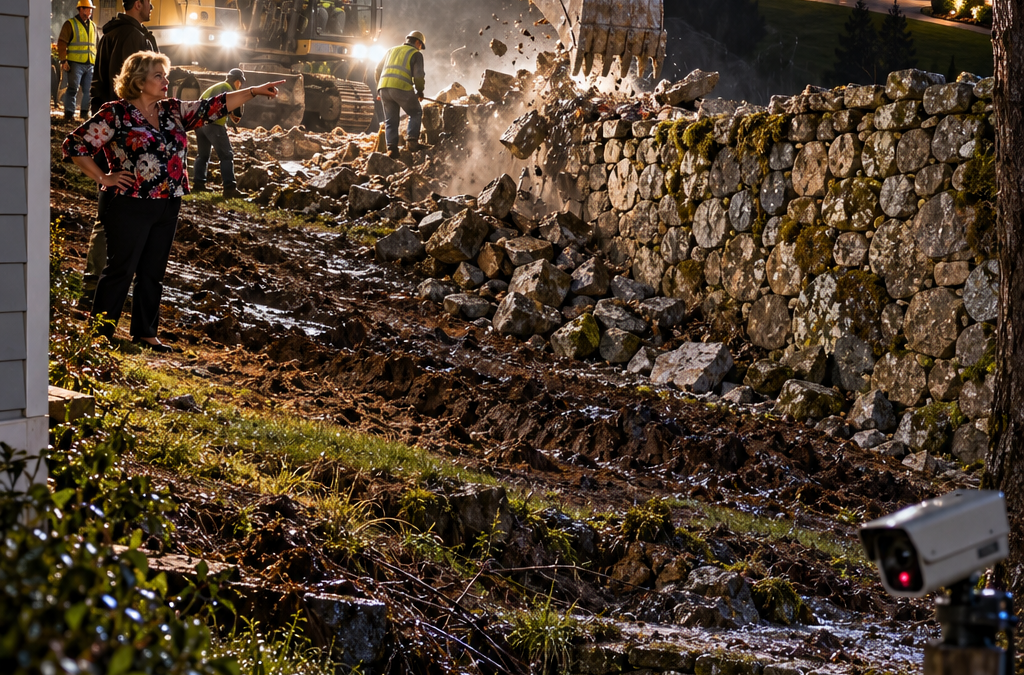
The excavator bucket struck.
The sound was deeper than I expected.
Stone breaking against stone.
A hollow crack traveled through the ground.
I felt it in my chest.
The first section collapsed.
I wanted to run toward them.
I wanted to drag Vanessa away from the machine.
I wanted to do something.
Instead I stood there.
Recording.
The bucket struck again.
Stones my father had reset with his own hands rolled into the mud.
I called to Brett.
“There is a court order prohibiting this work.”
The excavator stopped.
For several seconds, Brett sat motionless.
Vanessa walked across the torn ground.
She climbed onto the track.
I could not hear every word from where I stood, but my closer camera could.
“The association accepts responsibility,” she told him.
Brett said something.
Vanessa pointed at the wall.
“Keep going.”
The machine moved again.
I called the police.
Twenty minutes later, a patrol car came down the access lane.
Blue lights flashed against the stones.
The officer stepped out.
Vanessa met him before he reached me.
She carried a folder.
“This is a civil dispute involving association property.”
I walked over and handed him Judge Hallstead’s order.
He read it beneath his flashlight.
Every page.
Then he looked at Vanessa.
“Ma’am, this says you are prohibited from altering this wall.”
“Our attorney has advised us regarding the emergency nature of the work.”
“I don’t care what your attorney told you. I’m telling you I’m documenting this.”
“I understand.”
“You understand this could have consequences?”
“Yes.”
Then she turned toward Brett.
“Continue.”
Even the officer looked stunned.
From that point forward, nobody could call it a misunderstanding.
I had warned her.
Colton Ree had warned her.
A judge had ordered her.
A police officer had warned her again while the work was happening.
She continued.
At approximately 1:06 a.m., more than half the wall was gone.
Then the excavator bucket hit something beneath the old footing.
A sharp metallic crack cut through the engine noise.
Brett stopped.
A section of buried drainage pipe had been exposed.
Part of it was crushed.
Water and mud began seeping through.
I knew immediately what it was.
The county system.
Brett climbed down.
He called Vanessa over.
She looked at the pipe.
Then said, “Cover it.”
My camera recorded her.
At 1:43 a.m., almost nothing remained of the wall.
Just broken stone.
Mud.
Pieces of footing.
Vanessa walked toward me.
The floodlights cast her shadow twenty feet across the ground.
She smiled.
“Now you can take your court order and protect a wall that doesn’t exist.”
I looked at my watch.
2:03 a.m.
“Good.”
Her smile faded.
“What?”
“Now there’s no question when you did it.”
She stared at me.
Then turned away.
Before leaving, she made one more decision.
She ordered Brett’s crew to grade the disturbed land flat so trucks could use it.
Judge Hallstead’s order had protected the entire disputed area.
Not just the stones.
The camera captured Vanessa pointing to exactly where the excavator should push soil.
By dawn, everything looked different.
The wall was gone.
The slope was scarred.
The drainage pipe was crushed.
Mud filled the area where my father and I had once worked on spring Saturdays.
Paige arrived before sunrise.
She did not hug me.
Did not offer sympathy.
Not yet.
She photographed everything.
Measured distances.
Copied license plates.
Collected names.
Backed up my camera files in three locations.
Then she stood beside what remained of the wall.
“Yesterday,” she said, “we had a property case.”
I looked at the rubble.
“And today?”
“Today we have evidence of deliberate contempt of court.”
At 5:41 a.m., she filed an emergency motion.
By 8:15, Vanessa was ordered back before Judge Hallstead.
I sat behind Paige.
Vanessa entered with the HOA attorney.
Her posture was straight.
Her expression controlled.
The lawyer argued that contractors had performed emergency stabilization of an unsafe structure.
Judge Hallstead listened.
Then asked:
“Who determined an emergency existed?”
The attorney paused.
He looked toward Vanessa.
Vanessa looked at her notes.
Nobody answered clearly.
Paige stood.
“Your Honor, may I play the recording?”
The courtroom monitor came on.
12:17:36 a.m.
There was Vanessa beneath the floodlights.
Her hand went up.
The excavator struck.
The next clip showed me announcing the court order.
The next showed the officer reading it.
Then Vanessa waving Brett back to work.
Judge Hallstead folded her hands.
Her voice remained low.
“Ms. Calder, did you understand my order yesterday?”
Vanessa swallowed.
“Yes.”
“Were you at Mr. Vale’s property last night?”
“Yes.”
“Did demolition continue while you were present?”
The HOA attorney stood.
“Your Honor, I object to—”
“Sit down.”
He did.
Judge Hallstead looked at Vanessa.
“Answer.”
A long pause.
“Yes.”
The judge immediately froze the site.
Nothing could be removed.
Nothing could be relocated.
No debris could be hauled away.
Every email, message, recording, financial document, contractor communication, and project file had to be preserved.
An independent engineer would inspect the property.
And Vanessa personally was ordered to preserve her phone.
That was the first moment I saw fear on her face.
Two days later, Colton Ree and an independent engineer inspected the site.
Their findings were worse than I expected.
The wall had not simply been knocked over.
The demolition had crushed sections of the old drainage system.
The slope had been undercut.
The county easement had been damaged.
Soil had been destabilized exactly where Crestview intended to build its service road.
The repair was not a matter of stacking stones.
The site required redesign.
Excavation.
Drainage replacement.
Reinforced footing.
Slope stabilization.
Engineering.
County review.
The preliminary estimate came in between $940,000 and $1.2 million.
Vanessa had told her board the wall could be removed for approximately $35,000.
Now Crestview was potentially looking at more than twenty-five times that amount.
And several board members had never authorized demolition at all.
Lillian Frost began asking questions.
Who had approved the overnight work?
Where had the $180,000 payment come from?
Why did the official meeting minutes say the board unanimously authorized emergency stabilization?
Lillian had been at that meeting.
There had been no unanimous vote.
When the court ordered the original electronic file, metadata showed the paragraph describing board approval had been added after the demolition.
That changed everything.
Vanessa had not only violated the court order.
Someone had altered official association records afterward to make it appear that the full board had approved her decision.
The HOA’s lawyer began distancing the association from its own president.
That told me more than anything else.
Then Brett Danner was ordered to produce his communications.
Vanessa seemed convinced he would protect her.
He did not.
Brett came to court with his own lawyer and a thick folder.
He never looked at Vanessa.
The first printed page contained her message:
I NEED THE WALL GONE BEFORE SUNRISE.
The next:
ONCE IT’S GONE THERE’S NOTHING LEFT FOR HIM TO STOP.
The invoice was worse.
It included a surcharge described as:
OVERNIGHT COMPLETION BEFORE MORNING COURT ACTION.
I almost couldn’t believe anybody had typed those words onto an invoice.
Brett testified.
He admitted he knew there was a dispute.
He said Vanessa had assured him the HOA had authority.
Once I announced the court order, he had wanted to stop.
Vanessa told him to continue.
“Why did you save the messages?” Paige asked.
Brett looked toward his attorney.
Then answered.
“Because I figured if this went bad, somebody would say it was my decision.”
That was honest.
Not heroic.
Honest.
Paige built the timeline.
3:42 p.m.—Judge Hallstead issued the order.
4:06—Vanessa confirmed receipt.
6:18—Vanessa called Brett.
7:03—She offered additional payment.
9:47—She instructed his crew not to wear clothing bearing Crestview logos.
11:52—equipment entered my property.
12:17—demolition began.
1:43—the wall was effectively destroyed.
There was no way to turn that into confusion.
Then Lillian came forward.
She arrived at Paige’s office carrying a canvas tote bag filled with financial records.
Her hands were shaking.
“I should have said something sooner.”
Paige closed the conference-room door.
“Tell us everything.”
Lillian explained the $180,000 reserve transfer.
She had refused to approve it.
Vanessa had used secondary authorization.
Then association minutes were altered afterward.
Lillian had printed earlier versions before the changes.
Paige spread them across the table.
I looked at Lillian.
“Why are you doing this?”
She looked exhausted.
“Because this isn’t what I signed up for.”
“What did you sign up for?”
“Budgets. Landscaping contracts. Pool repairs.”
She almost laughed.
“Not midnight demolitions.”
The board called an emergency meeting.
Members demanded Vanessa resign.
She refused.
She told them Crestview needed to stay united.
She said I would eventually take money.
“Everyone has a price,” she told them.
Paige heard about that later.
When she told me, I said, “She’s still missing the point.”
“What point?”
“I don’t want her money.”
“You will need restoration money.”
“That’s different.”
It was.
I wasn’t holding my land hostage.
I wasn’t waiting for Crestview to raise its offer.
I wanted what had been mine before Vanessa decided my ownership was inconvenient.
Then Paige found the 1958 deed.
That document destroyed Crestview’s access argument.
Before the subdivision existed, the surrounding land had been one large farm.
In 1958, when acreage was divided, the owner granted the county a narrow easement along the eastern line for drainage maintenance.
Nothing more.
No roadway.
No access corridor.
No right of passage for neighboring landowners.
No vehicular easement.
The wall sat within that drainage system.
Vanessa had destroyed it trying to seize a right Crestview never possessed.
Removing the stones did not create the missing easement.
That should have ended the clubhouse-road idea.
Instead, it opened an even bigger problem.
The clubhouse had been financed using a multimillion-dollar construction loan.
The lender required an approved access plan.
The plan submitted by Crestview showed a secondary service road running directly through my property.
Apparently, the bank had assumed the association possessed that right.
It did not.
When the lender received notice of the dispute and reviewed the 1958 deed, it froze approximately $2.3 million in remaining disbursements.
The effect was immediate.
Vendors stopped work.
Landscaping remained unfinished.
The gala was postponed.
Contractors wanted payment.
The clubhouse sat nearly complete behind orange fencing while the project budget began unraveling.
Vanessa destroyed my wall because she thought it was delaying the project.
Her decision froze the entire project.
Residents became furious.
Not because they suddenly loved me.
Most had never met me.
They were furious because they realized they might pay for decisions they had never approved.
At a packed community meeting, Vanessa tried blaming Brett.
She said she had authorized removal of only part of the wall.
The contractor had exceeded instructions.
Brett’s attorney produced a voicemail.
11:28 p.m.
Vanessa’s voice came through the speakers:
“Take all of it. I don’t want one section standing by morning.”
The room fell silent.
Then Lillian stood.
“If insurance refuses to cover an intentional act,” she asked, “where does the million dollars for restoration come from?”
Vanessa answered that the reserve fund existed for emergencies.
Lillian looked directly at her.
“The reserve fund you already removed one hundred eighty thousand dollars from?”
That was when Vanessa finally lost the room.
The board scheduled a removal vote.
The night before that vote, Vanessa made the worst decision she had left.
Judge Hallstead’s preservation order had been explicit.
No project data could be altered, moved, or deleted.
At 11:54 p.m., Vanessa logged into Crestview’s document system.
Over the next forty minutes, meeting files were renamed.
One email was moved.
An annotated site map disappeared.
The IT system automatically logged everything.
And backed it up.
Paige presented the access log to Judge Hallstead.
No accusations were necessary.
Time.
Username.
File.
Action.
The missing map was restored from backup.
It had been prepared weeks before the demolition by Crestview’s own engineer.
Beside my parcel, handwritten in the margin, were five words:
NO VEHICULAR RIGHTS ACROSS VALE PARCEL.
Vanessa had been told by her own professional.
Before the court order.
Before the midnight demolition.
Before she offered Brett extra money.
She knew Crestview had no road right.
And just before the board vote, she tried to remove the document proving it.
The board removed Vanessa as president the next evening.
The vote wasn’t close.
Lillian later told me Vanessa gave a speech about sacrifice.
She said she had worked harder for Crestview than anybody.
She said the clubhouse benefited everyone.
Lillian answered:
“Serving a community doesn’t give you permission to ignore a judge.”
Then they voted.
Vanessa lost her title.
But the case continued.
Brett gave sworn testimony.
Lillian turned over financial records.
The original engineer authenticated the annotated map.
The IT administrator supplied access logs.
The contractor produced invoices.
The patrol officer submitted his report.
My cameras preserved the demolition.
Every person Vanessa assumed would protect her ended up becoming part of the evidence.
I wish I could say I enjoyed watching it happen.
I didn’t.
One afternoon, I stood where the wall used to be.
Rain had turned the scraped ground dark.
Broken stones lay everywhere.
Some had split.
Others were buried in mud.
It looked like somebody had pulled teeth from the earth.
Paige walked out beside me.
For a while, neither of us spoke.
“My grandfather built sections of this,” I said.
“I know.”
“My father and I worked on it every year.”
“I know.”
“Money doesn’t fix that.”
“No.”
I looked at her.
“Then what exactly are we winning?”
Paige studied the ruined slope.
“We’re not bringing the old wall back.”
“Then what’s the point?”
“The point is making sure nobody gets to erase something because they think destroying it will erase your rights with it.”
That stayed with me.
The final hearing came the following month.
When Vanessa entered the courtroom, one message was already displayed on the monitor.
I NEED THE WALL GONE BEFORE SUNRISE.
Judge Hallstead began by reading her original order aloud.
Every word.
Then she asked Vanessa:
“Did you receive this order?”
“Yes.”
“Did you understand it?”
“Yes.”
“Did you contact the contractor after receiving it?”
Vanessa shifted.
“The work had been planned previously.”
Paige handed the court the timeline.
The overnight surcharge had been requested only after the ruling.
The extra payment had been approved only after Vanessa left the courthouse.
Judge Hallstead read another message.
“Once it’s gone, there’s nothing left for him to stop.”
She looked at Vanessa.
No one spoke.
There was no plausible safety explanation for that sentence.
The court found Vanessa’s violation willful.
The HOA was held responsible for restoring the damaged property and drainage system.
Vanessa faced personal sanctions connected to her contempt and portions of the legal fees caused by her conduct.
The court also required payment of engineering, surveying, preservation, and inspection costs.
By then, the engineered restoration estimate had settled around $1.08 million.
Legal and technical expenses continued climbing.
Vanessa still cared about the clubhouse road.
Through her attorney, she made one final proposal.
I could name my price for a permanent vehicular easement.
Any reasonable amount.
The HOA would pay.
Paige didn’t need to ask me.
“No,” she said.
Vanessa’s attorney leaned toward her.
“Perhaps your client should consider—”
“He has considered it.”
I asked Judge Hallstead if I could speak.
She allowed me.
I stood.
My hands were shaking slightly, which annoyed me.
But I kept my voice steady.
“A wall can be destroyed, Your Honor.”
I looked toward Vanessa.
“Ownership can’t.”
Nobody moved.
“The stones being gone doesn’t change where my property line is. It doesn’t create an easement. It doesn’t give Crestview rights it didn’t have the day before the demolition.”
I sat down.
That was all I needed to say.
The HOA would have to redesign the access route entirely within its own land.
The lender made clear that funds would remain frozen until the disputed road disappeared from the plans.
Then Judge Hallstead addressed Vanessa.
Her voice was as calm as it had been from the beginning.
“You were told to stop in daylight.”
She paused.
“You waited for darkness and did it anyway.”
I will remember that sentence for the rest of my life.
The judge also referred questions involving altered minutes and deleted records to the appropriate authorities for separate review.
She did not decide what criminal or regulatory consequences, if any, should follow.
But she made certain the evidence would not disappear.
Vanessa walked out of court without looking at me.
For the first time since I had met her, she seemed small.
Not physically.
Just stripped of the things she had mistaken for power.
The title.
The board.
The project.
The certainty that people would do what she told them.
Restoration began several months later after winter loosened its grip on the ground.
I could have accepted a decorative replacement.
I refused.
If the wall was coming back, it would come back correctly.
Colton Ree supervised the county side.
An independent engineer designed the drainage work.
The crushed pipe was removed.
A modern drainage system replaced it.
The footing went deeper.
The slope was stabilized.
The new retaining structure met current engineering standards.
Concrete survey markers were set permanently along the boundary.
The drainage easement was updated and clearly referenced in county records.
There would never again be a reasonable excuse for confusion.
On the afternoon the final section was completed, Colton walked the full length with a clipboard.
He checked outlets.
Grades.
Footings.
Markers.
Then signed the inspection form.
He handed it to me.
“Keep that somewhere safe.”
I looked at the single sheet.
“I have an entire cabinet devoted to safe paperwork now.”
He smiled.
“Good.”
Before the masons finished, I made one request.
Every original stone that had survived intact was to be reused in the face of the new wall.
Some were stained.
Some chipped.
Some carried decades of lichen.
The masons scattered them across the new structure.
Old stone among new.
When they finished, the wall did not look like the one my grandfather knew.
It was straighter.
Stronger.
More engineered.
But pieces of the old wall remained visible everywhere.
Scars.
Memory.
Proof.
Crestview abandoned the second entrance completely.
The clubhouse eventually opened.
Months late.
The HOA redesigned service access entirely within its own boundaries.
It cost hundreds of thousands more than the original plan.
Residents were angry about that expense.
I understood.
But the cost did not come from me refusing to cooperate.
It came from Crestview designing a multimillion-dollar project around land it did not own.
The new board formally canceled every supposed fine issued against me.
They sent me a letter confirming two things.
Garrett Vale was not a member of Crestview Ridge HOA.
And Crestview Ridge had no authority to enforce its rules against my property.
I framed that letter.
Not because I needed reassurance.
Because after everything that happened, I appreciated seeing reality written clearly.
Lillian remained involved long enough to reform the board’s financial controls.
No president could move major reserve funds alone.
Emergency expenditures required documented approval.
Meeting minutes were version-controlled.
Contract authority became clearer.
Lillian and I never became friends.
We didn’t need to.
But when we saw each other, we spoke.
There was respect.
Brett faced professional consequences too.
He had taken money to perform work he knew was disputed.
The fact that he preserved Vanessa’s messages did not erase that.
But it mattered.
He could have lied.
He didn’t.
Vanessa carried the heaviest consequences.
She had made one fundamental mistake.
She believed destroying the wall would destroy the problem.
She thought law protected objects.
Therefore, remove the object and the legal obstacle disappears.
But property law does not vanish under an excavator bucket.
Neither does a court order.
Neither does an easement.
Neither does video.
Neither do text messages.
Neither do bank records.
Neither do metadata.
Neither does ownership.
The following autumn, I walked down to the eastern line near sunset.
No engines.
No floodlights.
No police cruiser.
No lawyers calling.
Just the wall.
The new stones were still pale compared with the old ones.
The surviving original stones stood out darker across the face.
I had placed a small sign near the boundary.
PRIVATE PROPERTY.
NO HOA ACCESS.
Nothing dramatic.
Nothing insulting.
Just clear.
I ran my hand across one of the old stones.
I remembered Vanessa standing in the rubble under white floodlights.
“Now you can take your court order and protect a wall that doesn’t exist.”
She had been so certain.
Before that night, the case had been about a wall.
After that night, she had to explain why she disobeyed a judge.
Why she transferred $180,000.
Why meeting minutes changed.
Why an engineer’s map disappeared.
Why her texts ordered demolition before sunrise.
Why the clubhouse financing depended on a road Crestview had no right to build.
Why video showed her standing on my land directing an excavator after a police officer warned her to stop.
She created every piece of that evidence herself.
I did not beat Vanessa because I had more money.
I didn’t.
I did not beat Crestview because I had more influence.
I certainly didn’t.
I won because I never gave her the fight she wanted.
She wanted anger.
I gave her a survey.
She wanted intimidation.
I called the county.
She wanted me to charge an excavator.
I held a camera.
She wanted the wall destroyed before the law could react.
I recorded the exact minute she destroyed it.
And while she kept making decisions under the glare of her own floodlights, I did the simplest thing I could.
I kept the cameras rolling.
My father once told me stone remembers impatience.
It took me thirty years to understand him.
Vanessa thought she could force an outcome before sunrise.
She believed speed could replace ownership, destruction could replace permission, and darkness could replace accountability.
She was wrong about all three.
The wall standing on my eastern boundary today is stronger than the one she tore down.
The drainage beneath it is stronger.
The property records are clearer.
The survey markers are permanent.
And every old stone the excavator failed to break sits in that new wall exactly where I asked the masons to place it.
Vanessa tried to erase something my family had protected for generations.
Instead, she made certain nobody would ever question it again.








