𝗙𝗨𝗟𝗟 𝗦𝗧𝗢𝗥𝗬 The HOA President Used a Stolen Key to Enter My Home, but He Had No Idea Who Was Waiting Inside
𝗣𝗔𝗥𝗧 𝟮
Gary paused.
“Heather, hostility won’t help you.”
My jaw tightened.
“I’m not being hostile.”
“You’re challenging established authority.”
There it was.
Not policy.
Not rules.
Authority.
I didn’t understand the significance then.
I would.
Gary offered to reduce the fine if I removed the wind chime within twenty-four hours.
I didn’t remove it.
Maybe that was petty.
Maybe it was pride.
Maybe I simply could not stand the idea of telling Lily that the little thing she had made me wasn’t acceptable because Gary Dunmore didn’t like how it looked.
I paid the fine.
The wind chime stayed.
After that, the letters began arriving faster.
Sometimes certified mail.
Sometimes taped to my door.
Sometimes both.
Red lettering appeared across the envelopes.
FINAL NOTICE.
COMPLIANCE REQUIRED.
ACCUMULATING PENALTIES.
I got fined because my recycling bin could supposedly be seen from the street.
Because one shrub had dead branches.
Because Lily’s bicycle remained near the garage overnight.
Because a delivery box stayed on my porch for most of one Saturday.
Every violation had a photograph.
That bothered me more than the fines.
Gary was watching.
I began noticing his black Mercedes moving slowly through the neighborhood early in the mornings.
Sometimes he stopped.
Sometimes his window lowered.
Sometimes I saw his phone lifted toward a house.
He called these compliance inspections.
Priya called them stalking.
Priya Desai lived three houses down from me.
She was in her early forties, worked as a pharmacist, and possessed the useful ability to say exactly what everybody else was afraid to say.
One evening, she caught me collecting another violation letter from my door.
“Another one?”
“Apparently Lily’s bicycle is an architectural emergency.”
Priya didn’t laugh.
Instead, she looked toward the street.
“Gary took that picture?”
“Probably.”
She stepped closer.
“You need to start keeping everything.”
“I have the letters.”
“I mean everything.”
Her voice lowered.
“Photos. Dates. Text messages. Voicemails. When his car comes by. When he knocks. Every conversation you can legally document.”
Something in her tone made me stop smiling.
“Why?”
She hesitated.
Then said, “Because he did this to the Alvarez family.”
I knew the name.
They had lived near the back entrance before suddenly moving out.
I had assumed a job transfer.
“What happened?”
Priya looked toward Gary’s side of the neighborhood.
“Ask the county recorder.”
“What am I looking for?”
“You’ll know when you see it.”
That night, after Lily went to bed, I searched public property records.
At first, I found nothing remarkable.
Then I found a lien.
Willow Crest HOA versus the Alvarez property.
The original dispute had involved about four hundred dollars in fines.
Late fees had accumulated.
Administrative charges had accumulated.
Legal charges had accumulated.
The association eventually recorded a lien against the house.
The Alvarez family had attempted to sell.
The lien complicated the closing and delayed the sale for nearly three months while attorneys fought over whether several charges were valid.
I sat alone at my kitchen table reading the documents.
Four hundred dollars.
That was where it began.
Gary had turned four hundred dollars into a legal cloud hanging over a family’s home.
I remembered the casual way Priya had said they moved.
Now I wondered what moving had cost them.
That was when Gary stopped being ridiculous in my mind.
He became dangerous.
I bought a file box.
Every notice went inside.
I photographed the front yard every morning before work.
Grass height.
Trash bins.
Porch.
Driveway.
Wind chime.
When Gary drove past, I wrote down the time.
When he left a voicemail, I saved it.
When he sent texts, I took screenshots.
Within two months, the fines against me reached eleven hundred dollars.
I appealed.
Gary denied the appeal.
I requested a board hearing.
Gary scheduled it for two o’clock on a Wednesday afternoon while I was working.
I asked for an evening meeting.
Denied.
I requested remote attendance.
Denied.
Finally, I used half a vacation day and attended in person.
The clubhouse conference room had a long polished table surrounded by eight leather chairs.
Only three people were there.
Gary sat at the head.
Beside him were two board members, both older men who barely spoke.
Gary wore a pale gray suit and a blue pocket square.
He looked like he was preparing for a television interview.
I placed my file folder on the table.
“Where is everyone else?”
Gary looked up.
“Excuse me?”
“The board. Aren’t there supposed to be five members?”
“We have sufficient authority to conduct compliance hearings.”
“Do you have a quorum?”
His expression changed slightly.
“Let’s focus on your violations.”
That answer stuck with me.
I sat down.
Gary went through every citation as though prosecuting a felony case.
Trash can.
Grass.
Wind chime.
Bicycle.
Shrub.
Package.
I showed photographs.
He dismissed them.
I pointed out inconsistencies with neighboring houses.
He called them irrelevant.
Finally, I said, “What do you want from me?”
Gary folded his hands.
“Compliance.”
“With what? Whatever you decide that morning?”
One of the board members shifted uncomfortably.
Gary leaned back.
“You have a pattern of resistance.”
“I have a pattern of being fined.”
“Because you resist.”
His logic was circular and airtight.
If I complied, he was justified.
If I objected, my objection proved I was difficult.
I looked toward the other board members.
“Do either of you agree with this?”
Neither answered.
Gary smiled.
“This hearing is concluded.”
My appeal was denied.
A week later, I skipped the monthly community meeting because Lily had a dance recital.
She had practiced for three months.
There was no universe in which I was missing it to sit in the clubhouse while Gary lectured everyone about hedge symmetry.
The recital ended around eight-thirty.
Lily ran toward me backstage wearing a silver costume and enough glitter to contaminate the entire state.
“Did you see me?”
“Every second.”
“I almost fell.”
“I saw.”
“But I didn’t.”
“You recovered beautifully.”
She hugged me.
That was one of those moments I remember clearly because of what happened afterward.
We got home around nine-fifteen.
Three violation notices were stapled to my front door.
Three.
One for a decorative planter positioned outside the approved porch zone.
One for grass clippings allegedly visible near the curb.
One for failure to respond to a previous compliance notice within the required time frame.
Lily stopped behind me.
“Mom?”
I pulled the papers down.
“It’s fine.”
“Is it Mr. Dunmore again?”
Children notice more than adults think.
I folded the notices.
“Go inside, sweetheart.”
She hesitated.
“Are we in trouble?”
That question broke something in me.
Because Willow Crest wasn’t supposed to be another unstable place in her life.
It was supposed to be the opposite.
I forced a smile.
“No.”
“Promise?”
“Promise.”
She went inside.
I remained on the porch.
The wind chime moved gently above me.
Three fines because I had missed Gary’s meeting to watch my daughter dance.
Maybe officially the two things were unrelated.
But I no longer believed in coincidence.
The next morning, I emailed the HOA requesting copies of meeting minutes, board voting records, fine schedules, management agreements, and documentation showing who had approved my penalties.
Gary answered personally.
His message was four sentences long.
The records were available only as permitted under association policy.
My request was overly broad.
Administrative costs might apply.
Further abusive requests could be interpreted as harassment.
I read the final sentence twice.
Then I replied.
Please provide the applicable document-request procedure.
He didn’t answer.
Three days later, an email appeared in my inbox.
Subject line:
BOARD MINUTES – EXECUTIVE REVIEW
It had obviously been sent to me by mistake.
Gary attempted to recall it seconds later.
Too late.
I downloaded everything.
That mistake changed the entire case.
The attached files contained months of meeting minutes.
Some looked ordinary.
Others didn’t.
Votes supposedly approving enforcement actions included names of board members who, according to other records, had not attended.
I compared signatures.
They were inconsistent.
One board member’s name appeared beneath three separate approvals with three visibly different signatures.
Another supposedly signed an authorization on a date I knew she had been hospitalized because neighbors had organized meals for her family.
Then I found the emails.
Gary had forwarded an internal message chain beneath the minutes.
One sentence stopped me cold.
Need these enforcement votes completed before month-end. We need the additional fine revenue to cover outstanding personal reimbursement.
Personal reimbursement.
I kept reading.
Another message referenced expense advances.
Another referenced a reimbursement schedule.
Another contained an attached accounting worksheet.
There were payments to Gary.
Not ordinary documented expenses.
Boat-related charges appeared among records supplied by a whistleblower inside the management chain.
Marina fees.
Marine maintenance.
An insurance payment.
A large amount associated with a boat loan.
My hands started shaking.
I printed everything.
Then I called the management company.
A receptionist transferred me twice before a supervisor answered.
When I mentioned Gary, the woman’s voice changed.
“Ms. Collins, Willow Crest is currently self-managed.”
“Since when?”
“Several months.”
“Why?”
A pause.
“That relationship ended.”
“With your company?”
“Yes.”
“Who ended it?”
“Mr. Dunmore.”
“Why?”
Another pause.
“I’m not authorized to discuss client matters.”
“Did your company question the fines?”
Silence.
Then she said carefully, “Willow Crest has worked with three management firms in recent years.”
“All three were fired?”
“I didn’t say that.”
“You didn’t have to.”
I thanked her and hung up.
That afternoon, Priya came over.
My dining table was covered in documents.
She picked up one of the meeting records.
“What am I looking at?”
“Signatures.”
She studied them.
“Oh.”
“Exactly.”
I showed her the email.
Then the reimbursement records.
Priya stared at me.
“Heather, you need a lawyer.”
“I know.”
“No. I mean an actual serious lawyer. Not somebody’s cousin who handled their divorce.”
“I know.”
She pointed toward the files.
“And make copies. Multiple copies.”
I did.
The attorney I hired was named Rebecca Sloan.
She specialized in real-estate litigation and association disputes.
She had short dark hair, a quiet voice, and an unnerving habit of becoming more interested the worse the facts became.
I brought two boxes to her office.
She spent nearly an hour reviewing documents without saying much.
I sat across from her, twisting my wedding-ring finger even though I hadn’t worn a wedding ring in four years.
Finally, Rebecca picked up the email mentioning personal reimbursement.
She looked at the questionable signatures.
Then the lien threat.
Then the financial records.
One corner of her mouth lifted.
“Jackpot.”
I blinked.
“That’s good?”
“For proving a pattern? Very.”
I leaned forward.
“Can he put a lien on my house?”
“He can attempt to record one. Whether it survives challenge is another matter.”
“My daughter and I can’t lose this house.”
Her expression became serious.
“Then we move before he does.”
She explained the plan.
Formal complaint to the relevant state oversight and consumer authorities.
Notice to the association.
Demand for records.
Emergency court relief if necessary to prevent enforcement of an invalid lien.
Preservation letters instructing Gary and the board not to destroy documents.
“What about the forged signatures?”
“That may become much bigger than an HOA dispute.”
“And the money?”
“Same answer.”
For the first time in months, I felt as though somebody besides me understood the scale of what was happening.
Rebecca didn’t laugh at the wind chime.
She didn’t tell me eleven hundred dollars wasn’t enough to fight over.
She looked at the pattern.
And she believed me.
We filed.
Gary found out quickly.
His first response was an email.
Heather,
Your continued campaign against the Board is becoming increasingly disruptive. Your allegations are defamatory, irresponsible, and damaging to this community. You are advised to withdraw them immediately and bring your account current.
Failure to cooperate will result in all remedies available to the Association.
Gary Dunmore
President
Willow Crest Estates HOA
I forwarded it to Rebecca.
She replied with five words.
Do not respond to him.
So I didn’t.
Gary came to my house instead.
Saturday morning.
8:04 a.m.
He rang the bell.
I opened the door but left the storm door locked.
Gary stood outside wearing tan slacks, a white golf shirt, expensive sunglasses, and that same polished expression.
“Heather.”
“Gary.”
“We need to talk.”
“My attorney said communication should go through counsel.”
He smiled.
“You don’t need lawyers to resolve a neighborhood matter.”
“You threatened my house.”
“You created this situation by refusing compliance.”
“Rebecca has your records.”
His smile disappeared.
“What records?”
I didn’t answer.
He stepped closer to the storm door.
“You have association documents that may have been provided to you inadvertently.”
“They were emailed to me.”
“They remain confidential.”
“Then maybe you shouldn’t forge signatures in confidential documents.”
His face went still.
For one second, I saw something behind the smooth professionalism.
Fear.
Then anger covered it.
“You need to be very careful making accusations like that.”
“Leave my property.”
“Heather—”
“Leave.”
He lowered his voice.
“You’re making this much worse than it needs to be.”
“For who?”
He stared at me.
Then walked away.
That evening, another notice appeared.
Immediate compliance inspection required.
Gary claimed the HOA needed access to confirm several supposed interior-adjacent modifications visible from outside.
I showed Rebecca.
She laughed once.
Not because it was funny.
Because it was outrageous.
“He has no general right to enter your home.”
“I know.”
“Put that in writing.”
I did.
No interior inspection authorized. No HOA representative has permission to enter my residence.
I emailed it.
Sent a certified copy.
And taped another copy inside the front window.
Gary returned Tuesday evening.
This time, he banged on the door.
Not knocked.
Banged.
Lily jumped on the couch.
“Mom!”
“Stay there.”
I looked through the peephole.
Gary.
I started recording on my phone.
“What do you want?”
“Open the door.”
“No.”
“I am conducting a compliance inspection.”
“You don’t have permission.”
“I don’t need your personal approval to fulfill association responsibilities.”
Rebecca’s voice came back to me.
Do not debate him.
“Leave.”
“Heather, if you continue obstructing—”
“Leave my property.”
He stared at the camera beside the door.
A small doorbell camera Priya had convinced me to install one week earlier.
I watched him notice it.
His expression changed.
He stepped backward.
Then pointed toward me through the glass.
“This isn’t over.”
I saved the recording.
That night, Lily asked whether Gary could take our house.
I hated him most for that.
Not the money.
Not the notices.
Not even the threats.
That question.
My ten-year-old daughter should have been worrying about a math test and which costume she wanted for Halloween.
Instead, an HOA president had taught her the word lien.
I sat on the edge of her bed.
“No one is taking our house.”
“Are you sure?”
“Yes.”
It wasn’t completely true.
At that moment, I couldn’t guarantee what a court would do.
I couldn’t guarantee Gary wouldn’t file something fraudulent.
I couldn’t guarantee the legal fight wouldn’t become so expensive that the mortgage itself became difficult.
But children deserve some certainties.
So I gave her one.
“This is our home.”
She nodded.
Then she looked toward the window.
“Can I keep the wind chime?”
My throat tightened.
“Yes.”
“Even if he doesn’t like it?”
“Especially then.”
Three days later, I came home and knew somebody had been inside.
It wasn’t dramatic.
No broken window.
No overturned furniture.
Nothing obviously missing.
I simply walked through the door and felt that something was wrong.
The house smelled different.
Men’s cologne.
Sharp.
Expensive.
Familiar.
Gary.
I froze just inside the entrance.
My purse slid from my shoulder.
“Mom?”
Lily was behind me.
I turned quickly.
“Stay outside.”
“What?”
“Go to Priya’s.”
“Why?”
“Just go.”
She saw my face.
She didn’t argue.
I watched until she reached Priya’s porch.
Then I stepped inside.
The kitchen chair had been moved.
A drawer wasn’t completely closed.
Mail I remembered leaving beside the fruit bowl had been shifted.
My home suddenly felt contaminated.
I walked slowly toward the hallway.
Nothing.
Bedroom.
Nothing obviously disturbed.
Office.
One filing cabinet drawer sat slightly open.
My skin went cold.
I backed out of the room.
Then I remembered the camera.
My hands shook so badly I entered the password wrong twice.
Finally, the app loaded.
Motion event.
1:17 p.m.
I pressed play.
Gary Dunmore appeared on my screen.
I stopped breathing.
He walked along the side of my house.
Not toward the front door.
Toward the back.
He looked around.
Reached into his pocket.
Pulled out a key.
A key.
He inserted it into my back door.
Turned it.
And entered my house.
For several seconds, I could only stare.
Then I skipped through additional camera footage from the interior camera I’d installed facing the kitchen after Gary’s recent escalation.
There he was.
Inside.
He walked through the kitchen like a man conducting an inspection of property he owned.
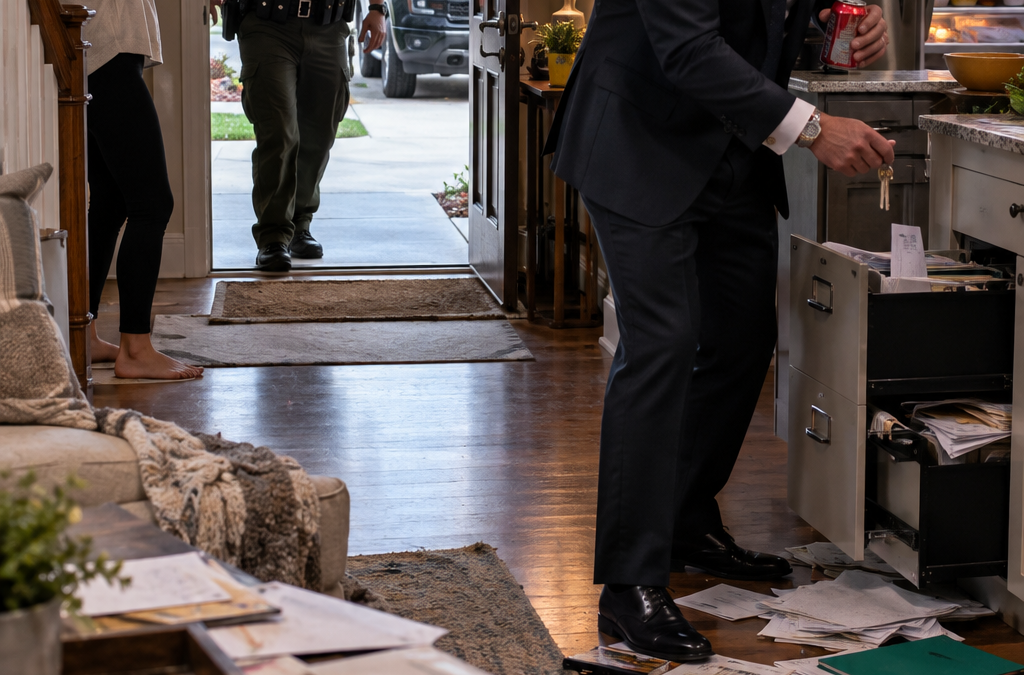
He opened drawers.
Looked through mail.
Picked up documents.
Opened a cabinet.
Then, unbelievably, he opened my refrigerator.
He took out a soda.
I stared at the screen.
“You have got to be kidding me.”
Gary twisted off the cap, drank directly from the bottle, and continued walking through my house.
For one absurd second, rage collided with disbelief so perfectly that I laughed.
The man had broken into my home and apparently decided burglary made him thirsty.
Then the next clip played.
Gary opened Lily’s homework folder.
My laughter vanished.
He stood at my kitchen counter turning through her worksheets.
Spelling test.
Math homework.
A drawing.
My daughter’s private little world in his hands.
Something primal rose inside me.
I wanted to drive directly to his house.
I wanted to shove the phone in his face.
I wanted him to see exactly what he’d done to me.
Instead, I called Rebecca.
She answered.
“Heather?”
“He was inside.”
“Who?”
“Gary.”
Silence.
“Inside where?”
“My house.”
Her voice changed instantly.
“Are you safe?”
“Yes. He’s gone.”
“Is Lily safe?”
“She is with Priya.”
“Do not touch anything you believe he handled.”
“I have video.”
“How did he enter?”
“With a key.”
Another silence.
“A key?”
“He used a key to my back door.”
“Call the sheriff.”
“I want to confront him.”
“No.”
Her answer was immediate.
“Heather, listen carefully. Do not confront him.”
“He went through Lily’s things.”
“I understand.”
“He opened my filing cabinet.”
“I understand.”
“I want him to know I saw him.”
“He will.”
Her voice became harder.
“But he needs to hear it from a deputy, not from you.”
I stood in the middle of my kitchen staring at the open drawer.
Then Rebecca said the sentence that changed what happened next.
“Let him walk into the trap he built himself.”
The sheriff’s office sent Deputy Marcus Bell.
He watched the footage at my kitchen table.
When Gary appeared using the key, Bell leaned closer.
“You ever give him permission to enter?”
“No.”
“Did the association have a key?”
“Apparently.”
“Did you know?”
“No.”
I remembered something from when I bought the house.
The previous owner had mentioned Willow Crest used to request spare keys for certain elderly residents participating in an emergency-access program.
I had never enrolled.
I had never given anyone a key.
Bell asked me to check whether anything was missing.
I searched carefully.
Nothing obvious.
Then he examined the back lock.
No damage.
“He may still have the key?”
“I assume so.”
Bell looked at the video again.
“How often has he been coming around?”
I showed him the records.
The letters.
Inspection demands.
Voicemails.
Threats.
The attempted lien.
His expression became progressively less neutral.
Finally, he asked, “Do you think he’ll come back?”
“Yes.”
I didn’t know that for certain.
But I knew Gary.
He had entered once because he believed he could.
And men like Gary interpreted getting away with something as permission.
The deputy took a report.
Rebecca notified the relevant investigators and preserved the video evidence.
She advised me to change the locks after law enforcement finished documenting them.
But first, the sheriff’s office wanted to determine whether Gary would use the key again.
We didn’t have to wait long.
Two days.
Tuesday.
I left work early.
Lily stayed with Priya.
My car remained parked farther down the street behind a neighbor’s garage where it couldn’t easily be seen from my house.
Deputy Bell arrived in an unmarked vehicle first.
Another deputy waited nearby.
I sat in my car with my phone in my hand, watching the camera feed.
My heart pounded so violently I could feel it in my fingertips.
1:42 p.m.
Nothing.
2:03.
Nothing.
2:19.
A black Mercedes entered the street.
My stomach dropped.
Gary parked around the corner.
He didn’t use my driveway.
That told me everything.
He walked toward my backyard.
No clipboard.
No inspection packet.
No notice.
He looked toward the neighboring houses.
Then reached into his pocket.
The spare key appeared.
I whispered, “Oh my God.”
Deputy Bell was watching from inside the house this time.
Gary unlocked the back door.
Entered.
Closed it behind him.
I wanted to run toward the house.
Bell had told me not to.
Stay outside.
Let us handle it.
My phone showed Gary moving through the kitchen.
He was more confident now.
He went directly toward my small office.
Opened the filing cabinet.
Started searching.
Not inspecting.
Searching.
He pulled out folders.
Mortgage documents.
Legal correspondence.
Copies of HOA records.
One folder dropped onto the carpet.
Papers spilled.
Gary crouched.
That was when Deputy Bell walked down the hallway.
“Sir.”
Gary spun around.
Even through the camera, I saw his body stiffen.
Bell stood with his badge visible.
“What are you doing in this residence?”
Gary rose slowly.
For maybe two seconds, he said nothing.
Then the transformation happened.
The surprise disappeared.
The HOA president returned.
Shoulders back.
Chin raised.
Voice controlled.
“I’m Gary Dunmore. President of Willow Crest Homeowners Association.”
Bell didn’t move.
“I didn’t ask your title. I asked what you’re doing in this house.”
Gary pointed toward the documents.
“This property is under active compliance review.”
“Does the homeowner know you’re here?”
“The association retains inspection authority.”
“Does the homeowner know you’re here?”
Gary hesitated.
“She has been obstructing lawful inspections.”
“That wasn’t my question.”
Gary reached for his pocket.
Bell’s posture changed immediately.
“Keep your hands where I can see them.”
Gary froze.
“I’m reaching for association identification.”
“Don’t.”
Gary lifted his hands.
“This is ridiculous.”
Bell stepped closer.
“Do you have permission from Heather Collins to be inside?”
“The HOA—”
“Yes or no.”
Gary stared at him.
“No, but—”
Bell cut him off.
“How did you enter?”
Gary said nothing.
Bell looked toward the back door.
“Did you use a key?”
Gary’s jaw tightened.
“It is an emergency-access key retained by the association.”
“For this property?”
“Yes.”
“With Ms. Collins’s authorization?”
Gary didn’t answer.
Bell repeated the question.
“With Ms. Collins’s authorization?”
“No.”
Outside, I covered my mouth.
For months, Gary had always found a sentence that made his actions sound official.
Compliance.
Standards.
Association authority.
Inspection.
Governance.
But inside my living room, with a uniformed deputy standing in front of him, those words had nowhere to hide.
Bell glanced at the open filing cabinet.
“What emergency required you to search these files?”
Gary’s face flushed.
“I was documenting noncompliance.”
“In a filing cabinet?”
“These documents relate to the association dispute.”
“Exactly.”
Bell’s voice hardened.
“You entered a home without permission and began searching private files connected to a legal dispute you’re personally involved in.”
“You don’t understand.”
Gary sounded different now.
Smaller.
“I’m the HOA president. I have authority to inspect.”
Bell looked straight at him.
“Sir, you have a house key that isn’t yours, inside a home you weren’t invited into.”
Gary opened his mouth.
Bell continued.
“That’s not an inspection.”
Then he reached for his handcuffs.
For the first time since I had known Gary Dunmore, every ounce of arrogance drained from his face.
“You’re arresting me?”
“Turn around.”
“This is insane.”
“Turn around.”
“I have an obligation to the community.”
“Hands behind your back.”
“You cannot arrest an HOA president for performing official duties.”
Bell secured one wrist.
“You’re not being arrested because you’re an HOA president.”
The second cuff closed.
“You’re being arrested because you’re inside somebody else’s home without permission.”
Gary looked toward the window.
For a second, our eyes met through the glass.
I don’t know whether he saw me clearly.
But I saw him.
His face was pale.
His perfect hair had fallen slightly across his forehead.
His expensive shirt was wrinkled where Bell had positioned his arms.
He no longer looked powerful.
He looked like a man in handcuffs standing beside somebody else’s filing cabinet.
Bell began reading him his rights.
I thought I would feel triumphant.
Instead, I felt sick.
Not because I regretted it.
Because seeing him arrested made everything real.
This man had been in my house.
More than once.
He had held a key.
He had walked through rooms where my daughter slept.
For months, I had worried about losing my home financially.
I had never considered that the man threatening the mortgage might simply unlock the door and enter.
Deputy Bell led him outside.
Gary immediately started talking again.
“Heather!”
I stood beside my car.
“Heather, tell him this is a misunderstanding.”
I said nothing.
“Heather!”
Bell guided him toward the cruiser.
“You know I had association authority.”
I looked at him.
“No, Gary.”
His eyes widened.
“You knew I entered before?”
I lifted my phone.
“I have all of it.”
That finally silenced him.
Bell placed him in the cruiser.
The door shut.
The Georgia afternoon became strangely quiet.
No shouting.
No red and blue lights.
Just cicadas in the trees.
A lawn mower several houses away.
The wind chime on my porch.
And Gary Dunmore sitting behind the glass of a sheriff’s cruiser in my driveway.
Priya came outside with Lily only after the deputies told us it was safe.
Lily saw the cruiser.
Her face changed.
“Mom?”
I knelt.
“Everything’s okay.”
“Is that Mr. Dunmore?”
“Yes.”
“What happened?”
I looked toward the car.
“He went somewhere he wasn’t allowed to go.”
She glanced at our house.
Then at me.
“Inside?”
Children notice everything.
I nodded.
Her eyes widened.
“Is he going to take our house?”
I hugged her.
“No.”
This time, I wasn’t forcing confidence I didn’t feel.
“No, sweetheart.”
The investigation expanded faster than any of us expected.
When Deputy Bell entered Gary’s information and reviewed prior complaints, another report surfaced.
Alvarez.
The family Priya had warned me about.
More than a year earlier, Mr. Alvarez had reported suspected unauthorized entry during their HOA dispute.
They had come home to find documents moved and a utility-room door open.
They couldn’t prove who had entered.
Gary denied involvement.
The complaint went nowhere.
Until my camera footage.
Rebecca contacted the Alvarez family’s attorney.
They still had records.
Emails.
Violation notices.
The lien paperwork.
And one message in which Gary had referenced details from documents the Alvarez family insisted had never been provided to the HOA.
What had once looked like an isolated accusation now looked like a pattern.
Investigators began asking questions.
How many homes had Gary entered?
How many keys did the HOA possess?
Who authorized him to keep them?
Were any other residents aware?
The answer to the last question became especially ugly.
Apparently Willow Crest had once maintained a limited emergency key program under a previous board.
The keys were supposed to be held securely and used only for residents who had voluntarily enrolled.
Most had supposedly been returned or destroyed when the program ended.
Gary had retained access.
Nobody could produce a legitimate document giving him permission to possess my key.
The previous owner of my house had apparently participated years earlier.
When the property transferred to me, the key should never have remained under HOA control.
Gary knew that.
He used it anyway.
Rebecca told me the unlawful-entry case was now separate from the HOA litigation.
The financial investigation also accelerated.
Once state investigators began reviewing the association records, the irregularities multiplied.
Votes had been recorded without a lawful quorum.
Signatures appeared on resolutions signed when members were absent.
Fine revenue moved through accounts in ways the board had never clearly authorized.
Reimbursement checks went to Gary.
Boat-related expenses appeared among the records under questionable categories.
One receipt was for marina storage.
Another for maintenance work.
Another connected directly to a payment associated with Gary’s boat.
The same boat he had posted photographs of online every summer.
Forty-two feet.
White hull.
Blue trim.
He had named it Authority.
I wish I were making that up.
Priya showed me the photo.
We stared at it.
Then she said, “That name aged badly.”
I laughed.
It felt good.
The state oversight division suspended the Willow Crest board’s enforcement authority pending investigation and froze several disputed collection actions.
Every active lien threat connected to questionable fines was reviewed.
Residents started coming forward.
At first, two.
Then six.
Then fourteen.
A widow said Gary had fined her repeatedly after she refused to support him in a board election.
A family said he threatened daily penalties over a basketball hoop that had previously been approved.
Another resident had been charged hundreds for landscaping violations while Gary’s own property violated the same standards.
And then there were the meetings.
The loyalty tests.
Gary kept attendance lists.
People who missed meetings seemed to receive unusually aggressive enforcement afterward.
Nobody could prove every violation was retaliatory.
But the pattern was difficult to ignore.
The more people talked, the less powerful Gary became.
That was the strange thing about him.
His authority had always depended on isolation.
One homeowner believed she was the only target.
Another believed his problem was unique.
Another assumed paying quietly would make Gary go away.
Another was embarrassed and told nobody.
Separate, we looked unreasonable.
Together, we looked like evidence.
Rebecca and attorneys representing other residents began coordinating claims.
The Alvarez family joined.
So did others.
A larger lawsuit formed challenging disputed liens, unlawful fines, financial misconduct, and damages tied to Gary’s actions and the board’s failures.
Gary’s lawyer called the allegations politically motivated.
He claimed residents were exploiting his arrest to settle old grievances.
Gary himself issued a statement through counsel insisting he had acted in good faith.
Good faith.
I read those words while sitting at the same kitchen table he had searched.
The same refrigerator he had opened.
The same filing cabinet he had rifled through.
I looked toward Lily’s homework folder.
Good faith.
I stopped reading.
Criminal charges followed.
Unlawful entry and breaking-and-entering-related charges arising from the house incident.
Fraud-related allegations connected to association records.
Financial charges tied to suspected misuse or embezzlement of HOA funds.
The exact charges would still have to be proven.
Gary was entitled to defend himself.
But for the first time, his explanations were being tested somewhere other than a boardroom he controlled.
His boat was seized as evidence connected to the financial investigation.
Priya called me when she heard.
“You know what they took?”
“What?”
“The boat.”
I leaned back in my office chair.
“Authority?”
“Authority has been relieved of duty.”
I laughed so loudly a coworker looked through my office door.
For maybe thirty seconds, the entire nightmare became funny.
Then I remembered what the money represented.
Seventy-five dollars from someone who forgot a trash can.
One hundred dollars from someone whose grass grew too high.
A fine from a widow.
A penalty against a young family.
Money collected under threat.
Money people paid because fighting cost more.
If even part of that had funded a luxury boat, it wasn’t funny.
It was obscene.
The emergency court hearing over my lien happened about three weeks after Gary’s arrest.
He wasn’t there.
His attorney attended.
Rebecca presented the records showing questionable board approvals and the absence of a lawful quorum for several actions affecting me.
She presented emails discussing fine revenue.
She showed the pattern of escalating enforcement after I challenged Gary.
She introduced documentation of his unauthorized entry into my home while searching files related to the dispute.
The association’s attorney argued that Gary’s criminal conduct should not automatically invalidate legitimate association debts.
Rebecca agreed.
Then she asked the court to identify which debts had been legitimately approved.
That became difficult.
The documentation was a mess.
Votes didn’t match attendance records.
Signatures were contested.
Procedures had not been followed.
Some fine amounts could not be reconciled with the published schedule.
The emergency lien action against my home was halted.
I sat beside Rebecca when the judge said it.
For a second, I thought I had misunderstood.
Rebecca leaned toward me.
“He cannot use these disputed fines to take enforcement action against your property while this is being litigated.”
“My house?”
“Protected.”
I looked at the ceiling.
I didn’t cry.
Not immediately.
I made it to the courthouse bathroom.
Locked myself inside a stall.
Then cried so hard I had to cover my mouth.
Months of fear came out.
Every time Lily had asked whether we were moving.
Every envelope.
Every photograph of my grass.
Every threat.
Every night I had opened my banking app wondering whether legal bills would eventually accomplish what Gary’s lien couldn’t.
When I came out, Rebecca was waiting near the sinks.
She handed me a tissue.
“You okay?”
I laughed weakly.
“No.”
Then I smiled.
“But better.”
The class action expanded over the following months.
The Alvarez family became central to it because their earlier experience showed the pattern had started long before me.
Their disputed lien was reviewed.
So were others.
Several were erased.
Others were substantially reduced or voided after the association could not establish proper authority, procedure, or accounting.
Residents received reimbursements and credits.
Some individual damages remained separate.
The financial investigation continued.
Gary’s reputation collapsed faster than his legal defenses.
People who had once praised him for maintaining standards began admitting they had been afraid of him.
Former board members insisted they hadn’t understood what he was doing.
Some probably told the truth.
Others probably wanted distance from the wreckage.
I learned not to care very much.
What mattered was that the system changed.
Six months after Gary entered my home, Willow Crest held elections for an entirely new HOA board.
The clubhouse was packed.
Not the reluctant attendance Gary had forced through social pressure.
People genuinely wanted to be there.
They asked questions.
Lots of them.
Budget questions.
Vendor questions.
Enforcement questions.
Conflict-of-interest questions.
Every proposed expenditure had to be documented.
Board votes were recorded clearly.
Quorum was verified publicly.
No single officer could approve fines alone.
No board representative could enter a home without explicit legal authority or the owner’s permission.
Residents created a records committee.
Someone proposed banning all HOAs from owning keys to private residences.
That passed so quickly people laughed.
Priya ran for the board.
She resisted for three weeks.
Then enough neighbors talked her into it.
On election night, she received more votes than anybody else.
I hugged her afterward.
“You realize this means people will complain to you about trash cans.”
She groaned.
“I’ve made a terrible mistake.”
The new president was a retired accountant named Thomas Reed.
His first statement lasted less than a minute.
“The purpose of this association is to maintain shared property, administer legitimate community obligations, and serve the homeowners. It does not own you.”
People applauded.
I didn’t.
I was too busy looking around the clubhouse.
Same walls.
Same tables.
Same artificial fireplace.
But the room felt different.
Gary had made that room feel like a courtroom where the verdict was already written.
Now it felt like a meeting.
Just a meeting.
That was enough.
My mortgage remained untouched.
The lien never consumed my home.
The fraudulent and improperly approved fines were removed.
The disputed balance disappeared.
I received reimbursement for amounts that should never have been collected.
The legal process involving Gary continued beyond those six months, and I learned something important about justice.
It rarely arrives as one perfect dramatic moment.
There was no single day when every wrong thing became right.
There were court dates.
Filings.
Investigators.
Lawyers.
Accounting reviews.
Delays.
Charges.
Hearings.
Arguments.
Some questions took months.
Some would take longer.
But the direction had changed.
Gary could no longer manufacture violations from behind a desk and expect people to obey because his name sat beside the word president.
He no longer controlled the association.
His financial activities were under investigation.
His alleged crimes were being handled by authorities who did not answer to him.
And people had stopped being afraid to speak.
The first quiet Saturday after the new board took over, I woke around seven.
No alarm.
No certified letter.
No pounding on the door.
Sunlight came through the bedroom blinds.
I lay still for a moment waiting for the familiar anxiety.
It didn’t come.
Then I heard something outside.
A soft metallic sound.
Chime.
Chime.
Chime.
I smiled.
Lily’s wind chime.
Still on the porch.
I made coffee and stepped outside.
Georgia summer had begun giving way to early fall.
The morning was cooler.
Leaves moved lightly above the street.
Lily came outside wearing pajamas and carrying a bowl of cereal.
She sat on the porch step.
“Mom?”
“Yeah?”
“Are they ever going to make us take it down?”
She pointed toward the wind chime.
I looked at it.
The paint had faded.
One metal tube had a small dent.
The string Lily had used was beginning to fray.
It wasn’t elegant.
It wasn’t expensive.
It wasn’t compliant with Gary Dunmore’s idea of perfection.
“No.”
She smiled.
“Good.”
We sat there together.
A few minutes later, Priya walked past with her dog.
She stopped.
“Your grass looks dangerously tall.”
I narrowed my eyes.
“Don’t start.”
“I may have to issue a citation.”
“I know where you live.”
She laughed and continued walking.
I looked across the neighborhood.
The Alvarez house had new owners by then.
I often thought about the family who had lived there before.
They had spent months fighting to escape a mess they didn’t create.
They were finally part of the lawsuit trying to recover what Gary’s actions had cost them.
I wished someone had believed them earlier.
Maybe if the county had connected their trespassing complaint sooner, Gary would never have reached my door.
Maybe if one board member had challenged the forged signatures earlier, the financial damage would have stopped.
Maybe if the first homeowner fined unfairly had fought harder, everything could have changed.
But that kind of thinking can become its own trap.
Because I had paid my first fine too.
Seventy-five dollars.
I had told myself it wasn’t worth the trouble.
I had laughed about the grass.
I had tried to cooperate.
I had assumed authority meant legitimacy.
Most people do.
That was how Gary operated.
He didn’t begin by breaking into houses.
He began with small demands.
Small enough that resistance looked unreasonable.
Seventy-five dollars.
Remove this.
Move that.
Attend this meeting.
Don’t ask that question.
Pay now.
Appeal later.
Trust the board.
Trust me.
Each surrender made the next demand easier.
Each fine taught homeowners to avoid conflict.
Each silence made him more confident.
Eventually, he stopped recognizing the boundary between enforcing a rule and owning the person subject to it.
That was why the key mattered so much to me.
Not physically.
I changed every lock in the house the same day the sheriff finished processing the scene.
But symbolically.
Gary had possessed a key to my home because somewhere along the line he had convinced himself that his title entitled him to access.
That was his entire worldview reduced to a small piece of metal.
He believed if something affected Willow Crest, it belonged within his authority.
My trash can.
My grass.
My porch.
My money.
My house.
My daughter’s school papers.
Me.
He was wrong.
A few weeks after the new board took office, Thomas stopped by.
He carried an envelope.
I laughed when I saw it.
“If that’s a violation notice, I’m calling the sheriff.”
He smiled.
“No fines.”
He handed it to me.
Inside was a formal written confirmation that the old enforcement balance had been rescinded and that no valid lien existed against my property.
I read it twice.
Then again.
“I already knew this from the court case.”
“I know,” Thomas said. “But I thought you deserved to have it from the association too.”
I looked up.
“Thank you.”
He nodded toward the wind chime.
“For the record, I like that.”
I laughed.
“Careful. Apparently it causes visual chaos.”
“I’ll risk it.”
He walked away.
I remained on the porch holding the letter.
For months, HOA letterhead had meant threat.
Now, finally, it contained something else.
Closure.
Later that evening, I opened the old file box.
The one I had created when Priya first told me to document everything.
It was full.
Violation notices.
Certified-mail receipts.
Photographs.
Copies of meeting minutes.
Screenshots.
Emails.
Rebecca’s letters.
Court filings.
The first lien threat.
I found the wind-chime violation near the bottom.
VISUAL CLUTTER.
$125.
I stared at it.
Then started laughing.
Lily came into the room.
“What?”
I held it up.
“Remember this?”
She rolled her eyes.
“Mr. Dunmore hated everything.”
“Pretty much.”
She came closer.
“Are you throwing it away?”
I thought about it.
Then shook my head.
“No.”
“Why not?”
“Because someday I might need to remember.”
“Remember what?”
I looked toward the front porch.
The chime moved in the evening breeze.
“That small things aren’t always small.”
She gave me the suspicious look children use when adults become philosophical.
“Okay.”
Then she went back upstairs.
I placed the violation notice in the box.
Not because Gary deserved space in my memories.
But because the woman I had been before all of this deserved to be remembered too.
The woman who paid seventy-five dollars because fighting seemed inconvenient.
The woman who thought documented authority must be legitimate authority.
The woman who believed politeness could stop a bully.
I didn’t hate her.
She was exhausted.
Busy.
Raising a child.
Trying to keep a mortgage paid.
Trying to avoid unnecessary conflict.
That’s exactly the kind of person men like Gary depend on.
People with too much to lose.
People too responsible to create chaos.
People who think, Surely nobody would risk everything over something this ridiculous.
Gary did.
He risked everything over control.
And eventually, control cost him everything he had been using it to protect.
His position.
His credibility.
His access to association money.
His boat, at least while it remained tied to the investigation.
Possibly his freedom, depending on the criminal proceedings ahead.
Most importantly, he lost the thing he valued most.
The ability to make people afraid simply by putting his name on a letter.
Months later, I saw him once.
Not in Willow Crest.
At a traffic light near the courthouse.
He was in the passenger seat of another car.
No Mercedes.
No clipboard.
No sunglasses.
Just Gary.
He noticed me.
Our eyes met.
Neither of us waved.
The light changed.
The cars moved in opposite directions.
I expected to feel something dramatic.
Anger.
Satisfaction.
Fear.
I felt almost nothing.
And that might have been the clearest sign that I was finally free of him.
When I returned home that evening, Lily was practicing dance routines in the living room.
Music shook the walls.
Her backpack sat in the hallway.
Shoes were abandoned near the stairs.
There was a bowl on the kitchen counter she was absolutely supposed to have put in the dishwasher.
Normal mess.
Normal life.
Beautiful visual clutter.
I stood in the kitchen smiling.
Lily stopped dancing.
“What?”
“Nothing.”
“You’re being weird.”
“Probably.”
She turned the music back up.
I opened the refrigerator.
There was one soda left.
For a second, I remembered the footage of Gary taking one while walking through my house as if he belonged there.
I took the bottle.
Twisted off the cap.
And drank it myself.
Then I checked the back door.
Not because I was afraid.
Just habit.
New deadbolt.
New key.
Mine.
Only mine.
I walked onto the porch.
The neighborhood was quiet.
No black Mercedes crawling down the street.
No violation notice stapled to the door.
No man with a clipboard photographing my yard.
My grass probably needed cutting.
The trash can was still beside the garage.
Lily’s bicycle leaned against the porch because she’d forgotten to put it away.
The wind chime moved above my head.
Any one of those things could once have brought another fine.
That evening, they were simply signs that somebody lived here.
A mother.
A daughter.
A real family in a real home.
Not a showroom.
Not a property-value exhibit.
Not part of Gary Dunmore’s personal kingdom.
Our home.
I reached up and touched the wooden moon Lily had painted.
The blue was chipped along one edge.
I thought about the night she asked whether Gary could take our house.
Then about the afternoon he was led through that same doorway in handcuffs.
I had believed justice would feel like revenge.
It didn’t.
Justice was quieter.
It was my daughter no longer asking whether we had to move.
It was opening the mailbox without fear.
It was knowing the mortgage remained untouched.
It was watching neighbors attend meetings because they wanted accountability instead of because one man demanded loyalty.
It was the Alvarez family’s case finally being heard.
It was forged signatures being examined instead of ignored.
It was residents getting back money they had been bullied into paying.
It was a sheriff’s deputy looking at a powerful man and saying that a title did not give him the right to enter somebody else’s home.
Most of all, justice was standing on my own porch and understanding that Gary had failed to take the one thing he had spent months trying to control.
My sense that this place belonged to us.
The breeze picked up.
The wind chime rang softly.
Once.
Twice.
Then again.
I smiled.
Gary Dunmore had called it visual clutter.
To me, it sounded like proof.
We were still here.








