𝗙𝗨𝗟𝗟 𝗦𝗧𝗢𝗥𝗬 The HOA President Turned My Own Driveway Into a Trap, and That Was the Moment I Stopped Being Afraid of Her
𝗙𝗨𝗟𝗟 𝗦𝗧𝗢𝗥𝗬
Autumn nodded.
“Orientation meeting tomorrow.”
“Anything I should know?”
She looked toward the street before answering.
“Don’t cross her.”
I thought she was joking.
“That’s dramatic.”
“She keeps files on everyone.”
“Files?”
“Photos. Violations. Complaints. Who said what at meetings.”
I opened the bottle.
“Why?”
“Because information is how she controls people.”
I laughed softly.
Autumn didn’t.
“You’ll see.”
The following evening, Priya and I attended orientation at the clubhouse.
That was the first time I properly met Karen Ashcroft.
She was forty years old and undeniably attractive, but there was something calculated about the way she presented herself.
Long blonde hair.
Perfect makeup.
Bright lipstick.
A full, curvy figure she emphasized with confidence.
And the red lace dress.
I would see that dress so many times over the next few months that it became almost like a uniform.
Low-cut.
Tight.
Revealing.
Always red.
Karen knew people looked at her.
She liked it.
She had a flirtatious ease around men she wanted on her side, leaning close, touching an arm, smiling as though she were letting them into some private joke.
But when someone challenged her, the warmth vanished instantly.
That first night, though, she was charming.
“Welcome to Brook Haven,” she said.
She shook my hand.
Then Priya’s.
“We take tremendous pride in preserving the character of this community.”
Priya smiled politely.
“It’s beautiful.”
Karen’s eyes moved toward me.
“Residents who cooperate with the board usually find life here very easy.”
Usually.
That word stayed with me.
I didn’t understand why until later.
Karen had been president for eleven years.
Nobody had successfully challenged her since 2015.
Gary, her husband, also sat on the board.
Gary was the exact opposite of Karen.
Quiet.
Reserved.
Always holding coffee.
He barely looked up during meetings.
Neighbors joked that he hadn’t expressed an independent opinion since the Obama administration.
At first, I assumed that was simply their marriage dynamic.
Later, I realized Gary’s silence was part of the system that kept Karen in control.
My first violation arrived six days after orientation.
Trash can left visible one hour beyond approved collection window.
Fifty-dollar fine.
I stared at the notice taped to my door.
Then at the trash can already sitting inside the garage.
Priya read it.
“Pay it.”
“Fifty dollars?”
“You don’t want to start fighting the HOA our first week.”
She was right.
At least, I thought she was.
I paid.
Karen interpreted that as permission.
The next notice concerned grass height.
Then another.
Same grass.
One hundred dollars.
Then two hundred fifty.
The numbers grew faster than the lawn.
I asked Karen at the next meeting how the same offense had jumped five times in less than three weeks.
She smiled.
“Repeat violations escalate.”
“I mowed the lawn.”
“Not to standard.”
“What standard?”
“Three inches.”
“I measured it.”
“So did we.”
“How tall was it?”
“Over three.”
“How much over?”
She glanced at the paperwork.
“Approximately an eighth of an inch.”
I thought I had misheard.
“An eighth?”
“Yes.”
“Karen, grass grows.”
“So do fines.”
A couple of people looked down to hide smiles.
Karen didn’t.
I paid the first fine because I wanted peace.
I disputed the rest.
That’s when the notices started multiplying.
A porch light bulb allegedly had the wrong color temperature.
A welcome mat didn’t match the approved neutral palette.
My garden hose remained visible for forty minutes.
The mailbox was next.
That was the incident that changed my approach.
The old mailbox had been rusting when we moved in.
I ordered a replacement directly from the model linked on the HOA website.
Exact manufacturer.
Exact style.
Exact dimensions.
I installed it on a Saturday.
Monday morning, I received a three-hundred-dollar violation.
NONCOMPLIANT MAILBOX FINISH.
I called the office.
Karen answered.
“What’s wrong with my mailbox?”
“The finish.”
“I bought the approved model.”
“Approved model doesn’t automatically mean approved finish.”
“It came from the link on your website.”
“The shade is off-white.”
“The description says eggshell.”
“It’s not eggshell.”
I walked outside while holding the phone.
The mailbox was white.
Or eggshell.
Or off-white.
Whatever microscopic difference Karen saw was invisible to me.
“Can I appeal?”
“You can submit one.”
“I am submitting one.”
“Fine.”
Eleven minutes later, the denial reached my inbox.
Eleven minutes.
The board meeting had not occurred.
No review panel had met.
Nobody had inspected anything.
Karen had simply denied it.
I stared at the timestamp.
That was when I filed my first request for HOA financial records.
At the time, I didn’t even know what I was looking for.
I wanted to know where all these fines went.
Karen acted like every twenty-five dollars was essential to preserving civilization.
Fine.
Then show me the numbers.
Doug, the treasurer, contacted me.
Doug was a nervous man in his fifties who always looked like he wanted to apologize before he spoke.
“We’re gathering the documents.”
“How long does that take?”
“Board review.”
“Why does the board need to review financial statements before an owner sees them?”
He hesitated.
“That’s the process.”
Three weeks later, he handed me incomplete records.
Missing months.
Vague categories.
No supporting invoices.
Autumn saw me carrying the folder to my car.
“You actually asked for them?”
“Why wouldn’t I?”
She laughed bitterly.
“Because nobody does.”
“Why?”
“Most people pay.”
Then she added, “Or leave.”
I looked at her.
“What does that mean?”
“Karen likes people who leave quietly.”
“I wasn’t planning to leave.”
Autumn studied me.
Then smiled faintly.
“Good.”
Two nights later, someone spray-painted an X across my new mailbox post.
Black paint.
Fresh.
Thick.
Ugly.
Priya stood beside me in the driveway.
“You think Karen did this?”
“I don’t know.”
“Don’t accuse her.”
“I didn’t.”
I called the police.
An officer photographed the damage.
No witnesses.
No clear evidence.
Simple vandalism.
Likely unsolved.
But the house across the street belonged to Mr. Feldman, an older man who almost never attended HOA meetings and had a security camera pointed toward the street.
I knocked.
He opened the door, listened to my question, disappeared for five minutes, then returned with a flash drive.
“About time somebody did something about her,” he muttered.
I plugged the drive into my laptop.
The footage was grainy.
A person wearing a gray HOA polo appeared near my mailbox while walking a dog.
The figure paused.
Bent slightly.
Moved on.
The face was too blurry to identify.
But the shirt logo was obvious.
Only six people had those shirts.
The board members.
And Karen’s personal assistant, Bethany.
I created a folder that night.
BROOK HAVEN TIMELINE.
Date.
Time.
Incident.
Supporting evidence.
Every letter.
Every photograph.
Every email.
Every strange coincidence.
Autumn began helping.
One evening she came over while Priya made coffee.
“She’s making money off this.”
I looked at her.
“What?”
“Fine money.”
“That’s HOA income.”
“Then why doesn’t the reserve balance make sense?”
I leaned forward.
“What do you know?”
Autumn shook her head.
“Nothing I can prove.”
“Tell me anyway.”
“Years ago I asked why dues went up without a vote.”
“What happened?”
“She called me divisive in the newsletter.”
I remembered seeing that newsletter archived online.
Autumn continued.
“Then the fines started.”
My stomach tightened.
“Have you ever seen full financial statements?”
“No.”
That sentence lit a fuse in me.
I filed another formal records request, this time citing Brook Haven’s status as a nonprofit corporation and the rights granted to members under applicable Georgia law and the association’s own documents.
Doug stalled again.
Board review.
Processing.
Administrative delay.
I sent a certified demand letter.
Ten business days.
Produce the records or explain the lawful basis for withholding them.
Karen answered personally.
Her letter began:
We hope you’re settling comfortably into Brook Haven, Wesley. New residents occasionally misunderstand how cooperative communities function.
Priya read it twice.
Then looked at me.
“Okay.”
“What?”
“I take back what I said.”
“About?”
“Paranoia.”
I smiled.
“So now I’m sane?”
“No. But she’s weird.”
Three days later, we received another violation.
Excessive holiday decorations.
I had one strand of white lights.
Across the street, the Petersons had reindeer, illuminated candy canes, two inflatable snowmen, and enough lights to guide aircraft.
No fine.
I began cataloging selective enforcement.
Who questioned Karen?
Who got fined afterward?
The pattern appeared almost immediately.
Autumn questioned a dues increase.
Fine within ten days.
A homeowner asked about vendor contracts.
Landscape violation.
Another challenged Karen’s parking interpretation.
Mailbox violation.
It was too consistent.
I asked Autumn whether she would testify if this ever went to court.
Her smile disappeared.
She hesitated.
Then nodded.
“I’ve got nothing left to lose.”
That night, someone left dog waste directly on our front doormat.
Centered perfectly in the camera’s blind spot.
Priya stared at it.
“This is disgusting.”
I grabbed gloves.
She watched me clean it.
“You’re not angry?”
“I’m furious.”
“You don’t look furious.”
“I am.”
I tied the trash bag.
“But anger is what Karen expects.”
“What are you going to do?”
I looked toward the growing folder on my desk.
“Paperwork.”
Priya almost laughed.
“Your revenge is paperwork?”
“Paperwork, patience, and time.”
That became my strategy.
I didn’t know someone had already begun preparing the nail board.
The financial records finally arrived.
Three weeks late.
They were a mess.
Administrative Services — $4,200.
Community Coordination — $3,800.
Maintenance Consultation — $5,100.
No vendor detail.
No invoices.
No clear explanations.
Fine revenue for one quarter appeared to total roughly eighteen thousand dollars.
Only about six thousand showed up as deposited association income.
That discrepancy was too large to ignore.
Priya called an old colleague.
Her name was Renata.
She had worked in forensic accounting.
Renata had the emotional warmth of a tax audit and exactly the personality we needed.
She spread the records across our kitchen table.
“Who prepared these?”
“Doug.”
“He should be embarrassed.”
I smiled.
“That’s your professional opinion?”
“My professional opinion would be less polite.”
Over the next several days, Renata traced payments.
One repeated administrative vendor led to an LLC.
The LLC’s registration address made my stomach drop.
Karen Ashcroft’s house.
I stared at Renata’s screen.
“That’s her address.”
“Yes.”
“So she’s paying herself?”
“Not necessarily directly. But funds are being routed through an entity registered to the board president’s residence.”
She pointed toward the statements.
“That needs an explanation.”
I sat back.
The room felt colder.
Until then, I had still allowed myself to believe Karen was simply power hungry.
Petty.
Vindictive.
Obsessed with control.
Financial misconduct was different.
“This could be embezzlement.”
Renata looked at me.
“It could be several things.”
“Do we confront her?”
“No.”
The answer came so fast that I blinked.
“Why?”
“Because if the records are incomplete now, imagine what happens when she knows you’re tracing money.”
Priya nodded.
“We need proof she can’t erase.”
So I stayed quiet.
We collected LLC filings.
Routing information.
Deposit dates.
Payments.
Meeting records.
Then Autumn brought me an old Brook Haven newsletter from 2019.
The treasurer listed wasn’t Doug.
It was Carl Voss.
Carl had resigned suddenly.
Officially for personal reasons.
Nobody knew more.
I tracked him down through an old community contact.
He agreed to meet at a diner two towns away.
Carl arrived early.
He sat facing the door.
Every time someone walked in, his eyes flicked upward.
“She threatened to sue me.”
No greeting.
No small talk.
Just that.
“Karen?”
He nodded.
“For defamation.”
“What did you say?”
“That money was disappearing.”
He wrapped both hands around his coffee.
“Same shell-company structure you’re looking at now.”
“How long ago?”
“Years.”
I stared at him.
“You had proof?”
“Enough to ask questions.”
“What happened?”
“She turned the board against me.”
He looked embarrassed.
“Then she said she’d ruin me financially if I kept talking.”
“So you left?”
“I resigned.”
His jaw tightened.
“And I shut up.”
“Will you give a sworn statement?”
He looked at me.
Fear was still there after all those years.
Then something else.
Shame.
Finally he nodded.
“Yes.”
Driving home, I felt different.
Priya noticed the moment I walked through the door.
“You found something.”
“Carl confirms the same pattern.”
She lowered the book she was reading.
“How far back?”
“Years.”
She stared at me.
“You’re not just annoyed anymore.”
“No.”
“What are you?”
I thought about Dolores-like elderly residents Karen had pushed around.
Autumn.
Carl.
The missing money.
“I’m building a case.”
Priya was quiet.
“I can see that.”
“And I’m not stopping.”
The following morning, a new notice arrived.
Five hundred dollars for unauthorized landscaping equipment stored in view.
My lawn mower.
The same lawn mower I’d owned since moving in.
The same type of mower sitting beside garages throughout Brook Haven.
I didn’t appeal.
I photographed it.
Logged it.
Saved the notice.
Incident number sixty-one.
Autumn suggested we begin recording board meetings openly.
We checked the applicable rules and our rights.
At the next meeting, I placed my phone on the table.
Recording indicator visible.
Karen stopped mid-sentence.
Her smile returned quickly.
“Recording devices aren’t typically welcomed here.”
I leaned back.
“Open meetings may be recorded.”
Her hand tightened around the podium.
“I prefer residents ask permission.”
“I’m not asking.”
The room became silent.
Gary looked up from his coffee.
Karen’s eyes narrowed.
Then she smiled.
“Very well.”
Halfway through the meeting, someone asked why administrative costs had increased.
Karen answered without hesitation.
“Board compensation has become necessary given the volume of work certain officers perform.”
My heart jumped.
Brook Haven’s bylaws expressly prohibited board compensation.
I didn’t react.
I simply said, “Thank you for clarifying.”
Karen gave me a suspicious look.
Renata listened to the recording that evening.
She paused it after Karen’s statement.
“That matters.”
“Because compensation is prohibited?”
“Yes.”
She pressed play again.
“And because she admitted it publicly.”
Autumn called after the meeting.
“You made her nervous.”
“Good.”
“I’ve never seen that before.”
“Nervous people make mistakes.”
Autumn laughed.
“You’re starting to sound like Renata.”
That night, my dashboard camera detected motion outside.
2:14 a.m.
I reviewed the footage.
A shadow near the mulch bed by the mailbox.
Nothing clear.
No face.
No obvious activity.
I should have walked outside and checked.
I didn’t.
That mistake cost me four tires.
Instead, I focused on filing a complaint with Georgia’s nonprofit oversight authorities concerning the shell LLC and association finances.
The process felt painfully slow.
Forms.
Supporting records.
Follow-ups.
Waiting.
Meanwhile, Karen continued fining us.
Garden hose.
Welcome mat.
Lawn edge.
Recycling placement.
I stopped paying disputed charges and challenged each in writing.
Autumn’s fines increased too.
“She knows we’re talking.”
“Maybe.”
“Bethany’s watching us.”
Bethany drove a lime-green hatchback.
Once Autumn pointed it out, I began seeing it everywhere.
Near the clubhouse.
Near my house.
Parked two streets over when I visited Carl.
Maybe coincidence.
Maybe not.
I started changing routines.
We met Renata outside Brook Haven.
Autumn stopped coming directly to my house as often.
It felt paranoid.
But by then, caution seemed less ridiculous than trust.
Renata’s forensic report eventually reached eighteen pages.
Her estimate stunned me.
Approximately two hundred ten thousand dollars in diverted or suspicious funds over five years.
I reread the number.
$210,000.
Not $210.
Not $2,100.
Two hundred ten thousand dollars.
Money collected from residents who had been told every dues increase and every fine protected their community.
I forwarded the report, Carl’s sworn statement, and supporting records to the attorney general’s consumer-protection division.
An investigator called within a week.
His name was Marcus Webb.
The coincidence made me laugh the first time he introduced himself.
He did not laugh much.
“This is unusually organized.”
“Good or bad?”
“Good.”
He paused.
“Keep documenting.”
“Should I confront her?”
“No.”
Again.
Everybody gave me the same advice.
“Why?”
“Because we don’t want her changing behavior before we understand the full financial trail.”
So I kept quiet.
Then Karen changed the timeline herself.
At 6:47 that morning, I found four flat tires.
The nail boards.
The fresh mulch.
The trap.
Officer Delgado arrived within fifteen minutes.
He was younger than I expected, calm, observant.
He photographed each board.
Bagged them.
Measured placement.
Then asked, “Anyone around here have a reason to target you?”
I laughed once.
No humor in it.
“How much time do you have?”
I told him about Karen.
The HOA dispute.
The financial complaint.
The selective enforcement.
He raised an eyebrow at her name.
“Karen Ashcroft?”
“Yes.”
“We’ve had complaints involving her before.”
That surprised me.
“What kind?”
“Noise disputes. Neighbor conflicts.”
He closed his notebook.
“Nothing that went anywhere.”
“Why?”
He looked toward the houses.
“She’s careful.”
Careful.
Maybe.
But not perfect.
One plywood strip had a faint store logo on the back.
Beneath the mulch, Officer Delgado found part of a receipt.
Wet.
Dirty.
Still legible.
Purchased three days earlier.
Cash.
Plywood.
Galvanized nails.
Same store.
Same items.
Cash eliminated a card trail.
But not cameras.
Delgado requested surveillance footage.
Mr. Feldman’s camera caught something too.
A lime-green hatchback parked near my house around two in the morning.
Bethany’s car.
Priya watched the footage beside me.
Her face went white.
“We’re leaving.”
I turned.
“What?”
“Today.”
“Priya—”
“No.”
Her voice broke.
“This isn’t fines anymore.”
“I know.”
“Someone put nails under our car.”
“I know.”
“What if you’d been driving fast?”
“I wasn’t.”
“What if next time it’s something else?”
I didn’t answer.
Her eyes filled.
“I don’t care about winning.”
That hurt.
Because neither did I anymore.
Not in the way I had before.
I wanted safety.
But I also knew what leaving would mean.
Karen would learn that sabotage worked.
“I’ll understand if you want to stay somewhere else for a while.”
Priya stared at me.
“What about you?”
“I’m staying.”
“Why?”
“Because if we leave now, someone else gets the nail board next.”
Her face crumpled.
For a second, I thought she might slap me.
Instead she turned away.
“You’re impossible.”
“Probably.”
“You think being stubborn makes you brave.”
“No.”
I stood behind her.
“I think I’m terrified.”
She slowly turned back.
“So am I.”
I pulled her into my arms.
Autumn arrived within the hour.
She was pale.
“This is criminal.”
“Yes.”
“This isn’t an HOA fight anymore.”
“No.”
I called Investigator Webb.
He listened without interruption.
Then said, “This changes the timeline.”
“How?”
“We accelerate.”
Four days later, the store footage arrived.
A woman wearing a wide-brimmed hat purchased plywood and galvanized nails.
Face partially obscured.
Body type consistent with Karen.
Not enough for identification beyond doubt.
But the timing matched.
Officer Delgado documented everything.
The transaction had been paid in twenty-dollar bills.
That detail was strange because Doug’s records showed many cash fine payments had also been stored and deposited in twenty-dollar denominations.
Not proof.
Another coincidence.
But coincidences were beginning to stack high.
I replaced all four tires.
$687.42.
I saved the receipt.
That number would later appear in court records.
Autumn wanted to go public immediately.
“Post the nail boards.”
“We’ll tip her off.”
“She already knows she did it.”
“We don’t know that.”
Autumn stared at me.
“You still need certainty?”
“I need evidence.”
We compromised.
She posted a warning about vandalism concerns without naming Karen.
The comments exploded.
One homeowner had found her vehicle keyed after questioning a fine.
Another described strange damage to landscaping.
Another reported violations appearing immediately after disputes with Karen.
Then Karen responded publicly.
She called the stories baseless rumors.
She named Autumn.
And me.
Investigator Webb called that evening.
“She publicly acknowledged awareness of specific complainants.”
“Is that important?”
“For motive and retaliation, yes.”
I saved everything.
Screenshots.
Timestamps.
Backups.
For the first time in months, I slept well.
That was a mistake.
Three days later, a certified letter arrived.
Karen’s attorney, Trevor Bosch, threatened a defamation lawsuit unless I issued a public retraction within seventy-two hours.
Renata read the letter and laughed.
“What’s funny?”
“She wants to scare you.”
“It’s working.”
“Truth matters.”
She put the letter down.
“This looks like an intimidation move. Let counsel handle it.”
Autumn received an identical letter.
Word for word.
We retained a local attorney, Priscilla Kemdarim.
Priscilla was young, sharp, impatient with bullies, and frighteningly organized.
She reviewed my entire file.
The fines.
Recordings.
Renata’s report.
Nail board.
Store receipt.
Bethany’s car.
Defamation threat.
When she finished, she closed the binder.
“This isn’t a defense case anymore.”
“What does that mean?”
“We countersue.”
“For what?”
“Harassment. Intimidation. Selective enforcement. Financial misconduct. Property damage as the evidence allows.”
I leaned back.
“You’re serious.”
“Completely.”
We filed within the week.
Trevor withdrew the defamation threat almost immediately.
That told us something.
Behind the scenes, Karen’s support was breaking.
Doug stopped attending meetings.
Rumor was he had hired his own attorney.
Separate counsel meant separate interests.
Then Doug contacted Investigator Webb.
He wanted to cooperate.
His statement confirmed much of Renata’s report.
Shell LLC.
Diverted funds.
False categories.
And one sentence changed the sabotage investigation.
Karen had instructed Bethany to “handle the Cole situation.”
Doug had preserved the email.
He told investigators he saved it “just in case.”
Apparently I wasn’t the only person building a folder.
Subpoenas followed.
Karen and Bethany’s emails painted a much darker picture.
Karen had written about making examples of residents who asked too many questions.
Bethany had documented my jogging schedule.
Work hours.
Typical departure times.
The mornings I usually drove somewhere before work.
When Investigator Webb summarized the emails over the phone, my stomach turned.
This wasn’t random anger.
It was surveillance.
Planning.
Patience.
“The plywood purchase fits the timeline,” he said.
“Can you charge them?”
“We’re building toward formal charges.”
Those words were the first time I allowed myself to believe this might end.
Autumn cried when I told her.
“We’re actually going to win.”
“Don’t say that yet.”
“Why?”
“Because I haven’t seen handcuffs.”
Priya hugged me that night.
For weeks, every conversation between us had included the possibility of leaving.
This one didn’t.
“You were right,” she whispered.
“About?”
“Someone had to stop her.”
I held her.
“We haven’t stopped her yet.”
“We will.”
Karen sensed the trap tightening.
That made her more dangerous.
She called an emergency board meeting and proposed new bylaws restricting disruptive homeowner behavior.
The language specifically targeted recording devices and repeated records requests.
It was almost embarrassingly obvious.
I attended.
Phone recording.
Karen stood at the podium in the red lace dress.
Her hands shook slightly as she read.
Gary sat beside her.
For years, he had been silent.
Then something extraordinary happened.
He put down his coffee.
“Karen.”
She stopped.
Everyone looked at him.
He spoke so quietly I almost missed it.
“Maybe we should stop.”
The room went completely silent.
Karen turned toward her husband.
For one second, her face showed something raw.
Fear.
Then rage.
“We are not stopping anything.”
Gary looked down.
Bethany shifted uncomfortably near the wall.
The outburst went into the recording.
The proposed bylaw failed.
Four votes to one.
Karen was the only yes.
Even her loyalists had abandoned her.
Three days later, Investigator Webb called.
Formal charges were being filed.
Financial fraud.
Breach of fiduciary duties connected to the funds.
Criminal mischief tied to the sabotage investigation.
Bethany faced accessory-related charges for her role in purchasing the plywood and nails under Karen’s instructions.
Karen was arrested on a Tuesday morning.
No television cameras.
No dramatic raid.
Two officers walked to her front door.
Autumn texted me.
It’s happening.
I stepped onto my porch.
Karen came out in handcuffs.
For once, she wasn’t wearing the red lace dress.
Gray sweater.
Black pants.
No makeup I could see from where I stood.
She walked past the mailbox she had once fined me over.
Her jaw was tight.
She never looked at me.
Neighbors gathered slowly on lawns.
Nobody cheered.
Priya came outside and stood beside me.
Gary remained in the doorway.
He didn’t stop the officers.
Didn’t defend his wife.
He simply watched.
Then he exhaled.
It looked like a breath he had been holding for years.
The board held an emergency session that week.
Karen was removed permanently from the presidency.
Autumn was nominated as interim president.
The motion passed with something close to a standing ovation.
Someone nominated me for treasurer.
I immediately refused.
“No.”
People laughed.
I raised both hands.
“I’ve seen enough HOA spreadsheets for one lifetime.”
Autumn smiled.
“Coward.”
“Absolutely.”
The state investigation expanded.
Authorities found connections to victims from other communities Karen had previously managed.
Carl finally spoke publicly.
A reporter asked why he’d remained silent.
He looked directly into the camera.
“I should’ve spoken sooner.”
Then he added, “I’m glad somebody finally did.”
Local news ran a segment about the Brook Haven sabotage and financial investigation.
Reporters called me.
I gave one short statement.
“I moved here because I wanted peace. That’s all.”
Priscilla continued our civil case.
Renata’s eighteen-page report became evidence.
Every transaction she’d traced.
Every discrepancy.
Every shell-company payment.
The criminal case moved quickly because investigators had financial evidence, internal emails, Doug’s cooperation, Carl’s testimony, and the sabotage trail.
Karen’s attorney offered restitution in exchange for reduced charges and no incarceration.
Prosecutors rejected the initial proposal.
Investigator Webb told me afterward, “She had months to stop.”
He paused.
“She escalated instead.”
The trial was scheduled for early autumn.
Almost exactly one year after Autumn first warned me about Karen.
There was something almost poetic about that.
Meanwhile, Brook Haven began changing.
Autumn instituted independent appeals.
No fine could be issued without photographic evidence.
No board president could unilaterally deny an appeal in eleven minutes.
Financial records were posted for residents.
Improperly collected fines were reviewed.
Mine were refunded.
The money mattered.
But not as much as I expected.
What mattered was hearing the fountain running again.
What mattered was neighbors stopping to talk instead of rushing indoors whenever Karen’s SUV appeared.
What mattered was Priya no longer checking the security cameras every ten minutes.
Doug resigned from the board.
His cooperation kept him from prosecution, but he carried obvious shame.
I saw him once near the clubhouse.
He couldn’t look at me.
“Wesley.”
“Doug.”
He stared at the pavement.
“I should’ve stopped her.”
“Yes.”
The answer came out harsher than I intended.
He nodded.
“I know.”
I softened slightly.
“Why didn’t you?”
“Fear.”
He laughed without humor.
“Same reason everybody else didn’t.”
I thought of Carl.
Gary.
Autumn.
Even me paying that first fine.
Doug continued.
“I kept thinking if I just signed what she wanted, she’d leave me alone.”
“That worked?”
“No.”
He finally looked at me.
“It never works.”
Bethany eventually pleaded guilty to criminal mischief.
She received probation and restitution obligations that included the $687.42 cost of my tires.
When Priscilla told me, I stared at the number.
Six hundred eighty-seven dollars and forty-two cents.
The exact amount from the receipt I’d almost thrown away after replacing the tires.
Documentation.
Again.
Karen refused plea deals longer than anyone expected.
She insisted on trial.
Maybe she believed she could still control the room.
Maybe eleven years of winning neighborhood arguments had convinced her she could outtalk a prosecutor.
She couldn’t.
The trial began in early autumn.
Priya sat beside me.
Autumn sat on my other side.
Carl testified.
Doug testified.
Renata explained the financial trail.
Officer Delgado described the nail boards and the store receipt.
Store surveillance footage was shown.
Then the emails.
Karen directing Bethany.
Bethany discussing schedules.
The words appeared on a courtroom screen.
I had read summaries before.
Seeing them enlarged for a jury made them feel different.
Cold.
Deliberate.
One email referred to me as “the Cole problem.”
Another said, “He needs to understand there are consequences for attacking leadership.”
I felt Priya’s hand tighten around mine.
The defense argued that “handle” referred to ordinary compliance enforcement.
Then prosecutors presented Bethany’s purchase records and the surveillance timeline.
The interpretation became harder to sell.
Karen testified.
That surprised everyone.
She walked to the stand wearing a conservative navy suit.
No red lace.
No seductive smile.
She described herself as a dedicated volunteer targeted by disgruntled residents.
She blamed Doug for the accounting.
Bethany for misunderstandings.
Carl for resentment.
Me for escalating conflict.
Autumn for organizing neighbors.
At one point, the prosecutor asked:
“Mrs. Ashcroft, is everyone else responsible?”
Karen hesitated.
“I didn’t say that.”
“You’ve blamed the treasurer.”
“He handled finances.”
“Your assistant.”
“She made independent decisions.”
“Your former treasurer.”
“He was hostile.”
“Mr. Cole.”
“He targeted me.”
“Mrs. Reyes.”
“She spread rumors.”
The prosecutor paused.
“And yet you were president throughout all of it.”
Karen’s face tightened.
“Yes.”
The jury watched.
The trial lasted days.
The deliberation lasted less than four hours.
We were called back into the courtroom.
My heart hammered.
Priya leaned close.
“Whatever happens, it’s over after this.”
I nodded.
But I couldn’t breathe normally.
The foreperson stood.
Guilty.
Financial fraud.
Guilty.
Breach-related criminal conduct proven in the charged scheme.
Guilty.
Criminal mischief.
Every count that went to verdict came back against her.
Karen’s face went pale.
She stared forward.
No tears.
No shouting.
Nothing.
Autumn squeezed my hand.
I realized mine was shaking.
The sentencing came later.
Eighteen months in county detention.
Five years probation.
Restitution.
And a permanent prohibition preventing Karen Ashcroft from serving on any homeowners association board anywhere in Georgia.
When the judge announced that last condition, someone behind me exhaled loudly.
Karen looked toward the gallery.
For a moment, our eyes met.
I expected hatred.
There was some.
But mostly, she looked exhausted.
Small.
Not physically.
The woman was still attractive.
Still carefully dressed.
Still composed enough to hold her posture.
But the mythology around her was gone.
No clipboard.
No board members.
No terrified residents.
No red-ink violation stamps.
Just Karen Ashcroft.
One person.
Accountable like everyone else.
When officers led her away, I felt something loosen in my chest.
I hadn’t known I’d been carrying it.
The nail board.
The camera alerts.
The threats.
The uncertainty.
The fear that Priya might be right and we should run before somebody got seriously hurt.
It finally released.
Autumn leaned toward me.
“You okay?”
I nodded.
Then shook my head.
“I don’t know.”
She smiled.
“That’s probably normal.”
Outside the courthouse, Priya wrapped both arms around me.
“You’re safe.”
I hadn’t realized how much I needed someone to say that.
Brook Haven changed rapidly afterward.
The board rewrote its enforcement procedures.
Residents could appeal without going through the person who issued the fine.
Financial reviews became routine.
Contracts required documented bids.
No single officer could control records access.
Autumn became a surprisingly good interim president.
Her first meeting lasted three hours because she allowed everyone to speak.
At the end, she looked exhausted.
I stood near the door laughing.
“Still happy you volunteered?”
She pointed at me.
“You could have been treasurer.”
“Not a chance.”
“Coward.”
“Proudly.”
Priya laughed.
It was the first HOA meeting we’d attended where she laughed for a good reason.
The fountain began running consistently again.
Not because it symbolized anything important.
Just because someone finally paid for maintenance instead of hiding money in vague administrative accounts.
The hedges were trimmed.
The landscaping contract went through a real bidding process.
Residents started using the common areas more.
People who had spent years avoiding one another began stopping to talk.
Mr. Feldman even attended a barbecue.
He stayed twenty minutes and complained the entire time.
For him, that was practically social transformation.
I kept the damaged plywood.
Not the whole thing.
Officer Delgado returned one strip after the case concluded and evidence release became possible.
Priya hated it.
“Why do you want that in the garage?”
“Reminder.”
“Of what?”
I looked at the nails.
“How far this got.”
She crossed her arms.
“You have sixty-seven folders reminding you how far it got.”
“Sixty-eight.”
“That isn’t better.”
I smiled.
Eventually, I put the board in a sealed box.
Not because I wanted revenge.
Because I never wanted to forget the morning I realized fear had stopped working on me.
That might sound strange.
The nail board scared me more than any fine or lawsuit threat.
But it also changed the fight.
Before that morning, some part of me still wondered whether I was overreacting.
Maybe Karen was only strict.
Maybe the money had an explanation.
Maybe the weird incidents were coincidence.
Maybe if I backed off, life would return to normal.
Four flattened tires ended that fantasy.
Someone had brought physical sabotage onto my property.
There was no longer a comfortable middle ground.
We either finished the fight or left.
Priya had wanted to leave.
Sometimes I still wonder whether refusing was selfish.
I asked her once.
We were sitting on the porch nearly a year after Karen’s conviction.
“You ever resent me for staying?”
Priya looked surprised.
“Why?”
“Because after the tires you wanted out.”
She nodded slowly.
“I did.”
“And I said no.”
“You said you’d understand if I left temporarily.”
“That’s not the same thing.”
“No.”
She thought for a moment.
“I was angry.”
“I know.”
“I thought you cared more about beating Karen than protecting us.”
That hurt because there had been moments when I feared the same thing.
“And now?”
Priya looked toward the street.
Children were riding bicycles.
Autumn was arguing with a landscaping crew over mulch.
The fountain splashed near the entrance.
“Now I think you understood something I didn’t.”
“What?”
“That moving wouldn’t guarantee safety.”
I waited.
“She’d just learn it worked.”
Priya reached for my hand.
“But if you ever make me live through something like that again, I’m leaving you with Autumn and the HOA binders.”
I laughed.
“Fair.”
Autumn eventually stepped down after helping stabilize the board.
She refused to turn the presidency into a permanent position.
That mattered.
Brook Haven adopted term limits.
When Autumn announced she wasn’t running again, several residents protested.
She shrugged.
“That’s the point.”
The room quieted.
“No one should hold this chair long enough to believe it belongs to them.”
I looked at Priya.
She looked at me.
We both understood.
Carl visited once after everything settled.
He stood beside the fountain with me.
“I should’ve fought her earlier.”
“Maybe.”
He looked surprised.
I wasn’t going to lie to him.
“But you came forward when it mattered.”
He nodded.
“She would’ve kept doing it.”
“Yes.”
“I thought leaving made it someone else’s problem.”
I watched a family walking toward the playground.
“It did.”
He looked down.
I touched his shoulder.
“That doesn’t mean you caused what she did.”
He took a breath.
“I know.”
Then he smiled faintly.
“Took me a while.”
Doug never returned to HOA leadership.
Bethany moved away after completing the early portion of her probation.
Gary sold the house he had shared with Karen.
Nobody knew much about where he went.
I heard he filed for divorce during the criminal case.
I wasn’t surprised.
One of the strangest parts of the entire experience was realizing how many people around Karen had spent years adapting themselves to her anger.
Gary by staying silent.
Doug by signing things.
Bethany by obeying.
Residents by paying.
Me by trying to reason with her.
People often imagine authoritarian personalities control others because they are constantly powerful.
Sometimes it’s the opposite.
They control people because everyone around them keeps making small accommodations to avoid provoking them.
One accommodation becomes ten.
Then fifty.
Then suddenly a neighborhood president thinks she can order surveillance of a homeowner because he asked where money went.
That’s how far things can drift when nobody pushes back.
The $210,000 Renata identified became part of the broader recovery and civil process.
Not every dollar came back immediately.
Financial damage rarely cleans itself up neatly.
But enough assets and recoverable funds were traced to restore much of what Brook Haven had lost.
More importantly, residents finally knew where their money was going.
Every quarter, the new treasurer published a report.
Income.
Expenses.
Reserve balance.
Contracts.
No mysterious administrative-services line hiding four thousand dollars at a time.
I read the first report twice.
Then Priya caught me opening the second.
“You trust them?”
“I do.”
“Then why are you checking?”
I looked at her.
She smiled.
“Never mind.”
Some habits remain.
The first anniversary of the nail-board incident arrived quietly.
I woke before seven.
For a moment, I didn’t remember the date.
Then I walked outside and saw my Honda.
Same driveway.
Different tires.
No boards beneath the mulch.
I crouched anyway.
Priya opened the door behind me.
“What are you doing?”
“Checking.”
“For nail boards?”
“Maybe.”
She shook her head.
“Come inside, Wesley.”
“In a minute.”
I stood.
Across the street, Mr. Feldman’s camera still pointed toward the road.
Autumn’s porch light was on.
A delivery van turned the corner.
Nothing threatening.
Nothing unusual.
I went inside.
At breakfast, Priya asked whether I regretted buying the house.
I thought about it.
“Sometimes.”
She raised an eyebrow.
“That’s romantic.”
“I regret what happened.”
“Not the house?”
“No.”
“Why?”
I looked through the window toward the oak tree in the yard.
“Because now it actually feels like ours.”
That was the strange truth.
When I first moved into Brook Haven, I wanted the illusion of belonging.
Matching mailboxes.
Clean lawns.
A fountain.
Perfect hedges.
I thought belonging meant fitting into the picture.
Karen believed the same thing.
She just took it further.
To her, belonging meant obedience.
Same colors.
Same behavior.
Same silence.
If you questioned her, you became a problem to remove.
By the end, I understood belonging differently.
Belonging was Autumn walking across the lawn when she heard about my tires.
It was Mr. Feldman handing me camera footage without asking for credit.
It was Carl overcoming years of fear to sign a sworn statement.
It was Doug finally telling the truth even though it exposed his own cowardice.
It was Priya staying beside me even when she desperately wanted to run.
It was residents comparing stories instead of suffering alone.
That was community.
Not Karen’s newsletters.
Not fines.
Not enforcement stamps.
People.
Years later, I still occasionally receive messages from homeowners in other communities who heard about the case.
They ask what the secret was.
How did I beat her?
They expect some dramatic answer.
There wasn’t one.
I tell them to start with documents.
Get the real bylaws.
Not the version someone summarizes.
Save letters.
Save receipts.
Take photographs.
Know the appeal process.
Compare enforcement.
Ask where money goes.
If something becomes criminal or dangerous, call professionals.
Attorneys.
Accountants.
Law enforcement.
Don’t turn suspicion into accusation before you have evidence.
And don’t confuse silence with peace.
That last lesson cost me four tires and months of sleep.
Karen had peace in Brook Haven for eleven years.
At least, that’s what the newsletters called it.
What the neighborhood actually had was silence.
There is a difference.
Peace is when people are safe enough to disagree.
Silence is when they’re too frightened to speak.
Karen Ashcroft mistook one for the other.
That mistake ended her career.
I keep one photograph in my office.
Not Karen in handcuffs.
Not the courtroom.
Not the nail board.
It’s a picture of Brook Haven’s fountain taken on an ordinary summer evening.
Kids are playing nearby.
Autumn is standing in the background talking to a neighbor.
Priya is sitting on a bench.
You can barely see her.
Nothing dramatic is happening.
That’s why I like the photo.
For months, everything in my life had been dramatic.
Letters.
Threats.
Police.
Court filings.
Flat tires.
Financial reports.
Handcuffs.
The picture reminds me what we were fighting for.
Ordinary.
Quiet.
Safe.
The life I thought I was buying when I moved there.
I eventually replanted the mulch bed where the nail boards had been hidden.
Priya wanted flowers.
I wanted something low maintenance.
We compromised.
Small shrubs.
No HOA violation.
At least not anymore.
One afternoon, Autumn walked past while I was working.
She stopped.
“Looks crooked.”
I looked up.
“What?”
“That shrub.”
I narrowed my eyes.
“Careful.”
She smiled.
“HOA standards.”
I pointed the shovel at her.
“Get off my property.”
She laughed and kept walking.
I laughed too.
A year earlier, those words would have triggered something in me.
Now they were just a joke.
That’s when I knew the fight was truly over.
Karen served her sentence.
Her probation followed.
The injunction barring her from HOA leadership remained.
I never wrote to her.
Never visited.
Never tried to hear an apology.
I didn’t need one.
Some people imagine closure requires the person who hurt you to finally understand.
It doesn’t.
Karen could spend the rest of her life believing she was the victim.
That was no longer my problem.
My problem had been stopping her from turning that belief into power over everyone else.
We did.
The crooked oak tree still stands in my yard.
Storms have taken a few branches.
The trunk leans farther than it did when we moved in.
Every year, someone tells me I should remove it.
Every year, I refuse.
It reminds me of Brook Haven now.
Not perfect.
Not symmetrical.
Not exactly what somebody’s design committee would choose.
But alive.
Still standing.
And finally allowed to be itself.
Sometimes I think back to 6:47 a.m.
The first hiss from the tire.
The nails buried beneath fresh mulch.
Priya’s face when she saw the plywood.
That was the most frightened I had been during the entire fight.
It was also the moment Karen lost.
She didn’t know it.
Neither did I.
But she had crossed from intimidation into something we could no longer explain away.
She had pushed me to the point where surrender felt more dangerous than resistance.
Once that happened, fear stopped working the way she intended.
And without fear, Karen Ashcroft had very little left.
A red dress.
A clipboard.
A title.
A room full of invented authority.
None of it could survive evidence.
So when people ask what brought her down, I don’t say it was the attorney general.
Or the forensic report.
Or Doug’s cooperation.
Or Bethany’s emails.
Or Officer Delgado.
Or the jury.
All of those mattered.
But the real beginning was much smaller.
A homeowner receiving a ridiculous fine and deciding to save the letter instead of throwing it away.
Then another.
Then another.
Until one person’s private frustration became a documented pattern.
And a documented pattern became a case.
Karen spent eleven years believing nobody would ever take the time to connect the dots.
She was almost right.
Almost.
Now Brook Haven has its fountain back.
Its reserve fund is transparent.
Residents argue at meetings and nobody gets fined the next morning.
Autumn lives next door and still complains about everything.
Priya no longer asks whether we should move.
My Honda sits in the same driveway where someone once buried nail boards beneath the mulch.
And every morning when I back out, I still look down.
Just once.
Not because I’m afraid Karen is coming back.
Because some lessons stay with you.
The biggest one is simple.
A bully’s power isn’t measured by how loudly they threaten you.
It’s measured by how many people believe resistance is pointless.
The day we stopped believing that was the day Karen Ashcroft’s reign ended.
Everything after that was just evidence catching up.
𝗧𝗛𝗘 𝗘𝗡𝗗
The HOA President Turned My Own Driveway Into a Trap, and That Was the Moment I Stopped Being Afraid of Her
The first tire exploded at 6:47 in the morning.
I remember the time because the numbers were still glowing blue on the dashboard when the front-left side of my Honda dropped hard enough to slam my shoulder against the door.
I hadn’t even made it out of my driveway.
There was a sharp metallic pop, followed by the unmistakable hiss of air escaping under pressure.
“What the hell?”
I killed the engine and stepped outside.
The morning was quiet.
Too quiet.
Brook Haven Estates always looked almost artificial at that hour. Freshly trimmed hedges. Identical mailboxes. Wet lawns glowing beneath sprinkler mist. The decorative fountain near the entrance hadn’t started running yet, so there wasn’t even the usual splash of water in the distance.
I crouched beside the front tire.
Flat.
Completely.
Then I heard another hiss.
Rear tire.
My stomach tightened.
I walked around the car.
All four tires were going down.
Not slowly.
Not from age.
Not from bad luck.
Four tires.
Four punctures.
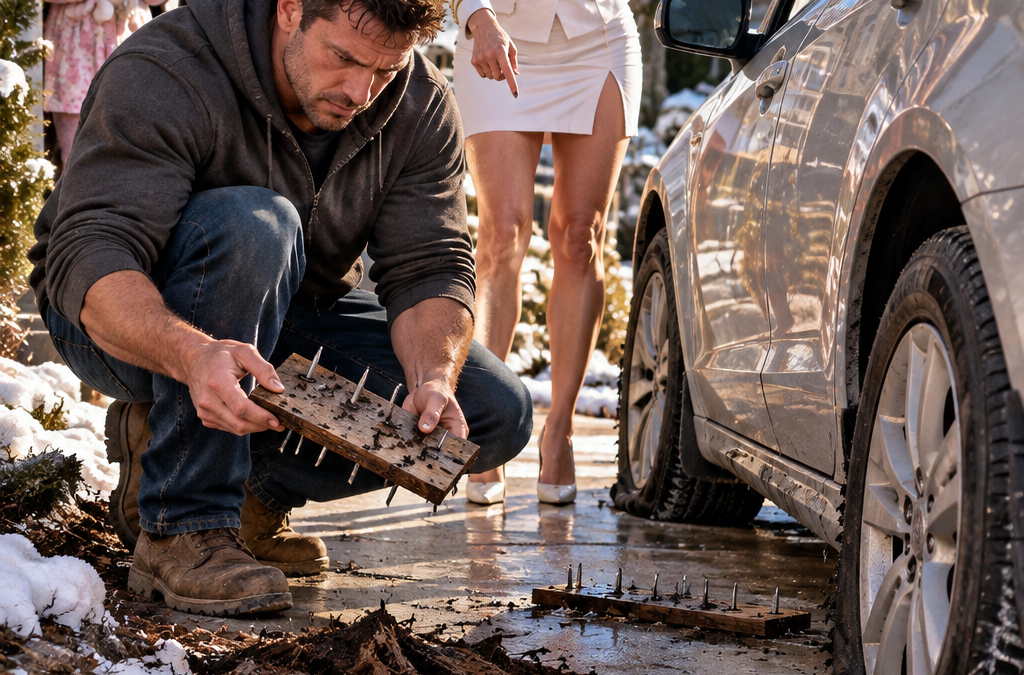
I knelt near the edge of the driveway and saw something dark beneath the fresh mulch.
At first I thought it was landscaping debris.
Then I pulled it out.
A narrow strip of plywood.
Three galvanized nails had been hammered through it in a perfectly straight line, their sharp points facing upward.
Another strip lay farther back.
Then another.
Someone had buried them beneath the mulch exactly where my tires would roll when I backed out.
I stared at the boards in my hands.
My pulse began pounding.
This had not been random vandalism.
Someone had planned it.
Measured it.
Placed it.
Waited.
My wife, Priya, opened the front door behind me.
“Wesley?”
I didn’t answer.
She stepped onto the porch wearing pajamas and wrapped her arms around herself.
“What happened?”
I lifted the nail board.
Her face changed.
“Oh my God.”
I looked toward the quiet houses surrounding us.
Curtains closed.
Driveways empty.
Perfect suburban silence.
Then I looked down the street toward Karen Ashcroft’s house.
Three months earlier, I would have felt ridiculous even thinking her name.
Now I didn’t.
My name is Wesley Cole.
And I knew before the police arrived that the nail board in my driveway was not the beginning of my problem with Karen Ashcroft.
It was an escalation.
The ugliest one yet.
I had moved into Brook Haven Estates three months earlier because I wanted the opposite of conflict.
I wanted quiet.
I wanted somewhere permanent.
My job had been stable for years, Priya and I were finally in a position to buy rather than rent, and after bouncing between apartments and townhouses, I wanted one address that actually felt like ours.
Brook Haven looked perfect.
Thirty-eight minutes from downtown.
Good schools nearby.
A grocery store ten minutes away.
Tree-lined streets.
Thirty-two houses arranged around a manicured entrance with a decorative stone sign and a fountain residents were apparently not allowed to touch.
The houses weren’t mansions.
They were comfortable suburban homes with neat yards, clean sidewalks, and just enough sameness to make the place feel orderly.
I bought our house because of the quiet.
But if I’m being honest, I also bought it because I wanted the feeling of belonging somewhere.
That turned out to be the most expensive illusion Brook Haven sold.
The first person who warned me was Autumn Reyes.
She lived next door.
Autumn was in her late forties, divorced, sharp-eyed, funny when she trusted you, and perpetually irritated by the HOA.
She came over the afternoon we moved in carrying two bottles of water.
I was dragging a bookcase through the garage.
“New people always think they can finish unloading before dark,” she said.
I laughed.
“You volunteering?”
“Absolutely not.”
She handed me the water.
Then her expression changed.
“You’ve met Karen yet?”
“HOA president?”
Autumn nodded.
“Orientation meeting tomorrow.”
“Anything I should know?”
She looked toward the street before answering.
“Don’t cross her.”
I thought she was joking.
“That’s dramatic.”
“She keeps files on everyone.”
“Files?”
“Photos. Violations. Complaints. Who said what at meetings.”
I opened the bottle.
“Why?”
“Because information is how she controls people.”
I laughed softly.
Autumn didn’t.
“You’ll see.”
The following evening, Priya and I attended orientation at the clubhouse.
That was the first time I properly met Karen Ashcroft.
She was forty years old and undeniably attractive, but there was something calculated about the way she presented herself.
Long blonde hair.
Perfect makeup.
Bright lipstick.
A full, curvy figure she emphasized with confidence.
And the red lace dress.
I would see that dress so many times over the next few months that it became almost like a uniform.
Low-cut.
Tight.
Revealing.
Always red.
Karen knew people looked at her.
She liked it.
She had a flirtatious ease around men she wanted on her side, leaning close, touching an arm, smiling as though she were letting them into some private joke.
But when someone challenged her, the warmth vanished instantly.
That first night, though, she was charming.
“Welcome to Brook Haven,” she said.
She shook my hand.
Then Priya’s.
“We take tremendous pride in preserving the character of this community.”
Priya smiled politely.
“It’s beautiful.”
Karen’s eyes moved toward me.
“Residents who cooperate with the board usually find life here very easy.”
Usually.
That word stayed with me.
I didn’t understand why until later.
Karen had been president for eleven years.
Nobody had successfully challenged her since 2015.
Gary, her husband, also sat on the board.
Gary was the exact opposite of Karen.
Quiet.
Reserved.
Always holding coffee.
He barely looked up during meetings.
Neighbors joked that he hadn’t expressed an independent opinion since the Obama administration.
At first, I assumed that was simply their marriage dynamic.
Later, I realized Gary’s silence was part of the system that kept Karen in control.
My first violation arrived six days after orientation.
Trash can left visible one hour beyond approved collection window.
Fifty-dollar fine.
I stared at the notice taped to my door.
Then at the trash can already sitting inside the garage.
Priya read it.
“Pay it.”
“Fifty dollars?”
“You don’t want to start fighting the HOA our first week.”
She was right.
At least, I thought she was.
I paid.
Karen interpreted that as permission.
The next notice concerned grass height.
Then another.
Same grass.
One hundred dollars.
Then two hundred fifty.
The numbers grew faster than the lawn.
I asked Karen at the next meeting how the same offense had jumped five times in less than three weeks.
She smiled.
“Repeat violations escalate.”
“I mowed the lawn.”
“Not to standard.”
“What standard?”
“Three inches.”
“I measured it.”
“So did we.”
“How tall was it?”
“Over three.”
“How much over?”
She glanced at the paperwork.
“Approximately an eighth of an inch.”
I thought I had misheard.
“An eighth?”
“Yes.”
“Karen, grass grows.”
“So do fines.”
A couple of people looked down to hide smiles.
Karen didn’t.
I paid the first fine because I wanted peace.
I disputed the rest.
That’s when the notices started multiplying.
A porch light bulb allegedly had the wrong color temperature.
A welcome mat didn’t match the approved neutral palette.
My garden hose remained visible for forty minutes.
The mailbox was next.
That was the incident that changed my approach.
The old mailbox had been rusting when we moved in.
I ordered a replacement directly from the model linked on the HOA website.
Exact manufacturer.
Exact style.
Exact dimensions.
I installed it on a Saturday.
Monday morning, I received a three-hundred-dollar violation.
NONCOMPLIANT MAILBOX FINISH.
I called the office.
Karen answered.
“What’s wrong with my mailbox?”
“The finish.”
“I bought the approved model.”
“Approved model doesn’t automatically mean approved finish.”
“It came from the link on your website.”
“The shade is off-white.”
“The description says eggshell.”
“It’s not eggshell.”
I walked outside while holding the phone.
The mailbox was white.
Or eggshell.
Or off-white.
Whatever microscopic difference Karen saw was invisible to me.
“Can I appeal?”
“You can submit one.”
“I am submitting one.”
“Fine.”
Eleven minutes later, the denial reached my inbox.
Eleven minutes.
The board meeting had not occurred.
No review panel had met.
Nobody had inspected anything.
Karen had simply denied it.
I stared at the timestamp.
That was when I filed my first request for HOA financial records.
At the time, I didn’t even know what I was looking for.
I wanted to know where all these fines went.
Karen acted like every twenty-five dollars was essential to preserving civilization.
Fine.
Then show me the numbers.
Doug, the treasurer, contacted me.
Doug was a nervous man in his fifties who always looked like he wanted to apologize before he spoke.
“We’re gathering the documents.”
“How long does that take?”
“Board review.”
“Why does the board need to review financial statements before an owner sees them?”
He hesitated.
“That’s the process.”
Three weeks later, he handed me incomplete records.
Missing months.
Vague categories.
No supporting invoices.
Autumn saw me carrying the folder to my car.
“You actually asked for them?”
“Why wouldn’t I?”
She laughed bitterly.
“Because nobody does.”
“Why?”
“Most people pay.”
Then she added, “Or leave.”
I looked at her.
“What does that mean?”
“Karen likes people who leave quietly.”
“I wasn’t planning to leave.”
Autumn studied me.
Then smiled faintly.
“Good.”
Two nights later, someone spray-painted an X across my new mailbox post.
Black paint.
Fresh.
Thick.
Ugly.
Priya stood beside me in the driveway.
“You think Karen did this?”
“I don’t know.”
“Don’t accuse her.”
“I didn’t.”
I called the police.
An officer photographed the damage.
No witnesses.
No clear evidence.
Simple vandalism.
Likely unsolved.
But the house across the street belonged to Mr. Feldman, an older man who almost never attended HOA meetings and had a security camera pointed toward the street.
I knocked.
He opened the door, listened to my question, disappeared for five minutes, then returned with a flash drive.
“About time somebody did something about her,” he muttered.
I plugged the drive into my laptop.
The footage was grainy.
A person wearing a gray HOA polo appeared near my mailbox while walking a dog.
The figure paused.
Bent slightly.
Moved on.
The face was too blurry to identify.
But the shirt logo was obvious.
Only six people had those shirts.
The board members.
And Karen’s personal assistant, Bethany.
I created a folder that night.
BROOK HAVEN TIMELINE.
Date.
Time.
Incident.
Supporting evidence.
Every letter.
Every photograph.
Every email.
Every strange coincidence.
Autumn began helping.
One evening she came over while Priya made coffee.
“She’s making money off this.”
I looked at her.
“What?”
“Fine money.”
“That’s HOA income.”
“Then why doesn’t the reserve balance make sense?”
I leaned forward.
“What do you know?”
Autumn shook her head.
“Nothing I can prove.”
“Tell me anyway.”
“Years ago I asked why dues went up without a vote.”
“What happened?”
“She called me divisive in the newsletter.”
I remembered seeing that newsletter archived online.
Autumn continued.
“Then the fines started.”
My stomach tightened.
“Have you ever seen full financial statements?”
“No.”
That sentence lit a fuse in me.
I filed another formal records request, this time citing Brook Haven’s status as a nonprofit corporation and the rights granted to members under applicable Georgia law and the association’s own documents.
Doug stalled again.
Board review.
Processing.
Administrative delay.
I sent a certified demand letter.
Ten business days.
Produce the records or explain the lawful basis for withholding them.
Karen answered personally.
Her letter began:
We hope you’re settling comfortably into Brook Haven, Wesley. New residents occasionally misunderstand how cooperative communities function.
Priya read it twice.
Then looked at me.
“Okay.”
“What?”
“I take back what I said.”
“About?”
“Paranoia.”
I smiled.
“So now I’m sane?”
“No. But she’s weird.”
Three days later, we received another violation.
Excessive holiday decorations.
I had one strand of white lights.
Across the street, the Petersons had reindeer, illuminated candy canes, two inflatable snowmen, and enough lights to guide aircraft.
No fine.
I began cataloging selective enforcement.
Who questioned Karen?
Who got fined afterward?
The pattern appeared almost immediately.
Autumn questioned a dues increase.
Fine within ten days.
A homeowner asked about vendor contracts.
Landscape violation.
Another challenged Karen’s parking interpretation.
Mailbox violation.
It was too consistent.
I asked Autumn whether she would testify if this ever went to court.
Her smile disappeared.
She hesitated.
Then nodded.
“I’ve got nothing left to lose.”
That night, someone left dog waste directly on our front doormat.
Centered perfectly in the camera’s blind spot.
Priya stared at it.
“This is disgusting.”
I grabbed gloves.
She watched me clean it.
“You’re not angry?”
“I’m furious.”
“You don’t look furious.”
“I am.”
I tied the trash bag.
“But anger is what Karen expects.”
“What are you going to do?”
I looked toward the growing folder on my desk.
“Paperwork.”
Priya almost laughed.
“Your revenge is paperwork?”
“Paperwork, patience, and time.”
That became my strategy.
I didn’t know someone had already begun preparing the nail board.
The financial records finally arrived.
Three weeks late.
They were a mess.
Administrative Services — $4,200.
Community Coordination — $3,800.
Maintenance Consultation — $5,100.
No vendor detail.
No invoices.
No clear explanations.
Fine revenue for one quarter appeared to total roughly eighteen thousand dollars.
Only about six thousand showed up as deposited association income.
That discrepancy was too large to ignore.
Priya called an old colleague.
Her name was Renata.
She had worked in forensic accounting.
Renata had the emotional warmth of a tax audit and exactly the personality we needed.
She spread the records across our kitchen table.
“Who prepared these?”
“Doug.”
“He should be embarrassed.”
I smiled.
“That’s your professional opinion?”
“My professional opinion would be less polite.”
Over the next several days, Renata traced payments.
One repeated administrative vendor led to an LLC.
The LLC’s registration address made my stomach drop.
Karen Ashcroft’s house.
I stared at Renata’s screen.
“That’s her address.”
“Yes.”
“So she’s paying herself?”
“Not necessarily directly. But funds are being routed through an entity registered to the board president’s residence.”
She pointed toward the statements.
“That needs an explanation.”
I sat back.
The room felt colder.
Until then, I had still allowed myself to believe Karen was simply power hungry.
Petty.
Vindictive.
Obsessed with control.
Financial misconduct was different.
“This could be embezzlement.”
Renata looked at me.
“It could be several things.”
“Do we confront her?”
“No.”
The answer came so fast that I blinked.
“Why?”
“Because if the records are incomplete now, imagine what happens when she knows you’re tracing money.”
Priya nodded.
“We need proof she can’t erase.”
So I stayed quiet.
We collected LLC filings.
Routing information.
Deposit dates.
Payments.
Meeting records.
Then Autumn brought me an old Brook Haven newsletter from 2019.
The treasurer listed wasn’t Doug.
It was Carl Voss.
Carl had resigned suddenly.
Officially for personal reasons.
Nobody knew more.
I tracked him down through an old community contact.
He agreed to meet at a diner two towns away.
Carl arrived early.
He sat facing the door.
Every time someone walked in, his eyes flicked upward.
“She threatened to sue me.”
No greeting.
No small talk.
Just that.
“Karen?”
He nodded.
“For defamation.”
“What did you say?”
“That money was disappearing.”
He wrapped both hands around his coffee.
“Same shell-company structure you’re looking at now.”
“How long ago?”
“Years.”
I stared at him.
“You had proof?”
“Enough to ask questions.”
“What happened?”
“She turned the board against me.”
He looked embarrassed.
“Then she said she’d ruin me financially if I kept talking.”
“So you left?”
“I resigned.”
His jaw tightened.
“And I shut up.”
“Will you give a sworn statement?”
He looked at me.
Fear was still there after all those years.
Then something else.
Shame.
Finally he nodded.
“Yes.”
Driving home, I felt different.
Priya noticed the moment I walked through the door.
“You found something.”
“Carl confirms the same pattern.”
She lowered the book she was reading.
“How far back?”
“Years.”
She stared at me.
“You’re not just annoyed anymore.”
“No.”
“What are you?”
I thought about Dolores-like elderly residents Karen had pushed around.
Autumn.
Carl.
The missing money.
“I’m building a case.”
Priya was quiet.
“I can see that.”
“And I’m not stopping.”
The following morning, a new notice arrived.
Five hundred dollars for unauthorized landscaping equipment stored in view.
My lawn mower.
The same lawn mower I’d owned since moving in.
The same type of mower sitting beside garages throughout Brook Haven.
I didn’t appeal.
I photographed it.
Logged it.
Saved the notice.
Incident number sixty-one.
Autumn suggested we begin recording board meetings openly.
We checked the applicable rules and our rights.
At the next meeting, I placed my phone on the table.
Recording indicator visible.
Karen stopped mid-sentence.
Her smile returned quickly.
“Recording devices aren’t typically welcomed here.”
I leaned back.
“Open meetings may be recorded.”
Her hand tightened around the podium.
“I prefer residents ask permission.”
“I’m not asking.”
The room became silent.
Gary looked up from his coffee.
Karen’s eyes narrowed.
Then she smiled.
“Very well.”
Halfway through the meeting, someone asked why administrative costs had increased.
Karen answered without hesitation.
“Board compensation has become necessary given the volume of work certain officers perform.”
My heart jumped.
Brook Haven’s bylaws expressly prohibited board compensation.
I didn’t react.
I simply said, “Thank you for clarifying.”
Karen gave me a suspicious look.
Renata listened to the recording that evening.
She paused it after Karen’s statement.
“That matters.”
“Because compensation is prohibited?”
“Yes.”
She pressed play again.
“And because she admitted it publicly.”
Autumn called after the meeting.
“You made her nervous.”
“Good.”
“I’ve never seen that before.”
“Nervous people make mistakes.”
Autumn laughed.
“You’re starting to sound like Renata.”
That night, my dashboard camera detected motion outside.
2:14 a.m.
I reviewed the footage.
A shadow near the mulch bed by the mailbox.
Nothing clear.
No face.
No obvious activity.
I should have walked outside and checked.
I didn’t.
That mistake cost me four tires.
Instead, I focused on filing a complaint with Georgia’s nonprofit oversight authorities concerning the shell LLC and association finances.
The process felt painfully slow.
Forms.
Supporting records.
Follow-ups.
Waiting.
Meanwhile, Karen continued fining us.
Garden hose.
Welcome mat.
Lawn edge.
Recycling placement.
I stopped paying disputed charges and challenged each in writing.
Autumn’s fines increased too.
“She knows we’re talking.”
“Maybe.”
“Bethany’s watching us.”
Bethany drove a lime-green hatchback.
Once Autumn pointed it out, I began seeing it everywhere.
Near the clubhouse.
Near my house.
Parked two streets over when I visited Carl.
Maybe coincidence.
Maybe not.
I started changing routines.
We met Renata outside Brook Haven.
Autumn stopped coming directly to my house as often.
It felt paranoid.
But by then, caution seemed less ridiculous than trust.
Renata’s forensic report eventually reached eighteen pages.
Her estimate stunned me.
Approximately two hundred ten thousand dollars in diverted or suspicious funds over five years.
I reread the number.
$210,000.
Not $210.
Not $2,100.
Two hundred ten thousand dollars.
Money collected from residents who had been told every dues increase and every fine protected their community.
I forwarded the report, Carl’s sworn statement, and supporting records to the attorney general’s consumer-protection division.
An investigator called within a week.
His name was Marcus Webb.
The coincidence made me laugh the first time he introduced himself.
He did not laugh much.
“This is unusually organized.”
“Good or bad?”
“Good.”
He paused.
“Keep documenting.”
“Should I confront her?”
“No.”
Again.
Everybody gave me the same advice.
“Why?”
“Because we don’t want her changing behavior before we understand the full financial trail.”
So I kept quiet.
Then Karen changed the timeline herself.
At 6:47 that morning, I found four flat tires.
The nail boards.
The fresh mulch.
The trap.
Officer Delgado arrived within fifteen minutes.
He was younger than I expected, calm, observant.
He photographed each board.
Bagged them.
Measured placement.
Then asked, “Anyone around here have a reason to target you?”
I laughed once.
No humor in it.
“How much time do you have?”
I told him about Karen.
The HOA dispute.
The financial complaint.
The selective enforcement.
He raised an eyebrow at her name.
“Karen Ashcroft?”
“Yes.”
“We’ve had complaints involving her before.”
That surprised me.
“What kind?”
“Noise disputes. Neighbor conflicts.”
He closed his notebook.
“Nothing that went anywhere.”
“Why?”
He looked toward the houses.
“She’s careful.”
Careful.
Maybe.
But not perfect.
One plywood strip had a faint store logo on the back.
Beneath the mulch, Officer Delgado found part of a receipt.
Wet.
Dirty.
Still legible.
Purchased three days earlier.
Cash.
Plywood.
Galvanized nails.
Same store.
Same items.
Cash eliminated a card trail.
But not cameras.
Delgado requested surveillance footage.
Mr. Feldman’s camera caught something too.
A lime-green hatchback parked near my house around two in the morning.
Bethany’s car.
Priya watched the footage beside me.
Her face went white.
“We’re leaving.”
I turned.
“What?”
“Today.”
“Priya—”
“No.”
Her voice broke.
“This isn’t fines anymore.”
“I know.”
“Someone put nails under our car.”
“I know.”
“What if you’d been driving fast?”
“I wasn’t.”
“What if next time it’s something else?”
I didn’t answer.
Her eyes filled.
“I don’t care about winning.”
That hurt.
Because neither did I anymore.
Not in the way I had before.
I wanted safety.
But I also knew what leaving would mean.
Karen would learn that sabotage worked.
“I’ll understand if you want to stay somewhere else for a while.”
Priya stared at me.
“What about you?”
“I’m staying.”
“Why?”
“Because if we leave now, someone else gets the nail board next.”
Her face crumpled.
For a second, I thought she might slap me.
Instead she turned away.
“You’re impossible.”
“Probably.”
“You think being stubborn makes you brave.”
“No.”
I stood behind her.
“I think I’m terrified.”
She slowly turned back.
“So am I.”
I pulled her into my arms.
Autumn arrived within the hour.
She was pale.
“This is criminal.”
“Yes.”
“This isn’t an HOA fight anymore.”
“No.”
I called Investigator Webb.
He listened without interruption.
Then said, “This changes the timeline.”
“How?”
“We accelerate.”
Four days later, the store footage arrived.
A woman wearing a wide-brimmed hat purchased plywood and galvanized nails.
Face partially obscured.
Body type consistent with Karen.
Not enough for identification beyond doubt.
But the timing matched.
Officer Delgado documented everything.
The transaction had been paid in twenty-dollar bills.
That detail was strange because Doug’s records showed many cash fine payments had also been stored and deposited in twenty-dollar denominations.
Not proof.
Another coincidence.
But coincidences were beginning to stack high.
I replaced all four tires.
$687.42.
I saved the receipt.
That number would later appear in court records.
Autumn wanted to go public immediately.
“Post the nail boards.”
“We’ll tip her off.”
“She already knows she did it.”
“We don’t know that.”
Autumn stared at me.
“You still need certainty?”
“I need evidence.”
We compromised.
She posted a warning about vandalism concerns without naming Karen.
The comments exploded.
One homeowner had found her vehicle keyed after questioning a fine.
Another described strange damage to landscaping.
Another reported violations appearing immediately after disputes with Karen.
Then Karen responded publicly.
She called the stories baseless rumors.
She named Autumn.
And me.
Investigator Webb called that evening.
“She publicly acknowledged awareness of specific complainants.”
“Is that important?”
“For motive and retaliation, yes.”
I saved everything.
Screenshots.
Timestamps.
Backups.
For the first time in months, I slept well.
That was a mistake.
Three days later, a certified letter arrived.
Karen’s attorney, Trevor Bosch, threatened a defamation lawsuit unless I issued a public retraction within seventy-two hours.
Renata read the letter and laughed.
“What’s funny?”
“She wants to scare you.”
“It’s working.”
“Truth matters.”
She put the letter down.
“This looks like an intimidation move. Let counsel handle it.”
Autumn received an identical letter.
Word for word.
We retained a local attorney, Priscilla Kemdarim.
Priscilla was young, sharp, impatient with bullies, and frighteningly organized.
She reviewed my entire file.
The fines.
Recordings.
Renata’s report.
Nail board.
Store receipt.
Bethany’s car.
Defamation threat.
When she finished, she closed the binder.
“This isn’t a defense case anymore.”
“What does that mean?”
“We countersue.”
“For what?”
“Harassment. Intimidation. Selective enforcement. Financial misconduct. Property damage as the evidence allows.”
I leaned back.
“You’re serious.”
“Completely.”
We filed within the week.
Trevor withdrew the defamation threat almost immediately.
That told us something.
Behind the scenes, Karen’s support was breaking.
Doug stopped attending meetings.
Rumor was he had hired his own attorney.
Separate counsel meant separate interests.
Then Doug contacted Investigator Webb.
He wanted to cooperate.
His statement confirmed much of Renata’s report.
Shell LLC.
Diverted funds.
False categories.
And one sentence changed the sabotage investigation.
Karen had instructed Bethany to “handle the Cole situation.”
Doug had preserved the email.
He told investigators he saved it “just in case.”
Apparently I wasn’t the only person building a folder.
Subpoenas followed.
Karen and Bethany’s emails painted a much darker picture.
Karen had written about making examples of residents who asked too many questions.
Bethany had documented my jogging schedule.
Work hours.
Typical departure times.
The mornings I usually drove somewhere before work.
When Investigator Webb summarized the emails over the phone, my stomach turned.
This wasn’t random anger.
It was surveillance.
Planning.
Patience.
“The plywood purchase fits the timeline,” he said.
“Can you charge them?”
“We’re building toward formal charges.”
Those words were the first time I allowed myself to believe this might end.
Autumn cried when I told her.
“We’re actually going to win.”
“Don’t say that yet.”
“Why?”
“Because I haven’t seen handcuffs.”
Priya hugged me that night.
For weeks, every conversation between us had included the possibility of leaving.
This one didn’t.
“You were right,” she whispered.
“About?”
“Someone had to stop her.”
I held her.
“We haven’t stopped her yet.”
“We will.”
Karen sensed the trap tightening.
That made her more dangerous.
She called an emergency board meeting and proposed new bylaws restricting disruptive homeowner behavior.
The language specifically targeted recording devices and repeated records requests.
It was almost embarrassingly obvious.
I attended.
Phone recording.
Karen stood at the podium in the red lace dress.
Her hands shook slightly as she read.
Gary sat beside her.
For years, he had been silent.
Then something extraordinary happened.
He put down his coffee.
“Karen.”
She stopped.
Everyone looked at him.
He spoke so quietly I almost missed it.
“Maybe we should stop.”
The room went completely silent.
Karen turned toward her husband.
For one second, her face showed something raw.
Fear.
Then rage.
“We are not stopping anything.”
Gary looked down.
Bethany shifted uncomfortably near the wall.
The outburst went into the recording.
The proposed bylaw failed.
Four votes to one.
Karen was the only yes.
Even her loyalists had abandoned her.
Three days later, Investigator Webb called.
Formal charges were being filed.
Financial fraud.
Breach of fiduciary duties connected to the funds.
Criminal mischief tied to the sabotage investigation.
Bethany faced accessory-related charges for her role in purchasing the plywood and nails under Karen’s instructions.
Karen was arrested on a Tuesday morning.
No television cameras.
No dramatic raid.
Two officers walked to her front door.
Autumn texted me.
It’s happening.
I stepped onto my porch.
Karen came out in handcuffs.
For once, she wasn’t wearing the red lace dress.
Gray sweater.
Black pants.
No makeup I could see from where I stood.
She walked past the mailbox she had once fined me over.
Her jaw was tight.
She never looked at me.
Neighbors gathered slowly on lawns.
Nobody cheered.
Priya came outside and stood beside me.
Gary remained in the doorway.
He didn’t stop the officers.
Didn’t defend his wife.
He simply watched.
Then he exhaled.
It looked like a breath he had been holding for years.
The board held an emergency session that week.
Karen was removed permanently from the presidency.
Autumn was nominated as interim president.
The motion passed with something close to a standing ovation.
Someone nominated me for treasurer.
I immediately refused.
“No.”
People laughed.
I raised both hands.
“I’ve seen enough HOA spreadsheets for one lifetime.”
Autumn smiled.
“Coward.”
“Absolutely.”
The state investigation expanded.
Authorities found connections to victims from other communities Karen had previously managed.
Carl finally spoke publicly.
A reporter asked why he’d remained silent.
He looked directly into the camera.
“I should’ve spoken sooner.”
Then he added, “I’m glad somebody finally did.”
Local news ran a segment about the Brook Haven sabotage and financial investigation.
Reporters called me.
I gave one short statement.
“I moved here because I wanted peace. That’s all.”
Priscilla continued our civil case.
Renata’s eighteen-page report became evidence.
Every transaction she’d traced.
Every discrepancy.
Every shell-company payment.
The criminal case moved quickly because investigators had financial evidence, internal emails, Doug’s cooperation, Carl’s testimony, and the sabotage trail.
Karen’s attorney offered restitution in exchange for reduced charges and no incarceration.
Prosecutors rejected the initial proposal.
Investigator Webb told me afterward, “She had months to stop.”
He paused.
“She escalated instead.”
The trial was scheduled for early autumn.
Almost exactly one year after Autumn first warned me about Karen.
There was something almost poetic about that.
Meanwhile, Brook Haven began changing.
Autumn instituted independent appeals.
No fine could be issued without photographic evidence.
No board president could unilaterally deny an appeal in eleven minutes.
Financial records were posted for residents.
Improperly collected fines were reviewed.
Mine were refunded.
The money mattered.
But not as much as I expected.
What mattered was hearing the fountain running again.
What mattered was neighbors stopping to talk instead of rushing indoors whenever Karen’s SUV appeared.
What mattered was Priya no longer checking the security cameras every ten minutes.
Doug resigned from the board.
His cooperation kept him from prosecution, but he carried obvious shame.
I saw him once near the clubhouse.
He couldn’t look at me.
“Wesley.”
“Doug.”
He stared at the pavement.
“I should’ve stopped her.”
“Yes.”
The answer came out harsher than I intended.
He nodded.
“I know.”
I softened slightly.
“Why didn’t you?”
“Fear.”
He laughed without humor.
“Same reason everybody else didn’t.”
I thought of Carl.
Gary.
Autumn.
Even me paying that first fine.
Doug continued.
“I kept thinking if I just signed what she wanted, she’d leave me alone.”
“That worked?”
“No.”
He finally looked at me.
“It never works.”
Bethany eventually pleaded guilty to criminal mischief.
She received probation and restitution obligations that included the $687.42 cost of my tires.
When Priscilla told me, I stared at the number.
Six hundred eighty-seven dollars and forty-two cents.
The exact amount from the receipt I’d almost thrown away after replacing the tires.
Documentation.
Again.
Karen refused plea deals longer than anyone expected.
She insisted on trial.
Maybe she believed she could still control the room.
Maybe eleven years of winning neighborhood arguments had convinced her she could outtalk a prosecutor.
She couldn’t.
The trial began in early autumn.
Priya sat beside me.
Autumn sat on my other side.
Carl testified.
Doug testified.
Renata explained the financial trail.
Officer Delgado described the nail boards and the store receipt.
Store surveillance footage was shown.
Then the emails.
Karen directing Bethany.
Bethany discussing schedules.
The words appeared on a courtroom screen.
I had read summaries before.
Seeing them enlarged for a jury made them feel different.
Cold.
Deliberate.
One email referred to me as “the Cole problem.”
Another said, “He needs to understand there are consequences for attacking leadership.”
I felt Priya’s hand tighten around mine.
The defense argued that “handle” referred to ordinary compliance enforcement.
Then prosecutors presented Bethany’s purchase records and the surveillance timeline.
The interpretation became harder to sell.
Karen testified.
That surprised everyone.
She walked to the stand wearing a conservative navy suit.
No red lace.
No seductive smile.
She described herself as a dedicated volunteer targeted by disgruntled residents.
She blamed Doug for the accounting.
Bethany for misunderstandings.
Carl for resentment.
Me for escalating conflict.
Autumn for organizing neighbors.
At one point, the prosecutor asked:
“Mrs. Ashcroft, is everyone else responsible?”
Karen hesitated.
“I didn’t say that.”
“You’ve blamed the treasurer.”
“He handled finances.”
“Your assistant.”
“She made independent decisions.”
“Your former treasurer.”
“He was hostile.”
“Mr. Cole.”
“He targeted me.”
“Mrs. Reyes.”
“She spread rumors.”
The prosecutor paused.
“And yet you were president throughout all of it.”
Karen’s face tightened.
“Yes.”
The jury watched.
The trial lasted days.
The deliberation lasted less than four hours.
We were called back into the courtroom.
My heart hammered.
Priya leaned close.
“Whatever happens, it’s over after this.”
I nodded.
But I couldn’t breathe normally.
The foreperson stood.
Guilty.
Financial fraud.
Guilty.
Breach-related criminal conduct proven in the charged scheme.
Guilty.
Criminal mischief.
Every count that went to verdict came back against her.
Karen’s face went pale.
She stared forward.
No tears.
No shouting.
Nothing.
Autumn squeezed my hand.
I realized mine was shaking.
The sentencing came later.
Eighteen months in county detention.
Five years probation.
Restitution.
And a permanent prohibition preventing Karen Ashcroft from serving on any homeowners association board anywhere in Georgia.
When the judge announced that last condition, someone behind me exhaled loudly.
Karen looked toward the gallery.
For a moment, our eyes met.
I expected hatred.
There was some.
But mostly, she looked exhausted.
Small.
Not physically.
The woman was still attractive.
Still carefully dressed.
Still composed enough to hold her posture.
But the mythology around her was gone.
No clipboard.
No board members.
No terrified residents.
No red-ink violation stamps.
Just Karen Ashcroft.
One person.
Accountable like everyone else.
When officers led her away, I felt something loosen in my chest.
I hadn’t known I’d been carrying it.
The nail board.
The camera alerts.
The threats.
The uncertainty.
The fear that Priya might be right and we should run before somebody got seriously hurt.
It finally released.
Autumn leaned toward me.
“You okay?”
I nodded.
Then shook my head.
“I don’t know.”
She smiled.
“That’s probably normal.”
Outside the courthouse, Priya wrapped both arms around me.
“You’re safe.”
I hadn’t realized how much I needed someone to say that.
Brook Haven changed rapidly afterward.
The board rewrote its enforcement procedures.
Residents could appeal without going through the person who issued the fine.
Financial reviews became routine.
Contracts required documented bids.
No single officer could control records access.
Autumn became a surprisingly good interim president.
Her first meeting lasted three hours because she allowed everyone to speak.
At the end, she looked exhausted.
I stood near the door laughing.
“Still happy you volunteered?”
She pointed at me.
“You could have been treasurer.”
“Not a chance.”
“Coward.”
“Proudly.”
Priya laughed.
It was the first HOA meeting we’d attended where she laughed for a good reason.
The fountain began running consistently again.
Not because it symbolized anything important.
Just because someone finally paid for maintenance instead of hiding money in vague administrative accounts.
The hedges were trimmed.
The landscaping contract went through a real bidding process.
Residents started using the common areas more.
People who had spent years avoiding one another began stopping to talk.
Mr. Feldman even attended a barbecue.
He stayed twenty minutes and complained the entire time.
For him, that was practically social transformation.
I kept the damaged plywood.
Not the whole thing.
Officer Delgado returned one strip after the case concluded and evidence release became possible.
Priya hated it.
“Why do you want that in the garage?”
“Reminder.”
“Of what?”
I looked at the nails.
“How far this got.”
She crossed her arms.
“You have sixty-seven folders reminding you how far it got.”
“Sixty-eight.”
“That isn’t better.”
I smiled.
Eventually, I put the board in a sealed box.
Not because I wanted revenge.
Because I never wanted to forget the morning I realized fear had stopped working on me.
That might sound strange.
The nail board scared me more than any fine or lawsuit threat.
But it also changed the fight.
Before that morning, some part of me still wondered whether I was overreacting.
Maybe Karen was only strict.
Maybe the money had an explanation.
Maybe the weird incidents were coincidence.
Maybe if I backed off, life would return to normal.
Four flattened tires ended that fantasy.
Someone had brought physical sabotage onto my property.
There was no longer a comfortable middle ground.
We either finished the fight or left.
Priya had wanted to leave.
Sometimes I still wonder whether refusing was selfish.
I asked her once.
We were sitting on the porch nearly a year after Karen’s conviction.
“You ever resent me for staying?”
Priya looked surprised.
“Why?”
“Because after the tires you wanted out.”
She nodded slowly.
“I did.”
“And I said no.”
“You said you’d understand if I left temporarily.”
“That’s not the same thing.”
“No.”
She thought for a moment.
“I was angry.”
“I know.”
“I thought you cared more about beating Karen than protecting us.”
That hurt because there had been moments when I feared the same thing.
“And now?”
Priya looked toward the street.
Children were riding bicycles.
Autumn was arguing with a landscaping crew over mulch.
The fountain splashed near the entrance.
“Now I think you understood something I didn’t.”
“What?”
“That moving wouldn’t guarantee safety.”
I waited.
“She’d just learn it worked.”
Priya reached for my hand.
“But if you ever make me live through something like that again, I’m leaving you with Autumn and the HOA binders.”
I laughed.
“Fair.”
Autumn eventually stepped down after helping stabilize the board.
She refused to turn the presidency into a permanent position.
That mattered.
Brook Haven adopted term limits.
When Autumn announced she wasn’t running again, several residents protested.
She shrugged.
“That’s the point.”
The room quieted.
“No one should hold this chair long enough to believe it belongs to them.”
I looked at Priya.
She looked at me.
We both understood.
Carl visited once after everything settled.
He stood beside the fountain with me.
“I should’ve fought her earlier.”
“Maybe.”
He looked surprised.
I wasn’t going to lie to him.
“But you came forward when it mattered.”
He nodded.
“She would’ve kept doing it.”
“Yes.”
“I thought leaving made it someone else’s problem.”
I watched a family walking toward the playground.
“It did.”
He looked down.
I touched his shoulder.
“That doesn’t mean you caused what she did.”
He took a breath.
“I know.”
Then he smiled faintly.
“Took me a while.”
Doug never returned to HOA leadership.
Bethany moved away after completing the early portion of her probation.
Gary sold the house he had shared with Karen.
Nobody knew much about where he went.
I heard he filed for divorce during the criminal case.
I wasn’t surprised.
One of the strangest parts of the entire experience was realizing how many people around Karen had spent years adapting themselves to her anger.
Gary by staying silent.
Doug by signing things.
Bethany by obeying.
Residents by paying.
Me by trying to reason with her.
People often imagine authoritarian personalities control others because they are constantly powerful.
Sometimes it’s the opposite.
They control people because everyone around them keeps making small accommodations to avoid provoking them.
One accommodation becomes ten.
Then fifty.
Then suddenly a neighborhood president thinks she can order surveillance of a homeowner because he asked where money went.
That’s how far things can drift when nobody pushes back.
The $210,000 Renata identified became part of the broader recovery and civil process.
Not every dollar came back immediately.
Financial damage rarely cleans itself up neatly.
But enough assets and recoverable funds were traced to restore much of what Brook Haven had lost.
More importantly, residents finally knew where their money was going.
Every quarter, the new treasurer published a report.
Income.
Expenses.
Reserve balance.
Contracts.
No mysterious administrative-services line hiding four thousand dollars at a time.
I read the first report twice.
Then Priya caught me opening the second.
“You trust them?”
“I do.”
“Then why are you checking?”
I looked at her.
She smiled.
“Never mind.”
Some habits remain.
The first anniversary of the nail-board incident arrived quietly.
I woke before seven.
For a moment, I didn’t remember the date.
Then I walked outside and saw my Honda.
Same driveway.
Different tires.
No boards beneath the mulch.
I crouched anyway.
Priya opened the door behind me.
“What are you doing?”
“Checking.”
“For nail boards?”
“Maybe.”
She shook her head.
“Come inside, Wesley.”
“In a minute.”
I stood.
Across the street, Mr. Feldman’s camera still pointed toward the road.
Autumn’s porch light was on.
A delivery van turned the corner.
Nothing threatening.
Nothing unusual.
I went inside.
At breakfast, Priya asked whether I regretted buying the house.
I thought about it.
“Sometimes.”
She raised an eyebrow.
“That’s romantic.”
“I regret what happened.”
“Not the house?”
“No.”
“Why?”
I looked through the window toward the oak tree in the yard.
“Because now it actually feels like ours.”
That was the strange truth.
When I first moved into Brook Haven, I wanted the illusion of belonging.
Matching mailboxes.
Clean lawns.
A fountain.
Perfect hedges.
I thought belonging meant fitting into the picture.
Karen believed the same thing.
She just took it further.
To her, belonging meant obedience.
Same colors.
Same behavior.
Same silence.
If you questioned her, you became a problem to remove.
By the end, I understood belonging differently.
Belonging was Autumn walking across the lawn when she heard about my tires.
It was Mr. Feldman handing me camera footage without asking for credit.
It was Carl overcoming years of fear to sign a sworn statement.
It was Doug finally telling the truth even though it exposed his own cowardice.
It was Priya staying beside me even when she desperately wanted to run.
It was residents comparing stories instead of suffering alone.
That was community.
Not Karen’s newsletters.
Not fines.
Not enforcement stamps.
People.
Years later, I still occasionally receive messages from homeowners in other communities who heard about the case.
They ask what the secret was.
How did I beat her?
They expect some dramatic answer.
There wasn’t one.
I tell them to start with documents.
Get the real bylaws.
Not the version someone summarizes.
Save letters.
Save receipts.
Take photographs.
Know the appeal process.
Compare enforcement.
Ask where money goes.
If something becomes criminal or dangerous, call professionals.
Attorneys.
Accountants.
Law enforcement.
Don’t turn suspicion into accusation before you have evidence.
And don’t confuse silence with peace.
That last lesson cost me four tires and months of sleep.
Karen had peace in Brook Haven for eleven years.
At least, that’s what the newsletters called it.
What the neighborhood actually had was silence.
There is a difference.
Peace is when people are safe enough to disagree.
Silence is when they’re too frightened to speak.
Karen Ashcroft mistook one for the other.
That mistake ended her career.
I keep one photograph in my office.
Not Karen in handcuffs.
Not the courtroom.
Not the nail board.
It’s a picture of Brook Haven’s fountain taken on an ordinary summer evening.
Kids are playing nearby.
Autumn is standing in the background talking to a neighbor.
Priya is sitting on a bench.
You can barely see her.
Nothing dramatic is happening.
That’s why I like the photo.
For months, everything in my life had been dramatic.
Letters.
Threats.
Police.
Court filings.
Flat tires.
Financial reports.
Handcuffs.
The picture reminds me what we were fighting for.
Ordinary.
Quiet.
Safe.
The life I thought I was buying when I moved there.
I eventually replanted the mulch bed where the nail boards had been hidden.
Priya wanted flowers.
I wanted something low maintenance.
We compromised.
Small shrubs.
No HOA violation.
At least not anymore.
One afternoon, Autumn walked past while I was working.
She stopped.
“Looks crooked.”
I looked up.
“What?”
“That shrub.”
I narrowed my eyes.
“Careful.”
She smiled.
“HOA standards.”
I pointed the shovel at her.
“Get off my property.”
She laughed and kept walking.
I laughed too.
A year earlier, those words would have triggered something in me.
Now they were just a joke.
That’s when I knew the fight was truly over.
Karen served her sentence.
Her probation followed.
The injunction barring her from HOA leadership remained.
I never wrote to her.
Never visited.
Never tried to hear an apology.
I didn’t need one.
Some people imagine closure requires the person who hurt you to finally understand.
It doesn’t.
Karen could spend the rest of her life believing she was the victim.
That was no longer my problem.
My problem had been stopping her from turning that belief into power over everyone else.
We did.
The crooked oak tree still stands in my yard.
Storms have taken a few branches.
The trunk leans farther than it did when we moved in.
Every year, someone tells me I should remove it.
Every year, I refuse.
It reminds me of Brook Haven now.
Not perfect.
Not symmetrical.
Not exactly what somebody’s design committee would choose.
But alive.
Still standing.
And finally allowed to be itself.
Sometimes I think back to 6:47 a.m.
The first hiss from the tire.
The nails buried beneath fresh mulch.
Priya’s face when she saw the plywood.
That was the most frightened I had been during the entire fight.
It was also the moment Karen lost.
She didn’t know it.
Neither did I.
But she had crossed from intimidation into something we could no longer explain away.
She had pushed me to the point where surrender felt more dangerous than resistance.
Once that happened, fear stopped working the way she intended.
And without fear, Karen Ashcroft had very little left.
A red dress.
A clipboard.
A title.
A room full of invented authority.
None of it could survive evidence.
So when people ask what brought her down, I don’t say it was the attorney general.
Or the forensic report.
Or Doug’s cooperation.
Or Bethany’s emails.
Or Officer Delgado.
Or the jury.
All of those mattered.
But the real beginning was much smaller.
A homeowner receiving a ridiculous fine and deciding to save the letter instead of throwing it away.
Then another.
Then another.
Until one person’s private frustration became a documented pattern.
And a documented pattern became a case.
Karen spent eleven years believing nobody would ever take the time to connect the dots.
She was almost right.
Almost.
Now Brook Haven has its fountain back.
Its reserve fund is transparent.
Residents argue at meetings and nobody gets fined the next morning.
Autumn lives next door and still complains about everything.
Priya no longer asks whether we should move.
My Honda sits in the same driveway where someone once buried nail boards beneath the mulch.
And every morning when I back out, I still look down.
Just once.
Not because I’m afraid Karen is coming back.
Because some lessons stay with you.
The biggest one is simple.
A bully’s power isn’t measured by how loudly they threaten you.
It’s measured by how many people believe resistance is pointless.
The day we stopped believing that was the day Karen Ashcroft’s reign ended.
Everything after that was just evidence catching up.








