𝗙𝗨𝗟𝗟 𝗦𝗧𝗢𝗥𝗬 The HOA President Turned My Grandfather’s Private Ranch Road Into a Neighborhood Highway and Threatened Me When I Tried to Stop Him
𝗙𝗨𝗟𝗟 𝗦𝗧𝗢𝗥𝗬
The ranch meant more to me than a deed and a collection of fields.
My grandfather had worked that property until his hands were permanently rough and his back never quite straightened again.
When I was a boy, I spent summers following him around the pastures.
He taught me how to repair wire fencing, read the weather, operate machinery, and recognize when an animal was sick before the signs became obvious.
He also taught me that land didn’t take care of itself.
Every field required work.
Every fence required attention.
Every road had to be maintained.
The ranch was not a decorative landscape.
It was a working property.
When my grandfather died, the responsibility eventually became mine.
I inherited more than acreage.
I inherited his equipment, his handwritten maintenance notes, old surveys, and a filing cabinet filled with records going back decades.
Some people might have looked at those papers and seen clutter.
I saw the history of a man who had spent his life making certain the ranch remained intact.
That was why, on the eighth morning of watching strangers cross the property, I went into the small office beside the kitchen and opened his filing cabinet.
The drawers still smelled faintly of old paper and machine oil.
I found the original deed records.
Then the older property descriptions.
Then the survey maps he had kept folded inside a large brown envelope.
I carried everything to the kitchen table.
The ranch access road was clearly shown inside the property boundary.
It wasn’t labeled as a county road.
It wasn’t identified as public access.
And nothing in the recorded information I had showed an easement granting the neighboring HOA permission to use it as a community shortcut.
I checked the map twice.
Then I opened the title information from the most recent records.
Again, nothing supported the idea that the association controlled the road.
I leaned back and looked toward the window.
Another SUV passed the pasture.
I had spent most of my life on that ranch.
I knew the road belonged to the property.
But seeing it confirmed in my grandfather’s records made the situation feel different.
The drivers weren’t simply using an unfamiliar rural route.
They were crossing privately owned land that had never been offered to the neighborhood as a public street.
And somebody was allowing them to believe that was acceptable.
I decided to find out who.
The next morning, I walked toward the eastern entrance before the traffic began.
There was an old ranch gate near the connection between the gravel road and the edge of the neighboring development.
The gate had been used primarily when moving cattle or equipment.
For years, I hadn’t needed to close it regularly because there had been almost no outside traffic.
I stood beside it as the first vehicles appeared.
A silver sedan came through.
The driver slowed when he saw me, looked confused, and continued.
I didn’t try to stop him in the middle of the road.
I wasn’t interested in causing an accident.
A few minutes later, a black SUV approached.
I recognized it immediately.
Not because I’d seen it every morning, but because it belonged to the most recognizable man in the neighboring development.
Karen.
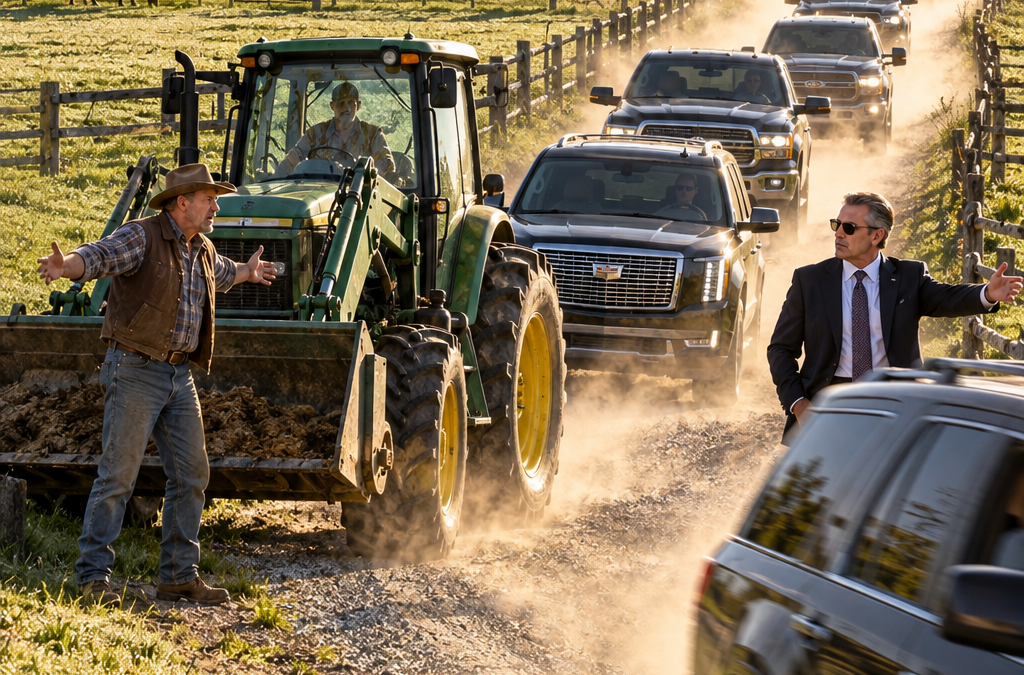
He was fifty years old, president of the homeowners association, and a man who treated authority like a personal possession.
Karen was always dressed as though he expected a photographer to appear.
Even at seven fifteen in the morning, he wore a tailored jacket over a spotless shirt. His dark hair was combed into a glossy, perfectly controlled style, and his expensive watch caught the morning light whenever he raised his hand.
He drove an immaculate black SUV.
Not a trace of mud ever seemed to remain on its tires.
For a man who lived beside working ranchland, he appeared almost offended by the existence of dirt.
I had met him a few times at local community events.
Our conversations had never lasted long.
Karen had a habit of speaking about his neighborhood as though he personally owned every driveway, tree, and blade of grass.
He called it my community.
He described the association’s decisions as my policies.
And when somebody questioned him, his smile became thin and unpleasant.
I had always kept my distance.
Now he was driving across my ranch without permission.
I stood safely beside the gate and raised my hand.
Karen slowed.
His window descended.
He looked at me with obvious irritation.
“Something wrong?”
“Morning, Karen.”
He glanced at his watch.
“I’m running late.”
“I just need to ask you something.”
His expression suggested that my question was an unreasonable inconvenience.
“What?”
“Why are you using this road?”
He looked past me toward the pasture.
“What do you mean?”
“This is my ranch access road. I’ve noticed vehicles coming through every morning.”
He shrugged.
“Everyone uses this road.”
I waited for him to continue.
He didn’t.
“That doesn’t make it public,” I said.
Karen gave a short laugh.
“You’re not seriously going to make an issue out of people driving to work.”
“I’m asking why they’re crossing private property.”
“It’s been an established route for a long time.”
“Established by whom?”
He adjusted his watch.
“The community.”
“Do you have a recorded right-of-way?”
His expression changed.
Only slightly.
But I noticed.
“Excuse me?”
“An easement. A documented access agreement. Something showing that residents have a legal right to use this road.”
Karen smiled.
It wasn’t friendly.
“People around here have been using that route for years.”
“That wasn’t my question.”
He leaned toward the window.
“Listen, I manage a large residential community. People need reliable access. You can’t suddenly interfere with their daily routines.”
I felt my patience tighten.
“I’m not suddenly interfering with anything. This road crosses land my family has owned for generations.”
“Then your grandfather clearly understood the importance of community cooperation.”
The remark hit harder than I expected.
Karen had never known my grandfather.
He had no right to speak for him.
I kept my voice level.
“My grandfather understood property boundaries.”
Karen sighed.
“Look, everyone uses this road. That’s simply how things work.”
“Not without permission.”
He looked down the road.
Then back at me.
“You’re making this unnecessarily difficult.”
“I’m asking a simple question.”
“And I’ve answered it.”
“No, Karen. You’ve told me people use the road. You haven’t explained why they’re entitled to.”
His jaw tightened.
For a moment, his polished expression slipped.
Then he put on his sunglasses.
“I don’t have time for this.”
He raised the window.
And drove away.
I stood beside the gate watching his SUV disappear.
I hadn’t shouted.
I hadn’t threatened anyone.
I hadn’t even demanded that he turn around.
I had asked why he was crossing my land.
And Karen had responded as though I was the one violating an established arrangement.
I went back toward the farmhouse feeling more irritated than before.
I still believed the problem could be solved.
Perhaps Karen would check the records.
Perhaps the HOA would realize the road was private.
Perhaps the residents simply didn’t know.
I underestimated how much Karen disliked being questioned.
The next morning, the traffic increased.
Instead of six or seven vehicles, I counted eleven.
Two days later, there were fourteen.
By the following week, nearly twenty cars and trucks were using the road during the morning rush.
The change was impossible to ignore.
The shortcut had become a regular neighborhood commute.
Drivers entered in a loose procession.
SUVs.
Sedans.
Pickup trucks.
One after another.
Some accelerated before they cleared the gate.
Others followed so closely that dust from the vehicle ahead covered their windshields.
I began seeing unfamiliar vehicles in addition to the ones I recognized.
Whatever had been a small habit was spreading.
One morning, I watched three SUVs travel through in less than two minutes.
I wondered whether Karen had told residents to keep using the route.
I couldn’t prove that.
But his attitude made the possibility difficult to dismiss.
I had confronted him politely.
The next thing I knew, the traffic was worse.
And the road was beginning to show it.
The first damage appeared near the lower bend.
That section ran through a shallow depression where rainwater sometimes collected after heavy storms.
My grandfather had built a drainage ditch along one side and installed gravel to keep the road stable.
It worked well for ranch equipment and occasional vehicle use.
It wasn’t designed for repeated commuter traffic.
Heavy tires began cutting shallow grooves into the surface.
After a night of rain, those grooves filled with water.
Then more vehicles passed through.
The ruts deepened.
Loose gravel shifted toward the shoulders.
The center of the road became uneven.
I spent one afternoon using my tractor to level a section near the barn.
By the next morning, the traffic had already disturbed it again.
I stood in the driveway looking at the damage and felt anger building.
This wasn’t a paved public highway.
It was a working ranch road.
When a drainage ditch filled with sediment, I had to clear it.
When gravel washed away, I had to replace it.
When a culvert became damaged, I was the one responsible for repairs.
Karen’s residents were saving a few minutes on their drive.
I was paying for the privilege.
One Saturday, I walked the length of the most heavily used section with a notebook.
I marked the damaged areas.
Measured several ruts.
Photographed standing water.
And estimated how much gravel I would need if the traffic continued.
The numbers were unpleasant.
I had already spent more hours maintaining the road that month than I normally spent on it in an entire season.
And every hour I worked on the shortcut was an hour I wasn’t repairing fences, maintaining equipment, or caring for the cattle.
I called the HOA office.
A woman answered.
I explained that the association’s residents were repeatedly using a private ranch road and that I needed to speak with someone about stopping the unauthorized traffic.
She transferred me.
Karen answered.
“Yes?”
“It’s me.”
There was a pause.
“Michael.”
I could hear the displeasure in his voice.
“The traffic is getting worse,” I said.
“What traffic?”
“Your residents crossing my ranch every morning.”
He sighed.
“Are we still discussing this?”
“Yes. Because the road is being damaged.”
“Roads are meant to be driven on.”
“Not every private road is open to the public.”
“You’re exaggerating.”
“I’ve photographed the damage.”
“I’m sure an old ranch road had a few ruts before our residents started using it.”
My grip tightened around the phone.
“I know what that road looked like before the traffic increased.”
He laughed softly.
“You’re being emotional about a practical transportation issue.”
I looked through the kitchen window.
A pickup truck was moving toward the eastern gate.
“Karen, I need the association to stop directing people across my property.”
“We’re not directing anybody. Residents use the most convenient route available.”
“Convenience doesn’t create an easement.”
His voice hardened.
“You keep repeating that phrase as if it settles the matter.”
“Then show me a document that says otherwise.”
“Michael, I have more important responsibilities than arguing over a gravel road.”
“Then perhaps you should stop treating mine like HOA property.”
Silence.
When he spoke again, his tone was colder.
“You should think carefully before creating an access problem for an entire neighborhood.”
“Is that a threat?”
“It’s a warning about consequences.”
Then he ended the call.
I stood in the kitchen holding the phone.
The conversation had lasted only a few minutes.
But I knew something had changed.
Karen wasn’t merely dismissing my concerns.
He was telling me that my right to control my property should depend on how inconvenient that control might be for his residents.
I tried another approach.
I prepared a short written notice explaining that the road was private, that the increasing traffic was damaging it, and that there was no recorded public easement shown in my documents.
I sent the notice to the association and requested that residents be directed to the existing public roads while the access issue was clarified.
I included a copy of the relevant survey page.
I didn’t threaten anyone.
I didn’t demand compensation.
I wanted the traffic stopped before somebody got hurt.
The response came several days later.
It was signed by Karen.
The letter claimed the route had become part of the community’s customary transportation pattern.
It argued that restricting access would create unnecessary inconvenience.
And it suggested that I should cooperate with the association in the interest of maintaining positive neighborhood relations.
I read the letter twice.
There was no easement attached.
No recorded agreement.
No document establishing legal access.
Just another polished demand that I accept the situation.
I filed it with the other papers.
Then I went outside to work.
The near-collision happened the following Tuesday.
I remember the morning clearly because it had rained hard overnight.
The eastern pasture was muddy, and I needed to move equipment toward the barn before the ground softened further.
I was driving my tractor along the ranch road shortly after seven fifteen.
The tractor was large, slow, and plainly visible.
Its engine made enough noise to announce its presence long before it reached the bend.
I had my lights on.
I was traveling carefully.
The road narrowed near a stand of oak trees, where a drainage ditch ran along one shoulder and an old fence bordered the other.
That section had always been suitable for ranch machinery because I knew exactly when to use it and could coordinate movement around other equipment.
It wasn’t built for two large vehicles approaching each other at commuting speeds.
I came around the bend.
And suddenly there was an SUV directly in front of me.
It was moving far too fast.
For one terrible second, I saw the driver’s face through the windshield.
He was looking down.
Then he looked up.
His eyes widened.
The SUV jerked toward the side of the road.
I hit the brakes.
The tractor lurched.
I gripped the steering wheel so tightly that my fingers hurt.
The SUV slid across loose gravel and stopped at an angle near the drainage ditch.
My tractor came to a halt only a short distance away.
For several seconds, neither vehicle moved.
The engine continued rumbling beneath me.
My heart was hammering.
I could barely hear anything except my own breathing.
I looked toward the fence.
If the SUV had swerved a little farther, it could have struck the posts or dropped into the ditch.
If I had reacted differently, the tractor’s front equipment could have made contact with the vehicle.
Either possibility could have caused serious injuries.
I climbed down carefully.
My legs felt weak.
The SUV driver stepped out.
He was younger than I expected, perhaps in his thirties, wearing business clothes and holding a phone.
“What the hell?” he shouted.
I stared at him.
“Excuse me?”
“You nearly hit me!”
For a moment, I couldn’t believe what I was hearing.
I pointed toward the tractor.
“I was driving slowly on my ranch road.”
He looked at the machinery.
“You’re taking up the whole road!”
“It’s a ranch access road. That’s what it was built for.”
He threw up his hands.
“People use this to get to work.”
“People aren’t supposed to be using it without permission.”
He frowned.
“What do you mean?”
“This is private property.”
He stared at me.
“No, it isn’t.”
I felt something cold move through my chest.
“Yes, it is.”
He shook his head.
“Our HOA said this was a community access route.”
There it was.
The sentence I had been waiting to hear.
The claim Karen had repeated so confidently was now coming out of the mouth of a driver who had nearly collided with my tractor.
I looked at the SUV.
Then at the narrow road.
Then at the man standing in front of me.
“Who told you that?”
“The neighborhood association.”
“Karen?”
He hesitated.
“Yeah. The president.”
I took a slow breath.
“Did he show you a property map?”
The man looked confused.
“What?”
“Did he show you an easement? Anything proving this road is public?”
“No. Why would he?”
I felt a wave of exhaustion.
Because that was the whole problem.
People trusted Karen because he spoke with authority.
They assumed someone in his position had checked the facts.
They drove across my ranch because it was convenient and because the HOA president had apparently allowed them to believe they were entitled to.
And now one of them had nearly collided with equipment that belonged on the road.
I looked at the driver.
“Are you hurt?”
He shook his head.
“No.”
“Good.”
I pointed toward the county road.
“Please slow down. This is an active ranch, and there are tractors, livestock, and equipment moving through here.”
He glanced at the ditch.
For the first time, he seemed to understand how close the situation had come to becoming serious.
“I didn’t know,” he said.
I believed him.
That made me angrier at Karen, not less.
The driver returned to his SUV.
I waited until he had carefully backed away and cleared the bend before climbing onto the tractor.
But I didn’t continue working immediately.
I sat there with the engine idling.
My hands were still shaking.
I imagined what could have happened if the driver had been another few seconds faster.
If one of my cattle had wandered into the road.
If a truck had been carrying a trailer.
If somebody had been injured on land I was responsible for maintaining.
I thought about Karen sitting in his immaculate SUV, dismissing my concerns as an inconvenience.
He wasn’t risking his tractor.
He wasn’t maintaining the road.
He wasn’t standing in the middle of a narrow gravel track wondering whether the next commuter would come around the bend looking at a phone.
I was.
And the responsibility for keeping people safe was falling on me while the association continued treating my road like a free convenience.
I turned off the tractor.
Then I took out my phone and photographed the scene.
The tire tracks.
The narrow shoulder.
The drainage ditch.
The damaged gravel.
I documented everything while it was fresh.
That was the moment I knew the situation couldn’t continue.
The argument was no longer about whether the neighbors were being inconsiderate.
It was about safety.
I couldn’t wait for a serious accident before establishing control over access to the ranch.
That afternoon, another HOA notice arrived.
The timing almost made me laugh.
It was written in the same polished language Karen favored.
The association claimed that residents required continued access through the existing route.
It warned that restricting the road would interfere with established transportation patterns and potentially affect community safety.
I sat at the kitchen table with the letter in front of me.
Then I placed the photographs of the near-collision beside it.
Community safety.
Karen was invoking safety to justify traffic that had nearly caused an accident.
I read the notice again.
The association wrote as though my permission were already assumed.
There was no acknowledgment that the road crossed private ranch property.
No offer to help maintain it.
No concern about damage.
No recognition that heavy agricultural equipment had the right to use a road built for exactly that purpose.
Only the expectation that I would keep allowing residents to cross my land.
I looked at my grandfather’s survey hanging beside the filing cabinet.
For years, I’d avoided conflict because I believed neighbors should try to live peacefully.
But peace had become a one-sided obligation.
Karen expected me to tolerate damage, danger, and unauthorized traffic so his residents could save a few minutes on their morning drive.
And every time I asked for a reasonable solution, he increased the pressure.
I was done arguing with individual drivers.
I needed a physical boundary.
Not something dangerous.
Not a trap.
Not an obstacle placed on a public road.
A clear, lawful barrier at the entrance to my private ranch.
I began looking into permanent steel bollards.
I had seen them used around equipment yards, private service entrances, and areas where vehicle access needed to be controlled.
They weren’t particularly complicated.
Strong steel posts anchored into properly prepared foundations.
Installed in the correct location, they could prevent ordinary vehicles from treating a private entrance as an open road.
But this was a working ranch.
I couldn’t simply block the access I needed for tractors, trucks, trailers, and emergency vehicles.
The arrangement had to allow authorized ranch access.
And I wanted the boundary verified carefully before anything went into the ground.
Karen had made enough unsupported claims.
I wasn’t going to answer them by making one of my own.
I contacted a licensed contractor experienced with agricultural access controls.
His name was Ray.
He arrived at the ranch in a work truck, wearing scuffed boots and carrying a measuring tape, marking equipment, and a folder of installation specifications.
We walked the entrance together.
I explained the traffic problem.
Then the near-collision.
Then the HOA notices.
Ray listened without interrupting.
When I finished, he looked down the road.
“You’re getting commuter traffic through here?”
“Every morning.”
“How much?”
“Enough that I’m spending more time repairing the road than using it.”
He examined the ruts.
Then the drainage ditch.
“That’s not what this road was built to handle.”
“I know.”
He looked toward the gate.
“What are you trying to accomplish?”
“I want unauthorized neighborhood traffic stopped. I still need ranch equipment and legitimate emergency access.”
He nodded.
“Then we design around those requirements. We don’t just drop posts across a driveway and hope for the best.”
That was exactly what I wanted to hear.
We reviewed the survey.
We marked the property line.
Then we measured the area where the bollards could be installed entirely inside my boundary, away from the county-maintained road and without obstructing its travel lanes.
Ray checked the turning space needed for my equipment.
We discussed the drainage conditions.
We checked where underground utilities might be present before excavation.
The layout included fixed steel bollards defining the restricted portions of the entrance and a secure removable section for authorized ranch vehicles.
I could still get my tractor and trailers through.
Emergency access could be arranged through the controlled opening.
But the entrance would no longer function as an unrestricted commuter shortcut.
Ray pointed to the markings.
“This is where the first post would go.”
I studied the line.
“And the others?”
He showed me.
The measurements made sense.
The posts would clearly identify where the private ranch began without creating a hidden hazard or trapping traffic.
I stood near the entrance, looking toward the road that had once carried nothing more than my grandfather’s tractor.
I felt a tightening in my chest.
Not because I doubted the need for a barrier.
Because I knew Karen would treat it as a personal challenge.
Ray seemed to read my expression.
“You’re expecting trouble?”
“From the HOA president.”
He looked toward the neighboring development.
“Does he have an easement?”
“He keeps saying he does.”
“Has he shown one?”
“No.”
Ray shook his head.
“Then keep your survey handy.”
I almost smiled.
“I’ve been doing that for weeks.”
We scheduled the installation.
During the days before Ray returned, I continued documenting the morning traffic.
I didn’t confront every driver.
I didn’t stand in the road.
I recorded the numbers, photographed the worsening damage, and kept copies of Karen’s notices.
I also contacted the appropriate county offices to verify the records and ensure the planned work did not intrude into public right-of-way.
I wanted no confusion about where the barriers belonged.
The problem had already grown far beyond what it should have.
I wasn’t interested in creating another legitimate dispute.
One evening, as I sorted the documents, I found a handwritten note my grandfather had made decades earlier.
It concerned maintenance of the eastern access road.
The handwriting was uneven.
The paper had yellowed.
He had listed gravel quantities, drainage work, and repairs to the culvert.
At the bottom, he’d written a reminder to himself about checking the road after heavy rain.
I ran my thumb over the words.
My grandfather had spent real money and labor keeping that road usable.
He hadn’t built it so a neighboring HOA could quietly turn it into a public shortcut.
He had built it because the ranch needed it.
I folded the note carefully.
Then I put it back into the file.
The contractors arrived on a clear morning.
Their trucks carried the steel bollards, concrete materials, and installation equipment.
Ray walked through the layout one final time.
The crew established a controlled work area and made sure no vehicles were entering the section where they were operating.
Then the work began.
I watched the first excavation.
The hole was carefully positioned.
The steel post was set.
The foundation was prepared.
Then the next post followed.
One by one, the entrance changed.
For weeks, the road had looked like an open invitation to every commuter in the neighboring development.
Now a clear boundary was taking shape.
The steel bollards were substantial.
They weren’t decorative fence posts.
They were designed to remain in place under ordinary conditions and make unauthorized vehicle access impossible.
Yet the arrangement still preserved the opening I needed for ranch equipment.
Ray checked the spacing repeatedly.
I helped where I could.
By the time the installation was nearly finished, the entrance looked completely different.
It no longer resembled an unmarked shortcut.
It looked like what it had always been.
The entrance to a private working ranch.
I stood beside the first post, looking down the gravel road.
For the first time in weeks, I felt a measure of control returning.
Then I heard the familiar sound of a black SUV approaching.
I looked toward the county road.
Karen.
Of course.
He slowed as he saw the new steel posts.
For a moment, he remained behind the wheel.
Then his door opened.
He stepped out wearing a tailored charcoal jacket, cream-colored trousers, and polished leather shoes.
His hair was arranged with the same glossy precision as always.
His sunglasses hid his eyes.
But even from a distance, I could see his expression changing.
He stared at the bollards.
Then at Ray’s work truck.
Then at me.
“What the hell is this?”
Ray glanced toward me.
I set down the measuring tape I had been holding.
“Morning, Karen.”
He pointed at the steel posts.
“Who authorized this?”
I looked at him.
“I did.”
His mouth opened slightly.
Then his jaw tightened.
“You can’t do this.”
“I hired a licensed contractor to install access-control barriers on my property.”
“You’re blocking the neighborhood.”
“I’m controlling access to my ranch.”
He stepped closer.
“Don’t play word games with me, Michael.”
I felt my pulse quicken.
Ray and his crew had stopped working nearby.
Karen noticed them.
His posture changed.
He straightened his jacket.
Raised his chin.
And adopted the polished, commanding voice I had heard so many times before.
“I’m Karen, president of the homeowners association. This road serves our development, and these unauthorized barriers need to be removed.”
Ray looked at me.
I gave him a small nod.
Then I turned back toward Karen.
“Do you have a recorded easement?”
Karen’s face reddened.
“We have already discussed this.”
“Yes. Several times. You’ve still never produced one.”
His eyes narrowed behind the sunglasses.
“You have no idea what you’re interfering with.”
“I know exactly what I’m protecting.”
He gestured toward the bollards.
“Those posts are an outrageous attempt to punish our residents.”
I felt anger rise.
“Punish them?”
“You’re deliberately making their commute more difficult.”
“Karen, an SUV nearly collided with my tractor on this road.”
He shrugged.
“Drivers need to exercise caution.”
“The road isn’t designed for commuter traffic.”
“Then improve it.”
I stared at him.
For a moment, I honestly couldn’t believe what he’d said.
“Improve it?”
“Yes. If the condition of the road is your concern, improve the surface.”
“At whose expense?”
He frowned.
“You’re the property owner.”
The answer came so easily that it left me speechless.
He expected his residents to use my land.
He expected me to maintain the road.
And when the traffic created safety problems, he expected me to spend more money fixing them.
I looked at him.
“You want me to pay for a public-quality road so your neighborhood can keep using my private driveway?”
He adjusted his watch.
“You’re twisting my words.”
“No, Karen. I’m repeating them.”
His face hardened.
“Remove the bollards.”
“No.”
“Michael.”
“No.”
The second refusal came more firmly.
Karen took another step toward me.
“You are creating a serious access dispute.”
“You created the dispute when you started treating my ranch like HOA property.”
He pointed toward the posts.
“I can have the board intervene.”
“Then call them.”
He stared at me.
I reached into my truck and retrieved the survey.
I unfolded it across the hood.
“Here.”
Karen looked at the document without moving.
“This is my grandfather’s property boundary, confirmed by the current records.”
I pointed to the line.
“The road is inside it.”
Then I pointed toward the entrance.
“The bollards are inside it.”
Then I looked directly at him.
“Show me where your HOA has a recorded right to cross.”
Karen didn’t look at the map for more than a second.
“I don’t need to prove the obvious to you.”
“Then you won’t mind proving it to the board.”
His expression turned cold.
“You think you’re clever.”
“No. I think you’re accustomed to people accepting your word without checking.”
The muscles along his jaw tightened.
For a moment, I thought he might shout.
Instead, he pulled out his phone.
“Fine.”
He turned away.
“I’m calling the board.”
I watched him walk toward his SUV.
He spoke rapidly into the phone.
Every few seconds, he glanced back toward the bollards.
His free hand moved sharply through the air.
I couldn’t hear every word.
But I heard one phrase clearly.
“He’s closed our road.”
I looked at Ray.
He raised an eyebrow.
“Your road, huh?”
I gave a tired laugh.
“Apparently.”
Karen ended the call.
Then he looked at me.
“The board is coming.”
I nodded.
“Good.”
He frowned.
“Good?”
“Maybe they’ll finally look at the survey.”
His face twisted with irritation.
“You’ve made this unnecessarily confrontational.”
I looked toward the damaged gravel stretching past the trees.
“Karen, I’ve spent weeks trying to resolve this without a confrontation.”
He ignored me.
“The board will make it clear that this behavior is unacceptable.”
I folded the survey.
“I’ll be here.”
Karen stood beside his SUV with his arms crossed.
He didn’t leave.
I suspected he wanted to supervise the situation until the board arrived.
But the longer he stood there, the more obvious the problem became.
He was waiting for other people to enforce a claim he couldn’t explain.
About half an hour later, two vehicles pulled onto the roadside near the entrance.
Several HOA board members stepped out.
They looked less enthusiastic than Karen.
One was a gray-haired man carrying a notebook.
Another was a woman who appeared to be in her late forties.
A third man wore a casual jacket and looked from the bollards to the road with visible confusion.
Karen immediately approached them.
“Thank you for coming.”
He gestured toward the entrance.
“As you can see, Michael has taken it upon himself to barricade our access route.”
The woman studied the posts.
“Is this the route you’ve been telling us about?”
“Yes.”
She looked toward me.
“Are you the owner?”
“I am.”
I walked toward the group carrying the survey folder.
“My name’s Michael. This road crosses my ranch.”
Karen interrupted.
“That’s disputed.”
I stopped.
Then looked at him.
“No, Karen. The location of the road isn’t disputed. What you’re claiming is a right to use it.”
The gray-haired board member glanced at me.
“Do you have documentation?”
“Yes.”
I opened the folder.
Karen gave an exaggerated sigh.
“We’ve already been over this.”
I ignored him.
I placed the survey on a flat surface where everyone could see it.
“This is the recorded boundary of my ranch.”
The board members leaned closer.
I traced the property line.
“Here’s the county road.”
Then the ranch entrance.
“And this is the access road residents have been using.”
The woman frowned.
“That’s all inside your parcel?”
“Yes.”
She looked at Karen.
“Have we seen this survey before?”
Karen shifted his weight.
“We’ve been operating from the historical understanding of the route.”
The gray-haired man looked up.
“Karen, that wasn’t the question.”
For the first time that afternoon, Karen seemed uncertain.
The man continued.
“Has the board reviewed this survey?”
Karen adjusted his watch.
“Not this particular copy.”
I felt a small surge of disbelief.
He had sent me notices.
He had threatened me.
He had defended months of unauthorized traffic.
And the board had never even seen the property survey.
The woman turned toward me.
“May I look at the boundary again?”
“Of course.”
I showed her.
Then I explained the difference between the ranch road and the public roads serving the neighboring development.
I described the traffic.
The damage.
The near-collision.
And the repeated requests I’d made for a recorded access agreement.
The board members listened.
Karen interrupted several times.
He talked about history.
Community expectations.
Emergency access.
Resident convenience.
But every time he spoke, I returned to the same question.
Where was the legal right?
The gray-haired member finally looked at Karen.
“Do we have a recorded easement?”
Karen hesitated.
“The route has been used for years.”
“That’s not what I’m asking.”
The woman studied the map again.
“If the road is entirely on his property, we need to establish whether the association actually has a right to use it.”
Karen folded his arms.
“We can’t let a private landowner shut down community infrastructure.”
I looked directly at him.
“This isn’t community infrastructure.”
He turned sharply.
“You’re interfering with residents’ lives.”
“And you’re interfering with the operation of my ranch.”
My voice was louder now.
Not shouting.
But sharp enough that everyone looked at me.
I continued.
“Your residents have been crossing this road every morning without permission. They’ve damaged the gravel, deepened the drainage ruts, and nearly caused an accident with my tractor.”
Karen opened his mouth.
I raised my hand.
“I’m not finished.”
The board members remained silent.
I pointed toward the ranch.
“My grandfather maintained that road for decades. He built it for livestock, tractors, trailers, and ranch equipment. He didn’t build it so an HOA president could turn it into a shortcut without asking the owner.”
Karen’s expression darkened.
“You’re making this emotional.”
I stared at him.
“Of course I’m emotional. Somebody nearly got hurt.”
He looked away.
I turned toward the board.
“I don’t want to strand anyone. I don’t want to create a fight with your residents. But I cannot keep allowing commuter traffic to use a narrow agricultural road that was never designed for it.”
The woman nodded slowly.
“That seems reasonable.”
Karen snapped toward her.
“Reasonable?”
She looked at him.
“We need to establish the legal situation before we insist he reopen the road.”
Karen’s face flushed.
“He has installed permanent steel barriers!”
“On his property,” she replied, “according to the survey he’s shown us.”
He looked from one board member to another.
Then he did something I hadn’t expected.
He demanded an official review.
“Fine,” he said. “If everyone is so determined to question the association’s authority, let’s get the county involved.”
The gray-haired man nodded.
“That would be appropriate.”
Karen looked almost surprised.
He had expected the suggestion to intimidate me.
Instead, the board agreed.
I felt my heartbeat slow.
“That’s exactly what I’ve been asking for,” I said.
Karen stared at me.
Then he looked away.
The board decided to request a formal review of the property boundary and available access records.
Until the issue was clarified, they would not insist that I remove the bollards based solely on Karen’s assertions.
Ray’s crew completed the remaining work.
The HOA representatives left.
Karen stayed behind for another few minutes.
He stood beside his SUV, glaring at the finished posts.
I walked toward the entrance to inspect the controlled opening.
He called after me.
“You know this isn’t over.”
I stopped.
I was tired.
Tired of the traffic.
Tired of the letters.
Tired of being treated like a troublemaker for protecting land that belonged to my family.
I turned toward him.
“Karen, I hope it isn’t over.”
He frowned.
“What?”
“I hope the county reviews everything. I hope the board sees every map. And I hope your residents finally find out where their legal access actually is.”
His mouth tightened.
“Careful, Michael.”
I looked at him.
“That’s what I’ve been doing all along.”
Then I turned back toward the ranch.
I didn’t watch him leave.
The following week felt longer than it should have.
The bollards were in place, and unauthorized commuters could no longer drive straight through the entrance.
The change was immediate.
Instead of streams of vehicles crossing the ranch, drivers had to use the roads that already served their neighborhood.
Some slowed near the entrance.
A few stopped briefly, apparently confused.
But the physical boundary was clear.
No one was trapped.
The development still had its established public-road access.
The shortcut was simply no longer available.
I expected that to be the end of the traffic problem.
But I knew the larger dispute remained unresolved.
Karen had made public claims about my property.
The HOA had issued notices.
And the board had requested an official review.
I was confident about the records.
Still, confidence didn’t eliminate anxiety.
I had spent enough time examining property documents to understand that access disputes could become complicated.
I didn’t want to discover some overlooked recorded agreement that my grandfather had never mentioned.
So I reviewed everything again.
The old deed.
The survey.
The title information.
The correspondence.
I organized the photographs of road damage and the near-collision location.
I kept the original survey ready.
When the county surveyor arrived, I wanted the discussion to be based on evidence from the beginning.
The surveyor came on a bright morning after several days of rain.
He arrived with professional equipment and copies of the relevant maps.
I met him near the entrance.
Karen was already there.
Of course he was.
He stood beside his black SUV wearing an expensive blue jacket and polished shoes.
The gray-haired HOA board member and the woman from the earlier meeting had also come to observe.
Karen looked confident.
Too confident.
He greeted the surveyor before I could speak.
“Thank you for coming. We’re dealing with a serious access obstruction.”
The surveyor looked toward the steel bollards.
Then toward the road.
“We’re here to verify the boundary and review the location of the claimed access route.”
Karen nodded.
“Exactly.”
I stepped forward.
“Good morning. I’m Michael, the ranch owner.”
The surveyor shook my hand.
“Let’s start with the recorded information.”
For the next several hours, the discussion moved away from opinions.
The surveyor examined the boundary records.
He checked the relevant monuments and measured the property line.
He compared the current survey with the available county information.
The ranch road was located inside my parcel.
The bollards were located inside the verified boundary.
There was no mystery about that.
Karen stood nearby watching every measurement.
At one point, he asked whether the surveyor was accounting for historical community use.
The surveyor answered carefully.
“Physical boundaries and legal access rights are related but separate questions. I’m confirming where the property lines and road are located. The recorded access documents also need to be reviewed.”
Karen seized on the distinction.
“So you’re saying we may still have rights.”
“I’m saying a boundary survey alone doesn’t decide every possible easement question. But it does establish where this road lies.”
I appreciated the precision.
The surveyor wasn’t trying to make anyone happy.
He was doing his job.
The records review addressed the other part of the dispute.
The county information showed no recorded public easement or HOA access right across the ranch road in question.
The association had not produced a document establishing such a right.
Karen’s repeated assertion that the road was a community shortcut remained just that.
An assertion.
By the time the surveyor finished explaining the findings, the atmosphere had changed.
The gray-haired board member studied the map silently.
The woman looked toward the bollards.
Karen stood motionless.
Then the board member asked the question I had been waiting to hear.
“So the road crosses Michael’s private ranch, and we have no recorded document showing our association has a right to use it?”
The surveyor nodded toward the map.
“The boundary confirms the road is on his parcel. The records reviewed do not identify the recorded access right you’re describing.”
The board member turned toward Karen.
“Then where did our claim come from?”
Karen cleared his throat.
“The route has been used by residents for years.”
The woman spoke.
“Karen, you’ve said that repeatedly.”
He looked at her.
“Because it’s true.”
“That doesn’t answer where the legal access right came from.”
Karen’s face reddened.
“I was trying to preserve community convenience.”
There it was.
Not safety.
Not a recorded easement.
Not some ancient right-of-way established by my grandfather.
Convenience.
For weeks, Karen had dressed that word in the language of legal authority.
He had called the road established infrastructure.
He had described the bollards as an unlawful obstruction.
He had issued warnings and demanded continued access.
But underneath all of it was the same simple expectation.
His residents wanted a faster drive to work.
And he believed I should be required to provide it.
I looked toward him.
“Karen, you could have asked me about the road before telling people to use it.”
He turned sharply.
“You’re enjoying this.”
“No.”
He gave a bitter laugh.
“You certainly look satisfied.”
I took a slow breath.
“An SUV nearly collided with my tractor. I’ve spent weeks repairing damage to a road my grandfather maintained for decades. I’ve had to hire a contractor and defend the right to control access to my own property.”
I stepped closer, stopping several feet away.
“There’s nothing enjoyable about that.”
His eyes narrowed.
“Then why are you so determined to make this difficult?”
I looked toward the board members.
“Because nobody else was willing to stop it.”
The silence that followed was heavier than any shouting match.
The woman from the board lowered her eyes.
The gray-haired man folded the map carefully.
Karen looked away.
For the first time since the problem began, I saw something approaching embarrassment in his expression.
He was still polished.
Still well dressed.
Still carrying himself like a man accustomed to giving orders.
But his authority over this particular road had disappeared beneath the weight of the records.
The surveyor completed his work.
The county’s findings were documented.
And the HOA board could no longer pretend that the ranch road was a public street merely because residents had become accustomed to driving across it.
The truth began spreading through the neighborhood almost immediately.
Several residents contacted me afterward.
Some were apologetic.
Others were confused.
A few seemed genuinely shocked.
They had assumed the road was public.
They had believed Karen knew what he was talking about.
One man told me he’d been using the shortcut for months because the route had been discussed among residents as though it were part of the neighborhood’s transportation network.
Another said he had never seen a private property notice before the bollards were installed.
I explained that the road had always belonged to the ranch.
I also explained that I wasn’t angry at every individual driver.
Many had relied on information supplied by someone they trusted.
That didn’t excuse the damage or danger.
But it helped me understand how the situation had grown so large.
A shortcut had become a habit.
The habit had become an expectation.
And Karen had mistaken that expectation for a property right.
One afternoon, the woman from the HOA board visited the ranch entrance.
She didn’t drive through.
She parked near the public road and waited while I walked over.
“I wanted to speak with you,” she said.
“About the survey?”
“About what happens next.”
I looked at her.
“All right.”
She glanced toward the steel bollards.
“Residents are frustrated about losing the shortcut.”
“I imagine they are.”
“But the board understands now that we can’t simply demand access across your ranch.”
I nodded.
“Good.”
She hesitated.
“We’re discussing an alternative route.”
That caught my attention.
“An alternative?”
“Something properly planned and documented. A route using land and access the association can lawfully develop.”
I looked toward the ridge.
“That sounds better than using my equipment road.”
She nodded.
“That’s what we’re beginning to understand.”
I was quiet for a moment.
Then I said something I had wanted to make clear from the beginning.
“I don’t want your residents stranded.”
She looked surprised.
“I know that’s how Karen has described this, but I never wanted to make life difficult for the neighborhood. I just can’t have commuter traffic crossing an active ranch every morning.”
“I understand.”
“The tractors aren’t going anywhere. The cattle aren’t going anywhere. The road was built for the ranch.”
She glanced toward the pasture.
“I saw the photographs of the ruts and the drainage damage.”
“Then you know what I’m dealing with.”
She nodded.
“We do.”
I looked toward the entrance.
“If the HOA wants a permanent access solution, it needs to be lawful, properly documented, and built for the traffic it will carry.”
“That’s the direction we’re considering.”
For the first time, the conversation felt productive.
Nobody was threatening me.
Nobody was demanding that I surrender control.
Nobody was pretending that convenience somehow erased a boundary line.
We were discussing a practical transportation problem and the possibility of solving it without taking something from somebody else.
I had been asking for that kind of discussion from the beginning.
Over the following weeks, the HOA board continued reviewing its options.
The residents still had access through their existing public entrance, so there was no need to treat my ranch road as an emergency solution.
The issue was whether the association could create a more convenient route on land where it actually had the required rights.
That would take planning.
It would require proper documentation.
And it would cost money.
I knew Karen wouldn’t like any of those things.
He had become accustomed to a shortcut that cost the association almost nothing.
My grandfather’s gravel road carried the traffic.
My equipment repaired the damage.
My property absorbed the risk.
The residents received the convenience.
An alternative route meant the HOA would finally have to accept responsibility for the access it wanted.
I didn’t attend every board discussion.
I had a ranch to operate.
There were fences to repair, cattle to move, and equipment to maintain.
But I followed the issue closely enough to know that the association was moving toward a legitimate solution.
Eventually, the board approved a properly documented access project.
The selected route would use lawful access rather than crossing my private ranch road.
Appropriate planning and construction would be required.
It wasn’t as effortless as telling residents to drive across somebody else’s property.
But it was legitimate.
And legitimacy mattered.
When the construction crews began their work, I drove past the area one afternoon.
Equipment was clearing and preparing the approved route.
Workers were setting out markers.
Gravel trucks arrived.
The work looked familiar.
I had spent enough years maintaining agricultural roads to recognize the effort involved in building a route that would carry regular traffic.
It took planning.
Materials.
Labor.
Drainage.
A surface designed for the vehicles expected to use it.
Exactly the things Karen had wanted me to provide for free.
I watched for a moment from the public road.
Then I continued home.
I didn’t feel any need to interfere.
The HOA was finally solving its own access problem.
That was all I had ever wanted.
When the new route became usable, the remaining argument about my ranch road lost what little practical force it had.
Residents had a proper route.
The association had documented its access.
My property no longer needed to carry their morning commute.
The steel bollards stayed exactly where they had been installed.
Karen had once called them an outrageous obstruction.
Now they simply marked the entrance to a private ranch.
I never received an apology from him.
Not a sincere one.
He didn’t arrive at my gate to admit that his assumptions had been wrong.
He didn’t thank me for identifying the problem before someone was seriously injured.
And he certainly didn’t acknowledge the months of frustration his decisions had caused.
That was Karen.
He had spent years presenting himself as the final authority on everything surrounding his development.
Admitting that he’d tried to control a road outside his jurisdiction would have required a kind of humility he rarely demonstrated.
But something about his position had changed.
The board had seen the survey.
The county review had confirmed the boundary.
Residents had learned that the shortcut crossed private ranch property.
And the HOA had approved a lawful alternative.
Karen could still attend meetings in tailored jackets.
He could still drive his polished SUV.
He could still speak about neighborhood standards and community responsibilities.
But he could no longer claim that my ranch road belonged to his association.
The documents had made that clear.
And the physical boundary made it impossible to ignore.
The first truly quiet morning came after the new route was operating.
I woke before sunrise.
The farmhouse was cool, and the kitchen windows were covered with a faint layer of condensation.
I made coffee.
Then I stood at the window.
Seven o’clock.
The eastern pasture was still dark.
The cattle were beginning to move.
I could hear the wind working through the trees.
Seven ten.
No engines.
Seven fifteen.
I waited.
For months, that had been the moment when the first vehicles came rushing across the ranch.
The black SUV.
The silver crossover.
The pickups.
The endless tires grinding into gravel.
I had grown so accustomed to the sound that I almost expected it even after the traffic stopped.
But nothing came.
Seven twenty.
Still nothing.
I opened the back door and stepped outside.
The morning air smelled of damp soil and grass.
Somewhere near the creek, birds were calling.
The windmill creaked.
A cow lowed in the pasture.
Ordinary ranch sounds.
Sounds I hadn’t realized how much I’d missed.
I stood on the porch holding my coffee and listened.
No SUVs.
No sedans.
No pickup trucks.
No dust rising behind the barn.
Just my ranch.
For the first time in months, the morning belonged to the land again.
I walked down toward the road.
The repaired sections of gravel were settling properly.
The drainage ditch was clear.
The deep tire ruts had been filled.
Rainwater no longer collected in the same damaged grooves.
There was still maintenance to do.
There always would be.
But now I was maintaining a ranch road for ranch work.
Not a commuter shortcut for people who had never asked permission to use it.
Near the eastern entrance, the steel bollards stood in a straight line.
The controlled opening remained available for my equipment.
The fixed posts clearly defined the private access boundary.
They weren’t particularly beautiful.
They weren’t meant to be.
They were practical, strong, and unmistakable.
I ran my hand across the nearest post.
I remembered the afternoon Karen had first seen them.
His shocked expression.
His demand to know who had authorized the installation.
His insistence that I couldn’t block the neighborhood.
I almost smiled.
He had never understood the distinction.
I wasn’t blocking his neighborhood.
I was controlling access to mine.
The residents had other roads.
Eventually, they had built a better one.
My grandfather’s access road had never needed to become their solution.
I looked back toward the farmhouse.
The sun was rising over the eastern ridge.
Light spread across the pasture, turning the grass gold.
I thought about my grandfather standing on that same land years earlier.
He had taught me how to operate a tractor when I was barely tall enough to see comfortably over the steering wheel.
He had shown me how to follow a property fence through dense brush.
He had explained why a drainage ditch needed cleaning before the rain came, not afterward.
And he had warned me that taking care of land meant protecting it from problems before they became disasters.
For months, I had felt as though I was failing that responsibility.
Strangers were using the road.
The surface was deteriorating.
An accident had nearly happened.
And every attempt to stop the problem seemed to make it worse.
Karen had treated my concern as selfishness.
He had tried to convince me that protecting my property meant harming the community.
But the final solution proved something different.
The neighborhood didn’t need to take from my ranch to solve its transportation problem.
It needed a legitimate route of its own.
Once the board accepted that fact, the conflict became manageable.
The problem had never been that residents wanted a shorter commute.
There was nothing inherently wrong with wanting a more convenient drive.
The problem was the assumption that their convenience gave them rights over land they didn’t own.
And Karen had spent months encouraging that assumption.
I stood beside the bollards for a long time.
Then I heard a vehicle in the distance.
My body tensed automatically.
I looked toward the public road.
A dark SUV passed beyond the entrance.
For a second, I wondered whether it was Karen.
It might have been.
The vehicle didn’t slow.
It didn’t turn onto my ranch.
It continued along the lawful route.
I watched it disappear.
Then I let out a breath.
That was all I had wanted.
I didn’t need to control where Karen drove.
I didn’t need to embarrass him at another board meeting.
I didn’t need revenge.
He could travel wherever he had a right to travel.
He just couldn’t use my ranch as a private shortcut anymore.
I went back toward the farmhouse.
There were cattle to feed.
A fence along the northern pasture needed attention.
The tractor required maintenance before the next round of fieldwork.
Life was returning to the ordinary problems I understood.
And I welcomed every one of them.
Over the following weeks, I noticed something else changing.
The ranch no longer felt like a place I had to defend every morning.
I stopped checking the clock at seven fifteen.
I stopped listening for engines before opening the kitchen door.
I stopped wondering whether the next approaching vehicle would bring another argument about access.
The road became quiet enough that deer occasionally wandered near the treeline again.
The cattle moved through the eastern pasture without the constant disturbance of passing traffic.
When rain fell, I could hear it hitting the metal barn roof instead of listening to tires grind through wet gravel.
The difference was remarkable.
Not because silence was rare in the countryside.
Because I had almost forgotten what it felt like to have it.
One afternoon, a neighboring rancher stopped by to borrow a tool.
He noticed the steel bollards near the entrance.
“Those are new,” he said.
“Fairly new.”
“What happened?”
I looked down the road.
“Neighborhood started using this as a shortcut.”
He frowned.
“Your ranch road?”
“Every morning.”
He shook his head.
“You’re kidding.”
“I wish I were.”
He studied the posts.
“Well, that’ll make the property line pretty clear.”
I smiled.
“That’s the idea.”
He nodded.
Then we went back to discussing the tool he needed.
It was such a small conversation.
But I remembered it later.
People kept asking why the bollards had suddenly appeared.
Some assumed there must have been a major lawsuit.
Others imagined a dramatic confrontation with police.
A few thought I had simply grown tired of visitors.
The truth was less complicated.
My property needed a boundary that people could no longer ignore.
I had tried conversation.
I had shown records.
I had explained the damage.
I had warned about safety.
And when those efforts failed, I installed a lawful physical barrier and insisted that the access question be resolved through proper documentation.
That decision had forced everyone to confront the real issue.
The road was private.
The ranch was mine.
And the association’s convenience wasn’t a substitute for legal authority.
I learned something about Karen through the experience.
His power depended heavily on people accepting his confidence as proof.
He looked the part.
He spoke like a man accustomed to making decisions.
He used the language of community safety and responsibility.
But whenever somebody asked him to identify the actual legal basis for his demands, the argument became much weaker.
He didn’t like being questioned.
He especially didn’t like being questioned in front of the board.
Yet that was precisely what needed to happen.
For too long, Karen had been treating his preferences as rules.
The residents had trusted him.
The board had assumed his information was correct.
And my ranch had carried the consequences.
The county review changed that.
The boundary wasn’t determined by who spoke most forcefully.
It wasn’t determined by how many drivers had become accustomed to the shortcut.
It wasn’t determined by the president’s title.
It was established by the recorded property information and the legal rights that could actually be demonstrated.
Karen could argue with me.
He could argue with the contractor.
He could argue with his board.
But he couldn’t move the property line simply because he disliked where it fell.
And once the association accepted that, a practical solution became possible.
The new route served the residents.
The steel bollards protected the ranch.
The board had properly documented the access arrangement.
Nobody needed to lose their property rights for somebody else to get to work on time.
That was the ending I had wanted from the beginning.
Not humiliation.
Not punishment.
A solution.
A few months after the first strange SUV crossed my pasture, I found myself standing beside the same kitchen window where the whole problem had started.
The sun was just coming up.
I held a mug of coffee.
Outside, the grass was wet with dew.
The cattle moved slowly toward the feeding area.
The windmill creaked near the fence.
The ranch access road lay empty.
I watched it for a moment.
Then I smiled.
My grandfather used to tell me that owning land didn’t make a man important.
Taking responsibility for it did.
I hadn’t fully understood those words when I was younger.
Back then, the ranch seemed enormous and permanent.
The fields would always be there.
The road would always run through the property.
The fences would always mark where one person’s responsibilities ended and another’s began.
As I got older, I learned that none of those things protected themselves.
A road could be damaged.
A fence could fail.
A boundary could be ignored.
And sometimes the greatest threat wasn’t a storm or a broken piece of machinery.
Sometimes it was a person who believed his authority extended wherever he wanted it to.
Karen had tried to turn my grandfather’s ranch road into an HOA commuter route.
He had dismissed my concerns, sent official notices, and demanded that I accept traffic I had never authorized.
When I installed the bollards, he treated the decision like an act of rebellion.
But I hadn’t rebelled against anything.
I had protected what was mine.
And I had insisted that the association solve its own transportation problem without making my ranch pay the price.
I finished my coffee.
Then I pulled on my boots and headed toward the barn.
There was work waiting.
Honest work.
The kind my grandfather understood.
I climbed onto the tractor, started the engine, and drove slowly along the gravel road.
At the narrow bend where the SUV had nearly struck me, I remembered that terrible moment.
The sudden headlights.
The sliding tires.
The tractor jolting beneath me.
My hands gripping the wheel.
For a moment, the memory tightened my chest.
Then I looked ahead.
The road was empty.
No commuter traffic.
No impatient driver coming around the bend.
No stranger assuming I should move aside because the HOA president had told him the road belonged to the neighborhood.
Just a clear stretch of gravel leading toward the pasture.
I drove through the morning sunlight with the windows open.
The tractor engine rumbled beneath me.
Birds scattered from the fence as I passed.
Beyond the trees, the steel bollards stood at the entrance, marking a boundary that should never have required an argument.
For the first time in months, I wasn’t driving defensively through my own property.
I was simply working.
And that felt like getting something important back.
Karen eventually had his own route.
The residents could reach their neighborhood without crossing my ranch.
The HOA could maintain the access it had properly established.
And I could maintain the road my grandfather had left me without paying for an entire subdivision’s morning commute.
The conflict had cost me time, money, patience, and more peaceful mornings than I cared to count.
But it had also taught me something I would never forget.
A boundary doesn’t become meaningless because other people find it inconvenient.
A road doesn’t become public simply because enough drivers start using it.
And a man doesn’t gain authority over somebody else’s land merely by calling himself president of an association.
I reached the pasture and shut off the tractor.
For a moment, I sat listening to the wind move across the grass.
Then I climbed down and opened the fence gate.
The cattle were waiting.
The fields stretched out beneath the rising sun.
And behind me, the ranch road was quiet.
It belonged to the ranch again.
Exactly as my grandfather had intended.
I closed the pasture gate, secured the latch, and went back to work without looking over my shoulder.
For the first time in months, there was no reason to.








