𝗙𝗨𝗟𝗟 𝗦𝗧𝗢𝗥𝗬 The HOA President Turned My Grandfather’s 3,000-Acre Private Lake Into His Neighborhood’s Water Supply and Threatened Me When I Questioned Who Owned It
𝗙𝗨𝗟𝗟 𝗦𝗧𝗢𝗥𝗬
Then I reached a narrow inlet near the Cedar Ridge boundary.
Something metallic caught the light beneath the water.
I stopped.
At first, I thought it was part of an old irrigation installation.
My grandfather had maintained several small water-control structures over the years.
But as I approached, I realized these were different.
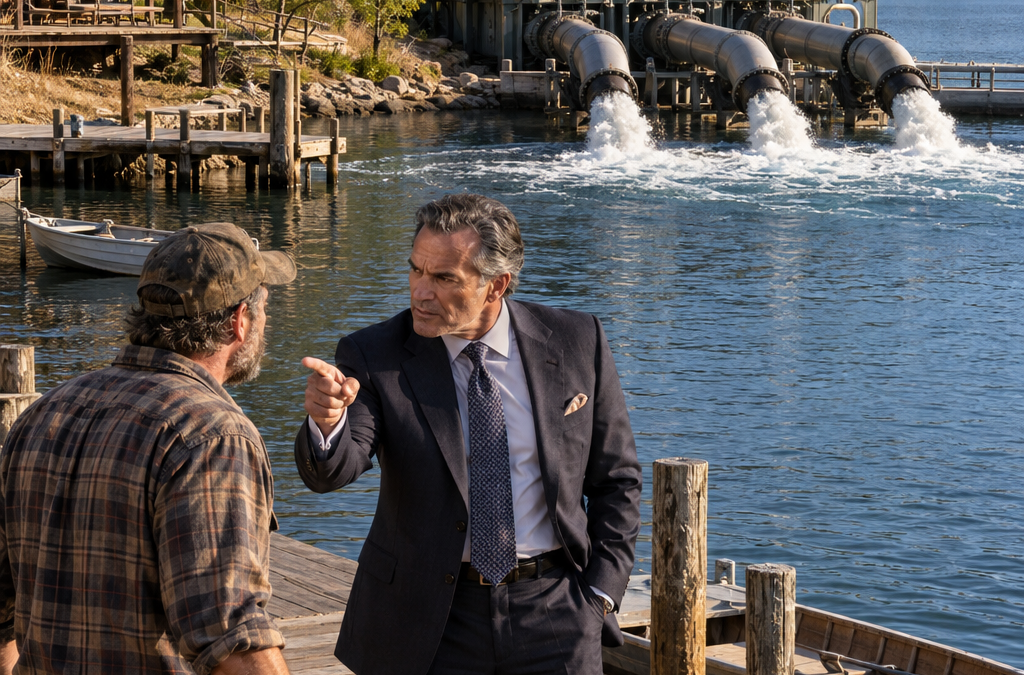
Large industrial pipes extended into the lake.
There were several of them.
Thick, dark-colored lines disappearing beneath the surface, surrounded by newer concrete supports and protective grates.
The fittings looked far more modern than anything my grandfather had installed.
I crouched near the shore.
Fresh maintenance marks surrounded one connection.
The soil behind the intake structure had been disturbed.
A narrow service corridor led away from the water through the trees.
I stood slowly.
“What the hell is this?”
The question disappeared into the morning air.
I followed the corridor with my eyes.
It headed east.
Toward Cedar Ridge Estates.
I unfolded the property map.
The shoreline was marked clearly.
The family boundary extended beyond the intake location.
There was no reference to a pumping system serving the subdivision.
I walked back to the cabin and opened my grandfather’s maintenance records.
I checked the irrigation diagrams.
The old permits.
The water-control notes.
Nothing matched the equipment I had found.
By noon, I had made copies of the relevant pages and driven toward the neighboring community.
Cedar Ridge Estates occupied a hillside above the eastern shore.
The development looked like a small private resort.
Large modern houses stood behind carefully maintained lawns.
Stone retaining walls followed the curves of the streets.
Decorative fountains stood near several intersections.
And above everything rose a huge clubhouse with glass windows facing the lake.
I stopped near the entrance.
A bronze sign identified the community.
CEDAR RIDGE ESTATES — PRIVATE RESIDENTIAL COMMUNITY.
I almost laughed at the irony.
Apparently, private property mattered when it belonged to the HOA.
I drove along the permitted visitor route toward the administrative office.
Near the clubhouse, I spotted something that made my stomach tighten.
An industrial utility building.
Concrete foundation.
Metal fencing.
Large pipes entering one side.
A row of electrical cabinets.
Several pumps visible through an open maintenance bay.
A company truck stood outside.
I parked and approached the employee near the gate.
“Morning,” I said. “Is this the water pumping station?”
He looked up.
“Yes.”
“What does it supply?”
“The community system.”
I glanced at the large pipes.
“Where’s the intake?”
He pointed toward the lake.
“Down the hill.”
“How many homes are connected?”
He shrugged.
“Most of the development.”
I felt my chest tighten.
“Most?”
“The whole system runs through here. Irrigation, storage tanks, household supply connections. Different branches, same source works.”
I looked at the building.
The pumps were enormous.
This wasn’t a small line installed for a decorative fountain.
It was infrastructure.
Expensive infrastructure.
“Who authorized the lake intake?”
The worker frowned.
“You’d have to ask management.”
“Who manages it?”
“Cedar Ridge HOA.”
I stared at him.
“How long has this been here?”
“Longer than I’ve worked here.”
I thanked him and walked back to my truck.
I sat behind the wheel for several minutes.
The pipes in the lake.
The pumping station.
The houses.
The enormous landscaped grounds.
All connected.
The realization unfolded slowly.
Cedar Ridge hadn’t merely been allowing residents to enjoy a view of my grandfather’s lake.
It had built a neighborhood water system around it.
And I had found no agreement authorizing that withdrawal.
I called the HOA office.
A receptionist answered.
“Cedar Ridge Estates Administration.”
“I need to speak with whoever manages the water system.”
“May I ask who’s calling?”
“Jake Bennett. I own Bennett Lake.”
There was a pause.
Then another voice came on.
“This is Douglas Pike, community operations manager. What can I do for you?”
“I’ve just inspected several large intake pipes extending into my lake.”
He said nothing.
I continued.
“I also found your pumping station near the clubhouse. I need to know who authorized the connection.”
Douglas cleared his throat.
“That’s a longstanding utility installation.”
“Longstanding doesn’t tell me who authorized it.”
“The community has used the lake since development began.”
“Under what agreement?”
“I don’t have that information in front of me.”
“Then find it.”
His tone changed.
“Mr. Bennett, I don’t think you understand how established this system is.”
“I understand that industrial pipes extend into privately owned water.”
“Our residents depend on that supply.”
“That makes the authorization more important, not less.”
He exhaled.
“Perhaps you should speak with the board president.”
“Who is that?”
“Linden Whitmore.”
“Then I’d like a meeting.”
Douglas hesitated.
“Mr. Whitmore is extremely busy.”
“So am I.”
A long silence followed.
Then he said, “I’ll see what I can arrange.”
I ended the call.
Before leaving Cedar Ridge, I took photographs of everything I could legally see from accessible areas.
The pumping station.
The pipe corridor.
The utility signs.
The service vehicles.
I recorded the date, time, and location.
Then I drove back to the lake.
For the first time in my life, the water looked unfamiliar.
It was still beautiful.
Still blue beneath the afternoon sunlight.
Still surrounded by the same ridges I had known since childhood.
But now I could see the intake structures on the eastern shore.
And I couldn’t stop imagining the pumps pulling water through those pipes while someone collected money from residents for a system my grandfather had never agreed to surrender.
That evening, I received a call.
The voice on the other end was deep, polished, and slightly impatient.
“Jake Bennett?”
“Speaking.”
“Linden Whitmore. President of Cedar Ridge Estates.”
“Good evening.”
“I understand you’ve been questioning our operations manager about the community’s water infrastructure.”
“Yes.”
He gave a short laugh.
“Well, I appreciate your curiosity, but there are established arrangements you may not be familiar with.”
“That’s why I asked for the agreement.”
“The lake has served this community for decades.”
“Cedar Ridge hasn’t existed for decades.”
There was a pause.
Then Linden said, “You’re being unnecessarily literal.”
I frowned.
“How else should I interpret ownership records?”
He sighed.
“Look, Jake. Your grandfather and the original developers understood the relationship between the lake and this neighborhood.”
“Did they sign a water-use agreement?”
“These matters were handled during development.”
“Then show me the document.”
His tone sharpened.
“You’ve inherited a remarkable piece of property, but that doesn’t mean you can walk into an established community and question every decision made before you arrived.”
“I didn’t arrive. My family owned the lake before your houses existed.”
Silence.
Then he said, “I think we should discuss this in person.”
“Fine.”
“I’ll be at the clubhouse tomorrow morning.”
“I’ll bring the records.”
He laughed softly.
“Bring whatever makes you comfortable.”
The line went dead.
I stared at the phone.
That was my first real introduction to Linden Whitmore.
I didn’t yet know how much trouble he would cause.
But I recognized the type.
A man who treated every question as a challenge to his authority.
A man who mistook confidence for evidence.
A man who believed expensive clothes and an important title made his version of reality more convincing than everybody else’s.
The next morning, I drove to the clubhouse.
Linden was waiting near the entrance.
He looked about fifty years old, tall and broad-shouldered, with carefully styled black hair brushed back from his forehead and silver beginning to show at his temples.
His face was clean-shaven.
His navy suit fitted perfectly.
A white pocket square sat in his breast pocket.
His black leather shoes gleamed beneath the lobby lights.
A heavy silver watch flashed on his wrist when he extended his hand.
Everything about him appeared calculated.
The immaculate grooming.
The expensive cologne.
The easy smile.
Even the way he stood seemed designed to remind people that he was accustomed to being in charge.
“Jake,” he said warmly. “Welcome to Cedar Ridge.”
I shook his hand.
“Mr. Whitmore.”
“Linden, please.”
He glanced at the folder beneath my arm.
“I see you’ve brought paperwork.”
“Yes.”
He chuckled.
“Your grandfather was fond of paperwork too.”
I looked at him.
“Did you know him?”
“We had several discussions.”
“About the lake?”
His smile tightened.
“About cooperation.”
He led me into a conference room overlooking the water.
The view was spectacular.
Floor-to-ceiling windows framed the eastern shoreline.
Below us, landscaped paths curved toward decorative gardens.
Farther down the slope stood the pumping station.
I sat across from him.
Douglas Pike occupied another chair near the door.
Linden folded his hands on the table.
“Let’s clear up this misunderstanding.”
I opened my folder.
“Good. Who owns Bennett Lake?”
He blinked.
“Excuse me?”
“Who owns the lake?”
“Your family has certain property interests.”
“Certain?”
He smiled.
“The broader water system involves historical community rights.”
“Then identify those rights.”
Douglas shifted in his chair.
Linden leaned back.
“Jake, Cedar Ridge is not some careless operation. This is a multimillion-dollar residential community. Hundreds of homeowners depend on infrastructure that has operated successfully for years.”
“I understand.”
“Then you understand why we cannot entertain sudden challenges based on incomplete information.”
I placed the survey on the table.
“This is the recorded boundary.”
He glanced at it.
“The lake has been used by the association for a very long time.”
“Use isn’t ownership.”
He smiled as though explaining something obvious to a child.
“Longstanding use creates expectations.”
“Expectations aren’t automatically legal rights.”
Douglas looked down.
Linden’s expression cooled.
“You’re making this adversarial.”
“I’m asking for the original agreement authorizing your pumping system.”
He opened a leather portfolio and pulled out a thick stack of papers.
“There are extensive development records.”
He pushed them toward me.
I began reading.
Community planning documents.
Utility diagrams.
HOA operating policies.
Architectural maps.
Water-distribution schedules.
But no agreement from my grandfather.
No deed transferring the lake.
No license authorizing the intake.
No permit proving the HOA held the necessary withdrawal rights.
I looked up.
“Where’s the original authorization?”
“It’s all there.”
“No. These documents show what the HOA built. They don’t show who gave you permission to take water from my lake.”
His jaw tightened.
“You have no idea how much money has been invested in this system.”
“Then someone should have made sure the legal rights were secured before spending it.”
Linden stopped smiling.
“Let me explain something to you.”
He leaned forward.
“I am responsible for protecting the interests of several hundred homeowners. Their properties are worth millions collectively. Their landscaping, household systems, and community facilities rely on our water infrastructure.”
I kept my voice steady.
“Then you should welcome a review of its legal foundation.”
His eyes narrowed.
“You’re not going to hold this community hostage because you’ve inherited a lake.”
I stared at him.
“I’m not holding anyone hostage. I’m asking why your pumps are connected to private property without a document authorizing them.”
Linden glanced toward Douglas.
Then back at me.
“Perhaps you should focus on maintaining your cabin and docks rather than interfering with infrastructure you don’t understand.”
The words hit harder than I expected.
My grandfather had spent his life protecting that lake.
And this man, who had never owned a single acre of it, was telling me to stay out of his way.
I stood.
“Send me the recorded agreement, the applicable water-right documents, and the permits supporting the intake.”
Linden remained seated.
“And if we don’t?”
“Then I’ll have an attorney review the system.”
His expression hardened.
“That would be an expensive mistake.”
I looked down at him.
“So was building a pumping station without verifying the source rights.”
For several seconds, nobody spoke.
Then I gathered my documents.
Linden called after me as I reached the door.
“Jake, understand something. That lake has served this community for years. You don’t get to change that simply because your name is now on the deed.”
I turned.
“My grandfather’s name was on those records long before Cedar Ridge existed.”
He smiled thinly.
“And yet the water kept flowing.”
I looked at him for a moment.
“That may be exactly the problem.”
I walked out.
That evening, I returned to the cabin and opened every file I could find.
My grandfather kept property records in a heavy steel cabinet beside the fireplace.
The drawers were labeled in his handwriting.
LAND ACQUISITION.
BOUNDARY SURVEYS.
WATER RIGHTS.
SHORELINE MAINTENANCE.
PRIVATE ACCESS.
CORRESPONDENCE.
I spent hours examining them.
The deeds traced the lake property through generations of family ownership.
The recorded surveys outlined the shoreline and associated land.
The water-right records documented the family’s historic interests and permitted uses.
There were agreements concerning limited irrigation withdrawals and specific neighboring parcels.
But nothing granting Cedar Ridge unlimited use of the lake.
No transfer of ownership.
No agreement authorizing a massive private pumping network.
No document allowing the HOA to operate a revenue-generating utility using my family’s property without permission.
I continued searching.
Near midnight, I found a large envelope at the bottom of the cabinet.
Inside was an older property map.
The paper had yellowed.
The corners were worn.
My grandfather had marked several boundaries in red pencil.
The lake occupied the center of the drawing, nearly three thousand acres of water surrounded by the family property.
Along the eastern shore, he had written a short note.
The water is not to be given away.
I stared at those words.
My grandfather wasn’t a sentimental man.
He rarely wrote messages unless they served a practical purpose.
But that sentence felt different.
It wasn’t simply a statement about ownership.
It was a warning.
I sat at the kitchen table with the map spread before me.
The clock above the fireplace ticked.
Outside, wind moved through the pines.
I remembered Grandpa telling me that people would eventually want the lake for reasons that had nothing to do with loving it.
They would want the views.
The shoreline.
The recreational access.
The water.
And once they became accustomed to using something, they might begin treating it as though it had always belonged to them.
I looked down at the map.
For the first time, I wondered how long he had been fighting to keep that from happening.
The next morning, I drove into town and began researching Cedar Ridge’s utility arrangements.
I expected to find evidence of unauthorized pumping.
What I found was more disturbing.
The HOA charged residents a separate lake utility fee.
It wasn’t hidden.
It appeared openly in the association’s financial materials and homeowner billing descriptions.
The fee supported water-related services, infrastructure maintenance, and the community’s lake-based supply network.
Hundreds of homeowners were paying it.
Year after year.
The association had turned my grandfather’s lake into a financial resource.
I requested the publicly available and lawfully obtainable documents connected to the utility system.
I reviewed homeowner disclosures made available to me.
I photographed fee schedules.
I preserved copies of relevant association statements.
The exact allocation of the revenue wasn’t immediately clear.
But the pattern was.
Cedar Ridge was collecting money connected to water drawn from a source it had not yet demonstrated any legal authority to use.
I sat at my kitchen table calculating the potential scale of those recurring fees.
Even without knowing every household’s exact payment, the revenue could be substantial.
And that didn’t include the economic value of supplying irrigation and other water needs for an expensive development.
My grandfather had paid property taxes.
Maintained shoreline structures.
Protected access points.
Monitored erosion.
And preserved the lake.
Meanwhile, the HOA had been charging residents for water infrastructure dependent on his property.
I felt sick.
The issue was no longer simply about trespass.
It involved money.
A business model.
A system that had become so embedded in the neighborhood that nobody seemed willing to question where the water actually came from.
I called Sarah Mercer.
“I need your help.”
She heard something in my voice.
“What happened?”
“The HOA has industrial intake pipes in the lake. They’re pumping water throughout Cedar Ridge.”
“Do they have a documented withdrawal right?”
“They claim they do.”
“Have they shown you?”
“No.”
“What else?”
“They’re charging hundreds of homeowners a separate utility fee.”
She was quiet.
Then she asked, “Do you have the records?”
“Everything I could legally obtain.”
“Bring them tomorrow.”
I spent the rest of the afternoon organizing the evidence.
Photographs of the intake.
The pumping station.
The pipe corridor.
The HOA fee descriptions.
The property maps.
The lake deeds.
The historical water-right records.
The handwritten note.
When I finished, the documents covered half the dining table.
I looked at them and felt a strange mixture of pride and fear.
Pride because my grandfather had left such careful records.
Fear because I was beginning to understand how large the dispute could become.
Hundreds of homes.
A sophisticated pumping network.
Revenue collected over years.
An HOA president who refused to answer basic questions.
And one private lake at the center of it all.
Sarah spent nearly an entire day reviewing the material.
She brought in a specialist familiar with state water law and utility infrastructure.
They examined the deed chain separately from the water-right documentation.
They checked the recorded instruments.
They reviewed available permits and historical agreements.
They distinguished the family’s ownership of the lake property from the legal authority required for different categories of water withdrawal.
I appreciated that.
Linden had treated everything as though his confidence settled the issue.
Sarah insisted on understanding exactly which rights existed.
By late afternoon, she placed her pen on the table.
“Jake, your family’s property ownership is well documented.”
I nodded.
“And the HOA?”
“We have not found a valid agreement giving Cedar Ridge authority to occupy your shoreline with these intake structures or to use the lake in the manner claimed.”
I leaned forward.
“What about the water rights?”
“The available records also do not establish the withdrawal authority they’re asserting. We’re requesting final confirmations from the relevant agencies and will address any remaining statutory issues before taking action.”
I rubbed my forehead.
“So they can’t just declare the lake community property?”
“No.”
“And they can’t rely entirely on the fact that they’ve been using it?”
“Long use can be legally relevant in some circumstances. But it doesn’t automatically create ownership or unrestricted water rights. They need a legally sufficient basis, and the documents they’ve supplied don’t establish one.”
I exhaled.
“What happens now?”
“We issue formal notice.”
I looked at her.
“What kind of notice?”
“One that identifies your property interests, disputes their claimed authority, demands production of supporting documents, and requires the unauthorized commercial use to cease through a lawful process.”
“Can we disconnect the pumps?”
She shook her head.
“Not by simply walking up and turning them off.”
I frowned.
“Why?”
“Because homes are connected. Some residents may depend on that water for essential purposes. There are safety, regulatory, contractual, and liability issues to address.”
I thought about the houses on the hillside.
Families.
Children.
Older residents.
People who had paid their HOA bills believing the system was legitimate.
“I don’t want anyone waking up without water.”
“Then we’ll make that an express condition of our approach.”
I sat back.
“But I also can’t let them continue taking it forever.”
“Exactly. We establish a lawful transition, require appropriate contingency arrangements, and pursue the remedies available to protect your rights.”
I nodded slowly.
“What about the HOA fees?”
“We’ll require an accounting of the relevant arrangements and preserve that issue. The residents may have questions of their own.”
I looked toward the old map.
“Grandpa told me the water wasn’t to be given away.”
Sarah followed my gaze.
“Then we protect it properly.”
The formal notice went out the following week.
It identified the private lake property.
It described the intake facilities.
It challenged the HOA’s authority to occupy the shoreline and commercially withdraw water without the necessary rights.
It demanded supporting documentation and an accounting of the claimed arrangements.
And it required Cedar Ridge to stop unauthorized pumping through a legally supervised process that protected essential service and public safety.
I knew Linden would react badly.
I underestimated how badly.
He called less than an hour after receiving the notice.
I was repairing a loose board on the family dock when my phone rang.
“Jake.”
His voice was cold.
“Linden.”
“What the hell is this letter?”
“A formal notice from my attorney.”
“I can read.”
“Then you understand what we’re asking.”
He laughed sharply.
“You’re demanding that we stop using our own water system.”
“I’m demanding that you establish a lawful right to use my family’s lake.”
“You’re trying to extort this community.”
The accusation hit me like a slap.
“What?”
“You’ve inherited valuable property, discovered a successful residential development nearby, and decided you want a piece of our revenue.”
I stared across the water.
“Your pumps are in my lake.”
“Our system has operated for years.”
“That isn’t proof of authorization.”
His voice rose.
“Do you have any idea what shutting down those pumps would do?”
“That’s why my attorney is requiring a controlled process and alternative supply arrangements.”
“You expect hundreds of families to reorganize their lives because you’re suddenly concerned about an old family deed?”
I felt my jaw tighten.
“Yes, Linden. I expect your HOA to comply with property and water law.”
“You are making a catastrophic mistake.”
“Then provide the documents showing I’m wrong.”
He was silent.
For a moment, I thought he might finally acknowledge the problem.
Instead, he said, “Withdraw the notice.”
“No.”
“Jake, I’m giving you a chance to resolve this privately.”
“That’s what I tried to do.”
“You don’t understand the financial power of this association.”
I looked toward the eastern shore.
The intake structures were just visible beyond the trees.
“I understand you’ve been charging residents for access to water you haven’t proved you’re entitled to withdraw.”
His breathing changed.
“Be very careful what you accuse us of.”
“Then answer the questions.”
He hung up.
I stood beside the dock listening to the water strike the pilings.
I wasn’t surprised he was angry.
But his refusal to discuss the actual documents frightened me.
He had invested his authority in the belief that the lake was effectively his.
And now he was willing to use every resource the HOA possessed to defend that belief.
The following morning, he arrived at my private dock.
I heard tires on the gravel before I saw the vehicle.
A black luxury SUV stopped near the old boat shed.
Linden stepped out wearing a light gray suit beneath an expensive dark overcoat.
His hair was perfectly styled.
His shoes gleamed.
He looked absurdly polished against the weathered wood and muddy shoreline.
I was replacing a rotten dock plank.
He approached without greeting me.
“You need to restore our water access immediately.”
I straightened.
“The pumps haven’t been disconnected yet.”
“Your letter is interfering with our utility operations.”
“Your utility operations are drawing from my lake.”
His face reddened.
“Do you understand how much responsibility I carry?”
I set down the hammer.
“Do you understand how much responsibility I inherited?”
He glanced toward the water.
“This lake has supported Cedar Ridge for years.”
“Without an agreement you’ve been willing to produce.”
“Your grandfather allowed the arrangement.”
I stared at him.
“Then show me what he signed.”
He looked away.
“Not every arrangement is reduced to a document.”
“An industrial pumping network serving hundreds of homes should be.”
He stepped closer.
“You need to stop pretending this is some little fishing pond behind your cabin.”
I felt anger rise in my chest.
“Don’t talk about my grandfather’s lake like that.”
He gave a dismissive smile.
“The lake is part of the regional infrastructure whether you like it or not.”
“It’s private property.”
“Private property isn’t absolute.”
“Neither is HOA authority.”
His jaw tightened.
He pointed toward the lake.
“You cannot take away a resource this community has built its future around.”
I looked at him.
“Your community built its future around something it didn’t properly secure.”
For several seconds, we stood facing each other.
The wind pushed small waves against the dock.
A gull cried somewhere above us.
Linden’s expression hardened into something almost possessive.
“This development is my responsibility,” he said. “Every road. Every home. Every utility system. I will not have some inexperienced heir interfering with what I’ve built.”
There it was.
Not a legal argument.
Not a document.
A declaration of ownership over everything he believed his position entitled him to control.
I took a slow breath.
“You don’t own the lake, Linden.”
He looked at me with open contempt.
“You keep saying that as though it settles everything.”
“It settles who you need to obtain permission from.”
His eyes narrowed.
“You’re going to regret this.”
I looked toward the property marker beside the trail.
“You’re standing on my land, demanding control of my water, and threatening me because I asked for proof of your rights.”
He lifted his chin.
“I’m protecting hundreds of families.”
“Then start telling them the truth.”
His face went pale with anger.
He pulled out his phone.
“Fine.”
I watched him dial.
“What are you doing?”
“Calling the sheriff.”
I almost laughed.
“About what?”
“Unlawful interference with a community utility system.”
I stared at him.
He turned away and began explaining the situation into the phone.
His version was breathtaking.
He described me as an aggressive new landowner threatening essential water service.
He claimed I was attempting to disrupt an established public-safety resource.
He requested immediate assistance.
When he finished, he looked at me triumphantly.
“We’ll see what law enforcement thinks of your demands.”
I looked toward the cabin.
Then back at him.
“Good.”
He frowned.
“Good?”
“Maybe somebody will finally ask you for the documents.”
The sheriff’s deputy arrived about forty minutes later.
His name was Daniel Brooks.
He was in his late forties, broad-shouldered, calm, and clearly uninterested in being dragged into a personal power struggle.
He parked near the boat shed and approached us.
“Afternoon. Dispatch said there’s a dispute involving water access.”
Linden immediately extended his hand.
“Deputy, Linden Whitmore. President of Cedar Ridge Estates.”
Daniel shook it briefly.
Then looked toward me.
“And you are?”
“Jake Bennett. I own the lake property.”
Linden interrupted.
“He inherited it recently and is threatening to shut down our community water system.”
Daniel raised one hand.
“One at a time.”
He looked at me.
“Have you shut anything down?”
“No.”
“Have you damaged equipment?”
“No.”
“Have you threatened anyone?”
“No.”
I pointed toward the cabin.
“My attorney issued formal notice disputing the HOA’s rights. The letter specifically requires a lawful process that protects the residents.”
Daniel turned toward Linden.
“Do you have the notice?”
Linden pulled a folded copy from his portfolio.
Daniel read it.
His expression remained neutral.
Then he looked at the pumping facilities visible across the water.
“Mr. Whitmore, what legal right does your association have to draw water from this lake?”
Linden straightened.
“Historical use.”
“Do you have a permit or agreement?”
“Our records establish the arrangement.”
“Can you show me?”
Linden hesitated.
“Not here.”
Daniel looked at me.
“Do you have ownership documents?”
“Yes.”
I went inside and retrieved the property folder.
I handed him the recorded deed, survey, and relevant supporting documents.
Daniel studied the property description.
He compared the map with the shoreline.
Then he looked toward the intake structures.
“So those pipes are within the property described here?”
“Yes.”
“And the HOA is drawing water through them?”
“That’s what their operations manager confirmed.”
Daniel looked toward Linden.
“Is that accurate?”
Linden adjusted his coat.
“The system has served Cedar Ridge for years.”
Daniel waited.
Linden finally nodded.
“Yes.”
The deputy examined the documents again.
Then he closed the folder.
“All right. This appears to be a civil property and water-right dispute. I’m not going to determine title or utility rights here at the dock.”
Linden’s face tightened.
“Deputy, hundreds of residents could lose water service.”
“Then the association needs to work with its attorneys and the appropriate regulators to maintain essential service while the dispute is resolved.”
“You’re not going to stop him?”
“From what? He hasn’t shut anything down.”
Linden pointed toward me.
“He’s threatening our infrastructure.”
Daniel looked at the notice again.
“This letter is from counsel. It calls for a legal process.”
The silence was sharp.
I looked at Linden.
He was staring at the deputy as though he couldn’t believe his authority was being questioned.
Daniel continued.
“Nobody should damage equipment or interfere with essential service outside lawful procedures. And nobody should assume they can occupy private land or withdraw water without establishing the necessary rights.”
He looked between us.
“I’m here to prevent a disturbance, not decide the underlying case.”
I nodded.
“Understood.”
Linden’s jaw worked.
“This community can’t simply be abandoned.”
Daniel’s voice remained calm.
“Then make sure it isn’t. Work through the proper channels.”
He returned my documents.
Before leaving, he looked at me.
“Keep everything documented.”
“I will.”
Then he turned to Linden.
“And you should do the same.”
Linden watched the patrol vehicle disappear up the gravel road.
For the first time since arriving, he had nothing to say.
I picked up my hammer.
“Are we finished?”
He looked at me.
His face was stiff.
“This isn’t over.”
“No,” I said. “It isn’t.”
He returned to his SUV.
I watched him drive away.
Then I sat on the dock for a long time.
The confrontation had left my hands shaking.
I had expected anger.
I had expected legal threats.
But I hadn’t expected him to call law enforcement as though preserving my property rights made me a criminal.
I thought about the residents.
Some of them probably didn’t even know their water came from a privately owned lake.
They were paying utility fees.
Maintaining their homes.
Following the rules of their association.
And now they were caught between my family’s rights and an HOA that had built its infrastructure on assumptions it couldn’t prove.
That realization frightened me more than Linden’s threats.
Because I could fight him.
I could hire attorneys.
I could produce documents.
But families needed water.
And I refused to become the man responsible for denying innocent people an essential necessity simply to make a point.
I called Sarah.
“He brought the sheriff.”
She sighed.
“Did anyone get hurt?”
“No.”
“Did you touch the pumping equipment?”
“No.”
“Good.”
I explained the encounter.
She listened carefully.
Then she said, “This confirms we need to proceed exactly as planned.”
“Meaning?”
“Legal review, agency coordination, contingency supply, and documented termination of any unauthorized connection.”
I looked toward the lake.
“Can we really make them stop?”
“If the applicable rights and regulatory findings support our position, yes. But we do it in a way that doesn’t jeopardize residents.”
I nodded.
“That’s what I want.”
Over the following weeks, the dispute became more complicated.
Sarah and the water-law specialist gathered records from the relevant state and local agencies.
They examined the pumping system’s permits, the history of the shoreline installation, and the rights claimed by Cedar Ridge.
They identified what approvals applied to the equipment itself and what separate authority was required to occupy the lake property and withdraw water.
The distinction mattered.
A permit relating to construction or equipment didn’t automatically grant ownership of someone else’s shoreline.
An HOA maintenance policy didn’t create a water right.
And years of billing residents didn’t establish permission from my grandfather.
The available legal and regulatory review supported my family’s position.
The HOA had failed to establish sufficient rights for the use it had been making of the lake.
The formal process to end that unauthorized withdrawal moved forward.
There were notices.
Meetings.
Technical assessments.
Requirements for interim supply.
Discussions with the county and the agencies responsible for water service and safety.
Linden fought nearly every step.
His attorneys argued that Cedar Ridge had relied on the lake for years.
They emphasized the expense of building alternative infrastructure.
They warned that withdrawal of the lake supply would create hardship.
Sarah responded that those concerns needed to be addressed through proper transition planning.
They didn’t erase my property rights.
And they didn’t create authorization where the association had failed to secure it.
I attended several meetings.
I watched Linden sit across from us wearing immaculate suits and an expression of constant irritation.
Sometimes he interrupted the engineers.
Sometimes he challenged the attorneys.
Sometimes he accused me of trying to bankrupt the neighborhood.
But whenever the discussion returned to the original agreements, the same problem remained.
He could not produce a valid authorization matching the scope of the HOA’s claimed use.
At one meeting, he leaned across the table.
“Jake, do you have any idea what you’ve cost this community already?”
I stared at him.
“How much have you charged residents for water from my lake?”
His face hardened.
“That’s association business.”
“It’s relevant to this dispute.”
“Those fees maintain infrastructure.”
“Infrastructure that draws from property you didn’t properly secure.”
He looked toward the other officials.
“This is exactly the hostile attitude we’ve been dealing with.”
Sarah interrupted.
“Mr. Whitmore, the purpose of today’s meeting is to establish a safe, lawful transition. We should return to the technical plan.”
Linden leaned back angrily.
I looked at the engineers.
They were discussing temporary supply arrangements, storage capacity, and the sequencing required to isolate the lake intake without placing households at risk.
It was practical work.
Difficult work.
Expensive work.
And it should have been unnecessary.
All because the original development had proceeded without adequately securing the rights it depended upon.
When the approved transition plan was finally ready, I felt relief and dread in equal measure.
The HOA had been required to arrange a compliant interim supply and service continuity measures before the lake connection could be terminated.
The technical team verified that essential household needs could be maintained during the changeover.
Residents received notice of the transition.
Emergency arrangements were established where necessary.
Only then did the authorized crews prepare to disconnect the lake intake from the HOA network.
I insisted on being present.
Not because I wanted to watch people suffer.
Because the pumping equipment sat on my family’s property.
And I wanted to see the unauthorized connection end.
The morning of the disconnection was cold and gray.
I arrived before sunrise.
A thin mist drifted above the lake.
The pumping station lights glowed through the trees.
Several technicians were already working near the equipment.
A representative of the relevant authority reviewed the procedure with the crew.
Sarah stood beside me.
“Everything has been checked,” she said. “The contingency arrangements are in place. The work will proceed under the approved plan.”
I nodded.
My stomach was tight.
Across the access road, a black Mercedes was parked.
Linden stood beside it.
He wore a dark overcoat over a black suit.
His hair was perfectly combed.
His shoes looked absurdly expensive against the wet gravel.
He watched the technicians with an expression of controlled fury.
When he saw me, he approached.
“Enjoying this?”
I looked at him.
“No.”
He gave a bitter laugh.
“Really?”
“Really.”
He pointed toward the pumping station.
“Years of community infrastructure. And you’re standing here watching it get dismantled.”
“I’m watching an unauthorized connection being removed.”
His face reddened.
“You have absolutely no understanding of what it takes to run a modern residential development.”
I took a breath.
“Then explain why a modern residential development didn’t secure its water source legally.”
He looked away.
I continued.
“Your residents are being protected through a transition plan. The work is being done by professionals. Nobody is turning off a valve and abandoning hundreds of homes.”
His jaw tightened.
“Because we had to spend money making other arrangements.”
“That’s what happens when infrastructure has to be corrected.”
He stared at me.
For the first time, I saw something beneath the anger.
Fear.
Not fear of me.
Fear of losing the control he had built his identity around.
I looked toward the technicians.
“This was never about humiliating you, Linden.”
He laughed sharply.
“Of course it was.”
“No. It was about asking you to show me the document that gave you the right to use my lake.”
“You could have negotiated.”
“I tried.”
“You demanded we stop.”
“Because you refused to establish any authority for what you were doing.”
He stepped closer.
“You have no idea how many people are angry with you.”
I looked at him.
“Then maybe you should explain why they were paying lake utility fees while your association couldn’t prove its rights to the lake.”
His expression changed.
He looked away.
I knew I’d touched the issue he feared most.
The money.
For years, the HOA had collected fees tied to a system built around my family’s water.
Now the residents were beginning to ask questions.
Questions Linden couldn’t answer with polished smiles or vague references to tradition.
A technician called to the others.
The final verification was complete.
The authorized isolation procedure was beginning.
Sarah touched my arm.
“Jake.”
I turned.
Across the station, the crew moved through the sequence of controls.
Valves were positioned.
Pressure readings were checked.
Equipment was isolated.
The system was carefully separated from the lake source.
There was no dramatic explosion.
No flood.
No shouting.
Only the measured work of people following a technical procedure designed to keep everyone safe.
Then one of the large pumps slowed.
The deep mechanical hum faded.
Another unit shut down.
The familiar vibration I’d begun to notice near the eastern shore grew quieter.
The technicians confirmed that withdrawal from the lake had ceased.
For the first time in years, Cedar Ridge’s system was no longer drawing from Bennett Lake.
I stood completely still.
The silence felt enormous.
Not absolute silence.
The wind still moved through the trees.
Water still lapped against the shore.
Birds called across the inlet.
But the industrial hum was gone.
I hadn’t realized how much it bothered me until it stopped.
Linden stared toward the pumping station.
He said nothing.
I looked at the lake.
I thought about my grandfather sitting on the dock with his fishing rod.
About his hands resting on the old wooden boards.
About the way he used to tell me the lake didn’t need anyone to make it valuable.
The water had been there long before Cedar Ridge.
Long before Linden.
Long before the pumps.
And now, at last, it was no longer being treated as a free resource for someone else’s business.
Linden turned toward me.
“This isn’t finished.”
I looked at him.
“The legal and financial consequences may not be finished. But the unauthorized pumping is.”
His face tightened.
He walked back to his Mercedes.
I watched him leave.
Then I sat on a nearby bench.
Sarah stood beside me.
“How do you feel?”
I looked across the water.
“Tired.”
She nodded.
“That’s understandable.”
I watched the mist lift slowly from the lake.
“Also relieved.”
For several minutes, neither of us spoke.
Then I said, “I wish Grandpa could have seen this.”
Sarah looked toward the cabin in the distance.
“He left you everything you needed to protect it.”
I swallowed.
“Yeah.”
I looked down at my hands.
“He did.”
The HOA emergency meeting took place that evening.
I didn’t attend.
But by the following morning, I knew what had happened.
A resident named Rebecca Lawson called me.
She lived in Cedar Ridge and had obtained my number through a mutual acquaintance.
Her voice was nervous.
“Mr. Bennett?”
“Jake is fine.”
“Jake, I’m sorry to bother you. I was at the HOA meeting last night.”
I sat down at the kitchen table.
“All right.”
“People are furious.”
I closed my eyes.
“About the water transition?”
“About everything.”
She took a breath.
“Most of us didn’t know the lake was privately owned.”
I said nothing.
She continued.
“We knew we paid a lake utility fee. We thought it was for a legitimate community water system.”
“That’s what I understand.”
“But the board couldn’t explain where the legal access rights came from.”
I looked toward the property map on the wall.
“That’s the question I’ve been asking since I discovered the pipes.”
Rebecca hesitated.
“Mr. Whitmore told everyone you were trying to punish the neighborhood.”
I exhaled.
“I expected that.”
“But then someone asked to see the original water-use agreement.”
“What happened?”
“Nobody could produce it.”
I leaned back.
She continued.
“People started asking why we’d been paying all these fees. Who approved the pumping station. Who checked the water rights. Why nobody told us there was a dispute until the transition notices arrived.”
I could hear tension in her voice.
“It got ugly.”
“Did the board explain?”
“Not really. Mr. Whitmore kept saying the HOA had relied on historical arrangements.”
I almost laughed.
That phrase again.
Historical arrangements.
It sounded respectable until somebody asked for a document.
Rebecca lowered her voice.
“Can I ask you something?”
“Of course.”
“Did you ever intend to leave our families without water?”
“No.”
“Not even to force the HOA to negotiate?”
“Never.”
She was silent.
Then I explained the legal process, the continuity requirements, and the reason the alternative arrangements had to be in place before the lake withdrawal stopped.
When I finished, she let out a long breath.
“That’s not what we were told.”
“I know.”
“I have two children, Jake. When the first notices came, I was terrified.”
I felt a sharp ache.
“I’m sorry you had to go through that.”
She hesitated.
“I don’t think you’re the person who should be apologizing.”
After we hung up, I sat quietly.
For weeks, Linden had portrayed me as a threat to the neighborhood.
And yet the more residents learned, the more their anger turned toward the people who had built the system.
The next HOA meeting was even worse for Linden.
Several homeowners demanded a detailed accounting of the lake utility fees.
Others wanted copies of the infrastructure agreements.
Some questioned whether the board had misrepresented the water source when selling homes or preparing homeowner disclosures.
A group of residents sought independent legal advice.
The HOA could no longer hide behind statements about tradition.
It had to address actual property records, water-right requirements, utility arrangements, and financial decisions.
Linden still tried to blame me.
At one meeting, according to Rebecca, he stood before the residents and declared that an unreasonable private landowner had forced the community into expensive changes.
A man in the audience interrupted him.
“Did we have a valid agreement to use the lake?”
Linden started explaining historical reliance.
The man asked again.
“Did we have an agreement?”
A woman near the front stood.
“Why were we paying lake utility fees if nobody had checked the source rights?”
Another resident asked who had approved the original intake construction.
For once, Linden couldn’t control the conversation.
He had spent years behaving as though the HOA’s decisions were unquestionable.
Now the residents wanted evidence.
And the evidence wasn’t on his side.
Meanwhile, I returned to the shoreline.
The lake felt different.
The water moved naturally through the eastern inlet.
The enormous pipes remained secured pending lawful removal or final treatment, but no commercial pumping was taking place.
The constant mechanical vibration had disappeared.
I could hear wind passing through the reeds.
Small waves breaking against the stones.
Birds settling near the shallows.
One morning, I stood near the intake location and listened.
I remembered Grandpa telling me that water had its own sounds.
He said you could tell when the wind was changing by the way waves struck the western rocks.
You could hear fish breaking the surface at dawn.
You could distinguish a storm moving across the lake before the clouds reached the cabin.
For years, I thought he was exaggerating.
Now I understood.
The lake had a voice.
And the pumping station had been drowning out part of it.
I began repairing the old family dock.
It was slow work.
Several boards were rotten.
One support had shifted.
The railing needed replacement.
I spent entire afternoons pulling old nails and fitting new timber.
Sometimes Caleb came to help.
He’d bring coffee and complain about how much work I’d inherited.
One afternoon, while we were replacing a section of railing, he looked across the water.
“Hard to believe the HOA thought this whole thing was theirs.”
I tightened a bolt.
“They didn’t actually claim to own every acre.”
“No?”
“They acted like ownership didn’t matter because they’d been using the water.”
Caleb shook his head.
“That’s worse.”
I smiled faintly.
“Yeah.”
He looked toward the eastern shore.
“What happens now?”
“The HOA has to establish a legitimate independent supply. They’re already working on the permanent system.”
“And you?”
I looked at the unfinished dock.
“I’m fixing what Grandpa left behind.”
He nodded.
“Sounds about right.”
We worked until sunset.
The following week, I repaired the old boat shed.
Then I restored several private shoreline signs my grandfather had installed years earlier.
Some had been knocked down.
Others had faded so badly they were almost unreadable.
I replaced the damaged posts.
Repainted the lettering.
And made sure the boundaries were clearly identified.
I also reviewed the private access trails.
A few had become overgrown.
Others needed drainage work.
I hired local contractors to help restore the worst sections.
Every improvement felt like a small act of returning the property to its intended purpose.
Not a commercial water source for a neighborhood that hadn’t secured the right to use it.
A family lake.
A place for fishing.
Wildlife.
Quiet mornings.
And the generations who would come after me.
The legal process continued in the background.
Sarah worked through the remaining questions concerning the intake equipment, property access, and the consequences of the unauthorized use.
The HOA had financial and administrative issues to resolve.
Residents wanted accountability.
The board had to explain the history of the utility system and the fees collected.
And the community needed a permanent independent water source.
There were no easy shortcuts.
New infrastructure required planning.
Engineering.
Permits.
Money.
Construction.
The association could no longer pretend the lake was available simply because relying on it had become convenient.
For the first time, Cedar Ridge had to build its water future on rights and infrastructure it could actually establish.
I didn’t celebrate their expenses.
I knew those costs would affect homeowners who had purchased their houses in good faith.
But I also knew the alternative.
If I had surrendered because Linden shouted loudly enough, the HOA would have continued using the lake indefinitely.
It would have kept collecting fees.
It would have kept operating industrial equipment on family property.
And the day might have come when future board members claimed the system had been there so long that I no longer had any meaningful right to challenge it.
That was exactly what my grandfather had warned me about.
One evening, Sarah called with an update.
“The HOA’s independent water project is progressing.”
I leaned against the kitchen counter.
“Good.”
“The interim arrangements have remained compliant, and the long-term infrastructure plans are moving through the necessary approvals.”
“Any trouble?”
“Not with the supply transition.”
I paused.
“What about Linden?”
She hesitated.
“He’s still unhappy.”
I laughed softly.
“That’s not news.”
“But the board is dealing with questions about the old arrangements. They’re no longer relying exclusively on his interpretation.”
I looked toward the framed photograph of Grandpa near the fireplace.
“That’s a start.”
Sarah continued.
“The important thing is that your family’s property interests have been formally documented and the unauthorized withdrawal has ceased.”
I exhaled.
“Thank you.”
“Jake?”
“Yes?”
“You’ve handled this carefully. That matters.”
I looked toward the lake outside.
“I just didn’t want people hurt because the HOA made a mistake.”
“I know.”
After the call, I sat on the porch for a long time.
I thought about how close the dispute had come to turning ugly.
Linden had threatened me.
Accused me of extortion.
Called the sheriff.
Tried to convince residents I wanted to leave their families without water.
Any one of those moments could have pushed me into doing something reckless.
I could have confronted the pumping crew.
I could have damaged the pipes.
I could have tried to shut the equipment down myself.
But that would have placed innocent people at risk and weakened the very rights I was trying to protect.
Instead, we had followed the law.
We had documented everything.
We had made sure residents had alternative supply arrangements.
And when the connection was finally terminated, it happened safely.
My grandfather would have appreciated that.
He believed being right didn’t give a man permission to behave irresponsibly.
A few months later, Cedar Ridge completed the essential work needed to establish its permanent independent supply arrangements.
The project was expensive.
The board had to revise budgets and explain the costs.
But the community no longer depended on Bennett Lake without authorization.
Residents received water through infrastructure supported by legally established rights and appropriate approvals.
The neighborhood continued operating.
Families stayed in their homes.
Lawns remained green.
The clubhouse remained open.
And the association no longer collected its water from my grandfather’s lake.
One afternoon, I drove past the Cedar Ridge entrance.
Construction vehicles were leaving one of the new utility sites.
Workers were removing temporary equipment.
The large entrance sign still gleamed in the sunlight.
The houses were still beautiful.
The streets still carefully landscaped.
From the outside, nothing looked particularly different.
But I knew the change was enormous.
For years, Cedar Ridge had treated the lake as the foundation of its water system.
Now it had been forced to support its own community through lawful infrastructure.
The distinction mattered.
They hadn’t lost the right to exist.
They had lost the ability to depend on someone else’s property without establishing permission.
I returned to the cabin and continued working on the boat shed.
That was where Linden found me for the final time.
I heard a vehicle approaching along the gravel road.
When I looked up, his black Mercedes was slowing near the dock.
For a moment, I felt the familiar tension in my chest.
Then I reminded myself that the dispute had changed.
The pumping had stopped.
The alternative system was operating.
The lake’s ownership and applicable rights had been documented.
I no longer needed to fear what he might demand.
Linden stepped out.
He wore a charcoal jacket, dark trousers, and his usual expensive leather shoes.
His hair was still carefully styled.
His watch still flashed in the sunlight.
But the man beneath the polished appearance seemed different.
His shoulders were lower.
His movements slower.
He approached without the confident smile I remembered from our first meeting.
“Jake.”
I set down my tools.
“Linden.”
He stopped several feet away.
“Do you have a minute?”
I studied him.
“For what?”
He looked toward the lake.
“I wanted to talk.”
I waited.
He took a breath.
“The new water system is operational.”
“I heard.”
“It’s been a difficult transition.”
“I imagine so.”
He looked down at his shoes.
Then back at me.
“The association relied on Bennett Lake for a long time.”
I said nothing.
He continued.
“Longer than we should have.”
I watched his face.
It was the closest thing to an admission I’d heard from him.
“Yes,” I said. “You did.”
He looked toward the restored dock.
“I thought protecting the community meant making sure nothing interrupted the services residents expected.”
“That’s part of the job.”
He nodded.
“But I treated that expectation as though it gave us rights we hadn’t established.”
I leaned against the boat shed.
He looked uncomfortable.
“I should have listened when you first asked for the agreement.”
“Yes.”
“And I shouldn’t have threatened you.”
I studied him.
“No. You shouldn’t have.”
He swallowed.
“I owe you an apology.”
The words hung between us.
For weeks, I had imagined this moment.
I thought I would feel triumphant.
That I would remind him of every insult.
Every threat.
Every accusation.
But standing there, I mostly felt tired.
I looked toward the lake.
“This was never personal, Linden.”
He gave a faint, bitter smile.
“It certainly felt personal.”
“Because you made it personal.”
He looked down.
I continued.
“I asked a simple question. What gave your HOA the right to pump water from my family’s lake?”
He nodded.
“And instead of answering, you treated me like an enemy.”
“I know.”
I pointed toward the water.
“My grandfather protected this place for decades. He didn’t do that so a neighboring development could build a business around it without permission.”
Linden looked across the surface.
For a moment, neither of us spoke.
Then he said quietly, “I understand that now.”
I wasn’t sure he understood everything.
But I believed he understood enough.
I extended my hand.
“I accept your apology.”
He looked surprised.
Then he shook it.
“But the boundary stays where it belongs,” I added.
He nodded immediately.
“Of course.”
“And any future request involving this property goes through the proper process.”
“Agreed.”
I released his hand.
He looked toward the old dock.
“You’ve done a lot of work.”
I smiled faintly.
“Still plenty left.”
He glanced toward the lake again.
“It’s beautiful out here.”
I looked at the water.
“Grandpa thought so too.”
Linden nodded.
Then he returned to his car.
I watched him drive away.
For the first time, I didn’t feel angry when I saw the Mercedes disappear.
I simply felt finished.
The following week, Deputy Daniel Brooks stopped by the cabin.
He was making a routine visit in the area and wanted to confirm that the earlier dispute had remained peaceful.
I met him on the porch.
“Afternoon, Jake.”
“Deputy.”
“Everything going all right?”
“Much better.”
He looked toward the lake.
“No more confrontations?”
“No.”
“Any trouble with the old pumping station?”
“None. The connection was handled through the approved process.”
He nodded.
“Good.”
I handed him a brief summary of the completed work and the relevant correspondence, which he reviewed without attempting to make a legal determination.
He looked up.
“That’s how these situations ought to be handled.”
I smiled.
“Wish we’d started there.”
He chuckled.
“Usually better when people read the paperwork before they start giving orders.”
I laughed.
“Grandpa used to say something similar.”
Daniel looked toward the dock.
“He sounds like he knew what he was doing.”
“He did.”
The deputy’s expression became serious.
“Property boundaries and agreements matter. People sometimes forget that when a system has been operating a long time.”
I nodded.
“That’s exactly what happened.”
He handed the documents back.
“Glad nobody got hurt.”
“Me too.”
We shook hands.
Then he returned to his patrol vehicle.
I watched him leave, remembering the day Linden had called him to the dock.
Back then, I had been frightened that the sheriff might somehow be persuaded to treat me as the criminal.
Now the entire dispute was ending with documented compliance, a working independent water supply, and no violence.
It wasn’t dramatic.
But it was right.
Months passed.
Winter faded into spring.
The ice disappeared from the shallower northern coves.
Migrating birds returned.
New grass spread along the shoreline.
And the lake moved through its natural seasonal rhythms without the constant industrial withdrawal serving Cedar Ridge.
I spent most mornings outside.
Sometimes fishing.
Sometimes repairing trails.
Sometimes simply walking the property with my grandfather’s old map folded inside my jacket.
The work never ended.
There were fences to inspect.
Dock pilings to maintain.
Drainage channels to clear.
Signs to repair.
The lake was enormous, and caring for it required patience.
But I liked the work.
It gave shape to the days.
And it connected me to the man who had taught me everything I knew about the place.
One evening in early summer, I carried my grandfather’s old property map into the cabin.
The paper had become fragile.
Its edges were soft.
The red pencil marks were beginning to fade.
I had been afraid to handle it too often.
So I took it to a local framing shop.
The woman behind the counter examined it carefully.
“That’s a beautiful old survey.”
“It’s my grandfather’s.”
She looked at the lake outlined in red.
“That’s a lot of water.”
I smiled.
“Almost three thousand acres.”
She raised her eyebrows.
“Your family owns that?”
“Yes.”
She looked at the handwritten note.
The water is not to be given away.
“Sounds like your grandfather wanted somebody to remember something.”
I swallowed.
“Yeah.”
I chose a simple wooden frame.
Nothing elaborate.
Dark oak.
Protective glass.
A clean border around the old paper.
When I brought it home, I hung it above the fireplace.
I stood back and looked at it.
The lake.
The shoreline.
The family boundary.
The handwritten warning.
For decades, those lines had existed quietly in a filing cabinet.
Now they occupied the center of the room.
Not because I wanted to display how much property I owned.
Because I wanted the next generation to understand what had been protected.
I thought about children who might one day visit this cabin.
My own children, perhaps.
Nieces.
Nephews.
Grandchildren.
I wanted them to know that the lake hadn’t always been peaceful.
That someone had once tried to turn it into a private utility business without securing the necessary rights.
That protecting it had required patience, evidence, restraint, and a willingness to stand against people with more money and influence.
But I also wanted them to understand something else.
The people living in Cedar Ridge weren’t enemies.
Most had simply trusted their HOA.
They had paid their bills.
Maintained their homes.
Raised their families.
The real problem had been leadership that treated access as entitlement and refused to admit when assumptions were wrong.
The framed map wasn’t a trophy.
It was a reminder.
A reminder that ownership came with responsibility.
That rights had to be supported by law.
And that protecting something valuable sometimes meant resisting people who believed convenience was more important than permission.
Later that evening, I climbed the hill behind the cabin.
It was my grandfather’s favorite place.
A narrow trail wound through pine trees before reaching a broad overlook.
From there, nearly the entire lake spread beneath the sky.
Three thousand acres of blue water.
Small coves cutting into the forest.
Long stretches of undisturbed shoreline.
The old dock near the cabin.
The cedar grove.
The northern inlet.
And far to the east, the distant rooftops of Cedar Ridge Estates.
The sun was beginning to set.
Golden light moved across the surface.
A breeze stirred the water into long, gentle patterns.
I stood there with my hands in my pockets, looking at the property that had changed my life.
When my grandfather died, I thought inheriting the lake meant receiving something extraordinary.
And it was extraordinary.
But I hadn’t understood what it would ask of me.
I hadn’t expected to discover industrial pipes extending into private water.
I hadn’t expected to find an HOA collecting utility fees from hundreds of residents while relying on rights it couldn’t establish.
I hadn’t expected a fifty-year-old president in a tailored suit to stand on my dock and threaten me because I demanded documentation.
And I hadn’t expected to feel responsible for protecting those same residents from the consequences of the HOA’s decisions.
But that was part of what ownership meant.
It wasn’t simply having the power to say no.
It was knowing when to say no, how to enforce it lawfully, and how to avoid hurting people who had done nothing wrong.
I looked toward the eastern shore.
The pumping station no longer drew from the lake.
Cedar Ridge had its independent water arrangements.
Its residents continued living in their homes.
The HOA had been forced to confront its records and financial responsibilities.
And the lake remained protected.
My grandfather had spent decades defending that water quietly.
I had spent months discovering why.
I remembered him sitting on the dock when I was a boy.
His boots resting against the weathered boards.
His fishing line stretching into the water.
His voice low and patient.
“Jake, people get used to things. Sometimes they get so used to something that they start believing it’s theirs.”
I remembered asking him how you could tell the difference.
He smiled.
“You ask whether they ever had the right to take it in the first place.”
I looked across the lake.
That question had settled everything.
Not the size of the HOA.
Not the price of its houses.
Not the number of residents.
Not the revenue from its utility fees.
And certainly not Linden Whitmore’s expensive suits or polished threats.
The question had always been whether Cedar Ridge possessed the lawful authority to use my family’s property the way it had been using it.
When forced to produce the evidence, the association couldn’t establish the rights it claimed.
The lake had not become HOA property through habit.
The water had not become theirs simply because pipes had been installed.
And ownership had not disappeared because the association had grown comfortable benefiting from something it never properly secured.
The sun slipped lower.
The eastern hills turned purple.
Small waves moved toward the shore.
I breathed in the cool evening air.
For the first time since my grandfather’s funeral, I no longer felt as though I was standing at the beginning of a problem too large to understand.
The dispute was over.
The lake was quiet.
The boundary was respected.
And I had kept the promise I never needed to speak aloud.
I had protected what he left me.
I stayed on the hill until the last sunlight faded from the water.
Then I turned toward the cabin, where my grandfather’s old map hung above the fireplace.
Nearly three thousand acres stretched behind me.
Not a commercial asset waiting for someone else to exploit.
Not an unofficial utility reservoir for a wealthy subdivision.
Not property that belonged to whichever powerful man shouted the loudest.
It was my family’s lake.
It had been protected long before I inherited it.
And because I finally understood the responsibility my grandfather had placed in my hands, it would remain protected long after I was gone.








