𝗙𝗨𝗟𝗟 𝗦𝗧𝗢𝗥𝗬 The HOA President Turned My Broken Porch Light Into a $5,000 Threat Against My Home
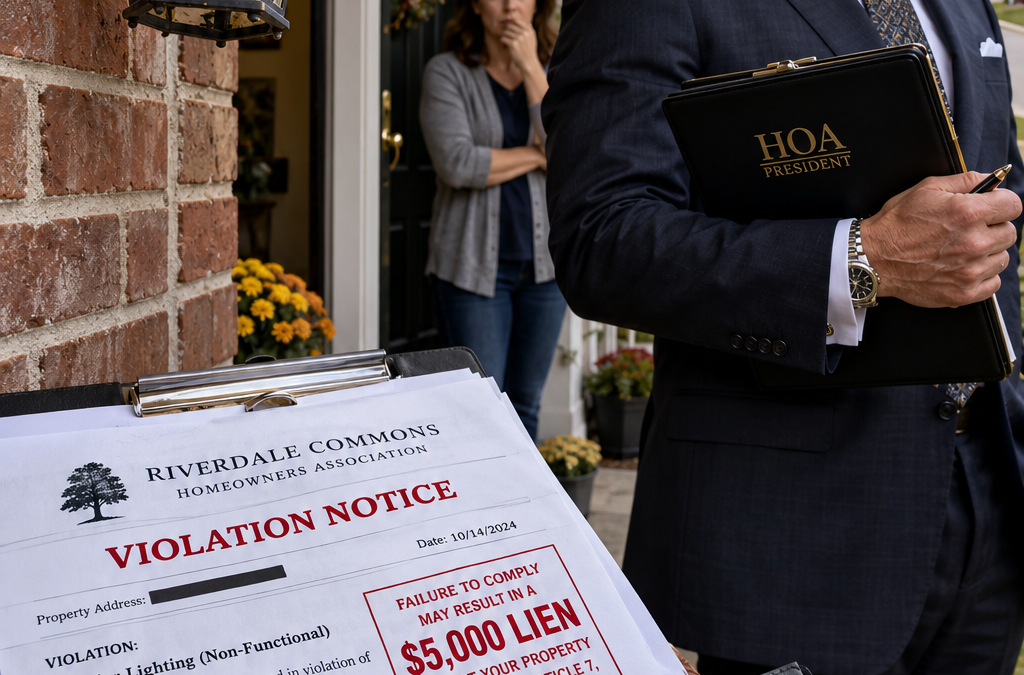
𝗙𝗨𝗟𝗟 𝗦𝗧𝗢𝗥𝗬
I handed her the letter.
She read it, frowned, then looked out the window at the trimmed lawn.
“This is ridiculous.”
“I know.”
“Can they really fine you for that?”
“It says they can.”
She looked at the bottom of the page.
“What does lien action mean?”
“Probably just scare language.”
I said it casually because I wanted it to be true.
I paid the fifty dollars.
That was my first mistake.
At the time, it seemed easier than fighting. We had work, bills, appointments, aging parents, and all the normal pressures of adult life. I didn’t want to spend my evening arguing with a woman who clearly enjoyed arguing. Fifty dollars felt cheaper than stress.
But Deborah Voss understood that kind of calculation better than I did.
She knew most people would pay a small fine just to avoid trouble.
Then she learned who would keep paying.
The next notice came two weeks later.
Trash cans visible from the street before the permitted time.
I checked the rule. Containers were supposed to be placed at the curb no earlier than 6:00 p.m. the night before pickup.
Deborah’s photo showed my trash cans at 5:08 p.m.
The problem was, that photo had to be old.
I remembered that day clearly because Rosa and I had gone to her sister’s house for dinner, and I hadn’t pulled the cans out until after we got home at 7:30. I even had a receipt from the gas station where we stopped on the way back.
Still, the fine arrived.
Seventy-five dollars.
I thought about challenging it.
Then I pictured Deborah at the next board meeting, smiling that icy smile, asking why I was wasting everyone’s time over seventy-five dollars.
I paid.
Then came the wind chime.
Rosa had bought it at a craft fair in Amish country. It hung beside the porch and made a soft, hollow sound when the wind moved through. Not loud. Not sharp. Just gentle.
Deborah called it an “unapproved auditory nuisance.”
Another fine.
Then Halloween.
Rosa set one pumpkin beside the front steps. Not a giant inflatable ghost. Not flashing lights. Not fake tombstones. One pumpkin.
The notice called it unauthorized seasonal decor because it had not been submitted for architectural review.
That was the first time I went to an HOA meeting angry.
The clubhouse smelled like burnt coffee and floor cleaner. About twenty homeowners sat in rows of folding chairs while Deborah presided from the front table, wearing pearls, a navy blazer, and an expression that suggested she had been inconvenienced by our existence.
When the floor opened for comments, I stood.
“I’d like to ask about the violation notices I’ve received.”
Deborah looked over the top of her glasses.
“Name and address for the record.”
She knew my name. Everybody in the room knew she knew it.
“George Callahan. 118 Maple Hollow Court.”
She wrote something on the paper in front of her.
“You may proceed.”
“I was fined for grass length while I was actively mowing. Then for trash cans using a photo I believe was taken on a different day. Then for a wind chime and a pumpkin.”
A few neighbors shifted in their seats.
I continued.
“I reviewed the bylaws. They’re vague on grass length, and I don’t see anything requiring architectural approval for a single pumpkin on the porch.”
Deborah smiled.
“Board discretion applies where the bylaws do not list every possible exterior condition.”
“Funny thing about discretion,” I said, before I could stop myself. “It seems to land mostly on certain houses.”
The room got quiet.
Deborah’s smile remained, but her eyes sharpened.
“Are you accusing this board of misconduct?”
“I’m asking how you decide who gets fined.”
“We enforce standards as needed.”
“Against everyone?”
“Against violations.”
I looked around the room.
Nobody met my eyes for long.
That was my first real clue.
People were afraid of her.
Not annoyed.
Not frustrated.
Afraid.
Deborah leaned toward the microphone.
“If you are unhappy with community standards, Mr. Callahan, you are free to submit a written recommendation to the board.”
“And if the board ignores it?”
“Then perhaps Maple Hollow is not the right community for you.”
There it was.
A warning dressed as a polite suggestion.
I sat down.
On the way out, my neighbor Priya caught up with me in the parking lot. She lived three doors down, a software project manager with sharp eyes and a sharper memory. She glanced toward the clubhouse before speaking.
“Be careful with Deborah.”
“I’m starting to understand that.”
“No,” Priya said quietly. “I mean really careful.”
I looked at her.
“What do you know?”
She hesitated, then lowered her voice.
“She handles people.”
“Handles?”
“That’s what folks call it.”
I almost laughed, but her face stopped me.
“What does that mean?”
“It means if she decides you’re a problem, the letters start. Then fees. Then threats. Then people get tired and sell.”
I stared at her.
“Sell their houses?”
She nodded.
“Three families in two years.”
“That can’t be right.”
“It is.”
“Why doesn’t anyone fight her?”
Priya looked toward the clubhouse doors.
“Because fighting her costs money. Selling feels like escape.”
I stood there under the yellow parking lot light, suddenly colder than I had been a minute earlier.
“Who bought the houses?”
Priya’s mouth tightened.
“That’s the part nobody talks about.”
“What part?”
“The buyers always seem connected to a company tied to Deborah’s brother-in-law’s real estate firm.”
For a second, the background noise faded.
Cars on the road. Crickets in the grass. Someone laughing near the clubhouse entrance.
All of it seemed distant.
“You’re saying she fines people until they sell low, and then someone connected to her family buys?”
“I’m saying it looks that way.”
“Can you prove it?”
“Not yet.”
That was the night I started the folder.
I labeled it HOA at first.
Inside went every violation notice, every envelope, every payment confirmation, every email, every photo of the yard, the trash cans, the porch, the pumpkin, the wind chime, and the grass after every mowing.
Then I started taking screenshots.
Dates.
Times.
Weather.
Security camera clips.
If Deborah wanted a paper war, I was going to document every inch of the battlefield.
Rosa thought I was overreacting at first.
She stood in the doorway of the spare bedroom while I spread papers across the desk.
“George, you’re turning the house into a law office.”
“I’m protecting us.”
“From an HOA president?”
“From someone who thinks she can threaten our home.”
Rosa walked over, picked up one of the notices, and read the bold lien warning at the bottom.
Her face changed.
“Do you think she’d really do that?”
“I don’t know.”
That was the honest answer.
And it was enough to make both of us quiet.
The broken porch light fine came next.
The bulb above our front steps burned out during a storm. I noticed it the following morning and replaced it after work.
By then, Deborah had already issued a notice.
Exterior safety lighting failure. Continued non-compliance. Administrative penalty.
Two hundred dollars.
I emailed her immediately.
The light was out for less than twenty-four hours. It was fixed. Please withdraw the fine.
Her reply came ten minutes later.
Violation existed at time of inspection. Fine stands.
I stared at that sentence until my jaw hurt.
That was Deborah’s entire governing philosophy.
If she saw it, you owed.
If you questioned it, you owed more.
If you fought, she came for the house.
The fines multiplied after that.
A shrub supposedly over height.
A hose visible beside the garage.
A recycling bin lid not fully closed.
A small crack in the driveway sealant.
Every violation notice ended with the same lien warning.
Rosa started losing sleep.
I would wake around three in the morning and find her sitting in the living room, wrapped in a blanket, staring at nothing.
One night, I sat beside her.
“You okay?”
She looked at me with tired eyes.
“What happens if she files a lien?”
“We fight it.”
“With what money?”
I didn’t answer fast enough.
She looked toward the hallway, toward the framed photos on the wall, toward everything that made this house ours.
“We spent ten years paying this place down, George.”
“I know.”
“We skipped vacations. We drove old cars. We fixed things ourselves.”
“I know.”
“I can’t lose it over a porch light.”
“You won’t.”
I said it with more certainty than I felt.
Rosa leaned into me.
“I’m scared.”
“I am too.”
That was the first time I said it out loud.
Fear has a way of becoming smaller when named, but not harmless. It still sat between us. It still followed me to work. It still made me check the mailbox like it might explode.
Then I found the timestamp problem.
One of Deborah’s violation photos claimed my trash cans were visible at 7:03 a.m. on a Monday.
But something about the lighting looked wrong. The shadows fell across the driveway from the west, not the east. I opened the photo on my computer and enlarged it.
Then I checked my own security camera from that morning.
At 7:03 a.m., the cans were not visible.
They were behind the side gate.
I checked again.
Then again.
Then I looked at Deborah’s photo metadata.
The visible timestamp printed on the notice said Monday at 7:03 a.m.
But the image data suggested the original file had been created days earlier.
My pulse quickened.
I opened another fine.
Then another.
Several photos had inconsistencies.
One showed my lawn supposedly overgrown on a day after I had cut it, yet the photo contained Halloween decorations that had already been removed.
Another showed the porch light out on a date when the replacement bulb was already installed.
The most absurd one was a photo of my trash cans supposedly taken at 7:00 a.m. on a Saturday when Deborah’s own social media betrayed her.
She had posted a cheerful Ring doorbell clip that morning, bragging about “finally sleeping in until 9.”
In the reflection on her front window, visible in the video, her golf cart was parked in the garage. Her driveway was empty. She had not been driving past my house at seven.
Yet somehow her violation report said she had photographed my cans at that exact time.
I leaned back from the computer.
My fear began changing shape.
It did not disappear.
It hardened.
She was not mistaken.
She was staging evidence.
Pulling old photos. Changing dates. Manufacturing violations that had not happened when she claimed they happened.
I printed everything.
The photo metadata. My camera stills. Deborah’s public post. The timeline.
When Rosa came home, I had papers spread across the kitchen table.
She looked at my face and stopped.
“What happened?”
“She’s lying.”
“About what?”
“The photos. The dates. The inspections.”
I showed her.
One image after another.
At first, she just stared.
Then she covered her mouth.
“She can’t do this.”
“She already did.”
Rosa sat slowly.
“So the fines—”
“Some of them are fabricated.”
“And the lien threats?”
“Built on those fines.”
Her eyes filled with tears, but this time they were not only fear.
They were anger.
“She’s trying to steal our home.”
I didn’t answer.
Because for the first time, I thought she might be right.
I filed a formal request for the HOA’s financial records.
I cited the state rules that gave homeowners access to certain association documents. I requested violation ledgers, fine revenue records, vendor contracts, board minutes approving collection actions, and any records involving recent property liens.
Deborah stalled.
First she said the records were being audited.
Then she said the management software was being updated.
Then she claimed the board secretary was ill.
Then she said I had not submitted the request through the proper form, even though I had used the form from the HOA website.
I resubmitted it.
Certified mail.
Email.
Hand-delivered copy.
No more excuses.
The next time I saw her was at a board meeting. She stood near the coffee table, holding a paper cup. When I approached, her smile appeared before her eyes were ready.
“George.”
“Deborah.”
“I received your records request.”
“I know.”
“It’s rather broad.”
“It’s specific.”
“It may take time.”
“The law gives you a deadline.”
Her fingers tightened around the cup.
Just slightly.
But I saw it.
Coffee rippled near the rim.
That tremor told me more than her words did.
She was nervous.
I filed it away.
A few nights later, Priya came over after dark. She brought a folder of her own.
Rosa made coffee while we sat at the kitchen table.
Priya opened the folder and placed three property sale records in front of me.
“These are the families I told you about.”
The Matthews family. The Carver family. The Lanes.
All had received escalating fines.
All sold below market value.
All sold after lien threats.
And all three properties were purchased by holding companies with mailing addresses connected to a real estate operation owned by Deborah’s brother-in-law.
I looked at the documents until the names blurred.
“This is insane.”
“It’s organized,” Priya said.
Rosa sat beside me.
“She’s forcing people out.”
Priya nodded.
“Or pressuring them so hard that selling feels like the only way to breathe.”
“And then her family benefits.”
“Looks that way.”
I pushed back from the table.
“This isn’t about grass.”
“No,” Priya said. “It never was.”
That was twist number one, although it didn’t feel like a twist in the moment.
It felt like a trap finally becoming visible.
The fines were not random.
The lien threats were not merely cruel.
They were pressure.
Slow, calculated pressure, designed to make targeted homeowners desperate enough to sell quickly and cheaply.
A land grab dressed up as bylaw enforcement.
I couldn’t prove the whole scheme yet, but I could see the outline.
Every fine was a shove.
Every letter was a warning shot.
Every lien notice was a hand on the back of a homeowner’s neck, pushing them toward the door.
The next morning, I called an attorney.
His name was Mateo Alvarez, though everyone called him Mr. Alvarez. He specialized in HOA disputes and real estate fraud. His office was downtown, above a title company, and the walls were lined with framed court filings instead of diplomas.
He was a compact man with sharp eyes, silver hair, and the calm manner of someone who enjoyed complicated fights.
When I placed my folder on his desk, he looked at it for two seconds before opening it.
“Most people bring me emotions,” he said. “You brought me evidence.”
“I’ve got plenty of emotions too.”
He smiled faintly.
“We’ll use the evidence first.”
For nearly an hour, he reviewed the notices, the photos, the metadata comparisons, the Ring video, the sale records Priya had found, and Deborah’s delays over financial documents.
By the time he finished, his expression had changed.
“This isn’t sloppy management.”
“That’s what I thought.”
“This looks intentional.”
I swallowed.
“How serious is it?”
“If the records support what this suggests, serious enough that Deborah Voss should be worried.”
He tapped the violation photos.
“Fabricated evidence.”
Then the sale records.
“Potential predatory enforcement tied to insider purchases.”
Then the financial request.
“Stalling inspection of records.”
Then the lien notice.
“And collection pressure based on questionable charges.”
He looked up.
“This looks criminal.”
The word sat in the room.
Criminal.
Not petty.
Not excessive.
Not unfair.
Criminal.
“What do we do?”
“We escalate properly.”
He prepared a formal records demand through the state HOA oversight channels, attaching the timestamp discrepancies as evidence of possible fraud. He sent letters to the board, the management company, and Deborah directly. He demanded preservation of records relating to fines, liens, vendor contracts, home sale communications, board votes, and any correspondence involving companies linked to board members or their relatives.
He also warned them not to destroy or alter documents.
That letter changed everything.
Deborah could have retreated.
She could have paused enforcement, hired counsel, and let the records speak.
Instead, she escalated.
Two weeks later, she called an emergency board vote to approve foreclosure proceedings against my home.
The notice arrived by email and certified mail.
Rosa read it in silence.
Then she put one hand on the kitchen counter to steady herself.
“George.”
“I know.”
“They’re really doing it.”
“Trying to.”
Her voice cracked.
“What if we lose?”
I took the letter from her.
“We won’t go in unprepared.”
The meeting was scheduled for Thursday night at the community center.
By then, word had spread through the neighborhood group chat. Priya had told a few people. Others had received their own suspicious fines and started talking. For once, fear began turning into solidarity.
When Rosa and I arrived, the parking lot was full.
Residents stood in clusters near the entrance. People who had barely spoken to me before nodded as I passed. A few touched my shoulder. Gary from the next street whispered, “Give her hell,” then immediately looked embarrassed for saying it in front of Rosa.
Inside, every chair was taken.
Deborah stood at the podium, wearing pearls and a cream-colored blazer, composed as ever. A stack of papers sat in front of her. Her husband stood near the back wall, arms crossed. Three board members sat behind the table, looking uncomfortable.
Mr. Alvarez sat beside me, silent, his briefcase closed.
Deborah called the meeting to order.
She spoke for ten minutes about responsibility, standards, unpaid fines, and the difficult burden of protecting property values.
Then she turned toward me.
“Mr. Callahan has repeatedly refused to bring his property into compliance, failed to satisfy outstanding penalties, and forced this board to consider remedies no association wishes to pursue.”
Rosa’s hand tightened around mine.
I kept my face still.
Deborah continued, reading from her prepared notes as if reciting scripture.
“Brook Haven cannot function if homeowners decide rules apply only when convenient.”
Then Priya raised her hand from the third row.
Deborah’s eyes narrowed.
“This is a board proceeding, Priya.”
Priya stood anyway.
“I have a question about the homes that were sold after lien threats.”
The room went silent.
Deborah’s smile flickered.
“What homes?”
“The Matthews, Carver, and Lane properties.”
A murmur moved through the room.
Priya held up copies of the sale records.
“All three received escalating violation notices before selling below market value. All three were purchased through companies linked to your brother-in-law’s real estate firm.”
Deborah’s mouth tightened.
“That is irrelevant.”
Her voice cracked on the second syllable.
Just slightly.
But everyone heard it.
Three board members exchanged uneasy glances.
Mr. Alvarez leaned toward me and whispered, “Good. Let her talk.”
Deborah gripped the podium.
“This meeting concerns Mr. Callahan’s unpaid violations, not conspiracy theories.”
I stood.
“They’re not unpaid.”
She turned toward me.
“Excuse me?”
“I disputed fabricated fines. I paid some early ones. You added fees based on photos with altered timestamps.”
Her face hardened.
“That is false.”
Mr. Alvarez stood beside me.
“We have submitted the evidence to the appropriate oversight body.”
Deborah lifted her chin.
“Then let them review it. Tonight, this board votes.”
The board secretary looked down at her papers.
“Deborah, maybe we should postpone until counsel—”
“No,” Deborah snapped.
Her mask slipped again.
Then she inhaled and recovered.
“No. The association has been patient long enough.”
That was the moment I realized something.
She needed this vote.
Not tomorrow.
Not after records review.
Not after oversight agencies became involved.
Tonight.
She needed my house under foreclosure pressure before her documents were examined too closely.
The board table was quiet.
Then Deborah moved to call the vote.
Before anyone could answer, Mr. Alvarez stood.
“Before any vote, I have one question.”
Deborah glared.
“You are not a member of this association.”
“I represent one.”
“This is not a courtroom.”
“No,” he said. “But if this board proceeds tonight, every person voting will be tied to a foreclosure action supported by evidence we believe to be fraudulent.”
The room went still.
He removed a folder from his briefcase and placed three photographs on the table.
“Fabricated timestamps.”
Another set of papers.
“Property sales involving targeted homeowners.”
Then a copy of the records demand.
“And refusal to produce financial records required for homeowner inspection.”
Deborah stared at him.
“You’re trying to intimidate the board.”
“I’m trying to prevent them from becoming witnesses against themselves.”
The board members looked at each other.
Deborah’s face flushed.
Then she said, “Vote.”
The secretary did not move.
That meeting ended without a vote.
Deborah stormed out through the side door while half the room whispered behind her.
I thought that night might force her to slow down.
I was wrong.
Two days later, an anonymous padded envelope arrived in my mailbox.
No return address.
Inside was a small thumb drive.
Rosa stood beside me as I held it.
“Don’t plug that into your computer,” she said.
“I’m not stupid.”
“I know. I’m just nervous.”
So was I.
I took it to Mr. Alvarez.
He had a digital forensics contact examine it safely.
The contents changed the entire case.
Internal HOA emails.
Messages between Deborah and a vendor.
Instructions to inflate late fees on targeted homeowners.
Requests to “increase pressure” on certain accounts.
Emails discussing which residents were “close to selling.”
And invoices from a company we had never seen before.
The company name sounded like a routine administrative vendor.
But Mr. Alvarez traced it quickly.
It belonged to Deborah’s son.
A shell company.
Billing the HOA for services never performed.
The inflated fees were not just pressure.
They were profit.
That was twist number two.
Deborah was not only bullying homeowners into selling. She was siphoning association money through fake invoices, using fines and fear as the smoke screen. Her son’s company billed for collection support, administrative processing, and compliance services that appeared either exaggerated or nonexistent.
My yard had never been the real issue.
My broken porch light had never been the real issue.
My house was one pressure point in a larger scheme.
When Mr. Alvarez finished reviewing the emails, he leaned back in his chair.
“This is bigger than your property.”
I nodded slowly.
“What happens now?”
“I’m sending this to the district attorney’s office.”
I looked at him.
“And Deborah?”
“She doesn’t know we have it?”
“No.”
“Good.”
The foreclosure hearing was scheduled for the following week.
Deborah pushed forward, apparently convinced that if she moved fast enough, she could break me before the investigation caught up with her.
The hearing was held in the Maple Hollow community center, under association procedures, with legal counsel present and residents watching from the back rows. It was not a court trial, though Deborah behaved as if she were the judge, prosecutor, and executioner combined.
Rosa sat beside me, pale but steady.
Priya sat behind us.
Mr. Alvarez had two thick folders in front of him.
Deborah arrived in a dark suit and pearls. Her hair was perfect. Her smile was controlled. She looked almost pleased.
As the meeting began, she read our violations aloud.
Grass over regulation.
Trash cans visible.
Wind chime nuisance.
Unauthorized holiday decor.
Exterior lighting failure.
Shrub height.
Driveway crack.
She savored every phrase.
Each word was meant to make us smaller.
Each violation was presented as if Rosa and I had spent six months attacking the peace of Maple Hollow instead of trying to protect our home from fabricated evidence.
When she finished, she looked at the board.
“This association cannot allow chronic non-compliance to continue.”
Mr. Alvarez stood.
“Then let’s discuss compliance.”
Deborah’s eyes narrowed.
He placed the first set of documents on the table.
“These are the violation photos submitted against my clients.”
Then he laid down the metadata reports.
“These are the creation dates, file records, and timestamp discrepancies.”
Then he added screenshots from my home security footage.
“These show that the alleged conditions did not exist when claimed.”
A hush fell over the room.
The air conditioner hummed overhead.
Deborah’s mouth tightened.
“This is technical manipulation.”
Mr. Alvarez did not raise his voice.
“No. This is evidence.”
He placed another folder down.
“These are property sale records for three prior homeowners targeted by similar enforcement pressure.”
Another folder.
“These are corporate links connecting the buyers to a real estate firm associated with Ms. Voss’s family.”
The board members stared at the papers.
Deborah’s face lost color.
Then Mr. Alvarez opened the final folder.
“And these are internal emails, vendor communications, and invoices connected to a shell company operated by Ms. Voss’s son.”
The room erupted.
Deborah grabbed the edge of the table.
“Where did you get those?”
Mr. Alvarez looked at her.
“Interesting first question.”
Her eyes flashed.
“You had no right to steal private communications.”
“We received evidence relevant to suspected fraud. The district attorney’s office has already been notified.”
That sentence changed the room.
Not gradually.
Instantly.
People stopped whispering.
Deborah stopped moving.
The board attorney leaned forward.
Mr. Alvarez continued.
“This is not HOA enforcement. It is a coordinated fraud scheme involving fabricated violations, inflated fees, insider real estate connections, and association funds diverted through false vendor billing.”
Deborah’s lips parted.
No sound came out.
Then the doors at the back of the community center opened.
Two uniformed officers stepped inside.
For the first time in eleven years, Deborah Voss looked genuinely afraid.
The lead officer approached the board table and asked for Deborah by name.
She stood slowly.
“This is absurd.”
No one answered.
He informed her that she was being taken into custody in connection with an ongoing investigation involving fraud, theft, mail interference, and related offenses.
Mail interference.
That was the final twist.
The city had installed cameras near the neighborhood mailbox kiosk months earlier after a vandalism complaint. None of us knew they had been operating clearly enough to matter.
Those cameras had captured Deborah tampering with resident mailboxes.
More than once.
She had been intercepting formal dispute letters before they reached the HOA’s official records. Complaints vanished. Appeals disappeared. Homeowners were marked as non-responsive because their responses never made it into the file.
She hadn’t just manipulated evidence.
She had physically stolen complaints from mailboxes.
A federal offense stacked on top of embezzlement, fraud, and predatory enforcement.
Deborah looked around the room as if expecting someone to stop what was happening.
No one did.
Not her husband.
Not the board.
Not the neighbors who had once whispered her name like a curse.
The handcuffs clicked under the fluorescent lights.
For a second, she looked directly at me.
There was no smirk now.
No clipboard.
No pearls powerful enough to protect her.
Just fear.
I didn’t smile.
I thought I would.
After everything she had done, I thought watching her fall would feel like victory.
But standing there beside Rosa, listening to my neighbors gasp and seeing years of terror collapse into stunned silence, all I felt was exhausted relief.
The kind that comes when you finally stop holding your breath.
The board dissolved within a month.
Technically, several members resigned first. Then the remaining officers voted to step aside under pressure from residents and outside counsel. A temporary committee took over, supervised by legal advisors until a new election could be held.
The investigation widened.
Deborah’s son was questioned about the shell company invoices.
Her brother-in-law’s real estate connections came under scrutiny.
The targeted sales were reviewed.
Residents who had moved away were contacted.
Priya helped locate the Ramirez family from a nearby development who had been through something similar years before. Others came forward. People who had paid fines they couldn’t afford. People who had sold homes just to escape the pressure. People who had thought they were alone.
Rosa and I were not alone anymore.
That mattered more than I expected.
My lien was withdrawn.
Every fine tied to Deborah’s fabricated evidence was voided.
The HOA refunded what I had paid, with interest, after the temporary board reviewed the case. The foreclosure threat disappeared. The letters stopped. The phrase continued non-compliance may result in lien action vanished from my life like a bad dream.
It took longer for Rosa to sleep through the night again.
For weeks after Deborah’s arrest, she still checked the front window whenever a golf cart went by. She still asked if we had mail from the HOA. She still kept the lien notice in a drawer because throwing it away felt like inviting the threat back.
One evening, I found her on the porch, staring up at the light above the front door.
It glowed warm and steady.
The same porch light Deborah had turned into a weapon.
I sat beside her.
“You okay?”
Rosa nodded.
“I keep thinking about how close we came.”
“We weren’t that close.”
She looked at me.
“We were terrified, George.”
That was true.
I could argue legal facts all day. I could say Deborah had no lawful right to take the house based on fabricated fines. I could say the evidence was on our side.
But fear doesn’t always wait for legal analysis.
For months, we had lived as if our home were balanced on the edge of a stranger’s signature.
“I’m sorry,” I said.
“For what?”
“For not fighting harder sooner.”
She shook her head.
“You fought when you understood what was happening.”
“I paid the first fines.”
“So did everyone.”
That was the truth Deborah had counted on.
She did not win by making one big demand at the beginning. She started small. Fifty dollars. Seventy-five. A minor notice. A little inconvenience. A warning at the bottom of the page.
Then another.
Then another.
By the time homeowners realized the danger, they were already tired, ashamed, confused, and afraid.
That was how she worked.
She didn’t break people in one blow.
She wore them down.
The new HOA election happened two months later.
For the first time in years, residents showed up in force. The community center was full again, but this time the air felt different.
No whispering.
No dread.
No Deborah at the podium.
Priya ran for the board and won. So did two retired accountants, a school counselor, and Gary, who claimed he only ran because “somebody had to make sure no one bought another clipboard with delusions of grandeur.”
The new board’s first official action was to suspend all fines pending review.
The second was to hire an independent accountant.
The third was to rewrite the enforcement process so no single person could issue penalties, inflate fees, intercept appeals, or push lien action without documented review.
They also created a rule that all homeowner complaints and appeals had to be logged digitally and confirmed by receipt.
No more disappearing letters.
No more invisible disputes.
No more one-woman kingdom.
A few weeks after the election, Rosa and I stood in the front yard while Gary inspected the mailbox kiosk from across the street.
“Feels different, doesn’t it?” he said.
“What does?”
“The whole place.”
I looked around.
A kid was drawing chalk stars on the sidewalk. Someone was trimming shrubs. A couple walked a dog past the corner lot. Nothing extraordinary.
“Yes,” I said. “It does.”
Gary nodded toward my porch.
“Light looks good.”
I laughed.
“Careful. That kind of comment used to cost money.”
“Not anymore.”
No, not anymore.
Deborah’s own house eventually became part of the restitution fight. I did not follow every legal detail because, after a while, I didn’t want her story living in our kitchen anymore. But I heard enough.
Assets frozen.
Liens filed.
Restitution claims.
Attorney fees.
The woman who had used lien threats like weapons now had her own property trapped beneath legal claims she could not smirk her way out of.
There was irony in that.
Maybe justice too.
But I tried not to build my peace on her suffering.
I wanted something better than revenge.
I wanted my home back.
And slowly, we got it.
Rosa replanted flowers by the porch.
I fixed the loose railing I had ignored during the worst of the fight.
We cleaned the garage.
I put the mower away without measuring the grass three times first.
The first Saturday I cut the lawn after everything settled, I shut off the mower and stood there listening.
No golf cart.
No camera shutter.
No voice from the curb announcing that I was a quarter inch over regulation.
Just wind in the maple tree and the hum of someone’s air conditioner down the street.
I looked at the grass.
It was ordinary.
Not a battlefield.
Not evidence.
Not leverage.
Just grass.
That realization almost made me laugh.
Rosa came outside with two glasses of iced tea.
“You done?”
“For today.”
She handed me a glass.
Then she looked at the lawn.
“Looks good.”
“Is that an official inspection?”
She smiled.
“Very official.”
“Do I pass?”
She leaned against me.
“You pass.”
That evening, we sat on the porch while the light glowed above us. The same light that had once appeared in a violation notice. The same fixture Deborah had tried to turn into a five-thousand-dollar threat.
It was almost ridiculous how peaceful it looked.
A porch light does not know it has been used as evidence.
A lawn does not know it has been measured by someone hungry for power.
A mailbox does not know someone tried to steal complaints from it.
Houses hold what people bring to them.
For months, Deborah had brought fear.
Now Rosa and I were trying to bring back something else.
Quiet.
Trust.
Ordinary evenings.
The truth did not fix everything all at once. It never does. Some neighbors still carried anger. Some felt embarrassed for staying silent. Some had to fight for refunds. Some former homeowners might never get back what Deborah’s pressure had cost them.
But the truth gave us a starting point.
It gave us records.
It gave us witnesses.
It gave prosecutors a case.
It gave residents courage.
And it gave Rosa and me our sleep back.
One night, several months after Deborah’s arrest, I found the original lien notice in the drawer where Rosa had kept it.
She watched me unfold it.
The paper was creased now, softened from being handled too many times.
Five thousand dollars.
Broken porch light.
Repeated non-compliance.
Threat against property.
I remembered the first time I read it. The way my hands shook. The way the kitchen seemed smaller. The way our home suddenly felt less secure, as if a stranger had found a hidden door into our life.
Rosa stood beside me.
“What are you going to do with it?”
I thought about throwing it away.
Then I thought about keeping it forever.
In the end, I folded it and placed it in the folder with the rest of the records.
Not because I was afraid anymore.
Because evidence matters.
Memory matters.
And people like Deborah count on exhaustion, confusion, and silence.
I closed the folder and put it on the highest shelf in the closet.
Then I turned off the light.
Outside, our porch lamp glowed steady and unbothered.
Rosa stood in the hallway, waiting.
“You coming?”
“Yeah.”
I took one last look toward the front window.
Maple Hollow Estates was quiet.
The streetlights were on.
The mailbox kiosk stood at the corner.
The lawns were cut, some shorter than others, and somehow the world had not ended.
Deborah Voss had tried to build a kingdom out of fear, paperwork, and stolen mail.
She had mistaken patience for weakness.
She had mistaken silence for consent.
And she had mistaken our home for something she could pressure, price, and take.
She was wrong.
In the end, it wasn’t anger that stopped her.
It wasn’t shouting.
It wasn’t revenge.
It was patience.
Evidence.
Neighbors finally willing to talk.
A lawyer who knew where to press.
A camera Deborah forgot existed.
And a truth that waited quietly beneath every forged timestamp, every fake invoice, every stolen letter, until it had enough weight to bring her whole kingdom down.
Rosa took my hand.
We went upstairs.
For the first time in months, neither of us checked the mailbox before bed.
Neither of us reread a notice.
Neither of us whispered about liens, fines, or foreclosure.
The porch light kept glowing below our bedroom window.
Steady.
Ordinary.
Ours.
𝗧𝗛𝗘 𝗘𝗡𝗗
The HOA President Turned My Broken Porch Light Into a $5,000 Threat Against My Home
The lien notice sat on my kitchen table like a loaded gun, and I stared at it with shaking hands, wondering how one broken porch light had become a five-thousand-dollar threat against the house Rosa and I had spent ten years paying for.
Six months earlier, none of this existed.
No threatening letters.
No sleepless nights.
No folder full of photos, timestamps, and certified mail receipts.
No lawyer.
No police officers walking through the doors of our community center while my neighbors sat frozen in their folding chairs.
Back then, it was just me, George Callahan, mowing my lawn on a quiet Saturday morning in our Ohio subdivision, trying to enjoy the first decent weather after a long gray spring.
Maple Hollow Estates had always been the kind of neighborhood people described with words like stable, quiet, and respectable. Brick ranch homes. Two-story colonials. Kids riding bicycles in circles around the cul-de-sac until somebody’s mother called them in. Men washing trucks in driveways. Women trading garden tips over fences. Nothing dramatic ever happened there.
That was why Rosa and I had bought our house.
We weren’t rich. I worked as a maintenance supervisor for a packaging plant, and Rosa worked part-time at a dental office. We had spent years saving for the down payment, years refinancing, budgeting, skipping vacations, replacing one appliance at a time, and doing almost every repair ourselves. When we finally got to the point where the mortgage balance looked manageable, it felt like breathing room.
Our house wasn’t fancy, but it was ours.
Three bedrooms. A small front porch. A maple tree near the curb. A backyard big enough for Rosa’s vegetable beds and my little tool shed. We had replaced the roof after a hailstorm, rebuilt the back steps, repainted the shutters, and planted hydrangeas along the side fence.
That house held ten years of our labor.
Brick by brick. Weekend by weekend. Paycheck by paycheck.
So when Deborah Voss rolled up in her golf cart that Saturday, clipboard in hand, sunglasses perched on her nose like a judge’s gavel, I had no idea she was bringing the first piece of a nightmare to my driveway.
I had just finished the last strip of grass near the sidewalk. The mower was still running when she stopped at the curb.
Deborah had been HOA president for eleven years, and she wore the position like inherited nobility. She was in her late fifties, always dressed as if she might be photographed for a magazine about suburban authority. Pearls at board meetings. Crisp blouses. Perfect hair. Lipstick that never seemed to fade. Her golf cart had a little Maple Hollow Estates decal on the front, and she drove it through the neighborhood like a patrol vehicle.
I shut off the mower and wiped sweat from my forehead.
“Morning, Deborah.”
She did not return the greeting.
Instead, she lifted her phone, snapped a picture of my front yard, and glanced down at her clipboard.
“Your grass is a quarter inch over regulation.”
I stared at her.
Then I laughed.
I actually laughed, because there was no other reasonable response.
“You’re joking.”
Her lips tightened.
“I don’t joke about property standards, George.”
“It’s Saturday morning. I’m mowing it right now.”
“The violation existed at the time of observation.”
I looked down at the lawn, then back at her.
“Deborah, the mower is still warm.”
“That doesn’t erase the violation.”
She said it so calmly that I stopped smiling.
“Are you seriously writing me up for grass while I’m cutting the grass?”
She clicked her pen.
“Standards only work when they are consistently enforced.”
Then she drove away before I could answer.
Three days later, the first fine arrived.
Fifty dollars.
Official letterhead. Formal language. A printed photograph of my lawn, taken from the street while I was standing beside the mower. At the bottom of the notice, in bold letters, was a sentence I would come to know by heart.
Continued non-compliance may result in lien action against your property.
I read that line twice.
Then I shook my head and laughed again, although not as easily as before.
Rosa found me at the kitchen table.
“What is it?”
I handed her the letter.
She read it, frowned, then looked out the window at the trimmed lawn.
“This is ridiculous.”
“I know.”
“Can they really fine you for that?”
“It says they can.”
She looked at the bottom of the page.
“What does lien action mean?”
“Probably just scare language.”
I said it casually because I wanted it to be true.
I paid the fifty dollars.
That was my first mistake.
At the time, it seemed easier than fighting. We had work, bills, appointments, aging parents, and all the normal pressures of adult life. I didn’t want to spend my evening arguing with a woman who clearly enjoyed arguing. Fifty dollars felt cheaper than stress.
But Deborah Voss understood that kind of calculation better than I did.
She knew most people would pay a small fine just to avoid trouble.
Then she learned who would keep paying.
The next notice came two weeks later.
Trash cans visible from the street before the permitted time.
I checked the rule. Containers were supposed to be placed at the curb no earlier than 6:00 p.m. the night before pickup.
Deborah’s photo showed my trash cans at 5:08 p.m.
The problem was, that photo had to be old.
I remembered that day clearly because Rosa and I had gone to her sister’s house for dinner, and I hadn’t pulled the cans out until after we got home at 7:30. I even had a receipt from the gas station where we stopped on the way back.
Still, the fine arrived.
Seventy-five dollars.
I thought about challenging it.
Then I pictured Deborah at the next board meeting, smiling that icy smile, asking why I was wasting everyone’s time over seventy-five dollars.
I paid.
Then came the wind chime.
Rosa had bought it at a craft fair in Amish country. It hung beside the porch and made a soft, hollow sound when the wind moved through. Not loud. Not sharp. Just gentle.
Deborah called it an “unapproved auditory nuisance.”
Another fine.
Then Halloween.
Rosa set one pumpkin beside the front steps. Not a giant inflatable ghost. Not flashing lights. Not fake tombstones. One pumpkin.
The notice called it unauthorized seasonal decor because it had not been submitted for architectural review.
That was the first time I went to an HOA meeting angry.
The clubhouse smelled like burnt coffee and floor cleaner. About twenty homeowners sat in rows of folding chairs while Deborah presided from the front table, wearing pearls, a navy blazer, and an expression that suggested she had been inconvenienced by our existence.
When the floor opened for comments, I stood.
“I’d like to ask about the violation notices I’ve received.”
Deborah looked over the top of her glasses.
“Name and address for the record.”
She knew my name. Everybody in the room knew she knew it.
“George Callahan. 118 Maple Hollow Court.”
She wrote something on the paper in front of her.
“You may proceed.”
“I was fined for grass length while I was actively mowing. Then for trash cans using a photo I believe was taken on a different day. Then for a wind chime and a pumpkin.”
A few neighbors shifted in their seats.
I continued.
“I reviewed the bylaws. They’re vague on grass length, and I don’t see anything requiring architectural approval for a single pumpkin on the porch.”
Deborah smiled.
“Board discretion applies where the bylaws do not list every possible exterior condition.”
“Funny thing about discretion,” I said, before I could stop myself. “It seems to land mostly on certain houses.”
The room got quiet.
Deborah’s smile remained, but her eyes sharpened.
“Are you accusing this board of misconduct?”
“I’m asking how you decide who gets fined.”
“We enforce standards as needed.”
“Against everyone?”
“Against violations.”
I looked around the room.
Nobody met my eyes for long.
That was my first real clue.
People were afraid of her.
Not annoyed.
Not frustrated.
Afraid.
Deborah leaned toward the microphone.
“If you are unhappy with community standards, Mr. Callahan, you are free to submit a written recommendation to the board.”
“And if the board ignores it?”
“Then perhaps Maple Hollow is not the right community for you.”
There it was.
A warning dressed as a polite suggestion.
I sat down.
On the way out, my neighbor Priya caught up with me in the parking lot. She lived three doors down, a software project manager with sharp eyes and a sharper memory. She glanced toward the clubhouse before speaking.
“Be careful with Deborah.”
“I’m starting to understand that.”
“No,” Priya said quietly. “I mean really careful.”
I looked at her.
“What do you know?”
She hesitated, then lowered her voice.
“She handles people.”
“Handles?”
“That’s what folks call it.”
I almost laughed, but her face stopped me.
“What does that mean?”
“It means if she decides you’re a problem, the letters start. Then fees. Then threats. Then people get tired and sell.”
I stared at her.
“Sell their houses?”
She nodded.
“Three families in two years.”
“That can’t be right.”
“It is.”
“Why doesn’t anyone fight her?”
Priya looked toward the clubhouse doors.
“Because fighting her costs money. Selling feels like escape.”
I stood there under the yellow parking lot light, suddenly colder than I had been a minute earlier.
“Who bought the houses?”
Priya’s mouth tightened.
“That’s the part nobody talks about.”
“What part?”
“The buyers always seem connected to a company tied to Deborah’s brother-in-law’s real estate firm.”
For a second, the background noise faded.
Cars on the road. Crickets in the grass. Someone laughing near the clubhouse entrance.
All of it seemed distant.
“You’re saying she fines people until they sell low, and then someone connected to her family buys?”
“I’m saying it looks that way.”
“Can you prove it?”
“Not yet.”
That was the night I started the folder.
I labeled it HOA at first.
Inside went every violation notice, every envelope, every payment confirmation, every email, every photo of the yard, the trash cans, the porch, the pumpkin, the wind chime, and the grass after every mowing.
Then I started taking screenshots.
Dates.
Times.
Weather.
Security camera clips.
If Deborah wanted a paper war, I was going to document every inch of the battlefield.
Rosa thought I was overreacting at first.
She stood in the doorway of the spare bedroom while I spread papers across the desk.
“George, you’re turning the house into a law office.”
“I’m protecting us.”
“From an HOA president?”
“From someone who thinks she can threaten our home.”
Rosa walked over, picked up one of the notices, and read the bold lien warning at the bottom.
Her face changed.
“Do you think she’d really do that?”
“I don’t know.”
That was the honest answer.
And it was enough to make both of us quiet.
The broken porch light fine came next.
The bulb above our front steps burned out during a storm. I noticed it the following morning and replaced it after work.
By then, Deborah had already issued a notice.
Exterior safety lighting failure. Continued non-compliance. Administrative penalty.
Two hundred dollars.
I emailed her immediately.
The light was out for less than twenty-four hours. It was fixed. Please withdraw the fine.
Her reply came ten minutes later.
Violation existed at time of inspection. Fine stands.
I stared at that sentence until my jaw hurt.
That was Deborah’s entire governing philosophy.
If she saw it, you owed.
If you questioned it, you owed more.
If you fought, she came for the house.
The fines multiplied after that.
A shrub supposedly over height.
A hose visible beside the garage.
A recycling bin lid not fully closed.
A small crack in the driveway sealant.
Every violation notice ended with the same lien warning.
Rosa started losing sleep.
I would wake around three in the morning and find her sitting in the living room, wrapped in a blanket, staring at nothing.
One night, I sat beside her.
“You okay?”
She looked at me with tired eyes.
“What happens if she files a lien?”
“We fight it.”
“With what money?”
I didn’t answer fast enough.
She looked toward the hallway, toward the framed photos on the wall, toward everything that made this house ours.
“We spent ten years paying this place down, George.”
“I know.”
“We skipped vacations. We drove old cars. We fixed things ourselves.”
“I know.”
“I can’t lose it over a porch light.”
“You won’t.”
I said it with more certainty than I felt.
Rosa leaned into me.
“I’m scared.”
“I am too.”
That was the first time I said it out loud.
Fear has a way of becoming smaller when named, but not harmless. It still sat between us. It still followed me to work. It still made me check the mailbox like it might explode.
Then I found the timestamp problem.
One of Deborah’s violation photos claimed my trash cans were visible at 7:03 a.m. on a Monday.
But something about the lighting looked wrong. The shadows fell across the driveway from the west, not the east. I opened the photo on my computer and enlarged it.
Then I checked my own security camera from that morning.
At 7:03 a.m., the cans were not visible.
They were behind the side gate.
I checked again.
Then again.
Then I looked at Deborah’s photo metadata.
The visible timestamp printed on the notice said Monday at 7:03 a.m.
But the image data suggested the original file had been created days earlier.
My pulse quickened.
I opened another fine.
Then another.
Several photos had inconsistencies.
One showed my lawn supposedly overgrown on a day after I had cut it, yet the photo contained Halloween decorations that had already been removed.
Another showed the porch light out on a date when the replacement bulb was already installed.
The most absurd one was a photo of my trash cans supposedly taken at 7:00 a.m. on a Saturday when Deborah’s own social media betrayed her.
She had posted a cheerful Ring doorbell clip that morning, bragging about “finally sleeping in until 9.”
In the reflection on her front window, visible in the video, her golf cart was parked in the garage. Her driveway was empty. She had not been driving past my house at seven.
Yet somehow her violation report said she had photographed my cans at that exact time.
I leaned back from the computer.
My fear began changing shape.
It did not disappear.
It hardened.
She was not mistaken.
She was staging evidence.
Pulling old photos. Changing dates. Manufacturing violations that had not happened when she claimed they happened.
I printed everything.
The photo metadata. My camera stills. Deborah’s public post. The timeline.
When Rosa came home, I had papers spread across the kitchen table.
She looked at my face and stopped.
“What happened?”
“She’s lying.”
“About what?”
“The photos. The dates. The inspections.”
I showed her.
One image after another.
At first, she just stared.
Then she covered her mouth.
“She can’t do this.”
“She already did.”
Rosa sat slowly.
“So the fines—”
“Some of them are fabricated.”
“And the lien threats?”
“Built on those fines.”
Her eyes filled with tears, but this time they were not only fear.
They were anger.
“She’s trying to steal our home.”
I didn’t answer.
Because for the first time, I thought she might be right.
I filed a formal request for the HOA’s financial records.
I cited the state rules that gave homeowners access to certain association documents. I requested violation ledgers, fine revenue records, vendor contracts, board minutes approving collection actions, and any records involving recent property liens.
Deborah stalled.
First she said the records were being audited.
Then she said the management software was being updated.
Then she claimed the board secretary was ill.
Then she said I had not submitted the request through the proper form, even though I had used the form from the HOA website.
I resubmitted it.
Certified mail.
Email.
Hand-delivered copy.
No more excuses.
The next time I saw her was at a board meeting. She stood near the coffee table, holding a paper cup. When I approached, her smile appeared before her eyes were ready.
“George.”
“Deborah.”
“I received your records request.”
“I know.”
“It’s rather broad.”
“It’s specific.”
“It may take time.”
“The law gives you a deadline.”
Her fingers tightened around the cup.
Just slightly.
But I saw it.
Coffee rippled near the rim.
That tremor told me more than her words did.
She was nervous.
I filed it away.
A few nights later, Priya came over after dark. She brought a folder of her own.
Rosa made coffee while we sat at the kitchen table.
Priya opened the folder and placed three property sale records in front of me.
“These are the families I told you about.”
The Matthews family. The Carver family. The Lanes.
All had received escalating fines.
All sold below market value.
All sold after lien threats.
And all three properties were purchased by holding companies with mailing addresses connected to a real estate operation owned by Deborah’s brother-in-law.
I looked at the documents until the names blurred.
“This is insane.”
“It’s organized,” Priya said.
Rosa sat beside me.
“She’s forcing people out.”
Priya nodded.
“Or pressuring them so hard that selling feels like the only way to breathe.”
“And then her family benefits.”
“Looks that way.”
I pushed back from the table.
“This isn’t about grass.”
“No,” Priya said. “It never was.”
That was twist number one, although it didn’t feel like a twist in the moment.
It felt like a trap finally becoming visible.
The fines were not random.
The lien threats were not merely cruel.
They were pressure.
Slow, calculated pressure, designed to make targeted homeowners desperate enough to sell quickly and cheaply.
A land grab dressed up as bylaw enforcement.
I couldn’t prove the whole scheme yet, but I could see the outline.
Every fine was a shove.
Every letter was a warning shot.
Every lien notice was a hand on the back of a homeowner’s neck, pushing them toward the door.
The next morning, I called an attorney.
His name was Mateo Alvarez, though everyone called him Mr. Alvarez. He specialized in HOA disputes and real estate fraud. His office was downtown, above a title company, and the walls were lined with framed court filings instead of diplomas.
He was a compact man with sharp eyes, silver hair, and the calm manner of someone who enjoyed complicated fights.
When I placed my folder on his desk, he looked at it for two seconds before opening it.
“Most people bring me emotions,” he said. “You brought me evidence.”
“I’ve got plenty of emotions too.”
He smiled faintly.
“We’ll use the evidence first.”
For nearly an hour, he reviewed the notices, the photos, the metadata comparisons, the Ring video, the sale records Priya had found, and Deborah’s delays over financial documents.
By the time he finished, his expression had changed.
“This isn’t sloppy management.”
“That’s what I thought.”
“This looks intentional.”
I swallowed.
“How serious is it?”
“If the records support what this suggests, serious enough that Deborah Voss should be worried.”
He tapped the violation photos.
“Fabricated evidence.”
Then the sale records.
“Potential predatory enforcement tied to insider purchases.”
Then the financial request.
“Stalling inspection of records.”
Then the lien notice.
“And collection pressure based on questionable charges.”
He looked up.
“This looks criminal.”
The word sat in the room.
Criminal.
Not petty.
Not excessive.
Not unfair.
Criminal.
“What do we do?”
“We escalate properly.”
He prepared a formal records demand through the state HOA oversight channels, attaching the timestamp discrepancies as evidence of possible fraud. He sent letters to the board, the management company, and Deborah directly. He demanded preservation of records relating to fines, liens, vendor contracts, home sale communications, board votes, and any correspondence involving companies linked to board members or their relatives.
He also warned them not to destroy or alter documents.
That letter changed everything.
Deborah could have retreated.
She could have paused enforcement, hired counsel, and let the records speak.
Instead, she escalated.
Two weeks later, she called an emergency board vote to approve foreclosure proceedings against my home.
The notice arrived by email and certified mail.
Rosa read it in silence.
Then she put one hand on the kitchen counter to steady herself.
“George.”
“I know.”
“They’re really doing it.”
“Trying to.”
Her voice cracked.
“What if we lose?”
I took the letter from her.
“We won’t go in unprepared.”
The meeting was scheduled for Thursday night at the community center.
By then, word had spread through the neighborhood group chat. Priya had told a few people. Others had received their own suspicious fines and started talking. For once, fear began turning into solidarity.
When Rosa and I arrived, the parking lot was full.
Residents stood in clusters near the entrance. People who had barely spoken to me before nodded as I passed. A few touched my shoulder. Gary from the next street whispered, “Give her hell,” then immediately looked embarrassed for saying it in front of Rosa.
Inside, every chair was taken.
Deborah stood at the podium, wearing pearls and a cream-colored blazer, composed as ever. A stack of papers sat in front of her. Her husband stood near the back wall, arms crossed. Three board members sat behind the table, looking uncomfortable.
Mr. Alvarez sat beside me, silent, his briefcase closed.
Deborah called the meeting to order.
She spoke for ten minutes about responsibility, standards, unpaid fines, and the difficult burden of protecting property values.
Then she turned toward me.
“Mr. Callahan has repeatedly refused to bring his property into compliance, failed to satisfy outstanding penalties, and forced this board to consider remedies no association wishes to pursue.”
Rosa’s hand tightened around mine.
I kept my face still.
Deborah continued, reading from her prepared notes as if reciting scripture.
“Brook Haven cannot function if homeowners decide rules apply only when convenient.”
Then Priya raised her hand from the third row.
Deborah’s eyes narrowed.
“This is a board proceeding, Priya.”
Priya stood anyway.
“I have a question about the homes that were sold after lien threats.”
The room went silent.
Deborah’s smile flickered.
“What homes?”
“The Matthews, Carver, and Lane properties.”
A murmur moved through the room.
Priya held up copies of the sale records.
“All three received escalating violation notices before selling below market value. All three were purchased through companies linked to your brother-in-law’s real estate firm.”
Deborah’s mouth tightened.
“That is irrelevant.”
Her voice cracked on the second syllable.
Just slightly.
But everyone heard it.
Three board members exchanged uneasy glances.
Mr. Alvarez leaned toward me and whispered, “Good. Let her talk.”
Deborah gripped the podium.
“This meeting concerns Mr. Callahan’s unpaid violations, not conspiracy theories.”
I stood.
“They’re not unpaid.”
She turned toward me.
“Excuse me?”
“I disputed fabricated fines. I paid some early ones. You added fees based on photos with altered timestamps.”
Her face hardened.
“That is false.”
Mr. Alvarez stood beside me.
“We have submitted the evidence to the appropriate oversight body.”
Deborah lifted her chin.
“Then let them review it. Tonight, this board votes.”
The board secretary looked down at her papers.
“Deborah, maybe we should postpone until counsel—”
“No,” Deborah snapped.
Her mask slipped again.
Then she inhaled and recovered.
“No. The association has been patient long enough.”
That was the moment I realized something.
She needed this vote.
Not tomorrow.
Not after records review.
Not after oversight agencies became involved.
Tonight.
She needed my house under foreclosure pressure before her documents were examined too closely.
The board table was quiet.
Then Deborah moved to call the vote.
Before anyone could answer, Mr. Alvarez stood.
“Before any vote, I have one question.”
Deborah glared.
“You are not a member of this association.”
“I represent one.”
“This is not a courtroom.”
“No,” he said. “But if this board proceeds tonight, every person voting will be tied to a foreclosure action supported by evidence we believe to be fraudulent.”
The room went still.
He removed a folder from his briefcase and placed three photographs on the table.
“Fabricated timestamps.”
Another set of papers.
“Property sales involving targeted homeowners.”
Then a copy of the records demand.
“And refusal to produce financial records required for homeowner inspection.”
Deborah stared at him.
“You’re trying to intimidate the board.”
“I’m trying to prevent them from becoming witnesses against themselves.”
The board members looked at each other.
Deborah’s face flushed.
Then she said, “Vote.”
The secretary did not move.
That meeting ended without a vote.
Deborah stormed out through the side door while half the room whispered behind her.
I thought that night might force her to slow down.
I was wrong.
Two days later, an anonymous padded envelope arrived in my mailbox.
No return address.
Inside was a small thumb drive.
Rosa stood beside me as I held it.
“Don’t plug that into your computer,” she said.
“I’m not stupid.”
“I know. I’m just nervous.”
So was I.
I took it to Mr. Alvarez.
He had a digital forensics contact examine it safely.
The contents changed the entire case.
Internal HOA emails.
Messages between Deborah and a vendor.
Instructions to inflate late fees on targeted homeowners.
Requests to “increase pressure” on certain accounts.
Emails discussing which residents were “close to selling.”
And invoices from a company we had never seen before.
The company name sounded like a routine administrative vendor.
But Mr. Alvarez traced it quickly.
It belonged to Deborah’s son.
A shell company.
Billing the HOA for services never performed.
The inflated fees were not just pressure.
They were profit.
That was twist number two.
Deborah was not only bullying homeowners into selling. She was siphoning association money through fake invoices, using fines and fear as the smoke screen. Her son’s company billed for collection support, administrative processing, and compliance services that appeared either exaggerated or nonexistent.
My yard had never been the real issue.
My broken porch light had never been the real issue.
My house was one pressure point in a larger scheme.
When Mr. Alvarez finished reviewing the emails, he leaned back in his chair.
“This is bigger than your property.”
I nodded slowly.
“What happens now?”
“I’m sending this to the district attorney’s office.”
I looked at him.
“And Deborah?”
“She doesn’t know we have it?”
“No.”
“Good.”
The foreclosure hearing was scheduled for the following week.
Deborah pushed forward, apparently convinced that if she moved fast enough, she could break me before the investigation caught up with her.
The hearing was held in the Maple Hollow community center, under association procedures, with legal counsel present and residents watching from the back rows. It was not a court trial, though Deborah behaved as if she were the judge, prosecutor, and executioner combined.
Rosa sat beside me, pale but steady.
Priya sat behind us.
Mr. Alvarez had two thick folders in front of him.
Deborah arrived in a dark suit and pearls. Her hair was perfect. Her smile was controlled. She looked almost pleased.
As the meeting began, she read our violations aloud.
Grass over regulation.
Trash cans visible.
Wind chime nuisance.
Unauthorized holiday decor.
Exterior lighting failure.
Shrub height.
Driveway crack.
She savored every phrase.
Each word was meant to make us smaller.
Each violation was presented as if Rosa and I had spent six months attacking the peace of Maple Hollow instead of trying to protect our home from fabricated evidence.
When she finished, she looked at the board.
“This association cannot allow chronic non-compliance to continue.”
Mr. Alvarez stood.
“Then let’s discuss compliance.”
Deborah’s eyes narrowed.
He placed the first set of documents on the table.
“These are the violation photos submitted against my clients.”
Then he laid down the metadata reports.
“These are the creation dates, file records, and timestamp discrepancies.”
Then he added screenshots from my home security footage.
“These show that the alleged conditions did not exist when claimed.”
A hush fell over the room.
The air conditioner hummed overhead.
Deborah’s mouth tightened.
“This is technical manipulation.”
Mr. Alvarez did not raise his voice.
“No. This is evidence.”
He placed another folder down.
“These are property sale records for three prior homeowners targeted by similar enforcement pressure.”
Another folder.
“These are corporate links connecting the buyers to a real estate firm associated with Ms. Voss’s family.”
The board members stared at the papers.
Deborah’s face lost color.
Then Mr. Alvarez opened the final folder.
“And these are internal emails, vendor communications, and invoices connected to a shell company operated by Ms. Voss’s son.”
The room erupted.
Deborah grabbed the edge of the table.
“Where did you get those?”
Mr. Alvarez looked at her.
“Interesting first question.”
Her eyes flashed.
“You had no right to steal private communications.”
“We received evidence relevant to suspected fraud. The district attorney’s office has already been notified.”
That sentence changed the room.
Not gradually.
Instantly.
People stopped whispering.
Deborah stopped moving.
The board attorney leaned forward.
Mr. Alvarez continued.
“This is not HOA enforcement. It is a coordinated fraud scheme involving fabricated violations, inflated fees, insider real estate connections, and association funds diverted through false vendor billing.”
Deborah’s lips parted.
No sound came out.
Then the doors at the back of the community center opened.
Two uniformed officers stepped inside.
For the first time in eleven years, Deborah Voss looked genuinely afraid.
The lead officer approached the board table and asked for Deborah by name.
She stood slowly.
“This is absurd.”
No one answered.
He informed her that she was being taken into custody in connection with an ongoing investigation involving fraud, theft, mail interference, and related offenses.
Mail interference.
That was the final twist.
The city had installed cameras near the neighborhood mailbox kiosk months earlier after a vandalism complaint. None of us knew they had been operating clearly enough to matter.
Those cameras had captured Deborah tampering with resident mailboxes.
More than once.
She had been intercepting formal dispute letters before they reached the HOA’s official records. Complaints vanished. Appeals disappeared. Homeowners were marked as non-responsive because their responses never made it into the file.
She hadn’t just manipulated evidence.
She had physically stolen complaints from mailboxes.
A federal offense stacked on top of embezzlement, fraud, and predatory enforcement.
Deborah looked around the room as if expecting someone to stop what was happening.
No one did.
Not her husband.
Not the board.
Not the neighbors who had once whispered her name like a curse.
The handcuffs clicked under the fluorescent lights.
For a second, she looked directly at me.
There was no smirk now.
No clipboard.
No pearls powerful enough to protect her.
Just fear.
I didn’t smile.
I thought I would.
After everything she had done, I thought watching her fall would feel like victory.
But standing there beside Rosa, listening to my neighbors gasp and seeing years of terror collapse into stunned silence, all I felt was exhausted relief.
The kind that comes when you finally stop holding your breath.
The board dissolved within a month.
Technically, several members resigned first. Then the remaining officers voted to step aside under pressure from residents and outside counsel. A temporary committee took over, supervised by legal advisors until a new election could be held.
The investigation widened.
Deborah’s son was questioned about the shell company invoices.
Her brother-in-law’s real estate connections came under scrutiny.
The targeted sales were reviewed.
Residents who had moved away were contacted.
Priya helped locate the Ramirez family from a nearby development who had been through something similar years before. Others came forward. People who had paid fines they couldn’t afford. People who had sold homes just to escape the pressure. People who had thought they were alone.
Rosa and I were not alone anymore.
That mattered more than I expected.
My lien was withdrawn.
Every fine tied to Deborah’s fabricated evidence was voided.
The HOA refunded what I had paid, with interest, after the temporary board reviewed the case. The foreclosure threat disappeared. The letters stopped. The phrase continued non-compliance may result in lien action vanished from my life like a bad dream.
It took longer for Rosa to sleep through the night again.
For weeks after Deborah’s arrest, she still checked the front window whenever a golf cart went by. She still asked if we had mail from the HOA. She still kept the lien notice in a drawer because throwing it away felt like inviting the threat back.
One evening, I found her on the porch, staring up at the light above the front door.
It glowed warm and steady.
The same porch light Deborah had turned into a weapon.
I sat beside her.
“You okay?”
Rosa nodded.
“I keep thinking about how close we came.”
“We weren’t that close.”
She looked at me.
“We were terrified, George.”
That was true.
I could argue legal facts all day. I could say Deborah had no lawful right to take the house based on fabricated fines. I could say the evidence was on our side.
But fear doesn’t always wait for legal analysis.
For months, we had lived as if our home were balanced on the edge of a stranger’s signature.
“I’m sorry,” I said.
“For what?”
“For not fighting harder sooner.”
She shook her head.
“You fought when you understood what was happening.”
“I paid the first fines.”
“So did everyone.”
That was the truth Deborah had counted on.
She did not win by making one big demand at the beginning. She started small. Fifty dollars. Seventy-five. A minor notice. A little inconvenience. A warning at the bottom of the page.
Then another.
Then another.
By the time homeowners realized the danger, they were already tired, ashamed, confused, and afraid.
That was how she worked.
She didn’t break people in one blow.
She wore them down.
The new HOA election happened two months later.
For the first time in years, residents showed up in force. The community center was full again, but this time the air felt different.
No whispering.
No dread.
No Deborah at the podium.
Priya ran for the board and won. So did two retired accountants, a school counselor, and Gary, who claimed he only ran because “somebody had to make sure no one bought another clipboard with delusions of grandeur.”
The new board’s first official action was to suspend all fines pending review.
The second was to hire an independent accountant.
The third was to rewrite the enforcement process so no single person could issue penalties, inflate fees, intercept appeals, or push lien action without documented review.
They also created a rule that all homeowner complaints and appeals had to be logged digitally and confirmed by receipt.
No more disappearing letters.
No more invisible disputes.
No more one-woman kingdom.
A few weeks after the election, Rosa and I stood in the front yard while Gary inspected the mailbox kiosk from across the street.
“Feels different, doesn’t it?” he said.
“What does?”
“The whole place.”
I looked around.
A kid was drawing chalk stars on the sidewalk. Someone was trimming shrubs. A couple walked a dog past the corner lot. Nothing extraordinary.
“Yes,” I said. “It does.”
Gary nodded toward my porch.
“Light looks good.”
I laughed.
“Careful. That kind of comment used to cost money.”
“Not anymore.”
No, not anymore.
Deborah’s own house eventually became part of the restitution fight. I did not follow every legal detail because, after a while, I didn’t want her story living in our kitchen anymore. But I heard enough.
Assets frozen.
Liens filed.
Restitution claims.
Attorney fees.
The woman who had used lien threats like weapons now had her own property trapped beneath legal claims she could not smirk her way out of.
There was irony in that.
Maybe justice too.
But I tried not to build my peace on her suffering.
I wanted something better than revenge.
I wanted my home back.
And slowly, we got it.
Rosa replanted flowers by the porch.
I fixed the loose railing I had ignored during the worst of the fight.
We cleaned the garage.
I put the mower away without measuring the grass three times first.
The first Saturday I cut the lawn after everything settled, I shut off the mower and stood there listening.
No golf cart.
No camera shutter.
No voice from the curb announcing that I was a quarter inch over regulation.
Just wind in the maple tree and the hum of someone’s air conditioner down the street.
I looked at the grass.
It was ordinary.
Not a battlefield.
Not evidence.
Not leverage.
Just grass.
That realization almost made me laugh.
Rosa came outside with two glasses of iced tea.
“You done?”
“For today.”
She handed me a glass.
Then she looked at the lawn.
“Looks good.”
“Is that an official inspection?”
She smiled.
“Very official.”
“Do I pass?”
She leaned against me.
“You pass.”
That evening, we sat on the porch while the light glowed above us. The same light that had once appeared in a violation notice. The same fixture Deborah had tried to turn into a five-thousand-dollar threat.
It was almost ridiculous how peaceful it looked.
A porch light does not know it has been used as evidence.
A lawn does not know it has been measured by someone hungry for power.
A mailbox does not know someone tried to steal complaints from it.
Houses hold what people bring to them.
For months, Deborah had brought fear.
Now Rosa and I were trying to bring back something else.
Quiet.
Trust.
Ordinary evenings.
The truth did not fix everything all at once. It never does. Some neighbors still carried anger. Some felt embarrassed for staying silent. Some had to fight for refunds. Some former homeowners might never get back what Deborah’s pressure had cost them.
But the truth gave us a starting point.
It gave us records.
It gave us witnesses.
It gave prosecutors a case.
It gave residents courage.
And it gave Rosa and me our sleep back.
One night, several months after Deborah’s arrest, I found the original lien notice in the drawer where Rosa had kept it.
She watched me unfold it.
The paper was creased now, softened from being handled too many times.
Five thousand dollars.
Broken porch light.
Repeated non-compliance.
Threat against property.
I remembered the first time I read it. The way my hands shook. The way the kitchen seemed smaller. The way our home suddenly felt less secure, as if a stranger had found a hidden door into our life.
Rosa stood beside me.
“What are you going to do with it?”
I thought about throwing it away.
Then I thought about keeping it forever.
In the end, I folded it and placed it in the folder with the rest of the records.
Not because I was afraid anymore.
Because evidence matters.
Memory matters.
And people like Deborah count on exhaustion, confusion, and silence.
I closed the folder and put it on the highest shelf in the closet.
Then I turned off the light.
Outside, our porch lamp glowed steady and unbothered.
Rosa stood in the hallway, waiting.
“You coming?”
“Yeah.”
I took one last look toward the front window.
Maple Hollow Estates was quiet.
The streetlights were on.
The mailbox kiosk stood at the corner.
The lawns were cut, some shorter than others, and somehow the world had not ended.
Deborah Voss had tried to build a kingdom out of fear, paperwork, and stolen mail.
She had mistaken patience for weakness.
She had mistaken silence for consent.
And she had mistaken our home for something she could pressure, price, and take.
She was wrong.
In the end, it wasn’t anger that stopped her.
It wasn’t shouting.
It wasn’t revenge.
It was patience.
Evidence.
Neighbors finally willing to talk.
A lawyer who knew where to press.
A camera Deborah forgot existed.
And a truth that waited quietly beneath every forged timestamp, every fake invoice, every stolen letter, until it had enough weight to bring her whole kingdom down.
Rosa took my hand.
We went upstairs.
For the first time in months, neither of us checked the mailbox before bed.
Neither of us reread a notice.
Neither of us whispered about liens, fines, or foreclosure.
The porch light kept glowing below our bedroom window.
Steady.
Ordinary.
Ours.








