𝗙𝗨𝗟𝗟 𝗦𝗧𝗢𝗥𝗬 The HOA President Tried to Turn My Own Neighborhood Into Evidence Against Me, and I Refused to Leave Before I Found Out Why
𝗣𝗔𝗥𝗧 𝟮
I would remember those words.
Within another month, I understood exactly what she meant.
Paint chips on the trim near my garage.
$200.
Trash bin visible from the street for forty-five minutes after collection.
$150.
A garden ornament allegedly exceeding the permitted size.
It was a ceramic bird less than three inches tall.
$175.
Late fees.
Administrative fees.
Reinspection charges.
Suddenly the balance was almost $1,000.
I disputed every new notice.
Dean denied each appeal.
Sometimes within hours.
Once, I submitted an appeal at 9:42 p.m.
At 7:06 the next morning, I had already received a formal denial allegedly reviewed by the board.
No meeting had occurred overnight.
At first, I thought the system was simply automated.
Then a certified letter came.
I signed for it before work.
The envelope contained a demand for payment and language explaining the association’s right to place a lien against my home.
One paragraph discussed foreclosure remedies.
The word appeared in bold.
FORECLOSURE.
I stood in my kitchen staring at it.
I can still remember the refrigerator humming behind me.
My coffee cooling on the counter.
Sunlight coming through the blinds.
Everything ordinary.
And one printed word changing the entire feeling of my house.
I had spent nine years trying to own a home.
Dean had spent a few months turning it into leverage.
My hands shook.
Not dramatically.
Just enough that the paper trembled.
I sat down.
Read it again.
Then again.
The actual balance wasn’t enough to justify losing a house.
But HOA liens could grow.
Legal fees could grow.
Collection costs could grow.
I didn’t know how far Dean could take it.
That ignorance was part of the fear.
I imagined my mortgage company getting involved.
I imagined court filings.
I imagined telling my parents I had lost the home I’d worked nearly a decade to buy because an HOA president claimed my grass and porch accessories violated neighborhood aesthetics.
I thought about calling Dean and paying everything.
Then I remembered the meeting.
Sweetie.
The smile.
The way he’d refused to identify an actual rule.
Something about it felt deliberate.
Not strict.
Cruel.
That night, I started a folder.
Every notice.
Every envelope.
Every email.
Every photograph.
I downloaded the bylaws and saved copies locally.
I created a spreadsheet with dates, violation descriptions, claimed inspection times, amounts, and appeal responses.
If Dean wanted paperwork, I decided I’d learn paperwork too.
The first real crack appeared almost accidentally.
I was searching old association newsletters online, trying to understand whether flagpole guidelines had changed.
I found an archived issue from two summers earlier.
There was a photograph from a community barbecue.
Dean stood in the background wearing sunglasses and holding a plate.
Behind him was his own front lawn.
Long.
Clearly overgrown.
The newsletter was dated during the exact week one of my supposed “repeat landscaping violations” had been cited.
I zoomed in.
Then laughed.
His grass was worse than mine had ever been.
I searched more newsletters.
More photographs.
Outdoor movie night.
Holiday decorating contest.
Board barbecue.
There were multiple examples of Dean’s own property failing standards he had used against me.
His trash bins were visible.
His yard contained decorative items larger than mine.
Once, his boat trailer sat in his driveway for almost a week despite rules limiting that kind of storage.
He had never fined himself.
Obviously.
But the larger realization wasn’t hypocrisy.
It was selective enforcement.
The rules were not being applied badly.
They were being applied strategically.
Against me.
I printed the photographs.
Added dates.
Cross-referenced the rules.
Then I walked across the street.
Mr. Delgado was sitting on his porch.
“I think he’s targeting me.”
He sighed before I finished.
“I know.”
I stopped.
“You know?”
“You think you’re the first?”
“Then why hasn’t anybody done anything?”
Mr. Delgado looked older suddenly.
He was in his seventies, with white hair and tired brown eyes.
“Because nobody wants the hassle, kid.”
“He threatened a lien.”
“I know.”
“Over a garden ornament.”
“I know.”
I sat in the porch chair beside him.
“Did he ever do this to you?”
“Not like this.”
“Why?”
Mr. Delgado looked toward Dean’s house.
“I learned to nod.”
That answer made me angry.
Not at him.
At the situation.
“So everybody just lets him?”
“He tires people out.”
“That isn’t authority.”
“No.”
“It’s bullying.”
Mr. Delgado shrugged.
“Bullying with letterhead.”
I stared at the houses around us.
Neat lawns.
Clean driveways.
Closed doors.
How many of those doors concealed people who had decided silence was cheaper?
“I can’t lose my house over this.”
Mr. Delgado looked at me.
“Then don’t.”
It sounded simple.
It wasn’t.
But that was when I stopped thinking only about the fines.
I wanted to understand the HOA itself.
Where did our dues go?
Who controlled enforcement?
Who hired the vendors?
Who approved payments?
Under the governing documents, homeowners had inspection rights for certain association records.
So I submitted a written request.
Budgets.
Bank statements.
Vendor contracts.
Maintenance invoices.
Meeting minutes.
Special assessments.
It should have been routine.
Dean responded four days later.
Your request is excessively broad and burdensome.
I wrote back asking what procedure I should use.
He didn’t answer.
Another week passed.
Then another.
I sent a second request.
Dean replied:
Financial records contain confidential information not available for unrestricted homeowner review.
I showed that response to a friend who worked in accounting.
She laughed.
“That sounds like a man hoping you don’t know what you’re entitled to.”
So I narrowed the request.
Maintenance invoices.
Landscaping payments.
Meeting minutes approving major expenditures.
No response.
I sent certified mail.
Finally, Dean produced documents.
Barely.
Pages were missing.
Some invoices had no vendor addresses.
Expense categories were absurdly vague.
“Grounds maintenance.”
“Community appearance.”
“Administrative adjustment.”
“Special services.”
Thousands of dollars moved with almost no useful description.
Several invoice numbers weren’t sequential.
Some board meeting minutes referenced votes without identifying who moved or seconded anything.
I sat on my living room floor surrounded by papers and realized I was completely out of my depth.
I needed someone who understood what these documents were supposed to look like.
That’s how I found Priya Anand.
Priya was a real estate attorney with a small office downtown and a reputation for dealing with HOA disputes.
I arrived carrying two folders.
She listened for forty minutes.
At first, she didn’t say much.
She flipped through notices.
Compared dates.
Read my appeals.
Reviewed the lien threat.
Then she reached the flagpole citation.
“Your neighbor has the same equipment?”
“Identical.”
“No citation?”
“None.”
She looked at the archived photograph of Dean’s yard.
Then the financial records.
Finally, she leaned back.
“This isn’t enforcement.”
I waited.
“This is harassment.”
Hearing a lawyer say it changed something inside me.
For months, Dean had made me feel unreasonable.
Oversensitive.
Difficult.
Like I was creating conflict by refusing to accept his version of reality.
Priya saw the same documents and reached the same conclusion in less than an hour.
“What do we do?”
“First, we make sure he knows you’re represented.”
She drafted a formal demand.
Selective enforcement.
Disputed fines.
Improper lien threats.
Incomplete records disclosure.
Preservation of documents.
Suspension of collection activity while the dispute was reviewed.
Priya’s letter was professional.
Calm.
Not threatening.
Just precise.
For one glorious week, Willow Court went silent.
No fines.
No inspection photographs.
No emails from Dean.
No certified envelopes.
I began sleeping through the night again.
I started to think hiring Priya had finally scared him into behaving like an adult.
Then the police came.
Two officers knocked on my door at 7:30 on a Tuesday evening.
I opened it with my stomach already tightening.
“Ms. Mia?”
“Yes.”
“I’m Officer Bennett. This is Officer Harris. We need to ask you about an incident reported near the Willow Ridge clubhouse.”
“What incident?”
The officers exchanged a glance.
“An allegation of trespassing and possible stalking behavior.”
I actually laughed.
I couldn’t help it.
“What?”
“Have you recently been near the clubhouse outside normal operating hours?”
“I walk past it all the time. Everyone does.”
“Have you been observing or photographing board members?”
My chest tightened.
“Who complained?”
They didn’t need to answer.
“Dean.”
Officer Bennett remained neutral.
“We’re not here to make assumptions.”
“Dean Cross filed this?”
“We’re following up on a report.”
I opened the door wider.
“Can I see it?”
They couldn’t simply hand me the investigative file, but they explained the allegation.
Dean claimed I had repeatedly loitered near the clubhouse, watched him through windows, approached restricted association areas, and followed his movements after board meetings.
None of it was true.
The incident he described as “persistent observation” was me walking to the community mailbox.
The “restricted area” was a public sidewalk outside the clubhouse.
The alleged following happened after a meeting when both of us drove out of the same subdivision because there was only one exit.
I felt sick.
He wasn’t merely fining me anymore.
He was trying to turn me into a criminal.
“I have cameras,” I said.
Officer Harris looked at me.
“Home cameras?”
“Doorbell. Driveway. Front yard.”
“Keep the footage.”
“I will.”
I called Priya the second the officers left.
She was furious.
Not loud.
Priya’s anger became quieter the more serious something got.
“Do not contact Dean.”
“I wasn’t planning to.”
“Write down everything the officers said while it’s fresh.”
“I already am.”
“I’ll request the incident report.”
“What if they believe him?”
“They’re investigating a complaint. That’s not the same thing.”
“It doesn’t feel different when two cops are standing at your door.”
“I know.”
My voice cracked despite myself.
“He wants me scared enough to leave.”
Priya was quiet.
“Then we make sure fear doesn’t make decisions for you.”
The police report arrived later.
It was worse than I expected.
Dean described me as unstable.
Obsessive.
Increasingly confrontational.
He claimed I was monitoring board activities and posed a potential threat.
But while Priya reviewed the report, she noticed something strange.
A supplemental note referenced prior complaints from the same HOA address.
She contacted the department for clarification.
One of the officers eventually told her this was not the first trespassing complaint originating from Dean’s address.
Three previous residents had been accused of similar conduct over the years.
Three.
Two had moved away.
The third had withdrawn complaints against the HOA shortly before selling.
I stared at Priya across her desk.
“He did this before.”
“It appears he used police reports during other disputes.”
“Did anyone investigate whether those reports were false?”
“Not thoroughly enough.”
That was the moment fear turned into resolve.
Until then, some part of me still wondered whether I should sell.
Take the loss.
Leave Willow Court.
Find peace somewhere else.
But those other homeowners had probably thought the same thing.
Dean had learned that harassment worked because eventually people disappeared.
I wasn’t disappearing.
Not anymore.
Priya filed a civil action challenging the enforcement campaign and seeking relief concerning harassment and the threatened lien.
Through the litigation process, we pursued the records Dean had refused to provide voluntarily.
This time, bank statements couldn’t be replaced with vague summaries.
The numbers told a story.
One landscaping vendor received thousands and thousands of dollars from the HOA.
Cross Outdoor Services.
Cross.
Priya circled the name.
“Any relation?”
“I don’t know.”
We checked business records.
Owner: Martin Cross.
Dean’s husband.
I stared at the screen.
“You’ve got to be kidding.”
Priya didn’t laugh.
“Does the contract disclose the relationship?”
We searched.
No clear conflict disclosure.
No documented competitive bidding process in the records we had.
No obvious board discussion acknowledging that the HOA president’s spouse owned a vendor receiving substantial association funds.
The more we looked, the worse it became.
Some landscaping invoices appeared inflated compared with work actually performed.
Charges repeated.
Seasonal services were billed at unusual intervals.
Maintenance descriptions were generic.
Meanwhile, homeowners were receiving special assessments and higher dues.
I leaned back in Priya’s chair.
“So he fines us for grass while his husband’s company gets paid to maintain the neighborhood?”
“That’s one issue.”
“And he controls the board reviewing the invoices.”
“Potentially another.”
I laughed.
Not because it was funny.
The audacity was almost impressive.
Then Mr. Delgado called me.
“You see Facebook?”
“No.”
“Look at Dean’s page.”
There it was.
Dean standing beside a brand-new boat.
White hull.
Chrome rails.
Huge smile.
Caption:
Hard work finally pays off.
The post had gone up three days after our latest dues increase.
By itself, the boat proved nothing.
Priya made that very clear.
People buy things.
People have savings.
People finance purchases.
But placed beside questionable vendor payments, incomplete records, special assessments, and unexplained maintenance charges, it was worth documenting.
We did.
Everything went into one complaint package.
Selective fines.
Backdated or inconsistent violations.
Lien threats.
False police report.
Incomplete financial disclosures.
Payments to a company owned by Dean’s husband.
Questionable invoices.
Prior similar complaints involving former residents.
We submitted the material to county authorities.
Then we waited.
Dean changed during those weeks.
The polished exterior remained.
Same tailored clothes.
Same silver hair.
Same controlled voice.
But the confidence underneath it began cracking.
He drove slowly past my house.
He attended fewer casual community events.
Board emails became longer and more defensive.
At one meeting he spent fifteen minutes explaining that “misinformation campaigns” threatened neighborhood property values.
He never said my name.
Everyone knew.
One afternoon, I found him standing near my driveway.
“What are you doing?”
He turned.
“Mia.”
“Why are you on my property?”
“I’m inspecting drainage.”
“From my driveway?”
“Common-interest communities require visual access.”
“My driveway isn’t common property.”
His jaw tightened.
“Your hostility is becoming tiresome.”
“So is finding you outside my house.”
He stepped closer.
“You think your lawyer changes anything?”
“Yes.”
That surprised him.
I continued.
“It means every time you threaten me, someone else writes it down too.”
His face hardened.
“Be careful.”
“You’ve been telling me that for six months.”
“Maybe you should start listening.”
I held up my phone.
“I’m recording now.”
Dean stopped.
His eyes dropped toward the screen.
Then he stepped off my driveway.
Smartest thing he did all year.
The county investigation started quietly.
We didn’t know exactly what authorities were reviewing.
Priya advised me not to speculate publicly.
Then investigators requested additional HOA records.
That was when Dean realized the danger was real.
And Dean responded to danger the way he always did.
By trying to control it.
The final confrontation began on a gray Thursday morning.
Two detectives arrived at Willow Ridge to execute investigative authority involving association financial records.
They intended to access the HOA office inside the clubhouse.
I was home because I had taken the morning off for a dental appointment.
Around 9:15, I saw an unmarked county vehicle turn onto Willow Court.
Then another.
Mr. Delgado texted me.
Something happening at clubhouse.
I didn’t go down there.
Priya had taught me that lesson.
Do not insert yourself into an active investigation.
But Willow Ridge had doorbell cameras everywhere.
And within minutes, half the neighborhood knew something was happening.
Dean arrived in his SUV.
Fast.
He parked crooked across two spaces and got out wearing a dark suit without a tie.
Even from a distance, I could tell he was furious.
One neighbor’s camera captured what happened next.
Dean approached the detectives as they walked toward the clubhouse entrance.
“Can I help you?”
One detective identified himself.
“We’re here regarding the association office.”
“You’ll need an appointment.”
“We don’t.”
Dean stepped in front of the door.
“This is private association property.”
The detective showed him documentation.
Dean barely looked.
“No one enters without board authorization.”
“Mr. Cross, step aside.”
“I am the board president.”
“We understand.”
“You clearly don’t.”
The detective remained calm.
“We are conducting an active investigation. Do not interfere.”
Dean planted himself directly between the officers and the door.
Hands spread.
Body blocking the entrance.
He had spent years stopping homeowners with paperwork.
Now he tried to stop detectives with his body.
“You’re not entering that office.”
The detective looked at him.
“Sir, step aside or you will be arrested.”
Any reasonable person would have moved.
Any frightened person would have moved.
Any person who understood that HOA authority ended somewhere before county law enforcement would have moved.
Dean couldn’t.
Because moving meant admitting there was an authority above him.
“I said no.”
The video captured everything.
The detective gave him another opportunity.
“Mr. Cross, this is your final warning.”
Dean pointed toward the clubhouse.
“Those records belong to this association.”
“We have lawful authority to access them.”
“You need my approval.”
“No, sir. We do not.”
Dean laughed.
Then he did something that sealed everything.
He put one hand against the detective’s chest.
Not a punch.
Not dramatic.
A blocking gesture.
But physical contact.
“Back up.”
The detective caught Dean’s wrist.
“Turn around.”
Dean jerked away.
“Get your hands off me!”
A second officer moved in.
“Sir, stop resisting.”
“I am in charge here!”
That’s when I stepped onto my porch.
Sirens had arrived.
Neighbors came outside.
The scene unfolded directly down the street, then moved toward the HOA office driveway near my end of the cul-de-sac.
Dean shouted the entire time.
“You’re making a mistake!”
“Call my attorney!”
“This is illegal!”
“I run this community!”
Then he saw me.
His expression changed.
“You!”
One officer was securing the second cuff.
Dean twisted toward me.
“This is because of her!”
The officer pulled him back.
“Face the vehicle.”
Dean shouted louder.
“She’s been stalking me for months!”
A detective looked in my direction.
Not suspiciously.
Almost wearily.
He already knew the history.
I didn’t say anything.
Dean kept shouting.
“Ask her! Ask what she’s done!”
Mr. Delgado walked down his driveway.
“Leave the girl alone, Dean.”
Dean stared at him.
“You stay out of this.”
Mr. Delgado stopped.
For years, he’d avoided challenging Dean.
Now he raised his chin.
“No.”
That one word was almost beautiful.
“No.”
More neighbors came outside.
Susan from the corner.
The Bradleys.
Marcus.
People Dean had fined.
People he’d intimidated.
People who had previously looked away.
The detective opened the rear patrol door.
Dean resisted again.
“Do you people understand what she’s done to this neighborhood?”
I finally spoke.
“What did I do, Dean?”
He looked at me.
“You couldn’t follow one simple rule.”
I almost laughed.
“Which one?”
His face twisted.
“The grass. The flagpole. All of it.”
“Which rule lets you file false police reports?”
He froze.
“Which rule lets your husband’s company bill the HOA without disclosure?”
“You don’t know what you’re talking about.”
“Then explain it to the detectives.”
His voice dropped.
“You think you’ve won something?”
I looked around Willow Court.
At my house.
At Mr. Delgado.
At neighbors who weren’t hiding anymore.
“This was never about winning.”
“It was always about you refusing to cooperate.”
“No.”
I stepped off my porch.
“You needed everybody afraid.”
The officer told me to stay back.
I did.
Dean was breathing hard now.
Sweat had appeared along his hairline.
His perfect appearance was coming apart.
“You people begged me to maintain standards!”
Nobody answered.
“I kept property values up!”
Still nobody.
“I protected this neighborhood!”
Mr. Delgado said, “You protected yourself.”
Dean looked at him with hatred.
The officer guided Dean into the car.
Before the door closed, he shouted one last time.
“I am still president!”
Then the door slammed.
Silence.
It was astonishing how quickly his voice disappeared behind glass.
For years, Dean’s words had filled Willow Ridge.
Letters.
Emails.
Meetings.
Warnings.
Rules.
Orders.
Now he was just a man sitting in the back of a patrol car.
The detectives entered the HOA office.
Records were collected.
Computers were secured.
Financial documents were preserved.
And because Dean had physically attempted to prevent investigators from entering, the obstruction charge was immediate and impossible to explain away as an accounting misunderstanding.
The doorbell footage showed everything.
Warning.
Refusal.
Second warning.
Physical blocking.
Contact with the detective.
Arrest.
What followed took months.
Real investigations are slower than stories.
There was no magical afternoon where every document suddenly made sense.
County investigators traced payments.
Subpoenaed accounts.
Interviewed homeowners.
Compared contracts.
Reviewed false police reports.
Former residents were located.
The people Dean had driven away finally had someone asking what happened.
Their stories sounded horribly familiar.
Selective violations.
Threats.
Lien warnings.
Police complaints.
Pressure to sell.
One former homeowner broke down during an interview because Dean had repeatedly reported him for trespassing in common areas after he challenged a roofing assessment.
Another family produced emails showing Dean had threatened escalating fines immediately after they questioned maintenance charges.
The pattern wasn’t subtle anymore.
Dean’s method was simple.
Identify resistance.
Create violations.
Increase financial pressure.
Use official systems to make the target appear unreasonable.
Police if necessary.
Lien threats if necessary.
Exhaust them.
Wait for surrender.
What he hadn’t anticipated was multiple victims telling the same story at once.
The financial investigation also confirmed serious misuse of association money.
Cross Outdoor Services had received substantial payments while Dean controlled the board process surrounding vendor selection and oversight.
Investigators uncovered conflicts that had not been properly disclosed.
Some maintenance invoices couldn’t be supported.
Certain expenses were inflated.
Funds earmarked for community purposes had been redirected or improperly used.
The new boat became relevant only when financial tracing connected personal benefit to misused money.
Priya called me one afternoon.
“They’ve filed charges.”
I sat down immediately.
“What charges?”
“Embezzlement-related counts. Filing false police reports. Obstruction. Additional financial charges may depend on the final accounting.”
I closed my eyes.
“Is that really happening?”
“Yes.”
For months, I had been afraid Dean would somehow turn everything back on me.
Now the allegations had his name on them.
Not mine.
Within days, the remaining board members removed him from office.
Technically, some insisted the bylaws required a formal emergency vote.
They held one.
Nobody defended him.
The vote was unanimous.
It was the first unanimous board vote involving Dean that I completely trusted.
An interim board took control.
Independent accountants reviewed years of records.
Collection activity based on Dean’s questionable enforcement was frozen.
That included mine.
Priya moved immediately against the lien threat.
Several weeks later, a letter arrived.
I almost didn’t open it.
Certified envelopes had become something I hated.
My stomach tightened just seeing the signature box.
I sat at the kitchen table before tearing it open.
The disputed lien was dissolved.
The fines were rescinded.
My account balance was corrected.
Every challenged violation was removed from the official enforcement record.
I read the paragraph three times.
Then I put the letter down.
And cried.
Not because I was sad.
Because I had spent months holding fear in places I didn’t know fear could live.
My shoulders.
My jaw.
My stomach.
Every knock at the door.
Every car slowing outside.
Every email notification.
Every time I saw Dean’s SUV.
I hadn’t realized how much of my own house I had stopped enjoying.
I had started treating my front door like a defensive position.
The mailbox like a threat.
My lawn like evidence.
Now a piece of paper finally said what I had known all along.
I had not been the problem.
An hour later, someone knocked.
My body still reacted before my brain did.
Heart racing.
Shoulders tightening.
I looked through the peephole.
Mr. Delgado.
He held a pie.
I opened the door.
“What’s this?”
“Apple.”
“Why?”
He smiled.
“Heard about the settlement letter.”
“How?”
“Willow Court has no secrets anymore.”
I laughed.
He handed me the pie.
“Guess the hassle was worth it, kid.”
I looked at him.
“You were right.”
“About what?”
“You told me nobody wanted the hassle.”
“That’s not being right.”
“Maybe not.”
I stepped aside.
“You want coffee?”
“Only if you promise it isn’t HOA compliant.”
We sat at my kitchen table eating pie.
Mr. Delgado told me something I’d never known.
Years earlier, after his wife became ill, Dean had cited them repeatedly for landscaping issues.
Mr. Delgado had paid because he didn’t have the energy to fight while taking his wife to chemotherapy appointments.
“I hated myself for it,” he said.
“Why?”
“Because every check felt like telling him he was right.”
“You were taking care of your wife.”
He looked down at his coffee.
“I know that now.”
I realized then that getting money back wouldn’t erase everything Dean had done.
Some damage wasn’t financial.
People had been made to feel unsafe in their own homes.
Ashamed.
Powerless.
Difficult.
Paranoid.
Some had moved.
Some had paid.
Some had stopped attending meetings.
Some had trained themselves not to ask questions.
Dean had taken ordinary neighborly peace and turned it into submission.
That couldn’t be refunded with interest.
But the money mattered too.
A court later ordered repayment connected to misused HOA funds.
Homeowners who had paid improper charges received reimbursements where records supported them.
Some received interest.
The association hired outside counsel to clean up years of enforcement records.
New financial controls were adopted.
No officer could approve a vendor contract involving a family member without full disclosure and independent board review.
Large payments required multiple approvals.
Monthly financial summaries became available to homeowners.
Violation notices had to include dated photographic evidence and specific bylaw citations.
Appeals could not be decided solely by the same individual who issued the violation.
Police referrals required actual emergencies or documented legal concerns, not personal feuds.
The changes seemed obvious.
That was the sad part.
They were ordinary safeguards any healthy organization should have had.
Dean had survived because people assumed someone else was checking.
Nobody was.
The county case continued.
Dean fought the charges.
Then negotiated portions as evidence accumulated.
The obstruction video became especially damaging because there was nothing ambiguous about it.
He had been told to step aside.
He refused.
He physically blocked officers carrying out a lawful investigation.
A neighbor’s camera had captured every word.
No selective memory.
No rewritten meeting minutes.
No HOA letterhead.
Just reality.
Eventually, Dean lost more than his board position.
The court ordered restitution connected to misused association funds.
The false reporting allegations became part of the criminal case.
The obstruction charge stood as a symbol of the same problem that had defined his entire presidency.
Dean believed authority meant everyone else moved.
Homeowners.
Board members.
Police.
Reality itself.
When reality finally refused, he pushed harder.
And that was what brought him down.
Months later, I was cleaning my office when I found the first grass violation.
One hundred fifty dollars.
Half an inch.
I stared at it for a long time.
Then I bought a cheap black frame.
I hung the notice above my desk.
People ask why.
It isn’t because the letter is funny.
It isn’t really a trophy either.
It’s a reminder.
The first time I received it, I thought paying would buy peace.
I thought small unfairness was easier to tolerate than conflict.
Sometimes that’s true.
Not every argument deserves a war.
But sometimes a small abuse is a test.
How much will you accept?
How quickly will you apologize?
How afraid are you of inconvenience?
Dean’s first fine taught him something about me.
I paid.
The next one tested whether I’d pay again.
Then came threats.
Then a lien.
Then police.
The escalation only stopped when I stopped treating each event as isolated.
That was the real lesson.
The grass wasn’t about grass.
The flagpole wasn’t about aesthetics.
The missing financial records weren’t administrative sloppiness.
The false trespass report wasn’t a misunderstanding.
Every piece belonged to the same system.
Control through exhaustion.
Dean didn’t need everyone to believe he was right.
He only needed them to believe fighting him was too expensive.
The new board president eventually knocked on my door.
Her name was Elena.
She was in her forties, worked as a nurse, and seemed genuinely uncomfortable with the title.
She stood on my porch holding no clipboard.
That alone made me like her.
“I wanted to ask you something.”
“Okay.”
“We’re reviewing older enforcement policies.”
“I heard.”
“Would you consider joining the compliance committee?”
I laughed.
“No.”
She laughed too.
“Fair.”
“I appreciate the offer.”
“Can’t blame me for asking.”
“No.”
She looked toward my lawn.
It was slightly overdue for mowing.
“Should I write you up?”
“Only if you want the shortest presidency in Willow Ridge history.”
She grinned.
“Noted.”
Then she became serious.
“We’re trying to do this differently.”
“I know.”
“People are still nervous.”
“That’ll take time.”
She nodded.
“What would help?”
I looked down the street.
Mr. Delgado was talking with another neighbor.
A couple of kids rode bicycles past Dean’s old house.
“Transparency.”
“Meaning?”
“If the board makes a decision, show people how. If money moves, show where. If somebody gets fined, show the exact rule. Don’t make residents beg for information that belongs to them.”
Elena nodded slowly.
“Anything else?”
“Don’t confuse being questioned with being disrespected.”
She smiled.
“I can work with that.”
After she left, I stood on the porch for a while.
Willow Court looked almost exactly the same as it had the day I moved in.
Same houses.
Same trees.
Same clubhouse.
Same sidewalks.
Dean’s old house eventually went on the market.
The boat disappeared long before that.
I didn’t ask where it went.
I didn’t care.
What surprised me was how quickly the neighborhood became ordinary again.
Not perfect.
Ordinary.
People disagreed at meetings.
Sometimes loudly.
Someone complained about dog waste stations.
Someone else hated the new pool hours.
Two neighbors argued for twenty minutes over whether holiday lights should be allowed through January 15.
Nobody got threatened with foreclosure.
Nobody called the police.
Nobody disappeared.
Ordinary disagreement turned out to be much healthier than enforced harmony.
My flagpole is still on the porch.
Same holder.
Same hardware.
Nobody has written me another violation.
My garden ornament came back too.
Not the two-inch one Dean cited.
A much larger gnome.
Mr. Delgado bought it for me as a joke.
It’s almost two feet tall.
Red hat.
Blue coat.
Ridiculous grin.
He left it on my porch with a card.
FOR MAXIMUM NONCOMPLIANCE.
I laughed so hard I had to sit down.
The current board doesn’t care.
Technically, the updated rules allow seasonal and personal garden decorations as long as they don’t obstruct sidewalks or create hazards.
Imagine that.
A rule based on an actual purpose.
I still mow my grass.
I still bring in my trash cans.
I still try to be considerate.
Getting rid of Dean didn’t make me hate community standards.
It taught me the difference between standards and domination.
Good rules make shared spaces easier to live in.
Bad leaders use rules to remind everyone who’s in charge.
Dean loved the second kind.
He enjoyed the fine print because it gave him endless opportunities to put himself between homeowners and their own property.
The strangest part is that none of us noticed how absurd that was until someone finally refused to move.
Sometimes I think about the day of his arrest.
Red and blue lights.
Dean shouting.
The patrol car door closing.
Mr. Delgado saying no.
That one quiet word stays with me more than the sirens.
No.
A small word.
Dean had spent years building a neighborhood where people were afraid to say it.
No, that violation isn’t legitimate.
No, you can’t hide the records.
No, you can’t threaten my home because I challenged you.
No, you can’t use police reports as intimidation.
No, you cannot physically block an investigation because you’re accustomed to people stepping aside.
Once enough people said it together, his power collapsed surprisingly fast.
Not because we became more powerful than he was.
Because we finally stopped lending him ours.
The last official document Priya sent me was a corrected account statement.
Balance due:
$0.
No outstanding violations.
No lien.
No enforcement action.
I printed it and put it in the folder that once held almost a thousand dollars of fines.
That folder is still in my desk.
I don’t keep it because I’m afraid anymore.
I keep it because paper works both ways.
Dean used paperwork to create fear.
I used paperwork to preserve truth.
Every timestamp.
Every email.
Every photograph.
Every missing page.
Every false report.
None seemed dramatic by itself.
Together, they became impossible to ignore.
My little house is still mine.
I still stand in the kitchen sometimes and remember the first day I got the keys.
I remember touching the counter and thinking nobody could tell me it didn’t belong to me.
I understand that thought differently now.
Ownership doesn’t mean nobody will challenge you.
It means that when they do, you shouldn’t surrender simply because their threat arrives on official stationery.
The grass violation above my desk has faded slightly.
The ink isn’t as dark as it used to be.
I could throw it away.
I won’t.
It reminds me how small this started.
Half an inch of grass.
One hundred fifty dollars.
One man testing whether another homeowner would pay quietly and move on.
He expected fear to keep Willow Court obedient forever.
Instead, that first ridiculous notice became the beginning of the paper trail that helped expose everything he was trying to hide.
And every morning when I step onto my porch, past the perfectly legal flagpole and the enormous ridiculous gnome Mr. Delgado bought me, I look down Willow Court and hear something I once took for granted.
Nothing.
No sirens.
No shouting.
No footsteps from an HOA president coming to inspect my property.
Just sprinklers.
Birds.
A lawn mower somewhere in the distance.
The sound of people living in homes that finally feel like theirs again.
𝗧𝗛𝗘 𝗘𝗡𝗗
The HOA President Tried to Turn My Own Neighborhood Into Evidence Against Me, and I Refused to Leave Before I Found Out Why
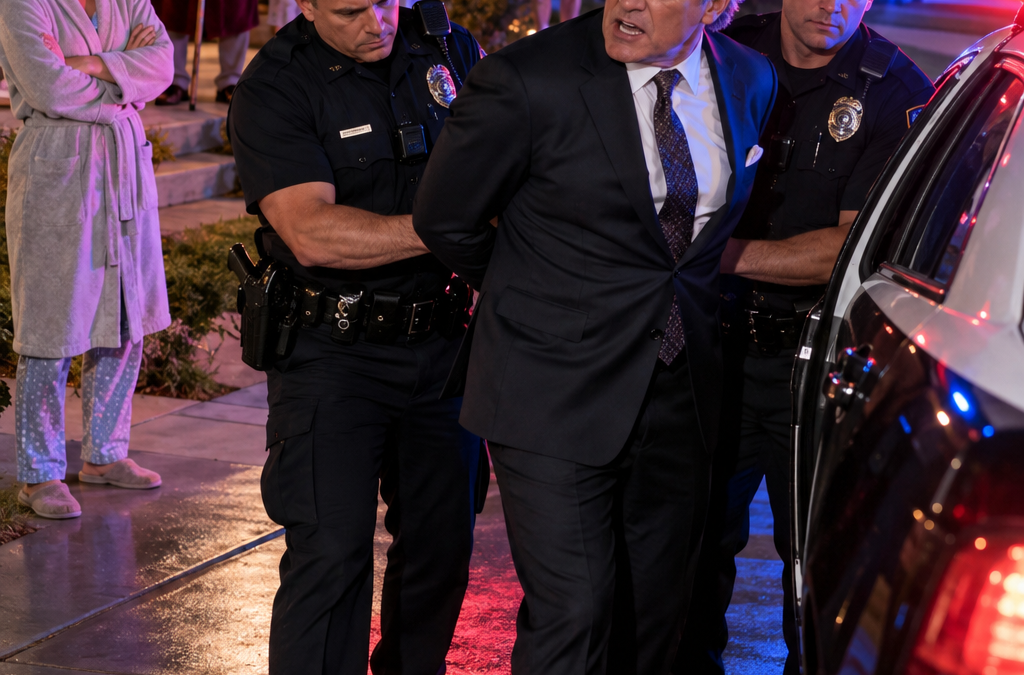
Red and blue lights flashed across my driveway hard enough to paint every window on Willow Court in alternating colors.
One second my little white house looked blue.
The next, blood red.
Neighbors stood barefoot on porches. Someone had come outside wearing a bathrobe. Mr. Delgado was at the edge of his lawn gripping his cane, his mouth hanging slightly open.
And in the middle of my driveway stood the president of our homeowners association, both wrists pulled behind his back.
“Take your hands off me!” he shouted.
An officer tightened one cuff.
“Sir, stop resisting.”
“I am the president of this association!”
Nobody answered.
“I said I am in charge here!”
The second officer guided him toward the patrol car.
For half a second, our eyes met.
Even then, with handcuffs around his wrists and two detectives standing between him and the office he’d spent years ruling like private property, Dean Cross looked at me as though I were the person who had done something wrong.
Six months earlier, none of us could have imagined Willow Court ending up like that.
Sirens.
Detectives.
Neighbors standing in the street.
Dean screaming about authority while the same police department he’d once tried to use against me put him into the back of a patrol vehicle.
Six months earlier, I still believed my biggest problem was a lawn half an inch too tall.
My name is Mia.
I bought my house on Willow Court because it finally felt like mine.
Not my landlord’s.
Not temporary.
Not a place where I needed permission to paint a wall or replace a faucet.
Mine.
The house wasn’t large.
Two bedrooms.
A narrow kitchen.
A one-car garage.
A porch just wide enough for two chairs and a planter.
There was a maple tree near the driveway that dropped leaves faster than I could rake them every October.
The bathroom tile was outdated.
The upstairs window stuck whenever humidity climbed.
The furnace made a clicking sound I still hadn’t figured out.
I loved every inch of it.
I had spent almost nine years saving.
There were years when I skipped vacations entirely.
Years when every tax refund went into an account labeled HOUSE.
I drove the same Honda until the driver’s seat cracked down the middle.
My friends used to tease me because I knew exactly how much money I could save by making coffee at home instead of buying it before work.
But on the morning I received the keys, none of that felt like sacrifice anymore.
I walked through the empty rooms with my shoes echoing against hardwood and touched the kitchen counter like I needed proof it existed.
I stood in the living room and thought, Nobody can tell me this isn’t mine.
That thought would become painfully ironic.
Willow Court was part of Willow Ridge Estates, a planned neighborhood of seventy-three houses built around three looping cul-de-sacs and a modest clubhouse.
The streets were clean.
The lawns were neat.
There were mature trees and walking paths.
People waved.
Children rode bikes after dinner.
The HOA documents looked tedious but ordinary.
Grass height.
Exterior paint colors.
Trash cans.
Parking.
Nothing alarming.
The real estate agent told me the board was “very active.”
I heard organized.
What she probably meant was Dean Cross.
Dean came to my house the afternoon after I moved in.
He was around fifty, maybe fifty-two, tall, broad through the shoulders, with carefully styled silver-black hair and the permanently polished look of a man who considered casual clothing a moral weakness.
He wore tailored slacks just to walk around the neighborhood.
Pressed shirts.
Expensive loafers.
A watch with a heavy steel band.
His fingernails looked manicured.
Even his smile felt professionally maintained.
He carried a large fruit basket.
“Welcome to Willow Ridge,” he said.
His voice was smooth, warm, controlled.
“I’m Dean Cross. HOA president.”
“Mia.”
“I know.”
That should have bothered me.
Instead, I laughed.
“Of course you do.”
“We try to know every homeowner.”
He handed me the basket.
Apples.
Pears.
Crackers.
A bottle of sparkling cider.
It was almost embarrassingly thoughtful.
“That’s really nice.”
“Community matters.”
His eyes moved over my porch.
The moving boxes.
The planter.
The flagpole holder beside the column.
Then he looked at me again.
“We protect what people invest here.”
I remember liking that sentence.
I had invested everything.
My savings.
My time.
My idea of stability.
“I appreciate that.”
Dean smiled.
“Read your bylaws carefully.”
“I already did.”
His smile sharpened.
“Read them again.”
Then he walked away.
Three weeks later, my first violation arrived.
Grass exceeding permitted height.
Half an inch.
Fine: $150.
I stood at my mailbox staring at the notice, then looked toward my lawn.
I had mowed five days earlier.
The grass looked fine.
Not perfect.
Fine.
I took out a ruler.
The tallest blades were roughly four inches.
The HOA standard was three and a half.
I laughed.
Actually laughed.
“Seriously?”
Mr. Delgado, who lived across the street, looked up from watering flowers.
“What?”
I held up the letter.
“Apparently I’m a criminal.”
He didn’t laugh.
Instead, he glanced toward the corner house where Dean lived.
“Grass?”
“Half an inch.”
Mr. Delgado turned off the hose.
“You going to fight it?”
“For one-fifty?”
I shrugged.
“I’ll mow it.”
He gave me a look I didn’t understand.
“That’s what everybody says the first time.”
I paid the fine.
Mowed the lawn.
Forgot about it.
Or tried to.
Two weeks later, a second notice came.
My porch flagpole was allegedly non-compliant.
I didn’t even have a flag displayed at the time.
The pole holder was mounted to the porch column, and the detachable pole leaned inside my garage.
Fine: $225.
That one irritated me.
I checked the rules.
Flagpoles were allowed if they met size requirements.
Mine did.
Then I looked across the street.
Mr. Delgado had the same holder.
Same angle.
Same hardware.
His had probably been installed twenty years earlier.
I walked over.
“Can I ask you something?”
He looked at mine, then his.
“Same one.”
“You ever get fined?”
“Nope.”
“Why not?”
He leaned on his cane.
“Maybe Dean likes me.”
“Does Dean like anyone?”
That finally made him laugh.
The next community meeting was four days later.
I decided to ask.
Nothing dramatic.
Nothing confrontational.
Just clarification.
The clubhouse meeting room had fluorescent lights, folding chairs, and a long table where Dean sat between four other board members.
Dean wore a navy blazer and white shirt.
No tie.
His version of casual.
He moved through the agenda briskly.
Landscaping.
Pool hours.
Dog waste stations.
Then he opened homeowner comments.
I raised my hand.
“Mia.”
“I received a flagpole violation.”
“Yes.”
“My setup matches several others in the community.”
Dean smiled.
“Every property is evaluated independently.”
“Okay, but if identical equipment is permitted on one house and fined on another, what’s the standard?”
His smile remained in place.
“Maybe you should read the bylaws more carefully, sweetie.”
The room became very quiet.
Sweetie.
Not Ms. Whatever.
Not Mia.
Sweetie.
A little word designed to put me beneath him without technically insulting me.
I felt my face heat.
“I did read them.”
“Then perhaps interpretation is the issue.”
A board member looked down at the table.
I said, “Could you show me which section my flagpole violates?”
Dean leaned back.
“If we stopped every meeting to provide individualized legal tutorials, we’d never conduct association business.”
“I didn’t ask for a legal tutorial.”
“Then submit an appeal.”
“I did.”
“Then the process will work.”
“My appeal was denied by you.”
His smile thinned.
“I think we’ve spent enough time on this.”
I sat down.
The rest of the meeting passed in a blur.
Afterward, a woman I barely knew caught me near the door.
“Don’t take it personally.”
I turned.
“What?”
“Dean.”
She gave me a tight smile.
“He’s like that.”
“That doesn’t make it okay.”
“No.”
She looked toward the board table.
“It just makes arguing expensive.”
I would remember those words.
Within another month, I understood exactly what she meant.
Paint chips on the trim near my garage.
$200.
Trash bin visible from the street for forty-five minutes after collection.
$150.
A garden ornament allegedly exceeding the permitted size.
It was a ceramic bird less than three inches tall.
$175.
Late fees.
Administrative fees.
Reinspection charges.
Suddenly the balance was almost $1,000.
I disputed every new notice.
Dean denied each appeal.
Sometimes within hours.
Once, I submitted an appeal at 9:42 p.m.
At 7:06 the next morning, I had already received a formal denial allegedly reviewed by the board.
No meeting had occurred overnight.
At first, I thought the system was simply automated.
Then a certified letter came.
I signed for it before work.
The envelope contained a demand for payment and language explaining the association’s right to place a lien against my home.
One paragraph discussed foreclosure remedies.
The word appeared in bold.
FORECLOSURE.
I stood in my kitchen staring at it.
I can still remember the refrigerator humming behind me.
My coffee cooling on the counter.
Sunlight coming through the blinds.
Everything ordinary.
And one printed word changing the entire feeling of my house.
I had spent nine years trying to own a home.
Dean had spent a few months turning it into leverage.
My hands shook.
Not dramatically.
Just enough that the paper trembled.
I sat down.
Read it again.
Then again.
The actual balance wasn’t enough to justify losing a house.
But HOA liens could grow.
Legal fees could grow.
Collection costs could grow.
I didn’t know how far Dean could take it.
That ignorance was part of the fear.
I imagined my mortgage company getting involved.
I imagined court filings.
I imagined telling my parents I had lost the home I’d worked nearly a decade to buy because an HOA president claimed my grass and porch accessories violated neighborhood aesthetics.
I thought about calling Dean and paying everything.
Then I remembered the meeting.
Sweetie.
The smile.
The way he’d refused to identify an actual rule.
Something about it felt deliberate.
Not strict.
Cruel.
That night, I started a folder.
Every notice.
Every envelope.
Every email.
Every photograph.
I downloaded the bylaws and saved copies locally.
I created a spreadsheet with dates, violation descriptions, claimed inspection times, amounts, and appeal responses.
If Dean wanted paperwork, I decided I’d learn paperwork too.
The first real crack appeared almost accidentally.
I was searching old association newsletters online, trying to understand whether flagpole guidelines had changed.
I found an archived issue from two summers earlier.
There was a photograph from a community barbecue.
Dean stood in the background wearing sunglasses and holding a plate.
Behind him was his own front lawn.
Long.
Clearly overgrown.
The newsletter was dated during the exact week one of my supposed “repeat landscaping violations” had been cited.
I zoomed in.
Then laughed.
His grass was worse than mine had ever been.
I searched more newsletters.
More photographs.
Outdoor movie night.
Holiday decorating contest.
Board barbecue.
There were multiple examples of Dean’s own property failing standards he had used against me.
His trash bins were visible.
His yard contained decorative items larger than mine.
Once, his boat trailer sat in his driveway for almost a week despite rules limiting that kind of storage.
He had never fined himself.
Obviously.
But the larger realization wasn’t hypocrisy.
It was selective enforcement.
The rules were not being applied badly.
They were being applied strategically.
Against me.
I printed the photographs.
Added dates.
Cross-referenced the rules.
Then I walked across the street.
Mr. Delgado was sitting on his porch.
“I think he’s targeting me.”
He sighed before I finished.
“I know.”
I stopped.
“You know?”
“You think you’re the first?”
“Then why hasn’t anybody done anything?”
Mr. Delgado looked older suddenly.
He was in his seventies, with white hair and tired brown eyes.
“Because nobody wants the hassle, kid.”
“He threatened a lien.”
“I know.”
“Over a garden ornament.”
“I know.”
I sat in the porch chair beside him.
“Did he ever do this to you?”
“Not like this.”
“Why?”
Mr. Delgado looked toward Dean’s house.
“I learned to nod.”
That answer made me angry.
Not at him.
At the situation.
“So everybody just lets him?”
“He tires people out.”
“That isn’t authority.”
“No.”
“It’s bullying.”
Mr. Delgado shrugged.
“Bullying with letterhead.”
I stared at the houses around us.
Neat lawns.
Clean driveways.
Closed doors.
How many of those doors concealed people who had decided silence was cheaper?
“I can’t lose my house over this.”
Mr. Delgado looked at me.
“Then don’t.”
It sounded simple.
It wasn’t.
But that was when I stopped thinking only about the fines.
I wanted to understand the HOA itself.
Where did our dues go?
Who controlled enforcement?
Who hired the vendors?
Who approved payments?
Under the governing documents, homeowners had inspection rights for certain association records.
So I submitted a written request.
Budgets.
Bank statements.
Vendor contracts.
Maintenance invoices.
Meeting minutes.
Special assessments.
It should have been routine.
Dean responded four days later.
Your request is excessively broad and burdensome.
I wrote back asking what procedure I should use.
He didn’t answer.
Another week passed.
Then another.
I sent a second request.
Dean replied:
Financial records contain confidential information not available for unrestricted homeowner review.
I showed that response to a friend who worked in accounting.
She laughed.
“That sounds like a man hoping you don’t know what you’re entitled to.”
So I narrowed the request.
Maintenance invoices.
Landscaping payments.
Meeting minutes approving major expenditures.
No response.
I sent certified mail.
Finally, Dean produced documents.
Barely.
Pages were missing.
Some invoices had no vendor addresses.
Expense categories were absurdly vague.
“Grounds maintenance.”
“Community appearance.”
“Administrative adjustment.”
“Special services.”
Thousands of dollars moved with almost no useful description.
Several invoice numbers weren’t sequential.
Some board meeting minutes referenced votes without identifying who moved or seconded anything.
I sat on my living room floor surrounded by papers and realized I was completely out of my depth.
I needed someone who understood what these documents were supposed to look like.
That’s how I found Priya Anand.
Priya was a real estate attorney with a small office downtown and a reputation for dealing with HOA disputes.
I arrived carrying two folders.
She listened for forty minutes.
At first, she didn’t say much.
She flipped through notices.
Compared dates.
Read my appeals.
Reviewed the lien threat.
Then she reached the flagpole citation.
“Your neighbor has the same equipment?”
“Identical.”
“No citation?”
“None.”
She looked at the archived photograph of Dean’s yard.
Then the financial records.
Finally, she leaned back.
“This isn’t enforcement.”
I waited.
“This is harassment.”
Hearing a lawyer say it changed something inside me.
For months, Dean had made me feel unreasonable.
Oversensitive.
Difficult.
Like I was creating conflict by refusing to accept his version of reality.
Priya saw the same documents and reached the same conclusion in less than an hour.
“What do we do?”
“First, we make sure he knows you’re represented.”
She drafted a formal demand.
Selective enforcement.
Disputed fines.
Improper lien threats.
Incomplete records disclosure.
Preservation of documents.
Suspension of collection activity while the dispute was reviewed.
Priya’s letter was professional.
Calm.
Not threatening.
Just precise.
For one glorious week, Willow Court went silent.
No fines.
No inspection photographs.
No emails from Dean.
No certified envelopes.
I began sleeping through the night again.
I started to think hiring Priya had finally scared him into behaving like an adult.
Then the police came.
Two officers knocked on my door at 7:30 on a Tuesday evening.
I opened it with my stomach already tightening.
“Ms. Mia?”
“Yes.”
“I’m Officer Bennett. This is Officer Harris. We need to ask you about an incident reported near the Willow Ridge clubhouse.”
“What incident?”
The officers exchanged a glance.
“An allegation of trespassing and possible stalking behavior.”
I actually laughed.
I couldn’t help it.
“What?”
“Have you recently been near the clubhouse outside normal operating hours?”
“I walk past it all the time. Everyone does.”
“Have you been observing or photographing board members?”
My chest tightened.
“Who complained?”
They didn’t need to answer.
“Dean.”
Officer Bennett remained neutral.
“We’re not here to make assumptions.”
“Dean Cross filed this?”
“We’re following up on a report.”
I opened the door wider.
“Can I see it?”
They couldn’t simply hand me the investigative file, but they explained the allegation.
Dean claimed I had repeatedly loitered near the clubhouse, watched him through windows, approached restricted association areas, and followed his movements after board meetings.
None of it was true.
The incident he described as “persistent observation” was me walking to the community mailbox.
The “restricted area” was a public sidewalk outside the clubhouse.
The alleged following happened after a meeting when both of us drove out of the same subdivision because there was only one exit.
I felt sick.
He wasn’t merely fining me anymore.
He was trying to turn me into a criminal.
“I have cameras,” I said.
Officer Harris looked at me.
“Home cameras?”
“Doorbell. Driveway. Front yard.”
“Keep the footage.”
“I will.”
I called Priya the second the officers left.
She was furious.
Not loud.
Priya’s anger became quieter the more serious something got.
“Do not contact Dean.”
“I wasn’t planning to.”
“Write down everything the officers said while it’s fresh.”
“I already am.”
“I’ll request the incident report.”
“What if they believe him?”
“They’re investigating a complaint. That’s not the same thing.”
“It doesn’t feel different when two cops are standing at your door.”
“I know.”
My voice cracked despite myself.
“He wants me scared enough to leave.”
Priya was quiet.
“Then we make sure fear doesn’t make decisions for you.”
The police report arrived later.
It was worse than I expected.
Dean described me as unstable.
Obsessive.
Increasingly confrontational.
He claimed I was monitoring board activities and posed a potential threat.
But while Priya reviewed the report, she noticed something strange.
A supplemental note referenced prior complaints from the same HOA address.
She contacted the department for clarification.
One of the officers eventually told her this was not the first trespassing complaint originating from Dean’s address.
Three previous residents had been accused of similar conduct over the years.
Three.
Two had moved away.
The third had withdrawn complaints against the HOA shortly before selling.
I stared at Priya across her desk.
“He did this before.”
“It appears he used police reports during other disputes.”
“Did anyone investigate whether those reports were false?”
“Not thoroughly enough.”
That was the moment fear turned into resolve.
Until then, some part of me still wondered whether I should sell.
Take the loss.
Leave Willow Court.
Find peace somewhere else.
But those other homeowners had probably thought the same thing.
Dean had learned that harassment worked because eventually people disappeared.
I wasn’t disappearing.
Not anymore.
Priya filed a civil action challenging the enforcement campaign and seeking relief concerning harassment and the threatened lien.
Through the litigation process, we pursued the records Dean had refused to provide voluntarily.
This time, bank statements couldn’t be replaced with vague summaries.
The numbers told a story.
One landscaping vendor received thousands and thousands of dollars from the HOA.
Cross Outdoor Services.
Cross.
Priya circled the name.
“Any relation?”
“I don’t know.”
We checked business records.
Owner: Martin Cross.
Dean’s husband.
I stared at the screen.
“You’ve got to be kidding.”
Priya didn’t laugh.
“Does the contract disclose the relationship?”
We searched.
No clear conflict disclosure.
No documented competitive bidding process in the records we had.
No obvious board discussion acknowledging that the HOA president’s spouse owned a vendor receiving substantial association funds.
The more we looked, the worse it became.
Some landscaping invoices appeared inflated compared with work actually performed.
Charges repeated.
Seasonal services were billed at unusual intervals.
Maintenance descriptions were generic.
Meanwhile, homeowners were receiving special assessments and higher dues.
I leaned back in Priya’s chair.
“So he fines us for grass while his husband’s company gets paid to maintain the neighborhood?”
“That’s one issue.”
“And he controls the board reviewing the invoices.”
“Potentially another.”
I laughed.
Not because it was funny.
The audacity was almost impressive.
Then Mr. Delgado called me.
“You see Facebook?”
“No.”
“Look at Dean’s page.”
There it was.
Dean standing beside a brand-new boat.
White hull.
Chrome rails.
Huge smile.
Caption:
Hard work finally pays off.
The post had gone up three days after our latest dues increase.
By itself, the boat proved nothing.
Priya made that very clear.
People buy things.
People have savings.
People finance purchases.
But placed beside questionable vendor payments, incomplete records, special assessments, and unexplained maintenance charges, it was worth documenting.
We did.
Everything went into one complaint package.
Selective fines.
Backdated or inconsistent violations.
Lien threats.
False police report.
Incomplete financial disclosures.
Payments to a company owned by Dean’s husband.
Questionable invoices.
Prior similar complaints involving former residents.
We submitted the material to county authorities.
Then we waited.
Dean changed during those weeks.
The polished exterior remained.
Same tailored clothes.
Same silver hair.
Same controlled voice.
But the confidence underneath it began cracking.
He drove slowly past my house.
He attended fewer casual community events.
Board emails became longer and more defensive.
At one meeting he spent fifteen minutes explaining that “misinformation campaigns” threatened neighborhood property values.
He never said my name.
Everyone knew.
One afternoon, I found him standing near my driveway.
“What are you doing?”
He turned.
“Mia.”
“Why are you on my property?”
“I’m inspecting drainage.”
“From my driveway?”
“Common-interest communities require visual access.”
“My driveway isn’t common property.”
His jaw tightened.
“Your hostility is becoming tiresome.”
“So is finding you outside my house.”
He stepped closer.
“You think your lawyer changes anything?”
“Yes.”
That surprised him.
I continued.
“It means every time you threaten me, someone else writes it down too.”
His face hardened.
“Be careful.”
“You’ve been telling me that for six months.”
“Maybe you should start listening.”
I held up my phone.
“I’m recording now.”
Dean stopped.
His eyes dropped toward the screen.
Then he stepped off my driveway.
Smartest thing he did all year.
The county investigation started quietly.
We didn’t know exactly what authorities were reviewing.
Priya advised me not to speculate publicly.
Then investigators requested additional HOA records.
That was when Dean realized the danger was real.
And Dean responded to danger the way he always did.
By trying to control it.
The final confrontation began on a gray Thursday morning.
Two detectives arrived at Willow Ridge to execute investigative authority involving association financial records.
They intended to access the HOA office inside the clubhouse.
I was home because I had taken the morning off for a dental appointment.
Around 9:15, I saw an unmarked county vehicle turn onto Willow Court.
Then another.
Mr. Delgado texted me.
Something happening at clubhouse.
I didn’t go down there.
Priya had taught me that lesson.
Do not insert yourself into an active investigation.
But Willow Ridge had doorbell cameras everywhere.
And within minutes, half the neighborhood knew something was happening.
Dean arrived in his SUV.
Fast.
He parked crooked across two spaces and got out wearing a dark suit without a tie.
Even from a distance, I could tell he was furious.
One neighbor’s camera captured what happened next.
Dean approached the detectives as they walked toward the clubhouse entrance.
“Can I help you?”
One detective identified himself.
“We’re here regarding the association office.”
“You’ll need an appointment.”
“We don’t.”
Dean stepped in front of the door.
“This is private association property.”
The detective showed him documentation.
Dean barely looked.
“No one enters without board authorization.”
“Mr. Cross, step aside.”
“I am the board president.”
“We understand.”
“You clearly don’t.”
The detective remained calm.
“We are conducting an active investigation. Do not interfere.”
Dean planted himself directly between the officers and the door.
Hands spread.
Body blocking the entrance.
He had spent years stopping homeowners with paperwork.
Now he tried to stop detectives with his body.
“You’re not entering that office.”
The detective looked at him.
“Sir, step aside or you will be arrested.”
Any reasonable person would have moved.
Any frightened person would have moved.
Any person who understood that HOA authority ended somewhere before county law enforcement would have moved.
Dean couldn’t.
Because moving meant admitting there was an authority above him.
“I said no.”
The video captured everything.
The detective gave him another opportunity.
“Mr. Cross, this is your final warning.”
Dean pointed toward the clubhouse.
“Those records belong to this association.”
“We have lawful authority to access them.”
“You need my approval.”
“No, sir. We do not.”
Dean laughed.
Then he did something that sealed everything.
He put one hand against the detective’s chest.
Not a punch.
Not dramatic.
A blocking gesture.
But physical contact.
“Back up.”
The detective caught Dean’s wrist.
“Turn around.”
Dean jerked away.
“Get your hands off me!”
A second officer moved in.
“Sir, stop resisting.”
“I am in charge here!”
That’s when I stepped onto my porch.
Sirens had arrived.
Neighbors came outside.
The scene unfolded directly down the street, then moved toward the HOA office driveway near my end of the cul-de-sac.
Dean shouted the entire time.
“You’re making a mistake!”
“Call my attorney!”
“This is illegal!”
“I run this community!”
Then he saw me.
His expression changed.
“You!”
One officer was securing the second cuff.
Dean twisted toward me.
“This is because of her!”
The officer pulled him back.
“Face the vehicle.”
Dean shouted louder.
“She’s been stalking me for months!”
A detective looked in my direction.
Not suspiciously.
Almost wearily.
He already knew the history.
I didn’t say anything.
Dean kept shouting.
“Ask her! Ask what she’s done!”
Mr. Delgado walked down his driveway.
“Leave the girl alone, Dean.”
Dean stared at him.
“You stay out of this.”
Mr. Delgado stopped.
For years, he’d avoided challenging Dean.
Now he raised his chin.
“No.”
That one word was almost beautiful.
“No.”
More neighbors came outside.
Susan from the corner.
The Bradleys.
Marcus.
People Dean had fined.
People he’d intimidated.
People who had previously looked away.
The detective opened the rear patrol door.
Dean resisted again.
“Do you people understand what she’s done to this neighborhood?”
I finally spoke.
“What did I do, Dean?”
He looked at me.
“You couldn’t follow one simple rule.”
I almost laughed.
“Which one?”
His face twisted.
“The grass. The flagpole. All of it.”
“Which rule lets you file false police reports?”
He froze.
“Which rule lets your husband’s company bill the HOA without disclosure?”
“You don’t know what you’re talking about.”
“Then explain it to the detectives.”
His voice dropped.
“You think you’ve won something?”
I looked around Willow Court.
At my house.
At Mr. Delgado.
At neighbors who weren’t hiding anymore.
“This was never about winning.”
“It was always about you refusing to cooperate.”
“No.”
I stepped off my porch.
“You needed everybody afraid.”
The officer told me to stay back.
I did.
Dean was breathing hard now.
Sweat had appeared along his hairline.
His perfect appearance was coming apart.
“You people begged me to maintain standards!”
Nobody answered.
“I kept property values up!”
Still nobody.
“I protected this neighborhood!”
Mr. Delgado said, “You protected yourself.”
Dean looked at him with hatred.
The officer guided Dean into the car.
Before the door closed, he shouted one last time.
“I am still president!”
Then the door slammed.
Silence.
It was astonishing how quickly his voice disappeared behind glass.
For years, Dean’s words had filled Willow Ridge.
Letters.
Emails.
Meetings.
Warnings.
Rules.
Orders.
Now he was just a man sitting in the back of a patrol car.
The detectives entered the HOA office.
Records were collected.
Computers were secured.
Financial documents were preserved.
And because Dean had physically attempted to prevent investigators from entering, the obstruction charge was immediate and impossible to explain away as an accounting misunderstanding.
The doorbell footage showed everything.
Warning.
Refusal.
Second warning.
Physical blocking.
Contact with the detective.
Arrest.
What followed took months.
Real investigations are slower than stories.
There was no magical afternoon where every document suddenly made sense.
County investigators traced payments.
Subpoenaed accounts.
Interviewed homeowners.
Compared contracts.
Reviewed false police reports.
Former residents were located.
The people Dean had driven away finally had someone asking what happened.
Their stories sounded horribly familiar.
Selective violations.
Threats.
Lien warnings.
Police complaints.
Pressure to sell.
One former homeowner broke down during an interview because Dean had repeatedly reported him for trespassing in common areas after he challenged a roofing assessment.
Another family produced emails showing Dean had threatened escalating fines immediately after they questioned maintenance charges.
The pattern wasn’t subtle anymore.
Dean’s method was simple.
Identify resistance.
Create violations.
Increase financial pressure.
Use official systems to make the target appear unreasonable.
Police if necessary.
Lien threats if necessary.
Exhaust them.
Wait for surrender.
What he hadn’t anticipated was multiple victims telling the same story at once.
The financial investigation also confirmed serious misuse of association money.
Cross Outdoor Services had received substantial payments while Dean controlled the board process surrounding vendor selection and oversight.
Investigators uncovered conflicts that had not been properly disclosed.
Some maintenance invoices couldn’t be supported.
Certain expenses were inflated.
Funds earmarked for community purposes had been redirected or improperly used.
The new boat became relevant only when financial tracing connected personal benefit to misused money.
Priya called me one afternoon.
“They’ve filed charges.”
I sat down immediately.
“What charges?”
“Embezzlement-related counts. Filing false police reports. Obstruction. Additional financial charges may depend on the final accounting.”
I closed my eyes.
“Is that really happening?”
“Yes.”
For months, I had been afraid Dean would somehow turn everything back on me.
Now the allegations had his name on them.
Not mine.
Within days, the remaining board members removed him from office.
Technically, some insisted the bylaws required a formal emergency vote.
They held one.
Nobody defended him.
The vote was unanimous.
It was the first unanimous board vote involving Dean that I completely trusted.
An interim board took control.
Independent accountants reviewed years of records.
Collection activity based on Dean’s questionable enforcement was frozen.
That included mine.
Priya moved immediately against the lien threat.
Several weeks later, a letter arrived.
I almost didn’t open it.
Certified envelopes had become something I hated.
My stomach tightened just seeing the signature box.
I sat at the kitchen table before tearing it open.
The disputed lien was dissolved.
The fines were rescinded.
My account balance was corrected.
Every challenged violation was removed from the official enforcement record.
I read the paragraph three times.
Then I put the letter down.
And cried.
Not because I was sad.
Because I had spent months holding fear in places I didn’t know fear could live.
My shoulders.
My jaw.
My stomach.
Every knock at the door.
Every car slowing outside.
Every email notification.
Every time I saw Dean’s SUV.
I hadn’t realized how much of my own house I had stopped enjoying.
I had started treating my front door like a defensive position.
The mailbox like a threat.
My lawn like evidence.
Now a piece of paper finally said what I had known all along.
I had not been the problem.
An hour later, someone knocked.
My body still reacted before my brain did.
Heart racing.
Shoulders tightening.
I looked through the peephole.
Mr. Delgado.
He held a pie.
I opened the door.
“What’s this?”
“Apple.”
“Why?”
He smiled.
“Heard about the settlement letter.”
“How?”
“Willow Court has no secrets anymore.”
I laughed.
He handed me the pie.
“Guess the hassle was worth it, kid.”
I looked at him.
“You were right.”
“About what?”
“You told me nobody wanted the hassle.”
“That’s not being right.”
“Maybe not.”
I stepped aside.
“You want coffee?”
“Only if you promise it isn’t HOA compliant.”
We sat at my kitchen table eating pie.
Mr. Delgado told me something I’d never known.
Years earlier, after his wife became ill, Dean had cited them repeatedly for landscaping issues.
Mr. Delgado had paid because he didn’t have the energy to fight while taking his wife to chemotherapy appointments.
“I hated myself for it,” he said.
“Why?”
“Because every check felt like telling him he was right.”
“You were taking care of your wife.”
He looked down at his coffee.
“I know that now.”
I realized then that getting money back wouldn’t erase everything Dean had done.
Some damage wasn’t financial.
People had been made to feel unsafe in their own homes.
Ashamed.
Powerless.
Difficult.
Paranoid.
Some had moved.
Some had paid.
Some had stopped attending meetings.
Some had trained themselves not to ask questions.
Dean had taken ordinary neighborly peace and turned it into submission.
That couldn’t be refunded with interest.
But the money mattered too.
A court later ordered repayment connected to misused HOA funds.
Homeowners who had paid improper charges received reimbursements where records supported them.
Some received interest.
The association hired outside counsel to clean up years of enforcement records.
New financial controls were adopted.
No officer could approve a vendor contract involving a family member without full disclosure and independent board review.
Large payments required multiple approvals.
Monthly financial summaries became available to homeowners.
Violation notices had to include dated photographic evidence and specific bylaw citations.
Appeals could not be decided solely by the same individual who issued the violation.
Police referrals required actual emergencies or documented legal concerns, not personal feuds.
The changes seemed obvious.
That was the sad part.
They were ordinary safeguards any healthy organization should have had.
Dean had survived because people assumed someone else was checking.
Nobody was.
The county case continued.
Dean fought the charges.
Then negotiated portions as evidence accumulated.
The obstruction video became especially damaging because there was nothing ambiguous about it.
He had been told to step aside.
He refused.
He physically blocked officers carrying out a lawful investigation.
A neighbor’s camera had captured every word.
No selective memory.
No rewritten meeting minutes.
No HOA letterhead.
Just reality.
Eventually, Dean lost more than his board position.
The court ordered restitution connected to misused association funds.
The false reporting allegations became part of the criminal case.
The obstruction charge stood as a symbol of the same problem that had defined his entire presidency.
Dean believed authority meant everyone else moved.
Homeowners.
Board members.
Police.
Reality itself.
When reality finally refused, he pushed harder.
And that was what brought him down.
Months later, I was cleaning my office when I found the first grass violation.
One hundred fifty dollars.
Half an inch.
I stared at it for a long time.
Then I bought a cheap black frame.
I hung the notice above my desk.
People ask why.
It isn’t because the letter is funny.
It isn’t really a trophy either.
It’s a reminder.
The first time I received it, I thought paying would buy peace.
I thought small unfairness was easier to tolerate than conflict.
Sometimes that’s true.
Not every argument deserves a war.
But sometimes a small abuse is a test.
How much will you accept?
How quickly will you apologize?
How afraid are you of inconvenience?
Dean’s first fine taught him something about me.
I paid.
The next one tested whether I’d pay again.
Then came threats.
Then a lien.
Then police.
The escalation only stopped when I stopped treating each event as isolated.
That was the real lesson.
The grass wasn’t about grass.
The flagpole wasn’t about aesthetics.
The missing financial records weren’t administrative sloppiness.
The false trespass report wasn’t a misunderstanding.
Every piece belonged to the same system.
Control through exhaustion.
Dean didn’t need everyone to believe he was right.
He only needed them to believe fighting him was too expensive.
The new board president eventually knocked on my door.
Her name was Elena.
She was in her forties, worked as a nurse, and seemed genuinely uncomfortable with the title.
She stood on my porch holding no clipboard.
That alone made me like her.
“I wanted to ask you something.”
“Okay.”
“We’re reviewing older enforcement policies.”
“I heard.”
“Would you consider joining the compliance committee?”
I laughed.
“No.”
She laughed too.
“Fair.”
“I appreciate the offer.”
“Can’t blame me for asking.”
“No.”
She looked toward my lawn.
It was slightly overdue for mowing.
“Should I write you up?”
“Only if you want the shortest presidency in Willow Ridge history.”
She grinned.
“Noted.”
Then she became serious.
“We’re trying to do this differently.”
“I know.”
“People are still nervous.”
“That’ll take time.”
She nodded.
“What would help?”
I looked down the street.
Mr. Delgado was talking with another neighbor.
A couple of kids rode bicycles past Dean’s old house.
“Transparency.”
“Meaning?”
“If the board makes a decision, show people how. If money moves, show where. If somebody gets fined, show the exact rule. Don’t make residents beg for information that belongs to them.”
Elena nodded slowly.
“Anything else?”
“Don’t confuse being questioned with being disrespected.”
She smiled.
“I can work with that.”
After she left, I stood on the porch for a while.
Willow Court looked almost exactly the same as it had the day I moved in.
Same houses.
Same trees.
Same clubhouse.
Same sidewalks.
Dean’s old house eventually went on the market.
The boat disappeared long before that.
I didn’t ask where it went.
I didn’t care.
What surprised me was how quickly the neighborhood became ordinary again.
Not perfect.
Ordinary.
People disagreed at meetings.
Sometimes loudly.
Someone complained about dog waste stations.
Someone else hated the new pool hours.
Two neighbors argued for twenty minutes over whether holiday lights should be allowed through January 15.
Nobody got threatened with foreclosure.
Nobody called the police.
Nobody disappeared.
Ordinary disagreement turned out to be much healthier than enforced harmony.
My flagpole is still on the porch.
Same holder.
Same hardware.
Nobody has written me another violation.
My garden ornament came back too.
Not the two-inch one Dean cited.
A much larger gnome.
Mr. Delgado bought it for me as a joke.
It’s almost two feet tall.
Red hat.
Blue coat.
Ridiculous grin.
He left it on my porch with a card.
FOR MAXIMUM NONCOMPLIANCE.
I laughed so hard I had to sit down.
The current board doesn’t care.
Technically, the updated rules allow seasonal and personal garden decorations as long as they don’t obstruct sidewalks or create hazards.
Imagine that.
A rule based on an actual purpose.
I still mow my grass.
I still bring in my trash cans.
I still try to be considerate.
Getting rid of Dean didn’t make me hate community standards.
It taught me the difference between standards and domination.
Good rules make shared spaces easier to live in.
Bad leaders use rules to remind everyone who’s in charge.
Dean loved the second kind.
He enjoyed the fine print because it gave him endless opportunities to put himself between homeowners and their own property.
The strangest part is that none of us noticed how absurd that was until someone finally refused to move.
Sometimes I think about the day of his arrest.
Red and blue lights.
Dean shouting.
The patrol car door closing.
Mr. Delgado saying no.
That one quiet word stays with me more than the sirens.
No.
A small word.
Dean had spent years building a neighborhood where people were afraid to say it.
No, that violation isn’t legitimate.
No, you can’t hide the records.
No, you can’t threaten my home because I challenged you.
No, you can’t use police reports as intimidation.
No, you cannot physically block an investigation because you’re accustomed to people stepping aside.
Once enough people said it together, his power collapsed surprisingly fast.
Not because we became more powerful than he was.
Because we finally stopped lending him ours.
The last official document Priya sent me was a corrected account statement.
Balance due:
$0.
No outstanding violations.
No lien.
No enforcement action.
I printed it and put it in the folder that once held almost a thousand dollars of fines.
That folder is still in my desk.
I don’t keep it because I’m afraid anymore.
I keep it because paper works both ways.
Dean used paperwork to create fear.
I used paperwork to preserve truth.
Every timestamp.
Every email.
Every photograph.
Every missing page.
Every false report.
None seemed dramatic by itself.
Together, they became impossible to ignore.
My little house is still mine.
I still stand in the kitchen sometimes and remember the first day I got the keys.
I remember touching the counter and thinking nobody could tell me it didn’t belong to me.
I understand that thought differently now.
Ownership doesn’t mean nobody will challenge you.
It means that when they do, you shouldn’t surrender simply because their threat arrives on official stationery.
The grass violation above my desk has faded slightly.
The ink isn’t as dark as it used to be.
I could throw it away.
I won’t.
It reminds me how small this started.
Half an inch of grass.
One hundred fifty dollars.
One man testing whether another homeowner would pay quietly and move on.
He expected fear to keep Willow Court obedient forever.
Instead, that first ridiculous notice became the beginning of the paper trail that helped expose everything he was trying to hide.
And every morning when I step onto my porch, past the perfectly legal flagpole and the enormous ridiculous gnome Mr. Delgado bought me, I look down Willow Court and hear something I once took for granted.
Nothing.
No sirens.
No shouting.
No footsteps from an HOA president coming to inspect my property.
Just sprinklers.
Birds.
A lawn mower somewhere in the distance.
The sound of people living in homes that finally feel like theirs again.








