𝗙𝗨𝗟𝗟 𝗦𝗧𝗢𝗥𝗬 The HOA President Tried to Take My Ranch Before He Learned Why No One Climbs Into a Bull Pasture at Dawn
𝗙𝗨𝗟𝗟 𝗦𝗧𝗢𝗥𝗬
I considered throwing the letter in the trash.
Instead, I repainted the mailbox.
Not because Karen was right.
Because I had work to do, cattle to feed, and no interest in fighting a man over paint chips.
Then came the grass fine.
Half an inch over the approved limit along the front ditch.
I mowed it that afternoon.
Paid the fine.
Told myself Karen was testing the new authority and would eventually get bored.
But Karen did not get bored.
He got focused.
The next letter called my barn an “unapproved agricultural structure.”
I read that line three times at my kitchen table, then looked out the window at the barn that had stood there since before most of Maple Ridge’s houses existed.
The barn was older than the HOA.
Older than Karen’s presidency.
Probably older than Karen’s hairline, though the way he styled it, a man could never be sure.
I called the HOA office.
A young woman answered, polite and nervous.
“This is Maple Ridge Association Services.”
“My name’s Daniel Mercer. I got a letter saying my barn is unapproved.”
“Let me pull up your account.”
I waited.
Keyboard clicks.
A pause.
Then her voice came back thinner.
“Yes, Mr. Mercer. It looks like the president flagged the structure during exterior review.”
“That barn predates the HOA.”
“Mr. Whitfield has noted that it may not meet current residential aesthetics.”
“It’s a ranch barn.”
“Yes, sir.”
“On ranch property.”
Another pause.
“Yes, sir.”
“So which bylaw says a grandfathered barn becomes illegal because Karen Whitfield doesn’t like looking at it?”
She lowered her voice.
“Sir, the bylaws are currently under presidential interpretation pending updated guidance.”
I stared at the wall.
“Presidential interpretation?”
“That’s the wording I was given.”
“Put that in an email.”
“I—I don’t know if I can.”
“Then tell Mr. Whitfield I’d like the specific covenant section in writing.”
The email never came.
Instead, three days later, Karen showed up at my gate.
He parked his spotless white SUV beside the road and stepped out wearing a pale blue button-down, pressed jeans, polished boots, and a silver belt buckle large enough to signal aircraft. Clipboard in one hand. Phone in the other.
I was carrying a feed sack toward the barn.
Tank stood in the pasture, watching.
Karen lifted his phone and began taking pictures through the fence.
“Can I help you?” I called.
He didn’t look up.
“Compliance inspection.”
“This is private property.”
“This property is within Maple Ridge jurisdiction.”
“Partially,” I said. “And you can inspect what you’re allowed to inspect from where you’re allowed to stand.”
He smiled like I’d said something cute.
“I have broad authority as board president.”
“No, you have a clipboard.”
The smile thinned.
He pointed toward the cattle pen.
“That structure violates residential zone aesthetics.”
“It’s a cattle pen.”
“Exactly.”
I set the feed sack down.
“You’re saying a cattle pen violates the look of a ranch?”
“I’m saying Maple Ridge is not a livestock operation.”
“My parcel is zoned for livestock use, and the deed restrictions allow it.”
Karen snapped another photo.
“Your bull presents a safety concern.”
Tank raised his head at the word bull, as if insulted by the tone.
“Tank is inside a fenced pasture.”
“That animal is visible from the street.”
“So are your sunglasses. I’m learning to live with it.”
Karen’s face changed.
There was the real man.
Not polished.
Not diplomatic.
Just angry that somebody hadn’t lowered his eyes fast enough.
“You should be careful, Mr. Mercer.”
“About what?”
“About turning this into something expensive.”
I walked closer to the gate.
“Which bylaw bans a bull on ranch property?”
Karen opened his mouth.
Closed it.
Then looked down at his clipboard.
“The board can impose penalties for threats to community safety.”
“Which bylaw?”
His jaw tightened.
“If you continue this attitude, the penalty may reach five thousand dollars.”
I stared at him.
“For asking you to name the rule?”
“For noncompliance.”
“You’re making this up as you go.”
He stepped closer to the gate.
“I don’t make things up, Mr. Mercer. I enforce standards.”
That was when I noticed the badge clipped to his belt.
Not a police badge.
A real estate license badge, the kind agents sometimes wear during open houses or association events. His name was printed under the brokerage logo.
The issue date was recent.
Same month he joined the board.
I looked at it, then back at him.
“New license?”
He glanced down, then covered it slightly with the clipboard.
“Not relevant.”
“Maybe not.”
But it stuck with me.
Karen Whitfield, HOA president and newly licensed real estate agent, suddenly very interested in violations on a five-acre corner parcel near the highway expansion everyone in town had been talking about.
He left after promising formal enforcement.
I watched his SUV disappear down the road.
That night, I opened a folder.
Not a digital one.
A real folder.
Thick manila, the kind my father used to keep tax papers in.
I wrote HOA on the tab in black marker.
Then I put in every letter.
Mailbox.
Grass.
Barn.
Cattle pen.
Fence.
Copies of my deed.
County zoning confirmation.
Photos of the barn.
Photos of the fence.
Notes from the call with the HOA office.
Date, time, name, exact words.
Because something in my gut told me Karen Whitfield wasn’t interested in grass.
The fines doubled.
Then tripled.
A letter claimed my front fence exceeded the approved height by six inches.
The fence had been there when I bought the property.
It was built to hold livestock, not impress architectural committees. Tall enough to discourage curious children from reaching through. Strong enough to keep Tank where he belonged.
I measured it anyway.
Karen was wrong.
In some sections, depending on where the ground dipped, the top rail looked higher from the roadside, but from the actual grade, it matched the old approved agricultural boundary fencing shown in the property file.
I sent photos.
No response.
Another notice came.
Unpaid penalties.
Administrative fees.
Escalation warning.
Then came the letter that made my hands shake.
FORMAL NOTICE OF INTENT TO FORECLOSE.
I read the first paragraph standing on the porch.
Then sat down hard on the step.
The HOA claimed I owed unpaid dues and accumulated violation charges for notices I had never received. Several were backdated. One referenced a prior hearing that had never happened.
At the bottom was Karen’s signature.
It looked fresh.
Dark ink, sharp lines, no aging, no scan marks.
I felt heat climb up my neck.
They weren’t just threatening fines anymore.
They were threatening my ranch.
Five acres I had worked years to buy.
Land with cattle on it.
A barn older than the subdivision.
A fence they were pretending had become illegal because a man in polished boots decided it was in his way.
I looked across the pasture.
Tank was standing near the oak, flicking flies with his tail.
My throat tightened.
For the first time, I understood how people lost things they owned.
Not all at once.
Not by one dramatic theft.
But by paperwork stacked high enough to bury them.
I called the HOA office.
No answer.
I emailed.
No response.
So I drove to the county records office the next morning.
It was a low brick building beside the courthouse, cool inside, smelling faintly of paper, toner, and old dust. I had pulled permits there before. The clerks knew me well enough to nod.
I asked for every Maple Ridge HOA filing from the past five years.
Budgets.
Assessment records.
Foreclosure filings.
Lien releases.
Board disclosures.
Property transfers after HOA enforcement.
The clerk raised her eyebrows.
“That a lot of paper, Daniel.”
“I brought coffee money.”
She smiled.
“You’re going to need lunch money too.”
I sat at a public terminal for four hours.
At first, it was exactly what I expected.
Routine filings.
Annual budgets.
Maintenance assessments.
Common-area landscaping costs.
Pool repairs.
Streetlight fees.
Then the numbers stopped making sense.
Assessments collected far exceeded what Maple Ridge appeared to spend on actual maintenance.
There were reserve transfers, administrative charges, legal processing fees, and enforcement recovery payments that looked swollen beyond reason.
One line item repeated across several years.
Property preservation after delinquency.
Another.
Disposition services.
Another.
Foreclosure acquisition support.
I wrote them down.
Then I found three properties that had been foreclosed after HOA enforcement actions.
All modest homes.
All previously owned by people whose names I recognized from neighbor gossip.
A widow.
A young family.
A retired mechanic.
Each property was later sold.
The buyer names looked ordinary at first.
Different entities.
Different mailing addresses.
But one company appeared more than once.
Whitfield Holdings LLC.
My stomach tightened.
I searched the state business registry.
Whitfield Holdings had been formed shortly after Karen joined the board.
The registered agent was a corporate service, but the mailing address traced back to a private office used by Karen’s real estate brokerage.
I sat back in the chair.
The room seemed suddenly too quiet.
I kept searching.
Whitfield Holdings had purchased three addresses previously seized or forced into sale after HOA foreclosure actions led by Karen’s board.
All below market value.
All later relisted or rented.
My mouth went dry.
This wasn’t about a fence.
It wasn’t even about power for the sake of power.
Karen had found a machine.
Fine people.
Escalate penalties.
Threaten liens.
Push foreclosure.
Then buy distressed properties through a shell company.
And my five-acre ranch, sitting on a corner lot near the new highway exit, was worth more than any small suburban house in Maple Ridge.
The bull complaints.
The barn complaints.
The fence complaints.
The mailbox complaint.
All of it clicked into place.
Karen didn’t want my ranch cleaned up.
He wanted it vulnerable.
But guts don’t win in court.
Documents do.
So I hired a forensic accountant.
His name was Ray Bell.
He was a quiet man with wire-frame glasses, gray hair, and the emotional range of a calculator. He spoke in spreadsheets, asked exact questions, and raised one eyebrow whenever numbers offended him.
We met in his office above a tax preparation business.
I laid out the county records, HOA letters, foreclosure filings, and LLC documents.
Ray said nothing for nearly twenty minutes.
He read.
Made notes.
Opened his laptop.
Typed.
Read again.
Finally, he leaned back.
“Mr. Mercer.”
“Daniel.”
“Daniel, this is not clean.”
“How dirty?”
He looked at the stack.
“Potentially very.”
He pointed to the foreclosure-related fees.
“These charges appear inflated compared with similar HOAs.”
“Can you prove that?”
“I can compare them. I can trace where funds went if we obtain bank records. I can identify patterns.”
“What about Whitfield Holdings?”
His eyebrow went up.
“That is the interesting part.”
“Interesting good?”
“Interesting like a rattlesnake under a feed bucket.”
That was the moment I knew I had hired the right man.
While Ray worked, Karen escalated again.
A communitywide notice appeared in every mailbox the following Monday.
It identified me by name.
Daniel Mercer, problem resident.
Danger to neighborhood safety.
Repeated noncompliance.
Wild livestock.
Unsightly agricultural structures.
Potential hazards to children and property values.
I stood beside my mailbox reading it, feeling every neighbor’s window looking at my back.
By noon, people who had waved at me for years were suddenly busy when I approached.
A man from two streets over crossed to the other sidewalk.
A woman at the mail cluster glanced at me, then away.
The notice had done exactly what Karen intended.
It made me look guilty before I ever got a hearing.
That afternoon, Rosa Martinez stopped by.
She lived across the curve, a widow in her late sixties with silver hair and the kind of eyes that noticed more than people wanted noticed.
She stood near my porch, holding the notice.
“Don’t let him scare you.”
I laughed once.
No humor.
“Little late for that.”
She looked toward the road.
“He did this to Gloria Bennett.”
“The widow?”
Rosa nodded.
“Tom Alvarez too. And the Parkers.”
“Why didn’t anyone say anything?”
She looked at me with tired sadness.
“Because by the time you understand what he’s doing, you’re already trying to save your own house.”
I folded the notice.
“He wants my land.”
“Yes.”
The word landed hard.
No hesitation.
No softening.
Rosa looked toward the pasture.
“That highway exit changed everything. Developers have been circling this side of town for a year. Five acres on a corner like this? With road frontage?”
I turned toward her.
“You knew?”
“I suspected.”
“And nobody warned me?”
She lowered her eyes.
“We were afraid.”
For a second, anger flared.
Then I saw her hands trembling around the notice.
Not guilt.
Fear.
Karen hadn’t just bullied homeowners.
He had trained them to survive him quietly.
I took the paper from her.
“Thank you for telling me now.”
She nodded.
Then she said, “Fight him smart.”
“I plan to.”
“No.” She gripped my wrist. “Smarter than he expects.”
That became the rule.
No shouting.
No threats.
No trespassing.
No late-night confrontations.
Just records.
I gathered every fabricated fine, every backdated notice, every county filing, every LLC document, every email where Karen refused to cite a bylaw.
Ray produced a preliminary report showing suspicious assessment overages, foreclosure-related fee patterns, and property transfers tied to Whitfield Holdings.
I mailed copies to a real estate attorney across town.
Her name was Nadia Price.
She was known for taking apart bad foreclosure cases the way some people take apart engines. Slow, patient, and with no mercy for stripped bolts.
We met in a small conference room with a wall of Texas property codes behind her.
She read the lien notice first.
Then the foreclosure threat.
Then my deed.
Then Ray’s report.
Then the LLC documents.
She took off her glasses.
“Mr. Mercer, this is aggressive.”
“Illegal?”
“Some of it may be. Some of it is certainly challengeable. Some of it may become criminal if the money trail confirms what it appears to suggest.”
I swallowed.
“Can they take my ranch before we stop them?”
“They can try to move the process forward. We can seek emergency relief if necessary.”
“What’s the immediate move?”
“Demand validation of every charge. Challenge the lien notice. Put the board and its counsel on formal notice. Request financial records. And preserve evidence.”
“I’ve got a folder.”
She glanced at the box of documents beside my chair.
“You have a hay bale of documents.”
“It’s a ranch.”
For the first time, she smiled.
Then she leaned forward.
“Daniel, do not confront Karen alone. He will be looking for anything that makes you seem unstable or dangerous.”
“He already called my bull wild livestock.”
“Then don’t give him a human version of the same label.”
That was hard advice.
Because Karen wasn’t finished.
He needed photographic proof of ongoing violations before the foreclosure hearing.
He needed fresh images.
Current images.
Something dramatic.
Something that could support the story he had already told the neighborhood.
And that was why he came back at dawn.
I was awake early, as always.
Coffee in hand.
Boots on.
Kitchen light off because I liked watching the pasture brighten slowly.
The sky was still gray when I saw movement near the front fence.
At first, I thought it was a loose dog.
Then I saw the bright pink.
Karen Whitfield was climbing my fence.
Not opening a gate.
Not knocking on my door.
Climbing.
In tight white jeans, polished boots, and a bright pink blazer that looked like it had been purchased by a man who believed visibility was the same thing as courage.
He had a camera in one hand.
He swung one leg over the top rail, wobbled, cursed, then dropped awkwardly into the pasture.
I set my coffee down very carefully.
Tank was about thirty yards away.
Head down.
Grazing.
For the moment.
Karen lifted the camera and started taking pictures.
Flash.
Flash.
Flash.
He moved toward the cattle pen, muttering to himself, angling the camera toward the barn, the fence, the bull, the pasture.
I pulled my phone from my pocket and started recording from the kitchen window.
“Idiot,” I whispered.
Tank raised his head.
Karen took another photo.
Flash.
Two feet closer.
Tank stared at him.
Every rancher knows that moment.
A bull is not a dog.
He doesn’t bark before he acts.
He reads the field.
He measures the distance.
He decides whether the thing in front of him is stupid enough to become his problem.
Tank lowered his head slightly.
Snorted once.
The sound carried all the way to the house.
Karen didn’t recognize it.
He took another step.
Flash.
Tank pawed the ground.
My pulse kicked hard.
I ran out the back door, phone still recording.
“Karen!” I shouted. “Do not move toward that bull!”
He spun around, startled.
Tank snorted again.
Karen looked at him, then at me.
“This is evidence!” he yelled. “You’re interfering with an official inspection!”
“You’re trespassing in a bull pasture!”
“I have authority!”
“You have about five seconds before authority meets two thousand pounds of Angus!”
Tank took one step forward.
Karen’s face finally changed.
Not anger.
Fear.
Real fear.
He looked at the fence.
Then at Tank.
Then at the fence again.
He had climbed in.
Climbing out quickly was another matter.
“Don’t run,” I called. “Back away slow. Keep your body turned. No sudden moves.”
Karen froze.
Tank moved again.
Not charging.
Not yet.
But the warning was written in every inch of him.
I stepped through the gate on the far side with a feed bucket and rattled it hard.
“Tank!”
His ears flicked toward me.
“Come on, boy!”
I shook the bucket again.
For a moment, he stayed locked on Karen.
Then his head turned.
I backed toward the pen, still rattling feed.
Tank followed.
Slow.
Suspicious.
Unconvinced that the pink-blazer problem was solved.
“Now move,” I told Karen. “Slow.”
He stumbled backward toward the fence.
His boots slipped in the damp dirt.
He grabbed the top rail, tried to climb, failed, cursed, then hauled himself over in the least dignified scramble I have ever seen from a man who owned more than one pair of designer sunglasses.
He landed on the roadside ditch, flat on his backside.
His camera bounced beside him.
I closed the gate and latched it.
Tank came to the bucket, huffed, and began eating like he hadn’t just nearly become Exhibit A in Karen’s obituary.
Karen stood, dirt on his jeans, face white with fury.
“You threatened me with that animal!”
I stared at him.
“You climbed into his pasture.”
“I was documenting violations.”
“You were trespassing.”
“I am HOA president!”
“Not on my side of the fence.”
He pointed a shaking finger.
“That bull is dangerous.”
“Only to people dumb enough to climb into his pasture at dawn.”
His eyes flashed.
“You’ll regret this.”
I held up my phone.
“Just so we’re clear, Karen. I have the whole thing on video.”
For one second, he stopped breathing.
His gaze moved to the phone.
Then to my kitchen window.
Then to the pasture.
Then back to me.
He tried to recover.
“You edited nothing?”
“It’s still recording.”
He turned and limped toward his SUV.
“You’re finished, Mercer.”
“No,” I said. “I think you are.”
He drove off fast enough to throw gravel.
I sent the video to Nadia before I finished feeding Tank.
Her response came ten minutes later.
Do not post this. Preserve original file. This helps.
By noon, Karen’s version had already reached the HOA board.
He claimed I had used livestock to threaten him during an authorized compliance inspection.
He claimed Tank had nearly attacked him.
He claimed my property presented an immediate safety danger.
He demanded emergency action.
By two o’clock, Nadia had sent the board my video, my deed, the agricultural-use documents, and a formal notice that Karen had trespassed on private ranch property without permission and placed himself in danger by entering an occupied bull pasture.
The board went quiet.
Very quiet.
That silence told us something.
Some board members were finally scared.
Not of me.
Of liability.
A president entering livestock property without authorization, nearly causing an incident, while pursuing a questionable foreclosure against the same homeowner was not a good look.
Three days later, Nadia requested an emergency injunction to stop the foreclosure process pending review of the disputed charges.
Ray completed his first formal findings.
The numbers were worse than we thought.
Association assessments had been inflated through repeated administrative add-ons.
Foreclosure processing fees flowed through vendors with undisclosed connections.
Several properties acquired after HOA enforcement were connected through corporate filings, mailing addresses, or brokerage paperwork to Whitfield Holdings.
And my ranch had already been mentioned in an internal email Ray recovered through a records request.
Potential redevelopment parcel.
Those three words sat in the middle of a message between Karen and a broker.
Potential redevelopment parcel.
Not problem resident.
Not safety concern.
Not wild livestock.
Redevelopment.
I read the email once.
Then again.
Then I walked out to the pasture because I couldn’t breathe in the house.
Tank was standing near the fence, broad and black against the late afternoon.
The barn glowed red-brown in the sun.
The dust smelled like home.
For the first time since the lien notice landed on my porch, I let myself feel the fear fully.
If Karen won, I would lose more than land.
I would lose the mornings.
The barn.
The cattle.
The oak.
The work I’d put into every post, hinge, and roof panel.
He wasn’t trying to correct violations.
He was trying to erase my life and replace it with profit.
The hearing was packed.
Neighbors filled every bench in the county courtroom. Some came to watch me lose. Some came because they had started to wonder if Karen had done the same thing to them. Rosa sat behind me with her hands clasped in her lap.
Karen arrived in a navy suit, white shirt, and red tie, looking polished again. No pink blazer. No pasture dirt. No visible sign that he’d ever landed on his backside in a ditch.
He sat beside the HOA attorney, jaw tight.
Nadia sat beside me with our binders arranged in clean stacks.
Ray sat behind us, expressionless, holding a laptop.
The judge reviewed the filings.
The HOA argued first.
Their attorney claimed I had accumulated unpaid fines over repeated safety and aesthetic violations. He described my fence as excessive, my bull as dangerous, my barn as noncompliant, and my refusal to pay as evidence of bad faith.
Karen sat perfectly still, hands folded.
Then Nadia stood.
She did not speak dramatically.
She didn’t need to.
She began with the deed.
The agricultural-use allowance.
The barn’s age.
The grandfathered structures.
The fence requirements for livestock.
Then the notices.
Backdated documents.
Missing hearing records.
Unsent violation letters.
A fee schedule with no proper adoption record.
Then she played the video.
Karen climbing my fence at dawn.
The courtroom watched in complete silence.
Pink blazer over the rail.
Camera raised.
Flash near Tank’s face.
My voice warning him.
Tank snorting.
Karen scrambling out.
Someone in the back coughed hard enough to sound like a laugh.
The judge did not laugh.
He looked at Karen.
Then at the HOA attorney.
“Was Mr. Whitfield authorized to enter the pasture?”
The attorney hesitated.
“Your Honor, the association maintains inspection authority—”
“Was he authorized to climb a fence into an occupied livestock pasture?”
Silence.
Nadia continued.
Then came Ray.
He explained the financial pattern in the driest voice imaginable.
Inflated enforcement charges.
Questionable foreclosure processing fees.
Transfers connected to related entities.
Properties acquired after HOA foreclosures.
Whitfield Holdings LLC.
Three prior addresses.
Below-market acquisitions.
Brokerage connections.
And finally, the email.
Potential redevelopment parcel.
The judge’s face changed when he saw it.
Not anger exactly.
Something colder.
Attention.
Karen leaned toward his attorney and whispered.
His attorney looked suddenly older.
Nadia finished by asking the court to halt any foreclosure proceedings based on disputed HOA charges and preserve the relevant records for full investigation.
The judge granted the emergency relief.
The foreclosure was stopped.
The lien enforcement was frozen.
The HOA was ordered to preserve records and produce additional documentation.
And Karen Whitfield was warned, on the record, that he was not to enter my property again.
I should have felt victorious.
I didn’t.
I felt like a man who had been pulled back from the edge but could still see the drop.
Outside the courthouse, Karen found me near the steps.
Nadia was speaking with Ray a few feet away.
Karen approached quietly.
No smile.
No clipboard.
No sunglasses.
Just rage dressed in navy wool.
“This isn’t over,” he said.
I looked at him.
“It is for my pasture.”
He stepped closer.
“You think a judge’s order makes you safe?”
I didn’t answer.
He lowered his voice.
“Men like you don’t hold land like that forever.”
Something in me went still.
“Men like me?”
His eyes flickered.
He realized what he’d said.
Then he smiled.
“People without vision.”
I looked toward Nadia.
She had heard enough to turn.
Karen saw her and stepped back.
“Enjoy your little delay,” he said.
Then he walked away.
Two weeks later, the state real estate commission opened an inquiry into Karen’s undisclosed interests and related property acquisitions.
The county attorney’s office began reviewing the foreclosure patterns.
The HOA’s insurance carrier got involved after learning about the pasture trespass and potential board misconduct.
And the board, suddenly allergic to Karen’s leadership, called an emergency meeting.
That meeting happened in the Maple Ridge clubhouse.
Same room where Karen had spent months pretending he was king.
Only this time, the room was packed wall to wall.
Rosa was there.
Tom Alvarez was there.
Gloria Bennett, the widow Karen had supposedly bankrupted, was there too, sitting in the front row with her daughter beside her.
Karen stood at the podium, polished and pale.
He tried to speak first.
He talked about misunderstandings.
About hostile residents.
About the difficulty of maintaining standards in a growing community.
About how agricultural parcels reduced the neighborhood’s appeal.
Then Rosa stood up.
“My husband died in that house,” she said, voice shaking. “You fined me for tomatoes because I asked about missing funds.”
Karen’s mouth tightened.
“Mrs. Martinez, this isn’t—”
Tom stood.
“You threatened my place over driveway oil stains that weren’t even on my driveway.”
Gloria Bennett’s daughter stood next.
“My mother sold because you told her foreclosure was inevitable.”
Karen raised both hands.
“These are emotional distortions.”
Then Ray connected his laptop to the projector.
Numbers filled the wall.
Not accusations.
Numbers.
Addresses.
Dates.
Fines.
Foreclosure filings.
LLC transfers.
Resale profits.
Vendor fees.
Processing charges.
The room got quieter with every slide.
Karen’s face lost its shine.
Then Nadia stood and read the court order stopping my foreclosure. She read the preservation requirement. She read the excerpt identifying my ranch as a “potential redevelopment parcel.”
The room erupted.
Karen shouted over everyone.
“This is a coordinated attack!”
But the board members no longer looked loyal.
They looked trapped.
The vice president, a nervous man named Harold Finch, moved to suspend Karen’s authority pending full audit and legal review.
Another board member seconded.
Karen spun around.
“You don’t have the authority.”
Harold swallowed hard.
“We do.”
The vote passed.
Unanimous.
Karen stared at them like betrayal was an unfamiliar language.
He was removed from the presidency that night.
Temporarily at first.
Then permanently after the audit confirmed enough misconduct to refer the matter to authorities.
The lien against my ranch was withdrawn.
Every fine tied to unsupported or fabricated violations was canceled.
The foreclosure threat was dismissed completely.
My attorney demanded reimbursement of legal fees, and the HOA’s insurer eventually paid a substantial portion after determining the association faced serious exposure from Karen’s actions.
But the consequences didn’t stop with my ranch.
Investigators dug deeper into Whitfield Holdings.
The three foreclosed properties were reviewed.
So were the vendor payments, administrative fees, and foreclosure processing charges.
Karen’s real estate license was suspended pending investigation, and later revoked after the commission found he had failed to disclose conflicts and used his HOA position in ways tied to personal financial interests.
The county filed charges related to fraudulent filings and misuse of association authority. The case took months, and I won’t pretend every piece ended quickly or perfectly.
Legal consequences rarely move at the speed victims want.
But Karen lost the board.
Lost the license.
Lost the shield of respectability he’d built around himself.
And most importantly, he lost the machine he had used to harvest homes from people too frightened or too broke to fight him.
One afternoon, after the worst of it had passed, I found Rosa standing by my fence, watching Tank graze.
“He’s calmer than I expected,” she said.
“Tank?”
She nodded.
“He looks peaceful.”
“He is,” I said. “As long as no one climbs in wearing a pink blazer.”
She laughed so hard she had to hold the fence post.
It was the first time I’d heard her laugh without fear behind it.
A month later, Gloria Bennett filed a civil claim over the loss of her home. Others joined. Nadia helped connect them with counsel. The process would take time, but the silence Karen had depended on was gone.
Maple Ridge changed.
Not overnight.
People still argued about lawns and mailboxes and where trash cans should sit. It was still an HOA, after all. But the board rewrote enforcement procedures. No single president could approve foreclosure action alone. All fines had to cite a specific adopted covenant. Inspection records had to include time-stamped photos and proper notice. Conflicts of interest had to be disclosed in writing.
The agricultural allowance on my parcel was formally acknowledged in the association records.
My barn stayed.
My cattle stayed.
My fence stayed.
Tank, to his disappointment, never got called as a witness.
I repainted the mailbox black.
Not approved black.
Just black.
Nobody said a word.
One evening near sunset, I walked the fence line with a cup of coffee in my hand. The highway exit construction was visible in the distance now, cranes and dust beyond the fields. Developers would keep coming. Money would keep circling land like buzzards over roadkill.
But the deed was still in my name.
The barn door creaked in the wind.
Tank stood near the oak, broad and stubborn and alive.
I leaned against the fence post Karen had climbed and looked across the pasture.
That strip of Texas dirt had nearly become somebody else’s investment strategy.
A line on a redevelopment email.
A parcel to be acquired after manufactured violations made me desperate enough to lose it.
Karen had seen my home and calculated profit.
He saw the barn as an obstacle.
The fence as leverage.
The bull as a complaint.
The land as inventory.
He never understood what it meant to me because men like him don’t look at land and see mornings. They see margins.
I thought about the lien notice landing on my porch.
The shake in my hands.
The humiliation of neighbors avoiding me at the mailbox.
The fear that legal language could take what honest work had earned.
Then I thought about Rosa standing up.
Gloria coming back.
Ray’s spreadsheets.
Nadia’s steady voice.
Tank’s warning snort at dawn.
I smiled.
Not because any of it had been funny.
Because in the end, Karen Whitfield had been undone by the one thing he never respected.
Boundaries.
Property boundaries.
Legal boundaries.
Ethical boundaries.
And one very physical fence around one very unimpressed bull.
The sun dipped lower, turning the pasture gold.
Tank lifted his head and looked at me.
“You did good,” I told him.
He snorted.
Maybe agreement.
Maybe complaint that dinner was late.
Either way, he was still there.
So was I.
The ranch remained mine.
And for the first time in months, when I looked toward Maple Ridge, I didn’t see a battlefield.
I saw my land.
My fence.
My barn.
My bull.
My home.
And no HOA president alive was ever going to make me forget the difference again.
𝗧𝗛𝗘 𝗘𝗡𝗗
The HOA President Tried to Take My Ranch Before He Learned Why No One Climbs Into a Bull Pasture at Dawn
The lien notice landed on my porch like a slap, threatening to seize my ranch over a fence he claimed was six inches too tall. By the time Karen Whitfield crossed my pasture in polished shoes with a camera in his hand, he had already decided my land was his next prize.
My name is Daniel Mercer, and I bought those five acres because I wanted quiet.
Not rich-man quiet.
Not gated-community quiet.
Real quiet.
The kind you get when the morning starts with cattle lowing beyond the barn, coffee steaming in your hand, and the Texas sun climbing slow over dirt, mesquite, and barbed wire. The kind of quiet where a man can hear his own thoughts before the world starts demanding answers from him.
Three years before all of this happened, I found the property at the edge of Maple Ridge Estates.
It was a strange little place, half ranch, half suburban edge. The kind of neighborhood developers create when they buy farmland, carve it into lots, and then pretend the cows were never there. Maple Ridge had neat streets, matching mailboxes, and houses painted in soft approved colors, but my five-acre parcel sat on the older side of the development, where the lots were wider, the fences rougher, and the soil still remembered what it had been before someone drew subdivision lines over it.
The ranch wasn’t much by some standards.
Five acres.
A small house with a metal roof.
A weathered barn that had stood there long before the HOA’s entrance sign.
A cattle pen, a feed shed, a wind-bent oak near the driveway, and a pasture just large enough for the few head I kept.
But to me, it was everything.
I had spent years working construction jobs, hauling materials, doing foundation repairs, framing houses for people who would never know my name once the invoice cleared. I saved money slowly. No vacations. No new truck when the old one still ran. No fancy restaurants when beans, brisket, and leftovers would do.
I wanted land.
Not much.
Just enough that when I stepped outside, I wasn’t looking directly into another man’s breakfast nook.
The day I signed the papers, I stood in the pasture with the deed folded in my back pocket and felt something I hadn’t felt in a long time.
Relief.
The land was mine.
The barn was mine.
The fence was mine.
And Tank, my prize bull, was standing near the far post, chewing like he had personally approved the purchase.
Tank was a thick-necked black Angus with a white patch between his eyes and an attitude that depended entirely on whether you understood boundaries.
He wasn’t mean.
That was the mistake people made.
A mean bull looks for trouble.
Tank simply expected the world to respect the fact that he weighed nearly two thousand pounds and had no interest in being surprised.
He knew my voice.
He knew my truck.
He knew the sound of a feed bucket rattling against my hip.
But strangers?
Tank watched strangers the way a judge watches a defendant who has already lied once.
Still, Maple Ridge seemed harmless enough at first.
The HOA had rules, sure.
Mailbox colors.
Lawn height.
Approved fence stains.
Guidelines about exterior structures.
I read the paperwork before closing. The ranch parcel had an older designation that allowed limited agricultural use, and the barn had existed before the HOA was created. The cattle operation wasn’t commercial in the big sense. It was small, legal, and grandfathered through the deed restrictions attached to my tract.
I asked questions at closing.
My title company checked the records.
The county zoning office confirmed the agricultural allowance.
The seller, an old rancher named Bill Ortega, told me, “You keep your papers, son. Folks out here are friendly until they smell money.”
I laughed when he said it.
I shouldn’t have.
The first two years were peaceful.
I repaired the barn roof, replaced rotted boards in the cattle pen, painted the house, and planted cedar posts along the front fence. I kept the pasture clean, the road ditch mowed, and the cattle where they belonged.
My neighbors waved.
Some stopped to buy eggs when I had extra from the hens.
Kids pointed at Tank from the sidewalk, and their parents would laugh when I told them to admire him from the correct side of the fence.
Then Karen Whitfield became HOA president.
Karen was fifty years old and looked like a man who had never once broken a sweat without scheduling it first.
He wore tailored shirts tucked into expensive jeans, glossy leather boots that had clearly never touched real mud, and silver-rimmed sunglasses even when the sky was cloudy. His hair was swept back with so much product it looked lacquered. His beard was trimmed with surgical precision. He had a gold watch, white teeth, and a smile that never reached his eyes.
He carried himself like a man campaigning for governor of a town that didn’t exist.
At the first HOA meeting after he took office, he stood at the front of the clubhouse and talked about “restoring prestige,” “protecting property values,” and “preserving the Maple Ridge lifestyle.”
I sat near the back, arms folded, wondering when caring for the neighborhood had started sounding like a corporate takeover.
Karen’s gaze found me halfway through the meeting.
I noticed because his expression changed.
Not much.
Just enough.
He looked at me like a man seeing a problem he had already decided to solve.
A week later, I got my first warning.
Mailbox color.
According to the letter, my mailbox was painted an unapproved shade of black.
I stood by the road holding the notice, staring at the mailbox.
It had been black when I bought the place.
Every mailbox on the street was black.
Mine had a few scratches and a small rust spot near the flag, but it was a mailbox, not a wedding tuxedo.
I considered throwing the letter in the trash.
Instead, I repainted the mailbox.
Not because Karen was right.
Because I had work to do, cattle to feed, and no interest in fighting a man over paint chips.
Then came the grass fine.
Half an inch over the approved limit along the front ditch.
I mowed it that afternoon.
Paid the fine.
Told myself Karen was testing the new authority and would eventually get bored.
But Karen did not get bored.
He got focused.
The next letter called my barn an “unapproved agricultural structure.”
I read that line three times at my kitchen table, then looked out the window at the barn that had stood there since before most of Maple Ridge’s houses existed.
The barn was older than the HOA.
Older than Karen’s presidency.
Probably older than Karen’s hairline, though the way he styled it, a man could never be sure.
I called the HOA office.
A young woman answered, polite and nervous.
“This is Maple Ridge Association Services.”
“My name’s Daniel Mercer. I got a letter saying my barn is unapproved.”
“Let me pull up your account.”
I waited.
Keyboard clicks.
A pause.
Then her voice came back thinner.
“Yes, Mr. Mercer. It looks like the president flagged the structure during exterior review.”
“That barn predates the HOA.”
“Mr. Whitfield has noted that it may not meet current residential aesthetics.”
“It’s a ranch barn.”
“Yes, sir.”
“On ranch property.”
Another pause.
“Yes, sir.”
“So which bylaw says a grandfathered barn becomes illegal because Karen Whitfield doesn’t like looking at it?”
She lowered her voice.
“Sir, the bylaws are currently under presidential interpretation pending updated guidance.”
I stared at the wall.
“Presidential interpretation?”
“That’s the wording I was given.”
“Put that in an email.”
“I—I don’t know if I can.”
“Then tell Mr. Whitfield I’d like the specific covenant section in writing.”
The email never came.
Instead, three days later, Karen showed up at my gate.
He parked his spotless white SUV beside the road and stepped out wearing a pale blue button-down, pressed jeans, polished boots, and a silver belt buckle large enough to signal aircraft. Clipboard in one hand. Phone in the other.
I was carrying a feed sack toward the barn.
Tank stood in the pasture, watching.
Karen lifted his phone and began taking pictures through the fence.
“Can I help you?” I called.
He didn’t look up.
“Compliance inspection.”
“This is private property.”
“This property is within Maple Ridge jurisdiction.”
“Partially,” I said. “And you can inspect what you’re allowed to inspect from where you’re allowed to stand.”
He smiled like I’d said something cute.
“I have broad authority as board president.”
“No, you have a clipboard.”
The smile thinned.
He pointed toward the cattle pen.
“That structure violates residential zone aesthetics.”
“It’s a cattle pen.”
“Exactly.”
I set the feed sack down.
“You’re saying a cattle pen violates the look of a ranch?”
“I’m saying Maple Ridge is not a livestock operation.”
“My parcel is zoned for livestock use, and the deed restrictions allow it.”
Karen snapped another photo.
“Your bull presents a safety concern.”
Tank raised his head at the word bull, as if insulted by the tone.
“Tank is inside a fenced pasture.”
“That animal is visible from the street.”
“So are your sunglasses. I’m learning to live with it.”
Karen’s face changed.
There was the real man.
Not polished.
Not diplomatic.
Just angry that somebody hadn’t lowered his eyes fast enough.
“You should be careful, Mr. Mercer.”
“About what?”
“About turning this into something expensive.”
I walked closer to the gate.
“Which bylaw bans a bull on ranch property?”
Karen opened his mouth.
Closed it.
Then looked down at his clipboard.
“The board can impose penalties for threats to community safety.”
“Which bylaw?”
His jaw tightened.
“If you continue this attitude, the penalty may reach five thousand dollars.”
I stared at him.
“For asking you to name the rule?”
“For noncompliance.”
“You’re making this up as you go.”
He stepped closer to the gate.
“I don’t make things up, Mr. Mercer. I enforce standards.”
That was when I noticed the badge clipped to his belt.
Not a police badge.
A real estate license badge, the kind agents sometimes wear during open houses or association events. His name was printed under the brokerage logo.
The issue date was recent.
Same month he joined the board.
I looked at it, then back at him.
“New license?”
He glanced down, then covered it slightly with the clipboard.
“Not relevant.”
“Maybe not.”
But it stuck with me.
Karen Whitfield, HOA president and newly licensed real estate agent, suddenly very interested in violations on a five-acre corner parcel near the highway expansion everyone in town had been talking about.
He left after promising formal enforcement.
I watched his SUV disappear down the road.
That night, I opened a folder.
Not a digital one.
A real folder.
Thick manila, the kind my father used to keep tax papers in.
I wrote HOA on the tab in black marker.
Then I put in every letter.
Mailbox.
Grass.
Barn.
Cattle pen.
Fence.
Copies of my deed.
County zoning confirmation.
Photos of the barn.
Photos of the fence.
Notes from the call with the HOA office.
Date, time, name, exact words.
Because something in my gut told me Karen Whitfield wasn’t interested in grass.
The fines doubled.
Then tripled.
A letter claimed my front fence exceeded the approved height by six inches.
The fence had been there when I bought the property.
It was built to hold livestock, not impress architectural committees. Tall enough to discourage curious children from reaching through. Strong enough to keep Tank where he belonged.
I measured it anyway.
Karen was wrong.
In some sections, depending on where the ground dipped, the top rail looked higher from the roadside, but from the actual grade, it matched the old approved agricultural boundary fencing shown in the property file.
I sent photos.
No response.
Another notice came.
Unpaid penalties.
Administrative fees.
Escalation warning.
Then came the letter that made my hands shake.
FORMAL NOTICE OF INTENT TO FORECLOSE.
I read the first paragraph standing on the porch.
Then sat down hard on the step.
The HOA claimed I owed unpaid dues and accumulated violation charges for notices I had never received. Several were backdated. One referenced a prior hearing that had never happened.
At the bottom was Karen’s signature.
It looked fresh.
Dark ink, sharp lines, no aging, no scan marks.
I felt heat climb up my neck.
They weren’t just threatening fines anymore.
They were threatening my ranch.
Five acres I had worked years to buy.
Land with cattle on it.
A barn older than the subdivision.
A fence they were pretending had become illegal because a man in polished boots decided it was in his way.
I looked across the pasture.
Tank was standing near the oak, flicking flies with his tail.
My throat tightened.
For the first time, I understood how people lost things they owned.
Not all at once.
Not by one dramatic theft.
But by paperwork stacked high enough to bury them.
I called the HOA office.
No answer.
I emailed.
No response.
So I drove to the county records office the next morning.
It was a low brick building beside the courthouse, cool inside, smelling faintly of paper, toner, and old dust. I had pulled permits there before. The clerks knew me well enough to nod.
I asked for every Maple Ridge HOA filing from the past five years.
Budgets.
Assessment records.
Foreclosure filings.
Lien releases.
Board disclosures.
Property transfers after HOA enforcement.
The clerk raised her eyebrows.
“That a lot of paper, Daniel.”
“I brought coffee money.”
She smiled.
“You’re going to need lunch money too.”
I sat at a public terminal for four hours.
At first, it was exactly what I expected.
Routine filings.
Annual budgets.
Maintenance assessments.
Common-area landscaping costs.
Pool repairs.
Streetlight fees.
Then the numbers stopped making sense.
Assessments collected far exceeded what Maple Ridge appeared to spend on actual maintenance.
There were reserve transfers, administrative charges, legal processing fees, and enforcement recovery payments that looked swollen beyond reason.
One line item repeated across several years.
Property preservation after delinquency.
Another.
Disposition services.
Another.
Foreclosure acquisition support.
I wrote them down.
Then I found three properties that had been foreclosed after HOA enforcement actions.
All modest homes.
All previously owned by people whose names I recognized from neighbor gossip.
A widow.
A young family.
A retired mechanic.
Each property was later sold.
The buyer names looked ordinary at first.
Different entities.
Different mailing addresses.
But one company appeared more than once.
Whitfield Holdings LLC.
My stomach tightened.
I searched the state business registry.
Whitfield Holdings had been formed shortly after Karen joined the board.
The registered agent was a corporate service, but the mailing address traced back to a private office used by Karen’s real estate brokerage.
I sat back in the chair.
The room seemed suddenly too quiet.
I kept searching.
Whitfield Holdings had purchased three addresses previously seized or forced into sale after HOA foreclosure actions led by Karen’s board.
All below market value.
All later relisted or rented.
My mouth went dry.
This wasn’t about a fence.
It wasn’t even about power for the sake of power.
Karen had found a machine.
Fine people.
Escalate penalties.
Threaten liens.
Push foreclosure.
Then buy distressed properties through a shell company.
And my five-acre ranch, sitting on a corner lot near the new highway exit, was worth more than any small suburban house in Maple Ridge.
The bull complaints.
The barn complaints.
The fence complaints.
The mailbox complaint.
All of it clicked into place.
Karen didn’t want my ranch cleaned up.
He wanted it vulnerable.
But guts don’t win in court.
Documents do.
So I hired a forensic accountant.
His name was Ray Bell.
He was a quiet man with wire-frame glasses, gray hair, and the emotional range of a calculator. He spoke in spreadsheets, asked exact questions, and raised one eyebrow whenever numbers offended him.
We met in his office above a tax preparation business.
I laid out the county records, HOA letters, foreclosure filings, and LLC documents.
Ray said nothing for nearly twenty minutes.
He read.
Made notes.
Opened his laptop.
Typed.
Read again.
Finally, he leaned back.
“Mr. Mercer.”
“Daniel.”
“Daniel, this is not clean.”
“How dirty?”
He looked at the stack.
“Potentially very.”
He pointed to the foreclosure-related fees.
“These charges appear inflated compared with similar HOAs.”
“Can you prove that?”
“I can compare them. I can trace where funds went if we obtain bank records. I can identify patterns.”
“What about Whitfield Holdings?”
His eyebrow went up.
“That is the interesting part.”
“Interesting good?”
“Interesting like a rattlesnake under a feed bucket.”
That was the moment I knew I had hired the right man.
While Ray worked, Karen escalated again.
A communitywide notice appeared in every mailbox the following Monday.
It identified me by name.
Daniel Mercer, problem resident.
Danger to neighborhood safety.
Repeated noncompliance.
Wild livestock.
Unsightly agricultural structures.
Potential hazards to children and property values.
I stood beside my mailbox reading it, feeling every neighbor’s window looking at my back.
By noon, people who had waved at me for years were suddenly busy when I approached.
A man from two streets over crossed to the other sidewalk.
A woman at the mail cluster glanced at me, then away.
The notice had done exactly what Karen intended.
It made me look guilty before I ever got a hearing.
That afternoon, Rosa Martinez stopped by.
She lived across the curve, a widow in her late sixties with silver hair and the kind of eyes that noticed more than people wanted noticed.
She stood near my porch, holding the notice.
“Don’t let him scare you.”
I laughed once.
No humor.
“Little late for that.”
She looked toward the road.
“He did this to Gloria Bennett.”
“The widow?”
Rosa nodded.
“Tom Alvarez too. And the Parkers.”
“Why didn’t anyone say anything?”
She looked at me with tired sadness.
“Because by the time you understand what he’s doing, you’re already trying to save your own house.”
I folded the notice.
“He wants my land.”
“Yes.”
The word landed hard.
No hesitation.
No softening.
Rosa looked toward the pasture.
“That highway exit changed everything. Developers have been circling this side of town for a year. Five acres on a corner like this? With road frontage?”
I turned toward her.
“You knew?”
“I suspected.”
“And nobody warned me?”
She lowered her eyes.
“We were afraid.”
For a second, anger flared.
Then I saw her hands trembling around the notice.
Not guilt.
Fear.
Karen hadn’t just bullied homeowners.
He had trained them to survive him quietly.
I took the paper from her.
“Thank you for telling me now.”
She nodded.
Then she said, “Fight him smart.”
“I plan to.”
“No.” She gripped my wrist. “Smarter than he expects.”
That became the rule.
No shouting.
No threats.
No trespassing.
No late-night confrontations.
Just records.
I gathered every fabricated fine, every backdated notice, every county filing, every LLC document, every email where Karen refused to cite a bylaw.
Ray produced a preliminary report showing suspicious assessment overages, foreclosure-related fee patterns, and property transfers tied to Whitfield Holdings.
I mailed copies to a real estate attorney across town.
Her name was Nadia Price.
She was known for taking apart bad foreclosure cases the way some people take apart engines. Slow, patient, and with no mercy for stripped bolts.
We met in a small conference room with a wall of Texas property codes behind her.
She read the lien notice first.
Then the foreclosure threat.
Then my deed.
Then Ray’s report.
Then the LLC documents.
She took off her glasses.
“Mr. Mercer, this is aggressive.”
“Illegal?”
“Some of it may be. Some of it is certainly challengeable. Some of it may become criminal if the money trail confirms what it appears to suggest.”
I swallowed.
“Can they take my ranch before we stop them?”
“They can try to move the process forward. We can seek emergency relief if necessary.”
“What’s the immediate move?”
“Demand validation of every charge. Challenge the lien notice. Put the board and its counsel on formal notice. Request financial records. And preserve evidence.”
“I’ve got a folder.”
She glanced at the box of documents beside my chair.
“You have a hay bale of documents.”
“It’s a ranch.”
For the first time, she smiled.
Then she leaned forward.
“Daniel, do not confront Karen alone. He will be looking for anything that makes you seem unstable or dangerous.”
“He already called my bull wild livestock.”
“Then don’t give him a human version of the same label.”
That was hard advice.
Because Karen wasn’t finished.
He needed photographic proof of ongoing violations before the foreclosure hearing.
He needed fresh images.
Current images.
Something dramatic.
Something that could support the story he had already told the neighborhood.
And that was why he came back at dawn.
I was awake early, as always.
Coffee in hand.
Boots on.
Kitchen light off because I liked watching the pasture brighten slowly.
The sky was still gray when I saw movement near the front fence.
At first, I thought it was a loose dog.
Then I saw the bright pink.
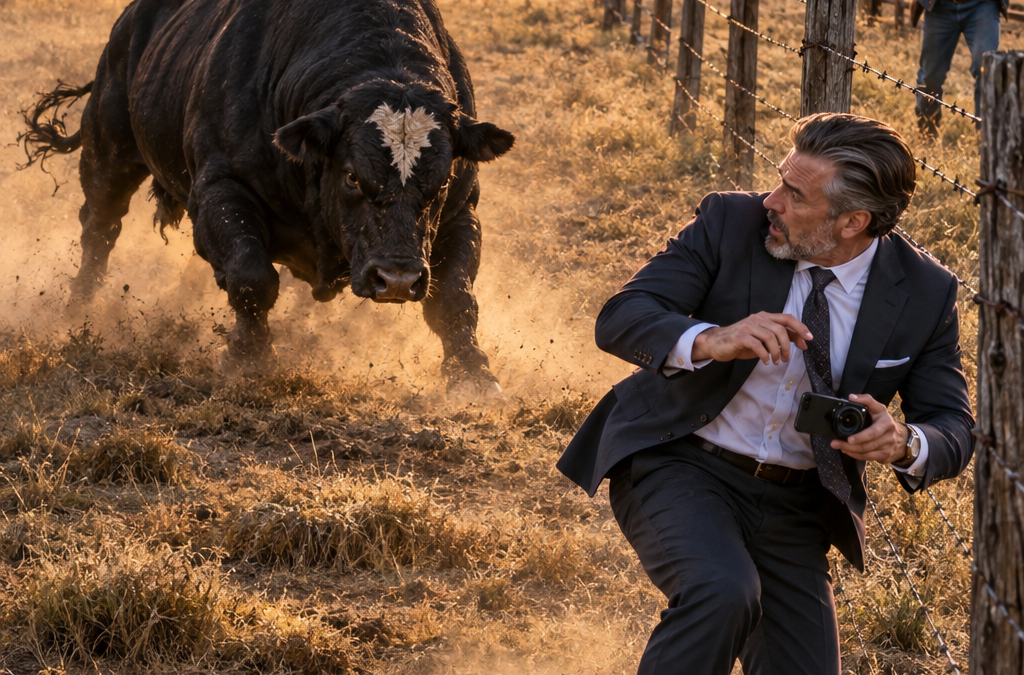
Karen Whitfield was climbing my fence.
Not opening a gate.
Not knocking on my door.
Climbing.
In tight white jeans, polished boots, and a bright pink blazer that looked like it had been purchased by a man who believed visibility was the same thing as courage.
He had a camera in one hand.
He swung one leg over the top rail, wobbled, cursed, then dropped awkwardly into the pasture.
I set my coffee down very carefully.
Tank was about thirty yards away.
Head down.
Grazing.
For the moment.
Karen lifted the camera and started taking pictures.
Flash.
Flash.
Flash.
He moved toward the cattle pen, muttering to himself, angling the camera toward the barn, the fence, the bull, the pasture.
I pulled my phone from my pocket and started recording from the kitchen window.
“Idiot,” I whispered.
Tank raised his head.
Karen took another photo.
Flash.
Two feet closer.
Tank stared at him.
Every rancher knows that moment.
A bull is not a dog.
He doesn’t bark before he acts.
He reads the field.
He measures the distance.
He decides whether the thing in front of him is stupid enough to become his problem.
Tank lowered his head slightly.
Snorted once.
The sound carried all the way to the house.
Karen didn’t recognize it.
He took another step.
Flash.
Tank pawed the ground.
My pulse kicked hard.
I ran out the back door, phone still recording.
“Karen!” I shouted. “Do not move toward that bull!”
He spun around, startled.
Tank snorted again.
Karen looked at him, then at me.
“This is evidence!” he yelled. “You’re interfering with an official inspection!”
“You’re trespassing in a bull pasture!”
“I have authority!”
“You have about five seconds before authority meets two thousand pounds of Angus!”
Tank took one step forward.
Karen’s face finally changed.
Not anger.
Fear.
Real fear.
He looked at the fence.
Then at Tank.
Then at the fence again.
He had climbed in.
Climbing out quickly was another matter.
“Don’t run,” I called. “Back away slow. Keep your body turned. No sudden moves.”
Karen froze.
Tank moved again.
Not charging.
Not yet.
But the warning was written in every inch of him.
I stepped through the gate on the far side with a feed bucket and rattled it hard.
“Tank!”
His ears flicked toward me.
“Come on, boy!”
I shook the bucket again.
For a moment, he stayed locked on Karen.
Then his head turned.
I backed toward the pen, still rattling feed.
Tank followed.
Slow.
Suspicious.
Unconvinced that the pink-blazer problem was solved.
“Now move,” I told Karen. “Slow.”
He stumbled backward toward the fence.
His boots slipped in the damp dirt.
He grabbed the top rail, tried to climb, failed, cursed, then hauled himself over in the least dignified scramble I have ever seen from a man who owned more than one pair of designer sunglasses.
He landed on the roadside ditch, flat on his backside.
His camera bounced beside him.
I closed the gate and latched it.
Tank came to the bucket, huffed, and began eating like he hadn’t just nearly become Exhibit A in Karen’s obituary.
Karen stood, dirt on his jeans, face white with fury.
“You threatened me with that animal!”
I stared at him.
“You climbed into his pasture.”
“I was documenting violations.”
“You were trespassing.”
“I am HOA president!”
“Not on my side of the fence.”
He pointed a shaking finger.
“That bull is dangerous.”
“Only to people dumb enough to climb into his pasture at dawn.”
His eyes flashed.
“You’ll regret this.”
I held up my phone.
“Just so we’re clear, Karen. I have the whole thing on video.”
For one second, he stopped breathing.
His gaze moved to the phone.
Then to my kitchen window.
Then to the pasture.
Then back to me.
He tried to recover.
“You edited nothing?”
“It’s still recording.”
He turned and limped toward his SUV.
“You’re finished, Mercer.”
“No,” I said. “I think you are.”
He drove off fast enough to throw gravel.
I sent the video to Nadia before I finished feeding Tank.
Her response came ten minutes later.
Do not post this. Preserve original file. This helps.
By noon, Karen’s version had already reached the HOA board.
He claimed I had used livestock to threaten him during an authorized compliance inspection.
He claimed Tank had nearly attacked him.
He claimed my property presented an immediate safety danger.
He demanded emergency action.
By two o’clock, Nadia had sent the board my video, my deed, the agricultural-use documents, and a formal notice that Karen had trespassed on private ranch property without permission and placed himself in danger by entering an occupied bull pasture.
The board went quiet.
Very quiet.
That silence told us something.
Some board members were finally scared.
Not of me.
Of liability.
A president entering livestock property without authorization, nearly causing an incident, while pursuing a questionable foreclosure against the same homeowner was not a good look.
Three days later, Nadia requested an emergency injunction to stop the foreclosure process pending review of the disputed charges.
Ray completed his first formal findings.
The numbers were worse than we thought.
Association assessments had been inflated through repeated administrative add-ons.
Foreclosure processing fees flowed through vendors with undisclosed connections.
Several properties acquired after HOA enforcement were connected through corporate filings, mailing addresses, or brokerage paperwork to Whitfield Holdings.
And my ranch had already been mentioned in an internal email Ray recovered through a records request.
Potential redevelopment parcel.
Those three words sat in the middle of a message between Karen and a broker.
Potential redevelopment parcel.
Not problem resident.
Not safety concern.
Not wild livestock.
Redevelopment.
I read the email once.
Then again.
Then I walked out to the pasture because I couldn’t breathe in the house.
Tank was standing near the fence, broad and black against the late afternoon.
The barn glowed red-brown in the sun.
The dust smelled like home.
For the first time since the lien notice landed on my porch, I let myself feel the fear fully.
If Karen won, I would lose more than land.
I would lose the mornings.
The barn.
The cattle.
The oak.
The work I’d put into every post, hinge, and roof panel.
He wasn’t trying to correct violations.
He was trying to erase my life and replace it with profit.
The hearing was packed.
Neighbors filled every bench in the county courtroom. Some came to watch me lose. Some came because they had started to wonder if Karen had done the same thing to them. Rosa sat behind me with her hands clasped in her lap.
Karen arrived in a navy suit, white shirt, and red tie, looking polished again. No pink blazer. No pasture dirt. No visible sign that he’d ever landed on his backside in a ditch.
He sat beside the HOA attorney, jaw tight.
Nadia sat beside me with our binders arranged in clean stacks.
Ray sat behind us, expressionless, holding a laptop.
The judge reviewed the filings.
The HOA argued first.
Their attorney claimed I had accumulated unpaid fines over repeated safety and aesthetic violations. He described my fence as excessive, my bull as dangerous, my barn as noncompliant, and my refusal to pay as evidence of bad faith.
Karen sat perfectly still, hands folded.
Then Nadia stood.
She did not speak dramatically.
She didn’t need to.
She began with the deed.
The agricultural-use allowance.
The barn’s age.
The grandfathered structures.
The fence requirements for livestock.
Then the notices.
Backdated documents.
Missing hearing records.
Unsent violation letters.
A fee schedule with no proper adoption record.
Then she played the video.
Karen climbing my fence at dawn.
The courtroom watched in complete silence.
Pink blazer over the rail.
Camera raised.
Flash near Tank’s face.
My voice warning him.
Tank snorting.
Karen scrambling out.
Someone in the back coughed hard enough to sound like a laugh.
The judge did not laugh.
He looked at Karen.
Then at the HOA attorney.
“Was Mr. Whitfield authorized to enter the pasture?”
The attorney hesitated.
“Your Honor, the association maintains inspection authority—”
“Was he authorized to climb a fence into an occupied livestock pasture?”
Silence.
Nadia continued.
Then came Ray.
He explained the financial pattern in the driest voice imaginable.
Inflated enforcement charges.
Questionable foreclosure processing fees.
Transfers connected to related entities.
Properties acquired after HOA foreclosures.
Whitfield Holdings LLC.
Three prior addresses.
Below-market acquisitions.
Brokerage connections.
And finally, the email.
Potential redevelopment parcel.
The judge’s face changed when he saw it.
Not anger exactly.
Something colder.
Attention.
Karen leaned toward his attorney and whispered.
His attorney looked suddenly older.
Nadia finished by asking the court to halt any foreclosure proceedings based on disputed HOA charges and preserve the relevant records for full investigation.
The judge granted the emergency relief.
The foreclosure was stopped.
The lien enforcement was frozen.
The HOA was ordered to preserve records and produce additional documentation.
And Karen Whitfield was warned, on the record, that he was not to enter my property again.
I should have felt victorious.
I didn’t.
I felt like a man who had been pulled back from the edge but could still see the drop.
Outside the courthouse, Karen found me near the steps.
Nadia was speaking with Ray a few feet away.
Karen approached quietly.
No smile.
No clipboard.
No sunglasses.
Just rage dressed in navy wool.
“This isn’t over,” he said.
I looked at him.
“It is for my pasture.”
He stepped closer.
“You think a judge’s order makes you safe?”
I didn’t answer.
He lowered his voice.
“Men like you don’t hold land like that forever.”
Something in me went still.
“Men like me?”
His eyes flickered.
He realized what he’d said.
Then he smiled.
“People without vision.”
I looked toward Nadia.
She had heard enough to turn.
Karen saw her and stepped back.
“Enjoy your little delay,” he said.
Then he walked away.
Two weeks later, the state real estate commission opened an inquiry into Karen’s undisclosed interests and related property acquisitions.
The county attorney’s office began reviewing the foreclosure patterns.
The HOA’s insurance carrier got involved after learning about the pasture trespass and potential board misconduct.
And the board, suddenly allergic to Karen’s leadership, called an emergency meeting.
That meeting happened in the Maple Ridge clubhouse.
Same room where Karen had spent months pretending he was king.
Only this time, the room was packed wall to wall.
Rosa was there.
Tom Alvarez was there.
Gloria Bennett, the widow Karen had supposedly bankrupted, was there too, sitting in the front row with her daughter beside her.
Karen stood at the podium, polished and pale.
He tried to speak first.
He talked about misunderstandings.
About hostile residents.
About the difficulty of maintaining standards in a growing community.
About how agricultural parcels reduced the neighborhood’s appeal.
Then Rosa stood up.
“My husband died in that house,” she said, voice shaking. “You fined me for tomatoes because I asked about missing funds.”
Karen’s mouth tightened.
“Mrs. Martinez, this isn’t—”
Tom stood.
“You threatened my place over driveway oil stains that weren’t even on my driveway.”
Gloria Bennett’s daughter stood next.
“My mother sold because you told her foreclosure was inevitable.”
Karen raised both hands.
“These are emotional distortions.”
Then Ray connected his laptop to the projector.
Numbers filled the wall.
Not accusations.
Numbers.
Addresses.
Dates.
Fines.
Foreclosure filings.
LLC transfers.
Resale profits.
Vendor fees.
Processing charges.
The room got quieter with every slide.
Karen’s face lost its shine.
Then Nadia stood and read the court order stopping my foreclosure. She read the preservation requirement. She read the excerpt identifying my ranch as a “potential redevelopment parcel.”
The room erupted.
Karen shouted over everyone.
“This is a coordinated attack!”
But the board members no longer looked loyal.
They looked trapped.
The vice president, a nervous man named Harold Finch, moved to suspend Karen’s authority pending full audit and legal review.
Another board member seconded.
Karen spun around.
“You don’t have the authority.”
Harold swallowed hard.
“We do.”
The vote passed.
Unanimous.
Karen stared at them like betrayal was an unfamiliar language.
He was removed from the presidency that night.
Temporarily at first.
Then permanently after the audit confirmed enough misconduct to refer the matter to authorities.
The lien against my ranch was withdrawn.
Every fine tied to unsupported or fabricated violations was canceled.
The foreclosure threat was dismissed completely.
My attorney demanded reimbursement of legal fees, and the HOA’s insurer eventually paid a substantial portion after determining the association faced serious exposure from Karen’s actions.
But the consequences didn’t stop with my ranch.
Investigators dug deeper into Whitfield Holdings.
The three foreclosed properties were reviewed.
So were the vendor payments, administrative fees, and foreclosure processing charges.
Karen’s real estate license was suspended pending investigation, and later revoked after the commission found he had failed to disclose conflicts and used his HOA position in ways tied to personal financial interests.
The county filed charges related to fraudulent filings and misuse of association authority. The case took months, and I won’t pretend every piece ended quickly or perfectly.
Legal consequences rarely move at the speed victims want.
But Karen lost the board.
Lost the license.
Lost the shield of respectability he’d built around himself.
And most importantly, he lost the machine he had used to harvest homes from people too frightened or too broke to fight him.
One afternoon, after the worst of it had passed, I found Rosa standing by my fence, watching Tank graze.
“He’s calmer than I expected,” she said.
“Tank?”
She nodded.
“He looks peaceful.”
“He is,” I said. “As long as no one climbs in wearing a pink blazer.”
She laughed so hard she had to hold the fence post.
It was the first time I’d heard her laugh without fear behind it.
A month later, Gloria Bennett filed a civil claim over the loss of her home. Others joined. Nadia helped connect them with counsel. The process would take time, but the silence Karen had depended on was gone.
Maple Ridge changed.
Not overnight.
People still argued about lawns and mailboxes and where trash cans should sit. It was still an HOA, after all. But the board rewrote enforcement procedures. No single president could approve foreclosure action alone. All fines had to cite a specific adopted covenant. Inspection records had to include time-stamped photos and proper notice. Conflicts of interest had to be disclosed in writing.
The agricultural allowance on my parcel was formally acknowledged in the association records.
My barn stayed.
My cattle stayed.
My fence stayed.
Tank, to his disappointment, never got called as a witness.
I repainted the mailbox black.
Not approved black.
Just black.
Nobody said a word.
One evening near sunset, I walked the fence line with a cup of coffee in my hand. The highway exit construction was visible in the distance now, cranes and dust beyond the fields. Developers would keep coming. Money would keep circling land like buzzards over roadkill.
But the deed was still in my name.
The barn door creaked in the wind.
Tank stood near the oak, broad and stubborn and alive.
I leaned against the fence post Karen had climbed and looked across the pasture.
That strip of Texas dirt had nearly become somebody else’s investment strategy.
A line on a redevelopment email.
A parcel to be acquired after manufactured violations made me desperate enough to lose it.
Karen had seen my home and calculated profit.
He saw the barn as an obstacle.
The fence as leverage.
The bull as a complaint.
The land as inventory.
He never understood what it meant to me because men like him don’t look at land and see mornings. They see margins.
I thought about the lien notice landing on my porch.
The shake in my hands.
The humiliation of neighbors avoiding me at the mailbox.
The fear that legal language could take what honest work had earned.
Then I thought about Rosa standing up.
Gloria coming back.
Ray’s spreadsheets.
Nadia’s steady voice.
Tank’s warning snort at dawn.
I smiled.
Not because any of it had been funny.
Because in the end, Karen Whitfield had been undone by the one thing he never respected.
Boundaries.
Property boundaries.
Legal boundaries.
Ethical boundaries.
And one very physical fence around one very unimpressed bull.
The sun dipped lower, turning the pasture gold.
Tank lifted his head and looked at me.
“You did good,” I told him.
He snorted.
Maybe agreement.
Maybe complaint that dinner was late.
Either way, he was still there.
So was I.
The ranch remained mine.
And for the first time in months, when I looked toward Maple Ridge, I didn’t see a battlefield.
I saw my land.
My fence.
My barn.
My bull.
My home.
And no HOA president alive was ever going to make me forget the difference again.








