𝗙𝗨𝗟𝗟 𝗦𝗧𝗢𝗥𝗬 The HOA President Tried to Take My Paid-Off Home Before She Learned What My Porch Lights Were Really For
𝗙𝗨𝗟𝗟 𝗦𝗧𝗢𝗥𝗬
He gave me the name.
Halloway Property Group.
I wrote it down.
Then searched state business records.
The registered agent led to a corporate filing service, but the mailing address connected to a small real estate office near Cleveland. Digging deeper took an hour. Then another.
By midnight, I found a name.
Evan Halloway.
Vivian’s nephew.
My stomach tightened.
The shell LLC that had tried to buy my house belonged to Vivian’s nephew.
Twice rejected by my realtor.
Suddenly, the pattern made sense.
This was not about light bulbs.
Not about mailbox stain.
Not about trash cans.
Somebody wanted my property.
Vivian was the battering ram.
The next day, I confronted her at the community mailbox.
I waited until she finished sorting through her envelopes, clipboard tucked under one arm like always.
“Vivian.”
She looked up.
“Dean.”
“Does Halloway Property Group mean anything to you?”
Her expression did not change.
But her fingers paused on the mail.
“Should it?”
“It belongs to your nephew.”
“Evan has several business interests.”
“He tried buying my house.”
“Many people receive offers.”
“And then you started fining me every week.”
She smiled.
Not a friendly smile.
A thin, polished little curve of the mouth.
“Rules are rules, Dean.”
That was all she said.
Rules are rules.
Then she walked away.
That night, I called my cousin Priya.
Priya Desai was a real estate attorney in Columbus, the kind of person who could make a contract clause sound like a weapon. We had grown up together, and she had always been smarter than everyone else in the room, even when she was twelve and correcting adults at family dinners.
She answered while I was sitting at my kitchen table with every citation spread around me.
“Dean?”
“I need help.”
“What happened?”
“My HOA president may be trying to fine me out of my house.”
There was a pause.
“Send me everything.”
I scanned the letters.
The porch-light fine.
The mailbox fine.
The trash-bin citation.
The garage-door warning.
The hose notice.
The lien threat language from earlier letters.
The shell LLC records.
The photos of other houses.
Priya called me the next morning.
Her voice was different.
Calm, but tight.
“You need to listen carefully.”
“That bad?”
“Potentially. I found something in the HOA bylaws.”
“What?”
“Fines cannot legally exceed fifty dollars unless approved by a documented unanimous board vote.”
I looked at the stack of letters.
“Most of mine are over fifty.”
“I know.”
“She never held a vote.”
“Not in the minutes I reviewed.”
“What does that mean?”
“It means every fine over fifty dollars may be unenforceable if she didn’t follow the procedure.”
I stood slowly.
“All of them?”
“Every one that lacks a proper recorded vote.”
“What about foreclosure threats?”
“Based on those fines? Highly questionable.”
I closed my eyes.
For the first time in weeks, I felt air enter my lungs fully.
Then Priya added, “But knowing that isn’t enough.”
I opened my eyes.
“Why?”
“Because Vivian controls the paperwork.”
She was right.
Vivian controlled the meeting minutes.
She controlled the community Facebook group.
She controlled notices.
She controlled who got to speak at meetings and whose comments mysteriously disappeared overnight.
Homeowners who questioned fines online saw their posts deleted.
Meeting recordings were not posted, despite the bylaws saying they should be available upon request.
Minutes were vague.
Board votes were summarized in phrases like “approved as discussed,” which meant nothing and everything depending on who needed it.
So I did what any nervous, stubborn guy does when cornered.
I started recording.
Every conversation.
Every drop-in visit.
Every voicemail.
Every veiled threat.
Ohio has rules about recording, and Priya made sure I understood exactly what I could and could not do. I did not get cute. I did not try to trap anyone illegally. I documented what I was legally allowed to document, and I kept copies of everything.
Two weeks later, Vivian raised the stakes.
She claimed my exterior lights were excessive.
The letter called them unauthorized commercial-grade illumination after dark.
Fine: $600.
Administrative review fee: $150.
Ongoing violation notice.
Possible escalation.
I stood on the porch, letter in hand, and looked up at the motion-sensor light.
The funny part was, those lights were not decorative.
They were required.
After a break-in on my street the previous spring, my insurance company had inspected the property and required upgraded motion-sensor lighting as part of maintaining the policy discount and security compliance. The previous owner had installed part of the system, and I had updated the bulb and sensor after moving in.
I sent Vivian the insurance letter.
She sent back another fine.
Her email said HOA aesthetic code overruled any outside third-party recommendation.
Outside third party.
That was what she called my insurance company.
I forwarded her response to Priya.
Priya replied with three words.
She’s getting sloppy.
But the second twist landed only after I called the company that had installed the light.
I wanted the exact model number for Priya’s file.
The technician looked up the address and said, “Oh, you’re one of the pilot homes.”
“What pilot?”
“The emergency responder beacon program.”
I stared at the phone.
“The what?”
“City trial. Corner-lot signal assist. Your exterior system ties into the new emergency responder beacon pilot. That’s why the bulb and sensor have specific specs.”
For a moment, I thought he was joking.
He was not.
My house sat on a corner lot near the entrance to the subdivision, visible from two directions. After the prior break-in and several delayed emergency response incidents in nearby neighborhoods, the city had started a small public safety pilot. Select homes had upgraded motion-triggered lighting and beacon-compatible fixtures to help responders identify address points during emergency calls.
My porch lights were not just insurance lights.
They were tied to city-authorized safety equipment.
Vivian had been fining a municipal safety installation for eight months straight.
Completely unaware she was picking a fight with the local fire department.
I almost felt bad telling her.
Almost.
Instead, I forwarded the citation directly to the city’s emergency services coordinator, Ms. Elena Alvarez.
I included Vivian’s letters, the insurance documentation, and the installer’s confirmation that my system was tied to the city pilot.
Ms. Alvarez did not find it funny.
She called me within an hour.
“Mr. Whitfield, do I understand correctly that your HOA president is fining you for the beacon-compatible exterior light?”
“Yes, ma’am.”
“And she instructed you that HOA aesthetic code overrules this installation?”
“That’s what her email says.”
There was a pause.
Then Ms. Alvarez said, very carefully, “Please forward me the original email.”
I did.
The next call went to Vivian.
I was not on that call, but I heard about it from two board members within the day.
Ms. Alvarez informed Vivian that interfering with or pressuring removal of city-authorized emergency signal equipment could carry municipal penalties and create serious liability concerns if emergency response were affected.
Vivian backpedaled instantly.
She claimed clerical confusion.
She claimed she had not understood the installation.
She claimed the matter would be reviewed.
But the damage was spreading because I copied the entire HOA board on every email.
For the first time, board members began asking questions.
Why were fines over fifty dollars not going to recorded votes?
Why had the president ignored city safety documentation?
Why were only certain houses being cited?
Why had dissenting comments disappeared from the Facebook group?
The next HOA meeting was packed.
People came because they had heard something was wrong.
Some came because they were curious.
Some came because they had their own folders and had finally begun to wonder if Vivian had done the same thing to them.
Vivian sat at the front table, rigid behind her gavel.
She wore a burgundy blazer and pearls, but for once the outfit did not make her look in control. Her knuckles were white around the gavel handle. Sweat shone at her temple.
She opened the meeting with a speech about misinformation.
That was her favorite word when truth got inconvenient.
She said Meadow Crest could not function if residents spread half-understood legal theories.
She said safety mattered, but community standards mattered too.
She said board authority must be respected.
I waited until homeowner comments.
Then I stood with my folder in hand.
My legs felt unsteady.
My voice did not.
“Section 8.3 of the Meadow Crest bylaws states that fines exceeding fifty dollars require unanimous recorded board approval.”
People shifted in their chairs.
I opened the folder.
“Over the past eight months, President Halloway has issued forty-one fines above that amount without a documented vote.”
Vivian’s face tightened.
I read them one by one.
Date.
Homeowner.
Amount.
Alleged violation.
Missing board vote.
Porch light.
Mailbox stain.
Trash cans.
Driveway edge.
Garage door.
Garden hose.
Exterior lighting.
Forty-one times.
Eight months.
By the time I finished the second page, someone in the back gasped.
By the third, a woman whispered, “Oh my God.”
Then Mrs. Okafor stood.
She lived on Primrose Court, a retired teacher with perfect posture and a voice that carried without effort.
“I paid three thousand dollars in fines last year,” she said. “Are you saying those may have been illegal?”
I looked at Priya, who was seated beside me.
She stood.
“I’m saying they require review. If they exceeded fifty dollars and lacked the required recorded vote, they may not have been properly imposed.”
The room erupted.
Vivian slammed the gavel.
“Order.”
No one quieted.
“Order!”
Still nothing.
Then came the moment I had not planned.
The treasurer stood.
His name was Martin Doyle, a thin man with nervous hands and glasses that kept sliding down his nose. He had rarely spoken at meetings. Most of us had barely noticed him.
That night, he looked like a man about to step off a cliff.
“I need to say something.”
Vivian turned sharply.
“Martin, sit down.”
He did not.
“There are discrepancies.”
The room quieted.
Vivian’s mouth tightened.
Martin held a folder in both hands.
“The fine money collected does not match the HOA’s official bank statements.”
No one moved.
I felt my heartbeat in my ears.
Martin continued, voice shaking.
“Nearly sixty thousand dollars in fines over two years have no clear paper trail.”
Vivian’s face went the color of old drywall.
Someone said, “Sixty thousand?”
Another person said, “Where did it go?”
Vivian snapped, “This is not on the agenda.”
Martin looked at her.
“No. It should have been.”
That was when Priya stood again.
“There is another issue the homeowners need to know.”
Vivian’s eyes locked onto her.
Priya opened a document.
“The LLC that attempted to purchase Mr. Whitfield’s home was initially traced to the president’s nephew.”
Vivian lifted her chin.
“My nephew’s business has nothing to do with—”
Priya turned the page.
“Additional filings connect Halloway Property Group back to Vivian Halloway herself.”
The room went silent.
Twist three.
The shell LLC did not belong only to her nephew.
It traced back to Vivian.
She had been engineering pressure through bogus fines, then attempting to buy distressed properties below market through a family-linked company.
My house had not been randomly targeted.
It had been selected.
The room erupted.
Someone said “embezzlement” out loud.
Someone else was already dialing the county sheriff’s non-emergency line, hands trembling.
I did not have to push anymore.
The evidence had become fuel poured onto a fire Vivian herself had lit.
She tried to regain control.
She lifted the gavel.
She called the meeting disorderly.
She accused me of orchestrating a smear campaign.
But no one was listening to her as president anymore.
They were listening to her as a suspect.
That difference mattered.
Within a week, the county opened a formal fraud investigation into Meadow Crest HOA’s finances.
Every account tied to Vivian’s signature authority was frozen pending review.
The board met in emergency session.
For once, there was a unanimous vote.
Vivian was removed as president.
Ironically, it was the only unanimous vote she had ever actually respected during her tenure.
The lien against my home was dissolved in writing.
The apology came in writing too.
Cold, formal, and clearly drafted by a lawyer, but I kept it anyway.
Every illegal fine I had paid was refunded with interest.
The check arrived by certified mail.
I stood in my kitchen holding it, remembering the first $75 fine for the porch-light color.
That was how it had started.
A light bulb.
A device measuring color temperature.
A woman telling me rules were rules.
And now the association was sending money back because her rules had never been properly applied in the first place.
Six other households received refunds after Priya filed a joint complaint representing every resident Vivian had quietly targeted.
Mrs. Okafor cried when hers arrived.
Not because the money fixed everything.
Because the refund admitted she had been wronged.
Sometimes people need the record corrected as much as they need the money.
The investigation continued.
Bank records.
Fine ledgers.
LLC filings.
Property offers.
Meeting minutes.
Deleted Facebook posts.
Vendor payments.
Vivian’s attorney issued a statement calling the allegations misleading.
Nobody believed it.
By autumn, Vivian moved out of Meadow Crest.
The official reason was privacy.
The real reason was that everyone knew.
She was facing embezzlement charges and civil claims tied to the improper fines and property scheme. The criminal case would take time. Lawyers always say that, and they are right. Court moves slower than anger.
But Vivian’s power over Meadow Crest ended quickly.
The new board rewrote the enforcement process.
No fine over fifty dollars without documented unanimous board approval.
No deletion of homeowner comments from official forums without a recorded reason.
No enforcement action based on aesthetics without a clear covenant citation.
No board member, officer, or family-linked LLC allowed to pursue property transactions involving residents under active HOA enforcement without full disclosure.
Simple rules.
Obvious rules.
Rules that should have existed before Vivian ever touched a clipboard.
The city also finalized my corner-lot beacon installation paperwork.
Ms. Alvarez sent a polite letter to the new board explaining the municipal safety purpose of the lights and advising against interference.
I framed a copy.
Not because it was pretty.
Because it was satisfying.
Three months after the lien notice, I sat on my porch beneath those supposedly commercial-grade lights, drinking coffee at dusk.
The motion sensor clicked on when a delivery truck passed.
Bright white light filled the porch steps.
For eight months, Vivian had fined me for that light.
Called it excessive.
Commercial.
Ugly.
Noncompliant.
The very thing she tried to punish me for turned out to be the thing that brought the city into the fight.
The thing that made the board ask questions.
The thing that exposed the missing votes.
The thing that led to the meeting where her treasurer finally spoke.
I laughed.
Alone on my porch, under the bright white glow, I laughed hard enough that my neighbor across the street looked over and waved.
I waved back.
The house behind me was still mine.
Paid off.
Quiet.
Safe again.
For months, I had been afraid to open my mailbox.
Afraid each letter would be worse than the last.
Afraid a woman with a clipboard could undo twelve years of double shifts by manufacturing enough paper.
Now the mailbox held ordinary things again.
Coupons.
Utility bills.
A flyer for gutter cleaning.
No red stamps.
No threats.
No artificial deadlines.
No nine-thousand-dollar demand built on illegal fines.
I thought about the first day Vivian knocked on my door with that handheld device.
I had laughed because I thought she was absurd.
I had paid because I thought it was easier.
That was how people like her survive.
They make the first abuse small enough to tolerate.
Seventy-five dollars.
A mailbox stain.
A trash can.
A light bulb.
You pay to avoid stress.
Then you pay again.
Then one day, you are standing at your mailbox with shaking hands, holding a lien notice that threatens the home you worked half your life to own.
I will never laugh off the first fine again.
Not from an HOA.
Not from anyone who refuses to cite the rule behind it.
But I also learned something else.
Paper cuts both ways.
Vivian used letters to scare people.
I used letters to stop her.
Bylaws.
Emails.
City records.
Insurance documents.
LLC filings.
Bank statements.
Meeting minutes.
A folder full of dates and facts.
That was what brought her down.
Not shouting.
Not revenge.
Documentation.
The porch light clicked off.
The street settled into evening.
Children rode bikes near the cul-de-sac.
Mrs. Okafor walked past with her dog and lifted her hand.
I nodded.
For the first time since moving to Meadow Crest, the neighborhood felt like the place I had hoped it would be.
Quiet.
Not because people were afraid.
Because the person who had made them afraid was gone.
I leaned back in the chair and looked up at the light.
It waited above my door, silent and ordinary until needed.
A safety signal.
A city pilot fixture.
A bright white problem Vivian should have left alone.
Funny how justice works sometimes.
She tried to punish the light.
And the light exposed everything.
𝗧𝗛𝗘 𝗘𝗡𝗗
The HOA President Tried to Take My Paid-Off Home Before She Learned What My Porch Lights Were Really For
The lien notice gave me forty-eight hours to pay nine thousand dollars or risk losing the house I had paid off with twelve years of double shifts. Vivian Halloway thought she had built the perfect paper trail, but she had no idea the one violation she kept punishing was connected to the city itself.
My name is Dean Whitfield, and three months before that red-stamped notice hit my mailbox, I did not know what a homeowners association could really do to a person.
I thought HOAs were annoying.
Maybe picky.
Maybe too concerned with grass height and mailbox colors.
I did not know they could turn an ordinary man into a defendant on his own porch.
I did not know they could stack small fines until they looked like a mortgage payment.
I did not know a woman with a clipboard could make a paid-off house feel temporary again.
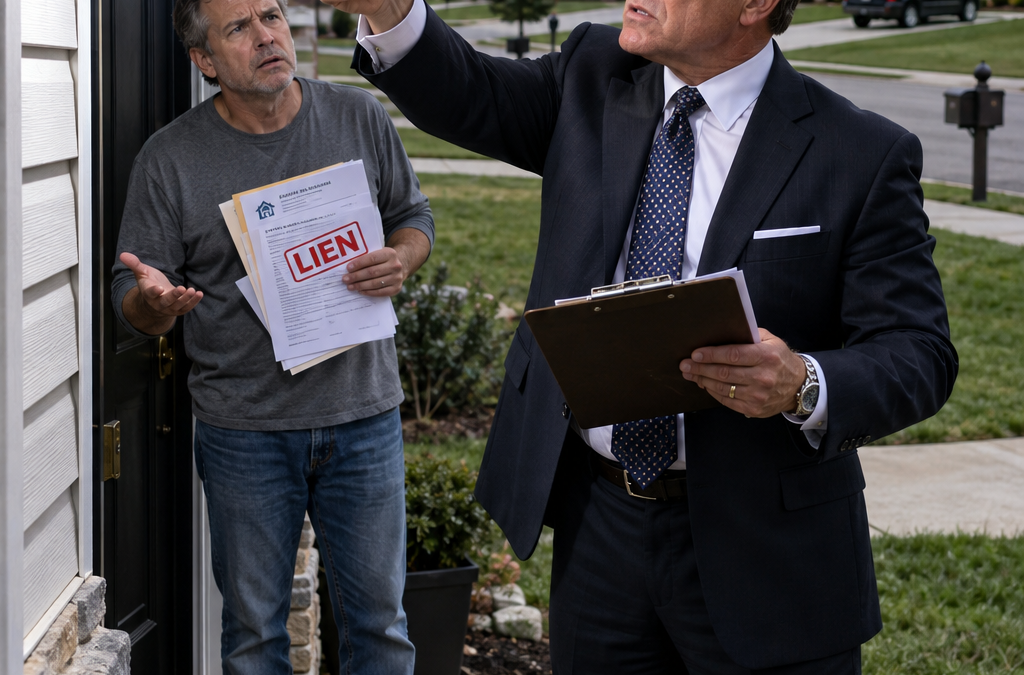
That Tuesday morning, I stood in front of my mailbox in Meadow Crest Estates, Ohio, holding a certified letter with the word LIEN printed across the top in red.
My hands were shaking before I finished the first paragraph.
The Meadow Crest Homeowners Association claimed I owed nine thousand dollars in accumulated fines, administrative costs, late penalties, and enforcement fees. If I failed to pay within forty-eight hours, the letter said, the HOA would proceed with filing against my home.
My home.
The three-bedroom ranch house I had bought after my divorce.
The house I had paid off early by working twelve years of double shifts, weekends, night calls, and every miserable overtime assignment I could get.
The house I had promised myself nobody could take from me once the bank was finally gone.
For a long time, I just stared at the number.
$9,000.
Forty-eight hours.
I read the letter again, hoping I had misunderstood.
I had not.
I looked up at my porch light, the one Vivian Halloway had fined me for eight months straight.
It was still on because the morning was gray, and the motion sensor had triggered when I walked outside.
Bright white.
Too bright, according to Vivian.
Commercial grade, she had called it.
Aesthetic assault, she had said at one meeting, as if my porch were attacking the neighborhood.
That light was the reason she thought she could bury me.
It became the reason she finally fell.
Three months earlier, I moved to Meadow Crest Estates because I wanted quiet.
After the divorce, I needed a reset.
I had spent years living inside other people’s decisions. My ex-wife and I had split without screaming, without dramatic courtroom battles, without hatred, but that almost made the loneliness worse. There was no villain to blame. No great betrayal to point to. Just two people who had worn each other down until silence became easier than staying.
When the divorce was final, I wanted one thing that felt fully mine.
A house.
Not an apartment where the neighbors argued through thin walls.
Not a rental where a landlord could raise the price whenever he wanted.
A house with a porch, a driveway, and enough distance from everyone else that I could breathe.
Meadow Crest looked like the answer.
Quiet cul-de-sacs.
Good schools.
Clean sidewalks.
Small trees planted in perfect rows.
Houses painted in soft approved colors.
Children riding bikes after dinner.
People waved when I drove by.
At closing, the realtor told me the HOA was “active but reasonable.”
I remember that phrase now and want to laugh.
Active but reasonable.
That was like calling a house fire warm but manageable.
The first week, everything seemed fine.
I unpacked slowly.
Changed the locks.
Put my tools in the garage.
Bought a new coffee maker.
Sat on the porch in the evenings and let the silence settle around me.
Then Vivian Halloway knocked on my door.
She was in her late fifties, maybe early sixties, with silver-blond hair sprayed into a perfect helmet, narrow eyes, and a smile that looked expensive but never kind. She wore a pale green blazer, white slacks, and wedge sandals despite the cold. In one hand, she held a clipboard. In the other, a small handheld device.
At first, I thought she was from a utility company.
Then she introduced herself.
“Vivian Halloway. HOA president.”
She said the title like it came with a badge and a sidearm.
I opened the door wider.
“Dean Whitfield. Nice to meet you.”
Her eyes moved past me to the porch light beside the door.
“That bulb is the wrong shade of white.”
I waited for the punchline.
There was none.
“The wrong shade of white?” I asked.
She lifted the handheld device.
“This measures color temperature.”
I stared at it.
“You’re measuring my light bulb?”
“I’m measuring compliance.”
I laughed.
Not hard.
Just enough to show I thought we were both adults standing inside a ridiculous moment.
Vivian did not laugh.
“Meadow Crest maintains a warm residential lighting standard,” she said. “Your bulb reads as cool white.”
“It came with the house.”
“Then the previous owner should have corrected it.”
I looked at the light.
“It’s a porch bulb.”
“It is an aesthetic violation.”
I thought she was being dramatic for effect.
She was not.
Two days later, a citation appeared in my mailbox.
$75.
Aesthetic violation.
Improper color temperature.
I paid it.
That was the first mistake.
I told myself it was a rookie error in a picky neighborhood. Seventy-five dollars was irritating, not catastrophic. I had just moved in. I did not want to begin my life in Meadow Crest by fighting the HOA president over a light bulb.
So I paid.
No big deal.
That was exactly what Vivian counted on.
The next fine came for my mailbox post.
Improper stain color.
Then my trash cans.
Visible eleven minutes past the permitted curb window.
Eleven minutes.
I know because the citation included the exact time she photographed them.
6:11 p.m.
Permitted window ended at 6:00 p.m.
The fine was $125.
Then came a warning about my front flower bed not being sufficiently edged.
Another about my garage door being open too long while I carried boxes inside.
One about a garden hose visible from the street.
Each fine alone was almost laughable.
Together, they stacked fast, like Vivian was building a ladder out of my supposed mistakes.
At first, I thought I was just unlucky.
Then I started watching the neighborhood.
My neighbor two houses down had peeling paint on his trim for weeks.
No citation.
A house on the corner had grass so tall it leaned over the sidewalk.
No citation.
A blue recycling bin sat outside a garage for three days.
No citation.
A basketball hoop stayed in a driveway overnight despite a rule against visible recreational equipment.
No citation.
Only my house.
Every single time.
I started keeping a folder.
I photographed every notice.
Every envelope.
Every timestamp.
Every so-called violation.
Then I photographed other houses with similar or worse conditions.
Dates.
Times.
Addresses.
Not because I planned to sue anyone.
Because something about Vivian’s attention felt too precise to be random.
The first twist arrived quietly.
My realtor called me on a Thursday afternoon.
“Dean, this is strange,” he said.
“What is?”
“You remember that cash offer you got before closing?”
I frowned.
“There were a few.”
“Two came through a shell LLC. Same buyer group. They tried again after you closed.”
I sat up straighter.
“What do you mean after I closed?”
“They reached out informally asking whether you’d consider selling.”
“No one told me that.”
“I didn’t think it was serious. Lowball number. Aggressive terms.”
“What LLC?”
He gave me the name.
Halloway Property Group.
I wrote it down.
Then searched state business records.
The registered agent led to a corporate filing service, but the mailing address connected to a small real estate office near Cleveland. Digging deeper took an hour. Then another.
By midnight, I found a name.
Evan Halloway.
Vivian’s nephew.
My stomach tightened.
The shell LLC that had tried to buy my house belonged to Vivian’s nephew.
Twice rejected by my realtor.
Suddenly, the pattern made sense.
This was not about light bulbs.
Not about mailbox stain.
Not about trash cans.
Somebody wanted my property.
Vivian was the battering ram.
The next day, I confronted her at the community mailbox.
I waited until she finished sorting through her envelopes, clipboard tucked under one arm like always.
“Vivian.”
She looked up.
“Dean.”
“Does Halloway Property Group mean anything to you?”
Her expression did not change.
But her fingers paused on the mail.
“Should it?”
“It belongs to your nephew.”
“Evan has several business interests.”
“He tried buying my house.”
“Many people receive offers.”
“And then you started fining me every week.”
She smiled.
Not a friendly smile.
A thin, polished little curve of the mouth.
“Rules are rules, Dean.”
That was all she said.
Rules are rules.
Then she walked away.
That night, I called my cousin Priya.
Priya Desai was a real estate attorney in Columbus, the kind of person who could make a contract clause sound like a weapon. We had grown up together, and she had always been smarter than everyone else in the room, even when she was twelve and correcting adults at family dinners.
She answered while I was sitting at my kitchen table with every citation spread around me.
“Dean?”
“I need help.”
“What happened?”
“My HOA president may be trying to fine me out of my house.”
There was a pause.
“Send me everything.”
I scanned the letters.
The porch-light fine.
The mailbox fine.
The trash-bin citation.
The garage-door warning.
The hose notice.
The lien threat language from earlier letters.
The shell LLC records.
The photos of other houses.
Priya called me the next morning.
Her voice was different.
Calm, but tight.
“You need to listen carefully.”
“That bad?”
“Potentially. I found something in the HOA bylaws.”
“What?”
“Fines cannot legally exceed fifty dollars unless approved by a documented unanimous board vote.”
I looked at the stack of letters.
“Most of mine are over fifty.”
“I know.”
“She never held a vote.”
“Not in the minutes I reviewed.”
“What does that mean?”
“It means every fine over fifty dollars may be unenforceable if she didn’t follow the procedure.”
I stood slowly.
“All of them?”
“Every one that lacks a proper recorded vote.”
“What about foreclosure threats?”
“Based on those fines? Highly questionable.”
I closed my eyes.
For the first time in weeks, I felt air enter my lungs fully.
Then Priya added, “But knowing that isn’t enough.”
I opened my eyes.
“Why?”
“Because Vivian controls the paperwork.”
She was right.
Vivian controlled the meeting minutes.
She controlled the community Facebook group.
She controlled notices.
She controlled who got to speak at meetings and whose comments mysteriously disappeared overnight.
Homeowners who questioned fines online saw their posts deleted.
Meeting recordings were not posted, despite the bylaws saying they should be available upon request.
Minutes were vague.
Board votes were summarized in phrases like “approved as discussed,” which meant nothing and everything depending on who needed it.
So I did what any nervous, stubborn guy does when cornered.
I started recording.
Every conversation.
Every drop-in visit.
Every voicemail.
Every veiled threat.
Ohio has rules about recording, and Priya made sure I understood exactly what I could and could not do. I did not get cute. I did not try to trap anyone illegally. I documented what I was legally allowed to document, and I kept copies of everything.
Two weeks later, Vivian raised the stakes.
She claimed my exterior lights were excessive.
The letter called them unauthorized commercial-grade illumination after dark.
Fine: $600.
Administrative review fee: $150.
Ongoing violation notice.
Possible escalation.
I stood on the porch, letter in hand, and looked up at the motion-sensor light.
The funny part was, those lights were not decorative.
They were required.
After a break-in on my street the previous spring, my insurance company had inspected the property and required upgraded motion-sensor lighting as part of maintaining the policy discount and security compliance. The previous owner had installed part of the system, and I had updated the bulb and sensor after moving in.
I sent Vivian the insurance letter.
She sent back another fine.
Her email said HOA aesthetic code overruled any outside third-party recommendation.
Outside third party.
That was what she called my insurance company.
I forwarded her response to Priya.
Priya replied with three words.
She’s getting sloppy.
But the second twist landed only after I called the company that had installed the light.
I wanted the exact model number for Priya’s file.
The technician looked up the address and said, “Oh, you’re one of the pilot homes.”
“What pilot?”
“The emergency responder beacon program.”
I stared at the phone.
“The what?”
“City trial. Corner-lot signal assist. Your exterior system ties into the new emergency responder beacon pilot. That’s why the bulb and sensor have specific specs.”
For a moment, I thought he was joking.
He was not.
My house sat on a corner lot near the entrance to the subdivision, visible from two directions. After the prior break-in and several delayed emergency response incidents in nearby neighborhoods, the city had started a small public safety pilot. Select homes had upgraded motion-triggered lighting and beacon-compatible fixtures to help responders identify address points during emergency calls.
My porch lights were not just insurance lights.
They were tied to city-authorized safety equipment.
Vivian had been fining a municipal safety installation for eight months straight.
Completely unaware she was picking a fight with the local fire department.
I almost felt bad telling her.
Almost.
Instead, I forwarded the citation directly to the city’s emergency services coordinator, Ms. Elena Alvarez.
I included Vivian’s letters, the insurance documentation, and the installer’s confirmation that my system was tied to the city pilot.
Ms. Alvarez did not find it funny.
She called me within an hour.
“Mr. Whitfield, do I understand correctly that your HOA president is fining you for the beacon-compatible exterior light?”
“Yes, ma’am.”
“And she instructed you that HOA aesthetic code overrules this installation?”
“That’s what her email says.”
There was a pause.
Then Ms. Alvarez said, very carefully, “Please forward me the original email.”
I did.
The next call went to Vivian.
I was not on that call, but I heard about it from two board members within the day.
Ms. Alvarez informed Vivian that interfering with or pressuring removal of city-authorized emergency signal equipment could carry municipal penalties and create serious liability concerns if emergency response were affected.
Vivian backpedaled instantly.
She claimed clerical confusion.
She claimed she had not understood the installation.
She claimed the matter would be reviewed.
But the damage was spreading because I copied the entire HOA board on every email.
For the first time, board members began asking questions.
Why were fines over fifty dollars not going to recorded votes?
Why had the president ignored city safety documentation?
Why were only certain houses being cited?
Why had dissenting comments disappeared from the Facebook group?
The next HOA meeting was packed.
People came because they had heard something was wrong.
Some came because they were curious.
Some came because they had their own folders and had finally begun to wonder if Vivian had done the same thing to them.
Vivian sat at the front table, rigid behind her gavel.
She wore a burgundy blazer and pearls, but for once the outfit did not make her look in control. Her knuckles were white around the gavel handle. Sweat shone at her temple.
She opened the meeting with a speech about misinformation.
That was her favorite word when truth got inconvenient.
She said Meadow Crest could not function if residents spread half-understood legal theories.
She said safety mattered, but community standards mattered too.
She said board authority must be respected.
I waited until homeowner comments.
Then I stood with my folder in hand.
My legs felt unsteady.
My voice did not.
“Section 8.3 of the Meadow Crest bylaws states that fines exceeding fifty dollars require unanimous recorded board approval.”
People shifted in their chairs.
I opened the folder.
“Over the past eight months, President Halloway has issued forty-one fines above that amount without a documented vote.”
Vivian’s face tightened.
I read them one by one.
Date.
Homeowner.
Amount.
Alleged violation.
Missing board vote.
Porch light.
Mailbox stain.
Trash cans.
Driveway edge.
Garage door.
Garden hose.
Exterior lighting.
Forty-one times.
Eight months.
By the time I finished the second page, someone in the back gasped.
By the third, a woman whispered, “Oh my God.”
Then Mrs. Okafor stood.
She lived on Primrose Court, a retired teacher with perfect posture and a voice that carried without effort.
“I paid three thousand dollars in fines last year,” she said. “Are you saying those may have been illegal?”
I looked at Priya, who was seated beside me.
She stood.
“I’m saying they require review. If they exceeded fifty dollars and lacked the required recorded vote, they may not have been properly imposed.”
The room erupted.
Vivian slammed the gavel.
“Order.”
No one quieted.
“Order!”
Still nothing.
Then came the moment I had not planned.
The treasurer stood.
His name was Martin Doyle, a thin man with nervous hands and glasses that kept sliding down his nose. He had rarely spoken at meetings. Most of us had barely noticed him.
That night, he looked like a man about to step off a cliff.
“I need to say something.”
Vivian turned sharply.
“Martin, sit down.”
He did not.
“There are discrepancies.”
The room quieted.
Vivian’s mouth tightened.
Martin held a folder in both hands.
“The fine money collected does not match the HOA’s official bank statements.”
No one moved.
I felt my heartbeat in my ears.
Martin continued, voice shaking.
“Nearly sixty thousand dollars in fines over two years have no clear paper trail.”
Vivian’s face went the color of old drywall.
Someone said, “Sixty thousand?”
Another person said, “Where did it go?”
Vivian snapped, “This is not on the agenda.”
Martin looked at her.
“No. It should have been.”
That was when Priya stood again.
“There is another issue the homeowners need to know.”
Vivian’s eyes locked onto her.
Priya opened a document.
“The LLC that attempted to purchase Mr. Whitfield’s home was initially traced to the president’s nephew.”
Vivian lifted her chin.
“My nephew’s business has nothing to do with—”
Priya turned the page.
“Additional filings connect Halloway Property Group back to Vivian Halloway herself.”
The room went silent.
Twist three.
The shell LLC did not belong only to her nephew.
It traced back to Vivian.
She had been engineering pressure through bogus fines, then attempting to buy distressed properties below market through a family-linked company.
My house had not been randomly targeted.
It had been selected.
The room erupted.
Someone said “embezzlement” out loud.
Someone else was already dialing the county sheriff’s non-emergency line, hands trembling.
I did not have to push anymore.
The evidence had become fuel poured onto a fire Vivian herself had lit.
She tried to regain control.
She lifted the gavel.
She called the meeting disorderly.
She accused me of orchestrating a smear campaign.
But no one was listening to her as president anymore.
They were listening to her as a suspect.
That difference mattered.
Within a week, the county opened a formal fraud investigation into Meadow Crest HOA’s finances.
Every account tied to Vivian’s signature authority was frozen pending review.
The board met in emergency session.
For once, there was a unanimous vote.
Vivian was removed as president.
Ironically, it was the only unanimous vote she had ever actually respected during her tenure.
The lien against my home was dissolved in writing.
The apology came in writing too.
Cold, formal, and clearly drafted by a lawyer, but I kept it anyway.
Every illegal fine I had paid was refunded with interest.
The check arrived by certified mail.
I stood in my kitchen holding it, remembering the first $75 fine for the porch-light color.
That was how it had started.
A light bulb.
A device measuring color temperature.
A woman telling me rules were rules.
And now the association was sending money back because her rules had never been properly applied in the first place.
Six other households received refunds after Priya filed a joint complaint representing every resident Vivian had quietly targeted.
Mrs. Okafor cried when hers arrived.
Not because the money fixed everything.
Because the refund admitted she had been wronged.
Sometimes people need the record corrected as much as they need the money.
The investigation continued.
Bank records.
Fine ledgers.
LLC filings.
Property offers.
Meeting minutes.
Deleted Facebook posts.
Vendor payments.
Vivian’s attorney issued a statement calling the allegations misleading.
Nobody believed it.
By autumn, Vivian moved out of Meadow Crest.
The official reason was privacy.
The real reason was that everyone knew.
She was facing embezzlement charges and civil claims tied to the improper fines and property scheme. The criminal case would take time. Lawyers always say that, and they are right. Court moves slower than anger.
But Vivian’s power over Meadow Crest ended quickly.
The new board rewrote the enforcement process.
No fine over fifty dollars without documented unanimous board approval.
No deletion of homeowner comments from official forums without a recorded reason.
No enforcement action based on aesthetics without a clear covenant citation.
No board member, officer, or family-linked LLC allowed to pursue property transactions involving residents under active HOA enforcement without full disclosure.
Simple rules.
Obvious rules.
Rules that should have existed before Vivian ever touched a clipboard.
The city also finalized my corner-lot beacon installation paperwork.
Ms. Alvarez sent a polite letter to the new board explaining the municipal safety purpose of the lights and advising against interference.
I framed a copy.
Not because it was pretty.
Because it was satisfying.
Three months after the lien notice, I sat on my porch beneath those supposedly commercial-grade lights, drinking coffee at dusk.
The motion sensor clicked on when a delivery truck passed.
Bright white light filled the porch steps.
For eight months, Vivian had fined me for that light.
Called it excessive.
Commercial.
Ugly.
Noncompliant.
The very thing she tried to punish me for turned out to be the thing that brought the city into the fight.
The thing that made the board ask questions.
The thing that exposed the missing votes.
The thing that led to the meeting where her treasurer finally spoke.
I laughed.
Alone on my porch, under the bright white glow, I laughed hard enough that my neighbor across the street looked over and waved.
I waved back.
The house behind me was still mine.
Paid off.
Quiet.
Safe again.
For months, I had been afraid to open my mailbox.
Afraid each letter would be worse than the last.
Afraid a woman with a clipboard could undo twelve years of double shifts by manufacturing enough paper.
Now the mailbox held ordinary things again.
Coupons.
Utility bills.
A flyer for gutter cleaning.
No red stamps.
No threats.
No artificial deadlines.
No nine-thousand-dollar demand built on illegal fines.
I thought about the first day Vivian knocked on my door with that handheld device.
I had laughed because I thought she was absurd.
I had paid because I thought it was easier.
That was how people like her survive.
They make the first abuse small enough to tolerate.
Seventy-five dollars.
A mailbox stain.
A trash can.
A light bulb.
You pay to avoid stress.
Then you pay again.
Then one day, you are standing at your mailbox with shaking hands, holding a lien notice that threatens the home you worked half your life to own.
I will never laugh off the first fine again.
Not from an HOA.
Not from anyone who refuses to cite the rule behind it.
But I also learned something else.
Paper cuts both ways.
Vivian used letters to scare people.
I used letters to stop her.
Bylaws.
Emails.
City records.
Insurance documents.
LLC filings.
Bank statements.
Meeting minutes.
A folder full of dates and facts.
That was what brought her down.
Not shouting.
Not revenge.
Documentation.
The porch light clicked off.
The street settled into evening.
Children rode bikes near the cul-de-sac.
Mrs. Okafor walked past with her dog and lifted her hand.
I nodded.
For the first time since moving to Meadow Crest, the neighborhood felt like the place I had hoped it would be.
Quiet.
Not because people were afraid.
Because the person who had made them afraid was gone.
I leaned back in the chair and looked up at the light.
It waited above my door, silent and ordinary until needed.
A safety signal.
A city pilot fixture.
A bright white problem Vivian should have left alone.
Funny how justice works sometimes.
She tried to punish the light.
And the light exposed everything.








