𝗙𝗨𝗟𝗟 𝗦𝗧𝗢𝗥𝗬 The HOA President Tried to Take My House Over Beige Paint, but Her Lie Went Live Before She Could Stop It
𝗙𝗨𝗟𝗟 𝗦𝗧𝗢𝗥𝗬
I leaned over the desk slightly.
“I’m a homeowner asking why you’re threatening my house.”
“You are a homeowner refusing to follow community standards.”
“Show me the standard.”
She tapped the folder in front of her.
“You’ve been notified.”
“That is not the same thing.”
For a second, her smile disappeared.
Then it came back colder.
“You have ten days before the association proceeds.”
I stared at her.
Ten days.
To pay $4,200 in fake fines or face a lien on the house I had bought for my daughter.
I picked up the notice.
“You’re making a mistake.”
“No,” Brenda said. “You made the mistake when you thought this neighborhood would tolerate defiance.”
That night, I started building the file.
Every notice.
Every email.
Every envelope.
Every photograph of my yard, porch, trim, driveway, grass line, and trash bins.
Every screenshot from the HOA portal.
Every payment record showing my regular dues were current.
Every timestamp.
Every inconsistency.
I labeled folders like I would label materials on a job site.
Paint dispute.
Grass strip.
Trash bin.
Lien threat.
Bylaw request.
I was not a lawyer, but I understood structure.
A house stands because the pieces connect in the right order.
So does a case.
The first real twist came from Denise.
Denise Harper lived across the cul-de-sac. She was a retired paralegal with silver hair, pink gardening gloves, and a gift for making sweet tea strong enough to revive the dead.
She came over the next evening while I was photographing the porch trim.
“Brenda got you too?” she asked.
I lowered my phone.
“Depends what ‘got’ means.”
Denise looked toward the street before stepping closer.
“Lien notice?”
I stared at her.
“How did you know?”
“She has a pattern.”
My stomach tightened.
“What pattern?”
Denise crossed her arms.
“Fines. Lost paperwork. Administrative fees. Then a lien threat. If the homeowner panics and pays, she wins. If they can’t pay, the law firm takes over.”
“What law firm?”
“Whitmore, Keene & Barlow.”
The name hit me.
Whitmore.
I looked at her.
“Brenda’s husband?”
Denise nodded.
“He’s a partner there.”
I felt the air change around me.
“Her husband’s firm handles HOA foreclosure filings?”
“And processing.”
“Processing?”
“Administrative fees. Collection letters. Lien filings. Foreclosure notices.”
The anger in my chest went quiet.
That was worse than heat.
That was the cold place anger goes when it turns useful.
“This isn’t clumsy enforcement,” I said.
Denise shook her head.
“No. It’s a pipeline.”
That night, after Mia went to bed, I dug through old HOA meeting minutes.
Brook Haven posted some minutes online, but not all. The rest were buried in attachments, archived newsletters, and PDFs that looked like they had been scanned by someone who hated clarity.
I found three families pushed out in two years.
The Parkers.
The Millers.
The Jennings family.
Each started with minor violations.
Paint.
Grass.
Fence height.
Trash storage.
Each account showed escalating administrative fees.
Each one eventually reached a forced sale or settlement under pressure.
The totals made my stomach turn.
Families had lost thousands before giving up.
Then I found the email.
It had been misfiled inside a board packet attachment labeled Quarterly Compliance Update.
Brenda had written to a board member and someone at the law firm.
Approve the lien fast. We need the numbers before quarter’s end.
I read it five times.
Not because it was hard to understand.
Because it was too easy.
We need the numbers.
Not compliance.
Not safety.
Not community standards.
Numbers.
The next morning, I called Miss Alvarez.
Her full name was Marisol Alvarez, but everyone called her Miss Alvarez because she had that calm, precise presence that made even angry people sit straighter.
She was a real estate attorney who had sued two HOAs and one management company in our county. Denise gave me her number with the seriousness of someone handing over a weapon.
Miss Alvarez met me in a small office above a dental clinic downtown.
She wore a navy suit, no jewelry except a thin gold watch, and read through my documents without wasting words.
When she reached Brenda’s email, she stopped.
Her eyes moved once across the page.
Then again.
“Where did you get this?”
“Public board packet. Buried in an attachment.”
She leaned back.
“This is very useful.”
“That’s one way to put it.”
She kept reading.
When she finished, she tapped the lien notice.
“You need to understand something. This is not only about your paint color.”
“I figured that out.”
“She appears to be using enforcement pressure to create fee revenue.”
“Through her husband’s firm.”
“That is a conflict of interest at minimum. Potentially more.”
I exhaled.
“Can she take my house?”
Miss Alvarez looked at me directly.
“Not if we move fast and the records support what you’ve brought me.”
“What do you need?”
“Everything. And you need to stay calm publicly.”
I almost laughed.
“Calm?”
“Yes. People like Brenda rely on making opponents look unstable. Do not give her that.”
So I smiled at meetings.
I nodded when she spoke.
I asked polite questions.
I played the compliant resident while the file grew thicker each week.
Inside, I was furious.
But fury is not evidence.
Paper is.
Then came the community picnic.
The city’s local news station was filming a short segment about neighborhood spirit after Brook Haven won some minor beautification award Brenda had nominated us for herself.
There were folding tables near the clubhouse lawn, hot dogs on the grill, kids chasing each other with juice boxes, and Brenda floating from group to group like a queen inspecting tribute.
She wore a pale blue sundress and white sandals. Her sunglasses were on her head, naturally. A small microphone from the news crew was clipped near the reporter’s collar.
Mia had gone to a friend’s house, thankfully.
I was standing near the grill with Denise when Brenda spotted me.
Her smile changed.
“Careful,” Denise whispered.
“I’m not doing anything.”
“That never stopped her.”
Brenda crossed the lawn quickly, too quickly for someone pretending to be casual.
The reporter followed, probably thinking this was another neighborhood interaction worth capturing.
“Nelson,” Brenda called loudly.
Several people turned.
I set down my paper plate.
“Brenda.”
“I need you to stop harassing board members.”
The words hit the air like a dropped glass.
I stared at her.
“Excuse me?”
“You’ve been filing false complaints, intimidating volunteers, and making people feel unsafe.”
The reporter’s eyebrows lifted.
The camera operator shifted closer.
I became very aware of the microphone inches from Brenda’s furious face.
“Ma’am,” I said carefully, “I think there’s a misunderstanding.”
“No,” she snapped. “There is not. You physically threatened me in the clubhouse parking lot.”
A bald lie.
A theatrical, public, reckless lie.
Delivered with tears forming in her eyes like she had rehearsed in a mirror.
I had not spoken to her all week.
I had never threatened her.
I had never touched her.
For one second, I wanted to defend myself loudly.
Then I remembered Miss Alvarez.
Stay calm publicly.
So I said nothing.
Brenda kept going.
“He has terrorized this board for weeks because he refuses to follow rules.”
The reporter glanced at me.
I kept my hands at my sides.
“Those accusations are false,” I said quietly.
That was all.
The reporter was a woman named Camille Daniels.
I learned later that she was the sister of Officer Daniel Daniels from the county sheriff’s office. At the time, all I knew was that her eyes sharpened the moment Brenda accused me of a physical threat.
Brenda kept talking.
And talking.
And crying.
And accusing.
Then Camille turned to me after Brenda stormed off.
“Mr. Cruz,” she said quietly, “you should know this segment has been livestreaming for the last six minutes.”
I blinked.
“What?”
“Unedited. Live feed.”
Denise made a sound beside me that was almost a laugh.
My phone started buzzing before I reached my truck.
By the time I got home, the clip was already spreading online.
HOA president falsely accuses resident live on camera. Watch her meltdown.
Thousands of local viewers had seen Brenda accuse me of harassment and threats without evidence. They had seen me stand there calmly. They had seen the reporter’s face change when Brenda went too far.
Within an hour, comments flooded in.
Not just jokes.
Stories.
Former Brook Haven residents.
People who had moved after fines became impossible.
People whose paperwork had gone missing.
People who had paid administrative fees to Brenda’s husband’s law firm.
People who had been threatened with liens for violations they still did not understand.
I forwarded everything to Miss Alvarez.
She called that night.
For the first time since I had met her, she sounded almost thrilled.
“Nelson, this is the pattern evidence we needed.”
“For what?”
“For the class action.”
We filed jointly with four displaced families.
Fraud.
Harassment.
Improper lien practices.
Breach of fiduciary duty.
Defamation.
Conflict of interest.
Brenda posted an apology video two days later.
It was shaky, badly lit, and clearly recorded in her kitchen.
She claimed her words had been edited.
But the livestream had no edits.
She said emotions had been high.
But the accusation had been specific.
She said she supported transparency.
But she still refused to produce the missing records.
The county sheriff’s office opened an inquiry after Officer Daniels confirmed Brenda’s on-camera claims matched no police report, no complaint, and no documented incident.
Meanwhile, forensic accountants subpoenaed HOA financial records.
That was when the second layer opened.
Fee overages.
Duplicate administrative charges.
Expedited lien processing.
Legal-review costs that did not match actual filings.
Transfers to a shell account tied to Brenda’s husband’s law firm.
The tension in Brook Haven thickened like humidity before a storm.
Everyone knew the next board meeting would matter.
Residents packed the clubhouse.
Phones were raised before Brenda even arrived.
Denise sat near me.
Miss Alvarez stood along the side wall with a leather folder under one arm.
Brenda entered twelve minutes late.
Makeup perfect.
Hair perfect.
Sunglasses perched high.
She walked to the front as if applause might happen.
It did not.
She called the meeting to order with a voice sweet enough to rot teeth.
“This association will not be bullied by bitter homeowners who broke the rules and now seek to avoid accountability.”
Someone in the back muttered, “Here we go.”
Brenda continued.
“The lawsuit is baseless harassment.”
Miss Alvarez stepped forward.
“No, Mrs. Whitmore. It is not.”
Brenda’s eyes snapped toward her.
“This is a board meeting. You are not recognized.”
Miss Alvarez placed printed emails on the front table.
“You may want to recognize these.”
The room went quiet.
Miss Alvarez picked up the first page.
Then read aloud.
“Approve the lien fast. We need the numbers before quarter’s end.”
Nobody moved.
Even Brenda went still.
Miss Alvarez held up the page.
“This email came from your account, Mrs. Whitmore.”
Brenda’s mouth opened.
No words came.
Miss Alvarez continued.
“Additional records show lien processing fees routed through a shell account connected to your husband’s law firm.”
That was twist three.
The room went dead silent.
Then it exploded.
People stood.
Phones rose higher.
Board members looked at one another with pure terror, not moral outrage yet, but liability fear.
Brenda’s polished mask cracked instantly.
“This is fabricated,” she shrieked.
Miss Alvarez’s face did not change.
“The forensic accountant disagrees.”
“I was set up.”
“By your own email?”
“My words are being twisted.”
Denise stood.
“You twisted people out of their homes.”
That landed.
Brenda looked around the room, searching for allies.
She found none.
One board member, pale as paper, moved to suspend Brenda from her duties pending investigation.
Another seconded it so fast he nearly knocked over his water bottle.
The vote was unanimous.
Security escorted Brenda out while she shouted that everyone would regret this.
For the first time since I moved into Brook Haven, nobody looked afraid of her.
Three months later, the county filed formal charges.
Fraud.
Extortion.
Falsifying municipal records.
Improper lien filings.
Brenda’s mugshot replaced her old campaign flyer in every group chat in town.
Her husband’s firm lost the HOA contract entirely. Disbarment proceedings began after the state bar reviewed the shell account evidence and fee-routing records.
Every fraudulent lien was voided by court order.
Including mine.
Homeowners were reimbursed in full, with interest, for years of improper fees.
The Parkers got money back.
The Millers got money back.
The Jennings family, who had moved out under pressure, became part of the settlement.
I received a formal release clearing my property records.
The day Miss Alvarez handed me the document, I sat in her office and stared at it for a long time.
“Nelson,” she said gently, “it’s over.”
I nodded.
But I could not speak right away.
Because for months, I had imagined losing the house.
Not because I failed my daughter.
Not because I missed payments.
Not because I did anything wrong.
But because one woman with a clipboard had discovered how to turn rules into traps and fear into revenue.
When I got home, Mia was sitting on the porch steps.
She looked up.
“What happened?”
I handed her the release.
She read it slowly.
Then looked at me.
“So they can’t take the house?”
“No, baby.”
Her eyes filled.
I sat beside her.
She leaned into my shoulder.
For a while, neither of us said anything.
The house was quiet behind us.
The same house.
Same porch.
Same uneven strip of grass.
Same beige trim Brenda had tried to turn into a weapon.
Only now, it felt like ours again.
Brook Haven elected a new board that spring.
Transparent.
Boring.
Careful.
Which is exactly what an HOA should be.
The first thing they did was publish all current bylaws online.
The second thing they did was terminate every legal and processing arrangement connected to Brenda or her husband.
The third thing they did was create a rule requiring homeowner access to all nonprivileged financial records within ten business days.
No more lost paperwork.
No more secret paint swatches.
No more magical evolving standards.
Mia and I repainted the porch in May.
Not because Brenda had ordered us to.
Because it needed it.
We picked the color ourselves.
A clean warm white.
Not antique white.
Not eggshell.
Not whatever shade Brenda might have approved from some imaginary binder.
Just white.
Mia rolled paint onto the railing while I cut in near the trim.
She got a streak on her cheek and told me not to wipe it off because it made her look “professionally useful.”
Elena would have laughed at that.
I thought about her a lot that day.
She had wanted Mia to grow up strong, but not hardened.
There is a difference.
I hoped this whole mess had taught my daughter that standing up for yourself does not always mean shouting. Sometimes it means keeping the email. Saving the envelope. Taking the picture. Staying calm while someone lies into a live microphone because you know the truth has better endurance than drama.
I still keep the first lien notice framed in my garage.
Mia thinks that is weird.
Maybe it is.
But I keep it above my workbench, near my levels and saw blades, because it reminds me of something important.
A threat is not the same as power.
A letter is not the same as truth.
And a person who acts untouchable is often leaving fingerprints everywhere.
Sometimes neighbors ask if I regret fighting Brenda.
I tell them no.
I regret paying the first fine.
I regret laughing when I should have been documenting.
I regret how close she came to hurting my daughter’s sense of safety.
But I do not regret fighting.
Watching Brenda’s perp-walk clips circulate online with captions pulled from her own televised meltdown felt like poetic justice, but it was not the real victory.
The real victory was quieter.
It was Mia doing homework at the kitchen table without asking if we might have to move.
It was Denise waving from across the cul-de-sac with no fear in her face.
It was the Parkers getting reimbursed.
It was the new board treasurer boring everyone half to death with transparent financial reports.
It was the porch, painted fresh, no permission slip required.
It was Brook Haven becoming a neighborhood again instead of a hunting ground.
Brenda Whitmore thought she could turn my home into a number before quarter’s end.
She thought families were easier to pressure than corporations.
She thought people would pay because lawyers cost too much, because court sounds scary, because most homeowners are too tired to fight over paint and grass and trash bins.
For a while, she was right.
Then she chose the wrong widower.
The wrong daughter to frighten.
The wrong attorney to provoke.
And the wrong live camera to lie into.
That was the beginning of the end for her.
For us, it was the beginning of getting our peace back.
𝗧𝗛𝗘 𝗘𝗡𝗗
The HOA President Tried to Take My House Over Beige Paint, but Her Lie Went Live Before She Could Stop It
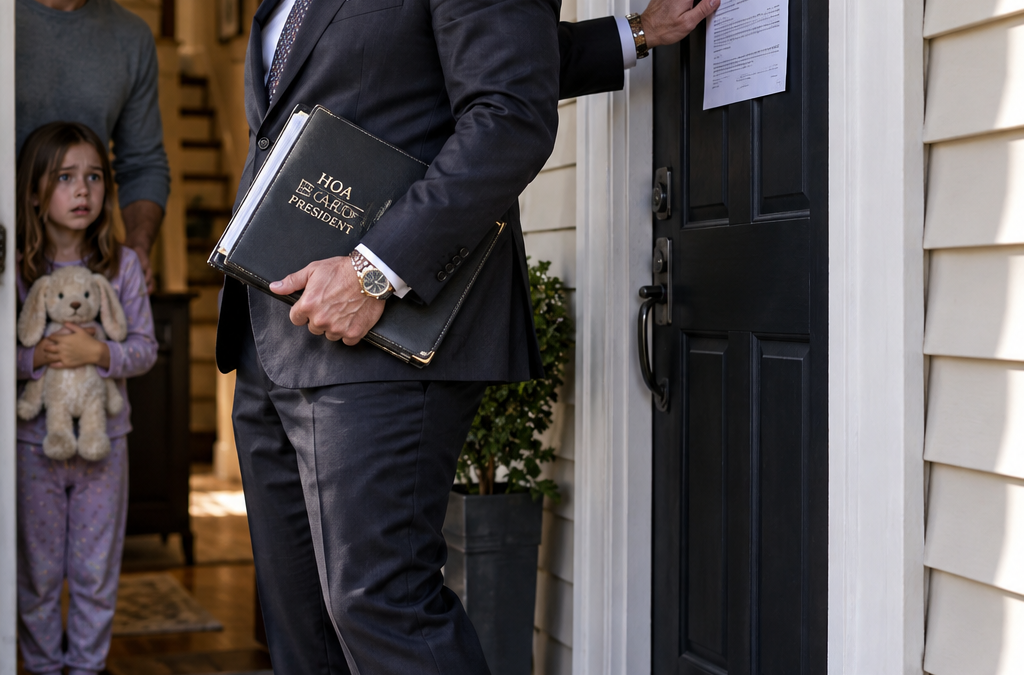
The lien notice was taped to my front door at seven in the morning, crooked and ugly, like Brenda Whitmore wanted my daughter to see it before I did. Three weeks earlier, I never imagined a strip of grass, a can of white paint, and one live camera would expose the foreclosure scheme hiding behind her clipboard.
My name is Nelson Cruz, and I was forty-two years old when Brenda Whitmore decided my house would be easier to take than to leave alone.
I was a contractor by trade.
Not the glossy kind who drove around in a clean truck handing out business cards while other men carried lumber. I was the kind who still knew how to frame a wall, hang a door, fix a rotten sill, patch drywall, rebuild a porch, and spot bad work from across a room.
I had spent most of my adult life earning money with my hands.
My wife, Elena, used to joke that I could not walk through a restaurant without mentally correcting the crown molding.
She died four years before all this happened.
Cancer.
The kind that moved quietly at first, then brutally.
After she passed, it was just me and our daughter, Mia.
Mia was twelve when we moved into Brook Haven Estates. Old enough to understand that her mother was not coming back, young enough to still leave little drawings on my workbench when she thought I needed cheering up.
I bought the house for her.
That was the truth.
It was not the biggest house in the neighborhood. It was not the fanciest. It had a narrow porch, a two-car garage, beige siding, and a strip of grass along the side yard that always grew uneven because the soil stayed damp after rain.
But it sat in a quiet cul-de-sac.
There were kids nearby.
The school bus stopped two blocks away.
The garage had enough space for my tools.
And the bedroom at the back of the house got morning light, the kind Elena would have loved.
I told myself Brook Haven would give Mia something steady.
No apartment moves.
No landlords.
No noisy street.
Just a home.
A place where she could grow up without feeling like the ground kept shifting.
For the first year, that was exactly what it felt like.
Neighbors waved from driveways. People left packages on porches without worrying. Someone always seemed to be walking a dog. The HOA sent the usual reminders about trash bins and landscaping, but nothing serious.
Then Brenda Whitmore became president.
She did not win the position so much as absorb it.
The previous board president moved to Arizona, two members resigned, and Brenda stepped into the vacuum like she had been waiting beside it with a clipboard.
She was in her late fifties, with sharp cheekbones, dyed blond hair cut into a stiff bob, and sunglasses that lived permanently on top of her head like a crown. Every morning, she patrolled the streets in a golf cart with the HOA logo on the side, slowing in front of houses, lifting her phone, making notes.
Neighbors joked that Brenda treated Brook Haven like a gated monarchy.
They stopped joking after the first wave of fines.
My first citation came on a Tuesday afternoon.
I found it tucked beneath the windshield wiper of my truck.
Trash receptacle encroachment.
According to Brenda, my bin had been placed four inches past the property line after pickup.
Fine: fifty dollars.
I stood in the driveway holding the paper, staring at my trash bin like it had committed a crime.
Four inches.
I laughed.
That was my first mistake.
I paid it that night because I was tired, because fifty dollars was annoying but not worth a fight, and because I believed reasonable people could survive unreasonable paperwork by not feeding it.
The second letter came nine days later.
Unapproved exterior paint color.
I read that one twice.
My house was beige. The same beige it had been when I bought it. The same beige the HOA had approved in 2019, according to the closing packet still sitting in my file cabinet.
Brenda claimed the trim along my porch had been repainted in a shade that disrupted neighborhood consistency.
I had not repainted anything.
I requested the original color approval paperwork.
Brenda replied two days later.
Unfortunately, those records were lost during a system update.
Convenient.
Very convenient.
The third notice came before I had even finished arguing about the second.
Landscape boundary irregularity.
Apparently, the damp strip of grass between my driveway and the sidewalk had grown slightly beyond the approved edge line.
Fine: two hundred dollars.
That one made me angry.
Not because of the money alone.
Because I had edged that strip myself the previous weekend.
I took photos, marked measurements, and emailed them to the HOA office.
No response.
The next notice doubled the fine.
Then came another.
Then another.
Two hundred became six hundred.
Six hundred became a cumulative penalty.
Then one morning, I opened my mailbox and saw a certified envelope thick enough to raise my heart rate before I tore it open.
Cumulative penalty balance: $4,200.
Lien filing pending.
I sat at the kitchen table and read the letter while Mia poured cereal across from me.
She noticed my face.
“Dad?”
I folded the letter slowly.
“Nothing, sweetheart.”
“That’s your lying voice.”
I looked at her.
She had Elena’s eyes.
That made it harder.
“It’s just HOA stuff.”
“Is it bad?”
“No. I’ll handle it.”
She did not look convinced.
Honestly, neither was I.
I went to the HOA office that afternoon.
The office sat inside the clubhouse near the community pool, a low building with fake stone columns and a bulletin board covered in notices Brenda had laminated as if preservation made them law.
She was there when I arrived.
Of course she was.
Sitting behind the desk in a white blouse, coral lipstick, sunglasses perched on her head, her clipboard resting beside her like a weapon.
“Nelson,” she said.
Not Mr. Cruz.
Not hello.
Just Nelson.
“I need an explanation,” I said, placing the lien notice on the desk.
She glanced at it.
“You received the warning.”
“I received a pile of fines for violations nobody has proven.”
Her smile sharpened.
“Read the bylaws, Nelson. Ignorance isn’t an excuse.”
“I requested the paint approval records. You said they were lost.”
“Administrative systems change.”
“The house was approved in this color when I bought it.”
“That does not mean it remains compliant.”
“How does beige expire?”
Her eyes narrowed.
“Your tone is not helping you.”
I leaned over the desk slightly.
“I’m a homeowner asking why you’re threatening my house.”
“You are a homeowner refusing to follow community standards.”
“Show me the standard.”
She tapped the folder in front of her.
“You’ve been notified.”
“That is not the same thing.”
For a second, her smile disappeared.
Then it came back colder.
“You have ten days before the association proceeds.”
I stared at her.
Ten days.
To pay $4,200 in fake fines or face a lien on the house I had bought for my daughter.
I picked up the notice.
“You’re making a mistake.”
“No,” Brenda said. “You made the mistake when you thought this neighborhood would tolerate defiance.”
That night, I started building the file.
Every notice.
Every email.
Every envelope.
Every photograph of my yard, porch, trim, driveway, grass line, and trash bins.
Every screenshot from the HOA portal.
Every payment record showing my regular dues were current.
Every timestamp.
Every inconsistency.
I labeled folders like I would label materials on a job site.
Paint dispute.
Grass strip.
Trash bin.
Lien threat.
Bylaw request.
I was not a lawyer, but I understood structure.
A house stands because the pieces connect in the right order.
So does a case.
The first real twist came from Denise.
Denise Harper lived across the cul-de-sac. She was a retired paralegal with silver hair, pink gardening gloves, and a gift for making sweet tea strong enough to revive the dead.
She came over the next evening while I was photographing the porch trim.
“Brenda got you too?” she asked.
I lowered my phone.
“Depends what ‘got’ means.”
Denise looked toward the street before stepping closer.
“Lien notice?”
I stared at her.
“How did you know?”
“She has a pattern.”
My stomach tightened.
“What pattern?”
Denise crossed her arms.
“Fines. Lost paperwork. Administrative fees. Then a lien threat. If the homeowner panics and pays, she wins. If they can’t pay, the law firm takes over.”
“What law firm?”
“Whitmore, Keene & Barlow.”
The name hit me.
Whitmore.
I looked at her.
“Brenda’s husband?”
Denise nodded.
“He’s a partner there.”
I felt the air change around me.
“Her husband’s firm handles HOA foreclosure filings?”
“And processing.”
“Processing?”
“Administrative fees. Collection letters. Lien filings. Foreclosure notices.”
The anger in my chest went quiet.
That was worse than heat.
That was the cold place anger goes when it turns useful.
“This isn’t clumsy enforcement,” I said.
Denise shook her head.
“No. It’s a pipeline.”
That night, after Mia went to bed, I dug through old HOA meeting minutes.
Brook Haven posted some minutes online, but not all. The rest were buried in attachments, archived newsletters, and PDFs that looked like they had been scanned by someone who hated clarity.
I found three families pushed out in two years.
The Parkers.
The Millers.
The Jennings family.
Each started with minor violations.
Paint.
Grass.
Fence height.
Trash storage.
Each account showed escalating administrative fees.
Each one eventually reached a forced sale or settlement under pressure.
The totals made my stomach turn.
Families had lost thousands before giving up.
Then I found the email.
It had been misfiled inside a board packet attachment labeled Quarterly Compliance Update.
Brenda had written to a board member and someone at the law firm.
Approve the lien fast. We need the numbers before quarter’s end.
I read it five times.
Not because it was hard to understand.
Because it was too easy.
We need the numbers.
Not compliance.
Not safety.
Not community standards.
Numbers.
The next morning, I called Miss Alvarez.
Her full name was Marisol Alvarez, but everyone called her Miss Alvarez because she had that calm, precise presence that made even angry people sit straighter.
She was a real estate attorney who had sued two HOAs and one management company in our county. Denise gave me her number with the seriousness of someone handing over a weapon.
Miss Alvarez met me in a small office above a dental clinic downtown.
She wore a navy suit, no jewelry except a thin gold watch, and read through my documents without wasting words.
When she reached Brenda’s email, she stopped.
Her eyes moved once across the page.
Then again.
“Where did you get this?”
“Public board packet. Buried in an attachment.”
She leaned back.
“This is very useful.”
“That’s one way to put it.”
She kept reading.
When she finished, she tapped the lien notice.
“You need to understand something. This is not only about your paint color.”
“I figured that out.”
“She appears to be using enforcement pressure to create fee revenue.”
“Through her husband’s firm.”
“That is a conflict of interest at minimum. Potentially more.”
I exhaled.
“Can she take my house?”
Miss Alvarez looked at me directly.
“Not if we move fast and the records support what you’ve brought me.”
“What do you need?”
“Everything. And you need to stay calm publicly.”
I almost laughed.
“Calm?”
“Yes. People like Brenda rely on making opponents look unstable. Do not give her that.”
So I smiled at meetings.
I nodded when she spoke.
I asked polite questions.
I played the compliant resident while the file grew thicker each week.
Inside, I was furious.
But fury is not evidence.
Paper is.
Then came the community picnic.
The city’s local news station was filming a short segment about neighborhood spirit after Brook Haven won some minor beautification award Brenda had nominated us for herself.
There were folding tables near the clubhouse lawn, hot dogs on the grill, kids chasing each other with juice boxes, and Brenda floating from group to group like a queen inspecting tribute.
She wore a pale blue sundress and white sandals. Her sunglasses were on her head, naturally. A small microphone from the news crew was clipped near the reporter’s collar.
Mia had gone to a friend’s house, thankfully.
I was standing near the grill with Denise when Brenda spotted me.
Her smile changed.
“Careful,” Denise whispered.
“I’m not doing anything.”
“That never stopped her.”
Brenda crossed the lawn quickly, too quickly for someone pretending to be casual.
The reporter followed, probably thinking this was another neighborhood interaction worth capturing.
“Nelson,” Brenda called loudly.
Several people turned.
I set down my paper plate.
“Brenda.”
“I need you to stop harassing board members.”
The words hit the air like a dropped glass.
I stared at her.
“Excuse me?”
“You’ve been filing false complaints, intimidating volunteers, and making people feel unsafe.”
The reporter’s eyebrows lifted.
The camera operator shifted closer.
I became very aware of the microphone inches from Brenda’s furious face.
“Ma’am,” I said carefully, “I think there’s a misunderstanding.”
“No,” she snapped. “There is not. You physically threatened me in the clubhouse parking lot.”
A bald lie.
A theatrical, public, reckless lie.
Delivered with tears forming in her eyes like she had rehearsed in a mirror.
I had not spoken to her all week.
I had never threatened her.
I had never touched her.
For one second, I wanted to defend myself loudly.
Then I remembered Miss Alvarez.
Stay calm publicly.
So I said nothing.
Brenda kept going.
“He has terrorized this board for weeks because he refuses to follow rules.”
The reporter glanced at me.
I kept my hands at my sides.
“Those accusations are false,” I said quietly.
That was all.
The reporter was a woman named Camille Daniels.
I learned later that she was the sister of Officer Daniel Daniels from the county sheriff’s office. At the time, all I knew was that her eyes sharpened the moment Brenda accused me of a physical threat.
Brenda kept talking.
And talking.
And crying.
And accusing.
Then Camille turned to me after Brenda stormed off.
“Mr. Cruz,” she said quietly, “you should know this segment has been livestreaming for the last six minutes.”
I blinked.
“What?”
“Unedited. Live feed.”
Denise made a sound beside me that was almost a laugh.
My phone started buzzing before I reached my truck.
By the time I got home, the clip was already spreading online.
HOA president falsely accuses resident live on camera. Watch her meltdown.
Thousands of local viewers had seen Brenda accuse me of harassment and threats without evidence. They had seen me stand there calmly. They had seen the reporter’s face change when Brenda went too far.
Within an hour, comments flooded in.
Not just jokes.
Stories.
Former Brook Haven residents.
People who had moved after fines became impossible.
People whose paperwork had gone missing.
People who had paid administrative fees to Brenda’s husband’s law firm.
People who had been threatened with liens for violations they still did not understand.
I forwarded everything to Miss Alvarez.
She called that night.
For the first time since I had met her, she sounded almost thrilled.
“Nelson, this is the pattern evidence we needed.”
“For what?”
“For the class action.”
We filed jointly with four displaced families.
Fraud.
Harassment.
Improper lien practices.
Breach of fiduciary duty.
Defamation.
Conflict of interest.
Brenda posted an apology video two days later.
It was shaky, badly lit, and clearly recorded in her kitchen.
She claimed her words had been edited.
But the livestream had no edits.
She said emotions had been high.
But the accusation had been specific.
She said she supported transparency.
But she still refused to produce the missing records.
The county sheriff’s office opened an inquiry after Officer Daniels confirmed Brenda’s on-camera claims matched no police report, no complaint, and no documented incident.
Meanwhile, forensic accountants subpoenaed HOA financial records.
That was when the second layer opened.
Fee overages.
Duplicate administrative charges.
Expedited lien processing.
Legal-review costs that did not match actual filings.
Transfers to a shell account tied to Brenda’s husband’s law firm.
The tension in Brook Haven thickened like humidity before a storm.
Everyone knew the next board meeting would matter.
Residents packed the clubhouse.
Phones were raised before Brenda even arrived.
Denise sat near me.
Miss Alvarez stood along the side wall with a leather folder under one arm.
Brenda entered twelve minutes late.
Makeup perfect.
Hair perfect.
Sunglasses perched high.
She walked to the front as if applause might happen.
It did not.
She called the meeting to order with a voice sweet enough to rot teeth.
“This association will not be bullied by bitter homeowners who broke the rules and now seek to avoid accountability.”
Someone in the back muttered, “Here we go.”
Brenda continued.
“The lawsuit is baseless harassment.”
Miss Alvarez stepped forward.
“No, Mrs. Whitmore. It is not.”
Brenda’s eyes snapped toward her.
“This is a board meeting. You are not recognized.”
Miss Alvarez placed printed emails on the front table.
“You may want to recognize these.”
The room went quiet.
Miss Alvarez picked up the first page.
Then read aloud.
“Approve the lien fast. We need the numbers before quarter’s end.”
Nobody moved.
Even Brenda went still.
Miss Alvarez held up the page.
“This email came from your account, Mrs. Whitmore.”
Brenda’s mouth opened.
No words came.
Miss Alvarez continued.
“Additional records show lien processing fees routed through a shell account connected to your husband’s law firm.”
That was twist three.
The room went dead silent.
Then it exploded.
People stood.
Phones rose higher.
Board members looked at one another with pure terror, not moral outrage yet, but liability fear.
Brenda’s polished mask cracked instantly.
“This is fabricated,” she shrieked.
Miss Alvarez’s face did not change.
“The forensic accountant disagrees.”
“I was set up.”
“By your own email?”
“My words are being twisted.”
Denise stood.
“You twisted people out of their homes.”
That landed.
Brenda looked around the room, searching for allies.
She found none.
One board member, pale as paper, moved to suspend Brenda from her duties pending investigation.
Another seconded it so fast he nearly knocked over his water bottle.
The vote was unanimous.
Security escorted Brenda out while she shouted that everyone would regret this.
For the first time since I moved into Brook Haven, nobody looked afraid of her.
Three months later, the county filed formal charges.
Fraud.
Extortion.
Falsifying municipal records.
Improper lien filings.
Brenda’s mugshot replaced her old campaign flyer in every group chat in town.
Her husband’s firm lost the HOA contract entirely. Disbarment proceedings began after the state bar reviewed the shell account evidence and fee-routing records.
Every fraudulent lien was voided by court order.
Including mine.
Homeowners were reimbursed in full, with interest, for years of improper fees.
The Parkers got money back.
The Millers got money back.
The Jennings family, who had moved out under pressure, became part of the settlement.
I received a formal release clearing my property records.
The day Miss Alvarez handed me the document, I sat in her office and stared at it for a long time.
“Nelson,” she said gently, “it’s over.”
I nodded.
But I could not speak right away.
Because for months, I had imagined losing the house.
Not because I failed my daughter.
Not because I missed payments.
Not because I did anything wrong.
But because one woman with a clipboard had discovered how to turn rules into traps and fear into revenue.
When I got home, Mia was sitting on the porch steps.
She looked up.
“What happened?”
I handed her the release.
She read it slowly.
Then looked at me.
“So they can’t take the house?”
“No, baby.”
Her eyes filled.
I sat beside her.
She leaned into my shoulder.
For a while, neither of us said anything.
The house was quiet behind us.
The same house.
Same porch.
Same uneven strip of grass.
Same beige trim Brenda had tried to turn into a weapon.
Only now, it felt like ours again.
Brook Haven elected a new board that spring.
Transparent.
Boring.
Careful.
Which is exactly what an HOA should be.
The first thing they did was publish all current bylaws online.
The second thing they did was terminate every legal and processing arrangement connected to Brenda or her husband.
The third thing they did was create a rule requiring homeowner access to all nonprivileged financial records within ten business days.
No more lost paperwork.
No more secret paint swatches.
No more magical evolving standards.
Mia and I repainted the porch in May.
Not because Brenda had ordered us to.
Because it needed it.
We picked the color ourselves.
A clean warm white.
Not antique white.
Not eggshell.
Not whatever shade Brenda might have approved from some imaginary binder.
Just white.
Mia rolled paint onto the railing while I cut in near the trim.
She got a streak on her cheek and told me not to wipe it off because it made her look “professionally useful.”
Elena would have laughed at that.
I thought about her a lot that day.
She had wanted Mia to grow up strong, but not hardened.
There is a difference.
I hoped this whole mess had taught my daughter that standing up for yourself does not always mean shouting. Sometimes it means keeping the email. Saving the envelope. Taking the picture. Staying calm while someone lies into a live microphone because you know the truth has better endurance than drama.
I still keep the first lien notice framed in my garage.
Mia thinks that is weird.
Maybe it is.
But I keep it above my workbench, near my levels and saw blades, because it reminds me of something important.
A threat is not the same as power.
A letter is not the same as truth.
And a person who acts untouchable is often leaving fingerprints everywhere.
Sometimes neighbors ask if I regret fighting Brenda.
I tell them no.
I regret paying the first fine.
I regret laughing when I should have been documenting.
I regret how close she came to hurting my daughter’s sense of safety.
But I do not regret fighting.
Watching Brenda’s perp-walk clips circulate online with captions pulled from her own televised meltdown felt like poetic justice, but it was not the real victory.
The real victory was quieter.
It was Mia doing homework at the kitchen table without asking if we might have to move.
It was Denise waving from across the cul-de-sac with no fear in her face.
It was the Parkers getting reimbursed.
It was the new board treasurer boring everyone half to death with transparent financial reports.
It was the porch, painted fresh, no permission slip required.
It was Brook Haven becoming a neighborhood again instead of a hunting ground.
Brenda Whitmore thought she could turn my home into a number before quarter’s end.
She thought families were easier to pressure than corporations.
She thought people would pay because lawyers cost too much, because court sounds scary, because most homeowners are too tired to fight over paint and grass and trash bins.
For a while, she was right.
Then she chose the wrong widower.
The wrong daughter to frighten.
The wrong attorney to provoke.
And the wrong live camera to lie into.
That was the beginning of the end for her.
For us, it was the beginning of getting our peace back.








