𝗙𝗨𝗟𝗟 𝗦𝗧𝗢𝗥𝗬 The HOA President Tried to Take My House Over a Handmade Table in My Backyard
𝗙𝗨𝗟𝗟 𝗦𝗧𝗢𝗥𝗬
His smile tightened.
“It appears to be an unauthorized outdoor structure.”
I stared at him.
“It’s furniture.”
“It is over two feet tall and located in an exterior yard space.”
“It’s on sawhorses while the varnish dries.”
He lifted his phone and took a picture.
“Rule 14.3.”
I set the rag down.
“What about it?”
“Any object over two feet tall in a yard for more than forty-eight hours requires board approval.”
I almost laughed.
Almost.
But something about his face stopped me.
He was enjoying this.
“It’s a wedding gift for my daughter,” I said. “It’ll be inside tonight.”
“That would have been easier if you had submitted the proper exterior placement request.”
“It’s not exterior placement. It’s drying.”
“Rules are rules.”
He said it softly, the way men like him say things when they want you to understand they are not discussing, they are declaring.
I wiped my hands on a rag.
“Derek, it’s a table.”
“And this is an HOA.”
He took another picture and walked back to his golf cart.
The fine arrived two days later.
Two hundred dollars.
Unauthorized outdoor structure.
I paid it.
I moved the table inside that night, leaning it carefully against the garage wall, telling myself the whole thing was ridiculous but finished.
It was not finished.
A week later, another citation appeared.
Same table.
Same rule.
But the violation date was backdated to before I had moved it inside.
I called the HOA office.
No one would explain the discrepancy.
A woman named Janet answered first, then transferred me to voicemail, then sent an email saying all compliance questions had to be submitted in writing.
I submitted the question in writing.
Derek replied with one sentence.
The board stands by its inspection record.
That was when my father’s voice came back to me.
Paperwork beats yelling, son.
He used to say that whenever a contractor tried to cheat him, whenever a warranty company tried to dodge a claim, whenever some office clerk told him a record did not exist.
Paperwork beats yelling.
So I started a folder.
Photos.
Dates.
Emails.
Violation notices.
Payment confirmations.
Screenshots.
Everything.
I took pictures of the table inside the garage with timestamps. I photographed the backyard empty. I printed the email where Derek refused to explain the backdated citation.
At first, I felt foolish.
A grown man building a legal file over a table.
Then the fines kept multiplying.
Noise violation.
Improper storage.
Unauthorized equipment visibility.
A citation for my dog barking during quiet hours, though my dog, Tucker, had been at the vet’s kennel the entire week while I helped my sister move in Dayton.
That one made me sit down at the kitchen table and stare at the paper until anger turned cold.
Derek was not mistaken.
He was manufacturing.
I pulled out the notices and started lining them up by date.
That was when I noticed something strange.
Every fine landed exactly three days after I had spoken to Rosa.
Not once.
Not twice.
Again and again.
If I waved to Rosa at the mailbox on Monday, a letter arrived Thursday.
If I leaned over the fence to ask how her grandson was doing, another notice landed three days later.
It sounded paranoid even inside my own head, but the pattern was there.
Rosa lived next door in a pale yellow ranch house with white shutters and a backyard full of tomato plants. She was in her late fifties, widowed, sharp-tongued when she trusted you, quiet when she did not. She had been kind to Emily after her mother died. She had brought casseroles, birthday cards, and once a whole box of old wedding magazines when Emily got engaged.
Derek despised her.
I did not know why.
One evening, after another fine arrived, Rosa pulled me aside near the fence.
Her voice dropped low.
“Matt, he’s targeting you because of me.”
I looked at her.
“What?”
“Derek.”
“Why would he care if I talk to you?”
She glanced toward his house down the street.
“Because he tried to buy my house last year.”
I frowned.
“What?”
“He offered cash. Low. Insultingly low. Said he had investors interested in ‘neighborhood improvement.’ I told him no.”
I waited.
She swallowed.
“Two weeks later, the fines started.”
“What kind of fines?”
“Fence stain. Gutter color. Garden edging. A shed permit from fifteen years ago. Anything he could invent.”
I looked down at my own citation letter.
A table.
A dog.
A mailbox.
“Why didn’t you tell anyone?”
“I did. The board told me Derek was following procedure.”
“He is the board.”
“Exactly.”
That was twist one, though it came quietly.
This was not about my table.
It was not about Rosa’s fence.
Derek wanted control of specific properties, and anyone friendly with the holdouts got targeted.
I went inside and pulled up old HOA meeting minutes.
They were buried on the association website, badly scanned and poorly labeled. I searched Derek’s name, then “acquisition,” then “beautification.”
At 1:17 in the morning, I found it.
A proposal from three months before Derek became president.
Beautification acquisitions.
That was the phrase.
Three properties listed as strategic for future community improvement.
Mine.
Rosa’s.
And a third house at the corner owned by an elderly man named Harold Price.
I sat back from the computer, the room lit only by the glow of the screen.
Derek had identified my house before he ever cited my mailbox.
Before the table.
Before the dog.
Before he stood in my yard with that polished smile.
My stomach dropped.
This was not a control freak enjoying power.
This was a man engineering financial pressure to force people out and profit from the resale.
The table had simply given him a starting point.
The next letter arrived three days later.
Notice of intent to lien.
Eighteen hundred dollars in unpaid fines.
Some of the fines listed were familiar. Others I had never received.
I called the county recorder’s office.
A patient woman named Mrs. Holloway walked me through what had been filed and logged.
According to HOA documentation, three warning letters had been delivered before the lien notice.
They had not.
I knew they had not.
I asked for copies of the delivery logs.
She emailed them within an hour.
There were signatures beside each entry.
Not mine.
Not even close.
My name had been written in a rushed, ugly hand, and the delivery confirmation had been marked by the HOA compliance officer.
His name was Kyle Whitfield.
Derek’s nephew.
Nineteen years old.
Part-time compliance officer.
Paid by the HOA.
That was twist two.
The forged delivery signature was not Derek’s.
It belonged to his nephew.
This was not one rogue man anymore.
It was a family operation, running fake violations through an unqualified relative to build a paper trail against homeowners.
For the first time, I felt real fear.
Not annoyance.
Not anger.
Fear.
They were making records.
False records, but records all the same.
And records, if unchallenged, can become reality in the eyes of the system.
I hired a real estate attorney the next morning.
Her name was Marisol Alvarez, though she told me to call her Ms. Alvarez in court and Marisol everywhere else. She specialized in HOA abuse cases and had the steady calm of someone who had seen polite suburban corruption in every possible costume.
I brought the folder.
Then a second folder.
Then the printed meeting minutes.
Then the county delivery logs.
She read everything.
Slowly.
Carefully.
Without interrupting.
I watched her face, looking for signs that I was overreacting.
I did not find any.
When she reached the forged signatures, she went still.
Then she read the beautification acquisition minutes again.
Finally, she closed the folder and looked at me.
“You have more evidence than most of my clients bring after two years.”
My hands were clasped under the table.
“So I’m not crazy.”
“No.”
“This is fraud?”
“It may be. It is certainly more than harassment.”
She tapped the delivery log.
“Forged service records.”
Then the backdated citations.
“Manufactured enforcement.”
Then the acquisition minutes.
“Possible predatory pressure tied to property acquisition.”
Then the nephew’s compliance role.
“Conflict of interest at minimum.”
She leaned back.
“Mr. Callahan, your table may have opened a very ugly door.”
We filed a formal complaint with the state’s common interest community board.
Every fabricated citation.
Every mismatched date.
Every forged signature we could prove.
Every record request Derek had ignored.
Every conflict involving his nephew.
Every meeting minute showing my property had been listed before any violation occurred.
Ms. Alvarez also sent a preservation letter demanding the HOA keep all communications, financial records, enforcement logs, vendor payments, meeting notes, and correspondence involving me, Rosa, Harold, and the so-called beautification acquisition properties.
Derek did not know the state complaint was already moving.
So he doubled down.
A certified letter arrived demanding immediate payment within ten days or foreclosure proceedings would begin on my home.
Five thousand dollars now.
The amount had jumped from eighteen hundred to five thousand in less than two weeks through administrative costs, late fees, attorney preparation fees, and something called accelerated compliance review.
I stood in my kitchen with that letter in my hand and felt the world narrow around me.
Five thousand dollars.
Foreclosure proceedings.
My home.
The house I had kept after my wife died.
The garage where Emily had done homework on the steps.
The backyard where the table had dried in the sun.
I called Emily that night and almost told her.
I heard her happy, distracted voice on the other end, talking about wedding flowers and seating charts and how her fiancé’s aunt was apparently allergic to every centerpiece idea.
I looked at the table in my garage, wrapped in cloth, waiting for her wedding.
And I said nothing about the lien.
“Dad?” she asked. “You okay?”
“Yeah, sweetheart.”
“You sound tired.”
“Long day.”
“You’re still bringing the table, right?”
I closed my eyes.
“Wouldn’t miss it.”
After we hung up, I sat in the garage beside that table for nearly an hour.
My knuckles were rough from sanding it.
My wife’s morning glory pattern curled down the carved legs.
It was supposed to be a gift.
Something beautiful.
Derek had turned it into a weapon against me.
That was when anger finally burned through the fear.
At the next HOA meeting, Derek performed exactly the way I expected.
He stood at the podium in a charcoal blazer, black shirt, polished shoes, and that gold watch flashing whenever he moved his hand. His hair shone under the community room lights. He spoke about order, standards, and responsibility in the tone of a man auditioning for public office in a town that did not exist.
“We will have zero tolerance,” he said, “for residents who believe community rules are optional.”
His eyes landed on me.
I sat in the third row, drinking terrible community room coffee out of a Styrofoam cup.
I said nothing.
He wanted me angry.
He wanted me defensive.
He wanted me to stand up and look unreasonable in front of the room.
So I let him talk.
I let him enjoy his little performance.
He had no idea what was sitting in my attorney’s office.
After the meeting, Harold Price pulled me aside.
Harold was seventy-three, retired from county public works, and the kind of man who wore suspenders because he had no interest in modern belts. He lived at the corner house listed in Derek’s beautification acquisition plan.
His voice was barely above a whisper.
“She’s been dipping into the reserve fund.”
I frowned.
“She?”
He shook his head.
“Sorry. Habit. I mean Derek. People used to say ‘the board’ like it was some lady in an office. It’s him. He’s been dipping into the reserve fund.”
My body went still.
“What makes you say that?”
“I was treasurer before Derek pushed me out. Pool repair money is short.”
“How short?”
“Thousands.”
“Can you prove it?”
“I have copies.”
“Why haven’t you said anything?”
Harold looked toward the exit, where Derek was laughing with two board members.
“Because when I asked questions, I got three violation letters and my grandson’s car was towed.”
The funniest part of the whole ordeal, if anything about it could be funny, was Derek lecturing me about financial responsibility while quietly draining the HOA’s pool repair budget.
Harold agreed to testify if it came to that.
Suddenly, my little table dispute had become the thread that could unravel Derek’s entire reign.
Ms. Alvarez moved quickly.
We requested a full financial audit of the association, citing the state law and HOA provisions allowing homeowners to demand review with sufficient board support and documented evidence of irregularities. Harold helped secure the necessary signatures. Rosa added hers. Two other homeowners joined once they saw the beautification acquisition minutes.
Derek tried blocking the audit twice.
First, he claimed the request was procedurally defective.
Ms. Alvarez corrected him.
Then he claimed the records were not ready.
Ms. Alvarez reminded him of the preservation letter.
Then he claimed outside audits were unnecessary because the board had internal oversight.
Harold sent a written statement that he had been removed from financial access after questioning missing pool repair funds.
That ended the argument.
The delay only made Derek look guiltier.
Neighbors who had quietly paid unfair fines for years started coming forward.
A woman on Alder Lane had been fined into replacing a perfectly good fence.
A man near the entrance had paid late fees on notices he swore he never received.
Rosa brought out her own folder, thinner than mine but just as damning.
The pattern stretched back further than anyone wanted to believe.
Derek had not built a system from scratch.
He had inherited a sleepy HOA, found its weak points, filled them with family, and turned procedure into pressure.
Then the audit results arrived.
Twist three.
Nearly thirty-one thousand dollars had vanished from HOA accounts over eighteen months.
Not misplaced.
Not delayed.
Not poorly categorized.
Vanished through vendor invoices routed to a shell company Derek controlled.
The company had a name so bland it almost disappeared on paper.
Crestline Property Services.
It billed for landscaping consultation, pool repair coordination, compliance processing, community signage review, and administrative support.
Most of the work had never happened.
The registered mailing address led to a post office box.
The banking trail led back to Derek.
My table had been a distraction.
An easy target.
A way to punish me while he quietly emptied the community’s savings under everyone’s nose.
The state board scheduled an emergency hearing.
The morning of the hearing, I put on my best shirt, the one Emily had bought me for Father’s Day. I stood in front of the bathroom mirror longer than usual, trying to recognize the man looking back.
He looked tired.
Older than he had six weeks earlier.
But steady.
The hearing room was plain and bright, with rows of chairs and a long table at the front. Derek arrived dressed like he owned the courthouse. Navy suit. White shirt. No tie. Gold watch. Hair slicked back. Leather binder tucked under his arm like armor.
He smiled when he saw me.
That bothered me at first.
Then I realized it was habit.
Some men smile because they feel confident.
Men like Derek smile because they cannot imagine the room turning against them.
Ms. Alvarez sat beside me.
Rosa was behind us.
Harold was two seats down, holding a folder in both hands.
The hearing officer began with the lien.
Then the citations.
Then the delivery logs.
Ms. Alvarez laid everything out point by point.
Backdated notices.
Forged delivery records.
The nephew’s fake compliance role.
The acquisition minutes listing my property before any violation occurred.
The refusal to produce records.
The inconsistent enforcement.
Then the audit.
Crestline Property Services.
Thirty-one thousand dollars.
Eighteen months.
Vendor invoices.
Bank trails.
Derek’s signature.
His smirk cracked when the auditor read the number aloud.
Just slightly.
Like a table leg taking too much weight.
His attorney tried to object.
The hearing officer let the auditor continue.
Each sentence made the room heavier.
Each document took something from Derek that his blazer and watch could not give back.
Authority.
Credibility.
Control.
When Ms. Alvarez presented the forged delivery log, Derek finally leaned toward his attorney and whispered. His attorney’s face did not change, but I saw his hand tighten around his pen.
Then Kyle Whitfield’s name came up.
Derek’s nephew.
Nineteen years old.
Part-time compliance officer.
Signer of delivery logs.
Paid through HOA funds.
The hearing officer looked over the papers.
“Was Mr. Kyle Whitfield trained or licensed for this role?”
Derek’s attorney said, “He assisted administratively.”
“That is not what I asked.”
Silence.
The hearing officer turned to the lien demand.
“Every fine against Mr. Callahan and Ms. Rosa Medina arising from these defective notices is void pending further review. The lien is dismissed.”
I heard Rosa inhale behind me.
My hands went numb.
The hearing officer continued.
“The financial irregularities identified in the audit are referred to the county prosecutor’s office.”
Derek’s smile was gone now.
Completely.
The man who had stood in my backyard calling a table an unauthorized structure looked suddenly smaller behind that long table.
Not humble.
Not sorry.
Just exposed.
He was removed from the HOA board that same afternoon.
Not politely.
Not ceremonially.
The remaining board members voted under state pressure to suspend and remove him pending investigation. Two officers escorted him out of the building while homeowners who had suffered under his rules watched from the hallway.
He did not look at me as he passed.
I was glad.
I did not trust myself to stay quiet if he had.
Three months later, Derek Whitfield was formally charged with embezzlement and forgery.
Kyle, his nephew, cooperated with prosecutors in exchange for a reduced plea deal. He admitted he had signed delivery logs without serving notices, backdated compliance forms, and used templates Derek gave him.
He was nineteen.
Old enough to know better.
Young enough that I could still feel disgust and pity in the same breath.
Derek had used everyone.
Even his own family.
Rosa got her retraction letter.
Harold got vindicated.
I got a public apology from the new HOA board, along with a full refund of every fraudulent fine I had paid.
The refund check arrived in the mail on a Friday.
I stood at the kitchen counter holding it, thinking about the first fifty-dollar fine for the mailbox post.
How easy it had been to pay.
How harmless it had seemed.
How quickly harmless became dangerous when the wrong person realized you wanted peace more than confrontation.
The table finally made it to Emily’s wedding.
I transported it wrapped in blankets in the back of my truck, checking the straps three times like it was made of glass instead of oak. When we set it under the string lights, Emily put both hands over her mouth.
“Dad.”
I tried to play it off.
“It’s just a table.”
“No, it isn’t.”
She ran her fingers over the carved morning glories.
I saw when she recognized them.
Her eyes filled.
“Mom.”
I nodded.
“Thought she should be here.”
Emily hugged me so hard my back popped.
That night, the table held the guest book, framed photos, flowers, and a small candle for her mother. People signed their names on it, leaned over it, rested hands on it while laughing, crying, congratulating.
Not one person knew it had nearly cost me my house.
Not until later.
Not until after the speeches, after the first dance, after Emily and her husband drove away beneath sparklers.
I stood alone beside the table near the end of the night, running my hand over the varnished top.
Oak legs gleaming under string lights.
Strong.
Steady.
Completely unaware it had once been evidence in a fight against a man who thought rules were weapons.
Rosa came up beside me.
“Looks good.”
“Thanks.”
“Worth the trouble?”
I looked at the table.
Then at the empty dance floor.
Then at my daughter laughing near the barn doors.
“Yes,” I said. “Every bit.”
Willamir Court changed after Derek fell.
Not overnight.
Neighborhoods do not heal like television endings.
At first, people were embarrassed.
Some had defended him.
Some had paid fines they knew were wrong.
Some had stayed silent while others were targeted.
Some had benefited from looking away.
But the new board, led by Harold as temporary treasurer and Rosa on the compliance committee, did something Derek never had.
They opened the books.
Every invoice.
Every vendor.
Every fine collected.
Every lien threat issued.
Every board vote.
The first meeting after the audit lasted three hours and was the most boring, beautiful thing I had ever witnessed.
People argued about procedure.
They asked for clarification.
They voted on record-keeping rules.
They discussed vendor bids.
No one threatened anyone’s house.
No one used “community standards” like a club.
No one called a table a structure.
At the end, Harold stood and said, “From now on, paperwork protects homeowners. It doesn’t punish them.”
That got the longest applause I had ever heard in that room.
I kept building furniture.
For a while, I stopped leaving anything outside, even for an hour. I would varnish in the garage with fans running and the door barely cracked. I measured noise. I checked sight lines. I found myself looking for violation letters before they arrived.
That kind of fear leaves splinters.
You pull most of them out.
Some stay under the skin.
Then one Saturday, I was working on a small bench for Rosa’s porch, and I carried it outside to inspect the finish in sunlight.
I set it on sawhorses.
Right in the backyard.
For a second, my chest tightened.
Then Tucker barked from the kitchen window, the sun warmed the wood, and no golf cart appeared at the curb.
No Derek.
No clipboard.
No fake rule.
Just a bench.
Just my yard.
Just the life I had almost let him make smaller.
I left it there all afternoon.
Sometimes I still laugh thinking about Rule 14.3.
Any object over two feet tall in the yard for more than forty-eight hours requires board approval.
Derek thought that rule would bury me.
Instead, it became the first loose thread in the paperwork trail that buried him.
That is the thing about men like Derek Whitfield.
They love documents until the documents turn around.
They love signatures until someone checks who signed.
They love notices until someone asks whether they were delivered.
They love rules until a rule applies to them.
Justice does not always come loud.
Sometimes it sounds like a printer in an attorney’s office.
A county clerk emailing logs.
A treasurer whispering the truth in a hallway.
A neighbor sliding her own folder across a kitchen table.
A hearing officer reading a dollar amount out loud while a powerful man realizes paper cuts both ways.
My father was right.
Paperwork beats yelling.
Not because paper is magic.
Because records remember what bullies count on people forgetting.
I still have the folder.
It sits on a shelf in my garage, next to clamps, sandpaper, and a jar of old screws I keep for no good reason. Every now and then, I see the label and think about those six weeks when a handmade table became a threat against my home.
Then I look around.
At the tools.
At the sawdust.
At the boards waiting to become something useful.
At the empty space where Emily used to sit doing homework.
At the photographs from her wedding, one of them showing the oak table glowing under string lights.
And I feel something better than victory.
I feel rooted.
Derek wanted me scared enough to leave.
Instead, I stayed long enough to watch him carried out under the weight of his own paperwork.
Rosa stayed too.
Harold stayed.
The neighborhood stayed.
And the table, the one that started all of it, now sits in Emily’s dining room.
She called me last week to say her husband accidentally scratched one leg moving a chair.
I told her not to worry.
Oak can take a mark.
That is the point of building with something strong.
It carries the evidence of what happened and keeps standing anyway.
𝗧𝗛𝗘 𝗘𝗡𝗗
The HOA President Tried to Take My House Over a Handmade Table in My Backyard
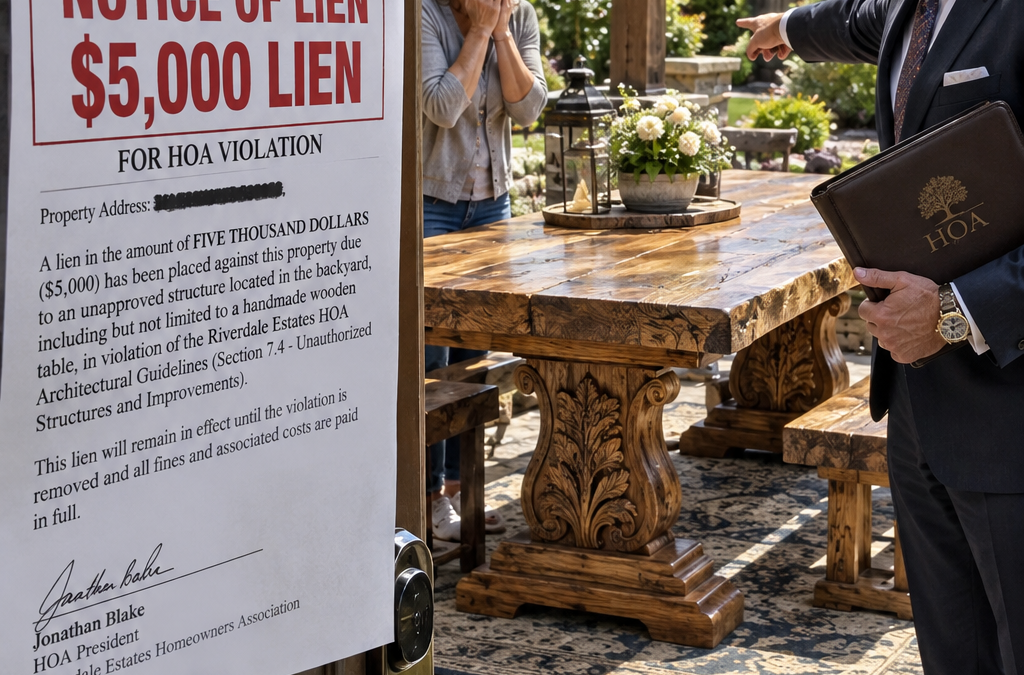
They slapped a five-thousand-dollar lien notice on my front door because of a table, and for a moment I just stood there staring at the paper, trying to understand how something I had built with my own hands had become a threat against the house I had spent nine years paying for.
My name is Matt Callahan.
I am a carpenter, though most people in Willamir Court knew me as the quiet guy who worked at the lumberyard, mowed every Saturday, and spent his evenings in the garage with the door half-open, sawdust on my boots and country radio playing low enough not to bother anybody.
That was my life.
Simple.
Predictable.
Honest.
I went to work before sunrise. I loaded lumber, checked orders, helped contractors find the right grade of oak or pine, and came home with my shoulders aching in that familiar way a working man learns to accept. After dinner, I went into the garage and built things.
Chairs.
Shelves.
Benches.
Cabinets.
Small tables for neighbors who asked nicely.
A rocking horse once, for Rosa’s grandson.
Furniture made sense to me in a way people did not always make sense. Wood tells you what it is if you pay attention. It has grain, tension, knots, flaws, strengths. You cannot bully it into becoming something it is not. You work with it, or it splits.
Maybe that was why what happened with Derek Whitfield bothered me so deeply.
He was the kind of man who thought everything could be forced into shape if he had the right title, the right signature, and enough people afraid to say no.
Derek became HOA president that spring.
Before him, the Willamir Court homeowners association had been irritating but mostly harmless. We had rules about trash cans, grass height, mailbox color, fence repairs, and holiday decorations. I followed them because I had no interest in neighborhood drama.
I had lived there for nine years.
Nine years of paying dues on time.
Nine years of keeping my yard clean.
Nine years of repairing my fence before anyone had to ask.
Nine years of waving to neighbors, minding my own business, and building furniture in my garage after my shift at the lumberyard.
Then Derek Whitfield decided a clipboard made him God.
He was fifty years old, maybe fifty-one, with slick black hair combed so perfectly it looked varnished, a tight smile, and clothes that belonged in a downtown law office rather than an Ohio cul-de-sac. Pressed slacks. Polished shoes. Silk shirts open at the collar just enough to show a gold chain. Expensive watch. Cologne that arrived before he did.
He looked smooth.
Too smooth.
The kind of man who wanted you to notice the shine before you noticed the knife.
The first week after taking office, Derek repainted the welcome sign at the entrance, added four new “community clarification policies,” and started patrolling the street every evening at six in a black golf cart with the HOA seal stuck to the front.
He called it neighborhood stewardship.
Rosa called it what it was.
“Peacocking with paperwork,” she said over the fence one Saturday.
I laughed then.
That was before the first citation.
It came in a white envelope with the HOA logo stamped in the corner.
My mailbox post was off-center.
That was the violation.
Not broken. Not leaning. Not unsafe.
Off-center.
I stood at the end of my driveway with the letter in my hand, staring at the post like maybe it had betrayed me overnight.
It looked exactly the way it had looked for nine years.
I measured it out of curiosity. If it was off-center, it was off by less than an inch from whatever imaginary line Derek had decided existed.
The fine was fifty dollars.
I should have challenged it.
Instead, I laughed, wrote the check, and mailed it.
Fifty dollars felt cheaper than fighting a man who clearly wanted to feel important.
That was the first mistake.
The second mistake was thinking men like Derek stop after they get a little money.
They do not.
They take payment as proof that fear works.
The table began as a wedding gift for my daughter, Emily.
She was getting married in late summer under string lights at a small barn venue outside Columbus. She had asked if I would build something for the reception, maybe a guest book table or a small display stand.
I told her I would think about it.
That was a lie.
I had already started sketching it.
Emily had grown up sitting on the garage steps while I worked. When she was little, she would hand me screws one at a time and ask why wood smelled different after it was cut. After her mother passed, the garage became the place where we could be together without needing to say everything we felt. I built things. She sat nearby, doing homework, listening to music, sometimes crying quietly when she thought I could not hear.
A wedding table felt too small for what she meant to me, so I made it as beautiful as I knew how.
Solid oak.
Hand-carved legs.
Rounded edges.
A top wide enough for framed photos, a guest book, and whatever flowers she chose.
I sanded it until my knuckles were raw. I worked the grain with oil and patience. I carved a small vine pattern into the legs because Emily’s mother used to grow morning glories along our back fence, and I wanted some part of her at that wedding too.
When the table was nearly done, I set it outside in the backyard on sawhorses to finish the varnish. The weather was clear. The garage was dusty. The backyard gave me better light.
It sat there for two days.
Forty-eight hours.
That was apparently all it took to become a criminal in Willamir Court.
Derek showed up unannounced on the third afternoon.
I was wiping the final coat of varnish across the tabletop when I heard his golf cart hum near the curb.
A moment later, he was standing at my side gate, clipboard in one hand, phone in the other.
“Matt.”
I looked up.
“Derek.”
His eyes went straight to the table.
“What is that?”
“A table.”
“I can see that.”
“Then why ask?”
His smile tightened.
“It appears to be an unauthorized outdoor structure.”
I stared at him.
“It’s furniture.”
“It is over two feet tall and located in an exterior yard space.”
“It’s on sawhorses while the varnish dries.”
He lifted his phone and took a picture.
“Rule 14.3.”
I set the rag down.
“What about it?”
“Any object over two feet tall in a yard for more than forty-eight hours requires board approval.”
I almost laughed.
Almost.
But something about his face stopped me.
He was enjoying this.
“It’s a wedding gift for my daughter,” I said. “It’ll be inside tonight.”
“That would have been easier if you had submitted the proper exterior placement request.”
“It’s not exterior placement. It’s drying.”
“Rules are rules.”
He said it softly, the way men like him say things when they want you to understand they are not discussing, they are declaring.
I wiped my hands on a rag.
“Derek, it’s a table.”
“And this is an HOA.”
He took another picture and walked back to his golf cart.
The fine arrived two days later.
Two hundred dollars.
Unauthorized outdoor structure.
I paid it.
I moved the table inside that night, leaning it carefully against the garage wall, telling myself the whole thing was ridiculous but finished.
It was not finished.
A week later, another citation appeared.
Same table.
Same rule.
But the violation date was backdated to before I had moved it inside.
I called the HOA office.
No one would explain the discrepancy.
A woman named Janet answered first, then transferred me to voicemail, then sent an email saying all compliance questions had to be submitted in writing.
I submitted the question in writing.
Derek replied with one sentence.
The board stands by its inspection record.
That was when my father’s voice came back to me.
Paperwork beats yelling, son.
He used to say that whenever a contractor tried to cheat him, whenever a warranty company tried to dodge a claim, whenever some office clerk told him a record did not exist.
Paperwork beats yelling.
So I started a folder.
Photos.
Dates.
Emails.
Violation notices.
Payment confirmations.
Screenshots.
Everything.
I took pictures of the table inside the garage with timestamps. I photographed the backyard empty. I printed the email where Derek refused to explain the backdated citation.
At first, I felt foolish.
A grown man building a legal file over a table.
Then the fines kept multiplying.
Noise violation.
Improper storage.
Unauthorized equipment visibility.
A citation for my dog barking during quiet hours, though my dog, Tucker, had been at the vet’s kennel the entire week while I helped my sister move in Dayton.
That one made me sit down at the kitchen table and stare at the paper until anger turned cold.
Derek was not mistaken.
He was manufacturing.
I pulled out the notices and started lining them up by date.
That was when I noticed something strange.
Every fine landed exactly three days after I had spoken to Rosa.
Not once.
Not twice.
Again and again.
If I waved to Rosa at the mailbox on Monday, a letter arrived Thursday.
If I leaned over the fence to ask how her grandson was doing, another notice landed three days later.
It sounded paranoid even inside my own head, but the pattern was there.
Rosa lived next door in a pale yellow ranch house with white shutters and a backyard full of tomato plants. She was in her late fifties, widowed, sharp-tongued when she trusted you, quiet when she did not. She had been kind to Emily after her mother died. She had brought casseroles, birthday cards, and once a whole box of old wedding magazines when Emily got engaged.
Derek despised her.
I did not know why.
One evening, after another fine arrived, Rosa pulled me aside near the fence.
Her voice dropped low.
“Matt, he’s targeting you because of me.”
I looked at her.
“What?”
“Derek.”
“Why would he care if I talk to you?”
She glanced toward his house down the street.
“Because he tried to buy my house last year.”
I frowned.
“What?”
“He offered cash. Low. Insultingly low. Said he had investors interested in ‘neighborhood improvement.’ I told him no.”
I waited.
She swallowed.
“Two weeks later, the fines started.”
“What kind of fines?”
“Fence stain. Gutter color. Garden edging. A shed permit from fifteen years ago. Anything he could invent.”
I looked down at my own citation letter.
A table.
A dog.
A mailbox.
“Why didn’t you tell anyone?”
“I did. The board told me Derek was following procedure.”
“He is the board.”
“Exactly.”
That was twist one, though it came quietly.
This was not about my table.
It was not about Rosa’s fence.
Derek wanted control of specific properties, and anyone friendly with the holdouts got targeted.
I went inside and pulled up old HOA meeting minutes.
They were buried on the association website, badly scanned and poorly labeled. I searched Derek’s name, then “acquisition,” then “beautification.”
At 1:17 in the morning, I found it.
A proposal from three months before Derek became president.
Beautification acquisitions.
That was the phrase.
Three properties listed as strategic for future community improvement.
Mine.
Rosa’s.
And a third house at the corner owned by an elderly man named Harold Price.
I sat back from the computer, the room lit only by the glow of the screen.
Derek had identified my house before he ever cited my mailbox.
Before the table.
Before the dog.
Before he stood in my yard with that polished smile.
My stomach dropped.
This was not a control freak enjoying power.
This was a man engineering financial pressure to force people out and profit from the resale.
The table had simply given him a starting point.
The next letter arrived three days later.
Notice of intent to lien.
Eighteen hundred dollars in unpaid fines.
Some of the fines listed were familiar. Others I had never received.
I called the county recorder’s office.
A patient woman named Mrs. Holloway walked me through what had been filed and logged.
According to HOA documentation, three warning letters had been delivered before the lien notice.
They had not.
I knew they had not.
I asked for copies of the delivery logs.
She emailed them within an hour.
There were signatures beside each entry.
Not mine.
Not even close.
My name had been written in a rushed, ugly hand, and the delivery confirmation had been marked by the HOA compliance officer.
His name was Kyle Whitfield.
Derek’s nephew.
Nineteen years old.
Part-time compliance officer.
Paid by the HOA.
That was twist two.
The forged delivery signature was not Derek’s.
It belonged to his nephew.
This was not one rogue man anymore.
It was a family operation, running fake violations through an unqualified relative to build a paper trail against homeowners.
For the first time, I felt real fear.
Not annoyance.
Not anger.
Fear.
They were making records.
False records, but records all the same.
And records, if unchallenged, can become reality in the eyes of the system.
I hired a real estate attorney the next morning.
Her name was Marisol Alvarez, though she told me to call her Ms. Alvarez in court and Marisol everywhere else. She specialized in HOA abuse cases and had the steady calm of someone who had seen polite suburban corruption in every possible costume.
I brought the folder.
Then a second folder.
Then the printed meeting minutes.
Then the county delivery logs.
She read everything.
Slowly.
Carefully.
Without interrupting.
I watched her face, looking for signs that I was overreacting.
I did not find any.
When she reached the forged signatures, she went still.
Then she read the beautification acquisition minutes again.
Finally, she closed the folder and looked at me.
“You have more evidence than most of my clients bring after two years.”
My hands were clasped under the table.
“So I’m not crazy.”
“No.”
“This is fraud?”
“It may be. It is certainly more than harassment.”
She tapped the delivery log.
“Forged service records.”
Then the backdated citations.
“Manufactured enforcement.”
Then the acquisition minutes.
“Possible predatory pressure tied to property acquisition.”
Then the nephew’s compliance role.
“Conflict of interest at minimum.”
She leaned back.
“Mr. Callahan, your table may have opened a very ugly door.”
We filed a formal complaint with the state’s common interest community board.
Every fabricated citation.
Every mismatched date.
Every forged signature we could prove.
Every record request Derek had ignored.
Every conflict involving his nephew.
Every meeting minute showing my property had been listed before any violation occurred.
Ms. Alvarez also sent a preservation letter demanding the HOA keep all communications, financial records, enforcement logs, vendor payments, meeting notes, and correspondence involving me, Rosa, Harold, and the so-called beautification acquisition properties.
Derek did not know the state complaint was already moving.
So he doubled down.
A certified letter arrived demanding immediate payment within ten days or foreclosure proceedings would begin on my home.
Five thousand dollars now.
The amount had jumped from eighteen hundred to five thousand in less than two weeks through administrative costs, late fees, attorney preparation fees, and something called accelerated compliance review.
I stood in my kitchen with that letter in my hand and felt the world narrow around me.
Five thousand dollars.
Foreclosure proceedings.
My home.
The house I had kept after my wife died.
The garage where Emily had done homework on the steps.
The backyard where the table had dried in the sun.
I called Emily that night and almost told her.
I heard her happy, distracted voice on the other end, talking about wedding flowers and seating charts and how her fiancé’s aunt was apparently allergic to every centerpiece idea.
I looked at the table in my garage, wrapped in cloth, waiting for her wedding.
And I said nothing about the lien.
“Dad?” she asked. “You okay?”
“Yeah, sweetheart.”
“You sound tired.”
“Long day.”
“You’re still bringing the table, right?”
I closed my eyes.
“Wouldn’t miss it.”
After we hung up, I sat in the garage beside that table for nearly an hour.
My knuckles were rough from sanding it.
My wife’s morning glory pattern curled down the carved legs.
It was supposed to be a gift.
Something beautiful.
Derek had turned it into a weapon against me.
That was when anger finally burned through the fear.
At the next HOA meeting, Derek performed exactly the way I expected.
He stood at the podium in a charcoal blazer, black shirt, polished shoes, and that gold watch flashing whenever he moved his hand. His hair shone under the community room lights. He spoke about order, standards, and responsibility in the tone of a man auditioning for public office in a town that did not exist.
“We will have zero tolerance,” he said, “for residents who believe community rules are optional.”
His eyes landed on me.
I sat in the third row, drinking terrible community room coffee out of a Styrofoam cup.
I said nothing.
He wanted me angry.
He wanted me defensive.
He wanted me to stand up and look unreasonable in front of the room.
So I let him talk.
I let him enjoy his little performance.
He had no idea what was sitting in my attorney’s office.
After the meeting, Harold Price pulled me aside.
Harold was seventy-three, retired from county public works, and the kind of man who wore suspenders because he had no interest in modern belts. He lived at the corner house listed in Derek’s beautification acquisition plan.
His voice was barely above a whisper.
“She’s been dipping into the reserve fund.”
I frowned.
“She?”
He shook his head.
“Sorry. Habit. I mean Derek. People used to say ‘the board’ like it was some lady in an office. It’s him. He’s been dipping into the reserve fund.”
My body went still.
“What makes you say that?”
“I was treasurer before Derek pushed me out. Pool repair money is short.”
“How short?”
“Thousands.”
“Can you prove it?”
“I have copies.”
“Why haven’t you said anything?”
Harold looked toward the exit, where Derek was laughing with two board members.
“Because when I asked questions, I got three violation letters and my grandson’s car was towed.”
The funniest part of the whole ordeal, if anything about it could be funny, was Derek lecturing me about financial responsibility while quietly draining the HOA’s pool repair budget.
Harold agreed to testify if it came to that.
Suddenly, my little table dispute had become the thread that could unravel Derek’s entire reign.
Ms. Alvarez moved quickly.
We requested a full financial audit of the association, citing the state law and HOA provisions allowing homeowners to demand review with sufficient board support and documented evidence of irregularities. Harold helped secure the necessary signatures. Rosa added hers. Two other homeowners joined once they saw the beautification acquisition minutes.
Derek tried blocking the audit twice.
First, he claimed the request was procedurally defective.
Ms. Alvarez corrected him.
Then he claimed the records were not ready.
Ms. Alvarez reminded him of the preservation letter.
Then he claimed outside audits were unnecessary because the board had internal oversight.
Harold sent a written statement that he had been removed from financial access after questioning missing pool repair funds.
That ended the argument.
The delay only made Derek look guiltier.
Neighbors who had quietly paid unfair fines for years started coming forward.
A woman on Alder Lane had been fined into replacing a perfectly good fence.
A man near the entrance had paid late fees on notices he swore he never received.
Rosa brought out her own folder, thinner than mine but just as damning.
The pattern stretched back further than anyone wanted to believe.
Derek had not built a system from scratch.
He had inherited a sleepy HOA, found its weak points, filled them with family, and turned procedure into pressure.
Then the audit results arrived.
Twist three.
Nearly thirty-one thousand dollars had vanished from HOA accounts over eighteen months.
Not misplaced.
Not delayed.
Not poorly categorized.
Vanished through vendor invoices routed to a shell company Derek controlled.
The company had a name so bland it almost disappeared on paper.
Crestline Property Services.
It billed for landscaping consultation, pool repair coordination, compliance processing, community signage review, and administrative support.
Most of the work had never happened.
The registered mailing address led to a post office box.
The banking trail led back to Derek.
My table had been a distraction.
An easy target.
A way to punish me while he quietly emptied the community’s savings under everyone’s nose.
The state board scheduled an emergency hearing.
The morning of the hearing, I put on my best shirt, the one Emily had bought me for Father’s Day. I stood in front of the bathroom mirror longer than usual, trying to recognize the man looking back.
He looked tired.
Older than he had six weeks earlier.
But steady.
The hearing room was plain and bright, with rows of chairs and a long table at the front. Derek arrived dressed like he owned the courthouse. Navy suit. White shirt. No tie. Gold watch. Hair slicked back. Leather binder tucked under his arm like armor.
He smiled when he saw me.
That bothered me at first.
Then I realized it was habit.
Some men smile because they feel confident.
Men like Derek smile because they cannot imagine the room turning against them.
Ms. Alvarez sat beside me.
Rosa was behind us.
Harold was two seats down, holding a folder in both hands.
The hearing officer began with the lien.
Then the citations.
Then the delivery logs.
Ms. Alvarez laid everything out point by point.
Backdated notices.
Forged delivery records.
The nephew’s fake compliance role.
The acquisition minutes listing my property before any violation occurred.
The refusal to produce records.
The inconsistent enforcement.
Then the audit.
Crestline Property Services.
Thirty-one thousand dollars.
Eighteen months.
Vendor invoices.
Bank trails.
Derek’s signature.
His smirk cracked when the auditor read the number aloud.
Just slightly.
Like a table leg taking too much weight.
His attorney tried to object.
The hearing officer let the auditor continue.
Each sentence made the room heavier.
Each document took something from Derek that his blazer and watch could not give back.
Authority.
Credibility.
Control.
When Ms. Alvarez presented the forged delivery log, Derek finally leaned toward his attorney and whispered. His attorney’s face did not change, but I saw his hand tighten around his pen.
Then Kyle Whitfield’s name came up.
Derek’s nephew.
Nineteen years old.
Part-time compliance officer.
Signer of delivery logs.
Paid through HOA funds.
The hearing officer looked over the papers.
“Was Mr. Kyle Whitfield trained or licensed for this role?”
Derek’s attorney said, “He assisted administratively.”
“That is not what I asked.”
Silence.
The hearing officer turned to the lien demand.
“Every fine against Mr. Callahan and Ms. Rosa Medina arising from these defective notices is void pending further review. The lien is dismissed.”
I heard Rosa inhale behind me.
My hands went numb.
The hearing officer continued.
“The financial irregularities identified in the audit are referred to the county prosecutor’s office.”
Derek’s smile was gone now.
Completely.
The man who had stood in my backyard calling a table an unauthorized structure looked suddenly smaller behind that long table.
Not humble.
Not sorry.
Just exposed.
He was removed from the HOA board that same afternoon.
Not politely.
Not ceremonially.
The remaining board members voted under state pressure to suspend and remove him pending investigation. Two officers escorted him out of the building while homeowners who had suffered under his rules watched from the hallway.
He did not look at me as he passed.
I was glad.
I did not trust myself to stay quiet if he had.
Three months later, Derek Whitfield was formally charged with embezzlement and forgery.
Kyle, his nephew, cooperated with prosecutors in exchange for a reduced plea deal. He admitted he had signed delivery logs without serving notices, backdated compliance forms, and used templates Derek gave him.
He was nineteen.
Old enough to know better.
Young enough that I could still feel disgust and pity in the same breath.
Derek had used everyone.
Even his own family.
Rosa got her retraction letter.
Harold got vindicated.
I got a public apology from the new HOA board, along with a full refund of every fraudulent fine I had paid.
The refund check arrived in the mail on a Friday.
I stood at the kitchen counter holding it, thinking about the first fifty-dollar fine for the mailbox post.
How easy it had been to pay.
How harmless it had seemed.
How quickly harmless became dangerous when the wrong person realized you wanted peace more than confrontation.
The table finally made it to Emily’s wedding.
I transported it wrapped in blankets in the back of my truck, checking the straps three times like it was made of glass instead of oak. When we set it under the string lights, Emily put both hands over her mouth.
“Dad.”
I tried to play it off.
“It’s just a table.”
“No, it isn’t.”
She ran her fingers over the carved morning glories.
I saw when she recognized them.
Her eyes filled.
“Mom.”
I nodded.
“Thought she should be here.”
Emily hugged me so hard my back popped.
That night, the table held the guest book, framed photos, flowers, and a small candle for her mother. People signed their names on it, leaned over it, rested hands on it while laughing, crying, congratulating.
Not one person knew it had nearly cost me my house.
Not until later.
Not until after the speeches, after the first dance, after Emily and her husband drove away beneath sparklers.
I stood alone beside the table near the end of the night, running my hand over the varnished top.
Oak legs gleaming under string lights.
Strong.
Steady.
Completely unaware it had once been evidence in a fight against a man who thought rules were weapons.
Rosa came up beside me.
“Looks good.”
“Thanks.”
“Worth the trouble?”
I looked at the table.
Then at the empty dance floor.
Then at my daughter laughing near the barn doors.
“Yes,” I said. “Every bit.”
Willamir Court changed after Derek fell.
Not overnight.
Neighborhoods do not heal like television endings.
At first, people were embarrassed.
Some had defended him.
Some had paid fines they knew were wrong.
Some had stayed silent while others were targeted.
Some had benefited from looking away.
But the new board, led by Harold as temporary treasurer and Rosa on the compliance committee, did something Derek never had.
They opened the books.
Every invoice.
Every vendor.
Every fine collected.
Every lien threat issued.
Every board vote.
The first meeting after the audit lasted three hours and was the most boring, beautiful thing I had ever witnessed.
People argued about procedure.
They asked for clarification.
They voted on record-keeping rules.
They discussed vendor bids.
No one threatened anyone’s house.
No one used “community standards” like a club.
No one called a table a structure.
At the end, Harold stood and said, “From now on, paperwork protects homeowners. It doesn’t punish them.”
That got the longest applause I had ever heard in that room.
I kept building furniture.
For a while, I stopped leaving anything outside, even for an hour. I would varnish in the garage with fans running and the door barely cracked. I measured noise. I checked sight lines. I found myself looking for violation letters before they arrived.
That kind of fear leaves splinters.
You pull most of them out.
Some stay under the skin.
Then one Saturday, I was working on a small bench for Rosa’s porch, and I carried it outside to inspect the finish in sunlight.
I set it on sawhorses.
Right in the backyard.
For a second, my chest tightened.
Then Tucker barked from the kitchen window, the sun warmed the wood, and no golf cart appeared at the curb.
No Derek.
No clipboard.
No fake rule.
Just a bench.
Just my yard.
Just the life I had almost let him make smaller.
I left it there all afternoon.
Sometimes I still laugh thinking about Rule 14.3.
Any object over two feet tall in the yard for more than forty-eight hours requires board approval.
Derek thought that rule would bury me.
Instead, it became the first loose thread in the paperwork trail that buried him.
That is the thing about men like Derek Whitfield.
They love documents until the documents turn around.
They love signatures until someone checks who signed.
They love notices until someone asks whether they were delivered.
They love rules until a rule applies to them.
Justice does not always come loud.
Sometimes it sounds like a printer in an attorney’s office.
A county clerk emailing logs.
A treasurer whispering the truth in a hallway.
A neighbor sliding her own folder across a kitchen table.
A hearing officer reading a dollar amount out loud while a powerful man realizes paper cuts both ways.
My father was right.
Paperwork beats yelling.
Not because paper is magic.
Because records remember what bullies count on people forgetting.
I still have the folder.
It sits on a shelf in my garage, next to clamps, sandpaper, and a jar of old screws I keep for no good reason. Every now and then, I see the label and think about those six weeks when a handmade table became a threat against my home.
Then I look around.
At the tools.
At the sawdust.
At the boards waiting to become something useful.
At the empty space where Emily used to sit doing homework.
At the photographs from her wedding, one of them showing the oak table glowing under string lights.
And I feel something better than victory.
I feel rooted.
Derek wanted me scared enough to leave.
Instead, I stayed long enough to watch him carried out under the weight of his own paperwork.
Rosa stayed too.
Harold stayed.
The neighborhood stayed.
And the table, the one that started all of it, now sits in Emily’s dining room.
She called me last week to say her husband accidentally scratched one leg moving a chair.
I told her not to worry.
Oak can take a mark.
That is the point of building with something strong.
It carries the evidence of what happened and keeps standing anyway.








